Why have the Irish not revolted? Part II

imagesausterityIn my first post I qualified the view that there was something particularly weak in the resistance of Irish workers to austerity but argued that nevertheless an explanation is needed.  To develop this further we need to ask what this austerity has involved.

Some commentators would have a ready explanation.  In terms of the share of taxation in Gross Domestic Product (GDP), in terms of the share of Government spending in GDP and overall deficit as a percentage of annual value added there has not been ‘savage austerity’ so there has been nothing to rebel against.

Here unfortunately we have no choice but to enter the world of economic statistics where only the naive can expect clear objectivity and accuracy.

A post on the Irish Economy blog records that (adjusting the statistics for the well-known effect of foreign multinationals in the Irish State significantly overstating economic performance) living standards measured in GDP per person (in Purchasing Power Parity values) declined by 14 per cent from 2007 to 2011.  This is a bigger decline in living standards than in Portugal where the fall was only 1.6 per cent, in Spain where it was 4.9 per cent and Greece where it was 8 per cent.  In terms of national income (another measure) the drop was bigger – 20 per cent – and it will have fallen further since then.  It would appear that the relative quiescence of Irish workers needs additional explaining.

But does it?

Any Irish statistic that uses GDP is immediately suspect for the reason above but not only because of this.  GDP is a measure of value added which means the 2007 figure will include property produced at vastly over-inflated values.  Houses and offices built and priced at one value will have been shown subsequently to have been worth 50, 60 or 70 per cent less, or sometimes to be completely worthless.  A moment’s thought reveals that this is not a characteristic simply of Irish statistics but of measures of capitalist production everywhere.

When we think of the effects of the banking industry on measures of economic growth we again see that this measure is seriously distorting, not only because of the difficulties of capturing accurately what is happening, but because of the nature of capitalist production.  This takes place through the production of commodities whose real value is only realised after production. The value of these commodities is elaborated through the workings of the market which reveals the socially necessary value of output in a cyclical fashion.

For economists wedded to capitalism recessions are always the result of exogenous shocks outside the system or of purely irrational behaviour within it, which amount to the same thing.  For Marxists the cycle of boom and bust is how the values of commodities are established and then re-established in a constant process.  By nature therefore there can be no precise measure of value produced at any one point in time or over any one period.

In figures for GDP the distinction between use value and exchange value is absent never mind any accounting for how really ‘socially useful’ the use values produced are – ghost estates and weapons compared to commodities actually consumed by workers. This is to be considered on top of the well-known criticisms of measuring living standards by GDP.

There are alternative measures we can review but before we leave behind this discussion we should appreciate that what we have been looking at is not simple mismeasurement of economic activity but one form of the appearance of real contradictions within the system.

From the point of view of our particular investigation we can make two points.  That a critical review of some of the figures means the boom was not as boomier (to quote Bertie Ahern) as some statistics might appear to show and the recession not as sudden and complete a reversal as might first appear.  The expectation of more or less immediate revolt might therefore be less justified?  Other evidence however might suggest that such a view should be considered a relatively minor factor.

Secondly, the constant reporting of such economic statistics plays an ideological role such that workers must accept real changes to their lives on the basis of these statistics.  Workers are subject to such pressures not just in the recession but also in the boom – encouraged to get into unsustainable debt for example.  To the extent that they do the latter they are then under ideological assault to accept that they, along with everyone else, ‘partied’ and went on a ‘mad borrowing’ frenzy, as Taoiseach Enda Kenny has put it.

Some commentators might argue that a recognition of ‘guilt’ has played a role in short-circuiting resistance but the existence of such undoubted views is as much a result of demoralisation as a cause of the lack of resistance.

There are other statistics we can look at to see if there are material reasons for the lack of opposition apart from this particular ideological one.

What appears a more relevant statistic is called Actual Individual Consumption which encompasses goods and services consumed by households including government services such as education and health provision.  This would appear to show that between 2008 and 2011 living standards in the Irish State fell more than in Spain and in Portugal but less than in Greece or Iceland.

Actual Individual Consumption

State

2008 index

2011 index

Percentage fall

Ireland

109

100

8.3

Spain

99

94

5.1

Greece

104

94

9.6

Portugal

84

82

2.4

UK

123

118

4.1

Iceland

122

107

12.3


This measure is made up of a component of GDP so is subject to some of the criticism above.  We have already seen that three different measurements of living standards result in reductions in living standards of 20 per cent, 14 per cent and over 8 per cent, depending on dates and the measurement adopted.

What we can say with certainty is that living standards fell abruptly and significantly due to the crisis and it is not obvious that the severity of the fall in any country determined the relative extent of opposition to austerity.  It is necessary before drawing any conclusions to look at what might be at least some of the components of the fall in living standards, not by any means only a result of the effects of Government austerity policies.

By one measure unemployment in the Irish State increased from 3.4 per cent in 2007 to 10.4 per cent in 2012, a tripling of the rate in only five years.  The economically inactive, which must contain many who have given up hope of getting a job, increased from 27.5 per cent of the population aged 15 to 64 to 30.8 per cent.

Using a different measurement unemployment in the Irish state was 13.5 per cent in January 2013 compared to 17.8 per cent in Portugal, 26.8 per cent in Spain and 27 per cent in Greece.  Clearly the crisis has hit the latter countries much harder than Ireland.  It is by no means clear that higher unemployment breeds resistance since its function under capitalism is to facilitate increased exploitation of the working class.  The mobilisation of the unemployed is not always for progressive reasons, which is one reason we have noted before that economic crises often breed reactionary movements.

Once unemployed some workers face the prospect of hardship and one measure of this defined as deprivation, or being without two or more basic items, has increased from 11.8 per cent of the population to 24.5 per cent in 2012.  The possibility of this is affected by the level of welfare an unemployed personmight rely upon and this is measured by the net replacement rate, or the payments due to the unemployed as a percentage of previous net income.  This obviously depends on whether the person has children or is married etc.

Net Replacement rates 2011


No children

2 children

Country Single person One earner

Married couple

Two-earner Married couple Lone Parent One-earner married couple Two-earner married couple
Republic of Ireland 50 81 75 64 75 81
Greece 49 54 75 58 63 80
Spain 79 76 90 77 75 89
Portugal 75 75 92 77 76 91


The table shows that Greece has significantly lower replacement rates than the other selected countries for most categories but that the Irish state’s is generally lower than Spain’s and Portugal’s.  It would not appear that the prospect of a more significant loss of income as a result of unemployment has spurred opposition in Ireland relative to that in Spain or Portugal.

The other obvious way workers cope with periods of unemployment is falling back on any savings that they have accumulated.  The following table shows the movement in net financial assets per person (€) in the various countries:

Country

2007

2011

Republic of Ireland

23,634

26,279

Spain

21,698

16,328

Portugal

19,950

19,750

Greece

19,681

10,105

Euro area (17 countries)

37,289

36,201


The table shows the Irish State to have the highest level of financial assets (though much below the Euro area average) and that this even increased between 2007 and 2011!  Since these figures say nothing about the unequal distribution of wealth and we know that many have suffered unemployment, cuts in wages or tax increases, it is clear that certain sections of Irish society are bearing up quite well.  In the other countries financial wealth fell and in Spain, but particularly in Greece, fell quite dramatically.

Such average figures hide as much as they reveal.  Average household disposable income in the Irish state fell from €49,043 in 2008 to €41,819 in 2011 but this was still significantly higher than in 2004 when it was €38,631.  Right wing commentators have often made the observation that incomes have often just gone back to such and such a date and we are all much better off than before the boom kicked off in the first half of the 1990s.  This is undoubtedly true for many but doesn’t provide an answer why as a class Irish workers have resisted austerity so weakly, unless the argument is that expectations have very quickly reduced.  Is this however another result of defeat or a contributing factor to it, or both?

Averages can obscure because it is precisely the unequal incidence of the effects of capitalist crisis that can have decisive political effects.

Unemployment has increased dramatically but its incidence is not uniform.  Employment in construction has collapsed, from 258,000 at the start of 2008 to 102,000 at the end of 2012, a fall of over 60 per cent.  Over the same period employment in the state sector fell from 417,000 to 381,000, a fall of 8.6 per cent.  The pitting of private sector workers against those in the public sector was a clear strategy of the Government, the employers and the media and it was quite successful.

But this has not been the only divisive effect of the crisis.  Rates of unemployment among young people in Ireland, just like other countries, have been much higher than the general rate.  In the Irish state the rate of unemployment among those less than 25 years old was 26.6 per cent in April this year while it was 42.5 per cent in Portugal, 56.4 per cent in Spain and 62.5 per cent in Greece.  These are truly staggering figures.  The rate of long term unemployment has increased from 29.2 per cent of total unemployment at the start of 2007 to 45.5 per cent at the end of 2012.  What this should remind us, is that unemployment is a divisive imposition of the effects of capitalist crisis that impacts not only on those without a job but also those in employment.  Emigration has returned and is continuing to increase, up from 87,100 in the year to April 2012 to 89,000 in the year to April 2013.

None of these figures illustrates the hardship caused by tax increases and public expenditure cuts that can affect the most vulnerable the most.  They do not include the effects on people’s experience of negative equity, the full effects of which have yet to hit home.  Here again it is younger people who are more likely to be in negative equity and to be in arrears in their mortgage payments.  And of course the figures do not tell us that the results of the crisis and austerity are to be here for a long time.

Over 32 people were unemployed for each job vacancy in 2012, while the figures for Spain and Portugal were 72.6 and 90.4 respectively.  The General Government Debt as a percentage of GDP was 117.6 per cent in 2012 while the 2012 EU Fiscal Compact stipulates that where this is above 60 per cent it must reduce by 1/20th per year.  In 2012 the in-year Government deficit was 7.5 per cent which means the debt was not getting smaller but getting bigger.  Normally optimistic forecasters are predicting that unemployment, as measured by the International Labour Organisation methodology, was only to reduce from 14.7 per cent in 2012 to 13.9 per cent in 2014.

So what are we to make of all these figures?

The fall in living standards has been significant even if not so sudden or large for some sectors of society as others and not on the same scale as some other countries such as Greece.  Certainly the disproportionate effects on young people and rise in emigration have blunted resistance but these factors exist on the same or greater scale in some other countries in Southern Europe where resistance has been greater.

It is not therefore the effects of the crisis themselves that explain the response even if these act to weaken certain social and political reactions.  The left wing economist Michael Taft has claimed that the ‘squeezed middle’, the 4th to 8th deciles of income earners, suffered declines in direct income in the five years leading up to the crash, gaining only as a result of social transfers.

During the boom the level of trade union organisation fell relatively as union density dropped from 46 per cent of the workforce in 1994 to less than a third in 2007, and only 16 per cent in the private sector.

Thus even during the most favourable circumstances, when workers are best placed to protect and advance their living standards, they were unable to do so with their own strength.  During recession such weakness is exposed.

Now they are subject to the vicious laws of the capitalist market and, as we said in the first post, short of overturning the system there is a limited amount workers can do about this without challenging the system itself.

During this post I have said that workers have not resisted austerity but in truth the great mass of unemployment, insecurity caused by mortgage arrears and negative equity, and the drop in personal consumption are not so much the result of the austerity policies of the Government, which of course have made things worse, but of the capitalist crisis.  This crisis can in certain circumstances be postponed or ameliorated by the State but it cannot be suppressed and certainly not by a State in bankruptcy.

When even during the boom large number of workers dependency on this state increased rather reduced and rather than their developing their own independent power, it can be little surprise that when the state turns round and kicks them in the teeth they are unprepared.

Some socialists argued again and again during the boom that social partnership, the vehicle by which the Irish trade unions hitched themselves to the State, was to be opposed not mainly because it prevented workers making gains in their living standards that they should but because it rotted away their independent organisation.  This has not just organisational consequences but political and ideological ones and it is to these that I need to look at next.
Why have the Irish not revolted?

Public-service-workers-st-006The defeat of the opposition to the property tax and the ability of the Government to impose a second Croke Park austerity deal might lead many to conclude that resistance to austerity has been defeated.  Even before this many have commented that while Greece has witnessed violent protests and numerous general strikes the absence of such events from Ireland is notable and remarkable.  General strikes have also taken place in Spain and Portugal but not in the Irish State.

The relative electoral success of the United Left Alliance appeared to blind some to this but the collapse of the ULA has simply confirmed what is more generally understood to be the case.  More and more it is acknowledged on the Left that we have to face the reality as opposed to perennial false claims that an upsurge is taking place or is just around the corner.

Realistic assessments of the state of workers’ action have often been drowned out by childish claims that this shows one is insufficiently revolutionary, underestimates the workers , their ability to change their ideas quickly or that such views will not encourage workers to take action.  Not in front of the children appears to be the motto.  Workers are always ‘angry’ and all it needs is the right campaign, so long as it is active enough, to stir them into action.

Reality is imposing itself and no sound bites along the lines of ‘the darkest hour is just before dawn’ can hide the fact that the economic crisis has resulted in the imposition of austerity on workers without effective resistance.  Why is this?

First we must qualify the judgement that Irish workers are peculiarly useless.  Commentators have remarked in similar terms about the countries in southern Europe.  We have noted before that more or less spontaneous social explosions have not resulted in great advances by the working class.  Greek workers have been by far the most combative in terms of general strike action but in hardly anywhere has living standards plummeted so much.  I have also noted in one of my first posts that economic crises spurs growth in extreme reactionary forces and we have seen this is in Greece with the rise of the Golden Dawn movement.  So Greece is no model to seek to copy.

Secondly Irish workers have fought back albeit within very strict limits.  I can still remember the very large demonstration in November 2009 in Dublin, which had many working class people from outside the ranks of the trade unions taking part.  The following year public sector trade unions organised a successful strike.  At a local level in certain places and at certain times strong campaigns have developed against tax increases or hospital closures.  All this and more was reflected in the vote for ULA.

There is however an over-estimation about what workers can achieve within the limits of the capitalist system – a general misconception that workers’ struggles can overturn the laws of capitalism.    For example, if a company goes bust and attempts to close down, making all its workers redundant, it is pretty obvious that strike action will not achieve very much.

At this point many on the left propose that the capitalist state protect workers even though these same people have a part of their brain that tells them that the state is a weapon of the capitalist class that cannot be reformed and must be smashed.  They also believe that the emancipation of the working class must be achieved by workers themselves but usually object to the idea that, instead of the state, the workers should take over and own and run these workplaces as workers cooperatives.

It is a similar situation at the level of society as a whole and at an international level.  The Irish state was and still is bankrupt.  It needed a massive injection of money to save the banks and put itself in a position to start reducing its mushrooming debt.  Austerity is a means of doing this.  Again the Left argues that the state can adopt policies of taxing the rich and spending money on investment that will restore the capitalist economy to economic growth, which will then deal with the problem of the debt.

This is not however the view of socialists.  The socialist view, confirmed once again by recent events, is that capitalism inescapably produces economic crises which are dealt with and resolved by the laws by which the system works, including through unemployment and destruction of unsuccessful capital whose markets and sometimes businesses are picked up on the cheap by those remaining.  It is not possible for the capitalist system to prevent such crises by adopting policies of more investment, as for example argued by left followers of Keynes.

It is not therefore possible for workers no matter how well organised to prevent the laws of capitalism from working.  This at least was the view of Marx and the evidence of history would again confirm this.  So workers resistance against austerity may be able to ameliorate austerity but, in so far as they are necessary to lay the foundations of a new upturn, it is not possible for workers to prevent unemployment or wage cuts or tax increases in their entirety or even to a significant degree.  In other words it is not possible within the system to prevent capitalism periodically disrupting workers’ lives.  That’s why we oppose the system and why we propose a different one called socialism.  If we thought capitalism could work better without its nasty effects we wouldn’t be socialists would we?

Yet the left presents austerity as simply one policy option of the Government which it could choose to reject and replace with their own proposals.  But even the Keynesian alternative requires ‘counter cyclical’ state action.  In other words the austerity measures are simply postponed.  All the left’s proposals involve actions by the capitalist state in one way or another – tax changes, public investment, nationalisation etc.

The point in terms of the current argument is not that the Left is misleading workers into accepting reformist solutions that won’t work and this is a reason why resistance to austerity has been such a failure in Ireland.  These ideas are more widespread in southern Europe than they are here.  No, the issue is that, absent a socialist alternative being created, as long as capitalism exists the laws of capitalism will continue to work and impose themselves.  Resistance to austerity will therefore fail and this failure is bound in turn to lead to weakening of the resistance.

We must be careful however not to qualify the problem out of existence when it contains more than a grain of truth.  When Greek workers chanted “we are not Irish” on their May Day demonstration in Athens in 2010 they weren’t imagining the relative weakness of resistance in Ireland.

Nor can the question be dismissed by saying Irish workers did fight back – they did, but nowhere near to the extent required for success.

Nor is it credible to blame the poor politics or organisation of the Irish Left.

It is also not adequate to simply say that capitalism wins unless we create socialism. This is obviously true, although its logical implications for reformist strategies and policies are often ignored.  But it doesn’t come near explaining why the reformist strategies for resistance have elicited such weak workers’ action.  It’s hardly that Irish workers can see through such strategies and are ready for something more radical.

Socialism is not an event or a situation but a movement. Workers will only become capable of building a socialist movement and carrying out revolutionary change if they are also capable of mounting strong resistance to the ravages of capitalism.  In Ireland this hasn’t happened and there has been a retrogression of the small socialist movement, although this in itself is not particularly new.

So in Ireland the state has been able to pursue austerity policies that increase unemployment and wage restraint in order to restore its solvency in very much the same way capitalist crises work to   restore profitability in the private sector.  It has been able to do so without much of the resistance shown in other countries in a very similar situation.  This remains to be explained.

To be continued.

A new Left electoral campaign in Limerick

600802_517707581597926_1373887597_n

The Revolutionary Programme web site altered me recently to the latest electoral initiative of the Left – here.  The programme of this initiative is the following:

  • No to the Property, Water & Septic Tank Taxes – No to Deduction at Source.
  • No to all Austerity – ordinary people have paid enough.
  • For a united movement of ordinary people affected by home taxes and austerity – no to divisions based on race or nationality.
  • Tax the Wealthy as the alternative to austerity: For progressive taxation on the wealthy and corporate sector.
  • End the bailouts of banks and bondholders, instead use the money to create real jobs through a programme of necessary public works.
  • Our candidates if elected would:
    Fight against plans for Water Metering, Water Taxes and Water Privatisation.
    Oppose all cuts in council services or erosion of workers conditions.
    Make no deals on the Council with the austerity Parties (FF, FG, LP).
    Oppose the gravy train – no participation in junkets. Demand local planning for the community, not for developers or vested interests.

What attitude should Marxists take to this electoral initiative?

Just like every other party standing in an election it must surely be judged by what it says – by its professed programme or set of policies, providing of course these are also what it truly represents.

Can and should it be supported?

The electoral slate is clearly not a party and was organised by the Campaign Against Property Tax and Austerity but the logic of standing in an election is to act like a party and even more so if elected.  The failure of the Unite Left Alliance to do so has led to its demise.

The policies above are no way different from that of the ULA, except more limited.  The Left has argued over the last number of years that elections and those elected are there to advance ‘real’ struggles outside of parliament and council chambers.  The last few years have demonstrated conclusively however that it is the other way round – struggles in communities and estates have been means to advance electoral ambitions.  Electoralism is a dirty word on the Left but nothing would appear to describe the method of organising so accurately.

This initiative, the promised first of many, must be judged firstly on its own terms.

The short summary of its aims says it is against austerity and the various taxes that have made up a large part of this agenda.  The anti-property tax has failed so it will have to be explained how standing in elections will bring success.  Otherwise voters are being asked to vote for good intentions.  Councils can clearly not change the policy of central government so how will the taxes and austerity more generally be blocked and reversed?  No concrete and practical way forward is put forward.  Maybe it will be, but if it isn’t then it is purely propaganda.

If the reason for standing is to build the campaign this should be the main point of the programme but even here it should be explained how the campaign will achieve its aims.  Is, or rather was, a mass boycott a road forward given deduction at source?  If not what is the alternative – a mass political campaign aimed at persuading tax workers to refuse implementation of the tax?

What role is there for councils?  Are enough candidates standing to win a majority?  If so what would they do with such a majority?  Can they unite with other similarly minded councils to campaign against the tax?  What powers do councils have to frustrate or prevent this tax or austerity?  Will the new council promote workers control or ownership of council services?  What other steps will it take to promote the democratisation of local government?

If there is no possibility of winning a majority then what role would those elected take?  Will they release all information currently withheld on council activities?  How will they frustrate the local implementation of austerity?

If these questions aren’t put to the fore then, as I’ve said, what we are seeing is purely propaganda.  This does not mean that this aspect should be underestimated.  Even in periods of limited struggle, in fact particularly in such periods, the task of socialists is to try to educate as many workers as possible through propaganda.  Given the very small size of the socialist movement in Ireland this is by far and away its biggest task.  If it doesn’t get this right then the majority of what it is capable of doing is wasted if not positively harmful.

The thrust of the programme appears to be anti-austerity with the alternative being taxation of the wealthy – “for progressive taxation on the wealthy and corporate sector.”  It is also proposed to “End the bailouts of banks and bondholders, instead use the money to create real jobs through a programme of necessary public works.”

I have shown what is wrong with the idea you can tax the wealthy here and here so I won’t repeat my arguments again in this post.  The main problem is that it is not the wealth or high incomes of the rich that are the cause of austerity so even if it were possible to tax both effectively the cause of austerity would persist.  This cause is the economic crisis.  Because the economic system is a capitalist one the elementary task of a manifesto would be to state this and explain it.  Explain exactly how the way the capitalist system works has given rise to this crisis and will create more in future. This would be necessary in order to argue that the alternative to austerity from a working class point of view is socialism.  Explaining what this is would involve is an obvious next step – expropriation of capitalist ownership and workers ownership in its place and a workers’ state in place of the existing state.

Complaining that the programme does not mention socialism is not the problem since the programme is not a socialist one.  If this is the way it is then it is better that it does not claim to be socialist.

The programme proposes ending the bailouts of banks but does not explain how this might be done, the consequences or the alternatives.  Some of these issues are touched upon here, here and here.  How is the debt to be repudiated?  What debt is to be repudiated? How would credit be provided if the banks were allowed to fail?

Anyone who begins to think seriously about what “ending the bailouts” means will have these questions in their head and without an answer they will be open to accepting right wing claims that such proposals are not thought through , cannot be implemented or would be even more disastrous than what we already have.  Dealing with such claims is the important task of propaganda and at this point in time elections are useful means of getting across the message.

In the absence of all this the message put across is a radical Keynesian one, that is a capitalist one.  One that is temporarily more beneficial to working people but one, if followed,that would lead to inflation, wage cuts, unemployment, and calls for reducing budget deficits and tax increases later on.  That’s if it worked in the meantime!

From a political point of view therefore the programme does not assert separate working class politics but, in so far as it puts forward an alternative, puts forward the benign actions of the capitalist state as the solution.  It therefore doesn’t even get to first base in terms of a socialist alternative.  It may therefore be reformist but it isn’t working class reformism because it seems to rely solely on pressurising the state.

In terms of the reformist/revolutionary dichotomy it isn’t even the former since it lacks the courage of its convictions and fails to propose a Left Government for the Dail that could tax the rich and the corporations; burn the bondholders and use the money to create jobs in the public (read – capitalist state) sector.

A socialist programme would explain that fighting austerity is required to defend our living conditions but that this will ultimately fail unless the system is replaced.  Austerity can at best be ameliorated but such is the depth of the crisis it cannot be entirely halted and reversed under the present economic system.

Some will deny this and claim that austerity can be ended without changing the system; that the rich can be made to pay for their crisis and that policies of growth will ensure that this can happen.

On the other side will be those who will claim that austerity is an inevitable result of an economic crisis, which is caused by the capitalist system in its attempts to produce and accumulate capital beyond the conditions that allow it reproduce itself harmoniously.  The excessive expansion of credit is always a feature of capitalist crisis and the bigger the boom the bigger the bust, unless even more credit is injected into the economy in which case the bigger the boom  . . . No amount of regulation or honest government can prevent this without seriously gumming up the capitalist system, in which case you simply have a different sort of crisis with very much the same symptoms of unemployment etc.

On the first side of this debate will be the liberal defenders of Keynes, including their economists and leaders of the trade unions.  On the second, socialists, who can only consistently defend their ideas by understanding and presenting the arguments of Karl Marx, which is the reason Marx wrote ‘Capital’.

A recent post on the Michael Roberts blog has a couple of interesting points to make about these arguments.

He points to research showing that inequality of income reduced between 1910 and 1950 across the OECD (most advanced) countries, which calls into question the idea that capitalist crisis is a result of inequality that progressive taxation could cure.  This period, after all, covers the great depression of the 1930s.

He points to other research that:

“Credit booms mostly lead to financial crises, but inequality does not necessarily lead to credit booms. “Our paper looks for empirical evidence for the recent Kumhof/Rancière hypothesis attributing the US subprime mortgage crisis to rising inequality, redistributive government housing policy and a credit boom. Using data from a panel of 14 countries for over 120 years, we find strong evidence linking credit booms to banking crises, but no evidence that rising income concentration was a significant determinant of credit booms. Narrative evidence on the US experience in the 1920s, and that of other countries, casts further doubt on the role of rising inequality.

The problem with left solutions that highlight (sometimes more or less exclusively) inequality of income and wealth is that their solutions do nothing to tackle the origin and cause of this inequality.  The Michael Roberts blog points out that “in 2011, capital income constituted 60% of the top earner’s income compared to just 32% in the 1980s.”

The origin and cause is capitalist ownership of the means of production, including its purchase of labour power, its ownership of capital and the money and power this involves.  It is the relations of production in which workers have to sell their ability to work to a class of owners of the means of production that produces the gross inequalities in society.  Redistributing what is already produced, even were it possible, would not overturn this power relationship or the exploitation and oppression involved because it does not get to the heart of the matter.

In a country where little or nothing of this is understood the elementary task of socialists is to explain this to as wide a number of workers as possible and elections should be taken as an opportunity to do so.

So we are back to our question – should this electoral initiative be supported?

To the extent it has been judged as a more or less adequate immediate guide to action or corresponds to the  educational  needs of the working class the verdict would appear to be no.

Perhaps unity could not be agreed between the participants on any other basis and what we see is a campaign standing in an election not a party.  But was any other basis proposed or offered?  Was any discussed or do the participants see no problem in the platform of a campaign being adequate to a programme for an election?

It might truthfully be said that the low level of the programme reflects the low level of Irish workers’ class consciousness but this is not a way out of objections to it, for there is nothing in it to advance Irish workers’ understanding of the cause of the austerity they face or the great changes that are required to defeat it and establish a new society.

The only conditions upon which it would be possible to support this initiative is if it went further in arguing the socialist case or if it raised the prospect of invigorating a section of workers into activity, in which case through this activity they may learn about the roots of their predicament and themselves go beyond the timidity of the anti-austerity campaign.  To do the latter they may have to go beyond the existing Left groups who save what they think is socialism for potential recruits while the broader class of workers they address in electoral material, the purported agent of revolution, are fed re-heated capitalist reforms.

Workers’ control of production Part 2

0425.1974_Portugal-newspapeIn my last post on workers’ control I noted that it inevitably arose as a result of crisis, and crises are by their nature temporary, occasioned by society-wide political upheavals or by threatened closure of a particular workplace that is perhaps producing unnecessary products, is working in an obsolete manner or is otherwise failing to compete successfully in the capitalist market.

In Britain in the 1970s there were more than 260 occupations of workplaces by their work forces including, perhaps most famously, at Upper Clyde Shipbuilders in Glasgow, usually sparked off by closures, layoffs, redundancies, dismissals or threats of closure.  Such occupations were spontaneous, often acts of desperation and with no real planning.  If successful, the numbers occupying would be offered jobs by a new employer although this number would usually be less than when the occupation would have begun.  When no new owners would appear the occupations might attempt to become workers’ cooperatives but the motivation was normally a pragmatic search for a solution rather than something drawn from political commitment and ideology.

The occupations were often built by shop stewards and sometimes at odds with the official trade union movement, a situation we see again and again and a result of factors far from accidental.

The theme of ‘industrial democracy’ was very much alive and in 1974 the Conservative Government called a general election on the issue of “who governs Britain”, in direct reference to the miners who had engaged in successful strike action.  The Tories lost and the new Labour Party Government included Tony Benn, who wanted greater involvement of workers in their workplaces.  He also came into conflict with trade union leaders who opposed his dealings with rank and file groups of workers.  “The whole machine is against you” Benn told one supporter of an occupation at Imperial Typewriters.

Workers’ cooperatives received the support of Benn, who was in a position to do something as Minister at the Department of Industry, but his financial help was relatively small and most industrial aid continued to go towards private industry.  That which did go to the cooperatives was mainly for compensation to previous owners who were paid for obsolete plant.  This left the new cooperatives under-capitalised and without the necessary resources to carry out research and development.  They generally lasted only a short space of time but still sometimes produced radical, innovative and still exemplary struggles.  One such was as at Lucas Aerospace, where workers pioneered conversion plans to socially useful production, again opposed by the union leadership.

By the end of the decade however these types of struggles had declined dramatically.  Few of the experiments in workers’ ownership survived and as history is usually written by the winner the victory of Thatcher, built on the attacks on workers commenced by Labour, left a legacy of disappointment and nostalgia in some old enough to remember.  This has affected the Left up to today in so far as it is suspicious, if not actually hostile, to workers’ cooperatives.  This is a profound mistake as the willingness of workers to fight for ownership and control of their own workplaces is an instinctive impulse to go beyond capitalism.

The history of American workers organisation in the 1930s is perhaps more celebrated than this experience but in some ways was more limited.  Workers and trade union power grew during the decade not just because of the struggle of workers to organise, most famously in Minneapolis, but because of the strong growth of US manufacturing industry.  Between 1936 and 1939 workers occupied 583plants in sit-down strikes in defence of their terms and conditions, protection of wages, achievement of union recognition, or prevention of sell-outs where recognition already existed. These were often successful.

Unfortunately there followed 70 years of union-management collaboration – no strike agreements during the second world war; the witch hunt and expulsion of socialist activists in the McCarthy period; mob penetration of the union movement and the turning of the union bureaucracy into a world-wide vehicle of the US state in its cold war with the Soviet Union.  The US union movement has now declined so much that in most of the private sector it is irrelevant, with unionisation accounting for only 7.5 per cent in the private sector in 2008.  In some workplaces where unions do ‘organise’ workers are not even aware there is a union!

The history of American workers’ militancy drives home a lesson to be  learnt from the British experience of the 1970s and 1980s – that politics are not only determined by workers militancy and their experiments with workers control but that politics can influence decisively the short and long-term success of these experiments.

In the end the question of politics is crucial, which is why Marxists believe that working class conquest of state power – revolution – is decisive.  It is important however not to telescope the path to this destination.  Revolution is decisive only if the material basis for working class rule is present.  This is not simply a question of the level of economic development but of the social and political development of the working class.  Without both of these the question of revolution is not posed practically i.e. in reality, no matter what more general ‘crisis of capitalism’ is evident.

The analysis of workers’ control in these posts is based on the belief that working class conquest of state power is necessary but that the immediate question is how to make that a widely shared goal given the low level of class consciousness and struggle than now pertains.

It is therefore important to attempt to draw lessons from the impact of political developments on workers attempts at independent organisation in the workplace.  In turn we can then look at the role of workers’ organisation in the workplace for its impact on wider political struggle.  This will reveal the limits as well as the strengths of a workplace-based strategy and what political demands should be raised as a result.  Such lessons informs the opposition to calls for nationalisation that have been argued in many earlier posts.

For example in the Spanish revolution in the 1930s it was the Republican state that strangled the workers’ and peasants’ collectives rather than the fascist counterrevolution.  Clearly in this case a call for this government to nationalise such collectives would not have made much sense.  Anarchists believed these collectives were a means of controlling the Republican authorities but clearly what was needed was an alternative Government and state – perhaps built on these bodies.

In Yugoslavia self-management was a means of mobilising the population against economic blockade and potential invasion, boosting production, minimising the power of the trade unions during a labour shortage and hoping that the workers would discipline themselves.  Unfortunately self-management as then practised led to accusations of workers’ neo-capitalism in which the enterprises were seen as the workers property, narrowly conceived, so that they competed with each other in a capitalist-like manner.  Self-management became not a means of workers self-realisation but a trade union-like bargaining system of clientelism and patronage.  Increased enterprise autonomy acted to dissolve wider working class solidarity leaving enterprise loyalty and territorial state loyalty as the alternative, one which ultimately descended into bitter and bloody nationalist war.  On the way to this dénouement it has been argued that enterprise autonomy became a mechanism to insert the Yugoslav economy directly into the capitalist world market.  Increased autonomy became the means of strengthening management power not workers’ autonomy.

Both Spain and Yugoslavia are testament to the fact that without real working class political and state power workers’ control can be subverted and/or crushed.  I have argued that it is the lack of workers’ economic power and experience before revolutionary crises that has weakened the struggle for their class rule thus making revolutionary success less likely in such crises.  But it is also true that such episodic economic power is doomed without a political project.  In Poland workers councils existed in 1945, 1956, 1970 and 1980-81 but revolution there became a restoration of capitalism.

In nationalist revolutions, such as in Indonesia, the most radical actions of workers are betrayed by a backward political consciousness; as when workers control is achieved and defended not as an extension of workers’ power as a class but as the property and achievement of the new independent (still capitalist) state.  This state can indulge in the wildest revolutionary rhetoric but as long as its power is not an extension of that of the workers it is just rhetoric, to be retracted when the new state feels itself more in control.  It succeeds in this as long as workers power is mistakenly seen by its holders as the gift of the newly independent state.  The examples of nationalism trumping the radical actions of workers are legion and proof again that revolutionary action does not automatically generate revolutionary socialist politics and consciousness.

What is clearly decisive is workers’ own consciousness and workers control, self-management or councils are not in themselves decisive in determining it.  This however is not the question and not the argument being put.  There is no ‘magic’ strategy guaranteeing a workers’ victory but there are more or less adequate roads and strategic conceptions.

The argument here is that workers’ control, and in the longer term, workers’ ownership can provide a more solid, permanent and robust material basis for the development of the necessary socialist consciousness than simple trade unionism, no matter how militant.  More realistic than reliance on spontaneous political revolutions to do all the work of consciousness raising in the necessarily short space of time in which they take place and certainly more than demands for nationalisation, which for example were obviously meaningless in both Yugoslavia and Poland.

What workers ownership should do is provide a basis and foundation for a political programme that seeks to extend and deepen this form of ownership and give it a political dimension, to make easier removal of the division between the political and the economic that characterises capitalism.  Workers’ collective control and ownership of the state can be more easily argued for on the basis of their wider ownership in the economy.

The argument is more easily advanced if there exists a successful worker owned and controlled sector of the economy that can be presented as an alternative to the capitalist owned sector or the illusion that a benevolent state can take ownership of the latter in order to benefit workers.  On this basis the socialist project can become a political one for which the ideal form to advance it is a mass workers’ party.  Such a project can begin to win the battle for hegemony within societies which are currently dominated by capitalist ideas despite the objective failures of that system.  A real material basis for an alternative is provided that can focus generalised discontent that now expresses itself in free-floating ethical concerns for justice and can find no more specific or concrete alternative than vague calls that ‘another world is possible.’  Instead through development of workers’ cooperatives and the wider labour movement another world is built in front of our eyes.

The absence of such hegemony of ideas, and its corollary – that no alternative to the capitalist system seems possible – results in the upheavals that returned societies to capitalism in Eastern Europe and the Soviet Union.  This wider and deeper lack of legitimacy of the socialist project weighs heavily on the spontaneous activity of workers even when they have engaged in the most radical activity.

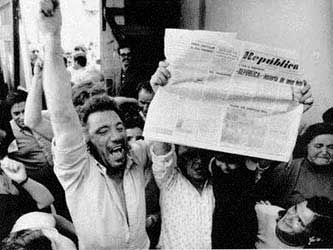
In the Portuguese revolution in 1974 a movement within the army overthrew the dictatorship and between May and October of that year 4,000 workers’ commissions were established following mass meetings.  Not only factories but empty houses and apartments were occupied.

Within these commissions political competition developed between the Portuguese Communist Party and smaller revolutionary currents.  A failed right wing coup shifted events further to the Left.  Workers councils became not just organs of control in the workplace but organisations of struggle that could potentially threaten the power of the capitalist state.

In the end however they proved too weak and were unable to pose a political alternative to the quickly developing normal organisations of capitalist democracy – trade unions, political parties, parliament and the state.  In the end the Portuguese Socialist Party became the mechanism for a stabilisation of capitalist rule and bourgeois democracy.

Short-lived experiments in workers control and ownership were not in themselves capable of establishing hegemony for the project of workers’ state power.  A deeper and wider radicalisation was required.

The point is that this can take time and can only come about through the development of socialist consciousness in the working class over a more or less extended period and this must rest on a material base.  This can only be the development of the power of the workers in existing capitalist society, expressed in democratic trade unions, political parties, cultural organisations and workers cooperatives.

The opposite of this road is reliance on the state, expressed in the demand for nationalisation.  In Spain, Eastern Europe, Indonesia and Portugal it was the State which became the guarantor of capitalist ownership and power.

Today we are in circumstances where workers must not only defend themselves against the depredations of capitalism – battling against austerity – but socialists must also look to ways in which to advance a workers consciousness that seeks permanent expression of their needs and powers.  Not just defending immediate interests but looking and taking care of the future of the movement and workers’ position in society.

But it is not simply about the needs of the present as against the needs of the future because Marxism is the belief, confirmed by nearly two centuries of industrial capitalism, that it is not possible to satisfy the needs of workers today by only fighting today’s battles.  A socialist society is the future only because it is the answer to the challe-nges and problems of the present.  The demands for workers control and ownership express this view and are rejection of the clam that the existing capitalist state, by nationalisation etc, can provide the answer.

Workers’ control of production

rr06[1]In my review of the programme put forward by the left in Ireland, generally no different from other countries across Europe and further afield, I have argued that while it may be better for workers than the current austerity policies it is not socialist.  By this I mean that it does not involve a class alternative, an alternative to capitalism, one that involves ownership of the means of production moving to the working class.

Only in one area is this not the case: the Left’s occasional demand for workers’ control.  Even in these cases I have argued that the proposals are not put forward within any real practical perspective but put forward in such a way that they must assume a near revolutionary situation.  Demands for widespread workers’ control are only a practical proposition in such circumstances.

In current conditions demands for workers’ control simply demonstrate a lack of seriousness by those proposing them.  In the article by Trotsky previously quoted, he states that “before this highly responsible fighting slogan is raised, the situation must be read well and the ground prepared. We must begin from below, from the factory, from the workshop.”

This is to be done by revolutionaries gauging the moods of other workers – “to what extent they would be ready to accept the demand to abrogate business secrecy and to establish workers’ control of production. . . . Only in the course of this preparatory work, that is the degree of success, can (we) show at what moment the party can pass over from propaganda to further agitation and to direct practical action under the slogan of workers’ control.”

“It is a question in the first period of propaganda for the correct principled way of putting the question and at the same time of the study of the concrete conditions of the struggle for workers’ control.”

One small means of doing this recently was, when the banking crisis erupted, members of Socialist Democracy leafleted bank workers in Dublin asking them to let other workers know what was going on in the banks through leaking internal emails etc.  This small step abrogating business secrecy is a first step to workers’ control.  The poor response showed that the preparatory work described by Trotsky had yet to begin.

In this post I want to look at what is meant by workers’ control and how this is a result of the working class’s historical experience of this means of struggle.  The experience shows that it inevitably arises as a result of a crisis, and crises are by their nature temporary, occasioned by a society-wide political crisis or by the threatened closure of a particular factory that is producing unnecessary products, is working in an obsolete manner or is otherwise failing to compete successfully in the capitalist market.

How to institutionalise such control in periods of relative calm is a central problem we will look at in future. Relying on temporary crises to quickly provide workers with answers to the problems posed by their taking control has not resulted in success.  Revolutions of themselves do not give all the answers to the problems posed by revolution, at least not unless they are prepared for and prepared for well.  Since revolution is the task of workers themselves we are talking about how they can be prepared to take on the tasks of control.  Such preparation involves convincing at least some of them them that they should want to control or manage their own places of work as well as how they might be able to do so.  Only in this way can the superiority of worker owned and managed production be demonstrated.

The historical understanding of what workers’ control means derives mainly from the experience of the Russian revolution in 1917; the only successful workers led revolution.  Yet the goal of this revolution was initially a democratic republic, not a workers’ state, with the result that only a ‘transitional’ social and economic programme was on the agenda.  A decision to seize power by the Bolshevik Party could not change the level of economic and social development in itself.  We can see from an earlier post that this informed Lenin’s view that the immediate economic programme was one more akin to state capitalism than complete working class ownership and  power over the economy.

This is decisive in understanding the development of the revolution.  The workers could seize state power in order to stop the war, support distribution of land to the peasantry and attempt to put some organisation on production but workers could not by an act of will develop the Russian economy under  their own control and management, at least not outside of a successful international revolution, and this never came.

Workers’ control in such a situation did not, and at least initially could not, equate to complete management.  In Russian ‘kontrol’ means oversight; a “very timid and modest” socialism, as the left Menshevik Sukhanov put it.  The Bolsheviks understood that workers’ control was not socialism but a transitional measure towards it.  Capitalists would and did continue to manage their enterprises.  (The historian E H Carr reported that in some towns workers who had driven out their bosses were forced to seek their return.)

This approach was supported by the factory committees created by the workers during the revolution.  These committees initially hardly went beyond militant trade unionism but did not accept management prerogatives as inevitable and, as the bosses increasingly sabotaged production, they increased their interventions to take more radical measures of control.

The workers nevertheless saw the solution to their problems as soviet power and state regulation, evidence by their acceptance of a purely consultative voice in state-owned (as opposed to privately owned)enterprises.  This reflected the worker’s weakness, expressed by one shipyard worker on the eve of the October revolution at a factory committee conference: “often the factory committees turn out to be helpless . . . Only a reorganisation of state power can make it possible to develop our activity.”  Thus much of the activity of the factory committees was attempting to find fuel, raw materials and money simply to keep factories going and real management was sometimes consciously avoided.

Trade union leaders criticised the factory committees for only looking after the interests of their own plants and for not being independent of the capitalists who owned them. The workers in the committees were themselves keenly aware of being compromised by the capitalist owners, of being given responsibility without effective power.

While the revolution was supposed to have a transitional character in economic terms, workers were faced with greater and greater sabotage and recognised that the worsening crisis required a solution that could only come from the state, which would provide the centralised control that would combat economic dislocation. The weakness of the workers themselves can be quantified by the decline in their number.  In 1917 the industrial workforce in Petrograd was 406,312 but fell to 339,641 by the start of 1918 and only 143,915 by May of that year.

Although more active forms of workers’ control were sanctioned after the revolution, it had been increasing anyway, the steps towards the central state regulation that had been championed were constrained by the lack of an “organised technical apparatus, corresponding to the interests of the proletariat”, as the resolution unanimously adopted by the January 1918 Factory Committee conference put it.  Nevertheless the conference called for the immediate nationalisation of factories in a good physical and financial situation.

The economic situation however was desperate as the new state faced immediate armed attack.  The Factory Committee conference noted that: “Every one of us knows that our industrial life is coming to a standstill and that the moment is fast approaching when it will die.  We are now living through its death spasms.  Here the question of control is no longer relevant. You can control only when you have something to control.”

Widespread nationalisation was introduced but it was viewed as a necessity compelled by circumstances, not a positive choice and not one driven by socialist ideology.  Alongside this nationalisation was increasing centralisation of economic decision making, which was imposed on the factories.

But of course if the workers were unable to run the factories how could they run the state?  Complaining that the factory committees were ignoring everything but their own local interests and themselves disorganising production one section of the state’s economic organisation stated that reorganisation would not happen “without a struggle of the worker’s government against the workers’ organisations.”

All these quotes are taken from the article by David Mandel in the collection of articles on workers’ control in the book ‘Ours to Master and to Own: Workers control from the Commune to the Present.’  In this he states that the contradiction between planning and workers self-management can be resolved if there are conditions allowing for significant limitations on central control and these conditions also provide workers with security and a decent standard of living.  Both, he says, were absent in Russia.  More important for the argument here is his view that there must be a working class capable of defending self-management.

This too did not exist in Russia and our very brief review shows this.  The Bolsheviks were acutely aware of the low cultural development of Russian workers, evidenced through their lack of education, high levels of illiteracy, lack of technical skills and lack of experience in the tasks of economic administration and management.  That their numbers declined dramatically, not least because of the demands of the Red Army, leaves no grounds for surprise that this experiment in workers’ control did not prove successful.

The limited character of the initial steps in control and the awareness workers had of their lack of skills were revealed in their calls for the state to reorganise production.  While certain centralised controls over the economy are a necessity, and this is doubly so in order to destroy the power of the ruling classes, the socialist revolution is not about workers looking to any separate body of people to complete tasks that it must carry out.

If workers could not control production they could not be expected to control state power.  This was to turn out to be the experience of the revolution and in its destruction by Stalinism the state turned into the ideal personification of socialism.

This identification of socialism with the state in the minds of millions of workers across the world continues, a product of Stalinism and of social democracy but gleefully seized on by the right.  Since the state is organised on a national basis this also entailed socialism’s corruption by nationalism.

The path required to developing and deepening a genuine workers’ revolution lay not in seeking salvation in the state but in workers creation of this state themselves out of their own activity in the factory committees and soviets.  The coordination, centralisation and extension of the functions of these bodies would ideally have been the means to build a new state power that could destroy and replace the old.  It would also have been the organisation that would have combatted economic dislocation and provided the means for cooperative planning of production and trade with the independent peasantry.

In this sense the Russian revolution is not a model for today.  While workers control came to the fore in this revolution its limitations must be recognised and a way looked to that would overcome them in future.

It might be argued that the backward cultural level of the Russian working class, while acknowledging its high class consciousness, is not a problem today.  After all the working class in Ireland, Britain and further afield is literate, educated and with a large number educated to third level education.  The working class is the vast majority of society, which it was not in Russia in 1917.  Many workers are now highly skilled albeit specialised.  This however is a one sided way of looking at things. 

Firstly on the technical side the very specialisation that makes some workers skilled reflects an increased division of labour that in so far as it is deep, widespread and reflected also in a division of social roles militates against the widespread accumulation of the skills and experience of management and control.

Many workers reflect their specialisation in a narrowing of outlook but illustrates that the increased division of labour is foremost a question of political class consciousness which is at least in part a reflection of social and economic stratification of the class.  Thus some workers see themselves as professionals – engineers, accountants, managers etc. and regard themselves as middle class.  Just like white collar workers and state civil servants in the Russian revolution they do not identify themselves as workers with separate political interests along with other workers slightly below them in the social hierarchy.  They do not identify with socialism.

Modern society in this way reflects early twentieth century Russia: the working class does not rule society, even at the behest of the capitalist class, but there are numerous social layers (the middle classes) who help the capitalist class to do so, and they imbue into themselves and others the political outlook of their masters.

Because the division of labour is increasingly an international phenomenon the road of revolution at initially the national level poses even bigger problems for workers management of production than existed in Russia in 1917.  Especially in Ireland production is often a minor part of an internationally dispersed process so that control of the whole is exercised elsewhere.  How then do workers take control of such production in any one country especially one lower down the value chain?

For these reasons revolution needs to be prepared.  It needs prepared in the sense that workers must be won to a fully conscious commitment to their becoming the ruling class of society; a rule based on their ownership and management of the forces of production.  In order to achieve this, the force of example rather than simply the power of argument is necessary.  In other words workers must have seen and experienced ownership and management.  This can provide many with the experience and knowledge necessary to lead the whole class to own and manage the whole economy when such control is the basis for their own state power, after capitalist state power has been destroyed.

The best, in fact only way, to prepare for socialism is through practice, practice in asserting the interests of the working class as the potential new dominant class of society.  Demands for nationalisation are demands that someone else, the state – because the state is a group of people – create the good society.  And when anyone is asked to create the good society it is always what is good for them.

Such dominance is more than simple resistance to the exploitation of the old society but must in some way herald the new.  Opposition to austerity for example can only ameliorate the effects of capitalism and does not provide panaceas – not even ‘taxing the rich.’  The real importance of fighting austerity therefore lies in the building of the organisation and class consciousness of the working class. This is what Marx meant when he wrote in ‘The Communist Manifesto that:

“the Communists fight for the attainment of the immediate aims, for the enforcement of the momentary interests of the working class; but in the movement of the present, they also represent and take care of the future of that movement.”  The future is that in its “support (for) every revolutionary movement against the existing social and political order of things” communists “in all these movements, (they) bring to the front, as the leading question in each, the property question, no matter what its degree of development at the time.”

This then is the importance of workers’ control and workers ownership.  It is the question of the future of the movement of the working class because it brings to the fore “the property question.” 

I shall look at it some more in future posts.

Workers say NO to Croke Park 2

5178_54_news_hub_5200_328x250Commentators across Europe, indeed the world, have marvelled at the ability of the Irish to suffer punishing austerity without strikes, riots and political convulsions.  Local commentators have basked in their acclaim as the austerity poster-boy – in damning comparison to those Greeks and other southern Europeans.  Instead the Irish voted for a European austerity Treaty and voted in a Fine Gael-led coalition with politics no different from the previous Fianna Fail led one.   If opinion polls are to be believed, many have gone back to supporting the utterly discredited Fianna Fail.  The recent Meath by-election saw the Fine Gael candidate handsomely returned and the particular local circumstances do not adequately explain it.

Irish workers accepted the tearing up of the existing social partnership deal and voted for a new one called Croke Park, which inflicted cuts in services and conditions, including yellow pack terms and conditions for younger workers, in return for no compulsory redundancies.

Unemployment however has soared, reaching over 14 per cent officially and, according to the IMF, over 23 per cent if the underemployed are included.  This is despite emigration of tens of thousands of the younger generation to destinations across the world.

Yet still the ‘fighting Irish’ showed no signs of fighting.

Until now.

This is the significance of the vote on a new Croke Park deal.  Irish workers have said NO.

If it has been a surprise to many on our side it has been a shock to the Government who thought their threats, bullying and intimidation would work.  Above all they thought the rotten leadership of the Irish trade union movement, which supported the new deal, would pull it through.

Its mouthpieces in the media reacted with denial.  The ‘Irish Times’ journalist said “it was so close”, “if 1,000 members of SIPTU had voted the other way, or if more of its members had been minded to come out and vote – there was an extraordinarily low turnout of 45 per cent – the deal would have sufficient support to be ratified.”

There is a grain of truth in this but we will come back to this.  Let us first note that the press and media betray once again their class character by agonising about how the democratic wishes of the workers can be subverted by ‘tweaking’ the deal to get it through.  You will search in vain for commentary deliberating over how the workers’ majority can assert and validate their democratic decision.

The deal has been rejected but the vote is a mere inconvenience.  It doesn’t count.  The workers can say anything they want and will be listened to, but only if they agree.  Like European referendums voting is to allow worker s to approve the plans of the capitalist class and its state.  Again and again Irish workers are taught this lesson – voting is not a choice, it’s a stamp made of rubber.

Instead we are fed rubbish that a vote that saw the deal decisively rejected by a majority of two to one, 115,000 to 55,000, could somehow have been passed “if 1,000 members of SIPTU had voted the other way, or if more of its members had been minded to come out and vote.”  The votes of those who didn’t vote are ‘virtually’ counted to support austerity while in fact the vote against will have awakened the many workers who didn’t vote to the possibility of voting against the Government, the State, the mass media and their own rotten leaderships.

But even these propagandists of the system couldn’t help but recognise that many workers voted no, not because they were personally affected very badly by the deal, but because they didn’t think they should vote for other workers to take a pay cut.

The grain of truth – that the result could have been very different – is a reflection of the bureaucratic nature of the trade union movement, where a majority of 60,000 might be reversed by 1,000 voting differently in the biggest union.  This is only one illustration of what is now the biggest question that is to be answered, which is not the one asked in the media – of what will the Government do?  The real question is – what will, or can, the workers do about their leaders who recommended and argued for and censored the opposition to this rotten deal?

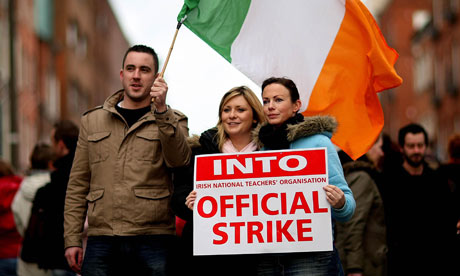
The problem is neatly encapsulated by a report on the Irish National Teachers Organisation Conference at which delegates wanted to put an emergency motion calling on the leadership to have a strategy in place if there was a No vote.  This was ruled out of order but a weaker one was allowed.  Only when delegates booted this out was a compromise motion passed that called “on the central executive committee to urgently liaise with the executives of other public service unions with a view to promoting and planning a public service solidarity alliance of trade unions across the public service.”

What this episode reveals all too obviously is the restrictions placed on workers by union bureaucracy and this bureaucracy’s intention of relying on the Government to ‘tweak’ the deal so it can be imposed on the membership.  It shows the awareness of trade unionists that a strategy is required and one that seeks the maximum unity.  The obvious weakness involves relying on the same union bureaucrats to provide this strategy and implement it.

Putting together a convincing strategy will not be easy but the vote itself is a massive step forward, as is the appreciation of the need for a strategy and for this to be based on unity within the union movement.

Very early on in the current crisis the then Government relatively easily divided workers through claiming those working in the public and private sectors had separate and opposing interests.  The union leaders seemed only too happy to walk into this trap.  Their willingness to sacrifice services for short-term and increasingly illusory benefits for public sector workers has failed even these workers as their pay has been slashed and the deal they signed up to was torn up with union consent.  Meanwhile the workers who use these services have had some confirmation that the quality of these services may suffer to defend the conditions of those who deliver them.

The initial reaction against this disastrous approach was recourse to an even more divisive one, with the creation of a Frontline Alliance that saw narrow trade unionism prioritise the interests of some workers who are on the frontline of some services, implying a common interest not shared across all workers.  However I’ve yet to meet a frontline service that could operate without the support of rearguard(?) workers.

Even this signalled not some reduced form of trade union unity but the plaintive cries of the ‘special case’.  I remember listening to an interview some months back on ‘The Last Word’ on Today FM with a group of union leaders from this Alliance.  What was most striking was that when they were interviewed one-by-one there was hardly the slightest hint of a common grievance.  They seemed totally ignorant of how narrow their complaints seemed and how stupid a strategy is which is based on claiming special treatment when such an all-engulfing attack is being meted out.

There are other courses of action and what might seem like alternative courses for workers looking to fight back are in fact the same struggle.

The view that it is impossible to get the union movement to fight back without first kicking out its rotten leadership replaces a task on which workers have just voted – rejection of Croke Park 2 – with one they have not had placed clearly before them, debated and decided upon.  There is limited traction in simply claiming ‘betrayal’ and saying these leaders must be replaced now before a real struggle to give effect to the No vote can be realised.

The entirely justified and valid view that the current union leaders must be replaced can be achieved by demonstrating to the majority of members the practical effects of these leaders supporting attacks on their interests while frustrating any resistance.  In the course of mounting this resistance the task of replacing these leaders can be posed but not as a precondition or prior requirement for such resistance.

The related questions of whether workers should demand that their leaders hammer out a united strategy or should unite at rank and file level to achieve this themselves are also not opposed.  While rank and file workers must unite across unions to create their own structures this can only be in addition to the established ones. In this way they might demand that their separate leaderships take action and also advance towards an end-point where, if they do not, workers are in a position to pose this task practically themselves.

In doing so workers might learn that replacing the current leaders is not enough and that what is really required is an entirely rejuvenated trade union movement.  One that is open, democratic and not in thrall to either bureaucratic leaders or bureaucratic structures and rules.  A big step forward has been taken with the No vote and the Government is faced with the threat of resistance.

As this post is finished it is reported that the Government does indeed intend to ‘tweak’ the deal in what is called a “carrot and stick approach”.   Since it still intends to make the same amount of cuts what won’t change are the pain and divisiveness of the tweaked deal and the threats that will accompany it.  Like donkeys workers are expected to look at a carrot paraded in front of them while what they feel is the stick.

What is Anti-capitalism?

electronblueOver the last two decades the left has attempted to respond to the heavy defeats of the working class by breaking out of its isolation and creating, or rather supporting the creation of, broad left parties.  Similarly sections of society, especially youth, have responded to the obvious unfairness of global capitalism by involving themselves in protests and movements against globalisation.  Both of these moves have to one degree or other come under the label of anti-capitalism.  It has never been very clear what this anti-capitalism consists of.

The left groups have more often than not attempted to create these broad, anti-capitalist parties themselves rather than insert themselves into genuine broad movements.  The anti-globalisation movement has also by and large been separated from working class struggle due to the latter’s decline.  In the absence of such struggle speculative attempts to create broad parties can have only limited success but this does not account for complete failure.

In Ireland we have just witnessed the failure of the United Left Alliance, which follows on the failure of previous initiatives such as the Socialist Alliance.  This comes as similar initiatives in Britain such as its Socialist Alliance, Scottish Socialist Party and RESPECT have also ended in failure.

To a greater or lesser extent these projects have been based on the idea that there exists a vacuum on the left through the rightward trajectory of social democratic parties which the left organisations can fill.  There has been no pause for thought that this movement to the right is a result not of some pathology to betray traditional social democratic politics but results from the assault of right wing forces, consequent defeat of workers and an undermining of the basis for social democratic answers.

Much weaker forces from the left trying to occupy this ‘space’ with not dissimilar policies, in the absence of any change to any of these larger factors, could only expect to face a similar evacuation of this ‘space’ – usually through collapse.

The invention of the term anti-capitalism that is supposed to sit outside the traditional reformist/revolutionary dichotomy has been the programmatic basis for these initiatives although these take various guises.  In this blog I have critiqued the anti-capitalist programme of the left organisations in Ireland as they have grouped themselves around the United Left Alliance.  This criticism has examined their programme of debt default, their budget proposals, taxing the rich, state investment and nationalisation.

This programme can nevertheless be called anti-capitalist because no pro-capitalist force currently comes anywhere near supporting it.  No party supports high taxation of the rich, defaulting on debt or much increased state spending to lower unemployment.  The capitalist class would bitterly oppose implementation of these measures, which would be better for the working class than current austerity policies.

None of these considerations however make this a working class programme.  Capitalist states have defaulted on their debt before – many times; taxation of high incomes was well over 90 per cent in the post-war United States during the cold war; deficit spending by the state has been an automatic result of the current crisis and nationalisation has been a response across the world to the current crisis.  In Britain and the US parts of the financial system were effectively nationalised and in Ireland almost all the banks were nationalised.

The anti-capitalist policies proposed differ only in degree to those imposed by capitalism many times before.  Above all this programme is not a working class one because it does not provide an alternative to capitalism in the sense that working class power is built and strengthened and the germs of alternative relations of production are created.

The social democratic programme was evacuated because it was not seen as the best option for capitalism.  If the capitalist class or its representatives change their minds about this they will get their own parties, including social democratic ones, to implement it.

The anti-capitalist content of this programme is twofold.  First it may target particular sections of the capitalist class or its representatives but only to benefit others.  Thus debt default will impose losses on sectors of financial capitalism that may benefit industrial/producer sectors.  High taxation will hit the highest paid mangers of capitalist enterprises such as bank CEOs, so depressing their salaries, which may be to the benefit of capitalist owners as shareholders.  Deficit spending on infrastructure will obviously directly benefit capitalist construction companies while putting pressure on lending to other capitalists.  Nationalisation of banks has been a means of protecting capitalist investors, not of expropriating them, but it also maintains the integrity of other capitalist’s liabilities.

The second way this programme is anti-capitalist we have explained – the capitalists oppose it.  The anti-capitalism of the programme is very like the anti-imperialism of Irish republicanism in the 1970s and 1980s.  It was heartfelt and genuine in a subjective sense and involved enormous sacrifice.  In an objective sense it was unrealisable by the methods adopted – armed struggle by republicans and electoralism by the left, which means that eventually the means change or the objective is abandoned.  In the case of republicans it was both.

In both cases neither programme opposed or presented an alternative to the class interests that they fought against.  In the case of republicans they never had a programme that opposed and had an alternative to the British and Irish capitalist classes who defended partition.  In the case of the left even implementation of their programme would not end the capitalist system or threaten the power of the capitalist state.  In fact most of its programme involves strengthening the capitalist state.

As I posted before: in one aspect of their programme these weaknesses might be seen to have been mitigated if not overcome.  The demand for workers’ control of enterprises taken over by the state might seem to present a means to increase working class power while encapsulating the potential of an alternative, new society.

Unfortunately the demand for workers control is proposed as part of the demand for nationalisation as if the capitalist state is in some way a facilitator for the creation of working class power.  The Marxist analysis of the state is that when the capitalist class is threatened by working class action it is the state which is strong enough to defend capitalist interests.  State ownership is not therefore a route to workers’ control.  No aspects of the many forms of state organisation involve workers’ control of any aspect of its bureaucracy.

In capitalist society ownership entitles control and capitalist ownership entails capitalist control.  State ownership entails state control.  Only in times of extreme crisis is the possibility of workers’ control raised and it is raised only when it is imposed by the workers themselves.  If they are in a position to do so, and to make it work, the demand should also be for workers ownership.

Above all the demand for workers’ control must be posed as a practical demand because it is necessary in order to achieve certain objectives.  In the past this has often involved keeping a workplace open when it is threatened by closure.  It does not normally arise in workers minds as an objective in itself.  Unfortunately this is how it is posed by the left – not as a burning necessity to achieve certain things which only the workers have an interest in accomplishing.  It is rarely posed as a practical measure needed to achieve particular objectives.

As I posted before in relation to the Transitional Programme, demands must be concrete and practical or they are simply tools of education (when not means of spreading confusion). Nothing wrong with this in itself, if that is where the struggle is at, but for the left the education given creates illusions in the state by demanding nationalisation as the key. The demand for nationalisation under workers’ control fits comfortably within a general programme that is reliant on state action for implementation.

More often lately the primary role assigned to state action is reflected by the left’s dropping of the rider to nationalisation since it plays no vital role.  Workers’ control in itself is not necessary to achieve any particular goal.  It is what Trotsky referred to as workers’ control “for platonic purposes.”

So we have the ULA before the last election demanding that “key wealth and resources must be taken into democratic public ownership.”  Another Left organisation demands taking “Ireland’s natural Resources into public ownership”.  Another states that “AIB, Bank of Ireland and other banks should be nationalised.  The banks should be amalgamated into one state bank.  The boards should be sacked.  A new board under the democratic control of working people should be established including elected representatives from the workplace and representatives elected from society as a whole.”

Another demands that “a publicly controlled banking system should be administered by elected representatives of the Irish people, representatives of employees of the banking industry, and trained financial experts employed on public sector pay scales.”

These proposals become blueprints, not demands that workers are to impose through their struggle to achieve certain practical needs.  Demands that workers exercise control coexist with formulations that are perfectly consistent with bog standard capitalist state nationalisation.  Demands for ‘public’ or ‘democratic’ control can be perfectly understood to mean the existing forms of state ownership.

On the other hand claims that workers’ control, when it is part of the Left’s propaganda, really means what Marxists have traditionally meant by it would be hard to accept.  Calls for widespread workers’ control were characterised thus by Trotsky in 1931:

“Thus the regime of workers’ control, a provisional transitional regime by its very essence, can correspond only to the period of the convulsing of the bourgeois state, the proletarian offensive, and the failing back of the bourgeoisie, that is, to the period of the proletarian revolution in the fullest sense of the word.” It hardly needs saying that we are nowhere near such a situation today, not in Ireland or anywhere else.

Instead today’s routine demands for workers’ control, when they are made – instead of mealy-mouthed formulations about ‘democratic public ownership’- are closer to this description of it, again by Trotsky, in the same article:

“If the participation of the workers in the management of production is to be lasting, stable, “normal,” it must rest upon class collaboration, and not upon class struggle. Such a class collaboration can be realised only through the upper strata of the trade unions and the capitalist associations. There have been not a few such experiments: in Germany (“economic democracy”), in Britain (“Mondism”), etc. Yet, in all these instances, it was not a case of workers’ control over capital, but of the subserviency of the labour bureaucracy to capital. Such subserviency, as experience shows, can last for a long time: depending on the patience of the proletariat.”

We shall examine further the historical experience of workers’ control in a further post.

Thoughts on the Class Struggle in Greece (Part 1)

For many in Ireland the situation in Greece is one from which we can learn many lessons.  The United Left Alliance has just advertised a public meeting in Dublin with a speaker from the Greek left organisation Syriza.  A couple of months ago a debate on the Greek class struggle, on Syriza and the attitude of Marxists to this organisation was published here and here.  In this post I want to address some of the questions that have been raised on these issues.  I am not by any means an expert on Greece and the judgements I am making can only be tentative but I believe that the debate has illuminated the situation sufficiently to make some remarks.

Syriza is not a Marxist Party and is not committed to the revolutionary overthrow of capitalism.  It is not even a working class party with deep roots in the class or its organisations.  In fact the Greek participants in this debate have noted its mediocre rise in membership and its being mainly a reflection of a collective mood of opposition to the two traditional parties, the social democratic PASOK and conservative New Democracy.   The writers also observe its rightward trajectory.  Its economic policy is essentially Keynesian (a capitalist system but reduced austerity at least initially) and its main plank is debt reduction from the European Union, European Central Bank and International Monetary Fund – the Troika.  It supports fiscal consolidation (cuts and tax increases), as it must if the debt is not to grow larger again after some debt forgiveness, but says this must be “socially just and viable.”

It has grown rapidly in support and increased its vote in the most recent election to 26.9% from 16.8%.  In a situation of extreme hardship it is not unreasonable for workers to look for some respite and this is what Syriza offers.  The Greek Marxists also argue that the capitalist class in Greece and the Troika might at some point see Syriza as a mechanism to impose a new austerity in place of the current one, widely considered illegitimate.  In this situation, the leadership of the opposition to austerity, having no fundamental antagonism to the system, would agree to impose reduced austerity in return for support for the legitimacy of this austerity, putting the brakes on opposition and support for the continuation of Greek membership of the Euro.

The articles by the Greek Marxists are written by participants in Antarsya, which scored only 0.33% in the most recent elections, down 0.9%. They correctly emphasise the need to work with supporters of Syriza in order to win them to their politics and to defend the working class as a whole from the danger of fascism.  The difference between them and the supporter of Socialist Resistance in the debate is the insistence by the latter that their united front approach falls significantly short of what is required.  It is criticised for not being applied to the demand for governmental power, which crown the demands of Marxists and which frame the critical task of political power without which the crisis cannot be decisively solved in favour of workers.

Both sides appear to agree that there exists real revolutionary potential in the existing situation, although the Greek writers provide evidence that this is not in fact the case and we will look at this in a second post. The question of a governmental slogan in such a pre-revolutionary situation, if it exists, is therefore crucial.  If the left does not provide for such a political solution the right will. Socialist Resistance is right in my view if, and it’s a big if, there really is a pre-revolutionary situation but even if there is not the question still needs an answer. Do the Greek Marxists have one?

The argument of Socialist Resistance is that the partial solutions of Syriza, where they elected into government, would profoundly challenge the logic of capitalism and create a pre-revolutionary crisis.  Their electoral victory “would be a massive advance for the Greek working class” upon which Marxists would build with a revolutionary strategy, eventually to a “revolutionary outcome favourable to the working class.” It is acknowledged that Syriza may betray its programme but if this is so it may be that the working class has to go through this experience.

This is a formula with an alibi for when it doesn’t work. The Greek Marxists’ writings demonstrate a more concrete understanding of the problem. The first is that a government of Syriza may include nominally ‘left’ parties which drag the whole arrangement to the right. But worse, while the Greek working class invest their hopes in Syriza the latter and its electoral successes are not seen as a branch of its own struggle. If it is not a branch of the workers struggle, an organic part of it and not just an electoral reflection of it, then the tactic of the united front employed by Marxists in terms of supporting a Syriza Government will be much less productive.

Above all the Greek Marxists point to the real possibility that Syriza will actually keep to its programme and not actually betray it, which would mean continuing with austerity, betraying the Left in the eyes of the population and preparing the way for the fascists of Golden Dawn who may unfortunately not betray their programme.  In fact of course the programme of Syriza, negotiated debt reduction, is not within its gift, but requires the agreement and actions of the Troika.

The Greek Marxists point out that revolutionaries can delude themselves on the influence they can have on larger reformist bodies by supporting them in elections. Of course the point of such support is not so much to sway the organisation as to influence its members. Through supporting its campaign one can win the respect of Syriza’s supporters, showing your agreement that the debt burden should be reduced and austerity resisted, while explaining that Syriza does not go far enough and will not go far enough.  If or when this is proved to be the caes these supporters might acknowledge the correctness of Antarsya and be won to their perspectives.  Of course supporting an organisation in an election means taking a certain responsibility for that organisation and what it is standing for and this definitely should not be done by pretending its programme is more than it actually is.

There may also be the issue that this writer has come across often. Small organisations say they are adopting a united front approach and declare support for a much larger reformist party in an election but don’t actually support it in any way that anyone could recognise. The support is often a purely verbal statement of position but does not involve actual campaigning. It must also be recognised that the latter activity can take a long time to have an effect through establishing the seriousness and credibility of the support that is given. The applicability of these latter remarks to the Greek situation is one for Greek Marxist to determine.

On the other hand the Socialist Resistance article admits ignorance of the most recent developments in Syriza’s political practice and programme including setting to the side the unity of Greek workers with immigrant workers, which is understandable given that Socialist Resistance is British, but the article goes on to blithely assert that “Syriza has withstood the bourgeois onslaught without bending.”

Both are grappling with the simple fact that the balance of forces does not yet admit of a working class solution and that this becomes evident when it comes to framing a governmental slogan. The writer from Socialist Resistance covers this up by prettifying Syriza as in some way representing an (impaired) working class programme when this is not the case. The Greeks on the other hand, perfectly aware of the severe limits of Syriza as an alternative and the real role they play in the workers movement and struggle are forced into downplaying the importance of the governmental slogan and present the question in a way that allows the Socialist Resistance article to describe it as abstract, which it appears to me to be the case.

Being in the midst of the action it is my view that the Greek Marxists more accurately describe the real class struggle in their country and the political character of Syriza. If their proposals for a governmental solution to the crisis, which acts as the proxy for the question of which class will impose a solution, is abstract this simply reflects the fact that the working class is not unfortunately currently in a position to put forward its own solution. This is primarily because the Greek working class does not support a solution in which it rules as a class and capitalism and its state are removed in the process. If a significant section of the Greek working class did believe this organisations like Antarsya would not be getting less than half of one per cent of the vote. It is to this fundamental problem that we will turn to in the next post.