The 2011 census results in Northern Ireland

NorthernIrelandCouncils-religion2008 

The results from the 2011 Northern Ireland census have been eagerly anticipated because the Northern Ireland state was created, and continues to be justified, by a sectarian head count.  Had partition not been imposed on the island of Ireland either through the independence of the whole island or through continued British rule the census would be interesting but would not in itself raise the question of the state’s existence or legitimacy.  That the census raises both and by virtue of the religious affiliation of the people who live in it is in itself a condemnation of the Northern state.

The census revealed that the Protestant population has declined to 48% in 2011 from 53% in 2001 while that of the Catholic has increased to 45% from 44%.  In order to arrive at these figures the 17% who said they had no religion, or the religion was not stated, were asked what religion they were brought up in.  A sort of ‘you can run but you cannot hide’ from religion no matter how much you might want to.  This is similar to employment monitoring which asked not what your religion is but what community you are perceived to belong to. The latter leads to mistakes if you happen to read ‘The Irish News’ in your lunch break and show a partiality to Glasgow Celtic when discussing football in the office but have never ever been to your first holy communion.

In the latest census 5.6% say they neither belong to nor have been brought up in any religion, up from 3% who said they belonged to neither religious category in 2001.  The census of course is silent on whether anyone brought up in any religion, or who professes to be a member, has complete faith in that religion’s doctrines, respects its institutions and cadres, accepts and identifies with any of its associated cultural practices (like going to mass) or follows its leadership in any way.  So even on this the census raises more questions than it answers.

The question that an answer is sought for most is the political views of the population, which has always been strongly linked to religious affiliation.  The same problems arise in making any firm assessment of what this information means.  First political views are read across from identification of nationality rather as if the latter determined the former in some over-riding way.  However one can identify oneself as British and be appalled at the way sectarianism seeps from every pore of society and one can define oneself as Irish and still reject all the isms that supposedly accompany it such as Catholicism and nationalism.  The full range of political positions in between are absent from the census as is beliefs on how ones political views are to be put into action.

The census is full of boxes and people, even in Northern Ireland, do not fit into them, or if they do they often do not do so neatly.  The census itself is a means of forcing them to do so but because they don’t debate is now raging over what the figures mean.

So 40% said they had a British only national identity, 25% an Irish only identity and 21% a Northern Irish only identity.  It was possible for example to tick two boxes and say you were both British and Northern Irish, which was ticked by 6.2%; 5% were none of these nationalities.

It is the combination of the religion and nationality results that has raised most debate.  Are those that say they are Northern Irish mainly pointing to the fact that they are Irish but from the North, or simply as a matter of fact citizens of the Northern State, or are they saying that they recognise a separate Northern Ireland nationality that  may or may not thereby warrant a separate state?

Commentators have noted that a large section of the population that are Catholic have not identified themselves as Irish but probably as Northern Irish and some no doubt as British.  This information will be released later.  From this it might be judged that even if they are culturally Irish (whatever that means) they are either happy with British jurisdiction or might be, given certain conditions.  In any case they might not, if asked to in a referendum, vote for a united Ireland.  They are what has been described by First Minister Peter Robinson as Catholics who support the union and who the Democratic Unionist Party could canvass for support. Many in this group however currently vote for nationalist parties – either Sinn Fein or the SDLP.

This however shows only the limitations of deriving conclusions from figures in a census.  Robinson has made reference to a majority of Catholics who support the union.  He has also prominently supported loyalist bands parading past a Catholic Church at which one band had previously stopped and marched round in circles playing a sectarian song.  He also called onto the streets the loyalist mobs that have protested against the reduced flying of the union flag over Belfast City Hall.  This has resulted in violent demonstrations, attacks – particularly on the Alliance Party – and death threats.  Loyalist mobs have repeatedly blocked roads or carried out violent attacks.  They have wandered round Belfast City Hall with union flags singing sectarian songs associated with old and new Glasgow Rangers football club supporters and burning Irish tricolours.

The unionists have done this on the basis that the union flag is their flag, a symbol of unionist and Protestant identity.  The Catholics whom Robinson supposedly seeks support from are therefore being told to accept that the trappings of state are those of a different religion and alien political tradition.  The party traditionally associated with the pretence to a non-sectarian union with Britain is the Alliance Party which the DUP and loyalists have made a main target of their attacks.  So much for a non-sectarian Northern Ireland.

This week has also witnessed another report on the murder of solicitor Pat Finucane which revealed massive collusion between loyalist paramilitaries and the state.  The report, despite it being inadequate, has yet again revealed the widespread use by the British State of the most extreme sectarian bigots to kill anyone who gets in its way.

The report revealed that the forces of the British State in the shape of the army, police, security service and top level officials were all instrumental in murder.  The prominent Home office junior minister Douglass Hogg set the scent by declaring, after briefing by the police, that certain lawyers were unduly sympathetic to the IRA and legions of later government ministers and politicians did their bit by strenuously denying claims of collusion.  The report is unable to say how high up collusion went but is nevertheless sure that there was no overarching conspiracy.  The Finucane family have pointed out that those most damned are dead as are the organisations most criticised.  We are expected to believe that all this is in the past.

Unfortunately state collusion with loyalism never ended.  The treatment of widespread loyalist protest over the past week or so has revealed yet again the partial attitude of the police to loyalist illegality and violence.  The new police force declare that there is no evidence of the loyalist paramilitary leadership being involved while it is impossible to deny that the protests have been organised by these same organisations. The distinction between leadership and organisations is introduced to protect the leadership.

So we have the unionist movement claiming that the symbols of the British State are Protestant and another exposure of how this state has worked hand in glove with the most extreme bigots to kill those entirely engaged in lawful activity.  In the past week the widespread but relatively small protests have been allowed to cause considerable disruption where, had it been republican protest, it is almost certain they would have been suppressed.

In other words the State to which Catholics are more and more assumed to owe some loyalty to and to identify with has been found, both through its most fervent supporters and its officially authorised defenders, to be guilty of the most rabid bigotry and violence.  Therefore even if the former is true, and more Catholics are prepared to accept it, political developments may be such that is doesn’t matter what some people believe to be the case, it is what is actually the case that will matter.  In politics as in everything else people are free to believe what they want but they are not free to make what they want actually be the case.

While the census results cannot be read simply to determine and predict political developments, and they cannot even be confident in population projections, the figures revealed have their own political impact.

For a state set up on the basis of a sectarian head count that head count is important.  The publication of figures showing the Protestant population is no longer an absolute majority and the gap between them and the Catholic population is narrowing is a blow to unionist claims.

When the Northern state was set up Ulster Unionists had the opportunity to justify the Ulster part of their self-description by pushing for the inclusion of all 9 counties of the province within British jurisdiction.  They did not because they wanted their hold to be secure and it needed a sizeable Protestant majority because the support of the minority was not to be expected.  Now that the religious populations are so near in size it does not make sense to fight to make the state an expression of a sectarian identity if the purpose is to defend the union.  It does however make sense if the purpose is to maintain sectarian power and division.  It then makes perfect sense that even the slightest hint that within the Protestant community this sectarian solidarity is not primary should be squashed – hence the attacks on the Alliance Party.

On the other hand the census does not support a perspective based on a Catholic majority voting a united Ireland, at least not for a long time.  The previous census results appeared amidst widespread speculation of a large increase in the Catholic population, an increase that didn’t materialise.  This latest census has recorded only a small increase, albeit that Catholics are a majority in the youngest age groups.  Even in purely demographic terms this does not mean an inevitable Catholic majority and in political terms the significantly lower proportion defining themselves as Irish hardly gives confidence that even a future Catholic majority will simply demand a united Ireland.  This is especially so given that the Ireland that they might be united with is such an unattractive political entity.

With these alternative programmes and the near equivalence of populations the prognosis can hardly be one of stability.  The need for some alternative is currently championed by the call for mutual respect and reconciliation but this is proving more than a little difficult.  How can two mutually exclusive, even antagonistic, claims show respect to each other never mind be reconciled?  The DUP and Sinn Fein have supposedly been working on an anti-sectarian policy for five years and there is no sign of it while it took the unionist parties five days to propose the union flag fly all-year round at Stormont.

This policy of reconciliation is actually accommodation of sectarianism not its eradication.  Instead of the sectarian politicians being the solution it is unionist politicians who kicked off the recent protests.  Reconciliation means Sinn Fein covering up for the worst of unionist aggression.  So after getting the flag down (some of the time) Sinn Fein then votes along with those who created the violent protest in a hypocritical Assembly motion condemning violence, thus implicitly absolving the DUP and Unionist Party of responsibility.  The flying of the union flag, as we pointed out here before on this question, is a means of intimidation.  The purpose of it flying at City Hall as on every other Government building is to sanction the many, many more union flags that fly all over the North which tell Catholics that this place is not theirs and tells Protestants that their place is anti-Catholic.

The possibility of such a situation being compatible with a shared Northern Ireland national identity, much trumpeted by the media in the wake of the census results, is remote.  The only identity that can be shared by Protestants and Catholics is one that expresses something that they have in common. What is it that they have in common that could possibly form the basis for such unity?
Support the ICTU demonstrations!

frame-1-ictu-protest-march-over-the-governments-four-year-austerity-plan-assembling-at-christchurch-in-dublin-irelandThe Irish Congress of Trade Unions is meeting on Wednesday to discuss the possibility of organising a series of demonstrations across the Irish State in opposition to austerity and debt.  It has issued a press statement outlining its reasons; in particular it is targeting the issue of debt and has indicated that demonstrations might take place in a number of towns and cities including Dublin, Cork, Galway, Sligo, Limerick and Waterford.

The possibility of these being organised should be welcomed but more important, if they take place, they should be supported.  It gives working people an opportunity to demonstrate their opposition to austerity, to demonstrate the scale and anger of their opposition and put forward what they think should be the alternative.

It gives the small socialist movement an opportunity to campaign in the working class to make these events as large as possible so that the demonstrations can convince and give confidence to others to also oppose austerity and oppose the crippling debt.  It gives it the opportunity to speak to workers to take action outside as well as inside the trade union movement and in the private sector as well as the public sector.  The purpose would be to begin reuniting workers who have been successfully divided into union and non-union and between public and private sector by the propaganda of the State, employers and media.

A real campaign at union and community group meetings, at workplaces and in the streets including door to door leafleting and canvassing should aim to mobilise as many as possible to turn out, should the demonstrations be called.  Right away attempts should be made to extend the numbers building the demonstrations through meetings organised to discuss the demonstrations and how they could be made as large as possible.

These meetings should not simply be organising meetings but should also discuss why we oppose austerity and the debt, how they are affecting the lives of working people, how we should organise against them and what our alternative should be.  What for example is our position on debt default?  What role does strike action have in a campaign against austerity and default?

There are many issues facing workers and socialists have the opportunity to give them the possibility of coming together beyond the existing union movement to unite and discuss all these issues.

In this blog I have addressed these questions here, here, here and here.

What have been called as one-off demonstrations should be supported in order to make them an on-going campaign both before and after they take place.

All this is primarily the task of the socialist movement but it is not limited to it.  There are many opposed to austerity and many campaigns against its effects that should take the opportunity to better organise and unite with each other to discuss what should be the alternative.

An additional onus is however placed on the socialist movement.  It claims to stand for the interests of the whole working class and has a special duty to take every step to unite it in defence of its own interests.  This has two aspects.  First it must unite itself to carry out the task of uniting workers.  Otherwise it is weaker and opens itself to charges of incompetence, hypocrisy or political sectarianism.  The second is to create a campaign which is open and democratic and which at the very least offers the possibility, if not yet the certainty, of uniting the most militant workers.

The unity of the socialist movement in such a task should in principle be easier since it has theoretically already achieved some level of unity through the United Left Alliance.  The ULA should immediately discuss how such an opportunity can be utilised to build an anti-austerity campaign, on what basis it should be built and what policies it should fight for.  This is, after all, something which the ULA said it was going to do when it got elected and it would not do to renege on promises, just like the Labour Party and all the other right wing parties, once elected to the Dail.

Complete agreement should be no barrier to taking this action.  A democratic campaign would in any case allow everyone to argue its particular view on the way forward and the alternative.  In a democratic campaign of action there would be no role for vetoes.

The objective on the day would be a united left contingent, united around an agreed programme and demands, offering an on-going campaign to everyone at the demonstration who didn’t just want to go home afterwards to watch themselves on the RTE news.  The size and resonance of such a contingent would testify to the potential to build real and lasting opposition to austerity.

There is of course a flip side.

To borrow from management-speak: for every opportunity there is a threat and for every potential strength a potential weakness.  To fail to take opportunities threatens the effectiveness of resistance to austerity and to fail to strengthen the resistance will result in weakening it.  The ULA through its minor electoral success has given itself some responsibilities which it should relish as opportunities to help workers build a movement against austerity.

Support, build and go way beyond the ICTU demonstrations!

Budget 2013 and the alternative

6122011-budget-2012-second-day-14-630x491The 2013 budget is going to introduce tax increases and spending cuts of €3.5 billion.  Michael Noonan smiled when holding up the budget document to the cameras while Brendan Howlin looked serious.  Nevertheless RTE reported that Labour TDs were pleased claiming that their fingerprints were all over it.  And so they are.  Their footprints, where they walked all over many vulnerable sectors of society, are also all over the budget.

There has essentially been only one defence of these austerity budgets and that is that the Government has had no choice.  No choice because there is no economic alternative and no choice because the State has lost its economic sovereignty and is basically doing what it is told to by the Troika of European Commission, European Central Bank and International Monetary Fund.

In this budget they have felt compelled to come up with a new defence – it is nearly over. This was trumpeted by Michael Noonan and also claimed by the Labour leader that “It is the budget that is going to get us to 85% of the adjustment that has to be made, and will therefore put the end in sight for these types of measures and these types of budgets”.

This hardly looks credible, which is not good news, because what it essentially means is that the austerity measures implemented have both been insufficient and haven’t worked.  The economy has contracted and stagnated even as the austerity measures have been insufficient to bridge the deficit.

For 2012, the deficit has turned out to be around €500 million larger than planned but because of upward revisions to data from earlier years, the deficit target, set as a percentage of GDP, will still be hit. This assistance in meeting the ‘target’ will not be available in 2013.

At the end of 2013 the deficit will be 7.5% of GDP.  In 2008 (excluding that related to the banking bail out) it was 7.3% rising to 11.5% in 2009. All the austerity budgets have achieved so far is a reduction of 4% – less than half way to eradicating the budget deficit never mind 85% of the way.  Even by 2017 the IMF forecasts the deficit will be 1.8% so the debt will still be getting bigger.

As with all these budgets there have been cuts to capital expenditure with another €500 million reduction targeted for 2013. In 2008, capital expenditure was close to €10 billion. In 2013, it will be under €3.5 billion. Public capital expenditure has been slashed by 66% which wipes out, and more, the so-called stimulus measures announced earlier in the government’s PR/con exercise that claimed to be promoting jobs.  This means the infrastructure of the state, economy and society will disintegrate more or less quickly.

The sheer madness of the austerity agenda is demonstrated by the fact that the €3.5 billion in cuts and tax increases will be wiped out before they are even implemented by the €3 billion payment of the promissory notes for the Anglo-Irish bank, which no longer exists, and repayments of €2.45 billion of bonds for Irish Life & Permanent. On top of this there is the rising interest cost of the debt, which will increase from €5.7bn in 2012 to €8.1 billion in 2012-13.

With the debt increasing, even at a reduced rate of increase, the burden of interest payments on it can only worsen.  This makes the debt unsustainable.  A rising interest burden will be a permanent anchor on growth.  This is a problem because the Government is relying on renewed economic growth to get out of the stagnation now in place.  The weakness of Irish capitalism means that it must rely on outside forces for this growth.  Either that or there is some debt relief to lower the amount of debt and the burden of interest payments.

In the meantime particular groups of the working class will suffer real hardship, living standards will decline or at best stagnate and unemployment will be limited only by continuing emigration.  The stresses imposed on society will be expressed in mounting social problems that will often be presented as a simple increase in personal misfortune while increased inequality will coarsen social relations and further weaken social solidarity.  The absence of any radical perspective will see reactionary prejudice become common currency.

Once again the United Left Alliance has put forward what it states is a socialist alternative.  In substance it is the same argument as that put forward last year but with more detail and some development here and there.  There is no need to repeat the analysis presented earlier in this blog including here, here and here.

The ULA is in no position to implement any of its proposals.  The purpose of the document must therefore be an educational one.  What it teaches is therefore the only useful criterion by which to judge it.

It starts out by claiming to be a socialist alternative and its headline is repudiation of the debt, an end to austerity and the need to invest in jobs and services.  All these are undoubtedly the immediate needs of the working class.  The problems start when we look to see how it is proposed these ends might be achieved.

The ULA “proposes to take the burden of the crisis off working people, improve their lives and revive the Irish economy.”  On the other hand it admits that “the budgetary proposals put forward by the ULA can in no way offer a comprehensive solution to the crisis we face.”  How the first claim is reconciled to the second is not explained.

While the debt crisis “resulted entirely from the actions of developers, bankers and the politicians who facilitated them” it is not explained how this can be reconciled to it being “a manifestation of a deep structural crisis of global capitalism.”  It is nowhere explained what this latter statement means, how it explains what has happened or how it explains what solutions are possible.  The Marxism to which the core elements of the ULA claim commitment is founded on claims to present just such answers but they are not here.

It might, with some justification, be claimed that the precise cause of the crisis is also a cause of some debate within Marxism.  Unfortunately any suggestion that a key task of the ULA might be to debate this out so as to inform the politics it espouses would be held up many as a fetish of sectarian or dogmatic individuals who aren’t interested in practically ‘building the movement’, or some other such boorish remark.  Instead while (dumbed down) Marxism is relegated to recruitment meetings for novices the vacuum that is the politics presented to workers is filled with Keynesian, that is capitalist, ideas that are the currency of liberals and the leaders of the trade unions.

Let us see some ways in which this is expressed in the ULA economic alternative.

First the ULA proposes to improve the lives of working people and revive the Irish economy but there are no socialist measures proposed that would achieve this.  Were the proposals to therefore fail (if by some miracle they were tried) it would discredit what passes itself as socialism while if they were to succeed they would go some way to making socialism irrelevant.

The ULA claims that “the alternative we propose will not be implemented by the current parties in the Dail or by the Irish state.”  Yet it proposes that the Irish State increases income tax on the rich, reduces taxation on workers, introduces a wealth tax, introduces a financial transactions tax, increases corporation tax, takes “full control of the banks”, supports small business, invests to create jobs, embarks on a programme of council house construction, creates a new construction company, renationalises all privatised strategic enterprises and establishes a state owned gas and oil company. It declares that “the ULA believes public enterprise and public works must play the central role to redevelop the economy on a sustainable basis.”

The ULA claims that “radical measures that break with the logic of ‘markets’ are required” but the demands on the state above do not do this while it is claimed these measures will “revive” and redevelop the economy on a sustainable basis.”

“There is a need for active struggles to demand policies that prioritise the need for jobs, public services and growth, using public investment and democratic socialist planning to chart a way out of the current crisis.”  What sort of struggles? For what policies? And who will we demand this of?  How would they deliver on it?  What, who and how?  Where and when don’t even arise given the vacuousness of this string of words.

In other words – as a vehicle for education – the alternative budget, when it is not mistaken, as we have explained in earlier posts, is simply incoherent.

What is clear is that the ULA has no strategic perspective.  It calls for socialist planning, but socialist planning is just another term for working class rule, for the working class controlling society.  Yet it proposes the state, the capitalist state, take action in the here and now to solve the crisis and develop the economy on a “sustainable basis”.

This lack of coherence reveals itself in timidity, contradiction and calls for solutions that have already been the means to subordinate and exploit the working class; as when the ULA calls for “full nationalisation with direct public control of the banks” when it is nationalisation and state control of the banks that has been the mechanism to burden workers with the debts of the speculators.

Even when it calls for “direct public control of the banks” this can as easily be defined as the current arrangements as it might by workers control.  So how does such a demand clarify anything?  How does it educate anyone on what they should fight for?

The ULA is currently undergoing an organisational crisis but its real problems are political.  It argues an alternative that is simply not based on the actions of the working class. It is imperfectly aware of this so it substitutes vague calls for action and acknowledgements that what they are proposing is only temporary amelioration.

There is a possible solution to this problem and it involves debating openly and democratically what a socialist strategy should be.  As I have said such calls are resisted.  It therefore falls to those prepared to do so to engage in such a debate so that we don’t just point out what’s wrong but also say what’s right.

Fighting over flags in Belfast

6The decision last night of Belfast City Council to stop flying the union flag 365 days a year, and not at all over other council buildings, resulted in a protest by around 1,000 loyalists outside the City Hall and ultimately a small disturbance. There was also trouble in East Belfast when the result was announced including an attack on a Catholic Church.

In preparation for the vote the Democratic Unionist Party had distributed tens of thousands of leaflets attacking the Alliance Party which had indicated it would not support unionist demands that it continue to fly all-year round but would propose that it fly only on designated days.  This is around 15 days a year on occasions like the Queen’s birthday and is the policy at Stormont where the devolved Assembly sits.  Nationalists had stated their intention to call for a vote which would have led to the flag not being flown at all and the Alliance proposal was seen as a compromise.  Holding the balance of power in the council it was widely expected the Alliance proposal would succeed, as it did.

In the build up to the council meeting the loyalist Progressive Unionist Party (PUP), which is the political front of the paramilitary Ulster Volunteer Force (UVF) stated that while its previous position was that it accepted the flag should only fly on designated days, now that it was being demanded by nationalists it would oppose it.  Sinn Fein has claimed that the UVF was prominent in the protest which led to the minor violence.  There is no doubt that loyalist paramilitaries were behind the violence in East Belfast.

At the demonstration the usual sectarian songs and slogans were recited and an Irish tricolour was burnt.  The BBC interviewed some participants in the protest.  One protested about the need to defend the flag that had been flown in Afghanistan while inside a DUP councillor protested that nationalists were attacking the union flag and other parts of Protestant identity.  The case against flying the flag could hardly have been better made by those opposed to it.

Loyalists defend the flag because it is a symbol of imperialist might and of sectarian identity while liberals complain that it is the flag of the country and should not be confused with sectarianism.

Of course flags are symbols of states.  They fly to denote the claims of that state over territory or over institutions.  They cannot be divorced from the history and policies of that state or institutions and they cannot be divorced from the actions of those who fly it.  For all these reasons the union flag is a symbol around the world of empire, military adventure and occupation and in Ireland it has a history of being identified with a sectarian state and sectarian practices.  The protestors were defending it because they support all of this, they support imperialism and sectarianism.

The approach of the PUP is instructive in this regard.  To Catholics their policy is – yes you can have rights, but only those we will let you have.  So you would not have to put up with the union flag flying every day if you had kept your mouth shut and not tried to change it but now that you have you must be prepared to suffer protest and intimidation.

This is the point that all those complaining about pointless arguments over flags refuse to take on board.  If the continued flying of that flag results from the exercise of intimidation then that is what the continued flying of that flag represents and that is what it symbolises.  It would do so, and has done so up to now, because that is what has allowed the flag to fly.  As a symbol it represents sectarian intimidation and the union flag symbolises the power of a state established by force and sectarian intimidation.  That it is now defended in such a way simply confirms this.

Some further observations can be made.

The rabidly sectarian character of the protest and opposition inside the council chamber blows yet another hole in the ‘campaign’, if that’s not too strong a word, by Peter Robinson and his claim that Catholics are happy with the union, partition and can be won to support the DUP.  If the flag of that union is claimed by its defenders as a part of a sectarian identity just what part of the state are Catholics supposed to identify with and support?

Garnering non-sectarian support for British rule is the role of the Alliance Party and it is no coincidence that the main target of the unionist campaign was this party.  The intention of the DUP is to win the East Belfast Westminster seat back from that party and sectarian flag waving is the way to do it.  That in doing so the claims of Robinson are exposed is not accidentally ironic.

The protest was relatively small despite the effort put into it but the reaction from the state was instructive.  The police had their usual low profile which was criticised by Sinn Fein and compared to what their activity would have been had 1,000 republicans turned up.  The presence of  figures reminds everyone, or rather it should, of the Chief Constable’s attendance at the PUP party conference earlier in the year.  This is now neatly sandwiched between UVF rioting in the lower Shankill and similar activity in the city centre and East Belfast.  This attendance signalled acceptance of such activity as part of the normal rules of the game but rules which should not be overstepped.

BBC interviewers refused to entertain criticism that loyalist figures were in attendance and might have something to do with the violence.  Fortunately one no longer has to worry whether the BBC will similarly refuse criticism of Osama Bin Laden on the grounds he is not in the studio to defend himself.

Concentration on the small size of the protest is therefore misplaced.  Unionism has increasingly taken to the streets, reflected in sectarian exhibitions in Donegall Street outside a Catholic Church and in the very large Ulster Covenant demonstration. The City Hall protest was sponsored by the main unionist parties who are both in government and they have signalled the issue is not over by promising to demand that the union flag is flown permanently at the cenotaph in the grounds of council buildings.

Even as low level controversy sectarianism is necessary for political rivalry and feeds continued division.  It sets wider political expectations and exposes the limited role of the state in combating expressions of sectarianism.  The liberal pretentions of the British state are allowed to continue to be presented as the only choice and the effect is to enforce an unacknowledged intimidation of alternatives.

In the larger scheme of things this particular issue does not threaten wider instability but it is one of a number of sectarian outbursts that remind everyone who cares to pay attention that the sectarian dynamics of Northern politics and society remain intact.  It is very unlikely that the continued brewing of this sectarian kettle will forever remain off boiling point.

Should we call for a general strike?

One theme of the anti-austerity demonstration in Dublin was the call for a 24 hour general strike by a number of left groups.  The Socialist Workers Party (SWP) said that “one march is not enough – we need a 24 hour general strike”.  The United Left Alliance (ULA) called for a “boycott of the Property Tax” and “for a 24 hour general strike – on 31 March next year”.  The leaflet from the Socialist Party did not mention a general strike but said that the “mass campaign against Property Tax can be key to defeating austerity agenda . . challenge the sell-out of the trade union leaders – organise from below to strike against austerity.”

Repeatedly reference was made to the experience of workers in Spain, Portugal and Greece and sometimes unflattering comparisons with Ireland.  General strikes against austerity have taken place in these countries but not in Ireland.  Under the headline “How austerity can be defeated” an article in the Socialist Party paper says that “all that is needed is some leadership and direction.  The union leaders should follow the example of workers in Spain, Portugal and Greece – a one day strike in Ireland of public and private sector workers against the cuts and austerity taxes would be a body blow against this weak government.”

Two questions immediately arise from such a call.  What is the purpose of a general strike and how would one be brought about?

It is not stated explicitly by any of the groups demanding one but it must be assumed by the criticism of the failure of demonstrations and previous action, that the purpose a general strike is to stop austerity.  Unfortunately reference to Spain, Portugal and Greece does not support such a claim.  In all countries austerity has continued, if not intensified, despite general strikes.  In fact, as we have noted here and in an earlier post Greece has had a huge number of general strikes but austerity there is the worst.  So at the very least supporters of a general strike owe it to everyone to explain in what way it will work to achieve a specific purpose.

An argument can be made that a general strike will prevent austerity getting worse but again this is not the Greek experience.  It can be argued that the situation would be worse if there was no resistance and as socialists we could all agree with this but this is not the argument being made, in so far as there is one.  This argument appears to be that a general strike will not just prevent austerity from being worse than it might otherwise be but that it would stop austerity, or at least prevent it deepening.

The Socialist Party article claims that a general strike might destroy the Government.  This is doubtful but even if it were true the experience of Greece bears witness to falling governments and continuing austerity.

So if the purpose of a general strike is not apparent the means by which one could be brought about seems even less clear.

Two problems are posed.  What is the role of the Irish Congress of Trade Unions (ICTU) and the trade union leadership generally and what is the role of the Left and rank and file activists inside and outside the trade unions?

Two criticisms of the approach of some on the Left have been levelled here.  It is argued that while the call for a general strike is a good one it is a mistake to pose it as a demand on the rotten ICTU leadership.  This is because such a demand would confuse those working people looking to the ULA through implying ICTU would carry through on such a call.  Even if forced to give nominal support their role would be to minimise its impact and undermine its success.  Any mention of ICTU should be to expose their role not imply that they could be on our side.

There are various formulations relating to how we should approach the question of the ICTU leadership.  The Socialist Party proposes to “challenge the sell out of the trade union leaders – organise from below to strike against austerity.”  “There is a rotten trade union leadership – we need a revolt from below which either pushes them into action or else has the power to push them aside.”

The Socialist Workers Party says that “trade union members and activists should unite and campaign within all unions to demand that the union leaders organise a fight back – organising demonstrations is not enough – real action including strike action against austerity is needed now.”   It argues that “resistance (has been) held back because most union leaders are in the Labour Party.  Break all links with this Party and remove people who support them from the leadership of our organisations.”

It is clear, from the size of the anti-austerity demonstration compared to that of earlier ICTU organised events, that there is currently not a large enough unofficial or rank and file movement either within or outside the trade unions calling for, never mind in a position to organise, a general strike.   It is not on this basis a realistic short term possibility.  At the moment the only body with the authority, credibility and organisation to call a general strike is ICTU.  It is the unchallenged leadership of the trade union movement and of the vast majority of its members.  However much we might regret that fact it is nevertheless the case.

Unrivalled in its position of leadership it certainly has the authority no other grouping has.  It is the only body currently, which if it issued a call, would be seen as credibly being able to threaten the Government with such an action.  There is no other organisation with the capacity to mobilise the trade union membership and organise a general strike.

However much we also reject their claim to be against austerity the majority of Irish workers have not consciously rejected their leadership.  The vast majority of workers not totally cynical either accept that all that can be done is being done or that austerity is inevitable or that they wish, hope or believe that something more could be done but don’t know what that something is or how it could be made to come about.  Irish workers are angry but they have no clear idea about what to do about it and have no clear and united vision of what the alternative might be.  The general election that voted in a Fine Gael dominated Government and the passing of the Austerity Treaty referendum are confirmation of this.

This means that ICTU cannot be ignored and that the problem is not that of creating illusions in ICTU that are not there but destroying the vast illusions or acquiescence in their role that is there.

So if we should agree that on their own ICTU will not call a general strike, and would attempt to neuter it of its potential if it did, we are left with a recognition that we are not in a position to make a general strike anything more than a propaganda demand that lays the foundations for possible realisation of it in the less immediatefuture.

This is in effect acknowledged by the various Left currents.  The ULA leaflet says we must “start the campaign now with trade union and community meetings to oppose Croke Park II and demand a 24 hour stoppage.”  The SWP also talks about the “start of mass resistance”,  that “we need to start taking real protest action” and calls for, as yet non-existent, “assemblies to allow people to put forward their own vision.”

All the Left argues we need a campaign against austerity but it would be putting its money where its mouth is if it were able to debate openly and come to an agreed decision on how such a campaign should be built.  At the moment there is no agreed position on this.  The ULA has unfortunately signally failed to unite the Left in an anti-austerity campaign with an agreed policy and perspective.  If it cannot unite itself it has to explain how the working class will be united in a general strike against the Government.

A first step in such a task would be to determine the role of a general strike in the struggle against austerity.  A 24 hour general strike would be clear evidence of the potential power and organisation of the working class.  To even achieve the level of organisation beforehand that would be required to make it a success would indicate a jump in political consciousness and capacity to independently organise.  Success in carrying it off would add to this class consciousness and capacity.  It would demonstrate to the Government the opposition to it that exists and the potential for it to be toppled.  But after 24 hours everyone would have to go back to work and the question would have to be what next?  Everyone, including the Government, would know this.

In Greece some socialists are speaking of an indefinite general strike but such a call really is a challenge for political power in one form or another and who believes the Irish working class is remotely in a position to issue such a challenge?

A general strike therefore can only be the product of a prior campaign that was able to extend enormously the consciousness and organisational capacity of the working class.  From where we are now it is clear that a campaign for a general strike would have to argue that this should be the demand of the whole trade union movement and wider forces.  This means fighting for it to be the demand of ICTU.  Such a campaign would have the aim not of passing resolutions calling on the current leadership to call a strike, although this would be one necessary approach, but would fundamentally be about building a movement within (and outside) the trade unions to win support for it from ordinary workers and making them capable of carrying out a general strike with or without and probably against the leadership of ICTU.

We are a long way from that at the moment.

The call for a general strike however is only one rallying point for a campaign against austerity.  Workers not only suffer from austerity they also implement it.  In order to impose the property tax workers must process the bills.  In order to close services workers must accept that they close.  In such cases campaigns must be built that boycott processing of new taxes, wage cuts and redundancies etc and which occupy services threatened with cutbacks or closure, or related workplaces that have been spared.  Taking over the workplace is often a more effective form of action than walking out of it.  Such actions have begun in Greece.

All of this means that workers must have effective control over their own organisations.  This is either through fighting to democratise existing organisations that have been bureaucratised such as the trade unions or creating real democratic organisations from the new campaigns against austerity, the property tax etc that have been or will be created.

Within such a perspective the culminating point, the objective, is not a general strike but the advancing organisation, consciousness and power of the working class movement.  The question of a general strike is one (important) one of many.  Any significant advance along this road would raise the question of a working class political party.

Such a perspective allows us to start from where we are without seeming to pose currently unrealistic objectives.  It is designed to build solid foundations and to go as far as it can without thereby suffering failure because it has not achieved everything.  It is not saddled with a perspective based on one determining clash of forces that it will fail, until that is it might be capable of offering such a battle with some confidence of success.  It is built on the workers themselves and not concessions from the State that are under the State’s control and can be pulled back later.  It is a movement of opposition that teaches workers to rely on themselves and not on the State and not on Left TDs passing legislation that will supposedly make the rich pay for the crisis.

In other words the debate on a general strike cannot be divorced from the problems thrown up by austerity and the resistance to it more generally.  Other questions and issues around this have been put forward by the Left.  Is the Socialist Party correct that the Campaign against Household and Water Taxes is key?  Is it true that “the property tax issue can become a vital issue to defeat not just the Government’s agenda for more home taxes but to undermine the entire austerity agenda itself”. What is the role of the Labour Party and its links with the trade union leadership in betraying any fight against austerity?

A debate on what the purpose of a general strike is – what it is expected to achieve – and how such a call can be put forward as a practical objective, if at all, is necessary.

Thousands march in Dublin against Austerity

Thousands of working people from around the country marched in Dublin yesterday against austerity.  The demonstration had been called by the Dublin Council of Trade Unions and by other groups.  While not on the scale of the earlier demonstrations in 2008 and 2009 it was nevertheless a large protest against the government.  That it was smaller should not be surprising since in the meantime the people of the state have voted in a referendum, reluctantly of course, to support austerity.  The Garda initially estimated that there were 18,000 on the demonstration and later reduced that number to 10,000.  In my own view, at its height, the former figure was closer to the truth.  In this post I want to give my own impressions of the demonstration and in a further post look at some of the issues raised by it.

The demonstration was very diverse with lots of banners and placards from many different organisations and places around the State.  This diversity was not unfortunately united around any very clear or coherent perspective of opposition or alternative.  If it had a unifying theme it was simply one of opposition to austerity and opposition to the Government.  However what the demonstration did show was the potential to build some sort of opposition.  Unfortunately the organisers offered no means for those who might attend to either meet beforehand or afterwards to discuss what an opposition might look like, how it would come together to organise itself and on what policies it might unite.

In the age of the internet it should not be impossible to register groups and individuals’ interest in a demonstration beforehand and call a conference to discuss the demonstration and what everyone attending might want to come out of it.  On the other hand the demonstration itself could have been used to issue a single predominant leaflet advertising such a conference.  As ever these demonstrations seem to unite those prepared to protest for one afternoon, only for them to disperse and go their separate ways again.

The largest contingent on the demonstration seemed to be the Campaign Against the Household and Water Taxes (CAHWT) with banners from various localities in Dublin and other cities and towns across the State.  There were also large contingents from various trade unions including the Communication Workers Union, TEEU and SIPTU.  They were large by the standard of the demonstration but obviously not at all in relation to the size of their memberships.  The unions had obviously mobilised some of their activists but had not built more widely inside their union or across the movement.  A comrade had mentioned to me that he had looked at the union web sites that morning and it was clear that they had not sought to really build the demonstration.

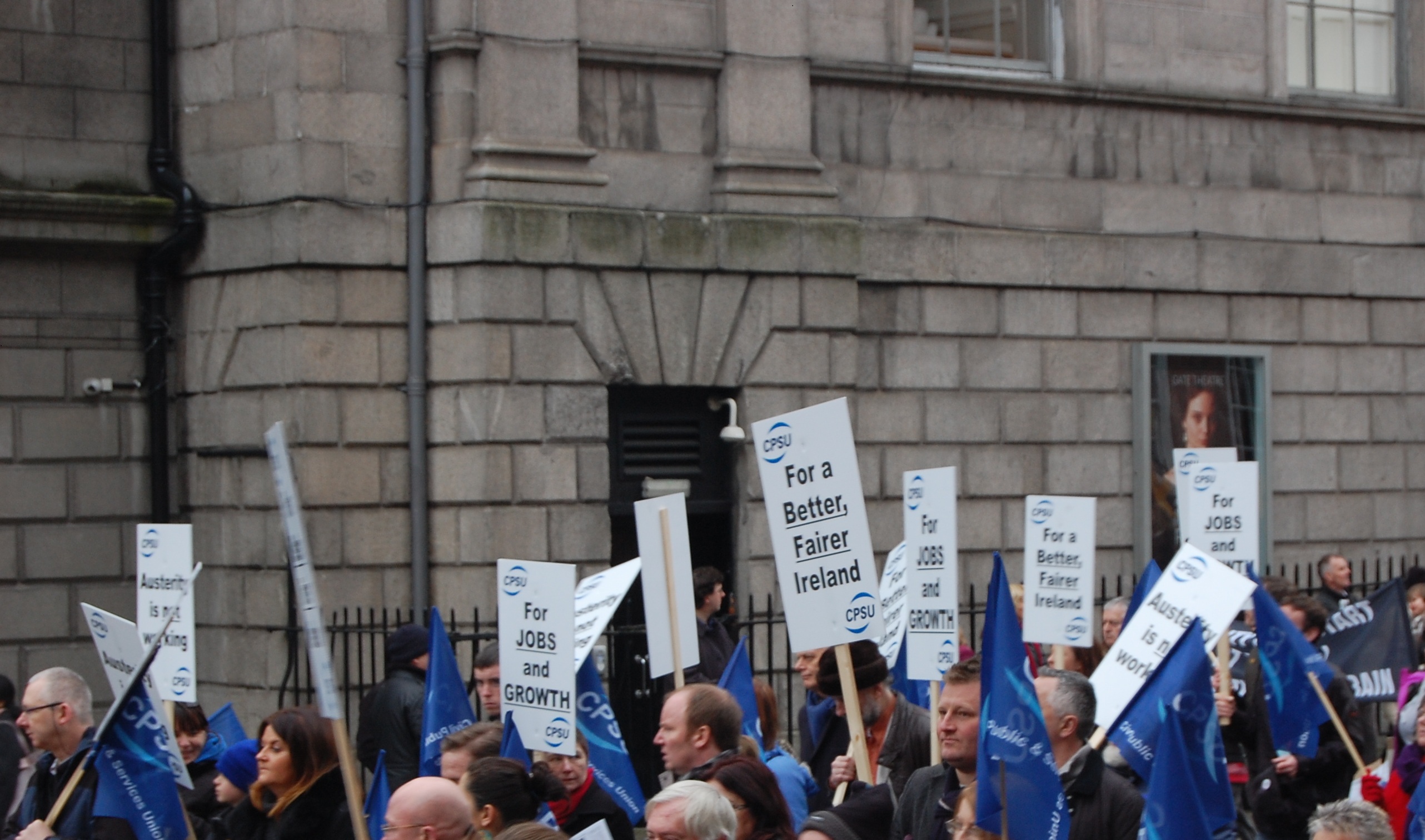
The Communication Workers Union held up placards ‘for a better fairer Ireland’(while their band played the Internationale), no doubt in reference to the Irish Congress of Trade Union’s ‘better fairer way.’  Unfortunately we’ve already got this better fairer way as far as the trade union leadership is concerned.  They have negotiated a deal with the Government – the Croke Park deal – which has involved acceptance of austerity with no more than verbal opposition and the odd protest allowed.

The Croke Park deal requires that the trade unions not take industrial action and the union leaderships have ensured that this has been the case.   They seem happy enough with the present situation because they are about to go into negotiations for a Croke Park II with the Government setting a condition of a €1 billion cut.  This is proving no barrier to entering the talks.

The various community campaigns took up a large part of the demonstration and the rest by the various political parties.  Sinn Fein had the largest contingent of a political party, taking up the rear of the march.  Labour Youth also had a banner and a very small contingent.  This was brave enough given their Party’s role in Government but at least they had the decency to look a bit sheepish.  These young comrades must certainly know that their task, if they insist on staying in the Party, is to build an opposition within it to the leadership and demand it withdraw from the Government and never enter another one like it.

There were banners and members from People before Profit/SWP, Socialist Party, United Left Alliance, Communist Party, Socialist Democracy, Irish Socialist Network, Workers Solidarity Movement, Republican Sinn Fein, 32 County Sovereignty Movement, Republican Network  for Unity and Erigi – all in favour of the unity of the working class or of the nation.

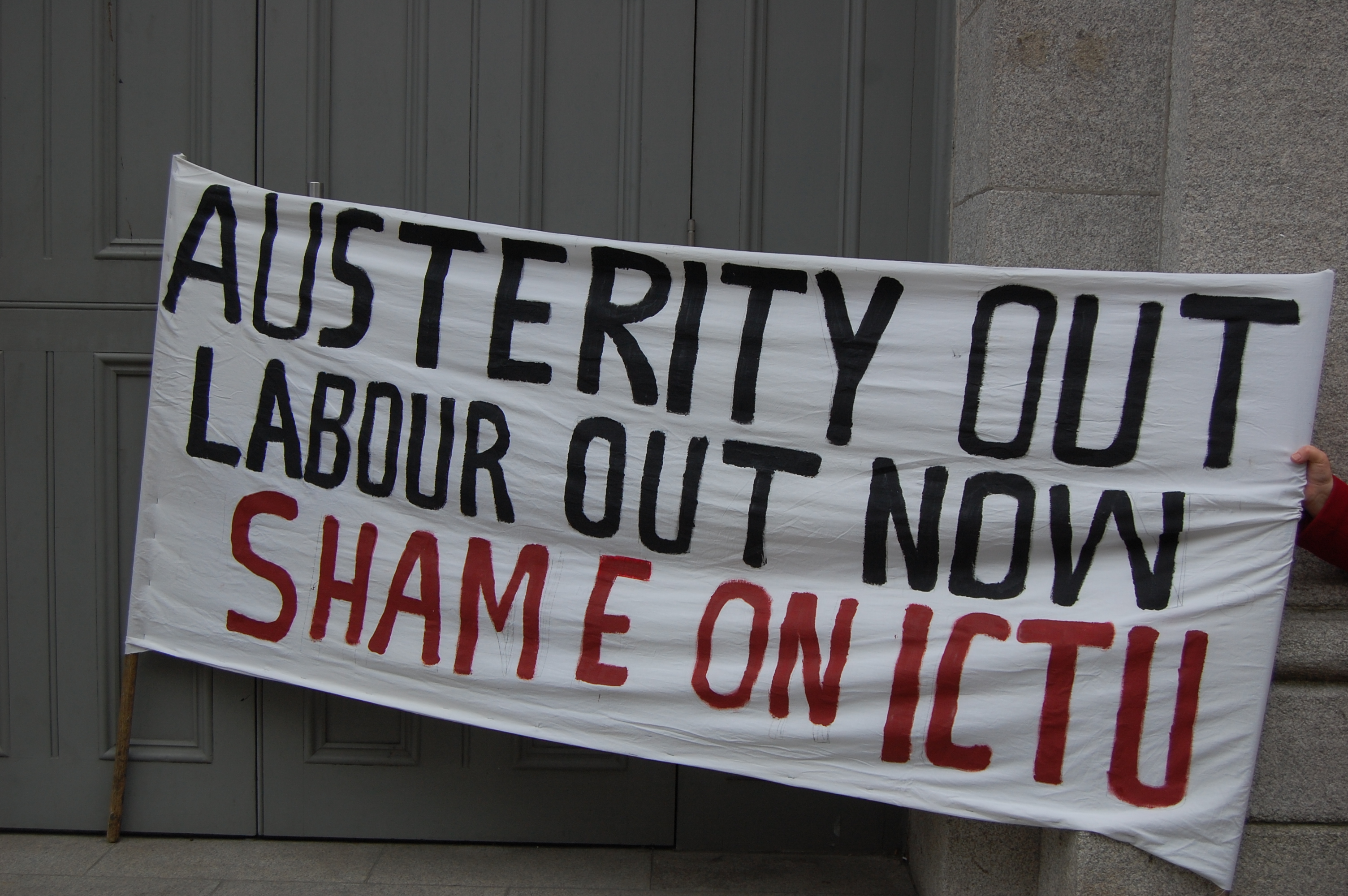
There was no predominant chant from the demonstration; the odd ‘they say cutback, we say fightback’ and chants against paying the household charge.  Socialist Democracy (SD) and their supporters held up a banner at the side of the demonstration as it left Parnell square and called for ‘Labour out of Government, ICTU out of Talks’ and ‘No new Croke Park’.

A demonstration united around these demands would have been a more powerful expression of opposition.  It would have targeted the weakest part of the Government and the key task of the moment – stopping ICTU and the trade unions selling out to the austerity drive once again.  It must be clear that preventing the trade unions’ acceptance of cuts would be a real victory, and would be a first step to really opposing them.  Failure to do so would make it much more difficult to achieve this.  The many on the Left calling for a general strike should realise that such calls mean very little if the prior step of preventing ICTU from signing up to a Croke Park II is not achieved.

There were one or two calls from small parts of the demonstration for calling a general strike and in my next post I will look at this demand.  Whether or not the Socialist Democracy call had some effect I do not know but a couple of sections of the demonstration took up their point about the Labour Party.  One SD member told me that the CAWHT contingents had reacted enthusiastically to their loudhailer demands, the trade union contingents had reacted with silence and the SIPTU contingent had attempted to raise an alternative chant to drown them out.

The small Union of Students of Ireland contingent targeted Labour with –

“Ruairi Quinn – we know you

We know you’re a blueshirt too”

The Waterford CAWHT contingent had a rather more colourful take on this message –

“Eamon Gilmore – we know you

You’re a fuckin’ blueshirt too”

At the end of the demonstration what was left of the protest waited outside the GPO for the speeches.  I waited a while as well as some music was played.  I was talking to a fellow Marxist when he said he was debating whether to wait to listen to the speeches or do some shopping.  I was in the middle of telling him I was debating the same issue myself, but felt obliged to stay since I was going to cover it in the blog, when I realised that over 90 per cent of the demonstration had left and that I could leave as well without doing an injustice to most participants’ experience of the day.

It was later reported that one of the speakers, the current President of the Irish Congress of Trade Unions, Eugene McGlone had joined in calls for a general strike in protest at austerity and cutbacks and that other speakers had echoed this call.  He was initially heckled when he took to the platform as was SIPTU President Jack O’Connor who said that ‘while he is not necessarily opposed to a day of action against austerity, unions would have to be able to convince the overwhelming majority of workers that the objectives they were advocating were achievable and were a better alternative.’  Sounds like a job description to me but not obviously one that Jack recognises.

The precious SIPTU leader then criticised what he called ‘fascist behaviour’ at the protest when McGlone and he were heckled by members of the crowd.  RTE reported that ‘a number of other senior trade unionists dissociated themselves from Mr McGlone’s call for a general strike – describing it as a “solo run”.’

RTE also reported that ‘the organisers of the pre-Budget anti-austerity protest have condemned what they describe as “the divisive attack” (on) Mr O’Connor (by) a section of the crowd.  In a statement, Councillor Brid Smith said: “Nobody orchestrated any heckling – it was a spontaneous outburst of anger at the inaction of union leaders.  Some highly-paid union bosses appear so much out of touch with the anger of their own grassroots that they see conspiracies everywhere,” she added.

We can be in little doubt that McGlone’s call is indeed a ‘solo-run’ but that unfortunately it is not “the inaction of union leaders” that is the problem but rather their actions that are.  In negotiating a deal with the Government which accepts austerity and agrees not to organise effective action against it they have consciously adopted the role of enforcing Government and Troika policy.  Their actions, in appearing to be concerned only with their members in the public sector, has effectively validated and supported the strategy of the Government, bosses and media of dividing workers into public versus private and making easier the imposition of austerity on both.

Attacking O’Connor is not “divisive” because these leaders have agreed a deal which supports austerity.  That he was allowed and able to speak at an anti-austerity rally shows how far Irish workers have to go to build a real opposition to it.  What is heartening is that some workers seem to appreciate this.

Savita Halappanavar and the demand for the Truth

Minister for Health James Reilly

In this post I warned that the State was going into defence mode in order to protect itself from the fall-out from the death of Savita Halappanavar who, from all accounts, died in agony while the hospital in which we was being treated refused to terminate her pregnancy because this would necessarily result in the death of the foetus. “This is a Catholic country” she and her husband were told.  As a result her life was unnecessarily put in danger and she died.

The response of the Government and many others, including the anti-abortion lobby, is to emphasise the uncertainty around events and to defuse the response to them by calling inquiries which, on the face of it, have no credibility.

Consider the following.

Mr Halappanavar heard nothing from the Irish authorities until he made the tragic death of his wife public.

The Government then announces an inquiry by the hospital group where Savita died and one by the employing body, the Heath Services Executive (HSE).  In effect both bodies would be investigating themselves.

Such is the arrogance and panic of the organs of the State concerned that they include three doctors in the HSE inquiry from the Galway hospital where Savita died!  When I first heard this on RTE news I was struck immediately with complete incredulity. Did I hear that right?  Mr Halappanavar has pointed out that there were five members of the medical staff in the room when he was told that she could not have a termination because “This is a Catholic country”.

The Chairman of the inquiry says he needs these medical staff in order to “find out about their standard practice.”  In other words those investigating the death would be asking themselves what goes on!  This is independent?

As Mr Halappanavar and his legal advice say – the inquiry is private, it is confidential, evidence will not be taken on oath and there will be no cross-examinations.

The Government makes a partial retreat by removing the local medical staff but then puts pressure on Praveen Halappanavar to accept the HSE inquiry.  The HSE know he is unhappy but then claim it is only the participation of the three staff that evoked his concern.

It is then pointed out that he didn’t know about the three internal staff at this time and had in fact objected because the HSE was running the inquiry (into itself) and would not be holding hearings with witnesses.  So he could not have objected on the grounds claimed by the HSE.

Praveen Halappanavar’s solicitor also claims that the medical notes of Savita  given to Praveen have parts missing.  They contain records of requests by Savita for tea and toast and a blanket but no written information about her repeated requests for a termination nor of the consultant saying “This is a catholic country”.

A spokeswoman from the HSE is then quoted as saying that she was sure no notes were withheld for “spurious reasons”.  Indeed.

Yet we are expected to believe that the State and its inquiries will give Praveen Halappanavar and everyone else the truth.

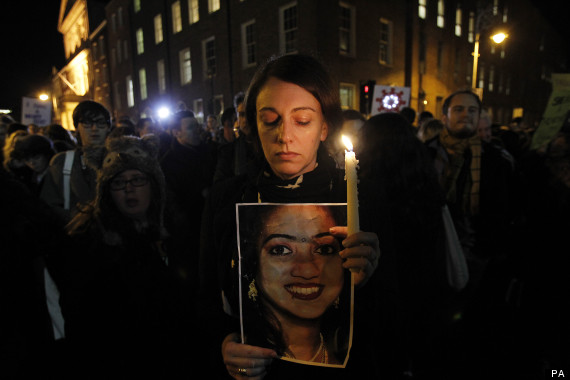
The courageous stand by Praveen Halappanavar has stripped the State inquiry of any credibility and it cannot now perform the function assigned to it by the State.  The huge march in Dublin has demonstrated the anger and determination of many not to accept the death of Savita or accept that it might happen again.  So far the anger of many women and men, along with Praveen Halappanavar’s determination, has forced the State to retreat and put serious pressure on the Government.  The pressure is particularly strong on the Labour Party, which claims progressive credentials.  Fine Gael on the other hand has always been a reactionary tribe. It is so far an open question how far and for how long a more or less spontaneous reaction can threaten this Government and advance women’s rights.

The emphasis on legislating for the X case, while this would be an advance, also runs the real risk of duplicating the uncertainty which already exists but which thereby provides the certain barrier to women’s realisation of their right to control their own bodies.  A limited, confused and contradictory constitution and legal view is just as liable to bring forth another limited, confused and contradictory piece of legislation, and would the Government really mind that?

The spontaneous eruption of women and men claiming their rights has an unrivalled quality of energy, hope and passion but the force and determination of organisation and strategy is, as time goes by, much more likely to bring what is required.

Politicians are manoeuvring to avoid the blame or claim the leadership of the demand for women’s rights.  The not-so-united United Left Alliance has put two separate amendments to the Sinn Fein motion in the Dail calling for legislating for the X case, putting a large question mark over its ability to perform this latter role.

This role is not to seek immediately to lead this spontaneous movement but to help it find organisation, a strategy, its own leadership and to fight for a women’s right to choose as the only certain route to establishing the rights of women.

The Left, with its history of political sectarianism, would have to change its instrumental approach to campaigns if this were to happen and they become able to play this role.  There are reasons why it might not do so but there are many, many more why it should.


What is certain about the death of Savita Halappanavar

The husband of Savita Halappanavar has been very clear.  His wife was refused a termination of her pregnancy although the foetus would not survive, because the foetal heartbeat was still present, and Savita and he were told, “this is a Catholic country”.  He later said that he was convinced she would have lived had this medical intervention taken place.  All this appears pretty clear and it adds up to a shattering condemnation of the Irish State and the reactionary forces within Irish society which have denied the rights of women to control their own bodies.  What has happened is indefensible not least because the Indian nationality of Savita Halappanavar means it has become an international story.

The Irish State has gone into defence mode and sought to do so through diversion.  First it is hoped the issue can be immediately defused and closed down at least temporarily by the call for an enquiry that, it is stated, will take three months.  We are expected to believe that the truth will emerge from a government that couldn’t even give clear answers why two health centres are to be built in the Minister of Health’s own constituency.

For those opposed to women’s rights there is nothing wrong and women can rest assured that whatever medical treatment is required for their good will be provided, a claim that flies in the face of all that we know about what has happened.

More dangerously the issue has been diverted by the repeated calls from politicians and commentators that what we need is ‘legal certainty’ as if this is the problem.

This is not the problem.

Thousands of Irish women travel from Ireland to receive abortions because they are all too certain that they cannot control their own bodies within Ireland.  It is all too clear that there are no abortion facilities in Ireland and it is all too clear and certain that all the political parties don’t want to change this.  They have had twenty years to bring the slightest doubt to such a judgement and they haven’t even tried.

Secondly we are meant to believe that certainty can be delivered from this piece of the constitution: “The State acknowledges the right to life of the unborn and, with due regard to the equal right to life of the mother, guarantees in its laws to respect, and, as far as practicable, by its laws to defend and vindicate that right.”  Given the history of this question it is as likely that legislation would result in the same certain denial of women’s rights as currently exists.

Thirdly, and most importantly, lack of certainty isn’t at all the issue.  It is the right of women to control their own bodies, to make their own decisions.  We can be certain that had Savita Halappanavar’s wishes been acceded to there would be no question of medical practice being based on theology.  We can at the very least say that her chances of being alive today would be higher.  Isn’t that what hospitals and health services are supposed to be for?

It is not a question therefore of the State being certain about the restrictions that they impose on women’s rights.  It is not an answer that the medical profession be clear when they must let a women die in agony because the law is certain when they can and cannot intervene.  It is not enough that women travel abroad because it has been made crystal clear that they cannot vindicate their rights to control their own fertility within the Irish State.

What has happened to Savita Halappanavar has been portrayed as an extreme case and in an obvious way it is.  But by its very extremity it has demonstrated that women’s rights to control their bodies will be prevented on anti-abortion grounds, even when it leads to a woman’s death.

The staff at the hospital must be asked to reveal the full decision making process that went on.

What must be made clear to the Government is that the rights of women will not be dismissed and we will not be diverted into accepting a new certainty as to the restrictions placed on them.  Legislating for the X case would of course be welcome but it is not enough.

The demonstration outside the Dail last night and actions elsewhere were exactly what was immediately required.  This must be followed up by demonstrations and a campaign that demands the full rights of women to control their own fertility including safe and legal abortions with all the necessary facilities to provide them.

Savita Halappanavar told “This is a Catholic country.”

Savita Halappanavar, who was 17 weeks pregnant, arrived with back pain at University Hospital Galway on October 21st but was found to be miscarrying.  Doctors told her the baby wouldn’t survive but it would all be over in a few hours.  Her agony lasted until 28th.

Her husband says she asked several times that the pregnancy be terminated but that this was refused because the foetal heartbeat was still present. Her husband reported that the doctor “told us the cervix was fully dilated, amniotic fluid was leaking and unfortunately the baby wouldn’t survive.”  There followed three days, he says, of the foetal heartbeat being checked several times a day.

He says that, having been told she was miscarrying, and after one day in severe pain, Ms Halappanavar asked for a medical termination.

This was refused, he says, because the foetal heartbeat was still present and they were told, “this is a Catholic country”.  She spent a further 2½ days “in agony” until the foetal heartbeat stopped.  When the dead foetus was removed Savita was taken to the high dependency unit and then the intensive care unit, where she died of septicaemia on the 28th.

“Savita was really in agony. She was very upset, but she accepted she was losing the baby. When the consultant came on the ward rounds on Monday morning Savita asked if they could not save the baby could they induce to end the pregnancy. The consultant said, ‘As long as there is a foetal heartbeat we can’t do anything’.

“Again on Tuesday morning, the ward rounds and the same discussion. The consultant said it was the law, that this is a Catholic country. Savita said: ‘I am neither Irish nor Catholic’ but they said there was nothing they could do.

“That evening she developed shakes and shivering and she was vomiting. She went to use the toilet and she collapsed. There were big alarms and a doctor took bloods and started her on antibiotics.  “The next morning I said she was so sick and asked again that they just end it, but they said they couldn’t.”

When the foetal heart had stopped Ms Halappanavar was brought to theatre to have the womb contents removed. “When she came out she was talking okay but she was very sick. That’s the last time I spoke to her.”  At 11 pm Ms Halappanavar’s husband got a call from the hospital. “They said they were shifting her to intensive care. Her heart and pulse were low, her temperature was high. She was sedated and critical but stable. She stayed stable on Friday but by 7pm on Saturday they said her heart, kidneys and liver weren’t functioning. She was critically ill. That night, we lost her.”

On the face of it we have a desperate tragedy that could possibly have been avoided. That it has not is because of the continuing power of a state colluding with an institution, the Catholic Church, which, despite being increasingly discredited, continues to wield enormous power.  This includes its patronage of hospitals and influence on medical practices.

The Church has been found guilty of systematic and widespread child abuse in report after report.  It has defended itself first by cover up and denial, relying on the state, including the Garda to protect it; and finally by expressions of sorrow and regret while making the minimal of changes.  The Church has still been allowed to continue to ‘self-regulate’ while it being obvious that the resources provided to protect children are woefully inadequate. The Church has shown not the slightest sign of willingness to pay for its crimes.

Above all it has been the state which has been the last line of defence for the institutional power of the Church and this is so despite the much publicised criticism by politicians, including Enda Kenny in the Dail, and the weak measures to reduce Church patronage of schools.  Such criticism is designed to save the Church from itself and reduced patronage is acceptable to it, if it is limited, because the Church has already stated it is currently over-extended.

For years the Irish State has been under an obligation to legislate for abortion where the life of the mother is threatened and all the political parties have avoided discharging this obligation.  How bitterly ironic then that the Expert Group set up to report on this issue, in reality a device to kick the question further down an infinite road, reported its findings to the Government last night.  We can be absolutely certain that this procrastination will continue now that the report has been completed.

The expressions of sorrow from the politicians in the Dail this afternoon are nauseating and hypocritical.  If the facts are as they are now understood then their defence of Catholic Church teaching has led to a result that has been both foreseeable and foreseen.  Two internal inquiries into what has happened are to take place, one by the hospital itself and one by the Health Services Executive.  Those who work in the hospital should, through their trade unions if that is easiest, report what has happened or at the very least prevent any cover up.  Much better would be a workers enquiry made up of health service staff and users of the services. Neither of the internal inquiries can be trusted to reveal the truth of this case.

Most fundamentally this is because, while this is a personal tragedy, it is the result of a political system that still defends the reactionary social teaching of an increasingly disgraced institution.  It does so because of the independent power of that institution, the historical ties that bind and the need for the Irish State to hold to whatever forms of legitimacy it can, no matter how tattered.  The Church and its teachings remain a powerful reactionary force in Irish society notwithstanding the scandals.  This is an earthly power with deep roots.

Some on the Left appear to believe that confronting the power of the Catholic Church in Ireland is a battle won when in fact it has been battles fought by women and the self-inflicted wounds of the abuse scandals that have weakened its authority.  It is now well past the time that the Left demanded the rights of women to control their own bodies, with the right to choose whether they have an abortion or not.  This requires the complete separation of the Church from the State and the expulsion of the Church from education and health services.  Safe and legal abortion services must be provided by the health services free at the point of delivery.

We should expect to see the deputies of the United Left Alliance excoriate the political leaders who have allowed this to happen.  It is one of the few truly useful functions a TD in the Dail can perform.  This is not a tragedy above or beyond politics but is something a rotten political system and its defenders made inevitable.

Marxism and the State

In a previous post I said that I would be looking at the Marxist view of the State and in this post I will look at some aspects of Karl Marx and Frederick Engels’ original view.   For them the possibility of socialism was not that it best met some general principles of justice or equality but that it was based on the actual social and political development of the existing capitalist system.  If there were no developments within capitalism that might form a real foundation for achieving the former ideals then these ideals were practically worthless.  The question however is on what developments within capitalism is the potential for socialism based?

It is undoubtedly the case that the state plays a greater and greater role in capitalist society and that as this system has developed so has the role of the state.  That this has been so despite decades of rhetoric by the most ideologically rabid supporters of capitalism against the state ranks as only further proof of its central role.  The state also played a major role in the creation of the capitalist system although its importance may be subject to historical debate.

On this basis the majority of the socialist movement has come to identify socialism with this state either through state ownership, regulation, taxation or state expenditure on ‘public’ services.  In the form of Stalinism it has taken the shape of the most gargantuan forms of state power which has assumed prerogatives in social life that have associated the liberatory content of socialism with the totalitarian nightmares of Orwell’s 1984.

This has nothing to do with Marxism.  In fact the intellectual journey by which the young Marx came to ‘Marxism’ involved an utter and complete opposition to the state, as formulated by the German philosopher Hegel, which Marx carried out through his ‘Critique of Hegel’s Philosophy of Right’.  Marx’s view of socialism was not an ideal state which society must seek to achieve but the movement of a class to achieve political power as the means by which to ensure its own and humanity’s social liberation.  Socialism is therefore the movement of the working class to achieve power, not the actions of a state and especially not a capitalist one!

For Marx therefore the active germ of socialism is not expressed under capitalism by the growth of the state but by the growth in the social and political power of the working class, which itself is based on the objective development of the capitalist system.  The growth of the state does not in itself herald the new society because Stalinism has demonstrated that a society based on even the state of a superpower is not a historically viable social formation.

The Marxist view of the increasing role of the state was explained by Engels in relation to his native Germany under the Chancellor Bismarck:

“. . . only when the means of production and distribution have actually outgrown the form of management by joint-stock companies, and when, therefore, the taking them over by the State has become economically inevitable, only then — even if it is the State of today that effects this — is there an economic advance, the attainment of another step preliminary to the taking over of all productive forces by society itself. But of late, since Bismarck went in for State-ownership of industrial establishments, a kind of spurious Socialism has arisen, degenerating, now and again, into something of flunkyism, that without more ado declares all State-ownership, even of the Bismarkian sort, to be socialistic. Certainly, if the taking over by the State of the tobacco industry is socialistic, then Napoleon and Metternich must be numbered among the founders of Socialism.

If the Belgian State, for quite ordinary political and financial reasons, itself constructed its chief railway lines; if Bismarck, not under any economic compulsion, took over for the State the chief Prussian lines, simply to be the better able to have them in hand in case of war, to bring up the railway employees as voting cattle for the Government, and especially to create for himself a new source of income independent of parliamentary votes — this was, in no sense, a socialistic measure, directly or indirectly, consciously or unconsciously. Otherwise, the Royal Maritime Company, the Royal porcelain manufacture, and even the regimental tailor of the army would also be socialistic institutions, or even, as was seriously proposed by a sly dog in Frederick William III’s reign, the taking over by the State of the brothels.”

In the development of capitalism increased socialisation of production that anticipates and presages socialism is reflected in the increased role of the state and in this sense only is it progressive in that it signals the development of society towards socialism.  This does not mean that socialists should give any political support to this increased role of the state never mind put it forward as socialist in itself.  The development of capitalism has created and continues to create massive misery and exploitation through driving people from the countryside to cities and is progressive because it creates a working class which is the bearer of a new society but no one thereby claims that socialists should support this process politically.

This again is presented by Engels:

“But, the transformation — either into joint-stock companies and trusts, or into State-ownership — does not do away with the capitalistic nature of the productive forces. In the joint-stock companies and trusts, this is obvious. And the modern State, again, is only the organization that bourgeois society takes on in order to support the external conditions of the capitalist mode of production against the encroachments as well of the workers as of individual capitalists. The modern state, no matter what its form, is essentially a capitalist machine — the state of the capitalists, the ideal personification of the total national capital. The more it proceeds to the taking over of productive forces, the more does it actually become the national capitalist, the more citizens does it exploit. The workers remain wage-workers — proletarians. The capitalist relation is not done away with. It is, rather, brought to a head. But, brought to a head, it topples over. State-ownership of the productive forces is not the solution of the conflict, but concealed within it are the technical conditions that form the elements of that solution.”

Support for nationalisation as a socialist measure is a short-cut, a short-cut to nowhere:

“It is a purely self-serving falsification by the Manchesterite [laissez-faire] bourgeoisie to label every intervention into free competition as `socialism’: protective tariffs, guilds, tobacco monopoly, statification of branches of industry,…, royal porcelain factory. We should criticize this, not believe it. If we do the latter and base a theoretical argument on it, then it will collapse along with its premises” (Engels quoted in Draper, Karl Marx’s Theory of Revolution, 1990,p.96)

From the glorification of the power of the state comes the betrayal of socialism in the form of nationalism which is why it is so apt that this is often expressed in the demand for nation-alisation, as if the more of this demanded the more radical is the socialism.

This type of ‘socialism’ is often also associated with ethical considerations of justice and equality and the view that this can be achieved through state action.  This opens up the possibility of the latter becoming prettified beyond all recognition.  So vast bureaucracies become socialist institutions and means tested, inadequate benefits dispensed through pipettes become a whole new model of society.

If statisation is the advance of socialism then reforming this state is inherently the way forward and electoral success to reach the ‘pinnacle’ of this society becomes the most natural means to its attainment.  Calls for widespread nationalisation, defence of the welfare state without the least criticism of it, demands on the capitalist state to do things it simply will not and cannot do and rank electoralism are all consistent with each other and hallmarks of many of today’s ‘Marxists’.  As Marx was himself compelled to say of some of his ‘followers’, if this is Marxism I am no Marxist.

In his career Marx came across this approach to politics, which is all too familiar today, in the shape of the German Ferdinand Lassalle, who sought state aid for workers cooperatives as the germ of a future socialism, of which the workers were not yet ready to openly fight for.  Today some demands for nationalisation and state redistributive policies are designed to manoeuvre workers into a movement for socialism without even mentioning the word never mind traducing its real content.

Frederick Engels and Eduard Bernstein penned a critique of this sort of approach:

“If the masses could not yet be interested in the actual end of the movement, the movement itself was premature and then, even were the means attained, they would not lead to the desired end. In the hands of a body of working-men not yet able to understand their historical mission, universal suffrage might do more harm than good, and productive co-operative societies – with State-credit could only benefit the existing powers of the State, and provide it with a praetorian guard. But if the body of working-men was sufficiently developed to understand the end of the movement, then this should have been openly declared. It need not have even then been represented as an immediate aim, to be realised there and then. Not only the leaders, however, but every one of the followers that were led ought to have known what was the end these means were to attain, and that they were only means to that end.”

Today calls on the state to do good are presented as the means to win workers’ votes, which will ultimately lead to socialism, while the goal is considered too advanced to be put forward clearly, put to them as something that they must do and only they can achieve.  The avoidance of socialism and its real content today goes under the name of anti-capitalism or under the banner of broad left parties and alliances which hide what its sponsors claim they really stand for.

Let’s be clear about what the nature of Marx and Engels’ argument was.  It has been compared to their attitude to reforms.  Thus while they were in favour of many reforms to the capitalist system, the purpose of such reforms was to place the working class in a better position to carry out the revolutionary overthrow of capitalism.  It was not because such reforms of themselves were the means to bring socialism into effect.

So today socialists should not reject demands on the state or recoil from calls for nationalisation where these might be appropriate.  These proposals should not however be considered the basic mechanism for the transition to socialism; the all-encompassing framework for the programme that becomes its heart, body and soul and the all-embracing grounds on which the socialist argument takes place.  However as we have noted before this is exactly the role that the capitalist state plays today in the politics and programme of the left.  In a number of posts this has been explained; from the demands that the state tax the rich to investment to create jobs and nationalisation as if this were socialism itself.

The difference can quite easily be seen,on the one hand, in opposition to austerity, cuts in public services and opposition to privatisation, which should all be supported, and, on the other hand, putting forward as the socialist solution massive state investment  as the answer to unemployment, economic insecurity, inequality and low standards of living.  While such a policy by the capitalist state might be better for workers in that it provides some protection and better grounds for workers’ own organisation it is not itself the workers’ own alternative.  Nationalisation, state investment and taxation are not solutions and certainly not socialist ones.  All this has been explained in previous posts.

One other thing must also be explained.  Opposition to austerity must be supported, be part of the Marxist programme, because this is something to be carried out by workers themselves.  Keynesian programmes of state-led investment hand everything over to the state to achieve.  It remains in control, dictates how much and what is to be done, when, where and how.  It is precisely to remove all this from state control that is the task of the working class.

This is what Marx meant when he said that “every step of real movement is more important than a dozen programmes” which has been re-translated today so that state reformist electoral programmes are mistaken for real movement.  This denial of the primary role of workers’ own activity is reflected also in these organisations sectarian organisational practices and electoralism which are simply the everyday practical out-workings of a programme that signals dependence on the state for solutions that should come from the workers themselves.

Thus for Marx, support for workers cooperatives in ‘Capital’ is distinguished from Ferdinand Lassalle’s state aid for producers’ co-operatives  – “as far as the present co-operative societies are concerned, they are of value only insofar as they are the independent creations of the workers and not protégés either of the governments or of the bourgeois.”

For Marx and Engels “the emancipation of the working classes must be conquered by the working classes themselves.”  This is the starting point for today’s struggle for socialism, not faith in the benign actions of the capitalist state.