Workers’ control of production

rr06[1]In my review of the programme put forward by the left in Ireland, generally no different from other countries across Europe and further afield, I have argued that while it may be better for workers than the current austerity policies it is not socialist.  By this I mean that it does not involve a class alternative, an alternative to capitalism, one that involves ownership of the means of production moving to the working class.

Only in one area is this not the case: the Left’s occasional demand for workers’ control.  Even in these cases I have argued that the proposals are not put forward within any real practical perspective but put forward in such a way that they must assume a near revolutionary situation.  Demands for widespread workers’ control are only a practical proposition in such circumstances.

In current conditions demands for workers’ control simply demonstrate a lack of seriousness by those proposing them.  In the article by Trotsky previously quoted, he states that “before this highly responsible fighting slogan is raised, the situation must be read well and the ground prepared. We must begin from below, from the factory, from the workshop.”

This is to be done by revolutionaries gauging the moods of other workers – “to what extent they would be ready to accept the demand to abrogate business secrecy and to establish workers’ control of production. . . . Only in the course of this preparatory work, that is the degree of success, can (we) show at what moment the party can pass over from propaganda to further agitation and to direct practical action under the slogan of workers’ control.”

“It is a question in the first period of propaganda for the correct principled way of putting the question and at the same time of the study of the concrete conditions of the struggle for workers’ control.”

One small means of doing this recently was, when the banking crisis erupted, members of Socialist Democracy leafleted bank workers in Dublin asking them to let other workers know what was going on in the banks through leaking internal emails etc.  This small step abrogating business secrecy is a first step to workers’ control.  The poor response showed that the preparatory work described by Trotsky had yet to begin.

In this post I want to look at what is meant by workers’ control and how this is a result of the working class’s historical experience of this means of struggle.  The experience shows that it inevitably arises as a result of a crisis, and crises are by their nature temporary, occasioned by a society-wide political crisis or by the threatened closure of a particular factory that is producing unnecessary products, is working in an obsolete manner or is otherwise failing to compete successfully in the capitalist market.

How to institutionalise such control in periods of relative calm is a central problem we will look at in future. Relying on temporary crises to quickly provide workers with answers to the problems posed by their taking control has not resulted in success.  Revolutions of themselves do not give all the answers to the problems posed by revolution, at least not unless they are prepared for and prepared for well.  Since revolution is the task of workers themselves we are talking about how they can be prepared to take on the tasks of control.  Such preparation involves convincing at least some of them them that they should want to control or manage their own places of work as well as how they might be able to do so.  Only in this way can the superiority of worker owned and managed production be demonstrated.

The historical understanding of what workers’ control means derives mainly from the experience of the Russian revolution in 1917; the only successful workers led revolution.  Yet the goal of this revolution was initially a democratic republic, not a workers’ state, with the result that only a ‘transitional’ social and economic programme was on the agenda.  A decision to seize power by the Bolshevik Party could not change the level of economic and social development in itself.  We can see from an earlier post that this informed Lenin’s view that the immediate economic programme was one more akin to state capitalism than complete working class ownership and  power over the economy.

This is decisive in understanding the development of the revolution.  The workers could seize state power in order to stop the war, support distribution of land to the peasantry and attempt to put some organisation on production but workers could not by an act of will develop the Russian economy under  their own control and management, at least not outside of a successful international revolution, and this never came.

Workers’ control in such a situation did not, and at least initially could not, equate to complete management.  In Russian ‘kontrol’ means oversight; a “very timid and modest” socialism, as the left Menshevik Sukhanov put it.  The Bolsheviks understood that workers’ control was not socialism but a transitional measure towards it.  Capitalists would and did continue to manage their enterprises.  (The historian E H Carr reported that in some towns workers who had driven out their bosses were forced to seek their return.)

This approach was supported by the factory committees created by the workers during the revolution.  These committees initially hardly went beyond militant trade unionism but did not accept management prerogatives as inevitable and, as the bosses increasingly sabotaged production, they increased their interventions to take more radical measures of control.

The workers nevertheless saw the solution to their problems as soviet power and state regulation, evidence by their acceptance of a purely consultative voice in state-owned (as opposed to privately owned)enterprises.  This reflected the worker’s weakness, expressed by one shipyard worker on the eve of the October revolution at a factory committee conference: “often the factory committees turn out to be helpless . . . Only a reorganisation of state power can make it possible to develop our activity.”  Thus much of the activity of the factory committees was attempting to find fuel, raw materials and money simply to keep factories going and real management was sometimes consciously avoided.

Trade union leaders criticised the factory committees for only looking after the interests of their own plants and for not being independent of the capitalists who owned them. The workers in the committees were themselves keenly aware of being compromised by the capitalist owners, of being given responsibility without effective power.

While the revolution was supposed to have a transitional character in economic terms, workers were faced with greater and greater sabotage and recognised that the worsening crisis required a solution that could only come from the state, which would provide the centralised control that would combat economic dislocation. The weakness of the workers themselves can be quantified by the decline in their number.  In 1917 the industrial workforce in Petrograd was 406,312 but fell to 339,641 by the start of 1918 and only 143,915 by May of that year.

Although more active forms of workers’ control were sanctioned after the revolution, it had been increasing anyway, the steps towards the central state regulation that had been championed were constrained by the lack of an “organised technical apparatus, corresponding to the interests of the proletariat”, as the resolution unanimously adopted by the January 1918 Factory Committee conference put it.  Nevertheless the conference called for the immediate nationalisation of factories in a good physical and financial situation.

The economic situation however was desperate as the new state faced immediate armed attack.  The Factory Committee conference noted that: “Every one of us knows that our industrial life is coming to a standstill and that the moment is fast approaching when it will die.  We are now living through its death spasms.  Here the question of control is no longer relevant. You can control only when you have something to control.”

Widespread nationalisation was introduced but it was viewed as a necessity compelled by circumstances, not a positive choice and not one driven by socialist ideology.  Alongside this nationalisation was increasing centralisation of economic decision making, which was imposed on the factories.

But of course if the workers were unable to run the factories how could they run the state?  Complaining that the factory committees were ignoring everything but their own local interests and themselves disorganising production one section of the state’s economic organisation stated that reorganisation would not happen “without a struggle of the worker’s government against the workers’ organisations.”

All these quotes are taken from the article by David Mandel in the collection of articles on workers’ control in the book ‘Ours to Master and to Own: Workers control from the Commune to the Present.’  In this he states that the contradiction between planning and workers self-management can be resolved if there are conditions allowing for significant limitations on central control and these conditions also provide workers with security and a decent standard of living.  Both, he says, were absent in Russia.  More important for the argument here is his view that there must be a working class capable of defending self-management.

This too did not exist in Russia and our very brief review shows this.  The Bolsheviks were acutely aware of the low cultural development of Russian workers, evidenced through their lack of education, high levels of illiteracy, lack of technical skills and lack of experience in the tasks of economic administration and management.  That their numbers declined dramatically, not least because of the demands of the Red Army, leaves no grounds for surprise that this experiment in workers’ control did not prove successful.

The limited character of the initial steps in control and the awareness workers had of their lack of skills were revealed in their calls for the state to reorganise production.  While certain centralised controls over the economy are a necessity, and this is doubly so in order to destroy the power of the ruling classes, the socialist revolution is not about workers looking to any separate body of people to complete tasks that it must carry out.

If workers could not control production they could not be expected to control state power.  This was to turn out to be the experience of the revolution and in its destruction by Stalinism the state turned into the ideal personification of socialism.

This identification of socialism with the state in the minds of millions of workers across the world continues, a product of Stalinism and of social democracy but gleefully seized on by the right.  Since the state is organised on a national basis this also entailed socialism’s corruption by nationalism.

The path required to developing and deepening a genuine workers’ revolution lay not in seeking salvation in the state but in workers creation of this state themselves out of their own activity in the factory committees and soviets.  The coordination, centralisation and extension of the functions of these bodies would ideally have been the means to build a new state power that could destroy and replace the old.  It would also have been the organisation that would have combatted economic dislocation and provided the means for cooperative planning of production and trade with the independent peasantry.

In this sense the Russian revolution is not a model for today.  While workers control came to the fore in this revolution its limitations must be recognised and a way looked to that would overcome them in future.

It might be argued that the backward cultural level of the Russian working class, while acknowledging its high class consciousness, is not a problem today.  After all the working class in Ireland, Britain and further afield is literate, educated and with a large number educated to third level education.  The working class is the vast majority of society, which it was not in Russia in 1917.  Many workers are now highly skilled albeit specialised.  This however is a one sided way of looking at things. 

Firstly on the technical side the very specialisation that makes some workers skilled reflects an increased division of labour that in so far as it is deep, widespread and reflected also in a division of social roles militates against the widespread accumulation of the skills and experience of management and control.

Many workers reflect their specialisation in a narrowing of outlook but illustrates that the increased division of labour is foremost a question of political class consciousness which is at least in part a reflection of social and economic stratification of the class.  Thus some workers see themselves as professionals – engineers, accountants, managers etc. and regard themselves as middle class.  Just like white collar workers and state civil servants in the Russian revolution they do not identify themselves as workers with separate political interests along with other workers slightly below them in the social hierarchy.  They do not identify with socialism.

Modern society in this way reflects early twentieth century Russia: the working class does not rule society, even at the behest of the capitalist class, but there are numerous social layers (the middle classes) who help the capitalist class to do so, and they imbue into themselves and others the political outlook of their masters.

Because the division of labour is increasingly an international phenomenon the road of revolution at initially the national level poses even bigger problems for workers management of production than existed in Russia in 1917.  Especially in Ireland production is often a minor part of an internationally dispersed process so that control of the whole is exercised elsewhere.  How then do workers take control of such production in any one country especially one lower down the value chain?

For these reasons revolution needs to be prepared.  It needs prepared in the sense that workers must be won to a fully conscious commitment to their becoming the ruling class of society; a rule based on their ownership and management of the forces of production.  In order to achieve this, the force of example rather than simply the power of argument is necessary.  In other words workers must have seen and experienced ownership and management.  This can provide many with the experience and knowledge necessary to lead the whole class to own and manage the whole economy when such control is the basis for their own state power, after capitalist state power has been destroyed.

The best, in fact only way, to prepare for socialism is through practice, practice in asserting the interests of the working class as the potential new dominant class of society.  Demands for nationalisation are demands that someone else, the state – because the state is a group of people – create the good society.  And when anyone is asked to create the good society it is always what is good for them.

Such dominance is more than simple resistance to the exploitation of the old society but must in some way herald the new.  Opposition to austerity for example can only ameliorate the effects of capitalism and does not provide panaceas – not even ‘taxing the rich.’  The real importance of fighting austerity therefore lies in the building of the organisation and class consciousness of the working class. This is what Marx meant when he wrote in ‘The Communist Manifesto that:

“the Communists fight for the attainment of the immediate aims, for the enforcement of the momentary interests of the working class; but in the movement of the present, they also represent and take care of the future of that movement.”  The future is that in its “support (for) every revolutionary movement against the existing social and political order of things” communists “in all these movements, (they) bring to the front, as the leading question in each, the property question, no matter what its degree of development at the time.”

This then is the importance of workers’ control and workers ownership.  It is the question of the future of the movement of the working class because it brings to the fore “the property question.” 

I shall look at it some more in future posts.

Marx on pre-capitalist societies: review of ‘Marx at the Margins’ part IV

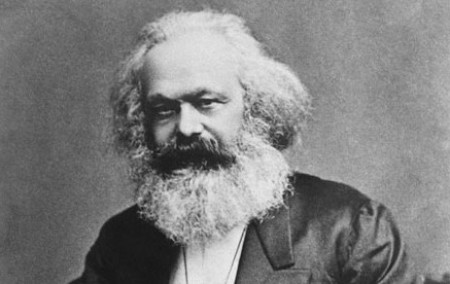
karl-marx-theoristBy Belfast Plebian

Marx published very little in the last ten years of his life and did not even manage to finish volumes two and three of Capital.  Some historians have said that he ran out of mental capacity. There were only two important documents published, small in size: the Critique of the Gotha Programme of 1875 is a schematic appraisal of the muddled socialism of Germany Social Democracy and the other a revised version of the Communist Manifesto for mainly Russian readers published just a month before Marx died in March 1883

It is the second document that offers a clue to what Marx was researching in his later years.  Marx and Engels state in the preface that they had neglected to say much concerning social developments in the United States of America and also in Russia in the original Manifesto. They then present a brief synopsis of the condition of the small independent farmers in the United States under the duress of expanding capital while turning to conditions in Russia they note the rise of a new revolutionary movement. They then attempt to take stock of the revolutionary potential contained within the primeval communal relations of the Russian society:

‘Can the Russian obshchina, a form , albeit heavily eroded, of the primeval communal ownership of land, pass directly into the higher form of communal ownership? Or must it first go through the same process of dissolution that marks the West’s historical development? Today there is only one possible answer: If the Russian revolution becomes the signal for a proletarian revolution in the Wes , so that the two complement each other , then Russia’s peasant communal land ownership may serve as the point of deparure for a communist development.’(T.Shanin p139)

In 1983 Teodor Shanin published a ground breaking book called ‘Late Marx and the Russian Road: Marx and the peripheries of capitalism’, a collection of Marx’s draft sketches and letters dealing with questions posed by the development of embryonic capitalism in Russia.

In a letter addressed to the Russian populist writer Nikolai Mikhailovsky Marx explained his research: ‘In order to reach an informed judgement on Russia’s economic development, I learned Russian and then for many years studied official and other publications relating to the question’.(Shanin p135)   Marx also says that ‘I have come to the conclusion that if Russia continues along the pathway she has followed since 1861, she will lose the finest chance ever offered by history to a people and undergo all the fateful vicissitudes of the capitalist regime.’ Marx stated his thesis tentatively referring to the now hectic undermining by both Russian and foreign capital of the customs of the usually isolated communal villages.

What Marx seemed most eager to banish in the mind of his Russian populist reader was the idea that he had arrived at a general philosophical account of modern historical developments.  Marx’s letter was a response to a sympathetic review by Mikhailovsky of Capital Volume One, an appraisal that had ascribed to Marx a unilinear account of necessary historical development.

The Russian populist had said in the review that Marx:  ‘In the sixth chapter of Capital, the section called  So called Primitive Accumulation, here, Marx has in view a historical sketch of the first steps of the capitalist process of production, but he gives us something much bigger, a whole philosophical-historical theory. This theory is of great interest in general and especially great interest for us Russians.’

In his reply Marx is determined to say that he has no such general theory of historical development ‘The chapter on primitive accumulation claims no more than to trace the path by which, in Western Europe, the capitalist economic order emerged from the womb of the feudal economic order….Thus events of striking similarity, taking place in different historical contexts, led to totally disparate results.  By studying each of these developments separately, one may easily discover the key to this phenomenon, but this will never be attained with the master key of a general historical-philosophical theory, whose supreme virtue consists in being suprahistorical.’(Shanin 136)

The above is important for it distances the late Marx from some of his own more rigid conceptions as articulated in the German Ideology and from the common ‘historic Marxism’ thesis that what Marx was about was revising the Hegelian philosophy of History in a materialist direction. The idea that Marxism is a failed Universal Theory of History is still the predominant one in social science.

The other equally important point was that Russia and other pre-capitalist societies ought not to be conflated with Western feudalism. Marx was in fact researching various pre-capitalist societies that were not feudal in the European sense.  When he spoke of an Asiatic mode of production he was not using the construction in a geographical sense, for it included most of South America and even parts of North Africa, especially Algeria.  Marx was not even trying to describe the pre-capitalists societies in any historical-anthropological way.  What he was really interested in was how capitalist expansion was penetrating and transforming pre -capitalist societies that had no feudal past, in short the disruption being wrought by the advancing capitalist-colonialism of his own lifetime. (We do not say imperialism for this terminology was not used by Marx.)

Marx conducted his research using his normal method of reading the leading bourgeois authors and compiling excerpts from them with his own added comments.  He made extensive excerpts and notes drawn from authors such as: the pioneering anthropologists  Henry Morgan’s ‘Ancient Society’ 1877; the evolutionist John Lubbock’s ‘The  Origin of Civilisation and the Primitive Conditions of Man’ 1870; Maxim Kovalevsky’s  study of India ‘Communal Landownership, the Causes, Course and Consequences of its Decline’ published in Russian in 1879; the political historian Henry Sumner Maine’s ‘Early History of Institutions’ (1885); notes of sixteen thousand words on John Phear’s ‘The Aryan Village of India and Ceylon’ 1 1880 and Robert Sewell’s ‘Analytical History of India’ 1870.

Much of this material had to do with the communal and clan structures of the still prevailing pre-capitalist societies. Marx appropriated, albeit critically, these works.  He portrays Maine as an ideologue defending capitalism and empire rather than a genuine historical scholar.  He agrees with Kovalevsky’s arguments covering changes to the communal property forms in India but criticises him for sometimes conflating India with European feudalism.

Marx declares one maxim of his method as ‘One has to be on guard when reading the histories of primitive communities written by bourgeois authors. They do not even shrink from falsehoods. Sir Henry Maine, for example, who was an enthusiastic collaborator of the English government in carrying out its violent destruction of the Indian communes, hypocritically assures us that all of the government’s noble efforts to maintain the communes succumbed to the spontaneous power of economic laws!’ (Shanin 107)

Anderson, basing himself on notes by Kovalevsky, argues that, Marx created a typology of communal forms across many societies and made differing assessments of their durability.  The second theme in the notes and drafts is a comparison between Russia and other ‘Asiatic communes’. To be sure he had not worked out a theory of revolution for Russia or for the others he had studied; moreover he was careful to take note of the political independence of Russia as an important difference.

In respect of the potential for social resistance Anderson argues that of the several communal forms that he had studied, Marx thought they were not as resistant to elimination as those that were rooted in Russia. This was due more to the fact that most of the others had already been conquered by colonial capitalism.  Marx’s guess on Russia is best stated in this from a letter quoted in the Shanin collection: ‘What threatens the life of the Russian commune is neither an historical inevitability nor a theory; it is oppression by the State and exploitation by capitalist intruders made powerful, at the expense of the peasants, by this same State.’   

Anderson concludes by saying that he hopes that his journey into Marx’s writings on nationalism, race, ethnicity and non-Western societies has revealed the multidimensional character of his overall intellectual projects, especially in his later years. Marx’s critique of capitalism was far broader than is usually supposed.

Anderson has done this, though he may have talked more about gender relation.  He mentions differences between Marx and Engels on how they each made use of the findings of Morgan’s study of the origins of patriarchy but he does not develop it much.

There are just a few other points I would like to make that Anderson in his restraint refrains from making.

One point about historical materialism that springs to mind after reading Anderson’s book is that it is not a finished theory and has no pretension to be a finished one.  It must be open to new evidence and new experiences.  If it is taken up as a closed system it would only become a sort of repository of past societies, like a great city museum stuffed full of abandoned knowledge and artefacts.

Another point concerns the assessment of the idea of progress that inheres within historical materialism. The bourgeois ideology of progress is rampant and without qualification: capitalism always improves the world through its free production of commodities, its new technologies, its science and its legal and political forms.

In so far as there is an opposition to this bourgeois credo of progress it can take on more than one mask.  In our time the most forceful originates from the mind of the German philosopher F. Nietzche, who declares in his ‘The Anti-Christ’ of 1888 that ‘Progress is merely a modern idea, that is to say a false one.’  Nietzche was much more impressed by the knowledge and art of the ancient world than he was with the modern one, as are his most intelligent followers.

This is not the kind of opposition, said Marx, that the workers and oppressed of the modern world need, the opposition of reactionary modernism.  Yet the socialist movement in the broad sense has been damaged by the full embrace of the capitalist ideology of progress.  In the first instance, with the progressive Germany ideology of Social Democracy and the Second International, revolution was no longer necessary as steady progress was already happening under capitalist conditions.  This steady progress must we remind ourselves included an acceptance of progressive colonialism.

Then there was the progress of actually existing socialism, supervised by the Stalinist bureaucracy and its ideology of State controlled economic progress.  Soviet society was reputed to be one without social contractions

Yet Marx assesses capitalism and its progress under the auspicious of dialectical contradiction; all progress within capitalism is torn by irony, even the breakthroughs of science are bundled with contradiction.  Medicines are withheld by patents and the Internet technologies are distorted by corporations, to cite just a few examples.

When we speak about the dialectic we are in fact using irony rather than a special kind of logic. The use of dialectic was spoken about by Plato in his dialogues.  Socrates was the master of subjective irony.  When Hegel revived the use of the dialectic he tell us that he learned it by studying the dialogue by Plato called the Meno.

Marx is the master of something more than subjective irony, he is the master of objective irony, he found it especially in the capitalism-colonialism of his own time and the quotes I have picked out from Anderson’s study are replete with this objective irony.

Finally something should be said about the controversy over Marx’s occasional referrals to the Asiatic and feudal modes of production.  Marx in fact wrote more words about Asiatic society than he did about Ancient or Feudal society, yet in the official Stalinist literature it went unmentioned.  The Communists spoke of the slave owning, feudal and then capitalist modes of production but not the Asiatic. Why was all talk of Asiatic society covered up by the Stalinist ideologues?

The best known book on this is a tendentious one by Karl Wittfogel called Oriental Despotism published in 1957.  The book is tendentious because Marx stopped speaking about pre-capitalism societies in terms of Oriental Despotism at an early stage, and because it is doubtful Marx had developed an account of such societies to the point that he was confident in naming them as belonging to a separate mode of production; the societies were too various for him to make that mistake.

Finally the Stalinists did not censure the terminology primarily because it sounded more like a description of the despotic Soviet Union under Stalin but because referring to the feudalism of China or India or Vietnam facilitated an international politics of anti-capitalist revolution that conceded revolutionary leadership to a class of supposed ‘progressive capitalists’ who were an integral part of common national and democratic revolution directed against the colonists and a class of reactionary feudal landowners.  It hardly mattered that Marx thought these Asiatic societies were not feudal in the European sense.      

Kevin Anderson has produced an admiral book.

concluded

Marx on Ireland and the American Civil War: review of ‘Marx at the Margins’ Part III

Jenny and Karl Marx

Jenny and Karl Marx

By Belfast Plebian

After the publication of Capital volume I in 1867 Marx’s perspective on Ireland underwent a transformation. During these years the Fenian movement was gaining support in Ireland, in the United States and in England with the more political minded Irish migrant workers. Anderson explains that ‘From its beginning, the International seems to have had some links to the Fenians, although, given the fact that the latter were part of a movement that was illegal in the British Empire, these were not always made public.’

In 1867 the Irish struggle really came to a boil and in March troops crushed a Fenian led uprising by poorly armed Irish peasants. On September 11 in Manchester, the police caught and charged two leading Fenians, Thomas Kelly and Timothy Deasy. Then, on Sept 18, some Fenians ambushed the prison van escorting the arrested men and an English police sergeant died of his wounds.

These events transpired during the same week that Marx was visiting Engels in Manchester to confer about publicising Capital volume I. Kelly and Deasy managed to escape to America but the police swooped down on the Irish community of Manchester arresting dozens and putting five men on trial for murder. Three of them were hanged on November 23 as a drunken mob celebrated outside. Queen Victoria articulated the ruling class opinion of the time ‘These Irish are really shocking, abominable people-not like any other civilised nation.’

In the days before the executions the International launched a solidarity campaign on behalf of the condemned prisoners. Marx wrote a letter to Engels saying ‘I have sought by every means at my disposal to incite the English workers to demonstrate in favour of Fenianism.’ Marx prepared a speech on Ireland for the November 26 meeting of the General Council but did not speak it aloud and an English worker presented it on his behalf.

The speech begins ‘Since our last meeting the object of our discussion, Fenianism, has entered a new phase. It has been baptised in blood by the English Government. The Political Executions at Manchester remind us of the fate of John Brown at Harpers Ferry. They open a new period in the struggle between Ireland and England.’ There began a hectic period of solidarity work on behalf of the Fenian prisoners, with the daughters of Marx heavily involved.

Marx’s daughter Jenny then twenty five years of age sought to break the silence about the plight of Fenian prisoners in the European press.  In February through April 1870 she published an eight-part series of articles on Ireland in ‘La Marseillaise’, a left of centre Paris newspaper. The articles of concern for, and plight of, the prisoners was then picked up and distributed by popular newspapers across Europe and the United States. The international embarrassment caused by the articles sparked a debate in the British Parliament, resulting in a formal inquiry. Finally in December 1870 Gladstone released the prisoners on condition that they leave the country.  In their letters Marx and Engels expressed a considerable pride in Jenny’s role in the affair and Engels and Elizabeth Burns sent her a twig of shamrock on Saint Patrick’s Day.

Marx’s own engagement with Ireland came to a rise in the International when a battle with the followers of Bakunin’s group became public in January 1870, after publication of the General Council’s Confidential Communication, written by Marx in French and responding to the accusation of authoritarian leadership. What usually goes unmentioned in this disputation with the anarchists is the fact that the attack on Karl Marx was two-pronged, the second targeting Marx’s support for revolution in Ireland.  A pro- Bakunin newspaper published a strong attack on the General Council Resolution on Ireland in December 11 1886, characterising it as a diversion from true revolutionary politics. Marx drafted a response to criticism and about a quarter of his 12 page document dealt with Ireland.

Marx states that ‘Ireland is the bulwark of English landlordism. If it fell in Ireland it would fall in England too. In Ireland this is a hundred times easier because the economic struggle is concentrated exclusively on landed property, because this struggle is at the same time national and because the people are more revolutionary and angry than in England…In the second place, the English bourgeoisie has divided the proletariat into two hostile camps…The common English worker hates the Irish worker as a competitor who lowers wages and the standard of life. He feels national and religious antipathies for him. He views him similarly to how the poor whites of the Southern states of America viewed black slaves…Thus the position of the International Association with regard to the Irish question is very clear. Its first concern is to advance the social revolution in England. To this end the great blow must be struck in Ireland.’    

This public statement had been prepared after a great deal of study of Irish history undertaken during October and November of 1869 and concentrating on the periods of the American and French revolutions up to the abolition of the Act of Union of 1801. Marx’s research notes comprise some 70 printed pages, following his usual method of taking excerpts from books he had been reading and then lacing them with his own comments.

Marx tracked the career and writings of John Curran, a radical Irish parliamentarian who became the defence attorney of the United Irishmen; he writes to Engels: ‘you must get hold of Currans’s speeches…I meant to give it to you when you were in London.  For the period of 1779-1800 it is of decisive importance, not only because of Curran’s speeches in court( I regard Curran as the sole great people’s advocate of the 18th century and the noblest personality, while Grattan was a parliamentary rogue) but because you find all the sources about the United Irishmen.  This period is of greatest interest, scientifically and dramatically. First the dirty infamies of the English in 1588-89 repeated perhaps even intensified in 1788-89. Second, class movement is easily shown in the Irish movement itself. Third the infamous policy of Pitt. Fourth which very much irks the English gentlemen, the proof that Ireland came to grief because in fact, from a revolutionary standpoint, the Irish were far too advanced for the English King and church mob, while English reaction in England as in Cromwell’s time has its roots in the subjugation of Ireland..’

Two letters, one to Engels and the other to  Kugelmann dated November 29, 1869 and December 10 spelled out his mature position on Ireland, which became the basis of a refutation of his critics in the International a year later: ‘For a long time I believed it would be possible to overthrow the Irish regime by English working class ascendancy. I always took this viewpoint in the New York Tribune. Deeper study has now convinced me of the opposite.  The English working class will never accomplish anything before it has got rid of Ireland.  The lever must be applied in Ireland.  This is why the Irish question is so important for the social movement in general.’

The life of the International coincided with the revolutionary war against slavery in America. It is a travesty of historical understanding that the great conflict between capitalist-slavery and free labour in America has featured so little in the making of ‘historic Marxism’, for the historical record shows that Marx regarded it as the most important political drama in his own time.

In several key places in Capital, Marx addressed the Civil War, the relationship between capital, labour and race; the first in the very preface where he refers implicitly to the impact the Civil War made on the very founding of the First International: ‘Just as the in the eighteenth century the American War of Independence sounded the tocsin for the European middle class, so in the nineteenth century the American Civil War did the same for the European working class.’

Marx takes up the story in a chapter called ‘The Working Day’. In comparing the finished book to the draft version, Dunayevskaya had argued that the Civil War and its impact on European labour was so great that the first edition was drafted to fit around it, rearranging his composition to remove the theoretical criticism of the economists and relegating that material to a fourth volume. She held that Marx’s activity in the International alongside the workers who had championed the Union cause was crucial to his decision to add the chapter on the working day: ‘He is breaking with the whole concept of theory as something intellectual, a dispute between theoreticians. Instead of keeping up a running argument with theorists, he goes directly into the labour process and thence to the Working Day…It wasn’t he; however who decided that the Civil War in the United States was A HOLY WAR OF LABOUR. It was the working class of England, the very ones who suffered the most, who decided that.’ (1958)

The above reference to the working class of England is to the fact that they sacrificed jobs and income and fought their own national ruling class to side with the Union Cause.  The context was explained by Marx ‘Direct slavery is as much the pivot upon which our present day industrialism turns as are machinery, credit.  Without slavery there would be no cotton, without cotton there would be no modern industry.  It is slavery which has given value to the colonies, it is the colonies which created world trade, and world trade is the necessary condition for large-scale machine industry…Slavery is therefore an economic category of paramount importance.’

Marx wrote many articles charting the unfolding of events in America and intervening in the common struggle in England, it might well be argued that his theoretical proposition that the working class is the only universal emancipating class was vindicated by this single struggle.  Anderson quotes the historian Padover:  ‘The beginning of the conflict found British opinion divided. On the pro-Confederacy side were the aristocracy, which sympathised with the southern plantation owners, and commercial interests which hoped for cheaper raw materials , particularly cotton, from an independent South. On the pro-Northern side were British liberal who saw in the civil war a struggle to preserve democracy and the working class which felt that the fate of free labour was at stake. Much of the London press spearheaded by the influential Times, which Marx read assiduously was pro-South. The British government led by Lord Palmerston as Prime Minister and Lord John Russell as Foreign Minister, leaned toward the Confederacy.’ Marx’s first Tribune article The American Question in England published on October 11 1861 dealt with this political battle on the home front.

I will not try to cover the entire story, there is way too much of it to summarise. In fact Anderson’s account of it is a vital part of his study. When the Civil War started, Lancashire was the workshop of the world; the cotton industry employed at least 440,000 workers in 2,400 factories. The main source of raw material came by way of the Confederate states, over a billion tons a year.  Disaster struck when the Union side imposed a naval blockade on the South, mills in Lancashire were closed or put on reduced working hours, half of the cotton workers went without wages, became unemployed and were evicted from their factory build homes.

The shipping and factory owners openly sided with the Confederacy; they called for the British navy to be used to break the Union blockade. The cotton workers response was to organise a campaign of public meetings to maintain the blockade and stand firm with the Union. The most remarkable testimony of the social setting has come down to us in the words of one Henry Hotze a Southern agitator for the Confederacy in England: ‘The Lancashire operatives are the only class which as a class continues actively inimical to us. With them the unreasoning aversion to our institutions is as firmly rooted as in any part of New England.’  In the year of 1863 English workers held at least 50 pro-union public meetings.

The Karl Marx archive gives us the drama of the story on both sides of the Atlantic, the differences of opinion over strategy, plus the role of the International.  Marx said that it was ‘the English working class that saved the West of Europe from plunging headlong into an infamous crusade for the perpetuation and propagation of slavery on the other side of the Atlantic.’

Anderson offers us a short political history of the assessment made by various threads of ‘historic Marxism’ and how Marx has been often criticised for not being critical enough of the Union cause and of Lincoln’s role in particular. Finally he shows how Marx analysed its overall impact and quotes a passage from the section of Capital on the working day:  ‘In the United States of America, every independent workers’ movement was paralysed as long as slavery disfigured a part of the republic. Labour in a white skin cannot emancipate itself where it is branded in a black skin. However a new life immediately arose from the death of slavery. The first fruit of the American Civil War was the eight hours agitation, which ran from the Atlantic to the Pacific, from New England to California with the seven-league boots of a locomotive. The General Congress of Labour held at Baltimore in August 1866 declared “ THE FIRST AND GREAT NECESSITY OF THE PRESENT, TO FREE THE LABOUR OF THIS COUNTRY FROM CAPITALIST SLAVERY, IS THE PASSING OF A LAW BY WHICH EIGHT HOURS SHALL BE THE NORMAL WORKING DAY IN ALL THE STATES OF THE AMERICAN UNION. WE ARE RESOLVED TO PUT FORTH ALL OUR STRENGTH UNTIL THIS GLORIOUS RESULT IS ATTAINEDTH.”

to be contined

Marx on Poland and Ireland: review of ‘Marx at the Margins’ part II

170px-Marx_oldby Belfast Plebian

Marx served as the chief European correspondent of the New York Tribune, the most important newspaper in the United States in the nineteenth century. Anderson believes these articles ‘constitute a far more serious and sustained affair than is generally realised. They fill most of the contents of volumes 12 through 17 of the MECW, each of which runs to over five hundred pages.’ All too often these articles have been seen as mere digressions from the more important economic works Marx was preparing roughly at the same time.

Their relative neglect is due in part to what Marx himself said about them in a letter disparaging his own involvement with political journalism. One letter Marx sent to a German comrade residing in the United States said he found the ‘perpetual scribbling for the newspapers tiresome’ and expressed a wish ‘ to withdraw into solitude for a few months and work at my economy.’

The articles were also ignored because in the beginning the principal students of the works of Marx were non English speaking Europeans who thought of him primarily as a writer of German prose and even as a strictly European intellectual. In more recent times the journalism has been downgraded due to a sarcastic criticism at the hands of some influential post colonial writers who have uncovered in them a so called Marxist justification for progressive colonialism.

Marx’s 1853 articles on India, especially his ‘The British rule in India’, are believed to espouse a doctrine of an enlightened colonialism. Edward Said’s book ‘Orientalism’ avers that in ‘article after article he [Marx] returnedwith increasing conviction to the idea that even in destroying Asia, Britain was making possible a realsocial revolution.’ Anderson accepts that some of the early Tribune articles contain Eurocentric generalisations.  In about the time of the communist manifesto Marx tended to extol the benefits of an inventive British capitalism over the cost of massive social dislocation. A dialectic relationship of both is present but not always so, and the neutral idea that all pre-modern societies like in India and China are destined to make an adjustment to a foreign induced capitalist modernisation is powerfully present.

Anderson presents the case that the Tribune articles on pre-modern and ‘barbarous Asian despotism’ register a steady shift in emphasis, becoming more dialectical and if anything the negative side of capitalist progress is emphasised and a critical support for political resistance to colonialism becomes more the norm.

What can be said with Said and others is that their criticism of Marx rests only on a few early Tribune opinion pieces and extrapolations from the general drift of the unrevised versions of the communist Manifesto, without appreciation of Marx’s constant revisions to his own analysis. What changed between 1853 and 1872-83 was his greater understanding and assessments of the various communal relations still dominant at that time.

Marx actually went on to identify at least three types of early communal relationships; the Greco-Roman, Germanic and the Asiatic. In the argument of 1853 the communal social relations present in these societies at the village level created a very repressive control by the village community over the non-free individual and made the basis for a despotic State, hence they were taken to be ‘barbarous.’ Marx then began to assess them differently and in the Grundrisse he states that the ‘The Asiatic form necessarily hangs on most tenaciously and for the longest time.

Already in the Grundrisse of 1857-58 he was beginning to characterise the communal relations as containing both despotic and democratic potential. He also began to think that it was not the supposed common ownership of land that differentiated these pre capitalist social formations but the use of collective labour in working the land that really marked them out. Thus in the 1880s he wrote that the Russian village with its communal social organisation might be able to avoid all of the exploitation typical of capitalist progress by revolutionising itself and overthrowing the landed class and by linking up with the workers movements in the West.  Marx in fact refers to such an alternative in the preface to the Russian edition of the Communist Manifesto, although it should be borne in mind that he was not proposing a unique Russian road to socialism.


Marx was not defending communal social  relations in their existing forms in any unqualified fashion, for he also argued they needed to be revolutionised from within and linked to technological achievements from without . In this way, these indigenous social forms, and the defence of them against capitalist encroachment, could form the starting point for a wider communist transformation that would involve both large agrarian societies like India or Russia and the revolutionary labour movements of already industrialising ones like England, France and Germany.

In the occasional scribbling on the British colonialists and their actions in India and China Marx became ever more contemptuous of what the British colonial-capitalists were actually achieving: ‘More than that of any other nation, the history of English economic management in India is a history of futile and actually stupid (in practice, infamous) experiments . In Bengal they created a caricature of English large scale landed property; in the south east they created a caricature of peasant smallholdings. In the north-west they did all they could to transform the Indian economic community with communal ownership of the soil into a caricature of itself.’(Grundrisse p. 451)  

The developing journalism of Marx also refutes the widely held idea that he took no interest in the national movements of his own time.  It has been widely trumpeted that Marx raised up the idea of trans-national social class to such a height in his dialectic that the idea of ‘national right’ was completely suppressed altogether in his mind. In textual terms, much of the critique of Marx and Engels on nationalism centres on their early ethnocentric disparagement of some of the Slavic societies of Eastern Europe and the Balkans as “unhistorical” nations.

This thesis is challenged in the examples of Poland and Ireland, both primarily rural societies with no organised communist movement. Anderson shows that Marx’s support for Polish independence was one of the great political passions of his life. One source of our confusion stems from the fact that some influential post Marx socialists developed a pronounced opposition to Polish independence and an explicit critique of Marx, especially Rosa Luxembourg and even Karl Kautsky.  Also with Stalin, who partitioned Poland in 1939-41, everything to do with Polish independence was labelled a counterrevolutionary deviation, while most of Marx’s writings on Poland were expunged from the official collections.

The historian of ideas Isiah Berlin is just one of many influential liberals who have charged Marx with a political blindness in respect of the great national movements of the nineteenth century. A study of Marx’s writings on various national struggles, especially those covering Poland and Ireland, showed that he in fact related the workers struggles to the key national struggles without compromising the higher cause of communist revolution.

Anderson shows that the themes of nation and race were intertwined with class analysis and were not relegated to minor matters in his own active political life.  In fact they took up most of his Marx’s time as a leader of the First International and were at the core of his clashes and controversies with rival socialist tendencies (mainly Proudhonist and Bakuninist), covering the entire duration of the First International.

Anderson writes that: ‘In Marx at the Margins, I did try to respond to serious scholarly critiques of Marx on nationalism and ethnicity such as those by Ephraim Nimmi (1994), who carried out a textual analysis of Marx’s voluminous writings on nationalism. I generally eschewed reference to the kinds of peremptory (and textually unsupported critiques of those like Giddens who seem to get a free pass so long as their target is Marx.’

In the document of 1864, the ‘Inaugural Address’ of the International, which in effect became its programme, the main theme was of course the international battle between capital and labour, however even here Marx referred to Ireland, Poland and the American civil war.

The period of the First International was also the period of the first drafts of Capital and all three political struggles feature heavily in the historical side of the economic critique. The importance of the American civil war for International Labour is cited in the very preface of the first edition of volume 1 of 1867. The ideological divisions that caused an eventual split in the First International were over Marx’s insistence that the workers movement should not restrict its own outlook to reductive class questions. At the time of Pierre Joseph Proudhon’s death in 1865, Marx wrote a long article in German in which he repeated his earlier critiques of the French utopian socialist’s economic theories. He also added a stinging rebuke directed against Proudhon’s thoughts on Poland: ‘ his last work, written against Poland, in which for the greater glory of the tsar he expresses moronic cynicism, must be described as…not merely bad but base.’

A year later, opposition to Marx emerged within the International among some of its French-speaking members, most of them influenced by Proudhon. In keeping with the viewpoint that labour should not involve itself in wider political issues, but stick to social and economic ones, they opposed singling out Poland for specific advocacy. In a letter Marx send to Engels dated January 5, 1886 Marx says that Poland is the basis of the dispute ‘A plot has been hatched…it is tied up with that pack ofProudhonists in Brussels. The real crux of the controversy is the political question.’

Marx opened the year 1867 in the midst of his finishing the final draft of Capital with a lengthy, well researched speech to a London meeting commemorating the 1863 Polish uprising sponsored by the International and a Polish exiles group. Marx avers that Poland remains the key to a revolution on Continental Europe because it would undermine the reactionary grip of Russia: ‘There is only one alternative left for Europe, Asiatic barbarism under Muscovite leadership will burst over her head like a lawine (avalanche), or she must restore Poland.’       ` 

After Marx set about constituting the International he became heavily involved with Irish affairs and this was underpinned by a substantial amount of private study. His first interest was following the struggle for land reform and he went more deeply into the class structure of rural Ireland, summarising his findings in a July 11th Tribune article ‘The Indian Question-Irish Tenant Right:

A class of absentee landlords has been enabled to pocket, not merely the labour, but also the capital of whole generations, each generation of Irish peasant sinking a grade lower in the social scale, exactly in proportion to the exertions and sacrifices made for the raising of their condition and that of their families. If a tenant was industrious and enterprising he became taxed in consequence of his industry and enterprise. If on the contrary he grew inert and negligent he was reproached with the “aboriginal faults of the Celtic race”.  He had accordingly no other alternative left but to become a pauper-to pauperise himself by industry or to pauperise by negligence.  In order to oppose this state of things “Tenant Right” was proclaimed in Ireland….England has subverted the conditions of Irish society. At first it confiscated the land, then it suppressed the industry by Parliamentary enactments and lastly it broke the active energy by armed force.  And thus England created those abominable conditions of society which enable a small caste of rapacious lordlings to hold the land and to live upon it. Too weak yet for revolutionising those social conditions the people appeal to Parliament, demanding at least their mitigation and regulation.’ Marx then detailed the vociferous opposition from the land-owning classes to the tenants’ rights law proposed to Parliament in June 1853.

After a break of two years Marx returned to the subject of Ireland with an article called Ireland’s Revenge written for the Neue Order-Zeitung on March 16, 1855 and another eulogising the deceased Irish Chartist leader Feargus O’Connor: ‘he died  as a pauper in the true sense of the word, the burial expenses were met by the working class of London.’ Three years later he wrote another article for the Tribune in January 1859 speaking of the ‘excitement in Ireland about a witch hunt directed against Irish conspirators.’

Kevin Anderson summarises the result of the first phase of the study of social conditions in Ireland covering the 1850s in three propositions:

1. While they (Marx and Engels) enunciated clear support for the struggles of the Irish they always counselled Irish revolutionaries to devote more attention to the internal class dynamics of Irish society. In this they were especially critical of the upper class Catholic nationalism of O’Connell.

2. They urged Irish revolutionaries to develop the firmest unity with British workers particularly the mass-based Chartist movement, pointing out that the Chartists supported the repeal of the Union of Ireland and England.

3. They singled out Irish immigrant labour in Britain, both as an index of Irish oppression at home and as a factor holding down the wages of English workers. Moreover they argued that British rule in Ireland proved that the British State could be just as repressive  as continental regimes like Bonapartist France or Prussia.

to be continued.

New Abortion Bill – should it be supported?

4378254-3x2-700x467

The death last October of a young woman, Savita Halappanavar, refused an abortion in a Galway hospital that may well have saved her life because, she was told by staff, “this is a Catholic country”, was shocking and led to an eruption of anger across the State.  It made headlines across the world.  It forced the establishment parties to get off the fence they had been sitting on for over two decades and promise they would legislate for some sort of abortion rights.

The problem they said was one of legal clarity and certainty for the medical profession.  At the time I argued that this was not the issue.  The issue was the all too certain denial of women’s rights to control their own bodies and their own fertility to the degree that they could be left to die rather than be allowed to abort a foetus that could not survive.

Now the nature of the proposed legislation has been made public.  It is clear from this that it is designed to protect the state and not women.

Enda Kenny spelled it out – the legislation “will not create any new rights.”  Although arising from the Halappanavar case it will not prevent such a tragedy happening again.  That’s about as damning a judgement as could be made given the circumstances.

The legislation will do nothing to facilitate abortion rights in cases of rape, incest or cases of foetal abnormality.  The health of women is of no consideration.  Abortion remains a crime and the 1861 British penalty of penal servitude for life has been replaced by the 21st century Irish penalty of 14 years imprisonment.  Women may go to jail because it would be ‘inequitable to penalise the doctor but not the woman undergoing the procedure’.  This will apply to pregnant women.  The denial of rights is indivisible.  Thousands of Irish women will be regarded as criminals who have escaped punishment only because their crime was perpetrated elsewhere.  These women will continue to travel to Britain rather than face the bureaucratic obstacle course which seems designed to ensure their journeys continue.

These rules require two doctors to approve an abortion where there is a “real and substantial risk to the woman’s life” and one if the termination is considered “immediately necessary.”   In the case of a woman at risk from suicide three doctors are required to approve (unanimously), two psychiatrists and a gynaecologist or obstetrician.  If the woman is refused a termination she has the right to appeal in writing to two doctors if it involves physical risk and another three doctors if she is in danger of suicide.  Again these are to be two psychiatrists and a gynaecologist or obstetrician.

The expertise of the medical profession is to be deployed in order to adjudicate on behalf of the State on women’s rights.  That this expertise is not the real function but rather a justification of the fetters determined by the State is abundantly clear from the fact that a gynaecologist or obstetrician must be on both the original and review panel and the verdict must be unanimous.  What expertise does a gynaecologist or obstetrician have in determining a woman’s state of mind?  In what way is a medical emergency requiring only one doctor in any essential way different from one determined by the threat of suicide?

The legislation has been enacted to deal with the State’s non-compliance with the European Court of Human Rights, which had concluded unanimously that it had breached a woman’s right under Article 8 “by reason of the absence of any implementing legislative or regulatory regime providing an accessible and effective procedure by which she could have established whether she qualified for a lawful abortion in Ireland.”  Now most women will know that they don’t and will face a struggle to affirm their rights if they think they do.

The State hopes that it will have neutralised the movement that wanted to affirm women’s rights and thereby bolster all the reactionary sections of society that seek to maintain the system of repression on which the Irish State was founded.

It would therefore be a mistake to welcome this legislation, this enactment that “will not create any new rights.”  We should not get into a fight over whether only two doctors are required in cases of possible suicide rather than three.  As has been pointed out by Doctors for Choice Ireland here , women will in all probability visit their GP first before going through the bureaucratic process meaning they could see two, three or four doctors initially.

Doctors for Choice Ireland put what we need to demand very succinctly “We believe that the safest way to protect all women in Irish society is to decriminalise abortion, leaving medical matters outside the criminal law. . . Women should have the choice to access safe abortion services with fully informed consent. To achieve this we will need to repeal the 8th amendment.”

So you think you know about Karl Marx? A review of ‘Marx at the Margins’, Kevin B Anderson.

Kevin B AndersonBy Belfast Plebian

To date, no comprehensive intellectual biography has been published in any language. Kevin Anderson.

Every new class consciousness generation is forced by contemporary events to return to the philosophy of Karl Marx, not in a mood of revival but to learn something important that has become forgotten or carelessly overlooked by previous students.

In the past the known side of Karl Marx was represented by the Communist Manifesto, a handful of works by Engels and the first volume of an unfinished study of the capitalist-bourgeois model of the good society, Capital volume 1. The later volumes of Capital economic studies were inaccessible to most readers because they followed a difficult logic and even Engels, the life long friend and editor of at least three of the economic volumes, is frequently accused by contemporary devotees of seriously misunderstanding the logic of value as expounded across its many pages.  In fact the leading lights of the ‘intellectual academy’ seem to have reached a sort of consensus that Engels got the economic critique wrong in his introductions and prefaces of the numerous editions, though it has not yet reached a consensus as to the linking arguments of the exposition, the relationship – to give one central example – of the tendency for the average rate of profit to fall to the sudden outbreak of an economic crisis, which is still hotly disputed.

There is another part of the Karl Marx legacy that has yet to be appreciated.  I will call this, for want of a better expression, the esoteric part: that part of the intellectual legacy that got buried and then neglected by the custodians of the early workers’ parties. Many documents concerning what Karl Marx did and thought during his own lifetime were left unpublished until after the formation of an ‘historic Marxism.’

Marx had frequent disputes with other communists in his own lifetime and they were certainly able to understand him, maybe because the fundamentals of political existence then were stated in common speech in contrast to the specialised language of later social  science.  Marx in fact is famous less for his critique of classical economic science than for his preparation of the communist manifesto in 1848, one of the most accomplished of common language documents ever recorded and distributed. The manifesto was composed as a blend of just rhetoric and historical knowledge, and espoused in the name of a living revolutionary movement, the Communist League.

The act of rendering the dialectical thought of Karl Marx into fluent and accessible pamphlets and journalism is not without a certain risk of vulgar distortion.  Even sections of books approved by Karl Marx himself, like the ‘Anti Duhring’ of Engels, to this day provoke criticism from some ‘Marxists’.

One reason we may well surmise why Karl Marx kept his partnership with Engels strong for so long was that he felt a need for an intellectual accomplice who could speak to the workers about political economy in a less convoluted style than he thought he could do. Marx always maintained that an attack on bourgeois economics as first expressed by Engels was not only his first introduction to the subject matter but a life-long inspiration.  

Marx for sure could write in the style of a campaigning journalist but he certainly preferred to delegate the role of first publicist to his partner in revolution. When Engels committed intellectual blunders Marx usually refrained from excommunicating him.  Engels held frustrations of his own, especially over the esoteric intellectual habits of Marx, complaining in a letter: “as long as you still have an unread book that you think important, you do not get down to writing.”

With the benefit of historical hindsight Marx and Engels may have even ‘over-succeeded’ with their exoteric publications like the Communist Manifesto and the Ani-Duhring because these publications became by the turn of the century the core of what became known as ‘Second International Marxism’.  They published the first version of the great manifesto in February 1848 and then went on to publish several revised versions.

With the very first one they faced a pressure familiar to all those who write for a public purpose: their friends’ impatience (from their comrades in the Communist League of whom we have records from the time). A month before publication the secretary of the Communist League wrote saying ‘The central committee charges its leading circle in Brussels to communicate with Citizen Marx and to tell him if the manifesto of the C. Party, the writing of which he undertook to do at the recent congress, does not reach London by February 1st of the current year, further measures will have to be taken against him.’

The manifesto was the declaration of a hard fought battle of ideas within the Communist League, an early example of a revolutionary united front, so the ideas expressed in the first edition can’t be ascribed without some reservation to Karl Marx alone.

Marx and Engels wrote several prefaces to the later editions that seem to edge closer to something like a genuine historical Marxism.  In the 1872 German edition they say that in view of the gigantic strides taken by modern industry in the preceding twenty-five years, and in view of the political experience gained through workers participation in the Paris Commune of 1870/71, the communist programme of the first edition has in some respect become antiquated.

In point of fact friendly critics of the manifesto like Leon Trotsky and Ernest Mandel point out some serious flaws even in the revised versions from the perspective of a later Marxism. Trotsky says that in showing how capitalism draws along in its wake the backward and barbaric countries the manifesto does not say anything about the struggle of the colonial and semi- colonial peoples for their independence. He also says that the most obsolete part of the manifesto is Marx’s criticism of the socialist literature prevalent at that time.

Ernest Mandel says that the manifesto established the unfortunate myth of the driving down of workers wages to a subsistence level, the iron law of wages, as one of the main tenets of orthodox Marxist thought, something he in fact refuted in his scientific account.

What we learn from this worry over the communist manifesto is that we must be conscious of shifts and developments in the thought of Karl Marx.  We must not even assume that the later books, essays and pamphlets are always an improvement on the earlier ones.  After all we all decline with age.

Marx is unusual in that he has often suffered greater distortion in the hands of his supporters than from his intellectual enemies although these have often stood on common ground. To give just one example, both past friends and enemies typically selected out points 5, 6 and 7 of the Communist Manifesto as the only guide to what Marx argued for by way of an alternative to capitalist arrangements.  Point 5 states that communists are in favour of the centralisation of all credit in the hands of the State by means of a national bank with an exclusive monopoly. Point 6 states that communists are in favour of a monopoly of the means of communication and transport in the hands of the State and point 7 calls for an extension of factories and instruments of production owned by the State. Nowadays we would call this a programme for state organised capitalism.

It is to the credit of the author of this book about the thought of Karl Marx that he scrupulously tries to avoid a stereotyping of Marx by not resorting to the usual interpretative device of selecting just a handful of well known ‘key passages’ from the better known publications and then referring to this selection as definitive of Marxism . The chief virtue of the book is that it presents to the contemporary militant a serious reading of essays, documents and letters by Karl Marx that are not well known or are seldom thought to be worthy of comparison to the key passages approach.  The good thing is that we are offered a more ‘historical’ account than we are usually given.  We might legitimately call this a dialectical account of the development of the mind of Marx.

Anderson’s method is to split the collected works into a kind of core and a periphery and show how the works of the periphery if studied carefully offer us a more concrete understanding of the abstract core. The core for Anderson consists not so much of a privileged statement or single book but of the concepts of social capital and the exploitation of labour, the theory of alienation and fetishism and finally the notion of dialectics. These ideas are the core because they appear as a seam that is more or less present in all of the primary works.

Anderson does not make an assessment of Marx’s intellectual development on the basis of a definite epistemological break between a young, humanist Marx and a mature, scientific Marx like the French professor Louis Althusser tried to do. 

Anderson is one of those historians participating in the publication of  MEGA2 which began in Moscow and Berlin in 1975, came to a standstill in 1989 with the implosion of the Soviet regimes, and was taken up again mainly by Western funded institutes.  What we now have before us is a much expanded version of the works of Marx and Engels than was previously available.  It is hard to think of another modern thinker with so small a ratio of published writings during their own lifetime to those actually written.  Works now considered central to the canon such as the 1844 manuscripts, the German Ideology, the Grundrisse and the Theories of Surplus Value were largely unknown to the “orthodox Marxists” of 1905.  For the purpose of this review it is useful to be reminded of what new material is included in the complete works, for Anderson makes use of some of them in his study.

The updated complete works are divided into four sections:

Section One: early works, articles and drafts.

Of thirty two volumes now planned, seventeen have appeared.  Especially notable is the inclusion of a rougher but larger version of the influential 1844 manuscripts. Marx appears to be writing two versions at the same time.

Section Two: Capital and Preliminary Studies.

Consisting in 15 volumes, of which as of 2010, 13 have been published.  What has been included are all the editions of volume one of Capital.  Important here is a print of Engels’s 1890 German edition, but with an important addition from a French edition prepared by Marx himself in 1872-1875 with an extra 60 pages not included in the English translation of the standard German edition. This, it turns out, was the edition most favoured by Marx though not by Engels.   Anderson presents some extracts of letters concerning their difference of opinion over what version of Capital volume 1 should be prioritised.  Other volumes offer draft manuscripts for what became Volumes 2 and 3 of Capital, which can now be studied to see how Engels edited and arranged them.

Section Three: Correspondence.

Of 35 volumes planned, 12 volumes covering the years up to 1865 have been published.  In the previous complete works most letters from Marx to people other than Engels were usually omitted.

Section Four: Excerpt notebooks.

Of 32 volumes planned, eleven have so far been published.  Here we have many drafts and notes never published before in any language.  These include notebooks from 1844-1847 on political economists such as Jean -Baptiste Say, Jean-Charles Sismondi, Charles Babbage, Andrew Ure and Nassau Senior.  Excerpt notebooks from Marx slated for publication include (1) notes from 1853 and 1880 on Indonesia, (2) notes from 1852 on the history of women and gender relations, (3) notes on the history of agriculture in Russia plus some on prairie farming in the United States, (4) substantial notes on Ireland from the 1860s, (5) notes on agriculture in Roman times, and finally (6) a massive chronology of world history composed during the 1880s.

Kevin Anderson situates his presentation of the development of Marx close to a mode of interpretation associated with the books of Raya Dunayevskaya (his own book is dedicated to her) whose most notable books are Marxism and Freedom (1958,) Philosophy and Revolution: from Hegel to Sartre, and from Marx to Mao (1973) and Rosa Luxemburg, Women’s Liberation and Marx’s Philosophy of Revolution (1981).

In her own work Dunayevskaya turned to the unpublished ‘Ethnographic’ notebooks of Marx to argue against the thesis that the old Marx(the last ten years) was an unproductive thinker, pointing to some of the different conclusions Marx reached in contrast to Engels in the study of the role of women and class in early societies. This she believed was important owing to the undisputed spell Engel’s ‘Origin of the Family, Private Property and the State’ held over all later communists.  It was taken on trust that Marx had no thoughts of his own relevant to what was later to be called women’s liberation.

Some of the less well know documents that Anderson mines concern the political journalism, especially those relating to race and class in the United States, the national struggles in Ireland and Poland, and others covering the colonial expansion in India, China and Java.  He then relates some of this material to editions of Capital especially the generally ignored French edition, the one Marx himself preferred.

He also takes us on an excursion through Marx’s late studies of pre-capitalist societies with particular reference to Russia and India and asks what his reasoning was in spending so much time on them, all the while jeopardising the completion of Volumes 2 and 3 of Capital.

What we end up with is a much more energetic and interesting ‘late Marx.’ It should be noted that David Riazanov and his colleagues at the Moscow institute neglected to publish some of these later documents stating that Marx by 1880 ‘had lost his ability for intensive, independent, intellectual creation….. Sometimes, in reconsidering these notebooks, the question arises; why did he waste so much time on this….that is inexcusable pedantry.’

In the next post we will look at some of what Anderson reveals about these writings, including those on Ireland.

Workers say NO to Croke Park 2

5178_54_news_hub_5200_328x250Commentators across Europe, indeed the world, have marvelled at the ability of the Irish to suffer punishing austerity without strikes, riots and political convulsions.  Local commentators have basked in their acclaim as the austerity poster-boy – in damning comparison to those Greeks and other southern Europeans.  Instead the Irish voted for a European austerity Treaty and voted in a Fine Gael-led coalition with politics no different from the previous Fianna Fail led one.   If opinion polls are to be believed, many have gone back to supporting the utterly discredited Fianna Fail.  The recent Meath by-election saw the Fine Gael candidate handsomely returned and the particular local circumstances do not adequately explain it.

Irish workers accepted the tearing up of the existing social partnership deal and voted for a new one called Croke Park, which inflicted cuts in services and conditions, including yellow pack terms and conditions for younger workers, in return for no compulsory redundancies.

Unemployment however has soared, reaching over 14 per cent officially and, according to the IMF, over 23 per cent if the underemployed are included.  This is despite emigration of tens of thousands of the younger generation to destinations across the world.

Yet still the ‘fighting Irish’ showed no signs of fighting.

Until now.

This is the significance of the vote on a new Croke Park deal.  Irish workers have said NO.

If it has been a surprise to many on our side it has been a shock to the Government who thought their threats, bullying and intimidation would work.  Above all they thought the rotten leadership of the Irish trade union movement, which supported the new deal, would pull it through.

Its mouthpieces in the media reacted with denial.  The ‘Irish Times’ journalist said “it was so close”, “if 1,000 members of SIPTU had voted the other way, or if more of its members had been minded to come out and vote – there was an extraordinarily low turnout of 45 per cent – the deal would have sufficient support to be ratified.”

There is a grain of truth in this but we will come back to this.  Let us first note that the press and media betray once again their class character by agonising about how the democratic wishes of the workers can be subverted by ‘tweaking’ the deal to get it through.  You will search in vain for commentary deliberating over how the workers’ majority can assert and validate their democratic decision.

The deal has been rejected but the vote is a mere inconvenience.  It doesn’t count.  The workers can say anything they want and will be listened to, but only if they agree.  Like European referendums voting is to allow worker s to approve the plans of the capitalist class and its state.  Again and again Irish workers are taught this lesson – voting is not a choice, it’s a stamp made of rubber.

Instead we are fed rubbish that a vote that saw the deal decisively rejected by a majority of two to one, 115,000 to 55,000, could somehow have been passed “if 1,000 members of SIPTU had voted the other way, or if more of its members had been minded to come out and vote.”  The votes of those who didn’t vote are ‘virtually’ counted to support austerity while in fact the vote against will have awakened the many workers who didn’t vote to the possibility of voting against the Government, the State, the mass media and their own rotten leaderships.

But even these propagandists of the system couldn’t help but recognise that many workers voted no, not because they were personally affected very badly by the deal, but because they didn’t think they should vote for other workers to take a pay cut.

The grain of truth – that the result could have been very different – is a reflection of the bureaucratic nature of the trade union movement, where a majority of 60,000 might be reversed by 1,000 voting differently in the biggest union.  This is only one illustration of what is now the biggest question that is to be answered, which is not the one asked in the media – of what will the Government do?  The real question is – what will, or can, the workers do about their leaders who recommended and argued for and censored the opposition to this rotten deal?

The problem is neatly encapsulated by a report on the Irish National Teachers Organisation Conference at which delegates wanted to put an emergency motion calling on the leadership to have a strategy in place if there was a No vote.  This was ruled out of order but a weaker one was allowed.  Only when delegates booted this out was a compromise motion passed that called “on the central executive committee to urgently liaise with the executives of other public service unions with a view to promoting and planning a public service solidarity alliance of trade unions across the public service.”

What this episode reveals all too obviously is the restrictions placed on workers by union bureaucracy and this bureaucracy’s intention of relying on the Government to ‘tweak’ the deal so it can be imposed on the membership.  It shows the awareness of trade unionists that a strategy is required and one that seeks the maximum unity.  The obvious weakness involves relying on the same union bureaucrats to provide this strategy and implement it.

Putting together a convincing strategy will not be easy but the vote itself is a massive step forward, as is the appreciation of the need for a strategy and for this to be based on unity within the union movement.

Very early on in the current crisis the then Government relatively easily divided workers through claiming those working in the public and private sectors had separate and opposing interests.  The union leaders seemed only too happy to walk into this trap.  Their willingness to sacrifice services for short-term and increasingly illusory benefits for public sector workers has failed even these workers as their pay has been slashed and the deal they signed up to was torn up with union consent.  Meanwhile the workers who use these services have had some confirmation that the quality of these services may suffer to defend the conditions of those who deliver them.

The initial reaction against this disastrous approach was recourse to an even more divisive one, with the creation of a Frontline Alliance that saw narrow trade unionism prioritise the interests of some workers who are on the frontline of some services, implying a common interest not shared across all workers.  However I’ve yet to meet a frontline service that could operate without the support of rearguard(?) workers.

Even this signalled not some reduced form of trade union unity but the plaintive cries of the ‘special case’.  I remember listening to an interview some months back on ‘The Last Word’ on Today FM with a group of union leaders from this Alliance.  What was most striking was that when they were interviewed one-by-one there was hardly the slightest hint of a common grievance.  They seemed totally ignorant of how narrow their complaints seemed and how stupid a strategy is which is based on claiming special treatment when such an all-engulfing attack is being meted out.

There are other courses of action and what might seem like alternative courses for workers looking to fight back are in fact the same struggle.

The view that it is impossible to get the union movement to fight back without first kicking out its rotten leadership replaces a task on which workers have just voted – rejection of Croke Park 2 – with one they have not had placed clearly before them, debated and decided upon.  There is limited traction in simply claiming ‘betrayal’ and saying these leaders must be replaced now before a real struggle to give effect to the No vote can be realised.

The entirely justified and valid view that the current union leaders must be replaced can be achieved by demonstrating to the majority of members the practical effects of these leaders supporting attacks on their interests while frustrating any resistance.  In the course of mounting this resistance the task of replacing these leaders can be posed but not as a precondition or prior requirement for such resistance.

The related questions of whether workers should demand that their leaders hammer out a united strategy or should unite at rank and file level to achieve this themselves are also not opposed.  While rank and file workers must unite across unions to create their own structures this can only be in addition to the established ones. In this way they might demand that their separate leaderships take action and also advance towards an end-point where, if they do not, workers are in a position to pose this task practically themselves.

In doing so workers might learn that replacing the current leaders is not enough and that what is really required is an entirely rejuvenated trade union movement.  One that is open, democratic and not in thrall to either bureaucratic leaders or bureaucratic structures and rules.  A big step forward has been taken with the No vote and the Government is faced with the threat of resistance.

As this post is finished it is reported that the Government does indeed intend to ‘tweak’ the deal in what is called a “carrot and stick approach”.   Since it still intends to make the same amount of cuts what won’t change are the pain and divisiveness of the tweaked deal and the threats that will accompany it.  Like donkeys workers are expected to look at a carrot paraded in front of them while what they feel is the stick.

What is Anti-capitalism?

electronblueOver the last two decades the left has attempted to respond to the heavy defeats of the working class by breaking out of its isolation and creating, or rather supporting the creation of, broad left parties.  Similarly sections of society, especially youth, have responded to the obvious unfairness of global capitalism by involving themselves in protests and movements against globalisation.  Both of these moves have to one degree or other come under the label of anti-capitalism.  It has never been very clear what this anti-capitalism consists of.

The left groups have more often than not attempted to create these broad, anti-capitalist parties themselves rather than insert themselves into genuine broad movements.  The anti-globalisation movement has also by and large been separated from working class struggle due to the latter’s decline.  In the absence of such struggle speculative attempts to create broad parties can have only limited success but this does not account for complete failure.

In Ireland we have just witnessed the failure of the United Left Alliance, which follows on the failure of previous initiatives such as the Socialist Alliance.  This comes as similar initiatives in Britain such as its Socialist Alliance, Scottish Socialist Party and RESPECT have also ended in failure.

To a greater or lesser extent these projects have been based on the idea that there exists a vacuum on the left through the rightward trajectory of social democratic parties which the left organisations can fill.  There has been no pause for thought that this movement to the right is a result not of some pathology to betray traditional social democratic politics but results from the assault of right wing forces, consequent defeat of workers and an undermining of the basis for social democratic answers.

Much weaker forces from the left trying to occupy this ‘space’ with not dissimilar policies, in the absence of any change to any of these larger factors, could only expect to face a similar evacuation of this ‘space’ – usually through collapse.

The invention of the term anti-capitalism that is supposed to sit outside the traditional reformist/revolutionary dichotomy has been the programmatic basis for these initiatives although these take various guises.  In this blog I have critiqued the anti-capitalist programme of the left organisations in Ireland as they have grouped themselves around the United Left Alliance.  This criticism has examined their programme of debt default, their budget proposals, taxing the rich, state investment and nationalisation.

This programme can nevertheless be called anti-capitalist because no pro-capitalist force currently comes anywhere near supporting it.  No party supports high taxation of the rich, defaulting on debt or much increased state spending to lower unemployment.  The capitalist class would bitterly oppose implementation of these measures, which would be better for the working class than current austerity policies.

None of these considerations however make this a working class programme.  Capitalist states have defaulted on their debt before – many times; taxation of high incomes was well over 90 per cent in the post-war United States during the cold war; deficit spending by the state has been an automatic result of the current crisis and nationalisation has been a response across the world to the current crisis.  In Britain and the US parts of the financial system were effectively nationalised and in Ireland almost all the banks were nationalised.

The anti-capitalist policies proposed differ only in degree to those imposed by capitalism many times before.  Above all this programme is not a working class one because it does not provide an alternative to capitalism in the sense that working class power is built and strengthened and the germs of alternative relations of production are created.

The social democratic programme was evacuated because it was not seen as the best option for capitalism.  If the capitalist class or its representatives change their minds about this they will get their own parties, including social democratic ones, to implement it.

The anti-capitalist content of this programme is twofold.  First it may target particular sections of the capitalist class or its representatives but only to benefit others.  Thus debt default will impose losses on sectors of financial capitalism that may benefit industrial/producer sectors.  High taxation will hit the highest paid mangers of capitalist enterprises such as bank CEOs, so depressing their salaries, which may be to the benefit of capitalist owners as shareholders.  Deficit spending on infrastructure will obviously directly benefit capitalist construction companies while putting pressure on lending to other capitalists.  Nationalisation of banks has been a means of protecting capitalist investors, not of expropriating them, but it also maintains the integrity of other capitalist’s liabilities.

The second way this programme is anti-capitalist we have explained – the capitalists oppose it.  The anti-capitalism of the programme is very like the anti-imperialism of Irish republicanism in the 1970s and 1980s.  It was heartfelt and genuine in a subjective sense and involved enormous sacrifice.  In an objective sense it was unrealisable by the methods adopted – armed struggle by republicans and electoralism by the left, which means that eventually the means change or the objective is abandoned.  In the case of republicans it was both.

In both cases neither programme opposed or presented an alternative to the class interests that they fought against.  In the case of republicans they never had a programme that opposed and had an alternative to the British and Irish capitalist classes who defended partition.  In the case of the left even implementation of their programme would not end the capitalist system or threaten the power of the capitalist state.  In fact most of its programme involves strengthening the capitalist state.

As I posted before: in one aspect of their programme these weaknesses might be seen to have been mitigated if not overcome.  The demand for workers’ control of enterprises taken over by the state might seem to present a means to increase working class power while encapsulating the potential of an alternative, new society.

Unfortunately the demand for workers control is proposed as part of the demand for nationalisation as if the capitalist state is in some way a facilitator for the creation of working class power.  The Marxist analysis of the state is that when the capitalist class is threatened by working class action it is the state which is strong enough to defend capitalist interests.  State ownership is not therefore a route to workers’ control.  No aspects of the many forms of state organisation involve workers’ control of any aspect of its bureaucracy.

In capitalist society ownership entitles control and capitalist ownership entails capitalist control.  State ownership entails state control.  Only in times of extreme crisis is the possibility of workers’ control raised and it is raised only when it is imposed by the workers themselves.  If they are in a position to do so, and to make it work, the demand should also be for workers ownership.

Above all the demand for workers’ control must be posed as a practical demand because it is necessary in order to achieve certain objectives.  In the past this has often involved keeping a workplace open when it is threatened by closure.  It does not normally arise in workers minds as an objective in itself.  Unfortunately this is how it is posed by the left – not as a burning necessity to achieve certain things which only the workers have an interest in accomplishing.  It is rarely posed as a practical measure needed to achieve particular objectives.

As I posted before in relation to the Transitional Programme, demands must be concrete and practical or they are simply tools of education (when not means of spreading confusion). Nothing wrong with this in itself, if that is where the struggle is at, but for the left the education given creates illusions in the state by demanding nationalisation as the key. The demand for nationalisation under workers’ control fits comfortably within a general programme that is reliant on state action for implementation.

More often lately the primary role assigned to state action is reflected by the left’s dropping of the rider to nationalisation since it plays no vital role.  Workers’ control in itself is not necessary to achieve any particular goal.  It is what Trotsky referred to as workers’ control “for platonic purposes.”

So we have the ULA before the last election demanding that “key wealth and resources must be taken into democratic public ownership.”  Another Left organisation demands taking “Ireland’s natural Resources into public ownership”.  Another states that “AIB, Bank of Ireland and other banks should be nationalised.  The banks should be amalgamated into one state bank.  The boards should be sacked.  A new board under the democratic control of working people should be established including elected representatives from the workplace and representatives elected from society as a whole.”

Another demands that “a publicly controlled banking system should be administered by elected representatives of the Irish people, representatives of employees of the banking industry, and trained financial experts employed on public sector pay scales.”

These proposals become blueprints, not demands that workers are to impose through their struggle to achieve certain practical needs.  Demands that workers exercise control coexist with formulations that are perfectly consistent with bog standard capitalist state nationalisation.  Demands for ‘public’ or ‘democratic’ control can be perfectly understood to mean the existing forms of state ownership.

On the other hand claims that workers’ control, when it is part of the Left’s propaganda, really means what Marxists have traditionally meant by it would be hard to accept.  Calls for widespread workers’ control were characterised thus by Trotsky in 1931:

“Thus the regime of workers’ control, a provisional transitional regime by its very essence, can correspond only to the period of the convulsing of the bourgeois state, the proletarian offensive, and the failing back of the bourgeoisie, that is, to the period of the proletarian revolution in the fullest sense of the word.” It hardly needs saying that we are nowhere near such a situation today, not in Ireland or anywhere else.

Instead today’s routine demands for workers’ control, when they are made – instead of mealy-mouthed formulations about ‘democratic public ownership’- are closer to this description of it, again by Trotsky, in the same article:

“If the participation of the workers in the management of production is to be lasting, stable, “normal,” it must rest upon class collaboration, and not upon class struggle. Such a class collaboration can be realised only through the upper strata of the trade unions and the capitalist associations. There have been not a few such experiments: in Germany (“economic democracy”), in Britain (“Mondism”), etc. Yet, in all these instances, it was not a case of workers’ control over capital, but of the subserviency of the labour bureaucracy to capital. Such subserviency, as experience shows, can last for a long time: depending on the patience of the proletariat.”

We shall examine further the historical experience of workers’ control in a further post.

Trotsky and nationalisation

trotskyIn two previous posts I have looked at Leon Trotsky’s transitional programme and the general approach to a working class programme which it encapsulated at a particular point in time. In this final post on the question I want to look directly at what Trotsky’s views were on nationalisation. As I said at the start of these posts, many organisations claiming inspiration from his politics place calls for state ownership high up in their political programme. This conflicts directly with Marx’s views but we need to look at Trotsky to see if this is also true of him.

First we should note that in the transitional programme Trotsky explicitly counterposes ‘expropriation’ to “the muddleheaded reformist slogan of ‘nationalisation’”. He gives four reasons for doing so. The first is that he rejects ‘indemnification’, i.e. compensation to the capitalists. Secondly he does so as a warning against reformist socialists who, while also advancing this demand, nevertheless remain the agents of capitalism. Thirdly he says workers must rely on their own strength. As we have stressed, nationalisation relies on the state. Lastly he does so because he links the question of expropriation with the seizure of power by the workers. This latter point is crucial in his presentation while, because we live in less revolutionary conditions, I have laid greater emphasis on his third reason.

Thus in the very next section of the programme from that above, in which he argues the importance and the benefits of expropriation of the banks and statization of the credit system, he says that the latter will “produce these favourable results only if the state power itself passes completely from the hands of the exploiters into the hands of the toilers.”

When pushed, Trotsky accepts that ‘nationalisation’ may be accepted as a slogan but only in so far as it actually means expropriation and involves a workers’ government to achieve it. In other words reason four must apply.

It is possible to argue that the socialist programme must be taken as a whole and that therefore calls for nationalisation are perfectly valid when part of a comprehensive programme. There are several problems with such an argument but we will point out only two.

First – try finding the call for destroying the capitalist state or creation of a workers’ state in the programme of the left that might act as an alibi for demanding capitalist state ownership in the here and now.

Allied to this is the second reason. In every advanced capitalist country the working class is separated from conquest of state power by a huge gulf in social and political development and experience. The left might often be opportunistic but it is not immune to registering this fact, if only through avoidance of demanding overthrow of the state. In effect a link between nationalisation and a change in the character of the state is non-existent and the former becomes a simple call for the capitalist state to take ownership from private capitalists.

In other words the organ of the capitalist class as a collective, and its principal organ of defence of its system, is called upon to play a role in the destruction of this class and system.

For some on the left their understanding of Marxism and the working class political programme has degenerated so much that nationalisation of the economy is itself seen as the transformation of capitalism into socialism. In such circumstances however the relations of production remain unchanged; capitalism continues and the working class remains exploited, oppressed and separated from the means of production. It is precisely the establishment of this last condition that made for the creation of capitalism, and its ending that will signal capitalism’s overthrow, when the working class as the associated producers become owners of the means of production.

Trotsky was scathing about just such a belief in the socialist character of nationalisation. When talking about expropriating the banks he says that “of course this question must be indissolubly linked to the question of the conquest of power by the working class.” In the same article (Trotsky, Nationalised Industry and Workers Control, Writings , 1939) he writes that “It would, of course, be a disastrous error, an outright deception, to assert that the road to Socialism passes, not through the proletarian revolution, but through nationalisation by the bourgeois state of various branches of industry and their transfer, into the hands of the workers’ organisations.”

In many formulations of the call for nationalisation there is not even a call for nationalised property to be transferred to workers’ organisations, although the sometimes call for nationalisation under workers control is a nod in this direction.

We are thus left in the following position having reviewed Trotsky’s programme:
The socialist programme must be understood as a whole and it involves the destruction of the capitalist state and creation out of the working class itself of the new state.

In no country does the working class accept such a task or seek a way to achieve it. In no county is it subjectively revolutionary.

Trotsky seeks to adapt the working class and its political consciousness to its historical task but if it is not seeking revolution and has a very low level of political consciousness how do we proceed in a revolutionary way that does not address workers with politics that undermines the revolutionary goal?

Trotsky said that “comrades are absolutely right when they say we should tell the workers the truth, but that doesn’t signify that every moment, every place, we state the whole truth, starting with Euclid’s geometry and ending with socialist society. We do not have the right to lie to them, but we must present to them the truth in such form, at such time, in such place, that they can accept it.”

It would therefore be wrong to believe that because the complete programme of revolution cannot right now profitably be canvassed among the working class that the programme that must be fought for is less revolutionary. This is so only in degree but not in any qualitative sense. The revolutionary programme does not lose traction, does not cease to truly encapsulate the interests and immediate tasks of the workers because we cannot yet concretely and practically today propose the arming of the working class and destruction and replacement of the capitalist state.

What is also not involved is shying away from arguing outright for a socialist society, a society run by workers, and nor is it necessary or desirable to run away from this vision to the refuge of an improved capitalism. The vision of a systemic alternative to capitalism must capture the working class for it to put it into practice. It cannot be the result of stumbling blindly into it through some disembodied ‘logic’ of class struggle. Not speaking the whole truth every time and everywhere does not mean renouncing the goal of socialism at any time.

The revolutionary programme in non-revolutionary conditions means first rejecting illusions in capitalism and in its state – encapsulated in the demand for nationalisation.

It involves rejecting the substitution of the state for tasks that must be accomplished by workers themselves and it means identifying the steps forward that workers must take to develop their political consciousness, through increasing their economic, social and political weight in existing capitalist society.

There is no shortage of demands which can do so. It involves the demand for workers’ cooperatives – production without capitalists, not just as an answer to failing enterprises but as the model for new ones, through employment of workers’ pension funds and sponsorship by existing workers organisations such as trade unions. This is a question to which we shall return.

It involves workers reclaiming their organisations from the bureaucracies which currently control them through challenging and defeating these bureaucracies. In Ireland one form this takes is opposition to the policy and practice of social partnership. This in turn may involve creation of new trade unions; whether this is so is a practical and tactical question involving judgments that must ensure socialists and other militants do not become isolated.

It means creation of a workers political party that does not become the creature of electoralist stratagems and of TDs, as in the dying ULA. Similarly it does not mean the erroneous view that declarations of revolutionary virtue can in themselves guarantee anything in the wider working class, within which lies the only promise of revolution. The working class will of necessity learn from its own mistakes just as in will be its own liberator.

A programme which proclaims that the emancipation of the working class will be the achievement of the working class itself would go a long way to providing such a programme, were awareness of the dangers of reliance on the capitalist state for solutions as strong as it should be. It is arguing against such illusions, at what might seem excessive length, that many of the posts on this blog have been directed.

It is therefore time to turn to alternatives.

Does the demand for workers control represent such an alternative and does its joining together with a call for nationalisation represent a positive overcoming of the reactionary character of the latter – nationalisation under workers control? (Hint – the answer is no).

Does the call for workers cooperatives represent a real working class alternative to capitalism? Not, it would appear, to the organisations in Ireland’s left. But are they right?

The new bank deal and the working class

debt maturityThe most important aspect of the deal that has replaced the promissory notes is not what it entails but what it does not entail. It does not involve a write off of any of the debt so that less would have to be repaid and interest burden on the debt lowered. It does not involve the European Stability Mechanism, in effect the EU, directly funding the banks which appeared to be the deal offered last June and it does not affect all the bank debt.

The deal on the promissory notes affects €28 billion of a total debt at the end of last year of €192 billion and relates to less than half that incurred in bailing out the banks. The Government has not changed its austerity targets. The editorial in the Financial Times stated that ‘restructuring the promissory note does not make the public liability for bank losses lower, just easier to bear.’ Easier to get workers to pay is more accurate. All the questions regarding how the deal will work have not been answered, which also demonstrates continuity with the promissory note arrangements that were understood fully by very few despite the enormous impact on people’s lives.

Never mind, the Taoiseach proudly told us that the “stains on our international reputations and dents to our national pride, have now been removed from the financial and political landscape”. This is a statement so revealing of the shallow moral argument for the deal, so instructive of the concerns of the elite as distinct from the majority and illuminating of the poisonous demands of national identity that despite its odious character it would be good to see it repeated again and again and again. The Irish people have decades to ponder how satisfying it is to pay for so long to erase such an embarrassment.

As for the new deal itself, it involved the liquidation of IBRC, which was the combination of Anglo-Irish bank and the Irish Nationwide building society. The Government will still pay €1bn to the bondholders of Anglo, as part of the 2008 guarantee, so no bondholder is left behind, and more rotten loans in Anglo will transfer to NAMA, which promises further losses down the road. Loans left in Anglo totalled €15bn.

It involves tearing up the promissory notes that provided the means for the State to get money from the Irish Central Bank (ICB), the local branch of the European Central Bank (ECB), to be replaced by ordinary government bonds, which are really just a more regular IOU used by states. This allows the state to keep the money loaned to it on the back of the promissory notes instead of having to pay it back when the notes were torn up. The state will still have to pay the money back and pay interest but will have much longer to pay and with what appears a lower rate of interest. Both of these are good things – having longer to repay and being charged less for the loan, but both are not as good as they appear.

The longer you have to pay the more you have to pay back, just like any mortgage. The lower interest rate is not such a change for the reason explained in the last article. This is because the high rate of interest paid by IBRC (8.2 per cent) to the Irish Central Bank, which the taxpayer ultimately funded, was used by the ICB to pay the ECB which charged a much lower rate of interest. The difference was returned to the Irish State so the effective rate of interest was not they headline rate of the promissory note. The reduced interest cost between the promissory notes and the government bonds is therefore not what it might appear.

But this is not the only reason the savings might not be so great. The ICB will have an asset, the bonds, the ownership of which entitles it to receive interest every year and receive repayment of the principal. Part of the deal is that the bonds are sold to private capitalists, €6.5 must be sold by 2022. How quickly they must be sold is not at all clear and thus neither is the cost of the deal, although this has not prevented the Government, media and commentators continuing to welcome the deal and proclaim its savings as if they were hard fact.

In selling the bonds the Government will in effect be raising new loans. If for example it attempts to sell €1bn worth of these bonds and investors don’t think the interest they would get on them is high enough they may be willing only to pay €980m, €950m or €930m instead of the €1bn. In other words the bonds would be sold at a loss and the tax payer would foot the bill. To replace the loss would require more loans costing more.

The rate of interest charged on the bonds over their lifetime is not known so calculations of how much the new deal will cost must make more or less educated guesses of how much the deal will actually cost over the long term. The longer the term the more the ‘educated’ guess becomes ‘pure’ guesswork.

Nevertheless within a couple of days estimates of savings on an NPV basis were quoted and savings of €8bn announced. Net Present Value (NPV) analysis allows one to calculate and compare amounts over different time periods recognising that someone would rather pay €1 in 10 years’ time than pay €1 today. It allows one to say whether it would be better to pay €1 for each of the next 9 years and €11 the following year or pay €2 for the next 10 years. In both you pay €20.

The money paid in the future is discounted so that €1 paid in ten years’ time is less than €1 paid in 5 years’ time which is calculated as less than €1 paid in 3 years’ time. How much you reduce the amount depends on the discount rate and this rate can have a big effect on the result. The rate chosen is another variable that is a guess, first educated and then pure.

The higher the discount rate the less costly future costs become which offsets the fact you are paying longer and on the face of it more. So one could be paying €21bn equally over 20 years instead of €19bn equally over 12 years but because the first means the money is paid off later it is worth less and the total cost on an NPV basis is less. In the example above an NPV calculation at a discount rate of 6 per cent shows that the first payment schedule costs €11.2 in NPV terms, where €11 is paid in the last year, and €14.7 in the second where equal yearly payments of €2 are made.

In the new deal the first repayment of principal is not until 2038 and the last in 2053. The NPV savings in the new deal were worked out by one economist as €8bn and then by a couple of others as €4bn, a whopping difference of 50 per cent of the first estimate. Another economist has stated that almost all of the calculated savings disappear if the timing of the sale of the government bonds to the private sector is accelerated. Factor in the loss on sale to the capitalists plus increased interest costs and the deal might very well cost more.

A final argument has been much quoted, and certainly more often than the lack of robustness of the savings estimates. This is that inflation will erode the real value of debt repayable by our children, who will be middle aged when they might finally pay it off. This means that, if say the interest rate is 5 per cent and inflation is 3 per cent the effective rate of interest is only 2 per cent. Also the real value of the money repaid in thirty years’ time will be less because of the cumulative reduction in the real value of the debt by this inflationary process.

It might otherwise be amusing to listen to these experts, who gave us a property ‘soft landing’ and now the wonderful benefits of inflation, except that we can state with absolute certainty that they will also be lecturing us in the future on the evils and futility of seeking pay rises to compensate for inflation because these will only increase it. Not only will interest rates rise in response to higher inflation thus limiting the effect above, which will also put up the cost of mortgages, car loans and credit card debt etc. but higher inflation will also erode living standards. What workers might gain from erosion of the real value of the debt they will surely lose by the reduction in living standards caused by an increased cost of living.

By now it should be apparent that the deal’s main benefit is putting off repayment of the loan principal thus making it less likely the state will have to default. In other words the main beneficiaries are the State and the ECB, which is sanctioning the lending of the money and protecting the European banking system. What is good for the state, that it continues to pay and does not default, is bad for workers who will really do the paying.

The second benefit is that the low interest rate charged for the money the state gets in exchange for the bonds will be around longer. However as we have seen, how much longer we don’t know. It won’t be our decision when it goes up (through selling the bonds to the capitalists) because this is a decision of the European Central Bank. Such a decision will cost us billions but we have absolutely no say in the matter. Yes, we live in a democracy.

Once again it is necessary to educate workers that they must distrust the state as much as they would distrust an email from Nigeria asking for their bank details. (The power of the state means it doesn’t need them.) We need to remind them that the state is able to foist the debt of Anglo and Nationwide on them because it nationalised these institutions. We need to inform them that both the Irish Central Bank and European Central Bank are institutions of the state deliberately designed to be protected against any kind of democratic pressure.

This brings us to a couple of questions a reader asked me about the promissory note deal. He asks how the government borrows from the central bank as if it is separate institution. “To me it looks like the government is borrowing from itself, but if that is the case why doesn’t it borrow some more?”

The first answer is that with so much debt the Irish State cannot borrow more from the markets (private capitalist funds) which is why the EU and IMF stepped in to loan the money. It can’t borrow more from these institutions because they want the state to reduce its indebtedness and pay them back their existing loans.

The second answer is that the Irish Central Bank is a branch of the state and a normal central bank can both provide loans and ‘print money.’ There are limits to the former if, as we have just noted, the state won’t be able to pay the loan back. In this case it is if it makes a loan that isn’t repaid just printing money. Printing money will at some point lead to a devaluation of the currency meaning that the Euro will be worth less and buy less making everyone across the Eurozone worse off when it has to buy goods from countries that don’t sell in Euros.

To protect against this the ECB has a firm grip on money printing and the deal on the promissory notes and the new one involving the issuing of bonds required its approval. The Irish state is part of the Euro so doesn’t control its own currency or it could try to get away with printing some money, although in reality it is too weak to be able to do so even if it went back to the Punt.

The ECB is taking control of the timing of selling the bonds because printing money in exchange for bonds that don’t have to be repaid for years is so close to money printing it really is printing money.

The rules of the ECB prevent it funding states and public institutions directly for this reason. It has however ended up with Irish government bonds in exchange for funding the IBRC. Because it ended up in this position indirectly by funding a bank (public banks must be treated just like private ones)rather than a government and through the receipt at first of promissory notes rather than regular government bonds this has to a very little degree been hidden.

This is why they’re not very happy with the deal and might also be why they will quickly ensure the bonds are sold to private capitalists; thereby entailing an interest cost more reflective of the market. As I have said, this will cost the Irish people a lot of money.

In the next post I will look at whether the new deal has solved the debt problem.