The debate on socialist strategy and the Irish Left – Part 3

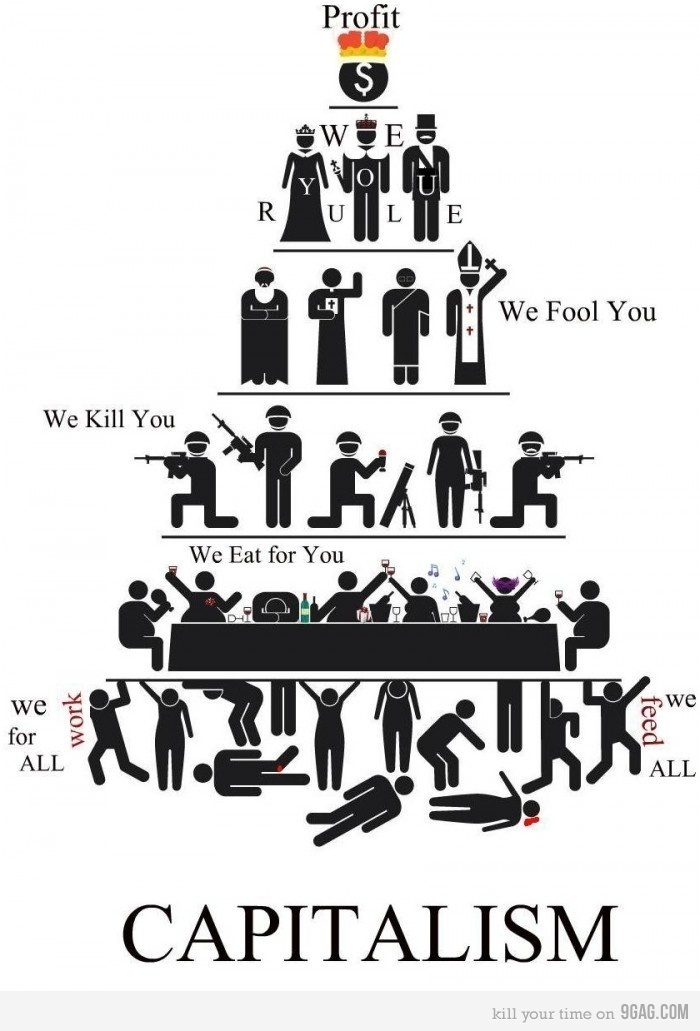
medium_Capitalism

“Marxists see the state as a form of class rule. It is not a free floating entity above the messy reality of class conflict but rather a tool for suppressing the exploited, that is, an organisational tool of those in control of the means of production. For much of history, this is essentially an accurate description and it remains fundamentally true to this day. In Ireland alone, the continuous and truly massive transfer of wealth from workers to capitalists arising from the latter’s losses in property speculation is a graphic illustration of the balance of class power.”

“. . . But modern society is more complicated than pre-capitalist social formations. The exploited are not as powerless and thus have gained a measure of influence over the state itself, the degree of which depends on the balance of class forces at any given juncture. The strength of the working class in Europe over the 20th century is reflected in the significant gains that it made, winning concessions on everything from maternity pay to lower retirement, from national health services to a reduction in militarism.”

“The western state is open to influence by other sectors. That is, it is dominated by capitalists and will, when push comes to shove, tend to favour their interests rather than those of other sectors. That tendency, however, demonstrates not that the state is intrinsically structured to deliver capitalism but that the social dominance of the capitalists manifests itself in the political choices made by those who control the state. Capitalist control of the investment process is key because most states are dependent on capitalists for a functioning economy, which itself is necessary to keep its population relatively satisfied and to generate income via taxation.”

“The state’s own capacity to reproduce itself, then, is dependent on capitalist investment but importantly it is not itself a capitalist formation as is proven by the existence of non-capitalist sovereign powers throughout history. The state, as a powerful entity with a distinct history and a degree of freedom regarding accruing resources, could attempt to usurp the capitalist position by supplanting its role in the investment process. Indeed, that is what we largely advocate. . . and a process of democratisation of the state is best seen as a parallel process to democratising the ownership of capital itself, rather than as either as a precursor or a successor to it. Until that balance of power is altered there is little reason to expect the state to escape its subservience to the needs of capitalists.”

“The state, in other words, does not operate on capitalist lines. It operates in a capitalist context. . .  The state is not, then, an eternal verity destined to contaminate all those who touch it but rather a site of struggle that reflects the balance of forces in wider society. It is a tool whose usefulness depends very much on who is wielding it and for what purpose. . . . but even if the premise of the state as an intrinsically capitalist one does not hold up, there is the further issue of whether its form in the advanced capitalist countries is so antithetical to socialism that it is of little use in the project of socialist transformation.”

These are the views of Gavin Mendel-Gleason and James O’Brien on the state.  In summary they say that the state has become more complicated, and so it has, and give its welfare functions as evidence of this.  The state has had a long history and has not always been capitalist and nor is it intrinsically capitalist now.  Rather it is open to pressure from forces in society, including the working class.  However the role of investment by capitalists, on which the state itself depends for functioning, means that the state tends towards supporting capitalism.  This however can be changed as both the state and capital is democratised with democratisation of the former being the means to democratise the latter.  So much so that it can be used to transform current society into a socialist one.

The view of Mendel-Gleason and O’Brien is essentially of a rather passive reflector of outside forces that has developed its own interests but which is a powerful mechanism that can be employed to revolutionise society.  Not altogether a very consistent or coherent analysis.

Let’s take the role of investment which Mendel-Gleason and O’Brien say is the key question.

Why is it that only the capitalists invest and so can influence the form of the state and how it operates?

This is because capitalism rests on the exclusion of the working class from ownership of the means of production.  When capitalists invest they also buy the labour power of workers and in order to make a profit, to extract surplus value in Marxist terms, they must pay workers less for the labour they perform than is included in what they produce.  The value of the labour performed by workers that they receive in wages is less than the value of the goods and services they produce.  This surplus value pays for the state among other things.

This arrangement seems natural and democratic since no one is compelled to work for any particular employer, can start their own business if they want and can ask for higher wages if they think they deserve more.  They enter into an employment contract voluntarily and as citizens with equal rights.  The state sets laws which reflect and guarantee this natural, democratic and equitable arrangement.

Mendel-Gleason and O’Brien can presumably see that the process of investment is but one part of an economic arrangement that places some with the ownership of capital and the many without and that this is neither natural or democratic nor equitable.  The role of the state is to protect this system so why can they not see that it too is neither natural or democratic or equitable but is rather intrinsically oppressive because it is based on the capitalist system itself?

If the state more and more took over the role of investment, i.e. took over the role of employing workers to produce surplus value, it would not be democratising capital but itself becoming the capitalist.

The apparent harmony of the capitalist system is exposed when  workers challenge the right of capital to exploit them either through strikes, occupations, pickets or pursuit of any restriction on capital that the owners of the means of production find unacceptable.  The state in these cases protects strike breakers, expels workers occupying workplaces, restricts or attacks pickets and allows sometimes the most egregious behaviour of capitalists to go unpunished.

The state will often sacrifice its own tax revenue to defend capitalists and in the case of the Irish state will see itself go bankrupt to bail out native and foreign bond holders and the banks.

What the state does not do, and has never done, anywhere and at any time – even in periods of mass working class pressure when Mendel-Gleason and O’Brien say it should – is organise strikes, attack strike breakers, plan occupations and pass laws that threaten the profitability of capitalism.  Sometimes, in extremis, it will nationalise capitalist concerns but since the state is itself capitalist this can easily be reversed, as it has been so many times.

The harmony of capitalism is therefore undermined by class struggle and the state exists to resolve this conflict.  Since this conflict can be resolved in ‘normal’ and peaceful periods through negotiation or compromise the state will support this.  In periods of crisis when it cannot be resolved the state will apply its force to defend capitalism.

In normal times the basic legitimacy and rules of capitalism are not contested so resolution means defending capitalism by default.  In periods of crisis workers break the rules and the state, as rule maker, must defend these rules or see its role destroyed so that defending itself is coincidental with defending the capitalist system on which the rules are based.

Since the rules apply to everyone and, as we have said, the economic system seems natural, democratic and equitable the rules and the state that defends them appear not to be defending any particular interest but the general interest, the national interest.  Workers who break the rules are charged with attacking the national interest, which is one reason why socialists are so opposed to nationalism since it binds workers to a state that defends and protects their exploitation.

So the state does indeed reflect class struggle but it is the means by which one class deploys the overwhelming power it disposes of in society, by virtue of its monopoly of the ownership of the means of production, to dominate and suppress the class of workers on whom it relies to expand its capital.

As law maker it sets rules which can only be consistent with the dominant mode of production and which are ultimately enforced by the most openly and patently reactionary arms of the state – the police, army, prisons and judicial system.  By these rules, as the old English saying goes:

They hang the man and flog the woman,

Who steals the goose from off the common,

Yet let the greater villain loose,

That steals the common from the goose.

The capitalist state therefore appears to be autonomous from any particular economic interest but the essential characteristic of the state is not its autonomy but its class character.  This autonomy is often exaggerated by Marxists and it is not uncommon for particular capitalist class interests to dominate to the detriment of others.  Political history is replete with conflicts between various sections of the capitalist class – industrial versus landed, large versus small, monopoly versus competitive, national versus comprador and foreign, declining versus growing, financial versus manufacturing.  This is why ideally the state does have autonomy.  But it cannot have it from the system as a whole.

How the state does this is a question of historical development but we must nail the argument that just because the state existed before capitalism and therefore could not then have been capitalist, it is not its class character which is its essential nature.  Before the capitalist state there was a feudal state and sometimes the bourgeoisie fought what is termed ‘bourgeois revolutions’ in order to make the state a capitalist one.

In these cases the transference of power was one from one exploiting class to another while socialism is the taking of power by the exploited majority.  That is why it cannot be achieved by simply taking over an oppressive and exploitative mechanism and developing it into a mechanism of liberation and freedom.  But we shall come back to that.

The debate on socialist strategy and the Irish Left – Part 2

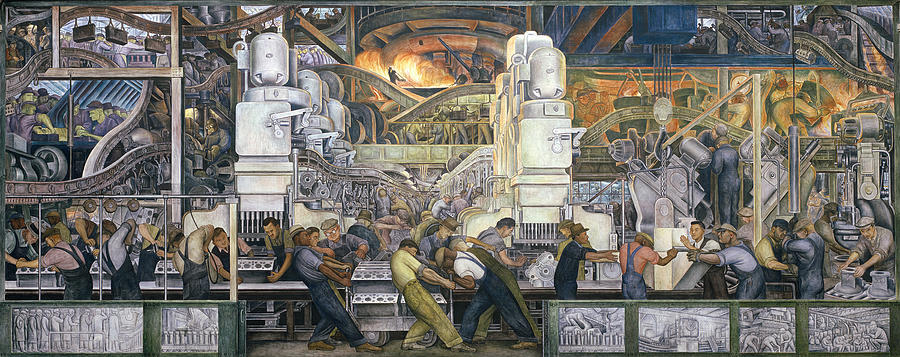
detroit-industry--north-wall-diego-riveraIn the first post I looked at those aspects of the Mendel-Gleason and O’Brien argument that I thought were broadly correct.  In this part I want to look at their other criticisms of what they see as the revolutionary approach and what I see as valid in their criticisms of what passes for revolutionary Marxism but what I believe is not necessary to it.

They state of the revolutionary approach that “destruction of the state is the order of the day, with the point of note being the sequence: first, the state, as the godfather of capital, must be taken out of the equation; only then can the working class organise, through new forms such as workers’ councils, the mass participation in public life necessary to the complete the journey to socialism.”

“Until a revolutionary situation arises in which the state can be smashed there are limits to what can be achieved on a mass scale since it is the process of revolution itself that draws the masses into public life.”

“The party that revolutionaries seek to build interacts with the masses during the revolutionary process and is the repository of the historical mission in less propitious times. But the revolutionary party itself has a different role than the workers councils and remains separate from them and pre-revolutionary mass organisations.  By separate we mean institutionally distinct, not that they never try to influence them.  Although naturally a pro-insurrectionary party would like to grow, it doesn’t aim to win a majority support for itself. . .”

“If anything the creation of permanent mass institutions becomes a fetter which prevents a revolutionary overthrow of capitalism by the treacherous actions of its bureaucratised leadership when the hour strikes.”

It is not that Mendel-Gleason and O’Brien are unaware of the dangers of bureaucratisation in the building of a socialist workers’ movement: “Clearly there is a danger that the day-to-day concerns force the grand vision into the background. Such is the risk of engaging with reality. But without being able to relate the day-to-day with the longterm project, the proponents of socialism will remain very isolated intellectuals.”

Mendel-Gleason and O’Brien also make criticisms of what they see as the anti-party and anti-political mindset of those who advocate workers’ councils but since I think this criticism is aimed mainly at anarchism and perhaps council communists I won’t take these arguments up.

If we work our way backwards through the criticisms above the first is the danger of bureaucratisation of workers’ organisations, especially through the long years (decades!) of non-revolutionary circumstances.  They are right to say that to try to seek to protect against this by avoiding the day-to-day concerns and small struggles of working people is failing to engage with reality.

We must start from where we are and not where we might want to be.  This might seem so obvious as to hardly require saying but take this from the British Socialist Workers’ Party article referred to in my last post:

“Who, after all, thinks that ‘in the present situation’ in France (or anywhere else) workers are going to try to centralise the power of their workers’ councils? The very precondition of such a development is that the ‘present situation’ has changed. The idea of revolution in a non-revolutionary situation is absurd. Every revolutionary situation has involved a split within the existing state apparatus and the existing ruling class. A revolutionary situation involves a crisis for the state, a loss of effectiveness. Without such a crisis there can be no revolution: that is part of the ABC of Marxism. It is precisely the crisis in the state which permits the emergence of a situation of ‘dual power’ and the possibility of a new form of state power conquering.”

The reformist approach to socialism is criticised by this writer for believing “the transition to socialism is to occur from the ‘present situation’ and without ‘economic collapse’.  In practice . . .  all reformists—seek(s) to construe a transition to socialism from the ‘present situation’.”

In other words revolutionary politics comes into its own when there is a revolutionary situation.  But of course how we get to this situation, how the working class is ready for it, how it has built its power and consciousness to the point where it can successfully challenge for power – all this has to be done precisely from the present situation.   After what has been decades in which there has patently not been revolutionary crises in the advanced capitalist states it is manifestly not enough to say that when such crises eventually erupt – although they will not even erupt without a prior revolutionising of working class consciousness, organisation and social power – we need to smash the capitalist state to effectively respond to the needs of such events.

Without a prior strategy to build up the power of the working class it will in all likelihood not be in a position to effectively challenge for power no matter what objective crisis capitalism undergoes.  The merit of the Mendel-Gleason and O’Brien argument is that they present this problem and it is the responsibility of Marxists to address it even if these authors use it as an argument against revolutionary destruction of the capitalist state.

There are other less crass ways of Marxists failing to engage with reality, such as demanding that campaigns or activity must meet some level of demands and therefore class consciousness that workers patently cannot rise to, at least not in current conditions or with the current level of political consciousness.  Some sections of the Left can then turn political demands not into bridges to advancing political consciousness but obstacles to action and subsequent rise in consciousness.

It is no doubt true that part of the reason for this is a belief by Marxists that the purpose of Marxism is to promote a revolutionary rupture and so seek to further this by advancing demands associated with partial struggles that if accepted by workers in such struggles can more or less quickly objectively clash with the logic of the capitalist system and therefore lead to revolutionary crisis.  The only problem of course is, as we have said above, it should be obvious that workers are many years from being in a position to perform such a role.  That many, many struggles cannot have a perspective of more or less raising the question of state power is hard to accept.

But it must be accepted because without being with the workers, no matter how backward their consciousness, socialism, real socialism, the socialism which is about the power of workers and not of the state, can by definition achieve nothing.

There are no formulas that guarantee this but it is important to dismiss formulas that guarantee against it.

Of course most left organisations claiming to be Marxist make the opposite mistake of dumbing down socialism so that it becomes an appeal to the state to accomplish what the working class is not yet willing or able to accomplish itself.

It is my view however that revolutionary politics not only exists in periods of relative class peace but must exist in such periods, if only because we have lived through decades of non-revolutionary conditions and the level of working class organisation and consciousness is now such that we cannot expect that this will be changed quickly.

Mendel-Gleason and O’Brien put forward similar ideas, without the view that revolution is necessary, but their argument is not always consistent.

Speaking of the tasks of the socialist movement now they say that: “We want to merge the socialists into mass organisations so that ideologically socialist parties exist on a truly large basis over a prolonged period of time, for decades at least, for centuries if necessary.”

But this sits uneasily with recognition of the dangers of bureaucratisation of the workers’ movement and how this weakens their case for a long term strategy of attrition: “The pressure of the wider pro-capitalist culture combined with the tendency towards increasing conservative apparatus makes the strategy of attrition a risky one. There is a race on between the socialist organisations aiming to transform capitalist society before capitalist society transforms them.”  A race lasting centuries?

Part of the problem Mendel-Gleason and O’Brien have is expressed in their description of their own strategy:

“The strategy of attrition is, therefore, compatible with a type of politics that is close to where many people already are. Its radicalism lies in its goals, not in its practice and this makes it easier to interact with non-socialists on an open basis. There is no need to hide its insurrectionary orientation because it doesn’t have one.”

The separation of goals and the practice of getting there inevitably means a failure to achieve the goals or leads to a different practice.  The view that socialism can be delivered by the state taking ownership of the economy, or redistributing wealth, does not lead to the working class achieving power but the extension of the power of the state.

Revolutionary politics therefore involves workers achieving what they can achieve by themselves.  The revolutionary content in any demand, or action or programme is the growth in the independent power and consciousness of the working class.  This obviously achieves its fullest extent when workers challenge for state power by attempting to destroy the state power wielded by the capitalist class and by creating its own.  But this does not prevent, rather it requires, years of workers learning that it is their own action that will deliver them what they want and what they need.

Building an independent trade union is more revolutionary than calling for increased taxation of the rich by the state even if some success attends the latter.  Creating a workers’ cooperative is more revolutionary than calling for the nationalisation of the banks even if banks, as they have been, are nationalised.  Workers fighting to control their own pension funds and taking them out of the hands of the bankers is more revolutionary than demanding that the state jail the corrupt bankers.  The latter happens in the US and the trial of the Anglo Irish bankers has begun.  They get jailed?  How does this advance the independent power of the working class?

We are now able to see how revolutionary politics is compatible with the long years of relative class peace as well as revolutionary crises.  We can evaluate political programmes as more or less revolutionary or reformist without being obliged to speculate on near-hand revolutionary crises.

We can say with Marx that:

“It is not a question of what this or that proletarian, or even the whole proletariat, at the moment regards as its aim. It is a question of what the proletariat is, and what, in accordance with this being, it will historically be compelled to do.”

But what the working class is and what it therefore does depends on its own existence, its own struggles and not on the actions of the state and those who inhabit it.

Much of the ‘transitional’ character of Trotsky’s transitional programme, upon which for many revolutionary politics must rest, does not connect the class struggle to the creation of an entirely new socialist mode of production.  This was something we saw in the first post and taken up in the comment to it.

That which does, the expropriation of capitalist enterprises, is wrongly bastardised into nationalisation by the capitalist state, see my earlier post.

We can now therefore look again at the description of revolutionary politics from Mendel-Gleason and O’Brien which we quoted earlier.

It is not necessary for revolutionary politics to claim that only revolution that can bring the working class into mass participation in politics.  Building workers cooperatives, trade unions and a workers’ political party are all necessary to stimulate and develop working class consciousness and organisation.  A revolution is not necessary for any of them.

It is a truism to say that only revolution expresses this participation to its fullest extent but even here the prior establishment, development and political defense of workers ownership requires certain levels and type of workers activity that political revolution is not a substitute for.  Cooperative production involves the working class learning the skills and experience of the future mode of production.

Revolutionaries do have to separately organise but this does not necessitate institutional separation in terms of a completely separate party.  Revolutionaries can seek to win a majority of the working class prior to a revolutionary situation.  It is not a fetter to win the majority of the working class to socialism; even if the majority of the working class did not actually support a revolutionary perspective.

The dangers of bureaucratisation and conservatism are real but deliberate minority status of the revolutionaries doesn’t protect either this minority or do anything to win a reformist majority.  Often of course reformist leaders will not give revolutionaries the choice of working within a larger reformist working class party but it is no answer to seek separation if revolutionaries are otherwise free to organise.

Revolutionaries do not believe that it is only after the working class has smashed the capitalist state that it can organise or we would have a classic chicken and egg situation – we can’t destroy the capitalist state until we are organised and can’t organise until we have destroyed the state.

It is in fact my argument that it is precisely the view of Mendel-Gleason and O’Brien, of attempting to use the existing state to create socialism and to organise primarily through electoralism, that restricts and limits the participation of workers in political activity and heightens the bureaucratisation of the workers’ movement.

It is obviously true that socialist revolution has not succeeded during the twentieth century but it is also true that this has been partly because the workers’ movement has been bureaucratised by and through the capitalist state that Mendel-Gleason and O’Brien think is the answer to the former failure.  And the strategy that produced this bureaucratisation was one of seeking election to office within the capitalist state when the working class was in a position only to administer capitalism not overthrow it.

In the next post I will look at the Mendel-Gleason and O’Brien view of the capitalist state some more.

The debate on socialist strategy and the Irish Left – Part 1

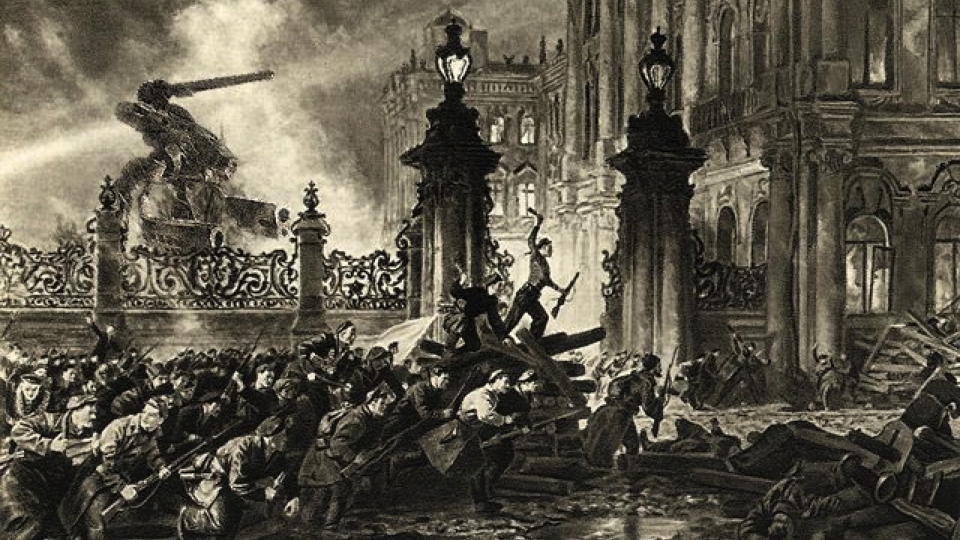
revolutionA couple of leading figures in the Irish Left Forum , Gavin Mendel-Gleason and James O’Brien, have written an extended piece on socialist strategy published here.   This has been subject to a ‘health warning’ and a critique on the Revolutionary Programme site here.  The latter is carried out mainly by simple reference to large quotations from Marx, Lenin and Trotsky.  The author gets away with this approach because these quotations are so apposite.

I welcome the intervention from the members of the Left Forum for the following reasons: They propose a strategy and practice that is already that of the Left groups in Ireland who claim to be Marxist.  The latter’s arguments are that the capitalist state can play a progressive role in the movement to socialism and that the main activity that workers and socialists should engage in is electoral intervention.  The left groups demands for nationalisation, increased state expenditure and taxation of the rich plus activity geared excessively to elections are evidence of this.

The difference between these groups and the Left Forum authors is that the latter put up an argument for such an approach.  Since it is common on the Left not to bother with such things this is to be welcomed.

The second reason is that the arguments put forward are important and some of them are correct.  These are not addressed in the reply noted above so I believe that some of the most important issues which they raise have not been adequately answered.

The third reason is that a debate on strategy is to be welcomed and if there is to be a debate there will be differences.  We should develop an ability to discuss them.  If we don’t or can’t then future initiatives at uniting socialists will be as unsuccessful as those in the past.

So what are the arguments and issues raised that are important and by and large correct? These are made mostly in the second part of the Mendel-Gleason and O’Brien piece.

The authors make the entirely valid point that “when capitalism tottered in September 2008 there wasn’t the slightest question that there was an alternative economic system that could step in and immediately take over.”  What this means is that we do not have an alternative, to be exact – an alternative that is both global and immediate.  We do have one that can grow and develop but not one that can challenge the capitalist system now.

It was lack of an alternative that explains why workers accepted, some even voted for, the imposition of manifestly unfair and hurtful measures in the EU referendum in Ireland in 2012.  In the post after the referendum I argued that it was precisely this lack of an alternative that was the main reason for the defeat in the austerity Treaty referendum, despite workers’ anger and frustration at what they were being asked to endorse.

is an expression of the weakness of the workers’ and socialist movement existing more or less everywhere, which Gavin Mendel-Gleason and James O’Brien also note. Their argument is that the perspective of a workers’ revolution to overthrow the capitalist state and usher in socialism is mistaken.

In making this argument they make some valid observations. They finish their analysis by saying, although they could have started it from here, that “Our short-term tasks do not involve overthrowing capitalism — a mode of production cannot even be overthrown. . .”  By this I assume that they mean that the capitalist mode of production cannot be overthrown without it being replaced (unless we envisage ruination as Marx put it in The Communist Manifesto) and it is the latter that is important, which might seem an obvious point except the question arises – replaced by what?

In the model of socialist revolution this is usually thought to mean replaced by ownership of the means of production by a workers’ state.  But states are just people organised in a certain way so how is this group of people to know how to run an economy and do so better than the capitalists if they have never done it before, have no practice and no plan to do so?

They have no plan to do so because the typical scenario for revolution is that it is a revolt against attacks on workers’ rights and not a conscious offensive to change the mode of production, which rather simply appears as a by-product of the need to smash the capitalist state through a mass strike and the creation of workers’ councils.

Some advocates of revolution accept this argument and therefore accept that socialist revolution will lead to economic collapse.  And although of course this is only temporary, a bit like a loss of form where your football team drops a few points – before going on to win the league, the prospect seems far from one that will sell socialism to most workers.  In fact it sometimes seems entirely light-headed and the product of a mentality entirely alien to most workers.

Take this example from the Socialist Workers Party in Britain. The writer says this – “we must be clear: a transition to socialism, to the complete reorganisation of society by the working class, cannot occur without ‘economic collapse’.  A socialist revolution involves ‘economic collapse’: the problem is to carry it through, decisively, so that economic recovery on a new basis can be started immediately.”

Let’s be very clear – if the socialist revolution leads to economic collapse it calls into question the readiness of the working class to be the new ruling class in the first place since it obviously lacks the power to prevent collapse and if this is the case what guarantees can there be that it would be capable of reversing it?  Especially “immediately”.

Mendel-Gleason and O’Brien state correctly that “getting past capitalism is an incredibly difficult problem,”  “At the outbreak of mass protest or revolution this is not a problem since the issue presents itself to the opposition in a simple way, e.g. “down with the regime”, “against the 1%”, “they all must go” (Argentina 2001). Sooner or later, however, it becomes necessary to move beyond a simple formulation of the problem and to advance structural solutions. “

“This transformation to socialism can only come from the working class having a pre-existing organisational capacity to take advantage of these developments, especially in the most advanced countries, of which the United States is currently the most important. That capacity takes decades to build up and it’s not a process that can be rushed or circumvented by some clever shortcuts and nor should it be.” “Unfortunately, it’s simply not possible to get big and capable institutions in one go.”

This seems obviously true and it is the necessity to build up the working class movement to such a position to effect revolution that is the task. Unfortunately this is not the task that Mendel-Gleason and O’Brien seek to solve by the strategy of increasing the power of the working class for they see the above problem as one that means that a revolutionary strategy is not appropriate.

One reason they posit for this is that the division of labour within modern economies has so developed that the intricate coordination necessary cannot arise from what is an essentially spontaneous process of revolution.  This view might therefore legitimately say that simply trying to make a virtue of this fact by admitting the inevitability of economic collapse also involves tacit admission of the dangers they see in revolution.

These include diminishing enthusiasm of the masses, because their revolutionary fervour is of recent, and therefore limited, vintage  since otherwise we would have had decades of a revolutionary situation, which is hardly credible.  This would be exacerbated by the drop in living standards consequent on ‘economic collapse’ and a similar consequential fall in political support for the revolutionary process.

These seem reasonable objections and it is up to those who defend and argue positively for the revolutionary overthrow of the capitalist state to present their strategy in such way that it plausibly answers this criticism. Before we look at this aspect however we should note other correct arguments advanced by Mendel-Gleason and O’Brien.

They rightly argue that there is “no shortcut to building up mass, popular organisations” and they are guilty only of exaggeration when they say that “in the absence of mass socialist-labour institutions workers’ capacity for action is restricted to protest and destruction.”

Protest demonstrations are the staple of left group activity and their electoral interventions are also a pure protest since they nowhere claim that they will form part of a government if elected. Mendel-Gleason and O’Brien argue that this is not enough “for the project of raising a socialist mode of production to dominance, via co-ops and labour unions.”

It is on building up this alternative that they concentrate their argument, pointing out the need to build specifically working class organisations , as the socialist movement used to do before the functions these organisations performed were taken over by the state and the majority of socialists took to believing that state action was somehow equivalent or substitute for working class self-activity. They point out the need for working class mass media and to the early history of the German Social Democratic Party and its ‘eco-system’ of social clubs, publications and summer camps etc.

They point out the failures of the Left’s favourite tactic of ‘single-issue’ campaigns which, besides usually being sectarian and right-ward looking fronts of one particular organisation, are incapable of getting beyond a single issue, incapable of broader radicalisation “so that when that campaign is over, irrespective of whether it has ended in victory or defeat, the next campaign must start from the same low basis.” These campaigns are structurally incapable of persisting through time and of achieving the cumulative growth of membership, organisation and consciousness on which alone a truly mass socialist working class movement can be developed

Some remarks on the internal organisation of the socialist movement are also in my view correct although not because of any original insight by Mendel-Gleason and O’Brien or myself.  Thus there is a need to fight for socialism within the working class movement of party, unions and cooperatives using the weapon of “freedom to organise and the freedom to articulate criticism and dissent.”  The petty bourgeois character of much of the left organisations is revealed by their inability to organise democratically.

So what is essentially valid in the argument is that while destruction of the capitalist state might solve the problem of armed reaction by that state (which is no small issue!) “it doesn’t . . . solve the problem of being able to transition to a socialist mode of production.” In the next part of this post I will look at what Mendel-Gleason and O’Brien have to say about the state itself.

Arguments against workers’ cooperatives: the Myth of Mondragon Part 2

mondragon-humanity-at-workIn Part one of this post I looked at the argument that the most famous example of workers’ cooperative ownership involves the division of the working class within the cooperative so that technicians and especially mangers have different views and interests from manual workers.  This is reflected in their relative enthusiasm for the cooperative form.

In fact there is no evidence or argument presented in the book under review that there is a fundamental difference of interest between managers and workers arising from class position within the relations of production, although some evidence that there is differing levels of enthusiasm.

I argued in response that the evidence for the view that there is weaker engagement of workers in the cooperative involves writing off the views of the higher paid workers, some of whom might be called managers, but that there is nevertheless some weak evidence of an unhealthy lack of participation by manual workers in decision making.  In Marx’s support for cooperative production he noted that:

“The co-operative factories of the labourers themselves represent within the old form the first sprouts of the new, although they naturally reproduce, and must reproduce, everywhere in their actual organisation all the shortcomings of the prevailing system. But the antithesis between capital and labour is overcome within them, if at first only by way of making the associated labourers into their own capitalist, i.e., by enabling them to use the means of production for the employment of their own labour.”

The evidence of the book is that some of the most political workers have organised to struggle against some of these shortcomings and have succeeded.  This response of the workers is one that should be supported rather than dismiss workers ownership outright.  To anticipate the whole argument – if workers should not take up experiments in running their own workplace how are they ever to be expected to – in one momentous event called revolution – ever to take over running the whole of society and creation of their own state to protect it?

The actions of these politicised workers show the role that a workers’ party could play in advancing the socialist project within cooperative production.

The argument of the book (The Myth of Mondragon) however is not only that the real workers cooperative, as opposed to the mythical one, divides workers within the cooperative but more especially has resulted in, and was meant to result in, the division of the working class in the local area and within the Basque country more generally.

The argument has already been referred to but it is made up of several components.  The first is that the cooperative has imposed middle-class values on workers by making them, in effect, small property owners.  In this they faithfully reflect the motives and views of the original sponsor of the cooperative in Mondragon, Catholic priest José Mariá Arizmendiarrieta, who was heavily influenced by Catholic social teaching and who sought to ameliorate class struggle through education and co-operativism.  Hence the significance noted in the first post of relatively more co-operators viewing themselves as middle class than workers in a private sector firm.

This fed into the views of Basque nationalism, particularly the bourgeois PNV (Partido Nacionalista Vasco) but also the radical nationalism of ETA, which, like the Irish versions of bourgeois and petty-bourgeois nationalism, liked to look on the Basque people as inherently egalitarian and predisposed to small property ownership which united the nation against the outside enemy, harking back to an original society free of class contradictions that preceded foreign rule.  For the radical nationalists the cooperative could simultaneously be supported by emphasising Basque unity and workers participation, so demonstrating the compatibility of nationalism and socialism while opposing any role for foreign multinationals.

The cooperative was thus a conscious political instrument to divide the working class, which was traditionally militant and socialist.  This division is also exhibited in resentment by some workers in Mondragon expressed in remarks that ‘los cooperativistas’ “have it easy”.

A third element of the argument is that it is no coincidence that the cooperative was set up under the fascist regime of General Franco since both co-operativism and fascism share a desire to negate class struggle.  Cooperatives were also supported by Mussolini and the Mondragon cooperative came into existence only because more militant forms of working class action were illegal and repressed.

The author of the book refers to the first criticisms of Mondragon by ETA which accused the Mondragon cooperative of dividing the local working class between co-operators and the rest because the cooperative workers did not want to engage in strikes with their fellow workers.

What is to be made of these arguments?

The argument that the cooperative workers have bought into the illusion that they are middle class is not strongly supported by the evidence in the book but if they did they would not be alone because such identification is not uncommon amongst many better off sections of the working class.  That through the cooperative, through their ownership of the firm, there is some basis for such a view is reflected in the quote from Marx above, that the workers make themselves their own capitalist.  However, this has not prevented workers expressing solidarity with their fellow workers or being sensitive to inequality within the workplace. Objectively their position is a transitional transcendence of capitalism but a very partial one, the more partial the more isolated it is, and cannot provide on its own guaranteed grounds for the development of socialist class consciousness.

This needs to be fought for by a working class party.  The class struggle is not abolished by cooperatives but is a means to pursue it and a battle ground on which to wage it.  The question is whether this battle involves growth and development of the cooperative form or not?  The answer for Marx was clear:

“. . . however excellent in principle and however useful in practice, co-operative labour, if kept within the narrow circle of the casual efforts of private workmen, will never be able to arrest the growth in geometrical progression of monopoly, to free the masses, nor even to perceptibly lighten the burden of their miseries. . . To save the industrious masses, co-operative labour ought to be developed to national dimensions, and, consequently, to be fostered by national means.”

That the Mondragon cooperative was sponsored by a Catholic priest should no more be a reason for condemning it than should the Bolsheviks have condemned the demonstration led by the Russian Orthodox priest Father Gapon, which sparked the revolution in Russia in 1905.

That cooperatives have existed under fascist regimes does not demonstrate that they are essentially instruments of fascism any more than it demonstrates that fascism is the essential expression of cooperatives.  In Italy Mussolini’s fascist thugs terrorised and burnt cooperatives before making them subordinate to the fascist regime.  In Spain the dictatorship of Franco could allow isolated cooperatives to the extent that they did not follow the path, recommended by Max to the First International above, that they expand and combine to develop nationally and indeed internationally.

The example of fascist sponsorship or acquiescence is but the most extreme warning to workers that the potential for their independent initiative should not be compromised by seeking the sponsorship of the capitalist state, no matter how democratic its form.  The revolutionary content of workers cooperatives, whatever its workers might believe at any particular point in time, is that they represent the independent actions of a class that is taking measures that undermines one pillar of existing society, which is the monopoly of the means of production in the hands of a separate class of capitalists.

The need to expand is not limited to national growth but is practical demonstration that workers ownership can only succeed internationally.  So far from supporting any form of nationalism it is practical vindication of the need for workers to reject national solutions, and not just at some future point in time but now.  Workers’ ownership should be extended internationally not tied to some view that workers are part of a purely national development of a specific country and its particular state, especially when this state is inevitably a capitalist one.  Workers of different nationalities united by ownership of the one enterprise with different workplaces in different countries would be powerful demonstration of unity of interest and practical international solidarity.

The first criticisms of ETA reflect a common view on the Left, which appears to be endorsed by the author of the book, which is that the struggle of trade unions against employers is a better model of class struggle than the development of workers’ cooperatives.  Hence the criticism that the cooperative workers often did not go on strike, even though the author quotes a local militant expressing the view that this is perfectly understandable.

Who would they be striking against?  If the purpose is not to influence or pressurise their employer, which is themselves, then it would be part of a movement to demonstrate support for particular demands and the strength of feeling and organisation behind those demands.  In that case this is what demonstrations and meetings are for.

In themselves trade unions do not exist to undermine capitalism but to enforce its operation by acting on one side of the supply and demand of labour power which sets its price.  It enforces the laws by which capitalism regulates workers alienation from ownership of the means of production, it does not in itself threaten it.  Strikes can be seen as a simple refusal to sell labour power for a period rather than an existential threat to the wages system itself.

Would Left critics criticise strikes that demanded workers ownership of their firms?  Or would this be seen as a demand not actually to be realised but one only useful in so far as it leads more or less quickly to revolution?  In which case what would they say if some workers, but not all, actually succeeded – fuggedaboutthat and let’s start all over again?

None of these points negate the argument that trade unions might not be helpful for cooperative workers in order to assist them in both elaborating alternative plans for their coop or to protect them against the actions of management. Particular interests of workers are not guaranteed by workers ownership but we should not believe that trade unions are somehow superior forms of workers’ organisation and representation than the organs of the cooperative.

The latter will be composed of all the workers while the trade union will usually not.  Trade unions are not inherently more democratic as the current bureaucratised organisations show.  Nevertheless for particular workers or in particular circumstances they may be useful in representing the interests of some workers even against the majority.  These workers need not be more backward but could be more advanced and we should not necessarily believe such organisation is required because the unions are needed to represent workers in the same way Lenin claimed they were required as protection against their own bureaucratised state.

The book recalls a significant strike in the Mondragon cooperative in 1974 sparked by job regradings and the system for their evaluation.  The strike only lasted one day, following a walk-out by some of the workforce, but twenty-four leaders were fired pending a vote of a general assembly of the workers.  When this assembly convened the workers voted to uphold the sackings.  A campaign was launched to let them return which eventually, in 1978, led to their being readmitted.

The strike and its aftermath exposed the political assumptions behind the participants on both sides with cooperative managers claiming the strikers were anti-Basque while some of the strikers went on to join a Maoist-oriented organisation.  Some Left organisations then went on to develop left-wing critiques of cooperativism.

The messiness of such events gives a headache to those who like their politics simple, with workers on one side and bosses on the other.  Simple trade unionism seems to provide for that although simple trade unionism does not go beyond capitalism, much of it is purely sectional and some of it is even reactionary.

Despite the authors apparent approval of this model of class struggle she notes that, contrary to her overall argument, that the “most important factor influencing the local labour movement” was the Moncloa Pact between the Left parties, including the Spanish Communist Party, the trade unions syndicates and the Spanish Government.  This accepted changes to the law which reduced workers’ rights below what had been provided under the Franco dictatorship.

So trade unions are not an anti-dote to workers’ failure to make islands of socialism out of workers’ cooperatives, which can hardly be expected because they haven’t been able to do that for themselves.  The answer is not to see workers cooperatives as alternatives to class struggle but as part of it.  Once again the question is whether the answer lies in expansion of cooperatives or their rejection.

The answer for Marx was that they should be developed.  This is elaborated on in the two posts recommended by Boffy in his comment on the first of these posts on Mondragon.

On their own a cooperative can easily be a capitalist enterprise owned by its workers in which, as Marx says, the workers become their own capitalist.  What makes them a powerful weapon of transformation is their development and growth into a social and economic alternative to capitalism through cooperation between them and their living example of workers’ power.

As isolated coops they are indeed subject to the economic and political subordination of the capitalist economy and its state.  If content to be providers of jobs and income only to their members there is clearly no wider ambition.  However as a cooperative movement determined to grow and develop in other areas of production, both to secure its own future and share its benefits with others, and to provide other cooperative services such as education, health and other socials services, it inevitably poses itself as an alternative to capitalist production and the capitalist state’s provision of services.  It becomes a political alternative because its growth, as an economic sector driven by the needs of its workers and their customers and not by profit, is a real, practical and living example of an alternative economic and social system.

The development of the cooperative sector to become such a political rival and alternative is at least partly dependent on Marxists fighting for such a perspective within cooperatives and for cooperatives to propagandise their alternative.  In Marx’s remarks to the First International he praises workers’ cooperatives and calls for the workers to pursue just such a task:

(a) We acknowledge the co-operative movement as one of the transforming forces of the present society based upon class antagonism. Its great merit is to practically show, that the present pauperising, and despotic system of the subordination of labour to capital can be superseded by the republican and beneficent system of the association of free and equal producers.

(b) Restricted, however, to the dwarfish forms into which individual wages slaves can elaborate it by their private efforts, the co-operative system will never transform capitalist society. to convert social production into one large and harmonious system of free and co-operative labour, general social changes are wanted, changes of the general conditions of society, never to be realised save by the transfer of the organised forces of society, viz., the state power, from capitalists and landlords to the producers themselves.

(c) We recommend to the working men to embark in co-operative production rather than in co-operative stores. The latter touch but the surface of the present economical system, the former attacks its groundwork.

(d) We recommend to all co-operative societies to convert one part of their joint income into a fund for propagating their principles by example as well as by precept, in other words, by promoting the establishment by teaching and preaching.

Let’s see how such a perspective might address another frequent criticism of Mondragon and other cooperative enterprises.  This is that the cooperative further divides the working class through its large use of temporary contract labour, as much as one third of a particular workforce in Mondragon.  These workers are not members of the cooperative with all the rights of membership and obviously have much less job security.  In these circumstances the workers are not their own capitalist, since they do not have membership of the cooperative, and are exploited not by themselves but by others – the Mondragon cooperative.

If it was the case that these workers were indeed needlessly kept on purely temporary contracts it would be open to the most class conscious workers within the cooperative to campaign and seek a vote on their award of cooperative membership.

On the other hand let us assume that the cooperative workforce does not accept this because it views these workers as an unfortunate but necessary buffer against periodic reductions in demand for their products, such fluctuations being an inevitable feature of capitalism.  Then it would not be possible to give these workers cooperative membership because the cooperative could not guarantee their continued employment should demand for the products they make fall.  This might be despite the fact that the Mondragon and other cooperatives seek to move workers around the wider cooperative group in order to protect the employment of their members.

The second class status of the workers could lead to resentment within the wider working class and support for the view that the cooperative workers are indeed a privileged layer that is separate from the rest of the workers.

What is the answer to this problem?

The answer is not obviously to give these workers the same rights as the rest of the cooperative workers for this solves no problem.  If demand does suffer a drop or there is some other crisis in the cooperative, for example if some customer does not pay up because it has gone out of business, the cooperative can choose to keep all its workers on the payroll and then either weather the storm or as a result go out of business altogether.

If the latter is the foreseeable result of the event then keeping all the workers on is a mistake, not only for those workers who could otherwise save their job but for the cause of worker owned production in general.  The whole cooperative would cease to exist when part of it at least could be saved.  If all the workers, including temporary workers, have equal rights how is it to be decided who will lose their job?

If this problem is to be minimised the cooperative should seek to be part of a wider federation of cooperatives so that downturns in economic activity in one area can be made up by possible growth in employment in another.  The larger the cooperative movement the more scope there is to diversify risk and build up reserves to protect its members during crises.  Were this to happen then cooperative production would be seen by workers in the capitalist sector as a real progressive alternative to the insecurity of the capitalist sector in which workers jobs are more or less quickly sacrificed for the profits of the big wigs.

The answer then is not to reject cooperative production but to seek its growth.

In the meantime there are steps that could be taken to defend the rights and position of temporary workers.  The first might be to ensure adequate union organisation and representation for them within the cooperative.  The second might be for these temporary workers to form or be part of a ‘temporary workers’ cooperative themselves, which has a membership across a number of firms that might not all have to be cooperative enterprises. (Just such an idea is proposed by Boffy in the posts referred to above).

In this way the temporary workers would not have to simply rely on the actions of others but would, through their own cooperative employment agency, take some control of their employment situation including building up reserves for bad periods, providing social insurance or job seeking support, including retraining facilities.  Such a cooperative could be the sponsor of a political campaign in defence of the rights of temporary contract workers.

To return to the main argument: the promotion of cooperative production is not an alternative to class struggle but a part of it.  It is the solution to a problem that many of those who believe in socialist revolution believe does not exist.  This problem is that the majority of the working class do not see any need for their own ownership and control of production.  They not only do not see the need for it but even if they did they have no experience of it, nor any particular, in fact any, view of how it would seek to achieve its aims.

The view that running society is something that can be done more or less easily on the morrow of the revolution does not ask why workers would carry out this revolution in the first place or why they would be fit to run things after it.  What is it they would seek to do differently and how could it be done?

Instead the process of revolution, as normally argued, envisages workers rebelling against attacks on their living standards and democratic rights through some sort of politicised general strike which develops into workers councils.  These will then take over from the capitalist state.  What is missing from this is any understanding of socialist revolution as a change in the mode of production.  From one based on profit to one based on use.  From one based on capitalist ownership of the means of production to one based on workers ownership.

We are asked in this scenario to believe that the whole working class will in one fit of more or less violent rebellion against repression etc, seek and know how to implement its own ownership of production but that such strivings should not be encouraged or expressed before the revolution in the growth of workers cooperatives.

There is no need for workers to learn about how to organise production within their own factories and offices.  No need to learn how to manage trade and production between other workplaces and customers.  No need to master how the economy works the better to make changes that benefit fellow workers and fellow consumers.  No need to learn how to compile economic plans within the firm, within the wider cooperative movement and the wider economy.

No need to learn by practical experience the role of the capitalist state in protecting capitalist property against rival workers’ owned property; to learn the need to build their own structures that will defend their plans to develop production as they see fit, and no need to seek to defend their own cooperative property through the overthrow of the capitalist state.

The argument is not whether cooperative production plays a role in the move to socialism but what role that is, over what period of time such production can realistically be expected to develop and what the role is of Marxists in politically fighting for and defending the growth of workers property.

Back to part 1

Arguments against workers’ cooperatives: the Myth of Mondragon Part 1

9780791430040Perhaps the most well-known workers’ cooperative is the Mondragon Group based in the Basque country, famous not only because of its success and longevity but because of its involvement in manufacturing.  Its approach has been recognised by many around the world as an alternative to the capitalist corporation, resulting in numerous visits and studies of its performance and operation from those keen to learn its lessons and apply them at home.  For Marxists it would seem practical demonstration of the claim that capitalists aren’t needed and workers can successfully organise production in a fairer and more equitable way and without abandoning efficiency or the making of goods that other workers would like to buy.  I therefore want to look at the arguments in a book that says that this view is wrong and is based on an understanding of the Mondragon story that is mistaken because that story is a myth.[i]

The myth arises, says the author, by de-contextualising the cooperative from its social and political environment and from its historical origins and development.  The workers of Mondragon are not more class conscious but less.  She quotes approvingly the view, expressed in a separate study of a particular group of workers’ class position, that political and ideological dimensions are often more significant for actual class position than are strict property relations.  When we adopt this perspective things look quite different.  The author presents general arguments around the question of workers’ cooperatives and a particular analysis of Mondragon.  She does so ‘from a working-class perspective.’

I am not knowledgeable enough to make judgements on the particular arguments about the Basque country but I will comment on the evidence for her claims that she presents and the general arguments presented on workers’ ownership within capitalism.

In my view her first mistake is to identify workers cooperatives as part of a spectrum of labour-management cooperation, ranging from quality circles, team organisation, works councils and employee share ownership programmes all the way to workers’ ownership.  All are designed not only to make workers obey management but to make them want to obey.  They involve various mechanisms of labour management cooperation and compare unfavourably with the conflict model that involves militant trade unions facing up to management and representing the workers.

Her mistake is to see workers’ ownership as a model of capital-labour cooperation.  Far from a mechanism for cooperation with management and capitalists it is a model for workers cooperating with each other and in which capitalists, at least within the firm, do not exist.  Its logic is to extend cooperation among the working class and in so doing create the grounds on which a new socialist society can be built and there are no capitalists anywhere.

Of course there is still a management within the cooperative and the model involves various mechanisms for shop-floor worker and management cooperation but it is the workers themselves who can appoint, and if so devised, replace management because it is the workers who are the owners.  Management is accountable to the owners who are the workers.  In a capitalist firm workers are accountable to management.

Of course Kasmir is aware of this but at places within her book she presents the management of Mondragon as virtually a separate class from workers on the shop floor.  As an anthropologist she is sensitive to the differences between the daily lives of workers and managers even where the income differences are relatively small compared to most capitalist enterprises. She sees these relatively small but significant differences in income reflected outside the workplace also reflected in knowledge, responsibility and power within the cooperative.  She notes that it is the cooperative’s managers who are most enthusiastic about the cooperative and that it is they who invariably welcome visitors and present the views of the cooperative’s members to outsiders.

It is undoubtedly true that workers are sensitive to even relatively small differences in income, especially in contexts in which equality is held as a primary virtue and objective.  It was just such dissonance between claims and reality that led to such cynicism among workers in the Stalinist regimes in Eastern Europe.  While workers were supposed to be in power and equality reigned, in the reality that everyone lived and saw the bureaucracy maintained exclusive power and defended all the material privileges that went with it.

It is not the case however that Mondragon is a little bit of Stalinism in the Basque country or economy of the Spanish State.  There is no attempt made to claim this in the book.  In fact the book records that repeated attempts by management to increase the allowed differential between management and shop floor pay have been repeatedly voted down by workers.  Workers have the power to limit the pay of management.  What capitalist firm allows that?  Read the financial press and it is full of complaints that even capitalist shareholders have difficulty doing this in big corporations.  How many votes did the Stalinist bureaucracies in Eastern Europe ever allow themselves to lose?  Unlike in these states the Mondragon cooperative does not outlaw political activity and the author records the actions of a small group of politicised workers who campaigned actively against the management proposal and succeeded.

The author however also reports that workers do not feel the strong identification with the cooperative that might be assumed.  She demonstrates this through a survey in which she is able to compare the attitudes of workers in a factory within the Mondragon Group to those in a similar privately owned one.  These results have been referred to on a number of occasions by people on the Left as justification for opposition to cooperatives, here for example.

Asked in the Clima cooperative whether ‘in your job, do you feel that you are working as if the firm is yours?’ 23 said yes (40 per cent) and 33 said no while in the privately owned Mayc 10 said yes (28 per cent) and 25 said no.  If technicians and managers are excluded the difference between the two almost disappears with 6 in Clima and 5 in Mayc agreeing.  In both therefore the majority denied feeling that they were working as if the firm was theirs.

Asked if they ‘feel that you are part of the firm?’ 34 agreed in Clima and 21 said no while 23 in Mayc said yes and 13 said no.  While a majority in both therefore agreed that they felt part of the firm a higher percentage agreed in the privately owned firm (64 per cent) than in the cooperative (59 per cent).  Again the feeling was stronger among managers within the cooperative.

Cooperative workers did however report that they felt solidarity with their co-workers, 97 per cent in Clima compared to 86 per cent in privately owned Mayc, while 53 per cent of Clima workers compared to 56 per cent of the private Mayc reported that they had participated in a solidarity strike.  The total for the Clima cooperative included 14 managers at all levels.  The author notes that age played a big part in the answer given the decline of such strikes.

To the question ‘is there any competition over salaries/job indexes?’ (indexes denote salary, responsibility and skill levels) 72 per cent in the cooperative said yes while 56 per cent in the private firm said yes.  When asked ‘is there competition for jobs?’ 79 per cent in the cooperative Clima said yes while 56 per cent in privately owned Mayc also said yes.

The author reports that in neither firms did the workers express strong confidence in the organs that represented them – the social council in the Clima cooperative and the workers’ council in Mayc.  Managers voiced stronger confidence in Clima.  Asked if trade union syndicates should play a role in the cooperative 13 manual workers said yes and 11 said no.  Asked if they needed them to support them and assist in getting expert advice to feed into alternative production and business plans 15 manual workers agreed.  Nevertheless though half of the sample agreed to trade union syndicates playing a role, and although individual membership was allowed while syndicate activity was not, only a handful of workers in 1990 were actually members.

Only six co-operators said they would prefer to work in a private firm.  Of those who did not want to change one said “but I would like it if things changed a lot in the cooperatives.”   Another, explaining his preference for a cooperative, said “because in theory we are worker-owners and the decisions are made by the manager as well as the guy who sweeps the floor.”

Finally asked ‘what social class are you?’ 25 per cent of manual workers in the private Mayc said they were middle class while 70 per cent in the Clima cooperative said they were middle class.  It is an argument of Kasmir that there is a tendency for cooperative workers to see themselves as middle class although she says that while this may be the case these workers see clear distinctions between themselves and their cooperative managers.

So what are we to make of these responses?  First we should note that the evidence is not clear cut and sometimes appears contradictory.  So more co-operators than private sector employees felt that they were working as if the firm was theirs, while a higher percentage of workers in the private firm agreed that they felt part of the firm.  More co-operators viewed themselves as middle class – 70 per cent -yet 97 per cent felt solidarity with their fellow workers.  Like all surveys we might not interpret the questions correctly never mind the answers.  Is there more competition for jobs in the cooperative and if there was was this a good thing rather than a bad thing – a sign of the openness to individual progress and a less rigid and restrictive job structure?

The most immediate problem however is that the survey was not representative.  In other words no robust conclusions can be drawn from it.  Only 58 cooperative workers answered the survey, which was only 19 per cent of the workforce.  Only 36 or 6 per cent of the private firm answered the survey.  The cooperative survey was also not representative because it contained a higher number of new recruits to the Clima cooperative, which might explain a lower identification with it.  Cooperative workers were also more likely to skip questions and write in their own answers and the author speculates that this might be evidence of the ‘culture of dialogue’ which exists in the cooperative.

The author is keen to point to the differences of response from manual workers and the technicians and managers, with the latter being more positive about the cooperative.  As we have seen, she endorses the view that ideological and political views might be more important than class position defined by the relations of production.  It is more than probable however, given the income differentials permitted in the cooperative, that these technicians and most managers were simply better paid workers and their views cannot be reduced on that account.  In the present context it would be rather circular to claim that particular ideological views are working class (less enthusiasm for cooperatives) than others (endorsement of workers’ ownership) without some argument as to why objectively cooperatives are not an expression of working class power inimical to capitalism.  To make such a case one would inevitably have to refer to relations of production but this is the approach the author appears to reject.

It would be a mistake however to simply reject and ignore the finding s of the survey because it is unrepresentative, although one could quite legitimately do this.  The author considers the survey important because its findings are consistent with the more informal and anecdotal evidence she has collected in her stays in Mondragon, including her conversations with some of the local people and review of the political debate among the left on the Mondragon experience.

But the same sort of criticism can be made of her evidence here as well.  So she refers to a demonstration in Mondragon over the annual province-wide labour contract for the metal sector.  This involved a ritualistic demonstration and a short strike as sometimes both the workers and business owners “simply go through the motions so that the structure of the contest does not break down.  Thus the strike is not always a genuine struggle between labour and owners but a ritual of class solidarity.”(page 169)

However this year, 1990, only 60 people turned up; many workers did not vote on whether to have a strike; many who did vote voted against one; the demonstration was short, was over in half an hour and “was disappointing for all who participated.”  It obviously graphically demonstrated the overall decline in workers’ struggle in the town and more widely in the Basque country and the Spanish State.  Given all this there is no big point to be made in noting that not one cooperative worker took part in the demonstration (and the metal contract only indirectly impacted on cooperative workers’ pay).  The author notes that co-operators always made some showing in the past.

The argument of the author however is that the cooperative model was a conscious stratagem to weaken the class combativity of the Mondragon working class – this argument, and that the cooperatives divide the working class, will be reviewed in the next post.  At this point however it is worthwhile accepting the possibility that the workers in Mondragon are not fully engaged in the management of the cooperative, might be apathetic and might not have the enthusiasm that we would wish for.

All this could be true and it would not at all invalidate the struggle for workers’ ownership as a crucial and central part of the struggle against capitalism and for a new socialist society.  Only if one believed that the weight of capitalist society could be lifted from workers’ shoulders by the still limited development of cooperatives could it be possible to be either surprised or deflated that the class consciousness of cooperatives workers has not risen to the requirements of socialist revolution.

It should be recalled that socialist revolution is not just the product of such consciousness but its creation and realisation.  Neither is such revolution reducible or possible as a one-off event but is the culmination of long and varied experience.  Since workers ownership and control of the whole of the productive powers of society is central to socialism it should not be a surprise that relatively early and limited steps towards this do not reflect in purity the future that socialists seek.

The Mondragon experience proves that cooperative workers and their political consciousness might not leap beyond that of their fellow workers.  The evidence of the book under review however is that the class consciousness and combativity of the Mondragon workers was not the cause of the downturn in class struggle in the Basque country and Spain but was simply a reflection of it.

Unlike workers in private firms however cooperative workers maintain ownership of their workplace even during such a downturn.  They therefore maintain an economic and social power which they can build upon in the future.  Their example lives on and they have at hand much greater resources to call upon when it is a more opportune time to advance.  All this compares very favourably with the more or less unrestricted powers of private owners and managers in firms stripped of trade unions or in which unions are weaker, thoroughly bureaucratised or in which they have become company poodles.  None of these rather common scenarios invalidates the correctness of continuing to fight for union organisation as part of the fight for socialism.

Perhaps the evidence of this book illustrates that greater trade union involvement might help raise the participation of workers in running the cooperative or that more open and structured involvement of political groups might achieve the same.  The point is that the possibility of this only arises where workers already own their workplace.

 Forward to part 2


[i] ‘The Myth of Mondragon. Cooperatives, Politics, and Working-Class Life in a Basque Town’, Sharryn Kasmir, State University of New York Press.

What the Haass talks failure tells us about Northern Ireland

bruegel3The failure of the negotiations chaired by the US diplomat Richard Haass is a significant failure. This can be seen for three reasons.

Firstly there was widespread initial expectation that an agreement would be reached – these talks are always carefully choreographed and why else had the Democratic Unionist party and Sinn Fein set it up?  .  Later it was equally widely assumed that some fudge would emerge.  In the event no agreement was reached.

Secondly, all the participants declared that the talks were not a failure; all keen not to be seen to be the party responsible for the failure.  If they were unimportant this would not have mattered.

Lastly their importance can be seen by recognising why they were required in the first place – because the issues they were to deal with have led to a year of low level conflict and proved the last bit of grit that was gumming up the works of the Stormont administration.  Over the last year it has been increasingly impossible to maintain the pretence that the governance put together by the Good Friday Agreement was working even minimally.  Ministers were taking each other to court, the smell of corruption was getting more rancid, meetings were not taking place and one representative from the DUP tweeted her approval of the killing of a fellow Sinn Fein MLA in Government.

The latter was a direct result of the bitterness created by a year of loyalist demonstrations against the decision of Belfast City Council to fly the union flag over City Hall on only designated days instead of all day, every day.  Apparently this was the last straw; a challenge requiring a demand for No Surrender; a provocation that required movement by not an inch; the final step in the war against the Protestant, Unionist and Loyalist People; one that required that this people stand in defiance because they could do no other.  In other words this supposedly existential crisis, like every other of Irish loyalism, invites ridicule before everyone is expected to take the grossly exaggerated claims seriously before then being gently told by the British State that they should be accommodated.

The three issues that the talks dealt with were the legacy of the past, flags and emblems, and parading.  The past is not about the past but about the nature of the present.  Flags are the symbols that represent this present and parades are the street-level reality of the symbols.

It was widely reported that the talks collapsed because the most extreme fringe of loyalism  that has been behind the flag protests would not accept a code of conduct for parading, something the DUP and Sinn Fein had previously agreed to in principle.  Such a code might have outlawed paramilitary displays and other unacceptable behaviour.  The unionist parties were not quick to deny this.  The right to parade past Catholic areas by loyalist paramilitaries, while they are also engaged in drug dealing, extortion and intimidation – mostly of the communities they live in, is the apparent reason for the failure of the Haass talks.

There is some truth in this despite what it says about the character of the Northern Ireland State, which cannot function with any sort of consensus because this consensus must reconcile itself to the most blatant displays of naked bigotry.  This cannot be too openly admitted but what we see is the proverbial emperor’s new clothes.

Go to any loyalist parade, say on the 12 July, and you will see serried ranks of smug and arrogant suited men (sometimes women) in bowler hats marching behind temperance banners led by uniformed flute bands, sometimes named after a sectarian killer, playing sectarian tunes to the beat of drums pummelled as violently as it is possible.  Surrounding and following the parades will be hundreds of drunken youths in various stages of stupor.  This is what you see and appearance faithfully corresponds to essence.

Loyalist parades contain the worst of the petty bourgeoisie and what Marx would have called the dangerous classes.  The make up of the latter can be seen in newspaper reports of the court cases dealing with those arrested at loyalist parades.  These include middle aged men miles from home who have sunk enormous quantities of beer and cannot remember what they have done.  They include Scotsmen who couldn’t get enough of their sectarian fix from attendance at Ibrox every two weeks following the new Glasgow Rangers Football club but have to come to Belfast to worship at the Mecca of bigotry.  It includes bandsmen whose reason for failing to stop playing sectarian tunes is that they are so illiterate they could not read the feet-long neon signs put up by the police telling them to stop.

Such classes exist everywhere and are a tribute to the worst aspects of capitalist society.  What differentiates Northern Ireland and makes its politics so incomprehensible to outsiders and so intractable inside is that these classes and their reactionary political representatives are sponsored by the State because they are the most vocal and enthusiastic supporters of the State’s existence.  This is not so much important as vital when the existence of that state is explicitly or implicitly continually in question.

The main force behind the crisis thrown up by the flags dispute has been the Ulster volunteer Force, which must have hundreds of members and a few thousand followers.  It has been repeatedly accused of sponsoring the riots surrounding the dispute, especially in East Belfast, and the conspicuous lack of action by the State’s police force has led even supports of the police to question just exactly what it is up to.  Collusion between the police and loyalist paramilitaries is not so much suspected as assumed and mountains of evidence in the recent past has shown the police arm, direct and facilitate loyalist murder gangs.  Even after massacres of plainly innocent civilians agents of the police responsible have had their payments from the police increased.

Most recently murals on house walls of armed UVF men have been painted while the police claim there is nothing they can do about it unless someone complains.  Such action is of course illegal – try painting your neighbours wall magnolia and you will soon find out.  The approach of the Police Service of Northern Ireland however, if consistently pursued, would leave murder as a legal activity unless the victim made a complaint.

The lack of action has emboldened loyalism.  When they come under some political pressure because of their drug dealing (or shooting of a young woman reported to be an ex-girlfriend of a UVF boss)  the police have issued statements, after much delay, to state that although such and such an attack  was carried out by members of the UVF it had not been sanctioned by the organisation’s leadership.  So that’s all right then.  The police present public alibis for the criminals that the criminals don’t even claim.

Just how they know this is rarely asked and never answered. However it is obvious that only by having agents within the UVF leadership could this be the case.  Since the organisation remains largely intact the only conclusion can be that the agents of the police are not there to destroy this organisation but to bend it to the police’s will and this requires that it continues to exist and exercise the  power that it does.  Loyalist paramilitaries have their uses and these aren’t to help old ladies across roads or collect litter.

I have explained before how relatively small loyalist organisations appear to exercise undue influence on unionism as a whole and in this case the failure of the Haass talk’s is put down to the upcoming electoral cycle in which being the most extreme defender of sectarian privilege is rarely the road to failure.

The talks failed not only on the issue of parades but also on that of flags and dealing with the past.  The past includes what all the previous peace process deals have represented – not an accommodation with nationalism but a recognition that unionism had won and thus simply stepping stones to majority rule within the North and the retrieval of all the sectarian powers unionism once held at Stormont.

Close acquaintance with Sinn Fein has demonstrated to unionism that deals can be broken; republicans arrested, threatened and insulted; their ministers taken to court and prevented from implementing policies of their own, and Sinn Fein will do nothing.  Nothing except agree with the DUP to call in a couple of Americans and watch while that DUP walks away from its own initiative.

The DUP now say that what nationalism has agreed is nothing but the starting point for new negotiations that will shift the result further to the right.  And when the unionists don’t like that street mobilisations, stewarded by the armed forces of the British state, will shift things further right again.

In a society in which over 40 per cent are Catholic and many Protestants are shamed by the antics of the Orange Order and repelled by loyalist paramilitaries this might seem irrational.  It leads only to increased political instability in the State they seek to defend.  Only the accommodating position of the British rulers, who are the real objects of unionist pressure, make this strategy continue to appear to be realistic.  Unionism cannot use a modern day B Specials or army mutiny to directly enforce its demands.  It can only succeed where the British allow it.

The problem for unionism is that the British will accommodate the most extreme loyalist actions when it feels it is necessary, and it will provide for increased loyalist privilege, but it will not provoke a crisis that will exclude nationalists from any role in administering the State.  This role can become smaller and smaller but the Catholic population is not prepared to accept a return to the old Stormont regime and this is what unionism wants.

In this situation Northern nationalism is not an opposition but merely an obstacle.  The difference?  With an opposition the possibility of defeat exists or perhaps retreat.  With merely an obstacle the possibility of victory is always there.  Sooner or later the obstacle might be removed.

There is an opposition but both the British State and loyalism are blessed by its character.  Republicanism, real Irish republicanism in the shape of what is termed the dissidents, is the major opposition to both but they have learnt nothing and forgotten nothing from a quarter century of armed action.  Such action has not, cannot and will not achieve its aim of destroying partition.

In the past it played a parasitic role on the political struggle, appearing to offer a more militant road to freedom, but ultimately collapsing into the arms of imperialism.  When the gap between its methods and objectives was eventually closed this led not to a re-evaluation of methods but a ditching of the objective.  The building of a united Irish working class movement North and South and within the North itself is therefore a task for socialism.  Only it seeks the liberation of people, the class that will liberate all classes, while republicans seek the liberation of an as yet to exist Irish Republic, in other words a new State machine.

For republicans workers are instruments for revolution while for socialists they are the subject of revolution.  For republicans workers might sometimes be the best fighters for a Republic while for socialists the liberation of workers is the purpose, the means and the objective.

In concrete reality the adherence to militarism by republicans continues to be the alternative that makes the crumbling peace process – that the Haass talks have failed to shore up – attractive.  The prospect of violent political action that substitutes for a political strategy is not at all attractive, except to ideological republicans irreconcilable to British rule and poorer working class Catholics who have gained nothing from the peace process.

This is not an insignificant support but it is not enough to move to a position that threatens British rule.  Instead its actions appear provocative in that they easily allow the British not only to hold them up as the horrible alternative to their own sectarian stew but also to justify whatever repression they consider necessary.  They also provide threadbare cover to loyalist actions.

In this way the armed actions of republicans have only reactionary consequences.  Whether such provocation is meant or is merely considered an acceptable by-product is ultimately of no importance.  The result is the same.  While socialists must continue to debate with those republicans that might listen on their mistaken road of armed action we cannot do so without patiently explaining their failures, the reactionary consequences of their actions and the alternative strategy.

This alternative involves complete opposition to the sectarian parades of the Orange Order, the claims of unionism to sectarian privilege and the protection of loyalist paramilitaries by the British State.

Employee ownership and socialism

coop-klBeyond the Corporation: Humanity Working, David Erdal, The Bodley Head, London, 2011.

The author of this book is clearly not a Marxist and he approves of arguments for workers’ cooperatives that encapsulate ‘good, basic, capitalist thinking.’  He puts forward the view that what he is proposing is, far from being woolly and utopian, not only immensely practical but has been implemented many, many times in many, many places.  It’s sheer practicality is one of its attractions and let’s be clear – the practicality of something is an attraction.  It is a clear advantage for any option that it can actually be implemented.

Much of the Left however recoils in horror at the ideas proposed in this book.  Nevertheless the impulse and development as well as the ideological case for workers’ ownership are forceful reflections of the analysis of Marx, which posits the growing contradiction between the socialisation of production and the private appropriation of this production by capital.

Ironically the author gives an illustration of this contradiction.  He compares the electronics industry in Silicon Valley favourably to that of Boston and accounts for the relative success of the former as a result of the fluidity of the movement of people involved in the industry, lack of proprietorial authority in many of the industries’ firms  and the inability of owners and managers to contain the flow of information within individual companies; all contributing to creative development of products and production.

It is notable, he says, that there is less of a top-down culture in Silicon Valley and that employee ownership has been a major driver in business development.  Companies could not attract good people simply by cash so instead used share options, a form of ownership, to get them to come, work for them and stay in the firm.  This together with the excitement of the work itself became the greatest motivating factors for employees.

The socialisation of production is evidenced by the increasing division of labour in which thousands, if not millions, of products are separately produced across the globe in order to come together as one combined product.  The necessity for this production to take place in a balanced and proportionate way, so that the final product can be efficiently produced, requires co-ordination and planning within and across hundreds and thousands of companies.

In April two years ago the BBC reported that a fire in a factory in the small town of Marl in western Germany had killed two people and affected the production of a resin called P-12, used in car braking and fuel  systems. This threatened car production across the world so that “Earlier this week, more than 200 executives from companies including General Motors, Volkswagen, Toyota and Ford met in Michigan. -. . . The group said that it was clear that “a significant portion of the global production capacity” had been compromised.  After the meeting, the big car companies were saying nothing on the record.  But some sources now say there is a real worry that the potential impact could be serious, including a slow-down in production.”

Such cooperation is planned but insufficiently so.  The inevitable disproportions in production lead not to conscious alterations in levels of production in order to seek balance in the myriad locations but to individual crises of cash-flow or profitability in individual firms and production units, leading to crises and disruption.  Economic and production efficiency is calculated at the individual firm level without regard to the overall system of production, the cooperative system of labour, which is in place.

We saw this through the recent dispute at the Grangemouth refinery and petro-chemical works, on which much of the British chemical industry was apparently dependent.  The economic calculation that was carried out rested solely on the relative profitability of the Grangemouth plant and not on an assessment of the industry as a whole.

Both examples illustrate the contradiction between private ownership of the means of production and the increasingly socialised system of production on which it is based.

An even more dramatic illustration of this contradiction is shown by the following two graphs.  They show the falls in world trade and industrial production following the credit crunch in 2008 compared to the impact of the great Depression of 1929:

World Trade

eo fig 2 eichengreen_2ndupdate_fig1

World Industrial Production

What these show is the dramatic falls in economic activity consequent on the decisions of individual banks and financial institutions not to lend because they did not trust each other to be in a position to pay the loans back.  The huge socialisation of resources that is carried out through the credit system became a prisoner of the private ownership of these credit institutions.  Each feared that the other might be fatally insolvent due to speculation in sub-prime mortgages or old-fashioned overproduction of houses and offices as in the case of Ireland.

What has this to do with the growth of workers cooperatives?  Well, if we  understand that capitalism is characterised by the separation of workers from the ownership of the means of production (including credit) and the ownership and control of these means in a separate class, the class of capitalists, we can see that such a system can exist only by workers gaining their livelihoods by selling their capacity to work on the labour market and using the money received to purchase the means of subsistence that they have just produced (but which are owned by the capitalists for whom they work).  The sale and purchase of these two types of commodities, labour power and means of subsistence, takes place in the market and the economics profession attempts to analyse how the economy works by focusing on how these markets work – without previously understanding or analysing why there is a need for these markets in the first place.

The explanation for this is that workers do not own the means of production and therefore cannot allocate these means or the output derived from them directly, through conscious planning, to satisfy the needs and wants that they have themselves previously identified.  They do not set the priorities for what has to be produced, how and where it is to be produced or consciously regulate the effects of what they produce so that any relative over-production does not lead to a closure of workplaces but to a planned decrease in capacity and switch to other desirable production.

The creation of workers cooperatives is a step in overcoming the separation of workers from the ownership of the means of production and therefore of overcoming capitalism.

Many on the left advance fears that workers will become their own capitalists and because the author of this book is not a socialist he quotes approvingly the view that while capitalism is good at creating capital it is not good at creating capitalists. The fear is that the competition involved in the Market will lead workers, even those owning their own businesses, to compete with each other in a way that simply replicates the exploitation involved in private capitalist ownership.  The drive to produce cheapest will lower wages and increase work effort.  In effect workers will exploit themselves.

What this view does in effect is give priority to the Market in analysing capitalism in just the same way as do the mainstream economists.  What they don’t see is the potential of workers cooperatives to overcome the separation of workers from ownership of the means of production and through ending this separation threaten the monopoly of the capitalist class, in doing so undermining the existence of the market as a regulator of economic life.

This can be done through the simple expedient of individual workers’ cooperatives cooperating!  The immediate objection to workers cooperatives is that they will have to compete with each other, or at least with private capital, and while the latter may be true the former is not.  Workers cooperatives can cooperate with each other.

Will workers cooperatives still exist within a society that is capitalist?  Yes, which is why books like the one reviewed see no contradiction between capitalism as a system and workers ownership.  Will this involve competition and will this not involve unwanted and unpleasant features and decisions? Yes, but Marx explained that the new society would not be born except on the basis of the old one and not on one that we could choose.

The sometimes contradictory arguments of this book reflect this contradiction existing in real life.  No more so than the argument about how the transition to workers cooperatives can come about.  Here it is argued, obviously on the basis that there is no contradiction between cooperative production and capitalism, that the capitalists themselves should simply transform their companies into cooperatives.  ‘The powerful need a change of heart’; senior managers will have to ‘make do with a smaller proportion of the wealth’; managers will ‘certainly have to learn how to exercise their power differently’ and ‘advisors will need a change of outlook’.  The book has explained why this should happen but not why it is in the interests of these people that it should happen.

The author calls on Government to prefer cooperatives and points out that this will increase prosperity, boost tax receipts, reduce social problems, increase citizen welfare and reduce social expenditure.  This makes sense only if you think the State is there for all citizens and not just for a few.

It calls on trade union leaders to realise the importance of workers gaining ownership rights and the potential it has for higher earnings, enhancing workers’ rights to information and their power to influence company decisions.  On this score it might appear that the author is on more secure ground since trade unions claim to represent workers and their interests.  Unfortunately it is just for this reason that many do not support worker ownership since such ownership would undermine claims that they exclusively represent workers in a particular workplace.  Normally union leaders prefer state ownership because the state will often guarantee union recognition, and therefore the dues income that pays the salaries of the union officials, while it allows these same officials the ability and right to claim exclusive representation rights.

The alternative perspective of some of the Left – of a once and for all take-over of all capitalist production by a workers’ state – has its own problems.  It leaves no role for the accumulation of prior social power and experience by the working class or of the potential radicalising effect of prior widespread workers ownership.  Such ownership would allow a ready reply to the accurate critique we now hear – where is your workers’ and socialist alternative?

Through many posts we have pointed out the fact that this has disarmed workers in fighting austerity, debt bondage and workplace closures.  Keynesianism – increases in state expenditure – is usually put forward as the only alternative to austerity but it is not an alternative that belongs to the working class.  The perspective of a workers’ economy can take root as a concrete alternative, at least in part to the degree that workers already own and control production.

Instead the ideal of a revolution, that in one blow achieves the requirements of decades of class struggle and experience, slides into the view that this comprehensive creation of socialised property becomes a single task of a country wide mechanism, usually the state.  So the State which is the protector of private ownership is wrongly held up as the means of overcoming it, through nationalisation etc.

Even those who see the creation of workers’ ownership as a task only for a workers’ state do not appreciate that this workers’ state itself must be based on workers ownership of production and of society.  How else do we prevent the bureaucratic degeneration experienced after the Russian revolution or expect the state to ‘wither away’ after revolution, which is the goal of Marxists and which was proclaimed by Lenin after the revolution?

The fight for workers cooperatives is a transitional one in that it contains the seeds of future society within the old.  It therefore contains elements of the old and those of the new but to condemn it for the former while ignoring the latter is a mistake.  In the next post I will look at criticisms of the idea of workers cooperatives as a means of achieving working class liberation and socialism.

Reforming the Northern Ireland Economy – A job for the State

No_Entry_to_Joy_Street_in_Belfast,_Northern_Ireland,_1974The following two articles originally appeared in the newspaper of the Irish Socialist Network.

CHANGING THE NORTH’S PUBLIC SECTOR

Northern Ireland got a new Finance Minister in August, Simon Hamilton from the DUP, and he made a bit of a splash in his first major speech.

He noted the well known facts that around one third of the workforce is in the public sector and two thirds of economic output is in the State’s hands.  However, instead of simply deploring these figures and blaming an inefficient and bloated public sector he said that the public sector can help the economy grow and not simply hold it back.  He said that what was needed was a reformed public sector that was more efficient.  And who could disagree with that?

Let’s skip for the moment what he means by reform and efficiency.  Surely socialists are in favour of reforms and efficiency? Aren’t we?

Well, the answer has to be yes.  Socialists are in favour of change.  In fact we want so much change that this requires not only reforms, not only radical change, but revolutionary change.  Of course we know the DUP aren’t advocating this but that doesn’t mean we don’t welcome change that involves genuine reform that, for example, improves efficiency.  And yes, we are in favour of increased efficiency.

In fact we are socialists because we believe a socialist society is a higher form of society than capitalism and is higher because, among many other things, it is more efficient.  Such efficiency could eliminate the need for unnecessary work, reduce the burden of work that does need to be done and create enough wealth so that poverty is eliminated and everyone has a standard of living that can satisfy our reasonable needs.

Simon Hamilton also said that he is in favour of alternative models of service delivery – like mutuals, cooperatives and social enterprises.  In other words public sector organisations or companies run or owned by the people who work in them.  What could be more socialist than firms or state bodies owned and controlled by workers?

Some might think this is a very naive approach to what Simon Hamilton is saying.  Surely he isn’t advocating the sort of reforms we would want?  Since when did the DUP become socialist and advocate workers’ ownership as a solution to economic underdevelopment?

Well there is a reason for the above approach and we can appreciate this reason when we compare it to the reaction of the trade unions to his speech.

I got a copy of the speech through a circular by my trade union NIPSA.  The letter from the General Secretary of NIPSA, Brian Campfield, noted the references to different models of public service delivery but said only that the view of NIPSA is that these would be detrimental to the interests of the union’s members and to the general community.

Of course Hamilton referred not only to cooperatives but also to ‘partnering with the private sector’, which is code for privatisation.  (You see! I’m not so naive!)  But this is only part of the story and not the most important part either.

Sticking only to the question of privatisation, which of course we should vigorously oppose, presents only a negative answer.  When our class enemies propose change our answer isn’t that things should stay as they are, but just be funded better.  We don’t defend the current state – or public sector as many call it – we want it changed just as much as we want the private sector changed.  We want the whole capitalist system changed, not just big private corporations but the bureaucratic state that supports and defends the corporations.

Socialists don’t look at the current state as a model for socialism. It’s bureaucratic and undemocratic.  I’ve worked in various bits of it for nearly 30 years and I haven’t had any meaningful say about how I do my work in all that time.  I have a boss, in fact I have loads of bosses, and I don’t have any say over who they are or what decisions they make.  How could this be any sort of socialism?

Socialists are socialists not only because are we against the present set-up but because we actually have an alternative – something positive to say.   So when the DUP says the present state is in need of change the first thing we should say is yes – and here is what it should look like.

It is much easier to be against things but much harder to say what you are for; even harder to explain what the alternative is and harder again to put it into practice.  That’s why when we see an opportunity to say we have an alternative and explain what it is we should grab it.

Part of the current weakness of socialism is that we, like the majority of people, are against how things currently are – with unemployment, inequality, crap jobs and the stress of everyday life – but we haven’t fought for the socialist answer that demonstrates the alternative.

Instead socialists have often been seen as defenders of the status quo – opposing privatisation but not offering any alternative to how the state delivers services, except to demand that it gets more money to do it.  Instead we are often seen as demanding solutions that don’t offer any radical change to the present system.  A better funded and bigger state is often how our alternative is presented, not just by our enemies but by ourselves!

The economy in the North of Ireland is well know as a bit of a basket case and the big size of the state sector is not the cause of it but is an expression of it.  This is also pretty well known by many.  It should be a big clue that a big state is not the answer.

Simon Hamilton thinks the public sector can be a vehicle for changing this situation and ironically the trade unions agree with him.  They just have slightly different ideas about how this can be done.

Socialist don’t agree with this and so don’t agree with Simon Hamilton or the standard trade union view.  In my next article I’ll explain this a bit more by looking at what else Hamilton said in his speech and what the standard left response has been.

STATE LED DEVELOPMENT?

When the new Finance Minister in the North said that the public sector could be a vehicle for developing the North’s economy, instead of being simply a drag, this was welcomed.  But with suspicion that this might mean privatisation.  There was also concern that he was continuing to boast of his party’s record of supporting low taxation.  In response the NEVIN economic think tank, sponsored by the trade unions, called for adequate levels of taxation; that is it was calling for increases in taxes.

What attitude should socialists take to this argument?

First of all we should recognise that states all over the world have involved themselves in promoting economic development, some more successfully than others.  Nationalists of all types are in favour of the nation state promoting its own economy in competition with other states.  For much of the last century this type of political programme was held up as ‘national liberation’. More and more state ownership was and still is presented as socialism.

It is very hard to see how the Northern state could ever be one of the successes.  State led economic development elsewhere has been successful to a point but the Northern State is dysfunctional.  Behind the rhetoric what is being proposed is not state led development but state enablement and facilitation of growth, but it is doubtful if the Northern State could even make progress with this.  Instead it will at best be reduced to attempting to lower taxes and entice a few footloose multinational companies to invest, based on a bucket of state hand-outs.

How desperate this has become was illustrated at the beginning of October when £3.3 million was given to a call centre company to promote nearly 1,000 jobs.  Half already existed, no capital investment was being made by the company and it had previously closed in Derry two years ago with the loss of 1,000 jobs.

The Northern Ireland Assembly hardly meets, it discusses things it can do nothing about and hasn’t a clue about what to do about things it can influence.  The Executive meets but has nothing to talk about since the DUP and Sinn Fein can agree nothing except to give hand-outs to multinationals.  But state led economic development requires much more than this.

It is doubtful if this is understood.  The DUP is a party of small businessmen who see the state and taxation purely as red tape and expense.  The need for the state to provide high class infrastructure and a well-educated and healthy workforce is all far removed from their immediate concerns with ‘how much tax do I have to pay?’

However a recent report by the Organisation for Economic Cooperation and Development records that in Northern Ireland (and England), 16 to 24-year-olds scored  266 on average in a literacy test, which put them third from bottom in a 24-nation league table.  In numeracy, 16 to 24-year-olds scored 257 – putting them fourth from the bottom.

Sinn Fein thinks the economy would be great if there were only one Irish economy rather than two but there is not even an inkling that a united economic state might result in benefits for the larger Southern bit to the detriment of the smaller Northern bit.  It’s called uneven development.

A policy of relying on the state in the north for economic development looks hopelessly improbable not least because the state hasn’t been able to modernise itself never mind anything else.  The new minister, Simon Hamilton, announced the creation of a new Public Sector Reform Division but there is no strategy.

It is recognised that innovation comes from people but in his speech all he can do is ask the question – “and how do we motivate our public servants and unlock their ability to innovate?”

Don’t expect an answer.  Workers won’t get paid any more and they won’t be trusted with ownership or control over their own workplace or job.  And if you’re not trusted to control your own job how could you be trusted to make truly transformative changes to society?

One ideological supporter of capitalism once wrote a book with the interesting title ‘Why most things Fail’.  It noted that most companies fail sooner or later.  While the capitalist state will accept that this or that capitalist enterprises can fail there is one capitalist undertaking that cannot be allowed to fail, ever, because it protects the rest.  That is the state itself. Only the most trustworthy can be entrusted with state power which is why the DUP and Sinn Fein don’t really have it.  What they have are the powers of a glorified council and they don’t even exercise the powers they have.

If workers were really to be given the power to develop a new economy there would still be many failures but the powers unleashed would ultimately lead to a new society.

This however isn’t the model of state economic development on offer or championed by any nationalist party.

The Northern state has failed but unfortunately for Sinn Fein so has the Southern State.  The nature of the capitalist state everywhere is that it cannot give workers the autonomy or freedom to take risks, innovate and try to change society, for example by promoting workers’ cooperatives.  Such economic power might sooner or later form the basis of a rival political power.

In other words state led economic development is nothing to do with socialism, which is the power of the working class.  And ‘national liberation’ tells us that the key problem is liberating a state in the oppressed nation instead of liberating the working class of the oppressed nation from the state – foreign and domestic.

This means workers have no interest in supporting many of the measures usually associated with such a programme, including tax increases, which will inevitably hit them hardest, or supporting local industry against foreign as if it was somehow ‘ours’.  Socialism is not the growth of the existing state or its accretion of more and more powers.

Simon Hamilton’s proposals on privatisation are widely recognised as bad news but the bureaucratic state is not the alternative.  If the Northern economy shows one thing it shows this.

Employee ownership and capitalism

{3E6643C4-0E2F-4C4C-B00C-DB42B68D2316}Img100Beyond the Corporation: Humanity Working, David Erdal, The Bodley Head, London, 2011.

The author of this book has an unusual pedigree.  He was born into a family which owned its own business from the year Charles Darwin was born, in 1809.  As a child he did not lack for money and joined the firm in 1977, at which time 1,500 people were employed in the company.  In 1985 he became its effective Chief Executive Officer.  In between he had led a rather different life, getting a job as an unskilled labourer on a London building site after leaving university

Through this real life experience he leant what thousands of Professors of economics are not – that it is employee’s work that creates wealth – and that the key to a company’s performance is leadership and commitment; leadership and commitment from everyone in the organisation.  That leadership is important should be readily understood by socialists.

He is therefore a strong advocate of employee ownership and the book presents his own experience of turning his family business into a workers’ cooperative and his own views on the benefits of such ownership.  He notes that because workers are so used to being ignored and exploited even the most minimal change, such as being allowed to own shares in the company, have positive effects in boosting productivity and performance.  He also notes however that such schemes transfer no real influence.  He is therefore clear that what is necessary is ownership because without ownership there is no real control.

Employee owned businesses do better because their workers are better trained, contribute more to the business and are more adaptable to change.  They generally do not suffer from underinvestment, do not lack ‘entrepreneurial’ spirit and do not exhibit shirking as workers monitor each other’s work effort.  Academic studies show them to be more productive and, while business problems are not solved by employee ownership in itself, or prevent strategic mistakes that may threaten the company’s existence, employee ownership will help the company survive longer.  If you own something you will look after it better.

He contrasts this with the views of traditional economists who, with no evidence, in fact against the evidence, claim that employee ownership will witness workers extract cash at the expense of the long term health of the business, take too long to make decisions, will see them avoid difficult decisions and witness the performance of  their business decline

In contrast he claims that the participation of everyone in decision making, and everyone being equally affected by the decisions made, makes for better decisions.

In his quest to turn the family company into a workers’ cooperative he was repeatedly told by finance advisors and other professionals that this was not a good idea.  The Market is always right – by definition.

He quotes one supporter of employee ownership who complains that workers normally have none of the rights associated with ownership, such as information, participation and control, and that while capitalism is good at creating capital, it is lousy at creating capitalists.

The view that cooperatives make capitalists of workers is one also heard from trade unions and argued as a reason to oppose workers’ ownership.  The author provides many examples of real employee ownership where workers have struggled with issues of productivity and competitiveness and where jobs have had to be cut because of threats of wholesale closure.

However the view that the Market is inimical to workers’ cooperatives is interesting because  in strict logic this is obviously not the case while it is also not the view most widespread on the Left, which is that workers’ cooperatives are simply not an alternative to capitalism because the market does not disappear and therefore capitalism does not disappear.

But it is not at all that simple and the hostility of some defenders of the market to worker owned companies is perfectly rational.

Irrespective of this the author notes that every generation throws up experiments with workers’ ownership but that most often this is not the result of the initiative of the workers themselves but arises from existing owners, from unusual individuals who stand against prevailing orthodoxy.  Who, from ideals of fairness, from appreciation of the contribution made to the company by workers, or realisation that the company can do better under their ownership, seek to transform ownership of their business.

Among the many issues arising from the idea of employee ownership, access to finance is often held up as the insuperable barrier to a business owned by those who work in it.  However the author notes that millions of small businesses do get access to finance, that most companies finance themselves from their own resources or can get started on the basis of the business itself, with funding based on sound business plans or backed by existing assets.  Or, in the case of the Mondragon cooperative in the Basque country, the workers can set up their own bank to finance their other cooperative initiatives.

This he contrasts favourably with the massive funding of mergers and acquisitions by private companies, which have a consistent record of failure, and the funding of property and other asset bubbles.  Mainstream dismissals of the viability and efficiency of workers’ cooperatives ignore the actual history and experience of capitalism as opposed to the mythical equilibrium properties of mathematical models of the market that exist nowhere outside of the models.

The massive increase of executive pay is ridiculed as an example that explodes the glib justifications of the market – that high pay for those at the top is simply the outcome of the interplay of supply and demand.  The demand for executives has not increased exponentially in line with pay but demand, fuelled by the cult of the capitalist exhibited in the growth of business schools and the MBA, alongside TV programmes such as ‘Dragon’s Den’ and ‘The Apprentice’, has seen supply multiply.  So why has the price risen?

Even if it could be argued that the demand for executives lies behind massive increased remuneration (to use the prevailing argot) the market is then supposed to increase supply to drive down prices to an efficient level.  Why hasn’t it?  Is it not working or is it rather that this is not how it actually works?

In the race to justify the rampant growth of inequality we now read about the ‘winner-takes-all’ society, which states baldly that market competition rewards those who win not those who come second or third or the rest.  The problem with this of course is that it is contradicted by the reality in which executive failure is still handsomely rewarded.  More worryingly for its proponents it contradicts the claim that the market rewards efficiency and is fair even minimally.

The author rejects many of the fashionable corporate claims.  For him employee ownership makes companies work better and their workers lead happier lives.  The contract of employment, which a worker signs, removes his right to his own product and pretends that he or she is a thing that can be rented.  Through case studies he argues that ownership make workers feel different – just as capitalism says it is supposed to!  But, he asks, why should such an effect be restricted to a few?

He has had enough experience to acknowledge the difficulties, not just of creating cooperatives but of running them.  How do you ensure workers’ actual as opposed to nominal participation and how do you deal with sometimes unrealistic expectations?  How do you overcome apathy among the workers?  After all, it is necessary not just to limit and control power exercised at the top but also necessary to ensure that it is wielded to effect at the bottom.

He addresses these questions and gives some practical answers, such as ownership being held collectively and not individually by particular workers.  This, he claims, has been the mechanism that ensures longevity of cooperative enterprises and obstructs private capital inserting itself and gaining control.  He acknowledges however that there is no obvious answer to what he calls the corporate governance problem.

It is exactly this question that is addressed by this recent blog post.  It is also only a Marxist approach that can address some of the apparently incongruous workings of capitalism that the author points up, such as why does it limit ownership of capital and not spread it around?

For a Marxist the obvious reason that capitalism does not encourage workers’ ownership is that by restricting such ownership capital compels workers to sell their labour power to those that do own capital and impels them to work on their behalf.  If all production was owned by workers then clearly an individual capitalist would be unable to compel anyone to work for them.

If all production was owned by the workers then equally clearly such production would be geared to what the workers wanted to produce and not to what capitalists believe would make them the most profit.  On both accounts production for profit would end.  Capitalists could find no one to provide the unpaid labour on which profit is based and the enterprises owned by the workers would have no incentive to pursue wasteful or aggressive competition aimed at forcing other enterprises out of business.  In fact they would have every incentive to collaborate in order produce in a way that met their collective needs.

When ownership becomes collective workers will feel differently but this simply demonstrates the truth of Marx’s claim that capital is not a thing but a relationship between capitalists and workers in which the unpaid labour of the latter expands the capital belonging to the former.  When workers own all the so-called capital it ceases to be a relationship between an owner and a worker, between an exploiter and exploited, and ceases to be capital.  When ‘capital’ is owned by everyone it ceases to be owned by anyone in particular so ceases to be capital.  This is why, unrealised by the author, the extension of workers ownership would spell not the expansion of capitalism but its ending.

Again and again the author reflects on how difficult it can sometimes be to get workers to think and act as owners of the enterprises they work in.   For Marxists this is indeed a big problem and is what we mean by saying that we need a revolution to change things, including changing the workers themselves.  Because a revolution is about transforming the lives of the working majority, which they can only do themselves, this includes transforming the vast amount of their lives they spend at work.  Probably unlike the author, we believe there are all sorts of obstacles and impediments put in workers way to gaining control of production, impediments that require workers taking political action to remove.

Production is only one aspect of how society works and attempting to take control of it requires ultimately taking control of the rest of society as well.  Taking control of society as a whole also reinforces the activity of workers control within the workplace.  It is also the Marxist case that ultimately no permanent and stable workers ownership or control can succeed unless the workers also control the state to defend such ownership.

There is therefore a real contradiction between workers cooperatives and capitalism, pace the author of this book, and equally no contradiction between cooperative production and revolution, pace the left opponents of workers’ ownership.

To be continued

Why have the Irish not revolted? Part IV

gustave_dore_fourth_circle_dante_infernoIn much of Europe the workers movement developed in the latter half of the 19th century and first half of the 20th through industrialisation, the growth of trade unions and socialist parties and the radicalisation caused by two world wars, in particular by the first.  The socialist movement often led the struggle for democratic rights and freedoms and gained support as a result.

The Irish experience has been different, leading to a working class with a lower level of class consciousness.  While Ireland started to industrialise early it was thrown back by the development of superior industrial development in Britain.  What industrialisation did occur was small and mainly concentrated in the north east of the country.  Defeat and brutal repression of Ireland’s bourgeois revolution in 1798 led to a bitterly divided working class with the most extreme reactionary ideology dominating the most advanced industrial area.

The land question was denuded of its radical potential by this counter revolution and by the effects of the catastrophic famine in the middle of the19th century when, in a population of over 8 million, around a million died and a million emigrated and the population began a decline that did not reverse until the 1970s.  The number of agricultural labourers fell by 700,000 from 1845 to the early twentieth century, the number of small farmers was halved and the cottier class almost wiped out.  All this could only but weaken the potential base for a radicalised land movement.

The result of all this was that when the national movement erupted in the first decades of the twentieth century in a battle for an independent state it was dominated by middle class revolutionaries who subordinated workers’ interests with the demand that ‘labour must wait’, which has been pretty much the policy of Irish republicanism since.

The new truncated statelet these most conservative of revolutionaries created was dominated by the same economic subordination as that which preceded nominal independence, resulting in economic growth after foundation of the new state at very much the same rate as before its creation; and a polity not much different than before except for the role of the new Irish bourgeoisie that often proclaimed its Catholicism more than its nationality.

The working class in its majority never broke from this political class and the socialist movement has been small and peripheral.  The Second World War passed the Irish State by and during the 1950s emigration was higher relatively than it had been almost 100 years earlier, sapping all social classes of vitality and energy.

The Irish State caught the tail end of the world-wide post war economic boom and the workforce in industry increased from 259,000 in 1961 to 363,000 in 1981.  Overall however there was little increase as the numbers employed as agriculture continued to decline.  This growth in the working class led to some limited revival in socialism reflected in the Labour Party claiming ‘the 70s will be socialist’ before that decade came and went  and republicanism being genuinely influenced by socialist ideas, although of a Stalinist-type that did not offer any real alternative.

This period saw a large growth in the number of strikes so that at one point the Irish State had the highest number in Europe (see below).

strikestats

It also witnessed huge demonstrations against the high taxes imposed by the State on the working class, which amounted to 87 per cent of all income taxes in 1978. In 1979 over 150,000 workers demonstrated in Dublin with many thousands in thirty other towns including 40,000 in Cork.

At this point the Irish State’s model of economic development began to collapse. World-wide economic crisis, a weakening of foreign investment and bankruptcy of indigenous industry led to massive unemployment, renewed emigration and a ballooning State debt.  That the Irish working class and small socialist movement were unable to offer an alternative to the resulting capitalist restructuring and political offensive should not surprise.  There was no successful resistance and alternative created anywhere else.

The defeat of the tax struggles in the late seventies and early eighties and the inability to take advantage of ruling class political disarray, evidenced by repeated general elections in the first few years of the decade, plus the mass unemployment and emigration during the decade, weakened the working class both materially and politically.  The graph of strike activity above clearly shows a steep decline from the 1970s from which there has been no recovery.  It was in these circumstances that social partnership was imposed in the late 1980s.

Partnership signalled the move away from bargaining with the employers and State through militant action and acceptance that when the solvency of the State was in question this took priority.  Beginning in 1987 a series of deals were negotiated that meant accepting major cuts in pay and state services in order to reduce the massive State debt.  The parallels with today are obvious.

There was resistance to social partnership but it came in its most militant form from outside the trade unions and the trade union leaders were decisive in its relatively smooth introduction.  This defeat of militant workers action and acceptance of the prerogatives of capitalism was, as we have said, not at all unique to Ireland.

Across the world the ability and willingness of the working class to fight back in defence of its interests was set back.  Strike statistics are only the most graphic measure of this development.  Taking 42 countries and looking at the period between 1981-85 and 1996-2000 the number of countries in which strikes increased was 8 while there were 34 countries in which they declined.  In the group of countries in which strikes had risen the increase was only 5,183 while the reduction in strike numbers was 63,657 in the group of countries in which there was a decline.

In the Irish State the annual number of days lost in strikes fell from over 580,000 in the 1970s to 26,650 in 2005.  In the latter year there were only 15 strikes and only 10 in 2006, in which only 7,352 working days were lost, the lowest since records began in 1923.  In 2007, the last year of the boom, there were only 6.

As a percentage of the employed workforce trade union membership fell from 56.2% in 1987 to 42% in 1998.  Separate figures record a reduction from 46% in 1994 to 35% in 2004 while the Irish Congress of Trade Unions has admitted that density continued to fall, being lowest among young workers.  Where unions did exist member participation dropped and some of the features of bureaucratisation long normal at higher levels of trade unions infected union representatives further down the ranks.

All this occurred during an unprecedented boom in the economy, the period of the Celtic Tiger, when GDP growth ranged between 7.8% and 11.5% from 1995 to 2000 and between 4.4% and 6.5% from 2001 to 2007.  From 1990 to 2007 total employment grew from 1.160m to 2.112m, an increase of over 80%.  While incomes fell during the 1980s they grew rapidly during the Celtic Tiger.  The historical working class was recreated in many ways as a result of rapid economic growth both quantitatively as a result of falling unemployment, immigration and increased labour force participation rates and qualitatively as a result of the increased employment of women (whose number grew by over 125% from 1990 to 2007) and an influx of foreign workers.

The Irish working class was recreated as a result of a boom fuelled primarily by foreign investment, which excluded unions from its workplaces, increasing corporatism and bureaucratisation of the unions that did exist.  This within a world in which the historic goals of the working class movement – from progressive reform of the capitalist system to the view that it could be replaced – was increasingly discredited through the fall of Stalinism and defeat and retreat of workers struggles and the claims of social democracy.

The boom saw no political strengthening of the workers’ movement even as unemployment fell and the class objectively, at least in numbers, grew enormously.  As we said at the end of Part 3 capitalism is a revolutionary mode of production that recreates the working class.  In the Irish State it did so in a way and in circumstances that did nothing to overcome the historic political weaknesses of the class.  Indeed the trade unions became weaker as they bought into social partnership and the view that the interests of workers, State and bosses were best aligned.  Even the historic nationalist politics that has been hegemonic became encapsulated in the need to have a low corporation tax for US multinationals.

Lack of a strategic alternative, among other things, brought about defeat of the large struggles of the 1970s.  Unemployment, emigration and prolonged economic crisis brought an assault by the State on working class living standards and did so in such a way that it survived, even prospered, when the economy recovered and entered into a boom.  Social partnership sold the working class into sacrifices to bail out the State from bankruptcy and made the workers subordinate even when the boom gave them the conditions in which they could have recovered their strength and learnt to advance their own interests.  Instead, in so far as social partnership was later abandoned it was abandoned by the State.

The nationalist politics of the working class, the partnership with the state and the agreement of workers to sacrifice themselves on its alter came together in the reluctant acceptance of workers that they must bail out the banks and accept austerity when the economic crisis finally broke.  This dependence on the State can be seen in two other ways.

In Part 2 we noted that the left wing economist Michael Taft has claimed that the ‘squeezed middle’, the 4th to 8th deciles of income earners, suffered declines in direct income in the five years leading up to the crash, gaining only as a result of social transfers.  Social partnership involved a deal between the trade union leaders and the State/bosses in which workers refrained from industrial action and accepted lower than potential pay rises in favour of tax cuts.  This was not just the case in the final years of the boom but was the line pushed almost from the start – a policy that became more and more explicit as the partnership deals were negotiated.

Thus not only did the workers movement become denuded of any militant initiative but it became more and more dependent on the state, and this was true not only of public sector workers but of workers in the private sector as well.  Gross average industrial earnings grew by 25% in real terms in the 15 years between 1987 and 2000 but take home pay rose by 60% for a single person and 58% for married because taxation was cut.

Mainstream economists, in 2000, also reckoned that these tax cuts were regressive because they were largely achieved through reductions in tax rates, which favoured those on higher incomes.   It is well known that the State became excessively reliant on revenues from a credit boom but what this shows is that social partnership, and the whole strategy of the trade union leaders, was just as reliant.  But really, how could it be otherwise?

The second way this dependence increased can be seen in the simple growth of the state itself, true in all countries and not just of Ireland.  ‘The Economist’ reported that the average size of the state had grown from 12.7% of GDP in 1913 to 47.7% in 2009.  Even in the UK after decades of Thatcher and New Labour the size of the state remained around 44% from 1980 to 2005.  This translates into widespread and increasing dependence of the population on the state, which has become the supposed solution to every and all sorts of problems.

Such massive growth could not fail to have deep impacts on society at the ideological level and the ruling ideas that infect the working class.  Neoliberalism hasn’t done away with the State and neither has it weakened illusions in it.  The Irish State now presides over the world’s biggest property company (NAMA) after private capital made a mess of it.  The State is now the means by which the debts created by this private capital are made good by the working and middle class.

One business journalist has quantified some of the ways in which this dependency is transmitted:

“Irish Budget 2014: Half of Ireland’s population is on welfare and when recipients of child benefit, farmers dependent on public subsidies which are effectively welfare, accounting for 81% of average farm income in 2012; legal services costing the state about a half billion euros annually; public payments to doctors; a raft of corporate welfare schemes and the public service itself, at least while Karl Marx is likely to be disappointed that a few remnants of the failed communism experiment only remain, in Ireland there is a shining example of the halfway house known as socialism or to put it in non-ideological terms, dependency on the State.”

As we can see, he paints the growth of the capitalist state as somehow a practical example the ideas of Marx, and who can blame him?  It’s the view of most of the Left as well, who constantly call not on the working class to solve its own oppression but for the state to do it for them.

The journalist gives a host of facts that demonstrate the growth of dependency on the state -from the growth of social welfare expenditure from €9.5m in 2002 to €15.5m in 2007 when the crash came and to €20.7m in 2012.  The number of social welfare beneficiaries rose from 1.5m in 2002 to 1.6m in 2007 and 2.3m in 2012.  Of these 486,000 were on the Live Register.

He notes the increased number holding medical cards; the direct subsidies to private industry and agriculture – mostly to the biggest operators; the tax breaks for business and the direct procurement of goods and services from private capital.

However the bottom line with the austerity offensive is that the Irish State became bankrupt and could not afford to continue this, so introducing harsh cuts and tax increases.  The question we have sought to address is why Irish workers have not resisted, or resisted so little and to so little effect.

We have seen numerous reasons for this – from the historic weakness of the class; the recreation of such weakness in the defeats of the last few decades; international developments that have demonstrated the hardly unique character of the experience of Irish workers in this respect, and the particular role of trade union and political leaders, which again is far from unique to Ireland.  Only a few weeks ago I listened on the radio while a professor of economics in Madrid noted that commentators in Spain were wondering why Spanish workers were not reacting more angrily to austerity compared to their Portuguese neighbours.

The experience of Irish workers reflects the weakness of indigenous capitalism which the growth of foreign direct investment has not significantly altered.  The latter has only reinforced the weakness of Irish workers – they have hardly even attempted to unionise in the multinational sector and appear to have bought into the view that they must live through nine circles of hell before the proud Irish race will ever succumb to a headline corporation tax rate higher than 12.5 per cent.

Finally we have seen the very direct dependency of so many on the State that has just bankrupted itself bailing out the banks.  Unable to stop them doing so, in fact not even being asked if they agreed, and fed crap about the ‘cheapest bailout in history’, the working class was left with a choice – bail out the state it depended on for jobs and welfare or default when the only people in place who could carry out this policy was the same State that was demanding they pay up.  Without a mechanism to enforce default, even if that is what they wanted, and without an economic and political power base outside of dependency on the State, the choice was pretty clear, even if there could have been struggles that could have made it messy.

Put simply – how could workers tell the State to get stuffed when it relied on it so much?  The Left has peddled nonsense that the State can be made a means to redistribute wealth such that only the rich pay for capitalist crises but the workers haven’t bought this and some of the Left that calls itself Marxist is not actually supposed to believe it either.

The defeat inflicted on workers in the last five years should cause a rethink.  Renewed declarations of faith will not do.