
The war in Ukraine has been the object of an unprecedented media barrage in the West that has gone beyond propaganda and become a proselytising campaign to recruit the population to support for ‘Ukraine’. The requirement not simply to justify but recruit is necessary not only because of the tarnished reputation of the Western powers when it comes to foreign wars, recently propelled into the headlines by the scramble to get out of Afghanistan, but also because the population is being asked to support war in new ways.
Personally, the most disappointing result of this is the otherwise sincere recruitment of many who are generally ‘for peace’ to a position of supporting the prosecution of war; a war that they have no control over and are kept uninformed of by the open bias of the main sources of information. Support for war is declared as opposition to war in true Orwellian style; but only to Russia’s war while supporting that waged by ‘Ukraine’, which through media censorship and bias is presented as essentially unblemished. Through this prism their genuine and real support for war is facilitated by cognitive dissonance so that it sits comfortably with what they consider their core belief in peace.
Proselytising is necessary for them to accept the supply of arms that are daily reported to be effective means of killing, to provide accommodation to Ukrainian refugees, and to accept that, although sanctions imposed on Russia will have enormously damaging effects on themselves they must nevertheless support them. The prospect of unaffordable energy costs in winter should at the very least encourage questioning but has been employed to enjoin them in continuing to accept their governments’ sanctions on Russian gas and oil.
Any opposition is regarded as morally reprehensible and as deriving from ignorant or malicious support for Russia and its barbarous aggression. No epithet is too charged not to be levied against it so that warlike bombast attempts to cover the failure of sanctions to quickly bring Russia to heel.
From the news reports by local radio stations with their human interest stories on the plight of Ukrainian refugees to the pompous briefings on national television by Rear Admirals discharging on the failure of Russian strategy, every angle and aspect drives home the obligation to support ‘Ukraine’ and its people. Sympathy for refugees can only mean unilateral opposition to Russia and any deeper recounting of the history and context of the war is considered exculpatory of Russian aggression and immediately suspect.
The effects of all this on the political consciousness of workers in the West is a primary concern of socialists; only the most stupid, belligerent, or naive can believe that the war has resulted in an increase in political consciousness or that their support for ‘Ukraine’ is the expression of the recognition of an independent class viewpoint.
Western states and mass media have declared Ukraine a bastion of freedom, defending democracy in the rest of Europe from Russian autocracy. The policy of the pro-war left is worse than the lies and hypocrisy of the bourgeoisie, not only because it should be better but because it openly declares it doesn’t matter what the character of the Ukrainian state and regime is. With its completely bourgeois understanding of the policy of self-determination of nations it openly states that neither of these matter.
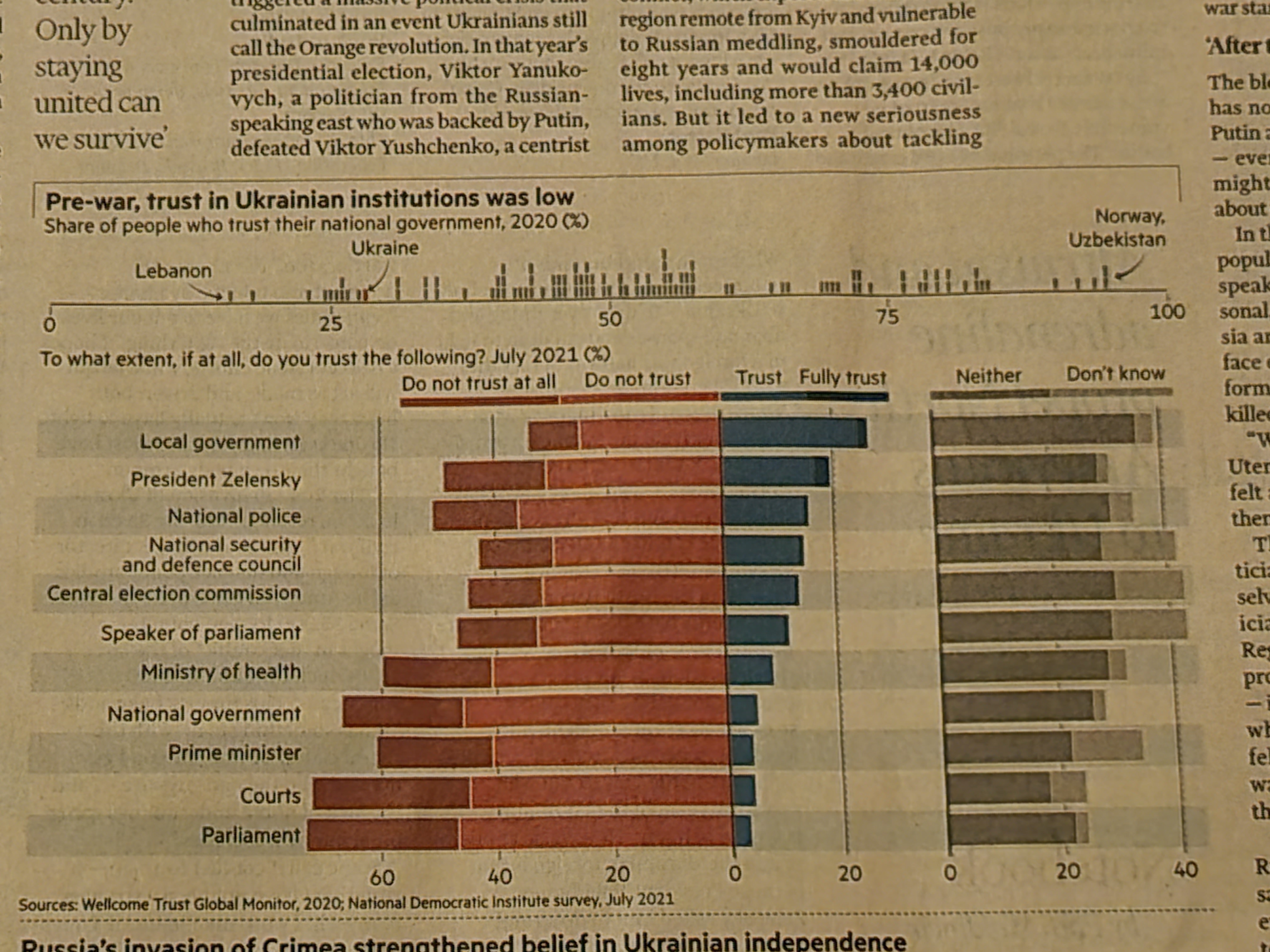
This means it would itself be hypocritical, if it even had the interest, in pointing out to workers in the West the reactionary character of this supposed defender of freedom. Using various indicators we can quantify (however unscientifically) some differences between the saviour of freedom and the autocratic threat. Two indices are taken purely as examples. They do not illustrate the social character of the two states, both capitalist, which is the prime determinant of whether socialists should support either. But for what it’s worth.
The right wing US think-tank The CATO Institute has an annual ‘Human Freedom’ index, a combination of separate indices for personal and economic freedom. Its 2021 report shows that Ukraine is the third worst country out of 22 in Eastern Europe while the Russian Federation is the worst. Over 165 countries Ukraine is number 98 while Russia is 126. The freest country at number 1 is Switzerland, which scores 9.11 for human freedom while Ukraine scores 6.86 (75% of the Swiss score) and Russia scores 6.23 (or 68% of the Swiss score). We are expected to support the war of Ukraine with 75% of the ‘human freedom’ of the freest against Russia with 68%. The war of 7%. It is relevant to note that while in 2021 Ukraine ranked 98th, it ranked higher at 82nd in 2008, so that relatively it has gotten worse, but so has Russia from 112th to 126th.
The second index is that of ‘Transparency International’ which reports the perceived levels of public sector corruption in 180 countries/territories around the world. It scores these countries out of 100, with the lower the score the more corrupt a country is perceived to be. The 2021 publication reports that the least corrupt countries included Denmark, Finland and New Zealand, scoring 88 each. Ukraine is 123rd on the list while Russia is 139th. A better indication of the difference is that Ukraine scores 32 out of 100 while Russia scores 29, meaning that the former scores 36% of Denmark etc. while Russia scores 33%. Not a pile of difference; 3 to be exact.
Source Financial Times
As the war has been articulated by the media there is no way to express any other position than to support the mainstream narrative or embellish it with democratic sounding phrases such as ‘self-determination’ that are the equivalent of putting lipstick on a pig. It has been said that to win an argument you must rob the other of the language to articulate their disagreement. With the language of ‘Ukraine’, ‘the Ukrainian people’ and ‘self-determination’ it seems obviously perverse to propose opposing ‘Ukraine’, ‘the Ukrainian people’ and ‘self-determination.’ How could you defend a position like that?
To stand in opposition to this war requires ideas and concepts that belong not to the hypocrisy of bourgeois politics but to socialism. To relate these concepts correctly to the war in Ukraine is not to impose them as true because some selected facts can be held up as justification but to examine the war and the interests expressed within it to determine its character and therefore the political position one should take to determine a working class approach.
This is the position of Marxists because previous investigation has revealed that only the working class can rid humanity of exploitation, oppression and the ravages of a system that regularly and inescapably produces war. It is not enough to hold these views at a general abstract level but to demonstrate that this is true in each individual case. If it cannot be demonstrated, then Marxist ideas are either only partially correct or wholly wrong.
We therefore need the language of class so that we can identify who the participants in the war actually are, what their core interests are and to what extent their actions reflect these interests. We need this and the concepts arising from our understanding of how society works in order to construct a language that allows us to articulate what the position of the working class should be.
A first word here about language. Supporters of Ukraine sometimes claim that Russia is an imperialist country and Ukraine is not and since the starting point of Marxists is anti-imperialism this points to opposition to Russia. Sometimes the argument becomes infantile, as when it is argued that Ukraine is a smaller and less powerful country than Russia, as if political positions resemble the school playground where big bullies are condemned. Others equally falsely claim that since the biggest imperialism supports Ukraine, we should support the smaller and weaker one. Sometimes it is stated that Russia is not imperialist by Marxist definition so this too points to its defence.
Since imperialism is a form of capitalism it is not the role of socialists to support smaller or weaker capitalist states in competition with larger ones, whether imperialist or not (by whatever criteria agreed). The starting point is not anti-imperialism or even anti-capitalism, because there are reactionary anti-capitalisms as well, but the independent interests of the working class. This identifies our allies and our enemies and must include opposition to subordination to any capitalist state no matter how big or small it is or how much shit it finds itself in. For the avoidance of doubt, Ukraine is not a colony, certainly not of Russia!, but an independent capitalist state.
This is the first task of socialists and the reaction to the war shows how drastically many of them have failed to properly determine its character. This series of posts will address this failure and we will start with two examples beginning in the next post.
Forward to part 2




 Sráid Marx