The politics of murder in Belfast

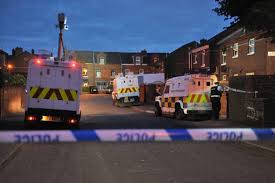
images (11)The murder of Kevin McGuigan on 12 August in East Belfast is widely seen as revenge for the former’s claimed involvement in the earlier murder of Provisional IRA leader Gerard ‘Jock’ Davison.

The Police Service of Northern Ireland (PSNI) have done their bit to protect the Provisional movement by claiming that although Provisional IRA members were involved there is no evidence that it was authorised by the leadership.  Since complete denial of Provo involvement would stretch credibility to breaking point and reflect on the PSNI as well as the Provos, this was as much as they could do.

Of course this makes no sense, although it was notable that some nationalist commentators were prepared to swallow it.  Much amazement was feigned by unionists that an IRA even existed, so ‘answers’ were demanded.  The British Government said that of course it knew the IRA existed but that what was important was what Sinn Fein said (i.e. not what the IRA actually did) and especially that it continued to express support for the ‘principles of democracy and consent”.

The Garda in the South had previously claimed that the IRA had no military structure but are going to look at it again and the PSNI claimed it was a lobby group for “peaceful, political republicanism”.  Sinn Fein spokesmen claimed that of course the IRA was not involved, that it had “gone away” and all allegations to the contrary were ‘palitics’.

So the Provos continue to support the police but not as far as allowing them to get in the way of taking revenge or protecting themselves and their enormous financial empire. Support for the police is therefore purely ‘palitical’.

In the hypocrisy and lying stakes each out-does the other.

So the British Government and PSNI are claiming that while a much slimmed-down ‘peaceful’ IRA exists there is no evidence that it sanctioned the murder of McGuigan; although investigations will continue, which means that if it suits the political purposes of the British Government such a judgement can be easily changed. And easily justified – a ‘peaceful’ IRA with guns, that murders its enemies, and which by its very reduced size and tightness makes inconceivable the idea that the murder was not approved from the top.

The meaning of this is obvious: the British state and its police force doesn’t care if the Provisional IRA kills people it doesn’t like.  It doesn’t care if loyalist paramilitaries kill people they don’t like. Round the corner from where McGuigan was killed a young woman was almost killed by the loyalist Ulster Volunteer Force but the PSNI refused to blame the UVF who were responsible.

Today it is reported that the murder of another Short Strand man Robert McCartney by the Provos was subject of a secret deal between the PSNI and Provos, with the cops offering not to go after those who cleared up the murder scene, in exchange for Provo information on the less important hands-on killers.  No one has gone to jail and the Provos kept their mouths shut.

The political import of the killing is the following:

The Provos can kill and the state will give them impunity but it will expect a price to be paid.  Anyone who thinks that the end of Sinn Fein’s meagre opposition to austerity through opposition to some welfare cuts will not form part of the price probably believes that everything that the British Government, police, unionists and Sinn Fein has said about the murder of Kevin McGuigan is 100% true.

A message has been sent to all enemies of the Provos, political or criminal, that they are willing and able to kill, no doubt under some new set of initials such as AAD (Action Against Drugs).

The slow crumbling of the architecture of the political peace settlement has speeded up and now threatens the current arrangements.  The Ulster Unionist Party has withdrawn from the all-party Executive, putting pressure on its supposed more rabid rivals in the DUP to follow its lead.

The DUP has now proposed that Sinn Fein be expelled from the Executive, although Sinn Fein can prevent it, and only the British Government can do this.  If the British do not support such a move the DUP would then be forced to either put its money where its mouth is and walk themselves, bringing down the Executive, or reveal themselves as joined at the hip to the Provos in the great gravy train on the hill.  It might then start losing support.

As the pro-settlement ‘Irish News’ editorial put it today, the Executive is so discredited most will not care if it remains or goes.  And as I have noted before, the current Stormont regime is so rotten it has little credibility left.

The peace process has been built on the lie that the rotten sectarian arrangement brought about the absence of widespread political violence.  In fact the defeat of the Provos and the ending of widespread violence preceded the creation of the rotten sectarian arrangements.  Again and again the sectarian political settlement has been defended by the claim its overthrow would bring us back to the troubles.

The recent killings demonstrate precisely the opposite.  The existence of the sectarian Assembly and Executive is now justifying collusion between the state, Provos and loyalist paramilitaries in violence, intimidation and large scale criminality.  The message from the British pro-consul has been explicit:  as long as Sinn Fein supports the sectarian settlement and police that is what counts.  What it actually does will be excused and glossed over if remotely possible.  The so-called peace settlement and its preservation is now the justification for allowing political and criminal violence.

Socialists must continue to oppose this rotten settlement.  They should continue to oppose the PSNI and expose its collusion with the Provisional IRA and loyalist paramilitaries.  They should oppose the austerity imposed by the British Government and the Stormont parties, especially Sinn Fein and its phoney anti-austerity posturing.

It should likewise refuse to offer political support to any opposition by Sinn Fein to its exclusion from Government should this occur.  The Provisional movement is an obstacle to working class people in the North and South of Ireland identifying their own interests and defending them.

The UK general election part 3: sectarianism and democracy

SF 1 downloadIn the final post on the UK general election I want to look at the results from my own little polity and the political slum that is Northern Ireland.  Like all slums the blame for its condition lies with the landlord, the British state.  As usual all the tenants hope and expect that the landlord will clean it up. But it never does.

There the analogy should rest.  The most recent election was notable for what the front page of the Northern nationalist paper, ‘The Irish News’, described as ‘Nationalists turn away from the polls’.  Their parties, Sinn Fein and the SDLP, collected 38.4% of the vote while the DUP and Ulster Unionists captured 41.7%.  The latter figure does not include the various other unionist parties such as Traditional Unionist Voice and UKIP which brings the unionist total to 46.6%. If we include the Alliance Party, which is a unionist party in all but name, the unionist vote was 55.2%.

The message?  There isn’t going to be a United Ireland any time soon.  The Sinn Fein vote went down slightly by 1% even while the SDLP vote declined by 2.6% and it lost the Fermanagh and South Tyrone seat, not the way they wanted to enter into the historic hundredth anniversary of the 1916 rising.  ‘The Irish News’ explained that the nationalist vote had declined to its lowest level since the 1992 Westminster vote, which is before the ceasefires. That is, before the current peace process ‘strategy’ of republicans was/is supposed to deliver a united Ireland.

None of this fits with the accepted story of a rising Catholic population and a more and more demoralised Protestant one.  Sooner or later, the story goes, there will be a Catholic majority that will vote in a united Ireland. The truth of this is accepted by many and, I would hazard a guess, by many who would deny it vehemently in public.  I remember my aunt, a Shankill Road Protestant, remark about 25 years ago that there would eventually be a united Ireland, but not in her lifetime.  And she was at least half right in that.

Socialists have always supported self-determination for the Irish people as a whole, as the only democratic response to the Irish national question.  Not of course universally.  The Militant Tendency/Socialist Party tradition with its notoriously statist view of socialism, which incidentally has nothing to do with Marxism, has always managed to get it wrong.  Its statist view has seen it join left nationalist formations in Britain such as NO2EU, and it led the rightward collapse of the left in Scotland into Scottish nationalism.  In the North of Ireland on the other hand, entirely consistent with its accommodation to whatever nationalism is strongest, it has capitulated time and time again to loyalism and the British State.

This general response of socialist to the national question remains correct but the growth of nationalism in the North of Ireland, which now appears halted, has demonstrated that democracy is not a classless construct.  Bourgeois democracy in a society which has always been characterised by sectarianism has definite limits.

These limits are demonstrated in the more and more sectarian expression of northern nationalism.  This means that the expression of democracy by the working class can only be of a non-sectarian character, or it would fail to be a particular expression of the working class.  In other words the expression of a democratic alternative to partition must come from the working class and not from any nationalist formation.  It must therefore be non-sectarian, not in an unconscious sense, in which to be anti-imperialist is somehow also to be ‘objectively’ anti-sectarian, but in a conscious sense that this is the key objective – of uniting the working class.  Just like Scotland so must this be the case in Ireland, that socialism cannot be derived from what happens to be bad for the UK state but from the political unity of workers.

The degeneration of Sinn Fein and Irish republicanism demonstrates that fidelity to the belief in a united Ireland is no guarantee of progressive politics.  It used to be said that Irish republicanism was largely confined to Catholics because of sectarianism and this also remains true but it is also now the case that the Irish republicanism of Sinn Fein is confined to Catholics because it is sectarian.

Once the Provisionals stopped fighting the British and decided to join in the governance of its system, and started asking the landlord to sort out the slum – the landlord responsible for its creation – it stopped having any claim to progressive status.  It then became the most militant and vocal champion of Catholic rights, not civil rights, but sectarian rights.  This has been exposed in the case of a prominent Sinn Fein Minister and also in the recent election.

In North Belfast Sinn Fein put out an election leaflet that included a graphic showing the Catholic and Protestant proportions of the constituency, the none too subtle message being that the majority Catholic constituency should be electing a Sinn Fein MP.  But of course that also means that Protestants must vote for the sitting Unionist MP.

The Sinn Fein excuses for it only bury it deeper in the sectarian mire.  First the excuses arrived only after it spent weeks defending the leaflet.  Then it wanted, it said, to use the terms nationalist and unionist but the Post Office said census figures had to be couched in terms of Catholic and Protestant.  So what it is saying, after trying to blame the Post Office, is that  instead of rejecting the graphic it decided that yes indeed substitution of Nationalist and Unionist by Catholic and Protestant was fine.  Now we know what it means when it uses the former terms in future.

Oh, and one more thing.  It regretted its decision to include the graphic – as Mr Gerry Kelly said “I think, in retrospect, the decision then should probably have been to withdraw the graph, because it did give an argument to our opponents, whether that was the SDLP or unionists.”  Yes Gerry, you’re right about that.

SF2images (10)

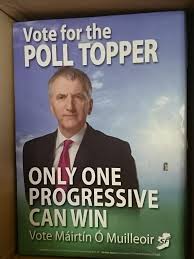
The reactionary position of Sinn Fein was also demonstrated in another graphic used on its leaflet for their candidate in South Belfast.  Having misleadingly described the candidate as ‘the poll topper’ – in fact the sitting MP was from the SDLP – it then said he was the ‘only Progressive Candidate who can win’ – clearly not the case since the SDLP were not listed by the leaflet as one of the five parties ‘united for austerity.’

These five parties were the Conservatives, DUP, UUP, UKIP and Alliance Parties. One of these parties stood out from the others – the DUP.  Why? – because Sinn Fein is in permanent coalition with this party.  And at the time the leaflet was put through the doors the Tories looked like they might be relying on the DUP to get them into power.

Wouldn’t that have looked lovely – the so-called anti-austerity Sinn Fein in Government with the DUP who were keeping the austerity-inflicting Tories in Government.  Don’t bother to try to work out how Sinn Fein would have justified it, they have been justifying inflicting one of the most right wing parties in Europe on this part of the continent for years.

‘The Irish News’ front page has reflected the disorientation of Northern nationalism following the election.  It produced some commentator to explain what had gone wrong.

Apparently  there is a ‘growing number of nationalists who appear switched off from the electoral process (reflecting) a community more at ease with Northern Ireland.’

The commentator said that “I think unionism is more highly strung about identity issues.  Nationalism is more happy in general with the status quo and there is a lack of competition between the parties.  Nationalism is suffering a retreat.”

Almost all of this is rubbish.

Yes, nationalism is suffering a retreat, it’s been retreating for years, and now endorses the legitimacy of partition and its institutions, the British nationality of Irish Protestants and the unionist veto on a united Ireland.

Contrary to its assertion, there is no lack of competition among nationalist parties and unlike unionism there was no electoral pact between the SDLP and Sinn Fein during the election.

Relatively high unionist participation in the election is not because they are more highly strung about identity; in fact the lack of unionist voter participation has been remarked upon for years.  Did they suddenly get a fit of the nerves just recently?  Newspapers have recently reported increasing numbers of parents from what is called ‘a Protestant background’ refusing to designate their children as Protestant at school.

The fall in the nationalist vote is not because nationalists are happy with the status quo but exactly the opposite.  The stench of nepotism, cronyism and corruption from Stormont is all the more repelling on the nationalist side given the claims to radical politics and progressive change from the nationalist parties, particularly Sinn Fein.

Instead the DUP/Sinn Fein coalition Government has been beset by crisis, incapacity, incompetence, secrecy, arrogance, lack of accountability, lack of transparency and financial scandal.  The simplest of questions don’t get answered for years (perhaps never) by Government departments with dozens of communications staff.

The latest such offerings are the revelation of the extent of the employment of Special Advisors (SPADS) employed by all the parties in office without any public recruitment process.  These SPADS are supposed to bring special skills to their political masters, the most prominent of which appears to be their close connection to the parties and their ability to hide any special skills.

freedom of information request revealed that in one financial year the Stormont Executive spent almost £2m on these SPADS, more than the Scottish and Welsh governments combined.  In 2013/2014, the pay bands and grades for these special advisers varied across the UK, going from £36,000 up to £91,000.  In Scotland, three of them were in the top pay band while at Stormont all 21 posts were.

The second is the scandal around a contractor to the Housing Executive which we reported on before here and here.  The SPAD at the centre of the controversy, far from being dumped has been promoted while it is reported that the DUP member who took a more principled stand is being subject to disciplinary action by the party.  At the end of an editorial dripping with scorn ‘The Irish News’ declared of the Stormont regime that “it is increasingly doubtful if the institutions are worth preserving in the first place.”

When the main voice of constitutional nationalism expresses exasperation with the peace process institutions it really does mean a lot of nationalists are thoroughly disillusioned.  This is one of the main results of the election.  In itself it is not a positive but it is certainly a prerequisite for one to develop.


Austerity and Sinn Fein

sfdownloadThe strike by public sector workers in the North of Ireland on March 13 was significant because the two major parties, including Sinn Fein, were a target of the strike, whether Sinn Fein or even some of the strikers liked it or not.  Sinn Fein obviously didn’t like it because it damaged its posturing as an anti-austerity party and trade union leaders didn’t like it because their strategy is to persuade the parties responsible for austerity to change their minds and try to get more out of the Treasury in London.

The latest multiyear budgetary programme of the Stormont administration is the second austerity programme which Sinn Fein has jointly authored while in office.  The first did not see the job losses witnessed in England, Wales and Scotland but it did see a reduction of around 14,000.  Pay and pension entitlement for public sector workers were also cut.  Along with almost every other public sector worker I have suffered two years of a pay freeze while inflation consistently exceeded the supposed target of the Bank of England and my pension contributions increased, while my benefits were reduced and I will have to work longer to get them.

The much vaunted protection of welfare in the new budget, whatever coverage it eventually has, will come from money taken from other public services, including cuts to education.  As one local newspaper columnist put it – these will include an end to free books for pre-school children, making Northern Ireland the only part of the UK that will not have the scheme.  This will save £250,000 a year, or one third of the £750,000 that 36 Sinn Fein politicians at Stormont paid to a party research company that was unable to show any research.

As also remarked, Sinn Fein’s often boasted politician’s salary at the industrial wage includes industrial scale expenses.  Widespread cynicism exists in ‘republican’ areas at the rise to riches of leading figures identified with the movement.

The much vaunted financial deal that saved the Stormont administration, before the latest crisis, was hailed for delivering an extra £2 billion to the Northern Ireland budget, except that it didn’t.  Only a third of it could be called new, which spread over 10 years is less than a third of 1% of what is spent each year.

The rest is loans or ‘flexibility’, which means that money that is for capital investment can be incurred on day-to-day expenditure.  You don’t have to be an accountant to realise that relying on loans and investment funds to pay for on-going expenses is not sustainable.  Further expenditure is allowed if funded by asset sales, which again is not sustainable, and raises a green light for privatisation.

Such privatisation would leave the lefty credentials of Sinn Fein wearing even thinner.

Not all the capital money will be spent on recurring expenses.  £700m can be spent (in fact must be spent or it won’t be spent at all) on paying off around 20,000 public sector employees through a voluntary exit scheme.  This is a major plank in the opposition of the trade unions but it is not clear that many workers themselves will not take the money and run.  Unfortunately the old union maxim that the job is not yours to sell is long forgotten.  It is obviously completely unknown to Sinn Fein who talk of losing only ‘posts’ as if this is not what is actually wrong about what they are doing.

It is claimed that there will be no compulsory redundancies but the NIPSA trade union has drawn attention to advanced plans to cut 50 jobs, or over half the workforce, from the Northern Ireland Association for the Care and Resettlement of Offenders (NIACRO).  As NIPSA points out, when NIACRO works with prisoners on release reoffending rates drop from over 50% to less than 25%. This has all the hallmarks of the stupid and counter-productive cuts often condemned by Sinn Fein.

The claim to be protecting the vulnerable now doesn’t look so strong.

An amount of £350m will go to capital investment in integrated education, which at least sounds progressive until it’s understood that this doesn’t involve Catholic and Protestant children being educated in the one classroom but actually often means two sectarian-denominated schools being put on the one campus.  The move towards a shared campus simply reflects the fact that sectarianism is becoming expensive.

Rather than signalling the end of sectarian schooling it shows the lengths that will be gone to in order to preserve this apartheid system.  But the sectarian education system also has the support of Sinn Fein.  It would appear that apartheid can be supported in this case if the justification  given for the original South African variety – separate but EQUAL – can be adhered to.

This isn’t even progressive never mind left wing or socialist.

That the new deal means no rejection of the previous imposition of reactionary Tory-Lib Dem policy is shown by the fact that the fines of £114m that had to be paid for not implementing the welfare cuts in 2014-2005 must be paid now, and the £100m loan required to balance the books in the same year must also be paid.

Last but not least the new financial arrangement allows the local administration to lower corporation tax, once again supported by Sinn Fein.  Their thread bare justification for this is the harmonisation of an all-island economy.  In fact, along with many republicans’ support for Scottish independence, it involves mutual competition of small states in a race to put more money into the fat pockets of mainly US multinationals.  Were the policy to succeed the London Treasury has stated clearly that the Stormont regime will have to pay it for its losses.

All of this passes Sinn Fein by.  It clings to its claims to be anti-austerity purely on its partial opposition to cuts in welfare benefits.  Its populist politics is revealed by its approach that workers are victims and its most vulnerable members should be given some form of protection by a benevolent state.

The effect of privileging one section of the working class above another is always to undermine and weaken its potential political unity.  In this case the potential unity of the working population and those on benefits, who are always the subjects of divisive attack by right wing forces.   By limiting its proclaimed anti-austerity agenda to support to some on benefits it plays into the divisive claims of these right wing forces.  Sinn Fein appears happy to see austerity delivered to those in work while proclaiming great concern for those who are unable to or cannot work.

The interests of the working class as a class and as a political force independent and opposed to the state are alien ideas to a purely nationalist movement.

Unfortunately it is also alien to the leaders of Ireland’s trade unions and their new proclaimed support for Sinn Fein is proof of this.  At the Sinn Fein Ard Fheis – that is even before Sinn Fein’s renewed expressions of concern for welfare claimants – the Irish Congress of Trades Unions President, Jack Douglas, extolled Sinn Fein’s adherence to the union cause.  That is after the austerity budget the Northern unions were calling a strike against!  A week or so earlier the leader of Ireland’s biggest union SIPTU, Jack O’Connor, hailed Sinn Fein as a potential partner of the Labour Party in Government. The same Labour Party that has been implementing the Troika austerity agenda it was elected promising to oppose.

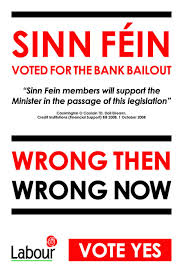
The performance of Sinn Fein in office in the North is a stark warning of its future role in the South but the record of Sinn Fein in the South is ample demonstration itself.  It was Sinn Fein who voted for the bank bailout that made the debts of the speculators the millstone round the neck of the workers.  Its ‘leading role’ in the resistance to austerity today is to identify itself with the campaign against water charges while seeking electoral advantage from it.  Beyond seeking votes from the campaign it has no strategy to make the campaign a success.

A couple of weeks ago an economist from Goldman Sachs claimed that the biggest threat to the Irish economy was that Sinn Fein would keep its promises on its opposition to austerity.  He needn’t have worried.

I remember around twenty years ago attending a meeting in Conway Mill on the Falls Road during which time Sinn Fein was trying to get into talks with the Unionists, who were refusing to engage. I asked Gerry Adams what he expected to achieve from such negotiations when the Unionists wouldn’t even talk to him.  A United Ireland he said.

Well we all know how that worked out.

Rape, Republicanism and Revenge

2014-10-28_new_4232679_I1A Belfast woman, Maíría Cahill, whose great-uncle Joe Cahill helped form the Provisional IRA in 1969, has claimed in a BBC programme that she was attacked and sexually abused by a much older IRA man from the age of 16 for a period of 12 months in 1997.

She has accused the Republican Movement of trying to force her to keep quiet about the rape and holding a “kangaroo court” in which she was interrogated about her claims.  “The only word I have for it is interrogation, because that’s exactly how it felt.” The IRA investigation lasted six months and included a face-to-face meeting with Cahill’s alleged abuser.  “They told me that they were going to read my body language to see who was telling the truth and that they were going to bring him into a room.”

She says that she was discouraged from going to the police, in line with Sinn Fein policy at the time.  When she did go to the police the prosecution authorities ensured that it was IRA membership charges that were first taken against the alleged rapist and those involved in the IRA investigation.

When these charges collapsed the prospect of conviction for rape also reduced so she withdrew support from the remaining trials.  She signed a withdrawal statement but maintained her claims of sexual abuse and her claims against the four people accused of subjecting her to an IRA interrogation. She also accused both the police and the Public Prosecution Service of failing her.

What we have then is the story of a rape victim who received no justice from the movement she supported and none from the state, which appeared, as usual, more interested in a political agenda than the concerns of a victim.

The case has become news just as an inquiry is to take place into child abuse at Kincora children’s home in east Belfast in the early 1970s.  It is widely suspected that the British security services colluded in a cover up of the horrific abuse that took place in the home in order to gather intelligence in pursuit of their dirty war.

The hands of the state when it comes to the North of Ireland are literally dripping with blood.

Not unexpectedly however most attention has been directed to Gerry Adams, who Cahill says she met to discuss her rape.  At this meeting she claims he suggested to her that abusers were so manipulative that they can make the abused actually enjoy their abuse.

Adams has rejected this and claims that he asked another female republican to tell Cahill to report her experience to the police.  Cahill in turn has argued that the idea that a senior republican would ask her to go to the police to give information against not only the IRA accused but also the IRA investigators as “absolutely ridiculous”.

The accusations against Gerry Adams come shortly after the conviction of his brother for abuse of his daughter, Gerry Adams’ niece.  Gerry Adams was again accused of doing little or nothing, failing to report the allegations to the police and of concocting a frankly incredible story regarding his own knowledge and actions.

Maíría Cahill continued to work for Sinn Fein even after her abuse and was briefly a member of the Republican Network for Unity, a political organisation very critical of Sinn Fein’s support for the police. She subsequently moved to support a campaign against former republican prisoners working in the new Stormont administration and she now declares her full support for the authorities and the police. She has also sought and received the public support of the leaders of Unionism and of the Southern capitalist parties.  As a result Sinn Fein has accused the latter of seeking political gain from her tragic experience.

Gerry Adams has subsequently given a very general apology on behalf of the IRA for its failures in the area of abuse, acknowledging that it had, on occasion, shot alleged sex offenders or expelled them.  The latter has raised a storm of protest from Southern politicians that the republican movement has in effect repeated the crimes of the Catholic Church by moving abusers about the country, free to abuse again.

The publicity surrounding the Maíría Cahill case has also brought out numerous allegations of IRA protection or leniency towards abuse by their own members in comparison to brutal treatment of others.

For Adams the disbandment of the IRA means there is no “corporate knowledge” to draw on in the Cahill case while he admits that the IRA was “singularly ill equipped” to deal with sexual abuse, although it presented itself as the alternative state for long enough.

So what are we to make of this?  One take on it is that what we are seeing is the politics of vengeance that does society no good.  The political ‘zig-zags’ of Maíría Cahill may obscure the political significance of her case but its significance is salient not only because of her own demands but also because of the other cases which the publicity she has generated has brought into the open.  In other words we are not simply dealing here with one person’s tragic experience that has no wider social significance.  This wider significance goes beyond the political impact of her case on the fortunes of Gerry Adams and Sinn Fein.

With regard to the latter we can lament her reliance on the state and any illusions on the justice to be received from it but in this respect the political significance of Maíría Cahill’s pursuit of justice through lobbying establishment politicians and the state, and her criticism of the handling of her case by Sinn Fein, is immeasurably less than the republicans own capitulation to the state and their embrace of it as the providers of justice.  Their treatment of Cahill is also of greater political significance given that they are a major political party seeking office, and the fact that this treatment appears to have been meted out to others.

Even in terms of her own particular situation, she was and is obviously caught between the devil and the deep blue sea.  She initially sought justice from the movement she supported and was betrayed.  The most charitable interpretation is that they let her down but having let her down they stand condemned for having abused and betrayed her.

And now she wants vengeance? As Leon Trotsky said “the feeling of revenge has its rights.”  It is not the case that she has no demands other than this.  She wants others put in the same position by the Republican Movement to come forward. She wants republicans to admit the truth of her claims and she wants help for her and other similar victims. These goals appear to me to be entirely supportable even if her road to achieving them is not. But, as I have noted, she initially chose a different road.  It is not difficult to understand how, given her circumstances, she chose the course she is now on.

The Socialist Democracy article noted above correctly argues that justice “can only be asserted by the self-organisation of the working class and oppressed” and that “to win justice we have to rebuild the self-organisation of the workers, not give backhanded support to the state and the mechanisms of class oppression.”  But this is hardly a task that one woman could be expected to take on board herself and if she did not see it as an option this reflects the current near invisibility of it as a practical option for her.

Which brings me to the political lessons that socialists must learn from this and similar episodes. The article states that “the IRA was a revolutionary nationalist army . . . the idea that it could effectively investigate rapes is ridiculous.” Yes indeed, just like the idea that it could defeat British rule.  Except it claimed it could do both and organised an armed campaign that assumed responsibility for both, a responsibility it has not properly accounted for. Instead the Republican Movement has rewritten the past (it fought for ‘equality’ not for ‘Brits Out’) and has relied on the British state to place it into its new arrangements for imperialist rule.

But let’s pause for a second to ask ourselves how an army, even an ‘army of the people’ could possibly represent an alternative state?  What sort of state would it be that is defined by, conditioned by and ruled by an army?  It’s not that the Republican Movement couldn’t help itself when it came to dealing with questions routinely addressed by the capitalist state, including rape allegations, but that Irish Republicanism has always elevated armed actions above political struggle, the liberation of the oppressed by the oppressed themselves.  When it has stopped doing so it has stopped being in any real sense republican.  It reminds one of the saying that you can do everything with a bayonet except sit on it.  Guns are no answer to fundamental social and political questions.  The singular in Adams’ “singularly ill equipped” can only truthfully refer to republican militarism that it embraced until it was defeated.

For Marxists it should be a salutary lesson that political programmes defined by what they are against; defined by ‘smashing the capitalist state’ are only progressive to the degree that the working class has built itself a democratic and viable alternative.  Too often this is not at all the case and justification for particular political positions is often reposed on the argument that it will split, weaken or smash the state while doing nothing to advance the organisation or political consciousness of the working class as the alternative.

Whatever political weaknesses that Maíría Cahill may have, they pale beside those of her abusers who must ultimately be held responsible for the trauma of which her political odyssey appears as an expression.

The arrest of Gerry Adams

images (6)When Gerry Adams was arrested for the murder in 1972 of mother-of- ten Jean McConville Sinn Féin claimed it was “political policing. The arrest of a high profile political leader during an election could hardly be anything else.  That the intention to question him was notified by the Police Service of Northern Ireland (PSNI) to the highest levels of government in advance and that this government tells us it is keeping Washington informed is simply confirmation.

Yet when it comes to explaining what this political policing amounts to, Sinn Féin’s Martin McGuinness claims lamely that the arrest is due to a “small cabal” of police officers, “an embittered rump of the old RUC (Royal Ulster Constabulary)”.  McGuinness claims that other police sources have described these people as the “dark side”.

So it’s not really political policing but a “rump” that presumably can be dealt with.

Yet Sinn Féin hasn’t asked for this but just a vague wish that the episode is “resolved in a satisfactory way”.  Meanwhile the party will continue to “support the reformers who have made a massive contribution to policing” while saying that if it “does not work out the way that it should” the party will review the situation “in the context of continuing with a positive and constructive role in a vitally important peace process”.

However the press conference at which all this was said was really about a threat to reverse its previous political support for the PSNI, an event that would precipitate yet another crisis in the never-ending peace process.

But how can Sinn Féin complain of political policing when it supports this policing?  How can it issue vague hopes that everything turns out ok when it also claims that policing is accountable?  Why is it threatening to withdraw support (in a very vague and indirect way) when it can hold the police to account for its actions?  Why doesn’t it just do that?

Graffiti has gone up in West Belfast attacking “Boston College Touts” (informers), i.e. those who gave their accounts of their own and Adams’ involvement in the IRA and its abduction of Jean McConville to the American institution , the acquisition of which may be the basis of his arrest.

_74622246_img_1763

Yet how can these people be touts when Sinn Féin supports the PSNI and has called for everyone to give the police whatever information they have on the actions of republicans (i.e. the dissidents)?  The hypocrisy involved is as staggering as it is completely unselfconscious.

McGuinness claims that “Sinn Féin’s negotiations strategy succeeded in achieving new policing arrangements, but we always knew that there remained within the PSNI an embittered rump of the old RUC (Royal Ulster Constabulary).”  Yet it never made any qualification when it announced its original support for the PSNI.

Does this mean it only supports part of the PSNI or only partly support the PSNI?  Which part? How is everyone else supposed to know which part to support?  How would it and everyone else partly support the PSNI?

How can such a situation exist when Sinn Fein is in government?  How could the brilliant negotiators of Sinn Fein agree to a deal to support the police without getting a guarantee its leader would not be lifted for allegations made years ago?

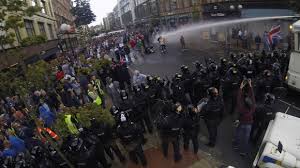
Why is Sinn Féin making such an issue of Adams’ arrest when it never threatened to withdraw support from the PSNI when the PSNI spent months allowing loyalist crowds, led by the UVF, to disrupt everyone else trying to get home during the flags protests?

Why did it not threaten to withdraw support when these illegal parades were allowed by the PSNI, in fact the PSNI met with organisers to arrange them, and not do so when these parades attacked the small Catholic area of the Short Strand?  Only this week a judge found the PSNI (all of it, its leadership included and not just some “rump”) guilty of failing to enforce the law when it came to illegal loyalist parades.

Again these last few weeks drunken loyalist paramilitary mobs have taken down legal election posters and put up their own flags on main roads in Belfast,  right in front of police stations, while the PSNI has told local residents on no account to take them down.  Is it only Sinn Féin’s leaders who must be protected from the “dark side”?

And why indeed should Adams be protected?  He denies any responsibility for Jean McConville’s killing but then he also denies ever being in the IRA.  Other former IRA members, with unimpeachable republican credentials, have admitted their involvement and claimed Adams was in on it.

As the recently deceased IRA member Dolours Price put it “I wanted very much to put Gerry Adams where he belonged and where he had been. We had worked so closely with him, on many occasions and taken orders from him on many occasions and then to deny us, particularly after we had been through such a harrowing experience in prison … we were offended that he chose to deny us as much as he chose to deny his belonging to the IRA. To deny it is to offend those of us who partook in what we partook in.”

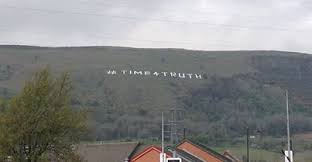
The message on the hill overlooking Belfast calls for the truth about the British Army murders of 11 people in Ballymurphy in August 1971, an enquiry into which has just been rejected by the British Government, but the same demand can apply to Adams.

But bad as these questions are for Sinn Féin none of them get anywhere near the biggest problem it has.   And this problem is that Adams would not have been arrested if the British Government had not given it the ok.  The political policing of which Sinn Féin speaks is not the actions of a “small rump” but the actions of a state.

That Sinn Féin should peddle the line of ‘sources’ within the PSNI that what is involved are the actions of “dark forces” against the reformers, “the many progressive and open-minded elements” of the PSNI that McGuinness hallucinates, is to swallow the old good-cop bad-cop tactic that old IRA men must have been warned about if caught or arrested.  That this is now the line of Sinn Féin shows how far it has travelled and so low it has sunk.

Swallowing and parroting this means buying into the designs of the British state just as much as swallowing the good cop line gives you the bad cop result.  What this means has been signalled by the British Government.

Recent speeches by Teresa Villiers, the NI Secretary of State, have glossed over the refusal of the Unionists to accept the deal offered by US diplomat Richard Haas, and supported by the British state itself,  and have conciliated their intransigent line, which itself is a play to extreme loyalism.  So the crimes of the state, never investigated with any seriousness it has been revealed, are even more to be airbrushed out of existence and instead it is the crimes of the “terrorists” which must be centre stage.  The role of state forces in sponsoring these terrorist gangs will of course also be occluded.

So the past will more and more become the one imagined by unionism.  Parades? Well the Parades Commission has given every evidence that its restrictions on loyal orders can be ignored with impunity.  Getting a form of words that ends with the same result might not be difficult given even a minimal willingness of loyalism to engage with Catholic residents whose neighbourhoods they parade in.  Flegs? Well we have noted the PSNI’s preference to let drunken loyalist mobs put up whatever symbols of intimidation they want.

That about completes the Haas agenda but even these do not signal the end game and this too is coming more into focus in a statement of Villiers.

In a speech widely reported, but the reporting of which missed its most significant element, Villiers anticipated the rewriting of the political deal on which Sinn Féin can claim success.  She foresees the “evolution” of the power-sharing institutions towards them having an opposition.

The whole point however of these institutions is that no one is in opposition, in particular nationalists are not put into opposition by unionists who have not demonstrated any capacity to act in other than a sectarian fashion.

It’s put in the usual honeyed words:

“The third way in which politics could be moved forward here is through the evolution of the devolved institutions.

Let me be clear, power sharing and inclusivity are enshrined in the Belfast Agreement and the government is not going to undermine any of those principles.

. . . Yet at the same time nobody can plausibly argue that the institutions must be set in stone for all time.

Political institutions the world over adapt and change.

As the founding father of modern Conservatism – the Irishman Edmund Burke – once put it:

‘A state without the means of change is without means of preservation.’

And there are inherent weaknesses in a system in which it is very difficult to remove one’s rulers by voting and to choose a viable alternative.

That’s why this government is clear that we would welcome moves that facilitate a more normal system at Stormont that allows for formal opposition, so long as a way can be found to do this which is consistent with power sharing and inclusivity.

But we also believe that if or how this happens really has to be primarily for parties in the Assembly to take forward, not least because it is so firmly within the Assembly’s competence to deal with those matters that might characterise an opposition, such as speaking rights, financial assistance and committee chairmanships.”

So at the moment the British Government would be quite happy for the Stormont regime to have parties outside Government if this was accepted by these parties, if it was voluntary.  No longer is this anathema, no longer is such a suggestion the antithesis of what the new arrangements are about.  Now this is both a viable and even preferred destination.

But of course it has to be voluntary.  Since having the nationalists in opposition is the primary objective of unionism such a policy stance is not so much a disinterested, absent-minded meandering on possible future directions as an incentive for unionism to get nationalists, or at least Sinn Féin, out of Government, “voluntarily”.

This is not actually the preferred British solution but it is testimony to how far it will go to keep unionism inside the existing deal that it floats ideas that while mollifying unionism actually increase instability.

That it only undermines the deal more and more by emboldening unionism and feeding its triumphalist agenda demonstrates only the continuing contradictions within the imperialist settlement – continuation of a sectarian state and sectarian political arrangements while hoping that this sectarianism can be made innocuous or at least reduced to an acceptable level, just as there used to be an “acceptable level of violence.”

So the incentive for unionism is to continue not to work the existing institutions while seeming to maintain a modicum of good faith, obstruct and provoke Sinn Féin as much as it can without damaging itself and hope that the sheer impossibility of Sinn Féin putting up with its obvious powerlessness gets the right reaction.

Unfortunately for them it is perfectly obvious that Sinn Féin will cling to the Stormont regime like grim death with no humiliation too embarrassing and no rebuke too severe for it to walk away. Sinn Féin will hold on to the appearance of power even when this appearance has gone.

But if clinging to the trappings of office becomes the main objective the point of actually having it – making changes – grows ever less important.  Being in office in the North is important for Sinn Féin getting into office in the South and it believes that it being in office in both Irish states on the centenary of 1916 will be a powerful symbol.

Indeed it will.  It will symbolise that the party has realised its strategy but that this strategy is ultimately a failure.  A Sinn Féin in government in both partitioned states will still leave both partitioned states in place.  Sinn Féin will simply sit over both.  Should it stay in office the sight of it doing so will prove no more remarkable than the sight of Sinn Féin toasting the Queen of Great Britain.

How quickly can illusions be shattered.  Fresh from congratulating themselves and being congratulated by the chattering classes for its wearing of white tails and standing for “God save the Queen” the acceptance of the privileges of the British monarchy is rammed home by her state exercising its powers as it sees fit.

Why toasting the symbol of oppression should lessen this oppression or limit its exercise can nowhere be explained by Sinn Féin.  When one swallows the toast there can be little complaint when one has to swallow a whole lot more.

Whatever the outcome of Adams’ arrest the whole exercise is a brutal demonstration of Sinn Féin failure and it will cost it in the long run.  The grounds for creation of an alternative are clearer but unfortunately there is no sign yet that any such alternative is arising or has some progressive working class content.

What the Haass talks failure tells us about Northern Ireland

bruegel3The failure of the negotiations chaired by the US diplomat Richard Haass is a significant failure. This can be seen for three reasons.

Firstly there was widespread initial expectation that an agreement would be reached – these talks are always carefully choreographed and why else had the Democratic Unionist party and Sinn Fein set it up?  .  Later it was equally widely assumed that some fudge would emerge.  In the event no agreement was reached.

Secondly, all the participants declared that the talks were not a failure; all keen not to be seen to be the party responsible for the failure.  If they were unimportant this would not have mattered.

Lastly their importance can be seen by recognising why they were required in the first place – because the issues they were to deal with have led to a year of low level conflict and proved the last bit of grit that was gumming up the works of the Stormont administration.  Over the last year it has been increasingly impossible to maintain the pretence that the governance put together by the Good Friday Agreement was working even minimally.  Ministers were taking each other to court, the smell of corruption was getting more rancid, meetings were not taking place and one representative from the DUP tweeted her approval of the killing of a fellow Sinn Fein MLA in Government.

The latter was a direct result of the bitterness created by a year of loyalist demonstrations against the decision of Belfast City Council to fly the union flag over City Hall on only designated days instead of all day, every day.  Apparently this was the last straw; a challenge requiring a demand for No Surrender; a provocation that required movement by not an inch; the final step in the war against the Protestant, Unionist and Loyalist People; one that required that this people stand in defiance because they could do no other.  In other words this supposedly existential crisis, like every other of Irish loyalism, invites ridicule before everyone is expected to take the grossly exaggerated claims seriously before then being gently told by the British State that they should be accommodated.

The three issues that the talks dealt with were the legacy of the past, flags and emblems, and parading.  The past is not about the past but about the nature of the present.  Flags are the symbols that represent this present and parades are the street-level reality of the symbols.

It was widely reported that the talks collapsed because the most extreme fringe of loyalism  that has been behind the flag protests would not accept a code of conduct for parading, something the DUP and Sinn Fein had previously agreed to in principle.  Such a code might have outlawed paramilitary displays and other unacceptable behaviour.  The unionist parties were not quick to deny this.  The right to parade past Catholic areas by loyalist paramilitaries, while they are also engaged in drug dealing, extortion and intimidation – mostly of the communities they live in, is the apparent reason for the failure of the Haass talks.

There is some truth in this despite what it says about the character of the Northern Ireland State, which cannot function with any sort of consensus because this consensus must reconcile itself to the most blatant displays of naked bigotry.  This cannot be too openly admitted but what we see is the proverbial emperor’s new clothes.

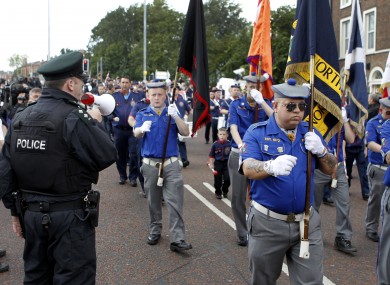
Go to any loyalist parade, say on the 12 July, and you will see serried ranks of smug and arrogant suited men (sometimes women) in bowler hats marching behind temperance banners led by uniformed flute bands, sometimes named after a sectarian killer, playing sectarian tunes to the beat of drums pummelled as violently as it is possible.  Surrounding and following the parades will be hundreds of drunken youths in various stages of stupor.  This is what you see and appearance faithfully corresponds to essence.

Loyalist parades contain the worst of the petty bourgeoisie and what Marx would have called the dangerous classes.  The make up of the latter can be seen in newspaper reports of the court cases dealing with those arrested at loyalist parades.  These include middle aged men miles from home who have sunk enormous quantities of beer and cannot remember what they have done.  They include Scotsmen who couldn’t get enough of their sectarian fix from attendance at Ibrox every two weeks following the new Glasgow Rangers Football club but have to come to Belfast to worship at the Mecca of bigotry.  It includes bandsmen whose reason for failing to stop playing sectarian tunes is that they are so illiterate they could not read the feet-long neon signs put up by the police telling them to stop.

Such classes exist everywhere and are a tribute to the worst aspects of capitalist society.  What differentiates Northern Ireland and makes its politics so incomprehensible to outsiders and so intractable inside is that these classes and their reactionary political representatives are sponsored by the State because they are the most vocal and enthusiastic supporters of the State’s existence.  This is not so much important as vital when the existence of that state is explicitly or implicitly continually in question.

The main force behind the crisis thrown up by the flags dispute has been the Ulster volunteer Force, which must have hundreds of members and a few thousand followers.  It has been repeatedly accused of sponsoring the riots surrounding the dispute, especially in East Belfast, and the conspicuous lack of action by the State’s police force has led even supports of the police to question just exactly what it is up to.  Collusion between the police and loyalist paramilitaries is not so much suspected as assumed and mountains of evidence in the recent past has shown the police arm, direct and facilitate loyalist murder gangs.  Even after massacres of plainly innocent civilians agents of the police responsible have had their payments from the police increased.

Most recently murals on house walls of armed UVF men have been painted while the police claim there is nothing they can do about it unless someone complains.  Such action is of course illegal – try painting your neighbours wall magnolia and you will soon find out.  The approach of the Police Service of Northern Ireland however, if consistently pursued, would leave murder as a legal activity unless the victim made a complaint.

The lack of action has emboldened loyalism.  When they come under some political pressure because of their drug dealing (or shooting of a young woman reported to be an ex-girlfriend of a UVF boss)  the police have issued statements, after much delay, to state that although such and such an attack  was carried out by members of the UVF it had not been sanctioned by the organisation’s leadership.  So that’s all right then.  The police present public alibis for the criminals that the criminals don’t even claim.

Just how they know this is rarely asked and never answered. However it is obvious that only by having agents within the UVF leadership could this be the case.  Since the organisation remains largely intact the only conclusion can be that the agents of the police are not there to destroy this organisation but to bend it to the police’s will and this requires that it continues to exist and exercise the  power that it does.  Loyalist paramilitaries have their uses and these aren’t to help old ladies across roads or collect litter.

I have explained before how relatively small loyalist organisations appear to exercise undue influence on unionism as a whole and in this case the failure of the Haass talk’s is put down to the upcoming electoral cycle in which being the most extreme defender of sectarian privilege is rarely the road to failure.

The talks failed not only on the issue of parades but also on that of flags and dealing with the past.  The past includes what all the previous peace process deals have represented – not an accommodation with nationalism but a recognition that unionism had won and thus simply stepping stones to majority rule within the North and the retrieval of all the sectarian powers unionism once held at Stormont.

Close acquaintance with Sinn Fein has demonstrated to unionism that deals can be broken; republicans arrested, threatened and insulted; their ministers taken to court and prevented from implementing policies of their own, and Sinn Fein will do nothing.  Nothing except agree with the DUP to call in a couple of Americans and watch while that DUP walks away from its own initiative.

The DUP now say that what nationalism has agreed is nothing but the starting point for new negotiations that will shift the result further to the right.  And when the unionists don’t like that street mobilisations, stewarded by the armed forces of the British state, will shift things further right again.

In a society in which over 40 per cent are Catholic and many Protestants are shamed by the antics of the Orange Order and repelled by loyalist paramilitaries this might seem irrational.  It leads only to increased political instability in the State they seek to defend.  Only the accommodating position of the British rulers, who are the real objects of unionist pressure, make this strategy continue to appear to be realistic.  Unionism cannot use a modern day B Specials or army mutiny to directly enforce its demands.  It can only succeed where the British allow it.

The problem for unionism is that the British will accommodate the most extreme loyalist actions when it feels it is necessary, and it will provide for increased loyalist privilege, but it will not provoke a crisis that will exclude nationalists from any role in administering the State.  This role can become smaller and smaller but the Catholic population is not prepared to accept a return to the old Stormont regime and this is what unionism wants.

In this situation Northern nationalism is not an opposition but merely an obstacle.  The difference?  With an opposition the possibility of defeat exists or perhaps retreat.  With merely an obstacle the possibility of victory is always there.  Sooner or later the obstacle might be removed.

There is an opposition but both the British State and loyalism are blessed by its character.  Republicanism, real Irish republicanism in the shape of what is termed the dissidents, is the major opposition to both but they have learnt nothing and forgotten nothing from a quarter century of armed action.  Such action has not, cannot and will not achieve its aim of destroying partition.

In the past it played a parasitic role on the political struggle, appearing to offer a more militant road to freedom, but ultimately collapsing into the arms of imperialism.  When the gap between its methods and objectives was eventually closed this led not to a re-evaluation of methods but a ditching of the objective.  The building of a united Irish working class movement North and South and within the North itself is therefore a task for socialism.  Only it seeks the liberation of people, the class that will liberate all classes, while republicans seek the liberation of an as yet to exist Irish Republic, in other words a new State machine.

For republicans workers are instruments for revolution while for socialists they are the subject of revolution.  For republicans workers might sometimes be the best fighters for a Republic while for socialists the liberation of workers is the purpose, the means and the objective.

In concrete reality the adherence to militarism by republicans continues to be the alternative that makes the crumbling peace process – that the Haass talks have failed to shore up – attractive.  The prospect of violent political action that substitutes for a political strategy is not at all attractive, except to ideological republicans irreconcilable to British rule and poorer working class Catholics who have gained nothing from the peace process.

This is not an insignificant support but it is not enough to move to a position that threatens British rule.  Instead its actions appear provocative in that they easily allow the British not only to hold them up as the horrible alternative to their own sectarian stew but also to justify whatever repression they consider necessary.  They also provide threadbare cover to loyalist actions.

In this way the armed actions of republicans have only reactionary consequences.  Whether such provocation is meant or is merely considered an acceptable by-product is ultimately of no importance.  The result is the same.  While socialists must continue to debate with those republicans that might listen on their mistaken road of armed action we cannot do so without patiently explaining their failures, the reactionary consequences of their actions and the alternative strategy.

This alternative involves complete opposition to the sectarian parades of the Orange Order, the claims of unionism to sectarian privilege and the protection of loyalist paramilitaries by the British State.

Why have the Irish not Revolted? Part III

1913_LOCKOUT_ADVERT-1

The weakness of Irish workers resistance to austerity cannot be explained as a supposed result of this austerity having less effect than in other countries.  We have just witnessed the eighth austerity budget, the previous seven having cumulatively accounted for 17 per cent of current Gross Domestic Product.

The budget deficit in 2013 is higher than that of Spain, Portugal or Greece; there is at least another austerity budget pencilled in and the State debt is continuing to rise.  Next to nothing of the debt taken on in order to bail out the banks has been paid back and these banks are still saddled with mortgage customers who can’t pay their loans back.  Were the much trumpeted rebound of the property market to be anything substantial the banks would be repossessing and selling the vacated properties.  They’re not.

In other words the crisis isn’t over and neither is austerity, although faint hope that it is coming to an end plays one part in explaining latterly the weakness of protest and resistance.

The answer to the problem lies in the weakness of the Irish working class itself.  For Marx capitalism, in creating the working class, created its grave digger.  The nature of a particular capitalism goes a long way to explaining the nature of a particular working class and the weakness of the Irish working class is a reflection of the weakness of Irish capitalism.

An objection might be made to this that the Russian working class was the most ideologically advanced working class a century ago while Russian capitalism was weak. On the other hand capitalism in the United States has been the most advanced for a century or more but its working class is a byword for exceptional weakness.

The uneven and combined development of both societies has gone a long way to explaining this apparent anomaly and it is beyond the scope of this post to compare and contrast the development of the US and Russian socialist movements.  Over 100 years ago Karl Kautsky wrote on this question in ‘The American Worker’, relatively recently republished as part of a symposium in the journal ‘Historical Materialism’.

What we can say here in respect of Ireland is that its uneven historical development both inside the country, and as a region within the wider British economy, mainly as a reserve of agricultural production and labour power, has accounted for its historical weakness.

I was reminded of this nearly a year ago when I received a United Left Alliance (ULA) email newsletter what presented a series of proposed meetings to be organised by the ULA against austerity.  These meetings were to deal with different aspects of the issue such as the economy, health services etc.  In Russia a noteworthy feature of political and intellectual life a hundred years ago was the strength, vibrancy and hegemony of Marxism such that it dominated even the thinking of Russian liberals.

How different a situation from Ireland!  The speakers proposed for the ULA list of meetings demonstrated the reverse – the domination of Irish socialism by liberalism.  We can see this in everything from the Left’s opportunist search for unity with organisations that are far from working class in political character, from the Greens to Sinn Fein and populist independents, to their Keynesian economic alternative that relies on the goodness of the liberal capitalist state –taxing the rich and nationalising industry.

This of course feeds into the mis-education of workers who, while they may not reject the ULA’s state-reformism from a revolutionary perspective, have a healthy distrust of the really existing bureaucratic state they know.  And they have a healthy scepticism that this state will create a new economy and tax the rich when the most widespread view of politics and government is that the politicians and the state mandarins are only in it for themselves.

Acquaintance with the occupational training by FÁS and the decades-long state attitude to tax dodging by the elite has convinced workers that the state is rotten; a source of corruption, incompetence and of patronage which moves according to who you know or who you can lobby or to whom you can provide supplication.  Meanwhile Irish liberals bemoan the population’s lack of civic virtue and the Left feeds it nonsense about the capitalist state as the solution to austerity and poverty.

Lack of a response to austerity is in small part a result of this but more significantly a long result of Irish economic development and the working class and its movement, which it has produced.  The weakness of the working class movement is therefore of long vintage in Ireland.  The outstanding figure of Connolly, who remains a giant of working class history, and the courage of the 1913 lock-out, are today appropriated by the bureaucrats of ICTU and the Labour Party wielders of the austerity knife.  Where is the movement that can legitimately claim this heritage?

Connolly and 1913 shine so brightly because the working class movement has for most of Irish history been subordinated to other forces.  While capitalist relations developed early in Ireland and industrialisation grew beside that in Britain it was much reduced by its greater development in the latter so that by and large it became limited to the north-east of the country.  There a relatively compact and developed working class developed but the fatal disease affecting it has long been known.  It could therefore play no wider progressive leadership role for the rest of the country

There the creation of a reserve of agricultural production for Britain created the conditions for the famine in the middle of the 19th century that devastated the country and led to reactionary social and political consequences everywhere.

First were the direct effects of death and emigration which robbed the country of a growing domestic market on which capitalist production could grow.

Then there was its effect on the land question that provided the social basis of Irish nationalism but which, because of the famine and its effects, including emigration, could be solved without a wider popular alliance of forces that included the working class.  The Irish nationalist movement was thus alternately dominated by reactionary bourgeois forces heavily influenced by the Catholic Church or a republican tradition that had its most democratic leadership in the United Irishmen ripped from it at the end of the 18th century through severe repression and sectarianism.  Republicanism became a petty bourgeois movement largely indifferent if not hostile to working class politics when at its strongest.

It did develop a wing which looked at the working class as ‘the men of no property’ but only so that they would help win national freedom.  This grew into a socialist republican tradition but this has also looked to the working class as the force for national freedom.  Where in other countries the socialist movement has grown through leading a fight for democracy, in Ireland this has never happened.  The left wing of the democratic movement has on the other hand appropriated radicalism that might in different circumstances have flowed into the working class movement.

Instead of a socialist movement that has taken on board the tasks highlighted by republicanism we have had a republican movement with left wing views tagged on but which has more often than not simply not understood what a socialist programme is, although sadly they are not alone in this.  Thus left wing opinions have abounded in this part of the republican movement but opinions have substituted for programme.  Marxism, genuine Marxism, and not its bastard imitation Stalinism, has been almost non-existent.  So many of the most radical spirits in Ireland have left the country or been absorbed in the dead end of republican politics.

The famine also resulted in the growth of the enormous power of the Catholic Church.  It is commonplace to at least partly account for the weakness of the working class movement in Ireland by pointing to the sectarian division of the class.  This division was hardened and strengthened tremendously by partition, creating an additional divide between workers in the North and those in the South, on top of the religious divide.

What is more and more apparent however is not simply the effects of the division itself, in preventing unity across state jurisdictions or in spite of sectarian identification, but the paralysing influence of the resulting political forces within the separate parts of the working class.

Sectarian division allowed the Catholic Church to engage in social repression involving sexual abuse, censorship and imposition of a reactionary ideological environment that was consciously and vehemently anti-socialist.  The more that is learned about this repression the more its class aspects become apparent.

The extreme reactionary monarchist ideology is perhaps less important in the North among some Protestant workers than the sheer ideology of division itself, i.e. sectarianism.

The strength of both Catholic and Orange movements have in no small part been due to the creation of the two states issuing from the division of the country.  Again and again even today we see the state protect the most reactionary elements in society both North and South – the Northern state facilitate loyalist paramilitaries and the Southern State finance the organisations found guilty of systematic child abuse.

National oppression has prevented the Irish working class from being an organic part of the growth of the British working class movement which means it has never availed of its strengths while it has on the other hand imported and copied all its weaknesses, including economism and trade union type politics.

Upon this weakness of the working class has been built its political subordination; its domination in the South until recently by the bourgeois Fianna Fail and its saturation by sectarian politics in the North.  Without a strong socialist tradition the periodic shifts away from the traditional parties can go in almost any direction.

In the last election the Left captured the vote of a small bit of this but the apolitical and clientelistic character of Irish politics affects the Left.  This and the state-centred nature of its politics is the basis for the chronic sectarianism that has shattered the alliance the Left had formed.

As Marx said the growth of sectarianism is in inverse proportion to the development of the class as a whole and the weakness of the class is the fertile ground on which the narrow and blinkered outlook of much of the Left has been established.

So what we have had is an historically weak working class.  During the key episode of political struggle around and after the First World War it was subordinated and subordinated itself to bourgeois nationalist or sectarian forces.  The victory of the most reactionary of these forces combined with retarded economic development prevented the growth of a strong working class movement thereafter. The Irish state did not participate in the Second World War so its working class missed out in the radicalisation that accompanied it in many countries.

Marx however called capitalism a revolutionary mode of production that continually creates and recreates the working class.  While this historic political weakness weighs on today’s generations the system throws up new industries, new work relations, new circumstances enabling economic growth and new forms of working class development.  The historical development of the Irish working class during the 19th and much of the twentieth centuries cannot explain the current lack of combativity of the Irish working class because this combativity is capable of being changed and transformed.

The Irish working class continued to develop after the Second World War but this subsequent development did not create a break from its historic political weakness and to the extent it has not done so the weight of history continues to oppress.


Sectarianism in the North of Ireland and Republicanism

the-triumpth-of-deathThe dysfunctional nature of the Stormont regime is widely acknowledged.  The two leading parties exclude the others in decision making while being unable to make decisions themselves; except not to expose each other’s most sectarian actions – employment discrimination by Sinn Fein minister Conor Murphy and moves to sectarianise housing by the DUP’s Nelson McCausland.

Other parts of the settlement are also exposed. The PSNI have lost much credibility with their facilitation of illegal loyalist flag protests while the Parades Commission, set up to solve the parades issue, is now part of the problem.  It is ignored even by the police, as during the flags protests, or has its determinations on how parades are to behave brazenly flouted by loyalist marchers, who the Commission then allows to parade again, with the same results.

Meanwhile spokesmen for the DUP partners of Sinn Fein in government blame the Sinn Fein Lord Mayor of Belfast for being physically assaulted by loyalists while visiting a park in a unionist area (DUP leaders were not attacked in the nationalist park earlier in the day) and a DUP member of the Stormont Assembly tweets her support for the killing of Sinn Fein leaders.

The DUP decision, announced by the First Minister from a holiday in Florida which appeared to last forever, that there will be no ‘peace centre’ at the site of the prison where the IRA hunger strikers died exposes the weakness of Sinn Fein.  A settlement that makes any change to the status quo dependent on the defenders of that status quo has been exposed once again.

In this situation it is not one religious group that primarily loses out, although the evidence in the first post shows that disadvantage remains unequal, but the lowest section of each working class that suffers most.  The old socialist maxim that sectarianism hits workers most, and the poorest at that, is demonstrated in the ways the new sharing of sectarianism works, or rather how it operates in its own dysfunctional manner.

The exposure that a homeless man in East Belfast on the housing waiting list with a points total of 330 (indicating level of need) was passed over in favour of a person with only 26 points caused a minor scandal (all scandals in the North are minor).  This flagrant breach of ‘rights’ was carried out by a housing association whose member includes a former Sinn Fein councillor.  Two of his nieces were allocated housing by the association, which is why, when the case appeared in court, the judge referred to nepotism.

A friend of mine has also reminded me that while he is recommended to go for a job interview with Shorts in East Belfast the social security staff tell him they won’t bother sending him for an interview in West Belfast, where he lives, because a job there is for ‘Shinners’.

In many Protestant areas the indulgence of loyalist paramilitaries by the state has made them more attractive to young Protestants who then end up with a career in violent sectarianism as opposed to a career on the dole or in part time and poorly paid employment.  These paramilitaries then feed off the local population in a wholly parasitic fashion – extorting protection money from small businesses; selling drugs and then claiming to be protectors against dealers; engaging in general criminality then ‘dealing’ with (other) criminals; and finally parading the reactionary politics of the local population while hiding their criminality behind their politics.  This reactionary politics in working class areas acts as another barrier to Protestant workers being able to escape the loyalist gangsters.

The situation is therefore complicated.  A political settlement exists that has the support of the State and Sinn Fein but which is more and more clearly just a stepping stone for unionism to return to unrestricted unionist rule.  At the moment this is simply not possible.  The reversal of the previous struggle against unionist and British misrule does not mean that history has gone backwards.

At the same time the sectarian demands of loyalism set the agenda.  Once more nationalist commentators call for loyalists to be ‘brought in from the cold’ despite their being treated as legitimate political representatives and special slush funds being created for their benefit.  It is vainly hoped that there is just one more Orange parade that is causing trouble and that if only it is sorted the other 3,000 odd will never cause a problem.

As this article is written the loyalists that everyone is invited to save from their supposed marginalisation by the peace process has, through a nomme de guerre, threatened everyone connected with three Catholic schools in North Belfast with ‘military action’.  In a throwback to sectarian assaults on Catholic primary school children in Ardoyne, primary school children are threatened because if loyalists can’t parade Catholics can’t go to school.

With such a mass of contradictions it appears that the whole edifice must crumble, and it is indeed crumbling.  But this could take some time – a decay that brings mutual ruination presided over by the British State but with no progressive force or alternative emerging.

In his eye-witness report of the republican anti-internment march Belfast Plebeian speculates on the revival of republicanism.  Not the new partitionism of Sinn Fein but a genuine movement committed to a united Ireland.  This anti-internment demonstration and relatively small electoral victories demonstrates that the movement has a small base of support.  But whether it has a progressive and realistic alternative is a different matter.

The support of a marginalised section of the Catholic population is one thing.  A programme that might promise an alternative to this population must go beyond gaining support from it to advancing solutions to wider society.  It is self-evident that there is no solution at the local level nor at the level of the Northern State and not, as recent events have so clearly shown, at the level of the island.

Republicans have to answer the question how they can unite the Irish people in order to unite the country.  Poor Catholics in Belfast would benefit from an ending of partition but workers in Dublin might want some alternative to the problems brought about by a capitalist economic crisis and political domination by a state in cahoots with imperialism – right now obviously subordinated by the Troika of European Union, International Monetary Fund and European Central Bank.

The challenges to the creation of this alternative even in the North are more complicated than those faced by the movement created in the 1960s.  While Catholic disadvantage persists the inclusion, even at a secondary level, of Catholic parties in the political administration, means, as has been argued, that it is not simply a matter of discrimination but of sectarian competition.  That Catholics lose out more than Protestants means the simple equation of their respective position and of the political expressions of the two sectarian groups is wrong.  That it is the workers and poorest of both that pay most does not mean that the sectarian division, and the political issues around it, can be ignored or treated as something without need of a particular political intervention that gives specific answers.

Despite their small base of support the republicans are not well placed to face up to and address these difficulties.

Firstly, and most obviously, but most importantly, this movement is confined to the Catholic population.  A strategy of seeking unity across the sectarian division is rendered particularly difficult.  These forces are weak among the rest of the Irish working class in the southern state so the mobilisation of the latter in a political alternative that can practically demonstrate to Protestant, and to other workers, the possibilities of their programme is itself presented with formidable obstacles.

All this assumes in the first place that these republicans, who are divided into a number of groups, regard the political contradictions of the peace process as the primary challenge and political task that they face.  Many in this movement have not broken from the militarism that so demonstratively failed in the 1970s, 1980s and 1990s.

The re-creation of a military campaign even approaching that of the Provisionals at its height in 1972, when the Official IRA also participated (‘ceasefire’ or not), is simply not going to happen.  This campaign fed off an elemental upsurge, British repression and extreme loyalist reaction.  The British learnt lessons in their counter-insurgency, which is one reason they won, although given the relative military resources they couldn’t really lose.

Some republican attempts to recreate a crisis, including British repression and loyalist reaction, through armed action (in the hope of sparking the third element of Catholic upsurge) might produce two out of three.  It is and will therefore be a reactionary project.

Some republicans clearly recognise this but no coherent, comprehensive or convincing critique of their previous military strategy has come from this movement.  Without this the option will remain open to large sections of it and with such an option failure is guaranteed.  Marxists do not favour premature armed action by revolutionary socialist forces never mind the action of republicans with no credible socialist credentials.

The character of the armed struggle was of an armed revolt by a minority of an oppressed Catholic population that was solely Catholic because the sectarian character of the State made it so. Nevertheless this situation meat that a premature armed campaign with no prospect of military victory was wide open and susceptible to political degeneration, which is what happened.  From mass gun battles lasting hours against the British army the armed struggle moved to blowing things up, like shops, bus depots, restaurants and hotels etc. without any rationale for doing so.

It meant the pursuit of soft targets and a wider and wider definition of ‘legitimate targets’; all to avoid the hard fact that the IRA could no longer engage the British Army, the army of occupation, in a serious guerrilla struggle.  The failure of the armed struggle and the impossibility of it succeeding against the military power of Britain were denied in word while accepted in deed.

This meant that the sectarian weakness of the republican resistance, its wholly Catholic character, was impressed on it through actions that more and more conflicted with its declared non-sectarian objectives.  Bombings were targeted at groups of Protestants seemingly without any regard to their political impact as if some spurious military logic was of primary importance.

So, for example, the IRA complained that the British caused unnecessary civilian casualties by not acting on bomb warnings.  The fact that the British had devised a way of discrediting republicans through exploiting one weakness of their bombing tactic did not prevent the IRA walking into this trap again and again for which many civilians paid the price.  This blindness to the requirements of a political struggle betrayed the undeveloped nature of the movement; one that still characterises those that would continue armed action today.

So we can say that while the republican struggle involved a progressive objective, fought for by an oppressed section of the population, it involved elements of sectarian practice that conflicted with this objective.  This may be contrasted with the armed actions of loyalists whose programme and actions didn’t contradict one another. Their programme didn’t occasionally involve sectarian murder but was sectarian murder.

I have never checked, but if the argument by John Hume – that more Catholics died at the hands of the IRA than British and loyalists – was even close to being true it would demonstrate the hopelessly misguided nature of the republican armed struggle.  This lesson needs to be learnt or many Irish workers will not trust today’s republicans with political leadership.  It has been said many times by many people that it is the threat of renewed armed struggle that has been one of the strongest arguments used to support the peace process and the current political settlement.

Today’s republicans are therefore an expression of the contradictions of imperialist rule and, in so far as they understand this and oppose this rule, they understand something important.  However the fact that this movement is so old in historical terms, going back to the late 18th century shows two other things.

One, is that its historical task has not therefore been achieved and two, that history has developed more fundamental tasks than the creation of an independent nation state within which an Irish capitalist system can develop and grow.

The development of capitalism around the world and creation of a world working class means that political programmes that put forward new independent states as the fundamental and first step to wider and deeper liberation are now backward looking.

The latest expressions of republicanism are old in another sense.  It is nearly 20 years since the first IRA ceasefire and the definitive surrender of the republican programme.  It is 15 years since the leadership and majority of the membership accepted partition and the Good Friday Agreement.  Time enough for those opposed to both to develop a programme that has learnt the lessons of this defeat and begun to construct an alternative.  It is not encouraging that this has yet to be done.

Loyalists riot in Belfast against Republican demonstration

images (3)

By Belfast Plebian

Yesterday I decided to participate in an anti-internment demonstration in Belfast. I could not get to the starting point so thought to join at the midpoint in central Belfast.  The demo I think was organised to do three things: to commemorate the August 1971 introduction of imprisonment without trail, to highlight the continuation of the same policy by less conspicuous means, imprisonment for long stretches of time under the guise of waiting for a trial date; internment on remand, and finally the abuse of the prisoners at Guantanamo Bay and in other ‘special facilities’.

I am not big on the commemoration thing, a street demonstration is a very inferior way of coming to a coherent understanding of past political events, however the other two are very important just now because the democratic rights of common people are under sustained attack in the countries that first originated them, namely in the United States, France and Britain.

The comprehensive attack on democratic rights is turning into something ever more serious in most bourgeois democracies.  Just last month the British Government passed into law something called the Justice and Security Act 2013 (JSA). The key provision creates a new procedure to permit the use of secret evidence and testimony against a defendant in any civil case in the UK.  The new measure constitutes yet another negation of the democratic rights of the individual in relation to the powers of the State.

The new provision is called ‘a closed material procedure’ (CMP) and it means that a defendant’s barrister will have no right to question the evidence against a client if the CMP procedure is invoked by the State.  The new courts will also now have the power to make use of evidence against defendants not previously disclosed to their legal team.

The JSA is a response to the case of Binyam Mohammed, a British citizen who was detained at Guantanamo. His legal team had forced a civil action against the British government for being complicit in his torture in 2011 and evidence came to light in court that showed that British police agents had secretly assisted in his torture and rendition.  The judge in the case had ruled that the secret police material was admissible. Now this sort of secret evidence is to be totally closed to viewing.

The new act is a change to the already highly restrictive Public Interest Immunity procedure frequently used during the ‘troubles’ to keep evidence of crimes committed by the security forces from legal examination.  From now on, even the presiding judge in a case will no longer have a say on what kind of evidence can be scrutinised by a jury.  It means the abandonment of civil courts presided over by judges in favour of political courts manipulated government officials against selected defendants.  In the closed material procedure only the government and its lawyers will be present before the judge.  The defendant and their lawyer will not be present in court, they will not be permitted to see the evidence being presented if it depends on ‘sensitive security material’. Also the defendant is not entitled to know the reasons why the judge came to a decision. The Act is to apply to ‘all relevant civil proceedings’ in the High Court, Court of Appeal, Court of Sessions and the Supreme Court. The above is just one way by which the rights of people are being curtailed by government.

The problem you always have to deal with when defending basic democratic rights in the North of Ireland is that those who do so are habitually associated with republican inspired anti- British feeling, not just by the State officials but by the organised part of political Unionism. So as I strode into the city centre the first thing I noticed was a very large number of angry loyalists gathered at one end of Royal Avenue, who were obviously hell bent on preventing a so called ‘dissident republican’ march from getting into their beloved British city centre.

They had been gathering for hours and had reached two thousand strong by about six o’clock. I wondered why there were so few police officers on duty, only a tiny fraction of the number that had been on duty for the G8 demo and I wondered why so many loyalists had been allowed to gather unhindered on the very street that the anti-internment demo was supposed to pass along.

I mingled with the loyalists for about an hour; the mood was ugly and the loyalists looked well up for a street battle. A riot then kicked into full swing when the police asked some loyalists to move into a designated zone behind a makeshift barrier consisting of a handful of police land rovers. It was pretty obvious that there would be no anti-internment rally passing down Royal Avenue this evening.  The loyalists were by now in full riot mode, getting tore into the police at close quarters, tossing bricks and bottles.

It was very striking just how many loyalists had turned out to stop what they considered to be a provocation by the ‘other side’ from holding a small political demonstration. The ‘other side’ were the despised Irish republican enemy without any equivocation or qualification. To be honest it has hard to see how the loyalists present could ever be reconciled to the State granting the same right to free assembly for republicans and reds in a city that they maintain is exclusively British and monarchist.

It does not look good for the ‘shared future’, with so many alienated loyalists regularly attacking the PSNI on the streets.  The DUP and the Unionist Party are clearly feeling a rising pressure to resile from the rather forced agreement they made with Sinn Fein called the Good Friday Agreement.

The British government on its part has no big idea or plan to settle things with the loyalists. The big idea of bourgeois democracy I believe includes a principle best articulated by Abe Lincoln in the famous Gettysburg Address, that in a democracy in contrast to a monarch- aristocracy ‘all men are created equal’: meaning they are all entitled to the same constitutional rights as something universal.

Bourgeois democracy is built on two platforms: free and fair elections leading to a democratic government and universal democratic rights. Ulster Unionism currently bows down to only the one platform of bourgeois democracy, the free and fair elections platform part, and even this is qualified by the anti-democratic forced partition of 1920

When the great majority of Irish nationalists voted in favour of the Good Friday Agreement it surely indicated that they were now ready to treat partition as an accidental error and not a terrible historical grievance perpetuated against them. They believed that by dropping the Irish constitutional articles on sovereignty, this act of political humility would be enough to lend a necessary democratic legitimacy to a perpetually insecure Unionism that would be great enough to allow for a future of peace and equality.

But Unionism accepted the offer ever so reluctantly and made no corresponding provision for Lincoln’s universal rights; unionist democracy just stayed thinking and behaving as in the past; an elected government should mean majority rule, and we the Protestants are the majority and our rights must come first. It should be recalled that the majority of unionists actually opposed the initial Trimble made Good Friday Agreement.

Majority rule was in fact the democratic cry of the Southern Confederacy; those states commanded a popular majority in favour of maintaining things as they stood, and in 1860 this so happened to include slavery.  The best of them who were not slave owners fought in the name of a democratic majority rule, a right of self- government in the seven and then eleven Southern States.  In their minds Lincoln was the opponent of democracy, the Tyrant of the Federal Union. The task of educating the American people in 1860 as to the essence of bourgeois democracy, that it was about more than not just having an elected government but was also about universal rights fell to Lincoln. The example of the American Confederacy is good reason why self-government in the name of a majority is not always for the better.

I am not suggesting that British Unionism in Ireland is in favour of slavery; in fact it has always favoured free wage labour and private property.  What I am suggesting is that it has no stomach for digesting the bourgeois principle that all men are created equal, and this is at the very heart of the matter and largely explains why there is so little of what is termed normal democratic politics to be seen in the here and now.

It should be said, this is not unique to Ireland, it appears almost everywhere in variations.  Across the Middle East the overthrowing of the military dictatorships in Iraq, Libya, Egypt were superseded by democracies that insisted on the unalloyed sectarian viewpoint of the majority must rule, there is no room for universal democratic rights. Marxists in particular need constant reminding that just getting to the normal state of bourgeois democracy and keeping it going is a massive undertaking in itself.

Karl Marx in1860 thought that if the side of Lincoln were defeated it would be a massive blow to the historical advance of the working class in Europe.  Leon Trotsky argued in 1933 that the smashing of bourgeois democracy in Germany would be a much greater blow to the international working class than the Stalinists at that time imagined. It is all too easy to downgrade the democratic rights side of the socialist programme in pursuit of the maximum or even the transitional demands of the socialist programme.

I decided to move away from the town centre and try and join up with the anti-internment demo at another place. I was told that the demo would most likely be rerouted along Millfield, a street that connects North Belfast to the lower Falls Road. As I took to my heels the police decided to do a pincer on the hundred or so mainly nationalist youths still standing at the juncture of Castle Street and Royal Avenue. They came at us from two directions and forced us up into Castle Street.

It was then that the nationalists realised their chance of joining the demo in the city centre was gone for this time. Some of them began chanting the familiar old anti police slogan SS-RUC, others mentioned groundhog day and moved away – the police had capitulated in the face of loyalist fury said others.  I walked up to Millfield and waited and waited without really knowing what was happening, the wait lasted for a couple of hours

Eventually, at about nine o’clock the head of the demo appeared, it was a substantial demo of about 1800 people; they looked tired but not demoralised.  The 300 hundred or so people waiting for them to arrive cheered and clapped like supporters standing at a football match. They joined the demonstration and it proceeded to snake its way up the Falls Road to the final destination point in Andersonstown.

I did not stay to listen to the speeches; I guessed they would be of a traditional republican hue something that I have heard many times before. I had still some walking to do to get back home, the buses were not operating, it was eleven thirty when I finally made it back to the house, an intended hour spent at a demo had turned into a seven hour marathon. 

Making a political assessment of the significance of the demo is a little more difficult than with loyalism. The demo was the biggest one that has occurred in Belfast organised by diverse republican and residents groups not aligned to Sinn Fein. The very subjective impression I got was that those on and those supporting the demo were drawn mainly from the very poorest segment of Belfast society, the loyalists gathering was composed of working class people too but they looked more prosperous in their general appearance.

They were certainly the sort of working class people who in earlier days used to be solid behind the IRA and Sinn Fein. The fact that Sinn Fein has lost some of its urban working class support is not that significant in electoral terms because the party has definitely replaced that support with those who used to be sympathetic to the political party of steady decline the SDLP.

A feature worth mentioning is the age profile, previous republican demos that I have witnessed were staffed by well seasoned not to say aging types; the bulk of the people on this one were under 30. What was positive was a genuine will not to get drawn into a sectarian street battle with loyalists. One young republican that I spoke to was worried that loyalists had come out to block their way. Why, he asked, do loyalists fight against things like demanding an end to interment on demand, something that oppresses them as much as it does us?

I think the organisers of the demonstration will be pleased with what they got and they will likely try to build on it by staging more of the same. However it might still be the case that the marked increase in the numbers of young people participating may actually just be a response to the rising tide of loyalist provocations generated by more and more loyalist street activities. It is too early to say if this represents a turning point against Sinn Fein within the old core republican community.  

A couple of other things are worthy of note. I have listened to a good number of nationalists speak well of the PSNI of late for standing up to loyalist threats of violence, a nationalist expectation that the police will continue to perform well may well lead to a big let down in the near future with unpredictable consequences for those politicians who are trusting them the most.

It was also evident that there were no socialist currents either on the parade or around the fringes.  They have abandoned all thought of unfulfilled democratic tasks in pursuit of socialism for today, or rather what they consider to be socialism.  The assessment they make of the recalcitrant republicans is one they hold in common with hired pundits who work for the capitalist owned press; that they are dreadful atavistic nationalists whose time has thankfully gone.

I don’t really share this mode of thought because it is too undifferentiated; all of the recalcitrant republicans are not unthinking militarists. ‘The Irish News’ referred to all involved as ‘dissident republicans’ but it was certainly more diverse than that expression suggests. Today basic democratic rights are being shredded all too readily, the prospect for socialist advances are very poor in both Ireland and Britain and politics at this time of austerity is favouring the right wing rather than the left wing – just look at the advance of UKIP compared to the abject failures of the socialists to the left of the labour Party.

The pressures of being in government for the foreseeable future are sure to test an inexperienced Sinn Fein’s capacity for political survival and in the absence of anything even vaguely resembling a socialist movement in the North of Ireland the social conditions may well favour a surprising republican revival.

Sectarianism in Belfast. What’s new?

On July 12 this year a loyalist flute band marched past St. Patrick’s Catholic Church in Donegall Street near Belfast city centre.  They stopped at that particular point by “pure chance” and started walking round in circles playing a tune known as the Famine Song, which contains the line “the famine is over, why don’t you go home?”  This song is sung by supporters of Rangers Football club in Scotland and refers to the large Irish and predominantly Catholic immigration into Scotland from the 19th century onwards.  It has been found to be both sectarian and illegal by the Scottish courts.  According to the band and their political apologists they were merely playing a pop song.  Perhaps it was again mere chance it doubles as a sectarian anthem.  Perhaps also those allegations of an attack on a cameraman filming this Orange version of the X Factor are also mistaken.

On this basis the Parades Commission, a quango established by the British government to adjudicate on contentious parades, decided the band could not take part in the loyalist parade last Saturday, which was to pass the same church.  The other bands were also only allowed to march by a single drum beat past the church.

Unionist politicians were outraged and issued a statement, along with assorted flute bands, denouncing the Parades Commission, saying they were running out of adjectives to describe it , so they gave some nouns instead – “arrogance”, “incompetence” and “general ignorance”. This statement was signed by prominent members of the Stormont Government who claimed that they could no longer let the Parades Commission do untold damage to the peace process. “Violence” would potentially ensue, they said.

So on Saturday the loyalist flute band at the centre of events marched as normal and played the normal sectarian tunes that are the staple of these ‘kick the pope’ bands, as did many of the rest. The normal sectarian insults were hurled, which are surprising only to those terminally stupid or naive.   The police did nothing that anyone could notice to prevent this.  Well, not exactly nothing: there is a picture of one policeman using a loudhailer to tell the passing bands that they were really not allowed to do what they were doing.  This robust action will no doubt be followed by the police warning burglars by megaphone that they are breaking the law when they are seen to break into someone else’s house in broad daylight. Through the Police Federation the police later complained of being caught in the crossfire, presumably between those intent on breaking the law and those who were, well, how shall we say it, wanting it upheld?

There were minor scuffles and one apparent loyalist from Scotland was arrested for running through a nationalist protest, although this was blamed by one unionist politician on a republican.

So we have a loyalist coat-trailing exercise in bigotry, defended by the most senior unionist politicians who warn of violence, which stokes up the adrenaline of the street level bigot but allows the unionist politician to deny any responsibility when the lighted match touches the blue touch paper.  The police wring their hands and the nationalist politicians talk about getting it all sorted out through talking.  You have to be very, very young not be aware that this record has been played a thousand times before.  So what’s new then?

Well what is new is supposed to be – everything!  We have a new peace process, a new political settlement, a new Government and a new coalition between the “two sides”.  Belfast has a new skyline with lots of new visitor attractions welcoming tourists, which is still a relatively new concept to Belfast.  We have new cafes and restaurants and art galleries and a new generation too young to remember ‘the troubles’ and which just wants to live in peace and has no time for this sectarian stuff.

But we have been here before.  Belfast in the 1960s was also a ‘happening’ city with a burgeoning night-life whose young generation was hailed as no longer interested in the sectarianism of the past.  The sixties brought new life, hope and light even to Belfast and not just the streets of London or San Francisco.  New housing was being created that was demolishing the slums that had no inside toilet and entries that doubled as permanent rubbish tips.  Some of this new corporation housing promised mixed estates and a new Unity Flats was built at the bottom of the Shankill Road only a couple of hundred yards, if that, from St. Patrick’s church.  Unity Flats was so called because it was to contain both Protestant and Catholic tenants, sharing the one space in harmony.

We all know, or at least have some vague idea, what happened at the end of the sixties.  That swinging decade that even moved in Belfast was very new and modern but Belfast was incapable of accepting civil rights, including fair allocation of housing and jobs and equal voting rights.  Instead it burst into violence, with Orange parades which were hyped up by unionist politicians and a police force that could not subject violent bigots to the normal restrictions of the ordinary law.  Of course this violent explosion hasn’t happened yet and in my view isn’t going to happen, not yet at least.

The mutual exhaustion of the contending political forces has not yet ended and been reversed.  The unionist leaders are attempting to exert pressure that might eventually usher in their preferred model of unionist-only rule but they are not in a position to force a confrontation that would see the British Government accede to their demands. It is not impossible that a violent eruption might occur that goes beyond unionist plans but it needs a realistic objective and the aim of getting Sinn Fein out of government has not yet become the unifying campaign theme within unionism and loyalist organisations that is required.

Instead the provocative and vitriolic sectarianism endorsed by unionist politicians in the highest offices of the Stormont administration erodes the faith of nationalists in the new deal. The approach of Sinn Fein to the recent events has been relatively muted and resembles nothing so much as the old SDLP approach which so many nationalists rejected by supporting the old (republican) Sinn Fein.  Here too however there is no unified project beyond staying in office and doing nothing to jeopardise the electoral prospects of Sinn Fein in the South.

The real republicans can attempt to take advantage of the disillusionment with the Sinn Fein reaction to the sectarian provocation and can build up their support base but what is their political project?  In so far as it simply involves a renewed armed campaign it only strengthens the ideological hold of the peace process even while more and more people, subconsciously at first, begin to wonder when exactly this process, like every other, is going to end.  The traditional republican policy isn’t credible except as a form of protest but outside of an overarching strategy this republicanism isn’t in a position yet to mobilise a large political opposition.

A large scale sectarian provocation might accelerate these trends and the planned large loyalist parade on 29 September past the same church certainly has the potential to be such a provocation.  It might at the least drive home the lessons of last Saturday if it goes ahead as the parade did then.

The condemnation by two Protestant church leaders of the sectarian behaviour of the loyalist bands shows how vulnerable the loyalists are to criticism.  It is their solutions and that of the Catholic Church that is the problem.  They both want to set the rulings of the Parades Commission as inviolable.  The Catholic Church is worse because it calls for special measures to apply when the parades pass a place of worship conveniently setting themselves up as victim, potentially privileged  protection in future while turning a blind eye to the fact that a sectarian march is a sectarian march no matter where it passes. Its vitriolic bigotry is no more acceptable a hundred yards from a church than right in front of it.

What is needed is an anti-sectarian campaign that is unafraid to name sectarianism when it sees it and is not seduced by the siren calls for equality of traditions, including mutual respect for each other’s culture.  There can be no equality for a tradition based on sectarian supremacy or respect for a culture soaked in bigotry.  Such a campaign would target not just loyalist parades but the sectarian policy creeping into housing policy and the recent discriminatory employment practices of Sinn Fein.  It would challenge the trade unions to take a principled stand and, at least in principle, should be capable of uniting much of the small left. The ULA could take the lead on this in the South by making it an issue on the floor of the Dail as the clarion call for an all-island campaign.  To do otherwise is to turn one’s back on sectarianism while claiming this as the means of opposing it.

The main task would be to rip away the protection of the current sectarian arrangements that are more and more revealing their true colours by refusing to subordinate anti-sectarianism to the demands of the peace process, however this is defined.  What sort of peace is it that allows, even sanctions, the displays of sectarian bigotry on display in Donegall Street on Saturday?