The decay of Stormont and Sinn Fein

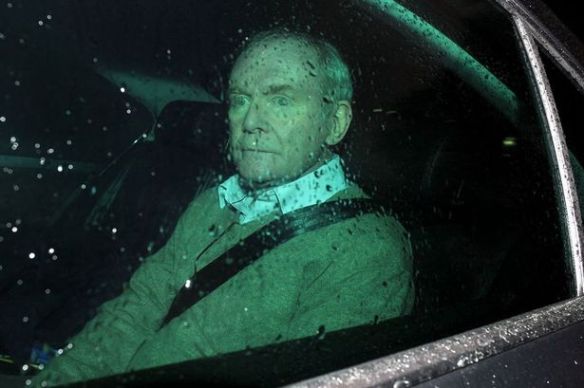
martin-mcguinness-resigns-2_-lewisWhen a dreadfully ill-looking Martin McGuinness appeared on television to announce his resignation as Deputy First Minister he perfectly personified the alarming state of Sinn Fein strategy.  Whatever about the nature of his illness there is nothing secret about the utter failure of the latter  The repeated response of Sinn Fein to republican critics that these detractors had no strategy to bring about their goals has itself been exposed, as their own policy has become a self-declared failure.

The resignation letter of McGuinness put a poor gloss on a hasty decision that was forced on the party and which it dearly sought to avoid.  Recent actions betrayed a desperation to save its position in the Stormont regime and thereby the regime itself.  It opposed a public inquiry into a scandalous Renewable Heat Incentive (RHI) Scheme, designed to protect the climate by giving participants £160 for every £100 they spent on burning wooden pellets.  Unlike the British scheme no limit was set on how much was to be spent on the incentive to burn as much as one could.  It was indefensible and in any other liberal democracy, such as Northern Ireland pretends to be, it would have led to a resignation.

Sinn Fein opposed a vote of no confidence in the First Minister Arlene Foster, responsible for the scheme, explicitly stating it was because it wished to save the Stormont institutions.  It also opposed a public inquiry into the scheme because it knew that the Democratic Unionist Party would not wear it.  It hoped instead that a call for Foster to merely step aside for a few weeks, while some fig-leaf of an investigation did the needful in calming the political waters, would be agreeable.  However, the DUP advanced the age-old ‘not an inch’ approach of unionism to reject its request for the pathetic.

To rub salt into the wounds, just before Christmas the DUP Culture Minister withdrew the small bursary scheme, costing only £50,000, for children to attend the Gaeltacht to learn Irish.  The widespread suspicion that millions were being given to well-connected DUP supporters through the RHI scheme sat beside the vindictive insult to Irish language enthusiasts who are overwhelmingly Catholic.

McGuinness has accused the DUP of arrogance, to which it might be tempting to say that it takes one to know one, where the DUP not in a league of their own. Nevertheless, they made for a workable double act for 10 years and the DUP has not recently changed its spots.

The personal arrogance or otherwise of Arlene Foster (she hardly hides it) confuted the media-attempted creation of yet another new ‘moderate’ Unionist leader and is hardly the point.  Expecting a Unionist leader to show humility ignores the laager supremacist ideology with which unionism is inseparably entwined, summed up in its primitive slogans of ‘not an inch’, ‘this we will maintain’, ‘we can do no other’, ‘no surrender’ and ‘we are the people’, all testament to an utterly reactionary movement.

Sinn Fein sat for ten years promising and not delivering, promising equality while delivering sectarian division; promising to oppose austerity while imposing it; promising opposition to welfare reform while handing powers to Westminster to ensure it was implemented, and within the last year promising a ‘Fresh Start’ and a ‘united Executive’, which produced the old, stale smell of bigotry and bitter animosity.

It failed and its complaint about the failure of the Good Friday Agreement is its own failure – the DUP are not complaining about any such failure.  So sewn up has Sinn Fein been that when McGuinness resigned over the RHI scheme the DUP straight away cynically announced its support for a judicial inquiry, leaving Sinn Fein as the only party not to support one.

It promises no return to the status quo following the resignation.  But how is it going to convince anyone that it can go back into office with the DUP and deliver anything different from the last decade of failure?

We should be clear.  It was not RHI that forced Sinn Fein out.  As we have seen it was prepared to give the DUP a way out.  It has known about this scandal for a year and did nothing.  It put up with unionist arrogance and sectarianism for 10 years on the basis that it too had its own sectarian spoils to dispense.  It hasn’t all of a sudden become remorseful at broken promises: once it abandoned armed struggle against the British state the Provisionals had no principles left.

McGuinness resigned because Sinn Fein’s humiliation was so comprehensive its base were leaving it – through increased Catholic abstention and grumblings even from the membership.  The election of two People before Profit candidates in West Belfast and Derry was a warning that it could face an alternative.  DUP arrogance was a factor to the extent that it knew its predicament wasn’t going to change – Foster and the DUP were openly flouting the rules that both parties were deemed to be equal and could only act together.

Some will see these events as proof that the Northern State is irreformable.  McGuinness’s statement was careful to include the British in the cast of those to blame.  A local Stormont regime steeped in sectarianism has never been unpalatable for the British and Sinn Fein is not now presenting them as the necessary factor in making unionism more amenable to equality of sectarian division.  The final proof of the irreformability of the Northern State, in the sense of its inherent sectarian nature, is that it is more than likely that any election will return the same two forces as the largest parties.

The Stormont regime provides evidence of the instability of a sectarian carve-up.  While almost all commentators and political parties have lamented the loss of credibility of the political settlement through the RHI scandal, this is its only progressive outcome.  Stormont is destroying itself.  What matters for socialists is that some steps are taken by workers to build an alternative.

How Northern Ireland Works

rhiTurn to a certain page of ‘The Irish News’ on any day and one will find an editorial and two opinion pieces, on a Thursday always by Newton Emerson and Allison Morris.  Today’s tells you a lot about how the British State in Ireland works.

Newton Emerson covers the £80 million Social Investment Fund run by the Westminster sub-contractor at Stormont, which, when it was set up, was widely and accurately described as a paramilitary slush fund.  It is meant to help paramilitary criminals ‘transition’ from sectarian thuggery and criminal racketeering to normal society by giving them money.  Much as previous Direct British rule gave them money, weapons and intelligence, all the better that they could kill and intimidate opposition to that rule.  Think of giving money to criminals in order to stop them beating the shit out of you or killing you and you will get the picture – it’s called protection.

The current controversy revolves around a police statement that ‘active’ UDA members are involved in one of the ‘community’ bodies which is funded by this Social Investment Fund.  The two parties running Stormont – the Democratic Unionist Party and Sinn Fein – both defend the governance of this fund and say that it has all the checks and scrutiny that disbursement of public money normally involves.

However, this appears to involve giving money to intermediary bodies who decide who gets the funding, so it’s not directly given by Stormont, and no particular monitoring, in fact no monitoring at all, of just what outputs or outcomes or performance measurements are expected to be demonstrated by these ‘community’ groups.  In fact, the front page of this edition of ‘The Irish News’ reports that accounting records can be burned and a qualified statement made on the organisation annual accounts and you will still get the money, rather raising the question of just what checks and scrutiny Sinn Fein and the DUP are referring to.

It might be expected by the ignorant or just naive that Sinn Fein might object and try to stop money being given by the DUP to sectarian loyalist criminals but this would be, well, either ignorant or naïve.  For Sinn Fein it’s a case of allowing each party to slush its own funds.  And anyway, these loyalist gangs are a much greater menace to working class Protestants than working class Catholics and Sinn Fein is a Catholic party.

It might also be expected that the law enforcement agencies might take steps to prevent the funding of terrorist organisations, of which the Ulster Defence Association is one.  Much of Newton Emerson’s opinion piece is taken up by setting out all of the anti-terrorist law that appears to have been broken by everyone involved, including, if I’ve got this right, you and me, now that you have read these lines and I have written them.

It is against the law to be a member of the UDA and it doesn’t matter if you are ‘active’ or otherwise.  Financial support to such an organisation is against the law, even when you merely have “reasonable cause to suspect that it may be used for the purposes of terrorism.”  “Entering into or becoming concerned with” any suspicious “funding arrangement” is also against the law.  And there is a duty to disclose any “belief or suspicion” regarding these offences, with failure to do so itself an offence that could send you to jail for five years. This law applies in Britain and not just in Northern Ireland – so if you’re reading this in Britain it also applies to you! –  so now that both of us have had our suspicions awakened we are all obliged to report this to . . . who exactly?

The second opinion piece by Allison Morris is about what is now called the biggest financial scandal to hit Stormont, since it’s reckoned to be going to cost £400m over 20 years.  It centres on the innocuous sounding Renewable Heat Incentive scheme (RHI) run by the now-renamed Department of Enterprise Trade and Investment (DETI).  This involves payments to people who burn renewable biomass (wooden pellets) and is part of the UK wide initiative to reduce climate change.  The scheme in Northern Ireland originated from a similar scheme in GB except the GB scheme had a cap on the money handed out and the local one didn’t.  Bit of a bummer from the kick-off you might think.

The scheme involved a further design feature that meant you could get more money for burning the wood pellets than it would cost you to buy and burn them.  So, let’s say I bought and burnt wood pellets to heat my farm and this cost me £1,000; the scheme would give me more than £1,000 to do it!

What would you do?  Would you economise on your fuel bills to help save the planet and human kind? Or would you join one scheme participant who is heating an empty barn, or others who have heated their property while opening the windows?  Apparently one farmer will earn £1m over the life of the scheme, and there is no suggestion he is doing anything other than playing by the rules.

This is a scandal not because it is stupid but because one concerned citizen reported to DETI that with five minutes research anyone could work out that this scheme was a mess.  It’s a scandal because the scheme wasn’t immediately stopped when this was pointed out.  It’s a scandal because the relevant Minister responsible has blamed almost everyone but herself and excused herself by saying that she cannot be expected to know “every jot and tittle.”

It’s a big scandal because she is now First Minister.  For the reaction of the Sinn Fein Deputy First Minister see scandal one above.  It’s an even bigger scandal because it appears the special advisor to the responsible Minister availed of the scheme, as did his brother, as did another brother of another DUP special advisor and as did god knows who else – because the full list of scheme participants hasn’t been revealed.

The First Minister is obviously not into “every jot and tittle” but not being into it does not seem to prohibit strong action, as she is reported to have delayed stopping the scheme when at last someone at Stormont thought the smell had become too much.

But really, this isn’t the point of this post as readers in the North of Ireland will know all this and others will be well aware that corruption is part and parcel of the capitalist system.  What I found interesting in the two opinion pieces was not the hand-wringing of the two columnists but the conclusions.

Newton Emerson believes that funding illegal terrorist organisations in order that they might behave better is against the law and that since the state is doing this and breaking the law we should change the law!

It’s simply brilliant – isn’t it?

“If paramilitary transitioning had a legal basis, would it feel less like putting some people above the law?” he asks.  I’m really sure there’s an answer to that.

Meanwhile Allison Morris has her conclusion:

“Arlene Foster (the First Minister) has refused to fall on her sword, and this is where I will probably differ in view from many other commentators.  I don’t think she should . . . because the alternative as DUP party leader and First Minister is too awful to think about, Sammy Wilson or Nigel Dodds running the place? No thanks.”

So what will Allison say to us when Foster does go, whenever that is and for whatever reason, and we get a Sammy Wilson or a Nigel Dodds to take over?  Who will the DUP put up as next in line to make Allison put up with a Sammy or a Nigel?

Such is the nature of the peace process in British ruled Ireland and such is the nature of the critical nationalist press, that is, those who are supposed to oppose the rottenness of British rule.

Anyway, that’s enough for tonight.  I’m away to watch the BBC Northern Ireland current affairs programme ‘Spotlight’, which has been trailed as an exposure of the truth by the DUP ex-minister who succeeded Foster at DETI.

Will it be fireworks or a damp squib, like the pathetic indoor fireworks I had to put up with as a child during the troubles because too many loud bangs would send the British Army into apoplexy?

If only I had a bottle of beer in the house I’d open it up and settle down, ready to be delighted or mildly disappointed.

Must go.


The politics of conspiracy – the case of Denis Donaldson

donaldsonI remember a number of years ago I was handing out leaflets at a Sinn Fein meeting in Conway Mill on the Falls Road in Belfast.  It was about the relatively new peace process and it would be fair to say that the leaflet was not celebratory of the new initiative.  I was outside the room, although inside the Mill complex, but since the Provos came to regard the whole of West Belfast as theirs it came as no great surprise that one of their number decided I was trespassing on their territory.  As the years have gone by, and if rumours are to be believed, this is less and less their territory and more and more their property.
I was collared (not very roughly) by a then prominent Sinn Fein councillor and pulled (not very strongly) over to another prominent Sinn Fein member, Denis Donaldson.  The councillor wanted to know from Donaldson was it not alright that I should be handing out leaflets critical of Sinn Fein but should be told to get lost.  Denis Donaldson was no more interested in me giving out leaflets than the man on the moon and couldn’t even give a full shrug of the shoulders in apparent indifference; he couldn’t either be bothered to grunt any disapproval or otherwise.

The councillor was a bit exposed so he mouthed some vague displeasure to no particular point and I meandered back to outside the door to give out the rest of the leaflets.  As a comrade of mine put it, the Provos were more tolerant of other opinions when they were less ‘political’, when they confined themselves overwhelmingly to shooting and bombing, than they were to become during the peace process.

The point of this reminiscence is that Denis Donaldson was obviously the go-to guy at the meeting who determined what (or who) was allowed, in other words from ‘the army’.  Denis Donaldson was later revealed as a long term agent of MI5 and is now dead.  He was shot after being exposed as a spy in a remote and ramshackle cottage in Donegal. The rather pathetic circumstances of his death were fitting to someone who, unlike other agents, appeared too demoralised even to run in an attempt to save himself.

Now he has become a headline again because an ex-British soldier has alleged he was shot by the Provisional IRA and not by a ‘dissident’ IRA, which had claimed responsibility.  The headlines have been made because the ex-soldier has now written a book about his activities in the north of Ireland and accuses Sinn Fein leader Gerry Adams of having sanctioned the killing.  Adams, through his lawyer, has denied it.

One of Donaldson’s notable activities was his involvement along with two other men in an alleged Sinn Fein spy ring at Stormont.  He was subsequently charged only for prosecutors to drop the charges “in the public interest.”  In such cases “the public interest” is anything but the public interest and is invariably in the state’s interest.

In the south of Ireland an inquest into his death has been delayed 20 times at the request of the Garda Síochána due to concern that a detailed journal found in Donaldson’s cottage contains information about the organisation of the republican movement and about his activity as informer and the activity of the state forces.  It’s doubtful either Sinn Fein or the British State want the contents revealed.

So we have an ex-soldier selling a book making one claim and Adams making the opposite claim.  The ex-soldier also claims that he was previously going to seek to join the IRA before then joining the British Army.  He regards himself as a republican and supports Sinn Fein today, indeed he claims he did so even when serving for the British Army in Ireland!  One can hardly think of anything more bizarre! Indeed it’s hard to think of anything less credible, except for Gerry Adams’ claim that he was never in the IRA.  So on purely a priori grounds of credibility the ex-Brit appears to come out on top.  Does it matter?

In so far as it impinges on Adams it simply reminds one of his lack of principle, unwilling and incapable of defending what was the primary dogma of republicanism – driving the British out of Ireland by armed force. After this was surrendered nothing remained sacred.  Following this betrayal there has no repentance of Gerry who has denied his movement more than three times.  Any further promises – to oppose austerity etc – are open to charges of relying on the same level of credulity necessary to accept his claims to non-membership of the IRA.

In so far as the headlines recall the murky intrigue of the ‘dirty war’ it reminds everyone who lived through it of just how dirty it was.  It was well enough known that loyalist murder survived upon the tolerance and sponsorship of the British state.  What has become clearer since the ‘end’ of the various armed ‘campaigns’ is the degree of this sponsorship.  But even more revelatory has been evidence of British penetration of the republican movement and the betrayal of genuine republican activists by agents of the British State inside the movement.

What all this history has demonstrated is that the conspiracy of the state cannot be overcome by any revolutionary conspiracy.  Irish republicanism is pathologically disposed to such conspiracy and has failed again and again.

As I near the end of reading a recent biography called ‘Karl Marx – a Nineteenth Century Life’, one consistent feature of Marx’s political activity recorded in the book was his opposition to conspiracy as the means of working class organisation.  The political activity that won Marx to socialism and which he in turn fought for again and again was the open organisation of the mass of workers, in struggle for their own objectives based on their own class interests.  It was Marx’s view that these interests are ultimately revolutionary and either the workers became conscious of them, became revolutionary, or they “were nothing.”  Freedom cannot be made behind the backs of workers.  A class cannot come to control society without being aware of its control.

A movement that perennially fails to recognise such basic truths signifies one of two things.  It is incapable of learning or its goals are essentially not about the freedom of the working class.  In both cases conspiracy becomes a favoured means of organisation since, like Gresham’s law, bad organisation drives out good.

Add to this a militaristic outlook and all the horrors of the dirty war are almost inevitable.  It is however not inevitable that sincere working class people end up in such demoralised circumstances that death is almost invited.

Trade union leaders support austerity? Oh yes they do!

Pantomime season is upon us, where actors go through well rehearsed and sometimes laughable theatrics to keep us distracted in the chilly season, performing roles we have seen so many times we could write the script ourselves.  Familiarity creates half the fun for the adults and innocent gullibility the mirth for the children.  Or at least for some.

A number of years ago a work colleague reported a conversation between two young boys sitting behind him while he was watching a panto with his kids.  “He’s behind you”, roared the children in the audience, only for the object of their warnings to turn round and miss the actions of the dastardly villain about to carry out the nefarious deed.  “Oh no he’s not” exclaimed the gormless actor.  “Oh yes he is!” screamed the children in the audience.  “He’s behind you!” they would roar again and so again would the witless actor turn round to see nothing amiss.  This obviously went on at some length until my friend heard one very well-spoken boy behind him tell his companion to shut up about the “he’s behind you” stuff – “be quiet Roger, the man’s obviously a fool.”

This story came into my head when I read the latest statement from the Irish Congress of Trade Unions (ICTU) about the “Fresh Start” agreement between the British Government, Irish Government and Northern Ireland parties.  The agreement was a stunning exposure of the hollowness of Sinn Fein’s opposition to austerity as it agreed and subsequently praised its agreement to Tory austerity, with less mitigation of the cuts than they had previously denounced as harmful to the most vulnerable.  The rest and larger part of austerity, including job losses, it had simply ignored as it happily implemented the cuts without a murmur of protest.  Shame and embarrassment are fundamentally important human emotions but there is something that Sinn Fein and the Tories share – they don’t have any such feelings.

The ICTU statement is a staged event which acts out opposition that is without even the merit of being funny and which could only be bought as serious if one was a small child, or rather the vast majority of small children.  It sets out ICTU’s support for the agreement even though this agreement is an agreement to implement austerity.  How then do ICTU hope to oppose austerity while supporting the agreement that implements it?

Why, you may as well shout “he’s behind you”, because austerity lies inside, behind, beside and in front of the ‘Fresh Start’ but ICTU will pretend not to see it – “Oh no it’s not! – it’s over there”.  “It’s inside, behind, beside and in front of you!” you might cry, to no avail.  And so it might go on.

As you can see, not half as funny as your regular panto.

The ICTU statement is full of lies and pathetic, vapid declarations of opposition that are a tiny leaf protecting its extremely modest pretence at opposition.  Not so much the naked emperor as the emperor’s naked servant.

So we can’t get past the first line of the statement before we get untruthful nonsense – “Given the critical role of the NI trade union movement in promoting and securing a peace process, Congress views it as essential that our devolved institutions remain intact.”

As a matter of fact it was not the trade unions and their large rallies that created the peace process but the secret negotiations between the British Government and republicans plus the unionists.  Everyone knows this.  All the rallies organised by ICTU did was reinforce support for the view that peace lay with those responsible for the violence.  It is only in the sense that ICTU continues to support the same sectarian politicians that can it claim to continue to “secure” the peace.

As I pointed out before, the demand for local sectarian institutions was justified by the erroneous claim that this was required to end the violence, while now acceptance of violence is justified by needing to do so to save the institutions.  Now ICTU claim that the existence of the sectarian institution is necessary to oppose austerity – “The imposition of Direct Rule would have unimagined consequences for the most marginalised in our society, as well as for trade unionists”, when in fact it has just been demonstrated to all but gullible children that austerity is necessary for the survival of the sectarian institutions.

In order to avoid reality ICTU is required to peddle the same nonsense as Sinn Fein but because it cannot be seen to be politically partisan it has to go further and cover up for all the political parties, including those whose policies are to the right even of the evil Tories and who make little pretence about their support for austerity: “Congress accepts the validity of the statements made by political parties that they pressed the UK Government for additional financial resources for NI to no avail  . . . Congress in this context recognises that our political parties are facing up to their responsibilities to ameliorate the negative impact of welfare reform.”

Other embarrassing aspects of the agreement are hard to just ignore so instead they are ‘noted’ –“Congress, while noting the insertion of a clause in the Fresh Start Agreement which specifies that the cut in Corporation Tax can only occur if the NI Executive’s finances are on a ‘sustainable footing’, will continue to oppose the cutting of CT in the unconditional method as advocated in the Agreement.”

I don’t know what this means. Is cutting corporation tax ok if finances are on a ‘sustainable footing’; does ICTU oppose “unconditional” cuts only but support cuts with conditions; what would these be?  Does the agreement not already state conditionality – finances on a ‘sustainable footing’ – so does this not therefore mean it supports the agreement on this issue as well?

ICTU claims it will oppose the terrible austerity but only in so far as it is the responsibility of the Tories in London, without accepting the responsibility of the local reactionary parties for agreeing to it and implementing it.  All so that ICTU can pretend that the face of austerity is not in front of them when they go to lobby the local parties but is “behind them”.

ICTU pledges that it will “continue a vibrant opposition to austerity” but this opposition rests on a platform of “actions” that read not as solutions to austerity but as a list of “actions” that provide jobs for trade union bureaucrats.  Their alternative policies consist of economic strategies, models, policies and quangos that culminate in a plea for the notorious patronage in existence not to pass them by – “That the membership of the trade union movement, as the largest civil society organisation in NI, be reflected in the composition of public bodies proposed under the Fresh Start Agreement.”  So while thousands of public sector jobs disappear ICTU wants jobs for their head boys and girls.

The duplicity of the drafting of this rotten statement is exposed by the first lines of the statement being contradicted by the last – “Congress advises all of its members to note that the Fresh Start Agreement is not a trade union agreement but one reached by democratically elected political parties and both governments.”  Having claimed credit for the process at the beginning they deny responsibility for its results at the end, from embracing it they state it’s nothing to do with them.

Which of course implies that one of their claims is actually true.  And since I’ve just said that the opening lines were a lie, this means their concluding lines are correct.  But only in the literal sense that the deal was made by the local parties and British Government, and the Irish government were in attendance as well.

The political purpose of the statement however is clear – don’t blame us for the consequences of the deal we’re supporting, we didn’t negotiate it, the “democratically elected” politicians did.  More bluntly – you elected these people so you’re getting what you voted for.

This is also true and explains the ability of the two main parties to come out of negotiations confident they will still be the two biggest parties after the next election.  But this does not excuse ICTU or its rotten statement.  It simply means they lack the courage of their declared convictions.  Most crucially it means they provide no alternative to austerity but are unable and unwilling to admit it.

But doesn’t the fact that the majority has voted, and repeatedly voted, for these sectarian parties that are imposing austerity mean that there really is no alternative?

Well, yes and no.  Yes, because there is no political alternative at present to the collective plans of the British and Irish governments and the sectarian parties – no one can credibly claim that there is even a semi-coherent practical alternative being debated, or even ignored.

No, because these agreements always erupt into crises because the parties just don‘t agree on what their agreements are. ICTU backs every rotten deal that comes along and then they fail; so there will at some point be an alternative.  The problem is that there is no progressive, working class one on the horizon.

No again, because the statement not only fails to oppose the agreement and the austerity that necessarily goes with it but endorses it.  Exposing the austerity that resides in the heart of the agreement would begin to weaken it on grounds that are minimally progressive.  When the leaders of ICTU can’t even oppose austerity then what we need is to oppose the ICTU leaders.

Use ‘ A Fresh Start’ to whitewash your dirty linen – maximum spin programme recommended

2015-11-24 21.25.27

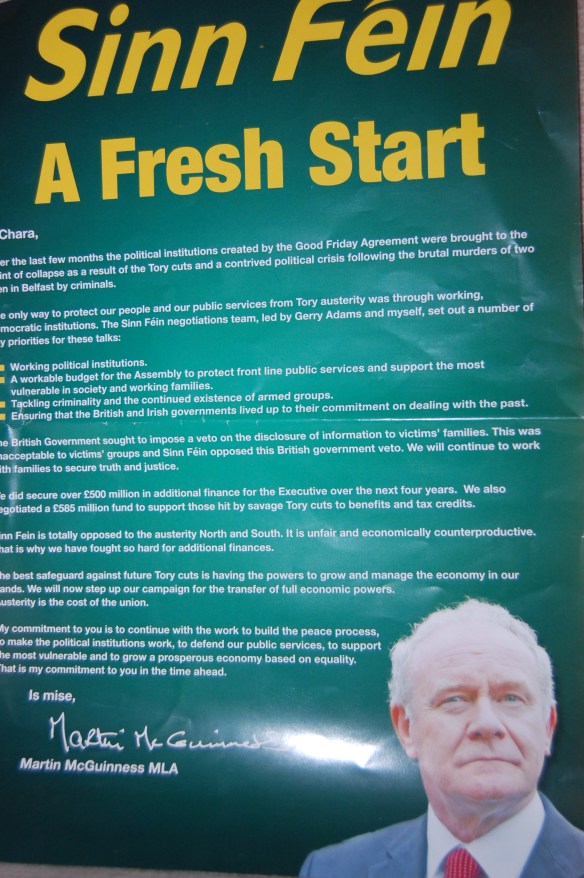
The richest political party in Ireland paid for the Northern nationalist newspaper ‘The Irish News’ to include a glossy leaflet inside it, selling the latest political deal which has been negotiated between it, the British government, Irish government and the Democratic Unionist Party.

It’s called ‘A Fresh Start’ although it isn’t: the whole point of it is to refurbish the previous agreement, of which Sinn Fein had been an enthusiastic supporter.

So it’s not fresh, since it contains no new ideas, and because we have been here countless times before and the main point is to implement the Stormont House Agreement, it’s not a start either.   In fact according to Sinn Fein no fresh start was even necessary.

Not necessary because the first paragraph in its open letter states that the crisis which prevented the implementation of the Stormont House Agreement was provoked by Tory cuts and a contrived political crisis caused by the murder of two people; one of which was carried out by Provisional republicans (so the contrivance must be partly their responsibility).

The other respect in which they were responsible for the ‘contrived’ crisis was their acceptance and then refusal to implement all the Tory welfare cuts, in the process claiming opposition to austerity while implementing it in all its other aspects.   In their leaflet they state that “the only way to protect our people and our public services from Tory austerity was through working the democratic institutions.”  Except that implementing Tory austerity became the only way of saving “the democratic institutions”.

The new deal implements the Tory cuts to welfare, with apparently some local mitigating measures already agreed, and nothing more than that.  The hollowness of the previous angry Sinn Fein opposition to the Tories and their cuts has been exposed through the ‘Fresh Start ‘Agreement making provision for transferring the powers to make the cuts from Stormont to Westminster.  Not so much standing up to Tory cuts as handing over the knives to the Tories to make them.

In parenthesis it may be noted that during all this fake opposition to welfare cuts the people affected were as utterly dependent on Sinn Fein as they are on the benefits themselves and have seen this opposition withdrawn along with some of their benefits.  What it proves is that the only way to protect our people and our public services from Tory austerity is through working people organising to fight back and creating an alternative.

The next paragraph in their open letter notes that Sinn Fein is standing up for victims by demanding the British Government discloses information, which it is refusing to do.  What a pity then that this is repeated on the other side of the leaflet below a picture of Gerry Adams whose complete disclosure of the past involves complete denial of ever being in the IRA.

The next paragraph boasts of “securing over £500 million in additional finance for the Executive over the next four year.  We also negotiated a £585 million fund to support those hit by savage Tory cuts to benefits and tax credits”.

The last deal they walked away from, because it failed to protect welfare recipients sufficiently, provided for £564 million over 6 years.  Sinn Fein claimed that this roughly £95 million per year was not enough “to protect the most vulnerable in our society” but has now accepted that £86.25 million a year over 4 years to cover the same cuts will be a better deal!  The money they claim to have negotiated now – £585 million in total – will have to be set against not only previous cuts but the new cuts to tax credits introduced since the previous agreement.  Even the ‘new’ money may not be new at all and the lone Green party member of the Assembly has claimed that some of it will come out of the existing Social Security Agency budget!

So what about the first £500 million claimed by Sinn Fein?

Well most of that is earmarked for those traditional objects of Sinn Fein sympathy – security and social security.  £188 million will go to security, with £160 million going to the Police Service of Northern Ireland to tackle republicans (the dissident ones?), and £125 million going to clamping down on social security fraud and error ( the irony of this is matched only by their calling those who murdered Kevin McGuigan “criminals”).

In the debate following the Agreement neither Sinn Fein nor the DUP have been able to demonstrate that all the claims about there being new money stand up and that the partial and temporary welfare relief is not just going to be paid by existing budgets.

So when Sinn Fein claims in its leaflet that “Sinn Fein is totally opposed to the austerity North and South” this really means nothing very much in the North and will very likely mean not a great deal in the South either.

In the penultimate paragraph it says that “the best safeguard against future Tory cuts is having the powers to grow and manage the economy in our hands.”  So how have they done this and how do they propose to do it in future?

Well, the Agreement notes approvingly the reduction of 7,410 jobs from state employment in the three years between April 2014 and March 2016 and “If cost cutting does not achieve the results required the Executive will “consider revenue raising measures.”   To indicate the meeting of minds involved, and to demonstrate that we are all in it together, “the Executive commits itself to lowering corporation tax to 12.5% in April 2018.”

In addition the British Government will legislate to ensure that local spending plans cannot exceed what is permitted and will review the Block grant to Northern Ireland after four years to take account of the effect of the reduction in corporation tax, no doubt with a view to further reductions.  How all this is opposition to Tory austerity is anyone’s guess.

Rather stupidly the other side of the Sinn Fein leaflet advertises the opposition of the British Government to disclosing its role in the past, about which Sinn Fein has achieved absolutely nothing.  The Agreement includes as the first of its principles “the ending of paramilitarism”.  This is straight after The British Government has issued an ‘independent’ report saying that the IRA army council still exists, and of course following the murder of Kevin McGuigan, all while Sinn Fein continues to claim that the IRA has left the stage.

On the Unionist side the repeated collaboration with loyalist paramilitaries by the unionist parties is studiously ignored.

It would be tempting to point the finger at both Sinn Fein and the DUP for their hypocrisy but the British have a special talent when it comes to this sort of thing.  It was reported only last week that there have been only ten convictions based on membership of a paramilitary organisation since 1998 and none for nearly seven years.  So how come, all of a sudden, it’s become such a big deal?

A new task force made up of the Northern and Southern police forces and tax authorities is to be established but this will achieve what its masters want it to achieve.  It is the stick to the carrot of additional (or not so additional) money.  However, as it’s a cross-border body it’s clearly aimed at republicans.

What sticks in the craw most about this part of the deal is that the Executive, made up of Sinn Fein and the DUP etc., is to “undertake a public awareness campaign to raise public understanding of the harm done by paramilitarism.”  Yeah, we really don’t have a clue.

The heading for a ‘Shared Future’, costing £60 million over four years, gets one paragraph and explains nothing, which could mean it will never be spent or might be spent on buying off ‘community representatives’, as flagged in the latest loyalist offensive for ‘inclusion’ of their gangster outfits in the Stormont gravy train.

By contrast the section ‘Irish Government Financial Support’ gets two and a half pages, with the highlight a meager £75 million for a road, although it also includes such key aspects of the Agreement as “development of further cross-border Greenways and Blueway cycling-walking-water leisure routes, including the Ulster canal.” The Irish Government also champions the use of private finance to fund further infrastructure projects.  In other words the Irish Government is pretty irrelevant except to allow nationalists to claim some role for it, what role is pretty clear.

The rest of the Agreement promises to implement the previous Agreement on Flags, Identity, Culture and Tradition.  So, while the paper mentions sectarianism twice it mentions Flags twenty-two times.

The ‘Fresh Start’ also rather embarrassingly reminds nationalists that the British Government endorses “the need for respect for and recognition of the Irish language in Northern Ireland” but again this means nothing and reminds everyone of the failure of Sinn Fein to achieve its long held objective of an Irish language Act.

What to do about the past is the one area where failure is so total that the Agreement has to admit it.  Yet, rather than skirt round the issue in its leaflet, Sinn Fein states that dealing with the past was one if its four priorities – so what happened then?

If the only thing now that has yet to be agreed, and which will therefore involve yet more talks, is about the past, it will continue to be easy to present the problem as one of living in it.

The Sinn Fein leaflet then is a catalogue of failure and the new Agreement is an attempt to build on that failure.  It is such an open declaration of defeat that even some of those opposed to Sinn Fein appear to find it a bit embarrassing.  The ‘Irish News’ columnist Newton Emerson begins his assessment of the Agreement by saying:

“The ‘fresh start’ agreement is such a total defeat for Sinn Fein that it is positively bizarre.  Even as a unionist, I find it unnerving”

The leaflet aimed at their supporters is just as bizarre as their negotiations and their spin on it is empty and pathetic.

It should also be said that the Agreement is also a rejection of unionist appeals to take steps to ditch Sinn Fein and allow the unionists to begin running the local state apparatus without them.  This would represent a clear break from British strategy and a divided unionism is in no position to achieve this.

Besides, for the British, with ‘enemies’ like Sinn Fein who needs friends?


How can you support a united Ireland and not support Scottish independence? Part 2

Roy-Keane-as-Braveheart-Paddy-Power-3When Irish unionists claim rights to self-determination history has shown that this is not a claim for equality but a claim on behalf of sectarian supremacy – a claim to the right to inequality.

But, the question can be put, if socialists regard self-determination as a means to facilitate the voluntary unity of nationalities surely a united Ireland will itself involve the forcible suppression of Protestants and of Protestant workers?  This would mean that while Irish unionism has no legitimacy the alternative of a united Ireland is also not one that socialists can support?

Some on the Left have stopped there, accepted this, and said that the only solution to the question of democratic national rights in Ireland is therefore socialism.  This tends to come from those for whom every thorny problem is solved by the invocation of socialism.

Workers’ opposition to mass immigration? A socialist society with full employment, great public services and housing would deal with objections.  Economic crises, with periodic mass unemployment and cuts in living standards? A socialist society!  Women’s oppression and racism? Socialism is the answer.  Workers’ passivity in the face of their right wing leaders’ betrayals?  A revolutionary party with a socialist alternative.  Sectarian division?  Workers unity around a socialist programme!

Such solutions are not so much an answer to a specific problem as an invocation that the problem would simply go away if it were made not to exist. It invokes an alternative reality and not an alternative set of policies to get there.  It says that the problems and challenges faced by workers are solved by socialism when in fact the reality is the reverse – socialism is created by workers.

This means working people being persuaded and organised to present answers to all these different questions, not invoking an idealist formula disembodied from those whose conscious actions alone can bring them about.  And the only people who can do this are working people themselves, with those who are socialists attempting to advance this process.

In the case of Ireland, the point of opposing self-determination for the Protestant Irish in the North is that such a claim is not compatible with workers’ interests.  It is not an invitation to violently impose a united Ireland.  Its purpose is to explain that the claiming of such rights is reactionary.  It is meant to identify unionist and loyalist ideas and movements as right wing by virtue of the demands they hold most dear.  In this sense the demand for a united Ireland is not one taken up despite the Protestant population but because of it, because it is they who are most saturated with reactionary sectarian and imperialistic ideology.

Treating it as a sanction to pursue an armed struggle against the wishes of the artificial majority in the Northern State is part of the Irish republican liberal understanding that there are rights which, if they exist, should be exercised regardless of any considerations of the reality in which they are supposed to be grounded.

This means for example that armed struggle by republicans is justified by the principle of the right of the oppressed to fight their oppressors by any means necessary, without stopping to ask ‘by any means necessary to achieve what?’  It means rights asserted as abstract principles without regard to efficacy or morality.

Socialism on the other hand is based on workers’ interests and needs grounded in the world they live in and not of abstractions that efface these needs and interests.

Opposition to Scottish independence by socialists can therefore only respond with bemusement to nationalist claims that every other country to achieve ‘independence’ has not wanted to go back, so that it can’t therefore be such a bad idea.

Well how many of these countries are really independent, of the requirements and pressures of capitalist globalisation for example?  How many of the workers in these countries have had their basic needs and interests resolved by the ‘independence’ of the countries they live in?  In what way does the principle of separation of itself address these problems; meaning have these nationalists really considered the alternatives; meaning also that if they have, this particular argument is not really one of principle at all.

The nationalists who claim that there are 200 or so nation states in the world – why has Scotland to be different – might want to ask how this world of nation states has fared in the twentieth century and whether it has been such a good way to order the world’s affairs.  Or have two world wars taught nothing?  Perhaps a look at the character of many of these states might make one think twice that this model is one to emulate.

When it comes to the demand for a united Ireland such a demand is both abstract and unrealistic outside of its insertion into a social and political struggle that understands it, not as the demand for a new Irish capitalist state, but as a means of reducing division; including by rejecting sectarian claims to state legitimacy and power by the Protestant population and rejecting the intervention of the British state to uphold such claims.

But it also means rejection of all the other ways in which division is imposed, including sectarian organisation of education and other state services both North and South, religious imposition of restrictions on women’s rights, sectarian employment practices, sectarian political arrangements such as Stormont and state sponsorship of armed sectarian paramilitary outfits.

It means building alternative centres of working class identification and power including a non-sectarian and anti-sectarian labour movement, trade unions and political parties, democratic campaigns, and workers cooperatives where workers livelihoods directly depend on their working together.

This socialist agenda is light years from nationalist answers. By understanding this workers might be able to see that the arguments of nationalists, their claims for rights that do nothing for workers, and their claims to address grievances which are either spurious or actually derive from class oppression are false.

concluded

How can you support a united Ireland and not support Scottish independence? Part 1

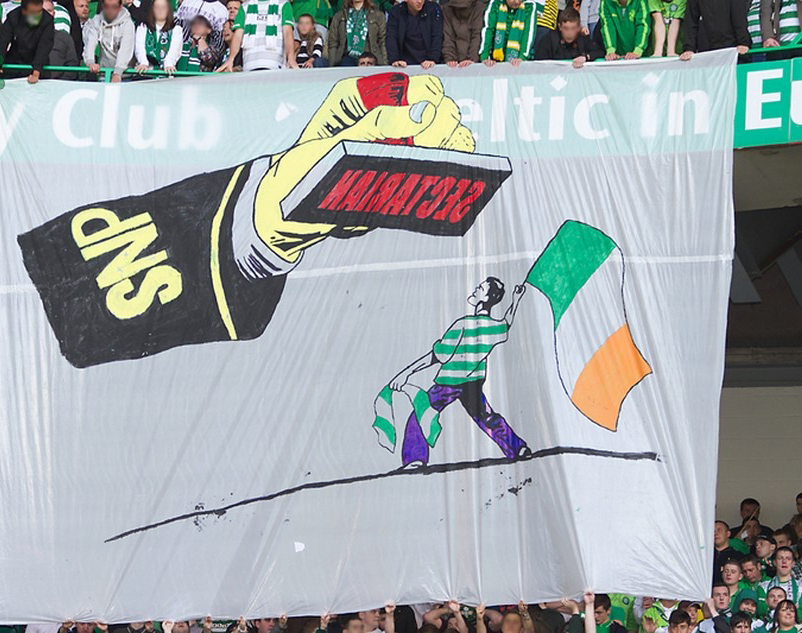
Celtic snp2_310902033This week I had a conversation arising out of Jeremy Corbyn’s interview in the Andrew Marr show on the BBC.  Like others I have spoken to who saw it I can’t remember ever making a point of watching until I knew it featured this interview.

The basic issue that arose was how Corbyn could claim to support a united Ireland but oppose Scottish independence.  Surely if you support the independence of one you should support it for the other?

Given that I agree with Corbyn I answered this question by pointing out that in both cases we were talking about removing borders (or stopping them being erected) and thereby preventing barriers to unity.

Through a united Ireland the unity of Irish people would be advanced, and by opposing the separation of Scotland from England and Wales you would support the unity of British people.  Since unity of the working class irrespective of nationality is a basic socialist principle it would require some argument to trump it.  None has been advanced for Scottish separation that isn’t either factually incorrect (like Scotland is an oppressed nation) or exceedingly weak (it would also be good for the English!).

An obvious response would be – does that mean you are also in favour of unity of Britain and Ireland?   And the answer is yes.  Provided the unity was one of equals, then there could be no objection to political arrangements that would further the erosion of national division and increase the grounds for united action by the working classes of the nationalities involved – English, Scottish, Welsh and Irish.  Previous unity of the islands involved British imperialist domination that was rejected by the majority of the Irish people and history demonstrated that no unity of the peoples was possible under these conditions, at that time at least. As I pointed out in this discussion – I am in favour of a united Europe.

The independence of Ireland has not been an over-riding principle for socialists and this is something that divides us from republicans, including those describing themselves as socialist republicans, or more bizarrely, republican socialists, whose socialism is in reality a variety of republicanism.  So much so that their socialism is not a means to overcome national division but a means of emphasising their nationalism: ensuring what they believe will be effective independence as opposed to nominal independence under a neo-colonial yoke.

What matters to socialists therefore is the unity of people, particularly of the working class, which is the bearer of a new socialist society, and not particularly the unity of state formations.  This is why socialists support self-determination so that unity is the voluntary unity required to overcome national divisions and not the forced unity of foreign rule and occupation.

As I have said before the absence of violent repression by English armed forces in Scotland stands in stark contrast to British repression in Ireland.  So while socialists support self-determination for Scotland we believe it should be exercised by continuing voluntary unity with the rest of Britain.  That the majority of Scottish people decided this in the referendum is therefore to be welcomed.

But if this is the case why do I support the unity of the Northern and Southern Irish states when quite clearly the majority in the north do not favour unity with the south?  Surely that would involve the coerced unity that you have just said you oppose?

Let’s leave aside for the purposes of this argument that unlike the Scots the population of Northern Ireland is not a nation and therefore not subject to the right of self-determination.  Leave aside also the argument that even if we restrict ourselves to the Protestant population it too, while being an identifiable people, are also not a nation and any purported right to self-determination on their behalf is transparently a means of frustrating the right to self-determination of the Irish people as a whole.

We’ll also ignore the historical fact that any declared separateness of the Ulster Protestants is inaccurate because it does not refer to Ulster but a truncated part of it and did not seem to arise when the whole of the island was ruled by Britain, when the Protestant population in the North was quite happy to consider itself Irish, the specifically ‘loyal’ part of the nation.

It’s much harder to put aside the coerced separation of partition and the continual violence needed to maintain it even if this is usually, but not always, ‘merely’ in the form of a threat to the majority of the Irish people residing south of the border.

We will however also ignore the visceral opposition to considering themselves Irish that some Northern Protestants express when the idea of a united Ireland is proposed.  Down this road leads capitulation to the most deranged bigotry – I recall being told by my father that my uncle refused to eat off a white plate with a green trim in a bed and breakfast in Blackpool, such was his sectarian impulses.  He even apparently showed some ambivalence about supporting the Northern Ireland football team because they played in green – much better the red, white and blue of Linfield and Rangers.

While it is of no interest of socialists to impose national identities on peoples against their will it is necessary for such identities to have some grounding in reality to be considered seriously by everyone else.

On this basis however it might seem that Irish Protestants in the northern state have some grounds to claim separate political rights since they obviously are in some senses a separate people.  It might appear that it doesn’t matter whether this is a nationality, defined as ‘Northern Irish’ or as simply British inhabitants of part of Ireland, or both.

What matters however again is the objective basis for claiming rights to self-determination because some of the argumentation above is really beside the point.

And the point is that (some) Irish Protestants have been provided with what they can consider self-determination, exercised as unity under the British state, which they chose to participate in through rampant and systematic sectarian discrimination; itself reflecting the objective fact that their claims for national status were based primarily on sectarian self-identification as a colonial population in what they considered, when it suited them, was (26/32 of) a foreign country.

Since for socialists national rights are democratic rights, which are reactionary if without democratic content, it would appear that the right to self-determination of the Irish/Ulster Protestants or Northern Ireland, however one wants to put it, is a reactionary demand that cannot be supported.  And it cannot be supported because not only does it not facilitate the unity of peoples but it furthers their disunity along sectarian grounds, plus the division that arises from living in two separate Irish states.  The violent and sectarian history of this self-determination is cast iron proof of the thoroughly reactionary nature of Irish unionism.

John McDonnell’s IRA apology

Brent-Hosts-Question-Time-1If you relied on the mainstream media to know what was happening in the world you would be mightily confused.  Some bearded, deluded and dishevelled guy has just become leader of the Labour Party.  Even worse, the BBC Six O’clock news led its programme with the announcement that he had just named a guy called John McDonnell as shadow chancellor, someone, the voiceover immediately told us, who once supported the IRA.

Who he was, what he had previously done that made him qualified for the job, what his economic policies were, none of these were the foremost issue for the BBC.

Now, John McDonnell has apologised for saying “It’s about time we started honouring those people involved in the armed struggle. It was the bombs and bullets and sacrifice made by the likes of Bobby Sands that brought Britain to the negotiating table.”

He explained the remarks by saying that  “I accept it was a mistake to use those words, but actually if it contributed towards saving one life, or preventing someone else being maimed it was worth doing, because we did hold on to the peace process.  There was a real risk of the republican movement splitting and some of them continuing the armed process. If I gave offence, and I clearly have, from the bottom of my heart I apologise, I apologise.”

A number of things should be said about this.

Firstly, there’s little point complaining about the obvious bias that pervades not only the Tory press but also the BBC.

This is fuelled by the social background of those in the organisation and their political views.  Their commitment to a view of objectivity and balance embraces such a narrow conception of what is acceptable that Corbyn and his supporters are clearly beyond the pale and don’t fall within the normal rules.

Along with this there is an inability to fully comprehend their politics, partly as a result of their limited experience of political debate that doesn’t stretch back beyond the Thatcherite consensus imposed on society during the 1980s.This means for example that the idea that the leader doesn’t make all the decisions is not seen as an example of democracy but as a weakness, causing confusion and division. And of course, there is fear of the Tories who have put the squeeze on the BBC as an organisation.

Complaining about bias is not going to change any of these.

What would change the situation is the British labour movement building its own mass media which, given modern technology, does not need to immediately seek to replicate the scale of the capitalist media.  Within the hundreds of thousands who voted for Jeremy Corbyn and the many more millions who support him there is the basis to do this.

The second thing to note is that the media presentation on this issue is only one example of a barrage of attacks that reveal not only bias but the current weakness of the Corbyn led movement.  It is not a surprise that Jeremy Corbyn and his support have not been prepared for the tasks of leading the opposition to the Tories.  They will obviously for example have to build a team to deal with a hostile media.

The greatest weakness however is not in this lack of media preparedness but in the weakness of their support among the mass of careerist Labour MPs.  It is this that has allowed the media to present the new leadership as shambolic.

There’s nothing that can immediately be done about this either.  In one ironic sense it is to be hoped that this right wing shower are actually motivated by careerism and not ideological fidelity to their rotten right wing politics.  If they are simply careerists they might understand that if they attempt to destroy Corbyn they will in all likelihood so damage their party that they would scupper their own careers as well.

In contrast the great strength of the Corbyn phenomenon, which put him where he is, is invisible, or invisible to the mass media anyway.  While appearing to recognise his mandate the media presents the world from ‘the Westminster bubble’, the same bubble it claims everyone else is outside of, although not apparently themselves.

Even in the case of John McDonnell’s apology on ‘Question Time’, the reporter in the local BBC Northern Ireland news noted that his apology seemed to go down well with the audience.

This support will be tested and its cohesion and growth depends not so much on Jeremy Corbyn himself but on what these people do.  In order to resist and fight the media as part of rebuilding the labour movement they must organise for this objective.  The arguments and political activism of hundreds of thousands will be the only effective response to a hostile media.

What Corbyn and McDonnell’s are now in a position to do is deliver political leadership, with arguments that can effectively galvanise, educate and rally their supporters.  Organisation of their support is the number one objective because only this support can convince the millions who can be won to their cause.

When it comes to the question of Ireland their position needs to be better.  The original political position of McDonnell arose because he put solidarity with the political leadership of the resistance to British rule before opposition to his own country’s oppression of Ireland.  And he did this at a time when this political leadership was surrendering its opposition.

So McDonnell claimed that armed struggle forced the British state to the negotiating table.  So it did, but once it got there this armed struggle showed how useless it was at getting anything from it.  It also showed that there wasn’t going to be any real negotiations unless the armed struggle stopped.  This is always the demand of the British and they get their way.  In fact it is more accurate to say that armed struggle gets them to the table which only becomes a negotiating table when they stop it.

But even in the recent ‘peace process’ this is to overstate its importance.  The Provos had to make significant political concessions before the British would get into substantive political talks, including accepting the supposed neutrality of the British state.  This is before we even consider the capitulation required before unionists would talk to them.

The result of these negotiations and the so-called peace process is something that the British Labour Party should not support.  It should reject the argument that an end to political violence is predicated on a sectarian and increasingly corrupt political settlement.  The political deal, one that has been in crisis since it was born, appeared after the ceasefires.  Of course the rotten nature of this settlement will pass the vast majority of British people by, but then so did the North of Ireland for decades before 1968.

The primary role of a Labour party is to support the independent organisation of workers and this is true of the Labour Party in the imperialist country.  This can best be done by solidarising with Irish workers’ own attempts to do this and campaigning to remove the foreign state presence that frustrates this.

In the North of Ireland the British state does this in a number of ways, including the sponsorship of loyalist paramilitaries and political policing of republicanism, where it has found ‘good’ republicans in the form of the Provos, for whom it will attempt to cover up violence, and ‘bad’ republicans who are labelled dissidents. (See here )

But even if Jeremy Corbyn became prime minister he would be able to do little to prevent the British military continuing its criminal conspiracies.  It swears loyalty to the Queen not parliament and certainly not to the people and it does so for a reason.  Marxists make the distinction between being in Government and being in power, between sitting on the top of a state and controlling and directing it.  The example of the British state’s operations in Ireland is graphic proof of the difference.

And there is yet another problem, as a comrade of mine put it last weekend at a rally in support of the refugees: Corbyn is more left wing than anyone in Ireland.  Who would be his political allies here?  Even if he wanted a united Ireland there is no significant political force in Ireland demanding it never mind in a position to do anything about it.

And don’t give me a response of ‘what about Sinn Fein’.  We have been at the stage for some time that when Sinn Fein politicians appear on TV claiming that they’re ‘for a united Ireland’ the reaction is one of – what?  Really?

What Sinn Fein does, its support for sectarian partitionist institutions and its ideological capitulation to unionism, betrays what it sometimes says about being republican.

The truth is that today there is no significant political force fighting for an end to imperialist rule.  Sinn Fein ‘support’ for a united Ireland is on a spectrum of such support declared by every nationalist party in the country and just as empty as the rest.

The task for Irish socialists is therefore very like the one for British socialists – rebuild a working class movement committed to democracy and socialism independent of their respective capitalist states.  That these are essentially the same is why socialists are internationalists.

For British socialists a democratic policy on Ireland is nothing to apologise for and nothing to hide from the British people, but it does not involve hitching their banner to the failed organisations of Irish nationalism including Provisional republicanism.


Political propagandists and political murder in Belfast

Feeney 1imagesAs the political crisis generated by the killing of Gerard McGuigan by IRA members threatens to spiral out of control the politically weary population is invited to pick sides on what is to happen next, with seemingly everyone in favour of keeping Stormont while everyone knows it’s rotten.

This appears to put the onus on being able to blame someone else in order to defend a sectarian corner and the particular rights assumed inside the settlement.

The ‘right’ attitude to the killing has therefore to be asserted first, although it is of the least concern to the parties involved in yet another round of talks.

As a result a notable feature of reaction to the murder of Gerard McGuigan has been the propensity of nationalist commentators to ventilate on the synthetic character of unionist outrage at the murder.  In other words the outrage is fake – they don’t care about dead ex IRA men.

If that were the only point being made the response should be one of agreement.  Yes, unionists have ignored state and loyalist violence and have collaborated openly with paramilitary groups so their condemnation of republican violence is hollow.  They don’t care about dead IRA men and their actions since the latest killing is guided by purely party political calculations.

But that isn’t all there is to it.  The point being made by these nationalist commentators is that what has happened shouldn’t be allowed to upset the current political arrangements because the outrage is phoney.  Just as I pointed out in the previous post on this (that the new peace institutions are now the justification for ignoring the killing of others) so expressing outrage at the killing is also to be discounted because the main unionist complainants are insincere.

And the fact that this outrage is insincere means that this is a purely manufactured crisis that originates in unionist bad faith.  This bad faith is therefore the problem.  The perfidious British however have turned this around, as they usually do, in order to appease unionism.

So nationalists are invited by these commentators to believe that what must be discussed now is not what the danger is to those who fall foul of the Provisional IRA but how the institutions can be saved.  The British are happy to go along with this but add that this involves giving the unionists confidence.  But since this a purely subjective thing we are in the world of Humpty Dumpty – confidence means just what unionists choose it to mean, neither more nor less.

So yes, nationalists have a point about pandering to unionist hypocrisy but they have a problem when they allow this hypocrisy to become their moral compass by replying to unionist hypocrisy with their own.

They have a problem when they excoriate British pandering to unionist violence while turning a blind eye to Provisional murder.  So the outrage at the latter is fake – let’s ignore both it and the event that occasioned it.  Then we can have our equal and opposite hypocrisy.  Unionists complain about Provo violence but we will turn a blind eye to it and complain about loyalist violence.

In this way the sectarian perfect circle of hell attempts to trap everyone within it, everything and everyone is to be defined by sectarian division.

A prime example of this capture by sectarian division, involving capitulation to acceptance of reactionary political violence, can be seen in the regular political columnist in the largest nationalist paper in the North, Brian Feeney in yesterday’s ‘Irish News’.

So the police fingering of Provisional IRA members for the murder of Kevin McGuigan was “ill-considered”.  As I also pointed out before – I wonder would he therefore have considered well-judged the previous failure to finger the loyalist UVF for the attempted murder of a young woman in the same area.

Feeney had a previous column on the unionist invention of the 1960s civil rights campaign as an IRA plot, a fiction of course, but what had this to do with the real IRA plot to kill McGuigan, unless he wanted to claim it too was another unionist fiction?

Instead he goes along with the Sinn Fein line that what this is all about is unionist refusal to live in equality with nationalists: “This refusal to accept mere equality prevents them seeing themselves in the same light as nationalists and republicans.”

He appears totally oblivious to the fact that with this attitude of Nelsonian ignorance of IRA responsibility in murder he should really be writing that nationalists should now see themselves in the same light as unionists, united equally in the same light of sectarian blindness.

By such a descent into sectarianism are nationalist claims for equality to become nationalist equality in sectarianism, which is indeed the political project of Sinn Fein.

He then makes hay with silly and insensitive remarks about “the futile and fatuous attempt to abolish the IRA.”  How would anyone know “if someone has left the IRA? . . how would anyone prove they’d left?”

So does Feeney not want to see the end of the UDA and UVF?  Would Feeney be questioning as futile and fatuous calls for an end to loyalist paramilitaries if they had just killed someone?

Sure how would you know whether they or the Provisional IRA had gone away or not?

Well here’s a start.  You might have a chance of convincing someone they had disappeared if they didn’t kill those who fall foul of them.

Feeney complains that the leader of the DUP Peter Robinson needs to feel that he is “not bound by any constraints that apply to normal relationships.”  Leaving aside what counts for normal in the North of Ireland, does he not think such a remark might also be pointed in another direction?

It was bad enough when the British so openly overlooked and colluded in political murder by loyalists but their shameless excuses for the Provisional IRA and its supposed peaceful intentions complete the circle that working people in the North have to break from.  In this case nationalist workers should see through the muck apparently thrown at the British and unionists because it’s really being thrown in their eyes.  Who else is expected to listen to Feeney?


The politics of murder in Belfast

images (11)The murder of Kevin McGuigan on 12 August in East Belfast is widely seen as revenge for the former’s claimed involvement in the earlier murder of Provisional IRA leader Gerard ‘Jock’ Davison.

The Police Service of Northern Ireland (PSNI) have done their bit to protect the Provisional movement by claiming that although Provisional IRA members were involved there is no evidence that it was authorised by the leadership.  Since complete denial of Provo involvement would stretch credibility to breaking point and reflect on the PSNI as well as the Provos, this was as much as they could do.

Of course this makes no sense, although it was notable that some nationalist commentators were prepared to swallow it.  Much amazement was feigned by unionists that an IRA even existed, so ‘answers’ were demanded.  The British Government said that of course it knew the IRA existed but that what was important was what Sinn Fein said (i.e. not what the IRA actually did) and especially that it continued to express support for the ‘principles of democracy and consent”.

The Garda in the South had previously claimed that the IRA had no military structure but are going to look at it again and the PSNI claimed it was a lobby group for “peaceful, political republicanism”.  Sinn Fein spokesmen claimed that of course the IRA was not involved, that it had “gone away” and all allegations to the contrary were ‘palitics’.

So the Provos continue to support the police but not as far as allowing them to get in the way of taking revenge or protecting themselves and their enormous financial empire. Support for the police is therefore purely ‘palitical’.

In the hypocrisy and lying stakes each out-does the other.

So the British Government and PSNI are claiming that while a much slimmed-down ‘peaceful’ IRA exists there is no evidence that it sanctioned the murder of McGuigan; although investigations will continue, which means that if it suits the political purposes of the British Government such a judgement can be easily changed. And easily justified – a ‘peaceful’ IRA with guns, that murders its enemies, and which by its very reduced size and tightness makes inconceivable the idea that the murder was not approved from the top.

The meaning of this is obvious: the British state and its police force doesn’t care if the Provisional IRA kills people it doesn’t like.  It doesn’t care if loyalist paramilitaries kill people they don’t like. Round the corner from where McGuigan was killed a young woman was almost killed by the loyalist Ulster Volunteer Force but the PSNI refused to blame the UVF who were responsible.

Today it is reported that the murder of another Short Strand man Robert McCartney by the Provos was subject of a secret deal between the PSNI and Provos, with the cops offering not to go after those who cleared up the murder scene, in exchange for Provo information on the less important hands-on killers.  No one has gone to jail and the Provos kept their mouths shut.

The political import of the killing is the following:

The Provos can kill and the state will give them impunity but it will expect a price to be paid.  Anyone who thinks that the end of Sinn Fein’s meagre opposition to austerity through opposition to some welfare cuts will not form part of the price probably believes that everything that the British Government, police, unionists and Sinn Fein has said about the murder of Kevin McGuigan is 100% true.

A message has been sent to all enemies of the Provos, political or criminal, that they are willing and able to kill, no doubt under some new set of initials such as AAD (Action Against Drugs).

The slow crumbling of the architecture of the political peace settlement has speeded up and now threatens the current arrangements.  The Ulster Unionist Party has withdrawn from the all-party Executive, putting pressure on its supposed more rabid rivals in the DUP to follow its lead.

The DUP has now proposed that Sinn Fein be expelled from the Executive, although Sinn Fein can prevent it, and only the British Government can do this.  If the British do not support such a move the DUP would then be forced to either put its money where its mouth is and walk themselves, bringing down the Executive, or reveal themselves as joined at the hip to the Provos in the great gravy train on the hill.  It might then start losing support.

As the pro-settlement ‘Irish News’ editorial put it today, the Executive is so discredited most will not care if it remains or goes.  And as I have noted before, the current Stormont regime is so rotten it has little credibility left.

The peace process has been built on the lie that the rotten sectarian arrangement brought about the absence of widespread political violence.  In fact the defeat of the Provos and the ending of widespread violence preceded the creation of the rotten sectarian arrangements.  Again and again the sectarian political settlement has been defended by the claim its overthrow would bring us back to the troubles.

The recent killings demonstrate precisely the opposite.  The existence of the sectarian Assembly and Executive is now justifying collusion between the state, Provos and loyalist paramilitaries in violence, intimidation and large scale criminality.  The message from the British pro-consul has been explicit:  as long as Sinn Fein supports the sectarian settlement and police that is what counts.  What it actually does will be excused and glossed over if remotely possible.  The so-called peace settlement and its preservation is now the justification for allowing political and criminal violence.

Socialists must continue to oppose this rotten settlement.  They should continue to oppose the PSNI and expose its collusion with the Provisional IRA and loyalist paramilitaries.  They should oppose the austerity imposed by the British Government and the Stormont parties, especially Sinn Fein and its phoney anti-austerity posturing.

It should likewise refuse to offer political support to any opposition by Sinn Fein to its exclusion from Government should this occur.  The Provisional movement is an obstacle to working class people in the North and South of Ireland identifying their own interests and defending them.