How left does a Left Government have to be?

AAAdownloadThe weakness of the left’s strategy is revealed in the proposals upon which they would proclaim their difference from Sinn Fein and their preference not to seek a common platform.  If we look at the Anti-austerity Alliance (AAA) proposals for the 2016 budget we can see this illustrated in a number of ways. The gap in the strategy of the Left, evidenced in the AAA proposals, therefore also raises the question of how left the policies of a Left government have to be.

But first there is the reluctance of the AAA to accept that there is an economic recovery and one that many have benefited from, if only to the extent that the cuts appear to have relented.  Of course, that the rich do best is a permanent result in capitalism.  The issue here is not that the rich do best but the view that “for us, for working class people, for the majority of young people, unemployed people, pensioners and small farmers – there is no recovery.”  (AAA)

But this isn’t true.  Unemployment has fallen, and not just as a result of emigration, and wages are beginning to rise again while taxes are no longer increasing as before.  These things matter to people and go some way to explaining why there will be no left Government elected in 2016.

Stating otherwise allows the opponents of socialism to claim that socialism is politics for the poorest only.  It sits comfortably in right-wing rhetoric that socialists are only interested in those at the very bottom of society as opposed to better off or better placed workers.  It makes poverty the issue rather than the class inequalities and class divide in society.  It does not make one more of a socialist, or revolutionary, to deny that capitalism can improve the living standards of workers in particular ways, within particular limits and with regular crises that threaten the lifestyle that workers have slowly tried to create for themselves.

Worst of all, it fits with the view that socialism is created not out of the strength of the working class – that it has employment, that this employment is often skilled, that society is dependent on this skilled labour, that the working class is increasingly educated, and that it is not on desperation and oppression that socialism will be built but on hope, expectation and confidence of the working class in its potential power.

Above all, the unity of workers is based on shared interests regardless of more or less temporary differences in status and income.  The income inequalities within the working class are barriers to its political unity while the reformist emphasis on redistribution ignores what all workers share regardless of levels of income.

Poverty, unemployment and marginalisation are most important from a political point of view because they present barriers to a common class identity and unity.   Denying what little improvement there is robs whatever else is said by socialists of some credibility and it is not necessary to deny the growth of capitalism in order to argue for its greater failure and the need for an alternative.

When we move to the programme of the AAA the gap in the perspective of the left becomes apparent.  In proposals to repudiate the debt the case of Syriza’s attempt to renegotiate the Greek debt is recalled.  While it is proposed that “a left government in Ireland would demand a negotiated write-down of debt to a sustainable level” it is acknowledged that “if as the Greek experience indicates seems likely, it did not have success at the negotiating table, it (a left government) would then turn to the option of repudiation.”

The proposals state that this would involve an audit of the debt and that “it is reasonable to estimate that such a debt audit repudiation would result in a reduction of the total debt to at most 50% of GDP.”  The issues this proposal throw up – of opposition by the EU and of private capitalist measures that would be taken in retaliation, in other words of everything that makes this option a challenge, is unexplained.  The unwillingness to state how this would be successfully implemented and the opposition to it defeated hides an inability to explain how it could be carried out.

No amount of rhetoric will hide the failure to explain what needs to be done to implement the policy.  In a previous post I have looked at the lessons that the Greek experience might teach us, which elicited some discussion, but none of the potential lessons touched upon there are presented in the proposals of the Anti-Austerity Alliance.   Unfortunately problems are not overcome by ignoring them.

A second area in which purely reformist perspectives are evident is in the proposals for ‘Public Investment, Jobs and Decent Work’.  Here it is argued that “the state should not only be willing to employ people in public services, but rather should also invest and create jobs in “wealth creating’ sectors of the economy – construction, communications, natural resources.”

This proposal cannot be confused with the demand for employment presented in the Transitional Programme written by Leon Trotsky, which was written to “deal with the present catastrophic period” and which was not a perspective for long term development of the (capitalist) economy.  It was required in order to protect the working class “under the menace of its own disintegration.”  Its purpose was not primarily to protect living standards or to provide a long-term solution to the ravages of unemployment but was necessary because “the proletariat cannot permit the transformation of an increasing section of the workers into chronically unemployed paupers, living off the slops of a crumbling society. . . Trade unions and other mass organizations should bind the workers and the unemployed together in the solidarity of mutual responsibility.”  Its purpose was plainly mainly a political one, to put the workers in a better position to take over society, not to confuse such measures with socialism itself.

The proposal is mistaken not only on the grounds of principle, that it proposes, and expects, that the capitalist state  could “provide the investment necessary for the creation of a an economically and environmentally sustainable recovery”, in other words a more efficient and effective capitalism, but that its proposals are concentrated on development of infrastructure that private capitalism has been so bad at providing almost everywhere and on which it has often relied on the capitalist state to provide.  In other words state investment in infrastructure is complementary to private capitalism not a competitor to it, even if state ownership in itself could be so considered, which it can’t.

The specific proposals for investment make this clear, mostly directed to traditional state sectors – a public works programme based on the water and sewerage industries, healthcare and education; childcare and development of wind energy.  All are complementary to existing private capitalist accumulation and are supportive of it.  Even development of the wind industry is already well established and already has state companies at its core – ESB and EirGrid.

The most dynamic industries situated in Ireland are in the ICT and chemicals sectors (including pharmaceuticals).  Encouraging the setting up of workers cooperatives in these would signal a real appreciation of the possibility of a workers’ owned cooperative sector of the economy growing in competition with the private capitalist sector, laying the basis of a future economy totally based on cooperative principles.   But there is no evidence that this has been considered at all.

Finally, the AAA proposes not to raise the corporation tax rate but simply asks that the headline rate of 12.5 per cent becomes the effective rate.  It is obviously aware of the timidity of its approach despite saying that: “by maintaining a regime of low effective corporation tax to entice foreign multinational companies, Irish society pays a heavy price by depriving our wrecked public services of the funds they require to provide decent living conditions for all.”

Given its view of the paramount need to redistribute income from the richest corporations to workers it makes little sense to propose that these corporations incur a tax rate of 12.5 per cent while the lowest income tax rate for workers is 20 per cent (excluding the universal social charge).  The reluctance to even make them equal arises from the knowledge that such a rate would not be considered credible.  The AAA is unable to rebut the claims of establishment society that low corporate taxation is essential for the State’s economic sustainability:

“If it is truly the case – as claimed by the entire political establishment (as well as Sinn Féin, who support not only maintaining corporation tax at its current levels but extending that rate into the North) – that the slightest rise in effective corporation tax, to say fund the expansion our healthcare system and end the scandal of homelessness, would lead to a flight of companies out of Ireland then that is an indictment of their system, not a mark of economic irresponsibility on the part of the Anti-Austerity Alliance.”

So despite stating that “it is not simply a matter of tweaking with elements of the system here and there”; that a “rupture is needed”; “rules must be broken” and “a fundamental transformation of our society  . . needed”, it becomes clear that this rupture lacks foundation, except as a generalised declaration of the existence already of “the wealth and resources . . to deal with all the ongoing problems of the crisis”.

The calls for a “move to a socialist economy, with public ownership of the key sources of wealth, under democratic control of working people, and planned in the interests of the majority”, like the AAA “indictment of their system”, becomes a moral condemnation separated from a programme to achieve the goals desired.

If the AAA cannot have the confidence that multinational capital will not up-sticks and leave upon increased corporate taxes, never mind actively seek to sabotage a left Government’s plans, then what confidence can workers have?  More importantly – what will give workers this confidence to take steps to tax the rich, tax the corporations and slash corporate welfare?  The AAA itself admits that: “as was unfortunately demonstrated in Greece, the wealthy are unreconciled as a class of people to any encroachment on their privilege. . . . the rich . . . will attempt to do whatever it takes to avoid paying for the crisis in their system.”

Unfortunately the AAA comes nowhere near explaining just what “whatever it takes” means, or whatever it takes would mean for the working class to defeat this capitalist resistance.  A radical left Government that truly sought to introduce a socialist society could not do whatever it takes, and this wouldn’t be mainly because of the opposition of capitalism, but because socialism can only be the creation of the working class itself, not a left government sitting atop a capitalist state.  If multinational capital struck against a radical Irish state this state is not capable of taking over the production vacated even if it were able to sell internationally what it produced.

This demonstrates in a very practical way how reformist notions of a state-led transformation of capitalism into socialism cannot work.  Only working people themselves can take over production and organise it on a cooperative basis.  Only workers can implement a radical restructuring and development of a cooperative economy and only they can replace, if necessary, the production vacated by fleeing multinationals.  That no significant section of Irish workers sees this as a possibility, as a mission, is why they buy into the fear that to challenge multinational capital too hard would only invite a retaliation they would be unable to cope with.

All this is why the creation of workers’ cooperatives is so necessary – in order to establish in the minds of workers the realisation that they can own and control production themselves; that they can create their own firms, provide their own jobs, develop their own products and markets, and impose their own discipline in the workplace.  On such a basis the failure of capitalist production will more and more witness a successful rival that, as the cooperative sector grows, would provide a potential alternative to it, one based on more than simple propaganda or agitation.

This alternative would involve the realisation of workers that their future lies not in sacrifices for the capitalist system but the development of their own cooperative sector to cover the whole of production.  In this rival sector of working class power all firms would be under the ownership and control of their workforce, all jobs their creation and all products those that workers see a genuine need for.  Within this sector of the economy their own discipline would determine the relations of power which would more and more come into conflict with the relations of power across the rest of society.  Such an exercise of power would see them shed illusions in the neutral role of the state and would see them stop looking to the state as the solution to all their problems – a state that they can never control and that can never reflect their interests or will.

Unfortunately the AAA like many others present the state very differently, as all its proposals demonstrate.  I will not dwell here on whether its devotion to the capitalist state as the vehicle for socialist transformation is a result of electoralism, which posits a left government at the top of the state as the key task, or whether worship of the transformative power of the state makes pursuit of a left Government the only rational objective.  But even the AAA sometimes can’t help expose the contradictions in its whole approach, as when it states that: “the contrast between the state’s efforts to publicise its corporate welfare schemes and its miserly approach to social welfare claimants could not be starker, or more revealing of the capitalist interests the state exists to serve.”

So if the state exists to serve capitalist interests why would it tax a resistant capitalist class, provide jobs for workers and strengthen their bargaining power; attack corporate welfare; countenance the replacement of private capitalist investment for its own and agree to a programme that clams will lead to socialism?

Perhaps some defence of the AAA proposals is possible by recalling its statement that “the purpose of the Anti-Austerity Alliance budget statement is to give an illustration of how things could be organised differently – how the wealth exists to provide decent living standards for all.” Except that what it holds up is more than an illustration but is proposed as an important step on the road to a socialist society.  Of course socialists should not oppose the measure proposed by the Anti-Austerity Alliance but only because their implementation, even partially, would make taking the right steps on the right road to working class power easier.

One purpose of the examination of the AAA proposals has been to demonstrate that the conception of change held by the left is not so very different from that of Sinn Fein; one based on state led economic development directed by a left Government with popular support.  In the next post I will look at further proposals to separate the left from the Sinn Fein by People before Profit and what approaches the Socialist Party and the Socialist Workers Party have for dealing with the situation after the election when there will not be the left Government they seek.

Back to part 2

Forward to part 4

The gap in the strategy of a Left Government

ireland IT map-480x360In the first part of this post on a left Government I stated that I did not believe that it was going to happen in the coming elections and also that this left a strategic gap in the perspectives of the left.  The fixation on electoral intervention and its potential success are therefore misplaced.    I have argued many times before in this blog that the reformist politics of the Left is inadequate to the objectives it professes to advance.

The focus on achieving a left government as the key to fighting austerity, and implementing policies that would mean a fairer capitalism, are misguided and bound for ultimate disappointment.  To put the argument at a very summary level: they fail to target the foundations of the capitalist system and avoid what is the root of the working class alternative.  The foundation of capitalism is the ownership of the means of producing everything we consume and rely upon for a remotely civilised existence by a separate class of capitalists and the resulting necessity of the working class to sell their labour power in order to earn the money to live. Workers do not own the product of their labour because it belongs to those who also own the means of production.

This is ABC for Marxists but unfortunately it is not carried forward to argue that the means of production should belong to the workers and thus support for measures that lead to this workers’ ownership of production, such as the formation of workers’ cooperatives.  Instead the Left argues for increased state ownership and argues that democratic control of the state and/or workers’ control under state ownership makes their programme different from the frequently employed policy of capitalist nationalisation.  I have argued differently here and here.  I have also addressed some arguments against workers’ cooperatives that are often advanced by the left here and here.

The Left’s alibi is that a revolution will accomplish the necessary transfer of property ownership, although this ignores a lesson of the Russian revolution that state ownership of property is not the same as workers’ ownership.  It also leaves the idea of a revolutionary approach, not as something that can grow today (before culminating in a transfer of power through creation of a new workers’ state after the capitalist one has been destroyed) but as something for the future, between now and which all sorts of very non-revolutionary methods are acceptable, if sometimes not actually desirable.

Because such non-revolutionary approaches are not in themselves fundamentally different from more or less radical alternatives that seek to reform capitalism a problem arises in distinguishing the proposals of the left parties from those of parties that do not seek to break from capitalism, such as left liberals or in Ireland – Sinn Fein.  As I have argued, this also leaves a strategic gap in perspectives aimed at fundamental transformation of society.

Again to summarise: without adequate preparation and prior strengthening of the working class through building strong trade unions, parties and workers’ cooperatives the fundamental break from the  diktats of capitalism becomes much harder and workers themselves,  as witnessed recently in Greece for example, are unwilling to consider a revolutionary leap.

Strengthening of the state, through state ownership and growing its power by increased taxation and spending does not increase the power of the working class but often leads to increased working class dependency on it.  Such dependency is something that should be argued against, not encouraged either directly or indirectly.  Workers doing it for themselves should be the maxim, not least because state initiatives proposed by the left are almost always national ones that are at best nationalist solutions.  It’s why nationalisation is nation-alisation.

Capitalist state ownership is not socialism and democratising the state does not make it socialist.

On practical grounds the reform of capitalism is easier to consider and to implement when the particular capitalist state is both strong economically and has greater political and social capacity to mobilise and organise wider society.  The relatively weak fundamentals of the native Irish economy reproduced also in the machinery of the Irish state, reflected in its endemic corruption and lack of developmental capacity, make the reformist development of a strong reforming state and dynamic economy less credible and more difficult to achieve.

This was the fundamental problem facing Syriza in Greece when it sought to confront the demands of the European Union led by Germany.  There was no strong Greek capitalism that it could rely upon both to increase the costs to the EU of any measures it might take against Greece or strong economic base on which to venture an alternative international economic strategy outside the EU.   This weakness of Greek capitalism is reflected in Greek consciousness through support for the Euro even while this was portrayed by many as the source of its disaster.

images (12)Similarly in Ireland the weakness of Irish capitalism is reflected in Irish workers acceptance of sycophantic policies towards the richest global corporations while suffering austerity themselves.  It is why the ability of the Irish State to set a low corporation tax and defend this policy against other countries’ opposition is held up as the peak of Irish sovereignty and is by and large accepted as such.

The latter view is in turn reflected in the policies of the left, which proposes not to raise the corporation tax rate but simply ask that the headline rate becomes the effective rate.  The existing rate of 12.5% thus lies below the rate of corporation tax that Thatcher found acceptable in Britain – when she resigned it was well over 30 per cent.  Such modesty must have an explanation.

This is only one aspect of the various proposals of the Left to increase state intervention which, of necessity, take into account the capacity of the capitalist economy to deliver.  We will see this again and again in the next post.

Finally, the necessity for international working class action to achieve socialism is clear when it is appreciated that a radicalised Irish state, even if it was not socialist, would be in a very weak position set against the ranks of the British State, its historic oppressors, occupiers of part of its territory; the European Union and its control of the currency; and the US, not least through its multinationals.  It is well known that the US, in the person of its treasury secretary Timothy Geithner, vetoed haircuts to senior bondholders of the insolvent Irish banks, which would have hugely reduced the burden on Irish workers.

It hardly needs saying that in a socialist society international economic links with the rest of the world will increase and so dependency on the outside world will also increase.  A hostile capitalist world would not see a radical Irish state survive in its radical state very long.

The left’s approach leaves a strategic gap which even the existence of a left Government does not fill because it is not a answer to these problems.  The gap is further evident in the separation (or lack of it) of the left’s proposals from that of non-anti-capitalist forces such as Sinn Fein.  As I have said, fundamentally the difference in proposals between the Left and Sinn Fein is one of degree and not fundamental.  This does not make the differences unimportant but it is not the difference between socialism and ‘progressive’ capitalism.

to be continued

Back to part 1

Forward to part 3

Prospects for a left Government in 2016

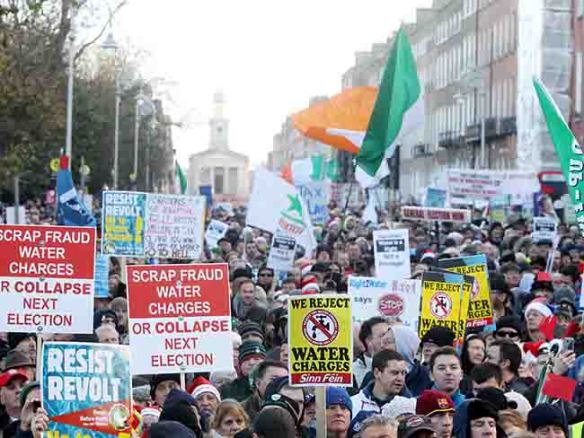
10/12/2014 Anti Water Charges Protests. Pictured are members of the public protesting against water charges at the Right 2 Water event outside Government Buildings in Dublin today. Picture: Sam Boal / Photocall Ireland

10/12/2014 Anti Water Charges Protests. Pictured are members of the public protesting against water charges at the Right 2 Water event outside Government Buildings in Dublin today. Picture: Sam Boal / Photocall Ireland

Twenty sixteen will see a general election in Ireland, one that will be a referendum on the policy of austerity and by implication the continued subordination of the Irish State to global multinational capital.  Austerity will be hailed by the Government as a success and the policy of bailing out the banks and bondholders inevitable and unavoidable.  Rising employment and falling unemployment; small reductions in taxes instead of large increases, and small increases in public expenditure will be held up as proof that the return of economic growth is no mere statistical artefact.

The policy of giving enormous tax breaks to the richest multinationals while Irish workers tightened their belt, or left the country, will continue to be hailed as successful and absolutely necessary.  So, for example, the takeover of Allergan by Pfizer will result in hundreds of millions of tax Euros for the Irish State every year and is the latest illustration of its importance.

Yes, times were tough but we had to tough them out, and we did.  This essentially will be the argument of the supporters of austerity and these are the arguments that those standing in the election will have to address.  They will have to present a critique which means presenting an alternative.

Central to this alternative is the idea of creating a left Government.  The strategy of most of the left in Ireland has centred on protest politics through single issue campaigns and building up constituency bases from which to launch a credible electoral campaign.  The ultimate purpose of this is to get a left Government elected because without it there is an enormous hole in the strategy of the left organisations.

Single issue campaigns, such as over water charges, can push back attacks but the bulk of austerity caused by pay reductions, unemployment, tax increases and cuts in services will not be reversed by protest and are the results of the actions of the Government.  This shows how central the perspective of entering government is to the left despite often protesting that it is subordinate to mass action by workers, although it is usually difficult to see by what mechanism mass action will achieve stated aims.

The left in Ireland has now developed to a scale where some electoral success is more than probable and such success can always be relied upon to cover up for deeper strategic failure and political weakness, such as failure to achieve a left Government or to satisfactorily address the arguments for austerity.

There will however be no left government elected in 2016, even by the widest interpretation of ‘left’.  In December the Red C/Sunday Business Post opinion poll put Fine Gael on  32% [+1]; the Labour Party on 9% [+2]; Fianna Fail on 17% [-2]; Sinn Fein on 19% [+1] and Independents/Others on 23% [-2].  Of the last figure, independents were 14 % with the left Anti Austerity Alliance and People before Profit Alliance on 3% and, the Greens, Renua and the Social Democrats all at 2% support.  In other words the three main parties that have implemented austerity are receiving 58% support, rising to well above 60% if we include the smaller right wing fragments of these parties and right wing independents.

Clearly the argument for an alternative has a long way to go. As it is obvious that there will be no left government elected in 2016 the left is beginning to address what the implications of this are.

Most obviously, the immediate prospect of a left government has no credibility if it does not include Sinn Fein.  Of course the idea of ‘the left’ is a purely relative one and in the past has included the Green Party, which implemented the biggest single attack on workers in the history of the State through the bank bailout and consequent austerity.  Sinn Fein itself has dropped much pretence of opposing austerity in the North, where it will implement most of it by itself in a coalition with the most reactionary party on the island, while handing powers back to the Tory Government in Britain to implement the bits it promised to defeat.

The idea of being on ‘the left’ is one easily appropriated and needs a clear context in which to be meaningful, but the traditional left organisations have for a long time sought to describe themselves in ways that they see as more immediately accessible to Irish workers, who have a very weak socialist tradition and low level of political class consciousness.  They have led the way in diluting political descriptions so that all sorts of words are used to replace the traditional vocabulary.  Misappropriation is one price to be paid for this.

There therefore exists a need to identify what exactly constitutes ‘left wing’, requiring a fight over ideas, which will ultimately be determined only when these are allied to a practice that demonstrates what they mean in reality.  The relationship of Sinn Fein to the idea of a left Government means that the left has had to address this in order to retain the perspective of a left Government at the centre of its strategy.

In this series of posts I will look at two aspects of this – what the political weakness is of the left’s strategy and what proposals the two left organisations – the Socialist Party and Socialist Workers Party – have put forward in order to deal with the problems posed to their electoral approach.

On 9 December an article appeared in ‘The Irish Times’ by two TDs from the Socialist Party  about their views on a possible alliance with Sinn Fein in the coming elections.  The Socialist Workers Party has also published an analysis upon which it has constructed a policy on a left Government for its electoral front, People before Profit.

Two things stand out in ‘The Irish Times’ article.  First is the decisive role “of a left Government that can mark a fundamental and radical shift away from a society dominated by the profits of the 1 per cent to one where the needs of the 99 per cent and the environment come first.”

Second is the definition of left Government as one that excludes the “traditional establishment parties” of Fine Gael, Fianna Fail and Labour but which does not immediately reject the participation of Sinn Fein.  Instead, it is challenged to accept the following programme – that a left Government:

“would have to include the reversal of the cuts implemented over the last years, abolition of austerity taxes such as water charges and property tax, investment to resolve the housing crisis and increasing the minimum wage and improving working conditions.  Implementing these policies means prioritising public services and housing over paying the bankers’ debts, shifting the burden of taxation on to the wealthy, corporations and high-income earners and challenging the straitjacket of the EU’s “Austerity Treaty”. A left government would also repeal the Eighth Amendment and challenge the oppression faced by women, Travellers, migrants and others.”

The Socialist Party TDs state that “Unfortunately, we have major doubts as to whether Sinn Féin would agree to such a programme.”  The doubts are justified but this isn’t altogether the point.  There is nothing on this list which one could immediately say Sinn Fein could not accept.  This being the case the task would therefore logically be to fight to get an agreement with Sinn Fein to agree a programme for Government on these lines in order to maximise the chances of such a Government after the elections.

It could be argued that promises from Sinn Fein would be worthless and there’s a long history of broken promises in the North.  However the North isn’t the South and the South isn’t the North and the very fact the anti-republican Socialist Party even raises the possibility of a Government with Sinn Fein acknowledges this.  Challenging Sinn Fein and doing so in front of its supporters would help to either expose lack of seriousness in its proclaimed policies or pressure them to commit to formation of a left Government while setting out clearly the policies on which this would be based.

It could also be argued that Sinn Fein would not be prepared to take the steps advocated by the Socialist Party to the same extent; it would not raise taxes on the rich or increase state investment to the same extent.  This objection however is only one of degree and not fundamental.  If it is considered by the Socialist Party that the commitment of Sinn Fein is too weak it could state what level of taxation and state investment it would see as constituting a minimum anti-austerity platform – certainly for both it will be more than the effect of the 2016 budget, which is estimated to raise household disposable income by 0.7%.

Sinn Fein however has endorsed the Right2Water campaign’s policy principles which are supported by a number of significant trade unions within the anti-water charges campaign.  Again these principles are vague but they do include a commitment to public investment of between €6 – €7 billion in water infrastructure alone, funded through progressive taxation, and they have provided a more detailed document setting out fiscal planning that envisages total spending of €9.4 billion from 2016 to 2020.  This was written in June 2015 and will have come before the most recent economic growth so will probably understate the amount that the authors would commit to.  In any case the amounts proposed appear to be the minimum they considered possible.

The Socialist Party’s own budget proposals contained in the Anti-Austerity Alliance (AAA) statement involve increased expenditure of €12.8 billion funded by increased taxation and savings of €16.4 billion and are clearly more extensive, but again it is a question of degree not of qualitative or fundamental difference.  For all the latter’s talk of “anti-capitalist” and “socialist measures” the budget proposals are in no sense qualitatively different from the former and the AAA budget is put forward only as “an illustration of how things could be organised differently”.

In terms of what is defined as a left Government there appears no decisive difference between the Socialist Party and Sinn Fein, regardless of what more radical ambitions to socialism the Socialist Party lay claim to.  It is what the Socialist Party proposes as the minimum programme for a left Government that is at issue.

Sinn Fein’s manoeuvring around potential coalition with what the Socialist Party calls the establishment parties, particularly the Labour Party, does not absolve the Party from responsibility to test the claims of Sinn Fein  and to fight to win it to a purely left Governmental programme.

None of this should be taken to mean that I endorse the strategic importance of a left Government as put forward by the Socialist Party or the rest of the left, or that I have any illusions in Sinn Fein.  Nor should it be taken that I endorse the measures proposed by the Socialist Party in the AAA budget proposals as essentially socialist, or even the road to socialism – I do not.

What I do believe is that the formation of a left Government in the Irish state would be a step forward for the working class and present much improved conditions within which workers could fight to advance their own organisational capacity and political consciousness.  This means that not only is the possible existence of such a Government important but so also is the programme on which it stands and the programme that it subsequently implements.

To simply damn the whole enterprise as reformist on the grounds that it will not see the overthrow of capitalism (which is true) is to abstain from the political issues as they present themselves and the struggles that are there.  In addition, to condemn the left organisations that proclaim to be Marxist for adopting a non-Marxist approach (which again is true) is hardly sufficient since the bigger question is not the erroneous views of these organisations but the much wider number of workers who are (rightly) looking for an alternative and see this project as involving an alternative (again correctly).

All these considerations matter, even though it is clear there will be no left Government in Ireland in 2016.

Forward to part 2

The UK general election part 3: sectarianism and democracy

SF 1 downloadIn the final post on the UK general election I want to look at the results from my own little polity and the political slum that is Northern Ireland.  Like all slums the blame for its condition lies with the landlord, the British state.  As usual all the tenants hope and expect that the landlord will clean it up. But it never does.

There the analogy should rest.  The most recent election was notable for what the front page of the Northern nationalist paper, ‘The Irish News’, described as ‘Nationalists turn away from the polls’.  Their parties, Sinn Fein and the SDLP, collected 38.4% of the vote while the DUP and Ulster Unionists captured 41.7%.  The latter figure does not include the various other unionist parties such as Traditional Unionist Voice and UKIP which brings the unionist total to 46.6%. If we include the Alliance Party, which is a unionist party in all but name, the unionist vote was 55.2%.

The message?  There isn’t going to be a United Ireland any time soon.  The Sinn Fein vote went down slightly by 1% even while the SDLP vote declined by 2.6% and it lost the Fermanagh and South Tyrone seat, not the way they wanted to enter into the historic hundredth anniversary of the 1916 rising.  ‘The Irish News’ explained that the nationalist vote had declined to its lowest level since the 1992 Westminster vote, which is before the ceasefires. That is, before the current peace process ‘strategy’ of republicans was/is supposed to deliver a united Ireland.

None of this fits with the accepted story of a rising Catholic population and a more and more demoralised Protestant one.  Sooner or later, the story goes, there will be a Catholic majority that will vote in a united Ireland. The truth of this is accepted by many and, I would hazard a guess, by many who would deny it vehemently in public.  I remember my aunt, a Shankill Road Protestant, remark about 25 years ago that there would eventually be a united Ireland, but not in her lifetime.  And she was at least half right in that.

Socialists have always supported self-determination for the Irish people as a whole, as the only democratic response to the Irish national question.  Not of course universally.  The Militant Tendency/Socialist Party tradition with its notoriously statist view of socialism, which incidentally has nothing to do with Marxism, has always managed to get it wrong.  Its statist view has seen it join left nationalist formations in Britain such as NO2EU, and it led the rightward collapse of the left in Scotland into Scottish nationalism.  In the North of Ireland on the other hand, entirely consistent with its accommodation to whatever nationalism is strongest, it has capitulated time and time again to loyalism and the British State.

This general response of socialist to the national question remains correct but the growth of nationalism in the North of Ireland, which now appears halted, has demonstrated that democracy is not a classless construct.  Bourgeois democracy in a society which has always been characterised by sectarianism has definite limits.

These limits are demonstrated in the more and more sectarian expression of northern nationalism.  This means that the expression of democracy by the working class can only be of a non-sectarian character, or it would fail to be a particular expression of the working class.  In other words the expression of a democratic alternative to partition must come from the working class and not from any nationalist formation.  It must therefore be non-sectarian, not in an unconscious sense, in which to be anti-imperialist is somehow also to be ‘objectively’ anti-sectarian, but in a conscious sense that this is the key objective – of uniting the working class.  Just like Scotland so must this be the case in Ireland, that socialism cannot be derived from what happens to be bad for the UK state but from the political unity of workers.

The degeneration of Sinn Fein and Irish republicanism demonstrates that fidelity to the belief in a united Ireland is no guarantee of progressive politics.  It used to be said that Irish republicanism was largely confined to Catholics because of sectarianism and this also remains true but it is also now the case that the Irish republicanism of Sinn Fein is confined to Catholics because it is sectarian.

Once the Provisionals stopped fighting the British and decided to join in the governance of its system, and started asking the landlord to sort out the slum – the landlord responsible for its creation – it stopped having any claim to progressive status.  It then became the most militant and vocal champion of Catholic rights, not civil rights, but sectarian rights.  This has been exposed in the case of a prominent Sinn Fein Minister and also in the recent election.

In North Belfast Sinn Fein put out an election leaflet that included a graphic showing the Catholic and Protestant proportions of the constituency, the none too subtle message being that the majority Catholic constituency should be electing a Sinn Fein MP.  But of course that also means that Protestants must vote for the sitting Unionist MP.

The Sinn Fein excuses for it only bury it deeper in the sectarian mire.  First the excuses arrived only after it spent weeks defending the leaflet.  Then it wanted, it said, to use the terms nationalist and unionist but the Post Office said census figures had to be couched in terms of Catholic and Protestant.  So what it is saying, after trying to blame the Post Office, is that  instead of rejecting the graphic it decided that yes indeed substitution of Nationalist and Unionist by Catholic and Protestant was fine.  Now we know what it means when it uses the former terms in future.

Oh, and one more thing.  It regretted its decision to include the graphic – as Mr Gerry Kelly said “I think, in retrospect, the decision then should probably have been to withdraw the graph, because it did give an argument to our opponents, whether that was the SDLP or unionists.”  Yes Gerry, you’re right about that.

SF2images (10)

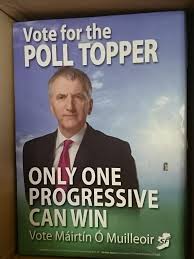
The reactionary position of Sinn Fein was also demonstrated in another graphic used on its leaflet for their candidate in South Belfast.  Having misleadingly described the candidate as ‘the poll topper’ – in fact the sitting MP was from the SDLP – it then said he was the ‘only Progressive Candidate who can win’ – clearly not the case since the SDLP were not listed by the leaflet as one of the five parties ‘united for austerity.’

These five parties were the Conservatives, DUP, UUP, UKIP and Alliance Parties. One of these parties stood out from the others – the DUP.  Why? – because Sinn Fein is in permanent coalition with this party.  And at the time the leaflet was put through the doors the Tories looked like they might be relying on the DUP to get them into power.

Wouldn’t that have looked lovely – the so-called anti-austerity Sinn Fein in Government with the DUP who were keeping the austerity-inflicting Tories in Government.  Don’t bother to try to work out how Sinn Fein would have justified it, they have been justifying inflicting one of the most right wing parties in Europe on this part of the continent for years.

‘The Irish News’ front page has reflected the disorientation of Northern nationalism following the election.  It produced some commentator to explain what had gone wrong.

Apparently  there is a ‘growing number of nationalists who appear switched off from the electoral process (reflecting) a community more at ease with Northern Ireland.’

The commentator said that “I think unionism is more highly strung about identity issues.  Nationalism is more happy in general with the status quo and there is a lack of competition between the parties.  Nationalism is suffering a retreat.”

Almost all of this is rubbish.

Yes, nationalism is suffering a retreat, it’s been retreating for years, and now endorses the legitimacy of partition and its institutions, the British nationality of Irish Protestants and the unionist veto on a united Ireland.

Contrary to its assertion, there is no lack of competition among nationalist parties and unlike unionism there was no electoral pact between the SDLP and Sinn Fein during the election.

Relatively high unionist participation in the election is not because they are more highly strung about identity; in fact the lack of unionist voter participation has been remarked upon for years.  Did they suddenly get a fit of the nerves just recently?  Newspapers have recently reported increasing numbers of parents from what is called ‘a Protestant background’ refusing to designate their children as Protestant at school.

The fall in the nationalist vote is not because nationalists are happy with the status quo but exactly the opposite.  The stench of nepotism, cronyism and corruption from Stormont is all the more repelling on the nationalist side given the claims to radical politics and progressive change from the nationalist parties, particularly Sinn Fein.

Instead the DUP/Sinn Fein coalition Government has been beset by crisis, incapacity, incompetence, secrecy, arrogance, lack of accountability, lack of transparency and financial scandal.  The simplest of questions don’t get answered for years (perhaps never) by Government departments with dozens of communications staff.

The latest such offerings are the revelation of the extent of the employment of Special Advisors (SPADS) employed by all the parties in office without any public recruitment process.  These SPADS are supposed to bring special skills to their political masters, the most prominent of which appears to be their close connection to the parties and their ability to hide any special skills.

freedom of information request revealed that in one financial year the Stormont Executive spent almost £2m on these SPADS, more than the Scottish and Welsh governments combined.  In 2013/2014, the pay bands and grades for these special advisers varied across the UK, going from £36,000 up to £91,000.  In Scotland, three of them were in the top pay band while at Stormont all 21 posts were.

The second is the scandal around a contractor to the Housing Executive which we reported on before here and here.  The SPAD at the centre of the controversy, far from being dumped has been promoted while it is reported that the DUP member who took a more principled stand is being subject to disciplinary action by the party.  At the end of an editorial dripping with scorn ‘The Irish News’ declared of the Stormont regime that “it is increasingly doubtful if the institutions are worth preserving in the first place.”

When the main voice of constitutional nationalism expresses exasperation with the peace process institutions it really does mean a lot of nationalists are thoroughly disillusioned.  This is one of the main results of the election.  In itself it is not a positive but it is certainly a prerequisite for one to develop.


The UK general election part 2: DIY austerity

8841963_origDuring the election, instead of selling themselves as a vote for independence the SNP presented themselves as the leaders of Scotland’s opposition to austerity who would make the new Labour Government keep true to its word of opposing austerity.  As I have and others have said, this was a lie.  The SNP opposed a vote for Labour in England and Wales since they supported the Greens and Plaid Cymru.  So where was this Labour Government to come from?

The SNP vote cannot therefore be characterised as any sort of left vote except in the sense I mentioned earlier: that workers often express their interests in very distorted form.  In this case in the form of nationalism that put forward the idea that Scots are uniquely opposed to austerity and the English not.  The SNP vote can also be said to be a nationalist one because a nationalist solution to austerity was proposed, even if it was supported by some who would not want to go as far as independence.

If the Scots were uniquely opposed to austerity they would also have demonstrated opposition to the cuts transmitted by their own Scottish parliament led by the SNP.

This party has slipped seamlessly from standing in order to put a backbone into a new Labour Government to the election being “a vote to make Scotland’s voice heard loudly” in Westminster.  Those who think there isn’t really any difference should read the last sentence again.  They should also consider if the SNP in any way contributed to getting the Tories out.  As I have also said before the only Tories they wanted out was the ‘red’ variety.

The absence of Labour in Government, which they said would be reliant on them, now means their real reliance on those in power in London is exposed.  Like the nationalists that they are the SNP demands privileges that they would not even consider for others.  So the new Tory Government has to listen to the ‘voice of Scotland’ even though they are 50 per cent of Scottish voices with 1.45 million votes.  UKIP on the other hand won 3.88 million votes, over two and half times the SNP vote. Should their voice not be louder?

However, now that the Conservatives are in Government the SNP will be seeking to cut a deal with them to increase devolved powers – so much for excoriating Labour and their promises not to do deals with the hated Tories.  The Guardian on Saturday reported an SNP advisor saying that Sturgeon will now negotiate with the Tories and that all the repeated promises that the party would never work with the Tories were based on the Conservatives forming a minority coalition government – not an outright majority.

Perhaps this approach seems obvious to SNP supporters but it isn’t at all obvious to anyone else.  If, as it claimed, it stood in this election against austerity why isn’t it trying to cut a deal on reducing austerity instead of more constitutional powers?

The election demonstrated that the SNP and Conservative Party were good for each other.  The inherently anti-English message of independence produced an anti-Scottish response led by the Tories and UKIP who were able to argue that a Labour Government in hock to a party bent on destruction of their nation was a mortal danger.  Both the Tories and SNP knew what they were doing in this mutual loathing.

Now, as the mutually beneficial conflict between the rival nationalisms continues to play itself out, it will become clear that English nationalism is bigger and uglier – because England is bigger and nationalism throwing its weight about is always ugly.

Boris Johnson has advocated giving the SNP greater devolved powers for the Scottish parliament – “some kind of federal offer”.  This is not such a novel departure since the Tories were already more radical than Labour before the referendum in what they promised as devolution in place of separation.

An offer by the Tories of full fiscal autonomy would call the SNP’s bluff since they know full well that Scotland could not afford such an arrangement given the fall in oil prices.  In effect it would be DIY austerity.

The SNP will argue that it wants any new arrangement to maintain current levels of financing.  In other words a settlement that allows Scotland the benefit of higher oil prices should they return but no down side when they don’t.  The English oppressors in the meantime will have to subsidise higher levels of public expenditure in Scotland.

When the Tories make mincemeat of these demands the SNP can then make the case that the dastardly anti-Scottish Tories are at it again and only independence will allow them to borrow more, make savings on Trident and make the independence sums add up again irrespective of the oil price.  Something they haven’t been very convincing at doing so far.

In the meantime increased tax and spending powers may allow the SNP led Scottish parliament to cut corporation tax, as will the Stormont administration in Belfast with the new tax varying powers that the Tories have already promised.  They can then unite with their Celtic cousins in the Irish State in a joint project of cutting each other’s throat.

The debate has begun on what the lessons are for Labour with the Blairites already dominating the media agenda that Ed Miliband was too left wing.

Such an argument hardly squares with the Labour rout in Scotland and nor with Labour gains in London.  It was obvious when Miliband became leader that he had to distance himself from the Blair legacy of the Iraq war and the obsequious defence to the city of London and the financial interests behind the crash.  We’re now asked to believe that a return to this politics is the way back.

Such a policy would have led the Labour Party into an even more confused message than it already had and would have left it with little or nothing to distinguish itself from a Tory Party promising deficit reduction, tax cuts and more money for the health service.

Even the rise of UKIP and the part of its vote that was taken from Labour cannot be seen as an endorsement of a move right.  In this case just how far right would you have to move to rival the xenophobic policies of that lot?

I remember two weeks ago listening to a vox pop on radio 4 from a constituency in the North of England.  A young man was saying he was voting UKIP as a protest against Labour even though he did not at all agree with UKIP policies because he wanted Labour to be more left wing!  I’m not for a moment suggesting that the working class UKIP vote is a left wing protest but some of it is a working class vote that is Labour’s to win.  These voters are not all irredeemably reactionary.  It is rather another example of some workers expressing their class interests as they see them, in a very distorted and disfigured way.

They are demoralised workers who blame immigrants, foreigners or Europe, or simply the establishment understood in some vague way, for the precarious position they find themselves in.

These people did not vote Tory and they did not do so because demoralised or not they don’t confuse their interest with those of the Tory classes and their smarmy representatives.  They just can’t identify their position with an uninhibited and robust defence of their class interests from a socialist perspective.  Perhaps because they haven’t been presented with it or because they have grown cynical with promises of it in the past that haven’t been delivered on.

There is no Blairite answer to workers who blame immigrants for lack of affordable housing, low wages, unemployment and failing health and education services.  There is a left wing answer and however weak it may be from a Marxist perspective it certainly makes more sense than voting UKIP.

The parliamentary arithmetic looks very bad for Labour, behind the Tories by almost 100 seats and suffering almost complete wipe-out in Scotland.  But that is only half the story.

Their vote increased by more than the Tories, and that despite the losses in Scotland.  They may trail by 99 seats but they lag only by 6.5 percentage points of the vote.  The Tories are not in as strong a position as they appear.

First they have a small majority and second they are about to go through a debate about Europe that has the potential to split them extremely badly.  This will take place most likely against the backdrop of gloomy economic news and growing unpopularity as the reality of their election promises come home to roost.  Cameron may seek to provide raw meat to the most Thatcherite elements of his party in order to provide himself with some room to keep the UK inside the EU.

Right now the opportunity exists to have a debate in front of working people about the wide range of policies that they need to advance their interests.  This arises from the debate on who will be the replacement leadership of the Labour Party.  It will not of course be a debate pitting a pure revolutionary programme (however understood) against a cowardly watered down Keynesianism.  But what could ever lead anyone to expect that?  This is where the working class is at and no amount of wishful thinking will make it otherwise.

Will those organisations claiming to be Marxist be able to place themselves in the middle of this debate?  Will they even want to? The debate will happen anyway and many will look to it for a new way forward beyond the despair that the new Tory regime will inevitably create.

The UK general election – part 1: ‘they’re all the same’

images (9)“Were you watching the election last night?” the doorman asked me when I walked into work on Friday morning.

“Yeah, five more years of Tory cuts”, I answered disconsolately.

“They’re all the same”, he said.

A common enough view.  Certainly the view of the left who stood for election, hoping for a vote while realistically knowing that they had no chance of being elected and discounting the effect of taking votes away from the Labour Party.

But not the view of others.

‘The Guardian’ reported that once the result became clear bank shares went up as the threat of more restrictive regulation receded and higher taxes on bankers’ bonuses loomed less large.

Around £1billion was added to the value of the energy company Centrica with the disappearance of the prospect of tougher rules in the energy sector.  The share value of companies that provide outsourced services (privatisation to you and me) also rose, as did those of Sports Direct, whose shares rose by £95m without a Labour threat to their use of zero hours contracts.

“Enquiries came in just after midnight” said one London estate agent, from prospective clients who no longer had to ‘worry’ about Labour’s ghastly mansion tax.  Even bookmakers did well, with Ladbrokes share value rising as the plan to crack down on fixed odds betting terminals, the ‘crack cocaine’ of the industry, disappeared, as Labour’s promise of a crackdown became a ripped up betting slip.

But the report in the ‘Financial Times’ on Saturday put it best, beginning its article like this. .

“. . as the surprise exit poll results came in shortly after 10pm on Thursday night, the mood in the Cavalry and Guards club on Piccadilly turned from funereal to one of incredulous celebration.”

“Earlier in the evening , diners at the Mayfair gentlemen’s club had wallowed in gallows humour as they declared that the election result could mark a fin d’époque for the wealthy in London. . . This stiff upper lip turned to genuine joy as it transpired that the fortunes of the Conservative party had exceeded both the opinion polls and the party’s wildest dreams.”

“This could turn into the biggest celebration ever”, said one Tory supporter. . “We can cancel the removal vans. Non-doms watching the exit polls are unpacking their bags”, said his friend.”

All overstated of course, but those who won’t acknowledge any truth in the report are blowing out of the wrong end.

In some ways I find such reports reassuring.  The super-rich, the real capitalist class, are daily invisible and even the reports of their reaction to the result are through their minions who sell their shares for them or sell them houses or advise them and the rest of us that higher taxes for the rich are a jolly bad thing.

These reports reveal the existence and power of those behind the system, who benefit most from its inequality, and provide glimpses of the class structure within the capitalist mode of production.

While the thought of champagne-popping celebrations in London gentlemen’s’ clubs are valuable because they provide an instinctive and visceral view of what the election victory means it really is no more than that.  The existence and power of the capitalist class, which can appear rather abstract and esoteric in Marxist analysis, is impersonal and largely invisible not only because we don’t run across the mega-rich every day but because it is the system itself which is the problem.  The super-rich are just the personalised expression of the social relations of the system, just as the rich hangers-on of these people such as the estate agents, city dealers and tax advisors represent themselves as the appearance of their mega-rich clients.

Understanding the system and how it works and what the alternative to it is are therefore fundamental.  Understanding the class nature of society and what side you’re on is what’s called class consciousness and it is oddly reassuring that at least one section of society understands theirs.

However the impersonal and systematic nature of capitalism makes this difficult for workers and in so far as they do recognise their own interests this is often expressed in distorted ways. Sometimes very distorted ways, as shown in the election results.

So a lot of the explaining of the election result takes off from the appearance that, for example, Miliband was a bit of a geek and Cameron much more Prime Ministerial.  While Sturgeon, a career politician in the Scottish parliament since 1999, is genuine and sincere and not like the other career politicians; one who could be trusted not so much despite the record of the SNP in Government but sometimes in more or less total ignorance of it.

At only a slightly more sophisticated level of analysis it is claimed that the election was lost because Labour did not have a coherent narrative.  They allowed the Tories to get away with lying that the recession was a ‘Labour recession’ caused by excessive Government spending instead of a financial crisis that affected the world.  They had a confused message that promised to reduce the deficit but also to protect public services and they appeared to both stand for and not stand for robust social-democratic politics.  All very true of course but hardly convincing by itself.

After all, if Labour sent mixed messages the Tory story was beyond belief. They waved the big scary deficit monster in everyone’s faces while promising to pass a law that appeared to prevent them from putting up taxes.

They were going to cut welfare, and not in a nice way either, but nobody would really get hurt, or rather they refused to say who would get hurt.  They had done it before they said and therefore could be relied upon to do it again.  Their record spoke for itself they said, except their record on welfare cuts didn’t at all support their claims.

While the deficit was their number one priority and hard choices had to be made they were still going to cut taxes and give the NHS an increase of £8 billion!  Was anyone supposed to believe this rubbish?

If they looked like they were confident of winning, while almost no one believed they would, it had to be because Eton and all the other posh schools they go to teach smarmy self-confidence and born to rule self-belief, while their management of the economy would appear to reflect that PPE at Oxford now means a piss poor education.

At a more persuasive level it has been argued that the improving economy allowed the Tories to claim that their austerity policies were working, and Labour appeared to have no convincing rebuttal to such claims.  In some respects therefore the Tories got lucky.  The recent upturn is very likely to be very temporary as the most recent figures for economic growth herald the downturn to come.  The recent upturn has therefore been based on short-term cyclical movements and one-off factors.

To really be able to rebut the Tories on this point would therefore have required a more advanced understanding of economic development than Labour was ever going to argue for, and frankly a more advanced understanding than many workers show themselves ready for at the moment.

It is nevertheless true, that despite these problems, the fact is that for many austerity has not ‘worked’ and has still led to the longest period of falling living standards for a very long time regardless of the latest limited improvement.

Finally it has been argued that the Labour party was caught between competing nationalisms in Scotland and England.  This would appear obvious but if you really believed the claims of the SNP it’s not.  This is because the SNP stated that the general election was not about independence.  They stated this because despite all the hype, the SNP lost the referendum, they might lose it again if they tried to have another one soon and they know they have perhaps only one more chance.  The sharp drop in the price of oil since the last one means the independence sums don’t add up.

Getting the ‘Red Tories’ out?

Sun Scotland England Tory SNP divide and conquerI was walking down Buchanan Street in Glasgow on Saturday afternoon when I came across a group that all had large red stickers on them saying ‘Red Tories Out’, which is Scottish nationalist-speak for the Labour Party.  The leaflets they were giving out called for a vote for the Scottish National Party so that it could ensure that a new Labour Government was socially just.  What on earth is going on?

‘Red Tories Out’?? The Labour Party is not in office in Holyrood in Edinburgh and equally obviously not in office in Westminster in London, so what exactly do this group of nationalists want Labour out of?  Since they assume (for the sake of their argument) that they are utterly opposed to the real Tories being in power and the only real alternative is the Labour Party, the only answer consistent with their proclaimed strategy is that of no Labour MPs in Scotland but a majority in England and Wales, one big enough to allow their favoured scenario of a Labour Government dependent (or so they want) on SNP support.

No matter how they dress it up the reactionary nationalist logic of division surfaces each time the left in Scotland trumpets its supposedly radical political credentials.  The Labour Party is shit; Scots need an alternative but Labour’s good enough for English workers, and we’ll just ignore the fact that we need it as well in order to defeat the hated Tories.  But just to show how this isn’t really our strategy we’ll support other parties in England and Wales standing against Labour.

‘Red Tories Out’ turns out to be not just out of Scotland but everywhere.  Except if successful this would let the real Tories in as Labour voters supported the Greens and Plaid Cymru, assisting the Conservative Party to capture marginal seats where Labour is the only conceivable alternative.

Of course this would mean that these nationalists wouldn’t be open to the charge of hoping to foist Labour on the English while it wasn’t good enough for them, but then they would have to explain to everyone what’s left of their supposed overriding priority in this election of getting rid of the Tories.

Something in their argument has to give and what gives is their proclaimed support for a Labour Government supported by the SNP.  What you see is what you get and when you see ‘Red Tories Out’ stickers it means what it says, no more and no less.  When you see aggressive heckling of Labour in a Glasgow street you’re seeing the real vitriolic hatred of the Labour Party.

It is the Labour Party that has stood in the way of the SNP objective of ‘speaking for Scotland’; the SNP having some time ago captured swathes of Scottish Tory support.  It is a Tory Government in Britain that strengthens their claims that only independence can rid Scotland of the Tories and it just such a Government that would provide the grounds upon which another tilt at separation might be launched.

So the ‘Scottish Sun’ newspaper calls for a vote for the SNP while the English version supports the Tories.  The Tories demonise the SNP, making their nationalism more attractive in Scotland in the process, and the SNP ride the wave of increased nationalist division by decrying opposition to their participation in government in England as anti-Scots while basing their whole rationale for existence on the baleful influence of the English.

So it turns out that it is the position of the Sun that is the most consistent of the publicly proclaimed stances – Tories in England and Wales and the Tartan variety dressed in ‘anti-austerity’ clothing in Scotland.

Both on the face of it (‘Red Tories Out’) and looking at underlying political calculation, it is clear that Tory little-Englandism and SNP nationalism is seeking to exploit nationalist division to their own benefit while undermining the causes they say they aspire to – unity of the UK in the case of the Conservative Party and anti-austerity in the case of the SNP.

Reading ‘The Herald’ newspaper on Saturday it reported from focus groups that voters have stopped listening to the political arguments and have bought into the narrative of empowerment, derived from the independence referendum, and the perceived possibility of standing up for Scotland in the General election. ‘No’ referendum voters are therefore voting SNP.

This doesn’t look like a simple unthinking or emotional vote to me but a buying into nationalist assumptions that don’t withstand political analysis and argument.  And the most fundamental of these is that there is a ‘Scottish’ interest oppose to that of ‘London’.  The conflation of nationalism with the interests of workers allows promotion of nationalism to appear as the promotion of workers’ interests even while it does exactly the opposite.

The double standards and scarcely conscious hypocrisy of the Scottish left are symptoms of this nationalism and an apparent disengagement from political argument an expression of the soporific effect of nationalist illusions.

But it would be wrong to blame the nationalists alone.  The Labour Party, that object of nationalist hatred, deserves its own fair share of blame.  For a long time it has channelled Scottish workers opposition to what is now called austerity into nationalist and constitutional demands in order to avoid a response based on workers’ own struggles and socialist policies.  In this way it could pioneer the conflation of workers’ interests with Scottish interests, when the latter might be seen to be reflected in their own political dominance in the country.

This could be seen in their impotent opposition to Thatcher and support for devolution and now in the appointment of Jim Murphy as Scottish Labour Leader and his proclaiming of the Labour Party as the party best based to fight for Scottish national interests.  When it comes to fighting for national interests it’s hard to out-do nationalism.  It has taken Ed Miliband to make the most prominent case for workers interests irrespective of nationality.

b_fimfswqaajkuk

While over in Glasgow I took in the Celtic match and logged on to a fans blog.  One poster derided concerns over the barracking of Jim Murphy while canvassing in Glasgow city centre, saying the guy was a Blairite and had responsibility for the wars in Iraq and Afghanistan. He had blood on his hands and deserved no sympathy.

Fair enough point you might think. As far as it goes. But where is it supposed to go?  A bit of shouting and obstruction hardly seems sufficient punishment for mass murder, does it?  But what would be appropriate punishment if that was the purpose of the barracking?

Well, for a socialist it is not this or that particular bourgeois politician that is the problem (and certainly not the answer).   So the SNP is opposed to ‘illegal’ wars?  Is legal mass murder any more acceptable?  Does a UN mandate legitimise imperialist murder? Just what sort of alternative is the SNP that the protestors against Murphy support? Just what sort of political mobilisation is it that rallies round a nationalist party whose fiscal manifesto is not essentially different from Labour’s yet considers itself self-righteously anti-austerity?

What matters for the future is building an alternative not only to bourgeois politicians but to the system itself that creates the social basis for these politicians, one which relies precisely on workers lack of engagement in political argument and analysis.

Right now such an alternative requires opposition to nationalist division.  It therefore means voting for the best option, given the choices available.  A vote for the Labour Party can be justified as one that will provide the best circumstances for fighting austerity, both by virtue of rejecting Scottish nationalist illusions and facing a reduced austerity offensive.

Nationalist separation on the other hand is a counsel of despair, one that asserts that British workers can never fight for an alternative.

  1. A friend has alerted me to an interview in Jacobin magazine with Neil Davidson, a supporter of Scottish separation, and I will take up the arguments raised by him in a future post.

The UK General election, the Labour Party and the SNP. Who’s calling the shots?

snpWhen the Independence referendum was lost by the nationalists I noted that this created something of a problem for left supporters of Scottish separation.  Their claim not to be nationalist looked threadbare when set aside rallies festooned with Saltires but now they had questions to answer.  Today the questions are even harder.

If the pro-independence campaign that they hailed as a genuine left-wing grass roots movement was not nationalist how do they explain that it is the nationalist Scottish National Party that has reportedly grown enormously since the referendum?  How do they explain that even within their ranks large chunks of their supporters are now members of the SNP?  How are they to explain that figures like Tommy Sheridan are calling for a vote for the SNP in the UK General election?  He wants to wipe out the ‘Blue, Yellow and Red Tories’ but not of course the Tartan ones.

The SNP are now regularly reported to be in position to wipe out the Labour Party in Scotland which would be quite a reversal.  In fact such a reversal that it overturns one of the claimed grounds for Scotland’s independence – that Scotland is more progressive because it elects predominantly Labour MPs.  Shortly it may predominantly elect a party that has gotten to this point by first taking over and assimilating a large part of the Scottish Tory vote, and it will be England and Wales upon which a Labour Government may be elected.

This is excused by the claim that the Labour Party of today is not the Labour Party of yesterday and indeed with the advent of new Labour this is to an extent true.  However, it is also true that the Labour Party of 2015 is not essentially different to that of 1975 or even 1945 and the view that it somehow is exhibits a flawed understanding of that party.

And there is another problem.  The SNP is making the claim, on the face of it ridiculous, that it will ensure that Ed MIliband becomes Prime Minister through Scottish voters voting not for the Labour Party but for the SNP.  How is Tommy Sheridan to justify opposition to the Labour Party, or ‘Red Tories’ as he prefers to call them, by voting SNP?  Perhaps it is because depriving the Labour Party of a majority might allow the real Tories into Government again, through some sort of new coalition with what’s left of the Liberal Democrats and support from the Democratic Unionist Party?

The SNP are making this type of claim because on their own they are incapable of offering any alternative effective opposition to the austerity that is the main issue in the campaign.  This has already been made clear by their imposition of austerity as the party of Government at Holyrood. Their projections for the financial position of an independent Scotland have already been blown out of the water by the collapse of the price of oil.   Their call for full fiscal autonomy is similarly exposed.  As I pointed out after the referendum result the only effective opposition to austerity can come from an all-British alternative but the ‘non-nationalist’ ‘left’ has seemed oblivious to this.

The SNP however being a serious bourgeois party is not.  That is why Nicola Sturgeon has moved the SNP to take up a UK-wide approach, at least rhetorically, projecting the SNP as a necessary part of a united front against austerity, for example in a possible alliance with the Greens and Plaid Cymru.

Knowing equally that this is not any sort of real alternative has forced her to make a virtue out of necessity and claim the need for the Labour Party to rely on SNP support.  It is backhanded recognition that only the Labour Party can blunt the Tory inspired austerity offensive and its intensification should they lead the next Government again.

So the SNP must claim opposition to Tory austerity as its priority when its real goal is to destroy the Labour Party in Scotland, so making continuation of Tory austerity that more likely.   That other serious bourgeois party, the red, white and blue Tories, also know this, which is why they have been bigging up the SNP and Labour’ so-called dependence on it, in order to undermine Labour.  They do this even while it also undermines the union they support; yet one more illustration of their incompetent character.  At least Thatcher’s strengthening of the forces of Scottish nationalism can claim it was unintended.

The two parties feed on each other, illustrating the divisive role of nationalism for the British working class. As this excellent post here points out, a plurality of SNP voters would rather have a Tory Government than a Labour one if it meant more SNP MPs.

The nationalist left’s opposition to ‘Blue, Yellow and Red Tories’ reduces to opposition to Labour since in Scotland the first has only one MP, the second is stuffed across Britain and the third is the single existing disproof of their claim that only nationalist separation offers an alternative to the Tories.  It is mightily embarrassing when an election comes long in which it is clear that this is patently untrue.  Except of course, as the post recommended above describes, the SNP is on such a roll that nothing will embarrass it, at least not at the minute.

The left nationalist case is that separation is necessary to defeat the Tories and that the UK state is unreformable, in the sense that it will never be social-democratic again.  Their enemy is therefore not the Tories, whose existence seems only to confirm this.  On the other hand, as even the mildly left approach of Ed Miliband threatens such claims, we can glimpse the fundamentally weak foundations upon which the great surge of Scottish nationalism currently rests and the totally spurious grounds on which left nationalism sits.

The actions of Sturgeon and the SNP demonstrate that in this General election the only alternative to Tory austerity, however weak and limited it is, is the Labour Party.