
In reaction to the Cass Report in Britain there has been widespread denunciation of the ‘toxic’ debate around the transgender issue without specifying why this is. There has also apparently been wide agreement that there needs to be better data to find out the effects of treatment of children and young people..
The second link above shows that the apparent agreement is a fiction and that the supporters of gender ideology, within and outside the NHS, have both no need for data and no need for a debate. The report itself reveals that most of the NHS’s gender identity development service (Gids) refused to cooperate with the inquiry in providing evidence and that this was ideologically driven, i.e. they accepted gender identity ideology.
It is abundantly clear that the toxic debate is not going away any time soon because the supporters of gender identity ideology have made it plain that there is no debate to be had, and that data on clinical outcomes of those young people who have had puberty blockers, or cross-sex hormones or other surgical intervention is impermissible. This, however, is only one reason for the toxic ‘debate’.
As we saw in the previous post, the shifting, imprecise and downright misleading use of definitions means that you get routine claims about the ‘right to change gender’ when what is meant is the ‘right to change sex’ which does not exist because it cannot be done.
The issue is not therefore about a ‘right to change sex’ but the social and political rights to be acquired from claiming to have one’s ‘true’ sex recognised, which is to be established not by any sort of health care, such as hormonal treatment or surgical intervention, but by accepting the view that one knows one’s identity better than anyone else and being a woman, for example, is just such an identity. Something that a man can be if he puts his mind to it.
This requires the belief that one can be ‘born in the wrong body’, meaning that the ‘real’ and essential person exists as something separate from the body, which is akin to the religious idea of a soul, also separate from the body. In this way the claims of gender identity ideology are a religion for which data, or any other scientific evidence, is irrelevant. For this ideology, denial of the quasi-religious nature of its claims means that the pretence must be made to objective validity but this must then involve denial of the means of validation. Irrational claims give rise to irrational discourse which gives rise to the toxicity.
The shifting, imprecise and downright misleading use of words, including the word ‘gender’ adds a twist to the non-debate by making it impossible to consistently identify what is being claimed or denied.
Gender can, as well as meaning sex, also be understood as the expression of social norms associated with and based on one’s sex, such as the characteristic stereotyped attributes of femininity to be expressed by women and of masculinity to be expressed by men. We have looked at some problems with this is the previous post but let us park these for the sake of this discussion.
Effeminate expression by men, by some gay men for example , has historically been disapproved of in many countries, with patterns of socialisation generally working to impose those characteristics considered masculine that would prevent or negate such expression. Similarly, the phenomenon of masculinised women, such as in some lesbians, has also been frowned upon. Regardless of the advances in gay and lesbian rights in some counties, this socialisation process continues and is still considered ‘normal’ with deviations from it being ‘abnormal’.
In real life, no one fits the pure stereotyped norms of femininity and masculinity. It therefore makes no sense to use the term gender in the way employed by one socialist: that trans means ‘people who wish to live permanently in the gender identity polar opposite to that ascribed to the biological sex’. No one’s gender is the polar opposite of their sex, while the free expression of one’s personality is a part of what socialism is about. Gender norms are restricting, stifling and enforce rigid stereotypes that are regressive for both sexes and for the relations between them.
Everyone expresses some combination of the characteristics that may be said to make up the ‘polar opposites’ of the social expression of one’s sex. To claim that one is a ‘polar opposite’ in identity to one’s sex is therefore to define oneself in stereotypical and reactionary terms, so that to assert political claims on such grounds is also reactionary.
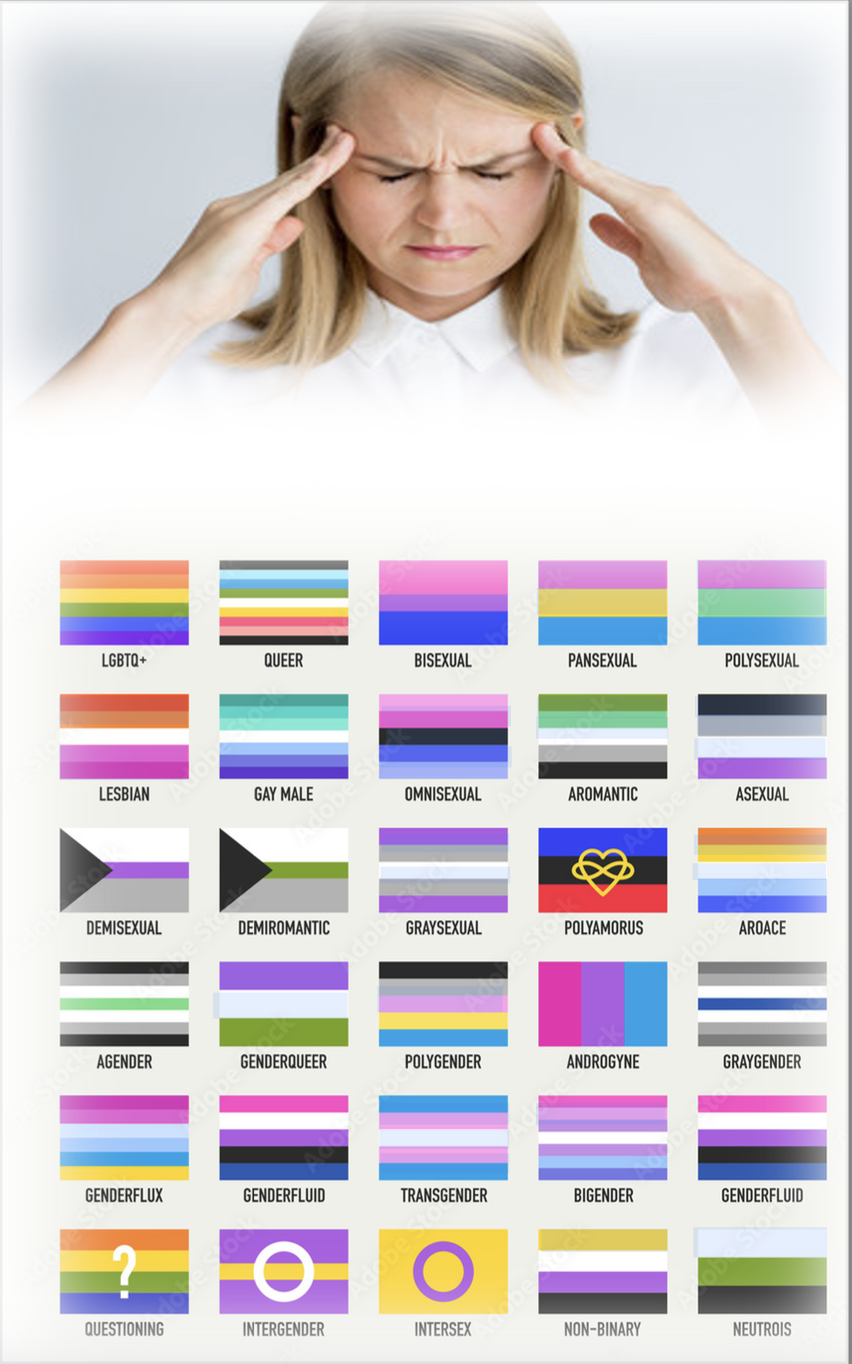
Gender identity ideology might think it avoids this by positing the idea of numerous genders, so that ‘polar opposite’ is not the only alternative to female and male, woman and man. This involves the creation of multiple genders, and different sources will provide different numbers of them. If you Google ‘how many genders are there’ you might find that there are either 3 or 4 or 68 nor 72 or the number is undefined. The BBC once claimed to children that there were over 100.
Since one’s gender is determined by one’s sense of oneself there can be any number of self-definitions, each of which must be considered to be valid by this ideology, precisely because it is self-determined. But purely subjective identities are paraded because they crave social recognition, validation and acceptance, (otherwise they remain in a private domain without validation etc.) so the assertion of such identities is a political question.
This ideology thereby becomes the only political position that asserts its legitimacy and authority on the basis of an unchallengeable declaration demanding immediate acceptance. However, this ‘first-person authority’ championed by gender identity ideologists (trans people know themselves better than anyone else so we should all accept what they say) excludes those who disagree (for example women who deny that they have any sort of gender identity).
Whatever about such claims to novel ‘genders’, the majority are either male or female, and since women are most vulnerable to the consequent results, claims that men can become (or always ‘really’ have been) women are the most contentious. Transmen in some male-only settings are at greater risk than the men they will encounter but this cannot be said for transwomen (men) entering women-only spaces.
This also means that while many transactivists supporting gender identity ideology think of themselves as left wing and progressive, their ideology is simply a mirror of the conservative and right-wing view of women that they claim to oppose. While the most conservative view regards the proper expression of a woman’s sex as stereotypical femininity, trans activists often define what it is to be a woman through stereotypical expression. The causal direction is simply reversed. For one, women should be feminine and for the other being feminine, in so far as they can make it, is to be a woman.
Since ‘gender’ can be understood as sex, or as the expression of norms of socialisation of the sexes, we confront claims to be able to change sex, which is impossible, or claims to be able to change gender through having a sense of one’s sex being different from what it actually is. In the latter case gender is then conflated with sex. Through identification with (or through) the social norms that are supposedly rejected the claim is made that one has changed sex.
The ‘explanation’ is to claim that to be a woman is to have some innate sense of being one. This innate sense, in order not to be something contingent and open to challenge, is held to be common to everyone; everyone has a gender identity, whether admitted or not. We thus end up with the mantra that ‘transwomen are women’. It is claimed by some supporters of gender identity ideology that everyone’s gender identity is expressed in terms of behaviour, appearance, including clothing, make-up, etc and is evidenced by it.
This ‘argument’ has its own problems. If a transwoman wears high heels, pretty pink dresses, lots of make-up and effects a flighty and skittish air they may be accused of believing that being a woman is existence as a crude stereotype that is insulting. Not doing any of these things might leave the transwoman looking like a man and putting immediate and impossible-to-ignore obstacles to acceptance of their claims. How recognition of all the other genders is to be accomplished, even by their bearers, is a moot point, including the idea of gender fluid, non-binary, non-gender, agender, third-gender etc.
More generally, what particular norms of behaviour, dress etc must be included in ‘gender identity’ and what is not, and how the mélange of social factors come together to instantiate and constitute a coherent sex status, is impossible to define. A transwoman may seek acceptance as a woman, but fundamentally rejection or qualified non-acceptance will not be because of any presentation etc. but will be based on knowledge of the person’s sex; the real transphobe will be the one who rejects a transwomen fundamentally for their failure to represent masculinity.
What these point to are the limitations of subjective claims over objective reality, illustrated in other ways. A person’s sex exists before it is ‘assigned’ (as the ideologists put it) and will exist whether it is ‘assigned’ at all, for example if no doctor is present ‘to do it’. A baby girl and an old woman are still females; the first does not identify as anything and will, bar accidental factors such as death, develop into a woman, and the latter is still a woman whether she is, because of dementia, no longer able to be conscious of this fact or not. When she is dead, she will be a dead woman.
It is claimed that because these subjective senses are unverifiable, we cannot test them – we cannot reach inside someone’s head to see how they really feel, process these feelings into thoughts and see how they are then formulated into claims to objective reality. We cannot know the motivation behind a claim to a gender identity for example. How do we know that a transwoman actually feels or thinks like a woman (leaving aside what this actually means) when they are a biological male? In fact, the assertion would have to be to feel and think as a woman, although this lexical formulation is immediately less plausible.
How is it known that their ideas of their identity, arising (sometimes) as the result of psychological distress caused by various factors, conform to and constitute essential ‘womanhood’? Since Gender identification is sometimes described by transgender activism as a political act, or that ‘there’s no one way to be transgender, and no one way for transgender people to look or feel about themselves’, or ‘there is no right or wrong way to be trans’, their claim is effectively denied.
Children come to know themselves through observing others and comparing themselves to others, including observing that there are two sexes and that they fit to one of them. They learn that this cannot be changed. In this, the sense of one’s sex is learned and not innate, even though it cannot be changed, so that for the vast majority of people it comes with the territory. Distress caused by a perceived discrepancy between the idea of one’s sex, misnamed gender identity, and sex characteristics of one’s body can lead to what is termed gender dysphoria, but this does not allow one to change sex. Even if medical and surgical interventions may help, that is relieve the distress to a greater or lesser degree, these will not change a person’s sex. They cannot therefore be a ‘cure’ for the claim that their condition requires a change of sex.
Such dysphoria evidences an awareness that one’s sex is different from one’s identity, from the claim to a fixed and innate identity as the opposite, or more accurately, other, sex. Further, it is often asserted that this identity warrants the claim that despite natal sex, for example as a male, the transwoman was ‘always’ a woman.
In effect, the sexed body is rendered both relevant and irrelevant to the construction of all of humanity since trans people are still to be included under the classification of the two sexes that encompasses everyone. (We leave aside the many other ‘identities’ that render the whole ideology even more incoherent). The claims about the meaning and importance of sex are therefore not just about trans people but about everyone and thus involve sweeping claims about the nature of the non-trans population that they are blissfully unaware of – that gender identity and not biological sex defines them and is definitive. Everyone is to be roped into the ideology whether they like it or not and the subjective claims of some become the objective claims on others.
In other words, if gender identity defines sex and everyone has a gender identity, everyone is defined by this phenomenon of gender identity with the social and political consequences demanded by the ideology. ‘Transwomen are women’ can thus be read backwards.
If transwomen claim that they feel like women and have the same sense of themselves as a biological woman has, it implies that the feelings that biological women have, and their sense of themselves as a sex, is the same as that of transwomen. I doubt very much whether the vast majority of women would endorse such a claim. Not least because their understanding and feelings about being a woman are based on their female body, its functioning and the social experiences that this necessarily entails. None of these considerations involve ‘biological determinism’ in the sense that women’s social and political roles are biologically determined.
Many women therefore, as we have said, deny having any gender identity of the kind expressed by trans activism. Their statements on their sense of themselves and the sexed bodies that they have will be more persuasive than the claims of men who do not inhabit female bodies, have not experienced life as a woman, and who cannot know how women feel about being a woman but can really only imagine or profess some idea of it.
Women will do so with much stronger objective grounds to make such statements. That they are often not called upon to do so makes it hard to avoid the view that a well-known hierarchy of authority between the sexes is being adopted. In any case, regardless of any supposed authority, identifying as a woman does not make you one.
To sum up: you cannot change sex, you cannot become a different one by behaviour or appearance or other cultural attribute, and you cannot identify yourself into one. Since we are most interested in the politics of gender identity ideology, we are left with the conclusion that any claims it makes are not based on reality. For Marxism, if they are not, they are reactionary.
We will look at whether this conclusion can be explained further in the next post.
Back to part 2
Forward to part 4