What Sinn Fein threw out when it threw out the Palestinians

When Sinn Fein stewards threw out some Palestinians from a Palestine solidarity meeting in Belfast, they threw out something else – all pretence that it will ever take effective action against the Zionist state’s genocide of the Palestinian people.  Specifically, it will do nothing to upset the United States, the sponsor of the Zionist state, its financier, arms supplier, and political attorney.  The Zionist state has its main benefactor, and through it Sinn Fein becomes an accomplice to Zionism’s actions by one remove.

The International Court of Justice (ICJ) has found it plausible that the Israeli state is carrying out genocide, although the vast majority of the world’s population did not have to wait to make this judgement, and does not have to wait the years required to see the ICJ confirm it.  There is therefore a political obligation to take now whatever action that can be taken to stop the genocide and Sinn Fein is not taking it.  How little this requires is demonstrated by the leader of the SDLP refusing to go to Washington on St Patricks day.  Sinn Fein has rejected doing the same.  This article has good coverage of the meeting and its background.

What this incident shows is the common nature of the struggle against imperialism across the world and the common character of that struggle.  Solidarity movements are supposed to be expressions of that common struggle but have become detached by petty bourgeois politics to be mere expressions of sympathy; appealing to human rights that fail to understand that the violence of imperialism is intrinsic to the capitalist system and that the only alternative is working class socialism.  This means that working class leadership of the struggle is needed, not just in Ireland but also in Palestine and all the other countries in the region and beyond where the outcome of the genocide will be determined.

Thus, this meeting illustrates that Sinn Fein, newly reinstalled in the leadership of the imperialist settlement in Ireland, will brook no criticism of the Palestinian Authority (PA) which plays the same, increasingly discredited, role in Palestine.  The PA is widely reported to be employed again as the mechanism for imperialist and Israeli pacification once the latter has finished its slaughter.

The message is therefore clear, Sinn Fein is not part of the Palestinian solidarity movement in any meaningful sense.  A party that participates in a shindig with those behind the genocide is a fifth column that undermines the solidarity movement by limiting the terms of effective solidarity, with an attempt to blind everyone to what it is doing.  What the solidarity movement needs to do, at the very least, is to take effective action to thwart the genocide.  A result of this it should be a step forward in the creation of a militant working class movement in Ireland as well.

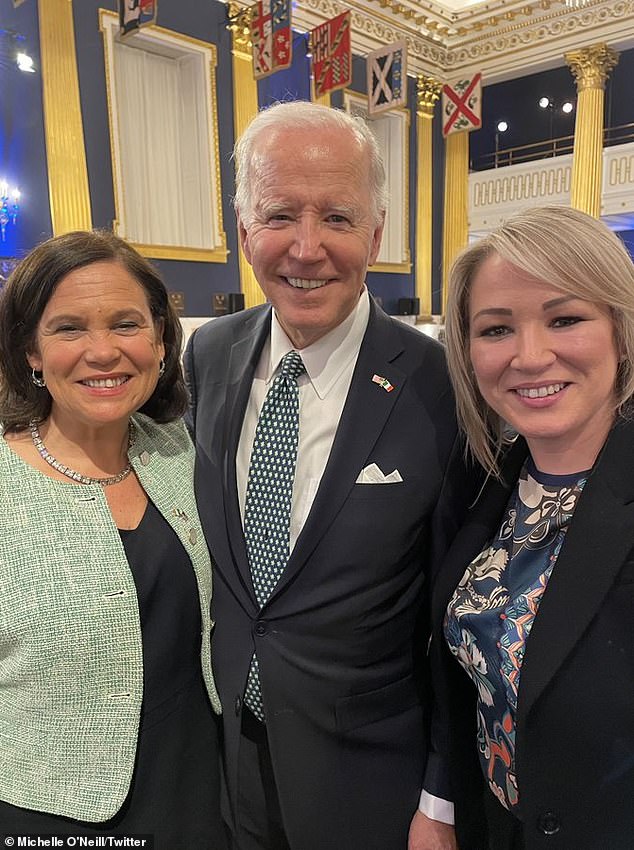
Refusing to party with Biden is not even a forceful act of solidarity but rejecting it is a statement that Palestinian genocide is not important enough to demonstrate opposition to its main facilitator.  The celebration with the British Prime Minister the week before showed Sinn Fein’s partnership with the British Government, second only to the US in its support for the Zionist state and complicity in the genocide.

Effective opposition in Ireland would involve preventing the US using Shannon airport as a transit to the Middle East and refusal to handle Israeli goods.  The solidarity campaign involving leaflets, meetings and demonstrations are in themselves protests, but the ruling class everywhere is perfectly happy to ignore protests unless they lead to more radical action.

 Instead, protests lead only to more protests which eventually tire the protestors.  They often involve naïve beliefs that those in power will listen and take action, as if they did not already know what is happening or are willing to be convinced or shamed into ‘doing the right thing’. This is a view borne of ignorance that they are not actually acting out of their class interests and will change their behaviour only if these are threatened, and only permanently change if their political and social power is destroyed.

This means creation of a working class solidarity movement.  Calls for individual boycotts of goods involve calls for individuals or individual companies that are unorganised.  The working class has the power to enforce boycotts that don’t require millions of individuals taking individual decisions millions of times not to buy this or that good.

The first place to seek to organise this is in the existing workers’ movement.  Any solidarity campaign should seek to achieve this, and the membership of its supporting organisations would have the duty to try.  The many Sinn Fein members will never be given this task, yet the purpose of all the leaflets, social media posts, meetings and demonstrations is to build a movement that will take this on and succeed.  They are designed to build the support, organisation and confidence of those who can undertake this action. Token attendance on the odd demonstration by the Irish trade union movement is a testament to failure to attempt this.

Some other lessons can be learnt from the Belfast episode.  There should be no fear in challenging Sinn Fein because other Irish political parties are doing nothing better.  It is not the job of a Palestine solidarity campaign to save Sinn Fein from its own perfidy.  The government parties are in office and have demonstrated the limits to their expression of sympathy; they will do nothing much more unless forced – they are not there to be convinced of the justice of any particular action, they know already.  Sinn Fein, on the other hand, professes to be part of the solidarity movement.

The common nature of the struggle across the world demonstrated by Sinn Fein’s defence of the Palestinian Authority means that assertions that we cannot criticise any particular Palestinian organisation or movement, as is sometimes stated, is frankly stupid and reactionary.  Socialists criticise movements across the world if they think their politics are inadequate, fail the working class, or betray it.  The Palestinian Authority has certainly betrayed the cause of Palestinian freedom and it would be a dereliction of duty not to say so.  Only belief in the moral superiority of Palestinians as a nation, uniquely undivided by class or blessed by political leadership, could justify such a position.  That some Palestinian activists have condemned the PA is to be welcomed and shames those who would keep schtum.

That these activists were thrown out of a Sinn Fein meeting is to their credit as much as it is damning of those who ejected them.  A fitting way that Sinn Fein could atone for their disgraceful action would be to protest against Genocide Joe and be thrown out of the White House.  What’s the chances?

Groundhog Day. Stormont is back! Again!

I remember giving out leaflets at a Sinn Féin demonstration on the Falls Road in about 1993.  The demonstration was called to support the Hume-Adams Agreement, hammered out between the leaders of the SDLP and Sinn Féin after several secret meetings.  No one knew what was in the Agreement, but thousands of republican supporters came out to show their support for it.

I don’t think my comrades, or I, ever had such a keen and eager crowd as the demonstrators queued up to get a copy.  It was clear that they thought they might find out what it was they were demonstrating in support of.  That in itself told us an awful lot about the political consciousness of rank and file republicans at the early stages of the peace process – they were going to faithfully follow their leadership, wherever it led them and swallow whatever they were told.

Many, many subsequent leaflets, and meetings through the long peace process changed nothing of their approach, or raised in them any consciousness that they might require a more critical approach, one that involved some scepticism of where their leadership was taking them.

Only a few years before, in 1987, Sinn Féin had published a document called ‘A Scenario For Peace’ in which it set out its proposals for a settlement to end the conflict.  It included that Britain should declare its intention to withdraw; the Royal Ulster Constabulary and Ulster Defence Regiment would be disbanded; ‘political’ prisoners should be unconditionally released; and Britain should provide a subvention for an agreed period to facilitate harmonisation of the northern and southern economies. In return, unionists would be offered equal citizenship within the new Ireland.

Well, the Hume-Adams talks were not about this agenda, and neither was the peace process.  The British have not gone, the RUC and UDR were indeed disbanded but the former was replaced by the PSNI and the latter were a unit of the British Army, and it certainly hasn’t gone away.  Political prisoners were released but not unconditionally, Britain imposed austerity (and Sinn Féin helped implement it).

The peace process in its various guises is now longer than the war it was supposed to end, and the former looks harder to get to the end of than the latter did.  When it was announced that the devolved Stormont Assembly was coming back, and a Sinn Féin leader, Michelle O’Neill, would be first minister, it was declared by Mary Lou McDonald that this showed that a united Ireland was “within touching distance”.  Of course, the Provisional republican movement has been promising a united Ireland since the early 70s, that is, for over half a century.  A unionist commentator noted recently that a recent opinion poll showed no increase in support for a united Ireland in the North over the last couple of decades.

Some columnists have claimed that the real significance of the return of the DUP to the Assembly and Government is this accession to the post of first minister of Sinn Féin, even while they admit that this is symbolic since the unionist deputy first minister has equal power.  No decision can be taken by the first minister if not agreed by the deputy and the post cannot be filled in the first place without unionist agreement.

In order to minimise unionist opposition to the deal between the DUP and British government over the ‘Irish Sea border’ the process of getting DUP agreement and all it entails is being rushed through.  The DUP Executive thus voted for the deal without seeing it; fittingly appropriate to the return of what passes for democracy in the North of Ireland.

This democracy, in the shape of the Stormont Assembly, has been suspended at least eight times, ranging from a single day to a couple of years.  It has been functioning for only sixty per cent of its existence and subject to a number of reviews and changes with yet more changes now widely canvassed. The sectarian, corrupt, incompetent and clueless governance it has provided and the future problems considered inevitable by everyone who thinks about it (and many don’t) means that the rules are not the problem.

Public services, from health to roads, are routinely described as being in crisis, while others such as education and voluntary organisation are subject to open sectarian practices. It has been claimed that these issues can only be put right by local governance, but its track record shows that it is as much responsible for the decay as British rule.  The repeated suspension allows the alibi to be sold that were it not for suspension public services would be much better.  The previous suspension following the Sinn Féin walk-out, after the DUP-implicated Renewable Heat Incentive scandal, showed levels of incompetence that could more easily be explained as corruption.

The return of Stormont is therefore no step forward, never mind a panacea, and is mainly an unstable framework to accommodate sectarian competition, one that has not proved to be very stable.  It stands on its rotten foundations only because there is no outside force to push it over, while those that have knocked it over temporarily have been internal.  It is widely accepted among the population and further afield because no alternative seems possible, which is why the DUP have gone back in.  This also helps explain why the misgivings of many unionists, and significant opposition, will be unsuccessful in stopping the Assembly’s return.

The opposition has no credible leadership, which would have to come from within the DUP itself, and there is as yet no real sign of this.  Further demoralisation of unionism is therefore one (welcome) result.

That this is the case throws light on the claim by the DUP leadership that their new deal is a significant victory. Packaged as a joint British government/DUP initiative, and launched by a joint press conference, there is not the slightest pretence at non-partisanship by the British: ‘Safeguarding the Union’ is the name of Command Paper1021.

Its content in 77 pages could safely be accommodated at one tenth of the length.  The measures introduced include proposed legislation to say that Northern Ireland is part of the UK – who would have thought it?  It has proposed legislation to ‘future-proof the effective operation of the UK’s internal market by preventing governments from reaching a future agreement with the EU like the Protocol’, which by definition cannot achieve what it claims.  It also includes a ‘commitment to remove the legal duties to have regard to the “all-island economy” in section 10(1)(b) of the European Union (Withdrawal) Act 2018.’  A bit of red meat for the DUP, and sticking it to Irish nationalism North and South, that will make little or no difference.

It promises that ‘Legislative change to recognise the end of the automatic pipeline of EU law . . . which applies in Northern Ireland is now properly subject to the democratic oversight of the Northern Ireland Assembly through the Stormont Brake and the democratic consent mechanism.’  This implies either future bust-ups with the EU if single market changes are not incorporated into the Northern Ireland market, or a formality to cover regulatory alignment.  The Brexiteers in Britain are aghast at this as they no doubt realise it might not be the former.

Media reporting has suggested that the EU Commission has yet to look at the Agreement but that ‘no red lines’ have been crossed; however, it is hard to believe it has not been agreed and only kept quiet in order to help the DUP sell it as an act of undiluted British sovereignty.

The ‘democratic consent mechanism’ that is held to act as a check on unwelcome EU encroachment states that it can be triggered by a majority of local members of the Assembly and not by some ’cross-community consent’ mechanism.  It is hard to be optimistic that this whole area will not entail future argument.

Other measures include promises on maintaining trade flows that can’t be honoured and a number of new quangos that will deliver more red tape that Brexit promised to get rid of.

The main gain pointed to by Jeffrey Donaldson is the removal of routine checks on certain exports from Britain to Northern Ireland that were set to reduce anyway but are now declared to be zero.  This is on goods, such as retail to consumers for example, that will stay in Northern Ireland and not considered to be at risk of going further into the Irish state and thus the EU single market proper.

Donaldson has, however, claimed too much – that there is unfettered trade between GB and NI and therefore no sea border.  The command paper states that ‘there will be no checks when goods move within the UK internal market system save those conducted by UK authorities as part of a risk-based or intelligence-led approach to tackle criminality, abuse of the scheme, smuggling and disease risks.’

‘Abuse of the scheme’ must mean that checks will be made if it is suspected that goods purportedly sent for sale only in Northern Ireland are actually heading further.  The acceptance of such controls by the DUP has so far been rather successfully sold by the leadership as simply a common sense measure that ensures that checks are made at the Northern Ireland ports instead of a long and windy North-South border.

This problem arises only because of Brexit, which the DUP supported, and of course the argument makes sense in its own terms; except those terms mean acceptance that there is a trade border on the Irish Sea because there had to be one somewhere, and its not south of Newry and north of Dundalk.  The opponents of the Agreement among unionists are therefore right that single market membership means EU law applying in Northern Ireland.  They go wrong when they, like the other hard Brexiteers, assume that the British government must pursue widespread non-alignment, without which Brexit makes even less sense that it already does.

In the last few weeks public sector workers in the North have engaged in very large strike action in pursuit of wage demands designed to recover some of their lost real incomes.  It has, however been subsumed under the politics of Stormont return, even while the trade unions have demanded that the British Government pay up and not use the lack of an Assembly as an excuse. It was supposedly putting pressure on the DUP to get back so the workers could get payed when the DUP didn’t, and doesn’t, give a toss.

The return of Stormont has not been lauded and celebrated as in previous ‘returns’ and the population is jaded by repeated failure and broken promises of a ‘new approach’.  The real new approach required is, unfortunately, a long way off.

Behind the call for a British ‘citizen army’

In my previous post I noted that the logic of supporting the Ukrainian State, and the British state’s support for it, was to support the British state itself; just as the Ukrainian state itself committed itself to this in their joint security agreement.

Further evidence of the unfolding logic of support for Ukraine was provided by the text of an agreement by leftist organisations in Eastern Europe published on International Viewpoint.  On top of vague anti-capitalist aspirations, this noted that among its ‘top priorities is countering Russian aggression, which is destroying Ukraine and threatening the entire region. “The only reason why Russian troops have not yet attacked Poland or Romania is because of the US troops deployed there. We are convinced that the countries of our region must jointly build their own subjectivity and strength,”

The statement thus endorses the view that Russia is an immediate threat, that the people of the region are being protected by US imperialism, and that the countries should strengthen the military power of their states. There was no critique of any of these positions by the hosts of this statement and it is not hard to understand why.

The ‘Fourth International’, whose publication International Viewpoint is, agrees that Russian imperialism is responsible for the war, that the Ukrainian state should be defended and that the support of US imperialism (and British) should also be defended.  This too, for them, is a top priority.  The statement of the Central Eastern European Green Left Alliance (CEEGLA) is consistent with the political line of the Fourth International, which prioritises opposition to aggressive Russian ‘imperialism’ and supports Western imperialism in this opposition.

The remilitarisation of the West has been accelerated and trumpeted with more and more bellicose rhetoric from Germany and Eastern European states on the need to face a coming Russian invasion.  Ukraine of course has been making this claim for two years, arguing that the best place to stop it is in Ukraine; in other words, the Western powers should directly join with Ukraine in the war. However, since Western powers are unprepared for this, including that they have not prepared their own populations, they have taken the route of proffering weapons to the Ukrainian state so that its workers can do the fighting and dying in the meantime.

Now the British state has upped this rhetoric by the head of its (supposedly non-political) Army calling for a “citizen army”, which implies the introduction of conscription, although this is denied, for what that’s worth.

In one way this is preparation for a replacement narrative to the one sold up to now that Ukraine must be supported because Western support is helping defeat the Russians, who are often portrayed as being as brutally incompetent as they are simply brutal.  Now that it is becoming clearer that the West does not have the means to ensure a Ukrainian victory and Russia is winning the war, previous escalation of the power of the weapons supplied cannot continue without such escalation increasing the risk of a qualitative change in its character, which again the West is not prepared for.

The call for a “citizen army” raises lots of issues, including the not irrelevant point that Britain including the bit of Ireland it controls, does not actually have citizens – it has subjects. It is also relevant that some parts of the UK will not provide many volunteers, one thinks of the North of Ireland and Scotland in particular; and while these two might find some more than willing, many in England and Wales might also not be so keen.

For the left supporters of the idea that Russian imperialism is a real threat, which must be opposed as a priority – even alongside and on behalf of capitalist states, it raises the question of how the British military is to be supported in the case of Ukraine but not otherwise.  (I assume that the pro-Ukraine left has not followed its own logic and gone so far down the road as to support the defence of its own capitalist state, although I have little doubt it would, should a war with Russia eventuate).

This left can maintain this inconsistent view because it refuses to consider everything from the position of the interests of the working class, the class as a whole.  Instead, it has a routine of political positions based on reforming capitalism through its state by way of a range of political formulations that hang together while appearing to hang apart, unacknowledged as reciprocal.  This includes self-determination for independent capitalist states; state removal of oppression of social groupings through laws against discrimination; capitalist state ownership of the means of production; capitalist state provision of welfare services, and capitalist state enlargement through appropriation of greater resources through increased taxation.  Bizarrely, it thinks that this is a road to smashing this state.

The most important failure then is not to see the capitalist world as a whole and recognise the consequences, So, for example, it supports Western imperialist intervention in Ukraine but not in Palestine.  It genuflects to the imperialist interest and objective in intervening in Ukraine but gives it no role in determining the nature of the war.  In fact it goes further and refuses the idea that this is a proxy war and would have us believe that Western imperialism is supporting an anti-imperialist war of national liberation.

When we simply add up the increasing military intervention of the West in Ukraine; Middle East, including Yemen; in economic sanctioning and forecast of war with China; mobilisation of the Russian armed forces and growth of its military-industrial complex; the growth of Chinese military power; and the increased fracturing and realignment of state alliances with the relative decline of US imperialism, what we have is a drift to war across the world.  In other words – World War III. The inevitability of war as a result of capitalist competition has in the past been well understood.

It must be obvious, to even the meanest intellect of those on the Left in the Western countries, that opposing the steps to this war by their own capitalist state cannot be done by claiming that in some parts of the world these states are defending the interests of the working class; against other capitalist states that are workers’ primary enemy.  By doing so you have already surrendered the foundations of any argument a socialist might have.

The calls for a citizen army by the General is part of the British state’s preparation of the working class for war on its behalf, so how does the pro-war left prepare the working class to resist the entreaties and demands of the state by validating its role in Ukraine?

Behind the war in Ukraine lies Russia, China, Iran and North Korea on one side and the United States/Europe etc. on the other, with other states negotiating a place between them.  A similar split arises in the war by Israel against the Palestinians and threats against Iran and some Arab countries.  War over Taiwan would involve China and the US with Europe dragooned into supporting the US and Russia having good reason to support China.  In other words these wars are conflicts between the same forces and their eruption signals their coming together.  The forces creating them are not for disappearing so hoping that they will dissipate and simply go away are forlorn.

As regards the proposal of a citizens’ army, Boffy has succinctly put forward the socialist view of such a proposal.  It is incompatible with the notion that workers should willingly join the armies of the capitalist state and defend its sovereignty, either with nominally separate workers battalions utterly subordinated to the Army command, or as individuals.  In the latter case, it would be the duty of socialists to still carry forward their arguments, in so far as individuals can, and not to put a shine on the patriotic lies of the capitalist state.

So, once again, the socialist alternative stands in opposition to those defending Ukraine in the war, as the Interview with a Ukrainian and a Russian ‘socialist’ previously mentioned, shows.

When the head of the British Army makes a political speech with such a far-reaching proposal, which assumes an approaching war, the proper reaction is not one of either complacency or dismissive of the inconsequential.  It is a political intervention of some purpose and socialists must explain what this purpose is and why it must be opposed.

Supporting the UK-Ukraine Security Co-operation Agreement

Stefan Rousseau/Pool via REUTERS

The Ukrainian and British Governments have just signed a security agreement that is supposed to be the first of many to follow with other Western countries.  What attitude should the supporters of Ukraine take to this agreement?  Should they support it?  After all, it promises an increase in military commitment from £2.3bn in 2021 and 2022 to £2.5bn in 2024, and the pro-Ukrainian left supports the provision of arms to Ukraine because it knows that without it the country would already have lost the war.

The main objective of the Agreement is ‘to ensure Ukrainian Armed Forces and security forces are able to fully restore Ukraine’s territorial integrity within its internationally recognised borders,’ which is precisely the objective of the Ukraine supporting left.

Of course, the agreement is also ‘committed to implementing the full set of policy requirements as set out in the IMF programme’, with Ukraine being able to ‘attract private finance, boost investor confidence, tackle corruption and create a fair and level playing field for all parties, including through a reform of state-owned enterprises (SOEs).’  This is all to be ‘underpinned by a strong private sector-led economy. The UK will seek to build a modern, resilient and sustainable Ukrainian economy that is integrated into global markets, is not susceptible to hostile Russian influence . . . ‘

This is obviously an imperialist charter but the intervention of the Western powers is usually dismissed as ‘of course’ the West is intervening ‘in its own interests’, which is taken to effectively bat away the problem, although how it does so outside the world of the pro-Ukraine left remains a mystery.  Would not NATO membership, as supported in the Agreement, swiftly follow ‘victory’?  Not to mention widespread privatisation and exploitation?  This is after all, what we mean by the West intervening ‘in its own interests’. In what way then is this a victory for the working class, unless the continued integrity of the Ukrainian state is paramount to this Left as it is to the Ukrainian ruling capitalist class and Western backers?

This left is keen that Ukraine is not saddled with onerous debt and the Agreement has an answer to this – ‘the Participants reaffirm that the Russian Federation must pay for the long-term reconstruction of Ukraine’, so that’s sorted?  Well, the idea that Western countries such as the US and Britain will pay to restore Ukraine and scrub its debt, when the debt of these countries themselves has exploded, is another mysterious eventuality of the pro-Ukraine left.

Since military victory against the Russian invasion is the absolute priority, it is hard to see how this Left, including its British component, cannot support this Agreement.  Since they advocate that everything else must wait until this success there can be no reason for it not to be welcomed.  Besides, stating support for some of it and not for others is a bit like saying that I want the chocolate from the chocolate cake but not the sugar, butter, eggs and flour – good luck with that!

In fact, opposing it because of the clear imperialist intentions of Britain within the Agreement implies that Ukraine also cannot be supported because these intentions are agreed and shared.  Unfortunately, prioritising support to Ukraine then means endorsing British imperialism, its partner in agreeing all the measures promised.  In fact the Agreement declares that Ukraine will defend the British state should it be attacked! And why not? (section 5.7) By supporting the capitalist Ukrainian state which in turn supports the British imperialist state, by one remove, so does this British Left. 

The Agreement caused some apprehension because it said that ‘in the event of future Russian armed attack against Ukraine, at the request of either of the Participants, the Participants will consult within 24 hours to determine measures needed to counter or deter the aggression.  The UK undertakes that, in those circumstances . . .  it would: provide Ukraine with swift and sustained security assistance, modern military equipment across all domains as necessary. . .’

It was thought that this might mean any new incursion by Russia into Ukraine, such as around Kharkiv or from Belarus, would cause direct British troop involvement, but this seems not to be the case.  This would entail war between Britain and Russia. The British would need the US on-side and the US to believe that NATO would not fracture in such a situation with some European states perhaps considering that it was not in their interests to suffer the costs of fighting for Ukraine.

The Agreement also implies the threat to confiscate the estimated $300bn in assets of Russia currently frozen in the West, mainly in Europe; the latest wheeze that could save Western countries from an expense it is more and more unwilling to bear.  The Russians have called this piracy, and it is difficult not to accept this description.

The pro-war Left might point to Western hypocrisy, especially its current support to Israel, but again, in the circumstances of absolute (that is unqualified) support to Ukraine, pointing to hypocrisy would be the height of their opposition.  They could, I guess, say that two wrongs do not make a right and that therefore Russian ‘imperialism’ should be made to pay.  What they can’t do is damn all the capitalist pirates and villains in the conflict because that again would include the West and its Ukrainian proxy.

Ukraine might not actually see much, if any, of this $300bn as much of it would go to the US (primarily) and other Western arms manufacturers to pay for past, current and future arms purchases.  What isn’t military hardware would go to Western contractors in Ukraine, with no doubt something for the local oligarchs and some reduction of the burgeoning Ukrainian state debt.

The Agreement’s objective to ‘fully restore Ukraine’s territorial integrity within its internationally recognised borders’ is a recipe for slaughter and bloodshed on a massive scale.  The summer 2023 Ukrainian offensive led to the massacre of tens of thousands of Ukrainian soldiers, and they didn’t even reach the first of three defensive lines.  The offensive was called off because of the losses.  To think that a new offensive can succeed is to support the press-gang of hundreds of thousands Ukrainian workers, men and women, many of whom have either fled the country, hope to escape, or hide in their homes out of fear of being apprehended on the streets by the recruiting commissars of the Ukrainian army. Even with this conscripted-against-their-will army Ukraine cannot succeed.

An interview with two supporters of this objective, who believe it can be achieved – one from Ukraine and one from Russia – declare that ‘we have to end the Russian invasion as a priority.  They state that ‘the government’s stance is clear about fighting for the sovereignty of Ukraine’, and that the war ‘is, first and foremost, a people’s war for national liberation’.  ‘The key priorities of the state should be based on the protection of people’s interests, fostering social cohesion, and promoting global solidarity against oppression.’

They repeat the maxim that ‘the Ukrainians have the right to defend themselves; they are the main victims in this conflict. This label of ‘proxy war’ doesn’t give any agency to the Ukrainians themselves.’  Yet it is acknowledged that, for the working class ‘there are not really other viable options in terms of separate fighting militias and units at the moment.’

The objectives and conduct of the war are thus in the hands of the Ukrainian state, in so far as it is not in the hands of its Western sponsors.  Thus, the ‘agency’ we are to bow down to is that of this state, including its conscription of workers to be flung onto the front in meat-grinder assaults. The agency of Ukrainian workers does not stretch to having their own militias, never mind determining the objectives of the war and how it is to be conducted.

This is not considered a problem because ‘the sovereignty of Ukraine’, that is, the sovereignty of the Ukrainian capitalist state is what must be defended for these ‘socialists’; not that of the working class.  They believe that the Ukrainian capitalist state can be made to base itself ‘on the protection of people’s interests, fostering social cohesion, and promoting global solidarity against oppression.’ What capitalist state has ever displayed these features?

The Agreement is further evidence that the Ukrainian state is basing itself on Western imperialism and that such lofty and fanciful views are preposterous and unbelievable, including its aspiration to ‘a hundred-year partnership.’

The Ukrainian interviewed believes that ‘some on the left . . . put an ideological lens on the war that obscures rather than clarifies, but actually obscures the situation for real people on the ground.’  Except hundreds of thousands of dead are not just ‘on the ground’ but underneath it, while tens of thousands more are disfigured and disabled above it.  The coerced conscription of the unwilling, who are not prepared to die for their state, is forcing many to hide while hundreds of thousands of refugees will not go home. It is the supporters of Ukraine who give no evidence of appreciating the bloody consequences of the war while displaying total innocence of any understanding of its capitalist character.

The interviewee, Vasylyna, asserts that the war ‘is, first and foremost, a people’s war for national liberation’, while she admits the workers cannot even organise themselves in their own defence: since when did British imperialism ever support ‘a people’s war for national liberation’?

Oppressor and Oppressed (10) – separating nations or uniting workers?

1920: M.N. Roy (centre, with black tie) with Vladimir Lenin (left) and Maxim Gorky (behind Lenin). An émigré communist party emerged in October 1920 in Soviet Tashkent under Roy’s guidance.

All the arguments employed against Lenin are claims on behalf of a national solution to national oppression.  The USC article asserts that Lenin believed that ‘the separation of an oppressed people and its creation of an independent state divided the proletariats of various nations, while a bourgeois multinational state with a ruling nation in command united them.’  But this makes no sense.

If Lenin believed that bourgeois empires united workers, why did he oppose great Russian chauvinism, or even place such importance on the right to self-determination if the former did not divide workers and the latter was required in order to unite them?  The article goes on to say that ‘state boundaries do not hinder the international drawing together of the workers of various nations. On the contrary, boundaries signify a respect for equal rights, and a real drawing together is only possible among equals.’

The world has by and large witnessed the end of multinational empires but where is the equality of nations?  How does the imposition of different laws, rules and regulations of labour; the creation of separate national labour organisations; the creation of separate economic, social and political circumstances in general – giving rise to different struggles – lead to drawing workers together?  Is not the point of the creation of such nations, from the nationalist point of view, that the different classes of the nation are ‘naturally’ to be separate from other nationalities and united within – workers with capitalists etc?

Since when was it possible for unequal nation states to achieve equality, and when did larger states stop imposing their interests on smaller ones, through political interference, economic coercion and war?  Is Ukraine not dramatic proof of all of these, by the West as well as Russia?  The author appears to recognise this when he writes that ‘modern American capitalism, which is not weighed down by feudal traditions, does not require the incorporation of other peoples into its state borders in order to dominate them.’  As we know, this hasn’t prevented repeated direct military invasion and occupation by it.  

The socialist demand for the equality of nations means only the right to independence and not belief in the possibility of real equality between vastly different states.   Their drawing together does indeed require the right to separation but rejection of the exercise of such a right can evidence that that this has already happened, to a greater or lesser extent.  Ultimately only the removal of the capitalist imperative to accumulate capital can remove the dynamic of antagonism between capitalist states.

In the Draft Theses on National and Colonial Questions for the Second Congress Of The Communist International, Lenin wrote that the 1914-18 war and the imperialists’ actions after it ‘are hastening the collapse of the petty-bourgeois nationalist illusions that nations can live together in peace and equality under capitalism.’

It is claimed in the USC article that the demise of the Tsarist multinational state after the First World War demonstrated the progressiveness of purely national formations, but the Second World War rather exposed the very restricted limits to this.  Cold War conflict muted direct war in Europe after World War 2, but even the success of the European Union in muting conflict between the major powers within Europe has not made all states within it equal.  The collapse of multinational Yugoslavia was not a progressive event, entailing war, ethnic cleansing and lasting bitterness and conflict.  Again, the war in Ukraine demonstrates that nation state independence is no obstacle to the intrusion of the more powerful.

The author opposes what Marx, and subsequently Lenin, considered as progressive tasks: ‘it was unfitting for a workers’ social-democratic party to support even the “progressive” tasks of capitalism on the eve of the First World War, because these tasks were accomplished with steel and blood.’   As Marx said, capitalism had never ‘effected a progress without dragging individuals and people through blood and dirt, through misery and degradation’, but that through its ‘development of the productive powers of man . . .  bourgeois industry and commerce create these material conditions of a new world . . .’  K Marx, The Future results of British rule in India, Collected Works Vol 12 p 221 and 222)

The author argues that Lenin’s concept of imperialism meant that ‘capitalism was decaying and that the only way out was through a socialist revolution and the disintegration of multinational and colonial empires. . . In this second period Lenin linked the resolution of the national question in Russia to the victory of the proletarian revolution’ and ‘considered that the peoples of Russia could unite again only in a union of republics with equal rights.’

In the Draft Theses on National and Colonial Questions Lenin wrote at its beginning that ‘In conformity with its fundamental task of combating bourgeois democracy and exposing its falseness and hypocrisy, the Communist Party, as the avowed champion of the proletarian struggle to overthrow the bourgeois yoke, must base its policy, in the national question too, not on abstract and formal principles but, first, on a precise appraisal of the specific historical situation and, primarily, of economic conditions.’

In this document he noted that ‘from these fundamental premises it follows that the Communist International’s entire policy on the national and the colonial questions should rest primarily on a closer union of the proletarians and the working masses of all nations and countries for a joint revolutionary struggle to overthrow the landowners and the bourgeoisie. This union alone will guarantee victory over capitalism, without which the abolition of national oppression and inequality is impossible.’

In 1916, after writing his brochure on imperialism, he wrote against a political opponent – in A Caricature of Marxism – that ‘every sensible worker will “think”: here we have P. Kievsky telling us workers to shout “get out of the colonies”. In other words, we Great-Russian workers must demand from our government that it get out of Mongolia, Turkestan, Persia; English workers must demand that the English Government get out of Egypt, India, Persia, etc.’

‘But does this mean that we proletarians wish to separate ourselves from the Egyptian workers and fellahs, from the Mongolian, Turkestan or Indian workers and peasants? Does it mean that we advise the labouring masses of the colonies to “separate” from the class-conscious European proletariat? Nothing of the kind. Now, as always, we stand and shall continue to stand for the closest association and merging of the class-conscious workers of the advanced countries with the workers, peasants and slaves of all the oppressed countries. We have always advised and shall continue to advise all the oppressed classes in all the oppressed countries, the colonies included, not to separate from us, but to form the closest possible ties and merge with us.’

‘We demand from our governments that they quit the colonies, or, to put it in precise political terms rather than in agitational outcries—that they grant the colonies full freedom of secession, the genuine right to self-determination, and we ourselves are sure to implement this right, and grant this freedom as soon as we capture power. We demand this from existing governments, and will do this when we are the government, not in order to “recommend” secession, but, on the contrary, in order to facilitate and accelerate the democratic association and merging of nations. We shall exert every effort to foster association and merger with the Mongolians, Persians, Indians, Egyptians.’

In June 1920 ‘a precise appraisal of the specific historical situation’ meant that ‘world political developments are of necessity concentrated on a single focus—the struggle of the world bourgeoisie against the Soviet Russian Republic, around which are inevitably grouped, on the one hand, the Soviet movements of the advanced workers in all countries, and, on the other, all the national liberation movements in the colonies and among the oppressed nationalities, who are learning from bitter experience that their only salvation lies in the Soviet system’s victory over world imperialism.’

‘Consequently, one cannot at present confine oneself to a bare recognition or proclamation of the need for closer union between the working people of the various nations; a policy must be pursued that will achieve the closest alliance, with Soviet Russia, of all the national and colonial liberation movements. The form of this alliance should be determined by the degree of development of the communist movement in the proletariat of each country, or of the bourgeois-democratic liberation movement of the workers and peasants in backward countries or among backward nationalities.’

‘Federation is a transitional form to the complete unity of the working people of different nations. The feasibility of federation has already been demonstrated in practice both by the relations between the R.S.F.S.R. and other Soviet Republics . .  . In this respect, it is the task of the Communist International to further develop and also to study and test by experience these new federations, which are arising on the basis of the Soviet system and the Soviet movement. In recognising that federation is a transitional form to complete unity, it is necessary to strive for ever closer federal unity . . . ; second, that a close economic alliance between the Soviet republics is necessary, otherwise the productive forces which have been ruined by imperialism cannot be restored and the well-being of the working people cannot be ensured; third, that there is a tendency towards the creation of a single world economy, regulated by the proletariat of all nations as an integral whole and according to a common plan. This tendency has already revealed itself quite clearly under capitalism and is bound to be further developed and consummated under socialism.’

He finishes the draft theses with the statement, that ‘complete victory over capitalism cannot be won unless the proletariat and, following it, the mass of working people in all countries and nations throughout the world voluntarily strive for alliance and unity.’  From all this it is clear that Lenin never departed from the view that the purpose of socialists, including in its national policy, was to create the maximum unity of the working class in its struggle for socialism. 

The Ukraine Solidarity Campaign has published an article that usurps the purpose of the demand for national self-determination as argued by Lenin, from one of strengthening the unity of the working class across and between countries to one of supporting the creation of new capitalist states in order to create an (impossible) equality of states; one that somehow leads to working class unity.  Internationalism as the unity of the working class regardless of nation has become the equality of nations, the solidarity of nationalisms with the retention of separate states and, by implication, the rights arrogated by them based on claims for the necessity of their existence.

The purpose is clear: to justify the war in Ukraine and the claims of the capitalist Ukrainian state on the subterfuge that these encompass the interests of its workers, which ‘Lenin’s contradictions’ have supposedly helped prevent from being appreciated.  It has the merit of recognising that Lenin cannot be summoned in support of Ukraine in the war, thereby undermining the arguments of others who think he can.

Series concluded

Back to part 9

Oppressor and Oppressed (9) – Lenin’s contradictions

The article published by the Ukraine Solidarity Campaign (USC) tells us that:


‘In another place Lenin stated that “large states can accomplish the task of economic progress and the tasks of proletarian struggle against the bourgeoisie more successfully than can small ones.” But Lenin also wrote the following: “In 1905 Norway separated from Sweden… What does this mean? Did the people lose? Did the interests of culture lose? Or the interest of democracy? Or the interests of the working class from such a separation? Not at all!… The unity and closeness of the Swedish and Norwegian peoples in fact gained from the separation.” This contradiction in Lenin (the progressive nature of multinational states and the progressive nature of the dissolution of multinational states).’

Lenin, however, says no more here than when larger states separate it is better that they do so without conflict, if unity does not have the necessary support, in order that the primary unity sought – that of the working classes of the various nations – is less impaired. Whether Lenin got this right in this particular case is secondary to the general argument.


The article goes on to say that ‘Most of Lenin’s statements, nevertheless, were in support of preserving the integrity of the Russian Empire, in 1903 he considered its disintegration “an empty phrase as long as its economic development continued to bind its various parts more closely into one political whole.” The break-up of Russia, according to Lenin, would be a step backwards, “in contrast to our aim of overthrowing autocracy,” In 1913 Lenin wrote:

“Autonomy is our plan for the organization of a democratic state. Separation is not our plan at all… On the whole we are opposed to separation. But we support the right to separation.”
This, indeed, was Lenin’s position. Both from the necessary, and much to be desired, purposes of development of the productive forces and the unity of the workers’ movement within the Tsarist Empire, the Bolsheviks were opposed to disintegration. As the article goes on to say, “The aim of socialism is not only to destroy the division of humanity into small states and all national aloofness, not only the rapprochement of nations, but also their merging,”


The author of the USC article criticises the idea of multinational states: ‘History has not yet provided us with the example of nations in one state enjoying complete equality, because a state is not only class coercion, but also national coercion. The stronger nation in a multinational state always wishes to be the ruling one.’[1]


Other lessons from history are, however, ignored; such as nation states often being the creation of nationalism, upon which national antagonisms have facilitated wars based on capitalist competition. Nation states often contain national minorities and attempts to create single-nation states often result in odious oppression of national minorities. Nationalism is not the answer to the disease of national oppression that it itself engenders.


It might therefore also be said that History has not yet provided us with the example of nation states enjoying complete equality, because a state is not only an instrument of class coercion, but also of national coercion of one against another. Instruments of class oppression will not be equal when there is competition between them to increase the resources that they can exploit.
The article appears to agree with this but seems to see it as relevant only within multinational states, in which it says that ‘as long as the state — violence — exists, equal rights for nations will be impossible, no matter how democratic the state might be.’


The USC article quotes from a ‘Ukrainian Marxist’ in 1916 ‘disagreeing with Lenin’s statement that a democratic Russian republic would make the realisation of the national right of separation a possibility’:


‘It is ridiculous to speak of the possibility of the ruler of a capitalist state “safeguarding rights of nations to self-determination,” Every state, even the most democratic, and especially today in the age of imperialism, would not only never agree to the separation of oppressed peoples but would always aspire towards new territorial gains, to a further oppression of nations. Capitalist governments have always looked upon the “rights of nations to self-determination” as treason to the fatherland and have punished the guilty with the death penalty… A blind faith in the democratic and socialist advantages of Russia…is in no way an expression —as is often thought — of the Great Russian socialism. On the contrary…the national program of Russian revolutionary social democrats is nothing other than the repetition of Great-Russian liberal patriotic programs.’


This argument contains some measure of truth – that capitalist governments cannot be relied upon not to oppress smaller national groups within their Empire, and is even true against Lenin who believed at this time that only a bourgeois democratic and not a working class revolution was possible. It ignores, however, that national minorities within nation states separated from Empires will also often be oppressed.


In terms of the class nature of the revolution that Lenin at that time believed would occur, he foresaw the working class taking the lead in this bourgeois democratic revolution, ensuring its thoroughly democratic character. Above all, as we have seen from the earlier post, the purpose of the demand for self-determination of nations by Lenin was the unity of the working class; not a presumed higher unity among different classes within a separating nation, with such unity always being that of the working class united with its ruling classes in its subordination. It is precisely this ‘solution’ to national oppression that the USC article attempts to assert.


It is claimed that the greater number of Lenin’s contradictions come from the period of the First World War and Russian 1917 revolutions, attacking what it sees as the cultural implications of Lenin’s policy:


‘Lenin wrote, on the one hand, that it was impermissible to force the Russian language upon the peoples of Russia: “you cannot drive people to heaven with an oak-wood club.” But, on the other hand, he wrote that in Ukraine in the Donbas region ‘the assimilation of the Great Russian and Ukrainian proletariat is an incontestable fact, and this fact is undoubtedly a progressive thing,” even though Tsarist assimilation was precisely the “oak-wood club” that Lenin condemned. For the Tsarist regime forbade the Ukrainian proletariat its own schools and compelled the Ukrainians to learn only in Russian. In another place Lenin wrote that he was for assimilation as long as it was not forced. But where in history does one see an uncompelled, voluntary assimilation?!’


Let’s start at the end – it is exactly the objective of socialist revolution to remove all oppression. That the chronicle of oppression, including national oppression, continues to exist is not at all surprising, given the heretofore failure of socialism. It is also possible, and what matters most, is that what is meant by assimilation is that the political unity of the different national proletariats is not prevented by national cultural, ethnic or racial differences.


‘Assimilation’ does not in itself entail oppression of cultural differences, including in language, but it is not the role of socialism to push against voluntary cultural assimilation, rather to allow those who wish to retain or develop cultural distinctions not to be forced by the state to disavow their cultural practices or to suffer discrimination against them. The example of the Donbas region quoted by Lenin is instructive: Ukrainian independence and Ukrainian nationalism have now, very obviously, failed to unite the different proletariats of the region and only Ukrainian nationalists can claim that ‘decolonisation’, that is the suppression of the Russian language and culture, is now the solution.

[1] We will leave aside such cases as the United States (are these states separate nationalities?) or the UK, where claims for the oppression of Scotland are false, with this country playing an equal, even outsized role, in creation of an Empire. There are other cases such a Belgium and Switzerland where the existence of two and several nationalities within one state has been the case.

Back to part 8

Forward to part 10

Oppressor and Oppressed (8) – where Lenin went wrong?

Lenin, in the National question in our programme (July 1903), stated that :

‘The Social-Democrats will always combat every attempt to influence national self-determination from without by violence or by any injustice. However, our unreserved recognition of the struggle for freedom of self-determination does not in any way commit us to supporting every demand for national self-determination. As the party of the proletariat, the Social-Democratic Party considers it to be its positive and principal task to further the self-determination of the proletariat in each nationality rather than that of peoples or nations. We must always and unreservedly work for the very closest unity of the proletariat of all nationalities, and it is only in isolated and exceptional cases that we can advance and actively support demands conducive to the establishment of a new class state or to the substitution of a looser federal unity, etc., for the complete political unity of a state.’

Further, in his Theses on the National Question in June 1913, ten years later, he wrote that:

‘The Social-Democratic Party’s recognition of the right of all nationalities to self-determination most certainly does not mean that Social-Democrats reject an independent appraisal of the advisability of the state secession of any nation in each separate case. Social-Democracy should, on the contrary, give its independent appraisal, taking into consideration the conditions of capitalist development and the oppression of the proletarians of various nations by the united bourgeoisie of all nationalities, as well as the general tasks of democracy, first of all and most of all the interests of the proletarian class struggle for socialism.’

‘Social-Democracy, therefore, must give most emphatic warning to the proletariat and other working people of all nationalities against direct deception by the nationalistic slogans of “their own” bourgeoisie, who with their saccharine or fiery speeches about “our native land” try to divide the proletariat and divert its attention from their bourgeois intrigues while they enter into an economic and political alliance with the bourgeoisie of other nations and with the tsarist monarchy.’

In Critical Remarks on the national question at the end of 1913 Lenin wrote that:

‘The principle of nationality is historically inevitable in bourgeois society and, taking this society into due account, the Marxist fully recognises the historical legitimacy of national movements. But to prevent this recognition from becoming an apologia of nationalism, it must be strictly limited to what is progressive in such movements, in order that this recognition may not lead to bourgeois ideology obscuring proletarian consciousness.’

In 1916, in The Discussion On Self-Determination Summed Up, he wrote that:

‘The several demands of democracy, including self-determination, are not an absolute, but only a small part of the general-democratic (now: general-socialist) world movement. In individual concrete casts, the part may contradict the whole; if so, it must be rejected. It is possible that the republican movement in one country may be merely an instrument of the clerical or financial-monarchist intrigues of other countries; if so, we must not support this particular, concrete movement, but it would be ridiculous to delete the demand for a republic from the programme of international Social-Democracy on these grounds.’

He goes on to say that no ‘democratic demand can fail to give rise to abuses, unless the specific is subordinated to the general; we are not obliged to support either “any” struggle for independence or “any” republican or anti-clerical movement.’

Supporters of the Ukrainian state in its war against the Russian state and in its alliance with Western imperialism have often held up the words of Lenin on self-determination of nations to justify their support.  In doing so they empty the policy of its purpose, its relevance to the circumstances, its required programmatic context, and break from all the conditions necessary to it that are contained in the various quotations above.

Having taken this historic red flag of out of the cupboard they have made it ready by washing all the colour out of it so that now the flag they wave is white.

An article dug up from the past and published by the Ukraine Solidarity Campaign has done everyone a favour and decided that Lenin’s ‘contradictions’ should be led bare.

The article does two things.  It firstly points out the failures of Bolshevik policy in the smaller and less developed countries of the Tsarist Empire, with a failure to live up to their declared aims.  In this regard, there is nothing exceptional to the less developed counties that did not also apply to the heartlands of the revolution in St Petersburg and Moscow; the underdevelopment of the grounds for socialism in these countries was just more pronounced than in Russia itself.  The contradictions in Bolshevik words and actions created by material circumstances were therefore real.

This, however, is subsidiary to the real purpose of the article, which is not to damn Lenin’s policy for its failure due largely to these circumstances, but to damn the policy itself.

This is divided into three periods with different emphases.  So: ‘in the first period Lenin clearly supported the idea of the progressive nature of multinational large-scale states. He considered that such states were more suitable for the workers’ movement and lead to the fusion of nations, which Lenin considered to be the ideal of socialism.’

‘In 1913 he wrote: The wide-ranging and rapid development of productive forces under capitalism demands territories unified and enclosed by large states, in which the bourgeois class alone will be able, together with its antipode, the proletarian class, to concentrate, destroying all the old, medieval, sexual, narrowly local, religious and other obstacles… As long as and insofar as various nations comprise one state, Marxists will in no case propagate either a federalist principle or decentralization. A centralized large state is a great historical step forward from medieval divisions towards a future of socialist unity of the whole world; and other than through such a state (indissolubly tied to capitalism) there is not and cannot be any path to socialism.’

This development carried forward by capitalism continues today, for example, in the creation of the European Union.  The attempts to reverse it are reactionary and have been demonstrated to be so, even to many of its supporters – we need only think of Brexit.  The failure of nation states to accommodate the international development of capitalism led to two world wars and today the development of the world capitalist system – characterised by rivalry between large states – threatens a third.  Neither the contradictions of the current system nor their solution by socialism will be resolved by attempting to go back to purely national development, which never in any case fully existed.  Today, smaller nations become proxies for the largest powers, such as Ukraine is for the US, and their nationalism becomes window dressing for the ‘intrigues . . . and political alliance(s) with the bourgeoisie of other nations’, as Lenin described.

In other words, the analysis of Lenin is valid today.

Back to part 7

Forward to part 9

Oppressor and Oppressed (7) – solving national oppression

in The Programme for Peace Trotsky states that:

‘The “deliverance” of Ukraine does not at all constitute the fundamental aim of the Allied governments. Both in the further progress of the war and after its conclusion, Ukraine will become but a pawn in the great game of the capitalist giants. Failing the intervention of the third power, Revolution, Ukraine may as a result of the war either remain in Western bondage, or fall under the yoke of Russia, or be divided between the powerful robbers of the two coalitions.’

Of course, Trotsky spoke of Belgium and not Ukraine, and of it being divided between Germany and Britain and not the West and Russia, but these are the only differences.  If some ‘socialists’ pretend that the victory of the US and NATO, or of Russia, will not witness the subjugation of the Ukrainian working class to the impositions of one or the other, or more likely both, they no longer understand how the world works.

Plans are already being advanced to sell off what is useful to the Western powers who have forked out so much money and weapons to ensure the Russians are defeated; the Russian main interest is that no sort of Ukraine is ever strong enough to be an effective ally of Western imperialism.  Of course, supporters of Russia see no harm in this but their concern for the working class is so subliminal they do not stop to consider the consequences of this for the Ukrainian working class. Heads they win and tails you lose, unless you stop playing the imperialist game.

As Trotsky put it ‘The independence of the Belgians, Serbians, Poles, Armenians and others is regarded by us not as part of the Allied war program . . .  but belongs to the program of the fight of the international proletariat against imperialism.’

The supporters of the capitalist state of Ukraine defend its reliance on Western imperialist weapons so their claims to stand for any sort of Ukrainian independence are something of a joke; while the supporters of Russia defend the destitution of that part of Ukraine not to be annexed on the grounds of the primacy of the security of the Russian capitalist state.  Their claim that the Russian intervention is some sort of protection of (part of) the Ukrainian population is also a joke, akin to the claims of many Western ‘humanitarian’ interventions of recent history.

In both cases the outcome of either policy is light years away from socialism or any move towards it.  Trotsky put forward three possible outcomes of war:

‘Theoretically, three typical possibilities may here be considered: (1) a decisive victory of one of the parties; (2) a general exhaustion of the opponents without decisive sway of one over the other; (3) the intervention of the revolutionary proletariat, which interrupts the “normal” development of military events.’

To work towards the last, to whatever extent possible, is the task of socialists.  At the very least they must understand that this is the alternative they must strive for:

‘As regards the third possible issue of the war, it seems to be the clearest. It presupposes that while the war is still on, the international proletariat rises with a force sufficient to paralyze and finally to stop the war from below. Obviously, in this most favourable case, the proletariat, having been powerful enough to stop the war, would not be likely to limit itself to that purely conservative program which goes no further than the renunciation of annexations.’

We have already seen that for Lenin the correct view on annexation is that it ‘is violation of the self-determination of a nation, it is the establishment of state frontiers contrary to the will of the population.’ (Lenin, The Discussion on Self-Determination Summed Up) while the correct approach is the ‘freedom to settle the question of secession by means of a referendum of the nation that desires to secede’ (The Socialist Revolution and the Right of Nations to Self-Determination)

Trotsky notes that the French “socialists” had approached the annexation of Alsace-Lorraine from Germany by reducing ‘the consultation of the population of Alsace-Lorraine to a shameful comedy: first occupying (that is, acquisition by force of arms) and then asking the population’s consent to be annexed. It is quite clear that a real consultation presupposes a state of revolution whereby the population can give their reply without being threatened by a revolver, be it German or French.’

He goes on: ‘The only acceptable content of the slogan “without annexations” is a protest against new violent acquisitions, which only amounts to the negation of the rights of nations to self-determination. But we have seen that this democratically unquestionable “right” is being and will necessarily be transformed into the right of strong nations to make acquisitions and impose oppression, whereas for the weak nations it will mean an impotent wish or a “scrap of paper.” Such will be the case as long as the political map of Europe forces nations and their fractions within the framework of states separated by tariff barriers and continually impinging upon one another in their imperialist fights.’

‘It is possible to overcome this regime only by means of a proletarian revolution. Thus, the centre of gravity lies in the union of the peace program of the proletariat with that of the social revolution.’

‘We saw above that socialism, in the solution of concrete questions in the field of national state groups, can make no step without the principle of national self-determination, which latter in its last instance appears as the recognition of the right of every national group to decide its national fate, hence as the right of peoples to sever themselves from a given state (as for instance from Russia or Austria). The only democratic way of getting to know the “will” of a nation is the referendum. This democratic obligatory reply will, however, in the manner described, remain purely formal. It does not enlighten us with regard to the real possibilities, ways and means of national self-determination under the present conditions of capitalist economy; and yet the crux of the matter lies in this.’

‘For many, if not for the majority of the oppressed nations, national groups and factions, the meaning of self-determination is the cancellation of the existing borders and the dismemberment of present states. In particular, this democratic principle leads to the deliverance of the colonies. Yet the whole policy of imperialism aims at the extension of state borders regardless of the national principle . . .’

‘ . . . the national-separatist movement very often finds support in the imperialist intrigue of the neighbouring state. This support, however, becomes decisive only in the application of war might. As soon as there is an armed conflict between two imperialist organisations, the new state boundaries will not be decided on the ground of the national principle, but on the basis of the relative military forces.’

‘. . . even if by a miracle Europe were divided by force of arms into fixed national states and small states, the national question would not thereby be in the least decided and, the very next day after the righteous national redistributions, capitalist expansion would resume its work. Conflicts would arise, wars and new acquisitions, in complete violation of the national principle in all cases where its preservation cannot be maintained by a sufficient number of bayonets. It would all give the impression of gamblers being forced to divide the gold justly among themselves in the middle of the game, in order to start the same game all over again with double rage.’

‘The right of national self-determination cannot be excluded from the proletarian peace program; neither can it claim absolute importance. On the contrary, it is, in our view, limited by deep, progressive, criss-crossing tendencies of historical development. If this “right” is by means of revolutionary power, set over against the imperialist methods of centralisation which place weak and backward peoples under the yoke and crush national culture, then on the other hand the proletariat cannot allow the “national principle” to get in the way of the inevitable and deeply progressive tendencies of the present industrial order towards a planned organisation throughout our continent, and further, all over the globe.’

The war in Ukraine is not the product of either the revolutionary power of the working class against narrow nationalist claims, or the international development of ‘the present industrial order towards a planned organisation throughout our continent’, and Ukraine is being destroyed not built up. Both the West and Russia are developing their industry for the purposes of increasing the means of destruction in a capitalist rivalry over how their respective developments are to weigh against each other in the current and future wars.  Were a war of ‘progressive tendencies of the present industrial order towards a planned organisation throughout our continent’ to occur it would not entail the incorporation of Ukraine into the European Union but would have the aim of also including Russia.

To contemplate this would involve two further considerations involving the breaking away of Europe from subordination to the United States, and the misgivings of China that a new European capitalist power might seek to exercise its power against it.

Liberals appear to labour under the illusion that, despite the whole history of nation states being one of revision of borders, the settlement since World War II is inviolable; except of course when it suits their purposes, such as the collapse of the Soviet Union, break-up of Yugoslavia and expansion of Israel.  The example of Ukraine demonstrates that there is no final and settled solution to the national question, or to the wars asserting national rights, within capitalism, which turn each claim to national rights into a claim for exploitation.

This does not, of course, absolve us from attempting to address each question concretely in its particularities to advance democratic measures in so far as we can, but it does indicate where the ultimate resolution lies.

Back to part 6

Forward to part 8

Oppressor and Oppressed (6) – the enemy of my enemy is also mine

In a previous post I noted that the Russian invasion of Ukraine with a relatively small army meant that it did not, and could not, hope to annex the whole country and that its limited claims of annexation in the east of the country demonstrated the intention not to annex the whole country.  And all this is true as far as it goes.

Russia, however, has expanded its mobilisation, increased its military budget, and made clear that its war aims include denazification and demilitarisation of Ukraine in order that it can no longer pose a threat to Russian security or be an accomplice of NATO in threatening it.  So, while its strategy and objective is not primarily one of territorial gains, its key objective is the attrition of the Ukrainian armed forces.  It has these aims because it would, as I have also said before, be no great victory for Russia if the Ukrainian state were to lose only the regions that could be controlled by a pro-Russian population while it remained free in the greater part of the country to rebuild its army and join NATO.

Leftist supporters of Russia think its war aims are justified, thereby making their idea of the interests of the working class synonymous in this case with the interests of the Russian State, just as leftist supporters of Ukraine do the same.  In the case of the latter, they ignore that this means supporting the project of US imperialism to weaken Russia as a step towards the encircling of China.  In other words, they claim to oppose the war by supporting the advance towards an even greater one.

By claiming that Russia’s invasion of Ukraine demonstrates that it is an aggressive imperialist power intent on taking over Ukraine it justifies that country’s armed defence by the US and NATO and gives carte blanche to acceptance of the same claims by other capitalist states in the Baltics and Poland etc.  In doing so the rest of the NATO alliance is thereby validated.  You can’t support imperialism just a little bit, only here and not there. You can’t tell the workers of Eastern Europe, In Poland or Baltics etc. that their enemy is their own ruling class and that they should oppose the aggressive NATO alliance if you have just rejected those claims next door in Ukraine.

But supporters of the Russian state must also accept the logic of their position.  In order to achieve the war aims that they have bought into they must accept the means necessary to achieve them, just as supporters of Ukraine have supported NATO intervention as an inevitable consequence of their defending that state.  The removal of any potential threat to the security of the Russian state from Ukraine means the crippling of that country and an effective Russian veto on its political leadership.  Genuine socialists will not fret over the weaknesses of any particular capitalist state, since we seek their overthrow and replacement by the rule of the workers through their own state, but the subordination of one capitalist state by another requires oppression that socialists do not support.

In the case of Ukraine it is necessary for Russian war aims that it lack the industrial capacity to create its own arms industry of the required size, and that it lack the human resources to effectively fight.  The attacks on industrial infrastructure and the massive decline in population is evidence of growing Russian achievement of these objectives.   The population of the country fell from 41.2 million in 2021 to 34.7 million in 2023.  In 1999 52.3m people lived in Ukraine; the dramatic fall in population has therefore not been mainly the result of the war but of the disastrous effects of the introduction of capitalism after the fall of the Soviet Union.  Once again, the main enemy of working people is proved to be its own ruling class, which now sends them into war or exile in pursuit of war aims that are to the benefit of Western imperialism.  The future looks even bleaker.  This does not however absolve the Russian state of its responsibility for the invasion and its consequences.

If it is alright to inflict this oppression on Ukrainian workers, then leftist supporters of Russia cannot claim to defend the interest of the working class in any general and universal sense, since Ukrainian workers are no less a part of the world working class than any other.  If the interests of the Russian state can permit this because of some primary objective of defeat of US hegemony, why would this not equally permit suppression of the Russian working class, as is currently the case?  And if this war is only part of a larger picture of preventing the US ultimately dominating China, why isn’t the Chinese capitalist state permitted to bolster itself by suppressing the Chinese working class as well?  Between them the so called socialist supporters of Ukraine and Russia can effectively justify the suppression of the working class of the whole world.

By supporting Ukraine in its maximalist demands, and US support for them, the pro-Ukraine Left has effectively signed off on the extension of Russian war aims to the more or less ruination of the country, as the only effective way to neutralise it when it has become a proxy for the US and NATO. They may believe that Ukraine is determining the nature of the war but by it being utterly dependent on Western imperialist support it is the objectives of this imperialism, and its capacities to deliver on them, that determines its nature and its outcome, and also the political character of this left’s support for it.

So what are the implications for those opposing the war and presenting negotiations as the means towards peace?  If the US seeks war in Ukraine it is not on behalf of Ukraine but itself, and if Russia seeks subordination of Ukraine to its security interests, what concern does either have for its people?  These are the competing interests that will frame any negotiations because these are why the war started, will ultimately determine its result and thereby the outcome of any negotiations.

In any event, Ukraine as a state and its people will be the plaything of greater powers.  Russia can have no interest in a ‘Minsk 3’ deal that leaves its war aims unachieved while Ukraine has also rejected a ‘Minsk 3’.   Russian proposals to the US before the war were not consistent with US policy of its substantial and definitive defeat and if implemented would have signalled acceptance of Russian regional influence.

To argue for negotiations that could only be concluded by these parties is to argue for some temporary pause in their mutual antagonism, which would have to involve removal of the antagonism itself to be any way permanent, which in turn would mean the end of great power rivalry and competition among the largest and strongest capitalist powers.  In other words the removal of capitalism itself.

The role of socialists is explain all this and to warn against the designs of both parties, including the Ukrainian state that has made itself a willing proxy of Western imperialism, before and after commencement of the war.  What you don’t do is pick one oppressor rather than another that therefore necessarily requires an oppressed.

Back to part 5

Forward to part 7

Oppressor and Oppressed (5) – How do socialists oppose War?

The answer to the question how to oppose war seems simple – to fight for peace.  In the article ‘Socialism and War’ Lenin set out the view of socialists, at that time in relation to the First World War, but applicable to the attitude to war in general:

‘Socialists have always condemned war between nations as barbarous and brutal. But our attitude towards war is fundamentally different from that of the bourgeois pacifists (supporters and advocates of peace) and of the Anarchists. We differ from the former in that we understand the inevitable connection between wars and the class struggle within the country; we understand that war cannot be abolished unless classes are abolished and Socialism is created; and we also differ in that we fully regard civil wars, i.e., wars waged by the oppressed class against the oppressing class, slaves against slave-owners, serfs against land-owners, and wage-workers against the bourgeoisie, as legitimate, progressive and necessary.’

When wars break out, those concerned with the oppressed are often impatient at the argument that war is inevitable under capitalism and that the fundamental task is to overthrow it and start the building of a socialist society.  More immediate tasks always seem more pressing and demand attention with the argument that all those on the side of the oppressed must unite to stop the worst of immediate suffering.

The task, of course, is not to ignore these immediate tasks, but unless they go hand in hand with creating a movement and party that will lead to the overthrow of capitalism such campaigns will have little role to play in preventing greater and more barbarous oppression in the future.  Good intentions count for naught in politics. Those who have been involved in politics longer will have seen multiple wars and will know that to simply oppose war with peace is treating symptoms but not the disease.

The current weakness of the socialist movement partially explains the pursuit of substitutes for it, which for some is ‘Ukraine’, for others Russia, and for others an unwillingness to consider such political considerations at all, with immersion in activity devoid of long-term perspectives: waiting for the next war so to demand peace.  Without stopping to think how can war be stopped before it starts – what is it that creates war after war.

Trotsky in The Programme for Peace dealt with this question in the midst of the First World War:

‘What is a peace program? From the viewpoint of the ruling classes or of the parties subservient to them, it is the totality of the demands, the ultimate realisation of which must be ensured by the power of militarism. Hence, for the realisation of Miliukov’s “peace program” Constantinople must be conquered by force of arms. Vandervelde’s “peace program” requires the expulsion of the Germans from Belgium as an antecedent condition. Bethmann-Holweg’s plans were founded on the geographical warmap. From this standpoint the peace clauses reflect but the advantages achieved by force of arms. In other words, the peace program is the war program.’ So, today, the peace programme of Ukraine and its supporters, and the peace programme of Russia and it supporters, is the war programme of the Ukrainian and Russian capitalist states, which some socialists have decided to endorse. For the former peace will come only from expulsion of Russia from all of Ukraine while for the latter peace will only be assured by a Ukraine too weak to join with NATO in threatening Russia and its legitimate security.

Consider too, for example, the peace programme of my local anti-war movement, which put out the following leaflet, which states that ‘The Belfast Anti War Group has opposed the war in the Ukraine and has called for a ceasefire and negotiations.’  But who and what will determine the outcome of the negotiations and what relationship will the outcome of the negotiations have for ‘the oppressed’; never mind the interests of ending war for good through socialism?

The answers are obvious – the stronger in the war will define the peace and the peace will be the victory of one capitalist power over the other; it will not care for the oppressed and far from bringing forward the end of war will simply create the grounds and starting point for the next.  It will not advance the interests of the working class and socialism.

This is what the call for the ending of war by negotiations means.

Trotsky’s following words could have been written for today, with reference to Ukraine instead of Belgium:

‘For the revolutionary proletariat, the peace program does not mean the demands which national militarism must fulfill, but those demands which the international proletariat intends to enforce by dint of its revolutionary fight against militarism in all countries. The more the international revolutionary movement expands, the less will the peace questions depend on the purely military position of the antagonists.’

‘This is rendered most clear to us by the question of the fate of small nations and weak states.’

‘The war began with a devastating invasion of Belgium and Luxemburg by the German armies. In the echo created by the violation of the small country, beside the false and egotistic anger of the ruling classes of the enemy, there reverberated also the genuine indignation of the common masses whose sympathy was attracted by the fate of a small people, crushed only because they happened to lie between two warring giants.’

‘At that first stage of the war the fate of Belgium attracted attention and sympathy, owing to its extraordinarily tragic nature. But thirty-four months of warfare have proved that the Belgian episode constituted only the first step towards the solution of the fundamental problem of the imperialist war, namely, the suppression of the weak by the strong.’

The analogy with Ukraine like all analogies is imperfect – Ukraine is not a small country and has large armed forces – but near enough to warrant close comparison.  Above all, such a comparison illustrates the definitive nature of the war as the ‘World competition of the capitalist forces, [which] means the systematic subjection of the small, medium-sized and backward nations by the great and the greatest capitalist powers.’

‘The war destroys the last shreds of the “independence” of small states, quite apart from the military outcome of the conflict between the two basic enemy camps.’

The mistake of those supporting Ukraine is that they think it irrelevant that Ukraine provoked the war by advancing membership of the major imperialist alliance – preparing for its own attack – and that this imperialist alliance had helped put in place in Ukraine a government that would pursue this course so that it might weaken its major competitors – Russia and China.  

The supporters of Russia make the mistake that this justifies the Russian invasion, which has nothing to do with defending democracy or its own people but is simply to protect its own capitalist interests – what else, after all, are capitalist states for?  Or do they, like the supporters of the Ukrainian state, believe that their chosen champion is unique such that it defends the interest of its working class? When these ‘socialists’ justify support for these interests, including the integrity of the Russian state, they simply admit their complete abdication from the socialist cause. The mistakes of either are the mistakes of both.  From the point of view of socialism, they land in the same place, simply waving different flags.

‘Only charlatans or hopeless simpletons can believe that the freedom of the small nations can be secured by the victory of one side or the other’, wrote Trotsky.

The supporters of one or other of the warring capitalist states are oblivious to a fact that should be blindingly obvious to Marxists, that they are supporting a capitalist state and in doing so surrender any claim to be Marxists. I have read supporters of Ukraine claim it is a democracy while Russia is an autocracy, while supporters of Russia have claimed it is an autocracy but Ukraine is fascist.  The fundamental problem is not that both are wrong but that even if one were correct, it could not justify support for either capitalist state.

Trotsky put it this way:

‘Social-patriotism which is in principle, if not always in fact, the execution of social-reformism to the utmost extent and its adaptation to the imperialist epoch, proposes to us in the present world catastrophe to direct the policy of the proletariat along the lines of the “lesser evil” by joining one of the two warring groups.’ 

‘We reject this method. We say that the war, prepared by antecedent evolution, has on the whole placed point-blank the fundamental problems of the present capitalist development as a whole; furthermore, that the line of direction to be followed by the international proletariat and its national detachments must not be determined by secondary political and national features nor by problematical advantages of militaristic preponderance of one side over the other (whereby these problematical advantages must be paid for in advance with absolute renunciation of the independent policy of the proletariat), but by the fundamental antagonism existing between the international proletariat and the capitalist regime as a whole.’

Lenin opposed the war and refused support to ‘democratic’ imperialism even when he saw Tsarism as especially reactionary, and refused support to Russia even when, after the February 1917 revolution, it was ‘the freest country on earth’, with dual power between the workers and peasant’s soviets and the capitalist Provisional Government.  Meanwhile the German social democrats supported the German state on the grounds that Tsarism was a special reactionary force compared to its own.

Today’s supporters of capitalist states only prove that, just like there is no fool like an old fool, there are no mistakes like the old mistakes.

Back to part 4

Forward to part 6