Record Defeat for the Government in Family and Care Referendum

“Woke is Dead”, read the banner. “It was all wokism demeaning window-dressing”, said the main voice of the ‘NO’ campaign, Michael McDowell, former Tánaiste and leader of the late and unlamented Progressive Democrats.

The Family and Care referendums, analysed previously here and here were massively defeated, the latter by the biggest ever No vote in a referendum. The amendment to the constitution on the family was defeated by 67.7 per cent of the votes and the care amendment by 73.9 per cent.

Both had been supported by the three government parties and by all but one of the opposition parties in the Dáil, including Labour, Social Democrats, Sinn Fein and People before Profit (PbP).  An ‘out-of-touch’ establishment turned out to include Sinn Fein and PbP, as well as several Non-Governmental Organisations, which supported a Yes vote.  The opposition parties all blamed the ineptness of the Government, a case not so much of rats leaving a sinking ship as jumping overboard when the ship was already at the bottom.  Sinn Fein ran so far away from the scene that it promised not to re-run the referendum, as it had previously promised if it was defeated.  It remains to be seen whether People before Profit will do the same and slink away from its similar promise in relation to ‘Care’.

The Irish Times sketch writer noted that Taoiseach Leo Varadkar’s acceptance of defeat was ‘a strangely nonchalant act of concession’, perfectly befitting the whole exercise, which was indeed “wokism demeaning window-dressing” but not only this.  The proposals also contained reactionary principles, as we set out in the two articles linked above.

On the family, it couldn’t tell anyone what the ‘durable relationships’ were that would receive constitutional ‘recognition’ or what this recognition would consist of, while it still claimed that ‘The State pledges itself to guard with special care the institution of Marriage’.  The Catholic right took this to be undermining the institution while others might have wondered how it was consistent with recognition of ‘durable relationships.’

The care amendment was bitterly opposed by some disability groups, who saw it as assigning responsibility for their care to their family and justifying the state’s abdication of any responsibility.  Varadkar let the cat out of the bag when he more or less accepted this interpretation in a media interview.

The referendum was rushed after having been delayed and without prior explanation or justification of the wording, which was deliberately withheld The debate in the Dáil was cut short with the vote pencilled in for International Women’s Day, which was taken by the electorate as a cynical ploy.

Varadkar stated that “the old adage is that success has many fathers and failure is an orphan”, but one person’s defeat is another one’s victory and the reasons for the victory of the No side were several, not limited to the arrogance of the Government.  The No vote included the opposition of right-wing Catholic opinion that is still a significant, if minority, force, while generally progressive voices could see through the lip service given to change, the reactionary implications of some of the wording, and the noted absence of other words (the word woman for example).

The care referendum was more obviously retrogressive, which prompted a slightly higher no vote and coloured many people’s appreciation of what the whole exercise was about.  The impulse to purge the existing constitution of sexism, encapsulated by a woman’s ‘life within the home’, was not enough to prompt a Yes vote, and at bottom reflects the point we made before: that no matter how reactionary it is it is not the cause of women’s disadvantage but rather reflects it.

Blame for failure of the Yes side has consisted of the unclear wording of the amendments; their change from that recommended by the Citizen’s Assembly; the government’s ‘hubris over strategy and superficiality over substance’ (Una Mullally, The Irish Times); the ‘immediate plunge into legalistic arguments’ (Una Mullally again), and the supposed ‘narrow’ campaign on the Yes side.

Since the Yes campaign included all the political parties except the smallest, the base of the Yes campaign wasn’t small. However, what was demonstrated were the limitations of the state’s political representation, including of the so-called anti-establishment parties, especially Sinn Fein.  As for the wording, its superficiality and legalistic ‘entanglement that never unravelled’, these were not accidental but intrinsic to the intention of the amendments that the Government simultaneously claimed were symbolic (but important) and meaningful (but unthreatening to the status quo).  No wonder it lost. 

Determining the nature of the vote can sometimes be established by looking at the consequences, which one journalist has called ‘a vacuum’ and another that while “it might not be the end of gesture politics . . . it will certainly give would-be gesturers pause for thought in future.’ (Pat Leahy in The Irish Times) He provides the example of some NGOs proposals for economic and social rights to be included in the constitution.  This is something we have opposed before and consider to be a complete diversion, misdirection, miseducation, and waste of time.

The threat of new Hate legislation is also offered as something that has government TDs worried about their popularity, if the public have the opportunity to understand it. The Irish government has previously passed the Gender Recognition Act with minimum publicity so that no opposition was likely to raise the issue of women’s rights.  Getting away with this now is more problematic as the profession of ‘progressive’ intentions loses its capacity to silence critical thought.  The referendum vote has certainly achieved this and for this alone it is to be welcomed.

The Family and Care referendum on 8th March – Yes or No? (2 of 2)

The second set of changes to the Constitution proposes deleting the current Articles 41.2.1 and 41.2.2 and inserting a new Article 42B.

Article 41.2.1 states “In particular, the State recognises that by her life within the home, woman gives to the State a support without which the common good cannot be achieved.”

Article 41.2.2 states that “The State shall, therefore, endeavour to ensure that mothers shall not be obliged by economic necessity to engage in labour to the neglect of their duties in the home.”

These are to be replaced by inserting a new Article 42B:

“The State recognises that the provision of care, by members of a family to one another by reason of the bonds that exist among them, gives to Society a support without which the common good cannot be achieved, and shall strive to support such provision.”

The two existing Articles are said to be sexist and based on Catholic teaching, such as the encyclical from 1891 in which Pope Leo XIII stated that ‘a woman is by nature fitted for homework . . .”, while it is believed that the Article was written by the Catholic archbishop, John McQuaid.

A socialist might note that it is not the role of working class women, or men, to support the State and that the State is not about “the common good” but about what is good for bourgeois private property, something the Irish State’s constitution is well known to be very good at protecting.

The commitment to “ensure that mothers shall not be obliged by economic necessity to engage in labour to the neglect of their duties in the home” not only assumes that it is women who must carry out domestic labour but also pretends that the state will help them avoid the economic necessity to go out to work.  The necessity to go out to work is a requirement of capitalism, otherwise there would be no working class to exploit, and it would not make much sense to effect equality by limiting this to only one sex, if it were possible, which it is not.

The Article had not much success in keeping many women “in the home” because economic necessity compelled them to seek paid employment.  In fact, it did not have much success in keeping them in the country, as hundreds of thousands emigrated in search of a better life.  This led to agonised concern that there were “moral dangers for young girls in Great Britain”, including that they might get pregnant.

As the Irish economy expanded in later decades more and more women entered the labour force although there is now concern that their presence is still relatively low.  Women’s participation in the labour force grew only slowly, from 28 per cent in the early 1970s to 32 per cent in 1990, rising rapidly during the economic boom to over 63 per cent in 2007.  In the third quarter of 2023 the participation rate for females was 60.8% compared to 71.1% for males.  Nothing of this had anything to do with the words in the constitution and everything to do with the workings of the capitalist economy.

Socialists should welcome the higher participation of women in the workforce both for the position of women in society and for the potential unity of women and men in the struggle to emancipate themselves from the domination of capitalist accumulation.  Domestic labour should be shared equally, and as far as possible should be socialised so that individuals of both sexes are able to exercise greater choice over whether, and how much, to work.  This, however, recognises that those able to work should work and under capitalism have mostly no choice.

There are some things that cannot be shared equally, but the concern to be ‘progressive’ in the sense of what has been called ‘virtue signalling’ and ‘performative activism’ means that this has been deliberately ignored.  The wording of the replacement Article is instructive not only because of what it says but because of what it doesn’t say.

If almost everyone is a member of a family and part of some sort of ‘durable relationship’ then the support given to Society by the care shown to each other by members of a family is simply the support given to all members of a family by Society.  It’s a truism that it is people in society who care and support each other.  The question is, what is the Irish State, through its Constitution, going to do to help?  How will it address the large additional labour carried out by women in paid employment through domestic labour?

The answer, if we look at the Article, is nothing much.  It “shall strive to support such provision” of care but commits to nothing, which means its ‘striving’ is meaningless, but rather points to the concept of caring being an individual concern of “members of a family” but of no fundamental responsibility of the state.

The state, however, is supposed to represent the general interest, “the common good”, as it is called here.  I suppose socialists should welcome the clear message for anyone that cares to discern it, that the provision of care is a private matter, or perhaps a privatised matter that the state will rely on becoming a wholly commodified service to be produced like all commodities in capitalism–for a profit.

It has been pointed out, and is also referenced above, that the Article drops any refence to women, while the two existing Articles reference them, albeit in reactionary terms.  The current Governing parties are not keen on talking about women and their rights because they have decided that women are some sort of thing that men can become if they put their mind to it.  I will be posting soon on Gender Identity Ideology but suffice to say here that the Irish State recognises that men can legally change sex by declaration.

The state cannot therefore recognise the role of women in society, and their specific contribution has to be ignored and covered under the general rubric of “care”.  Except “care” doesn’t cover it; it doesn’t cover what many women do, and only women can do.  Within whatever definition of family that the Governing parties want accepted, if it includes women, the contribution they make not only may include a major share of the care of others, but also the carrying of new humans to birth through pregnancy and breastfeeding thereafter.

This, however, would be to recognise the essentially biological nature of women and the Governing parties have decided to reject this.  They are therefore unable to recognise the real role of women in society and so substitute a new form of sexism for the old.

Given all these considerations in this and the previous post it is clear that the changes to the constitution should be rejected.  The false promises of extra funding to social services as a result of a yes vote from some, and the ‘unenthusiastic’ support of People before Profit because of its vacuousness are pointers.  This, and the previous, post have argued that these are the least of the reasons to vote No.

Back to part 1

The Family and Care referendum on 8th March – Yes or No? (1 of 2)

Liberal regimes usually involve claims about the rule of law, human rights and constitutional government. Marxists believe that it is not the law that rules but people, a ruling class; that human rights are ignored when it suits the state, as British complicity in the genocide in Gaza amply illustrates, and that constitutions don’t determine the nature of society, the state or regime but reflect them.  The work of socialists involves disabusing people of their illusions in all of  these.

This should be the starting point for consideration of the proposed amendments to the Irish State’s constitution.  In a previous post I noted the illusion of expecting changes in the constitution to be any sort of a solution to the housing crisis.  Now the government parties are proposing changes relating to the family, and to the care provided within it, while removing some archaic and sexist text based on reactionary Catholic teaching.

It’s all supposed to reflect the new progressive and enlightened Ireland that is no longer bound by such views: “It’s important that our constitution reflects the Ireland of today” says Minister Heather Humphreys. In fact, the wording shows how shallow this is and actually contrasts with the world outside the document.  The Church still controls almost all primary schools and will be given ownership of the new national maternity hospital. The state continues to subsidise the Church by paying for the claims arising from its abuse of children, while the Holy Orders drag survivors of abuse through the courts hoping they will get lost.  It drags its feet on paying up its much reduced liability, just as it also does with its promised divesting of patronage of schools.

The argument to approve the proposed changes on March 8th thus confirms that constitutions reflect and do not propel society.  The wording in the changes is so anaemic even supporters are calling it symbolic, but the symbolism is revealing – symbolic of the emptiness behind the claims.

They are welcomed as a step forward for those in non-marital relationships and for those who provide care within the family.  The main argument for voting yes is that the existing provisions are so bad that they discredit the constitution and thus reflect badly on the state and country.  In terms of their impact on state welfare payments the Minister responsible, Roderic O’Gorman, has stated that the constitutional changes will have no effect:

“It must be noted that the proposed amendment does not create an express constitutional entitlement to specific measures of support such as grants or allowances. The Government and the Oireachtas retain the power to define both the types and levels of supports, and the criteria in respect of eligibility for those supports.”

Changes to grants or allowances will continue to depend on political decisions partly reliant on economic realities so that changing these are what matter, not words on a page reliant on the good intentions of a state that has no good claim to have them.  This makes the argument by People before Profit that it is a “shame that there is no firm commitment to the women, children and men who are the carers” something of a complete delusion about what the capitalist state is willing and able to do. 

As to what the existing articles reflect, hypocrisy remains rife, and they remain as a standing reminder of the role of the Irish state that socialists have no reason to see either forgotten or provided with a facelift.

The first involves the insertion of additional text to Article 41.1.1 and the deletion of text in Article 41.3.1. The proposed changes are:

to change Article 41.1.1 to include the text in bold:

Article 41.1.1 “The State recognises the Family, whether founded on marriage or on other durable relationships, as the natural primary and fundamental unit group of Society, and as a moral institution possessing inalienable and imprescriptible rights, antecedent and superior to all positive law.”

and to change Article 41.3.1 by deleting text shown with line through it:

“The State pledges itself to guard with special care the institution of Marriage, on which the Family is founded, and to protect it against attack.”

In the first change to article 41.1.1 the state promises to recognise ‘durable relationships’ it hasn’t been able to define: a politically correct, right-on gesture that is immediately shoved aside by the wording of the second, Article 41.3.1.

Much criticism arises from what ‘durable’ is supposed to mean: ‘capable of lasting’ is held to not necessarily meaning ‘enduring’ or permanent, while of course nothing is permanent, and enduring is an observation at a point in time. ‘Capable of lasting’ invites interpretation of two other words, as does the word ‘relationships’.  In attempting to impose the state on human relationships it is found that its mechanism of the law cannot define and thus delimit the expansive nature of these relationships.

The growth of capitalism means that family production as the basis of society (by peasant holdings or small family farms) has been destroyed or marginalised and the attempt to encompass all the fragments of familial forms that have arisen ignore the worst effects of capitalist wage labour in its freeing workers from their means of production and consumption.  Free wage labour is the basis of capitalist society and the myriad forms in which workers attempt to provide love and security to each other in their relationships are subordinated within it.

This is reflected in the care or neglect of children, in their education and protection.  It is reflected in the services provided or not provided to workers such as health and social services, housing, child minding, and transport and the jobs and income they can obtain.  These all have decisive impacts on how people, including within families, are able to live.  Most workers know that what they can do for themselves and those they love depends on their own efforts.  It is just a pity many have so little comprehension that this has a class and political dimension and not just an individual one.

The family, in all its forms, thus really is ‘a moral institution’, demonstrating that what is moral is only as virtuous and good as the reality it is based on.  Families are often the grounds of domestic abuse, primarily against women and children, and not havens from the big, bad world outside.  Their rights are not ‘inalienable and imprescriptible’; they are often subject to state or other social interference, for good or ill, with their presumed prerogatives sometimes taken away, again for good or ill.  They are subject to social circumstances and the institutions of the state and its laws.

The hypocrisy of the Irish state’s claims to ‘recognise’ ‘durable relationships’ in their different forms is illustrated by the treatment of those seeking refuge in the State.  Demonstrations against the accommodation of international protection claimants have targeted single males, while the government has accepted this by withdrawing the accommodation from them and accommodating women and children instead.  But do these men cease of to be members of families because they are separated from them, potentially because of a ‘well-founded fear of persecution’?

The promise to protect the institution of marriage is not provided to the other ‘durable relationships’.  Perhaps this doesn’t matter, in which case the absence of such words calls into question the importance of their inclusion and the point of the changes.  At the very least it calls into question the claim of the National Women’s Council that a “Yes vote will value all families equally,” whatever valuing means.

Forward to part 2

Rape, Republicanism and Revenge

2014-10-28_new_4232679_I1A Belfast woman, Maíría Cahill, whose great-uncle Joe Cahill helped form the Provisional IRA in 1969, has claimed in a BBC programme that she was attacked and sexually abused by a much older IRA man from the age of 16 for a period of 12 months in 1997.

She has accused the Republican Movement of trying to force her to keep quiet about the rape and holding a “kangaroo court” in which she was interrogated about her claims.  “The only word I have for it is interrogation, because that’s exactly how it felt.” The IRA investigation lasted six months and included a face-to-face meeting with Cahill’s alleged abuser.  “They told me that they were going to read my body language to see who was telling the truth and that they were going to bring him into a room.”

She says that she was discouraged from going to the police, in line with Sinn Fein policy at the time.  When she did go to the police the prosecution authorities ensured that it was IRA membership charges that were first taken against the alleged rapist and those involved in the IRA investigation.

When these charges collapsed the prospect of conviction for rape also reduced so she withdrew support from the remaining trials.  She signed a withdrawal statement but maintained her claims of sexual abuse and her claims against the four people accused of subjecting her to an IRA interrogation. She also accused both the police and the Public Prosecution Service of failing her.

What we have then is the story of a rape victim who received no justice from the movement she supported and none from the state, which appeared, as usual, more interested in a political agenda than the concerns of a victim.

The case has become news just as an inquiry is to take place into child abuse at Kincora children’s home in east Belfast in the early 1970s.  It is widely suspected that the British security services colluded in a cover up of the horrific abuse that took place in the home in order to gather intelligence in pursuit of their dirty war.

The hands of the state when it comes to the North of Ireland are literally dripping with blood.

Not unexpectedly however most attention has been directed to Gerry Adams, who Cahill says she met to discuss her rape.  At this meeting she claims he suggested to her that abusers were so manipulative that they can make the abused actually enjoy their abuse.

Adams has rejected this and claims that he asked another female republican to tell Cahill to report her experience to the police.  Cahill in turn has argued that the idea that a senior republican would ask her to go to the police to give information against not only the IRA accused but also the IRA investigators as “absolutely ridiculous”.

The accusations against Gerry Adams come shortly after the conviction of his brother for abuse of his daughter, Gerry Adams’ niece.  Gerry Adams was again accused of doing little or nothing, failing to report the allegations to the police and of concocting a frankly incredible story regarding his own knowledge and actions.

Maíría Cahill continued to work for Sinn Fein even after her abuse and was briefly a member of the Republican Network for Unity, a political organisation very critical of Sinn Fein’s support for the police. She subsequently moved to support a campaign against former republican prisoners working in the new Stormont administration and she now declares her full support for the authorities and the police. She has also sought and received the public support of the leaders of Unionism and of the Southern capitalist parties.  As a result Sinn Fein has accused the latter of seeking political gain from her tragic experience.

Gerry Adams has subsequently given a very general apology on behalf of the IRA for its failures in the area of abuse, acknowledging that it had, on occasion, shot alleged sex offenders or expelled them.  The latter has raised a storm of protest from Southern politicians that the republican movement has in effect repeated the crimes of the Catholic Church by moving abusers about the country, free to abuse again.

The publicity surrounding the Maíría Cahill case has also brought out numerous allegations of IRA protection or leniency towards abuse by their own members in comparison to brutal treatment of others.

For Adams the disbandment of the IRA means there is no “corporate knowledge” to draw on in the Cahill case while he admits that the IRA was “singularly ill equipped” to deal with sexual abuse, although it presented itself as the alternative state for long enough.

So what are we to make of this?  One take on it is that what we are seeing is the politics of vengeance that does society no good.  The political ‘zig-zags’ of Maíría Cahill may obscure the political significance of her case but its significance is salient not only because of her own demands but also because of the other cases which the publicity she has generated has brought into the open.  In other words we are not simply dealing here with one person’s tragic experience that has no wider social significance.  This wider significance goes beyond the political impact of her case on the fortunes of Gerry Adams and Sinn Fein.

With regard to the latter we can lament her reliance on the state and any illusions on the justice to be received from it but in this respect the political significance of Maíría Cahill’s pursuit of justice through lobbying establishment politicians and the state, and her criticism of the handling of her case by Sinn Fein, is immeasurably less than the republicans own capitulation to the state and their embrace of it as the providers of justice.  Their treatment of Cahill is also of greater political significance given that they are a major political party seeking office, and the fact that this treatment appears to have been meted out to others.

Even in terms of her own particular situation, she was and is obviously caught between the devil and the deep blue sea.  She initially sought justice from the movement she supported and was betrayed.  The most charitable interpretation is that they let her down but having let her down they stand condemned for having abused and betrayed her.

And now she wants vengeance? As Leon Trotsky said “the feeling of revenge has its rights.”  It is not the case that she has no demands other than this.  She wants others put in the same position by the Republican Movement to come forward. She wants republicans to admit the truth of her claims and she wants help for her and other similar victims. These goals appear to me to be entirely supportable even if her road to achieving them is not. But, as I have noted, she initially chose a different road.  It is not difficult to understand how, given her circumstances, she chose the course she is now on.

The Socialist Democracy article noted above correctly argues that justice “can only be asserted by the self-organisation of the working class and oppressed” and that “to win justice we have to rebuild the self-organisation of the workers, not give backhanded support to the state and the mechanisms of class oppression.”  But this is hardly a task that one woman could be expected to take on board herself and if she did not see it as an option this reflects the current near invisibility of it as a practical option for her.

Which brings me to the political lessons that socialists must learn from this and similar episodes. The article states that “the IRA was a revolutionary nationalist army . . . the idea that it could effectively investigate rapes is ridiculous.” Yes indeed, just like the idea that it could defeat British rule.  Except it claimed it could do both and organised an armed campaign that assumed responsibility for both, a responsibility it has not properly accounted for. Instead the Republican Movement has rewritten the past (it fought for ‘equality’ not for ‘Brits Out’) and has relied on the British state to place it into its new arrangements for imperialist rule.

But let’s pause for a second to ask ourselves how an army, even an ‘army of the people’ could possibly represent an alternative state?  What sort of state would it be that is defined by, conditioned by and ruled by an army?  It’s not that the Republican Movement couldn’t help itself when it came to dealing with questions routinely addressed by the capitalist state, including rape allegations, but that Irish Republicanism has always elevated armed actions above political struggle, the liberation of the oppressed by the oppressed themselves.  When it has stopped doing so it has stopped being in any real sense republican.  It reminds one of the saying that you can do everything with a bayonet except sit on it.  Guns are no answer to fundamental social and political questions.  The singular in Adams’ “singularly ill equipped” can only truthfully refer to republican militarism that it embraced until it was defeated.

For Marxists it should be a salutary lesson that political programmes defined by what they are against; defined by ‘smashing the capitalist state’ are only progressive to the degree that the working class has built itself a democratic and viable alternative.  Too often this is not at all the case and justification for particular political positions is often reposed on the argument that it will split, weaken or smash the state while doing nothing to advance the organisation or political consciousness of the working class as the alternative.

Whatever political weaknesses that Maíría Cahill may have, they pale beside those of her abusers who must ultimately be held responsible for the trauma of which her political odyssey appears as an expression.

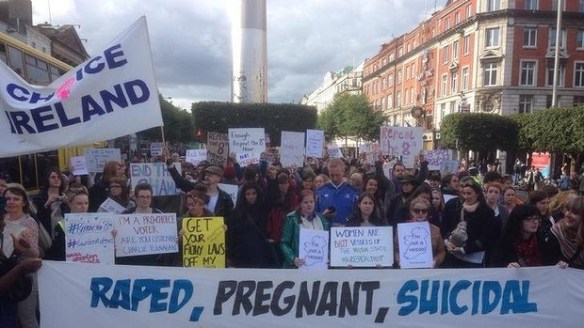
Thousands demonstrate for abortion rights in Ireland

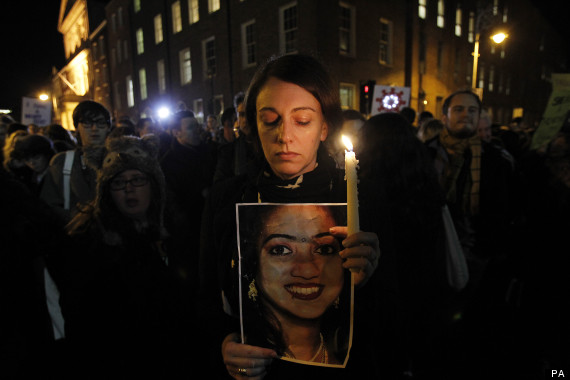
DSC_0185In August it was revealed that a young rape victim had been denied the abortion she requested while apparently being led to believe that this was possible.  It came after the horrific death two years ago of Savita Halappanaver who died when she was refused an abortion.

Yesterday thousands demonstrated in Dublin to demand for abortion rights and repeal of 8th amendment to the Irish State’s constitution which enshrines this denial of women’s rights.

The march was organised by the Abortion Rights Campaign and was mainly composed of young people, overwhelmingly young women, who represent a new generation that is not prepared to quietly accept the denial of the most fundamental of rights to control their own bodies.  They are aware that increasingly they speak for the majority of people in the State and that the barrier to the vindication of their rights is the State itself, behind which stands the reactionary forces long associated with the Catholic Church.

The leaflet given out at the demonstration by its organisers pointed out that the Irish state has the most restrictive abortion laws in Europe.  That if a woman seeks a termination it can only be on the grounds that there is an imminent and substantial risk to the woman’s life, including suicide.  Rape is not legal grounds for an abortion, nor is the fact that a foetus will not survive outside the womb and the restrictive grounds that do exist require an assessment by up to 6 doctors.

DSC_0173

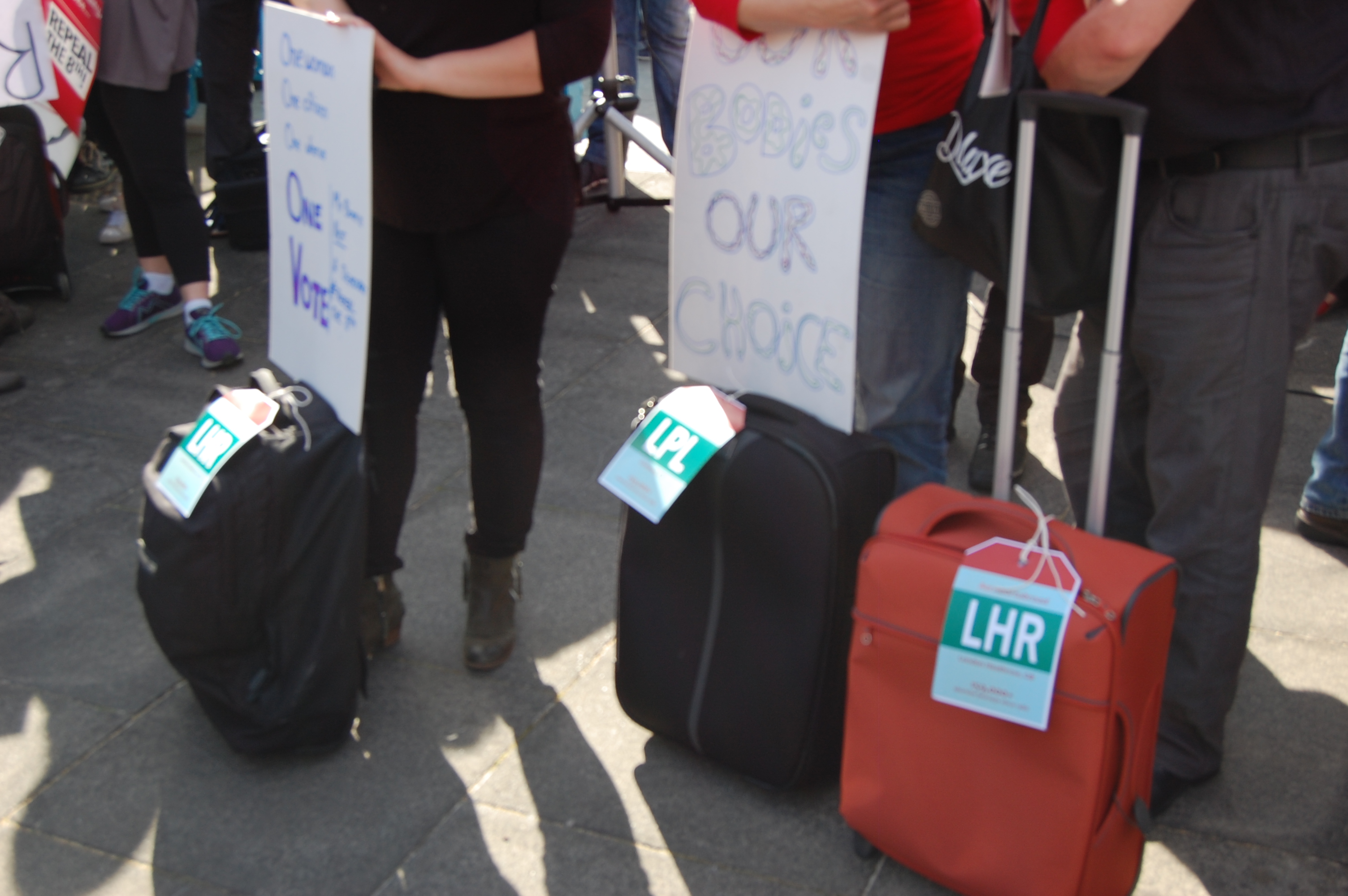
Many of the demonstrators pulled wheelie luggage with tags for LHR and LPL, recording the fact that 159,000 women have travelled to Britain for an abortion since 1980. The latest legislation by the State is not a solution to this infamous ‘Irish solution to an Irish problem’ – the temporary export of women to Britain.

The demonstration signposted the need for a new campaign to repeal the 8th amendment on the 30th anniversary of its passing, with speakers noting that most of those attending would have had no opportunity to participate in this decision.

The repeated exposure of the criminal abuse by the Catholic Church has robbed this body of much influence but it continues to retain its power though its alliance with the state and many demonstrators demanded their separation.

The campaign and others have correctly decided that the demand for repeal of this part of the State’s constitution is not a policy of reliance and dependency on the state but an effort to remove shackles on their rights and that direct, first-hand action has and will continue to be taken to provide women with real choice during unwanted pregnancies.


The Irish State’s pathological oppression of women

1408603830298.jpg-620x349In Britain there is no higher loyalty than to Queen and country.  In Ireland loyalty is to the State via the Constitution.

From high oaths to common usage it is the Queen, and by virtue of this the nation that are her subjects, that is held up as the object of allegiance.  Proclaiming loyalty to the State sounds a discordant note.

Although in Ireland there is no less promotion of nationalism this does not find expression so much in calls for allegiance to the country, certainly not to the President, perhaps more so to the nation – although that now also has subversive connotations of actually including the whole nation i.e. all 32 counties – rather it is disloyalty to the state that would see you harangued in the Dail by the establishment parties.

Fine Gael sees itself as the unique guardians of the probity and righteousness of the state, having been the party of its creation, even in its declaration as a Republic, with what it considers unequalled adherence to its laws and devout devotion to its legitimacy.  Fianna Fail has seen itself as so embodying the identity of the nation that it has in the past seen itself as the body and soul of the state so that its own laws are also the laws of the state.  That means it doesn’t matter so much if you break them.

The Labour Party can be seen as the most inoffensive party in and with respect to the State.  Republicans, who once swore to a ‘second round’ of war against the Free State now bend over backwards to swear to the legitimacy of the state’s institutions, especially its police and security service An Garda Síochána.

The left wants the state to nationalise the banks and the economy, tax the rich, spend more money, take on more powers to put people in jail – that is those nasty bankers – and pass all sorts of laws against discrimination and for equality etc.  It wants a much bigger state that is a little bit more democratic.

But this week we have witnessed another grotesque illustration of the repugnant character of the real Irish State, the one beyond the idealised phrases uttered without reflection.  In particular it is the constitution which has once again been the grounds on which the denial of women’s’ rights has been based.  This denial is a product of the State’s view of the role of women in society spelt out in Article 41 of this constitution, which states that:

“The State recognises the Family as the natural primary and fundamental unit group of Society, and as a moral institution possessing inalienable and imprescriptible rights, antecedent and superior to all positive law.  The State, therefore, guarantees to protect the Family in its constitution and authority, as the necessary basis of social order and as indispensable to the welfare of the Nation and the State.  In particular, the State recognises that by her life within the home, woman gives to the State a support without which the common good cannot be achieved.  The State shall, therefore, endeavour to ensure that mothers shall not be obliged by economic necessity to engage in labour to the neglect of their duties in the home.”

1408601099354.jpg

It is the State and its constitution’s treatment of women that has given display to its most cruel, repulsive and hypocritical features.  Its reactionary historical origins have imprinted on it a character that all pretensions to modern liberalism have proved unable to hide.  While capitalist development has undermined the holy foundations of the confessional state and its Catholic ethos it has done so in a manner different from that which a strong, vibrant, secular and socialist workers movement would have achieved and with different results.

The Catholic Church has lost mass-goers and much credibility but it still has patronage over the vast majority of primary schools, is still allowed to discriminate in appointing teachers and still imposes its dogmas in much medical practice.  The state it blessed, and which in turn blessed it with collusion in its violent abuse of thousands of women and children, and which paid for the cost of claims arising from this abuse, is now the primary mechanism that upholds its dogmas.

The decline in the ideological hold of the church has not been matched by its political decline and the political power it retains now owes more and more to the power of the state.  It is the State which stands more and more exposed, or should at least, as the rock upon which the oppression of women in Irish society rests, an oppression previously sanctified primarily by the Church and its institutions.

The state’s treatment of a teenage pregnant immigrant illustrates what this seemingly clichéd piece of jargon actually means.  The young woman at the centre of this latest tragedy was interviewed by Kitty Holland in ‘The Irish Times’.

The interview revealed that the young woman was refused an abortion after she had said that she had been raped, although she did not know she was pregnant until arriving in Ireland.  She was initially told she could have an abortion at 24 weeks but this subsequently changed and she delivered a baby by caesarean section.

“Yes, I would have preferred an abortion,” she said. “I was told the only way to end the pregnancy at this point would be a Caesarean . . . They said wherever you go in the world, the United States, anywhere, at this point it has to be a Caesarean.”

“I was raped in my country. I did not know I was pregnant until I came here.”  She was referred to the Irish Family Planning Association (IFPA), where her pregnancy was confirmed.  “It was very difficult for me. I cried. I said I am not capable of going through with this. I said I could die because of this… They said to me abortion was not legal here, but people like me are sent to England for abortions . . . I asked to go and they said they would have to arrange the documents and that could take six weeks.”

“They said it is okay because I was eight weeks and four days. After that day I hoped they were going to help me. I was shown documents that were filled in, and I understood that the process was under way.”  Over the following weeks, she says, she had a number of meetings at the IFPA and although the process seemed to be in train she was told some weeks later that the estimated cost of travelling to England, having the abortion and possible overnight accommodation could be over €1,500.  An individual in the IFPA, she says, told her the State would not fund the costs.  Remember this is the State that borrowed €64,000,000,000 to bail out the banks.

“In my culture it is a great shame to be pregnant if not married . . . I didn’t even know what [the medic] was saying to me.  “I said to her, ‘I could die because of this pregnancy. I am   prepared to kill myself’.”  At this stage she was 16 weeks’ pregnant.  “I said we’re getting too far, and she said, no, in England they carry out abortions up to 28 weeks . . . She said ‘that is not the problem. The problem is the money’.  She told the journalist that by then she had decided to kill herself.

She then made contact with a family friend who advised her to go to a GP and tell them that she was suicidal because of the pregnancy.  The GP referred her to a hospital, where she saw a psychiatrist.

“She had read the report and she said to me, ‘No, you are already too far pregnant’. I cried. She asked me lots of questions and I answered them, telling her everything I felt. Around 11pm I saw another psychiatrist. I told her the same thing. I spent the night there.

‘“The next day, around 10am, I was taken in a taxi to another hospital . . . When we got there I thought they were going to help me. They brought me to a room where they did a scan and the pregnancy was 24 weeks and one day . . .They said they could not do an abortion. I said, ‘You can leave me now to die. I don’t want to live in this world anymore’.”  She said that from this point a nurse was constantly at her bedside and was always accompanied to the bathroom.’

“They knew I was going to do myself ill. From Friday I did not eat. I did not drink. For four days I didn’t drink, I didn’t eat . . . I thought that way I could die…On Monday night two doctors came, a psychiatrist and a gynaecologist, and said, ‘We are going to carry out the abortion next Monday but you have to be strong. You have to eat. You have to drink.’ I started to eat and I drank.”  A few days later she was told that the plan had changed.

“They said the pregnancy was too far. It was going to have to be a Caesarean section . . . They said wherever you go in the world, the United States, anywhere, at this point it has to be a Caesarean.

“I didn’t know if I could continue to suffer.”  She says that a number of days later, two medics told her the authorities had been made aware of her situation and she would need a solicitor. “That really shocked me.”

A solicitor was appointed by the Health Services Executive.   “The solicitor said he was familiar with my case but it would be better to explain it myself. . . I didn’t eat again those days . . . On Monday evening a psychiatrist came again and said if I eat and drink they will try to do the operation on Tuesday.  I would have preferred an abortion.”

Was she told she had a choice between an abortion and a Caesarean?  “No. I was told the only route that remained was a Caesarean.”  She met the obstetrician she understood would perform the section on Tuesday, and this doctor told her about the operation.  “She said to me, there is a law. This law says abortion is prohibited but people like me can be helped. Abortion is allowed if the pregnant person wants to kill herself because of the pregnancy. “

“She promised they would do it [the Caesarean] on Wednesday. She showed me a document with three signatures, two psychiatrists and one gynaecologist.  She started talking about the negative effects [of a Caesarean section]. I didn’t listen. I didn’t have a choice. All the suffering I had gone through. Then on Wednesday at about 3pm they did it.

“When I woke up I felt sick. The following Wednesday I was let out.”  “I didn’t want to even know that I had a child. Still, even today, I feel really bad.”  She has seen a psychiatrist twice since she left hospital, provided for her by the HSE.

Asked if she has any friend to talk to about her situation, the young woman says she has not.  “No, I didn’t want people to know . . . For me this was shameful. In our culture if a girl gives birth to a child before marriage everything is finished. No one can respect you. As well as that, for me, with the rape, it was difficult.”

“Sometimes, when I feel the pain . . . I feel I have been left by everybody . . . I just wanted justice to be done. For me this is injustice.”

A spokeswoman for the HSE, when asked about the allegation that the woman was not offered a right to appeal the decision to carry out a Caesarean section, said that the woman’s request for a termination on the basis of suicidality was acceded to.  “It is important to note that a pregnancy can be terminated by way of delivery through Caesarean section, as it was in this instance.”  As they were acceding to her request for a termination of the pregnancy on those grounds, there is no requirement for a review.

It’s hard to know in what proportion this response of the HSE is composed of cynicism, mendacity and deceit; or how much to that infamous principle of conduct by the Irish State of ‘an Irish solution to an Irish problem.”  As the columnist Fintan O’Toole pointed out:

“At least 160,000 Irish women have had abortions abroad since 1980. That’s close to one in 10 of the female population aged between 14 and 64. These women are our mothers, sisters, daughters, friends, neighbours. Yet abortion is part of official discourse only when a new atrocity breaks the surface of a deep silence.”

An inquiry will be undertaken by the HSE which will, it is reported, establishe “all of the facts surrounding the care given to the woman” and will “end any inaccurate commentary surrounding this matter currently”, except that it “would not involve any review of the decision taken by the three clinicians who were empanelled to decide if an abortion was warranted under the 2013 Act .”

Meanwhile the Government through the Minister for Education Jan O’Sullivan has said that the constitutional ban on abortion should be revisited by a future government, but that the legislation introduced by the Coalition was “the best possible” under the circumstances.  A phrase that hardly comes anywhere near describing truthfully the circumstances of the case.

The announcement of an inquiry will attempt the same role as the inquiry called after the death of Savita Halappanavar.  Already we have been told that it may not be published in full and of course it is to be conducted by the same organisation, the HSE, which is squarely in the dock as the guilty party.

The Government has already ruled out doing anything so the exercise is entirely cynical and entirely in keeping with the history of a state that took 21 years to legislate for the X case.  It’s remarkable that at this time the Irish state could move at such speed in an attempt to prevent another young 14 year old rape victim threatening suicide from having an abortion in Britain yet took 21 years to legislate for the limited concession to women that resulted from the case.

The state has no role in limiting the participation of anyone in society or determining their role.  It certainly cannot be allowed to control the rights of women to control their own fertility or to endanger their health or their life because of doctrines dreamed up by a medieval institution that believes its leader is God’s deputy on earth.

Women must have the right to choose whether they will bear children without conditions being imposed.  The Constitutional impediments to this must be repealed and the fight to make their free choice a real one, which cannot be settled by any constitutional provision, must be taken up.

A way forward cannot be left to the existing State but requires a movement that not only campaigns for the freedoms and resources to make women’s self-determination a reality but starts itself to put in place the services that women need.

New Abortion Bill – should it be supported?

4378254-3x2-700x467

The death last October of a young woman, Savita Halappanavar, refused an abortion in a Galway hospital that may well have saved her life because, she was told by staff, “this is a Catholic country”, was shocking and led to an eruption of anger across the State.  It made headlines across the world.  It forced the establishment parties to get off the fence they had been sitting on for over two decades and promise they would legislate for some sort of abortion rights.

The problem they said was one of legal clarity and certainty for the medical profession.  At the time I argued that this was not the issue.  The issue was the all too certain denial of women’s rights to control their own bodies and their own fertility to the degree that they could be left to die rather than be allowed to abort a foetus that could not survive.

Now the nature of the proposed legislation has been made public.  It is clear from this that it is designed to protect the state and not women.

Enda Kenny spelled it out – the legislation “will not create any new rights.”  Although arising from the Halappanavar case it will not prevent such a tragedy happening again.  That’s about as damning a judgement as could be made given the circumstances.

The legislation will do nothing to facilitate abortion rights in cases of rape, incest or cases of foetal abnormality.  The health of women is of no consideration.  Abortion remains a crime and the 1861 British penalty of penal servitude for life has been replaced by the 21st century Irish penalty of 14 years imprisonment.  Women may go to jail because it would be ‘inequitable to penalise the doctor but not the woman undergoing the procedure’.  This will apply to pregnant women.  The denial of rights is indivisible.  Thousands of Irish women will be regarded as criminals who have escaped punishment only because their crime was perpetrated elsewhere.  These women will continue to travel to Britain rather than face the bureaucratic obstacle course which seems designed to ensure their journeys continue.

These rules require two doctors to approve an abortion where there is a “real and substantial risk to the woman’s life” and one if the termination is considered “immediately necessary.”   In the case of a woman at risk from suicide three doctors are required to approve (unanimously), two psychiatrists and a gynaecologist or obstetrician.  If the woman is refused a termination she has the right to appeal in writing to two doctors if it involves physical risk and another three doctors if she is in danger of suicide.  Again these are to be two psychiatrists and a gynaecologist or obstetrician.

The expertise of the medical profession is to be deployed in order to adjudicate on behalf of the State on women’s rights.  That this expertise is not the real function but rather a justification of the fetters determined by the State is abundantly clear from the fact that a gynaecologist or obstetrician must be on both the original and review panel and the verdict must be unanimous.  What expertise does a gynaecologist or obstetrician have in determining a woman’s state of mind?  In what way is a medical emergency requiring only one doctor in any essential way different from one determined by the threat of suicide?

The legislation has been enacted to deal with the State’s non-compliance with the European Court of Human Rights, which had concluded unanimously that it had breached a woman’s right under Article 8 “by reason of the absence of any implementing legislative or regulatory regime providing an accessible and effective procedure by which she could have established whether she qualified for a lawful abortion in Ireland.”  Now most women will know that they don’t and will face a struggle to affirm their rights if they think they do.

The State hopes that it will have neutralised the movement that wanted to affirm women’s rights and thereby bolster all the reactionary sections of society that seek to maintain the system of repression on which the Irish State was founded.

It would therefore be a mistake to welcome this legislation, this enactment that “will not create any new rights.”  We should not get into a fight over whether only two doctors are required in cases of possible suicide rather than three.  As has been pointed out by Doctors for Choice Ireland here , women will in all probability visit their GP first before going through the bureaucratic process meaning they could see two, three or four doctors initially.

Doctors for Choice Ireland put what we need to demand very succinctly “We believe that the safest way to protect all women in Irish society is to decriminalise abortion, leaving medical matters outside the criminal law. . . Women should have the choice to access safe abortion services with fully informed consent. To achieve this we will need to repeal the 8th amendment.”

The reality of the Good State

images (1)
Some readers of this blog might think that I’m labouring the question of nationalisation and state ownership and its identification with socialism. While I believe it is a question of fundamental political importance its practical significance has been vividly illustrated in the last few days.

mag6

In Britain the report from the fifth investigation into Stafford hospital has been delivered, prompting David Cameron to say that he was”truly sorry” for what had happened, which was “not just wrong, it was truly dreadful.” Previous investigations had already established in harrowing detail the abuse and neglect that took place from 2005 to 2008.

Between 400 and 1,200 more deaths took place than would have been expected between these years, although it is stated that it is impossible to say whether all of these patients would have survived had they received better treatment. Receptionists were left to decide which patients to treat, inexperienced doctors were put in charge of critically ill patients and nurses were not trained how to use vital equipment.

The National Health Service, so beloved of the British nation that it featured in the opening ceremony of the Olympics, has been damned from top to bottom.

Trust management ignored patients’ complaints while local GPs and MPs also failed to speak up, the inquiry said.

The local primary care trust and regional health authority were too quick to trust the hospital’s management and national regulators were not challenging enough.

Meanwhile, the Royal College of Nursing was highlighted for not doing enough to support its members who were trying to raise concerns.

The Department of Health was also criticised for being too “remote” and embarking on “counterproductive” reorganisations.

The findings of the report cannot be regarded as an aberration as it follows repeated damning judgments of care provided in Britain, especially care of the elderly, and news that five other hospitals are to be investigated following Stafford.

Yet the NHS is the crown jewels of the social democratic state.

The inquiry’s head said that patients “were failed by a system which ignored the warning signs and put corporate self-interest and cost control ahead of patients and their safety.”

Many on the left speak and act as if the only problem with the health service is a lack of cash but this is much less than the full story and money will not deal with what has been referred to as the cultural changes that are required.

Working class people in Britain and Ireland are all too aware of the shortcomings of the health services. While those in Ireland may wish for their own NHS those in the UK know its limitations and going to hospital is more and more regarded as something you really don’t want to do unless you have to.

Those with elderly relatives in care are all too aware of the possibility of mistreatment.

Only yesterday Channel 4 news reported on the death of an elderly person left with no domiciliary care for 9 days when the service she was receiving was closed by immigration police, who had raided the office of the private organisation providing the care. When the care provided by this organisation stopped the council never picked up on the elderly woman who had no relatives. She went without her medication and died hungry, thirsty and alone.

Two days ago the illegal charging by the Irish State of people in long-term care again became news. As early as 1976 the State, through the Department of Health, knew its charges were illegal. In 2005 the Government attempted to make them legal retrospectively although this was stopped by the Supreme Court.

The Government knew exactly what it was doing. The Minister of Health Mary Harney said that “more than 300,000 people were charged illegally during 28 years. This was entirely wrong. They were old, they were poor, they suffered from mental illness, they had intellectual disabilities, they were physically disabled. As vulnerable people, they were especially entitled to the protection of the law and to legal clarity about their situation.”

And yesterday the report on the Magdalene Laundries was released, which revealed some of the State’s role in the incarceration of thousands of women in institutions run by Catholic religious orders, compelled to work for nothing and stigmatised as ‘fallen women.’ “A very Irish form of slavery” as the Sinn Fein TD Mary Lou McDonald put it. Over one quarter of the women were put there by the State. The last laundry only closed in 1996.

The State again attempted to cover up and lie over its role.

In 2009 the Minister of Education Batt O’Keefe said that “the Magdalene laundries were privately owned and operated establishments which did not come within the responsibility of the State. The State did not refer individuals to the Magdalene laundries nor was it complicit in referring individuals to them.” Not true.

In 2011 Sean Aylward, secretary general of the Department of Justice, speaking in Geneva at the UN Committee Against Torture said “the vast majority of women who went to these institutions went there voluntarily or, if they were minors, with the consent of their parents or guardians.” He knew this because he had met some of these women.

Yet not one of the five women he had met had entered the laundries voluntarily or with the consent of their parents or guardians. Over eighty three per cent who entered the laundries were put there.

What all these examples demonstrate is that the capitalist state cannot be relied upon to provide services that working people, especially the most vulnerable, require. Some, like the Magdalene laundries, are now easy to denounce but none are models of socialism. Far from uncritically defending these services socialists must educate and agitate for a workers’ alternative to how they are currently organised and managed. The very last thing we want to do is proclaim these services as exemplars of socialism and the state that runs them as the font of this socialism.

Savita Halappanavar and the demand for the Truth

Minister for Health James Reilly

In this post I warned that the State was going into defence mode in order to protect itself from the fall-out from the death of Savita Halappanavar who, from all accounts, died in agony while the hospital in which we was being treated refused to terminate her pregnancy because this would necessarily result in the death of the foetus. “This is a Catholic country” she and her husband were told.  As a result her life was unnecessarily put in danger and she died.

The response of the Government and many others, including the anti-abortion lobby, is to emphasise the uncertainty around events and to defuse the response to them by calling inquiries which, on the face of it, have no credibility.

Consider the following.

Mr Halappanavar heard nothing from the Irish authorities until he made the tragic death of his wife public.

The Government then announces an inquiry by the hospital group where Savita died and one by the employing body, the Heath Services Executive (HSE).  In effect both bodies would be investigating themselves.

Such is the arrogance and panic of the organs of the State concerned that they include three doctors in the HSE inquiry from the Galway hospital where Savita died!  When I first heard this on RTE news I was struck immediately with complete incredulity. Did I hear that right?  Mr Halappanavar has pointed out that there were five members of the medical staff in the room when he was told that she could not have a termination because “This is a Catholic country”.

The Chairman of the inquiry says he needs these medical staff in order to “find out about their standard practice.”  In other words those investigating the death would be asking themselves what goes on!  This is independent?

As Mr Halappanavar and his legal advice say – the inquiry is private, it is confidential, evidence will not be taken on oath and there will be no cross-examinations.

The Government makes a partial retreat by removing the local medical staff but then puts pressure on Praveen Halappanavar to accept the HSE inquiry.  The HSE know he is unhappy but then claim it is only the participation of the three staff that evoked his concern.

It is then pointed out that he didn’t know about the three internal staff at this time and had in fact objected because the HSE was running the inquiry (into itself) and would not be holding hearings with witnesses.  So he could not have objected on the grounds claimed by the HSE.

Praveen Halappanavar’s solicitor also claims that the medical notes of Savita  given to Praveen have parts missing.  They contain records of requests by Savita for tea and toast and a blanket but no written information about her repeated requests for a termination nor of the consultant saying “This is a catholic country”.

A spokeswoman from the HSE is then quoted as saying that she was sure no notes were withheld for “spurious reasons”.  Indeed.

Yet we are expected to believe that the State and its inquiries will give Praveen Halappanavar and everyone else the truth.

The courageous stand by Praveen Halappanavar has stripped the State inquiry of any credibility and it cannot now perform the function assigned to it by the State.  The huge march in Dublin has demonstrated the anger and determination of many not to accept the death of Savita or accept that it might happen again.  So far the anger of many women and men, along with Praveen Halappanavar’s determination, has forced the State to retreat and put serious pressure on the Government.  The pressure is particularly strong on the Labour Party, which claims progressive credentials.  Fine Gael on the other hand has always been a reactionary tribe. It is so far an open question how far and for how long a more or less spontaneous reaction can threaten this Government and advance women’s rights.

The emphasis on legislating for the X case, while this would be an advance, also runs the real risk of duplicating the uncertainty which already exists but which thereby provides the certain barrier to women’s realisation of their right to control their own bodies.  A limited, confused and contradictory constitution and legal view is just as liable to bring forth another limited, confused and contradictory piece of legislation, and would the Government really mind that?

The spontaneous eruption of women and men claiming their rights has an unrivalled quality of energy, hope and passion but the force and determination of organisation and strategy is, as time goes by, much more likely to bring what is required.

Politicians are manoeuvring to avoid the blame or claim the leadership of the demand for women’s rights.  The not-so-united United Left Alliance has put two separate amendments to the Sinn Fein motion in the Dail calling for legislating for the X case, putting a large question mark over its ability to perform this latter role.

This role is not to seek immediately to lead this spontaneous movement but to help it find organisation, a strategy, its own leadership and to fight for a women’s right to choose as the only certain route to establishing the rights of women.

The Left, with its history of political sectarianism, would have to change its instrumental approach to campaigns if this were to happen and they become able to play this role.  There are reasons why it might not do so but there are many, many more why it should.


What is certain about the death of Savita Halappanavar

The husband of Savita Halappanavar has been very clear.  His wife was refused a termination of her pregnancy although the foetus would not survive, because the foetal heartbeat was still present, and Savita and he were told, “this is a Catholic country”.  He later said that he was convinced she would have lived had this medical intervention taken place.  All this appears pretty clear and it adds up to a shattering condemnation of the Irish State and the reactionary forces within Irish society which have denied the rights of women to control their own bodies.  What has happened is indefensible not least because the Indian nationality of Savita Halappanavar means it has become an international story.

The Irish State has gone into defence mode and sought to do so through diversion.  First it is hoped the issue can be immediately defused and closed down at least temporarily by the call for an enquiry that, it is stated, will take three months.  We are expected to believe that the truth will emerge from a government that couldn’t even give clear answers why two health centres are to be built in the Minister of Health’s own constituency.

For those opposed to women’s rights there is nothing wrong and women can rest assured that whatever medical treatment is required for their good will be provided, a claim that flies in the face of all that we know about what has happened.

More dangerously the issue has been diverted by the repeated calls from politicians and commentators that what we need is ‘legal certainty’ as if this is the problem.

This is not the problem.

Thousands of Irish women travel from Ireland to receive abortions because they are all too certain that they cannot control their own bodies within Ireland.  It is all too clear that there are no abortion facilities in Ireland and it is all too clear and certain that all the political parties don’t want to change this.  They have had twenty years to bring the slightest doubt to such a judgement and they haven’t even tried.

Secondly we are meant to believe that certainty can be delivered from this piece of the constitution: “The State acknowledges the right to life of the unborn and, with due regard to the equal right to life of the mother, guarantees in its laws to respect, and, as far as practicable, by its laws to defend and vindicate that right.”  Given the history of this question it is as likely that legislation would result in the same certain denial of women’s rights as currently exists.

Thirdly, and most importantly, lack of certainty isn’t at all the issue.  It is the right of women to control their own bodies, to make their own decisions.  We can be certain that had Savita Halappanavar’s wishes been acceded to there would be no question of medical practice being based on theology.  We can at the very least say that her chances of being alive today would be higher.  Isn’t that what hospitals and health services are supposed to be for?

It is not a question therefore of the State being certain about the restrictions that they impose on women’s rights.  It is not an answer that the medical profession be clear when they must let a women die in agony because the law is certain when they can and cannot intervene.  It is not enough that women travel abroad because it has been made crystal clear that they cannot vindicate their rights to control their own fertility within the Irish State.

What has happened to Savita Halappanavar has been portrayed as an extreme case and in an obvious way it is.  But by its very extremity it has demonstrated that women’s rights to control their bodies will be prevented on anti-abortion grounds, even when it leads to a woman’s death.

The staff at the hospital must be asked to reveal the full decision making process that went on.

What must be made clear to the Government is that the rights of women will not be dismissed and we will not be diverted into accepting a new certainty as to the restrictions placed on them.  Legislating for the X case would of course be welcome but it is not enough.

The demonstration outside the Dail last night and actions elsewhere were exactly what was immediately required.  This must be followed up by demonstrations and a campaign that demands the full rights of women to control their own fertility including safe and legal abortions with all the necessary facilities to provide them.