Lenin and nationalisation

144px-Lenin_perfilIn an earlier post I outlined the founders of Marxism opposition to confusing socialism, or the road to socialism, with capitalist state ownership.  I wanted to follow that up with a look at the views of Lenin.  When I did it would appear that the argument of opposition to state ownership is not advanced, in fact it is contradicted, and at best it might have to be modified.

This is because in the middle of the Russian Revolution, in fact in the weeks before the October revolution, Lenin wrote ‘The Impending Catastrophe and how to Combat it’ which sets out what appears a completely different approach.

The first thing that struck me about this short document is the title.  It does not promise a solution.  It does not declare ‘The Impending Catastrophe and how to Solve it’.  In fact the first sentence states ‘unavoidable catastrophe is threatening Russia’.  With all due regard to the much less severe crisis currently affecting Ireland there is something to be learnt from accepting that the job of socialists is not always to promise pain-free solutions to workers but to persuade them that they have to fight.

The problem is stated concretely and what’s more it is stated that everyone knows and says what the solution is.  This is “control, supervision, accounting, regulation by the state, introduction of a proper distribution of labour-power in the production and distribution of goods, husbanding of the people’s forces, the elimination of all wasteful effort, economy of effort.  Control, supervision and accounting are the prime requisites for combating catastrophe and famine. This is indisputable and universally recognised.”

Lenin proposes nationalisation of the banks but makes no claim that this is any sort of confiscation of private property.  In fact he is keen to emphasise how little difference it makes in this respect:

“If nationalisation of the banks is so often confused with the confiscation of private property, it is the bourgeois press, which has an interest in deceiving the public, that is to blame for this widespread confusion.”

“The ownership of the capital wielded by and concentrated in the banks is certified by printed and written certificates called shares, bonds, bills, receipts, etc. Not a single one of these certificates would be invalidated or altered if the banks were nationalised, i.e., if all the banks were amalgamated into a single state bank. Whoever owned fifteen rubles on a savings account would continue to be the owner of fifteen rubles after the nationalisation of the banks; and whoever had fifteen million rubles would continue after the nationalisation of the banks to have fifteen million rubles in the form of shares, bonds, bills, commercial certificates and so on.”

However he states that having done so “it is impossible to nationalise the banks alone, without proceeding to create a state monopoly of commercial and industrial syndicates (sugar, coal, iron, oil, etc.), and without nationalising them.”  Again the limitations of what is involved is stated – “All that remains to be done here is to transform reactionary-bureaucratic regulation into revolutionary-democratic regulation by simple decrees providing for the summoning of a congress of employees, engineers, directors and shareholders, for the introduction of uniform accountancy, for control by the workers’ unions, etc. This is an exceedingly simple thing, yet it has not been done! . . . and this could and should be done in a few days, at a single stroke.”

Where, as in the oil industry, the owners sabotage these plans and production generally Lenin proposed that they may have their property confiscated.  While all this was to be the task of the revolutionary-democratic state “the initiative of the workers and other employees must be drawn on; they must be immediately summoned to conferences and congresses; a certain proportion of the profits must be assigned to them, provided they institute overall control and increase production.”

The purpose was to increase production and stave off complete economic collapse and consequent famine, which was made all the more probable by the mismanagement and sabotage of the capitalist owners.  This required workers control, which meant workers supervision of existing management – not workers sole management and control never mind capitalist expropriation and workers ownership.  Abolition of commercial secrecy was proposed in order to make this control effective and democratic.  Under workers ownership the question of commercial secrecy would not arise as the owners with the secrets would be the workers.

Lenin was at pains to point out that what he was proposing was not socialism. “This is why I have already stated in Pravda that people who counter us with the argument that socialism cannot be introduced are liars, and barefaced liars at that, because it is not a question of introducing socialism now, directly, overnight, but of exposing plunder of the state .”

What he was proposing was not new.  “It might be thought that the Bolsheviks were proposing something unknown to history, something that has never been tried before, some thing “utopian”, while, as a matter of fact, even 125 years ago, in France, people who were real “revolutionary democrats”, who were really convinced of the just and defensive character of the war they were waging, who really had popular support and were sincerely convinced of this, were able to establish revolutionary control over the rich and to achieve results which earned the admiration of the world. And in the century and a quarter that have since elapsed, the development of capitalism, which resulted in the creation of banks, syndicates, railways and so forth, has greatly facilitated and simplified the adoption of measures of really democratic control by the workers and peasants over the exploiters, the landowners and capitalists.”

The exploiters, landowners and capitalists were not being abolished.  Indeed far from it.  They were to be organised!  Capitalism was to be developed!

“Compulsory syndication, i.e., compulsory association, of the industrialists, for example, is already being practised in Germany. Nor is there anything new in it.” The political opponents of the Bolsheviks were blamed for not carrying this out.  “Compulsory syndication is, on the one hand, a means whereby the state, as it were, expedites capitalist development . . . The German law, for instance, binds the leather manufacturers of a given locality or of the whole country to form an association, on the board of which there is a representative of the state for the purpose of control. A law of this kind does not directly, i.e., in itself, affect property relations in any way; it does not deprive any owner of a single kopek and does not predetermine whether the control is to be exercised in a reactionary-bureaucratic or a revolutionary-democratic form, direction or spirit. Such laws can and should be passed in our country immediately, without wasting a single week of precious time.”

The primary responsibility for implementation of this was to belong to the capitalists themselves.  “And it must be repeated that this unionisation will not in itself alter property relations one iota and will not deprive any owner of a single kopek. This circumstance must be strongly stressed, for the bourgeois press constantly “frightens” small and medium proprietors by asserting that socialists in general, and the Bolsheviks in particular, want to “expropriate” them—a deliberately false assertion, as socialists do not intend to, cannot and will not expropriate the small peasant even if there is a fully socialist revolution. All the time we are speaking only of the immediate and urgent measures, which have already been introduced in Western Europe and which a democracy that is at all consistent ought to introduce immediately in our country to combat the impending and inevitable catastrophe.”

So what are the political conceptions behind Lenin’s demands which he is clear do not amount to socialism?

“And what is the state? It is an organisation of the ruling class — in Germany, for instance, of the Junkers and capitalists. And therefore what the German Plekhanovs (Scheidemann, Lensch, and others) call “war-time socialism” is in fact war-time state-monopoly capitalism, or, to put it more simply and clearly, war-time penal servitude for the workers and war-time protection for capitalist profits.”

“Now try to substitute for the Junker-capitalist state, for the landowner-capitalist state, a revolutionary-democratic state, i.e., a state which in a revolutionary way abolishes all privileges and does not fear to introduce the fullest democracy in a revolutionary way. You will find that, given a really revolutionary-democratic state, state- monopoly capitalism inevitably and unavoidably implies a step, and more than one step, towards socialism!”

“For if a huge capitalist undertaking becomes a monopoly, it means that it serves the whole nation. If it has become a state monopoly, it means that the state (i.e., the armed organisation of the population, the workers and peasants above all, provided there is revolutionary democracy) directs the whole undertaking. In whose interest?”

“Either in the interest of the landowners and capitalists, in which case we have not a revolutionary-democratic, but a reactionary-bureaucratic state, an imperialist republic.”

“Or in the interest of revolutionary democracy—and then it is a step towards socialism.”

“For socialism is merely the next step forward from state-capitalist monopoly. Or, in other words, socialism is merely state-capitalist monopoly which is made to serve the interests of the whole people and has to that extent ceased to be capitalist monopoly.”

What Lenin is therefore saying is that the measures he proposes go no further in many cases than what exists in Western Europe but while implemented by a revolutionary-democratic state, i.e. not a workers’ state, they are a step towards socialism.  What is then decisive is the character of the state.

These measures gain their democratic and revolutionary character from the state – remember this is a state that has already resulted from a revolution, one that had overthrown a centuries-old monarchical regime, was headed by avowed Marxists and was subject to a situation of dual power where workers, soldiers and peasants organisations were vying for effective and official power with the institutions of this state.  How different is this from the idea that these measures, such as nationalisation, in themselves are socialist even when implemented by a right-wing government at the head of an established capitalist state implementing the diktats of the combined powers of European imperialism!

For the purposes of this very limited argument all this should be clear and its relevance and application to the political programme of today’s left also clear.

What concrete purpose does nationalisation of the banks serve in Ireland today?  Their nationalisation was the practical means to saddle the working class with the debts of large sections of the capitalist class.  This is obvious to everyone.  Is there any sign that the usefulness and correctness of this policy has been questioned?  Unfortunately not, instead the United Left Alliance demands “full nationalisation with direct public control of the banks”.  The same, but more so.  As was said of the Bourbon dynasty in France, ‘they had learned nothing and forgotten nothing’.

Related, but much wider, issues arise from this booklet by Lenin and the quotations cited that we shall not go into.  For example Lenin states: “that capitalism in Russia has also become monopoly capitalism is sufficiently attested by the examples of the Produgol, the Prodamet, the Sugar Syndicate, etc. This Sugar Syndicate is an object-lesson in the way monopoly capitalism develops into state-monopoly capitalism” and that “given a really revolutionary-democratic state, state-monopoly capitalism inevitably and unavoidably implies a step, and more than one step, towards socialism!”  This may gloss the undeveloped character of Russian economy and society as a whole.

Secondly the view that “if a huge capitalist undertaking becomes a monopoly, it means that it serves the whole nation. If it has become a state monopoly, it means that the state . . . directs the whole undertaking. In whose interest?  Either in the interest of the landowners and capitalists, in which case we have not a revolutionary-democratic, but a reactionary-bureaucratic state, an imperialist republic.  Or in the interest of revolutionary democracy—and then it is a step towards socialism.”  This takes a view that the state, even if “revolutionary-democratic”, can effectively act as the vehicle for working class emancipation without workers ownership of the means of production.  While Lenin calls for workers control we have seen how limited this is.  We have also to consider of course the long debate about the ambiguity of the formula of “revolutionary-democratic”.

It is not our purpose to debate these other issues here and regard must be had to the limited purposes of Lenin’s own booklet, the rather telescoped and formulaic end to it and his qualification that the revolutionary-democratic state tasks in relation to the economic crisis are “a step towards socialism” and not socialism itself.

The purpose of this post has rather been to set out that even where Lenin puts forward the demand for nationalisation it is not as a socialist programme but as one that is a precursor to it. In addition it assumes a state of a very different form and in a very different position from the one that many on the Left today call on to carry out tasks that should be those of the working class itself.

Budget 2013 and the alternative

6122011-budget-2012-second-day-14-630x491The 2013 budget is going to introduce tax increases and spending cuts of €3.5 billion.  Michael Noonan smiled when holding up the budget document to the cameras while Brendan Howlin looked serious.  Nevertheless RTE reported that Labour TDs were pleased claiming that their fingerprints were all over it.  And so they are.  Their footprints, where they walked all over many vulnerable sectors of society, are also all over the budget.

There has essentially been only one defence of these austerity budgets and that is that the Government has had no choice.  No choice because there is no economic alternative and no choice because the State has lost its economic sovereignty and is basically doing what it is told to by the Troika of European Commission, European Central Bank and International Monetary Fund.

In this budget they have felt compelled to come up with a new defence – it is nearly over. This was trumpeted by Michael Noonan and also claimed by the Labour leader that “It is the budget that is going to get us to 85% of the adjustment that has to be made, and will therefore put the end in sight for these types of measures and these types of budgets”.

This hardly looks credible, which is not good news, because what it essentially means is that the austerity measures implemented have both been insufficient and haven’t worked.  The economy has contracted and stagnated even as the austerity measures have been insufficient to bridge the deficit.

For 2012, the deficit has turned out to be around €500 million larger than planned but because of upward revisions to data from earlier years, the deficit target, set as a percentage of GDP, will still be hit. This assistance in meeting the ‘target’ will not be available in 2013.

At the end of 2013 the deficit will be 7.5% of GDP.  In 2008 (excluding that related to the banking bail out) it was 7.3% rising to 11.5% in 2009. All the austerity budgets have achieved so far is a reduction of 4% – less than half way to eradicating the budget deficit never mind 85% of the way.  Even by 2017 the IMF forecasts the deficit will be 1.8% so the debt will still be getting bigger.

As with all these budgets there have been cuts to capital expenditure with another €500 million reduction targeted for 2013. In 2008, capital expenditure was close to €10 billion. In 2013, it will be under €3.5 billion. Public capital expenditure has been slashed by 66% which wipes out, and more, the so-called stimulus measures announced earlier in the government’s PR/con exercise that claimed to be promoting jobs.  This means the infrastructure of the state, economy and society will disintegrate more or less quickly.

The sheer madness of the austerity agenda is demonstrated by the fact that the €3.5 billion in cuts and tax increases will be wiped out before they are even implemented by the €3 billion payment of the promissory notes for the Anglo-Irish bank, which no longer exists, and repayments of €2.45 billion of bonds for Irish Life & Permanent. On top of this there is the rising interest cost of the debt, which will increase from €5.7bn in 2012 to €8.1 billion in 2012-13.

With the debt increasing, even at a reduced rate of increase, the burden of interest payments on it can only worsen.  This makes the debt unsustainable.  A rising interest burden will be a permanent anchor on growth.  This is a problem because the Government is relying on renewed economic growth to get out of the stagnation now in place.  The weakness of Irish capitalism means that it must rely on outside forces for this growth.  Either that or there is some debt relief to lower the amount of debt and the burden of interest payments.

In the meantime particular groups of the working class will suffer real hardship, living standards will decline or at best stagnate and unemployment will be limited only by continuing emigration.  The stresses imposed on society will be expressed in mounting social problems that will often be presented as a simple increase in personal misfortune while increased inequality will coarsen social relations and further weaken social solidarity.  The absence of any radical perspective will see reactionary prejudice become common currency.

Once again the United Left Alliance has put forward what it states is a socialist alternative.  In substance it is the same argument as that put forward last year but with more detail and some development here and there.  There is no need to repeat the analysis presented earlier in this blog including here, here and here.

The ULA is in no position to implement any of its proposals.  The purpose of the document must therefore be an educational one.  What it teaches is therefore the only useful criterion by which to judge it.

It starts out by claiming to be a socialist alternative and its headline is repudiation of the debt, an end to austerity and the need to invest in jobs and services.  All these are undoubtedly the immediate needs of the working class.  The problems start when we look to see how it is proposed these ends might be achieved.

The ULA “proposes to take the burden of the crisis off working people, improve their lives and revive the Irish economy.”  On the other hand it admits that “the budgetary proposals put forward by the ULA can in no way offer a comprehensive solution to the crisis we face.”  How the first claim is reconciled to the second is not explained.

While the debt crisis “resulted entirely from the actions of developers, bankers and the politicians who facilitated them” it is not explained how this can be reconciled to it being “a manifestation of a deep structural crisis of global capitalism.”  It is nowhere explained what this latter statement means, how it explains what has happened or how it explains what solutions are possible.  The Marxism to which the core elements of the ULA claim commitment is founded on claims to present just such answers but they are not here.

It might, with some justification, be claimed that the precise cause of the crisis is also a cause of some debate within Marxism.  Unfortunately any suggestion that a key task of the ULA might be to debate this out so as to inform the politics it espouses would be held up many as a fetish of sectarian or dogmatic individuals who aren’t interested in practically ‘building the movement’, or some other such boorish remark.  Instead while (dumbed down) Marxism is relegated to recruitment meetings for novices the vacuum that is the politics presented to workers is filled with Keynesian, that is capitalist, ideas that are the currency of liberals and the leaders of the trade unions.

Let us see some ways in which this is expressed in the ULA economic alternative.

First the ULA proposes to improve the lives of working people and revive the Irish economy but there are no socialist measures proposed that would achieve this.  Were the proposals to therefore fail (if by some miracle they were tried) it would discredit what passes itself as socialism while if they were to succeed they would go some way to making socialism irrelevant.

The ULA claims that “the alternative we propose will not be implemented by the current parties in the Dail or by the Irish state.”  Yet it proposes that the Irish State increases income tax on the rich, reduces taxation on workers, introduces a wealth tax, introduces a financial transactions tax, increases corporation tax, takes “full control of the banks”, supports small business, invests to create jobs, embarks on a programme of council house construction, creates a new construction company, renationalises all privatised strategic enterprises and establishes a state owned gas and oil company. It declares that “the ULA believes public enterprise and public works must play the central role to redevelop the economy on a sustainable basis.”

The ULA claims that “radical measures that break with the logic of ‘markets’ are required” but the demands on the state above do not do this while it is claimed these measures will “revive” and redevelop the economy on a sustainable basis.”

“There is a need for active struggles to demand policies that prioritise the need for jobs, public services and growth, using public investment and democratic socialist planning to chart a way out of the current crisis.”  What sort of struggles? For what policies? And who will we demand this of?  How would they deliver on it?  What, who and how?  Where and when don’t even arise given the vacuousness of this string of words.

In other words – as a vehicle for education – the alternative budget, when it is not mistaken, as we have explained in earlier posts, is simply incoherent.

What is clear is that the ULA has no strategic perspective.  It calls for socialist planning, but socialist planning is just another term for working class rule, for the working class controlling society.  Yet it proposes the state, the capitalist state, take action in the here and now to solve the crisis and develop the economy on a “sustainable basis”.

This lack of coherence reveals itself in timidity, contradiction and calls for solutions that have already been the means to subordinate and exploit the working class; as when the ULA calls for “full nationalisation with direct public control of the banks” when it is nationalisation and state control of the banks that has been the mechanism to burden workers with the debts of the speculators.

Even when it calls for “direct public control of the banks” this can as easily be defined as the current arrangements as it might by workers control.  So how does such a demand clarify anything?  How does it educate anyone on what they should fight for?

The ULA is currently undergoing an organisational crisis but its real problems are political.  It argues an alternative that is simply not based on the actions of the working class. It is imperfectly aware of this so it substitutes vague calls for action and acknowledgements that what they are proposing is only temporary amelioration.

There is a possible solution to this problem and it involves debating openly and democratically what a socialist strategy should be.  As I have said such calls are resisted.  It therefore falls to those prepared to do so to engage in such a debate so that we don’t just point out what’s wrong but also say what’s right.

Should we call for a general strike?

One theme of the anti-austerity demonstration in Dublin was the call for a 24 hour general strike by a number of left groups.  The Socialist Workers Party (SWP) said that “one march is not enough – we need a 24 hour general strike”.  The United Left Alliance (ULA) called for a “boycott of the Property Tax” and “for a 24 hour general strike – on 31 March next year”.  The leaflet from the Socialist Party did not mention a general strike but said that the “mass campaign against Property Tax can be key to defeating austerity agenda . . challenge the sell-out of the trade union leaders – organise from below to strike against austerity.”

Repeatedly reference was made to the experience of workers in Spain, Portugal and Greece and sometimes unflattering comparisons with Ireland.  General strikes against austerity have taken place in these countries but not in Ireland.  Under the headline “How austerity can be defeated” an article in the Socialist Party paper says that “all that is needed is some leadership and direction.  The union leaders should follow the example of workers in Spain, Portugal and Greece – a one day strike in Ireland of public and private sector workers against the cuts and austerity taxes would be a body blow against this weak government.”

Two questions immediately arise from such a call.  What is the purpose of a general strike and how would one be brought about?

It is not stated explicitly by any of the groups demanding one but it must be assumed by the criticism of the failure of demonstrations and previous action, that the purpose a general strike is to stop austerity.  Unfortunately reference to Spain, Portugal and Greece does not support such a claim.  In all countries austerity has continued, if not intensified, despite general strikes.  In fact, as we have noted here and in an earlier post Greece has had a huge number of general strikes but austerity there is the worst.  So at the very least supporters of a general strike owe it to everyone to explain in what way it will work to achieve a specific purpose.

An argument can be made that a general strike will prevent austerity getting worse but again this is not the Greek experience.  It can be argued that the situation would be worse if there was no resistance and as socialists we could all agree with this but this is not the argument being made, in so far as there is one.  This argument appears to be that a general strike will not just prevent austerity from being worse than it might otherwise be but that it would stop austerity, or at least prevent it deepening.

The Socialist Party article claims that a general strike might destroy the Government.  This is doubtful but even if it were true the experience of Greece bears witness to falling governments and continuing austerity.

So if the purpose of a general strike is not apparent the means by which one could be brought about seems even less clear.

Two problems are posed.  What is the role of the Irish Congress of Trade Unions (ICTU) and the trade union leadership generally and what is the role of the Left and rank and file activists inside and outside the trade unions?

Two criticisms of the approach of some on the Left have been levelled here.  It is argued that while the call for a general strike is a good one it is a mistake to pose it as a demand on the rotten ICTU leadership.  This is because such a demand would confuse those working people looking to the ULA through implying ICTU would carry through on such a call.  Even if forced to give nominal support their role would be to minimise its impact and undermine its success.  Any mention of ICTU should be to expose their role not imply that they could be on our side.

There are various formulations relating to how we should approach the question of the ICTU leadership.  The Socialist Party proposes to “challenge the sell out of the trade union leaders – organise from below to strike against austerity.”  “There is a rotten trade union leadership – we need a revolt from below which either pushes them into action or else has the power to push them aside.”

The Socialist Workers Party says that “trade union members and activists should unite and campaign within all unions to demand that the union leaders organise a fight back – organising demonstrations is not enough – real action including strike action against austerity is needed now.”   It argues that “resistance (has been) held back because most union leaders are in the Labour Party.  Break all links with this Party and remove people who support them from the leadership of our organisations.”

It is clear, from the size of the anti-austerity demonstration compared to that of earlier ICTU organised events, that there is currently not a large enough unofficial or rank and file movement either within or outside the trade unions calling for, never mind in a position to organise, a general strike.   It is not on this basis a realistic short term possibility.  At the moment the only body with the authority, credibility and organisation to call a general strike is ICTU.  It is the unchallenged leadership of the trade union movement and of the vast majority of its members.  However much we might regret that fact it is nevertheless the case.

Unrivalled in its position of leadership it certainly has the authority no other grouping has.  It is the only body currently, which if it issued a call, would be seen as credibly being able to threaten the Government with such an action.  There is no other organisation with the capacity to mobilise the trade union membership and organise a general strike.

However much we also reject their claim to be against austerity the majority of Irish workers have not consciously rejected their leadership.  The vast majority of workers not totally cynical either accept that all that can be done is being done or that austerity is inevitable or that they wish, hope or believe that something more could be done but don’t know what that something is or how it could be made to come about.  Irish workers are angry but they have no clear idea about what to do about it and have no clear and united vision of what the alternative might be.  The general election that voted in a Fine Gael dominated Government and the passing of the Austerity Treaty referendum are confirmation of this.

This means that ICTU cannot be ignored and that the problem is not that of creating illusions in ICTU that are not there but destroying the vast illusions or acquiescence in their role that is there.

So if we should agree that on their own ICTU will not call a general strike, and would attempt to neuter it of its potential if it did, we are left with a recognition that we are not in a position to make a general strike anything more than a propaganda demand that lays the foundations for possible realisation of it in the less immediatefuture.

This is in effect acknowledged by the various Left currents.  The ULA leaflet says we must “start the campaign now with trade union and community meetings to oppose Croke Park II and demand a 24 hour stoppage.”  The SWP also talks about the “start of mass resistance”,  that “we need to start taking real protest action” and calls for, as yet non-existent, “assemblies to allow people to put forward their own vision.”

All the Left argues we need a campaign against austerity but it would be putting its money where its mouth is if it were able to debate openly and come to an agreed decision on how such a campaign should be built.  At the moment there is no agreed position on this.  The ULA has unfortunately signally failed to unite the Left in an anti-austerity campaign with an agreed policy and perspective.  If it cannot unite itself it has to explain how the working class will be united in a general strike against the Government.

A first step in such a task would be to determine the role of a general strike in the struggle against austerity.  A 24 hour general strike would be clear evidence of the potential power and organisation of the working class.  To even achieve the level of organisation beforehand that would be required to make it a success would indicate a jump in political consciousness and capacity to independently organise.  Success in carrying it off would add to this class consciousness and capacity.  It would demonstrate to the Government the opposition to it that exists and the potential for it to be toppled.  But after 24 hours everyone would have to go back to work and the question would have to be what next?  Everyone, including the Government, would know this.

In Greece some socialists are speaking of an indefinite general strike but such a call really is a challenge for political power in one form or another and who believes the Irish working class is remotely in a position to issue such a challenge?

A general strike therefore can only be the product of a prior campaign that was able to extend enormously the consciousness and organisational capacity of the working class.  From where we are now it is clear that a campaign for a general strike would have to argue that this should be the demand of the whole trade union movement and wider forces.  This means fighting for it to be the demand of ICTU.  Such a campaign would have the aim not of passing resolutions calling on the current leadership to call a strike, although this would be one necessary approach, but would fundamentally be about building a movement within (and outside) the trade unions to win support for it from ordinary workers and making them capable of carrying out a general strike with or without and probably against the leadership of ICTU.

We are a long way from that at the moment.

The call for a general strike however is only one rallying point for a campaign against austerity.  Workers not only suffer from austerity they also implement it.  In order to impose the property tax workers must process the bills.  In order to close services workers must accept that they close.  In such cases campaigns must be built that boycott processing of new taxes, wage cuts and redundancies etc and which occupy services threatened with cutbacks or closure, or related workplaces that have been spared.  Taking over the workplace is often a more effective form of action than walking out of it.  Such actions have begun in Greece.

All of this means that workers must have effective control over their own organisations.  This is either through fighting to democratise existing organisations that have been bureaucratised such as the trade unions or creating real democratic organisations from the new campaigns against austerity, the property tax etc that have been or will be created.

Within such a perspective the culminating point, the objective, is not a general strike but the advancing organisation, consciousness and power of the working class movement.  The question of a general strike is one (important) one of many.  Any significant advance along this road would raise the question of a working class political party.

Such a perspective allows us to start from where we are without seeming to pose currently unrealistic objectives.  It is designed to build solid foundations and to go as far as it can without thereby suffering failure because it has not achieved everything.  It is not saddled with a perspective based on one determining clash of forces that it will fail, until that is it might be capable of offering such a battle with some confidence of success.  It is built on the workers themselves and not concessions from the State that are under the State’s control and can be pulled back later.  It is a movement of opposition that teaches workers to rely on themselves and not on the State and not on Left TDs passing legislation that will supposedly make the rich pay for the crisis.

In other words the debate on a general strike cannot be divorced from the problems thrown up by austerity and the resistance to it more generally.  Other questions and issues around this have been put forward by the Left.  Is the Socialist Party correct that the Campaign against Household and Water Taxes is key?  Is it true that “the property tax issue can become a vital issue to defeat not just the Government’s agenda for more home taxes but to undermine the entire austerity agenda itself”. What is the role of the Labour Party and its links with the trade union leadership in betraying any fight against austerity?

A debate on what the purpose of a general strike is – what it is expected to achieve – and how such a call can be put forward as a practical objective, if at all, is necessary.

Marxism and the State

In a previous post I said that I would be looking at the Marxist view of the State and in this post I will look at some aspects of Karl Marx and Frederick Engels’ original view.   For them the possibility of socialism was not that it best met some general principles of justice or equality but that it was based on the actual social and political development of the existing capitalist system.  If there were no developments within capitalism that might form a real foundation for achieving the former ideals then these ideals were practically worthless.  The question however is on what developments within capitalism is the potential for socialism based?

It is undoubtedly the case that the state plays a greater and greater role in capitalist society and that as this system has developed so has the role of the state.  That this has been so despite decades of rhetoric by the most ideologically rabid supporters of capitalism against the state ranks as only further proof of its central role.  The state also played a major role in the creation of the capitalist system although its importance may be subject to historical debate.

On this basis the majority of the socialist movement has come to identify socialism with this state either through state ownership, regulation, taxation or state expenditure on ‘public’ services.  In the form of Stalinism it has taken the shape of the most gargantuan forms of state power which has assumed prerogatives in social life that have associated the liberatory content of socialism with the totalitarian nightmares of Orwell’s 1984.

This has nothing to do with Marxism.  In fact the intellectual journey by which the young Marx came to ‘Marxism’ involved an utter and complete opposition to the state, as formulated by the German philosopher Hegel, which Marx carried out through his ‘Critique of Hegel’s Philosophy of Right’.  Marx’s view of socialism was not an ideal state which society must seek to achieve but the movement of a class to achieve political power as the means by which to ensure its own and humanity’s social liberation.  Socialism is therefore the movement of the working class to achieve power, not the actions of a state and especially not a capitalist one!

For Marx therefore the active germ of socialism is not expressed under capitalism by the growth of the state but by the growth in the social and political power of the working class, which itself is based on the objective development of the capitalist system.  The growth of the state does not in itself herald the new society because Stalinism has demonstrated that a society based on even the state of a superpower is not a historically viable social formation.

The Marxist view of the increasing role of the state was explained by Engels in relation to his native Germany under the Chancellor Bismarck:

“. . . only when the means of production and distribution have actually outgrown the form of management by joint-stock companies, and when, therefore, the taking them over by the State has become economically inevitable, only then — even if it is the State of today that effects this — is there an economic advance, the attainment of another step preliminary to the taking over of all productive forces by society itself. But of late, since Bismarck went in for State-ownership of industrial establishments, a kind of spurious Socialism has arisen, degenerating, now and again, into something of flunkyism, that without more ado declares all State-ownership, even of the Bismarkian sort, to be socialistic. Certainly, if the taking over by the State of the tobacco industry is socialistic, then Napoleon and Metternich must be numbered among the founders of Socialism.

If the Belgian State, for quite ordinary political and financial reasons, itself constructed its chief railway lines; if Bismarck, not under any economic compulsion, took over for the State the chief Prussian lines, simply to be the better able to have them in hand in case of war, to bring up the railway employees as voting cattle for the Government, and especially to create for himself a new source of income independent of parliamentary votes — this was, in no sense, a socialistic measure, directly or indirectly, consciously or unconsciously. Otherwise, the Royal Maritime Company, the Royal porcelain manufacture, and even the regimental tailor of the army would also be socialistic institutions, or even, as was seriously proposed by a sly dog in Frederick William III’s reign, the taking over by the State of the brothels.”

In the development of capitalism increased socialisation of production that anticipates and presages socialism is reflected in the increased role of the state and in this sense only is it progressive in that it signals the development of society towards socialism.  This does not mean that socialists should give any political support to this increased role of the state never mind put it forward as socialist in itself.  The development of capitalism has created and continues to create massive misery and exploitation through driving people from the countryside to cities and is progressive because it creates a working class which is the bearer of a new society but no one thereby claims that socialists should support this process politically.

This again is presented by Engels:

“But, the transformation — either into joint-stock companies and trusts, or into State-ownership — does not do away with the capitalistic nature of the productive forces. In the joint-stock companies and trusts, this is obvious. And the modern State, again, is only the organization that bourgeois society takes on in order to support the external conditions of the capitalist mode of production against the encroachments as well of the workers as of individual capitalists. The modern state, no matter what its form, is essentially a capitalist machine — the state of the capitalists, the ideal personification of the total national capital. The more it proceeds to the taking over of productive forces, the more does it actually become the national capitalist, the more citizens does it exploit. The workers remain wage-workers — proletarians. The capitalist relation is not done away with. It is, rather, brought to a head. But, brought to a head, it topples over. State-ownership of the productive forces is not the solution of the conflict, but concealed within it are the technical conditions that form the elements of that solution.”

Support for nationalisation as a socialist measure is a short-cut, a short-cut to nowhere:

“It is a purely self-serving falsification by the Manchesterite [laissez-faire] bourgeoisie to label every intervention into free competition as `socialism’: protective tariffs, guilds, tobacco monopoly, statification of branches of industry,…, royal porcelain factory. We should criticize this, not believe it. If we do the latter and base a theoretical argument on it, then it will collapse along with its premises” (Engels quoted in Draper, Karl Marx’s Theory of Revolution, 1990,p.96)

From the glorification of the power of the state comes the betrayal of socialism in the form of nationalism which is why it is so apt that this is often expressed in the demand for nation-alisation, as if the more of this demanded the more radical is the socialism.

This type of ‘socialism’ is often also associated with ethical considerations of justice and equality and the view that this can be achieved through state action.  This opens up the possibility of the latter becoming prettified beyond all recognition.  So vast bureaucracies become socialist institutions and means tested, inadequate benefits dispensed through pipettes become a whole new model of society.

If statisation is the advance of socialism then reforming this state is inherently the way forward and electoral success to reach the ‘pinnacle’ of this society becomes the most natural means to its attainment.  Calls for widespread nationalisation, defence of the welfare state without the least criticism of it, demands on the capitalist state to do things it simply will not and cannot do and rank electoralism are all consistent with each other and hallmarks of many of today’s ‘Marxists’.  As Marx was himself compelled to say of some of his ‘followers’, if this is Marxism I am no Marxist.

In his career Marx came across this approach to politics, which is all too familiar today, in the shape of the German Ferdinand Lassalle, who sought state aid for workers cooperatives as the germ of a future socialism, of which the workers were not yet ready to openly fight for.  Today some demands for nationalisation and state redistributive policies are designed to manoeuvre workers into a movement for socialism without even mentioning the word never mind traducing its real content.

Frederick Engels and Eduard Bernstein penned a critique of this sort of approach:

“If the masses could not yet be interested in the actual end of the movement, the movement itself was premature and then, even were the means attained, they would not lead to the desired end. In the hands of a body of working-men not yet able to understand their historical mission, universal suffrage might do more harm than good, and productive co-operative societies – with State-credit could only benefit the existing powers of the State, and provide it with a praetorian guard. But if the body of working-men was sufficiently developed to understand the end of the movement, then this should have been openly declared. It need not have even then been represented as an immediate aim, to be realised there and then. Not only the leaders, however, but every one of the followers that were led ought to have known what was the end these means were to attain, and that they were only means to that end.”

Today calls on the state to do good are presented as the means to win workers’ votes, which will ultimately lead to socialism, while the goal is considered too advanced to be put forward clearly, put to them as something that they must do and only they can achieve.  The avoidance of socialism and its real content today goes under the name of anti-capitalism or under the banner of broad left parties and alliances which hide what its sponsors claim they really stand for.

Let’s be clear about what the nature of Marx and Engels’ argument was.  It has been compared to their attitude to reforms.  Thus while they were in favour of many reforms to the capitalist system, the purpose of such reforms was to place the working class in a better position to carry out the revolutionary overthrow of capitalism.  It was not because such reforms of themselves were the means to bring socialism into effect.

So today socialists should not reject demands on the state or recoil from calls for nationalisation where these might be appropriate.  These proposals should not however be considered the basic mechanism for the transition to socialism; the all-encompassing framework for the programme that becomes its heart, body and soul and the all-embracing grounds on which the socialist argument takes place.  However as we have noted before this is exactly the role that the capitalist state plays today in the politics and programme of the left.  In a number of posts this has been explained; from the demands that the state tax the rich to investment to create jobs and nationalisation as if this were socialism itself.

The difference can quite easily be seen,on the one hand, in opposition to austerity, cuts in public services and opposition to privatisation, which should all be supported, and, on the other hand, putting forward as the socialist solution massive state investment  as the answer to unemployment, economic insecurity, inequality and low standards of living.  While such a policy by the capitalist state might be better for workers in that it provides some protection and better grounds for workers’ own organisation it is not itself the workers’ own alternative.  Nationalisation, state investment and taxation are not solutions and certainly not socialist ones.  All this has been explained in previous posts.

One other thing must also be explained.  Opposition to austerity must be supported, be part of the Marxist programme, because this is something to be carried out by workers themselves.  Keynesian programmes of state-led investment hand everything over to the state to achieve.  It remains in control, dictates how much and what is to be done, when, where and how.  It is precisely to remove all this from state control that is the task of the working class.

This is what Marx meant when he said that “every step of real movement is more important than a dozen programmes” which has been re-translated today so that state reformist electoral programmes are mistaken for real movement.  This denial of the primary role of workers’ own activity is reflected also in these organisations sectarian organisational practices and electoralism which are simply the everyday practical out-workings of a programme that signals dependence on the state for solutions that should come from the workers themselves.

Thus for Marx, support for workers cooperatives in ‘Capital’ is distinguished from Ferdinand Lassalle’s state aid for producers’ co-operatives  – “as far as the present co-operative societies are concerned, they are of value only insofar as they are the independent creations of the workers and not protégés either of the governments or of the bourgeois.”

For Marx and Engels “the emancipation of the working classes must be conquered by the working classes themselves.”  This is the starting point for today’s struggle for socialism, not faith in the benign actions of the capitalist state.

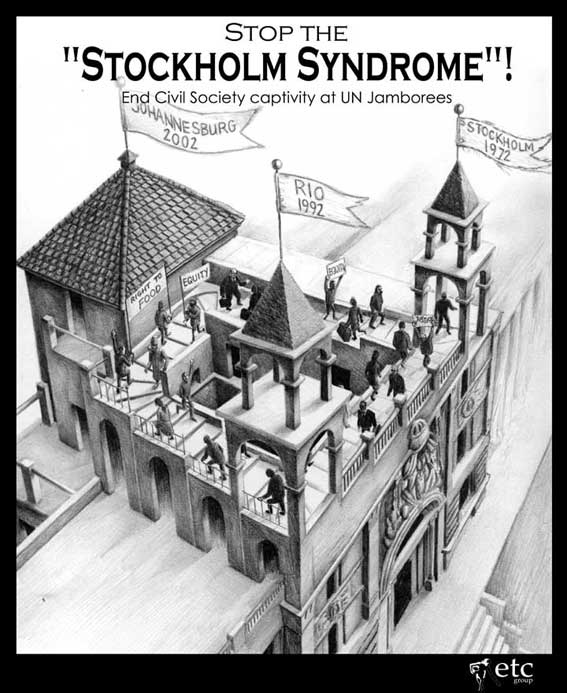
The State and Stockholm Syndrome – Part 2

Today the State is inflicting attack after attack on working people but just like sufferers of Stockholm syndrome many people keep coming back to ask it to protect them.

It is not that this is an idea with no rational content at all.  It does have a basis in reality but not one that justifies the political positions of some of the Left.

Last week on RTE news some disabled people were interviewed protesting outside the Dail at cuts to personal assistance, without which they might be forced into hospitalisation or else left to suffer appalling neglect.  Their protest was a powerful demonstration of the enormous dependence some of the most vulnerable have on the State and the capacity of that State to mistreat them appallingly.  While the media and others basked in the achievements of Irish athletes in the Paralympics in London the Irish State was preparing to shaft disabled citizens at home.  The protests succeeded in getting a U-turn on the proposed cuts and a rare but welcome victory.

This is but one example of the welfare state which is what the Left has in mind when it defends the state.  Where the right wing scream private good and public bad the left has often responded by defending public services and with declarations of the evils of the private sector.

Opposition to welfare cuts and to cuts in education and health services should not however imply any wider defence or support for the state or ‘public sector’.  The public sector is a large bureaucracy that has no democratic content, often providing poor and inefficient services.  The state training agency FAS is just one outstanding example of the corruption and wastefulness of the provision of services by the State. These are run by a capitalist state, in the interests of capitalism, by bureaucracies totally unaccountable to working people.  Why on earth should there be any inclination to defend what we are not responsible for? What we have no control over? That should rightly be criticised by us for its often bureaucratic waste of our money?

And this is the point. It is working people who pay for the welfare state, not the rich and not capital.  In a paper written some years ago the Marxist economist Anwar Shaikh sought to examine the argument that excessive welfare provision caused economic stagnation and unemployment.  In the course of this he demonstrated for six major countries (US, UK, Australia, Canada, Germany and Sweden) that this was not the case.  His central finding has relevance to our own argument, which was “that social benefit expenditures were financed out of the taxes paid by recipients of these very expenditures: in other words, by and large, social welfare expenditures were self-financed.”

The capitalist state taxes workers and then bribes them with their own money while liberals loudly declare that taxation is somehow progressive, even left-wing, and should be increased to improve welfare servicers and boost the economy.  Workers are expected to uncritically support this as if ‘the State’ is paying for something when it is actually they that are doing so.  The key question of ownership and control of the services provided by the state is ignored and the debate is framed in terms of the supposed ‘socialist’ position of ‘tax and spend’ and the right-wing position of cutting taxes and privatisation.

This framework has been used by the right to push privatisation, presenting it as the only alternative.  But it isn’t, and opposition to privatisation is not itself an alternative to the failures of health system or education systems that consistently betray those most in need of their help.  Too often the woeful character of state services has been defended in some misguided belief that defending state ownership is defending the workers delivering the services.  Such an error is rarely made when the unsatisfactory nature of services or products produced by workers in the private sector comes under similar attack.  It is against this background that the State seeks to divide private sector workers against public sector workers and portray the trade unions, often accurately enough, as primarily interested only in the latter because that is where their own bureaucratic power base resides.

While socialists must oppose privatisation as a solution to the inefficient provision of services we should never confuse this with support for or excuses for poor State delivery of services.  Too often the attacks on the working conditions of those employed to deliver these services are made prior to privatisation, or prepared prior to privatisation, by the state itself.  Nor is it true that state ownership guarantees better delivery of services.  The appalling neglect of older people in care for example has taken place under both private and state provision.

So what we have then is the provision of welfare state services which workers pay for but which are delivered often bureaucratically, with no democratic control and often in oppressive ways, such as the means-testing of welfare recipients.  Many workers delivering the services conscientiously do their best but this is despite rather than as a result of how they are organised and managed.  Simply demanding more welfare ignores all this and ignores that it is workers who pay for it.

Many are happy to pay because they care about the services provided and have in the past or will in the future benefit from them.  The provision of unemployment insurance etc. limits the devastation to living standards consequent on redundancy or sickness.  It puts a floor under the minimum wages capitalists can demand, which is why they always want it reduced; but fundamentally it is necessary because a pool of unemployed is necessary for capitalism and this pool must be of sufficient quality to take up employment when it is available.  Welfare capitalism is necessary for the capitalist system as a cost effective way of preserving the quality of labour power.  It is not fundamentally about delivering on the human needs of people.

The large growth of the capitalist state sector, from an average in the OECD (advanced capitalist countries)  of 27 per cent of gross Domestic Product in 1960 to 42 per cent in 1988 (statistics from Shaikh paper), has been the material and ideological power base of social democratic ideas that the capitalist system has been or can be reformed, if not into socialism, then at least something ‘different’ or along vague lines of ‘another world is possible’.   The limited standards of the services provided and endemic insecurity under which welfare recipients live are one testament to the limits and precariousness of this social democratic vision of reform.

Workers expected to row in behind demands to defend a large state should be aware that this sector has grown in recent years because of the state’s role in preventing a financial collapse pushing the whole capitalist system over a cliff. In Ireland, as in many other countries, workers are having to pay for it through tax increases and service cuts.  The last thing workers need is the idea that the State is something neutral that can be captured to represent its interests.  Yet this is the present perspective of much of the Left who have diagnosed the current situation as first of all a ‘crisis of working class representation’.  That is, a crisis of the social democratic illusions that once had hegemony over many workers, although to a much lesser degree in Ireland, who have suffered mainly from capitalist populism.

This dependence on the State as part of the fundamental programme of the Left is the ideological explanation for the electoralist strategy now so much a feature of the Left.  It is no accident that the need for a United Left Alliance was suddenly seen before the general election.  Having made the electoral intervention the need for unity was then considered by some as no longer so strong and the promised progress to a real party has evaporated.  We know when it will come back, if it’s not too late.

If this is at least one of the ideological origins of the chronic electoralism of the Left it must still be explained why this has happened given the parallel ideological notion that what the Left organisations want is a revolution in which the working class seizes state power.[i]

Whatever about the belief in revolution this has not been a practical proposition for many years: during the Celtic Tiger boom or the social and political defeat of workers during the previous couple of decades.  So, while often preaching revolution in the future, as a matter of pure practicality it has done what is actually possible.  Given its ideological confusion on the role of the state and having no conception of revolutionary politics outside of a contest for state power the Left has degenerated into electoralism.

The contest for state power by the working class in a long period where the working class has not been interested in such a project has become a reformist contest for state power which resolves into just getting elected to parliament.

The real Marxist attitude to the state, as opposed to dependence on the state for solutions, which I have looked at here, here and here for example, will be the subject of future posts.


[i] I realise that the Socialist Party has political roots which eschew this traditional Marxist view in favour of a perspective of a Left electoral victory, leading to majority in Parliament passing legislation nationalising big industry with the support of mass mobilisations, this allowing the introduction of what they believe to be socialism. But this has always been a relatively hidden revision of Marxism that is disguised by what is presented as a rather rigid orthodoxy.

A Case of Stockholm Syndrome* – The Left and the State

In two recent posts, here and here, I have criticised proposals of the United Left Alliance (ULA) that rely on dealing with unemployment through a state investment programme.  I have also made criticisms of tax plans of the ULA, which again rely on state action for their implementation.  The state is clearly extremely important to the left alternative proposed by the ULA.

The Socialist Party in the general election called for nationalisation of all the banks and their being run democratically under public control and management. It demanded that the state take the economy and natural resources into democratic public ownership in order to plan the development of a real manufacturing base.   It called for a government based on working class people that implements socialist policies and puts people before profit.  All eight of its proposals involved state action or the need to get the left into the state and into government.

The ‘Alternative Economic Agenda’ of the People Before Profit Alliance was constructed in a similar manner.  It has eleven separate elements and again all rely on the state taking action on behalf of the working class or ‘people’ in general.  Their demands include creation of one good state bank; creation of a State Construction Agency for infrastructural investment; expansion and reorientation of the public sector away from a corporate agenda and general reliance on the state to develop the economy.

These demands for the State to take action to defend working people must be taken at face value.  It is not possible that these demands are raised in order to expose the State and rid workers of their illusions in it because very few workers actually expect the State to take over the economy and run it for the benefit of working people.  The illusions peddled are those of the Left itself, for what is presented is the ideal objective which they aim for and which workers are called upon to endorse.  Except of course that state ownership is not socialism and the Left knows it, or rather will claim to know it.  The problem is that the means – capitalist state ownership – is supposed to lead to an end that is not capitalist state ownership.

When I say that the left knows that capitalist state ownership is not socialism I mean that it knows well the statements of  James Connolly including – “state ownership and control is not necessarily Socialism — if it were, then the Army, the Navy, the Police, the Judges, the Gaolers, the Informers, and the Hangmen, all would all be Socialist functionaries, as they are State officials — but the ownership by the State of all the land and materials for labour, combined with the co-operative control by the workers of such land and materials, would be Socialism… To the cry of the middle class reformers, ‘make this or that the property of the government,’ we reply, ‘yes, in proportion as the workers are ready to make the government their property.’ Workers’ Republic, 10 June 1899.

Engels put it similarly in ‘Anti Duhring’ published just over twenty years earlier -“… since Bismarck adopted state ownership a certain spurious socialism has made its appearance here and there even degenerating into a kind of flunkeyism which declares that all taking over by the state, even of the Bismarckian kind, is itself socialist. If, however, the taking over of the tobacco trade by the State was socialist, Napoleon and Metternich would rank among the founders of socialism. If the Belgian state, for quite ordinary political and financial reasons, constructed its own main railway lines, if Bismarck… took over the main railway lines in Prussia, simply in order to be better able to organise and use them for war, to train the railway officials as the government’s voting cattle, and especially to secure a new source of revenue independent of immediate votes – such actions were in no sense socialist measures. Otherwise the Royal Maritime Company, the Royal Porcelain Manufacturer, and even the regimental tailors in the army, would be socialist institutions.”

We only need to recall that the enormous austerity that working people are suffering is due to the state’s budget deficit and the state’s debt burden to understand what Irish workers should think of ‘their’ state.  It wasn’t the collapse of the banks that placed this debt on the backs of the workers, it was the State that placed this debt on the backs of the workers through guaranteeing all their liabilities and then effectively nationalising them.  Yet nationalisation of the banks has been a left demand for years and still is today.  Yet this nationalisation is precisely the mechanism used by the State to bail out the capitalists involved directly and the whole system indirectly.

Nor is such a purpose unusual for nationalisation.  In fact I can’t offhand think of a nationalisation that wasn’t meant to benefit capitalism and didn’t place a burden on workers.  The rhetoric about dependence of many working people on the state for jobs is no different in essence from that of the supporters of Sean Quinn who have been dependent on him in the past for employment.  Anyone on the left who argues that the State is somehow democratic and has duties to working people no longer believes that the capitalist state is above all the defender of the capitalist system.  That this is what is its defining role.  But for the Left it would appear that holding the belief that the capitalist state is both a defender of capitalism and cannot be reformed and that it can provide all the things that are demanded in Left manifestos are not two mutually exclusive ideas that cannot both be true.

I am reminded of F Scott Fitzgerald’s remark that “the test of a first-rate intelligence is the ability to hold two opposed ideas in the mind at the same time, and still retain the ability to function.”  Some in the left appear to go one better and actually sincerely believe two opposed ideas at the same time.  My view is that this is dysfunctional.

*Stockholm syndrome, or capture-bonding, is a psychological phenomenon in which hostages express empathy and have positive feelings towards their captors, sometimes to the point of defending them. (from Wikipedia)

to be continued.

Back to the Future? – the State to deliver jobs?

Before it went on holiday the government announced the stimulus package for the economy that many in opposition had demanded. An additional €2.25 billion is to be spent over the seven years to 2018 on roads, schools, a new college site in north Dublin, primary health care centres and Garda headquarters. The government claimed it will create 13,000 new jobs and is designed as a stimulus to the economy that will promote growth.  Green Party leader Eamon Ryan got it right when he said the “plan is a throw-back to the last century when the only way Irish politicians knew of stimulating the economy was to pump money into the construction industry.”

Unemployment is 309,000 or over 440,000 if you include part time, seasonal and casual workers entitled to Jobseeker’s benefits or allowances.  The stimulus will therefore not stimulate very much.  The chief Economist for the Irish Congress of Trade Unions (ICTU) nevertheless said it was “an important step in Ireland’s recovery.”  The Irish Business and Employer’s Confederation (IBEC) welcomed it in almost identical words saying it was “an important first step in helping to restore domestic demand in the Irish economy.”

The feeling of déjà vu became overpowering when the Minister announcing it, Labour’s Brendan Howlin, had to ‘explain’ why road projects were going ahead in his own constituency.  His Department was also unable to provide a journalist with any cost/benefit analyses for individual projects, which are always nice to see even when they begin ‘once upon a time’.  A commentator described one road project as “largely a vanity project” and that it “never added up even at the height of the boom.”

The money will come from what’s left of the National Pension Reserve Fund, so workers will know their future pension money is being craftily spent.  Some will come from the European Investment Bank but it’s not clear how much.  Some will come from the sale of state assets.  This is where the state buys duff things from the private sector – like banks – which cost it a lot of money and sells good stuff – like companies that make profits – which also cost it money.

No spanking new construction project would be complete without the involvement of the banks and they too will be involved, although again it isn’t known by how much, but since these are funded by the State this doesn’t really matter that much.  Finally, to complete the story, much use will be made of Public Private Partnerships, a partnership where one partner gives money to the other, for example when roads don’t have the traffic that was predicted but one partner gets paid anyway.  Again we don’t know the figures but we’re not expected to get much exercised over this because it’s all for a good cause, although it’s the usual story of being bribed by your own money.

Fianna Fail complained that many of the announcements would have no effect for six years, which might have been a good thing had it applied to their own policies.  They complained that some of the announcements were bringing back projects that the government had just cancelled, such as the Grangegorman project, which inspires confidence that planning by the capitalist state will continue to be used as a weapon to discredit socialist planning. The word planning might however be going a bit too far since Howlin said it would be nice to give the new jobs to people from the Live Register and also to apprentices who haven’t finished their training, but “I don’t want to promise  that that can be done.”   It’s wonderful how governments can promise to spend billions of workers’ pension and tax money while saying that they can’t promise that it will deliver what it’s supposed to deliver.  The sense of building new health facilities while preparing to get rid of health staff and of building new college facilities while cutting the number of lecturers seemed not to have been questioned by many.

The Irish State doesn’t have a great record when it comes to investment.  It bought 700 electronic voting machines for €55 million and they didn’t work.  It wasted money on hospital co-location, decentralisation and €100 million on the ‘Bertie Bowl’.  It commissioned a PPARS IT system for the health service with an original budget of €9 million in 1997 which ballooned to €120millin in 2004 before being pulled in 2007.  The Auditor General reported that the roads programme which was supposed to cost €5 billion ended up costing €20 billion.  The high-technology Media Lab Europe set up jointly with the Massachusetts Institute of Technology was to focus on the development of digital technology but went into liquidation within five years with consultants describing its output as “mediocre, “surprisingly weak” and “dismal”.

The United Left Alliance’s budget statement stated that “the current crisis cannot be resolved without a state led programme of investment.”  It proposes a reversal of cuts in capital spending and an emergency state programme of infrastructure investment costing €26 billion to get 150,000 back to work.  If we assume unemployment at around 310,000 this would still leave 150,000 unemployed. What happens to them?  The programme is to last “for at least five years”.  What happens after that? The economic contraction has already been going nearly five years and the slump could continue five more.

The ULA wants to employ workers’ private pension funds just like the government wants to use the pension funds of public sector workers.  The ULA wants the latter money, €5.3 billion, to fund investment in modern industry and it rejects privatisation.  Instead it wants state companies to carry out this investment.  If successful this might make some further dent in the unemployment total and at the cost of job creation estimated in its infrastructure programme this would reduce unemployment by perhaps 30,000. Of course there would be further multiplier effects but this depends on the overall performance of the economy.

It is the assumption around this performance that motivates both the proposals of the government and the ULA.  As we have seen, the bosses organisation IBEC, and also ICTU, see the problem as one of insufficiency of demand and the government’s stimulus “an important first step in helping to restore domestic demand in the Irish economy.”  The ULA say “direct government job creation through public works is necessary to promote effective demand and halt the deepening crisis.”  The government, bosses, trade unions and the left offers a similar analysis of the problem and a rather similar remedy.  Of course the trade unions and left oppose privatisation but state ownership in itself is not socialist. What we have, as in the sphere of taxation, is a difference of quantity in the measures being proposed, not a difference of quality.

What the ULA proposes, based apparently on a Keynesian analysis of the problem, is not socialist although, if successful, would have a big impact on defending workers’ living standards by reducing unemployment and defending its welfare entitlement, take home pay and public services.  Were its proposals to succeed they would go some way to providing a capitalist alternative to the policies of austerity although they would do little to prevent the regular future occurrence of capitalist crises.

Lest it be thought this judgement too harsh let’s go back to just one proposal of the ULA, that of using workers’ pension funds.  This is a proposal that the capitalist state that has saddled the working class with an unsupportable debt and denuded its state pension fund, imperilling the pensions of future workers, should also take a chunk of workers’ private pensions, and it with its sterling record of investment and economic management.  In effect it’s a capitalist expropriation of workers funds with no more than a promise from a politician for comfort, and a few Irish workers have had letters of comfort from the Irish State before.

The workers should take over management of their own pension fund?  They should promote worker owned firms to address the problem of unemployment?  Heaven forbid!  That sounds like socialism.

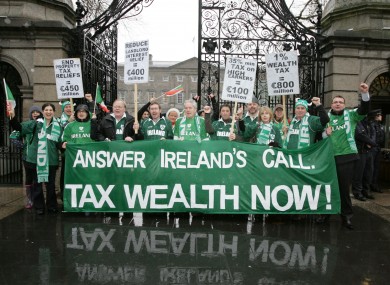
Taxing Capitalism

Turner’s ‘The Slave Ship’

A press statement by the United Left Alliance last week, just before the Dail went on its long summer holiday, reported on Richard Boyd Barrett of the ULA who  ‘challenged Taoiseach Enda Kenny during leaders questions over the “gross inequality and unfairness” in the manner in which “the pain of austerity policies has been imposed on the least well-off and most vulnerable sections of Irish society, while the wealthiest people in the country have been protected and in some cases have actually increased their incomes.   All the promises in the programme for government about “protecting the vulnerable and to burden sharing on an equitable basis” have now been fully exposed as hollow. The government have constantly claimed they have no choices, that austerity and pain for ordinary people was a tragic necessity.  Only people power, protests and strikes can challenge this obscene injustice.’

Boyd Barrett is correct to tear into the policies of the government, which favour the rich and places the burden of austerity on the rest of us.  He is absolutely right that this is not inevitable and that there are choices.  Above all he is right to demand taxation of the rich in order to press this home so that workers should not meekly accept that they suffer while the rich escape.

In my last post I criticised the ULA’s tax proposals but not for any of these reasons.  They were criticised for the idea that they could really take the wealth off the rich, that this could fund real protection against austerity, that the rich would not fight back and that the state would not help them do so.  Above all they were criticised because they were put forward as being practical, realistic and reasonable because they could be implemented by the state, when in reality all these things are determined by class struggle against the rich and the state. All the points made by Richard Boyd Barrett can be supported precisely because they are all arguments for and within the class struggle.  While I may disagree that “only people power, protests and strikes can challenge this obscene injustice” this difference is one of strategy to be adopted by workers, which is of a different character than criticism of a policy based on explicit reliance on the state.

In such strategy the excuses that the rich will evade tax would be turned against the state to demonstrate its incapacity to enforce a fair and just tax system as perceive by the majority.  The evasion by the rich would then be held up as a reason to demand expropriation of the source of their wealth and for refusing to pay for austerity in their place.

The policy of taxing the rich is not however what really stands out in the ULA taxation policy.  What stands out is the dog that does not bark, for what is most distinctive about tax policy in the Irish State is not its protection of the wealthy but its policy of minimal taxation of corporate profits.  This is such an article of faith of the political system that there appears almost universal agreement that while children, the sick, elderly and disabled should suffer from austerity the richest corporations in the world should be protected from even the most modest changes to their taxation.  The result is that the taxes paid by them have become voluntary contributions to facilitate the pretence that they are subject to rules and laws like everyone else.  Yet the ULA budget proposals simply note that the policy of taxing multinationals at an effective rate of 4 – 7 per cent has failed to develop a sustainable economy.

Some US multinationals pay even less than this.  Two years ago it was reported that Google paid only 2.4 per cent on non-US earnings that were routed through Ireland to Bermuda.  Apple is a pioneer of a tax strategy called ‘Double Irish with a Dutch Sandwich’ which routes profits through Ireland, the Netherlands and onto the Caribbean.  The deliberate lack of controlled foreign company legislation allows the Irish State to collaborate with notorious tax havens to produce such results.  Microsoft was reported in 2005 to have made a profit of over €682m on its Irish subsidiary and paid no corporation tax at all (as did Symantec between 2004 and 2005).  The company at the heart of this tax structure was based in a solicitor’s office in Dublin.  Facebook has five subsidiaries here but only two are required to publish accounts.

These tax structures and systems are not only used by big corporations but also by the world’s corrupt dictators, its non-resident multimillionaires and its international criminal organisations.  The offshore tax system, which should include the tax-dodging activities in Dublin’s International Financial Services Centre, has been described by Raymond Baker of the Washington Global Financial Integrity organisation as “the ugliest chapter in global economic affairs since slavery.”

This massive tax avoidance is central to the Irish taxation system yet it is ignored.  There are no proposals to raise the headline tax rate, not even for Irish companies many of whom pay no corporation tax either.  No proposals for controlled foreign company legislation, steps to tackle transfer pricing or suggestions to close tax breaks for holding companies.  All the ULA proposals are aimed at individuals not business or corporations. Why?  Why is there no proposal to increase taxation of multinationals?  Or proposals to tax the IFSC through which billions are routed in speculation every year, the sort closely associated with the recent global financial crash?

Perhaps the reason is revealed by the justification given by the Revenue Commissioners for continuing with a policy of encouraging corporations to set up their Headquarters in Ireland even though they recognise many pay no tax.  They justify it on the basis that these companies may increase real investment later.  It is therefore not just fiscal policy that is predicated on minimal corporate taxation but what is laughably called industrial policy, in fact the whole hope of economic growth to get out of the current slump. In essence the reliance on foreign investment is a testament to the continuing failure of native capitalism and a profound expression of its weakness.  On this weakness has rested a weak working class and on it sits a weak left, unable to present a convincing policy of taxing multinationals lest they pack up and leave and add perhaps another 100,000 or so to the ranks of the unemployed.

Would this be the result of an increase in corporate taxation?  The truthful answer is that this would probably depend on how much it increased.  Multinationals locate in Ireland for many reasons including market access to the EU, a relatively skilled and compliant workforce which speaks English and a general pro-business environment.  The left can hardly claim that increased tax will not endanger the location of these multinationals because it cannot credibly claim that it would support the continuation of a pro-business political environment which, among other things, ensures the exclusion of union organisation in most multinational plants.

Instead the ULA concentrates on income taxation and in doing so proposes measures that are radical only quantitatively but not qualitatively, in other words they are not in themselves socialist measures.  Proposals for increased taxation of the rich have to some degree gone mainstream, supported even by millionaires, conscious of the need to fund their state.  A financial transaction tax has been supported by Bill Gates and increased income tax by billionaires Warren Buffett and George Soros.  Of course the support of the rich for increased taxation goes nowhere near where the ULA would go.  It should however also not be forgotten that in Ireland as recently as the 1980s there was a marginal tax rate including PRSI of 72.5 per cent. In the US during the cold war a tax rate for income ranged up to 92 per cent and was still as high as 70 per cent in 1980.

In other words taxation does not get to the heart of the matter and the way in which it does not was explained by Karl Marx in his ‘Critique of the Gotha Programme’:

“it was in general a mistake to make a fuss about so-called distribution and put the principal stress on it.  Any distribution whatever of the means of consumption is only a consequence of the distribution of the conditions of production themselves. The latter distribution, however, is a feature of the mode of production itself. The capitalist mode of production, for example, rests on the fact that the material conditions of production are in the hands of nonworkers in the form of property in capital and land, while the masses are only owners of the personal condition of production, of labour power. If the elements of production are so distributed, then the present-day distribution of the means of consumption results automatically. If the material conditions of production are the co-operative property of the workers themselves, then there likewise results a distribution of the means of consumption different from the present one. Vulgar socialism (and from it in turn a section of the democrats) has taken over from the bourgeois economists the consideration and treatment of distribution as independent of the mode of production and hence the presentation of socialism as turning principally on distribution. After the real relation has long been made clear, why retrogress again?”

What matters fundamentally then is the mode of production.  The ULA concentrated in its budget statement on measures purely to do with distribution.  It did however raise the question of production and the way it did it will be looked at in the next post.


Taxing the Rich

In its 2011 budget statement the United Left Alliance (ULA) pointed out that while unemployment and taxation of workers had gone up, net financial assets of households had increased by €45 billion between 2008 and 2010, which meant that while many workers’ living standards were taking a hammering the wealthy in society were actually getting richer.  They therefore called “for a radical shift in taxation policy so that those with the real wealth pay according to their ability to pay.”

We all know the arguments against such a policy – higher tax rates, especially for those at the top, will discourage work, investment and business creation.  It would be tempting to dismiss such arguments except that Marxists believe that it is profits that regulate the operation and performance of the economy.  Surely reducing the returns to profitability would reduce capital accumulation and economic growth?

Research has shown however that the massive reduction in top tax rates in the English speaking world has not led to improved economic grow compared to countries without similar tax cuts.  The reduction of top tax rates, which were over 70 per cent in the 1970s, by over 40 percentage points in the US and UK has not witnessed any more impressive growth there than countries which have not reduced the rates by such enormous amounts.

This could be because high tax rates are not  the disincentive claimed, that those affected are often not capitalists, that most profits are reinvested and not subject to income tax anyway, and that profits are determined by much stronger and more fundamental forces than taxation of individuals or taxation in general.  Many people believe that those earning astronomical amounts of money simply want more of it because they are greedy, obscenely status conscious and engaged in grotesque exhibitions of conspicuous consumption.

The ULA has put forward plans to raise taxation on the rich in order to “use the money for a state funded programme of job creation.”  They state that the top 5 per cent hold 46.8 per cent of all wealth and have total net financial assets of €219.3 billion.  These figures are taken from Credit Suisse ‘Global Wealth Report’ in November 2011.  Elsewhere they quote a figure from the Central Statistics Office which estimates total net financial assets of €117 billion in 2010. If we assume non-financial assets (property) as 53 per cent of the total this would give a total wealth of €249 billion and that of the top 5 per cent at around €117 billion, over €100 billion less than they calculate from the Credit Suisse report.

It should be kept in mind that all economic statistics are estimates and subject to all sorts of errors.  One thing they are not is exactly right.  The Central Statistics Office has revised its GDP figure for last year by €2.6 billion while the Department of Finance double counted and found itself €3 billion better off.  How much more is this the case when the very rich seek to hide as much of their wealth as possible, which varies as the various markets go up and down, including the stock markets and currency markets. Looking at the Credit Suisse report I calculate the wealth of the top 5 per cent at ‘only’ €185.7 billion instead of €219.3 billion.

One more check available that I am aware of is to look at the ‘Wealth of Ireland’ report published in 2007 which recorded it at the height of the boom.  If we assume a fall in property prices of 50 per cent and its estimate of the share of the top 5 per cent at 40 per cent we arrive at a figure of almost €206 billion.  This however excludes the fall in value of shares, which dropped by 47 per cent between September 2007 and November 2010.  If we assume that equities were 40 per cent of financial assets the value of wealth becomes €188 billion.  This discussion only goes to show the uncertainty involved.  We will therefore go with the ULA budget statement number of €219.3 billion without any illusion that it is exactly right.

The ULA proposes an annual wealth tax of 5 per cent which would bring in roughly €10 billion a year (219.3 times 5%).  It also proposes that those earning over €100,000 should have their taxes increased.  These people, it says, have a total income of €20 billion and paid €4.86 billion in income tax.  This should be increased by a further €5 billion.  The ULA also sets a target of an additional €2 billion to be taken from the super-rich tax exiles.  Thus an extra €17 billion would be raised per year which, allied with refusal to pay for the bank debt, would be used to reverse cuts in social welfare, abolish the Universal Social Charge, increase tax credits for workers and reverse cuts in health and education etc.

There are five reasons why this won’t work

Firstly the sums involved.  The proposals above, where they to come in on plan, would raise €17 billion yet the budget deficit in 2010 excluding the bank bailout costs was €17.4 billion.  There would therefore be no room for closing this deficit while also funding the state-led investment programme of over €5 billion per year, which the ULA statement said was to be partly funded by tax increases. This also ignores reversing the €12 billion of cuts etc. which took place before and during 2010 in order to arrive at a deficit of ‘only’ €17.4 billion at its end.

The second is the nature of the wealth. Roughly half the wealth is in financial assets and half in property.  The financial assets will be in cash and bits of paper like shares which can be sold for cash.  To turn this wealth into money that can be used to pay workers to provide services, reverse workers’ tax increases and procure services it will be necessary to sell these bits of paper after the wealth held as cash is exhausted.  The value of these bits of paper, such as shares, may very well fall if a lot are sold at one time or it is known that they cannot be held and sold at what might be considered by their owners as the most favourable time.  The value they are held and valued at may therefore be greater than what could be got in a sale.  Everyone is familiar with this because of NAMA and the property collapse.  How much more of a problem is this for that half of assets which is property?

And there is an additional issue.  Who would the State sell these assets to?  Workers, self-employed, farmers and small businesses are in no position to buy these assets.  In fact only Irish and foreign rich would be in a position to buy.  But when we consider this for a moment, how would the Irish rich afford to buy these assets when these assets are being taken off them in the first place?  This leaves only foreign capitalists.  Putting it like this, selling off Irish assets to foreign capitalists to finance State expenditure doesn’t look too much different from what the Governing parties want to do.  Perhaps it is proposed that they too are taxed on Irish assets, in line with the policy on taxation of Irish assets held by tax exiles, but this then only puts them in the same position as the Irish rich.  Why buy assets that are going to be taken off you in tax?

Making the most simple assumption that a wealth tax would remove an equal amount of the wealth each year, with a wealth tax of 5 per cent the total wealth of the rich would be cut in half in ten years.  Ten years later it would be gone.  Even with wealth growing at say 2.5 per cent a year, and a wealth tax that took 5 per cent of what was left from the previous year, the wealth of the rich would still be halved in less than 23 years.

In other words this is not sustainable and anything not sustainable collapses long before the final step is taken.  An unsustainable tax base based on property is replaced by an unsustainable tax base constructed on wealth taxation.  The ULA proposes that those earning over €100,000 pay an additional €5 billion in taxes above the €4.86 they are currently paying, on a total income of €20billion, doubling their taxes and moving to an effective tax rate of half of income.  The ULA give the example of the top 0.5 per cent who have a current average after tax income of €400,000 each, which after the implementation of the ULA proposals would reduce to €166,000 each.  This is a reduction of 58.5 per cent in income.  This won’t work because of reason four.

The ‘Sunday Independent’ rich list published in March this year records that the richest man in Ireland is Pallonji Mistry, an Indian tycoon with Irish citizenship, worth €7.4 billion. How long does anyone think he would hang around if he thought the Irish State was going to take half his wealth off him within ten years and reduce his income by nearly 60 per cent?  How many others of his fellow rich would do exactly the same as him?

The ULA have said they have plans to get €2 billion extra out of Irish tax exiles and propose various measures to get this €2 billion.  Unfortunately they have said that “it is impossible to predict the revenue which would be generated by the above measures” which is tacit acknowledgement that they have little confidence that these measures could be effective.  They refer to the US and its expectations that its citizens will pay US income tax on earnings abroad but the Irish state is not the US state.  It says that its demands are reasonable but whether workers believe them to be or not, the rich do not and become tax exiles to avoid tax.  They will not be swayed by ‘reasonable’ demands that they pay up and the ULA knows this.

The ULA has said that even if such people move liquid assets out of the country, as will non-exile tax payers, the tax can be taken from the value of their fixed assets in Ireland.  But this leads us to the problems involved in reason two above.  The idea that the wealth of the rich can be taken by taxation is fine only if one believes that they will not resist with every weapon in their armoury.  The budget statement mentions that there is an investment strike by private investors as if it were some wilful act and not a perfectly rational response to the recession.  Yet serious attempts at taxation of the rich really would produce wilful acts and private investors would use their ownership of assets to reverse investment and sabotage the economy.

Marxists have always been aware that in the class struggle the capitalist class have usually demonstrated much higher levels of class consciousness than workers and their superior organisation will see them able to avoid a great deal of taxation, especially when it becomes worth it.  Their success in this is guaranteed by reason five.

The ULA have stated that “it is a matter for government which has Department of Finance, Revenue Commissioners, Central Statistics Office etc at its disposal to devise legislation to reach the target revenue of 10 billion from the top 5 % and that, in particular that the homes, farms and pension funds of those outside the top 5% be exempt.”  But this is the State that has given rich tax fraudsters two tax amnesties on top of all the various tax incentives and loopholes!

As a Marxist I believe that the state is an instrument to defend and protect the capitalist class, that it is therefore a capitalist state.  I believe that the bail out of the banks even at the cost of bankrupting the state itself is testament to how far it will go to do this.  The recent history of attacks on the working class in order to spare the rich are further examples and are the result not of a policy whim that can be changed but a result of the structure of the state, economy and society.  The proposals of the ULA rely on all this being mistaken.

I remember listening to Today FM and an American writer on financial affairs, whose name I did not hear, being interviewed about the situation in Ireland.  He remarked that Ireland was no more corrupt than many other countries but that what really set it apart was that no one ever seemed to get punished for all the corruption.  Yet the tax plans, and others, of the ULA depend not only on the Irish State not defending the rich but instead actually defending the working class.

The taxation proposals of the ULA are clearly presented as eminently reasonable and practical.  However what is reasonable is decided by class struggle and class struggle means they are not practical.

Default on the debt – part 3

How would a policy of default be implemented?  There might appear to be two ways for this to be achieved.  The left could demand it as part of a manifesto to win a majority in the Dail whereupon this majority would implement the policy.  This is however neither immediately realistic, practical nor will the Irish State allow workers to use the machinery of the State to challenge the capitalist system, which is what a left default would represent.

The second is that we think pressure can be put on the existing State to repudiate at least part of the debt and lessen the demands for austerity.  The Irish State already wishes to get concessions from the EU and ECB but on a very limited scale and with all the strength of a beggar asking for change.  However no amount of pressure will get the Irish State to break with the EU, IMF or the US.  If any significant concessions are ever offered it will only be in response to either recognition that the interests of European capitalism as a whole, or the Euro project, is threatened (which is why we now have the latest deal)or if a socialist movement threatens to do more than repudiate the debt. We are nowhere near the latter situation and it is not the current perspective of the left, which is the subject of these posts.

From a Marxist perspective repudiation should not be sought in order that the existing capitalist economy should grow, although that is a better capitalist alternative for workers than the existing policy – if it could work.  It should be part of a strategy of assisting the creation of a working class alternative that will ultimately overthrow this economic system and the state that defends it.  We should not seek salvation from a Keynesian alternative that seeks to grow the capitalist economy because Keynesianism seeks only to postpone austerity and to effect wage reductions through inflation.

The role and place of the demand for repudiation must therefore be dependent on the stage of development of the creation of this workers alternative.  We are neither at a point where the majority of the population actively seeks repudiation of the debt or even believes it a necessity and nor are we at a stage where a large movement is building up support for such a demand.  Most importantly we are not at the point where the working class in in a position to reject the necessary laws of capitalism and present itself to society with a new alternative.  By alternative I mean not absence of debt through repudiation but an alternative to the capitalist system, of which debt is a symptom.  And by ‘present itself’ I mean not promises that things will be better under socialism, but be in a position to show actual examples of workers power in the economy and society. The demand to repudiate the debt is therefore currently limited to an educational role, a propaganda role.

This does not mean that it is unimportant. The argument on debt is important in supporting opposition to austerity, which is the only way at present that workers can actually counter the effects of the debt and in effect seek their own means of repudiating it.  It plays a role in persuading workers that ending austerity is not only desirable but possible.  The wider and deeper the opposition to austerity the more convincing this argument will have to be.  The wider and more successful opposition becomes the more other elements of the programme become important, but we will take these up one by one as we proceed.

In relation to debt repudiation socialists are regularly challenged on the effects their proposals would have on the workings of the capitalist economy.  It has already been claimed that repudiation of the debt would lead to a flight of capital and virtual collapse of the banking and credit system and that, absent outside help from those just told to take their losses, it would lead to severe economic dislocation.  The crisis would intensify across Europe and beyond and lengthen and deepen the recession.  The reputation of the Irish State as a haven for multinational business and as a site for financial speculation would be in tatters.  The loss of capitalist confidence on its own would increase unemployment.  This of course does not affect in the least the purpose of our demand for debt repudiation, which is to win workers away from acceptance of payment for the crisis and for the debts of the State.  As we have seen above, we do not actually currently control any mechanism to repudiate the debt.

Nevertheless the arguments against repudiation of the debt and the effects such repudiation would cause are not false, they are not a lie, or a simple blackmail because in large measure they are true.  Repudiation of debt by a Russian or Argentinian government determined to get back into the markets by assaulting working class living standards do not provide the model for a working class default beyond countering arguments that it is in itself simply impossible.  While for socialists they do not outweigh the necessity to persuade workers to take no responsibility for the crisis they do expose the need not just for a socialist opposition but for a socialist alternative.

For Marxists, as we have said, the achievement of socialism is based not on sound and logical argument but on necessity.  If the socialist alternative is not practical then it will not succeed and will certainly not win the working class to take it up as its own programme.  This is the underlying reason we pointed to for the defeat in the referendum – that we are as yet far from having a real alternative – practical ,immediate, in place right now, contesting for hegemony because it is widely if not yet universally recognised as a real, potential, living alternative.

Sine this alternative is the working class taking ownership and control of the economy, the state and society as a whole we have to answer a very simple question today, right now: is the working class poised to take ownership and control of the economy to counter the sabotage of the capitalist class as we repudiate the debts to its big cousins in the European Banks?

That is the working class as it presently exists in reality; not an idealised one that resides in books or in abstract slogans, but the working people in your street, your neighbourhood and your workplace?  Have they been readying themselves to take over the running of the economy and the state; have they already taken over, or are in control of some workplaces?  Are they perfecting their organisation?  Have they been debating the necessity to do so, the requirements of doing so, the burning necessity to do so – to carry out a veritable revolution?  If not then we currently have no answer, or no practical answer, to the capitalist charge that what we propose, if implemented right now, would simply cause chaos.

That we, the working class, are not yet ready to take over society is obvious because we can see this every day if we live within working class communities and work alongside other workers.

A fatal answer to this current weakness is to seek salvation through a non-working class solution which at first glance might look more ‘practical’ or ‘realistic’: calling on the State to do what can only be done by workers.  Calling for nationalisation when what we stand for is ownership and control by the workers, not the capitalist state.

Instead of such ‘short cuts’ to a different destination Marxists recognise that we need to put forward a comprehensive programme that addresses the needs and interests of the working class and that repudiation of the debt, which is not even a specifically socialist measure, is only one element of this.  It is necessary to place any specific demand within an overall programme that represents a real alternative.  This does not mean that we need always to proclaim a veritable shopping list of demands or that specific and often very limited struggles and demands are not where we really are at.  It is to understand and be able to explain how any particular struggle fits within a global alternative.  As we have said, this alternative must assume a living corporeal reality to count as a real alternative and not simply a logically coherent programme.  The beginning of a living alternative based on a coherent programme is defending the working class by supporting its resistance to austerity and renouncing its responsibility for the causes of the austerity.  Only on such resistance can an alternative be built.

In addressing the austerity inflicted to pay off the State’s debt the left has recognised the necessity for a wider alternative by calling for the continuing budget deficit to be made whole by progressive taxation of the rich.  In our next post we will look at this part of the left alternative.

One more issue merits being addressed in the context of the Marxist approach to the state’s debt.  This is the call for an audit of the debt.  The burden of the bank debt was placed on the workers’ shoulders in order to pay bondholders, but who are or were these bondholders?  Who got paid in full or is awaiting payment that is a hedge fund used by the fabulously wealthy who bought the bonds at a huge discount or who already had insurance for default?  Who is the recipient of this huge transfer of wealth from working people? This is an elementary demand and is not an alternative to repudiation.

For example, what if we found that it was a workers pension fund that held the debt?  Then we could say to them – let’s talk about what effect it would have on your pensions of us not paying this debt.  What arrangements could we come to which would recognise the legitimate claims of both sides?  What if this pension fund was privately managed and subject to the normal charges by its managers which excluded the control of its members or even knowledge of what mangers were doing? Then we might say – ok, we recognise that we should not deprive you of your pensions but we have no obligation to fund the huge charges that allow the financial services industry to pay its managers and bosses salaries and bonuses that are counted in the millions.  We will take ownership of our debt if you, the workers of this pension fund, take ownership of this fund and do not use it to speculate against the living standards of other workers.

Such a debt audit is thus not a call for justification of the debt but becomes a call to action – a workers’ enquiry to determine its ownership and its beneficiaries now and in the past.  A call to action to repudiate what is not legitimate in our eyes and accept what we believe is legitimate by demanding the actions that make it so.

The argument will come back that this debt is subject to rules of confidentiality that are imposed by market exchanges in foreign countries.  Ok then, the debt we still owe should not be paid until we know who we are paying, that it is the appropriate amount and does not involve an unfair redistribution of wealth from workers to international spivs.  If the bondholders have already been repaid we still want to know who walked off with our money since we are still paying for it and we weren’t asked for permission in the first place.

The demand for an audit is a demand for the books to be opened on international finance and is the first step to taking it over.  The very first step in this would be bank workers doing a ‘Wikileaks’ and releasing all the emails and documents relating to the debt guarantee and repayment.  What an education that would be, especially the howls of condemnation from the powers that be – despite this being our money that is being paid over, our banks that we are supposed to own and our Government and State which are supposed to be defending our interests.

The demand for an audit is entirely legitimate; it is the first step to control and to demonstrating the legitimacy of repudiation.