The politics of conspiracy – the case of Denis Donaldson

donaldsonI remember a number of years ago I was handing out leaflets at a Sinn Fein meeting in Conway Mill on the Falls Road in Belfast.  It was about the relatively new peace process and it would be fair to say that the leaflet was not celebratory of the new initiative.  I was outside the room, although inside the Mill complex, but since the Provos came to regard the whole of West Belfast as theirs it came as no great surprise that one of their number decided I was trespassing on their territory.  As the years have gone by, and if rumours are to be believed, this is less and less their territory and more and more their property.

I was collared (not very roughly) by a then prominent Sinn Fein councillor and pulled (not very strongly) over to another prominent Sinn Fein member, Denis Donaldson.  The councillor wanted to know from Donaldson was it not alright that I should be handing out leaflets critical of Sinn Fein but should be told to get lost.  Denis Donaldson was no more interested in me giving out leaflets than the man on the moon and couldn’t even give a full shrug of the shoulders in apparent indifference; he couldn’t either be bothered to grunt any disapproval or otherwise.

The councillor was a bit exposed so he mouthed some vague displeasure to no particular point and I meandered back to outside the door to give out the rest of the leaflets.  As a comrade of mine put it, the Provos were more tolerant of other opinions when they were less ‘political’, when they confined themselves overwhelmingly to shooting and bombing, than they were to become during the peace process.

The point of this reminiscence is that Denis Donaldson was obviously the go-to guy at the meeting who determined what (or who) was allowed, in other words from ‘the army’.  Denis Donaldson was later revealed as a long term agent of MI5 and is now dead.  He was shot after being exposed as a spy in a remote and ramshackle cottage in Donegal. The rather pathetic circumstances of his death were fitting to someone who, unlike other agents, appeared too demoralised even to run in an attempt to save himself.

Now he has become a headline again because an ex-British soldier has alleged he was shot by the Provisional IRA and not by a ‘dissident’ IRA, which had claimed responsibility.  The headlines have been made because the ex-soldier has now written a book about his activities in the north of Ireland and accuses Sinn Fein leader Gerry Adams of having sanctioned the killing.  Adams, through his lawyer, has denied it.

One of Donaldson’s notable activities was his involvement along with two other men in an alleged Sinn Fein spy ring at Stormont.  He was subsequently charged only for prosecutors to drop the charges “in the public interest.”  In such cases “the public interest” is anything but the public interest and is invariably in the state’s interest.

In the south of Ireland an inquest into his death has been delayed 20 times at the request of the Garda Síochána due to concern that a detailed journal found in Donaldson’s cottage contains information about the organisation of the republican movement and about his activity as informer and the activity of the state forces.  It’s doubtful either Sinn Fein or the British State want the contents revealed.

So we have an ex-soldier selling a book making one claim and Adams making the opposite claim.  The ex-soldier also claims that he was previously going to seek to join the IRA before then joining the British Army.  He regards himself as a republican and supports Sinn Fein today, indeed he claims he did so even when serving for the British Army in Ireland!  One can hardly think of anything more bizarre! Indeed it’s hard to think of anything less credible, except for Gerry Adams’ claim that he was never in the IRA.  So on purely a priori grounds of credibility the ex-Brit appears to come out on top.  Does it matter?

In so far as it impinges on Adams it simply reminds one of his lack of principle, unwilling and incapable of defending what was the primary dogma of republicanism – driving the British out of Ireland by armed force. After this was surrendered nothing remained sacred.  Following this betrayal there has no repentance of Gerry who has denied his movement more than three times.  Any further promises – to oppose austerity etc – are open to charges of relying on the same level of credulity necessary to accept his claims to non-membership of the IRA.

In so far as the headlines recall the murky intrigue of the ‘dirty war’ it reminds everyone who lived through it of just how dirty it was.  It was well enough known that loyalist murder survived upon the tolerance and sponsorship of the British state.  What has become clearer since the ‘end’ of the various armed ‘campaigns’ is the degree of this sponsorship.  But even more revelatory has been evidence of British penetration of the republican movement and the betrayal of genuine republican activists by agents of the British State inside the movement.

What all this history has demonstrated is that the conspiracy of the state cannot be overcome by any revolutionary conspiracy.  Irish republicanism is pathologically disposed to such conspiracy and has failed again and again.

As I near the end of reading a recent biography called ‘Karl Marx – a Nineteenth Century Life’, one consistent feature of Marx’s political activity recorded in the book was his opposition to conspiracy as the means of working class organisation.  The political activity that won Marx to socialism and which he in turn fought for again and again was the open organisation of the mass of workers, in struggle for their own objectives based on their own class interests.  It was Marx’s view that these interests are ultimately revolutionary and either the workers became conscious of them, became revolutionary, or they “were nothing.”  Freedom cannot be made behind the backs of workers.  A class cannot come to control society without being aware of its control.

A movement that perennially fails to recognise such basic truths signifies one of two things.  It is incapable of learning or its goals are essentially not about the freedom of the working class.  In both cases conspiracy becomes a favoured means of organisation since, like Gresham’s law, bad organisation drives out good.

Add to this a militaristic outlook and all the horrors of the dirty war are almost inevitable.  It is however not inevitable that sincere working class people end up in such demoralised circumstances that death is almost invited.

The Norn Iron Elections – a few rays shine a light on the darkness

PbP imageIt may seem odd at first but the second most significant outcome of the Stormont Assembly election is the turnout, which fell from 55.71 per cent in 2011 to 54.91 per cent in 2016.  And even if the number of votes cast actually increased by nearly 30,000 it’s hard to overlook the fact that nearly half the population don’t bother to vote.  But this disenchantment with the political outcome of a world-renowned  peace process is a faithful reflection of the utter and complete inability of many to identify anything in the current political arrangements that they want to support.

Of course history has been rewritten, even as it was being made, to explain that this political agreement brought an end to political violence, and is still necessary for this to continue, but many (without thinking) are not buying the lie in practice.  While some will never vote, a greater proportion are disillusioned or have never bought into the sectarianism that saturates Northern Ireland politics.  The Stormont Assembly, its Trumpton Government and its third-rate politicians have been so utterly useless in even the most mundane of political terms that their unchallenged corruption is the stand-out feature of the regime.  Or it would be if the sectarianism that is the foundation of the regime and overlays every aspect of it were not primary, sometimes missed only because it is so taken for granted.

The turnout went down by under 1 per cent but this masks a fall in the combined DUP and Unionist Party share of the vote of 1.5 per cent and a fall in the nationalist vote of over 5 per cent; with the SDLP vote-share falling by 2.2 per cent and that of Sinn Fein by even more – 2.9 per cent.  The combined nationalist vote is now back to where it was in the early 1990s.  A majority for a United Ireland is not only a long way off but it’s getting further away.

Even the not very bright political commentators who had previously put this decline down to nationalist contentment with the new political arrangements are now forced to recognise that nationalist abstention is a result of precisely the opposite, and is a protest against the rotten Stormont regime.  Nationalists know they can not look to a united Ireland but the tolerable Northern Ireland is barely tolerable.

It is therefore the continuation of the sectarian regime which is the most significant outcome, despite its abysmal track record.  The largest unionist party, the DUP, has been validated in its nakedly tribal campaign to prevent election of a Sinn Fein First Minister, even when this was never a realistic possibility.  The sectarian card is played no matter what the game.

We now have another five years of sectarian dog-fighting, periodically interrupting a shared implementation of reactionary austerity policies.  It matters not that barely half the population took part in the election never mind the smaller number who voted for the two parties leading this austerity – the DUP and Sinn Fein.  This marriage made in hell is sold every five years based on one party claiming the greatest threat to hearth and home comes from the spouse.  The spouse continues to sell it as a progressive example to the world.

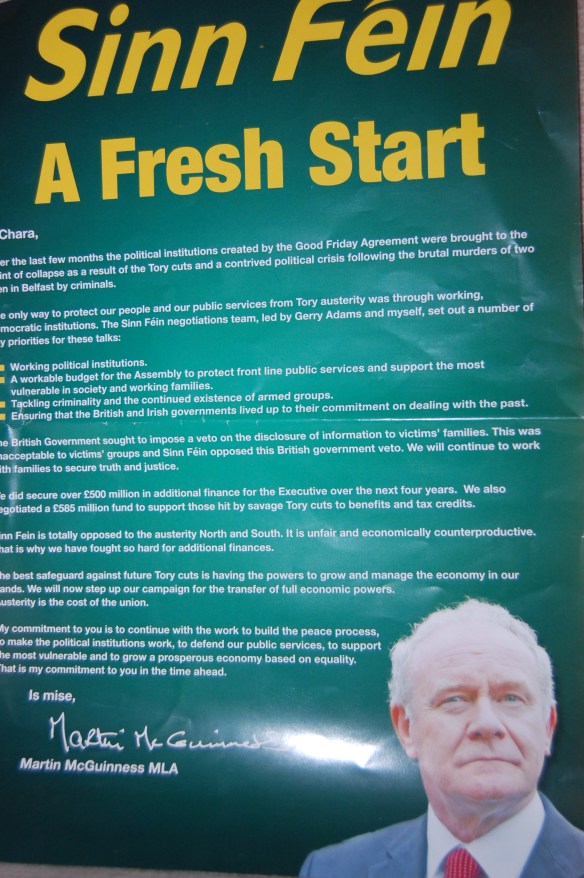
The sectarian gloom is never lifted.  There appears no alternative.  The trade unions first oppose the austerity policies but then welcome and support the political agreement, the ‘Fresh Start’, that saved the regime that now implements the austerity, the austerity that is codified in the political agreement now supported.  The other political parties oppose the big two Parties that dominate but are also in ‘Government’ and also support all the big two’s policies in all essentials and in almost every detail.

Opposition exists in the same way it exists inside the Stormont Assembly – it is assumed not to exist and no provision was made for it to exist.   Sectarian division means that all conflict must be contained lest in go down this cleavage so no real opposition to the sectarian agreement can be conceived.  The setbacks, conflicts and struggles are thus all internal to the arrangements which can brook no alternative.  We have an arrangement that seems rigid but at the expense of little flexibility.  Opposition within it is thus no threat as long as the political framework is accepted by that opposition at which point no real opposition can exist.

In other words a real opposition would oppose the very foundations of the Stormont regime.  It would however be the wildest dreams to believe that right now such an opposition can set itself the immediate task of bringing it down – any putative opposition is too weak and there is currently no alternative.

This however brings us to the third, but most dramatic, outcome of the election.  And that is the election of two self-declared revolutionary socialists from the People before Profit (PbP) organisation.

In the heart of Sinn Fein – West Belfast – the PbP candidate Gerry Carroll topped the poll with 8,229 votes, a stinging rejection of Sinn Fein by many and a rejection all the more cutting for not being unexpected.  The cronyism of the organisation has disgusted many and its disregard for its base illustrated by its support for building a new GAA ground with safety concerns in the heart of the constituency.  This will have particularly resonated in the last few weeks given media coverage of the victorious campaign by the relatives of those who died in the Hillsborough disaster.  This rejection has grown following complete capitulation to Tory welfare changes which Sinn Fein swore to oppose but eventually facilitated the implementation of.

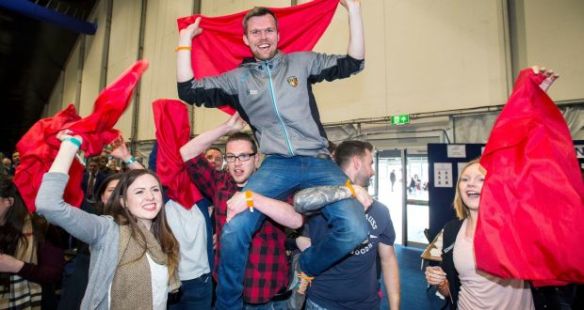
While Gerry Carroll is pictured carried aloft by supporters all waving the red flag the other victorious left candidate, Eamonn McCann from Derry, was to be heard on BBC Radio Ulster singing the Internationale.  Eamonn explained that he was surprised by how many during his canvassing expressed their opposition to being labelled ‘Orange’ or ‘Green’, as is required by the Stormont rules, but said they were ‘Other’, the only alternative designation allowed.  How fitting a sectarian designation’s only alternative is ‘Other’ rather than ‘Anti-Sectarian’ or even ‘Non-Sectarian’.

PbP success represents a dramatic rejection of Sinn Fein but if it is to represent something more it must not just declare an alternative but create one.  Two successful candidates allows PbP to present itself as more than a protest but how much more will depend on how it thinks its revolutionary socialism can be applied outside the Assembly.  As we have seen, what happens inside it is not taken seriously even by those who support it, especially by the DUP and Sinn Fein who carve up the jobs and the decisions between them.

A light can now be shone on the darkness through the election of two socialists but to begin to dispel the darkness will require an alternative labour movement that can offer practical alternatives to sectarian division.  What role will PbP play in that task?


The 2016 election – a victory for social democracy?

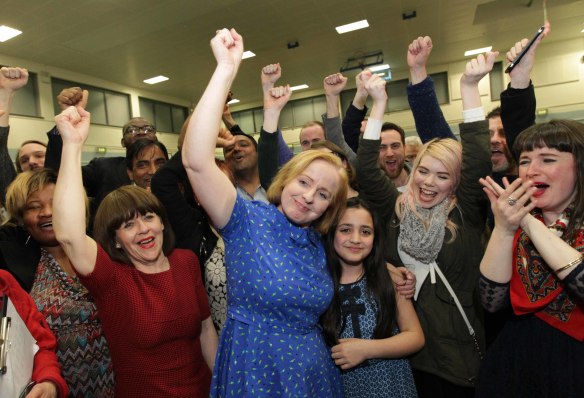
27/2/2016. General Election 2016 - Counting of Votes. Scenes from the counting of votes for the Dublin West Constituency, at the Phibblestown Communmity Hall Count Centre in Blanchardstown, Dublin. Photo shows Anti Austerity Alliance candidate Ruth Coppinger after winning a seat in her constituency. Photo:RollingNews.ie

27/2/2016. General Election 2016 – Counting of Votes. Scenes from the counting of votes for the Dublin West Constituency, at the Phibblestown Communmity Hall Count Centre in Blanchardstown, Dublin. Photo shows Anti Austerity Alliance candidate Ruth Coppinger after winning a seat in her constituency. Photo:RollingNews.ie

The 2016 general election has been hailed as delivering a ‘sensational’ result, although this is disputed, and has led to some difficulty in forming a new Government.  Apparently only one party, Fine Gael, wants to be part of one, partly as a result of the horrendous results for the governing parties in the last two contests.

In this election the two Governing parties, holding a record majority, lost heavily: the Fine Gael vote fell from 36.1% to 25.5%, while the Labour Party was decimated, losing more than three quarter of its seats, its vote falling from 19.5% to 6.6%.  The biggest apparent gainers were Fianna Fail mainly because of a striking reversal of fortune, increasing its vote from 17.5% in 2011 to over 24.3%, and Sinn Fein, which increased its vote from 9.9% to over 13.8%.  This performance however will be seen as disappointing, coming nowhere near the 20% it recorded in polls beforehand.

The governing parties stood in the election on the basis that their painful austerity medicine had worked and that there was now a remarkable recovery, the fruits of which would allow tax cuts and improvement in public services.  And the truth is that there has indeed been a recovery; new austerity measures have generally ceased and for some people incomes are rising, either through getting a job or pay increases.

Unfortunately for the Governing parties their arrogant declarations of success rankled with a population fully appreciative of the slenderness of the improvement, which for some has been non-existent, while the more they declared the scale of the success the more it appeared to contrast with the experience of the majority.  The Government claimed credit for the improvement but it was a long time coming and the Irish people are aware enough of the vulnerability of their economic circumstances not to be inclined to credit the Government with creating it or of letting the possibility of a new recession escape their minds.

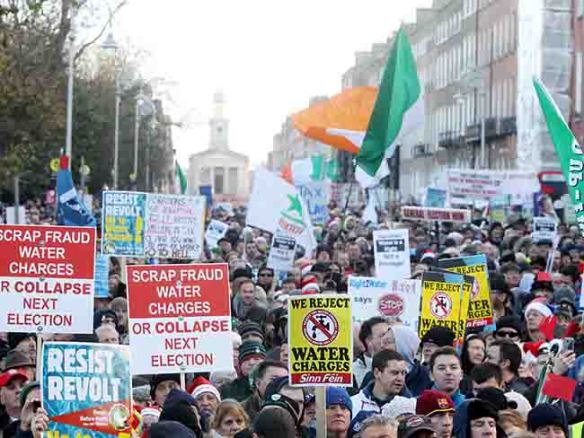
Above all, the accumulated austerity measures inflicted by the Government have not at all been reversed, the huge cuts and tax increases of the last seven or more years are still being felt, the price is still being paid, and smug and arrogant claims of achievement angered a population weary of austerity and aware of too recent and continuing attacks, including water charges.

Fine Gael won the previous election on the back of the then Government’s perceived responsibility for a disastrous economic collapse, a promise that its policy would be different and that the existing ‘no bondholder left behind’ approach would be challenged.  Labour campaigned on the grounds that there was a choice between Labour’s way and Frankfurt’s way.  Of course these promises were hollow and no coherent policy alternative was put forward, a more politically aware population would have understood this, but the immediate task was to punish the egregious Fianna Fail and a Fine Gael/Labour coalition has been its historic alternative. What this meant, as one commentator has put it, was that in that election they took the least radical option for change, just as they have almost done so again, while in between they voted to accept austerity in the 2012 EU referendum.

So the 2016 election has been hailed as a vote against austerity and an Irish reflection of the forces that have produced Syriza in Greece, Podemos in Spain, Jeremy Corbyn in Britain and Bernie Sanders in the US.

But the vote in 2011 was also in part a vote against austerity, although driven mainly by the desire for revenge through a massive vote against Fianna Fail, which rocked that traditional hegemonic party of the Irish State and led many to wonder whether it was finished.  It has now had something of a comeback in yet another anti-austerity election.  In the 2011 election the Labour Party did extremely well on an anti-austerity ticket, at one point believing it might end up the largest party.  So what exactly is the nature of a ‘new’ anti-austerity vote that sees the bounce-back of Fianna Fail and the continued development of Fianna Fail nua in the shape of Sinn Fein?

The general election has been characterised by some as a demand for social democracy, an anti-austerity alternative, that was reflected in Fianna Fail’s emphasis on the fruits of the recovery being spent on public services and not on tax cuts that disproportionately benefit the rich.  The claimed new consciousness is also supposed to be reflected in the increased vote for Sinn Fein, which emphasised that it was in favour of a ‘fair’ recovery in which the better off paid most, and in the showing of new formations such as the Social Democrats, which did moderately well arguing that US tax levels were not compatible with a European standard of public services.

There is therefore a case to be made that the election was a vote against austerity, a vote for some sort of social democracy and even a move towards a more conventional right/left political division, now that the more or less identical Fine Gael and Fianna Fail parties together have declined to just under half the vote.  There is also an obvious case to be made that this is a reflection in Ireland of a wider international phenomenon.  But it is more an Irish reflection of this phenomenon rather than a reflection of the phenomenon in Ireland.

So we have an initial clear problem that the recovery in the vote for Fianna Fail is evidence of the move towards social democracy while its savaging in 2011 was also such an example.   We have a move to a left/right divide while the historically largest civil war party made a strong recovery.

This does not invalidate the argument but simply demonstrates its limitations and the weakness of the shift.  But that a shift is taking place is nevertheless still the case.  The long term decline of the civil war parties continues, as recently as 1997 they received 78% of the vote and in 2011 73%.  The 2016 vote was a vote against austerity, but not yet a vote for an alternative, at least not a real alternative because neither Fianna Fail nor Sinn Fein are a real alternative and neither are the majority of right wing independents coming, as they say, from the Fianna Fail or Fine Gael gene pool.

The social democratic tone of the likes of Fianna Fail reflects more an improved economy and not any more basic shift in economic policy.  Fianna Fail is still widely blamed for sharing a large degree of responsibility for the economic crisis while Sinn Fein voted to bail out the bankers and bondholders.  Fianna Fail has a long history of populist rhetoric and actions, which may be called social democratic in a broad sense, but which has been successfully employed to prevent the development of a left/right divide in Irish politics.  Without such a divide we have simply had a right/right division.

The case for a growing right/left split rests partly on the policy proposals of Fianna Fail and Sinn Fein, and their success, and partly on the pressure on Fine Gael and Fianna Fail to collaborate in order to allow creation of a new Government.  There are no credible alternatives as the forces of ‘the left’ are too disparate and divided.  Some informed commentary is that Fianna Fail will not allow such an alliance to happen partly to frustrate the development of such a divide, which would threaten its traditional role and base inside the working class.

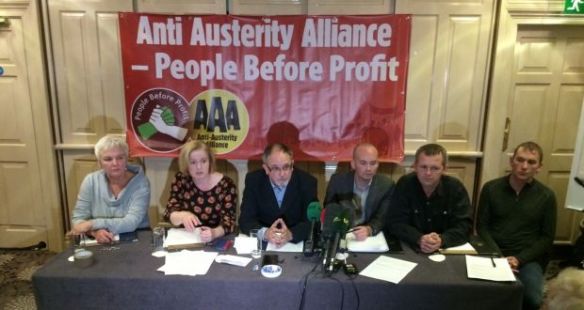
The argument for the development of a left/right demarcation however mainly rests on the rise of Sinn Fein, understood broadly as a ‘left’ party, and the fortunes of the Social Democrats and some left independents.  It also rests on the progress of the genuine left, most visibly in the shape of the Anti Austerity Alliance/People before Profit (AAA/PbP) alliance, the creation of the Socialist Party and Socialist Workers Party.

But Sinn Fein is not, it must be repeated again and again, a genuine left party.  Have a look at austerity in the North if you find this hard to accept. Only by the most expansive definition can it be considered left wing, which might be useful as some sort of catch-all description in some circumstances but is misleading when it comes to any analysis.

Having a predominantly working class support does not make a working class party; Fianna Fail has had the largest support of any party within the working class for many decades until relatively recently.  A working class party is one that not only is supported by the working class or part of it, but is composed of workers, is organised from within its ranks and in some way represents its separate interests to a greater or lesser degree.

So what constitutes ‘the left’ and how has it performed in this election?  One commentator has argued that, if we include one third of the large number of independents elected, the left has hardly increased, amounting to about a third now compared to 35% in the outgoing Dail, although the composition of this left may be said to be more ‘left wing’.  A second analysis defines Labour, Sinn Fein and United Left Alliance as the left in 2011, together receiving 31.5%, while Labour, Sinn Fein, AAA/PbP and Social Democrats are defined as left for the purposes of the 2016 election, receiving 27%.  Another perspective groups the AAA/PbP and explicitly left independents together to arrive at a total of 141,890 votes, not very different from the Labour Party’s 140,898 – which is supposed to have had disastrous election.  A narrower definition could take the TDs from the United left Alliance that went into the 2011 election and compare their performance in 2016 (while including the gains of the AAA/PbP) and arrive at a total of over 5%.

None of these show any dramatically increased vote for the left, however defined, and are certainly more convincing than some comments from the AAA/PbP, who have not unnaturally looked firstly at their own results.  Richard Boyd Barrett has been quoted as stating that “we went from being newly formed to almost 4 per cent.”

However one delineates the left it is clear that the only consistent social democratic alternative offered has come from the AAA/PbP and the candidates who used to belong to the United Left Alliance and perhaps a handful of others.

There has therefore been no qualitative radicalisation but instead a longer irregular evolution of rejection of the traditional right wing parties but without an embrace of any consistently thought out alternative.  This is therefore expressed in illusions in parties which peddle familiar solutions that may appear to a greater or lesser degree to be social democratic.  When we see these include the Labour Party, Sinn Fein and even Fianna Fail what we don’t see is any sort of consistent social democracy.

to part 2

Voting in the 2016 election

aaapbp imageAs we head into the last ten days of the general election campaign the failure of Fine Gael’s strategy of ‘stability or chaos’ tells us not only that a majority would like to see a new Government, something explicitly polled and confirmed, but that there really is no threat of chaos that Fine Gael can hold itself up as protection against.  The liberal author Fintan O’Toole has cited pursuit of foreign investment, membership of the EU and a ‘consent’ approach to the national question as the reigning consensus.  Even if we added such things as social partnership, fake neutrality and unwillingness to challenge the Catholic Church this consensus holds.

So even after a full scale crisis, encompassing banking meltdown and the approach of sovereign bankruptcy, plus a grossly unfair transfer onto the majority of the reckless gambling debts of a privileged minority, the Irish working class is not threatening to overturn the existing political order.  Not that this is a shock, having voted into office the traditional Tweedledum alternative of a Fine Gael-Labour coalition to the thoroughly but not completely discredited Fianna Fail Tweedledee in the last election and then confirmed its choice in the 2012 austerity referendum.

This current vote will again demonstrate that elections will usher in no fundamental shift in the political power of the working class without a previous shift in its economic and social power and how to achieve this is hardly apprehended never mind understood.  Instead, it appears that the only stable configuration of parties that could form a Government after the vote is a Fine Gael/Fianna Fail coalition, although opinion polls put them at just under 50 per cent of the vote.

So while nothing fundamental will change, and the inability of Irish workers to break from the rotten political culture of the Irish State is once again confirmed, this does not make the election unimportant.  A marriage of convenience between the civil war parties would be a step forward in removing the false alternative they have claimed to offer for the best part of 90 years.  Nor is the search for some sort of alternative by many workers without importance, even if most seek it in independents who are utterly dependent on the rotten political culture that is often seen as the problem, and in newer versions of the old populist nationalism that has already failed them.

The most striking expression of this search for an alternative is the potential vote for left parties made up of the Anti-Austerity Alliance/People before Profit Alliance and others such as Clare Daly and Joan Collins.  Irish workers should be encouraged to vote for this left alternative.

As regular readers of the blog will know I have many criticisms of the politics of this left and I do not consider their political programmes either adequate or Marxist, in fact not even socialist, except in the popular understanding of what socialism means, in itself a misunderstanding that these parties unfortunately only confirm.

aaapbpimages (13)

The manifesto of the AAA/PbP Alliance puts forward a mixture of increased state intervention into the economy and redistribution of income through taxation.  The first involves an increased role for the existing capitalist state, which in the form of taking over of the banks was a weapon against the majority, while the second is predicated on existing property relations, the redistribution of income presupposing the existing ownership which alone can allow such a redistribution to take place.

It is however an alternative in the sense that it breaks from the right wing consensus and in doing so opens up space for a debate on more radical alternatives.  It impinges on the current choices of private capital and by seeking to protect workers from the worst ravages of the system increases their social power, which should also increase the scope for their political development.  That ultimately this Keynesian programme will not work, as indeed some of its authors admit, does not currently matter since it will not be called upon to be implemented.

The problems created by the view that the limited programme will be naturally outgrown by the need to go further, in order to realise even the limited aims of the proposals offered, remain but will therefore not be exposed.  The fight for more radical change based on a strategy centred on electoral and parliamentary success, but without the necessary building of the working class’s social power, will prove disastrous, since it fights precisely on the terrain favoured by the political and social forces that are the bulwarks of the current system.  No amount of rhetoric about support for a left Government from mass action outside the Dail makes up for the weakness of seeing the state as the mechanism for social and economic transformation.

Nevertheless the left’s alternative creates openings and if even minimally successful would create more favourable political and social conditions for the political development of the working class.  The organisations involved would not be able to cope in their existing form were masses of workers to join them, seeking to make them vehicles for their political advance.  These organisations would be changed more by a large influx of workers than the workers would be changed by these organisations.  Already their sometime declared revolutionary politics has been diluted by their electoral activity and hasn’t withstood the necessity of knocking on doors and asking for votes.

The less than revolutionary character of their programmes is due to their inability to conceive of revolutionary politics in a non-revolutionary situation, reflected in the low level of political consciousness of the workers from whom they have sought votes.  In this the left are not an obstacle but not much of a help either, certainly not as much as they should be.

The lack of democracy and dogmatic character of the left organisations would shatter if masses of workers raised within them the real questions facing the construction of socialism.  This lack of democracy is not primarily because of undemocratic restrictions, such as lack of rights to organise political tendencies, but because the memberships see no fundamental problems that need debate in the first place; despite or perhaps because of the lack of any revolutionary success.  For them the strategic questions have already been answered.  However for workers this might not be the case.

The Left are now recording around 10 per cent in Dublin and such a result would be a significant step forward.  Such results do not however confirm the strategy of seeking creation of a Left Government as the way forward, and given the political and economic crisis of the last decade may be seen as a relatively poor return.  What the left offers however is a class identification even if somewhat diluted.  This is evidenced in their ideological background, their manifestos and subjective intentions. On this it may be possible for something more adequate to the tasks to develop.

A vote for these left candidates is therefore important and would strengthen the resistance to existing austerity.  It would place the existence of an alternative on the political agenda in a much more elevated way and make it the subject of increased debate.

The question then arises whether a vote for Sinn Fein should also be called for.  After all, I have previously argued that the difference between the policies of Sinn Fein and the Left is one of degree – greater state involvement and greater redistribution but no fundamental change in property relationships.  I noted that involvement of Sinn Fein in a left electoral alliance would add some credibility to the perspective of electing a Left Government, which is the left’s own perspective, and I recommended that the left seek agreement with Sinn Fein on the platform for such a potential alliance and future Government.

However, the pursuit of some sort of agreement was put forward in order to better expose the limitations of Sinn Fein’s claims or alternatively to lock them more effectively into an agreement of more substance.  In the event this approach was not attempted and neither objective can be said to have been achieved.  There is no real left alliance regardless of Sinn Fein signing up to the principles of Right2Change or agreements on voting transfers.

Sinn Fein is therefore standing as a purely independent party and can only be judged on its own credentials.  In the North it has been tried and tested and has not only failed to offer an effective fight against austerity, or alternative to it, but has actually implemented it in coalition with one of the most right wing parties in Europe.  It is a purely nationalist party that abandoned its core rationale a long time ago; it has no class perspective, even of a limited kind, and its interventions in actual struggles against austerity have been opportunistic.

Of course it can be argued that the smaller organisations of the left have the luxury of not having been tested either and their constant refrain of betrayals of the working class have been made without themselves having withstood the pressures of office.  Indeed my argument has been that their reformist and electoralist strategy puts them precisely in the position of those such as Syriza in Greece that they have condemned for selling out.

There is however a difference between those who have been tested and failed and those who have not.  A difference between those who offer some perspective of struggle, even if subordinated to electoral and parliamentary calculations, and those for whom such calculations are everything.   A difference between those whose politics are purely nationalist and those whose policies are limited to the nation state by virtue of other weaknesses of their political programme.  A difference between those for whom the working class has some independent political interest and those for whom it is simply a sociological category denoting the poorest sections of society.

There should be no vote for Sinn Fein even though a strong showing for it would also reflect opposition to austerity and pursuit of an alternative.  While it is possible that the working class could develop its political strength and its class consciousness through left organisations, in my view the possibility of doing this through Sinn Fein is excluded.  A strong vote for Sinn Fein is as likely to lead it into coalition with Fianna Fail as it is to result in increased pressure for concessions to workers.  This is more so the case because of the lack of any alliance of Sinn Fein with the left, for which of course the fault lies also with Sinn Fein itself.

Workers in the Irish State should therefore vote for the Left.

The exclusion of Sinn Fein from the idea of a Left Government

demo imagesSince there isn’t going to be a left government elected in 2016 the left has seen itself with two challenges.  Firstly how to defend themselves against the charge that it is they who are the barrier to such a prospect through ruling out an electoral alliance of some sort with Sinn Fein and the trade union organised Right2Water campaign and secondly, how do they explain their electoral strategy without a left Government; a plan B so to speak?

As I have argued in the three previous posts, the left programme for Government and that advocated by the Right2Water campaign are not so dissimilar and if they were serious about a broad alliance that included Sinn Fein there would have been more of an effort to pursue an agreed platform and having done so seek to split the trade unions from endorsing Sinn Fein if this effort proved fruitless.  The cause of the failure could then be held up as warranting the split of the unions from their endorsement  of the Sinners.  I have argued the grounds for the latter are narrow, although from my point of view this justifies more the creation of a different platform than accommodation with Sinn Fein.

The Anti-Austerity Alliance has attempted to do some weak imitation of this in a statement:

“The AAA is part of Right2Water and we believe that R2W and the trade unions behind it have played a very important role in mobilising people on many mass demonstrations.  We accept the positive intentions of the trade unions in initiating Right2Change but we believe having Sinn Fein at the centre of a new anti austerity political movement is a major mistake.”

The statement then goes on to make a number of points about the weak tactics of Sinn Fein in the anti-water charges campaign, their role in imposing austerity in the North, their signals to Fianna Fail (FF) that they may go into coalition with them and their own much more radical policies and reliance on working class self-activity.  Finally they bum up the potential for a left-led electoral intervention, dropping a figure of potentially 30 per cent support into the discussion.

As far as tactics go, tactics are tactics and not a strong basis to refuse alliance.  The criticism of Sinn Fein’s role in the North is bang-on; the question of coalition with FF would not arise if there was a wider left alliance and their claim to much more radical policies is not nearly as strong as they would like to believe.  Certainly, as the analysis of their budgetary proposals goes, it is a question of differences of degree only, which are important but not in themselves enough to rule out an alliance.  As for the question of workers’ self-activity – in the left’s strategy this the consistent practice of sponsoring campaign fronts consisting of protests over single issues.  The broader strategy remains one of electoral success backed up by such support outside, workers self-activity is therefore strategically subordinate.  And as far as the prospects for success go, the figure of 30 per cent is not a promise, not a forecast and not an analysis or fact on which to decide what has to be done.

In answering the specific questions posed by the Right2Change they argue as follows:

“Does the AAA support the Right2Change policy principles?

The AAA generally supports the reforms outlined in the policy principles. We believe that for these to be realised will necessitate going much further than the projected spending increases in the Fiscal Framework Document. These reforms are reasonable and necessary and provide the opportunity to win mass support for the radical change that is needed but they are beyond what the current system can offer.

Does the AAA agree now to form a progressive government based on this platform if the numbers allow?

The AAA is open to participate in government but not a government that includes any parties associated with austerity or a government whose policy is based on operating within the strict fiscal rules set by the EU or capitalism. We want a government that will scrap the unjust taxes and charges and reverse the draconian austerity cuts that have been implemented; a government that immediately sets about the transformation of the economy on the basis of democratic public ownership of the key sections of the economy to ensure people’s needs not profit is the basis of society.”

What this means is that the AAA is not in favour of a left Government but what might be called an anti-capitalist Government in which case an alliance with Sinn Fein does not arise, and neither for that matter does an alliance with the trade unions in the anti-water charges campaign

In so far as the AAA pretends to an alliance with these trade unions it is on the basis that agreed reforms have simply to be made more extensive to inevitably lead to a break with the EU and capitalism and the working class that voted for these reforms will carry along supporting this break.  The left Government leads and the working class follows or, in the very left version of this strategy the left leads the workers in militant action that leads them to elect a left Government that the working class follows.  Not much hangs on the difference.  In either case the working class is expected to be a bit slow in realising that when it votes for reforms it really gets revolution, of a sort.

Except it won’t be getting socialism.

As Leon Trotsky so accurately put it “it would of course be a disastrous error, an outright deception, to assert that the road to socialism passes, not through the proletarian revolution, but through nationalisation by the bourgeois state of various branches of industry and their transfer into the hands of the workers’ organisations.”

In essence the policy of the other organisation on the radical left, People before Profit (PbP), is no different from the Anti-Austerity Alliance:

“Sinn Fein is sending out conflicting signals. They talk about forming a ‘progressive government’ but also indicate that they are willing to join in coalition with Fianna Fail or Labour, provided they are the larger party. In view of the position we stated above, they

* would have to rule out coalition with the establishment parties –something they are very reluctant to do.

* would have to agree to an increase in corporation tax – even though they tried to reduce it in the North.

* would have to agree to writing down Ireland’s debt rather than just asking permission from the EU.

* would have to stop promoting austerity in the North while opposing it in the South.

* would have to join the active fight against water charges by promoting a boycott.

Working people who want real and significant change should query Sinn Fein on these issues.”

The PbP policy has all the strengths and weaknesses of the former but it combines it with its own political confusions which I will look at in the next post.

Back to part 3

Forward to part 5

How left does a Left Government have to be?

AAAdownloadThe weakness of the left’s strategy is revealed in the proposals upon which they would proclaim their difference from Sinn Fein and their preference not to seek a common platform.  If we look at the Anti-austerity Alliance (AAA) proposals for the 2016 budget we can see this illustrated in a number of ways. The gap in the strategy of the Left, evidenced in the AAA proposals, therefore also raises the question of how left the policies of a Left government have to be.

But first there is the reluctance of the AAA to accept that there is an economic recovery and one that many have benefited from, if only to the extent that the cuts appear to have relented.  Of course, that the rich do best is a permanent result in capitalism.  The issue here is not that the rich do best but the view that “for us, for working class people, for the majority of young people, unemployed people, pensioners and small farmers – there is no recovery.”  (AAA)

But this isn’t true.  Unemployment has fallen, and not just as a result of emigration, and wages are beginning to rise again while taxes are no longer increasing as before.  These things matter to people and go some way to explaining why there will be no left Government elected in 2016.

Stating otherwise allows the opponents of socialism to claim that socialism is politics for the poorest only.  It sits comfortably in right-wing rhetoric that socialists are only interested in those at the very bottom of society as opposed to better off or better placed workers.  It makes poverty the issue rather than the class inequalities and class divide in society.  It does not make one more of a socialist, or revolutionary, to deny that capitalism can improve the living standards of workers in particular ways, within particular limits and with regular crises that threaten the lifestyle that workers have slowly tried to create for themselves.

Worst of all, it fits with the view that socialism is created not out of the strength of the working class – that it has employment, that this employment is often skilled, that society is dependent on this skilled labour, that the working class is increasingly educated, and that it is not on desperation and oppression that socialism will be built but on hope, expectation and confidence of the working class in its potential power.

Above all, the unity of workers is based on shared interests regardless of more or less temporary differences in status and income.  The income inequalities within the working class are barriers to its political unity while the reformist emphasis on redistribution ignores what all workers share regardless of levels of income.

Poverty, unemployment and marginalisation are most important from a political point of view because they present barriers to a common class identity and unity.   Denying what little improvement there is robs whatever else is said by socialists of some credibility and it is not necessary to deny the growth of capitalism in order to argue for its greater failure and the need for an alternative.

When we move to the programme of the AAA the gap in the perspective of the left becomes apparent.  In proposals to repudiate the debt the case of Syriza’s attempt to renegotiate the Greek debt is recalled.  While it is proposed that “a left government in Ireland would demand a negotiated write-down of debt to a sustainable level” it is acknowledged that “if as the Greek experience indicates seems likely, it did not have success at the negotiating table, it (a left government) would then turn to the option of repudiation.”

The proposals state that this would involve an audit of the debt and that “it is reasonable to estimate that such a debt audit repudiation would result in a reduction of the total debt to at most 50% of GDP.”  The issues this proposal throw up – of opposition by the EU and of private capitalist measures that would be taken in retaliation, in other words of everything that makes this option a challenge, is unexplained.  The unwillingness to state how this would be successfully implemented and the opposition to it defeated hides an inability to explain how it could be carried out.

No amount of rhetoric will hide the failure to explain what needs to be done to implement the policy.  In a previous post I have looked at the lessons that the Greek experience might teach us, which elicited some discussion, but none of the potential lessons touched upon there are presented in the proposals of the Anti-Austerity Alliance.   Unfortunately problems are not overcome by ignoring them.

A second area in which purely reformist perspectives are evident is in the proposals for ‘Public Investment, Jobs and Decent Work’.  Here it is argued that “the state should not only be willing to employ people in public services, but rather should also invest and create jobs in “wealth creating’ sectors of the economy – construction, communications, natural resources.”

This proposal cannot be confused with the demand for employment presented in the Transitional Programme written by Leon Trotsky, which was written to “deal with the present catastrophic period” and which was not a perspective for long term development of the (capitalist) economy.  It was required in order to protect the working class “under the menace of its own disintegration.”  Its purpose was not primarily to protect living standards or to provide a long-term solution to the ravages of unemployment but was necessary because “the proletariat cannot permit the transformation of an increasing section of the workers into chronically unemployed paupers, living off the slops of a crumbling society. . . Trade unions and other mass organizations should bind the workers and the unemployed together in the solidarity of mutual responsibility.”  Its purpose was plainly mainly a political one, to put the workers in a better position to take over society, not to confuse such measures with socialism itself.

The proposal is mistaken not only on the grounds of principle, that it proposes, and expects, that the capitalist state  could “provide the investment necessary for the creation of a an economically and environmentally sustainable recovery”, in other words a more efficient and effective capitalism, but that its proposals are concentrated on development of infrastructure that private capitalism has been so bad at providing almost everywhere and on which it has often relied on the capitalist state to provide.  In other words state investment in infrastructure is complementary to private capitalism not a competitor to it, even if state ownership in itself could be so considered, which it can’t.

The specific proposals for investment make this clear, mostly directed to traditional state sectors – a public works programme based on the water and sewerage industries, healthcare and education; childcare and development of wind energy.  All are complementary to existing private capitalist accumulation and are supportive of it.  Even development of the wind industry is already well established and already has state companies at its core – ESB and EirGrid.

The most dynamic industries situated in Ireland are in the ICT and chemicals sectors (including pharmaceuticals).  Encouraging the setting up of workers cooperatives in these would signal a real appreciation of the possibility of a workers’ owned cooperative sector of the economy growing in competition with the private capitalist sector, laying the basis of a future economy totally based on cooperative principles.   But there is no evidence that this has been considered at all.

Finally, the AAA proposes not to raise the corporation tax rate but simply asks that the headline rate of 12.5 per cent becomes the effective rate.  It is obviously aware of the timidity of its approach despite saying that: “by maintaining a regime of low effective corporation tax to entice foreign multinational companies, Irish society pays a heavy price by depriving our wrecked public services of the funds they require to provide decent living conditions for all.”

Given its view of the paramount need to redistribute income from the richest corporations to workers it makes little sense to propose that these corporations incur a tax rate of 12.5 per cent while the lowest income tax rate for workers is 20 per cent (excluding the universal social charge).  The reluctance to even make them equal arises from the knowledge that such a rate would not be considered credible.  The AAA is unable to rebut the claims of establishment society that low corporate taxation is essential for the State’s economic sustainability:

“If it is truly the case – as claimed by the entire political establishment (as well as Sinn Féin, who support not only maintaining corporation tax at its current levels but extending that rate into the North) – that the slightest rise in effective corporation tax, to say fund the expansion our healthcare system and end the scandal of homelessness, would lead to a flight of companies out of Ireland then that is an indictment of their system, not a mark of economic irresponsibility on the part of the Anti-Austerity Alliance.”

So despite stating that “it is not simply a matter of tweaking with elements of the system here and there”; that a “rupture is needed”; “rules must be broken” and “a fundamental transformation of our society  . . needed”, it becomes clear that this rupture lacks foundation, except as a generalised declaration of the existence already of “the wealth and resources . . to deal with all the ongoing problems of the crisis”.

The calls for a “move to a socialist economy, with public ownership of the key sources of wealth, under democratic control of working people, and planned in the interests of the majority”, like the AAA “indictment of their system”, becomes a moral condemnation separated from a programme to achieve the goals desired.

If the AAA cannot have the confidence that multinational capital will not up-sticks and leave upon increased corporate taxes, never mind actively seek to sabotage a left Government’s plans, then what confidence can workers have?  More importantly – what will give workers this confidence to take steps to tax the rich, tax the corporations and slash corporate welfare?  The AAA itself admits that: “as was unfortunately demonstrated in Greece, the wealthy are unreconciled as a class of people to any encroachment on their privilege. . . . the rich . . . will attempt to do whatever it takes to avoid paying for the crisis in their system.”

Unfortunately the AAA comes nowhere near explaining just what “whatever it takes” means, or whatever it takes would mean for the working class to defeat this capitalist resistance.  A radical left Government that truly sought to introduce a socialist society could not do whatever it takes, and this wouldn’t be mainly because of the opposition of capitalism, but because socialism can only be the creation of the working class itself, not a left government sitting atop a capitalist state.  If multinational capital struck against a radical Irish state this state is not capable of taking over the production vacated even if it were able to sell internationally what it produced.

This demonstrates in a very practical way how reformist notions of a state-led transformation of capitalism into socialism cannot work.  Only working people themselves can take over production and organise it on a cooperative basis.  Only workers can implement a radical restructuring and development of a cooperative economy and only they can replace, if necessary, the production vacated by fleeing multinationals.  That no significant section of Irish workers sees this as a possibility, as a mission, is why they buy into the fear that to challenge multinational capital too hard would only invite a retaliation they would be unable to cope with.

All this is why the creation of workers’ cooperatives is so necessary – in order to establish in the minds of workers the realisation that they can own and control production themselves; that they can create their own firms, provide their own jobs, develop their own products and markets, and impose their own discipline in the workplace.  On such a basis the failure of capitalist production will more and more witness a successful rival that, as the cooperative sector grows, would provide a potential alternative to it, one based on more than simple propaganda or agitation.

This alternative would involve the realisation of workers that their future lies not in sacrifices for the capitalist system but the development of their own cooperative sector to cover the whole of production.  In this rival sector of working class power all firms would be under the ownership and control of their workforce, all jobs their creation and all products those that workers see a genuine need for.  Within this sector of the economy their own discipline would determine the relations of power which would more and more come into conflict with the relations of power across the rest of society.  Such an exercise of power would see them shed illusions in the neutral role of the state and would see them stop looking to the state as the solution to all their problems – a state that they can never control and that can never reflect their interests or will.

Unfortunately the AAA like many others present the state very differently, as all its proposals demonstrate.  I will not dwell here on whether its devotion to the capitalist state as the vehicle for socialist transformation is a result of electoralism, which posits a left government at the top of the state as the key task, or whether worship of the transformative power of the state makes pursuit of a left Government the only rational objective.  But even the AAA sometimes can’t help expose the contradictions in its whole approach, as when it states that: “the contrast between the state’s efforts to publicise its corporate welfare schemes and its miserly approach to social welfare claimants could not be starker, or more revealing of the capitalist interests the state exists to serve.”

So if the state exists to serve capitalist interests why would it tax a resistant capitalist class, provide jobs for workers and strengthen their bargaining power; attack corporate welfare; countenance the replacement of private capitalist investment for its own and agree to a programme that clams will lead to socialism?

Perhaps some defence of the AAA proposals is possible by recalling its statement that “the purpose of the Anti-Austerity Alliance budget statement is to give an illustration of how things could be organised differently – how the wealth exists to provide decent living standards for all.” Except that what it holds up is more than an illustration but is proposed as an important step on the road to a socialist society.  Of course socialists should not oppose the measure proposed by the Anti-Austerity Alliance but only because their implementation, even partially, would make taking the right steps on the right road to working class power easier.

One purpose of the examination of the AAA proposals has been to demonstrate that the conception of change held by the left is not so very different from that of Sinn Fein; one based on state led economic development directed by a left Government with popular support.  In the next post I will look at further proposals to separate the left from the Sinn Fein by People before Profit and what approaches the Socialist Party and the Socialist Workers Party have for dealing with the situation after the election when there will not be the left Government they seek.

Back to part 2

Forward to part 4
The gap in the strategy of a Left Government

ireland IT map-480x360In the first part of this post on a left Government I stated that I did not believe that it was going to happen in the coming elections and also that this left a strategic gap in the perspectives of the left.  The fixation on electoral intervention and its potential success are therefore misplaced.    I have argued many times before in this blog that the reformist politics of the Left is inadequate to the objectives it professes to advance.

The focus on achieving a left government as the key to fighting austerity, and implementing policies that would mean a fairer capitalism, are misguided and bound for ultimate disappointment.  To put the argument at a very summary level: they fail to target the foundations of the capitalist system and avoid what is the root of the working class alternative.  The foundation of capitalism is the ownership of the means of producing everything we consume and rely upon for a remotely civilised existence by a separate class of capitalists and the resulting necessity of the working class to sell their labour power in order to earn the money to live. Workers do not own the product of their labour because it belongs to those who also own the means of production.

This is ABC for Marxists but unfortunately it is not carried forward to argue that the means of production should belong to the workers and thus support for measures that lead to this workers’ ownership of production, such as the formation of workers’ cooperatives.  Instead the Left argues for increased state ownership and argues that democratic control of the state and/or workers’ control under state ownership makes their programme different from the frequently employed policy of capitalist nationalisation.  I have argued differently here and here.  I have also addressed some arguments against workers’ cooperatives that are often advanced by the left here and here.

The Left’s alibi is that a revolution will accomplish the necessary transfer of property ownership, although this ignores a lesson of the Russian revolution that state ownership of property is not the same as workers’ ownership.  It also leaves the idea of a revolutionary approach, not as something that can grow today (before culminating in a transfer of power through creation of a new workers’ state after the capitalist one has been destroyed) but as something for the future, between now and which all sorts of very non-revolutionary methods are acceptable, if sometimes not actually desirable.

Because such non-revolutionary approaches are not in themselves fundamentally different from more or less radical alternatives that seek to reform capitalism a problem arises in distinguishing the proposals of the left parties from those of parties that do not seek to break from capitalism, such as left liberals or in Ireland – Sinn Fein.  As I have argued, this also leaves a strategic gap in perspectives aimed at fundamental transformation of society.

Again to summarise: without adequate preparation and prior strengthening of the working class through building strong trade unions, parties and workers’ cooperatives the fundamental break from the  diktats of capitalism becomes much harder and workers themselves,  as witnessed recently in Greece for example, are unwilling to consider a revolutionary leap.

Strengthening of the state, through state ownership and growing its power by increased taxation and spending does not increase the power of the working class but often leads to increased working class dependency on it.  Such dependency is something that should be argued against, not encouraged either directly or indirectly.  Workers doing it for themselves should be the maxim, not least because state initiatives proposed by the left are almost always national ones that are at best nationalist solutions.  It’s why nationalisation is nation-alisation.

Capitalist state ownership is not socialism and democratising the state does not make it socialist.

On practical grounds the reform of capitalism is easier to consider and to implement when the particular capitalist state is both strong economically and has greater political and social capacity to mobilise and organise wider society.  The relatively weak fundamentals of the native Irish economy reproduced also in the machinery of the Irish state, reflected in its endemic corruption and lack of developmental capacity, make the reformist development of a strong reforming state and dynamic economy less credible and more difficult to achieve.

This was the fundamental problem facing Syriza in Greece when it sought to confront the demands of the European Union led by Germany.  There was no strong Greek capitalism that it could rely upon both to increase the costs to the EU of any measures it might take against Greece or strong economic base on which to venture an alternative international economic strategy outside the EU.   This weakness of Greek capitalism is reflected in Greek consciousness through support for the Euro even while this was portrayed by many as the source of its disaster.

images (12)Similarly in Ireland the weakness of Irish capitalism is reflected in Irish workers acceptance of sycophantic policies towards the richest global corporations while suffering austerity themselves.  It is why the ability of the Irish State to set a low corporation tax and defend this policy against other countries’ opposition is held up as the peak of Irish sovereignty and is by and large accepted as such.

The latter view is in turn reflected in the policies of the left, which proposes not to raise the corporation tax rate but simply ask that the headline rate becomes the effective rate.  The existing rate of 12.5% thus lies below the rate of corporation tax that Thatcher found acceptable in Britain – when she resigned it was well over 30 per cent.  Such modesty must have an explanation.

This is only one aspect of the various proposals of the Left to increase state intervention which, of necessity, take into account the capacity of the capitalist economy to deliver.  We will see this again and again in the next post.

Finally, the necessity for international working class action to achieve socialism is clear when it is appreciated that a radicalised Irish state, even if it was not socialist, would be in a very weak position set against the ranks of the British State, its historic oppressors, occupiers of part of its territory; the European Union and its control of the currency; and the US, not least through its multinationals.  It is well known that the US, in the person of its treasury secretary Timothy Geithner, vetoed haircuts to senior bondholders of the insolvent Irish banks, which would have hugely reduced the burden on Irish workers.

It hardly needs saying that in a socialist society international economic links with the rest of the world will increase and so dependency on the outside world will also increase.  A hostile capitalist world would not see a radical Irish state survive in its radical state very long.

The left’s approach leaves a strategic gap which even the existence of a left Government does not fill because it is not a answer to these problems.  The gap is further evident in the separation (or lack of it) of the left’s proposals from that of non-anti-capitalist forces such as Sinn Fein.  As I have said, fundamentally the difference in proposals between the Left and Sinn Fein is one of degree and not fundamental.  This does not make the differences unimportant but it is not the difference between socialism and ‘progressive’ capitalism.

to be continued

Back to part 1

Forward to part 3

Prospects for a left Government in 2016

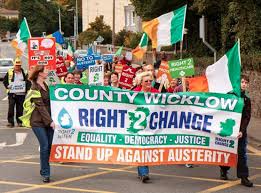
10/12/2014 Anti Water Charges Protests. Pictured are members of the public protesting against water charges at the Right 2 Water event outside Government Buildings in Dublin today. Picture: Sam Boal / Photocall Ireland

10/12/2014 Anti Water Charges Protests. Pictured are members of the public protesting against water charges at the Right 2 Water event outside Government Buildings in Dublin today. Picture: Sam Boal / Photocall Ireland

Twenty sixteen will see a general election in Ireland, one that will be a referendum on the policy of austerity and by implication the continued subordination of the Irish State to global multinational capital.  Austerity will be hailed by the Government as a success and the policy of bailing out the banks and bondholders inevitable and unavoidable.  Rising employment and falling unemployment; small reductions in taxes instead of large increases, and small increases in public expenditure will be held up as proof that the return of economic growth is no mere statistical artefact.

The policy of giving enormous tax breaks to the richest multinationals while Irish workers tightened their belt, or left the country, will continue to be hailed as successful and absolutely necessary.  So, for example, the takeover of Allergan by Pfizer will result in hundreds of millions of tax Euros for the Irish State every year and is the latest illustration of its importance.

Yes, times were tough but we had to tough them out, and we did.  This essentially will be the argument of the supporters of austerity and these are the arguments that those standing in the election will have to address.  They will have to present a critique which means presenting an alternative.

Central to this alternative is the idea of creating a left Government.  The strategy of most of the left in Ireland has centred on protest politics through single issue campaigns and building up constituency bases from which to launch a credible electoral campaign.  The ultimate purpose of this is to get a left Government elected because without it there is an enormous hole in the strategy of the left organisations.

Single issue campaigns, such as over water charges, can push back attacks but the bulk of austerity caused by pay reductions, unemployment, tax increases and cuts in services will not be reversed by protest and are the results of the actions of the Government.  This shows how central the perspective of entering government is to the left despite often protesting that it is subordinate to mass action by workers, although it is usually difficult to see by what mechanism mass action will achieve stated aims.

The left in Ireland has now developed to a scale where some electoral success is more than probable and such success can always be relied upon to cover up for deeper strategic failure and political weakness, such as failure to achieve a left Government or to satisfactorily address the arguments for austerity.

There will however be no left government elected in 2016, even by the widest interpretation of ‘left’.  In December the Red C/Sunday Business Post opinion poll put Fine Gael on  32% [+1]; the Labour Party on 9% [+2]; Fianna Fail on 17% [-2]; Sinn Fein on 19% [+1] and Independents/Others on 23% [-2].  Of the last figure, independents were 14 % with the left Anti Austerity Alliance and People before Profit Alliance on 3% and, the Greens, Renua and the Social Democrats all at 2% support.  In other words the three main parties that have implemented austerity are receiving 58% support, rising to well above 60% if we include the smaller right wing fragments of these parties and right wing independents.

Clearly the argument for an alternative has a long way to go. As it is obvious that there will be no left government elected in 2016 the left is beginning to address what the implications of this are.

Most obviously, the immediate prospect of a left government has no credibility if it does not include Sinn Fein.  Of course the idea of ‘the left’ is a purely relative one and in the past has included the Green Party, which implemented the biggest single attack on workers in the history of the State through the bank bailout and consequent austerity.  Sinn Fein itself has dropped much pretence of opposing austerity in the North, where it will implement most of it by itself in a coalition with the most reactionary party on the island, while handing powers back to the Tory Government in Britain to implement the bits it promised to defeat.

The idea of being on ‘the left’ is one easily appropriated and needs a clear context in which to be meaningful, but the traditional left organisations have for a long time sought to describe themselves in ways that they see as more immediately accessible to Irish workers, who have a very weak socialist tradition and low level of political class consciousness.  They have led the way in diluting political descriptions so that all sorts of words are used to replace the traditional vocabulary.  Misappropriation is one price to be paid for this.

There therefore exists a need to identify what exactly constitutes ‘left wing’, requiring a fight over ideas, which will ultimately be determined only when these are allied to a practice that demonstrates what they mean in reality.  The relationship of Sinn Fein to the idea of a left Government means that the left has had to address this in order to retain the perspective of a left Government at the centre of its strategy.

In this series of posts I will look at two aspects of this – what the political weakness is of the left’s strategy and what proposals the two left organisations – the Socialist Party and Socialist Workers Party – have put forward in order to deal with the problems posed to their electoral approach.

On 9 December an article appeared in ‘The Irish Times’ by two TDs from the Socialist Party  about their views on a possible alliance with Sinn Fein in the coming elections.  The Socialist Workers Party has also published an analysis upon which it has constructed a policy on a left Government for its electoral front, People before Profit.

Two things stand out in ‘The Irish Times’ article.  First is the decisive role “of a left Government that can mark a fundamental and radical shift away from a society dominated by the profits of the 1 per cent to one where the needs of the 99 per cent and the environment come first.”

Second is the definition of left Government as one that excludes the “traditional establishment parties” of Fine Gael, Fianna Fail and Labour but which does not immediately reject the participation of Sinn Fein.  Instead, it is challenged to accept the following programme – that a left Government:

“would have to include the reversal of the cuts implemented over the last years, abolition of austerity taxes such as water charges and property tax, investment to resolve the housing crisis and increasing the minimum wage and improving working conditions.  Implementing these policies means prioritising public services and housing over paying the bankers’ debts, shifting the burden of taxation on to the wealthy, corporations and high-income earners and challenging the straitjacket of the EU’s “Austerity Treaty”. A left government would also repeal the Eighth Amendment and challenge the oppression faced by women, Travellers, migrants and others.”

The Socialist Party TDs state that “Unfortunately, we have major doubts as to whether Sinn Féin would agree to such a programme.”  The doubts are justified but this isn’t altogether the point.  There is nothing on this list which one could immediately say Sinn Fein could not accept.  This being the case the task would therefore logically be to fight to get an agreement with Sinn Fein to agree a programme for Government on these lines in order to maximise the chances of such a Government after the elections.

It could be argued that promises from Sinn Fein would be worthless and there’s a long history of broken promises in the North.  However the North isn’t the South and the South isn’t the North and the very fact the anti-republican Socialist Party even raises the possibility of a Government with Sinn Fein acknowledges this.  Challenging Sinn Fein and doing so in front of its supporters would help to either expose lack of seriousness in its proclaimed policies or pressure them to commit to formation of a left Government while setting out clearly the policies on which this would be based.

It could also be argued that Sinn Fein would not be prepared to take the steps advocated by the Socialist Party to the same extent; it would not raise taxes on the rich or increase state investment to the same extent.  This objection however is only one of degree and not fundamental.  If it is considered by the Socialist Party that the commitment of Sinn Fein is too weak it could state what level of taxation and state investment it would see as constituting a minimum anti-austerity platform – certainly for both it will be more than the effect of the 2016 budget, which is estimated to raise household disposable income by 0.7%.

Sinn Fein however has endorsed the Right2Water campaign’s policy principles which are supported by a number of significant trade unions within the anti-water charges campaign.  Again these principles are vague but they do include a commitment to public investment of between €6 – €7 billion in water infrastructure alone, funded through progressive taxation, and they have provided a more detailed document setting out fiscal planning that envisages total spending of €9.4 billion from 2016 to 2020.  This was written in June 2015 and will have come before the most recent economic growth so will probably understate the amount that the authors would commit to.  In any case the amounts proposed appear to be the minimum they considered possible.

The Socialist Party’s own budget proposals contained in the Anti-Austerity Alliance (AAA) statement involve increased expenditure of €12.8 billion funded by increased taxation and savings of €16.4 billion and are clearly more extensive, but again it is a question of degree not of qualitative or fundamental difference.  For all the latter’s talk of “anti-capitalist” and “socialist measures” the budget proposals are in no sense qualitatively different from the former and the AAA budget is put forward only as “an illustration of how things could be organised differently”.

In terms of what is defined as a left Government there appears no decisive difference between the Socialist Party and Sinn Fein, regardless of what more radical ambitions to socialism the Socialist Party lay claim to.  It is what the Socialist Party proposes as the minimum programme for a left Government that is at issue.

Sinn Fein’s manoeuvring around potential coalition with what the Socialist Party calls the establishment parties, particularly the Labour Party, does not absolve the Party from responsibility to test the claims of Sinn Fein  and to fight to win it to a purely left Governmental programme.

None of this should be taken to mean that I endorse the strategic importance of a left Government as put forward by the Socialist Party or the rest of the left, or that I have any illusions in Sinn Fein.  Nor should it be taken that I endorse the measures proposed by the Socialist Party in the AAA budget proposals as essentially socialist, or even the road to socialism – I do not.

What I do believe is that the formation of a left Government in the Irish state would be a step forward for the working class and present much improved conditions within which workers could fight to advance their own organisational capacity and political consciousness.  This means that not only is the possible existence of such a Government important but so also is the programme on which it stands and the programme that it subsequently implements.

To simply damn the whole enterprise as reformist on the grounds that it will not see the overthrow of capitalism (which is true) is to abstain from the political issues as they present themselves and the struggles that are there.  In addition, to condemn the left organisations that proclaim to be Marxist for adopting a non-Marxist approach (which again is true) is hardly sufficient since the bigger question is not the erroneous views of these organisations but the much wider number of workers who are (rightly) looking for an alternative and see this project as involving an alternative (again correctly).

All these considerations matter, even though it is clear there will be no left Government in Ireland in 2016.

Forward to part 2

Use ‘ A Fresh Start’ to whitewash your dirty linen – maximum spin programme recommended

2015-11-24 21.25.27

The richest political party in Ireland paid for the Northern nationalist newspaper ‘The Irish News’ to include a glossy leaflet inside it, selling the latest political deal which has been negotiated between it, the British government, Irish government and the Democratic Unionist Party.

It’s called ‘A Fresh Start’ although it isn’t: the whole point of it is to refurbish the previous agreement, of which Sinn Fein had been an enthusiastic supporter.

So it’s not fresh, since it contains no new ideas, and because we have been here countless times before and the main point is to implement the Stormont House Agreement, it’s not a start either.   In fact according to Sinn Fein no fresh start was even necessary.

Not necessary because the first paragraph in its open letter states that the crisis which prevented the implementation of the Stormont House Agreement was provoked by Tory cuts and a contrived political crisis caused by the murder of two people; one of which was carried out by Provisional republicans (so the contrivance must be partly their responsibility).

The other respect in which they were responsible for the ‘contrived’ crisis was their acceptance and then refusal to implement all the Tory welfare cuts, in the process claiming opposition to austerity while implementing it in all its other aspects.   In their leaflet they state that “the only way to protect our people and our public services from Tory austerity was through working the democratic institutions.”  Except that implementing Tory austerity became the only way of saving “the democratic institutions”.

The new deal implements the Tory cuts to welfare, with apparently some local mitigating measures already agreed, and nothing more than that.  The hollowness of the previous angry Sinn Fein opposition to the Tories and their cuts has been exposed through the ‘Fresh Start ‘Agreement making provision for transferring the powers to make the cuts from Stormont to Westminster.  Not so much standing up to Tory cuts as handing over the knives to the Tories to make them.

In parenthesis it may be noted that during all this fake opposition to welfare cuts the people affected were as utterly dependent on Sinn Fein as they are on the benefits themselves and have seen this opposition withdrawn along with some of their benefits.  What it proves is that the only way to protect our people and our public services from Tory austerity is through working people organising to fight back and creating an alternative.

The next paragraph in their open letter notes that Sinn Fein is standing up for victims by demanding the British Government discloses information, which it is refusing to do.  What a pity then that this is repeated on the other side of the leaflet below a picture of Gerry Adams whose complete disclosure of the past involves complete denial of ever being in the IRA.

The next paragraph boasts of “securing over £500 million in additional finance for the Executive over the next four year.  We also negotiated a £585 million fund to support those hit by savage Tory cuts to benefits and tax credits”.

The last deal they walked away from, because it failed to protect welfare recipients sufficiently, provided for £564 million over 6 years.  Sinn Fein claimed that this roughly £95 million per year was not enough “to protect the most vulnerable in our society” but has now accepted that £86.25 million a year over 4 years to cover the same cuts will be a better deal!  The money they claim to have negotiated now – £585 million in total – will have to be set against not only previous cuts but the new cuts to tax credits introduced since the previous agreement.  Even the ‘new’ money may not be new at all and the lone Green party member of the Assembly has claimed that some of it will come out of the existing Social Security Agency budget!

So what about the first £500 million claimed by Sinn Fein?

Well most of that is earmarked for those traditional objects of Sinn Fein sympathy – security and social security.  £188 million will go to security, with £160 million going to the Police Service of Northern Ireland to tackle republicans (the dissident ones?), and £125 million going to clamping down on social security fraud and error ( the irony of this is matched only by their calling those who murdered Kevin McGuigan “criminals”).

In the debate following the Agreement neither Sinn Fein nor the DUP have been able to demonstrate that all the claims about there being new money stand up and that the partial and temporary welfare relief is not just going to be paid by existing budgets.

So when Sinn Fein claims in its leaflet that “Sinn Fein is totally opposed to the austerity North and South” this really means nothing very much in the North and will very likely mean not a great deal in the South either.

In the penultimate paragraph it says that “the best safeguard against future Tory cuts is having the powers to grow and manage the economy in our hands.”  So how have they done this and how do they propose to do it in future?

Well, the Agreement notes approvingly the reduction of 7,410 jobs from state employment in the three years between April 2014 and March 2016 and “If cost cutting does not achieve the results required the Executive will “consider revenue raising measures.”   To indicate the meeting of minds involved, and to demonstrate that we are all in it together, “the Executive commits itself to lowering corporation tax to 12.5% in April 2018.”

In addition the British Government will legislate to ensure that local spending plans cannot exceed what is permitted and will review the Block grant to Northern Ireland after four years to take account of the effect of the reduction in corporation tax, no doubt with a view to further reductions.  How all this is opposition to Tory austerity is anyone’s guess.

Rather stupidly the other side of the Sinn Fein leaflet advertises the opposition of the British Government to disclosing its role in the past, about which Sinn Fein has achieved absolutely nothing.  The Agreement includes as the first of its principles “the ending of paramilitarism”.  This is straight after The British Government has issued an ‘independent’ report saying that the IRA army council still exists, and of course following the murder of Kevin McGuigan, all while Sinn Fein continues to claim that the IRA has left the stage.

On the Unionist side the repeated collaboration with loyalist paramilitaries by the unionist parties is studiously ignored.

It would be tempting to point the finger at both Sinn Fein and the DUP for their hypocrisy but the British have a special talent when it comes to this sort of thing.  It was reported only last week that there have been only ten convictions based on membership of a paramilitary organisation since 1998 and none for nearly seven years.  So how come, all of a sudden, it’s become such a big deal?

A new task force made up of the Northern and Southern police forces and tax authorities is to be established but this will achieve what its masters want it to achieve.  It is the stick to the carrot of additional (or not so additional) money.  However, as it’s a cross-border body it’s clearly aimed at republicans.

What sticks in the craw most about this part of the deal is that the Executive, made up of Sinn Fein and the DUP etc., is to “undertake a public awareness campaign to raise public understanding of the harm done by paramilitarism.”  Yeah, we really don’t have a clue.

The heading for a ‘Shared Future’, costing £60 million over four years, gets one paragraph and explains nothing, which could mean it will never be spent or might be spent on buying off ‘community representatives’, as flagged in the latest loyalist offensive for ‘inclusion’ of their gangster outfits in the Stormont gravy train.

By contrast the section ‘Irish Government Financial Support’ gets two and a half pages, with the highlight a meager £75 million for a road, although it also includes such key aspects of the Agreement as “development of further cross-border Greenways and Blueway cycling-walking-water leisure routes, including the Ulster canal.” The Irish Government also champions the use of private finance to fund further infrastructure projects.  In other words the Irish Government is pretty irrelevant except to allow nationalists to claim some role for it, what role is pretty clear.

The rest of the Agreement promises to implement the previous Agreement on Flags, Identity, Culture and Tradition.  So, while the paper mentions sectarianism twice it mentions Flags twenty-two times.

The ‘Fresh Start’ also rather embarrassingly reminds nationalists that the British Government endorses “the need for respect for and recognition of the Irish language in Northern Ireland” but again this means nothing and reminds everyone of the failure of Sinn Fein to achieve its long held objective of an Irish language Act.

What to do about the past is the one area where failure is so total that the Agreement has to admit it.  Yet, rather than skirt round the issue in its leaflet, Sinn Fein states that dealing with the past was one if its four priorities – so what happened then?

If the only thing now that has yet to be agreed, and which will therefore involve yet more talks, is about the past, it will continue to be easy to present the problem as one of living in it.

The Sinn Fein leaflet then is a catalogue of failure and the new Agreement is an attempt to build on that failure.  It is such an open declaration of defeat that even some of those opposed to Sinn Fein appear to find it a bit embarrassing.  The ‘Irish News’ columnist Newton Emerson begins his assessment of the Agreement by saying:

“The ‘fresh start’ agreement is such a total defeat for Sinn Fein that it is positively bizarre.  Even as a unionist, I find it unnerving”

The leaflet aimed at their supporters is just as bizarre as their negotiations and their spin on it is empty and pathetic.

It should also be said that the Agreement is also a rejection of unionist appeals to take steps to ditch Sinn Fein and allow the unionists to begin running the local state apparatus without them.  This would represent a clear break from British strategy and a divided unionism is in no position to achieve this.

Besides, for the British, with ‘enemies’ like Sinn Fein who needs friends?


The politics of murder in Belfast

images (11)The murder of Kevin McGuigan on 12 August in East Belfast is widely seen as revenge for the former’s claimed involvement in the earlier murder of Provisional IRA leader Gerard ‘Jock’ Davison.

The Police Service of Northern Ireland (PSNI) have done their bit to protect the Provisional movement by claiming that although Provisional IRA members were involved there is no evidence that it was authorised by the leadership.  Since complete denial of Provo involvement would stretch credibility to breaking point and reflect on the PSNI as well as the Provos, this was as much as they could do.

Of course this makes no sense, although it was notable that some nationalist commentators were prepared to swallow it.  Much amazement was feigned by unionists that an IRA even existed, so ‘answers’ were demanded.  The British Government said that of course it knew the IRA existed but that what was important was what Sinn Fein said (i.e. not what the IRA actually did) and especially that it continued to express support for the ‘principles of democracy and consent”.

The Garda in the South had previously claimed that the IRA had no military structure but are going to look at it again and the PSNI claimed it was a lobby group for “peaceful, political republicanism”.  Sinn Fein spokesmen claimed that of course the IRA was not involved, that it had “gone away” and all allegations to the contrary were ‘palitics’.

So the Provos continue to support the police but not as far as allowing them to get in the way of taking revenge or protecting themselves and their enormous financial empire. Support for the police is therefore purely ‘palitical’.

In the hypocrisy and lying stakes each out-does the other.

So the British Government and PSNI are claiming that while a much slimmed-down ‘peaceful’ IRA exists there is no evidence that it sanctioned the murder of McGuigan; although investigations will continue, which means that if it suits the political purposes of the British Government such a judgement can be easily changed. And easily justified – a ‘peaceful’ IRA with guns, that murders its enemies, and which by its very reduced size and tightness makes inconceivable the idea that the murder was not approved from the top.

The meaning of this is obvious: the British state and its police force doesn’t care if the Provisional IRA kills people it doesn’t like.  It doesn’t care if loyalist paramilitaries kill people they don’t like. Round the corner from where McGuigan was killed a young woman was almost killed by the loyalist Ulster Volunteer Force but the PSNI refused to blame the UVF who were responsible.

Today it is reported that the murder of another Short Strand man Robert McCartney by the Provos was subject of a secret deal between the PSNI and Provos, with the cops offering not to go after those who cleared up the murder scene, in exchange for Provo information on the less important hands-on killers.  No one has gone to jail and the Provos kept their mouths shut.

The political import of the killing is the following:

The Provos can kill and the state will give them impunity but it will expect a price to be paid.  Anyone who thinks that the end of Sinn Fein’s meagre opposition to austerity through opposition to some welfare cuts will not form part of the price probably believes that everything that the British Government, police, unionists and Sinn Fein has said about the murder of Kevin McGuigan is 100% true.

A message has been sent to all enemies of the Provos, political or criminal, that they are willing and able to kill, no doubt under some new set of initials such as AAD (Action Against Drugs).

The slow crumbling of the architecture of the political peace settlement has speeded up and now threatens the current arrangements.  The Ulster Unionist Party has withdrawn from the all-party Executive, putting pressure on its supposed more rabid rivals in the DUP to follow its lead.

The DUP has now proposed that Sinn Fein be expelled from the Executive, although Sinn Fein can prevent it, and only the British Government can do this.  If the British do not support such a move the DUP would then be forced to either put its money where its mouth is and walk themselves, bringing down the Executive, or reveal themselves as joined at the hip to the Provos in the great gravy train on the hill.  It might then start losing support.

As the pro-settlement ‘Irish News’ editorial put it today, the Executive is so discredited most will not care if it remains or goes.  And as I have noted before, the current Stormont regime is so rotten it has little credibility left.

The peace process has been built on the lie that the rotten sectarian arrangement brought about the absence of widespread political violence.  In fact the defeat of the Provos and the ending of widespread violence preceded the creation of the rotten sectarian arrangements.  Again and again the sectarian political settlement has been defended by the claim its overthrow would bring us back to the troubles.

The recent killings demonstrate precisely the opposite.  The existence of the sectarian Assembly and Executive is now justifying collusion between the state, Provos and loyalist paramilitaries in violence, intimidation and large scale criminality.  The message from the British pro-consul has been explicit:  as long as Sinn Fein supports the sectarian settlement and police that is what counts.  What it actually does will be excused and glossed over if remotely possible.  The so-called peace settlement and its preservation is now the justification for allowing political and criminal violence.

Socialists must continue to oppose this rotten settlement.  They should continue to oppose the PSNI and expose its collusion with the Provisional IRA and loyalist paramilitaries.  They should oppose the austerity imposed by the British Government and the Stormont parties, especially Sinn Fein and its phoney anti-austerity posturing.

It should likewise refuse to offer political support to any opposition by Sinn Fein to its exclusion from Government should this occur.  The Provisional movement is an obstacle to working class people in the North and South of Ireland identifying their own interests and defending them.