 In the previous series of posts I have set out Marx’s views on the contradictions of capitalism, between its productive forces and the relations of production, and have gone to some length to explain the concepts involved.
Much of this might seem rather tenuously related to the issue of Marx’s alternative to capitalism. Previously, however, I have explained that this alternative can only arise out of existing society, and not from any sort of blueprint, either based on high moral values of equality and justice etc. or more or less elaborate plans for the a society, for example how a planned economy might be made to work more efficiently than capitalism.
More particularly, this alternative cannot be conceived as simply political revolution, for such a revolution presupposes the grounds for its success – on the development of the forces and relations of production as set out in these previous posts, this one and the next one.
The development of the forces and relations of production explains how the alternative that grows within capitalism and will supersede it might be conceived, and on these grounds that political revolution might be considered a reasonable objective.
In this way, Marx explains how the development of capitalism creates the grounds and tendencies of development of an alternative society:
“The conditions for production become increasingly general, communal and social, relying less on the individual capitalist. We have seen that the growing accumulation of capital implies its growing concentration. Thus grows the power of capital, the alienation of the conditions of social production personified in the capitalist from the real producers. Capital comes more and more to the fore as a social power, whose agent is the capitalist. This social power no longer stands in any possible relation to that which the labour of a single individual can create. It becomes an alienated, independent, social power, which stands opposed to society as an object, and as an object that is the capitalist’s source of power.”
“The contradiction between the general social power into which capital develops, on the one hand, and the private power of the individual capitalists over these social conditions of production, on the other, becomes ever more irreconcilable, and yet contains the solution of the problem, because it implies at the same time the transformation of the conditions of production into general, common, social, conditions. This transformation stems from the development of the productive forces under capitalist production, and from the ways and means by which this development takes place.”
Marx sets out “Three cardinal facts of capitalist production:
1) Concentration of means of production in few hands, whereby they cease to appear as the property of the immediate labourers and turn into social production capacities. Even if initially they are the private property of capitalists. These are the trustees of bourgeois society, but they pocket all the proceeds of this trusteeship.
2) Organisation of labour itself into social labour: through co-operation, division of labour, and the uniting of labour with the natural sciences.
In these two senses, the capitalist mode of production abolishes private property and private labour, even though in contradictory forms.”
Marx notes that the bigger, more concentrated and centralised capital becomes, the less important is the role of the capitalist himself, while this process simultaneously involves the centralisation of capital in a few hands including through the decapitalisation of many. Although “this process would entail the rapid breakdown of capitalist production, if counteracting tendencies were not constantly at work alongside this centripetal force, in the direction of decentralisation.” (Capital Volume III, p 354 – 355)
Ernest Mandel, in his introduction to Volume III of Capital, sets out a flow-diagram putting forward the elements of Marx’s analysis and placing them within separate boxes, with the end point being ‘socialism’, and with the penultimate box the ‘tendency towards collapse of capitalist system’.
While useful as a graphical presentation of the elements of Marx’s analysis, it is misleading if it is assumed that socialism is simply a result of capitalist collapse, rather than capitalist collapse being the result of socialism, in other words the actions of the working class.
It is however useful to sum up the last few posts by itemising these different elements that are included in Mandel’s schematic, with the understanding that socialism is not the result of the automatic working out of any or even all of these factors, but rather the conscious intervention of the working class, not in a voluntarist way, but arising out of (at least some of) the factors set out below, and in particular ways that we shall later explore.
- Growing difficulty of maintaining market economy, value realisation, under conditions of growing automation.
- Periodic crises of overproduction.
- Tendency to growing centralisation of capital in fewer and fewer hands.
- Tendency of average rate of profit to decline.
- Tendency to growing objective socialisation of labour.
- Growing contradiction between socialised labour and private appropriation.
The contradiction between capitalist relations of production and its productive forces is evident every day, in the inability of capitalism to secure permanent full employment, in fact its inability to function without a reserve army of labour that helps regulate its functioning.
The tendency to the socialisation of production through, for example, the growth of monopoly might be seen as anticipation of socialism, which in a negative fashion it is, but while it entails increased planning within enterprises, it does not otherwise prevent capitalist crises.
Likewise, increased state ownership and intervention also anticipates resolution of the contradiction between the forces and relations of production, but does not resolve it and does not represent a model of future society. As Engels notes:”
“But, the transformation — either into joint-stock companies and trusts, or into State-ownership — does not do away with the capitalistic nature of the productive forces. In the joint-stock companies and trusts, this is obvious. And the modern State, again, is only the organisation that bourgeois society takes on in order to support the external conditions of the capitalist mode of production against the encroachments as well of the workers as of individual capitalists.”
“The modern state, no matter what its form, is essentially a capitalist machine — the state of the capitalists, the ideal personification of the total national capital. The more it proceeds to the taking over of productive forces, the more does it actually become the national capitalist, the more citizens does it exploit. The workers remain wage-workers — proletarians. The capitalist relation is not done away with. It is, rather, brought to a head. But, brought to a head, it topples over. State-ownership of the productive forces is not the solution of the conflict, but concealed within it are the technical conditions that form the elements of that solution.”
The true anticipation and herald of the new mode of production is contained in the development of workers’ production, anticipation of the associated workers’ mode of production, through the growth of workers cooperatives, as argued by Marx:
“The co-operative factories of the labourers themselves represent within the old form the first sprouts of the new, although they naturally reproduce, and must reproduce, everywhere in their actual organisation all the shortcomings of the prevailing system. But the antithesis between capital and labour is overcome within them, if at first only by way of making the associated labourers into their own capitalist, i.e., by enabling them to use the means of production for the employment of their own labour.”
“They show how a new mode of production naturally grows out of an old one, when the development of the material forces of production and of the corresponding forms of social production have reached a particular stage. Without the factory system arising out of the capitalist mode of production there could have been no co-operative factories. Nor could these have developed without the credit system arising out of the same mode of production. The credit system is not only the principal basis for the gradual transformation of capitalist private enterprises into capitalist stock companies, but equally offers the means for the gradual extension of co-operative enterprises on a more or less national scale.”
“The capitalist stock companies, as much as the co-operative factories, should be considered as transitional forms from the capitalist mode of production to the associated one, with the only distinction that the antagonism is resolved negatively in the one and positively in the other.” (Capital Volume III)
Back to part 25
Forward to part 27
 For Marx in the 1859 Preface “the material productive forces of society come into conflict with the existing relations of production or – this merely expresses the same thing in legal terms – with the property relations within the framework of which they have operated hitherto. From forms of development of the productive forces these relations turn into their fetters. Then begins an era of social revolution.”
 Not only do increases in production often require machines to replace living labour but the increase in productivity necessarily increases the share of materials purchased and incorporated into the increased number of products produced. Materials which pass only their own value into the final product and no new surplus.
 The contradiction between the forces and relations of production is extreme under capitalism because the relations of production, while tending to promote the unlimited development of the forces of production, force the latter against the limits of these relations. Capitalism seeks to expand without limit through the creation and appropriation of surplus value expressed most immediately as the need to make profits. This is enforced through increased exploitation of labour and the competition of different capitals to capture market share. No previous mode of production has displayed such rapid development of its own logic of expansion, with such power, and with such effect across the world.
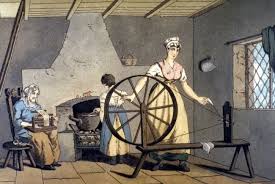 In Capital Volume 1 Marx provides an example of how the productive powers of society have come up against restricted relations of production, how they have further developed and in so doing have consequently revolutionised the economic foundation of society.
 Capitalism as such cannot develop on the limited basis it finds in the already existing forces of production. The pre-requisites for capitalism as a system, as a form of truly social production as we now know it, is a capitalist labour process that is the real subsumption of labour under capital, where the instruments of production can only be operated cooperatively and not individually as before.
 The superior productivity – productive power – of the developing capitalist forces of production can then destroy less efficient methods of production (if it is allowed to) or it uses the state to enforce ‘free trade’ on less efficient productive arrangements. We then have a society in which every need of the worker and capitalist is provided by wage labour working for capital, and gone are the days when such needs were met by the product of one’s own labour or the trading by oneself of one’s own products for those not self-made. While the latter limits the organisation and division of labour including the application of technology, the employment of wage labour cooperatively together in one place opens up an enormous vista of expanding productivity.
 I noted in
  History develops through the contradiction between the forces and relations of production, the forces representing the material, including human, organisation of productive powers and the relations representing the social relations between the classes entailed by the productive forces.
 The Preface to ‘A Contribution to the Critique of Political Economy’ of 1859 is a short couple of pages but, as perhaps one of the most vital expositions of Karl Marx’s interpretation of history, it has not unexpectedly been the subject of much controversy. Since Engels said of Marx, at his graveside, that one of his two fundamental contributions was the materialist theory of history, it would appear that the controversy is quite important. An interpretation provides not only the grounds and principles upon which we can understand history but also how we can change it.
 Sráid Marx