Left reaction to the ‘discovery’ that a woman is an adult human female (4) – questions and answers

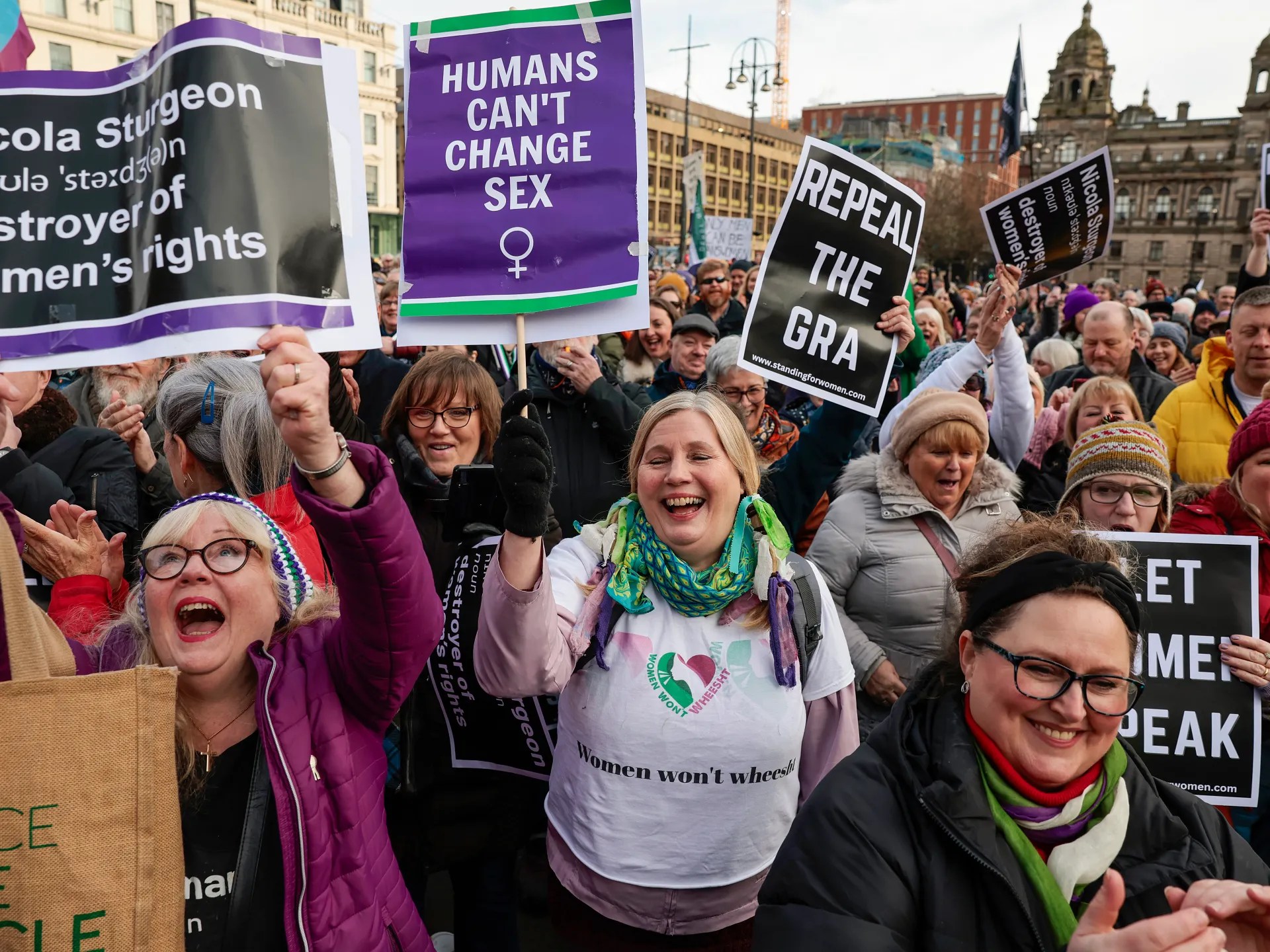
Of all the misconceptions and egregious nonsense in the responses of the left to the UK supreme court judgment the most irrational I have seen comes from the Fourth International and its British organisation Anti-Capitalist Resistance.

The former asks a number of questions as if these on their own expose the falsehood of the court decision but which really require only straight forward answers from anyone not immersed in gender identity ideology.

“What of the practical impacts that this ruling will have on cis women?” it asks.

The impacts are that single sex spaces will be open only to women and exclude men.  This means no men in women’s prisons, no men in women’s refuges, and no men in women’s sports etc.  Something taken for granted in the previous century during which no one was claiming that this involved women’s oppression – quite the reverse.

“What do we tell our young women when we say, ‘a woman is only biological sex’, that a man is also only biological sex?” 

Who is claiming that any woman or man is only a biological woman or biological man regardless of their other qualities, experiences and achievements?  What Marxists affirm is that, just like the assumption in the question itself, humanity is made up of women and men, and most will know that the distinction between them arises solely from their biological difference.

This reality does not at all mean, as this organisation seems to claim, “that because of a man’s biological sex, he is right to partake in oppressive structures of male hierarchy? That his desire to rape and sexually assault women is justified because of his biology?”  The biology of men does not mean that “oppressive structures” and “desires” are inevitable and if the Fourth International thinks the biological reality of humanity necessitates such structures, how then is it going to negate this biological reality and destroy these structures?

Does it think that gender identity is the answer to such ‘structures and desires?’  Does it seek to compel or convince everyone to adopt a gender identity that dispenses with their knowledge of their biological nature?  Would this not be an admission that it is they who wish to narrow young women and men’s understanding of themselves to a ‘gender identity’ that many reject they even have?

Anti-Capitalist Resistance states that trans “existence directly challenges the social order, which is structured by gendered power relations”, but fails to explain how identifying as the opposite sex (regardless of what that really means) actually changes “gendered power relations”, unless the gendered identities adopted are not those of real existing men and women that it currently argues constitute these “oppressive structures.” In other words, in their world in which sex is unimportant, but gender is decisive and in which we still have gender oppression, how will such oppression be ended simply by some (or all) identifying as the other (irrelevant!) sex?  Unless, that is, transmen aren’t actually identifying as men with all their claimed oppressive desires and transwomen aren’t really identifying as women with all their experience of oppressive structures.

Anti-Capitalist Resistance further claims that feminism seeks to overcome the view “that biology is destiny”, but only the adherents of gender identity ideology are arguing that biology is destiny, which is why they attempt the false claim that it can be dismissed.

Biology isn’t destiny in the way they claim – that it necessarily involves social oppression – but it is reality.  Biology is reality and if biology is physically and socially unimportant why does gender identity ideology base itself on being able to identify into the other sex with whatever physical changes that an individual believes they can make (with or without medical and surgical intervention)?

If these ideologists really want to stick to the claim that biology is not destiny I have an additional concept for them – death.

This organisation further claims that feminism opposes ideas “that bodily autonomy is socially dangerous” and “that organising social reproductive work on gendered lines is “natural”.  Yet the foundation of human reproduction is biological – one hundred percent of people reading this blog will be born to a woman.  The claim to autonomy is meant to evoke the rights of women to abortion but this autonomy – this independence and freedom – refers to the right to choose, which then requires the recognition by others for its effective exercise.  Trans people, as autonomous individuals, can think of themselves in any way they like but they cannot by this alone compel the world to accept their view of themselves and act upon it without violating everyone else’s right to the same autonomy. 

The Fourth International asks some more straight forward questions even more simply answered.

“How do you balance sex characteristics with gender reassignment characteristics?”  – Since these are separate characteristics, no balancing is required, the latter does not alter the essential nature of the former. 

“How do you prove sex discrimination when you are not recognized as that sex?”  – You can’t.

The Fourth International states that without this ideology we would have “an absurd ahistorical view of the working class as a homogenised lump that apparently never had gender queer people, or gay people or drag queens among its ranks.”  It sticks out a mile that women are absent from the list but yet another category of men pretending to be women is included.  That the history of the Marxist movement, going back to the man himself, has recognised the special oppression of women, and sought their organisation, is lost.  Instead, we have the truly ahistorical view of the working class in which we have something called ‘cis women’, and trans women whose very existence somehow “directly challenges the social order.”

For a Marxist the issue is also the claim that “There will be no revolution without trans liberation!”  Except, if this were true it would require the erasure of the female sex as a separate part (half!!) of humanity with all their specific oppression and need to organise.  It would also require abandoning any critical thought, with acceptance of the claim that ‘transwomen are women’ with no debate allowed over what are palpably untrue claims because of hyperbolic rhetoric and juvenile name calling.

Marx once said that ‘the philosophers have only interpreted the world, in various ways; the point is to change it.’  The left supporters of gender identity ideology think they can change it by reinterpretation but since the real world is a stubborn thing it cannot be changed by declaration, and it cannot even be reinterpreted by incantation of inane slogans or without debate.  The attempt to silence opposition by naming the gender critical left as ‘fascist’ or ‘transphobic’ is another illustration of denying reality and attempt to close down challenges to its imagined world of changing sex and many genders.

The demonisation of opponents however is only a device to buttress a position already acquired because adherents have accepted that gender identity ideology is ‘progressive’; to stand against it would see individuals also stand against those they would normally stand beside.  Support for the ideology no longer depends on rational argument because it is simply considered to be the ‘left wing’ position; it is left wing because I/she/he/we are left wing and therefore so must it.  It is circular reasoning, and a form of identity politics inoculated from reality by a form of solipsism.  The exploitation of their mistake by the right is then held aloft as ‘proof’ of their position’s left credentials.

The phenomenon of a political position being held up as left wing because so much of the left supports it has been seen before; as previously much of the left capitulated to Scottish nationalism and is now capitulating to western imperialism through support for Ukraine, both of which are their unlikely candidates as beacons of ‘democracy’ for the world.

It’s a case of political gangrene that occurs ‘as a result of an injury, infection or a long-term condition that affects blood circulation’.  The defeats of the working class and its movement are the injury; the infection is petty bourgeois politics, and these long term factors have affected the circulation of critical thought and Marxism.

Concluded

Back to part 3

Marxism and Gender Identity Ideology (4) – looking at a progressive movement?

We noted at the end of the previous post that there is a reason why it might be thought that the demands arising from gender identity ideology are regressive and reactionary, and for this reason should not be ignored.

In his book ‘Trouble with Gender’ the philosopher Alex Byrne remarks that it is ‘tempting to search for some hidden meaning’ in the actions of one prominent supporter of the ideology – ‘a sign that the current trouble with gender ultimately makes sense, rather than being an inexplicable cultural spasm that will eventually recede into historical mist, leaving some wondering whether it happened at all.’ 

If, for some leftists, the whole thing is therefore a diversion; is it a diversion into reactionary territory that should be ignored, even while recognising that it has many left supporters that should be challenged?

Marxists are constantly having to combat diversions from working class politics.  We are constantly facing challenges to our understanding of the world and the political responses that are required.  We only need to think of those who find reasons to support either the Western imperialist/Ukrainian alliance on the one hand, or the Russian capitalist state on the other, in the current war (that socialists should oppose outright) to see that these divisions are unfortunately common.

On the face of it gender identity ideology is reactionary, except that it pretends to be progressive, and this pretence is often effective.  I am reminded of the old TV show ‘Catchphrase’ in which contestants have to identify the familiar phrase represented by a piece of animation that appears block by block on a screen.  Today we quite regularly see feminist meetings being harassed by men dressed as women, often by young people masked up and acting in a threatening manner.

In times gone past this would have been seen as unacceptable and aggressive misogyny.  Today, many leftists support these men as the oppressed and damn the women as bigots.  The ‘Catchphrase’ presenter used to tell contestants to “say what you see”.  The upside-down inverted world of gender identity ideology prevents many from seeing what is plainly going on in front of their eyes.

The assertion that gender identity is what defines us and not sex is ‘explained’ by a leading inspiration of the movement, Judith Butler: “If gender consists of the social meanings that sex assumes, then sex does not accrue social meanings… but rather, is replaced by the social meanings it takes on; sex is relinquished… and gender emerges… as the term which absorbs and displaces ‘sex’” (Bodies That Matter, p. 5).

The substitution of gender identity for sex as the means of understanding the world, through claiming that this is how the world is actually structured, has profound consequences, not least the necessary imposition of an utterly changed comprehension of society and how it should order its everyday life.  Since the vast majority of people recognise sex as fundamental to the existence of humanity, its functioning in society, and how we relate to each other, it is necessary to impose this alternative ‘reality’.

The attempt to do so necessarily produces all the exaggerated features of gender ideology activism, including incoherence and self-righteous aggression.  In the ‘Weekly Worker’ article quoted before, even its sympathetic author notes that what he calls the ‘abolition of the oppression of trans people’ through imposition of rules against ‘transphobic speech would have unwelcome results that mean it could not be supported: ‘the workers’ movement should want to abolish it – but not at the price of losing freedom of speech and communication.’  Yet attacks on freedom of speech is a stand-out feature of this trans activism. Although not all agree, there are far too many examples of trans activism targeting women who meet or speak publicly in defence of sex-based rights to demonstrate that the ‘toxicity’ of the ‘debate’ around it is overwhelmingly the result of the approach of one side.

The censorial, hyperbolic and aggressive character of much trans activism is neither incidental nor accidental but a necessary feature of the movement. The necessity to make people perceive the world in a way that it is not makes the mantra of the movement “no debate” inevitable.  The claim to rights that cannot belong to them, that transwomen should have all the rights and prerogatives of women for example, cannot be substantiated so are camouflaged by appeals to ‘be kind’, attempts to associate themselves with the cause of gays and lesbians, and constant declarations of their special vulnerability and oppression. 

None of this is enough, so ‘no debate’ exists to forcibly try to shut down those asserting women’s sex-based rights. The attempted suppression comes in many forms, from censorship in academic journals and books; intimidation of academics in work, discrimination involving loss of employment in work, and foul and vicious threats on social media.  All justified by shouting that those critical of gender identity ideology are ‘Nazis’.

One example of the hyperbole gives a flavour of the approach. When the British Cycling organisation announced that the female category in competition would only be open to “those whose sex was assigned female at birth and transgender men who are yet to begin hormone therapy”, a transwoman cyclist published a statement stating that “This is a violent act, British Cycling are supporting this, they are furthering a genocide against us. Bans from sport is how it starts . . .” It should not need pointing out that if you want to see a real genocide you should look elsewhere – at the fate of the Palestinian people in Gaza.

It is often declared that to call into question the claims of this ideology is to deny trans people’s right to exist and constitutes violence against them; not metaphorical violence but actual violence.  To disagree is to endanger them and is proof that the critic is transphobic and bigoted.  A climate of censorship and fear of social exclusion has enveloped much of the left on the issue, a movement which needs the stifling of free speech like a hole in the head.  On this ground alone the growth of gender identity ideology is reactionary.

This shutting down of debate and presentation of the ideology as one of liberation against oppression prevents appreciation of its obvious reactionary consequences.  The erasure of sex removes the possibility of same sex attraction; ironic since the T for transgender has attached itself to LGB and come to dominate it.  Lesbians and their activities can now be attacked and sanctioned as transphobic for not considering transwomen, i.e. heterosexual men, as sexual partners.  Same sex attraction becomes impossible because it is ‘exclusionary’. Sex has been displaced by gender so that a heterosexual man declaring himself to be a woman can claim to be a lesbian and in doing so ‘change’ his sexual orientation.

Women, shorn of any essential biological reality are unable to identify, comprehend, explain, and fight the grounds of their oppression.  The ideology declares that while ‘transwomen are women’, women (females) have become ‘cis-women’, who become ‘privileged’ in comparison because their gender identity aligns with their sexed body.  This is the case even though it is also claimed that the sexed body is either a social construct, can be altered, or is irrelevant:

‘The quest for ‘gender recognition’ is not therefore an effort for an individual to change sex, but for an individual to be recognised in their true sex or gender (hence the change in nomenclature from ‘sex-change’ surgery to ‘gender-affirmation’ surgery). As Rothblatt argued in 1994, “we are not changing our sex. We are changing our gender…Our sex is the same as it was when we first entered the doctor’s office—the sex of our minds and our soul” (Rothblatt, Martine. 1994b. ‘Unisexuality: The Wave of the Future,’ Third International Conference on Transgender Law and Employment Policy Proceedings, Appendix E, pp. E1-E6. Quoted in Jones, Jane Clare. The Annals of the TERF-Wars and Other Writing (p. 40). Kindle Edition)

to be continued

Back to part 3

Forward to part 5

Irish Elections (1) – Sinn Fein was the future once?

For years Sinn Fein in the North was accused of acting as both government and opposition, enacting right wing policies in government while presenting itself as anti-establishment, pretending to oppose the sort of politics it was itself carrying out.  It talked out of both sides of its mouth and had more sides than the Albert Clock, as we say in Belfast.

It got, and still does to a lesser degree, get away with it because its dumping of traditional republicanism has been continually praised while its clinging to symbolic remembrance of its dead armed struggle is repeatedly damned.  More fundamentally, it succeeded because it is the most vigorous defender of Catholic rights in the ‘new’ political settlement that has been anointed saintly status by the powers that be, stretching from Washington and London to Dublin and Belfast, not to mention Brussels.

It has had lots of powerful friends on its journey from rebels to politicians, happy to indulge its self-ID as progressive radicals while it became the centrepiece of a regime of dysfunctional failure.  It could forever bask in the naked contempt of its unionist coalition partners, the best of enemies, while telling its supporters that a united Ireland was ‘within reach’. What made it repellant to some made it attractive to others.

*                   *                  *

During a walk-about with a Sinn Fein candidate in last weeks local elections an Irish Times journalist noted that some potential voters appeared to treat the party as if it was already in Government – part of the establishment – and part of the problem it was presenting itself as the solution to.  Waving Tricolours and singing rebel songs doesn’t exactly distinguish you in the South, which now routinely names itself Ireland, leaving the North to get along with Northern Ireland, the nomenclature that unionists goad Sinn Fein with its unwillingness to allow pass its lips.  Now Sinn Fein has found in ‘Ireland’ a new rival that claims to be even more nationalist than it and waves the flag even more vigorously.  The structural conditions applying in the North don’t exist south of the border so are no help to it.

The rise of the far-right and its opposition to immigration, especially in some working class areas of Dublin, is widely held to be a major reason for the apparently sudden and stunning setback to Sinn Fein in the local and European elections held last week.  In an opinion poll in June 2022 it was recording support at 36 per cent, by far the biggest party.  Last week it gained only 12 per cent of the first preference vote and would be the fourth largest if we count the bag of independents as a party.  In 2020 it suffered from standing too few candidates to maximise seats from 25 per cent of the vote while in 2024 it stood too many.

It isn’t Fine Gael or Fianna Fail who are labelled the traitors now, although Sinn Fein long ago found that approach would get them nowhere.  It is now Sinn Fein who are the traitors to the Irish nation, who support a ‘new plantation’ and who refuse to prevent immigration when ‘Ireland is full’.   It is Sinn Fein that is now accused by the assorted racists, far right and fascists as betrayers of the ordinary working class Irish.

All the anti-immigrant tropes that have been seen across Europe are now a ready currency in Ireland and Sinn Fein is the primary political target.  Within less than a couple of years a self-satisfied liberal view that Ireland was more or less immune from the rising tide of racism and xenophobia so prevalent elsewhere has been evaporated.

The growth of the population has largely been due to immigration while the keenness of the Irish bourgeoisie to show its support for Ukraine (in the absence of an ability to provide weapons or troops) has meant that over 100,000 Ukrainian refugees have been welcomed.  This has been followed by an increase in refugees from other countries, less welcome, not least because they aren’t white and no political capital is accrued by having them.

The Irish State was already undergoing a housing shortage when it decided to open its doors to these refugees; stumbling from one emergency measure to another in order to cope while offering welfare rates on a par with the natives.  As the number of those seeking international protection also grew local protests against the housing of these refugees developed in small towns and mainly working class areas of Dublin.

Numerous arson attacks prevented accommodation from being created for refugees while local people claiming not to be racist protested, claiming only to be concerned with the lack of local GP or other health services; an existing shortage of accommodation, or the turning of a local hotel that might have brought in tourists into a refuge for asylum seekers.  The localism of political activity in much of Ireland found it easier to mobilise against asylum seekers than against the failure of the state to keep health, education and housing in line with a growing population.  No doubt many of the local protesters are voters for the bourgeois parties responsible for the policies that led to the failure.

The governing parties decided to clamp down and the toughened rhetoric on immigration became one of control – ‘firm and fair’ – the same reactionary rhetoric employed elsewhere that everyone knows means an attack on the rights of refugees.  The governing parties had found a scapegoat for their failures and a handy weapon against its political rival in Sinn Fein: opinion polling claimed to show that part of its support was more opposed to immigration than that of other parties.

The party first tried to dampen this by arguing that the Government had failed to talk to or consult properly with local people about the accommodation of refugees in their areas but one of their TDs had to admit that “we were a bit all over the place.”  This has settled down to more or less aping the rhetoric of the Government and policies that are more or less the same.

None of this could appease those looking for a quick racist solution and who aren’t going to be convinced by the benefits of immigration, not least because they haven’t seen any.  The benefits of opposing anti-immigrant and racist solutions from a socialist point of view don’t exist for those who don’t have a socialist project and don’t see any utility in working class politics.  Sinn Fein can’t argue this way and even the left mainly presents liberal and human rights arguments that are no part of this politics.

Sinn Fein thus doesn’t escape blame from more backward and reactionary workers while its more liberal and vaguely progressive supporters won’t support it bowing too far in their direction.  Both have reason to doubt the party, with the recorded decline in its support preceding the more recent prominence of migration.

There is only so much complaining you can do before you’re asked to explain what you’re going to do about it, arising from doubts about exactly what you stand for.  U-turns have been public and obvious over a range of issues, including the price of housing, proposed hate legislation, support for the failed referendum proposals that were roundly defeated and then reversal of a promise to re-run the vote if they failed.  All these are small relative to the fundamental U-turns in the North, but this just illustrates the different environment it has to work in.

*                   *                  *

Sinn Fein is not yet the past, but it doesn’t look like the future now either.  That famous Irishman Oscar Wilde said that “there is only one thing in life worse than being talked about, and that is not being talked about.”  Sinn Fein has been much talked about leading up to the elections and especially about the results, including by the leader of the current Government coalition.  You’re not supposed to talk ill about the dead in Ireland so Sinn Fein isn’t dead, but it isn’t the main story and we’ll talk about that next.

Forward to part 2

Permanent Revolution (3) – basic principles

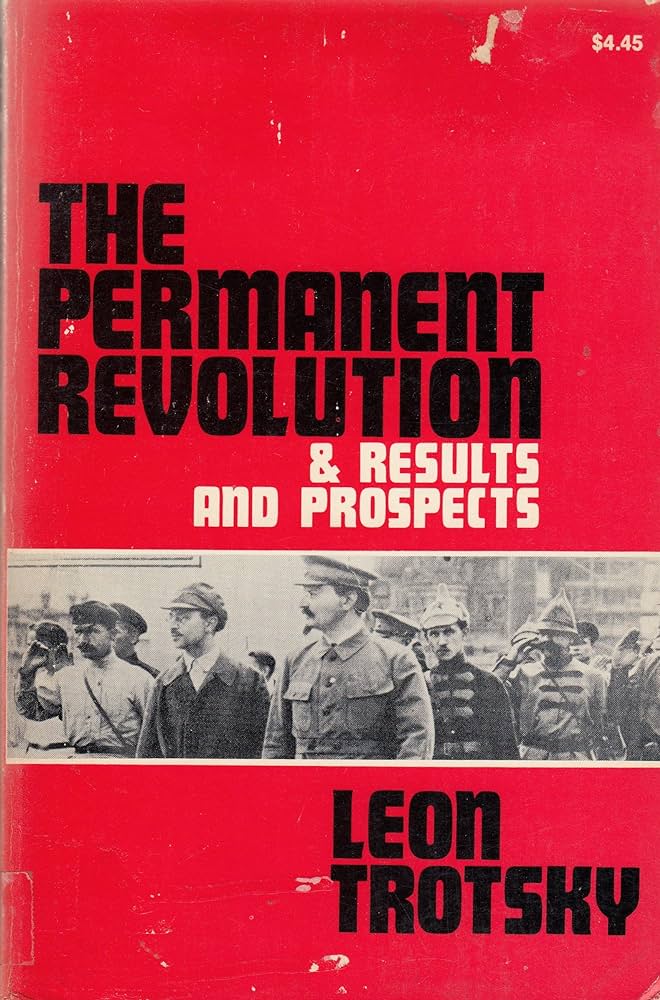
Trotsky, in his booklet The Permanent Revolution, set out a number of its ‘Basic Postulates’.  These include the following:

‘2. With regard to countries with a belated bourgeois development, especially the colonial and semi-colonial countries, the theory of the permanent revolution signifies that the complete and genuine solution of their tasks of achieving democracy and national emancipation is conceivable only through the dictatorship of the proletariat as the leader of the subjugated nation, above all of its peasant masses.’

‘3. Not only the agrarian, but also the national question assigns to the peasantry – the overwhelming majority of the population in backward countries – an exceptional place in the democratic revolution. Without an alliance of the proletariat with the peasantry the tasks of the democratic revolution cannot be solved, nor even seriously posed. But the alliance of these two classes can be realized in no other way than through an irreconcilable struggle against the influence of the national-liberal bourgeoisie.’

‘4. No matter what the first episodic stages of the revolution may be in the individual countries, the realization of the revolutionary alliance between the proletariat and the peasantry is conceivable only under the political leadership of the proletariat vanguard, organized in the Communist Party. This in turn means that the victory of the democratic revolution is conceivable only through the dictatorship of the proletariat which bases itself upon the alliance with the peasantry and solves first of all the tasks of the democratic revolution.’

‘8. The dictatorship of the proletariat which has risen to power as the leader of the democratic revolution is inevitably and very quickly confronted with tasks, the fulfilment of which is bound up with deep inroads into the rights of bourgeois property. The democratic revolution grows over directly into the socialist revolution and thereby becomes a permanent revolution.’

‘9. The conquest of power by the proletariat does not complete the revolution, but only opens it. Socialist construction is conceivable only on the foundation of the class struggle, on a national and international scale.’

‘10. The completion of the socialist revolution within national limits is unthinkable . . . The socialist revolution begins on the national arena, it unfolds on the international arena, and is completed on the world arena . . .’

‘11. The above-outlined sketch of the development of the world revolution eliminates the question of countries that are ‘mature’ or ‘immature’ for socialism in the spirit of that pedantic, lifeless classification given by the present programme of the Comintern. Insofar as capitalism has created a world market, a world division of labour and world productive forces, it has also prepared world economy as a whole for socialist transformation.’

‘13. The theory of Stalin and Bukharin, running counter to the entire experience of the Russian revolution, not only sets up the democratic revolution mechanically in contrast to the socialist revolution, but also makes a breach between the national revolution and the international revolution.’

        *         *          *

The number of ‘countries with a belated bourgeois development, especially the colonial and semi-colonial countries’ has decreased dramatically in the last one hundred years, most obviously with the massive growth of the working class, relative decline of the peasanty and the disappearance of most colonies.  Many of the semi-colonies are now important capitalist states, including those in the expanding BRICS collaboration.

It might therefore be considered that the theory of the permanent revolution, which ‘signifies that the complete and genuine solution of their tasks of achieving democracy and national emancipation is conceivable only through the dictatorship of the proletariat as the leader of the subjugated nation, above all of its peasant masses’ is of limited relevance today.

After all, how true is it that ‘the agrarian, but also the national question assigns to the peasantry – the overwhelming majority of the population in backward countries – an exceptional place in the democratic revolution’? Does this no longer apply in many countries?  We no longer consider that the question is one of democratic revolution but of socialist revolution in countries with widespread industrialisation and a large working class.  Even when Trotsky set out the basic ideas of Permanent Revolution, he was stating that his ‘sketch of the development of the world revolution eliminates the question of countries that are ‘mature’ or ‘immature’ for socialism.’

He went further to say, in the Transitional Programme in 1938 that ‘the economic prerequisite for the proletarian revolution has already in general achieved the highest point of fruition that can be reached under capitalism . . . All talk to the effect that historical conditions have not yet “ripened” for socialism is the product of ignorance or conscious deception . . . The objective prerequisites for the proletarian revolution have not only “ripened”; they have begun to get somewhat rotten . . .  The turn is now to the proletariat, i.e., chiefly to its revolutionary vanguard. The historical crisis of mankind is reduced to the crisis of the revolutionary leadership.’

Many who claim to be Trotskyist accept that the theory of Permanent Revolution applies today and also continue to argue that humanity’s crisis ‘is reduced to the crisis of the revolutionary leadership.’

We have seen, however, that despite this, many – if not most – agree to the theory but abandon it in practice.  They avoid cognitive dissonance by employing a different set of assumptions that enable the adoption of a different set of outwardly Marxist formulas to the actual struggles that arise and which previously would have been considered to come under the purview of the permanent revolution strategy.  Let’s take a look at Ukraine and Palestine.

In Ukraine, the supporters of that state who demand self-determination for Ukraine must presumably believe that the national question is key, and that therefore that the ‘democratic revolution’ is on the agenda, even if this no longer requires an alliance with the peasantry. But if this is so, where is the fight for the view that ‘the complete and genuine solution of their tasks of achieving democracy and national emancipation is conceivable only through the dictatorship of the proletariat?’  Why is support given to a bourgeois political regime and capitalist state when what is required is an ‘irreconcilable struggle against the influence of the national-liberal bourgeoisie’, with the need for ‘the political leadership of the proletariat vanguard, organised in the Communist Party?’

When have the supporters of ‘Ukraine’ ever put forward this argument to Ukrainian workers or those in their own country?  When has permanent revolution even been mentioned? Why do they defend the intervention of Western imperialism when ‘the democratic revolution grows over directly into the socialist revolution and thereby becomes a permanent revolution?’  How could Western imperialism fail to be a barrier to such an outcome? Why then do they support it?

The only political explanation is that they do not believe that permanent revolution is relevant, which means that socialism is not relevant and socialist revolution inconceivable and not in any way be a guide to longer term strategy. However, if this is so, the theory of permanent revolution states that there can’t be a democratic revolution either. They can’t believe the statement that in ‘the colonial and semi-colonial countries, the theory of the permanent revolution signifies that the complete and genuine solution of their tasks of achieving democracy and national emancipation is conceivable only through the dictatorship of the proletariat as the leader of the subjugated nation.’

They therefore cannot believe that ‘the objective prerequisites for the proletarian revolution have not only “ripened”; they have begun to get somewhat rotten . . .  The turn is now to the proletariat, i.e., chiefly to its revolutionary vanguard. The historical crisis of mankind is reduced to the crisis of the revolutionary leadership.’  If the problem was simply one of revolutionary leadership, why wouldn’t they be offering revolutionary politics?

In so far as the supporters of the Russian invasion advance the same arguments in relation to the democratic tasks supposedly devolving to the Putin regime and Russian state, purportedly justified by the rights of the Donetsk and Luhansk People’s  Republics, the same questions are posed to them!

If we turn our attention to Palestine, which is a question of (settler) colonialism, the genocide of the Palestinian people and the role of Western imperialism demonstrate that a revolution is required for their liberation.  Why is Western imperialism not their saviour as it is claimed it is for the ‘people of Ukraine’?  Why do the bourgeois Arab states not perform the same revolutionary democratic role played by the Ukrainian one?  Again, where are the arguments above advanced that this liberation can only come through permanent revolution?  A struggle that needs to be fought by the working class, under socialist leadership, ‘on the foundation of the class struggle, on a national and international scale’?

Instead, the debate revolves around a one state or two state solution, with neither having any particular class content, which, in effect, means that they are both proposals for a capitalist state and with no indication that a wider socialist revolution is necessary, in the Arab region or wider afield.

How are we to make sense of this à la carte Trotskyism – ‘God make me a Communist, but not just yet’?

Back to part 2

Forward to part 4

Permanent Revolution (2) – beginning with Marx

The theory of Permanent Revolution is associated with Leon Trotsky, although Marx is well known to have originated the term in his Address of the Central Committee to the Communist League in March 1850.  In this address he proclaimed that for German workers ‘their battle-cry must be: The Permanent Revolution.’

Marx called for this revolutionary strategy even though he noted that the situation was one in which ‘the German workers cannot come to power and achieve the realization of their class interests without passing through a protracted revolutionary development.’  They were to be comforted by the knowledge that ‘this time they can at least be certain that the first act of the approaching revolutionary drama will coincide with the direct victory of their own class in France and will thereby be accelerated.’

Their task was not one of immediate revolt but ‘must contribute most to their final victory, by informing themselves of their own class interests, by taking up their independent political position as soon as possible, by not allowing themselves to be misled by the hypocritical phrases of the democratic petty bourgeoisie into doubting for one minute the necessity of an independently organised party of the proletariat.’

Today, we are not in a situation in which the German or any other section of the working class is going to come to power, and ‘a protracted revolutionary development’ is required.  This is not admitted by many calling themselves Marxist but is imposed on them anyway.  The price paid is that they can’t consciously adjust their theoretical or strategic framework to adapt appropriately.

Today, we are again called upon to support ‘democracy’: for a ‘democratic’ Ukraine against autocratic Russia and to ‘defend the right of self-defence’ of the ‘only democracy in the Middle East’. The protests by students in US universities against the genocide carried out by this democracy is said by Antony Blinken to be a ‘hallmark of our democracy’ just as the students are attacked and locked up.  The ‘hypocritical phrases’ of the democratic bourgeoisie and petty bourgeoisie are thus louder now than they were when Marx called for their rejection 175 years ago, making his remarks as apposite now as they were then.

Unfortunately, much of the left has forgotten what it means to inform workers ‘of their own class interests, by taking up their independent political position as soon as possible’ and ‘by not allowing themselves to be misled by the hypocritical phrases’ of democracy.  Calls for national self-determination of Ukraine or Donbass simply become the hypocritical phrases by which to justify rallying behind Ukraine, because it is a ‘democratic’ capitalist state, or behind Russia, because it is fighting Western imperialism.

The capitalist character of both is rendered irrelevant by talking about ‘Ukraine’ or ‘Russia’ or the ‘people of Ukraine’ etc. while ignoring the need for the working class to ‘achieve the realisation’ of its ‘own class interests’ by ‘taking up their independent political position as soon as possible.’

On one side the Ukrainian capitalist state and Western imperialism are supported as defenders of these interests and on the other the Russian capitalist state is supposed to play the same role.  Neither can point to any independent role for the working class itself or even the existence of its own organisations that are not totally subordinated to, or in support of, their respective states.  In doing so it almost becomes superfluous to accuse them of abandoning Marxism.

The cognitive dissonance involved in defending a corrupt capitalist state, defending the massive intervention of western imperialism, and a war that continues only because of this intervention, can be seen in three defence mechanisms often employed to avoid accepting the patent contradictions: avoiding, delegitimising and belittling.

So, we get the avoidance of the implications of the points just raised and the commitment to a more straightforward campaign in support of the Palestinian people.  The arguments against support for the Ukrainian state are delegitimised by aping the propaganda of the mainstream media for whom opposition to Western imperialism and its proxy war can only equate to support for Russia.  Since this Left starts from opposition to the Russian invasion, its inability not to default immediately to support for Ukraine and the West reveals the utter irrelevance of any declared adherence to socialist politics separate and opposed to both.

Finally, the cognitive dissonance is limited through the importance of the war also being strictly circumscribed.  So, opposition to Russia becomes opposition to Russian imperialism while support for Western imperialist intervention is dismissed as the latter doing the right thing for its own reasons – without this having any significance for what it is actually doing.  The existence of a proxy war that defines a global conflict is also rendered irrelevant by the primary and over-riding issue being argued as the right to self-determination – of an independent capitalist state that had already determined its own future by allying with Western imperialism against its rival next door: not a very clever thing to do and a very reckless one for the interests of the Ukrainian working class.  The obvious danger of escalation of the conflict to a world war is also minimised but is implicit in the absolute priority given to the victory of the Ukrainian state and thereby, necessarily, of Western imperialism.

To claim that the invasion should not have taken place and is wrong.  That it should be opposed and the invaders blamed for the actions they have carried out, and for which they are responsible, is all very well but hardly constitutes an understanding of why it happened, what should be done about it, and by whom.  If you are a socialist, this socialism should have some role in answering these questions.  As has been stated many times on this blog, if you find yourself coming up with the same explanations and same policy as Western imperialism you need to deal with a lot of dissonance.  How could you start from a socialist position and end up with a policy indistinguishable in all essential and practical respects from Western imperialism? 

It is therefore relevant to look again at the ideas involved in permanent revolution to see how these should guide a socialist view of the current conflicts. 

Back tom part 1

Forward to part 3

Marxism and Gender Ideology (3) – Nothing without our body

In reaction to the Cass Report in Britain there has been widespread denunciation of the ‘toxic’ debate around the transgender issue without specifying why this is.  There has also apparently been wide agreement that there needs to be better data to find out the effects of treatment of children and young people.. 

The second link above shows that the apparent agreement is a fiction and that the supporters of gender ideology, within and outside the NHS, have both no need for data and no need for a debate.  The report itself reveals that most of the NHS’s gender identity development service (Gids) refused to cooperate with the inquiry in providing evidence and that this was ideologically driven, i.e. they accepted gender identity ideology.

It is abundantly clear that the toxic debate is not going away any time soon because the supporters of gender identity ideology have made it plain that there is no debate to be had, and that data on clinical outcomes of those young people who have had puberty blockers, or cross-sex hormones or other surgical intervention is impermissible.  This, however, is only one reason for the toxic ‘debate’.

As we saw in the previous post, the shifting, imprecise and downright misleading use of definitions means that you get routine claims about the ‘right to change gender’ when what is meant is the ‘right to change sex’ which does not exist because it cannot be done.

The issue is not therefore about a ‘right to change sex’ but the social and political rights to be acquired from claiming to have one’s ‘true’ sex recognised, which is to be established not by any sort of health care, such as hormonal treatment or surgical intervention, but by accepting the view that one knows one’s identity better than anyone else and being a woman, for example, is just such an identity.  Something that a man can be if he puts his mind to it.

This requires the belief that one can be ‘born in the wrong body’, meaning that the ‘real’ and essential person exists as something separate from the body, which is akin to the religious idea of a soul, also separate from the body. In this way the claims of gender identity ideology are a religion for which data, or any other scientific evidence, is irrelevant.  For this ideology, denial of the quasi-religious nature of its claims means that the pretence must be made to objective validity but this must then involve denial of the means of validation.  Irrational claims give rise to irrational discourse which gives rise to the toxicity.

The shifting, imprecise and downright misleading use of words, including the word ‘gender’ adds a twist to the non-debate by making it impossible to consistently identify what is being claimed or denied.

Gender can, as well as meaning sex, also be understood as the expression of social norms associated with and based on one’s sex, such as the characteristic stereotyped attributes of femininity to be expressed by women and of masculinity to be expressed by men.  We have looked at some problems with this is the previous post but let us park these for the sake of this discussion.

Effeminate expression by men, by some gay men for example , has historically been disapproved of in many countries, with patterns of socialisation generally working to impose those characteristics considered masculine that would prevent or negate such expression.  Similarly, the phenomenon of masculinised women, such as in some lesbians, has also been frowned upon.  Regardless of the advances in gay and lesbian rights in some counties, this socialisation process continues and is still considered ‘normal’ with deviations from it being ‘abnormal’.

In real life, no one fits the pure stereotyped norms of femininity and masculinity.  It therefore makes no sense to use the term gender in the way employed by one socialist: that trans means ‘people who wish to live permanently in the gender identity polar opposite to that ascribed to the biological sex’.   No one’s gender is the polar opposite of their sex, while the free expression of one’s personality is a part of what socialism is about.  Gender norms are restricting, stifling and enforce rigid stereotypes that are regressive for both sexes and for the relations between them.  

Everyone expresses some combination of the characteristics that may be said to make up the ‘polar opposites’ of the social expression of one’s sex.  To claim that one is a ‘polar opposite’ in identity to one’s sex is therefore to define oneself in stereotypical and reactionary terms, so that to assert political claims on such grounds is also reactionary.

Gender identity ideology might think it avoids this by positing the idea of numerous genders, so that ‘polar opposite’ is not the only alternative to female and male, woman and man.  This involves the creation of multiple genders, and different sources will provide different numbers of them.  If you Google ‘how many genders are there’ you might find that there are either 3 or 4 or 68 nor 72 or the number is undefined.  The BBC once claimed to children that there were over 100.

Since one’s gender is determined by one’s sense of oneself there can be any number of self-definitions, each of which must be considered to be valid by this ideology, precisely because it is self-determined.  But purely subjective identities are paraded because they crave social recognition, validation and acceptance, (otherwise they remain in a private domain without validation etc.) so the assertion of such identities is a political question.

This ideology thereby becomes the only political position that asserts its legitimacy and authority on the basis of an unchallengeable declaration demanding immediate acceptance. However, this ‘first-person authority’ championed by gender identity ideologists (trans people know themselves better than anyone else so we should all accept what they say) excludes those who disagree (for example women who deny that they have any sort of gender identity).

Whatever about such claims to novel ‘genders’, the majority are either male or female, and since women are most vulnerable to the consequent results, claims that men can become (or always ‘really’ have been) women are the most contentious.  Transmen in some male-only settings are at greater risk than the men they will encounter but this cannot be said for transwomen (men) entering women-only spaces.

This also means that while many transactivists supporting gender identity ideology think of themselves as left wing and progressive, their ideology is simply a mirror of the conservative and right-wing view of women that they claim to oppose.  While the most conservative view regards the proper expression of a woman’s sex as stereotypical femininity, trans activists often define what it is to be a woman through stereotypical expression.  The causal direction is simply reversed. For one, women should be feminine and for the other being feminine, in so far as they can make it, is to be a woman.  

Since ‘gender’ can be understood as sex, or as the expression of norms of socialisation of the sexes, we confront claims to be able to change sex, which is impossible, or claims to be able to change gender through having a sense of one’s sex being different from what it actually is. In the latter case gender is then conflated with sex.  Through identification with (or through) the social norms that are supposedly rejected the claim is made that one has changed sex.

The ‘explanation’ is to claim that to be a woman is to have some innate sense of being one.  This innate sense, in order not to be something contingent and open to challenge, is held to be common to everyone; everyone has a gender identity, whether admitted or not. We thus end up with the mantra that ‘transwomen are women’.  It is claimed by some supporters of gender identity ideology that everyone’s gender identity is expressed in terms of behaviour, appearance, including clothing, make-up, etc and is evidenced by it.

This ‘argument’ has its own problems. If a transwoman wears high heels, pretty pink dresses, lots of make-up and effects a flighty and skittish air they may be accused of believing that being a woman is existence as a crude stereotype that is insulting.  Not doing any of these things might leave the transwoman looking like a man and putting immediate and impossible-to-ignore obstacles to acceptance of their claims.  How recognition of all the other genders is to be accomplished, even by their bearers, is a moot point, including the idea of gender fluid, non-binary, non-gender, agender, third-gender etc.

More generally, what particular norms of behaviour, dress etc must be included in ‘gender identity’ and what is not, and how the mélange of social factors come together to instantiate and constitute a coherent sex status, is impossible to define.  A transwoman may seek acceptance as a woman, but fundamentally rejection or qualified non-acceptance will not be because of any presentation etc. but will be based on knowledge of the person’s sex; the real transphobe will be the one who rejects a transwomen fundamentally for their failure to represent masculinity.

What these point to are the limitations of subjective claims over objective reality, illustrated in other ways.   A person’s sex exists before it is ‘assigned’ (as the ideologists put it) and will exist whether it is ‘assigned’ at all, for example if no doctor is present ‘to do it’.  A baby girl and an old woman are still females; the first does not identify as anything and will, bar accidental factors such as death, develop into a woman, and the latter is still a woman whether she is, because of dementia, no longer able to be conscious of this fact or not.  When she is dead, she will be a dead woman.

It is claimed that because these subjective senses are unverifiable, we cannot test them – we cannot reach inside someone’s head to see how they really feel, process these feelings into thoughts and see how they are then formulated into claims to objective reality.  We cannot know the motivation behind a claim to a gender identity for example.  How do we know that a transwoman actually feels or thinks like a woman (leaving aside what this actually means) when they are a biological male?  In fact, the assertion would have to be to feel and think as a woman, although this lexical formulation is immediately less plausible.

How is it known that their ideas of their identity, arising (sometimes) as the result of psychological distress caused by various factors, conform to and constitute essential ‘womanhood’?  Since Gender identification is sometimes described by transgender activism as a political act, or that ‘there’s no one way to be transgender, and no one way for transgender people to look or feel about themselves’, or ‘there is no right or wrong way to be trans’, their claim is effectively denied.

Children come to know themselves through observing others and comparing themselves to others, including observing that there are two sexes and that they fit to one of them.  They learn that this cannot be changed.  In this, the sense of one’s sex is learned and not innate, even though it cannot be changed, so that for the vast majority of people it comes with the territory.  Distress caused by a perceived discrepancy between the idea of one’s sex, misnamed gender identity, and sex characteristics of one’s body can lead to what is termed gender dysphoria, but this does not allow one to change sex.  Even if medical and surgical interventions may help, that is relieve the distress to a greater or lesser degree, these will not change a person’s sex. They cannot therefore be a ‘cure’ for the claim that their condition requires a change of sex.

Such dysphoria evidences an awareness that one’s sex is different from one’s identity, from the claim to a fixed and innate identity as the opposite, or more accurately, other, sex.  Further, it is often asserted that this identity warrants the claim that despite natal sex, for example as a male, the transwoman was ‘always’ a woman.

In effect, the sexed body is rendered both relevant and irrelevant to the construction of all of humanity since trans people are still to be included under the classification of the two sexes that encompasses everyone. (We leave aside the many other ‘identities’ that render the whole ideology even more incoherent).  The claims about the meaning and importance of sex are therefore not just about trans people but about everyone and thus involve sweeping claims about the nature of the non-trans population that they are blissfully unaware of – that gender identity and not biological sex defines them and is definitive. Everyone is to be roped into the ideology whether they like it or not and the subjective claims of some become the objective claims on others.

In other words, if gender identity defines sex and everyone has a gender identity, everyone is defined by this phenomenon of gender identity with the social and political consequences demanded by the ideology.  ‘Transwomen are women’ can thus be read backwards.

If transwomen claim that they feel like women and have the same sense of themselves as a biological woman has, it implies that the feelings that biological women have, and their sense of themselves as a sex, is the same as that of transwomen.  I doubt very much whether the vast majority of women would endorse such a claim.  Not least because their understanding and feelings about being a woman are based on their female body, its functioning and the social experiences that this necessarily entails. None of these considerations involve ‘biological determinism’ in the sense that women’s social and political roles are biologically determined.

Many women therefore, as we have said, deny having any gender identity of the kind expressed by trans activism.  Their statements on their sense of themselves and the sexed bodies that they have will be more persuasive than the claims of men who do not inhabit female bodies, have not experienced life as a woman, and who cannot know how women feel about being a woman but can really only imagine or profess some idea of it.  

Women will do so with much stronger objective grounds to make such statements.  That they are often not called upon to do so makes it hard to avoid the view that a well-known hierarchy of authority between the sexes is being adopted.  In any case, regardless of any supposed authority, identifying as a woman does not make you one.

To sum up: you cannot change sex, you cannot become a different one by behaviour or appearance or other cultural attribute, and you cannot identify yourself into one.  Since we are most interested in the politics of gender identity ideology, we are left with the conclusion that any claims it makes are not based on reality.  For Marxism, if they are not, they are reactionary.

We will look at whether this conclusion can be explained further in the next post.

Back to part 2

Forward to part 4

The Third Year of War (1 of 3)

The second anniversary of the Russian invasion of Ukraine led to several retrospective summaries of the war and recapitulation of the arguments about its justification.  This should have involved an examination of the various claims made about its course over the two years and how they stand up today, but this was studiously avoided.  If we take even a cursory look at these claims, we can see how the lies told by the Western media about the war have increasingly been shredded by reality. Instead of winning against a stupid and incompetent Russia the all-powerful NATO might be losing? But let us come to that presently.

The genocide in Gaza has to a great extent eclipsed the war while the bias and lying of the Western media has increasingly been impossible to hide.  That the BBC live-streamed the Israeli case at the International Court of Justice but not the South African is just one example. While driving my car this morning Sky News reported that one hundred Palestinians had just ‘died’, which must be taken to refer to the killing by the Israeli army of their desperately starving victims attempting to get food from one of the few aid convoys the Zionists allowed through.

All this should provide grounds for clarifying the nature of the war in Ukraine but instead these have been treated as two entirely separate happenings, including by much of the left, which supports the actions of the United States in one and damns it in the other; excuses its intervention in one and rejects all its excuses in the other.  And we are supposed to believe this makes sense.

So, the war in Ukraine is the war in Ukraine; and the genocide in Gaza is but the latest murderous assault on the Palestinian people that must be addressed by a Palestinian solidarity movement. The long adopted method of single issue campaigns, designed supposedly to involve the maximum number of people, is exposed as divorced from reality.  Rather than help explain the world, it fragments reality and is an obstacle to understanding it.  Without such understanding the fundamental cause of war – capitalism – will forever lurk in the background, smothered by the appearance of this or that conflict, inviting this or that ‘solution’ that often relies on the criminals who caused it.

Much of the Western left has supported the Ukrainian state, and Western intervention, which is now accepted in Washington and Kyiv as the only thing keeping it going, with repeated threats that it will lose very soon if Western weapons do not continue to come.  Since money on its own does not kill Russians the reckless sponsorship of the war has been exposed because the Western powers no longer have the ammunition or other war materiel to keep Ukraine fighting.

Zelensky promises a new offensive in 2025 but the integrity of his armed forces might not last that long. Western powers are scrounging ammunition from various parts of the globe, but these simply mean that Ukrainians will keep on fighting and dying a little longer.  The alternative is the provision of more advanced weapons such as longer-range missiles and F-16 aircraft but these cross previous red lines, risk Russian retaliatory escalation and will not lead to Ukrainian victory.  In turn this risks further Ukrainian attempts to provoke greater Western intervention.

Threats to directly intervene with troops on the ground have only revealed that some have already been there and many of them have been killed.  A Russian officer has already stated that “NATO military personnel, under the guise of mercenaries, participate in hostilities. They control air defence systems, tactical missiles and multiple launch rocket systems, and are part of assault detachments.” The loss of over 60 French ‘mercenaries’ has already been reported in Kharkiv.  Now the German Chancellor Olaf Sholtz has let slip that the British and French are using their own troops to target and fire their missiles.  And someone else has revealed discussions within the German armed forces to attack Russia.

What successes Ukraine have achieved, such as the sinking of Russian warships and scarce and expensive surveillance aircraft, could only have been accomplished with Western systems, intelligence and personnel.  The most advanced weapons systems can only be used effectively by forces trained and familiar with them while their servicing and maintenance requires similar support. None of this has prevented increasingly rapid Russian advances on the ground.

Stopping, and reversing, this could not be achieved even by French, German, British or US troops on the ground without creation of a massive intervention force that these countries are currently in no position to construct and employ.  This has not excluded repeated announcements of the possibility of Western troops being sent to take part directly in the fighting.  This, even if on a limited scale, has the potential to lead to a World War.  The piloting of F-16 fighters by NATO pilots, with the green light by NATO Secretary General Jens Stoltenberg to attack targets in Russia, shows one path to escalation and war.

The prospect of Western infantry in Ukraine raised by Macron and shot down by others reflects awareness of the possibility of defeat, which Biden in particular has cause to fear, if this becomes clear before the November Presidential election. Even If Western escalation were partial, limited to occupation of Western Ukraine, Russia has the capacity to continue to move forward to achieving its aims, which would be expanded to account for a Western incursion. 

Left supporters of the Ukrainian state face the defeat of what has, politically, become their own proxy in their imagined progressive struggle alongside Western imperialism.  The presumed priority of Russian defeat would require massive Western imperialist intervention, with the risks discussed, and serves to justify the most reactionary nationalism in Eastern Europe (to be covered later).

Given the nature of the parties involved, exemplified in the massive disparity in power of the two forces, it is not Western imperialism that has become a proxy for the Left but the Left that has become a bourgeois proxy within the socialist movement.  Such is the position this pro-imperialist Left has put itself by supporting a pro-Western capitalist state in a war and by also supporting the assistance provided to it by Western imperialism.

The split personality of this left can be seen in their support in the case of Ukraine and opposition in the case of Palestine, as if all the Western powers are confused as to what is in their interests.  This disorder is as real for those that straight-forwardly support Ukraine and deny the proxy nature of the war as it is for those who directly express their confusion by both supporting the capitalist Ukrainian state while opposing the assistance of the capitalist states supporting it.

Defence of the Palestinian people will not be advanced by upholding in Ukraine the imperialist supporters of the Zionist state that is carrying out genocide, or by claiming that it is capable of playing a progressive role in one but not the other.

Of course, the genocide in Gaza is immediately more obvious and easier to argue, and especially more convenient for the moralistic approach that single-issue campaigns rely upon.  But for exactly this reason it is important to show how the two require the same approach and are not two single issues but two expressions of the one oppressive system that must face one combined struggle against it.

Both are wars by proxies of US imperialism in order to defend its hegemonic position in Europe and the Middle East.  Both reveal the poverty of its putative capitalist rivals.  The Russian invasion is incapable of stirring the sympathy of the workers of the world, and China, as the ultimate target of the US, cannot politically defend the Russian invasion.  In the case of Gaza, these putative leaders of the alternative pole of imperialist power have stood aside while the Zionist state commits genocide.  Russia and China have not made even a significant symbolic gesture by expelling the Israeli ambassador, while its BRICS associate, Saudi Arabia, has facilitated trade with Israel to nullify the efforts of the Houthis in Yemen to block it.  Iran has been as keen as the US to limit its opposition through its allies so that it can avoid war between them.

In both cases the Left, of almost all shades, sees no role for socialism in ending these capitalist wars but puts forward purely formal democratic proposals that do not go beyond capitalist solutions and have no bearing on reality. This includes the demand for ‘self-determination’ for Ukraine when the part of it allied to the West is already utterly reliant and subordinated to it.

In Gaza, the renewed murder and displacement of Palestinians has revived the debate over a two state or one state solution, neither of which are socialist and neither of which address the over-reaching power of the Zionist state, its US sponsors, or the opposition of the autocratic Arab regimes, which oppose the creation of any democratic Palestinian state lest it act as a beacon of inspiration for their own oppressed populations.

The hypocrisy that has been exposed by the two conflicts is a starting point to enlightening working people about the depraved and ruthless nature of the societies they live in, and that the scope and scale of the barbarity exposed is not accidental but is a fundamental feature.  This means that only a complete reordering of society will work and that this is what the socialist alternative involves.  If capitalist war does not demand and call for a socialist alternative then activists opposed to these wars will never be able to promise that one day they will end.

Forward to part 2

Groundhog Day. Stormont is back! Again!

I remember giving out leaflets at a Sinn Féin demonstration on the Falls Road in about 1993.  The demonstration was called to support the Hume-Adams Agreement, hammered out between the leaders of the SDLP and Sinn Féin after several secret meetings.  No one knew what was in the Agreement, but thousands of republican supporters came out to show their support for it.

I don’t think my comrades, or I, ever had such a keen and eager crowd as the demonstrators queued up to get a copy.  It was clear that they thought they might find out what it was they were demonstrating in support of.  That in itself told us an awful lot about the political consciousness of rank and file republicans at the early stages of the peace process – they were going to faithfully follow their leadership, wherever it led them and swallow whatever they were told.

Many, many subsequent leaflets, and meetings through the long peace process changed nothing of their approach, or raised in them any consciousness that they might require a more critical approach, one that involved some scepticism of where their leadership was taking them.

Only a few years before, in 1987, Sinn Féin had published a document called ‘A Scenario For Peace’ in which it set out its proposals for a settlement to end the conflict.  It included that Britain should declare its intention to withdraw; the Royal Ulster Constabulary and Ulster Defence Regiment would be disbanded; ‘political’ prisoners should be unconditionally released; and Britain should provide a subvention for an agreed period to facilitate harmonisation of the northern and southern economies. In return, unionists would be offered equal citizenship within the new Ireland.

Well, the Hume-Adams talks were not about this agenda, and neither was the peace process.  The British have not gone, the RUC and UDR were indeed disbanded but the former was replaced by the PSNI and the latter were a unit of the British Army, and it certainly hasn’t gone away.  Political prisoners were released but not unconditionally, Britain imposed austerity (and Sinn Féin helped implement it).

The peace process in its various guises is now longer than the war it was supposed to end, and the former looks harder to get to the end of than the latter did.  When it was announced that the devolved Stormont Assembly was coming back, and a Sinn Féin leader, Michelle O’Neill, would be first minister, it was declared by Mary Lou McDonald that this showed that a united Ireland was “within touching distance”.  Of course, the Provisional republican movement has been promising a united Ireland since the early 70s, that is, for over half a century.  A unionist commentator noted recently that a recent opinion poll showed no increase in support for a united Ireland in the North over the last couple of decades.

Some columnists have claimed that the real significance of the return of the DUP to the Assembly and Government is this accession to the post of first minister of Sinn Féin, even while they admit that this is symbolic since the unionist deputy first minister has equal power.  No decision can be taken by the first minister if not agreed by the deputy and the post cannot be filled in the first place without unionist agreement.

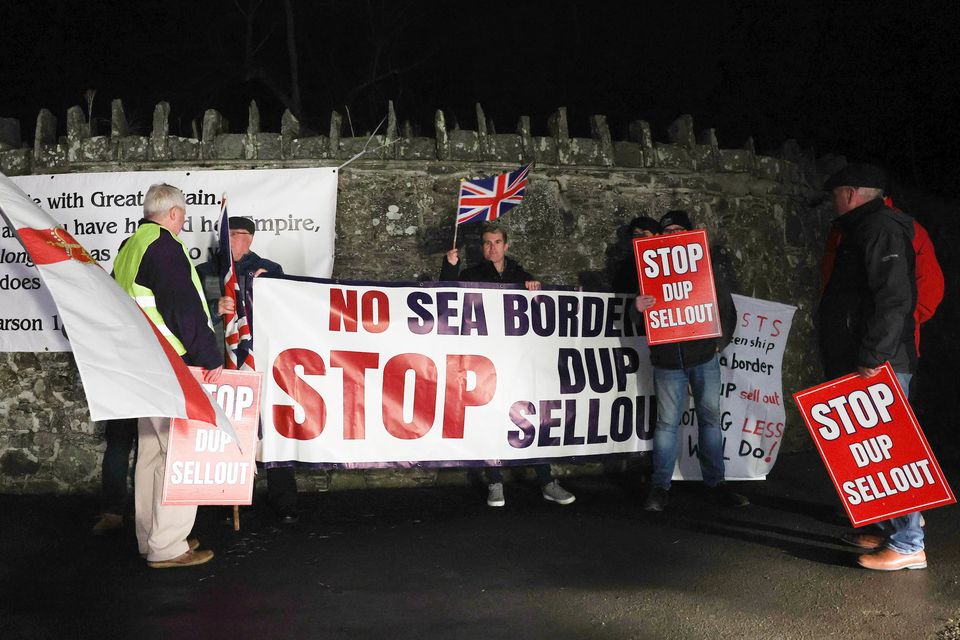
In order to minimise unionist opposition to the deal between the DUP and British government over the ‘Irish Sea border’ the process of getting DUP agreement and all it entails is being rushed through.  The DUP Executive thus voted for the deal without seeing it; fittingly appropriate to the return of what passes for democracy in the North of Ireland.

This democracy, in the shape of the Stormont Assembly, has been suspended at least eight times, ranging from a single day to a couple of years.  It has been functioning for only sixty per cent of its existence and subject to a number of reviews and changes with yet more changes now widely canvassed. The sectarian, corrupt, incompetent and clueless governance it has provided and the future problems considered inevitable by everyone who thinks about it (and many don’t) means that the rules are not the problem.

Public services, from health to roads, are routinely described as being in crisis, while others such as education and voluntary organisation are subject to open sectarian practices. It has been claimed that these issues can only be put right by local governance, but its track record shows that it is as much responsible for the decay as British rule.  The repeated suspension allows the alibi to be sold that were it not for suspension public services would be much better.  The previous suspension following the Sinn Féin walk-out, after the DUP-implicated Renewable Heat Incentive scandal, showed levels of incompetence that could more easily be explained as corruption.

The return of Stormont is therefore no step forward, never mind a panacea, and is mainly an unstable framework to accommodate sectarian competition, one that has not proved to be very stable.  It stands on its rotten foundations only because there is no outside force to push it over, while those that have knocked it over temporarily have been internal.  It is widely accepted among the population and further afield because no alternative seems possible, which is why the DUP have gone back in.  This also helps explain why the misgivings of many unionists, and significant opposition, will be unsuccessful in stopping the Assembly’s return.

The opposition has no credible leadership, which would have to come from within the DUP itself, and there is as yet no real sign of this.  Further demoralisation of unionism is therefore one (welcome) result.

That this is the case throws light on the claim by the DUP leadership that their new deal is a significant victory. Packaged as a joint British government/DUP initiative, and launched by a joint press conference, there is not the slightest pretence at non-partisanship by the British: ‘Safeguarding the Union’ is the name of Command Paper1021.

Its content in 77 pages could safely be accommodated at one tenth of the length.  The measures introduced include proposed legislation to say that Northern Ireland is part of the UK – who would have thought it?  It has proposed legislation to ‘future-proof the effective operation of the UK’s internal market by preventing governments from reaching a future agreement with the EU like the Protocol’, which by definition cannot achieve what it claims.  It also includes a ‘commitment to remove the legal duties to have regard to the “all-island economy” in section 10(1)(b) of the European Union (Withdrawal) Act 2018.’  A bit of red meat for the DUP, and sticking it to Irish nationalism North and South, that will make little or no difference.

It promises that ‘Legislative change to recognise the end of the automatic pipeline of EU law . . . which applies in Northern Ireland is now properly subject to the democratic oversight of the Northern Ireland Assembly through the Stormont Brake and the democratic consent mechanism.’  This implies either future bust-ups with the EU if single market changes are not incorporated into the Northern Ireland market, or a formality to cover regulatory alignment.  The Brexiteers in Britain are aghast at this as they no doubt realise it might not be the former.

Media reporting has suggested that the EU Commission has yet to look at the Agreement but that ‘no red lines’ have been crossed; however, it is hard to believe it has not been agreed and only kept quiet in order to help the DUP sell it as an act of undiluted British sovereignty.

The ‘democratic consent mechanism’ that is held to act as a check on unwelcome EU encroachment states that it can be triggered by a majority of local members of the Assembly and not by some ’cross-community consent’ mechanism.  It is hard to be optimistic that this whole area will not entail future argument.

Other measures include promises on maintaining trade flows that can’t be honoured and a number of new quangos that will deliver more red tape that Brexit promised to get rid of.

The main gain pointed to by Jeffrey Donaldson is the removal of routine checks on certain exports from Britain to Northern Ireland that were set to reduce anyway but are now declared to be zero.  This is on goods, such as retail to consumers for example, that will stay in Northern Ireland and not considered to be at risk of going further into the Irish state and thus the EU single market proper.

Donaldson has, however, claimed too much – that there is unfettered trade between GB and NI and therefore no sea border.  The command paper states that ‘there will be no checks when goods move within the UK internal market system save those conducted by UK authorities as part of a risk-based or intelligence-led approach to tackle criminality, abuse of the scheme, smuggling and disease risks.’

‘Abuse of the scheme’ must mean that checks will be made if it is suspected that goods purportedly sent for sale only in Northern Ireland are actually heading further.  The acceptance of such controls by the DUP has so far been rather successfully sold by the leadership as simply a common sense measure that ensures that checks are made at the Northern Ireland ports instead of a long and windy North-South border.

This problem arises only because of Brexit, which the DUP supported, and of course the argument makes sense in its own terms; except those terms mean acceptance that there is a trade border on the Irish Sea because there had to be one somewhere, and its not south of Newry and north of Dundalk.  The opponents of the Agreement among unionists are therefore right that single market membership means EU law applying in Northern Ireland.  They go wrong when they, like the other hard Brexiteers, assume that the British government must pursue widespread non-alignment, without which Brexit makes even less sense that it already does.

In the last few weeks public sector workers in the North have engaged in very large strike action in pursuit of wage demands designed to recover some of their lost real incomes.  It has, however been subsumed under the politics of Stormont return, even while the trade unions have demanded that the British Government pay up and not use the lack of an Assembly as an excuse. It was supposedly putting pressure on the DUP to get back so the workers could get payed when the DUP didn’t, and doesn’t, give a toss.

The return of Stormont has not been lauded and celebrated as in previous ‘returns’ and the population is jaded by repeated failure and broken promises of a ‘new approach’.  The real new approach required is, unfortunately, a long way off.