Nationalism planning for a United Ireland

The Belfast paper – The Irish News – has a column every Saturday by Patrick Murphy that regularly flagellates Sinn Fein for its hypocrisy and incompetence, sectarianism and corruption, its elevation of the cause of a united Ireland over a united people, and the constitutional question over questions of economic and social equality and poverty. Most of all it is criticised for its nationalism, even its betrayal of it through its recognition of the legitimacy of the ‘two traditions’ in Ireland, which translates as two nations and thereby betrays its own stated goal of a united nation.

Sinn Fein is not the only target and the SDLP and Southern parties get a lashing now and then as well.  It’s a bit repetitive, even if accurate in its own way, and his style can sometimes be irritating.  Anyway, the irony is that for all his economistic denunciations of nationalism, he is actually a bigger nationalist than the SDLP, Southern parties and Sinn Fein.

His bête noir is the European Union, which he sees as robbing Ireland of its sovereignty with Irish membership akin to allying with the British Empire against Germany in World War I, betraying Connolly’s entreaty to ‘serve neither King nor Kaiser but Ireland’. Of course, he has no difficulty is demonstrating the imperialist character of the EU and its current complicity in the imperialist and Zionist genocide in Palestine etc.  But he is no Marxist and so is unable to appreciate that his belief in a sovereign independent Ireland is a pipe-dream; a reactionary attempt to turn the clock back to a world of independent nation states that also ironically never existed and will never exist.  A recent article by Boffy sets out what is going on here.

By coincidence the Saturday issue of The Irish Times has an article by the Taoiseach Simon Harris setting out the need for the Irish State to defend its current success from the potentially devastating effects of a Trump presidency through some sort of ‘diplomatic offensive’.  This can only involve reminding Trump of how useful the Irish state is for the United States – “Ireland’s offering is one that speaks to Trump . . .”  Since what speaks to Trump most of all is willing and obsequious servility, the Irish are well practised in ingratiating themselves with US presidents, getting the opportunity to do so every St Patricks day with a ridiculously over-sized bowl of shamrock.  What handing over the bowl by the Irish Taoiseach symbolises is the handing over of the country to its true and ultimate chieftain.

The idea of Patrick Murphy that Ireland could genuinely be an independent and sovereign state, against the United States and outside of the European Union, is so divorced from reality it has been abandoned by every other Irish nationalist party.  Irish socialists should not take on the burden of trying to claim it and should instead recognise the ending of the era of nation states as heralding the ending (very painful ending) of capitalist nation states and inevitably of the nationalist ideology that is sustained by them.

The decline of nation states and agglomeration of super-states and imperialist alliances, demonstrated by the US and China and by NATO and BRICS, is an expression of the development of the productive forces of capitalism upon which the possibility of socialism rests.  The intensifying competition and rivalry between these imperialist states and their alliances poses an existential challenge to the interests of the working class, which, as Marx said, has no fatherland but can only assert its interests as an international class.

This means opposition to imperialist war, which currently means opposition to the imperialist conflict in Ukraine and the country’s proxy war on behalf of western imperialism against Russia.  It means rejecting the idea that an old slogan, and one not understood, of self-determination can be proclaimed as justification for supporting one or other side of this imperialist rivalry and the war it has generated.

That consciousness, including political consciousness, often lags behind economic and social development is nothing new and partly explains why many on the left have become enthusiasts for one imperialist alliance or the other.  This leads to hypocritical claims of opposition to oppression by the other side while ignoring the oppression of the favoured imperialism.  So, for example, the United States is claimed to be the key enemy of the working class of the whole world, including of Russia and China, while the role of these states in oppressing their own working class is a “separate question”, as one apologist for these states put it to me.

But let’s get back to the Murphy column in The Irish News.  He notes the recent ‘plan’ by Sinn Fein minister Conor Murphy to create 10,000 new student places centred on Derry.  He notes that it is based not on the purpose of new university facilities and what their wider role might have for development but mainly on where they will be sited.  Along with nearly all Stormont ‘plans’ it doesn’t have the money behind it to make it happen but promises to at least have some.  In this respect it is better than the new Health Service three year plan, recently announced while the first year was already three-quarters over and which promised new stuff if it had the money and cuts in the meantime.  This didn’t stop it being welcomed.

One of the many criticisms of the Conor Murphy plan was that it was a Northern Ireland plan that will reach full fruition by 2032, by which time his party leader has promised that Northern Ireland will not exist! Oh dear, nationalists revealing that they don’t believe their own hype?  I have to admit I almost laughed out loud.

Sinn Fein has been banging the drum on the ‘conversation’ about a united Ireland for years, demanding that the Irish government and everyone else start planning for it, lest the project suffer from the same lack of preparation as Brexit.  And here it is presiding over plans that ignore it!  Repeated calls for plans are followed by silence and their complete absence. Why? Because any plans would immediately confront obstacles that no one wants to talk about; assurances no one would believe, and promises that would invite the response of ‘why don’t you do that now then?’

Behind the empty rhetoric is the reality that nationalism itself has nothing to offer, which the utterly incapable Stormont regime has demonstrated in spades.  For socialists, the national question and a united Ireland is an Irish democratic revolution which cannot promise radical economic and social advance outside of an accompanying socialist revolution. All the limitations to an independent and united Ireland set out above would apply.

At most it is the act of uniting the country alone that would be justified as a democratic advance itself and during ‘the Troubles’ this was how it was implicitly understood.  Now, it is claimed by nationalists that it will have all sorts of other economic and social benefits that Sinn Fein says everyone else must plan for but which it can’t convincingly demonstrate exist and can’t plan for itself.  Instead, what political arrangements that are touted are flimsy and insubstantial – a new flag or national anthem – or actually undemocratic – some mechanism to guarantee continuing unionist power and influence.

All around us we see the pervasiveness of nationalist thinking and the failings of its nostrums.

The Northern elections point in only one direction Or do they?

There are three take-aways from the Westminster election in the North of Ireland.

First, Sinn Fein continued to make progress, defending its existing eight seats, including securing bigger majorities in a number of constituencies, and making gains in others that promise two more in the future.  It sealed its position as the biggest party in the Westminster elections, to rank alongside earlier local and Assembly successes, although small comfort for its failure in the local and European elections in the South a month ago.

Second, the Alliance Party, as the main face of ‘others’ in the North – neither Orange nor Green, Unionist or Nationalist – lost one seat and gained another, so stood still with a small drop in the share of the vote of 1.8% on the 2019 election.  The ‘Alliance surge’ has stopped surging.  At 15% of the vote it does not come anywhere near marginalising the sectarian division and the basic conflict over the existence of the Northern state.

Thirdly, and most dramatically, the  DUP lost three of its eight seats, very neatly lost another in East Derry and saw a dramatic fall in its majority in East Antrim.  It lost from all directions: from the Alliance Party, Ulster Unionist Party and the uber-unionist TUV.  In the case of the last, the defeat of Ian Paisley junior brought a smile to most faces in spite of the identity of the victor, such is the likeability of the loser.  Even some of his colleagues were reported not to be too displeased. The only real bright spot was securing the seat of its new leader in East Belfast.  A fall in the share of the vote of 8.5%, or a proportionate fall of 28%, is a disaster.

So what does it all mean?

Some nationalist commentary repeated familiar lines about ‘the writing on the wall’ and ‘the arrow pointing in one direction’ into the ‘inevitable future’ (Brian Feeney in The Irish News) – all references to the writing pointing to a future united Ireland.  Unfortunately it’s not so simple, even for the biggest party.  It won 27% of the vote, and when you factor in the lowest turnout for a Westminster election in the history of the North of 57.47%, we can readily see that 15.5% of the electorate does not a revolution make.

Over 42.5% found no reason to vote, which undoubtedly reflects a number of things, including apathy in constituencies in which a nationalist candidate hasn’t a chance, but even in the 2022 Assembly election, with a more proportionate system, Sinn Fein got 29% in a 63% turnout, or 18% of eligible voters.  In this election the pro-united Ireland vote was just over 40%.  If this is the writing on the wall, the wall is far away, the arrow points to a very long road, and the inevitability of a united Ireland is not quite the same as that of “death and taxes.”

Sinn Fein continues to advance in the North without any justification deriving from its now long record in office at Stormont.  The latest reincarnation of devolution managed to set a budget for departments without agreeing what they were going to spend it on – what were its priorities?  It spent plenty of time passing motion after motion lauding all sorts of good things with zero commitment to doing anything about them, while utterly failing to account for the public services it has been responsible for.  These, such as the health service, have fallen into a crisis worse than anywhere in the rest of the UK. 

For Alliance, its still second order existence testifies to the inability of the status quo to satisfy Northern nationalists or provide evidence that Unionists really are as confident that the state is as British as Finchley.  Its existence at all, however, is held to define what is necessary to change this status, which is not simple growth of Irish nationalism.  Convincing the ‘others’ of a united Ireland is argued as the key task for nationalism, which must include current Alliance supporters.

In this, Sinn Fein is not succeeding, in fact it doesn’t realise it isn’t even trying.  It continually berates other nationalist parties, especially in the South, for not joining ‘the conversation’ on a united Ireland, and calls out the necessity of planning for it; as if talking about it brings it any closer never mind making it inevitable.  It’s like being lifted by the cops who want to have a conversation with you – where you do all the talking.  Where are Sinn Fein’s plans?

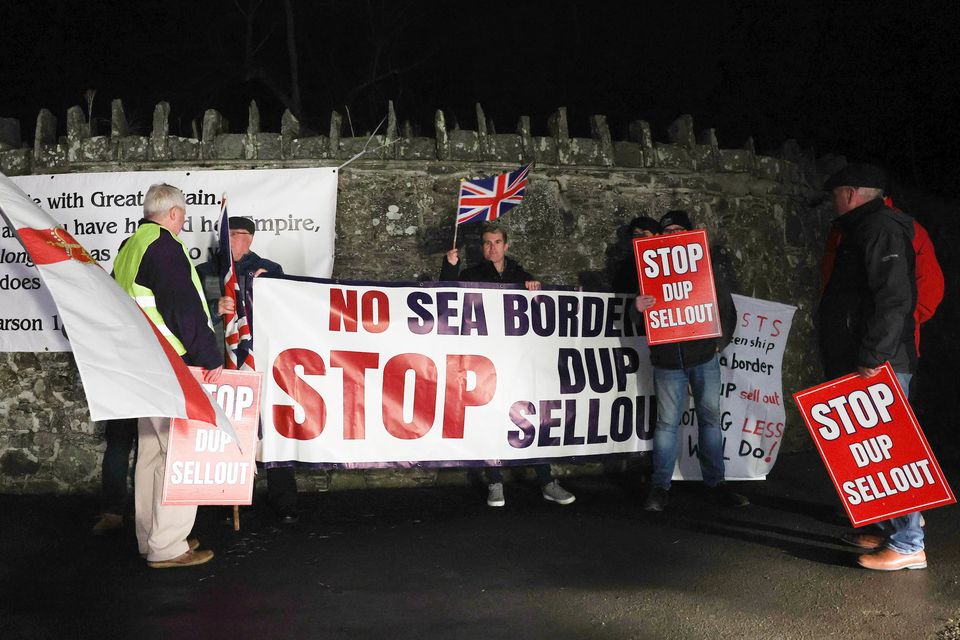
The biggest issue however, that has signalled a step to a united Ireland, has been Brexit, and it is this that has done to the DUP what it did to the Tories in Britain.  While the victory of the TUV was most obviously a result of the failure of the DUP to prevent ‘the Irish Sea border’ that resulted from Brexit, it also lost because it lied about its deal with the British government that would supposedly make it disappear.

The Alliance victory in Lagan Valley was partly due to the constituency MP Jeffrey Donaldson being sent for trail on sex-offence charges, but this copper-fastened a prior loss of personal credibility as author and prime advocate for the deal.  With the Brexit disaster in the background every credible opposition to the DUP looked that bit more attractive and its most vocal supporters, such as Ian Paisley and Sammy Wilson, suffered.

The local political commentator Newton Emerson noted that the DUP losses in very different directions made it difficult for the DUP to know where to pivot.  This dilemma exposes the real demoralisation within unionism that sought to strengthen partition by supporting the UK leaving Europe but found itself inside a part of Ireland less aligned with the  sovereign power.  There is no mileage in continuing to fight it, so they won’t follow the TUV in doing so, but this means that it remains exposed to this more rabid unionism with only the old age of its leader Jim Allister as the pathetic hope of future redemption.  

It can keep quiet about the whole thing and hope it disappears as an issue but there are at least three problems with this.  First, its opponents will remind people, people will remember DUP stupidity themselves, and much as Keir Starmer might try to ignore it and think he can evade its worst effects, it’s not going away and neither are its effects.

A bit like the election in Britain, a thoroughly boring campaign had some more noteworthy results.  The stasis, if not stagnation, in politics within the North continues but events elsewhere are not so stable and have their effect.

Groundhog Day. Stormont is back! Again!

I remember giving out leaflets at a Sinn Féin demonstration on the Falls Road in about 1993.  The demonstration was called to support the Hume-Adams Agreement, hammered out between the leaders of the SDLP and Sinn Féin after several secret meetings.  No one knew what was in the Agreement, but thousands of republican supporters came out to show their support for it.

I don’t think my comrades, or I, ever had such a keen and eager crowd as the demonstrators queued up to get a copy.  It was clear that they thought they might find out what it was they were demonstrating in support of.  That in itself told us an awful lot about the political consciousness of rank and file republicans at the early stages of the peace process – they were going to faithfully follow their leadership, wherever it led them and swallow whatever they were told.

Many, many subsequent leaflets, and meetings through the long peace process changed nothing of their approach, or raised in them any consciousness that they might require a more critical approach, one that involved some scepticism of where their leadership was taking them.

Only a few years before, in 1987, Sinn Féin had published a document called ‘A Scenario For Peace’ in which it set out its proposals for a settlement to end the conflict.  It included that Britain should declare its intention to withdraw; the Royal Ulster Constabulary and Ulster Defence Regiment would be disbanded; ‘political’ prisoners should be unconditionally released; and Britain should provide a subvention for an agreed period to facilitate harmonisation of the northern and southern economies. In return, unionists would be offered equal citizenship within the new Ireland.

Well, the Hume-Adams talks were not about this agenda, and neither was the peace process.  The British have not gone, the RUC and UDR were indeed disbanded but the former was replaced by the PSNI and the latter were a unit of the British Army, and it certainly hasn’t gone away.  Political prisoners were released but not unconditionally, Britain imposed austerity (and Sinn Féin helped implement it).

The peace process in its various guises is now longer than the war it was supposed to end, and the former looks harder to get to the end of than the latter did.  When it was announced that the devolved Stormont Assembly was coming back, and a Sinn Féin leader, Michelle O’Neill, would be first minister, it was declared by Mary Lou McDonald that this showed that a united Ireland was “within touching distance”.  Of course, the Provisional republican movement has been promising a united Ireland since the early 70s, that is, for over half a century.  A unionist commentator noted recently that a recent opinion poll showed no increase in support for a united Ireland in the North over the last couple of decades.

Some columnists have claimed that the real significance of the return of the DUP to the Assembly and Government is this accession to the post of first minister of Sinn Féin, even while they admit that this is symbolic since the unionist deputy first minister has equal power.  No decision can be taken by the first minister if not agreed by the deputy and the post cannot be filled in the first place without unionist agreement.

In order to minimise unionist opposition to the deal between the DUP and British government over the ‘Irish Sea border’ the process of getting DUP agreement and all it entails is being rushed through.  The DUP Executive thus voted for the deal without seeing it; fittingly appropriate to the return of what passes for democracy in the North of Ireland.

This democracy, in the shape of the Stormont Assembly, has been suspended at least eight times, ranging from a single day to a couple of years.  It has been functioning for only sixty per cent of its existence and subject to a number of reviews and changes with yet more changes now widely canvassed. The sectarian, corrupt, incompetent and clueless governance it has provided and the future problems considered inevitable by everyone who thinks about it (and many don’t) means that the rules are not the problem.

Public services, from health to roads, are routinely described as being in crisis, while others such as education and voluntary organisation are subject to open sectarian practices. It has been claimed that these issues can only be put right by local governance, but its track record shows that it is as much responsible for the decay as British rule.  The repeated suspension allows the alibi to be sold that were it not for suspension public services would be much better.  The previous suspension following the Sinn Féin walk-out, after the DUP-implicated Renewable Heat Incentive scandal, showed levels of incompetence that could more easily be explained as corruption.

The return of Stormont is therefore no step forward, never mind a panacea, and is mainly an unstable framework to accommodate sectarian competition, one that has not proved to be very stable.  It stands on its rotten foundations only because there is no outside force to push it over, while those that have knocked it over temporarily have been internal.  It is widely accepted among the population and further afield because no alternative seems possible, which is why the DUP have gone back in.  This also helps explain why the misgivings of many unionists, and significant opposition, will be unsuccessful in stopping the Assembly’s return.

The opposition has no credible leadership, which would have to come from within the DUP itself, and there is as yet no real sign of this.  Further demoralisation of unionism is therefore one (welcome) result.

That this is the case throws light on the claim by the DUP leadership that their new deal is a significant victory. Packaged as a joint British government/DUP initiative, and launched by a joint press conference, there is not the slightest pretence at non-partisanship by the British: ‘Safeguarding the Union’ is the name of Command Paper1021.

Its content in 77 pages could safely be accommodated at one tenth of the length.  The measures introduced include proposed legislation to say that Northern Ireland is part of the UK – who would have thought it?  It has proposed legislation to ‘future-proof the effective operation of the UK’s internal market by preventing governments from reaching a future agreement with the EU like the Protocol’, which by definition cannot achieve what it claims.  It also includes a ‘commitment to remove the legal duties to have regard to the “all-island economy” in section 10(1)(b) of the European Union (Withdrawal) Act 2018.’  A bit of red meat for the DUP, and sticking it to Irish nationalism North and South, that will make little or no difference.

It promises that ‘Legislative change to recognise the end of the automatic pipeline of EU law . . . which applies in Northern Ireland is now properly subject to the democratic oversight of the Northern Ireland Assembly through the Stormont Brake and the democratic consent mechanism.’  This implies either future bust-ups with the EU if single market changes are not incorporated into the Northern Ireland market, or a formality to cover regulatory alignment.  The Brexiteers in Britain are aghast at this as they no doubt realise it might not be the former.

Media reporting has suggested that the EU Commission has yet to look at the Agreement but that ‘no red lines’ have been crossed; however, it is hard to believe it has not been agreed and only kept quiet in order to help the DUP sell it as an act of undiluted British sovereignty.

The ‘democratic consent mechanism’ that is held to act as a check on unwelcome EU encroachment states that it can be triggered by a majority of local members of the Assembly and not by some ’cross-community consent’ mechanism.  It is hard to be optimistic that this whole area will not entail future argument.

Other measures include promises on maintaining trade flows that can’t be honoured and a number of new quangos that will deliver more red tape that Brexit promised to get rid of.

The main gain pointed to by Jeffrey Donaldson is the removal of routine checks on certain exports from Britain to Northern Ireland that were set to reduce anyway but are now declared to be zero.  This is on goods, such as retail to consumers for example, that will stay in Northern Ireland and not considered to be at risk of going further into the Irish state and thus the EU single market proper.

Donaldson has, however, claimed too much – that there is unfettered trade between GB and NI and therefore no sea border.  The command paper states that ‘there will be no checks when goods move within the UK internal market system save those conducted by UK authorities as part of a risk-based or intelligence-led approach to tackle criminality, abuse of the scheme, smuggling and disease risks.’

‘Abuse of the scheme’ must mean that checks will be made if it is suspected that goods purportedly sent for sale only in Northern Ireland are actually heading further.  The acceptance of such controls by the DUP has so far been rather successfully sold by the leadership as simply a common sense measure that ensures that checks are made at the Northern Ireland ports instead of a long and windy North-South border.

This problem arises only because of Brexit, which the DUP supported, and of course the argument makes sense in its own terms; except those terms mean acceptance that there is a trade border on the Irish Sea because there had to be one somewhere, and its not south of Newry and north of Dundalk.  The opponents of the Agreement among unionists are therefore right that single market membership means EU law applying in Northern Ireland.  They go wrong when they, like the other hard Brexiteers, assume that the British government must pursue widespread non-alignment, without which Brexit makes even less sense that it already does.

In the last few weeks public sector workers in the North have engaged in very large strike action in pursuit of wage demands designed to recover some of their lost real incomes.  It has, however been subsumed under the politics of Stormont return, even while the trade unions have demanded that the British Government pay up and not use the lack of an Assembly as an excuse. It was supposedly putting pressure on the DUP to get back so the workers could get payed when the DUP didn’t, and doesn’t, give a toss.

The return of Stormont has not been lauded and celebrated as in previous ‘returns’ and the population is jaded by repeated failure and broken promises of a ‘new approach’.  The real new approach required is, unfortunately, a long way off.

The local elections – another step to a united Ireland?

The local election results in the North of Ireland have given rise to more commentary that another step has been taken towards a referendum on Irish unity and a united Ireland.  The success of Sinn Fein in becoming the largest party at local government level in council seats and votes has provoked this reaction, as have its previous victories.  The two have almost come to seem synonymous.

At the same time the two are repeatedly separated by the selfsame commentators who argue that any vote for a united Ireland in a referendum would have to go way beyond Sinn Fein’s support.  If a vote for this party is an indicator of impending unity, then there is an obvious problem.  Its vote in the local elections was 30.9 percent of the ballot so even after an increase in its support of 7.7 percent it is not yet a third of those voting.

It is argued that other pro-unity candidates add to the forward movement of Irish nationalism, except that the other major nationalist party, the SDLP, is slowly dying.  Its vote fell by 3.3 percentage points to 8.7 per cent.  Together the two major nationalist parties gathered 39.7 per cent.  Even with the addition of the pro-unity parties on the left and right, People before Profit and Aontú, the total rises only to 41.5 per cent.  The total for the three main unionist parties is 38.1 per cent; Irish nationalism gained more votes than the these parties.

In the 2019 local government election the three Unionist parties plus smaller unionists gained 41.87 per cent of the vote while the comparable Irish nationalist and pro-unity parties won 37.73 per cent.  At this election the DUP was the largest party and the Unionist vote was higher than that of Irish nationalism.

Local elections, however, are the least accurate electoral indicator of the relative strengths of the two camps; the turnout in 2023 was only 54 per cent, an increase of 2 per cent on the 2019 vote.  Commentators have noted that the turnout in 2023 was higher in predominantly nationalist than unionist areas by as much as 10 percentage points in some places. Irish nationalism therefore won only 22 per cent of the electorate while many unionist voters stayed at home. During any referendum on a united Ireland it can hardly be expected that unionists will be so apathetic or demoralised, unless political circumstances make them so, unlikely to be a result of the vote itself.

In the 2022 Assembly elections, where the turnout was almost 63.6 per cent, the vote for the three Unionist parties was 40.1 per cent while the pro-Irish unity vote comparable to the most recent local elections was 40.7 per cent.  The recent local election results are not the first time the Unionist parties have fallen behind.

Twelve years ago in the 2011 Assembly elections, Unionism polled 47.65 per cent while Irish nationalism trailed behind at 42.81 per cent.  The decline in the Unionist vote over these years is therefore clear and it is this decline that has provided most of the impetus to claims that a nationalist referendum victory is a realistic prospect in the short to medium term.  The 2011 result however also reveals what the advance of Sinn Fein has hidden – that the nationalist share of the vote hasn’t increased:  42.81 per cent in 2011 and 41.5 per cent in 2023.

The missing piece of the jigsaw is the rise of the Alliance party: from 7.84 per cent in 2011 to  13.3 per cent in the recent local election.  The question then becomes the political nature of this party – unionist with a ‘small u’ or nationalist; or what it presents itself as – simply ‘other’.

So let’s start with the third alternative–that Alliance cannot be said to have a position on the national question.  Even if this were so the national question will face Alliance and its supporters with the choice sooner or later and ‘other’ will not be on the ballot paper.

Alliance is definitely not an Irish nationalist party, does not pretend to be or pretend to hide it, and while it has a significant Catholic support, this has consciously decided not to vote for Irish nationalism.  While it may be more likely than other Alliance supporters to vote for unity in a referendum, its existing vote is for the status quo and the status quo is continued British rule.

The party was originally set up as an openly unionist party that presented itself as non-sectarian; one that divorced its unionism from any religious identity.  It has moved from this to present itself as neither Unionist nor nationalist but with a soft, ‘small u’, unionist support that is repelled by the sectarianism of the Unionist mainstream, with many also rejecting Brexit.  In a referendum, all other things being equal, the majority of Alliance voters can be expected to support continued British rule, as will the party itself. 

The ’other things being equal’ is what will matter for many; the political circumstances will at some point be decisive.  These include the reality of what a united Ireland might offer and the configuration of the forces fighting for and against it.  This includes the approach of the British state and the extent of violent unionist opposition.  What the election results demonstrate is that this point is not yet near, whatever about Sinn Fein becoming the largest party and Irish nationalism garnering more votes than ‘big U’ Unionism.  This does not mean that nothing is really changing.

Unionism continues to decline.  Its support for Brexit and rejection of the deal negotiated by the British state with the EU indicates a political movement fighting against its own interests. These are still considered to include a sectarian supremacy that is no longer possible and opposition to economic forces that might make the Northern State more attractive, even while it strengthens the all-island character of potential economic prosperity.  No longer able to make its claims on the basis that it is the majority within the gerrymandered state, it simply declares its veto based on its own existence.  This existence has always been one of sectarian privilege.

The other significant change has been within Irish republicanism, which having ditched its armed struggle against British rule has found itself with no clothes it cannot discard.  From opposition to British imperialism it now stands foursquare behind the western imperialist  proxy war in Ukraine.  Its representatives have acclaimed its recent success as a result of its brilliant electoral campaign.  This put a united Ireland on the back-burner but purposively elevated its attendance at the British king’s coronation, ‘to show their respect’.

It seems not to occur to them that monarchy is the epitome of denial of democracy and deserves zero respect. When Celtic and Liverpool football fans demonstrate a higher level of awareness of very basic democratic and republican principles we can appreciate the level to which Sinn Fein has sunk (with all due respect to those fans).

If this seems a rather glib or flippant remark, we can recall the explanation by another Sinn Fein member who stated that its approach was anticipation of the mutually respectful attitude between an independent Ireland and Britain when it was united.  We are almost back to the original Arthur Griffith Sinn Fein that supported a Habsburg Empire-like dual monarchy.

What this illustrates is the relevance of the Marxist theory and programme of permanent revolution. This argues that the democratic tasks associated with the development of capitalism, such as national independence, should be part of a working class programme and struggle and that it was possible for this struggle to develop into one that went beyond purely democratic questions, and the limits acceptable to capitalism, to be a struggle for working class rule.

This does not mean that such struggles cannot be led by other classes, but that these could not be relied upon to advance the struggle in a thoroughly democratic way or for a consistent and comprehensive democratic outcome.  It matters who leads the struggle, because different classes will lead it to very different ends.

Marxists always defined Sinn Fein as a petty bourgeois organisation, which drew a reaction of complete incomprehension from republicans who were working class and living in solidly working class estates in Belfast, Derry or Dublin.  However, the movement’s political character was defined not mainly by its support considered in sociological terms, including its rural support or its ties to Irish American money, but by its politics.

This politics previously imagined a radically reconfigured capitalism, which the capitalist class opposed, while not seeking to overthrown the system itself, never mind forwarding real working class rule. The Irish capitalist class had no great interest in challenging British imperialism and the Irish working class has interests that go way beyond a united country that cannot provide for its needs.

As the possibility of a united Ireland is claimed to be approaching the democratic content to the struggle is more and more denuded of democratic content.  The obsequious kowtowing to British royalty does indeed show respect but not to democratic and republican principles.  The various scattered proposals to accommodate unionism in a united Ireland are also indicators of the inconsistent approach to a democratic outcome.

Many European countries have achieved unification after the defeat of the popular revolutions that sought to enact it in a more democratic way, such as Germany and Italy.  For socialists support for a united Ireland is a struggle to advance beyond a partitioned Ireland and not one that leaves every other component and trappings of the Irish and British capitalist states intact.

When measured against these tasks, the local government elections in 2023 are not even a minor tremble in the ground beneath the system that must be brought down.

The Windsor Framework

Dan Kitwood UK in a Changing Europe

The ‘Windsor Framework’ agreement between the EU and Britain to maintain or replace (take your pick) the Northern Ireland Protocol to the Brexit Withdrawal Agreement is a truly remarkable document.  It allows Northern Ireland to have free access to both the EU single and UK markets for goods.

The British Prime Minister visited to ensure we knew how great this was even though, as a staunch Brexiteer, he had helped ensure that Britain walked away from this “privilege”, this “prize” that put Northern Ireland in a “unique”,  “unbelievably special position” . . . ‘like the world’s most exciting economic zone”, that ensures we are an “incredibly attractive place to invest for businesses”.  Perhaps the most fulsome declarations against Brexit I have ever heard.

Yet the truly remarkable factor is that such an arrangement is supposed to be impossible.  When Russia claimed that Ukraine could have close trading relationships with the EU and also with its own Eurasian Customs Union, the EU claimed it couldn’t be done.  Ukraine had to look decisively West and could not continue its attempts to straddle between it and Russia.  We know, of course, that this provoked the Maidan uprising in 2013-2014, when the Ukrainian President decided that the price of greater access to the EU and erecting barriers to Russia was too high.

Ukraine split over his decision, with the open intervention of the United States, repression by the Ukrainian security forces, violence by protesters and seizure of weapons by pro-western elements, including the far right and fascists.  This led to a counter-mobilisation in the East of the country among pro-Russia Ukrainians and a civil war that led to Russian armed intervention in Crimea and then Donbas.  The conflict never really ended and, of course, we know that this eventually led to the Russian invasion and the proxy war between the US with its NATO allies, and Russia.

So, why is it that what has just been achieved in the North of Ireland could not be done in Ukraine?

The answer, of course, is that the decision in respect of Ukraine was a geopolitical one aimed not just at Ukraine but against Russia, even if some claim that the bureaucrats in Brussels did not fully appreciate this aspect of what they were doing.  In any case, the new ‘Windsor Framework’ is essentially a political agreement with political significance that does not primarily lie in the North of Ireland.

It has been pointed out by commentators that the EU and British have put entirely different spins on the significance of what has been agreed, with the former claiming that it has not “renegotiated the protocol” while the British have claimed that the deal “fundamentally amends the text and provisions of the original protocol”; lots of ‘dancing on the heads of pins’ according to one journalist.

Nevertheless, the protocol stays, there remains a ‘border on the Irish sea’ and not inside the island, and the fundamental relationship between the EU and Britain remains.  The EU has made concessions and the British have agreed measures that the EU thinks it can live with which minimise physical and other trade-related interventions.  The EU Q&A is replete with references to the limits of its flexibility. So, the trusted trader scheme can be suspended if ‘1) the UK fails to provide the EU with access to the relevant UK IT customs systems and databases, or 2) the UK does not live up to the commitments it undertook when setting up the trusted trader scheme.’  On excise ‘the UK will not be able to apply any duty rate below the EU minima’; on duty rates for small producers of alcoholic beverages ‘the UK will not be able to set duty rates for small producers below EU minima rates. The respect for EU minima rates will protect the level playing field with the EU’ etc.

Breaches of the controls are inevitable, but it must be considered that these are going to be relatively unimportant.  Northern Ireland is both small and peripheral and ultimately so in the political sense as well, a far cry from Ukraine.  The EU was quick to claim the deal as a one-off, so the Swiss can’t follow up on it.  The significance of the deal agreed lies in the British acceptance that the road is running out on hostilities with the EU, a project that is taking its Tory sponsors to electoral defeat.

The deal is not however the last word.  The disapplication of EU laws is still winding its way through Westminster and controls on imports to Britain have still not been introduced; Brexit has still not been ‘done’.  The ’Windsor Framework’ has still to be implemented while deadlines for the various steps are part of the agreement.  Beyond this, the problem of continued divergence between the EU and Britain remains, as does its potential impact.  While on the British side the debate is about the extent of future divergence, or even its advisability, on the EU side the debate will be about the potential benefits of further deepening, where consideration of its effect on relations with Britain will be a minor concern. 

The major innovation beyond the rather technical aspects of trade policy is the introduction of a ‘Stormont Brake’, as an ‘emergency mechanism that will allow the UK government, at the request of 30 Members of the Legislative Assembly in Northern Ireland (Stormont), in the most exceptional circumstances, as a last resort . . . to stop the application of amended or replacing provisions of EU law . . .’

‘The Stormont Brake can be triggered only after having used every other available mechanism, and where the amended or replacing EU act, or a part of it, significantly differs in scope or content from the previous one and application of such amended or replacing act would have a significant impact specific to everyday life of communities in Northern Ireland in a way that is liable to persist. . . . If triggered and if the conditions are met, the amended EU act would not apply automatically in Northern Ireland.’

This represents the introduction into the workings of the Protocol a mechanism akin to the ‘petition of concern’ introduced in the last British initiative to save the Stormont administration–New Decade, New Approach–meant to get Stormont to work after the previous breakdown.  The original devolution arrangements, meant to demonstrate that the Northern Ireland polity could function ‘normally’ and without conflict, introduced powers of veto for each sectarian bloc as a key incentive to make them work it.

The petition of concern was meant to be a last resort insurance-type mechanism but was reportedly used 115 times in five years, a testament not to it working, or to the number of issues absolutely vital to one side or the other, but to the degree of sectarian division.  It has quickly been speculated that the restrictive grounds of its use, mirrored in the wording of the new deal as set out above, would make no difference to the willingness of unionists to paralyse the Protocol agreement with the EU.  There is no reason why this might not be the case except for the different circumstances of the ‘Windsor Framework’.

Like the ‘New Decade, New Approach’ deal, it requires 30 members of Stormont to trigger it from at least two parties, and since there are 37 unionists out of a total of 90 members, this looks eminently possible, even accounting for those specifically excluded.  Once triggered it would take a harder to procure ‘cross-community’ vote to allow any suspension of a new EU law to be lifted.

While there are various other, on the face of it, rather onerous requirements, including for consultation, the key difference is that the British government is required to apply the veto on any new law, and the British government is not going to do this if it is not in their interest as well, regardless of what unionists think.  If it does, the EU can then take retaliatory measures that are proportionate.

It is just about feasible for unionists to repeatedly attempt to apply the brakes, but this would lead to ridicule for themselves and their Brexit cause, and would fail, not mainly because of this but because the British government is in charge.  The British, by making the agreement in the first place and failing to meet the Democratic Unionist Party’s seven tests, have shown that the demands of unionism are not its priority.  

The Stormont Brake has been characterised as a carrot to unionism but one that requires the DUP to return to Stormont and end its boycott, as it can only be triggered in a functioning Assembly.  The offer of a veto is thus a sardonic judgement on the power of the veto the DUP already wields.

It was widely thought, even before the appearance of the new deal, that the DUP would play for time so that it would withhold judgement before the local elections in May.  These, it is thought, would reveal the verdict of the majority of unionists on the deal to be negative, or certainly negative enough to damage the DUP should it accept it.  This would hardly be a surprise since an oft-repeated unionist expression is ‘not an inch’.  Unfortunately, it cannot retake the ground itself and the crisis is of its own making – by supporting Brexit, accepting the different circumstances of Northern Ireland, opposing the alternative Theresa May deal, even if it could have worked, and the initial support it gave for the Protocol’s benefits.  This leaves it ill-prepared for a battle against the British government.

Postponing decision on the deal might appear smart, especially since the party is divided, but it might not take that long before this looks weak, and vulnerable to accusations from rivals that it is.  The main rival is Traditional Unionist Voice, which is a one-man band, which itself illustrates the hollowness of unionist opposition. This, however, can just breed frustration and anger.  Far from protecting themselves, DUP delay may simply strengthen unionist opposition by opening the door to those willing to be clear and forthright, with resignation developing among others of its supporters.  In any event, in local terms, the Windsor Framework is a defeat for unionism.  You can tell this, when even the King gets it in the neck.

The significance of David Trimble

Trimble and Paisly at Drumcree (Belfastlive.co.uk)

The death of David Trimble will not be marked by the same fawning saturated media coverage of his fellow Nobel peace prize winner John Hume.  When the two winners were announced many nationalists thought he didn’t deserve the prize but was awarded it because it could not be given only to a nationalist.  It was part of the whole ’equality of the two traditions’ motif that characterised the whole process.

It wasn’t so much because of the personality traits that even respectful obituary writers found impossible not to mention of him.  That Peter Mandelson said he had ‘never encountered anyone as rude in my life’; or that he had a ’notorious temper’ passed down from a grandfather who was in the Royal Irish, and then Royal Ulster, Constabulary; or that he was argumentative just like his father.  Neither was it his arrogant angry public persona.

Bertie Ahern in ‘The Irish Times’ couldn’t help noting that he had ‘a short fuse’; the obituary in ‘The Irish News’ labelled him ‘to some extent a cynical politician’, and ‘The Belfast Telegraph’ political commentator stated that ‘he was a hard man to like.’    Much the same could be said about Hume, although he usually hid it better.

For someone who was a unionist politician for decades and then leader, it says something that Arlene Foster, who trod the same path, thought it necessary to state that ‘I never doubted that David fundamentally believed in the Union’, which must sit beside other observations that the Pope is a Catholic.

The much-hyped achievement of peace following historic agreement between the two sectarian tribes appeared as the pinnacle of Hume’s work and long political career.  Trimble, on the other hand, had not been so prominent for so long and when he did appear he did so as the next voice of unionist intransigence and supremacism.

His earliest notoriety came as a member of Bill Craig’s Vanguard movement, which is the closest unionism came in ‘the Troubles’ to becoming a mass fascist movement.  He also played a role in the Ulster Workers Council strike in 1974 that brought down the Sunningdale power-sharing agreement and which succeeded not simply because of extensive unionist opposition, but crucially because of widespread paramilitary intimidation and the complete failure of the British state’s armed forces to challenge it.

He then came to prominence in 1995 when he walked arms aloft with Ian Paisley as they celebrated the disputed march of Orangemen through the Catholic Garvaghy Road in Portadown, in what was seen as another act of sectarian triumphalism. This was widely seen to break the deal brokered previously to avoid residents having their noses rubbed in it, something he denied. But given the prominence of the dispute at Drumcree over a number of years and the loyalist killings associated with it, it was viewed as a victory over the whole Catholic population.

This action however helped him win the leadership of the Ulster Unionist Party shortly after, and his reputation for being hard-line was reinforced when he met the loyalist paramilitary killer from the Portadown area, Billy ‘King Rat’ Wright, during the Drumcree dispute the following year.

Thus, while Hume’s actions in giving birth to the Good Friday agreement appeared consistent with his prior political activity, Trimble’s role could only be presented as some sort of conversion, necessary to sell the Belfast Agreement as not some sort of unionist victory.  As we can see from Arlene Foster’s remarks, this proved difficult.

Victory may come in many colours but plenty of unionists believe it can only come with red, white and blue ribbons.  And this was Trimble’s problem, his achievement and his significance.

While it is claimed that the Good Friday Agreement was the creation of Hume and Adams it was built by the British.  The role of Hume and Trimble was to modify it as they were able and sell it to their constituencies.  That it is estimated well over 90 per cent of nationalists voted for it shows that this was not a difficult job for Hume.  Not so for Trimble.  Various numbers are quoted for the level of unionist support in the referendum that approved the deal, but the highest that looks reasonable is 57 per cent. And Trimble’s problems only started there. 

His even more difficult fight was within his own party to defend the deal, with repeated confrontations taking place within the Party’s ruling Council involving those opposed to the Agreement who sought to get rid of him.  At the meeting in May 2000 Trimble won only narrowly by 53 to 47 per cent.  The Party split, a part led by Jeffrey Donaldson joining Paisley’s DUP, which quickly became the main unionist party.  In effect, the majority of unionists now opposed the Good Friday Agreement; something studiously ignored by the media who don’t want to register this fact as the underlying reason for the repeated failure of the new Stormont to work as intended, even when it is sitting and not otherwise in suspension, as it is today.

Supporters of the Agreement, especially nationalists, must therefore acknowledge that they owe more to David Trimble than they might care to acknowledge, for given their enthusiasm for it his personality and previous history is secondary.  The relative failure to celebrate his role is understandable since his sectarian constituency just about voted for the deal at the time and without the enthusiasm of Irish nationalists.  But that is why his role was important in a way Hume’s was not.  Since then, of course, their approval has fallen and the deal has been subject to changes unaccompanied by the initial hype.

The failure of his achievement in the Agreement to bring the stability anticipated could not be ignored in the obituaries but we have been told that while ‘it has many flaws’, compared to the alternative ‘it is infinitely preferable’ (John Manley, ‘The Irish News’).  For ‘The Irish Times’ obituary writer ‘it is better than the alternative: another failed powersharing experiment and a possible return to violence . . .’

It is a moot point whether instability due to lack of a deal in 1998 is worse than instability as a result of its existence now: whether instability resulting from continued search for a deal is worse than that arising from the achievement of a deal that continually breaks down.  From the start the absence of widespread political violence has been identified with the Good Friday Agreement by politicians and the media but the origins of the deal and the experience of its (non) operation show the two are not the same.  That such identity is required is explained by the lack of any other merit to the sectarian arrangements put in place that repeatedly fail and fall over.

Trimble was a reactionary and the Belfast/Good Friday Agreement he fought tenaciously for was no exception.  Latterly he was a keen exponent of Brexit and opponent of the Northern Ireland Protocol.  So much for the politics of stability.

‘The Irish Times’ obituary records that the standout line in his Nobel peace prize acceptance speech in Oslo included the remark that Northern Ireland had been ‘a cold house for Catholics’.  This, however, is a euphemism for decades of discrimination and repression.  The Agreement he fought for was designed only to make modest changes to what was considered a modest injustice.  Turning the heating up was not a solution to a house that should be condemned. 

The Assembly elections and Brexit

The Assembly elections a month ago saw Sinn Fein become the largest party and entitled to nominate the First Minister of Northern Ireland.  The election was heralded as historic with an Irish nationalist taking the post for the first time.  Nationalists celebrated, although without much celebration, pointing to the irony of the ‘Protestant state for a Protestant people’ being headed by a (Catholic) nationalist.  Whether this was doubly ironic was not considered – what is the imperative to dismantle the Northern state if it is no longer able to guarantee its original purpose of sectarian supremacy?

Very symbolic, everyone agreed.  But beyond this obvious reversal, symbolic of what?

Perhaps the heralding of border polls North and South that would deliver a united Ireland?

This blog has argued that such unity is some way off and there does not yet exist a majority for a united Ireland in the North. Sinn Fein’s victory confirms this.

Despite declaring the election ‘historic’, turnout was slightly down from 64.78% in 2017 to 63.61% last month.  Sinn Fein appears to have cannibalised the nationalist vote rather than extended it, as its share increased by 1% and that of the nationalist SDLP fell by 2.9%.  As a share of the total vote the nationalist total amounted to 40.93% (353,069 votes), when including votes for People before Profit and the Irish Republican Socialist Party, (on the grounds that their position on the national question involves support for a united Ireland).

A point made here before however is that the national question will not be confined to purely national questions whenever it comes to be posed as a realistic possibility.  The ‘conversation’ campaigned for by Sinn Fein about such possibility does not make it probable.

The combined vote of unionist parties was only just under 4,000 less than the nationalist total at 40.47%.  Its composition changed however, as some DUP voters found something even more reactionary to vote for – the Traditional Unionist Voice vote increased from 2.55% to 7.63%, increasing more than three times absolutely.  Sinn Fein became the largest Party only because of Unionist division. Its prominence is therefore symbolic of what caused this division and weakening of unionism.

Since it might reasonably be expected that voting in a border poll will entail different considerations and additional incentives to participation it is necessary to consider what the election results imply for the outcome of a border poll.  If we consider the Sinn Fein result not just in terms of those who voted (29%) but as a share of the electorate as a whole (18.5%) we can see the scope of the potential impact of any increased turnout.

It is assumed that the 2021 census results that will come out relatively soon will record an increase in the Catholic share of the population and decrease in the Protestant. The last Census in 2011 found 45.1% of the Northern Ireland population were Catholic, with 48.4% from a Protestant background.  More importantly, religious background does not map directly onto political allegiance – the 2021 Northern Ireland Life and Times (NILT) survey reported that 32% of respondents identified as unionist, 26% as nationalist and 38% as other.  An examination of support for the Alliance Party illustrates the complexity.

It was held up as the real winner of the election, heralding not the victory of Irish nationalism but of ‘the centre ground’ in which the ‘constitutional question’ is not primary.  The party’s vote increased to 13.53% (116,681 votes) from 9.05% (72,717 votes), or an absolute increase in votes of 60%.

The Party originates as a straightforward Unionist Party with a clear position on the border but has moved away from presenting as a non-sectarian unionist party to a party variously described as neither unionist nor nationalist, as ‘other’, agnostic on the border or simply seeking to relegate it to the future. Beyond this, the Alliance Party has never shown that it is any real opposition to most of the reactionary policies pursued by either Irish nationalism or Irish unionism.

The weakness of this is obvious.  The national question is not one that can forever be avoided and the context and terms in which it is presented will go a long way in determining responses.  It will not simply be a question of recording existing opinions but a political struggle to change them, which will be heavily impacted by economic and social developments that will be driven by outside forces, as we have already seen through Brexit.

Most people already have a view, even Alliance voters.  The NILT survey is reported as showing that over half of all Alliance voters supported membership of the UK while only 35% of it from a Catholic background supported a united Ireland. When we consider that some (minority) of nationalists, in the SDLP for example, may not vote for a united Ireland and that the majority of those who do not vote will be from a Protestant background, the odds on a vote for a united Ireland are fairly long, as is the timescale in which it might become otherwise.

What has heightened speculation has been Brexit and the economic and political effects of unionist support for it, including through some unionists finding themselves voting against it.  While the DUP strongly supported it, and the hardest version of it they could get, the Ulster Unionist Party opposed Brexit, although it left it to its members whether they could support it or not.

The reverberations from the inconsistency between the anti-Brexit view of a minority of unionist voters and its most prominent leaders is not something that is going to go away. Brexit is not a one-off move, as many of its supporters believe.  Far from being the achievement of ‘freedom’ it involves increasing separation from Europe with all the negative consequences that it will continue to bring, for as long as it is implemented as it is currently.  What is really symbolic in the circumstances is the large number of unionists getting Irish (EU) passports (even some who voted for Brexit).

Trade between North and South has increased dramatically while trade between the Irish State and Britain has reduced as some of this is re-routed from the direct crossing via Dublin port to Northern Ireland and then into the Irish State.  This in itself matters because the Irish State is no longer significantly underdeveloped compared to Britain.  It is no longer clearly the case that people in the North would be significantly worse off if they lived in a united Ireland, on top of which the sectarian aspects of the Irish State have diminished, although far from disappeared.  What were once absolutes have been, and are still, in transition.  It is the North that now looks backward and parochial to increasing numbers of people across the island.

What is of more immediate importance is that despite claims to having got Brexit done, the Tory Government has demonstrated that it hasn’t got anywhere near it.  This is most obvious with the dispute over the Northern Ireland Protocol but is also shown through more delays to the introduction of controls on EU goods imported into Britain; plus the failure to gear up its own regulatory bodies to perform the functions previously carried out at EU level, and continued complaints of exclusion from European initiatives such as the Horizon scientific research programme.

The DUP is now refusing to join the Executive of the devolved administration and to allow the newly elected Assembly to operate.  It claims that the Protocol has impacted on the constitutional position of Northern Ireland as part of the UK, even though Jeffrey Donaldson has previously specifically dismissed such a claim, and the Party’s previous leader attempted to argue its positive impact on the local economy.

The DUP’s problem is not that Brexit has failed but that it has succeeded in demonstrating that it was a mistake.  The Protocol that was necessitated by the hardest Brexit the DUP could support is held up as being to blame for weakening political links to Britain. It dishonestly claims that it fundamentally impairs Northern Ireland’s constitutional position as part of the UK while nationalists equally dishonestly claim it has no significance at all.

While the DUP opposes the Protocol and nationalists support it both want it changed, and both want to pretend and ensure that Brexit can and will have little or no impact on trade. While both claimed before the vote that Brexit would have big consequences they now want to pretend it can have next to none.  It is claimed that the frictions and additional costs to trade can be more or less ameliorated and risks to the integrity of the EU’s Single Market minimised if not ignored.  

All are in reality, or so it is claimed, united on a ‘landing zone’ for a deal in which goods from Britain destined for the Northern Ireland market go through a radically different procedure than those being forwarded to the Irish State.  In this the business lobby is widely quoted as the experts without any particular agenda.

Already the EU has signaled that there can be dramatic reductions in checks but that this requires access to information, data flows and means of assurance that the British have so far refused to give, contrary to the Protocol they agreed and signed. Despite claims to the contrary the risk to the Single Market is not zero, and the British Foreign Secretary has already boasted of the future ability of Britain to import into Northern Ireland agricultural products from the rest of the world that would not be allowed into the European market.  This is not to mention other British objections around state aid and governance etc. that the EU will not accept.

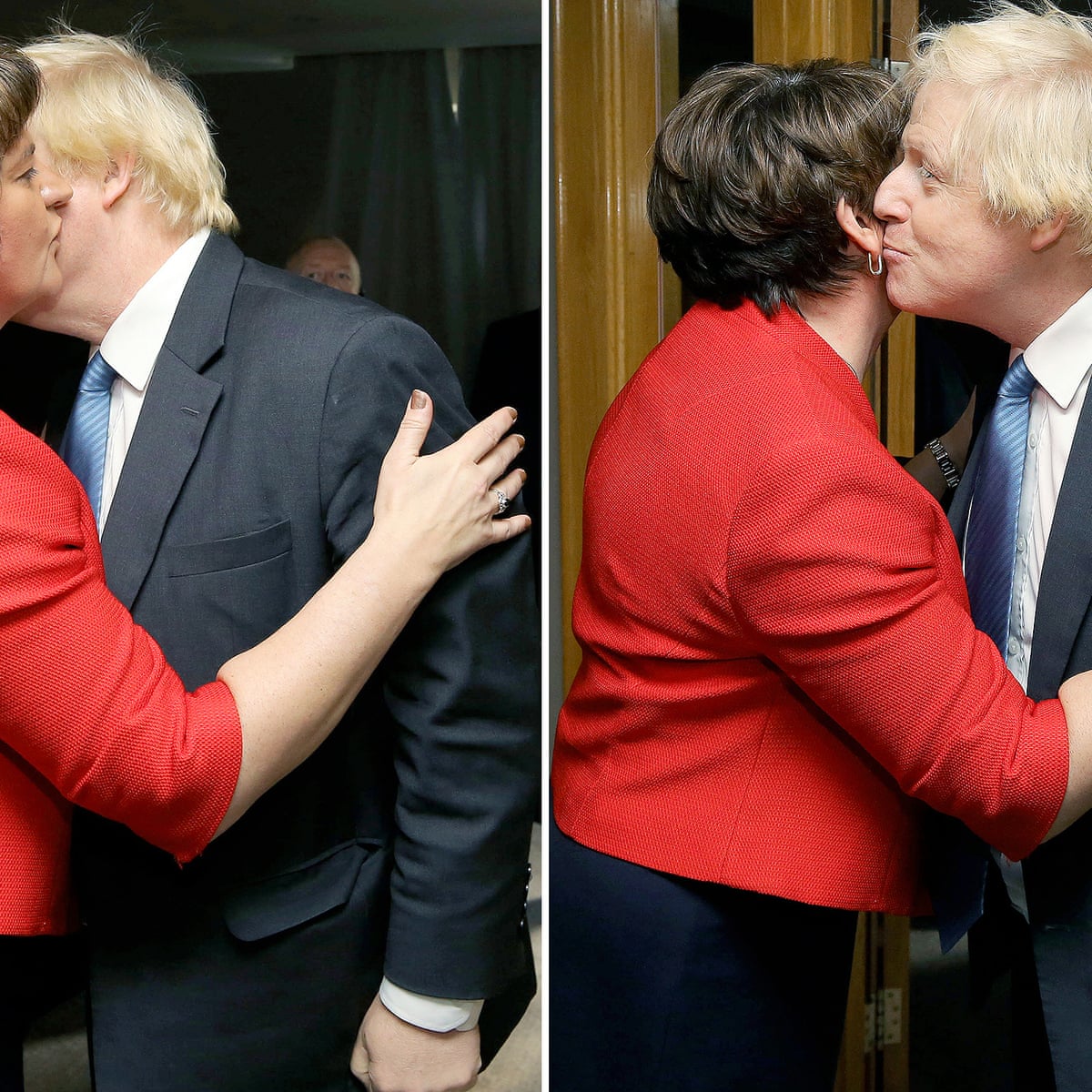
The DUP hitched itself to Boris Johnson’s Brexit and was betrayed through his agreement to the Protocol, an agreement the Brexit Tories had no intention of keeping.  For the Tories, the Protocol gives them the advantage of continuing to rally their support around a Brexit struggle they claimed to have already won, while offering some hope that they can leverage any EU concessions into the wider Trade and Cooperation Agreement.

For the DUP, reversal of previous claims that the Protocol is no threat and had positive economic impacts, provides an avenue for them to regroup from their mistakes and attempt to regain their position as the biggest party and therefore entitlement to the post of First Minister.  It was their idea to change the rules so that the largest party could claim this post, which had previously enabled it to demand support from unionists in order to prevent Sinn Fein capturing it.  If they can get sufficient concessions on the Protocol it can wait for another election, claim the credit and then get back to displacing Sinn Fein as the biggest party.

This requires reliance on the Johnson Government continuing to dispute with the EU but also ultimately coming to an agreement. Despite a continuation of the dispute being a reminder that Johnson did not ‘get Brexit done’ it is the only route he has to protecting his position inside the Conservative Party and providing some sort of cover for Brexit’s negative consequences.   The introduction of the legislative route to overturning the Protocol builds some delay to actually having to break from it or swallow defeat. This is obviously not sustainable in the longer term and is less and less convincing in distracting from Brexit’s failures. In these circumstances The EU has little reason to accept British demands.

The DUP will find it difficult to retreat while Johnson pretends he can face down the EU, and Johnson has become such a liability his policy of asking the punters why he did Brexit in the first place, and sticking a crown on pint glasses, will not cover for his mess.

The victory of Sinn Fein might be symbolic, but it arises within circumstances more important than such symbolism. It might herald a position in government office North and South of the border but the border will still be there and, as usual with its successes, it will illustrate that what is good for it has only remote connection to what is good for the Irish working class.

Covid and the failure of the NHS

Thirty-six years ago I had an interview for a temporary clerical officer job in the local hospital.  One question was – ‘Who is the most important person in the health service?’

Thinking on my feet as I sat in the interview I answered – ‘the patient.’

Which is the right answer.

Although this doesn’t appear to be the case today.

While I was recruited to possibly the very lowest rank in the health service all those years ago, those today at the very top appear to have a different view.

Last week the Minister for Health at Stormont, Robin Swann, issued a public consultation on whether new staff recruited to the health service and social services should be compulsorily vaccinated.  The Minister both in the consultation and in interviews more or less ruled out vaccination of all staff, considering it relevant, or perhaps only possible, for new and agency staff.

It should be remembered that the Minister and Executive ensured that all health service staff, including office staff with no contact with patients, were offered vaccination last year before patients described as extremely clinically vulnerable – those with suppressed immune systems for example. 

When some of these patients were sent the draft of a letter proposing that they ensure all visitors to their homes take a Covid test, the project disappeared when it was returned with a question whether this would also include the visit of district nurses.

The public consultation launched last week mentions that “Trade unions, employees and employers will have a key role in this consultation, but the views of the general public will also be very important.” It also mentioned relatives, and failed to mention patients.

This week the Minister announced he wanted the introduction of a mandatory Covid-19 passport scheme and this has been agreed by all the parties except the DUP.  So, while the Minister wants anyone going into a restaurant or pub to demonstrate that they are vaccinated, or not otherwise a risk, he thinks it’s acceptable for nursing staff dealing with the care of vulnerable patients to be excused this requirement.

Part of the reason for the recent increase in Covid is obviously the partially seasonal nature of the virus. In the case of Northern Ireland however it is also due to the relatively lower numbers vaccinated than Scotland, England and Wales, despite having had a head start on them.  It currently has a higher number totally unvaccinated and a lower number fully vaccinated with a booster shot.

Not only has this probably led to increased severity of infection – requiring hospitalisation – but also increased the sickness level of health service staff (up to 20% among nurses).  Media reports following Freedom of Information requests indicate potentially lower vaccination rates among nursing and social services staff than among the rest of the population.

The trade union UNISON has opposed mandatory vaccination of nurses and called for a voluntary approach of persuasion.  The union might appear to be on more solid ground if it did not make the stupid point of asking why health service staff should be singled out.  Management might also strengthen its position if it were to at least mention the needs of patients, that their views should be canvassed, and that protocols were in place to ensure that the most vulnerable patients were not unnecessarily exposed to unvaccinated staff.  Both might have more of a point if they had followed through on their argument and were to point to a rigorous campaign to get staff to voluntarily vaccinate.

Unfortunately, as argued before, the needs of the NHS bureaucracy have been put before the needs of the people it is supposed to serve; summed up in the mantra that we must ‘protect the NHS.’  Politicians wave the possibility of the closure of Emergency departments; of the health service “about to topple over” if immediate action is not taken; and warnings by senior medical staff that “this phase of the pandemic is now the toughest”.

Just like the Tories in Britain, they point to the crisis they helped create in order to point away from their own culpability.  Instead, it becomes an alibi that implicates those subject to a collapsing service who are blamed for not following guidance and advice.

They congratulate the staff on their heroism in order to absolve themselves while making their heroism a continuing requirement of their work; wrap themselves around the NHS brand in order to avoid and deflect away from their role in its failure, and threaten future collapse as a move to pre-emptively protect . . . themselves.

This partially explains Swann’s particular penchant for lavishing praise on NHS staff with ‘proof’ of seriousness by repeated announcements of additional funding.  When advertising the gruelling pressure on doctors and nurses dealing with the pandemic, he presents himself as a vicarious fellow sufferer.  Identification of the NHS with himself reaches a pinnacle when he says that “I don’t have enough nurses, I don’t have enough doctors.”

Additional funding, as he acknowledges himself, cannot conjure up and deploy staff out of nowhere; its announcement is instead more usefully deployed as a response to internal requests for action by medical staff raising concern at where services are heading.  Additional funding cannot immediately increase capacity, especially if it is non-recurring and limited to a one-off injection, but unfortunately long-term planning has not been a strong feature of the NHS.

So, we are now enjoined to accept renewed restrictions involving Covid-19 passports in order that the NHS not be overwhelmed.  Unfortunately, it is abundantly clear that the NHS has already been overwhelmed.  While pointing to the crisis and away from themselves we are supposed to listen to the words of politicians and not recall their responsibility and years of inaction.

Years of unprecedented underfunding of the NHS are now presented as a historic problem that attaches to no one in particular today.  We are simply reminded that the task now, our task, is to ‘protect the NHS’ in an unprecedented pandemic.

Many socialists get very defensive about criticism of the NHS, as if it were some sort of socialist enterprise in the midst of capitalism.  The reasons for this are numerous, including that it is free at the point of delivery, is not run for a profit and is owned by the state.

Except that it is not free, and is funded by a regressive taxation system; many private companies make a lot of money out of it; it is owned and managed by a capitalist state, and having worked in it for 22 years I can confirm that there is nothing democratic about the way it is managed.  Like all state ownership, it is bureaucratic and unaccountable, as repeated scandals exposed within it testify.

It is not therefore simply a question of underfunding, and to uncritically defend it because the only alternative is conceived as privatisation is a mistake.  Socialism involves different ownership of the productive forces, including those that protect and improve our health, and this democratic workers’ ownership is not a question of a name on a title deed but of how productive forces are organised and developed.  

Workers are not ignorant or indifferent to the bureaucratic failings of the NHS because they are the ones who use it, while some better off workers, middle classes, and definitely the richest all use private health care to one degree or another.

It is argued that the pandemic is unprecedented but the longer restrictions continue the more circumstances can no longer bear the description of exceptional.  The lower rate of vaccination might go some way to explaining the greater effect of increased incidence of Covid than in other countries, while the later roll-out of booster vaccinations than in other countries might similarly explain renewed restrictions.  Nevertheless, it is the declared necessity of protecting the health system that is employed as justification for the new restrictions announced this week.

We have been informed repeatedly about the pressure which health service staff have been put under, and our reliance on them has been reason enough for most people to accept restrictions.  That this pressure has been harsh is real enough but this in itself does not permit the demands of the politicians and bureaucrats to go without challenge.

There have been enough first- and second-hand reports that not all NHS staff have been under similar pressure to ask why this organisation cannot more effectively and efficiently deal with Covid and the other demands placed upon it. Some of the reasons we have mentioned above ­– that the NHS is a bureaucracy in which individual talent and commitment can only have individual effects.

That the NHS is failing is shown by some of the latest statistics from the Northern Ireland health service which show that between the years 2019/20 and 2020/21 total admissions to hospitals fell by 30%; average occupied beds fell by 17.9% and total theatre cases fell from 110,605 to 59,762, a fall of 46%, and 50% on the previous year’s figure.

What these figures show is that it was not simply a question of capacity but the capability to use that capacity and the inability to use it efficiently.  A factor in this will no doubt be increased sickness of staff, but the higher rate of unvaccinated staff contributed to this. Other factors will be the inability to institute infection control without reducing capacity with the creation of much-hyped ‘Nightingale Hospitals’ illustrating the problem.

The results of this failure can be seen in increased waiting times; for example in the 112,915 patients waiting to go to hospital at 30 June 2021, up from 97,243 at 30 June 2020, and 88,203 at the same time in 2019; an increase of 28% over the two years. This is an example of only the most obvious and measurable outcome, which most damaging effect is in the impact on health.

The British government has successfully protected itself by using the NHS as a shield because its popularity has facilitated this, which in turn is partially because the only alternative to it is perceived as privatisation, which is widely unpopular.  Much of the Left, with its state-centred view of socialism and greater predilection for knowing what it is against rather than what it is for, has put itself in no position but to follow the government, with the add-on of demanding more money.

When the London Olympics opened nearly ten years ago, it was noted that the NHS was part of the show, a tribute to its place in the national psyche.  What it wasn’t was a tribute to socialism, no more than was the presence in the show of James Bond and the Queen.  

The Northern Ireland Protocol and Brexit 2 – the cart without a horse

The offer by the EU to significantly reduce checks on goods, especially food, on the Irish Sea border, and the promise to legislate for British authorisation of medicines supplied into NI and therefore the Single Market, takes away the salience of complaints of barriers to the supply of goods from Britain into Northern Ireland.  The solution of the medicines issue was promised long ago and the EU was never going to allow itself to be held up to criticism for preventing the supply of medicines, including cancer treatments, to NI.  The non-issue of British sausages that was already hardly alive was killed once again by the EU breaking with its policy on chilled meats entering the Single Market. 

This does not mean that these issues are solved.  One reason that the existing border checks did not work was because the British and Unionist minister at Stormont made sure that they didn’t.  The scope, or motivation, for a repeat approach by the British in the enforcement of the compensating mechanisms proposed by the EU for the abandonment of checks at the sea border remain to be seen.

Instead, the question of the role of the EU’s European Court of Justice (ECJ) has been held aloft by the British as the key requirement in negotiation of a new Protocol.  Of course, the unionists don’t want any Protocol but that could only be the outcome if the UK and EU entered a trade war that none would benefit from, especially the British.  The unionists aren’t worth that price for the British so they will just have to sell as a victory whatever Johnson and Frost agree to in the end.

However, if both the British and unionists wanted to declare victory now is the time to do it.  The EU declared it would not negotiate and it has; its restrictions on food imports and requirement for authorisation within the EU for medicines circulating within it are important elements of its Single Market but have been given up in this case (the former to an extent).  It can bypass them only because it believes it can contain these concessions within the Protocol, that is within its arrangements for the North of Ireland.  It obviously takes the view that there will be no leakage into any other trading relationship and no precedent set that could be exploited by other trading partners.

Both the British and unionists could therefore claim that not only has it forced the EU to negotiate the Protocol, which it still denies, but that they have compelled the EU to surrender much of what it said it could not do.  It has political coverage for this not only for the reasons just set out but also because for its Irish member state and for Northern nationalists what matters is that there is no Single Market land border down the middle of the country.  As long as the checks along the Irish sea are held to be working, they are happy.

But this will remain an issue.  The more the British depart from EU regulation, the greater the scope for unapproved goods to circulate into the Single Market and therefore greater risk to the integrity of it.  The compensating proposals from the EU would therefore have to have meaningful effect and will grow in impact as Britain diverges from EU requirements, whether arising from its own decisions or from those of changed EU rules.

This is not the declared reason for the new prominence of the ECJ in British demands.  Instead, it is what a NI business representative called “nothing but a Brexit purity issue.”  For him the ECJ “it is not a practical or business issue.”  In fact, for business the Protocol gives unique access to both the UK and EU markets.  Were the British market certain to continue to be the much more lucrative and important the unionists would have little to fear from this parallel opportunity.  However, the growing trade between North and South and the reduced trade between the Irish State and Britain means that their opposition to the Protocol on political grounds is justified even if nationalists deny it. Unfortunately for unionist leaders this political opposition is detrimental to the people they represent, which will not have short term importance but will in the long term.

The unionist commentator Newton Emerson has argued that Irish and EU complaints about British negotiating tactics are a ‘slight loss of perspective’ and that their annoyance is mistaken.  In effect, both sides are at it and it’s a case of ‘all is fair in love and war’ . . . and trade negotiations.  He is however wrong to say that “the fact that Frost is tearing up his own deal is a redundant complaint.  The protocol is being negotiated.”  It matters that the negotiations that are now being conducted are not a first stab at an agreement but follow bad faith negotiations by the British who never intended to implement the deal they signed.

It matters because all the arguments made by Emerson about the ECJ not being necessary for Single Market governance must face up to this.  It is not a matter of whether the NI Protocol can be made amenable to Swiss type arrangements or those governing EU relations with Norway, Iceland and Lichtenstein, which insert arrangements that put ECJ competence at a greater distance.

Why would the EU agree to Swiss governance arrangements when the British have just rejected Swiss trading arrangements? Why would they seek to introduce arrangements involving numerous bilateral treaties that they already find too onerous and have sought to dispense with?  Why would they seek the governance arrangements applied with Norway etc. when the British specifically rejected the EEA option as the form of Brexit they should seek?  Part of the reason why the EU will not want to agree is that the British cannot be trusted.  

If Emerson wants to critique the statements of Irish politicians in relation to the British approach to negotiations he would be better to start with Varadkar’s nonsense that “for decades, for centuries, British people in many ways were renowned by the fact that they were an honourable people; people whose word you could trust . . .“ And by “people” it should be understood to mean the British state.

Has he not heard of Perfidious Albion?  Has he no knowledge of the Anglo-Irish treaty, with its Boundary Commission, or the promise by the British king in 1921 that the new Northern Ireland parliament would be “an instrument of happiness and good government for all parts of the community . . .’?

The British may reject the mitigations of border checks and alternative arrangements and may demand removal of any role for the ECJ.  If they do, they may proceed with Article 16, which will lead to further negotiations but also opens up the possibility of retaliatory measures against them by the EU.  Tory Brexiteers are still bloviating about the EU needing Britain more than the Brits need the EU but only the blinkered continue to entertain such nonsense.

It is reported that Article 16 may be triggered by the British on narrow grounds that may avoid a fuller EU retaliatory response but we would have to see what such narrow grounds might be and the EU has indicated it is weary of British negotiating tactics.

Even if the EU were to agree to some intervening body between the operation of the Protocol and adjudication by the ECJ, this would not essentially change the fact that there would be a Protocol that would involve a trade border between NI and GB and none between the North and South of Ireland.  It would not change Northern Ireland membership of both the UK and EU markets or the economic dynamics released by this arrangement.  It would not put to bed the problems that will arise if the British decide to increasingly diverge from EU rules.  It would not change the enforcement mechanisms ultimately available under the Protocol or wider Trade and Cooperation Agreement and it would not change the power imbalance between the UK and EU.

The attitude socialists should take to all of this should follow from their opposition to the whole reactionary Brexit project, which seeks to reverse the internationalisation of capitalism and the long-achieved broaching of nation state constraints on the productive forces.  Such an international development of capitalism is precisely the material basis for socialism and the unity of the working class irrespective of nationality.

Some on the left have opposed Brexit only by registering its English nationalist clothes and necessarily xenophobic and racist expression, without appreciation of this more fundamental basis.  For some, not even this has dawned on them and they have supported Brexit without being able to demonstrate that it has led to any compensating advance by the working class.

Just as nationalism feeds off other nationalisms so the Brexit war of words has involved Priti Patel advocating the threat to Ireland of food shortages from a no-deal Brexit and the French threatening to deny power supplies to the Channel Islands.  Socialists must oppose all such offensive nationalist threats.  Opposition to Brexit does not mean defence of the policies of the EU but simply recognition that we do not oppose the development of capitalism by demanding it regress to a more primitive form less suited to creation of a new society.

In terms of the Protocol, we oppose the creation of a land border in Ireland as a strengthening of division on the island and recognise that this could only come about from increasing the separation of Britain from the EU, most likely from acrimonious conflict that would have the effect of dividing workers, and not only in Ireland.

Back to part 1

A Brexit compromise with Unionism?

In the previous post I argued that there should be no attempt to conciliate unionism, and certainly not by socialists.  Although its politics is entirely reactionary this is what is being proposed by a number of commentators who really should know better.

In one blog, a comment asserted that the ‘institutions of the [Northern] State are errand boys for Sinn Féin, who are errand girls for the Army Council, which is a body of totally unreconstructed IRA hard men from back in the day.  Moreover, it is an almost entirely Northern body, on the cusp of taking control of a 26 County State.’

This, of course, is phantasy.  Locally, the regular columnist in the nationalist newspaper questioned whether ‘sectarian control [has] simply changed hands?’ and asserted that it was ‘difficult to avoid the observation’.

This ignores recent history that is littered with loyalist riots against what they see as encroachment on their rights by Catholics.  Indeed, such riots played a major role in the start of ‘the Troubles’ with such inconvenient facts as the first policeman killed being shot by loyalists.

Conciliation has already been adopted by the Police Service of Northern Ireland pretending that loyalist paramilitaries are not involved in organising and leading the riots.  Its first statement pointed the finger but refrained from outright assignment of responsibility.  It waited until the umbrella group for the main paramilitary groups had issued an appropriate statement denying involvement, and calling for only peaceful action, before stating that these organisations had not ‘sanctioned’ violent protest and that only individuals may have been involved.  This is the normal way of trying to prevent escalation; part of what was called a long time ago an ‘acceptable level of violence.’

The Unionist columnist Newton Emerson has written in a number of Irish newspapers that compromise with loyalist demands should be made to protect the peace process.  After all, warnings by nationalists and the Irish Government that republican violence would follow any Brexit land border within the island had led to it being placed down the Irish Sea.  If Irish nationalism could threaten violence to get its way what’s wrong with unionism doing the same?

There is some obvious truth in this, except that a hardened land border, while not strictly contrary to the Good Friday Agreement (GFA) as often claimed, would not only serve (dissident) republicans but would also severely undermine the current political arrangements.

In the GFA nationalists were to accept the legitimacy of partition and of the Northern State in return for some cross-border bodies, a hypothetical mechanism to bring about a united Ireland through a border poll, one however that was in the gift of the British Government, and a power-sharing Stormont regime that included an effective sectarian veto on change for both sides, which of course is more obstacle than opportunity for those seeking change.

If the border were to be strengthened as a result of a hard Brexit that most of unionism supported while the majority in the North of Ireland opposed, and with the stupidity of the DUP coming back to haunt them in loyalist riots, nationalism might consider that promises are cheap but reality expensive.  It was not republican dissidents that put a border down the Irish Sea but the Irish Government and the EU with the blessing of senior US politicians.

Emerson goes on to ask ‘should we risk restarting the Troubles ‘over inspecting packets of ham at Larne?’  He queries the evidence and reason for believing that the EU Single Market ‘would otherwise be swamped via circuitous smuggling of food through Britain and Northern Ireland.’

He also, in rather contradictory fashion, suggests a law-and-order solution to smuggling across the Irish border and maximum mitigation of the effects of the Protocol in order to assuage loyalist paramilitaries who, although almost defeated, require concessions.  In this regard there are further press reports of money for these paramilitaries in a continuation of the policy of weening them off criminality and political violence by giving them what they want.  Alongside this a law-and-order solution would be applied to the really delinquent factions.

All this is washed down by the admission that ‘at some point we will have to confront the moral squalor of giving in to violence but that moment is hardly now, when so little might be required to prevent violence.  Rather it would be immoral to prioritise hypothetical ham over life and property.’

Of course, the ham is far from hypothetical and Emerson gives every indication of suffering from the illusion of the supporters of Brexit who never understood the magnitude of the decision they supported.  He regards the potential breach of the EU Single Market as small, although both the EU and British sought to use the North of Ireland as leverage in the overall Trade and Cooperation Agreement, promoting its importance to any overall deal.

There is no reason to believe that loopholes would not be exploited and no reason for the EU to believe that the British Government would not seek to exploit concessions or mitigation or whatever term is used to fudge the regulations.  The British have openly breached agreements already reached and failed to implement practical measures, such as  installation of inspection posts and access to data, that it promised to deliver.

The EU has claimed that the most difficult issues could be solved by the British agreeing to synchronise their food standards with those of the EU but the British have ruled this out, and while the British have asked for flexibility the EU has stated that they must first implement what they have already agreed.

It would go too far to say that loyalism and the British Government are in cahoots, the latter is not attempting to get rid of the Protocol altogether, but the pressure applied by both is in the same direction.

The Single Market may not seem so dramatic as yet another political crisis in Northern Ireland but the EU has more interest in the former than the latter: concessions that are given only to Britain might easily give rise to discrimination cases against the EU.  More generally, retreating on the basis of pressure from political violence does not set a good example for any other potential challenges to Brussels and member states.

There is no reason or evidence to believe that smuggling would not take place on the Irish border were it also to become the border for Brexit, or to believe that such smuggling would need to ‘swamp’ the EU Single Market for it to matter to the EU.  On the other hand there is good reason to believe that mitigation of the trade border in the Irish Sea would not be enough for loyalism. For the EU, checks on any border would have to mean something and if they did loyalism would object.

There is no doubting that these checks are onerous and will increase after the transition but the negotiations between the EU and British to find technical solutions do not warrant the view that the Protocol will be effectively removed.  These negotiations were reported by RTE and the Guardian, with some sceptical coverage of them by one informed blogger.

There has so far not been enough direct impact on imports to motivate those not consumed by potential constitutional implications to protest.  As Emerson points out, Marks & Spencer has just announced the opening of a new food store in Coleraine, and Covid-19 has been a much more immediate barrier than Brexit to people getting what they want.

This does not mean that loyalism is not angry, or has cause, but their anger should really be directed to the DUP who led them up the garden path with Boris Johnson at the forefront. Nevertheless, while loyalism does not need to be particularly coherent, there are also limits to what an incoherent view of the world will achieve in bending that world to its own misapprehensions.

Emerson’s law-and-order solution does not seem to recognise the incongruity of calling for increased repression of dissident republicans and others in order to reduce ‘paperwork’.  He wants a retreat on policing of protest demonstrations that are held within unionist-majority areas so as to avoid ‘confrontation’, but it’s not clear how much consideration he has given to the minority living within these ‘unionist-majority areas’.

Of course, in most Protestant areas Orange marches are generally popular and there can be little doubt that a majority of Protestants oppose the protocol and would have sympathy with the aims of demonstrations against it.  The majority would have less sympathy with the paramilitaries who often accompany such displays and that is their problem: one doesn’t come without the other.  Emerson forgets that the immediate victims of loyalist paramilitaries are Protestants in working class areas who are often presented as the paramilitaries’ political constituency, in so far as they can claim one.

He is right therefore to acknowledge the ‘moral squalor’ involved in concessions to loyalism but over twenty years from the deal that was supposed to bring peace and an end to them, we apparently have to make some more, and to the same people.   He says that ‘we’ have to make them but the majority of the population have had no choice in the matter.  His ‘giving in to violence’ has in the past not only involved ‘giving in’ but the sponsorship of loyalist paramilitaries by the British State through all sorts of collusion.  This has involved not only accepting loyalist violence but protecting its perpetrators and assisting its organisation and effectiveness through state agents.  In his seemingly bold and brave admission of unfortunate necessity we are to forget what it has meant in the past.

If Newton Emerson’s proposals have any educative value, they show the limitations of unionist opinion, even from its most intelligent and least prejudiced sources.  It reminds me of the statement last week by First Minister Arlene Foster who, after riots and petrol bombs, and with one bus driver attacked in a case of “attempted murder”, declared that these actions were an “embarrassment” and “only serve to take the focus off the real law breakers in Sinn Fein.”

In the mind of unionism, even when its their fault it’s really someone else’s, anybody else’s.  Brexit was a unionist own-goal which they are trying to reverse.  Socialists have no interest in defending their seventeenth century reaction from twenty-first century capitalism.  It would be good if the many on the left in Ireland who also supported Brexit would acknowledge that they too have made a mistake.

Back to part 1