Nationalist answers 1 – Scotland

scoty images (11)A common analysis on much of the left is that the EU is a capitalist club that pursues an imperialist agenda, just confirmed by its brutal treatment of Greece.  The socialist answer is therefore to be in favour of leaving it.

Many of these same people argue that the UK is a capitalist state that has just re-elected a Tory Government committed to further austerity.  The election has shown that it too, just like the EU, is unreformable and should be split up; so for example Scotland should separate from it.

The answer to both is therefore a nationalist one.  Let’s not be distracted by the bells and whistles attached.  The objective is a change in the nature of the state but in both cases this means a return to the nation state, a smaller state, is the answer.

Ironically, as a recent post I read noted, while the treatment of Greece by the EU in the name of austerity has been acknowledged by more or less everyone to be brutal, the reaction of some nationalists has been much more muted.

Thus the SNP who are portrayed as opponents of austerity have rallied much of the British left around its nationalist argument for separation on the basis of its opposition to UK austerity.  It argues that any move to get out of the EU will see it demand a new indy referendum so Scotland can stay in.  Yet the austerity inflicted by the EU on Greece is of a magnitude many times greater than that directed from London.

From a socialist point of view it gets worse.  Their answer to this exposure to the contradictions of nationalism is to be even more nationalist than the nationalists.  Many of them demand that the UK (or the Irish State for that matter) leave the EU.  Of course it is claimed all the new states created will not be like their old incarnations  but progressive, if not socialist, but if they were there would be no need for them to be separate and if they are separate they will be in the position all nation states are in, which is in competition with each other.

We see such competition in the proposals of the various nationalists and left nationalists to reduce corporation tax.  Sinn Fein and the left in Ireland want to keep the low 12.5% rate but want it to be the effective rate while the SNP want a lower rate than the rest of the UK, whatever it is, and the Tories have just cut it to 18 per cent, so it now has to be lower than this.  When the Tories took office with the Liberal Democrats it was 28 per cent.  If my sums are right I think this makes Sinn Fein, the Irish Left and the SNP softer on the big corporations than Tony Blair.  But this doesn’t fit the narrative so let’s stick with it.

In an earlier post I promised I would look at an article notified to me by a friend, on the Left’s attitude to the SNP, just before the UK General Election so I’ll do that here.  I’ll also look in a second part at one of the many responses on the Left seeking to learn the lessons from the Syriza U-turn in Greece.  What they have in common is an accommodation to nationalism.

What they also have in common is being written from the Socialist Workers Party tradition.  As I noted before, this tradition, through their forerunner of the International Socialists, used to have much better positions on both the EU and Scottish nationalism.  However the two articles show that accommodation has not yet become capitulation.

The article in ‘Jacobin’ is in the form of an interview and it is revelatory that the first question doesn’t ask the interviewee why he supported Yes in the independence referendum but “what did you see in the movement that made it worthy of support?”

As I noted during the campaign, many on the left voted yes because they liked the campaign for it rather than any very compelling reasons for having a campaign for such an objective in the first place.

In this sense they were guilty of what Marx warned against – “Just as one does not judge an individual by what he thinks about himself, so one cannot judge such a period of transformation by its consciousness, but, on the contrary, this consciousness must be explained from the contradictions of material life. . “  Instead the Left supported a nationalist campaign, driven by social and economic concerns and desire for an alternative, and having done so declared it left wing.  It looked at itself in the mirror and liked what it saw.

Just like Sinn Fein in Ireland it does a grand job at telling itself and anyone else who will listen how great it is.  It might be something about nationalism.

I am also reminded by another less glorious figure in the history of the socialist movement who once declared “the movement means everything for me and . . . what is usually called “the final aim of socialism” is nothing.”

I exaggerate?  Well let’s look at the interview.  Davidson gives three reasons for changing his view to now supporting independence and, in his own words, he says that “the most important change was simply the nature of the campaign itself”

He says that “for many people it wasn’t about nationalism of any sort”. .  “It was about how to realise various social goals: an end to austerity, the removal of nuclear weapons, defence of the National Health Service”.  The fact that the answer to each of these problems is nationalism seems not to make the movement for it nationalist.

That the problems are not nationalist ones appears to mean that when the solution is national separation (“independence will improve their [workers’} situation immediately”) we don’t have to call it a nationalist solution.   Ironically if the problems were nationalist ones (like national oppression for example) a nationalist response might make more sense.

This self-regard leads to an exaggerated view of the role of the Left in the independence campaign, which, he says, dramatically changed its dynamic and drove the entire discussion of independence to the left.

In fact the landslide for the SNP in Scotland in the General election showed just who drove the campaign, who put independence on the agenda for decades before and who then benefited.

That the campaign for independence won the support of many working class people for a party Davidson admits is “on the extreme left of what I call “social neoliberalism” and “which broadly supports the neoliberal economic settlement”, i.e. austerity, is such an admission that it is simply staggering.

He supported separation because of the independence referendum campaign that led a neoliberal party to a landslide on the basis of that party claiming to lead opposition to austerity!

Davidson goes on to say that the SNP has moved to the left in economic terms “above all in rejection of austerity” and “is offering reforms” but also says they took up their “social democratic” position “in order to win votes” because “it would have been difficult to compete with New labour from the right”.

He accepts as good coin SNP claims of opposing austerity but fails utterly to examine its actual record in the Scottish Government, which would blow such claims out of the water.  Such an examination doesn’t fit the narrative.

In fact this narrative clashes obviously with reality.

He claims that the SNP sought an alliance with the Labour Party against the Tories, when in reality their strategy depended on destroying Labour in Scotland and keeping it to their right everywhere else.  Does he think the SNP would welcome a Jeremy Corbyn victory in the Labour leadership contest?

Why would it, since this would immediately demonstrate the efficacy of fighting together, that the Labour Party was not quite a dead loss and that there did actually exist a labour movement undivided by nationality.

He congratulates the SNP on their honesty, they’ll  never do a deal with the Tories he says, which means we can forget the one it had with them when in a minority administration in 2007 reliant on Tory support.

By supporting separation the pro-nationalist left has already separated itself from wider struggles.  In so far as there is a fight about austerity and its alternative in Britain today it is centred around the Corbyn campaign for leadership of the Labour Party.  I wondered on this blog whether the British Left would be part of it.  Were the unthinkable to happen and Corbyn actually win it could hardly be ignored.  Would an all-British movement against austerity in such circumstances be better than a purely Scottish one or would the Left insist on introducing national divisions where none were necessary?

It would appear that Davidson would answer the latter in the negative. “We must not give up the question of independence.  Unless a revolutionary situation emerges in England . . .”.  And of course Corbyn is far from being a revolutionary.

So it looks like English workers will have to deliver a revolutionary situation in England before the Scottish Left will be interested in political unity within one state.  (Talk about playing hard to get!) Not, mind you, that they are steaming ahead in the creation of a revolutionary party themselves because, Davidson says, “we are not in a position in Scotland to immediately set up a revolutionary party.”

Of course there are the ritualistic claims of wanting “solidarity” with English workers against the British State but not solidarity with English workers against a Scottish capitalist state which would replace the British one lording it over them come separation.  Joining with English workers to overthrow the Scottish state?  Now that really doesn’t fit the narrative.

Instead solidarity with English workers will mean we’ll demand the removal of Trident, which means moving these weapons to . . . err, England maybe?

And if the English follow this example and say that we’ll take the same position as you in Scotland and demand they’re not sited in our country, they can stay. . .err, in Scotland maybe?

What a splendid recipe for solidarity!

I mentioned that Davidson has accommodated to nationalism but not capitulated.  This is because although the article asks the question how the Left should relate to the SNP in advance of the General election he nowhere calls for a vote for the SNP.  The problem is, given what he says, I can’t see the reason for him not to.  Why not? given that he claims it opposes austerity, wants to introduce reforms, has moved to the Left and is now full of left-wing working class people who are ‘consolidating’ its position there.

It would be some slight comfort if it could be hoped that the reason for this is that, as a relatively recent convert to Scottish nationalism, at some level he just doesn’t quite believe his own argument.

Unfortunately the real reason may well be political sectarianism.  His reason appears to be that an SNP Government bent on reforms would face pressure and intransigence from capitalism when it would try to introduce its reforms.

He doesn’t say how this would not be the case in any other circumstance.  He doesn’t say how, what he might call a revolutionary party, would not face the same if not greater pressure.  He doesn’t say how it should be dealt with.  He doesn’t say why nationalist division prepares workers for such international capitalist intransigence and he does not say why this means that denial of support to the SNP now is justified by a future need for a revolutionary break, especially when he says the alternative party to be built now must not be revolutionary.  So how does he prepare all those inside and outside the SNP who must be prepared for this revolutionary break?

But what’s wrong with all this is not that Davidson should follow through on the implications of his analysis of the SNP and join it, but that his view of what is required of revolutionary politics now leads to a nationalist blind alley of supporting nationalist separatism now and being just as exposed to nationalist limitations when the grand day of revolutionary rupture might break out in the future.

His argument for national separation and endorsement of the SNP demand for independence falls apart because he refuses to support that party on the grounds that when it will be faced with international capitalist pressure it will be in no position to resist, most importantly because the working class will be divided by nationality whilst the capitalists won’t.

A convincing narrative or what?

Belfast socialists discuss Scotland after the referendum

A left non-nationalist rally in Glasgow

                                                                                                                                                                                                                                     A left non-nationalist rally in Glasgow

Last night I went to a meeting organised by the Irish Socialist Network (ISN) on Scotland after the referendum in the Realta Centre in Belfast.  The speaker was Colm Breathnach, who is Irish and a former member of the ISN but is now living in Scotland

He said at the start that he was not going to go over the pros and cons of the vote but look at the situation now.  In fact a lot of what he had to say was about the pros and cons of the referendum campaign and his impressions of it, and particularly of the Radical Independence Campaign (RIC) , of which he is a supporter.

He enthused about the activity of what he called this ‘mass movement’ the like of which he had not seen or been involved in before.  It was described as a grass-roots progressive campaign that effectively led the Yes campaign in the referendum and dragged it, and thereby the SNP, to the left.

He supported independence because it gave the working class a ‘better terrain’ on which to fight.  He gave a consistently positive and enthusiastic account of the pro-independence movement and of his impressions of those involved.  He criticised the fear spread among workers by the No campaign while acknowledging that their fear of the consequences of independence was at least partly justified.  He claimed the independence movement was a reflection of progressive working class politics while also acknowledging that a lot of working class people voted No.

He claimed to have no illusions in the SNP but his criticisms of it were muted, very muted in fact, and he didn’t find it necessary to provide any clear characterisation of the nature of that party. His attitude to the Labour Party on the other hand was scathing – a ‘husk’ that no one progressive could possibly support.

He rejected the charge that the left in Scotland were following reactionary nationalism and told me, it was me who put this to him, that I hadn’t been listening to what he had said.  The Yes campaign had been about the vision of a new fairer society and not about national identity or nationalism.

The debate therefore started and ended where it might have been expected to – impressions of a movement for independence that wasn’t nationalist and an incredulous denial that the campaign for a separate state had been a nationalist one.  Weren’t there different sorts of nationalism anyway e.g. British nationalism and Palestinian nationalism?  They weren’t all the same.  He was in favour of internationalism and working class solidarity and unity among Scottish, English and other European workers.

He said accusingly, that if I wanted the Scottish, Welsh and English working class to be united in one state why wouldn’t I want the Irish to be included as well?  Why wouldn’t I be in favour of the Irish Republic rejoining Britain?

Oh my god!  If ever an argument could be expected to crush opposition to nationalism (or whatever it is) in front of an audience from a republican background this was it!  How on earth could anyone succumb to a view that had this as its logical conclusion?

All this was at the end of the meeting so there was no opportunity to reply.  I’m glad however I have a blog.

Listening to a speaker it can be very easy to follow their stream of argument without noticing the holes and contradictions within it, especially if one hasn’t got a strong and considered view on it already.  But surely I cannot have been alone in wondering why it was necessary to claim there are different sorts of nationalism when the Yes campaign was very, very definitely not a nationalist one.

Surely it was noticed that the claim he wanted unity among Scottish, English and Welsh workers sat in flat contradiction to the view that he very definitely didn’t want them all to coexist in the one state. Was this not privileging the interests of separate (capitalist) states over the unity of the working class irrespective of nationality?  Well that’s how it looked to me.

I heard echoes of the view that working class unity among nationalities is possible without their being in the one state but the ridiculous argument that being inside one state doesn’t makes this easier was not advanced in justification. Instead I was asked why I supported the existence of the British state formation, the implication being that one formation of capitalist states is as good as another (although the implications of this for the demand for a separate Scottish state were probably furthest from the speaker’s thoughts).

I would have replied, had I the opportunity, that the British State has the advantage of already existing and containing within it a voluntary union of nationalities; that socialists are in favour of the voluntary union of nationalities; that the working class in Britain is united in one labour movement irrespective of nationality with a long tradition that includes exemplary struggle and that, yes ,this should even include the Irish if such unity could be voluntary and on the basis of equality.  That is, there would be an absence of the national oppression that has characterised previous and current British rule in Ireland and that has been absent from relations with Scotland except in relation to the latter’s role as oppressor

There is nothing special about the form of the British state in achieving this except that nationalist division would be a backward step away from it.  If the British state proved a barrier to wider unity on a continental state then calling for its supersession would be progressive.  In any case the creation of a European working class movement is required and every step in defeating nationalist division is to be welcomed.

None of this would have convinced the speaker because for him the British working class does not exist.

I put it to him that when I used to live in Scotland in the 1970s the Left in Scotland opposed Scottish nationalism as reactionary and it now supports this nationalism, but that this support does not make it progressive.  He said things had changed.  And so they have, in the way I have just described.

I also put it to him that the rise of Scottish nationalism had divided the British working class and divided the working class in Scotland.  The demand for independence if successful would mean dividing the British working class movement including its trade unions.  It was in reply to this that I was told that the British working class doesn’t exist ‘except in some peoples’ heads.’

This is no doubt why left supporters of Scottish separation hardly ever consider the unity of the British working class or factor it into their analysis.  It’s much simpler to pretend it simply doesn’t exist. We have had this argument on the blog before.

What we might have expected was some explanation of why socialists should support a separate Scottish state.  Providing a ‘better terrain’ was as much as we got, yet no one thought to ask what this meant or, more bluntly – is that it?

All in all I didn’t learn anything new from the meeting but most of the participants will at least have been exposed to some of the arguments and will have found it in some way informative.  The meeting was therefore a modest success.

I had however hoped that I would have learned more, which is why at the start of the meeting I asked some questions.

Colm said during his speech that he accepted the result of the referendum so I asked him what he meant by this and in order to explain what I meant by asking him this I said did he accept it as an exercise in self-determination by the Scottish people.

In reply he said that in saying he accepted it he meant he did not go along with the conspiracy theorists who claimed the result had been the subject of fraud, as some nationalists have claimed. But he asked what I meant by the question to which I explained – did he think the referendum was a legitimate exercise of self-determination?  His answer was less than clear.

He criticised the pro-union bias of the media – the newspapers and particularly the coverage of the BBC in Scotland.  The bias of the media is not new but such bias is a part of what Marxists call bourgeois democracy and the referendum was a part of this democracy.  He did not address the real point of the question and by failing to do so he and the nationalist movement consciously or unconsciously avoid its implications.  That is the implications of having lost.

The point of the question was to elicit his view whether, in saying he ‘accepted’ the result, he was accepting that the Scottish people had been given the opportunity to freely exercise self-determination and had done so by supporting union within the UK state.  Many nationalists appear to believe that self-determination only exists if it results in a separate state, as if determining one’s future only takes place when you vote the way they like.

The very non-committal answer showed an unwillingness to accept that the referendum was a legitimate exercise in self determination that should be accepted as such.  Whatever grounds for demanding separation exist they can not therefore include the claim that the Scottish people have not been given the opportunity to freely vote for ‘independence’ and were thereby subject to some form of national oppression. In this respect the answer showed that the left supporters of separation appeared no more inclined to really accept the result than the broader nationalist movement.  In doing so they ignore the implications for what they do next.

And this was my next question.  I asked what the strategy of the left supporters of independence was now?  Did they still hold that independence was necessary for the working class to move forward?  Or did his claim that this was really not a nationalist movement but a movement for social justice mean they would fight austerity without also requiring unity around independence?

Would they recognise that the austerity offensive from the Government in London is enforced by the Scottish Government, just as it is being enforced in the North of Ireland by Stormont, and seek unity with English and Welsh workers to oppose it?  Or would they seek to fight alone, so unnecessarily weakening themselves and the rest of the British working class?

I got a very unclear answer which involved acknowledging that whether the demand for independence was a high or low priority would be determined.  He was still strongly in favour of it.

Since the immediate requirement is to fight austerity and a new referendum is not immediately on the cards the prevarication revealed the divisiveness of the nationalist project.  In practice this means continued division of the British working class, which the nationalists appear to think doesn’t exist but the Condem Government is screwing nevertheless.

Repeatedly the speaker said that the Radical Independence Campaign was not a nationalist movement but he admitted that half of its supporters were members of the SNP, which has grown very significantly since the referendum.  They will no doubt campaign for and vote for this party.  The SNP is riding high and is reaping the benefits of relative success in the referendum.  Majorities in favour of ‘independence’ were recorded in Glasgow, Dundee and many other mainly working class areas.

Only by being unclear about what the SNP is; only by denying that a separate state is a nationalist and divisive demand and only by failing to recognise the harm this does to a united working class response to austerity can this be seen as in any way progressive.  Nationalism is what was on offer in the referendum and nationalism is what many voted for regardless of what they thought they were doing.  Colm mentioned false consciousness in his speech but didn’t properly identify who was falling victim to it.

Already figures on the Left are calling for a vote for the SNP at the next election.  The same SNP that colluded with the Tories when first entering into government in Scotland.  The same SNP that repeatedly accused the Labour Party of cuddling up to the Tories in the No campaign and the same SNP whose leader was such an ally of Rupert Murdoch.

This makes perfect sense if, as much of the Left appears to believe, ‘independence’ is the indispensable condition for progress.  The left voting for a right wing, pro-capitalist, pro neo-liberal party is the result of its collapse into nationalism.  Going by the meeting there is precious little sign of re-evaluation

The Left against Europe 5

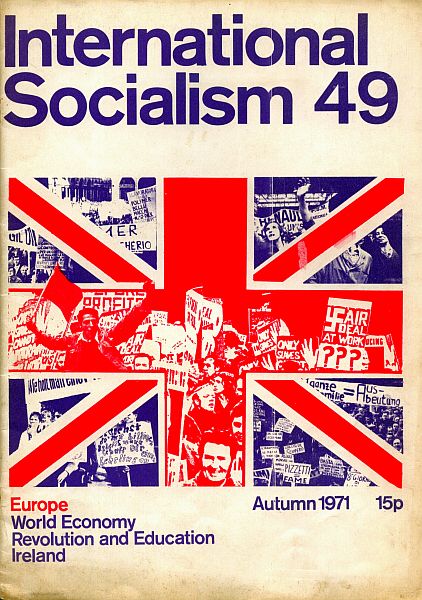
is049-600Chris Harman’s article on the Common Market signalled the adoption by the International Socialists of opposition to British membership of the European Economic Community.  In doing so it came into line with the majority of the rest of the Left.  Like the International Marxist Group (IMG) and others, IS was keen to differentiate its position from that of reformist organisations, particularly the Communist Party (CP) and left of the Labour Party.

It is worth remarking that the political positions of the Communist Party during this period are very similar to those of the Left today, including the successors to the IS and IMG, which thinks of themselves as opposed to the sort of Stalinism represented then by the CP and as advocates of a more revolutionary alternative.

The CP statement on the Common Market quoted by Harman states that:

“A new government, committed to socialist policies, would use its parliamentary majority, together with its mass support in the country, to challenge the power of the ruling class. The developing movement to the left over recent years points in this direction. That is why the ruling class, as part of its attack on positions gained by the working class, is out to deprive Parliament step by step of its authority, and to transfer it to the supranational institutions of the EEC …”

The CP concludes that “Britain’s national sovereignty is of vital concern to the British working class. Sovereignty is a class issue”.

In opposition to this Harman states that:

“A consistent socialist position on the Common Market must begin by rejecting out of hand the chauvinism explicit in the approaches of the Labour leaders and the established left. The national state is not our state. It functions to defend the ruling class, and cannot operate in any other way. The harping of the left about ‘national sovereignty’ only serves to sustain the illusion that somehow we have an interest in common with those who run the state at present. It intensifies the differences between workers in different countries. And it does so at a time when the growth of international firms emphasises the need for united international working class action. .”

Harman warns that nationalism can be a competitor to socialism within movements expressing social discontent, that this can take the form of right wing Tories such as Enoch Powell but can also arise within the working class movement itself.  The parallel with nationalism today in the form of UKIP and the left embrace of Scottish nationalism is striking.

Nevertheless Harman puts forward a number of reasons why it is “imperative for us to oppose entry” into the European Economic Community:

“1.    Entry is being used, alongside other measures, to hit at working class living standards and conditions. Of course, if the ruling class could not achieve its ends through entry, it would try to get what it wanted through other means. We should never forget this as those who peddle chauvinistic ideas within the Labour movement do. But that does not provide us with a reason for not opposing entry. We should oppose it as we would oppose other forms of attack if they were used instead.

  1. Entry is aimed to rationalise and strengthen capitalism. It is an attempt to solve certain of capitalism’s problems by capitalist methods. There was a time when revolutionaries could regard certain such measures as historically progressive. Marx, for instance, gave support to the movement for German unity. . . But he did so in a period in which capitalism as a system was still struggling for supremacy against older forms of class society and, in the process, preparing the preconditions for socialism. Today, however, these preconditions exist. Rationalisation of the system means strengthening it at a time when we as socialists argue that revolutionary change alone offers mankind any future. We have to oppose such measures, counterposing not continuation of the system under its present form, but a. socialist transformation of it.
  1. Not only is the rationalisation of capitalism no longer progressive in any sense, it also speeds up the development of intrinsically destructive forces. In the case of European integration this is expressed in the aim of creating on a European scale what cannot be built up by the isolated states – an effective independent arms potential. According to the British government white paper there is no other way by which British imperialism could have the same opportunities to ‘safeguard’ its ‘national security and prosperity’. Revolutionaries have to oppose this as they have opposed previous arrangements serving the same purposes, e.g. NATO, SEATO, etc.

“There is a fourth, subordinate, reason, that emphasises the need for clear opposition. All summer the makers of official opinion in this country have been worried about the difficulties of ensuring that the decision of the ruling class to go into the EEC is implemented politically. They fear that they might have difficulty getting parliamentary ratification for entry. And so they have been putting enormous moral pressures on sections of the Labour leadership to break with the party and to vote with the Tories for entry.”

“At such a political conjuncture the position of revolutionaries should be obvious. The defeat of the Tory government, in the present context of growing working class opposition to its policies, would give a new confidence and militancy to workers – even if the defeat occurred purely in the parliamentary sphere. Moreover, a defeat on the Common Market would not in fact be a defeat on that issue alone; behind much of the working class opposition to entry is a general, if vague and not fully conscious, distrust of the government’s intentions. The general anti-Tory feeling in the country is feeding the flames of opposition to the Market.”

As the alternative Harman put forward the following:

“In general, our position should be that

  1. We oppose the attempt through the Common Market to rationalise capitalism at our expense.
  2. We also oppose the ideological illusion being peddled in the labour movement that somehow a ‘sovereign’ capitalist Britain is a real alternative to entry into the Market for working people. We have to make clear that while we oppose the capitalist integration of Europe we would be for a Socialist United States of Europe. However, the demand for the United States of Europe is not going to be an immediate agitational demand in the conceivable future. That would require that political life was really moulded on a European scale. The fact, however, is that the failure of capitalist attempts at European integration means that national peculiarities still determine the tempo of the class struggle. In the Belgian and French general strikes (of 1961 and 1968) the key demands had to relate to class power in particular countries not in Europe as a whole.
  3. We argue, against the chauvinists, for a linking of opposition to the Common Market to opposition to the other attacks on working people – the Industrial Relations Bill, the welfare cuts and so on, so as to build up a class based opposition to the whole range of government policies, counterposing demands pointing towards a socialist transformation of society.
  4. At all possible times we put forward our own consistent class based viewpoint in opposition to that of the confusion of the CP and the Tribunites (left of the Labour Party). But if we are unable to get a majority for our clear and consistent positions, we have to vote against the government Common Market strategy in the only way possible – by voting with the CP and the Labour left while making our reservations known (just as, for instance, we would, if we had no choice, give critical support to a resolution opposing the Industrial Relations Law, even if it spoke in terms of the law aggravating ‘industrial unrest’). We are completely steadfast in our opposition to the peddling of ideological illusions in the Labour movement, while being relentless in our opposition to government policy.

Harman’s argument did not go unanswered.  In the same issue of ‘International Socialism’ Ian Birchall quoted from previous editorials of the journal from 1961 and 1967:

“For us the move to Europe extends the scope of class struggle in which we are directly involved; it worsens its conditions for the present. But it makes ultimate victory more secure. (EditorialIS 6, Autumn 1961)”

“It is true that Wilson’s Common Market policy does involve a serious threat to working-class living standards, and is designed to strengthen the hands of the employers in the fight against workers’ defence organisations in the struggles over speed-up, rate fixing, and working conditions. But inside or outside the Common. Market, that particular battle is going to be fought – indeed, outside the battle is likely to be more ferocious. (EditorialIS 28, Spring 1967)”

Birchall notes “that the editors of International Socialism once argued, clearly and consistently, that we must not carry out any kind of campaign against entry. Now that Heath appears to be about to succeed where his predecessors failed, Chris Harman argues that it is ‘imperative for us to oppose entry’.”

Birchall then presents some arguments against Harman: some are good and some are not.  So he says that changes in general objective conditions might warrant a change of view on Europe, which seems obviously correct, but he also says that the growth of the Internationals Socialists from a small propaganda organisation to a larger organisation means ‘merely passive commentary would have to be replaced by agitational slogans’.  This however doesn’t seem to me to justify in itself any change in policy but merely how such a policy is put into effect.

Among the better arguments employed, Birchall notes that Harman’s third is the “least substantial”:

“the suggestion that the Common Market aims to create an ‘effective independent arms potential’. This is supported merely by a quotation from the woolly rhetoric of the White Paper. The failure of the Common Market to achieve integration in other fields is argued elsewhere in this journal; there is no reason to expect a frightening success in the military sphere.”

Experience since the early 1970s has shown that the European Union has not developed into a military alliance that can, for example, replace NATO.

He regards the first argument as the “more substantial” one, although since Britain and the Irish state have long since joined, it is now less relevant, since attacks on the working class are a simple feature of capitalism and continue in or out of the EEC/EU.  He repeats the argument that the attacks associated with membership had already been going on for some time before Britain attempted joining.

He makes an important point about how socialists relate to the opposition of workers to attacks on them that do not take a progressive form.  On Harman’s observation that ‘many rank and file militants instinctively distrust the government’s entry policy’ he says:

“It is undoubtedly true that working-class opposition derives from a sort of class consciousness. It is equally true that, for example, hostility to foreign workers in Britain derives from a form of class consciousness – concern to defend employment and conditions, recognition that immigration is manipulated by the bosses in their own interests. We have to relate to these forms of distorted class consciousness; we certainly do not adapt to them.”

So, for example, opposition to austerity make take the form of nationalism.  Socialists should relate to this opposition but not adapt to the nationalism, and certainly not trumpet it.  Socialists and socialism, which is based on internationalism, while relating to those expressing progressive strivings, albeit through a reactionary form, should make their opposition to this reactionary form even more total.

On the second argument, he denies the claim that the EEC is in any way a progressive development because it lays the basis for socialist internationalism.  He accepts the view that capitalism “cannot achieve a genuine international organisation” but since what he really means by this phrase is so ill-defined it is difficult to make much of this.

He appears to criticise the view that capitalism cannot solve its problems anymore, cannot develop in some ways and so cannot make “technical” and “administrative innovations which could not be taken over by a socialist society.  We do not oppose automation or mergers as such; we oppose them if and when they cause attacks on workers, through redundancies” says Birchall.

Ultimately however since neither he nor Harman thinks capitalism has internationalised sufficiently he does not think that they are in a position to formulate an international programme.  This in part derives from the IS tendency’s, and its SWP successor’s, very un-Trotskyist insistence on not having a political programme of any sort, which, if they had one, would of necessity have to be an international one if it was to be socialist.

Such a view seems odd for the time and is even more wrong now, when globalisation has been a commonplace of analysis of economic development for decades.  Without capitalist development there can indeed be no foundation for socialism to arise on these grounds but IS still subscribed to the view that a socialist revolution in 1971 was not only possible but a realistic prospect.  Without the possibility of an international programme however it would of course have been impossible, since socialism is international or it is not socialism. Yet to further the contradictions within both Harman’s and Birchall’s argument, they both appear to agree that the preconditions for socialism existed.

The important point within this argument is the view that capitalism is no longer capable of any progressive development. What is posed is simply the struggle for socialism.  That there does not exist the material basis for the generation of an internationalist consciousness among workers, which would be a consequence of the lack of international organisation by capitalism postulated by Harman and Birchall, goes unrecognised or unacknowledged.  The implications of this problem for the perspective of socialist revolution are simply overlooked.

To go back to Tom Nairn in New Left Review, where we started this series of posts:  the source of the trouble is treacherous leaders who betray the working class – ‘the crisis of leadership’.  This in itself is not an objective factor since capitalism is ripe for socialism, being in its ‘death agony.’  It has nothing more to offer in providing the preconditions for socialism.

But is it true that capitalism is incapable of further development?  Is it true that such development would not contain, in dialectical fashion, progressive elements?  As the blog linked here shows: of all the goods and services (use values) produced in man’s entire history, nearly 25% have been produced in the first ten years of this century.

And if the creation of this stupendous amount of wealth, involving the industrialisation of the most populous state on earth and others, is not enough – what about this blog here, which records the massive growth of the grave-diggers of capitalism, the world working class, caused by the same industrialisation?

As Nairn quotes Leon Trotsky in his long article

“It has happened more than once in history that, when the revolution was not strong enough to solve those historical problems ripe for solution, reaction has itself been forced to try to resolve them”.  The EU is the capitalist, reactionary means of resolving the contradiction between the international development of the productive forces of society and the nation state configuration of political society and domination of the ruling classes.

The internationalist alternative proposed by socialism will be based on the common interests of workers resting on a common exploitation, imposed and more apparent for its expression in pan-European forms such as the EU.  It will rest on the interests of workers of different nationalities involved in international workers’ cooperatives; international trade unions and an international party, perhaps initially a Europe-wide socialist workers’ party.

At the moment the international organisation of capitalism is in advance of the international organisation of the working class and of socialism.  The answer is not to attempt to drag capitalism back to the immature development of the working class and existing socialist movement but, using the development of capitalism itself, to leap ahead of capitalist development so that the ground is prepared for the socialist revolution that will confirm the emergence of the new society that is the historical leap beyond capitalism.

Such are the issues posed by the British Left’s attitude to Europe in a forgotten debate conducted half a century ago.

concluded

Back to part 4

The Left against Europe 4

david cameronThe question of membership of the European Union has loomed large because of the recent successes of UKIP in Britain.  Many of the questions raised by it also underlie the recent Scottish ‘independence’ referendum: questions of nationalism and internationalism.  Both are or might be settled in referenda.

Thus many of the points I have argued in the posts on the Scottish referendum apply to the debate on Europe, which I was addressing in a series of posts before I interrupted them to post on Scotland.  This post continues to look at the issues that are thrown up for the Left by looking at the ‘great debate’ generated by Britain’s potential membership of the Common Market (as the EU was called then) in 1971.

In the previous post on the question I looked at the views of the International Socialists (IS), which was the forerunner of today’s Socialist Workers Party.

By the time of the ‘great debate’ among the ruling class in 1971 over joining the Common Market the majority of the International Socialists appeared to have dropped their previous attitude, which recognised the positive features of the capitalist European project (while still recognising that the working class had to assert its own position).

Instead the majority position appeared to be represented by a Chris Harman article in their journal ‘International Socialism.’  In this article Harman provided an analysis of what the European Economic Community was – “The Common Market is essentially what its title says it is – a business arrangement, an agreement between different capitalist ruling classes, relating to the way in which they organise their markets.”

“The second aim of the Common Market has been to move beyond being merely a unified arena within which different competing national capitalisms compete, to the beginnings of a positive integration of the rival capitalist classes.”

“There are a number of steps which would have to be taken for such a merging of interests to occur.”  These included that:

“ Impediments to the free movement of capital from one country to another would have to be done away with.

Legislation and tax policies in different countries have to be made homogenous with one another.

Exchange rates of the different European currencies with one another should be fixed immutably,

and preferential treatment in the allocation of governmental contracts to national rather than other European firms would have to be overcome.”

Today some of these steps have been taken while others are still the subject of controversy, such as harmonisation of taxation.  Others have been surpassed, such as the creation of a common currency.  All are steps that a state must take to advance a unified European capitalism.

Harman maintains that “paradoxically, the very internationalism of capitalism is an important factor enhancing the role of the national state.”  The problem then is to create a European state that can do at a European level what national states have been unable to do for their national capitalisms:

“The failure of the nationally based capitalisms to begin to merge with one another does not, however, do away with the need for them to do so. Resources have to be mobilised and production organised on a continental, rather than a merely national basis, for survival in the most advanced industries. Europe’s failure to integrate has been paralleled by a failure to keep up with the international leaders in such fields.”

So the problem becomes a political one: European capitalism “wants a ‘Europeanisation’ of capital – but this continually clashes against national state boundaries. The only way out would seem to be to somehow reduce the dependence of firms on the national state by developing some sort of European state.”

Harman sees the mechanism to achieve this as the European Commission, which he states was the original intention of the Treaty of Rome, officially the Treaty setting up the EEC.

“The Commission, it was implied, would represent a political projection of the economic trend for national boundaries to be superseded. What the international companies were accomplishing in economic terms, the Commissioners would accomplish politically. Eventually they would concentrate in their hands the budgetary and monetary prerogatives of national governments, and oversee on a European scale the economic and social needs of the system as a whole. At this point the present national governments would be effectively redundant. Such was the dream of the more extreme ‘Europeans’ [13] – and the nightmare of those who criticise the Market from the point of view of ‘national sovereignty’.”

“However, there is little evidence that the Commission has been able to fulfil this role at all, even in an embryonic form. So far the European institutions have not begun at all to rise above the squabbles of opposed national interests.”

“The failure of the Commission to develop as an autonomous power has effectively left real power with the separate governments. But these remain under the sway of different national economic interests and political orientations. Their interaction so far has failed completely to produce the sort of single minded direction that would correspond to the needs of the advanced sections of capital seeking integration.”

In part this would seem to be a failure of the institutions to take on the most essential role of the capitalist state:

“Above all the state remains the chief means by which the capitalist class exercises its political and ideological control over the rest of society. This does not only mean repression, although it remains of crucial significance. Also involved is guaranteeing the conditions under which subordinate classes can identify with the status quo.”

“Left to themselves the rival capitalist concerns would tear society apart in their relentless search for profits. The state prevents this, in so far as it can, in the interests of continued capitalist domination. It tries to integrate the middle classes into the system by all sorts of privileges for them; it attempts to placate working class discontent by ‘welfare’ policies and the like; budgetary and other measures are used to impose some restraint on economic fluctuation and to ensure some evenness of economic development in the different regions of the country.”

While the seemingly natural workings of the capitalist market, and the widespread view that there is no alternative, is the primary ideological force imprisoning workers, nationalism is the primary means by which the subordinate classes identify with the status quo.  This allows support for a variety of policies that the state can pursue but none that involve breaking the bounds of what is defined as the national interest, and certainly none that threaten capitalism or that point to a socialist alternative.

It is the national state that continues to tax and spend and so continues to pull the levers of privilege sought by the middle class and which also form the basis of welfareist measures to placate workers.  It also still has powers to ameliorate economic fluctuations endemic to the capitalist economy and which today’s EU has been so criticised in the ‘Euro crisis’ for being unwilling or unable to introduce, at least to the extent some consider necessary, (such as quantitative easing, Eurozone debt instruments etc).

It is not quite true today that, as Harman said over 40 years ago, “the European institutions have not begun at all to rise above the squabbles of opposed national interests” but it remains true that the European project has not won the workers of Europe to identification with its institutions or ultimate objective of a European state.  This means that national political forces continue to promote nationalist solutions, or solutions premised on nationalist assumptions, which therefore create difficulties for everyone when they need to take steps that go beyond the framework of the nation state.

These difficulties can become quite acute.  In January the ‘Financial Times’ carried a long article – ‘Torn in two’ – about the Tory leader David Cameron and his decision to call an in-out referendum on British membership of the EU by 2017.  ‘The British prime minister’s ‘in-out’ EU referendum strategy  looks like it is backfiring as he is caught between the anti-Europe faction of his Conservative party and powerful business groups.’

The Eurosceptic wing of the party has grown and is now making demands that Cameron cannot satisfy and which therefore threaten British membership of the EU and the vital interests of big business that are associated with it.  It is making demands that would mean, according to former Foreign Secretary William Hague, that “the European Single Market would not work” and other demands on restricting immigration from Eastern Europe that would be illegal under EU law.

The article quotes a spokesperson for a right-wing think-tank saying that “the party is going to split, there’s no doubt about it.”  It quotes former leader John Major saying that “calling three of my colleagues bastards was absolutely unforgiveable.  My only excuse is that it was true”.  The number of bastards has grown and some in big business have become concerned.

“Bankers attending last year’s Tory conference were startled by the pervasive mood of “rabid” euroscepticism.  “It seems to me they are bending more and more to Eurosceptic concerns because of Ukip, and the more they do that , the more unhappy business will be,” says a City worker.  “Companies want better outcomes from Brussels but you don’t get it by shouting insults from the sidelines.  City lobbyists are gearing up for intensifying discussions with senior Tories.  The Square Mile realises that if it waits for the referendum to be called, it could be too late to influence the debate.”

Contrary to the Tory policy of seeking big changes to powers given over to the EU, the City of London has taken the “view that there was no need for a “repatriation of powers” but that Britain should strengthen its ties with Brussels, for example by boosting the number of UK officials working there. “There is no prospect of negotiating a better deal for Britain of any significance” says a leading City manager.”

The split in the Tory party reflects the division in its support between big business which has Britain as its main base, but Europe and the world as its field of operations, and small capitalists and reactionary middle class who need not or cannot see further than the British market and for whom a ‘little Englander’ mentality is perfectly satisfactory for their position in the world.

The dynamic development of capitalism continues to disrupt all class and political relations just as much, if not more, than its revolutionary effects so vividly captured by Karl Mark over 150 years ago in ‘The Communist Manifesto.’

This development causes problems not only for the right but also the left.  Harman writes that “of course, the development of the forces of production demands the creation of a European state. But then the development of the forces of production also demands a socialist revolution. It may well be the case that the former will take place after the latter.”

If only this were true the problems posed by it not being true would not prove such a barrier to an internationalist policy.  Harman appeared to believe that the European capitalist project would fail but so far it has not:

“Indeed, it is an important fact that there seems to be no historical precedent for the peaceful integration of different bourgeois states. A minimum of physical force has always had to be used. The examples of Germany, Italy and the US bear this out. In the modern world national ruling classes are more closely linked to national state structures than ever before. There is no certainty that such an obstacle to unity can be removed.”

On top of this the prospect of socialist revolution in Europe looks further away than it did in 1971.  The view that the problems posed by the continuing rapid development of capitalism can somehow be ignored through the immediate alternative being a programme of socialist revolution is obviously mistaken.  But how is it mistaken and how does this relate to a socialist approach to the EU?  In the next post on the ‘great debate’ I will look at what policy Harman advocated and the alternative put forward in the same issue of ‘International Socialism’ by his comrade Ian Birchall.

Back to part 3

Forward to part 5

The Scottish referendum result – Part 2

ftdownload (1)In the first part of this post I noted that some ‘Yes’ voters said that their decision was not a vote for nationalism.  I said that in one sense this is very important but that in another it doesn’t matter.  It doesn’t matter because, as I explained, the objective significance of an action is often very different from the subjective intention of the person acting it out.

On the other hand subjective intentions are important because if these voters were really for social justice, and saw independence only as a means to this, then these voters are open to arguments that there is a very different and much better road to take in order to fight against austerity and for a new society, one based on internationalism and not on nationalist division.

It must be clear to such people that the referendum was deeply divisive not only between Scotland and England and Wales but also within Scotland itself.  Much has been made of the bullying of the British establishment and big business, and I will come to this, but it is also clear that big sections of Scottish nationalism ran an aggressive campaign that is incapable of seeing political questions in other than rancorous and bitter nationalist terms in which the Scottish people are either courageous or fearties, confident or scared, proud or filled with low self-esteem.  Many No voters claim to have felt intimidated.

The nationalists have lost the vote but they clearly believe the relative success of their campaign may allow them to continue to push the nationalist agenda.  Already Salmond is claiming the promises of the ‘No’ parties are a trick, and by implication calling into question the basis of the referendum result.

The promises of the Labour, Conservative and Liberal Democrat parties were one of two factors at the end of campaign which appear to have made some difference to the vote, with this one being the most important in this respect.  It is also therefore important that the promises of these parties are carried through and that additional devolution is given to Scotland.

The purpose of this is not to make the lives of Scottish workers better.  The SNP and nationalist movement have made much of getting increased powers for the Scottish parliament but such is the political shallowness of Scottish nationalism that it hasn’t even used the powers it already has.  The SNP has refrained from increasing taxation, and spending more on state services, for the same reason the Tories in England have opposed it.  Political attitudes are not so very different north of the border.

This is not the sign of a popular movement bursting with ideas to transform Scotland into a social democratic nirvana but a cynical populist one that damns Thatcherism while stating “we didn’t mind the economic side so much”; condemning Labour for sharing platforms with the Tories while the SNP relied on them as a minority administration to stay in office, and now demanding more powers when it hasn’t used existing ones.

The main purpose of ensuring the promises are kept is to confirm the validity of the result and to stymie the nationalist project.  This project has already engendered division within Scotland but has also fanned the flames of English nationalism.  That there is nothing inherently progressive about devolution is demonstrated by the Tories attempt to compete with the nationalism of UKIP by demanding ‘English votes on English laws’ and a diminution of the role of Scottish and Welsh MPS at Westminster.

The plans being hatched by the Tories have implications for the spread of resources across the UK and most of them aren’t good.  The demand for redistribution of such resources demanded by Scottish nationalists is a game that can be played by English nationalists, although of course the former can easily see through the greed, selfishness and divisiveness of the latter.  Other people’s nationalism always looks narrow-minded and egotistical.

For Scottish workers, and for their English and Welsh brothers and sisters, the fight against austerity and for improvements in their position cannot be won either by relying on the combined promises of the Labour, Tory and Liberal Democrat parties on devolution or by deepening nationalist division within and without Scotland.  An entirely different road needs to be taken.

If, for example, the Radical Independence Campaign is sincere that independence was not a goal in itself, but only because its supporters believed it made social justice and equality easier to achieve, will it now fight as equals with workers in the rest of Britain against austerity?  Or will it divide these forces by seeking change only within Scotland?  Will it argue that English and Welsh workers should join them in a campaign or will they maintain that these workers should remain separated and do their own thing?

Do they believe that justice and equality relies on independence or that such ideals are by their very nature international ones?  Do they really believe that further nationalist demands will further workers unity or will even be successful?

Is self-determination only the right to say ‘Yes’, and just what sort of self-determination would this amount to?

If they maintain the demand for independence as a necessary part of their work against austerity then they not only cut themselves off from English and Welsh workers, they also cut themselves off from half of Scottish workers.

The second new element in the latter days of the campaign was the prominence of threats by big business in the event of a Yes vote.  The pound sterling fell in value, dropping over 2 per cent against the dollar in the days following an opinion poll showing the ‘yes’ campaign with a small lead.  A fall in the value of the currency would mean that Scottish workers would pay more for imported goods.

Five Scottish banks said they would relocate their headquarters south of the border in the event of independence.  The chair of the BT group, deputy chairman of Barclays and president of the Confederation of British Industry said independence would destabilise investment in Scotland and Aegon and Standard Life also said they would move their registered offices.

The ‘Financial Times’ (FT) reported that funds data provider EPFR had said that $672m had left UK equity funds during the week, the second biggest since its records began in 2001, and one of Germany’s biggest asset managers was going to reduce its holdings of UK equities and bonds.  Share prices were therefore falling.

The FT also reported that Trusts with investments in fixed assets in Scotland such as wind farms had been engaged in an investment strike and that corporate investors had pulled more than $14bn from 36 funds with primary operations in Scotland since January.  The FT also pointed out that big Scottish companies have more customers in England than in Scotland, such as Standard life, which has 90% of its British clients south of the border.  Seventy per cent of Scotland’s external trade is with the rest of the UK and in a survey, 65% of 200 of the City of London’s top investors believed Scotland’s economy was ‘at risk’ if it voted Yes.

The message was that in the event of  a ‘Yes’ vote big business would stop investing, would move out, tax revenues of the new state would fall, its currency would devalue and jobs would be lost.

The reaction of Alex Salmond and the SNP was revealing.  Just like its response to the UK-wide parties’ claims that they would not participate in a currency union, Salmond and the SNP did not accuse big business of bullying and threatening behaviour but of ‘scaremongering’ in a campaign orchestrated by David Cameron.

In other word big business didn’t really mean what it was saying and there was nothing to worry about – an independent Scotland would be good for them.  Of course they didn’t address the problem that it wasn’t just a matter of what big business were saying but of what they were actually doing.

Salmond and the SNP could not directly challenge big business aggression because their whole case is that an independent Scotland would benefit it.  The leadership of Scottish nationalism is not anti-business, it is not ant-capitalist.  Its reaction to opposition by big business to their plans demonstrated that they are pro-capitalist, hence the weakness of their response.

The capital that supports the SNP and Scottish independence is generally small sized and there is nothing more progressive about small business with its more parochial political outlook and big business with its more global concerns.

Only one prominent independence supporter took up a different response.  Jim Sillars, a left nationalist, stated that the oil company BP would face a “day of reckoning” and nationalisation because of its opposition to independence.  However by and large the mainstream nationalist movement left him on his own and the last thing the SNP wanted were threats to business in its campaign for a business-friendly Scotland.

Not that Sillars threat was any sort of alternative.  Nationalisation would either be limited or it would produce a flight of capital.  In itself, unless there is fixed assets in the country, investment and money can move quickly out of the country and avoid nationalisation.  The Scottish State is in no position to pursue such a strategy to utmost effect and would sooner rather than later back down in the very, very unlikely event it pursued any sort of nationalisation.  The Scottish state cannot manage and operate the Scottish economy.  It would be the Soviet Union writ small.

In any case the nationalisation of the Scottish economy would not be the introduction of socialism but would rather represent a move towards national autarky with a more and more internationally isolated economy.  This is the road to regression, not to the future.  State ownership is not socialism; it is not the exercise of workers’ power.  Look at the activities of the State today?  Do Scottish workers run the state currently?  Do they have any hands –on control of it now?

The state is a strictly hierarchical structure with a bureaucracy and it is this bureaucracy that would manage and run state-owned industry under such a policy, not its workers.  That’s how all nationalised industry has worked.  In effect the state becomes the capitalist.

Real socialism on the other hand would mean BP workers owning and managing the company just as workers across the economy would own and manage their own workplaces and firms, joining together to reproduce the cooperative character of their company outside it across the wider economy.

Unfortunately the cooperative movement is currently too small and politically undeveloped to step up to the challenge of running society and the labour movement has not taken upon itself the task of making this its goal.  The sabotage of big business and the strangulation of bureaucratic state control would both produce disaster but the working class is not yet in a position to put its own rule forward as the solution.

This is nevertheless the real solution to the problems posed in the referendum debate.  The alternative to austerity is a new social system that priorities the satisfaction of social needs and not private profitability.  The answer to the demand for a democracy that satisfies the demands of the majority is a society where this majority controls society itself, not seeks the promises of career politicians to do it all for them.

Only a state structure and apparatus that isn’t separated from workers but whose management and control is a part of their working lives can end the subordination of working people to the bureaucratic state.  A country that really is ‘ours’ can only exist where the productive infrastructure of society that satisfies it varied needs is owned directly by society itself and directly managed by it.

The possibility that such a society can exist is demonstrated by existing cooperative production.  What such production needs is its extension, its politicisation by socialists and the creation of a new workers’ cooperative State that protects this form of production.

It is ironic that Monday’s ‘Financial Times’ contained an article in the Fund Management section of that paper which was headlined ‘power to the (working) people works’.  This provided evidence that even financial asset investment it is firms that are majority owned by their workers or have some form of workers’ ownership that perform best.

Rather than seeking a new capitalist state as the answer, the lesson of the referendum is that the most impressive power comes from working people themselves when they begin to organise.  Instead of falling in behind any variety of nationalism working people should set out a programme that advances and develops their own power so that one day it is their own independent power that becomes the alternative.

The Scottish referendum result – Part 1

a4431e01-6a57-468e-adb9-e40e8a65087dThe Scottish people have voted by a significant majority against the proposal that Scotland be an independent country.  They therefore voted for continuation of the voluntary union of Scotland with England and Wales; against the view that the creation of a new Scottish State was the way forward in dealing with their social and economic problems; and against nationalist division that would undoubtedly have increased dramatically in the event of a Yes vote.

All these are positive outcomes from the vote.  From a socialist point of view the result maintains the current state arrangements that provide better circumstances for workers in Britain to unite and fight against austerity and for a new society than the proposed nationalist alternative.  Since the interests of workers are essentially the same irrespective of nationality this positive aspect is also reflected in the blow, however large or small it is, to other nationalist movements in the rest of Europe that seek to ‘free’ nationalities in richer areas from having to make any transfers to people in poorer ones.

This means that no great step forward has been taken but that a big step backward has been avoided.

A lot therefore depends on what happens next.

A late surge in the Yes vote monitored by opinion polls in the two weeks before the referendum struck fear into the No campaign.  This removed all the previous complacency it had demonstrated and both the success of the Yes campaign and the removal of complacency among ‘No’ voters resulted in the extremely high turnout of 84.6 per cent.  In the end 55.3 per cent voted ‘No’ and 44.7 per cent voted ‘Yes’.

This result shows that while the result was ‘No’ it was ‘Yes’ that won the campaign; not the argument.  Glasgow voted ‘Yes’ by 53.5% to 46.5% while Dundee voted even more strongly for separation – by 57.35% to 42.65%.  North Lanarkshire also voted Yes by a small margin – 51.1% to 48.9%.  Not all cities voted Yes however and Aberdeen and Edinburgh voted ‘No’ decisively, by 58.6% and 61.1% respectively.

Glasgow is particularly striking even though the turnout there was lower than elsewhere.  In this city, in which barely over 51% voted in the 1997 devolution referendum, 75% voted this time.  This is put forward as the prime illustration of why the Yes vote rose dramatically.  It was made up of voters newly registered; younger voters, poorer voters and thus disproportionately of those with little to lose.  It was a vote built on hope, emotion and a ‘we can do this’ attitude.

For many in this camp politics is primarily about courage and optimism and the view that things cannot get any worse.  Salmond put this rather romantic approach best when he said that “the dream shall never die.”

By contrast, in this view, the ‘No’ vote was a reflection of the ‘No’ campaign, fearful and negative.  Oh, and it’s ‘old’ as well.  Older voters, who by virtue of having something to lose are more selfish, have been portrayed as the backbone of the ‘No’ vote.

This, anyway, is the story some nationalists are telling themselves, with their approach being one of refusing to accept the result and believing that they must continue to push for independence.  Now instead of ‘once in a lifetime’ the independence issue is only settled ‘at this stage’.  Promises of uniting after the vote have very quickly been dropped.

The rowing back on this promise is inevitable if, as all shades of nationalists have argued, from the left to the right, progress can only come through independence.  Division is intrinsic to nationalism, by definition.

This caricature of the vote has, like all caricatures, enough likeness to reality to provide an element of truth.  But as a wise philosopher once said, the truth is in the whole, and partial truths are not the truth.

Young nationalists might like to consider whether older voters thought not only of themselves but also of their children and of their future.  They might reflect that it is primarily older workers who will have a memory and real experience of mass class struggle for a better society by the British working class movement.  They might also wonder whether they are better placed to appreciate that things indeed could get worse.

And nor should the fashion for flags or words conceal the underlying basis of the ‘No’ campaign.   The majority of Scottish people do not see the English or Welsh as foreign, which is what ‘independence’ would have to mean if it were to mean anything.  This common view can currently only take on the language and identity of Britishness, which Scottish nationalists have tried to imbue with a purely reactionary connotation but which is, for example, actually preferred as a self-description more by those with black or Asian ethnicity in the UK than by those with white ethnicity.  Over three centuries of history has created acceptance of a common polity which is the bedrock of the ‘unionist’ vote (another word Scottish nationalists use pejoratively).

Youthful hope and rebellion are not themselves left wing never mind socialist and the poorest sections of the working class are generally not the best organised and therefore often cannot be expected to have the greatest class consciousness.

It is not only the comfortable middle class who voted ‘No’ otherwise there would not have been a ‘No’ majority.  The hopes and dreams of the young and poor are real but they are dreams.  The reality they seek is a new state that would be every bit as neoliberal as the existing UK state they seek to escape.

We can be sure of this because the British state is not unique in being neoliberal and in Europe it is the smallest states that bear the most pressure to be so.  The Irish State, the Baltic States and others in Eastern Europe are all involved in the competition for investment and trade that Scottish nationalists want to join.  Claims to social justice ring very hollow when placed beside the only concrete nationalist promise of tax changes, which was reduced corporation tax, something all these states pursue, not least to sustain their ‘independent’ existence.

The ‘Yes’ campaign reacted to the repeated questioning of the economic project of separation by acting as if it was an affront to their identity, without considering that if the arguments were true then reality would not bend to hope, optimism or declarations of courage.

Nevertheless young nationalists and many working class people did see something real when they voted ‘Yes’ but what the saw was not their declared objective of social justice in an independent Scotland.  This cannot come from a state that sits on top of a capitalist economic system; and Scotland was very definitely still going to be a capitalist society.

What they saw was an impressive grass roots campaign which fought under the banner of social justice and fairness.  Many young people will not be alive to the fact that just because this is what the people in the campaign wanted does not at all mean that this is what the campaign would have delivered, were it successful.  And no one can afford to go through life confusing their wishes for reality.

The road to hell is paved with good intentions and this old saying applies particularly in politics.  The values of justice and fairness that many believed they were fighting for are abstract and vague without being grounded in fundamental economic and political change which only a wholly new social system can deliver.  This was not on offer by either side of the debate.

Impressed by the ‘Yes’ campaign it would have been impossible not to recoil and turn away from the truly awful ‘No’ campaign.  As I remarked to my daughter who voted in the referendum: the best argument the ‘Yes’ campaign had was the ‘No’ campaign and this was no good reason to vote Yes.

Neither campaign could promise real social change because both were based on nationalism – Scottish or British.  The Scottish had the virtue of promising that its state would be all things to all people: low taxes for big business but big welfare for unfortunate workers.  It also had the benefit of the existing British State demonstrating that such contradictions are always resolved to the detriment of working people.  The Scottish variety could promise “something I could believe in”, as one young ‘Yes’ voter cried, but only because of the lack of understanding that it is not the nationality of the state but the social system it presides over that is fundamental.

This young ‘Yes’ voter said that their ‘yes’ vote “had nothing to do with hating the English or nationalism” and many ‘yes’ voters have taken this view – that their vote was not a vote for nationalism.

In one sense this is very important.  In another it matters not a jot.  It matters not a jot because, as explained above, the objective significance of actions are often very different from the subjective intention of the person acting them out.  They may do bad things for the best of reasons and may simply be subject to the law of unintended consequences.  It does not therefore matter whether there is a nationalist intention behind the creation of a new Scottish State because the creation of a new Scottish State is a nationalist project.

The only justification for a new Scottish State is a nationalist one, whether this is consciously acknowledged or not.  If we take the view that ‘independence’ is the best or only way to social justice then this can only mean that it is very unlikely or impossible in a united polity with English people.  English people are thus a break on progress.  If this is not so then why would one seek separation?

Much was made of the observation that ‘we’ (i.e. Scots) would get the Government we vote for by independence.  Besides the fact that it is more than possible that a majority will vote against the party that gains office within Scotland, and the certainty that this party will lie to get there and break its promises when it does,the greater point is that this argument rests on the argument that it is impossible to share an electoral space with the English on an equal basis because there are more English people than Scots (or Welsh).

For a socialist this is not a problem because in such an election the working class and its potential allies are a majority, and their nationality is immaterial, the support of which has to be fought for.  For a nationalist this English majority is the problem and those supporting the nationalist project inadvertently buy into it.

Much was made of Scottish ‘freedom’ but freedom from what and who?  What economic and social forces that cause injustice now would not also exist in an independent Scotland?  Right-wing politics; an exploitative economic system; a bureaucratic state which the people do not control; a world economy that threatens capital flight if inroads on the rich are promised -all would exist in an independent Scotland.  Yet a ‘Yes’ Vote would have disguised all this beneath the enthusiasm of ‘independence’ and creation of ‘our’ new state that all Yes voters would have had responsibility for creating.  Hope, optimism, courage and a ‘we can do this’ attitude would have blinded many to what was happening.

There would be lots of John F Kennedy speeches asking, or rather telling everyone – “ask not what your country can do for you, ask what you can do for your country.”   Neither is right.  It’s what you can do for yourselves, the construction of your own power that will deliver a new society.  In this sense the activist ‘Yes’ campaign gave a tiny glimmer of what this might be like but only negatively, if its political programme is ignored and its failure to root itself as a class organisation is discounted.

To be continued.

‘Yes’, a non-nationalist argument for Scottish independence. Part 3

Scotland-marchjDavidson mentions “that one immediate consequence of Scottish independence would be to place a question mark over the existential viability of Northern Ireland” and that “Sinn Fein would almost certainly begin agitation for an all-Irish referendum on reunification.”

A question mark has always hung over Northern Ireland’s existence which is why politics is permanently structured into parties for and against it. Sinn Fein has already accepted the legitimacy of the Northern Ireland State through support for the Good Friday and St Andrew’s Agreements so any call for an all-island referendum does not and will not remove the unionist veto on reunification.

This shows the difference between the referendum in Scotland that will allow a feely expressed vote that would be implemented and a putative referendum in Ireland that would not have binding effect, would not from the outset guarantee the wishes of the majority and would be preceded , accompanied and followed by threats, intimidation and violence.  We know this because we have seen it before.

Unionists will not cease being unionist because Scotland separates from the UK.  Their loyalty is ultimately to themselves and to whatever privileges they still have, think they have or want to reacquire.  They were willing to smuggle German guns into Ireland to fight their own Government’s declared decision to grant Home Rule at a time when Britain and Germany were involved in an arms race and heading towards war.  Scottish separation will not promote any anti-imperialist end in Ireland and no wing or branch of the Scottish independence movement could honestly claim one.  From the SNP to the Scottish Socialist Party they have shown themselves to have no fundamental objection to British rule in Ireland and the SSP’s guttural ‘full-blooded’ socialism saw blood drain from its face at the prospect of taking an anti-imperialist position on Ireland.

There is therefore no evidence for Davidson’s claim that “independence can be supported as a means to an anti-imperialist end, rather than as part of the political logic of Scottish nationalism.”  The independence movement is led and dominated by a pro-imperialist party and the argument has all been about the logic of nationalist separation.  So much is this the case that this nationalism has infected and taken over much of the Left.

Davidson calls for the ‘fragmentation’ of the British State as if this was some great anti-imperialist goal when it simply amounts to creating a new capitalist state based on nationalist identity where one based on multi-national identity existed before.  It is what people are for and not what they are against that defines a movement’s politics and there is nothing progressive about this ‘positive’ nationalist programme.

The splitting of the British State is proposed by the left as if it was some analogue of the Marxist view that the capitalist state should be destroyed, ‘smashed’ is the usual term used, but setting up two capitalist states where one previously existed is clearly something entirely different.

It is not even that smashing the capitalist state is the primary goal of Marxists.  This is only necessary as the necessary adjunct to creating a workers’ state where the positive rule of the majority is assured.  But clearly what is being proposed as some sort of solution, however interim, is not a workers’ state but a new capitalist one.  One that is apparently endowed with all sorts of positive attributes, necessarily so otherwise there would be no justification for calling for its creation.

But even this is not the true objective of Marxists.  What Marxists want is not to replace one state with another, even a workers’ one.  What Marxists want is a society where the state is so weak it withers away and all the functions that are carried out by the State are carried out by society itself through mechanisms of workers’ and popular self-organisation

So, for example, schools are managed and controlled by teachers, parents and the local community with any support functions such as advice on education policy, that might be seen as a state role, being provided by organisations of those concerned with these issues such as teachers, academics, educational psychologists, parents’ representative’s and pupil representatives.  How much to spend on education, whether to prioritise primary, secondary, tertiary or continuing learning would be a result of debate within society and not restricted to professional politicians and unaccountable civil servants.

This vision is very far from much left striving for an enlarged social-democratic state that dominates society.  It is light years from seeing some sort of solution arising from a new capitalist state.

It is no reply to this view to claim that the demand for a new, national, capitalist state is a stepping stone to this objective, which is anyway a very long-term goal.  This is because the steps towards it have actually to be steps towards it.

A second reason given by Davidson for supporting independence is that increased devolution, the alternative to independence, has now become a means of delegating responsibility for the imposition of neoliberalism, and in this way a means of legitimising and imposing its demands on the population. This is done through greater involvement of the middle class in decision making.  Independence on the other hand would increase “the ability to hold elected politicians to account” and “in particular, it would make it more difficult for the SNP to blame Westminster for the decisions that it has taken with regard to imposing the austerity programme.”  All this “without fostering any illusions in the ability of individual states to remove themselves from the pressure s of the capitalist world economy.”

So Davidson says the SNP would not have any excuse but actually accepts that it has something better than an excuse – that it would face the reality that Scotland cannot insulate itself from the pressures of the world capitalist economy.  The Irish State has had no excuse that its austerity programme is caused by the Brits but the demands of the world capitalist economy is a much more powerful argument to justify its actions.  The need to defend the Irish State and to accept the demands of US multinationals, for example that they pay next to no tax, has been accepted by the majority of the Irish people.  This is so even when they are told the State is bankrupt, their taxes must go up and state services and investment cut drastically.  Armed with a nationalist victory the SNP will find no difficulty in doing the same and the negotiations with Westminster after any Yes vote will provide ample opportunities to blame ‘London’ for failure to deliver all the good things promised from ‘independence.’

The fundamental problem with ‘holding elected politicians to account’ is not the nationality of the state, not its extensive or reduced geographical scope, but the fact that it is a capitalist state that imposes political decisions and a capitalist economic system that sets the framework and rules under which the state functions.  One can therefore no more make the capitalist state accountable to the people than one can make the capitalist economy accountable to the people and this goes for the politicians who preside over it, who may change from election to election.

The capitalist economy is run for profit and no state can make it run in any other way.  The mass of working people have no democratic control over the decisions of the state and the state itself is dependent for its existence on the profitable working of the capitalist economy.

Whatever limited effect can be imposed on the state or workings of the economic system depend fundamentally on the power of the working class and whatever allies it creates – through trade unions, campaigns etc.  Unity of the class is vital for this which is why socialists oppose nationalist division, most particularly where it does not already exist.

The argument that devolution is effectively delegation of responsibility for imposing neoliberalism could equally be said of ‘independence’, perhaps with even more force.  The argument that it is the middle class who would disproportionately take part in decision making is one that applies to much of the middle class support for independence.  This support sees a refashioned Scottish State as giving rise to opportunities for itself in jobs and patronage.  A reflection of this has been the widely publicised controversy about too many English people in the governance and administration of Scottish arts; an example of the xenophobic face of nationalism that supposedly doesn’t affect its Scottish variety.

Davidson states that “socialists may wish they were not faced with this issue” but they are and “we are rarely granted the luxury of deciding the terrain upon which we have to fight.”  Of course the latter is true but this does not justify taking a nationalist position upon this terrain.

One might be charitable and agree that socialists may wish that they were not faced with this issue but the evidence is that the majority of the Left in Scotland positively fought for it.  The question of independence is not something imposed on this Left but something they have earnestly desired.  The divisions engendered by it are therefore their responsibility to the extent that they are responsible for the nationalist advance. In mitigation it must be admitted that this is not that much.

Unfortunately this is now also true of Davidson, who there is some reason to believe did not want this issue to grow to its current prominence.  However the most worrying aspect of the position of this Left and of Davidson is that even if there is a No vote, as Davidson himself expects, neither he nor the majority of the Scottish Left will accept this decision.

It would appear that they will still fight for independence even if the majority of the Scottish people oppose it.  No doubt they will still do this under the banner of self-determination even though they will be rejecting it.

The nationalist cause has created and deepened political division within the British working class and the vote in Scotland will demonstrate that it has done this within the Scottish working class as well.  The duty of a socialist is to defend and promote workers unity and in this case to build up and repair any damage done to it.  Continued campaigning for a new Scottish State when the majority have rejected it would reinforce division.

Even where independence is justified it is incumbent on socialists to promote workers unity, expose the lies of nationalism and expose the antagonistic interests of workers and bosses of the same nationality.  The majority of the Scottish Left has signally failed to do any of this.

Tagging behind the nationalist demand for independence, even if rejected by a No vote, would only further demonstrate that their programme is a nationalist one despite Davidson’s claims to the contrary.  It would signal yet another postponement of any struggle based on class interests.

And what if there is a Yes vote?  Would this Left drop the nationalist stuff and discover some sort of appetite for socialism?  Unfortunately the evidence of the Independence campaign is that they would then go on to demand ‘real’ independence, whatever that is.

concluded


‘Yes’, a non-nationalist argument for Scottish independence. Part 2

1aWhen Davidson gets to his non-nationalist argument for Scottish independence he gets the essential question correct.  He says:

“For socialists the question is about whether or not independence strengthens the working class. But the working class with which we should be concerned is not only British, still less only Scottish, but international. Furthermore, the question cannot be posed in a purely economic way: strength comes from ideological and political clarity as much as from organizational capacity. So what, then, are socialist arguments for independence that would meet these requirements? The most obvious is the possibility of breaking up the British imperialist state.”

So having got the issue right he immediately moves away from it.  From identifying the key question – how does the nationalist demand affect the political position of the working class, not just in Scotland, but internationally, including England and Wales – he starts to talk about the British State.

The purpose of this can only be that he sees the only, or at least main, merit in separation as the weakening of the British State caused by Scottish separation increasing the relative strength of the international working class.  But since the simultaneous weakening of the British working class is so easily dismissed by left nationalists, and the example set internationally – one of promoting the creation of new national states – is not addressed, this isn’t really their argument.  It certainly isn’t argued in this article.

Davidson refers to the wars in Iraq and Afghanistan but the SNP supported the 1990-91 war against Iraq and the war in Afghanistan, supported the intervention in Libya and has already done a U-turn on membership of NATO.  It would have supported the second Iraq war had the US and Britain gotten the fig-leaf of a UN resolution to cover their small difficulties.  There is therefore nothing inherently anti-war about Scottish nationalism, or any new Scottish state, which is hardly surprising given Scotland’s enthusiastic participation in building the British Empire.

There were of course demonstrations in Scotland against the Iraq war but there were also huge demonstrations in London numbering the hundreds of thousands that were part of a feeling across Britain of united opposition to the war.  The vote in Westminster against intervention into Syria shows that the British State is not very different from a putative Scottish one and is prepared to consider its own interests before joining in the next imperialist adventure.  There’s nothing principled in it, at least nothing progressive, but that exactly sums up the posturing of the SNP.  if we lump them in with the war-mongers of the Labour Party, Tories and hand-wringing Liberal Democrats, the political forces dominating Scottish politics don’t look very different from the rest of Britain.

The SNP has promised that the new Scotland will remain in NATO so that’s the biggest pointer to where Scotland’s place in the world will be.  Not much weakening of international imperialism there.

It is however the SNP promise to remove nuclear weapons from the Clyde that is held up as some sort of totem of the progressiveness of Scottish separation. So much so it would appear that some see it as the reason to support separation.

This promise of the SNP conflicts with their proposed NATO membership and Davidson acknowledges that “the SNP cannot be relied on to carry through the removal of Trident without mass pressure from below.” So there is no change from the current situation as far as that is concerned.  So what difference would Scottish separation mean?

There have, after all, been mass mobilisations against nuclear weapons twice before, with the Campaign for Nuclear Disarmament in the 1950s and 1980s.  In effect Davidson is ruling out a more successful repeat of these except if Scotland becomes independent but doesn’t say how this would work.

He seems to say that the SNP promise will encourage the demand to be taken up that the weapons be moved out of Scotland when it separates.  In one way it’s hard to think of an example in which ‘not in my back yard’ politics would less appropriate.  In the British movement the demand was that they be scrapped.  Left Scottish nationalists demand that they be moved down South.  If indeed they were moved the nationalists couldn’t demand that the new reduced British State scrap them because that would be none of their business, as the British State would be very quick to remind them.

Let us see how this might work.  There is ‘independence’ and the left attempts to set up a campaign to remove Trident missiles from the Clyde.  The campaign would face a strong SNP that had just won the referendum and would have lots of capital to expend taking unpopular decisions to set up and defend the fledgling state.

Faced with tough negotiations with the Government in London it could easily barter nukes on the Clyde in return for using the pound sterling, or sharing financial regulation, or support from London for negotiating entry into the EU, or negotiating pension arrangements, or negotiating Scotland’s share of the debt, or facilitating the timetable for separation.

In other words lots of potential excuses to ditch the promise to get rid of the nukes.  The SNP could even still blame it on the ‘London parliament’ for being oppressive, holding it up as yet another reason to strengthen the forces of Scottish nationalism rather than have campaigns that divide the Scottish people.

On the other hand the Left campaign would be asking that the nukes be moved down the road, which would save Scottish workers from what exactly?  If it made a difference by moving them, they can hardly expect the support of English workers and those English people opposed to nuclear weapons.  So not much chance of building an international campaign on this basis.

The only effect of Scottish separation would be to weaken the reasons for Scottish workers to oppose nuclear weapons and weaken any common action with English workers.  Such would be the result of the nationalist demand for moving them instead of the radical demand for scrapping them.

The question of nuclear weapons is one illustration of the central argument that Scottish separation would weaken the British state and weaken its imperialist role in the world: “Scottish secession would at the very least make it more difficult for Britain to play this role, if only by reducing its practical importance for the USA.”

But left Scottish nationalists are rather late coming to this cunning plan to weaken British imperialism and have rather missed the point.  British imperialism has been in decline for over a century.  Britain leant from the Suez debacle in 1956 that it can do nothing important if the US does not permit it.  Even in Suez the British did not attempt to act alone but connived with France and Israel to invade Egypt.  Even so, some historians have declared that it “signified the end of Great Britain’s role as one of the world’s major powers.”

On the anniversary of the Falklands War sections of the British establishment complained that if Argentina mounted the same operation again Britain would not have the resources to take the islands back.  In June the ‘Financial Times’ had a front page story reporting that analysts from within the British armed forces had warned that cuts in the British defence budget were endangering the US-UK military partnership.

The article stated that ‘Robert Gates, former US defence secretary, said this year: “With the fairly substantial reductions in defence spending in Great Britain, what we’re finding is that it won’t have  . . . the ability to be a full partner as they have been in the past.’  It would seem that the cuts of successive British Governments are already having the progressive effect that the left nationalists claim Scottish secession will have, but without the downside.

The strength of British imperialism has already declined by much more than Scottish separation could possibly achieve. Has the prospect for socialism increased during this time?  Has the strength of the working class increased as a result?  The answer is no and rips apart this ‘non-nationalist’ argument for Scottish independence.

The strength of the working class internationally is primarily a function of the united organisation and political consciousness of the working class itself.  On both counts Scottish nationalism weakens it and both organisationally and ideologically weakens the internationalism on which working class politics must be built.

No amount of claims that imperialism will be divided, when the EU and NATO will continue to include Scotland, can be allowed to divert attention from the essential nationalist logic of Scottish separation.

To be continued.

‘Yes’, a non-nationalist argument for Scottish independence. Part 1

185coverThe May/June issue of Radical Philosophy has an interesting looking article entitled ‘Yes’ A non-nationalist argument for Scottish Independence, written by Neil Davidson who has written books on Scottish history and until recently was a member of the Socialist Workers Party.

So what is this non-nationalist argument?  Well we are well into over half of the article before this is directly addressed but it is this first part that is actually the most interesting.

But first Davidson mentions what he calls a pro-independence argument that can only be held in England.  This argument is that an independent Scotland would be social-democratic or even socialist and would inspire the English Left to seriously challenge neoliberalism.  If this were actually the case it would indeed be an argument for Scottish separation but it is not one that could only be held in England.  Why would it not be an important consideration for socialists in Scotland?  Or have the perspectives of supporters of Scottish separation unconsciously narrowed so much?

Davidson however notes that the powers already devolved have led only to “modest” although “real” reforms and that “there is nothing intrinsically progressive about Scottish statehood” although, as we shall see, the Left nationalist case is that there is something intrinsically progressive about separation.

Davidson points out contradictions within the Scottish National Party programme – opposition to nuclear weapons while supporting NATO membership and a low corporate tax (Irish-style) while promising Scandinavian-style welfare – and paints this as the starting point of the left critique of the independence movement.

While this may be true of some it is not the starting point of the Marxist critique of Scottish nationalism.  The so-called contradictions of SNP policy might be better understood as the usual double-talk of capitalist politicians.

Indeed for Davidson this double talk from the SNP, or its leadership at least, extends to the demand for independence itself.  He asserts that maximum devolution or ‘devo max’ is the constitutional option probably supported by most Scots, which begs the question of what is democratic in his support for separation, and is also what the SNP  leaders hope to achieve and what they think they can achieve.  This, he says, would also probably be acceptable to most Tories.

This is a striking admission of the manipulative nature of nationalism but what Davidson says about this aspect of the Scottish demand for independence has an even worse aspect.  The leadership of the SNP cannot come out openly for devo-max “without incurring the wrath of the fundamentalist-nationalist wing of his party, for whom anything less than independence is betraying the blood of Wallace and The Bruce, and so on.”

So what we have is nationalist fundamentalism driving the call for independence, leading the SNP party as a whole and trailing behind it the majority of the Scottish radical left, united in the call for a Yes vote.

And what this article purports to do is give us a good reason to join in.

Davidson doesn’t then give us his non-nationalist reason for following this nationalist-fundamentalist demand but instead goes on to critique arguments from the No side.

He states that the ‘No’ argument- that the demand for independence is a nationalist diversion from class issues that are essentially the same on both sides of the border – “does not deserve to be taken seriously”.  He does not however say why such a claim is mistaken and he does not say in what way the class issues that are primary and fundamental are not the same on both sides of the border.

He complains that supporters of Scottish independence are marked as nationalists but those supporting the status quo are not.  Why are those who want to maintain the current British state not British nationalists?  If they can detach their support for the British state from British nationalism why can’t supporters of Scottish independence divorce their support for an independent Scotland from Scottish nationalism?

There are two reasons.  Firstly Marxists can advocate a No vote, not by supporting the British state but simply accepting that it is a better framework to advance what they really value, which is the unity of the working class across nations.  On the other hand supporters of Scottish separation are compelled to defend the claim that Scottish independence, by itself, is progressive.

If there were some democratic content to the demand for independence on account of some lack of democracy arising from the union then there would be non-nationalist grounds for supporting formation of a new capitalist state, but there is none. Davidson is too knowledgeable about Scottish history to claim that this partner in Empire building is an oppressed nation.  So supporters of independence are reduced to calling for creation of a new border and a new capitalist state.  What is this if not nationalism?

The second reason is to do with the consequences of separation.  The argument presented on this blog before is that these would be wholly negative.  A new capitalist state would increase division where uncoerced union existed before.  It would strengthen the forces of nationalism by giving them a stunning victory that they would be stupid not to exploit.  A new state would engender competition, for example on reducing corporate taxes, and give nationalists many opportunities to demand support for ‘our’ new Scottish state and ‘our’ Scottish government.  A Yes vote would strengthen nationalism.  That’s why supporters of Scottish independence are accused of nationalism.

Davidson addresses other reasons why left objections to Scottish independence should be rejected, the most important of which is weakening of the British working class.

One aspect of this is the argument that the Labour Party would lose its Scottish MPs and would forever doom English workers to Tory rule.  Davidson correctly rejects this argument, describing it as a “type of political-emotional blackmail” although it is in fact a popular argument on the pro-independence Scottish Left who claim that the union dooms Scotland to Tory rule, although they seem less dismayed by Tartan Tory rule from the SNP.  Davidson correctly argues that the future electoral prospects of the Labour Party depend on the Labour Party.  But if this is the problem then this Party is the site of struggle, not a separate capitalist state.

A second argument refuted is that an independent Scotland would still be dominated by capital, much of it external in origin.  To this he responds “but who, apart from the most hopelessly naive ever imagined otherwise?”

This is ok as far as it goes, although reading some of the wilder left supporters of separation would give one the impression that a left wing Scotland will automatically take giant strides towards socialism free from union with England.  And most people who aren’t on the left are quite ignorant of the essential socialist argument about the internationalisation of capitalism.

The argument here however, which Davidson avoids, is whether there is any effect on working class power from the economy being dominated by foreign capital: in terms of capital’s ability to shift if it doesn’t get it way or ability to put downward pressure on union rights and corporate taxes for example.  In other words the question arises whether separation improves the framework and circumstances in which Scottish workers find themselves.  More developed analysis of this question instead of pat answers might indicate that it would not.

Davidson then addresses what he calls “by far the most serious left argument against Scottish independence” – “that it will undermine the British trade-union movement, by preventing cross-border unity”.

This however is only one aspect of the division of the British working class that would arise from separation, for by definition there would no longer be a British working class, but an English working class and a Scottish working class.  In itself this is an indication of just how important states are in defining the nature of the classes within their borders and one reason Marxists have opposed national division.

But for Davidson the disruption of unity is not an inevitable consequence of Scottish secession:

“Unity is not secured by the constitutional form of the state or by the bureaucratic structures of union organisation, but rather by the willingness to show solidarity and take joint collective action, across borders if necessary.”

Very true.  But can Davidson credibly deny that it is more difficult to create and maintain working class organisation across states than within them?  Is the whole history of the working class movement not that it is extremely difficult to create international workers unity because of the divisiveness of state organisation and nationalism?

Davidson notes that British unions organise in the Irish State but this rather disproves his argument since even in this case real unity, of objectives, of purpose and of action, is largely absent and much, much weaker than the unity within the purely British movement.  Irish workers face a different state with different policies, different economic and political conditions arising from different state organisation, and all this makes unity across Britain and Ireland much more problematic and difficult.

Can Davidson not see that the unity of English and Scottish workers is much greater than any unity of British and Irish workers?  As I have argued before, even within the one working class, within the Irish working class, the creation of two separate states North and South has deepened the division among Irish workers and is an enormous barrier to their unity.

Davidson gives the example of the Grangemouth dispute, the lessons of which I have looked at before, in order to argue that the existence of a UK-wide union did not prevent a debacle.  Quite true, but the issue is whether a Scotland-only union would have helped or whether, had the Grangemouth workforce belonged to a population which had decided it was better off without England and Wales, this would have stimulated solidarity action from English and Welsh workers.

Davidson also gives the example of coordinated strikes against austerity across European countries on November 12 2012.  The first point to make is that international strikes are rare.  The second is that the development of the European Union and particularly the creation of the Euro have played a large role in creating the grounds for international action by the working class.  National separation undermines these grounds.

Finally the left No argument which Davidson addresses is that “if Scottish independence is so unthreatening to capital, so divisive of the working class, why are most sections of the British – and, indeed, the European and US – ruling classes so opposed to it?”

Well, there is no indication that they are opposed to it because it will spur the development of a social-democratic or socialist Scotland that will inspire England as well.  That Davidson points out that the neoliberal ‘Economist’ magazine used to support Scottish independence demonstrates that it is quite possible to present an argument for an independent capitalist Scotland.  Indeed so much is this the case that this is the overwhelming argument being put forward by the Yes campaign.

That socialists should make up their minds by looking at what their enemies are saying is always stupid.  It is attractive only to those who don’t care to think for themselves and prevents any sort of critical thought.  Its exact stupidity is demonstrated here by the fact that the ‘Economist’ magazine changed its mind.  When the ‘Economist’ supported ‘Yes’ were socialists therefore to say ‘No’?  And after the ‘Economist’ changed its mind and decided ‘No’ was the answer were socialists to then say Yes?  Davidson is far too intelligent to go along with this but it is difficult to see what other point he is making here.

He says that he suspects the reason for the change of mind is “fear of the consequences for the British state, and consequences for capital invested in Britain” and this turns out to be his reason for supporting separation, as we shall see.

It is also fairly clear that opposition by most of big business, the EU bureaucracy and USA is because capitalism is increasingly international and needs international political mechanisms to assist its operation.  The international development of capitalism has been a feature almost from its beginning and was praised for its progressive potential by Marx and Engels in the ‘Communist Manifesto’, most remarkably because it gives rise to the class that will put in place an alternative – the working class.

To now seek national forms of economic and political organisation is backward, not only to the capitalist class but also to the working class.  The capitalist class in the referendum have made it clear that certain steps backward will not be taken such as leaving the European Union, setting up a new Scottish currency.  So Scotland will continue membership of NATO and financial regulation from London as well as an all-British energy market.

The working class is not obliged to support or go along with any of this but it is not in its interests to seek arrangements that will make it harder to organise internationally, while the capitalist class minimises the steps backward it has to take.

Socialism will be built on the international development of the forces of production, communication and society generally.  It will not be constructed on national roads to anywhere or anything.

In the next post I will look at what Davidson thinks the non-nationalist argument for Scottish Independence actually is.


The Darling Salmond debate – a short comment

_76766730_76764547The talking heads who appeared in the middle of and at the end of the debate between Alistair Darling and Alex Salmond are there so we don’t even make up our own minds about what we had been watching.  There was nothing new they said, but there was, if only because the debate format allowed the two sides to get to grips with each other as opposed to facing interviewers with one eye on ‘balance’ and decorum.

What we learnt was that, even with the certainty of being asked what plan B was in relation to a future currency in the independent state – should it not be allowed into a currency union with the rest of the UK – Salmond persisted in thinking he could get away without answering the question.

Of course Darling had his own moment of uncomfortable grilling when he refused to answer yes or no to the question of whether an independent prosperous Scotland was possible.  However this is much less important – he says yes and so what?  It’s the view of one person who thinks Scotland would still be better off inside the UK.  He says no – so what?  He’s already said that cuts in living standards will still be required by independence so you either believe that or you don’t and that’s the real question here.

The question of the currency however is important because it reveals what is meant by independence.  The real issue with the SNP and the currency is not that they won’t tell everyone what plan B is but that they don’t actually tell us what plan A amounts to because to do so would tell us what the limits of any possible ‘independence’ would be.

Plan A, as Darling explained but the importance of which was partially lost in the shouting and Salmond’s discomfort, is to keep the pound sterling in a currency union with what will then be a foreign country.  Salmond’s claim that the pound belongs to the Scottish people through years of hard work made him sound like a UKIP Neanderthal .  His claim that it belongs as much to Scotland as to England and Wales is so stupid it has to rely on the widespread ignorance of much of the population about economics.  If it really did belong to Scotland he would not be looking to the Bank of England to be the lender of last resort.  That would be a job for the Bank of Scotland or, more likely, a joint Bank of the rest of the UK and Scotland.  Then ‘independence’ might have some fig leaf to cover its modesty.

Not that ‘real’ independence is a worthwhile or achievable objective anyway.  Independence would mean real autonomy, some sort of substantial self-sufficiency and separation from the rest of the world.  The most developed countries of the world are so inter-dependent that real independence would mean turning the clock back centuries.  Trade, investment, production of all sorts of goods and services, movement of people, creation and movement of ideas – all these are international.  What we eat, inhabit, read, watch, play, think about and discuss are international.  The nature and agenda in none of these is set in one country, not even in the USA.

As I have said before – small countries do what they are told by big countries and they join alliances to prevent this being too nakedly coercive, in other words they attempt to avoid the behaviour Scotland engaged in for centuries as part of the British Empire.  A currency union with the rest of the UK would see broad economic policy set in London but without any input into electing its government.  This was the real argument that Darling put but was largely ignored.

It was ignored because there is no nationalist alternative to the real decisions being made outside Scotland and not by the Scottish people.  Joining the Euro would see the major decisions on economic policy being set by the biggest economic and political powers, particularly Germany.  The advantage of the Euro is that it involves a much larger framework which mirrors more adequately the real international development of the economy and the social forces it unleashes.

In short Salmond, while he looked stupid over plan B, could not actually withstand much of an examination over plan A.  Such an examination would reveal that all the honeyed words about a just and prosperous Scotland is dependent, not on the existence of an ‘independent’ state, but on the workings of an international economic system that has nothing at all to do with justice or democracy.

Trade, investment, movement of people, technological development, unemployment, poverty, job insecurity, working terms and conditions – all are the result, not of decisions by ‘London’, by the UK state or by any democratic or even undemocratic vote anywhere.  They are the result of how the economic system works, by how the capitalist system functions at an international and global level.

Trade, investment and technological development are all the result of the pursuit of profit, not the pursuit of justice or prosperity.  Unemployment, poverty, job insecurity, zero hours contracts and shit wages and conditions are all the result of this pursuit.  Neither Darling nor Salmond stated that they were going to change this dynamic of the system one iota.

And this brings us to the big argument that Salmond used again and again and that really did have force.  If Scotland were independent (no matter how real this would be) the Scottish people would get the government they voted for unlike now where, as Salmond said, they voted for only one Tory MP but got a Tory Government.

Of course there are people (a majority) within Scotland who did not vote for the SNP but are stuck with them as the Government, and places in England that did not vote for the Tories and are similarly stuck.  Even with a proportional voting system the SNP form the Scottish Government with a majority of the seats (over 53%) but with only a minority of the vote (44%) on a turnout of just over 50% – that is a government based on less than a quarter of the electorate.

That the proper starting point of democracy is the nation, however defined, is obvious to those who are nationalist but is not obvious to those of us who are not and who think that nationalism is reactionary and a political viewpoint that belongs to a very unhappy history.  For a socialist a Scottish state would be no more ‘ours’ than the British one is now.

An Edinburgh parliament would be no more an expression of the needs of working people than a London one.  Both would be dependent on, and be in support of, an economic system that will produce inequality and insecurity no matter what its nationality.  Scotland may have less Tories but it is no less capitalist, no less unequal and no less unjust.  Many previous Tory supporters now vote SNP while others hide their fundamentally right wing views behind the hypocritical and dishonest posturing of the Liberal Democrats.

The real question is – what is the best state framework in which to unite working people of all nationalities to fight for a new economic and social system?

And the answer to this is undoubtedly one in which national divisions are reduced – not built up and increased.  There should therefore be fewer borders, not more, which points to further unity not division – to a united Europe not a further divided state.

It therefore means not only rejecting Scottish separatism but refusing to accept British nationalism as the goal – rejecting Salmond and Darling.

It means seeking further unity among ourselves and not relying on the likes of Salmond to further divide us or on either Darling or Salmond to unite us in a Europe built to the demands of bankers and big business.

It means not relying on States to create a just, prosperous and fair society but realising that ultimately this depends on fighting and creating one ourselves.