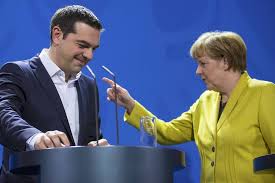
Greece Crucified

ws jimagesAlexis Tsipras justified his humiliating U-turn, and commitment to imposition of austerity worse than he had just rejected, by saying that he had no mandate for Greece to exit the Euro.  Very true.  But he had just claimed that the referendum a week before had not been about the Euro.  By 61 to 39 per cent he has no mandate for austerity, which is what he said the referendum was really about.

He came into office promising an end to failed bail outs and has ended with a third one bigger than the first.  He called for debt reduction and now seeks support for debt inflation.

Such is the scale of the crushing terms of the latest ‘bailout’ that no one is attempting to say that it is nothing other than complete humiliation for Greece.  Even the Eurozone bureaucrats stated the truth behind the unpalatable words spewed out by their leaders – Tsipras had been subjected to “mental waterboarding” and had been “crucified”.

What has been mental torture for Tsipras will be brutal and catastrophic austerity for the Greek people.

I could write a whole blog on the capitulation of Tsipras and what looks like the majority of Syriza, and there would be good political reasons for doing so.  The policy and strategy of Syriza has been endorsed by Irish opponents of austerity such as Sinn Fein and these now lie in tatters.

In fact in my own view Sinn Fein is not even as radical as Syriza and this is an easy claim to substantiate.  It has already implemented austerity in the North of Ireland while hiding behind opposition to some welfare cuts.   In the South it supported the fateful decision to make the debts of corrupt banks and property speculators the burden of Irish workers and in doing so made the struggle against paying this odious debt much more difficult.

But there will be plenty of voices pointing out that what radical politics Sinn Fein has to offer have been trialled in a real life laboratory and been found wanting.  The capitulation of Syriza is in principle no greater than the Republican’s own acceptance of British rule in Ireland, acceptance of partition, surrender of weapons and dissolution of the IRA.  But that is all now a history that no one wants to talk about.

What is more important therefore is to try to understand what has happened and whether it could have been any different.  Not that it must be accepted that the ‘coup’ against Greece cannot or will not be resisted.  It can and will but it would be blindness to reality not to acknowledge that under Syriza the fight against austerity has suffered a demoralising defeat.

As that new aphorism says: it’s not the despair, I can take the despair.  It’s the hope.  Syriza gave hope.

Working out what has happened is not easy. For the man or woman on the street they see television reports of quantitative easing by the Eurozone involving the figurative printing of  millions of Euros by the European Central Bank, yet this same institution is involved in the vindictive pursuit of Greece for sums it could easily accommodate.

The proposals of the conservative leaders of the EU seem equally hard to understand or justify.  In fact for many they seem stupid, if not crazy. So draconian are they that they seem designed to achieve the very opposite of what they claim to be for.

The imposition of yet greater austerity when this austerity has demonstrably failed might be explained by ideological blindness.  And the humiliation involved might seem to invite rejection while being another attempt to remove Syriza from office.  But many commentators have explained that Syriza may possibly remain the only force that can push austerity through without complete chaos and collapse.

This humiliation is perhaps not just a message to a small and weak Greece but an unmistakeable one to a larger Italy and France: that the development of the EU will be under a model defined by Germany and its allies.  Yet even here the degree of malevolence can only invite small countries with parties equally blinded by reactionary ideology as Germany to wonder just what fate would befall them in an EU with such a definition of ‘solidarity.’

So while ‘good’ reasons might be found for what would appear to be ideological blindness the proposal for a “timeout” exit by Greece from the Euro appears as simply stupid; unless of course it is also a means of pushing Greece out permanently. But then it is such a stupid idea as justification that its purpose might only seem to be how open the imperial bullying can become, ‘pour encourager les autres’.

For the Greek people the surrender of even nominal control of their affairs is way beyond what has gone before.  The original proposal to ring fence €50 billion of Greek assets under German control,  to be sold at the discretion of its creditors, was such an open declaration of debt bondage as to render the humiliation utter and complete. What is yours is no longer even yours to sell.  Now it is reported it will simply be wasted on insolvent Greek banks with the needs of financial capital once again talking precedence not only over people but over real productive activities.

Thus in many ways, its failure to actually work being the first, its effects on undermining the legitimacy of the EU second and materially weakening the incentives to solidarity among its members third, all make the bailout deal a defeat for the idea of a European Union.  This is not even a European imperialism to rival the US, Russia or China but an imperial core and vassal periphery.

The price being paid seems so unnecessary because the main demand of Syriza – in order to give hope and reduce the impact of austerity, i.e. debt forgiveness, will be given and is already hinted.  Not in the shape of outright reduction but in the form of postponing or extending repayments and similar measures on the interest due.  After all, what cannot be repaid will not be repaid.

What matters however to the right wing conservative leadership of Germany, the Netherlands etc. is that their strength, and by extension that of the European imperialist project, is not diluted by the weak European nations and that the Euro remain in position as a world currency and not a vehicle for default and certainly not by what is considered an advanced nation.  Greece must be bled dry in order that the Euro remains strong and the pretensions of the EU remain in place.

The vision of a united Europe is not being abandoned by Germany etc, but it is one in which austerity is the bond that unites. It can be claimed that austerity will be inflicted on German workers if crisis hits the German banks; except of course that Germany has broken the rules before and would do so again.  It is easier to be ideologically blind when the price is paid by someone else.

Could it have worked out differently?    Syriza had hoped that enlightened self-interest would have combined with pressure from the US and the legitimacy gained by the referendum to mitigate the demands for austerity by Germany, The Netherlands and all the other little right-wing led states that curry favour with the powerful.  They have been rudely disabused of their illusions.

The more fundamental reason for this outcome is the weakness of the alternative at an international level.  Where were the left wing Governments calling for debt forgiveness, an alternative to austerity or even its reduction?  Where were the mass movements pressurising their Governments to accede to Greek requests?  Greece could not push back the demands of much stronger states on its own but on its own it was.

The demand for a revolutionary socialist alternative seeking the destruction of the Greek capitalist state and take-over of the Greek economy by its workers fails to provide any sort of immediate alternative, which is what we are discussing, for two rather obvious reasons.

Such a strategy relies on the aspiration and activity of the working class and the Greek working class neither desires nor is organised to destroy the existing state, create its own and take over the running of Greek production.  The anti-capitalist ANTARSYA for example got less than 1 per cent of the vote and Syriza, it should not need to be said, is not a revolutionary party.  How does a revolution arise out of this except through a long and painful process of learning lessons and making advances on this basis?

I was recently reading an article entitled ‘Marxism and Actually Existing Socialism’ written, what seems like a long time ago, before the collapse of the Soviet Union, and which defended Marx’s theory and politics.  In it the author wrote that:

“Marx envisaged that socialism would come first in the most advanced industrial societies of Europe, and it has not done so. Arguably, however, Marxism is capable of comprehending this fact. In any case, this is a matter of detail, even if an important one; and it seems difficult to resist the conclusion that, in its broad and general outlines, Marx’s account of the historical tendencies of capitalism has been remarkably confirmed by historical events.”

But of course the coming of socialist revolution not to the most advanced countries is not a detail, not even an important one.  It has been fundamental to the development and future possibility of socialism and has led to the very definition of socialism being distorted and disfigured.

Socialism is not possible in Greece alone any more, and certainly less, than it was in Russia not least because it is too weak and poor.   It is obvious that no other working class within any other country in Europe is at a stage of development where it could either join or support working class rule in Greece.

This does not mean Syriza should not have taken office or that it should not have engaged in negotiations with the Troika. Its strength however derives fundamentally from the class consciousness and organisation of the working class and not from any superior moral position.  The building of an international European party of the working class, of a militant current within the working class movement including trade unions, and of international workers’ cooperatives is the only road to creating the foundations for a successful conquest of political power.

On the other hand capitalist economic and political crises and socialist propaganda are, respectively, simply the occasion for such a conquest and the means of spreading word of the need for it.

As I have said before: the worst result would be Syriza implementing austerity.  It should now reject the bailout, call fresh elections on such a platform and if elected pursue an alternative.  If in opposition it should develop a movement as set out above.

The alternative it should pursue is that which the Irish should have carried out in 2008.  Let the banks go bust and let its owners and lenders take part in a ‘bail-in’ in which they pay the price for their investment in insolvent companies.  This is sometimes known as capitalism.

A radical Greek Government would encourage Greek workers to turn the banks into cooperatives that would shed their bad debts into a ‘bad bank’ (like NAMA in Ireland, in theory if not in its practice) and guarantee deposits that would fund development of worker owned enterprise.

The Greek debt would thereby suffer default and the reactionary gamblers Merkel, Juncker, Schäuble, Draghi and Dijsselbloem would see where the chips fall.

The blogger Boffy has suggested that a solution to the currency problem would involve electronic Euros that would allow circulation of money without the requirements for additional notes etc. from Brussels.  While this could work for the domestic economy I cannot see how it could function as a means of payment for international trade and, while Greece is a relatively closed economy, it cannot function without it.

In any case the leadership of the EU would, on current form, expel Greece from the Euro and introduce its own capital controls on the country.

Greece would be forced into issuing a new currency, a new Drachma, which the people do not want.  This could not be done quickly or without significant disruption.  It has been asserted that the argument that this would result in devaluation and a massive reduction in Greek living standards is false because the catastrophe predicted has already happened.  ‘Internal devaluation’ has already achieved what external devaluation of the new currency would otherwise have done.

I am not convinced by this argument but this too might be academic if the EU decided that Greece would no longer be part of the Euro.

The strategy suggested therefore provides no guarantee of success.  There is no ‘technical’ solution or answer in this sense.   And why should one be expected?

I have said that socialist revolution depends on the prior creation of a working class power consisting of an international party, international trade union action and development of workers’ cooperatives on an extensive scale.  What on earth could substitute itself for these?

What is suggested is a strategy for struggle and not a ‘solution’ but we have reached the stage where not even the leaders of the EU can present false promises on this with any credibility.  Austerity will continue not to work.  Struggle is what we have.


Some comments on the Greek referendum

Greece3543The decision of the Syriza Government to call a referendum on the proposed austerity proposals of the Troika (European Commission, European Central Bank and IMF) in return for another ‘bailout’ programme reminds me of the Irish austerity referendum three years ago.  It gave rise to one of the first posts on this blog.

The Irish people voted by a large majority to support austerity.  Will the Greeks do the same?

The Irish voted reluctantly to accept austerity (how else could you do so?) because there was no alternative at hand.   The arguments of the Left that the Irish State could lead a growth agenda of Keynesian stimulus hardly convinced when that State had just bankrupted itself bailing out the banks.

Both the reason for the defeat and its effects have not been appreciated.  Of the latter it is enough to ponder the proposals of the trade unions behind the largest sustained opposition to the austerity agenda – the Right2Water proposals for ‘A New Fiscal Framework for a Progressive Government’, which proposes additional State expenditure of €9.4 billion over 4 years.  This would amount to less than 4.5% of the 2014 level of Government expenditure.

The Right2Water’s ‘Policy Principles for a Progressive Irish Government’ contains a section which proclaims the need for additional investment in the water and sanitation system of “between €6 and €7 billion”, which leaves just around €2.5 to €3.5 billion for education, health, investment and everything else.  This is not so much an alternative to the current Government’s strategy as a variant of it.  So much have horizons been lowered.

According to the authors of this document the rules of the EU will be adhered to while seeking flexibility within them and negotiating additional scope for spending.  But the case of Greece exposes that the rules of the EU, ECB and IMF can be bent to suit.

So the claim that joining the Euro was irrevocable has been discarded by the leading powers in the EU to be replaced as the biggest threat to the Greek Government and people – vote against our austerity plan and you are voting to leave the Euro.

The propaganda campaign by the EU leaders includes European Commission President Jean Claude Juncker, who says he feels ‘betrayed’, and complains about a lack of “good faith” and “sincerity” from the Greeks.  This from a man who presided over the building of Luxembourg into a tax haven.  Yet he sees fit to question the Greek Government and people over their right and capacity to raise taxes.  Has the tax evasion facilitated by Luxembourg not contributed to the Greek predicament?

Christine Lagarde of the IMF proclaims she wants “adults in the room” with whom to negotiate, attempting to infantilise the Greek Government representatives and by extension the Greek people.  This is the Lagarde who has been placed ‘under investigation’ in a fraud case.  One can’t help but recall the behaviour of the previous head of the IMF, Dominic Strauss-Kahn.  Getting fucked by the IMF is a pleasure for no one.

In the current case this involves Troika demands for drastic reductions in the pensions of some of the poorest Greek pensioners and increases in VAT that will hit both those who will pay increased prices and the small businesses compelled to charge them.

On the Left these demands of the Troika are likewise treated as in effect an ultimatum which should lead to exiting the Euro – as the only effective response to the unceasing demands for austerity.  What for the leaders of the EU is a threat which the Greek people should retreat from is for some on the Left a major part of the solution.  What for the former is a recipe for chaos is for the latter the way out of it.

In my view the former are correct.  Exiting the Euro would lead to a new Drachma that would involve massive devaluation and a large reduction in Greek workers’ living standards.  Cutting one’s own throat is not preferable to having someone else do it.  If Greece is thrown out of the Euro it naturally has no choice but that is not a choice it should itself make.

It is clear however that the choice at the end of the day is not Greece’s to make.  It is not in a position to compel a significant reduction in austerity or debt relief even while many commentators who support the austerity demanded admit that debt relief is inevitable.  The reason that they demand austerity nevertheless, even while recognising that it has failed, is that they seek the removal of the Syriza Government.

The EU leaders tried it last week and now seek it this week through refusing to accept Syriza’s huge concessions, refusing to extend the ‘bailout’ and through freezing ECB liquidity provision to the Greek banks.

The Greek workers should reject the austerity plan from the EU and reject the non-solution of leaving the Euro.  Only on the basis of fighting austerity and refusing a go-it-alone nationalist solution can it minimally seek to build a movement that would stem the demands for austerity.  What the Greek crisis shows is that such austerity can only be fought at an international level.

What does this mean?

Well, let’s look at what the Channel 4 journalist Paul Mason, who is covering the crisis, had to say.   Exit from the Euro may be inevitable he says because of democracy – the population of Northern Europe would not support the transfers required to reverse austerity inflicted on Greece while the Greek people may no longer accept it.

In this he is at least partly right.  Only an international campaign of solidarity with the Greek people, which explained that the bailout was not for them, but for the German and French banks and hedge funds who invested in lending to Greece, could explain the real function of austerity and lay out the grounds for convincing those outside Greece to reject it.  On this basis it might force a retreat from the austerity demanded by other EU Governments, including the repulsive Irish one.

Within Greece it would require not just an ‘OXI’ vote but a mass movement that would compel implementation of a Syriza programme to tax the oligarchs through occupations to open the books of these businesses and in doing so help put in place a rigorous system of tax collection.

In itself this would only form the starting point of a workers’ alternative – one that is based on development of worker owned production.  Such workers’ cooperatives are the alternative to the weak and crony capitalism from which Greece suffers.  It offers practical proof of the socialist alternative and is a basis for its growth this side of political revolution.  The latter in turn will gain credibility from practical demonstration of a socialist programme.

The lack of such international and domestic conditions caused defeat for Irish workers in their referendum.  A very different vote in Greece would be a step forward for Irish workers now.

On the other hand the very worst result would be defeat in the referendum and a Syriza Government implementing austerity.

While the Dutch hatchet-man Jeroen Dijsselbloem again reveals the Euro leaders agenda of getting rid of the elected Greek Government – “ who are we trusting” he says if Syriza promised to implement the austerity it had just rejected, Varoufakis is quoted as saying that Syriza would do just this.  “If the people give us a clear instruction to sign up on the institutions’ proposals, we shall do whatever it takes to do so – even if it means a reconfigured government.”

Such an approach would discredit any sort of Left alternative and pave the way for a hard right Government to eventually push through austerity on a demoralised workers’ movement.

The long resistance of Greek workers to austerity has given hope that we are not yet at such a result and that the struggle against austerity will continue.

Syriza and Ireland

syrizaimagesThis Sunday the Greek people will go to the polls in an election that could see the beginning of the end of austerity in Europe.  That anyway is the view of some on the left across Europe.

The potential election of a Coalition of the Radical Left (Syriza) Government, promising a radical reduction in the debt burden, has the potential to galvanise and set an example to the rest of the PIIGS.  It could incite a combined movement in Portugal, Ireland, Italy, Greece and Spain that would reduce the debt of these countries which has been a prime driver of austerity.  Through radically reducing the requirement to service and pay down enormous debts such a step could launch a definitive movement away from neoliberalism towards a radically different Keynesian social democratic alternative.

The elections in Greece will be followed this year by elections in Spain, in which a like-minded Podemos movement has grown, and in Portugal, and may also be joined by an election in Ireland despite the claims of the current Government that it will run in office until 2016.  Of the five PIIGS therefore at least three and possibly four may see elections this year.  Even elections in Britain could see the ousting of the Tory devotees of austerity and neoliberalism.  In fact the policy that might inspire the PIIGS is not confined to them but might apply right across Europe.  And Syriza is in the vanguard of this movement.

Is such a scenario a real possibility?

Let us notice what makes such a claim plausible.

Firstly the proposals of Syriza are not solely on behalf of the Greek people although as a Government it will be able to negotiate only on their behalf.  Syriza proposes a European Debt Conference modelled, with delicious irony, on effective debt forgiveness of (West) Germany in 1952.  This was carried out explicitly in order, or so it was claimed, to normalise relations between Germany and its creditors and to promote economic development.   That deal wrote off half of the debt, stretched repayment of the rest and for the first few years provided only for payment of interest, which was also limited.

Syriza proposals are more limited. Their policy could be based on an academic paper which proposes that half of the debt would be bought up by the European Central Bank (ECB) with either an interest holiday or interest charged on the remaining debt at a low rate.  The debt taken on by the ECB would not be written off but would be paid back only when the remaining debt left to the country had been reduced to 20 per cent of Gross Domestic Product (GDP).  In effect economic growth and inflation will have eroded the real value and real impact of debt repayment.

However in one very important sense the proposals are much more radical than the German precedent, because the Syriza proposal is that this plan applies to every country in the Eurozone with debt over 50 per cent of GDP (all but three countries).  The Irish state for example would see its debt reduced from 108 per cent of GDP to 50 per cent, saving €3.7 billion each year in interest payments, so reducing the need for cuts or tax rises and facilitating greater state spending and investment.[i]

It has been estimated that this would reduce sovereign debt in the Eurozone area by about €4.5 trillion.  It is asserted that this would not risk inflation because the ECB debt purchases would be funded by massive borrowing from private banks.  There would be no money printing since the money is borrowed.  And sure why worry about inflation when deflation is so clearly the enemy?  And who pays the interest on these loans?

Well, it is recognised that there will be losses in paying back the private banks, between €50bn – €60bn in each of the first 5 years, and €1trilion over 40 years, but it is argued that the borrowing costs of the ECB would be low and that renewed economic growth would compensate.  It would be cheaper than the current policy of austerity and expansion of the ECB balance sheet required to bail out the banks.

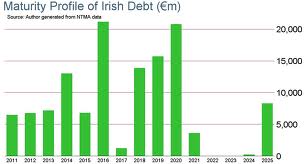
It is recognised that this may not be enough in the short term for some countries so that, for example, in order to prevent continued austerity in Greece the ECB would have to take over the debt that would be required to be issued in the next five years.  This would also be required because over 50% of outstanding debt has to be paid back within the next 5 years in Italy, Spain, France, Holland and Belgium and to cover this new debts would have to be taken on.

For Marxists the point is not that some monetary scheme has been devised that will solve capitalisms’ problems.  Nor is it the point that Syriza will go into negotiations and cannot expect, as in all negotiations, to get its original plan agreed, even discounting some conscious intention to betray the hopes of its supporters in order to accept the logic of capitalism.

The significance of the proposals is that it provides a concrete platform around which workers across Europe can organise and struggle together, and a series of elections that can be a focus for such struggle.  This is not to invest illusions in either elections or Syriza, who are condemned by some for having shifted from a policy of debt repudiation to one of simply extending repayment under more favourable terms.   If a practice of simply condemning the limitations of reformist politics were the answer we would no longer have the problem.

The Syriza programme is one that workers and socialists can support because it reduces the burdens they face and would deal a big political and ideological blow to austerity and the parties who have peddled it.  It would deal a real blow to reactionary political parties seeking nationalist or fascist solutions.  Through a successful campaign workers could gain strength and confidence to build up their organisations, their own social and political power and their own confidence and class consciousness.  The latter is the role that Marxists can play by advancing a programme that does all these things.

The victory of Syriza would allow an opportunity to directly organise workers on an international programme on an international basis.  It is remarkable that this significance has been somewhat missed.  So, for example, the call promoted by the Fourth International correctly argues that “their victory will be ours, but their defeat too” but appears to fail to appreciate that this can be so because other European workers will not just be in solidarity with Greek workers but can actually be part of the same struggle, demanding the same deal for their country, so that “our victory will be ours and our defeat will be ours too.”

This is made tactically easier by Syriza not proposing either to leave the Euro or leave the EU.  There can be no pretext that the demands of Syriza can be dismissed because they no longer want to belong to the club.

These policies have been condemned as examples of betrayal of earlier more radical promise but they are not just tactically recommended.  As argued before in the various posts on ‘The Left Against Europe’, the growing unity of capitalism provides the material basis for the international unity of the working class.  This is why a united international struggle against austerity is more immediately and concretely possible in the Eurozone than one against similar policies pursued more or less independently by separate capitalist states each with their own currency.

So to return to our question – is such a scenario possible?

It is possible to argue that it is, for the simple reason that the Greek debt is too big to be paid back anyway.  Some means of addressing it is required and the Syriza route is eminently preferable for workers than the slow death march of austerity and repeated minor debt ‘haircut’ so far embarked upon.

The second is that by the very fact that the Syriza plan is reformist there is no necessity for a life and death struggle by the forces of capitalism to defeat it.  The Syriza plans do not call the system into question, which both sets limits to what it can achieve but also provides scope for negotiations between a Syriza Government (and other PIIIGS Governments should they be elected or so inclined) and the IMF/ECB /EU/German State alliance.

The rallying of the Greek workers behind Syriza is one of many proofs that a revolutionary overthrow of Greek capitalism is not currently on the cards and is not therefore a realistic immediate alternative.  The revolutionary alternative today consists of preparing for such an eventuality tomorrow.

Not by either passively or even ‘aggressively’ preparing for socialist revolution but by the cumulative development of the power of the working class suggested above, with the certain knowledge that a revolutionary break with the capitalist state and system will be required.

To condemn Syriza for negotiating with capitalism when it cannot be overthrown is a bit like condemning trade unions for negotiating a pay award when they should be overthrowing the wages system.

The third has been pointed out here – Syriza will be damned if it does not get some sort of result and the executor of that judgement may be the fascists of New Dawn.  It is not only Syriza who has an interest in ensuring this doesn’t happen.

‘Ireland is not Greece’ we have been told repeatedly over the past five years or so.  If Syriza is anyway half successful Ireland will look pretty stupid if it isn’t.

[i] It is interesting that the authors go beyond the argument that this is some sort of socialism saying that “The left ought to be strategically against privatizations, having at the same time as an ultimate target the gradual historical replacement of “state control” by democratic forms of social control (unfortunately this type of discussion has not been adequately developed within the left).”

The Left against Europe 5

is049-600Chris Harman’s article on the Common Market signalled the adoption by the International Socialists of opposition to British membership of the European Economic Community.  In doing so it came into line with the majority of the rest of the Left.  Like the International Marxist Group (IMG) and others, IS was keen to differentiate its position from that of reformist organisations, particularly the Communist Party (CP) and left of the Labour Party.

It is worth remarking that the political positions of the Communist Party during this period are very similar to those of the Left today, including the successors to the IS and IMG, which thinks of themselves as opposed to the sort of Stalinism represented then by the CP and as advocates of a more revolutionary alternative.

The CP statement on the Common Market quoted by Harman states that:

“A new government, committed to socialist policies, would use its parliamentary majority, together with its mass support in the country, to challenge the power of the ruling class. The developing movement to the left over recent years points in this direction. That is why the ruling class, as part of its attack on positions gained by the working class, is out to deprive Parliament step by step of its authority, and to transfer it to the supranational institutions of the EEC …”

The CP concludes that “Britain’s national sovereignty is of vital concern to the British working class. Sovereignty is a class issue”.

In opposition to this Harman states that:

“A consistent socialist position on the Common Market must begin by rejecting out of hand the chauvinism explicit in the approaches of the Labour leaders and the established left. The national state is not our state. It functions to defend the ruling class, and cannot operate in any other way. The harping of the left about ‘national sovereignty’ only serves to sustain the illusion that somehow we have an interest in common with those who run the state at present. It intensifies the differences between workers in different countries. And it does so at a time when the growth of international firms emphasises the need for united international working class action. .”

Harman warns that nationalism can be a competitor to socialism within movements expressing social discontent, that this can take the form of right wing Tories such as Enoch Powell but can also arise within the working class movement itself.  The parallel with nationalism today in the form of UKIP and the left embrace of Scottish nationalism is striking.

Nevertheless Harman puts forward a number of reasons why it is “imperative for us to oppose entry” into the European Economic Community:

“1.    Entry is being used, alongside other measures, to hit at working class living standards and conditions. Of course, if the ruling class could not achieve its ends through entry, it would try to get what it wanted through other means. We should never forget this as those who peddle chauvinistic ideas within the Labour movement do. But that does not provide us with a reason for not opposing entry. We should oppose it as we would oppose other forms of attack if they were used instead.

  1. Entry is aimed to rationalise and strengthen capitalism. It is an attempt to solve certain of capitalism’s problems by capitalist methods. There was a time when revolutionaries could regard certain such measures as historically progressive. Marx, for instance, gave support to the movement for German unity. . . But he did so in a period in which capitalism as a system was still struggling for supremacy against older forms of class society and, in the process, preparing the preconditions for socialism. Today, however, these preconditions exist. Rationalisation of the system means strengthening it at a time when we as socialists argue that revolutionary change alone offers mankind any future. We have to oppose such measures, counterposing not continuation of the system under its present form, but a. socialist transformation of it.
  1. Not only is the rationalisation of capitalism no longer progressive in any sense, it also speeds up the development of intrinsically destructive forces. In the case of European integration this is expressed in the aim of creating on a European scale what cannot be built up by the isolated states – an effective independent arms potential. According to the British government white paper there is no other way by which British imperialism could have the same opportunities to ‘safeguard’ its ‘national security and prosperity’. Revolutionaries have to oppose this as they have opposed previous arrangements serving the same purposes, e.g. NATO, SEATO, etc.

“There is a fourth, subordinate, reason, that emphasises the need for clear opposition. All summer the makers of official opinion in this country have been worried about the difficulties of ensuring that the decision of the ruling class to go into the EEC is implemented politically. They fear that they might have difficulty getting parliamentary ratification for entry. And so they have been putting enormous moral pressures on sections of the Labour leadership to break with the party and to vote with the Tories for entry.”

“At such a political conjuncture the position of revolutionaries should be obvious. The defeat of the Tory government, in the present context of growing working class opposition to its policies, would give a new confidence and militancy to workers – even if the defeat occurred purely in the parliamentary sphere. Moreover, a defeat on the Common Market would not in fact be a defeat on that issue alone; behind much of the working class opposition to entry is a general, if vague and not fully conscious, distrust of the government’s intentions. The general anti-Tory feeling in the country is feeding the flames of opposition to the Market.”

As the alternative Harman put forward the following:

“In general, our position should be that

  1. We oppose the attempt through the Common Market to rationalise capitalism at our expense.
  2. We also oppose the ideological illusion being peddled in the labour movement that somehow a ‘sovereign’ capitalist Britain is a real alternative to entry into the Market for working people. We have to make clear that while we oppose the capitalist integration of Europe we would be for a Socialist United States of Europe. However, the demand for the United States of Europe is not going to be an immediate agitational demand in the conceivable future. That would require that political life was really moulded on a European scale. The fact, however, is that the failure of capitalist attempts at European integration means that national peculiarities still determine the tempo of the class struggle. In the Belgian and French general strikes (of 1961 and 1968) the key demands had to relate to class power in particular countries not in Europe as a whole.
  3. We argue, against the chauvinists, for a linking of opposition to the Common Market to opposition to the other attacks on working people – the Industrial Relations Bill, the welfare cuts and so on, so as to build up a class based opposition to the whole range of government policies, counterposing demands pointing towards a socialist transformation of society.
  4. At all possible times we put forward our own consistent class based viewpoint in opposition to that of the confusion of the CP and the Tribunites (left of the Labour Party). But if we are unable to get a majority for our clear and consistent positions, we have to vote against the government Common Market strategy in the only way possible – by voting with the CP and the Labour left while making our reservations known (just as, for instance, we would, if we had no choice, give critical support to a resolution opposing the Industrial Relations Law, even if it spoke in terms of the law aggravating ‘industrial unrest’). We are completely steadfast in our opposition to the peddling of ideological illusions in the Labour movement, while being relentless in our opposition to government policy.

Harman’s argument did not go unanswered.  In the same issue of ‘International Socialism’ Ian Birchall quoted from previous editorials of the journal from 1961 and 1967:

“For us the move to Europe extends the scope of class struggle in which we are directly involved; it worsens its conditions for the present. But it makes ultimate victory more secure. (EditorialIS 6, Autumn 1961)”

“It is true that Wilson’s Common Market policy does involve a serious threat to working-class living standards, and is designed to strengthen the hands of the employers in the fight against workers’ defence organisations in the struggles over speed-up, rate fixing, and working conditions. But inside or outside the Common. Market, that particular battle is going to be fought – indeed, outside the battle is likely to be more ferocious. (EditorialIS 28, Spring 1967)”

Birchall notes “that the editors of International Socialism once argued, clearly and consistently, that we must not carry out any kind of campaign against entry. Now that Heath appears to be about to succeed where his predecessors failed, Chris Harman argues that it is ‘imperative for us to oppose entry’.”

Birchall then presents some arguments against Harman: some are good and some are not.  So he says that changes in general objective conditions might warrant a change of view on Europe, which seems obviously correct, but he also says that the growth of the Internationals Socialists from a small propaganda organisation to a larger organisation means ‘merely passive commentary would have to be replaced by agitational slogans’.  This however doesn’t seem to me to justify in itself any change in policy but merely how such a policy is put into effect.

Among the better arguments employed, Birchall notes that Harman’s third is the “least substantial”:

“the suggestion that the Common Market aims to create an ‘effective independent arms potential’. This is supported merely by a quotation from the woolly rhetoric of the White Paper. The failure of the Common Market to achieve integration in other fields is argued elsewhere in this journal; there is no reason to expect a frightening success in the military sphere.”

Experience since the early 1970s has shown that the European Union has not developed into a military alliance that can, for example, replace NATO.

He regards the first argument as the “more substantial” one, although since Britain and the Irish state have long since joined, it is now less relevant, since attacks on the working class are a simple feature of capitalism and continue in or out of the EEC/EU.  He repeats the argument that the attacks associated with membership had already been going on for some time before Britain attempted joining.

He makes an important point about how socialists relate to the opposition of workers to attacks on them that do not take a progressive form.  On Harman’s observation that ‘many rank and file militants instinctively distrust the government’s entry policy’ he says:

“It is undoubtedly true that working-class opposition derives from a sort of class consciousness. It is equally true that, for example, hostility to foreign workers in Britain derives from a form of class consciousness – concern to defend employment and conditions, recognition that immigration is manipulated by the bosses in their own interests. We have to relate to these forms of distorted class consciousness; we certainly do not adapt to them.”

So, for example, opposition to austerity make take the form of nationalism.  Socialists should relate to this opposition but not adapt to the nationalism, and certainly not trumpet it.  Socialists and socialism, which is based on internationalism, while relating to those expressing progressive strivings, albeit through a reactionary form, should make their opposition to this reactionary form even more total.

On the second argument, he denies the claim that the EEC is in any way a progressive development because it lays the basis for socialist internationalism.  He accepts the view that capitalism “cannot achieve a genuine international organisation” but since what he really means by this phrase is so ill-defined it is difficult to make much of this.

He appears to criticise the view that capitalism cannot solve its problems anymore, cannot develop in some ways and so cannot make “technical” and “administrative innovations which could not be taken over by a socialist society.  We do not oppose automation or mergers as such; we oppose them if and when they cause attacks on workers, through redundancies” says Birchall.

Ultimately however since neither he nor Harman thinks capitalism has internationalised sufficiently he does not think that they are in a position to formulate an international programme.  This in part derives from the IS tendency’s, and its SWP successor’s, very un-Trotskyist insistence on not having a political programme of any sort, which, if they had one, would of necessity have to be an international one if it was to be socialist.

Such a view seems odd for the time and is even more wrong now, when globalisation has been a commonplace of analysis of economic development for decades.  Without capitalist development there can indeed be no foundation for socialism to arise on these grounds but IS still subscribed to the view that a socialist revolution in 1971 was not only possible but a realistic prospect.  Without the possibility of an international programme however it would of course have been impossible, since socialism is international or it is not socialism. Yet to further the contradictions within both Harman’s and Birchall’s argument, they both appear to agree that the preconditions for socialism existed.

The important point within this argument is the view that capitalism is no longer capable of any progressive development. What is posed is simply the struggle for socialism.  That there does not exist the material basis for the generation of an internationalist consciousness among workers, which would be a consequence of the lack of international organisation by capitalism postulated by Harman and Birchall, goes unrecognised or unacknowledged.  The implications of this problem for the perspective of socialist revolution are simply overlooked.

To go back to Tom Nairn in New Left Review, where we started this series of posts:  the source of the trouble is treacherous leaders who betray the working class – ‘the crisis of leadership’.  This in itself is not an objective factor since capitalism is ripe for socialism, being in its ‘death agony.’  It has nothing more to offer in providing the preconditions for socialism.

But is it true that capitalism is incapable of further development?  Is it true that such development would not contain, in dialectical fashion, progressive elements?  As the blog linked here shows: of all the goods and services (use values) produced in man’s entire history, nearly 25% have been produced in the first ten years of this century.

And if the creation of this stupendous amount of wealth, involving the industrialisation of the most populous state on earth and others, is not enough – what about this blog here, which records the massive growth of the grave-diggers of capitalism, the world working class, caused by the same industrialisation?

As Nairn quotes Leon Trotsky in his long article

“It has happened more than once in history that, when the revolution was not strong enough to solve those historical problems ripe for solution, reaction has itself been forced to try to resolve them”.  The EU is the capitalist, reactionary means of resolving the contradiction between the international development of the productive forces of society and the nation state configuration of political society and domination of the ruling classes.

The internationalist alternative proposed by socialism will be based on the common interests of workers resting on a common exploitation, imposed and more apparent for its expression in pan-European forms such as the EU.  It will rest on the interests of workers of different nationalities involved in international workers’ cooperatives; international trade unions and an international party, perhaps initially a Europe-wide socialist workers’ party.

At the moment the international organisation of capitalism is in advance of the international organisation of the working class and of socialism.  The answer is not to attempt to drag capitalism back to the immature development of the working class and existing socialist movement but, using the development of capitalism itself, to leap ahead of capitalist development so that the ground is prepared for the socialist revolution that will confirm the emergence of the new society that is the historical leap beyond capitalism.

Such are the issues posed by the British Left’s attitude to Europe in a forgotten debate conducted half a century ago.

concluded

Back to part 4

The Left against Europe 4

david cameronThe question of membership of the European Union has loomed large because of the recent successes of UKIP in Britain.  Many of the questions raised by it also underlie the recent Scottish ‘independence’ referendum: questions of nationalism and internationalism.  Both are or might be settled in referenda.

Thus many of the points I have argued in the posts on the Scottish referendum apply to the debate on Europe, which I was addressing in a series of posts before I interrupted them to post on Scotland.  This post continues to look at the issues that are thrown up for the Left by looking at the ‘great debate’ generated by Britain’s potential membership of the Common Market (as the EU was called then) in 1971.

In the previous post on the question I looked at the views of the International Socialists (IS), which was the forerunner of today’s Socialist Workers Party.

By the time of the ‘great debate’ among the ruling class in 1971 over joining the Common Market the majority of the International Socialists appeared to have dropped their previous attitude, which recognised the positive features of the capitalist European project (while still recognising that the working class had to assert its own position).

Instead the majority position appeared to be represented by a Chris Harman article in their journal ‘International Socialism.’  In this article Harman provided an analysis of what the European Economic Community was – “The Common Market is essentially what its title says it is – a business arrangement, an agreement between different capitalist ruling classes, relating to the way in which they organise their markets.”

“The second aim of the Common Market has been to move beyond being merely a unified arena within which different competing national capitalisms compete, to the beginnings of a positive integration of the rival capitalist classes.”

“There are a number of steps which would have to be taken for such a merging of interests to occur.”  These included that:

“ Impediments to the free movement of capital from one country to another would have to be done away with.

Legislation and tax policies in different countries have to be made homogenous with one another.

Exchange rates of the different European currencies with one another should be fixed immutably,

and preferential treatment in the allocation of governmental contracts to national rather than other European firms would have to be overcome.”

Today some of these steps have been taken while others are still the subject of controversy, such as harmonisation of taxation.  Others have been surpassed, such as the creation of a common currency.  All are steps that a state must take to advance a unified European capitalism.

Harman maintains that “paradoxically, the very internationalism of capitalism is an important factor enhancing the role of the national state.”  The problem then is to create a European state that can do at a European level what national states have been unable to do for their national capitalisms:

“The failure of the nationally based capitalisms to begin to merge with one another does not, however, do away with the need for them to do so. Resources have to be mobilised and production organised on a continental, rather than a merely national basis, for survival in the most advanced industries. Europe’s failure to integrate has been paralleled by a failure to keep up with the international leaders in such fields.”

So the problem becomes a political one: European capitalism “wants a ‘Europeanisation’ of capital – but this continually clashes against national state boundaries. The only way out would seem to be to somehow reduce the dependence of firms on the national state by developing some sort of European state.”

Harman sees the mechanism to achieve this as the European Commission, which he states was the original intention of the Treaty of Rome, officially the Treaty setting up the EEC.

“The Commission, it was implied, would represent a political projection of the economic trend for national boundaries to be superseded. What the international companies were accomplishing in economic terms, the Commissioners would accomplish politically. Eventually they would concentrate in their hands the budgetary and monetary prerogatives of national governments, and oversee on a European scale the economic and social needs of the system as a whole. At this point the present national governments would be effectively redundant. Such was the dream of the more extreme ‘Europeans’ [13] – and the nightmare of those who criticise the Market from the point of view of ‘national sovereignty’.”

“However, there is little evidence that the Commission has been able to fulfil this role at all, even in an embryonic form. So far the European institutions have not begun at all to rise above the squabbles of opposed national interests.”

“The failure of the Commission to develop as an autonomous power has effectively left real power with the separate governments. But these remain under the sway of different national economic interests and political orientations. Their interaction so far has failed completely to produce the sort of single minded direction that would correspond to the needs of the advanced sections of capital seeking integration.”

In part this would seem to be a failure of the institutions to take on the most essential role of the capitalist state:

“Above all the state remains the chief means by which the capitalist class exercises its political and ideological control over the rest of society. This does not only mean repression, although it remains of crucial significance. Also involved is guaranteeing the conditions under which subordinate classes can identify with the status quo.”

“Left to themselves the rival capitalist concerns would tear society apart in their relentless search for profits. The state prevents this, in so far as it can, in the interests of continued capitalist domination. It tries to integrate the middle classes into the system by all sorts of privileges for them; it attempts to placate working class discontent by ‘welfare’ policies and the like; budgetary and other measures are used to impose some restraint on economic fluctuation and to ensure some evenness of economic development in the different regions of the country.”

While the seemingly natural workings of the capitalist market, and the widespread view that there is no alternative, is the primary ideological force imprisoning workers, nationalism is the primary means by which the subordinate classes identify with the status quo.  This allows support for a variety of policies that the state can pursue but none that involve breaking the bounds of what is defined as the national interest, and certainly none that threaten capitalism or that point to a socialist alternative.

It is the national state that continues to tax and spend and so continues to pull the levers of privilege sought by the middle class and which also form the basis of welfareist measures to placate workers.  It also still has powers to ameliorate economic fluctuations endemic to the capitalist economy and which today’s EU has been so criticised in the ‘Euro crisis’ for being unwilling or unable to introduce, at least to the extent some consider necessary, (such as quantitative easing, Eurozone debt instruments etc).

It is not quite true today that, as Harman said over 40 years ago, “the European institutions have not begun at all to rise above the squabbles of opposed national interests” but it remains true that the European project has not won the workers of Europe to identification with its institutions or ultimate objective of a European state.  This means that national political forces continue to promote nationalist solutions, or solutions premised on nationalist assumptions, which therefore create difficulties for everyone when they need to take steps that go beyond the framework of the nation state.

These difficulties can become quite acute.  In January the ‘Financial Times’ carried a long article – ‘Torn in two’ – about the Tory leader David Cameron and his decision to call an in-out referendum on British membership of the EU by 2017.  ‘The British prime minister’s ‘in-out’ EU referendum strategy  looks like it is backfiring as he is caught between the anti-Europe faction of his Conservative party and powerful business groups.’

The Eurosceptic wing of the party has grown and is now making demands that Cameron cannot satisfy and which therefore threaten British membership of the EU and the vital interests of big business that are associated with it.  It is making demands that would mean, according to former Foreign Secretary William Hague, that “the European Single Market would not work” and other demands on restricting immigration from Eastern Europe that would be illegal under EU law.

The article quotes a spokesperson for a right-wing think-tank saying that “the party is going to split, there’s no doubt about it.”  It quotes former leader John Major saying that “calling three of my colleagues bastards was absolutely unforgiveable.  My only excuse is that it was true”.  The number of bastards has grown and some in big business have become concerned.

“Bankers attending last year’s Tory conference were startled by the pervasive mood of “rabid” euroscepticism.  “It seems to me they are bending more and more to Eurosceptic concerns because of Ukip, and the more they do that , the more unhappy business will be,” says a City worker.  “Companies want better outcomes from Brussels but you don’t get it by shouting insults from the sidelines.  City lobbyists are gearing up for intensifying discussions with senior Tories.  The Square Mile realises that if it waits for the referendum to be called, it could be too late to influence the debate.”

Contrary to the Tory policy of seeking big changes to powers given over to the EU, the City of London has taken the “view that there was no need for a “repatriation of powers” but that Britain should strengthen its ties with Brussels, for example by boosting the number of UK officials working there. “There is no prospect of negotiating a better deal for Britain of any significance” says a leading City manager.”

The split in the Tory party reflects the division in its support between big business which has Britain as its main base, but Europe and the world as its field of operations, and small capitalists and reactionary middle class who need not or cannot see further than the British market and for whom a ‘little Englander’ mentality is perfectly satisfactory for their position in the world.

The dynamic development of capitalism continues to disrupt all class and political relations just as much, if not more, than its revolutionary effects so vividly captured by Karl Mark over 150 years ago in ‘The Communist Manifesto.’

This development causes problems not only for the right but also the left.  Harman writes that “of course, the development of the forces of production demands the creation of a European state. But then the development of the forces of production also demands a socialist revolution. It may well be the case that the former will take place after the latter.”

If only this were true the problems posed by it not being true would not prove such a barrier to an internationalist policy.  Harman appeared to believe that the European capitalist project would fail but so far it has not:

“Indeed, it is an important fact that there seems to be no historical precedent for the peaceful integration of different bourgeois states. A minimum of physical force has always had to be used. The examples of Germany, Italy and the US bear this out. In the modern world national ruling classes are more closely linked to national state structures than ever before. There is no certainty that such an obstacle to unity can be removed.”

On top of this the prospect of socialist revolution in Europe looks further away than it did in 1971.  The view that the problems posed by the continuing rapid development of capitalism can somehow be ignored through the immediate alternative being a programme of socialist revolution is obviously mistaken.  But how is it mistaken and how does this relate to a socialist approach to the EU?  In the next post on the ‘great debate’ I will look at what policy Harman advocated and the alternative put forward in the same issue of ‘International Socialism’ by his comrade Ian Birchall.

Back to part 3

Forward to part 5

The Left against Europe 3

is006-250In Tom Nairn’s review of the Left’s approach to entering the Common Market it is the debate within the International Socialists (IS), forerunner of today’s Socialist Workers Party, that is the most interesting.

The group’s debate on the EEC began in 1961 at the time of Britain’s initial application to join and, contrary to the almost universal position today, IS supported membership.  In fact its approach was to ridicule the nationalist assumptions that lay behind the rest of the Left’s opposition:

“Tribune’s case against the Common Market remains unproven. The more one looks at it the more unrealistic seem the alternatives and the more it appears to be a defense of reformism. ‘Let us have a rich and sovereign Britain’, is what they are saying, ‘because only in such a Britain can we hope to use the State to better workers’ conditions’.”

This did not mean however that IS minimised the negative effects of membership and particularly of the pain that the bosses would attempt to impose in joining the European market:

“God knows the transition can be brutal. Rationalization of European capital might mean deep unemployment in some industries – shipbuilding, textiles, coal, agriculture, and more; it might mean a British loi unique to pass the costs on to the workers as a whole; it might mean concentrated European capital bearing down on a disunited, nationally-separate and disfigured European working class. It might mean these but it can mean more: in the same way as takeovers and the concentration of capital in this country have encouraged combine-wide organization of workers in joint shop-stewards’ committees, so we can expect to see – hesitantly at first – the internationalisation of similar rudimentary working class organizations.”

Although some of its analysis and argumentation can be challenged today, sometimes with that piercing weapon of hindsight, it is not the particular prognostications or faults in analysis that remain enlightening today.  It is what is essentially different to the Left’s position today that stands out.

“If, in the long run, Europeanisation hastens this process, as it surely will, cartel Europe will have laid, as surely, the basis for the United States of Socialist Europe. For revolutionary socialists in Britain there is no greater aim. We should be the first to clasp hands across La Manche. . . . For us the move to Europe extends the scope of class struggle in which we are directly involved; it worsens its conditions for the present. But it makes ultimate victory more secure.”

is007-250These remarks, written for the autumn 1961 (No. 6) issue of ‘International Socialism’ were followed up in the next issue by some more, very honest, remarks on the debate that had been launched:

“Controversy over the Conservative Government’s move to enter the Common Market established by the European “six” as a preliminary to their complete political, economic and military fusion has riven every political grouping in Britain. The editorial board of this paper has not escaped the general confusion, as is made clear in the position of the majority (stated in the editorial note, Britain and Europe, appearing in the last issue). For us, however, the terms of reference are different. Discussion among Marxists is concerned only with the means most effectively to forge unity of the international working class in the struggle against capitalism.”

In this article the author takes issue with the majority position expressed in the first article:

“The majority statement recognizes the economic basis of the Six as the untramelled power of the giant monopolies. It proceeds to the statement that “takeovers and the concentration of capital in this country have encouraged combine-wide organization of workers”. True enough. But when, in the whole history of socialist thought, has this been adduced as a reason for socialists to support or welcome such takeovers or such concentration, which so clearly strengthen capitalism and weaken the workers? Why have not the authors of the majority statement the courage of their convictions? Having said A, why not say B? Why not lend support (“critical”, no doubt) to imperialism, which smashes feudal barbarism and transforms backward peasants into workers often more advanced politically than their metropolitan confrères?

Of course Marxists press for the fullest utilization of the channels of increased contact between workers whose bosses combine, nationally or internationally. But they do so on the basis of total opposition to such combination. . . . It is one of opposition to every move on the part of international capitalism to stiffen its sinews, whatever incidental “advantages” may accrue (and, indeed, dialectically must accrue) to the working class in the process. Marxist-Leninists in this situation raise anew their battle cry: for a united socialist states of Europe.”

Against the argument of the majority that opposition to the Common Market rests on an essentially nationalist view of socialist transformation the author argues the following:

“The majority ask us to dismiss as unlikely the unilateral victory in Britain of a revolutionary socialist party. The opinion is noted, with the observation that, while Marxists are agreed that socialism cannot be built in isolation (least of all in economically vulnerable Britain), that is by no means to say that power, to be held, must be seized simultaneously in all European countries. Let us, however, envisage a more immediate probability: namely, the election of a Labour Government—classically rather than militantly reformist!

What finer excuse could the leaders of such a government have against measures of socialisation than membership of a non-socialist (indeed, classical and militant capitalist) West European federation? This is an argument which, not accidentally, is seldom deployed by centrist and Stalinist opponents of the Common Market, imprisoned in the same parliamentary cretinism as the Right.”

ISdownload (1)In No. 11 of the Journal a further article takes up the debate:

“For the record: the Common Market is designed as an economic arm of NATO; its existence perpetuates the division of Europe; it is designed to further the process of monopolisation and concentration of capital at the expense of the West European working class; and it is a rich man’s club whose sponsors hope that it can compete successfully against US capitalism in Asia and Africa. Also for the record: Britain outside the Common Market is equally an economic arm of NATO, equally perpetuates the division of Europe; is witnessing a process of monopolisation and concentration of capital as ruthless as any; and it is as certainly part of the white man’s club if not its chairman.”

The real issue posed by the Common Market is this:

‘Several big groups,’ writes The Times (5 November), ‘have been deliberately streamlining their work-force in preparation for Common Market competition.’

“Several equally big groups have been doing the same as a consequence of the Common Market on the Continent. ‘In preparation for,’ ‘as a consequence of’ – these are the words we need watch. In itself, the Common Market cannot tilt the class balance against us. But if we get lost in arguments for or against instead of ensuring that workers neither pay for the preparations nor suffer the consequences in unemployment, wages or prices, it can and might.”

In the next issue a more extensive analysis along these lines is carried out by John Palmer:

“. . . far from the ‘six’ being the progenitor of the accelerated trend to monopoly and wage freeze, with all that it implies for the Labour movement, it is in fact the creation of wider forces, which themselves have created the need within capitalism for state intervention on behalf of the employers in a major drive to reduce costs and ‘increase competitiveness’.

Because these forces arise precisely from the situation of international capitalism, Britain cannot be immune from them whether she is a member of the six or not. This is the fact which, more than any other, should determine our tactical attitude towards the political issues raised by the proposed entry into the ‘six’.

Indeed the same drift to monopoly and state backing for wage control has nowhere been seen more clearly than in Britain. And it has been made abundantly clear that if the Brussels negotiations end in failure, far from this move to tougher industrial discipline easing, it will be considerably increased. .

“ A leader writer in the Economist writes:

‘Those who imagine that the pressure will be off if we stay outside (the six) are under a grave misapprehension. In fact it will mean that we shall have to implement a far more comprehensive policy of income control …’

Other writers and industrialists have also been calling for ‘a more ruthless pruning of Government spending’ as well as cuts in social service expenditure, lower food subsidies and so on. It seems then for the Labour movement to pose the Common Market alone as a threat to our National Health Service, to ‘cheap’ food and to wage bargaining, is short sighted in the extreme.”

And further:

“It should be quite clear by now that the battles the labour movement will have to fight in the future cannot be won within the confines of one country. Never were the perspectives of ‘internationalism’ more relevant and more practicable.

If the working class is going to successfully resist the most serious, attacks of the employers and their state, as capitalism gears itself for the coming structural changes evolving within the system, then the key to success will be the spreading of resistance to as wide an arena as possible.”

This approach involves such things as the following:

“At the level of the struggles for reforms, and this more directly applies if Britain joins the ‘six’, we should now be forcing the leaders of the Labour Party to seek from the other mass reformist parties a common platform in defence of the highest standards of social services, of securing the maximum possible democracy within the various EEC commissions, and so on.

However, since the struggle for Socialism must be fought within the confines of the capitalist superstructure, the Labour movement should not be wasting valuable time now fighting irrelevant liberal battles on the questions of national independence, ‘our British way of life’ etc. but should be gathering and coordinating its international forces on an agreed policy to obtain the highest possible conditions both at the point of production and within the social services framework of the state.”

28download (1)Moving on from 1963 to 1967 (No 28 of ‘International Socialism’) the next contribution makes the following point, still entirely relevant today:

“It is true that Wilson’s Common Market policy does involve a serious threat to working-class living standards, and it is designed to strengthen the hands of the employers in the fight against workers’ defence organisations in the struggles over speed-up, rate fixing, and working conditions. But inside or outside the Common Market, that particular battle is going to be fought – indeed, outside the battle is likely to be the more ferocious. More to the point, there can be no positive class or socialist response based upon the defence of ‘our’ State, ‘our’, right to plan or ‘our’ sovereignty – they are not ‘ours,’ and the mere experience of how little the Labour movement runs this country when a Labour Government sits in Whitehall is surely vivid enough a lesson in that respect.”

This is still the position of the majority of IS but in the same issue the minority provides the arguments that were to become the majority by the time of the ‘great debate’ in 1971:

“. . . the nationalist and Statist arguments against the Market are not the only ones. The editorial chooses to dismiss the effects of entry in facilitating an attack upon wages and living costs; there may be a worse attack, it says, if Britain stays out. A political stand cannot be based on this play with imponderables. We know that Britain’s accession to Cartel Europe will tend to strengthen the ruling class. So ‘international’ is the perspective of the editorial that the whole role of the EEC in erecting barriers against the underdeveloped world is simply ignored. . . . The fact is that ‘The United States of Europe’ sticks out like a sore thumb among our other demands. It is a bureaucratic-Utopian piety, a typical instance of the pie-in-the-sky ‘blackboard Socialism’ that this journal has exposed so effectively at other times. Opposition to the Common Market (which in this country implies opposition to British entry) remains the only possible stance for Socialists.”

To be continued

Back to part 2

Forward to part 4

The Left against Europe 2

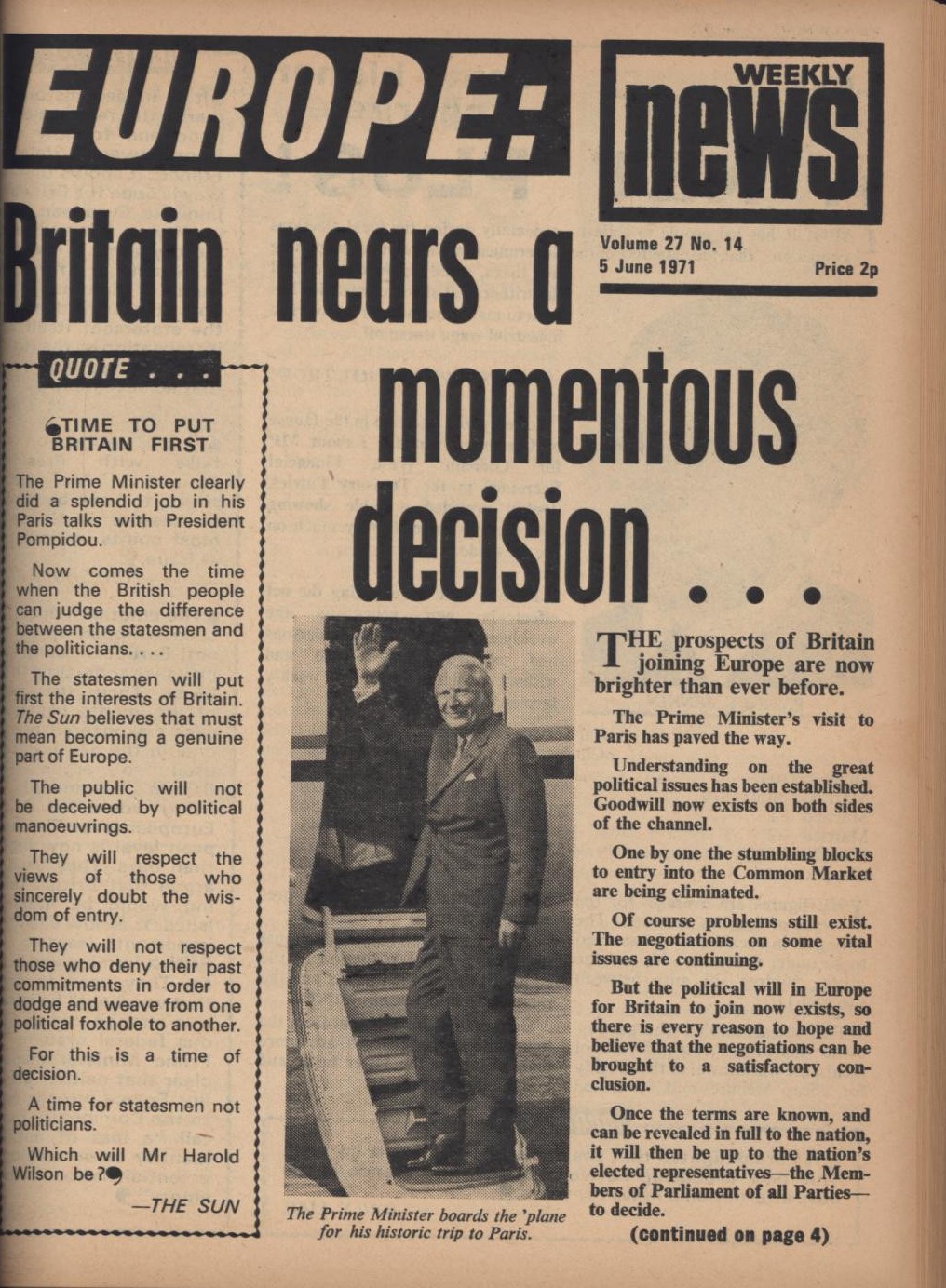
PUB 193-23 - EuropeIn explaining the opposition of the left in Britain to joining the Common Market in 1971 Tom Nairn argues that the working class had succumbed to nationalism long before and that nationalism had successfully corralled the rising working class movement in the 19th century. This of course eventually led to the mass socialist parties of Europe dropping their internationalist stance and supporting their own state in the slaughter that receives its centenary this year.

Having fixed the class struggle within national limits, within which it “acquired great inertia and the natural conservatism of hard-won reforms”, the bourgeoisie was able to seek new international or multi-national forms more appropriate to the expansion and development of the capitalist mode of production.  “It does so very cautiously, amid great confusion and contradiction.”  However in this movement “the principal asset of the western European bourgeoisies is a simple one: the absence of the left.”

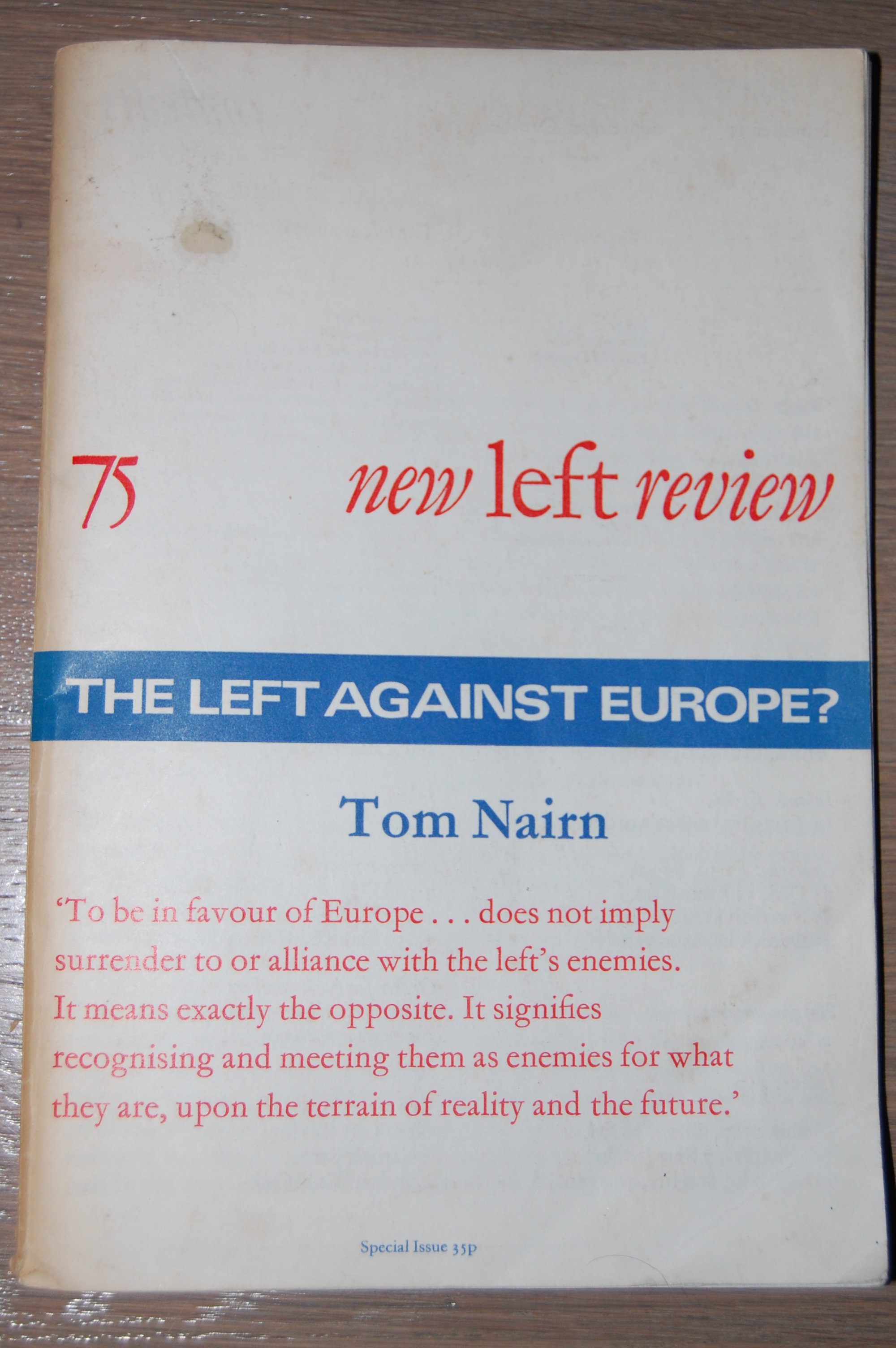
The margin for manoeuvre afforded the leaders of capitalism is relatively large because the class struggle in Europe long ago lost any concrete international dimension.  They are able to pose “questions to which the socialist and communist left simply have no answer . . . that is, except futile opposition, evasion of the issue, or a harmless rhetoric of abstract internationalism.”  Nairn then sets forth how he sees the left’s intervention within the ‘great debate’ in 1971 exhibiting all these characteristics.

Just like today, opposition to the Common Market was de rigueur and taken for granted.  It was opposition to a super-state – one bigger and further away, built in support of the biggest capitalist monopolies.  As we noted in the first of these posts Europe was “somehow more capitalist in nature than Great Britain and the British State.  The Common Market nations are either more capitalist than Britain, or they are capitalist in a more sinister sense; while the Community’s Brussels institutions represent the bureaucratic heart of darkness.”

“It would hardly be correct to call this a theory” remarks Nairn.  He quotes the British Communist Party (CP) stating that the Common Market is ‘anti-planning, anti-socialist, anti-working class’. National governments and their elected Parliaments have no control over its gigantic bureaucracy and the British would be merely represented in the same proportion as the Italians ‘as one sixth of the population of 300 millions involved.’  ‘We would be virtually sunk without trace’ and parliament would no longer be supreme.

The nationalist and statist conception of socialism exhibited here by the CP is hardly a surprise but it is remarkable, despite the categorical collapse of the Stalinist states, how much of this Stalinism is alive today under the banner of many of the supposed Trotskyist organisations – from their bureaucratic and undemocratic internal functioning to their reliance on nationalisation as a socialist measure, their support for popular front types of campaign organisation and electoralism.  And here: their opposition to the EEC.

What this illustrates is the good old Marxist dictum that being determines consciousness, that the material factors at play in society, the power of the capitalist mode of production and its state and the political movements supported and ideologies promoted by it, are more powerful than the purported political theories and programmes of small and isolated revolutionary organisations.  So the revolutionary left organisations in Britain in 1971 opposed entry into the EEC while today there is no campaign to leave it despite the question arising now as a live issue, yet in between there has been no reassessment.

Nairn looks at some of the left objections to the EEC, which are still around today.  On the Brussels bureaucracy Nairn points out that the employees of the Common Market Commission were approximately one fifteenth of the number working in one British Ministry, the Department of Health and Social Security.  On whether the Common Market is capitalist or not he asks the question “how could a union of six or ten capitalist national states be anything else?”   But the rational question for any socialist is “which of these two sets of capitalist conditions, the national or the Common Market, offers the best future environment for revolutionary thought and activity?”

Nairn remarks that, of the left in the anti-EEC campaign, “none of them – with the possible exception of the CP – looked happy inside it.  On every hand one found doubts, qualifications, and reservations.”  Nairn then looks at the arguments of various organisations on the revolutionary left, including the International Marxist Group (IMG).

The IMG opposed entry because “the Common Market is opposed to both the immediate and the long-term class interests of the labour movement.”  “The EEC is a capitalist solution to capitalist problems.”  However it lamented the lack of any scrap of socialist internationalism within the left of the Labour Party and argued that “chauvinism is a vicious enemy which must be destroyed.”  The unity of the Labour and trade union leaders and the mass of trade union members in opposition to entry is a unity that “holds no future for the working class, and one which must be rejected and fought against.”

The IMG posit that millions of workers are discussing the issue and into this debate revolutionaries can insert the alternative of working class unity “and the strategy of a red Europe against the capitalist EEC.”  This would involve “creating living links between workers’ struggles in the countries of Western Europe.”

In the same issue of the IMG paper ‘Red Mole’ Nairn quotes from an article by Ernest Mandel which looks at the EEC as an economic and political mechanism reflecting the internationalisation of monopoly companies and the need for British capital to join their competitors because it cannot beat them from outside.

Mandel concludes by stating that the most important factor in assessing the situation is “the dynamic of the class struggle.”  Joining the EEC would cause immediate material losses to workers but they could compensate for this because entry would not reduce economic class struggle but would exacerbate it. Political radicalisation would be reinforced (although entry was still opposed).

So how could the statement that “the Common Market (is) opposed to both the immediate and the long-term class interests of the labour movement” and the one stating that an increase in economic class struggle and reinforced political radicalisation will arise from joining both be true?

Nairn records the isolation of the revolutionary left in the debate but that they protected themselves from being camp-followers of left nationalist opposition through “a certain degree of intelligent half-heartedness.”  “Honour was saved, mainly by looking both ways at once and saying two different things at once.”  For Nairn this position arose partly from the void where some sense of what internationalism meant practically should have been.

So what was the reason for this lack of socialist internationalism?  Nairn quotes the IMG author: “  It is not the objective conditions that have been responsible for a lack of socialist internationalism in Europe but a failure on the part of the bureaucratically led labour movement to live up to its responsibilities.”  So the alternative is then to build a revolutionary party.

Whatever about the truth of the latter as a definition of the solution there are problems with the explanation of the problem.

For small Marxist organisations of hundreds or thousands the nationalist consciousness of millions of workers is not a subjective factor.  While betrayal of particular struggles on particular occasions has undoubtedly taken place it is hardly adequate to say that workers’ consciousness arises from having been betrayed repeatedly for decades otherwise the working class is essentially stupid.

What is the objective basis of workers consciousness over decades in all the most developed capitalist countries?  A Marxist would look for causes as long-lasting and as deep seated and profound as the phenomenon which is in need of explanation and ‘betrayal’ doesn’t meet this requirement.

It makes no sense to say that reformist and nationalist leaders betray reformist and nationalist workers.  The often contradictory character of workers’ consciousness can see their most radical and militant notions and impulses betrayed by their leaders but what has to be explained is why this radical consciousness does not predominate and why it can be betrayed, repeatedly.

Why is the lack of internationalist consciousness so pervasive among workers?

I will look at how the left has come to these questions in a future post but the next one will continue to look at how the question of the EEC was addressed by the revolutionary left in 1971 through looking at the debate within the International Socialists, forerunner of todays’ Socialist Workers Party.

Back to part 1

Forward to part 3

The Left against Europe 1

DSC_0122The failure of David Cameron to prevent Jean Claude Juncker becoming President of the European Commission drew widespread comment that it will now be harder for Britain to stay in the European Union (EU).  If the Tory Party wins the next British general election Cameron is committed to an in-out referendum by 2017.  Under pressure from The United Kingdom Independence Party (UKIP) and from within his own Eurosceptic ranks he has developed a policy that has temporarily settled the in-fighting within his Party.

In Ireland referenda on the development of the EU have been fairly frequent.  In 2001 Irish voters rejected the Treaty of Nice by 53.9% with only 34.8% of the electorate voting.  The vote was held again in 2002 and the Treaty was passed by 62.9%, with 49.5% of the electorate voting.

In 2008 53.4% voted against the Lisbon Treaty (on a turnout of 53.1%) so once again the vote was re-held to get the ‘right’ result. The next vote in October 2009 resulted 67.1% voting in favour of the treaty, once again on a higher turnout of 59%.

The Left in Ireland has been in the opposition within these EU referenda and opposed the original entry into the European Economic Community in 1972, which was decisively approved in a referendum by over 80% of those voting.  In Britain the Left also opposed British membership of the EEC in a 1975 referendum, which was passed by a majority of 67.2% in a turnout of 64.0%.

When I was in a second hand bookshop in Glasgow some weeks ago my attention was therefore drawn to an old copy of New Left Review from 1972, which was a special issue on ‘The Left Against Europe’.  The whole issue was devoted to one article written by Tom Nairn on the ‘great debate’ in Britain in the previous year whether Britain should join the Common Market, as the EEC was popularly called.  This debate eventually led to a vote in the Westminster Parliament to join and accession into membership in 1973, before the new Labour Government elected in 1974 held a referendum in 1975 to ratify staying in.

Nairn states that the debate was far from ‘great’ and that quotation marks enclosed the phrase from the outset.  It continued what he called a ‘stale and exasperated argument about the topic which had dragged on for years.’  The Cameron promise shows that it still continues.

The ‘great debate’ Nairn says “never at any moment approached ‘greatness, or even excitement.”  Nairn uses it however to examine the Left’s opposition to the EEC and this examination is worth looking at to see what lessons it provides for today.  The issue of the EU matters to the Left and working class as much as it still does for the Tory Party.

Whether Britain stays in or leaves also matters to the Irish State.  Its original membership was only viable if the British also joined and Britain leaving would create a real problem.  Only last week it was reported that a delegation from the German Parliament’s Finance Committee had issued a report – that the Irish tax regime “had failed to reach one of the goals of Irish economic promotion, namely to be less dependent on Britain.  Instead Ireland has moved from de facto full dependency on Britain to a shared dependency on Britain and the US in developing and securing employment.”

Nairn puts the British decision to join down to the hegemonic interests of finance in the City of London and the timing down to global monetary instability prompted by the dollar crisis that eventually forced the dollar off convertibility to gold in August 1971.  He quotes the Economist magazine stating that a future attempt at monetary union within the EEC will see Britain in the inside, with the strongest financial centre and having a dominant say in what gets done.

Not quite how things turned out but this story isn’t over and the choice to join the Euro is one that still faces the British capitalist class.

Nairn notes the virtual unity of the Conservative Party in seeking membership of the Common Market and the limited opposition of a marginalised rump led by the arch-bigot Enoch Powell, who by coincidence, has had the depths of his bigotry recalled by a flag supporting him going up in a loyalist area of Belfast.  Today the decline of the Tory Party into a backward, reactionary and ultimately self-defeating nationalism is evidenced by the ascendancy of Eurosceptics within that Party.

It is examination of the attitude of the Left however that is the purpose of this long 120 page article.  The opposition of the Labour Party to joining the Common Market in this ‘great debate’, or the vast majority of it at least, is put down to pure opportunism.  Under the leadership of Harold Wilson it opposed joining for purely party political purposes, Wilson having attempted to lead Britain into the EEC when in power between 1964 and 1970.

The ability of Labour to perform this U-turn is put down to the fundamentally nationalist character of the party.  For Nairn, the Labour Party is not fundamentally a class or popular Party but a nationalist Party and its reformism and ‘betrayals’ of the working class a result of its nationalism.  This nationalism is one shared in a basic sense by its supporters and voters, which explains why – despite the betrayals – they still support and vote for it.  Otherwise the phenomenon of continued support despite continued betrayal become inexplicable, unless workers are to be understood as fundamentally stupid – voting again and again for people who betray their beliefs and expectations.

Nairn records the opposition of the Left of the Labour Party in particular and its opposition to the Common Market on the basis of ‘internationalism’ and ‘socialism’.  In this respect the themes of the ‘great debate’ resonate today.

  • The Left in the Labour party presented Britain as more internationalist than the inward looking European States.  Open, free trading Britain was compared to the protectionist EEC.  Didn’t Britain look beyond the petty European states towards the countries of the Commonwealth and Britain’s wider role in international affairs and international bodies?  The latter providing the basis for a real socialist foreign policy.
  • Entry into the EEC would erect obstacles to the fight for socialism in Britain and prevent further socialist measures by a future Labour Government.  The EEC is a capitalist club and entry would mean the loss of the potential for socialism that does exist.
  • Refusal to enter this club would pose the question of an alternative, which would allow a socialist answer to be given.
  • The independence of Britain would allow the real popular character of the British nation to be revealed through its labour movement in a way that would be impossible within the rules of the EEC.

So what does this remind you of?

Well, swap Scotland for Britain and you have much of the Left nationalist case for Scottish independence today.

Just as the EEC is supposed to be more capitalist that the British state (God knows how) so Scotland is less reactionary than Britain (which is even less comprehensible).  London rule is capitalist but somehow Edinburgh rule is less capitalist!

Left nationalists proclaim the international potential of Scottish independence in the same self-refuting way the Labour Party did in the 1971 ‘great debate.’  Nationalist separation is somehow internationalist.  Why?  Because somehow, again unexplained or simply incredibly, there exists more potential for socialism in Edinburgh than London; just as the nations within the EEC and the EEC itself were assumed to be barriers to socialism that the British imperialist state wasn’t.

Today one part of the imperialist state – with a history of disproportionate participation in empire building – is again more socialist, or with the potential for it, than Britain as a whole.  Again while Scottish Left nationalists claim that the real Scottish nation is more left wing so did the Labour Party claim the real British nation was more socialist than the capitalist EEC, including such historical bastions of reaction as Paris and Rome.

Finally, even posing the nationalist question somehow gives rise to a socialist answer, or less extravagantly, gives rise to the potential for a socialist answer.  But it’s as if, if you ask the right question in the right way somehow socialism will pop up almost naturally as the answer.  And where is the evidence for this even when, as in Ireland for example, the capitalist crisis brought the Irish State to bankruptcy and exposed double standards that made working class people pay for the reckless gambling debts of the rich?

What more striking exposure of the rottenness of capitalism could be imagined?  Yet still there has been no alternative created and still in both Ireland and Britain there is no successful resistance to austerity – the most immediate question to which the socialist movement has been unable to provide an answer.

What this exposes, among many other things, is that the essence of socialism is not the displacement or even destruction of this or that aspect of capitalism or its state but the development of the working class.  Capitalism can only be superseded, at least progressively, by the development of something positive.  Unfortunately the Left thinks always in negative terms – of what it is against – and when it looks to achieve even this it posits the existing capitalist state or some configuration of it, usually its own nationalist version, as the mechanism of transformation.

It is ironic that Tom Nairn ridicules the claims that the the fight against the Tories, for national ‘independence’, against inflation and for socialism were, in 1971, ‘all the same thing’.  This is exactly the same claim made today in 2014, except we might replace inflation with austerity and support the claims of ‘Scotland’ instead of ‘Britain’.   He shows how Labourism rejuvenated itself and re-established unity within its own ranks by claiming to unite British workers in opposition to bureaucracy and international capitalism.  Except all this rested on the unity of British workers with the British state, shackled by the chain of nationalism.

But the question of Scottish separation is a derivative lesson to be drawn from reading ‘The Left Against Europe’.  The major lesson is the need to give real content to the socialist claim that it is international by its very nature.  Not an aspiration, not simply a goal to reach, an attitude to strike or an opinion to hold dearly but a practical and immediate part of its political programme.

What he says about this will be taken up in the next post.

Forward to part 2

The new bank deal and the working class

debt maturityThe most important aspect of the deal that has replaced the promissory notes is not what it entails but what it does not entail. It does not involve a write off of any of the debt so that less would have to be repaid and interest burden on the debt lowered. It does not involve the European Stability Mechanism, in effect the EU, directly funding the banks which appeared to be the deal offered last June and it does not affect all the bank debt.

The deal on the promissory notes affects €28 billion of a total debt at the end of last year of €192 billion and relates to less than half that incurred in bailing out the banks. The Government has not changed its austerity targets. The editorial in the Financial Times stated that ‘restructuring the promissory note does not make the public liability for bank losses lower, just easier to bear.’ Easier to get workers to pay is more accurate. All the questions regarding how the deal will work have not been answered, which also demonstrates continuity with the promissory note arrangements that were understood fully by very few despite the enormous impact on people’s lives.

Never mind, the Taoiseach proudly told us that the “stains on our international reputations and dents to our national pride, have now been removed from the financial and political landscape”. This is a statement so revealing of the shallow moral argument for the deal, so instructive of the concerns of the elite as distinct from the majority and illuminating of the poisonous demands of national identity that despite its odious character it would be good to see it repeated again and again and again. The Irish people have decades to ponder how satisfying it is to pay for so long to erase such an embarrassment.

As for the new deal itself, it involved the liquidation of IBRC, which was the combination of Anglo-Irish bank and the Irish Nationwide building society. The Government will still pay €1bn to the bondholders of Anglo, as part of the 2008 guarantee, so no bondholder is left behind, and more rotten loans in Anglo will transfer to NAMA, which promises further losses down the road. Loans left in Anglo totalled €15bn.

It involves tearing up the promissory notes that provided the means for the State to get money from the Irish Central Bank (ICB), the local branch of the European Central Bank (ECB), to be replaced by ordinary government bonds, which are really just a more regular IOU used by states. This allows the state to keep the money loaned to it on the back of the promissory notes instead of having to pay it back when the notes were torn up. The state will still have to pay the money back and pay interest but will have much longer to pay and with what appears a lower rate of interest. Both of these are good things – having longer to repay and being charged less for the loan, but both are not as good as they appear.

The longer you have to pay the more you have to pay back, just like any mortgage. The lower interest rate is not such a change for the reason explained in the last article. This is because the high rate of interest paid by IBRC (8.2 per cent) to the Irish Central Bank, which the taxpayer ultimately funded, was used by the ICB to pay the ECB which charged a much lower rate of interest. The difference was returned to the Irish State so the effective rate of interest was not they headline rate of the promissory note. The reduced interest cost between the promissory notes and the government bonds is therefore not what it might appear.

But this is not the only reason the savings might not be so great. The ICB will have an asset, the bonds, the ownership of which entitles it to receive interest every year and receive repayment of the principal. Part of the deal is that the bonds are sold to private capitalists, €6.5 must be sold by 2022. How quickly they must be sold is not at all clear and thus neither is the cost of the deal, although this has not prevented the Government, media and commentators continuing to welcome the deal and proclaim its savings as if they were hard fact.

In selling the bonds the Government will in effect be raising new loans. If for example it attempts to sell €1bn worth of these bonds and investors don’t think the interest they would get on them is high enough they may be willing only to pay €980m, €950m or €930m instead of the €1bn. In other words the bonds would be sold at a loss and the tax payer would foot the bill. To replace the loss would require more loans costing more.

The rate of interest charged on the bonds over their lifetime is not known so calculations of how much the new deal will cost must make more or less educated guesses of how much the deal will actually cost over the long term. The longer the term the more the ‘educated’ guess becomes ‘pure’ guesswork.

Nevertheless within a couple of days estimates of savings on an NPV basis were quoted and savings of €8bn announced. Net Present Value (NPV) analysis allows one to calculate and compare amounts over different time periods recognising that someone would rather pay €1 in 10 years’ time than pay €1 today. It allows one to say whether it would be better to pay €1 for each of the next 9 years and €11 the following year or pay €2 for the next 10 years. In both you pay €20.

The money paid in the future is discounted so that €1 paid in ten years’ time is less than €1 paid in 5 years’ time which is calculated as less than €1 paid in 3 years’ time. How much you reduce the amount depends on the discount rate and this rate can have a big effect on the result. The rate chosen is another variable that is a guess, first educated and then pure.

The higher the discount rate the less costly future costs become which offsets the fact you are paying longer and on the face of it more. So one could be paying €21bn equally over 20 years instead of €19bn equally over 12 years but because the first means the money is paid off later it is worth less and the total cost on an NPV basis is less. In the example above an NPV calculation at a discount rate of 6 per cent shows that the first payment schedule costs €11.2 in NPV terms, where €11 is paid in the last year, and €14.7 in the second where equal yearly payments of €2 are made.

In the new deal the first repayment of principal is not until 2038 and the last in 2053. The NPV savings in the new deal were worked out by one economist as €8bn and then by a couple of others as €4bn, a whopping difference of 50 per cent of the first estimate. Another economist has stated that almost all of the calculated savings disappear if the timing of the sale of the government bonds to the private sector is accelerated. Factor in the loss on sale to the capitalists plus increased interest costs and the deal might very well cost more.

A final argument has been much quoted, and certainly more often than the lack of robustness of the savings estimates. This is that inflation will erode the real value of debt repayable by our children, who will be middle aged when they might finally pay it off. This means that, if say the interest rate is 5 per cent and inflation is 3 per cent the effective rate of interest is only 2 per cent. Also the real value of the money repaid in thirty years’ time will be less because of the cumulative reduction in the real value of the debt by this inflationary process.

It might otherwise be amusing to listen to these experts, who gave us a property ‘soft landing’ and now the wonderful benefits of inflation, except that we can state with absolute certainty that they will also be lecturing us in the future on the evils and futility of seeking pay rises to compensate for inflation because these will only increase it. Not only will interest rates rise in response to higher inflation thus limiting the effect above, which will also put up the cost of mortgages, car loans and credit card debt etc. but higher inflation will also erode living standards. What workers might gain from erosion of the real value of the debt they will surely lose by the reduction in living standards caused by an increased cost of living.

By now it should be apparent that the deal’s main benefit is putting off repayment of the loan principal thus making it less likely the state will have to default. In other words the main beneficiaries are the State and the ECB, which is sanctioning the lending of the money and protecting the European banking system. What is good for the state, that it continues to pay and does not default, is bad for workers who will really do the paying.

The second benefit is that the low interest rate charged for the money the state gets in exchange for the bonds will be around longer. However as we have seen, how much longer we don’t know. It won’t be our decision when it goes up (through selling the bonds to the capitalists) because this is a decision of the European Central Bank. Such a decision will cost us billions but we have absolutely no say in the matter. Yes, we live in a democracy.

Once again it is necessary to educate workers that they must distrust the state as much as they would distrust an email from Nigeria asking for their bank details. (The power of the state means it doesn’t need them.) We need to remind them that the state is able to foist the debt of Anglo and Nationwide on them because it nationalised these institutions. We need to inform them that both the Irish Central Bank and European Central Bank are institutions of the state deliberately designed to be protected against any kind of democratic pressure.

This brings us to a couple of questions a reader asked me about the promissory note deal. He asks how the government borrows from the central bank as if it is separate institution. “To me it looks like the government is borrowing from itself, but if that is the case why doesn’t it borrow some more?”

The first answer is that with so much debt the Irish State cannot borrow more from the markets (private capitalist funds) which is why the EU and IMF stepped in to loan the money. It can’t borrow more from these institutions because they want the state to reduce its indebtedness and pay them back their existing loans.

The second answer is that the Irish Central Bank is a branch of the state and a normal central bank can both provide loans and ‘print money.’ There are limits to the former if, as we have just noted, the state won’t be able to pay the loan back. In this case it is if it makes a loan that isn’t repaid just printing money. Printing money will at some point lead to a devaluation of the currency meaning that the Euro will be worth less and buy less making everyone across the Eurozone worse off when it has to buy goods from countries that don’t sell in Euros.

To protect against this the ECB has a firm grip on money printing and the deal on the promissory notes and the new one involving the issuing of bonds required its approval. The Irish state is part of the Euro so doesn’t control its own currency or it could try to get away with printing some money, although in reality it is too weak to be able to do so even if it went back to the Punt.

The ECB is taking control of the timing of selling the bonds because printing money in exchange for bonds that don’t have to be repaid for years is so close to money printing it really is printing money.

The rules of the ECB prevent it funding states and public institutions directly for this reason. It has however ended up with Irish government bonds in exchange for funding the IBRC. Because it ended up in this position indirectly by funding a bank (public banks must be treated just like private ones)rather than a government and through the receipt at first of promissory notes rather than regular government bonds this has to a very little degree been hidden.

This is why they’re not very happy with the deal and might also be why they will quickly ensure the bonds are sold to private capitalists; thereby entailing an interest cost more reflective of the market. As I have said, this will cost the Irish people a lot of money.

In the next post I will look at whether the new deal has solved the debt problem.

The promissory notes and the working class

The response of the mass media to the deal on the promissory notes was one of considerable praise to a Government that had won a deal that “appears as good as could have been hoped for”.

The world of finance is notoriously complex so in simplifying the deal for a mass audience the media felt free to simply lie.  Thus the headline in the Irish Times said that the ‘Bank debt deal to cut borrowing by €20bn and ease next budget’.  The small print revealed it would only reduce the amount paid in the next decade and the debate after the deal has revealed that there is no certainty that the next two budgets will be any less severe than planned.  The Troika and others are demanding the original targets are adhered to and being a poster boy of austerity might demand it.  The uncertainty surrounding important aspects of the deal leaves open to doubt many of the claimed benefits.

But one thing is very clear: the bank debt was unsupportable despite the responsibility of all the parties for placing it on the shoulders of the Irish people and something had to be done to prevent a disorderly bankruptcy.  This would have been caused by inability to raise the financing required to run the State at remotely affordable interest rates.  The average maturity of the main sovereign debt of about €80bn is around six and a half years, which has to be renewed by borrowing this amount again to pay it off – ‘rolling over’ the debt.  Combined with a possible promissory note repayment of over €28bn averaging five years and continued deficits this looked close to impossible.

Not that anyone dared point out that the deal exposed the lie of the Government parties, of the previous administration, and of the current Governor of the Irish Central Bank that the deb was ‘manageable’.

Ignoring this also allowed the media to largely stay clear of why this deal was necessary in the first place.  The Irish State had decided it would protect the investors in two thoroughly rotten institutions, run recklessly by their owners, by promising them that the Irish working class would pay off their gambling bets.

The Irish State never asked workers whether they wanted to, or whether they thought it was a good idea, but conceived the original bank guarantee in the middle of the night, as a scheme concocted without even the presence of cabinet ministers who were supposed to make up the Government.  In effect it decided to pledge money it didn’t have to people we still did not know and get everyone else to pay for it, including generations not yet born.

As ever we are bombarded with propaganda that cuts must be made in wages and services; increases must be applied to taxes, charges and working hours and all because we need to be competitive.  Yet billions that could not possibly be afforded were pledged and paid that bankrupted the State.  This in turn necessitated a ‘bail-out’ by the EU and IMF, which is akin to a blood transfusion to a dying patient so that she can work to earn money to pay the vampire.

As the Croke Park deal is ripped up and more draconian conditions inserted – not ‘extended’ as claimed – on the back of demands for austerity, no austerity is to be inflicted on the capitalist gamblers.  While money can be wasted on dead banks money must be cut out of wages and services because ‘we’ can’t afford it.

This is the logic of the capitalist system but it is hidden not just by the mass media and politicians but by the opaque workings of the capitalist system itself, made more complicated by the complexity of the financial system.  This complexity is useful because when it is more difficult to understand and appreciate what is going on it is more difficult to fight against it.  Only vague ideas that you are being screwed do not help give you confidence to say stop!

That is the importance of understanding as much as possible what the promissory note deal involves.

When the State guaranteed the liabilities of the banks in September 2008 it claimed the problem was one of liquidity, that is the banks were basically sound but were in danger because they would not lend to each other.  There might also be a withdrawal of money by depositors.  This was the purest rubbish and the gamblers who had put their money into Anglo-Irish Bank and Irish Nationwide didn’t buy it.  They took their money and ran.  Deposits in these institutions, packaged together as the Irish Bank Resolution Corporation (IBRC), fell from €65.8bn at the end of 2007 to €1bn at the end of 2011 while the value of debt securities funding the IBRC fell from €30.85bn to €6.3bn during the same period.

So if the IBRC was bust where did the money come from to give to the depositors and holders of the IBRC debt?  The answer is that it came in the form of Exceptional Liquidity Assistance (ELA) from  the Central Bank of Ireland (CBI).   This ELA funding to the IBRC was zero in 2007 and €40.1bn at the end of 2011. ELA is money so the question is where did it come from, how did the CBI get it?

In many ways the CBI may be thought of as the Irish branch of the European Central Bank (ECB).  The ECB has strict rules about money creation (money printing) so the local branch in Ireland could not just print Euros (metaphorically speaking) although this is one of the things Central Banks can do.

Nevertheless the CBI was able to give money in the form of ELA to IBRC which then paid off its depositors and holders of debt securities.  Since this bank and building society were broke the state nationalised them making all their reckless speculation our reckless speculation and making their debts everyone else’s debts.  Because the State didn’t have the money either to pay back the speculators they issued IOUs to the Central Bank of Ireland in return for their money’ the ELA.

The result was that the CBI gave money to the State in the form of IBRC and the State gave the CBI promises to pay this money back with interest.  Although the two institutions that became the IBRC had issued loans which were due to be repaid many of these were worthless so only through the state intervening could the capitalist investors in these institutions get their money back.

The promissory note IOUs were the promise by the State that through tax increases, wage cuts and public service cuts the working class would ensure they got their money.  This is what prevented the ELA being simply money printing and thus prevent the CBI holding worthless pieces of paper.

So the cuts to wages and public services that are justified by the claims that we need to be competitive are partly in order to pay the debts of a very uncompetitive bank.  So uncompetitive it is now dead, having been in a zombie-like state for the last few years.  When the State pays part of the promissory note IOU to the CBI the Irish Central Bank has ‘taken the money out of circulation’, again to ensure the problem is not solved by printing money.  In other words the money workers paid through austerity is simply burnt (again metaphorically speaking).

What could be more uncompetitive than maintaining dead banks on life support through burning money by putting real people on the dole and cutting services such as education?  The promissory note episode is one object lesson in the irrationality of the capitalist system.

This course of action could not have been taken by the Irish Central Bank and the Irish State without the approval of the European Central Bank and the European Union and its Commission.  For them the over-riding concern has been the protection of the European banking system just as the main objective of the Irish State has been the protection of the Irish banks.  Nationalist complaints that the Irish have made sacrifices for everyone else, much trumpeted by trade union leaders, has to ignore this.

If Irish workers have paid more so far it is because the Irish banks have been weaker and more rotten and Ireland remains a subordinated country which is dependent on foreign money for its speculative bubbles.

If the Irish State’s attempt to save the banking system required the ultimate liquidation of the IBRC this is because there was, in the end, little left to save after all the depositors and holders of its debt securities had been paid.  Again only the workers, in this case of the two institutions, are threatened with picking up the bill through redundancy.

For the Irish State this promissory note device to ensure that it did its best for European banks (and its own) had some advantages and disadvantages.  Of course inability to actually afford it is one big disadvantage but if it can get workers to accept austerity then this is not such an insurmountable obstacle.

The ECB does not want to lend money to institutions that cannot pay it back and since IBRC was bust its actions in approving the lending by its local branch raised some controversy.  If for example it lent to a bank that went bust and which didn’t pay back the money lent this money would then have entered the economy (through those people the bank did pay back, its employees or new loans) and this would amount to money creation/printing.  This can create inflation and low inflation is the primary objective of the ECB.  A strong currency allows a state, or in this case the Eurozone, to command greater resources on the world stage and is thus integral to the project of a strong EU imperialism.

The ECB thus regularly monitors (every few weeks) its ELA so their approval or otherwise was always hanging over the Irish State, although even without this it remains under close and regular scrutiny.

An advantage of the promissory note arrangement that will be lost at some stage with the new deal is that because the State owes the money to the Irish Central Bank profits by the ICB on the loans can be returned to the Irish State.  Given the high interest rate of over 8 per cent this is important.

Because a lot of the ELA created by the Irish Central Bank has ultimately been paid by IBRC to banks and institutions in other EU states the ECB has had to lend money to the ICB so that the reserves of the Irish Central Bank do not decline dramatically.  The ECB charges the ICB for this money but at a low interest rate so that the difference between this low interest rate charged to the ICB and the higher interest rate charged by the ICB to IBRC is a profit which can go to the Irish State.

What this means in terms of the current benefits of the new deal is that the move to a lower interest rate on the Government bonds that replace the promissory notes is not a gain since the effective rate of interest actually paid on the notes is the rate charged by the ECB to the Irish Central Bank and not that charged on the promissory notes.  As explained the profit generated by the latter is taken by the Irish Central Bank and returned to the State.

In the next post I will look at the new deal to replace the promissory notes.