The Bedroom Tax and the Inevitability of Civil Disobedience by ‘Belfast Plebian’

By now most people will have heard something about the new welfare regime due to kick in next year. The range of the welfare bill is so vast that it almost defies summary. The implications for the whole of the working class are very profound. To the unwary the welfare changes are of little importance because they think it will not impact on them, after all they are in steady employment.  Yet the changes will impact on the whole of the working class.  First of all steady employment cannot be guaranteed in the long-run recessionary economic cycle that we are certainly in and second because most workers have family circles especially parents and children that will be severely impacted. It should be stated at once that the number of unemployed in receipt of welfare benefits are in fact the minority, just over 60% of those in receipt of significant welfare benefits are in fact not unemployed.

Let’s pick out just one item that has gone largely unrecognised, changes to housing benefit and let’s be specific about it. In the north of Ireland there are currently 63,000 people registered as unemployed, however there are a lot more, 161,634 homes to be exact, in receipt of essential housing benefit, in fact 67,500 out of a total of 90,000 of Housing Executive households get the benefit, another 23,600 with Housing Associations and then another 70,000 renting in the private sector. In additions there are another 34,800 on the social need waiting list, 20,000 classified as emergency need. It is a reasonable assumption to make that most on that list would be in receipt of housing benefit if they could find a place to live.

Life is about to get a lot more difficult for many of those in receipt of housing benefit. For a start if you are single and under 35 you will only be allowed enough benefit to cover the cost of only one bedroom in a shared property. Where are you going to go to find this prized one bedroom?  Certainly not to the Housing Executive with its ever growing waiting list and reducing building programme, down to less than 2,000 planned properties. What then of the private rented sector?  Here rents are rising due to the mortgage crash – people who in the recent past could expect to get a mortgage are now no longer able get one.

The typical rent on a small house starts at about £600 per month, fine for some who have only just missed out on the mortgage bonanza but not for the poor benefit claimant who is facing a £400 cap which can only get progressively worse in relation to non-benefit tenants, the likely outcome being private landlords refusing to rent to the poor and a steady increase in homelessness.

Let’s move on now to the bedroom tax or as the government calls it, the over occupancy charge. From April next year those in receipt of Housing Benefit will have to pay a charge of 14% relative to the cost of rent for the audacity of having too much living space i.e. having an extra bedroom and others a stiffer 25% charge for having two extra rooms. You see the new welfare orthodoxy says that the working class have way too much spare capacity in their council homes.  So from April 2012 only one bedroom in a council property will be covered by housing benefit per person or per couple. If you have anything extra you will have to pay for it out of your universal credit. You see the new regime has moved on from merely targeting single people for penalty, it now reaches right into the working class family itself. If the person or couple have children the following rules will be applied.

A child aged 15 or under will be expected to share a single bedroom with another child of the same sex.

A child aged 9 and under will be expected to share with another child regardless of their sex.

You will be deemed to be over occupying your home if for example you are a single parent family living in a three bedroom council house with two teenage sons below the age of 15, or if you are a couple without children living in a two bedroom council flat, or again you will be deemed to be over occupying if you are a couple who have to sleep in separate bedrooms due to disability or sickness needs, or again you are a divorced or separated parent living in a two or three bedroom property who needs the rooms for children who only stay at weekends and holiday periods. There are just too numerous variations on this simple over occupancy theme to cover here. The above is just a sample.

How many people in the north of Ireland are to be classified by the Daily Mail mind-set as ‘wicked over occupiers?’ We don’t yet know; when Lord Freud was asked in the House of Commons about the likely outcome for the UK as a whole he confessed that the family friendly ConDem government had not bothered to commission any proper research. It has been left to charities to come up with some statistics; Shelter reckons there are probably about 800,000 miscreants in GB.  In respect of the north of Ireland all the housing charities think that the region will be affected the most, the minimal estimate I have seen is 7,000, but a web site in sympathy with the measure put it as high as two thirds of the current social housing tenants.

How much you pay will depend on your situation. The average council rent is approx. £72 per week, meaning an over occupier stands to lose at least £10 and maybe £18 from their living expenditure. To take one pertinent example, the current job seeker who is under 25 receives just £56.25 per week to live on; those over 25 receive £71. How many of those facing the over occupation charge will be able afford to keep the roof over their heads? Some will try and succeed, others will fail and will sooner or later be up for eviction. But for those scrimpers and savers who manage to make the payments there is a looming threat to their existence; the impending bedroom charge is not a final instalment, rather it is only a first instalment.

Just a year ago it was only the under 25s who were forced into one bedroom accommodation in the private sector, this has already changed to the over 35s. The Prime Minister is on record as saying that nobody has a social right to a home financed by the taxpayer, having a council home is a privilege he says not a right; he also says that he wants to dispense with what remains of social housing.

George Osborne recently proclaimed that he wants another £10 billion worth of cuts on welfare spending. In other words it won’t be very long before the charge is increased and more fall prey to the eviction notice. By the way, the small number of people who know about the new charges think that those who may fall into the classification scheme will be offered an alternative home if they can’t pay the charge, they are mistaken; there is no legal obligation on the housing authority to offer you something more suitable, this may be because these homes don’t actually exist.

What then has been the reaction of the local politicians who say they oppose the new reforms?  Answer – bluff and evasion? Well they have passed the welfare bill, so far without amendment, the so called concessions they are championing are entirely procedural. Are they preparing to drop the over occupancy charges? No sign of it. They play the evasion game by not talking about the housing benefit part of the welfare reform bill, hoping that nobody of any importance will notice it. It is to be revealed to the unsuspecting working class voter, Cilla Black style surprise! Surprise!

Come April next year people will suddenly find out about it and it will be too late for them to turn to the local politicians for some sort of protection. The politics of this whole affair needs to be discussed now. Why are the Tories attacking the living conditions of the working class in the home and not just in the workplace? They will not even save any money on housing benefit at least in the first instalment.  It makes no macroeconomic sense and looks more like a very nasty political stoke of class divide and rule than an attempt to solve the chronic housing crisis.  Perhaps they believe that it will destroy what little remains of working class social solidarity. We know that GB has a horrendous housing crisis, those who are desperate to find a home will now be ‘educated’ by the pernicious right wing press to blame those wicked over occupiers for their unfortunate condition.

One of the splendid ironies of the impending social disaster is that the seniors of both nationalists political parties swear that they were indeed the very the people who fashioned the civil rights movement that began life as a protest and even a disobedience campaign against the Orange States’ grossly unfair housing policy. If things are programmed by Stormont to follow the requisite course set by the Welfare Bill they will have to oversee a new set of grievances in respect of housing policy of even graver consequence than went before.

Untold numbers of working class people will not be able to meet the new rent charges out of living expenditure. Not being able to find alternative smaller homes when the eviction notices start to fly; they will inevitably opt to refuse to pack up and leave their existing homes. The nationalist politicians sitting in Stormont will have to persuade them that it is a bad idea to ‘squat’ in a house that they believed falsely was theirs by right.  They will have to tell them that the incomes of the hard pressed British ‘middle class’ taxpayer must take precedence over their own voters social need. They will have to appeal ever more to sectarian instincts rather than to definite social progress to keep the party vote in place. Long live the nationalist political class! Long live the unionist political class! Long live the new dispensation!

Belfast Trade Unions demonstrate against Austerity

Trade Unionists march against Austerity

As part of the trade union campaign against austerity across the UK the trade union movement in the North of Ireland organised a demonstration in Belfast to coincide with those in London and Glasgow.  It is difficult to estimate the size of the demonstration which appeared significant as it snaked its way through Belfast’s city centre but didn’t look impressive as it assembled and looked even less so at the final rally.  The latter however is a feature of trade union demonstrations. The notion that the purpose of a rally at the end is to explain what to do next and get everyone involved is as alien to most people at these things as little green men from Mars.  What happens next always depends on the decisions of the union leaders.  It is not for deciding by those involved.

Supporters of the United Left Alliance in the North correctly made this the subject of their leaflet and put forward the key task of the demonstration as one of creating a real permanent campaign against austerity:

“Last November saw 40,000 mobilised in Belfast in a general public sector strike  – but it was a one-off event and everyone went home again.  No further action was taken, there was no continuing campaign and the next public sector strike was much less successful.

Everyone is no less opposed to austerity and the Tories and Labour plans show the issue isn’t going away.

At the end of this demonstration we must make sure we don’t go away either.  To ensure that this doesn’t happen we need to come together to create an on-going cross-union permanent campaign that will oppose austerity.  Not one that pops up every six months but one that continues every week to campaign inside the trade unions, inside workplaces and inside communities to unite them all in a way that each of them cannot do by themselves.”

I overheard one of the trade union leaders responsible for the demonstration express her delight at the size of the turnout.  The demonstration was successful in so far as it confirmed that a basis exists for starting to build a wider and potentially successful campaign but one should not underestimate the obstacles.

The first is that the demonstration was no more than a few thousand at the very, very most.  It was dwarfed by the very, very large sectarian demonstration three weeks before, which commemorated the signing of the Ulster Covenant that led to partition.  This was celebrated by the participation of dozens of ‘kick the pope’ flute bands.  A prominent organiser of it was Nelson McCausland of the Democratic Unionist Party who has led the introduction of the Welfare Reform Bill in the Stormont Assembly, which imposes in Northern Ireland the cuts decided by the Tory Government in London.   It is ironic that many of the marchers in the Ulster Covenant commemoration will be shafted by these cuts.

The welfare changes introduce the biggest assault on entitlement in decades and were also supported by Sinn Fein.  The latter bring their own ironic aspect to its passage.  The back bone of Sinn Fein’s political machine is a network of advice centres at which Sinn Fein activists help those on welfare get as much as they can.  It is what they called ‘screwing the system’ when they first started doing it.  Now of course Sinn Fein has joined the system and the only people getting screwed are their constituents.  The first many of them will know about the changes will be when their benefits get cut.   They will then run to the advice centres where Sinn Fein will tell them ‘sorry but these are the new rules’.  What they won’t tell them is that Sinn Fein voted for them and had the power to stop them but didn’t.  While welfare is cut along with public sector pay Martin McGuinness will continue to complain that the British won’t let Sinn Fein and the DUP cut corporation tax.  Sinn Fein posturing has been particularly vacuous – they have said they ‘might’ make an issue of monthly payments of benefits and demand that they are paid fortnightly instead.

The third obstacle is reflected by the fact that so many walked away from the demonstration with no demand to those on the platform that they provide them with a strategy promising success.  The demonstrators were activists in their various trade unions and community groups but there is no understanding of the need for wider organisation.  They were there to protest and no more.

A protest is an expression of disapproval, summed up in the slogan ‘not in my name’.  It is not an alternative and it ultimately receives the following answer by the Government and State – ‘yeah, so what?’  Sinn Fein and the DUP live and breathe as defenders of their respective community against the other even as together they fillet both.  The limits of the trade union leaders’ challenge can be seen in the statement released before the demonstration:

“The devolved administrations must build a robust joint defence of the people who elected them.  Let this rally today send a message to our MLAs and our MPs from all political parties that we the people are firmly opposed to the failed policy of austerity which destroys lives and futures.”

An appeal to the political parties at Stormont and to Stormont itself is not a strategy.  It amounts to an appeal to the enemy.  The financial crisis exploded because of a property boom and the well-reported antics of the Developers’ Unionist Party and hidden ‘let’s get rich’ antics of the leaders of the Provisional Movement mean these people ae personally tied up with the system that is demanding the cuts.

The political sectarianism of the left means that it too is not an alternative.  It is unable to unite its tiny forces in an attempt to make a difference, although this is not the biggest problem.  The Left’s inability to organise in an open and democratic way means it cannot include the wider forces needed to create a real movement.  Were it to attempt to do so the Left group concerned would no longer retain control.  Since their absolute need for control is not just a rather unfortunate sectarian aberration in their practice but a foundation in principle of their existence- they all believe that they are the sole essential nucleus of the mass working class party of the future because of their particular approach to socialist politics -they are both practically and in theory sectarian.

The leaflet of the supporters of the United Left Alliance correctly put forward the next step – creation of a permanent campaign that is organised across unions by rank and file members, in workplaces and in communities and their community campaigns.  This is not just the next step in a campaign against austerity.  Just as socialism is the creation of working people themselves so is the resistance to capitalism, one of the means by which the capitalist system will be superseded by the power of a new ruling class, made up for the first  time by the vast majority of society.

Default on the debt – part 3

How would a policy of default be implemented?  There might appear to be two ways for this to be achieved.  The left could demand it as part of a manifesto to win a majority in the Dail whereupon this majority would implement the policy.  This is however neither immediately realistic, practical nor will the Irish State allow workers to use the machinery of the State to challenge the capitalist system, which is what a left default would represent.

The second is that we think pressure can be put on the existing State to repudiate at least part of the debt and lessen the demands for austerity.  The Irish State already wishes to get concessions from the EU and ECB but on a very limited scale and with all the strength of a beggar asking for change.  However no amount of pressure will get the Irish State to break with the EU, IMF or the US.  If any significant concessions are ever offered it will only be in response to either recognition that the interests of European capitalism as a whole, or the Euro project, is threatened (which is why we now have the latest deal)or if a socialist movement threatens to do more than repudiate the debt. We are nowhere near the latter situation and it is not the current perspective of the left, which is the subject of these posts.

From a Marxist perspective repudiation should not be sought in order that the existing capitalist economy should grow, although that is a better capitalist alternative for workers than the existing policy – if it could work.  It should be part of a strategy of assisting the creation of a working class alternative that will ultimately overthrow this economic system and the state that defends it.  We should not seek salvation from a Keynesian alternative that seeks to grow the capitalist economy because Keynesianism seeks only to postpone austerity and to effect wage reductions through inflation.

The role and place of the demand for repudiation must therefore be dependent on the stage of development of the creation of this workers alternative.  We are neither at a point where the majority of the population actively seeks repudiation of the debt or even believes it a necessity and nor are we at a stage where a large movement is building up support for such a demand.  Most importantly we are not at the point where the working class in in a position to reject the necessary laws of capitalism and present itself to society with a new alternative.  By alternative I mean not absence of debt through repudiation but an alternative to the capitalist system, of which debt is a symptom.  And by ‘present itself’ I mean not promises that things will be better under socialism, but be in a position to show actual examples of workers power in the economy and society. The demand to repudiate the debt is therefore currently limited to an educational role, a propaganda role.

This does not mean that it is unimportant. The argument on debt is important in supporting opposition to austerity, which is the only way at present that workers can actually counter the effects of the debt and in effect seek their own means of repudiating it.  It plays a role in persuading workers that ending austerity is not only desirable but possible.  The wider and deeper the opposition to austerity the more convincing this argument will have to be.  The wider and more successful opposition becomes the more other elements of the programme become important, but we will take these up one by one as we proceed.

In relation to debt repudiation socialists are regularly challenged on the effects their proposals would have on the workings of the capitalist economy.  It has already been claimed that repudiation of the debt would lead to a flight of capital and virtual collapse of the banking and credit system and that, absent outside help from those just told to take their losses, it would lead to severe economic dislocation.  The crisis would intensify across Europe and beyond and lengthen and deepen the recession.  The reputation of the Irish State as a haven for multinational business and as a site for financial speculation would be in tatters.  The loss of capitalist confidence on its own would increase unemployment.  This of course does not affect in the least the purpose of our demand for debt repudiation, which is to win workers away from acceptance of payment for the crisis and for the debts of the State.  As we have seen above, we do not actually currently control any mechanism to repudiate the debt.

Nevertheless the arguments against repudiation of the debt and the effects such repudiation would cause are not false, they are not a lie, or a simple blackmail because in large measure they are true.  Repudiation of debt by a Russian or Argentinian government determined to get back into the markets by assaulting working class living standards do not provide the model for a working class default beyond countering arguments that it is in itself simply impossible.  While for socialists they do not outweigh the necessity to persuade workers to take no responsibility for the crisis they do expose the need not just for a socialist opposition but for a socialist alternative.

For Marxists, as we have said, the achievement of socialism is based not on sound and logical argument but on necessity.  If the socialist alternative is not practical then it will not succeed and will certainly not win the working class to take it up as its own programme.  This is the underlying reason we pointed to for the defeat in the referendum – that we are as yet far from having a real alternative – practical ,immediate, in place right now, contesting for hegemony because it is widely if not yet universally recognised as a real, potential, living alternative.

Sine this alternative is the working class taking ownership and control of the economy, the state and society as a whole we have to answer a very simple question today, right now: is the working class poised to take ownership and control of the economy to counter the sabotage of the capitalist class as we repudiate the debts to its big cousins in the European Banks?

That is the working class as it presently exists in reality; not an idealised one that resides in books or in abstract slogans, but the working people in your street, your neighbourhood and your workplace?  Have they been readying themselves to take over the running of the economy and the state; have they already taken over, or are in control of some workplaces?  Are they perfecting their organisation?  Have they been debating the necessity to do so, the requirements of doing so, the burning necessity to do so – to carry out a veritable revolution?  If not then we currently have no answer, or no practical answer, to the capitalist charge that what we propose, if implemented right now, would simply cause chaos.

That we, the working class, are not yet ready to take over society is obvious because we can see this every day if we live within working class communities and work alongside other workers.

A fatal answer to this current weakness is to seek salvation through a non-working class solution which at first glance might look more ‘practical’ or ‘realistic’: calling on the State to do what can only be done by workers.  Calling for nationalisation when what we stand for is ownership and control by the workers, not the capitalist state.

Instead of such ‘short cuts’ to a different destination Marxists recognise that we need to put forward a comprehensive programme that addresses the needs and interests of the working class and that repudiation of the debt, which is not even a specifically socialist measure, is only one element of this.  It is necessary to place any specific demand within an overall programme that represents a real alternative.  This does not mean that we need always to proclaim a veritable shopping list of demands or that specific and often very limited struggles and demands are not where we really are at.  It is to understand and be able to explain how any particular struggle fits within a global alternative.  As we have said, this alternative must assume a living corporeal reality to count as a real alternative and not simply a logically coherent programme.  The beginning of a living alternative based on a coherent programme is defending the working class by supporting its resistance to austerity and renouncing its responsibility for the causes of the austerity.  Only on such resistance can an alternative be built.

In addressing the austerity inflicted to pay off the State’s debt the left has recognised the necessity for a wider alternative by calling for the continuing budget deficit to be made whole by progressive taxation of the rich.  In our next post we will look at this part of the left alternative.

One more issue merits being addressed in the context of the Marxist approach to the state’s debt.  This is the call for an audit of the debt.  The burden of the bank debt was placed on the workers’ shoulders in order to pay bondholders, but who are or were these bondholders?  Who got paid in full or is awaiting payment that is a hedge fund used by the fabulously wealthy who bought the bonds at a huge discount or who already had insurance for default?  Who is the recipient of this huge transfer of wealth from working people? This is an elementary demand and is not an alternative to repudiation.

For example, what if we found that it was a workers pension fund that held the debt?  Then we could say to them – let’s talk about what effect it would have on your pensions of us not paying this debt.  What arrangements could we come to which would recognise the legitimate claims of both sides?  What if this pension fund was privately managed and subject to the normal charges by its managers which excluded the control of its members or even knowledge of what mangers were doing? Then we might say – ok, we recognise that we should not deprive you of your pensions but we have no obligation to fund the huge charges that allow the financial services industry to pay its managers and bosses salaries and bonuses that are counted in the millions.  We will take ownership of our debt if you, the workers of this pension fund, take ownership of this fund and do not use it to speculate against the living standards of other workers.

Such a debt audit is thus not a call for justification of the debt but becomes a call to action – a workers’ enquiry to determine its ownership and its beneficiaries now and in the past.  A call to action to repudiate what is not legitimate in our eyes and accept what we believe is legitimate by demanding the actions that make it so.

The argument will come back that this debt is subject to rules of confidentiality that are imposed by market exchanges in foreign countries.  Ok then, the debt we still owe should not be paid until we know who we are paying, that it is the appropriate amount and does not involve an unfair redistribution of wealth from workers to international spivs.  If the bondholders have already been repaid we still want to know who walked off with our money since we are still paying for it and we weren’t asked for permission in the first place.

The demand for an audit is a demand for the books to be opened on international finance and is the first step to taking it over.  The very first step in this would be bank workers doing a ‘Wikileaks’ and releasing all the emails and documents relating to the debt guarantee and repayment.  What an education that would be, especially the howls of condemnation from the powers that be – despite this being our money that is being paid over, our banks that we are supposed to own and our Government and State which are supposed to be defending our interests.

The demand for an audit is entirely legitimate; it is the first step to control and to demonstrating the legitimacy of repudiation.

Default on the debt – part 2

This post was largely written before the latest initiative of the EU, which has been hailed by Government parties as a major breakthrough for Ireland although we can be confident there will be no slacking in the austerity programme.

The devil in these deals is always in the detail, or so the cliché goes, but this is only partially correct.  The deal will also do little to reverse the austerity agenda in Europe, which is the big picture, and without this the crisis in the Eurozone will not be resolved.

The plan appears to involve the funds in the European Stability Mechanism going straight to the banks instead of the National State beforehand, thus avoiding the immediate burden on the State through increased sovereign debt and pressure on interest rates.  This was demanded by Spain and Italy and Germany has backed down.

The Irish now hope to piggy-back on this to get similar treatment, except this approach would have to be applied retrospectively as the EU demanded exactly the opposite in the Irish deal.  Since the Irish State owns the banks the debts of the banks are the debts of the State, which workers are expected to pay.  Michael Noonan has claimed that when the EU takes over lending to the Irish banks it will take over the asset side of the banks as well, in other words it will own them.  Whether this would involve the EU owning the shipwreck that is Anglo-Irish and Irish Nationwide is an open question and the deal may mean no more than extending the repayments and a little lower interest rate.

In any case socialists must exploit any concession to demand more, as the post below argues, and should draw attention to the concern in the EU statement about the sustainability of the Irish debt to demand that it be repudiated.  The post below is mostly about the tactical way this may be put forward and is therefore timely.

———————————————————————————–

So what should socialists demand now?  Should we demand repudiation of all the debt even that incurred before the economic crash?  What would be the rationale for this?  Should this include the debt currently being piled up to pay for day to day expenditure on public services?  Should we limit our call to repudiation of that part of the debt that is a result of the bank bailout, or add to this the pension savings wasted on buying the banks?  Who do we take this latter money from since it involves an arbitrary decision on who the state would otherwise have borrowed from instead of using the pension reserve?  In other words default on a sum of money that wasn’t actually borrowed!

It might be that some socialists believe that it is a betrayal of the working class if we do not always demand repudiation of all the debt, although these socialists would still be ignoring costs of bailing out the banks that didn’t result in debt creation while including repudiation of debt that had nothing to do with the banks.

But this brings us back to our point about socialists more or less ignoring the private debts bearing down on workers while not demanding that they be defaulted on. Is this a betrayal of the working class also?  One possible answer to such a charge is that to seek this as well would be to conflate two questions, that of the burden of debt generally and of the specific austerity drive resulting from the explosion of State debt in particular.  This would seem to me to be a valid argument.   It has to be recognised however that in making this argument we are making a political judgement.  It is not primarily about the absolute effect of debt on workers.  It is not a moral argument.

It should therefore be accepted that it may also be permissible to demand repudiation of the bankers’ debt while not believing that it is politically best at all times and in all places to call for rejection of all the debt.  This might be because doing so might no longer allow particular emphasis to be placed on the argument about acceptance of the bankers’ debt.  While it may be claimed that the huge deficits incurred, and to be incurred over the next number of years, are more or less a direct result of the bankers and developers crash we would be obliged, if we accepted this logic, to still accept payment of the debt that was not the result of the financial crisis.

In the end however the left must accept that whatever the advantages of propaganda in opposition to the debt of the bankers, or specifically on the promissory notes, this can really only be a matter of presentation for propaganda or educational purposes.  It cannot represent a deeper policy or strategy.  If successful this approach would anyway have to recede and give way to stronger arguments if it proved successful in winning workers to reject paying the debt.

To agree that the debt created by the budget deficits are simply an indirect result of the banking crash, if not the direct result of assuming banks’ gambling debts, means not explaining what has just happened.  This crisis is not ultimately the result of gambling debts but an abnormally large crisis of overproduction which is a form of crisis that is anything but abnormal in capitalism.  In other words the deficits are the result of a capitalist crisis and socialists should not be diverting workers from this fundamental truth by claiming it is the result of individual bankers or individual banks.

This is also true of the direct debts of the banks themselves that the left has prioritised.  In the last analysis the irrationality of the behaviour of Anglo-Irish and Nationwide banks etc is simply an expression of the irrationality of the system as a whole and it is this we want workers to learn.  The obvious greed, recklessness and stupidity of the individuals and banks involved must be held up as typical examples of the whole rotten and bankrupt system not particularly egregious exceptions.

So if we highlight the direct debt of the banks as the centre of a campaign to repudiate the debt this in no way means acceptance that workers have a duty to pay any of it, any more than we think workers should take responsibility for any other result of a capitalist economic crisis.  It is a matter of what we think are the political demands that will allow workers to come to an understanding of the causes of the crisis and mobilise in their own defence.  This is the decisive criteria for determining the demands that socialist should raise in respect of the debt. It is a tactical decision how we raise the question of debt repudiation, although it’s only a question of tactics if we reject responsibility for any of it.  It is rather like prioritising resistance against some particular item of austerity while not thereby accepting any of it.

We are not at the point where we can realistically hope to build a movement on the basis that workers do not accept any responsibility for the actions of the Irish State.  Identification with this state is derived in no small way from nationalist and bourgeois illusions in its legitimacy.  So the point is to break these illusions, not engage in political projects that assume they have already been erased.

If we believe that the debt is still so large after repudiation or amelioration of the bankers’ debts that the austerity demanded to repay it, or to narrow the State’s budget deficit, will still cripple workers then it would be wrong to accept this debt.  In this case it might be necessary to use the fight over the bankers’ debt as only one step to challenging payment of any of the debt.  (This might be the opportunity provided by the latest putative deal)  We would then be making clear that workers face a choice – acceptance of the legitimacy of the state’s demands or the legitimacy of their own needs.

Arguments around the origin of some of the debt arising from the banks would then play a subsidiary role to the contention that we simply can’t afford to pay these debts and will not pay them.  These arguments however might greatly assist this larger purpose.

This is the situation we are now in.  The level of debt is simply not supportable and the word restructuring will be applied where the word default would be more accurate.  When this happens it should be exploited to discredit the whole exercise, especially the bank bailout, and to push forward the demand for further debt repudiation.

This brings us to what the status of this demand is: why do we demand it and what role does it play in our socialist alternative?  After all, repudiation of the debt is not in itself a socialist demand.  Two of the most recent defaults have been by Argentina and Russia and neither of these were part of a socialist project but rather part of a policy that inflicted deep suffering on millions of workers.

We demand repudiation because of the suffering it inflicts and because if it is accepted workers cannot be in a position to create their own alternative.  We demand it because it puts the needs of workers before the demands of the capitalist system.  We demand it to give workers the opportunity to break with their illusions in ‘their’ State, whether derived from nationalist beliefs in the legitimacy of the nation state or illusions that the state is democratic and legitimate.  If this can best be approached today by putting to the fore the debts being paid on behalf of the banks then this is legitimate and appropriate.

Default on the Debt – part 1

The key argument of the Yes side in the Austerity referendum was that if there wasn’t a yes vote the state would lose access to the European Stability Mechanism (ESM) needed for a potential second bail out and the ATMs would run dry.  Much of the No campaign responded by saying that we could get access to the ESM, especially if the Government made this a condition of supporting the Treaty changes necessary to allow it to come into force; that the EU had promised to continue to support the Irish State; that anyway it could get money from the existing European Financial Stability Facility until June 2013 or it could access funding from the IMF.

You should know you’re in trouble when you’re putting forward the IMF as a solution.  Just what would the IMF or the EU, or anyone else in a position to do so, ask for in return for a new loan but more austerity?  As an alternative to austerity a new loan made about as much sense as another pub crawl for an alcoholic.

The alternative put forward by the left, which did not feature enough in the campaign, was defaulting on the debt so that the necessity for getting a new loan and suffering austerity to repay the existing ones was reduced.  The argument put forward for this was clear, logical and appealing.  We, the workers, should not pay these debts because these debts were not ours to repay.  We didn’t take out the loans so why should we pay them back?  The gambling debts of the bankers and property developers are theirs to repay.  If European banks were stupid enough to lend money to stupid and reckless Irish banks that lent to stupid and reckless developers then the rules of capitalism say that you take the downside of the risk which you claim justifies your reward.

But there is a problem.  Actually there are two problems.  The first we dealt with in our post on the referendum result.  Most Irish workers knew these arguments and enough of them either discounted them for what they thought were stronger ones or didn’t think they could challenge the forces gaining from paying off the debt – the bankers, developers, Irish State, EU, IMF, US etc.  In our article we stated that in an important way they are correct.

Marxists believe that it is not ideas that fundamentally shape the world but the economic and social forces that shape peoples’ lives and also shape their world view.  No matter how good a Marxist argument or idea is, if the capitalist reality is not challenged by a stronger reality the Marxist argument or idea will not prevail.  This is what the referendum result taught us.  The lesson is that we must create a new reality, one based on working class economic, social and political power if we are to hope to win battles like the austerity referendum and ultimately overcome capitalism.

But this also has implications for the Marxist argument itself.  For if political ideas and arguments are   ultimately only as good as their correspondence to reality and this reality does not currently allow victory for the working class then in what way is the argument presented above deficient?  We should want to know this so that we can clarify our arguments and our programme the better to fight for our ideas inside the working class and help create this new reality.

This does not mean we abandon our ideas but rather understand that to the extent that they do not engage the working class they lack power and to the extent that they do not represent the interests of the working class they will never represent their power.

When we call for repudiation of the debt, what do we mean?  In 2011 total debt equalled 494 per cent of national income, which at the end of the 2010 was roughly €129 billion, so that the debt was roughly €637 billion.  Paying off all this debt, even over 25 years, would lead to a depression which would make the 1930s look like the Celtic Tiger.  No one is seriously suggesting it.  In fact no one would even think of it.  This obvious inconsistency of treatment between public and private debt is a question not just for the ideological advocates of austerity but also for us.

I recently attended a meeting at which I asked why Marxists saw public debt as so very different from other debt, as do the ideologues of the right.  The best answer I got was that there was an assault on working people and their social wage as a result of the government’s austerity agenda which focussed the fight to defend working class interests.   And all this is true.  But it is also true that the financial crisis is not just one of the insolvency of the State but also of the banks which have lent to workers and to businesses.  It is a generalised economic crisis in which the debts of the state are smaller than private debt held by households and businesses.  The share of debt belonging to the State last year was roughly 28 per cent of the total, that of households 30 per cent and of businesses 42 per cent.

Such is the level of indebtedness of the Irish economy that ‘deleveraging’, or paying down these debts, is a necessary part of the system returning to some sort of normality (whatever that is).  There has therefore been a credit crunch and businesses have complained of difficulty in getting loans and those wishing to buy houses, even in seemingly sound financial circumstances, have also found it extremely difficult.  The austerity imposed on households and businesses, just like that imposed to solve the State’s debt crisis, has led to unemployment, reduced incomes and the very real threat of repossession of homes.  These are consequences every bit as severe as many of the measures required to reduce the public debt.  Yet are there calls to repudiate the debt of households, the self-employed and small businesses?  Why not?  The consequences for working people, as I have said, can be equally dramatic.

This may seem an abstruse, pedantic or simply irrelevant point in the context of a political campaign against austerity imposed by the government but I want to make a point which is relevant to it, even ignoring for the moment the issues raised by the exploitation of working people by their entanglement in private debt.

The argument that has been employed by the left has been that workers should not pay for the debts of the gambling banks.  This is a powerful argument that has robbed many of illusions in the current arrangements, albeit they do not see it as being the result of a fundamental flaw of the capitalist system and as yet see no alternative, certainly not one that rests in their own hands.

When the crisis exploded in September 2008 the left denounced the proposed bail out of the banks with workers’ money given with the blanket guarantee.  Even capitalist commentators were simply astounded at its generosity to the banks.  But it went ahead.  So what part of the existing debt is now a direct result of bailing out the banks?

There are different figures for the debt quoted by different authorities at different points in time and having very accurate figures depends on the assumptions made, for example whether to include potential losses in NAMA or whether there are further losses coming down the track from the banks.  All this is very important but not for our purposes where tolerably accurate amounts are only required to make the point.  Before the crisis the debt was €47 billion.  Annual budget deficits between 2008 and 2015 will have generated around €99 billion of borrowings and further borrowings of €13 billion were held in cash at the end of the year.  On top of this the bank bailout will have cost €47billion, making a total debt of €206 billion. (Figures from Seamus Coffey in ‘What if Ireland Defaults?’, Orpen Press 2012)

On the other hand the economist Karl Whelan on his blog has stated that the total outlay and commitments to the bank bailout will be €63 billion.  It is not necessary to try to reconcile the two amounts since they are not measuring the same thing.  For example Whelan’s total includes €20.7 billion invested in acquiring ownership of the banks using money from the National Pension Reserve Fund.  It is a cost of the bank bailout but it did not in itself result in creation of debt.  The state spent €28.1 billion buying shares that Whelan believes are scarcely worth €9 billion now, which will be a loss to the taxpayer but also not a debt.  This underscores the reality that while socialists opposed the bank bailout of September 2008, its implementation  has resulted in losses which have already been paid by workers but do not sit as debt on the State’s balance sheet.

Some of the cost is still in the process of being foisted on the working class taxpayer, such as the €31 billion of promissory notes to ‘save’ a dead bank, Anglo-Irish, now renamed the Irish Bank Resolution Corporation.  In reality the only people saved have been its bondholders.  We now have to pay the money back through tax increases and expenditure cuts which will generate the money to fund payment of the promissory notes to the local branch of the European Central Bank, the Central Bank of Ireland (CBI).  The CBI lent the money to the State to save these bondholders in the first place and will, when it is paid back to them, ‘retire’ the money, or burn it (figuratively speaking).  So much for the rationality of capitalism.

So when socialists say repudiate the debt of the bankers this neither includes all the debt nor all the cost of the bailout.  When it is demanded that the bondholders be ‘burned’ the boat has really been missed on this one.  The bondholders have been saved and the working class of Ireland has had its pension savings robbed and been saddled with enormous debt.

What sort of Social Explosion?

If austerity increases the likelihood of social upheaval and politics is crucial in determining this, it is also obvious that political factors determine the character of the reaction. Is the reaction even progressive?  The very title of an academic study that addresses this question gives pause for thought – “Right Wing Political Extremism in the Great Depression”.

The authors explain that they focus on right wing parties because it is they that made the most visible progress.  Their analysis covers 171 elections in 28 countries between 1919 and 1939, mainly in Europe but also covering North America, Australia and New Zealand.  In the last election before 1929 Communist Parties had an average vote of 2.8 per cent in these counties increasing to a post-1929 peak of 4.02 per cent.  Ring-wing ‘anti-system’ parties on the other hand increased their votes from 1.16 per cent to 7.39 per cent.  The highest post 1929 vote for a Communist Party was 16.9 per cent in Germany, 15.3 per cent in France and 10.32 per cent in Czechoslovakia.  The highest votes for the right were 43.2 per cent in Germany, 25.1 per cent in Romania, 22.8 per cent in Hungary, and 18.6 per cent in Belgium. In Spain the Franco dictatorship did away with any concern about elections.

The size of the extreme right wing vote was associated with whether the country in question was on the losing side in the First World War and, confirming the findings of the first study, whether there was a longer established democratic tradition.  The study also noted the importance of the right already having a previous base of support on which to build during the economic crisis.  “The Depression was good for fascists” the authors say but “evidently, the depression was of no great help to Communist parties on average.”

Again and again they emphasise the importance of long established traditions of what Marxists would call bourgeois democracy and the institutions and political culture this entails.  Absence of this factor increased the danger of anti-system parties growing to become a real threat.  Of such a threat they say “above all, it is greatest where depressed economic conditions are allowed to persist.”

So much for the 1930s.  What about now?  A third academic study examines the pattern of workers’ protest in a much more recent period.

This study** looks at a puzzling phenomenon: that unions have increasingly engaged in general strikes in Western Europe since 1980 while economic strikes have been in decline.   The number of general strikes has risen from 18 between 1980 and 1989 to 26 in the following decade and 28 in the next seven years between 2000 and 2006.  More recent data shows another peak with 10 in 2007-2009 and 14 in 2010. The study looked at 16 countries including Ireland, which have reported 72 general strikes of which an amazing 33 occurred in Greece alone!  The countries of Greece, France, Italy, Spain and Portugal accounted for 77 per cent of the total.

This phenomenon has taken place against a background of an increase in social pacts between unions, government and bosses, known as social partnership in Ireland, a sharp decline in trade union density and fall in the number of strikes generally.  Between 1980 and 1982 an average of 16.6 working days per 10,000 employees were lost to strikes in the 13 European countries, falling to 4.5 days by 1989-1991 and 1.1 days by 2004-2006. Finally the share of wages in the economy has fallen over the period, which is taken by the authors as an indicator of declining union power.   On the other hand general strikes have taken place even in countries with historically low levels of strike activity such as Austria and the Netherlands.

The authors point to certain political features of the general situation against which this trend has developed, which might go some way to explaining what has been happening.  They point to the rightward movement of social democratic parties and the loosening of their organisational connections with trade unions, weakening the inhibitions on unions taking action against social democratic governments.  Thus, while the more right wing a government appears the more likelihood of a general strike, half those in Greece and five out of seven in Spain have been against Socialist Party governments.

The incidence of general strikes seems linked to rejection by governments or employers of a social partnership type pact and with efforts by unions in the midst of such pact negotiations to achieve agreement on one, eventually with success.  This is often in response to government threats to abandon talks or as a demand by unions to get them started.  Within the authors’ dataset pacts succeeded a general strike or threat of one on 14 of 18 occasions where both events occurred in the same year.  On 17 occasions they find that trade unions deployed strikes as negotiations were under way, mostly to press for concessions.  The issue of union inclusion in a social contract type deal appears as important as the actual content of government policy in the deal agreed.  Finally, while trade union density was insignificant in accounting for the incidence of strikes, high authority of the trade union confederation (ICTU-like body) was important.

So what do these three academic studies tell us?  Firstly that austerity and persistent economic depression increases the likelihood of a social backlash against austerity.  The remarkable relative passivity of Irish workers in the face of significant attacks on their living conditions may therefore not continue.  On the other hand the way austerity is imposed is important, with an emphasis on tax increases as opposed to expenditure cuts perhaps reducing the likelihood of resistance. However the key factor, which is emphasised in each study, is the political conditioning of the working class through a long tradition of bourgeois democracy.

None of the studies investigate exactly how this works but it is obvious that having the ability to vote against governments imposing austerity in periodic elections is valued greatly by working people.  It can and is plausibly put forward as an alternative to specifically working class action.  Put forward by the state, bosses and the bourgeois parties and accepted by a working class bereft of any experience or knowledge of the possibility of having their own alternative.  The Irish workforce grew enormously from 1989 to 2007, by 92 per cent, but under a regime of social partnership with a political and capitalist class exposed regularly as venal and corrupt.  Partnership played its part in making this corruption acceptable.  Inevitably the corruption infected the unions.

Independent initiative and consciousness disappeared and the passivity that has been such a feature of the recent years of austerity was learned over the last two decades by many workers with no experience of anything else.  This is what is meant in Ireland by bourgeois democracy, the subordination of independent working class consciousness under the leadership of a trade union bureaucracy and populist politicians that was all the stronger because for so long it appeared to deliver increasing prosperity.  That tradition bears down heavily as an enormous weight now the boom years have evaporated and the foundations of that prosperity have been blown away.

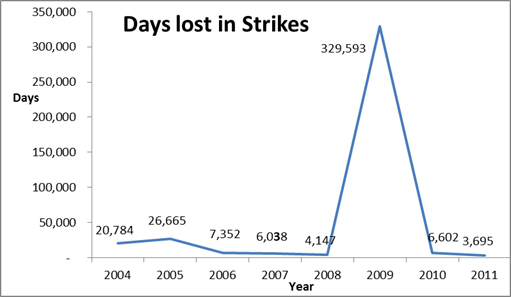
The low level of strike activity in the Irish State in the years just before the crash and after it is shown in the graph above.  The huge spike in 2009 reflects the one-day public sector strike in November of that year.  In retrospect it signalled the victory of a government policy which sought to divide workers employed in the public and private sectors and to blame the former for the state’s perilous finances.  This victory was pushed through with union agreement in the Croke Park deal which eschewed defence of state services valued by the working class in favour of defending the basic pay levels of its existing workforce.  This signalled entrenchment of division in the working class and tacit acceptance of the austerity agenda.  The rules of bourgeois democracy allowed working people to legitimise austerity further through a general election and an Austerity referendum.  All three of these demonstrate how effective bourgeois democracy is in imposing austerity when it so cruelly exposes the working class’s lack of a social and political alternative.

The studies show that no amount of militant action can substitute for this alternative.  As we have seen, general strikes, which often play such a prominent role in the demands of the left, are in themselves not the workers alternative.  Just think about it.  Greece has recoded 33 general strikes between 1980 and 2006, far more than any other country in Europe, yet if ever there is a working class in Europe suffering because of the crisis it is this one.  If ever the truth of Marx’s judgement of strikes received confirmation – that unions “ought not to forget that they are fighting with effects, but not with the causes of those effects” – it is in the Greek experience.

This, of course, does not mean that we must reject the strike weapon or the tactic of the general strike.  It is simply to confirm that these weapons of class struggle are not in themselves the alternative, or rather they are only steps and tactics in their creation.  Too often in the programme of the left they appear as events that will somehow spontaneously create the organisation and consciousness necessary for the creation of a truly permanent and conscious workers movement committed to socialism.  An unconscious faith in spontaneity appears at the heart of organisations that otherwise believe themselves to be wedded to building a fully conscious revolutionary movement.  Doubly so – that austerity will lead to militant resistance and that this will spawn the socialist alternative.  The building of the social and political power and consciousness of the working class are the crucial challenges that are bypassed.

This is often expressed in the view that the mass of workers will learn through action, which is true only in so far as it goes.  The point is that every action has a perceived purpose and, as we have seen, often what is a most militant action is wedded to quite limited, if not reactionary,  purposes – a general strike to demand a social pact, a public-sector wide strike to protect the Croke Park deal?  The ideas that workers fight with and for are crucial, if not decisive, not the tactics and methods of the unavoidable class struggle which they must engage in if they are even to think of a socialist alternative.  It is the creation of the conditions for the development of a revolutionary consciousness, which can utilise the various tactics of the class struggle, that must engage Marxists and not hopes that activity in itself, however militant, will solve this task.  The evidence we have looked at shows that this just doesn’t happen.

*Alan de Bromhead, Barry Eichengreen and Kevin H. O’Rourke, University of Oxford, Discussion Papers in Economic and Social History, Number 95, February 2012).

**“Unions Against Governments: Explaining General Strikes in Western Europe, 1980-2006”, John Kelly, Kerstin Hamann and Alison Johnston, Centre for Advanced Study in the Social Sciences, Working Paper 2011/261.

Will Austerity lead to a Social Explosion?

Greeks riot outside Parliament

In the debate over the austerity treaty the General Secretary, John Douglas, of the trade Mandate union told its Biennial Delegate in Wexford that:

“There are over 400,000 Irish workers without jobs, 50,000 are leaving the country each year, tens of thousands of families are being crushed under the burden of unsustainable mortgages and living in fear of eviction. Living standards, welfare and services are being slashed, the government is introducing a raft of regressive charges and taxes, a recent Irish League of Credit Unions report showed that 50% of those surveyed had less than €100 left to spend at the end of the month after paying all bills – what sort of an existence is this?”

“The imposition of austerity measures across Europe has resulted in over 25 million workers unemployed, of which 5.5 million are under the age of 25. This is a scandal, human waste of mega proportions – but still, our government at the behest of our European banking masters continues with these failed policies and ideologies, condemning future generations of Irish citizens to a mere existence on the margins of society.”

The treaty “may even shrink domestic demand further leading to mass unemployment, decades of emigration and sow the seeds for future social conflict.”

Irish workers are now well versed in watching scenes of riots outside the Greek parliament on RTE news bulletins.  It has been noted by just about every commentator that similar scenes have not been a regular occurrence in Merion Square or Kildare Street.

Is John Douglas therefore wrong?  A recent academic paper suggests not.*

Study

Employing the mathematical tool of regression analysis, using a wide range of indicators of social unrest – demonstrations, riots, strikes, assassinations and attempted revolutions – in  26 European countries, including Ireland, over 90 years – 1919 to 2009 – the authors look specifically at the relationship between austerity and social unrest.  They note previous studies of the same issue and a study of seven countries in South America during the period 1981 to 1990 which found that the run-up to austerity measures is associated with higher levels of unrest but that this declines after implementation.

Using the various indicators the authors create a single measure of instability which they call CHAOS which averaged 1.5 for the various countries over this period and peaked in Italy in 1947 where there were 38 incidents including 7 general strikes, 19 riots and 9 anti-government demonstrations.  The careful reader will wonder at a country with 7 general strikes but only 9 demonstrations.  We will not delve into the definition of the variables.  This does not mean we should cease to be sceptical of the results but we are obliged not simply to dismiss what we might not like, nor perhaps – more easily – simply accept that which fits our existing opinions.

Results

So what are the results of the study?

There are apparently relatively few protests caused by austerity but when they happen they are large and tend to be peaceful.  It should be remembered this study does not look at all protests, strikes and demonstrations etc. but only those linked to austerity measures.

It identifies no clear-cut patter over time but the interwar period, that immediately after World War II and the 1968 to 1994 periods show unusually high levels of unrest.  It also notes that the years since 1994 have been unusually tranquil.

Higher levels of expenditure and faster growth are associated with less unrest.  This might seem unsurprising but would appear to conflict with an assumption of socialists that lower levels of unemployment, usually associated with higher capitalist growth, allows the working class to rebuild its organisation and confidence and engage in more struggles to advance their social position.  The authors however note that while output growth is correlated negatively with assassinations, riots and revolutions it is not correlated in this way with strikes.

In the years after 1945 the authors observe that more growth lead to more unrest and state that “it seems that high rates of output growth may have encouraged worker militancy more generally.  At a time when many countries reached full employment, this effect seems to have become dominant.  The normal pattern of GDP growth reducing unrest reasserts itself after 1965, when there is also still a clear negative effect of higher government expenditure.”

State expenditure increases are relatively powerful in reducing instability while expenditure cuts are strongly correlated with increasing unrest and tax increases having a similar but weaker effect.

Expenditure cuts are linked to significant increases in demonstration’s, riots, assassinations and attempted revolutions but with less impact on the occurrence of general strikes.  These effects were strongest between the World Wars.

The authors note that after the fall of the Berlin wall the overall connection between austerity and social instability changes sign (in other words increased austerity is associated with less instability) but that it appears this relationship is statistically not significant. The authors conclude that non-economic factors become dominant in this period.

Politics

The importance of politics is emphasised when the authors look at the robustness of their results.  They find that unrest is particularly strong to budget cuts if the level of unrest generally is already high.  They also argue that the more democratic the political system in which austerity is implemented the lesser its impact in fostering unrest.

Increases in state expenditure do not reduce unrest to a large extent but this result of the statistical testing is not significant.  On the other hand state expenditure cuts “matter a great deal for unrest.”   Economic growth also does “much to cut unrest” while declines in growth do not set off unrest to the same degree.

The authors do not find that the spread of the mass media facilitates the rise of mass protest.

Finally the authors point to other literature which suggests that “there is no significant punishment at the polls for governments pursuing cut-backs . . . and no evidence of gains in response to budget expansion.”

The analysis would thus appear to confirm the view that political factors appear to be very important, which should be no surprise to Marxists.  Indeed they should find in it confirmation of their view that in questions of class struggle political questions such as the level of class consciousness and political organisation are paramount.

Thus whatever shortcomings, or suspicions, that might arise over the methods and assumptions employed in this academic paper its findings would not on the face of it appear at odds with general Marxist analysis.  It would confirm the view that austerity will generally lead to resistance, that this resistance is crucially framed by political factors and these factors will go some way to determining whether it occurs and is significant.

But what about the character of the political response to austerity?  What does history have to teach us about this?  What sort of politics arises in response to hard times and austerity?  In the next blog I will look at a second recent academic paper that carries out a statistical analysis of the political reaction to the great depression during the 1930s.

*  ‘Austerity and Anarchy: Budget cuts and social unrest in Europe 1919-2009’, Jacopo Ponticelli and Hans-Joachim Voth, CEPR Discussion Paper Series August 2011.