Has the Irish Left missed the boat?

Screen-Shot-2015-05-31-at-02.29.362An article in the ‘Village’ magazine presents the argument that the Left has missed the opportunity to translate widespread opposition to water charges into a significant challenge to the status quo in the coming general election.

As a hard fact that must be faced, the author of it notes that it’s now possible to imagine not only a Fine Gael and Fianna Fail coalition but even the re-election of a Fine Gael/Labour Party Government.  What a kick in the teeth that would be!  Rather like the re-election of the Tories in Britain.  “It’s time for some serious self-criticism” he says.

The conclusion drawn, although it remains totally unexplored, is that the people “have found the alternatives unconvincing.”  That is, they have found the left alternative unconvincing.

It’s not clear to me from the argument of the article that many ever did but I’m not going to go very far in this post in looking at this either.

Instead I want to reflect on the response that the article has evinced from the Socialist Party TD Paul Murphy.  While there appears to be a debate here the grounds of it are very narrow indeed.

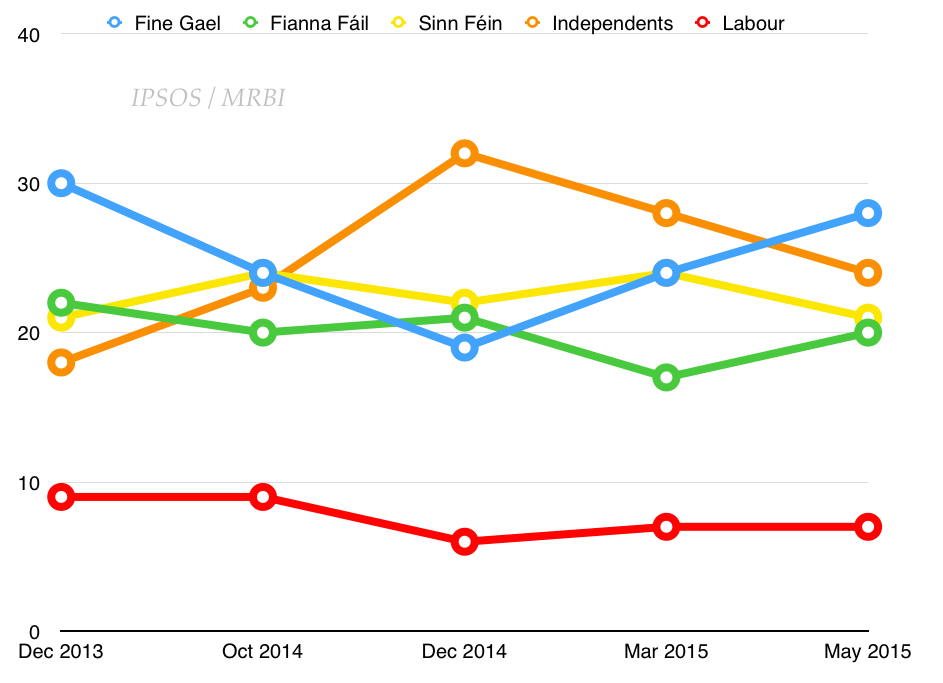
In his call for self-criticism Ronan Burtenshaw first points to opinion polls which showed a rise in support for independents during 2014, from 18% or 22% (depending on the poll) to 32% and 30%.  Support for the two established right-wing parties on the other hand had fallen from 30%/28% and 22%/22% for Fine Gael and Fianna Fail respectively to 19%/21% and 21%/19%.

The problem he points to is that in May this year one poll showed support for independents down to 24% and another back down at 22%.  Since he explains the original increase as a result of a series of mass mobilisations against water charges he argues that the effect of this “has evaporated pretty much completely.”

Paul Murphy argues that Ronan’s conclusion is wrong –

“His conclusion, that the fall in opinion polls is because people looked at the alternatives and found them to be unconvincing, simply does not flow from the data, or his preceding analysis. Instead, I would contend that the opinion polls worsened primarily because of the decline of major mobilisations as well as because the low point for the government wasn’t fully capitalised on by a sufficiently authoritative force to consolidate the indicated trends.”

The second part of this explanation is part-admission of Burtenshaw’s case – his argument that the alternative was not convincing might be seen as just another way of saying that there was no sufficiently authoritative force to consolidate gains.

Of course what Paul Murphy is arguing is that if the forces arguing for the left alternative were bigger its alternative would have been accepted by more people and there is nothing inherently unpersuasive about the left alternative.  But this leaves aside the problem why the left was not bigger and why its argument, if it was persuasive, did not lead to further growth than it did, or rather did not allow growth to be maintained.  If it was persuasive would it not also have been authoritative and, if authoritative is a euphemism for being bigger, how did being persuasive not lead to this increased size?

Paul Murphy argues that Burtenshaw’s case has two flaws, the first of which is that it ignores the temporary impact on the popularity of the governing parties of victory in the referendum on marriage equality.  He says that this allowed the Labour Party in particular “to wrap itself in a rainbow flag and present itself as socially progressive . . . I think much of that can be reversed as people are reminded by the real role of the Labour Party”, which includes further privatisation of Aer Lingus.

By the way, Murphy accuses Burtenshaw of ‘confirmation bias’.  That is the tendency to interpret new evidence as confirmation of one’s existing beliefs or theories.  But Murphy is guilty of this himself, no more obvious than when he dismisses the Labour Party’s role in the marriage equality referendum.  The “real role of the Labour Party” that Murphy wishes to counterpose to its progressive role in the recent referendum includes support for such liberal measures as marriage equality.

But Paul Murphy’s bigger argument is that the decline in opinion poll ratings was due to the absence of visible mass mobilisations around water charges such as the huge demonstrations that started in Dublin and around the State in the last quarter of 2014.  There is no doubt some merit in this argument but it is not as strong as it is presented and does not bear the weight he places on it.

But he also acknowledges two things which again support Burtenshaw’s argument about the weakness of the Left’s alternative.  The first is admission that the role of the leaders of the Right2Water campaign cannot be substituted by the campaigns of the Left, (which calls into question the creation of separate campaigns by the Left groups).

Second is the acknowledgement that protest demonstrations cannot in themselves be the answer.  They cannot substitute for a movement, one that is organised with permanent structures, which provide it with a life of its own outside the calls of unelected leaders to come onto the streets.  So Murphy admits that “It may not be the case that the same level of mobilisation could be achieved now.”

So if the decline in poll ratings is at least partly due to the decline in mass protest and the decline in mass protest is at least partly unavoidable this looks very much like another admission of the weakness of the Left alternative.  Even with support from the Right2Water leaders a series of mass protests could not continue to have the same effect as the first demonstrations that were such a shock to the political system.

Partly this is because the political consciousness of many participants does not go beyond protest politics, involving illusions that the Governing parties will listen, content that they have protested, or simply unable to find a way to turn anger and protest into an alternative.

Less importantly, but necessary to learn, the decline is due to the excessive weight put on the tactic of non-payment by some on the Left.  This tactic might be helped by regular mass demonstrations of opposition but this is not an absolute requirement.   It does not justify a separate campaign with this tactic as its raison d’etre, with its necessary downgrading of creation of a genuine democratic and united campaign that the Right2Water should have been and should still become.

So another illustration of weakness is the inability of the Left to effectively challenge the Right2Water leadership to create a genuine democratic campaign.

The weight put on the tactic of non-payment can be interpreted to mean that more or less on its own it will deliver victory, so why be so concerned about anything else?  But this anything else, as I have noted before, includes the opposition responding to a particular tactic with one of its own such as deducting payment out of incomes.

The Government has also responded by major concessions in terms of the amount to be paid.  As I have also noted before with the carrot comes the stick and shortly after the carrot came the attempts to criminalise and intimidate opposition activists through arrests.

So no tactic by definition is a guarantee of success.

The anything else also involves the whole austerity offensive to which non-payment is so clearly not relevant.  Cuts in services, unemployment, increases in taxes and wage cuts are not going to be prevented or reversed by non-payment so an anti-austerity campaign that features so heavily on non-payment as the key to success has a big question to answer about how success will be achieved in all the other, bigger areas in which austerity has bitten into workers’ living standards.  How if only non-payment works can we fight back in these other areas?

The biggest challenge to the Left which the anti-water charges campaign cannot by itself answer is the seeming success of the governing parties in implementing austerity and now being in a position to claim success.

The upturn in economic fortunes is real.  Unemployment has fallen, the series of major cut-backs has ended and new increases in public spending, cuts in taxation and pay Increases are promised.

The contribution of Eoin Ó Broin from Sinn Fein makes a number of correct points in relation to this:

“Trying to read the poll-on-poll movements against specific political events is always speculative.

Fine Gael’s poll decline in the second half of 2014 was as much to do with the controversies surrounding medical cards, penalty points and Garda Ombudsman as it was to do with the politics of water.

Indeed middle class discomfort with water charges during 2014 had more to do with the initial charging regime, the handing over of PPS numbers and the excessive costs of Irish Water than with principled opposition to the charges and privatisation.

It is not at all clear that the Right2Water mobilisations had any material impact on Fine Gael’s poll numbers or standing with the electorate during 2014.

Replacing Shatter and Reilly with Fitzgerald and Varadkar coupled with the impact of job growth and tax cuts on middle class voters is clearly driving the Fine Gael poll recovery.

Alan Kelly’s revised water package will also have eased the concerns of some middle class voters.”

While one can argue that it is very unlikely that the protests had no impact on the polls, it would be hardly deniable that both the polls and the protests flowed from the same anger at austerity and the charges in particular.  As I have pointed out before, the fact that there appears a clear way of defeating them, through non-payment, has been a big spur to mobilisation.

Also suspect is Ó Broin’s focus on the influence of the events he mentions on the middle class.  There is no reason why changed economic conditions will not have influenced many working class voters as well

Finally, there are two other aspects upon which those involved in this debate are not really so very far apart.   Regardless of the recent movement in the polls, they all note positively the long-term decline in the support levels of the three establishment parties (Fine Gael, Fianna Fail and Labour).

Burtenshaw points out that these parties received over 90% of the vote in every election from 1965 to 1989 while he quotes one recent poll that now puts their support at 57%.

However the participants to the discussion acknowledge, but refuse to digest, the reality that the majority of the electorate have not broken from the politics that delivered them austerity.  The evidence for this is pretty clear – from the 57% figure just quoted, to the election of a Fine Gael Government in 2011, the passing of the austerity referendum in 2012 and the character of much of the opposition to the established parties today.

The biggest and most coherent bloc of this opposition is Sinn Fein, which only the politically naïve could believe will oppose austerity in any comprehensive way.  The experience in the North is well known to political activists on the Left, while workers supporting Sinn Fein will take it at its word, and will then judge it on its actions.  Sinn Fein is no more than a more modern version of the old populist Fianna Fail and neither its nationalism nor its political practice is left wing, never mind socialist.

Meanwhile the Left has collapsed its political judgement and political practice into seeking a ‘left’ alternative instead of a socialist one.  It moved from an analysis based on some version of socialism to one in which the alternative must be ‘left wing’, to one that is simply termed ‘anti-establishment.’  But much of this anti-establishment vote is not even left-wing never mind imbued with any sort of socialism.

As Burtenshaw states:  “In the vast majority these new independent voters weren’t defining as Left but were a nebulous grouping, supporting a wide variety of positions, who found a degree of representation in being “independent” of established politics or wanted an alternative to “party politics” as practiced in Ireland.”

Of independents he notes that “this category, of course, included People Before Profit and the Anti-Austerity Alliance, though neither registered more than one percent at any stage.”

No one disputes this, but it rather puts into perspective any illusion of a Left Government after the next election.

Burtenshaw is right that the Left needs to be self-critical.

The spontaneous outburst of anger that arose in the anti-water charges demonstrations and the organisation of it thereafter will not of itself create the working class movement that is needed.

It will not be a question of surfing the wave of working class struggle; not a question of seizing some short term opportunity that will render history the long term weakness of Irish workers’ political consciousness, and it is not a question of what the Left does or does not do before the next election.

In the next post I’ll look at the most important aspect in which the contributors to the discussion are more or less agreed – the political programme to be advanced as the solution, whether currently estimated to be convincing and authoritative or not.
Austerity and Sinn Fein

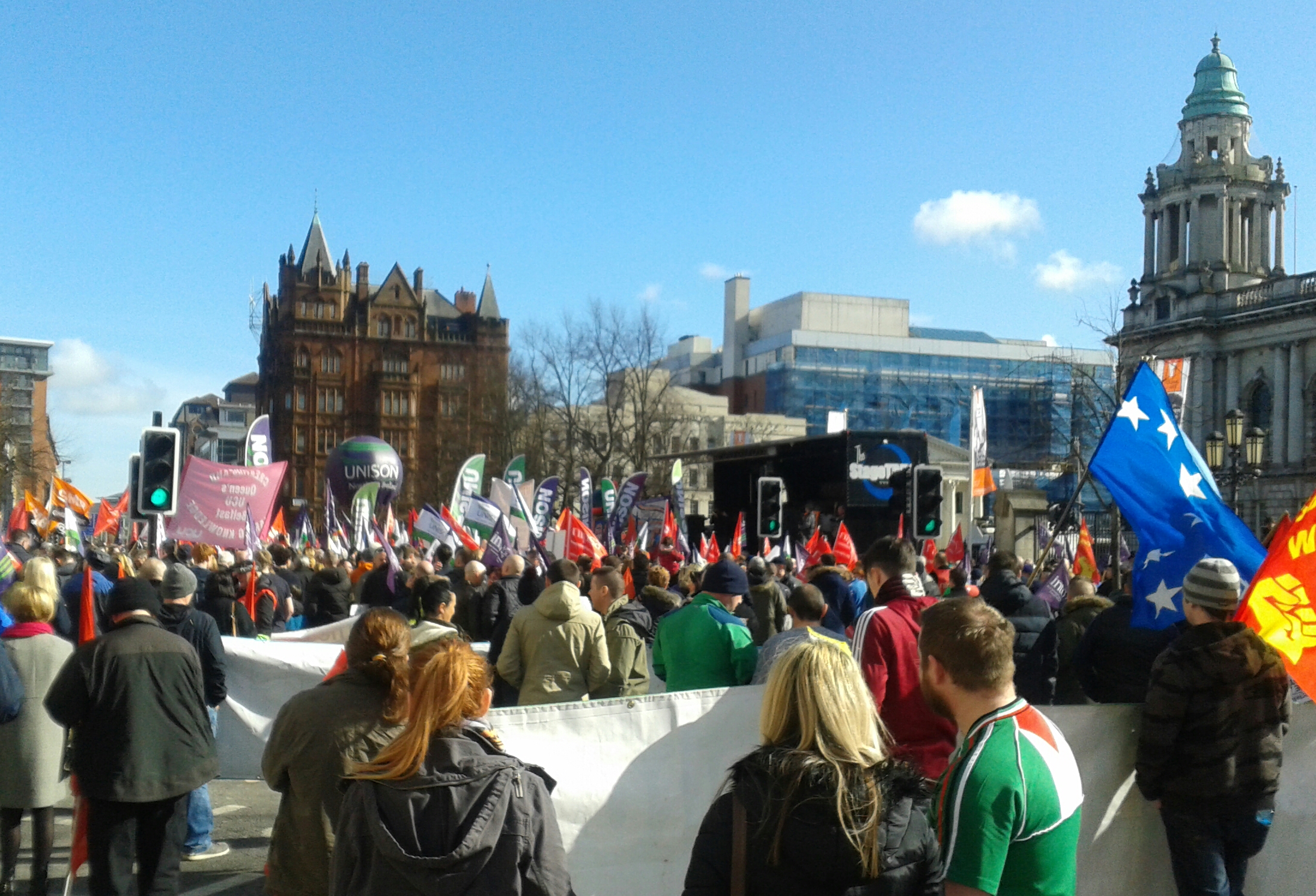
sfdownloadThe strike by public sector workers in the North of Ireland on March 13 was significant because the two major parties, including Sinn Fein, were a target of the strike, whether Sinn Fein or even some of the strikers liked it or not.  Sinn Fein obviously didn’t like it because it damaged its posturing as an anti-austerity party and trade union leaders didn’t like it because their strategy is to persuade the parties responsible for austerity to change their minds and try to get more out of the Treasury in London.

The latest multiyear budgetary programme of the Stormont administration is the second austerity programme which Sinn Fein has jointly authored while in office.  The first did not see the job losses witnessed in England, Wales and Scotland but it did see a reduction of around 14,000.  Pay and pension entitlement for public sector workers were also cut.  Along with almost every other public sector worker I have suffered two years of a pay freeze while inflation consistently exceeded the supposed target of the Bank of England and my pension contributions increased, while my benefits were reduced and I will have to work longer to get them.

The much vaunted protection of welfare in the new budget, whatever coverage it eventually has, will come from money taken from other public services, including cuts to education.  As one local newspaper columnist put it – these will include an end to free books for pre-school children, making Northern Ireland the only part of the UK that will not have the scheme.  This will save £250,000 a year, or one third of the £750,000 that 36 Sinn Fein politicians at Stormont paid to a party research company that was unable to show any research.

As also remarked, Sinn Fein’s often boasted politician’s salary at the industrial wage includes industrial scale expenses.  Widespread cynicism exists in ‘republican’ areas at the rise to riches of leading figures identified with the movement.

The much vaunted financial deal that saved the Stormont administration, before the latest crisis, was hailed for delivering an extra £2 billion to the Northern Ireland budget, except that it didn’t.  Only a third of it could be called new, which spread over 10 years is less than a third of 1% of what is spent each year.

The rest is loans or ‘flexibility’, which means that money that is for capital investment can be incurred on day-to-day expenditure.  You don’t have to be an accountant to realise that relying on loans and investment funds to pay for on-going expenses is not sustainable.  Further expenditure is allowed if funded by asset sales, which again is not sustainable, and raises a green light for privatisation.

Such privatisation would leave the lefty credentials of Sinn Fein wearing even thinner.

Not all the capital money will be spent on recurring expenses.  £700m can be spent (in fact must be spent or it won’t be spent at all) on paying off around 20,000 public sector employees through a voluntary exit scheme.  This is a major plank in the opposition of the trade unions but it is not clear that many workers themselves will not take the money and run.  Unfortunately the old union maxim that the job is not yours to sell is long forgotten.  It is obviously completely unknown to Sinn Fein who talk of losing only ‘posts’ as if this is not what is actually wrong about what they are doing.

It is claimed that there will be no compulsory redundancies but the NIPSA trade union has drawn attention to advanced plans to cut 50 jobs, or over half the workforce, from the Northern Ireland Association for the Care and Resettlement of Offenders (NIACRO).  As NIPSA points out, when NIACRO works with prisoners on release reoffending rates drop from over 50% to less than 25%. This has all the hallmarks of the stupid and counter-productive cuts often condemned by Sinn Fein.

The claim to be protecting the vulnerable now doesn’t look so strong.

An amount of £350m will go to capital investment in integrated education, which at least sounds progressive until it’s understood that this doesn’t involve Catholic and Protestant children being educated in the one classroom but actually often means two sectarian-denominated schools being put on the one campus.  The move towards a shared campus simply reflects the fact that sectarianism is becoming expensive.

Rather than signalling the end of sectarian schooling it shows the lengths that will be gone to in order to preserve this apartheid system.  But the sectarian education system also has the support of Sinn Fein.  It would appear that apartheid can be supported in this case if the justification  given for the original South African variety – separate but EQUAL – can be adhered to.

This isn’t even progressive never mind left wing or socialist.

That the new deal means no rejection of the previous imposition of reactionary Tory-Lib Dem policy is shown by the fact that the fines of £114m that had to be paid for not implementing the welfare cuts in 2014-2005 must be paid now, and the £100m loan required to balance the books in the same year must also be paid.

Last but not least the new financial arrangement allows the local administration to lower corporation tax, once again supported by Sinn Fein.  Their thread bare justification for this is the harmonisation of an all-island economy.  In fact, along with many republicans’ support for Scottish independence, it involves mutual competition of small states in a race to put more money into the fat pockets of mainly US multinationals.  Were the policy to succeed the London Treasury has stated clearly that the Stormont regime will have to pay it for its losses.

All of this passes Sinn Fein by.  It clings to its claims to be anti-austerity purely on its partial opposition to cuts in welfare benefits.  Its populist politics is revealed by its approach that workers are victims and its most vulnerable members should be given some form of protection by a benevolent state.

The effect of privileging one section of the working class above another is always to undermine and weaken its potential political unity.  In this case the potential unity of the working population and those on benefits, who are always the subjects of divisive attack by right wing forces.   By limiting its proclaimed anti-austerity agenda to support to some on benefits it plays into the divisive claims of these right wing forces.  Sinn Fein appears happy to see austerity delivered to those in work while proclaiming great concern for those who are unable to or cannot work.

The interests of the working class as a class and as a political force independent and opposed to the state are alien ideas to a purely nationalist movement.

Unfortunately it is also alien to the leaders of Ireland’s trade unions and their new proclaimed support for Sinn Fein is proof of this.  At the Sinn Fein Ard Fheis – that is even before Sinn Fein’s renewed expressions of concern for welfare claimants – the Irish Congress of Trades Unions President, Jack Douglas, extolled Sinn Fein’s adherence to the union cause.  That is after the austerity budget the Northern unions were calling a strike against!  A week or so earlier the leader of Ireland’s biggest union SIPTU, Jack O’Connor, hailed Sinn Fein as a potential partner of the Labour Party in Government. The same Labour Party that has been implementing the Troika austerity agenda it was elected promising to oppose.

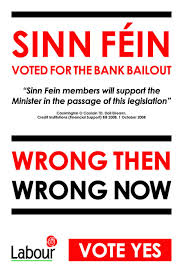
The performance of Sinn Fein in office in the North is a stark warning of its future role in the South but the record of Sinn Fein in the South is ample demonstration itself.  It was Sinn Fein who voted for the bank bailout that made the debts of the speculators the millstone round the neck of the workers.  Its ‘leading role’ in the resistance to austerity today is to identify itself with the campaign against water charges while seeking electoral advantage from it.  Beyond seeking votes from the campaign it has no strategy to make the campaign a success.

A couple of weeks ago an economist from Goldman Sachs claimed that the biggest threat to the Irish economy was that Sinn Fein would keep its promises on its opposition to austerity.  He needn’t have worried.

I remember around twenty years ago attending a meeting in Conway Mill on the Falls Road during which time Sinn Fein was trying to get into talks with the Unionists, who were refusing to engage. I asked Gerry Adams what he expected to achieve from such negotiations when the Unionists wouldn’t even talk to him.  A United Ireland he said.

Well we all know how that worked out.

Workers strike against austerity in the North of Ireland

20150313_130323-1Tens of thousands of workers went on strike across the North of Ireland on March 13 in protest against cuts in jobs and services implemented by the devolved administration in Stormont.  The local administration is imposing the austerity agenda dictated by the Tory-Lib Dem coalition in London.  The strike was particularly successful because transport workers, including on the buses and trains, took part as well as those in the civil service, health and education.

Observance of the strike was good and pickets and rallies had respectable turnouts.  Workers have suffered a long period of declining living standards and are clearly willing to declare their opposition.  It would be a mistake however to exaggerate the stage we are at in the development of this struggle.  A glance at the numbers voting for strike action in a couple of the biggest unions involved shows the distance yet to go to build a strong and active movement.

In the trade union NIPSA, covering staff in Government departments and other bodies as well as admin and clerical staff in the health service, 52.9% or 4,201 voted for strike action in the civil service side out of a membership of around 20,600, with the health service side having an even lower turnout.  Not all of the membership was called upon to strike but the vast majority of members were affected.  In UNISON, with a membership mainly in the health service and some in education ,3,181 voted for strike action in a membership of around 40,000, again not all of whom would have been called upon to vote but a majority of whom would have been affected.  The strike had sympathy among the wider population but this finds no expression in organisation.

Many on the left have demanded another strike and have claimed that the recent ostensible U-turn by Sinn Fein on welfare cuts is a result of the strike.  However this would be to take the Sinn Fein position at face value, or rather take them at their word, and exaggerates the effect of the strike.  While it focused opposition to austerity, and can lay the grounds for a deeper campaign against it, the actions of Sinn Fein are not so much a reaction to the strike but the wider feeling of opposition to cuts.

The strategy of the trade union leaders is to lobby and put pressure on local political parties so that if the next Westminster election results in a hung parliament local politicians can demand and negotiate an end to, or at least an amelioration of, austerity imposed in the Northern Ireland.  It therefore takes as given the continued position of these parties and resists any project of setting up a political rival.  This is on the basis that to do so would inevitably require a position to be taken on the constitutional position of the Northern State.

Such a party would inevitably have Keynesian policies of greater state activity in taxing and spending.  In other words salvation would be presented as arriving from the state, so the programme of any such labour or workers’ party would very quickly run up against this challenge.  No autonomous development of the party would be possible.  It is now some years since a labourist project was attempted and the last one that set up the current political arrangements was an embarrassing failure.

The strike was however noteworthy because it was carried out explicitly against the policies of the local Stormont Executive, the centre piece of the peace process and the ‘new’ political settlement.  It also took place against the background of another ‘crisis’ in the process, with the whole financial arrangements of the local administration thrown into doubt by a late Sinn Fein withdrawal of support for the budget because the deal to preserve it did not fully cover the cuts in welfare that were to mirror ‘reforms’ in Britain.

Sinn Fein therefore paraded its anti-austerity credentials, which the media took to be another late intervention by Gerry Adams to shore up the anti-austerity stance of the party in the South of Ireland.  Sinn Fein faces a general election in the South within the year.  The party is riding high in the polls on the basis of this perceived position and it would not look good if it were seen to be implementing austerity in the North while claiming to oppose it in the South.   Sinn Fein therefore ‘supported’ the strike even if the strike was clearly against the budget it had just approved as a major part of the local administration.

This support was invisible in the well-attended rally in Belfast city centre on 13th and is based on the party once again talking out of both sides of its mouth.  A long established practice.

This most recently saw an outing through Sinn Fein’s vocal support for the Catholic teacher training college St Mary’s, which was threatened with cuts by the local administration.  The cuts were proposed by the Alliance Party Minister responsible who was simply implementing the reduced budget given to him by Sinn Fein and its Democratic Unionist Party partners.  The sectarian aspect of this support was lost on no one as similar cuts were to be made to the ‘Protestant’ teacher training college at Stranmillis.  In the end the two biggest sectarian parties – Sinn Fein and the DUP – got together to overrule the Alliance Party Minister.

The last minute opposition to the welfare arrangements therefore doesn’t inspire the view that Sinn Fein are a principled opponent of austerity but rather smack of an opportunist change of tack.  At their Ard Fheis in Derry the weekend before they dropped their bombshell the leader of Sinn Fein in Stormont, Martin McGuinness , was proclaiming great satisfaction with the deal and congratulating the party on how well it had done in the re-negotiated financial settlement with the British Government.

At the very best their new found concern means that they hadn’t done their sums right or had been rather easily hoodwinked by the DUP; or perhaps that they had re-evaluated the calculus of staying with the welfare cuts programme as it was going to develop – thus facing the flak when it was put into practice – as against provoking another ‘crisis’ and the fall-out that would then ensue.

That this was all a bit last-minute became clear from the Sinn Fein media performances to explain its change of approach.  One prominent spokesperson on local radio refused to say it was a question of money when it could hardly be anything else; then it was claimed that it would cost over £280m to put right before this became translated into a round figure of £200m when the round figure it would appear closest to would be £300m.  Unionist claims that it was clear in the deal that not all the benefit cuts would be covered by mitigation measures in the budget, and would not be permanent for new claimants, seemed more convincing.

Nevertheless, the row over the extent of the funds to cover cuts in welfare matters to those welfare recipients affected who are indeed, as Sinn Fein says, some of the most vulnerable. It doesn’t in the least affect the fraudulent nature of Sinn Fein’s anti-austerity posturing.

To be continued

Syriza and Ireland

syrizaimagesThis Sunday the Greek people will go to the polls in an election that could see the beginning of the end of austerity in Europe.  That anyway is the view of some on the left across Europe.

The potential election of a Coalition of the Radical Left (Syriza) Government, promising a radical reduction in the debt burden, has the potential to galvanise and set an example to the rest of the PIIGS.  It could incite a combined movement in Portugal, Ireland, Italy, Greece and Spain that would reduce the debt of these countries which has been a prime driver of austerity.  Through radically reducing the requirement to service and pay down enormous debts such a step could launch a definitive movement away from neoliberalism towards a radically different Keynesian social democratic alternative.

The elections in Greece will be followed this year by elections in Spain, in which a like-minded Podemos movement has grown, and in Portugal, and may also be joined by an election in Ireland despite the claims of the current Government that it will run in office until 2016.  Of the five PIIGS therefore at least three and possibly four may see elections this year.  Even elections in Britain could see the ousting of the Tory devotees of austerity and neoliberalism.  In fact the policy that might inspire the PIIGS is not confined to them but might apply right across Europe.  And Syriza is in the vanguard of this movement.

Is such a scenario a real possibility?

Let us notice what makes such a claim plausible.

Firstly the proposals of Syriza are not solely on behalf of the Greek people although as a Government it will be able to negotiate only on their behalf.  Syriza proposes a European Debt Conference modelled, with delicious irony, on effective debt forgiveness of (West) Germany in 1952.  This was carried out explicitly in order, or so it was claimed, to normalise relations between Germany and its creditors and to promote economic development.   That deal wrote off half of the debt, stretched repayment of the rest and for the first few years provided only for payment of interest, which was also limited.

Syriza proposals are more limited. Their policy could be based on an academic paper which proposes that half of the debt would be bought up by the European Central Bank (ECB) with either an interest holiday or interest charged on the remaining debt at a low rate.  The debt taken on by the ECB would not be written off but would be paid back only when the remaining debt left to the country had been reduced to 20 per cent of Gross Domestic Product (GDP).  In effect economic growth and inflation will have eroded the real value and real impact of debt repayment.

However in one very important sense the proposals are much more radical than the German precedent, because the Syriza proposal is that this plan applies to every country in the Eurozone with debt over 50 per cent of GDP (all but three countries).  The Irish state for example would see its debt reduced from 108 per cent of GDP to 50 per cent, saving €3.7 billion each year in interest payments, so reducing the need for cuts or tax rises and facilitating greater state spending and investment.[i]

It has been estimated that this would reduce sovereign debt in the Eurozone area by about €4.5 trillion.  It is asserted that this would not risk inflation because the ECB debt purchases would be funded by massive borrowing from private banks.  There would be no money printing since the money is borrowed.  And sure why worry about inflation when deflation is so clearly the enemy?  And who pays the interest on these loans?

Well, it is recognised that there will be losses in paying back the private banks, between €50bn – €60bn in each of the first 5 years, and €1trilion over 40 years, but it is argued that the borrowing costs of the ECB would be low and that renewed economic growth would compensate.  It would be cheaper than the current policy of austerity and expansion of the ECB balance sheet required to bail out the banks.

It is recognised that this may not be enough in the short term for some countries so that, for example, in order to prevent continued austerity in Greece the ECB would have to take over the debt that would be required to be issued in the next five years.  This would also be required because over 50% of outstanding debt has to be paid back within the next 5 years in Italy, Spain, France, Holland and Belgium and to cover this new debts would have to be taken on.

For Marxists the point is not that some monetary scheme has been devised that will solve capitalisms’ problems.  Nor is it the point that Syriza will go into negotiations and cannot expect, as in all negotiations, to get its original plan agreed, even discounting some conscious intention to betray the hopes of its supporters in order to accept the logic of capitalism.

The significance of the proposals is that it provides a concrete platform around which workers across Europe can organise and struggle together, and a series of elections that can be a focus for such struggle.  This is not to invest illusions in either elections or Syriza, who are condemned by some for having shifted from a policy of debt repudiation to one of simply extending repayment under more favourable terms.   If a practice of simply condemning the limitations of reformist politics were the answer we would no longer have the problem.

The Syriza programme is one that workers and socialists can support because it reduces the burdens they face and would deal a big political and ideological blow to austerity and the parties who have peddled it.  It would deal a real blow to reactionary political parties seeking nationalist or fascist solutions.  Through a successful campaign workers could gain strength and confidence to build up their organisations, their own social and political power and their own confidence and class consciousness.  The latter is the role that Marxists can play by advancing a programme that does all these things.

The victory of Syriza would allow an opportunity to directly organise workers on an international programme on an international basis.  It is remarkable that this significance has been somewhat missed.  So, for example, the call promoted by the Fourth International correctly argues that “their victory will be ours, but their defeat too” but appears to fail to appreciate that this can be so because other European workers will not just be in solidarity with Greek workers but can actually be part of the same struggle, demanding the same deal for their country, so that “our victory will be ours and our defeat will be ours too.”

This is made tactically easier by Syriza not proposing either to leave the Euro or leave the EU.  There can be no pretext that the demands of Syriza can be dismissed because they no longer want to belong to the club.

These policies have been condemned as examples of betrayal of earlier more radical promise but they are not just tactically recommended.  As argued before in the various posts on ‘The Left Against Europe’, the growing unity of capitalism provides the material basis for the international unity of the working class.  This is why a united international struggle against austerity is more immediately and concretely possible in the Eurozone than one against similar policies pursued more or less independently by separate capitalist states each with their own currency.

So to return to our question – is such a scenario possible?

It is possible to argue that it is, for the simple reason that the Greek debt is too big to be paid back anyway.  Some means of addressing it is required and the Syriza route is eminently preferable for workers than the slow death march of austerity and repeated minor debt ‘haircut’ so far embarked upon.

The second is that by the very fact that the Syriza plan is reformist there is no necessity for a life and death struggle by the forces of capitalism to defeat it.  The Syriza plans do not call the system into question, which both sets limits to what it can achieve but also provides scope for negotiations between a Syriza Government (and other PIIIGS Governments should they be elected or so inclined) and the IMF/ECB /EU/German State alliance.

The rallying of the Greek workers behind Syriza is one of many proofs that a revolutionary overthrow of Greek capitalism is not currently on the cards and is not therefore a realistic immediate alternative.  The revolutionary alternative today consists of preparing for such an eventuality tomorrow.

Not by either passively or even ‘aggressively’ preparing for socialist revolution but by the cumulative development of the power of the working class suggested above, with the certain knowledge that a revolutionary break with the capitalist state and system will be required.

To condemn Syriza for negotiating with capitalism when it cannot be overthrown is a bit like condemning trade unions for negotiating a pay award when they should be overthrowing the wages system.

The third has been pointed out here – Syriza will be damned if it does not get some sort of result and the executor of that judgement may be the fascists of New Dawn.  It is not only Syriza who has an interest in ensuring this doesn’t happen.

‘Ireland is not Greece’ we have been told repeatedly over the past five years or so.  If Syriza is anyway half successful Ireland will look pretty stupid if it isn’t.

[i] It is interesting that the authors go beyond the argument that this is some sort of socialism saying that “The left ought to be strategically against privatizations, having at the same time as an ultimate target the gradual historical replacement of “state control” by democratic forms of social control (unfortunately this type of discussion has not been adequately developed within the left).”

The next step in the campaign against water charges?

Screen Shot 2014-12-10 at 01.50.42_0The Right2Water Campaign posted a message at the very end of 2014 setting out the tasks for 2015:

“So where to now? If we are to elect people who enact the laws we, the people, need in the next election to continue to unite on what we agree on and not sow division and discord over tactical approaches as some are currently endeavouring to do. We need to grow and develop the unity that has rocked the establishment and the media – not splinter in 100 different directions as Irish people have (to their great cost) many times before thereby allowing an elitist minority to reap and sow at great cost to the common good. It’s been the way of it for much too much of our history. Can we unite and through solidarity fundamentally change how our water, our housing, our jobs, our education and our health services are paid for and delivered in all our interests?”

The statement, and let’s leave aside the exact status of it for the moment, has been criticised on the Revolutionary Programme blog.  The criticism of ‘electoralism’ is correct in my view but the first problem is not the desire to somehow, in some way, at some time, lever the people mobilised by the campaign into support for some electoral initiatives, alliances or whatever.

There will be elections at some point not too far away and those opposed to water charges and austerity in general would be remiss in not seeking to utilise them to advance their struggle. Of course critics will claim, with previous ‘form’ for justifying such claims, that elections are typically used not to advance the struggle but the struggle used to advance elections.

For Marxists like the Revolutionary Programme blogger and myself the road to change, even for any significant reforms, never mind revolutionary change, will come primarily  from the actions of working people themselves and not from legislators “that enact laws that are wanted and needed by the people they are elected to represent, not Corporations and their cronies.”

Our view comes from our understanding of how the state works and how the nature of the state is such that it cannot fundamentally change society or challenge the priorities set by the corporations and their cronies.  This is because power and resources are distributed and reproduced by an economic system over which the Dail has little, and certainly no fundamental, control.  In Ireland this is much more obvious since the most dynamic sector of the economy is that controlled by US multinationals and Irish people are used to accepting that neither they nor their legislators control these multinationals.

To fundamentally challenge the priorities of the capitalist economy would mean either putting the system in crisis or compelling more radical transformation to a new system.  It stands to reason that if people are put before profit in a system that puts profit before people that the system will start to malfunction or at the very least not function as well – through capitalists taking their money out of the country, failing to invest or simply stirring up political opposition to change.  Alternatively, a completely new system requires something much more fundamental than changing the 166 people sitting in the chamber of the Dail.

This doesn’t mean nothing can be done short of some revolutionary change but it does mean that certain limits are put on such change; the fundamental driver for it will exist outside the Dail; such change can only be temporary if more fundamental change is not made and essential change requires action by the working class itself and not by people elected by it to do it on their behalf.

At the very least those advocating the election of those who will “enact the laws we, the people, need” are required to explain what will be done, who will do it and how it will be done.

If this really is the way forward there can be no objection to debating it.  If Marxists lose the debate and such a reformist road is carried then that will be accepted because it is only by changing workers’ minds that the Marxist alternative can come alive anyway.  Marxists are not opposed to reforms, we are in favour of them, strongly in favour of them, especially when they are posed as a real alternative not to revolution but to no change at all.

What’s more we do not believe that no reforms are possible, just that they will be contested, limited and will not conflict fundamentally with putting profit before people.

What Marxists might really object to now is that such top-down politics is often advanced in a top-down way by those most loudly proclaiming their bottom-up politics.

In Britain a working class party, at least in terms of support, exists in the form of the Labour Party through which the struggle to advance such reforms can be made.  In Ireland the Irish Labour Party excites the hopes of a smaller or larger minority of workers at various times, only for it to betray those hopes.  But it does not retain workers’ allegiance so that some continuing struggle within it can form the basis of advancing Irish workers political consciousness and organisation.

So no obvious candidate for the party needed to fulfil the perspectives of the Right2Water Campaign’s authors exists.  For many people newly drawn into political activity against the water charges this will be an obvious difficulty.  But it is not the most immediate.

The most immediate is the fact that what exists is a campaign against water charges that has no structure, or rather no democratic structure, so that it cannot decide whether any of the ideas put forward in the statement should be supported, because ‘it’ – a campaign – does not exist in any sort of form that could make a decision.  Nor is there any proposal in the statement to bring one into existence through, for example, a national conference and a democratically elected leadership accountable at all times to campaign supporters.

In a previous post I noted that it would be necessary to develop the scope and demands of the campaign but that this would need to be prepared.  Such preparation involves creating arrangements that allow people to discuss what they think collectively, whether they think the campaign should adopt additional objectives to that of opposing charges, and whether certain tactics should be promoted or not.  Even the statement leaves open the reality that the charges still exist, have not been killed off, and have a zombie-like existence – being half-dead and half-alive.  We have all seen enough zombie movies to know they keep on coming back to life to bite us.

Finally, but perhaps firstly, those involved in the campaign could hardly do better than follow the advice, once given by Tony Benn, and ask five questions of the campaign leaders: “what power do you have; where did you get it; in whose interests do you exercise it; to whom are you accountable; and, how can we get rid of you? Anyone who cannot answer the last of those questions does not live in a democratic system.”

This is all very simple.  If someone thinks the campaign should support certain candidates in an upcoming election they must be able to answer these questions when anyone in the campaign asks them.

Workers’ Cooperatives as an alternative to capitalism – 1

420389_494371703955556_1654331871_nIn October I was invited to speak at a meeting organised by the Glasgow South branch of Left Unity on the subject of workers’ cooperatives.  The post below is the first part of the text on which the speech delivered was based.  I would like to thank the comrades for the invitation and for the couple of pints in the pub afterwards.


The first thing I want to do is look at two problems to which I think workers’ cooperatives can play an important role in providing an answer.

In 2008 the Irish banking system was on the verge of complete collapse.  It had lent exorbitant amounts of money to commercial property development and for the construction of houses.  Not only finance but employment and state revenue became overly dependent on construction.  When the price of houses rose beyond a certain point, and when the commercial property market became saturated, the over-extension of property developers became evident in bad loans that bankrupted the banks.

This was an international problem because much of the financing of Irish banks came from Britain, the US and Germany for example.  The bankruptcy of the Irish banks would thus have had severe repercussions for investors in these and other countries, including the financial institutions in these countries.

To save the Irish banking system, to bail out the native bankers and foreign investors, the Irish Government launched a bailout of the banks through a state guarantee of all their liabilities, worth around €440 billion in an economy nominally producing €154 billion a year.  It was declared ‘the cheapest (bailout) in the world’ by the Irish Finance Minister.  This could not possibly be afforded and has so far cost an estimated €64 billion, although the exact figure is still a matter for development.

This bill and the huge budget deficit caused by the collapse of construction resulted in a series of attacks on working class living standards involving seven austerity budgets consisting of a variety of tax increases, cuts in public services and investment, the robbery of workers’ pension funds, massive unemployment, emigration and lots of praise from around the world at how well the Irish swallowed the austerity medicine.  From poster boy for the boom the Irish have become poster child for austerity.

In the following election the ruling Fianna Fail party was badly mauled and a coalition of Fine Gael and Labour Party was elected on the promise of a ‘democratic revolution’ and by Labour the promise it would reign in Fine Gael.  The vote was a choice between ‘Labour’s way or Frankfurt’s way.’

In truth however no one could really be surprised that this coalition continued and intensified the policies of austerity began by Fianna Fail.  That anyone thought differently demonstrated only a very low political awareness.

On the ‘left’ 5 United Left Alliance candidates were also elected and 14 Sinn Fein TDs out of a total of 166, although Sinn Fein had also voted for the bail-out.

In 2012 the Irish State was compelled to hold a referendum on the new EU Fiscal Compact that limited state deficits and debt.  It basically required signing up to continued austerity which is why it was called the ‘austerity treaty’.  Despite the unpopularity of austerity it was approved by 60% to 40%.  In my view a crucial reason for this was the complete lack of a convincing alternative.

What was the alternative proposed?

This consisted of a number of elements – repudiating the debt, opposing austerity, taxing the rich, and increasing public expenditure in order to improve public services, boost employment and further economic growth.

There are two points to note about this alternative – first it doesn’t change the nature of the economic system, it is what is called Keynesianism.  This does not mean that socialists should not support some of these measures, or point out the hypocrisy in their not being implemented.  But the question is, if the problem is capitalism and this alternative doesn’t threaten the system then quite obviously it cannot be a solution.

The second flows from this, because if it isn’t a solution would it actually work?  I’ll just take two examples from this programme – why on earth would the rich allow their wealth and income to be taken off them?  And how then could the state increase public sector investment when it was heading towards budget deficits of over 13%?

This illustrates a deeper problem with looking to the state as a solution.  This is because the burden placed on Irish workers was not simply, or even mainly, carried out by the banks and property developers.  It was the State that made their debts the debts of the Irish people and it has been the State that has increased taxes and cut services, making their own particular contribution to cutting wages and increasing unemployment.

Since the state is a capitalist state, funded and staffed at the highest levels by the propertied classes this can really be no surprise.  The actions of the capitalist state are not therefore the answer.  Not only does it not have any interest in providing a solution but it is incapable of being the solution.  State ownership, bureaucratic ownership, is not democratic and is totally unsuited to running productive activities the civil servants that staff it have no knowledge of.

There is no point calling for the state to nationalise the banks – they did and that was precisely the problem!

At bottom this is the root of the failure of resistance to austerity and is why it has not only failed in Ireland but in every other country affected by the financial crash.

The second point is connected to all this.  If the Keynesian alternative is not a road to socialism what is the road to it?

The alternative to the view that the capitalist state will reform society is that the state is actually the mechanism for enforcing oppression and exploitation and should therefore be smashed.  In this scenario of revolution the oppression of capitalist society breeds resistance which develops into a revolutionary seizure of power by the working class that then proceeds to build a new socialist society.  In this society the market is replaced by planning and capitalist economic crises become history.

But how are workers to become aware that their own ownership and control is the alternative?  How does it not only come to consciousness of this but is actually trained, ready and able to play this role?  How in the middle of crisis is a workers’ economy supposed to rise from the ashes more or less fully formed and present itself as a qualitative advance on what has went before?

Of course in some ways capitalism itself anticipates this planning through the growth of big business with advanced forms of planning within it, increased cooperation between companies that ostensibly are in competition and increased interdependency of different firms and different countries, encapsulated in the term globalisation.  This has all been demonstrated negatively through the simultaneous near collapse of the financial system, world trade and economic growth through the credit crunch plus the increased role of the state despite privatisation.

There is however one thing missing from this anticipation of the new society in the existing one and one thing missing from the scenario of revolutionary overthrow.

The missing factor is what the new society, the harbinger of socialism, actually is – the rule of the working class and its allies; the rule of the majority of society in place of the capitalist class and its managers, bureaucrats and politicians who all currently administer its rule.

Where in the anticipation of socialism within existing capitalist society is the growth of workers participation in running the economy, in preparation for taking over complete control?  Where are the grounds for workers to build a new society before, during and after revolution?  Where is the alternative that would avoid a new version of Stalinism where the State rules society rather than a society ruled by workers subordinating the state? Where even arises the motivation for workers to see that their own rule is the only valid unfolding of their resistance to the exploitation, oppression and iniquity of current society?

How are workers to come to see that it is they that not only can but must take control of society and its productive powers if they do not first take initial steps now through workers’ cooperatives?  Are we to believe they will suddenly come to realise through a revolution – an episode of at most a few years – that they must take over the economy?  How will they come to seek this as their solution unless many of them have already tried to do it and become committed to it?


The Politics of the Anti-Water Charges Campaign – Part 3

2014-10-18_iri_4011307_I1An old military maxim is that no battle plan survives engagement with the enemy.  And so it proved when the Government thought it could impose water charges on a population ground down by austerity. Unfortunately for them a sizeable section of the Irish working class decided it had had enough and that this was one bite of austerity that wouldn’t be taken.

As I said in a previous post, it began to appear in the last few months that this was a battle the Government was losing.  The announcement of further drastic changes to the Government’s plans this past week suggests that this is even truer now.

The charge that was provisionally priced at €176 in July is now €60 and is €160 for households with two or more adults – if the charge is paid and an absurdly name conservation rebate of €100 is claimed.  The cap on charges will be in place until the end of 2018 with the promise of continuing caps thereafter.  The introduction of charges is postponed for three months to January 2015; late/non payment penalties will be €30 for a single adult and €60 for other households.  PPS numbers will not be required and trickle water restrictions will not be imposed, with promises that court action will not be taken against non-payment.  Privatisation of Irish Water is off the agenda with other promises that legislation will be introduced to require a plebiscite before such action could be taken in future.

The Right2Water campaign noted “that the level of charges has been significantly reduced” and the Socialist Party TD Ruth Coppinger, interviewed on RTE Six One News, noted that they were low.  The Socialist Party has claimed that the non-payment charges will kick in at the time of the next general election and will become the major issue within the election campaign but then make the argument that the Government won’t be able to impose them.

The argument of the campaign is that the water charges need to be scrapped, that promises of future low levels of charging are worthless, that Irish Water should either be scraped as well or else it should be retained in ‘public’ ownership, and that promises not to privatise it are also worth nothing.

The argument can also be put that for many working people €160 is €160 they already can’t afford and for others it will tip them significantly into financial hardship.  The amount is not a lot but its impact is so much more painful the less it can be afforded.

None of this however may be enough; for now it is the campaign that is faced with its battle plan’s survival after further engagement with the enemy.  A campaign that has highlighted the cost of water charges and the tactic of non-payment now has to answer when the cost has been significantly reduced and a credible promise is made that it will not be increased quickly.  Can the campaign be maintained and can it grow and develop?

The current weakness of enforcement measures means that non-payment may not immediately have the intimidatory effect that they might have had, but the flip side of this is that the cost of paying for many is no longer prohibitive.  As I noticed in the previous post, given European Commission clearance the amount of money involved for the State is not unmanageable.  It can afford to retreat on this.

So as things stand the victory is not complete, but then no success is ever permanent until the final victory.  One small part of austerity has been rolled back but the decisive question is how the success that has been achieved can be copper fastened and advanced.

There is no silver bullet as an answer to this question or even a combination of answers such as sunlight, garlic and a wooden stake through the heart of the vampire.

But we do know that the answer lies with those who have been mobilised in the Right2Water campaign and the militant and active campaigns that have been organised at a local level.

The immediate requirement is to make the campaign a real coherent movement with democratic functioning so that all those involved can contribute to deciding what their collective attitude is to the Government’s concessions and what they are going to do next.  No one is going to decide for them. If they have the power to put the Government into disarray they should and must have the power to make their own decisions.  See the initiative launched here.

It is likely the case that the issue of water charging is still the struggle that will unite active opposition to austerity and that other issues might accrete to the campaign at a local level but cannot do so as part of an overall policy unless and until the democratic organisation into a State-wide campaign has been achieved.

Time now gained can be used to campaign among the trade unions and workers to boycott and black charging and create a real campaign against water charging within the union movement.

Despite the reduction in charges there is no reason that non-payment should not be a part of the campaign.  It should not however be allowed to become a means of dividing those opposed to the charges and should not be made into a loyalty test of opposition.

This does not exclude putting it up to political parties to state their policy.  It is not the views of individual TDs or councillors that is the issue.  It is a political question, a question of tactics not a moral obligation that failure to live up to will mean eternal damnation.

Some on the left appear to want membership cards, justifying it by reference to the Labour Party having subscription charges.  I think this is misplaced and the necessity of having an organisation to belong to i.e. a real democratic state-wide organisation comes before the levying of membership charges.  Membership of what and what are my rights of membership in this organisation would be the first questions if a membership card was put in front of me

The comparison with Labour raises the question whether the campaign can be treated as a political party or at least a political vehicle that stands in elections.  This is a question particularly exercised by the Left whose reformist politics leaves no conception of an alternative to electoral intervention, tailor made as it is to sectarian competition.

The failure of the Left to unite despite minimal political differences disqualifies them as adequate vehicles for the workers involved in the campaign to join as a means for electoral intervention.

In relation to the water charges electoralism only has meaning if it has the potential to see those opposed to charges become a majority in the Dail. But even this is not enough since it has become obvious that the charges could be abolished with little respite from the rest of the austerity agenda.   Standing in an election requires an alternative to this and as I have posted before, the Left doesn’t have this alternative.

In this respect the weakness that is exposed by elections – that an anti-austerity majority will not be elected – means that a full political programme is not required for electoral intervention.  We won’t be the Government so we don’t need to pretend we will.

But this means understanding the limits of the intervention and not seeking to provide comprehensive answers that are thereby comprehensively wrong.  A more limited programme would make clear that the elections are subordinated to the campaign rather than the Left which has a shameful history of subordinating the campaign to electoral intervention.

This is therefore the first reason why the elections are important (although they should not form the basis of a timetable for activity now).  They allow an opportunity for the campaign to grow and develop; for the election to produce a bigger campaign at the end of it and not for the campaign to produce a bigger number of TDs.

The second aspect of this is that when the elections arrive they will be the biggest task facing the opposition to austerity and they therefore need an intervention by those opposed to it.  The scale and political programme that this challenge to austerity will pose will be determined by the political development of the campaign between now and the election.  This is another reason why a functioning campaign must be created as quickly as possible.

The Politics of the Anti-Water Charges Campaign – Part 2


10462737_1574380029457738_3009321080822249136_n
The demonstrations against the water charges last Saturday showed that the Right2Water campaign is supported by local groups in towns and cities right across the State.  This grass-roots organisation is a reflection of the strength of feeling among the working class and is its greatest political strength.  It is not the creation or front of one or other, or even the whole collection, of political groups although they are deeply involved.

It is united in total opposition to the charges and to the tactic of non-payment and it should expect to be challenged by the State on both.  Concessions by the Government will be offered in the next days and afterwards stronger tactics will be employed against those who remain in opposition, if they can be sufficiently isolated.  This is always the way it works.  Every carrot is followed by a stick.

The various organisations involved in the campaign have put forward their own perspectives for the way forward.  By looking at the leaflets given out at the demonstration last Saturday I want to review what they are proposing.

Sinn Fein put out a leaflet ‘Stop the Water Charges’ which promises to reverse water charges when in Government, which rather admits it will be in some form of coalition with one of the capitalist parties after the election.  Otherwise it has little to offer those who want to see the charges scrapped.  Simply waiting for a new Government on the other hand is something that would paralyse and then kill the campaign.

Sinn Fein claims in the leaflet that it blocked the introduction of water charges in the North.  As Eamonn McCann noted in his article in ‘The Irish Times’ I referred to in the previous post – all four main parties in the North have claimed the credit for not introducing water charges.

Eamonn McCann claims “that it was a mass non-payment campaign that prevented the introduction of water charges by Stormont in 2007.” As someone who went round doors helping to organise meetings and speaking at them I know this is, unfortunately, not true.  There were numerous campaigns but none of them had a mass character and lots of signatures on a pledge of non-payment doesn’t make a mass campaign.  Meetings were usually small and when candidates from the Left stood on anti-water charges tickets they generally got the same derisory vote they always got.

The parties in the new Stormont regime did indeed refuse to introduce water charges because it was very unpopular with their own supporters, and it was something that they could manage without – so they did mange without.

The Socialist Party leaflet doesn’t mention it’s a Socialist Party leaflet but hides itself, as usual, behind some party front; this time it’s the ‘We won’t pay Campaign.’  Since it already dominates the Anti-Austerity Alliance, this method of organisation it appears wedded to wouldn’t seem to be useful even to the SP.

The leaflet is however very good at putting the case for non-payment and explaining the position of the State and the legal implications of the tactic.  It looks back to the successful water charges campaign in the mid-1990s but provides no indication that the lessons of more recent failures such as the anti-bin tax campaign have been assimilated.

The Workers Solidarity Movement leaflet also argues strongly for non-payment and advises on the real situation that non-payers will face.  It is also honest enough to explain the counter-measures that the State could adopt to thwart the non-payment tactic, but then also points out the problems this would give to the State.

So the State could deduct the charge from wages or benefits but this would require a change in the law and would make it impossible to privatise Irish Water, which they say is the primary reason for imposing water charges.  On this I am unconvinced.  Charging is necessary in order to raise revenue to reduce the budget deficit, meet demands from the Troika and get the debts of the company and its future debts off the Government’s balance sheet so its debt ratio looks better.  Direct State intervention to make deductions from salaries and benefits go against this project whether privatisation is hoped for in the future or not.

That the amounts might today be relatively small does not invalidate this view but does raise the point that retreat on the issue by the Government would not involve an enormous monetary cost.

In any case we should not lose sight of the fact that it is under public ownership that this attack on workers is taking place and it is under public ownership that the water service has been a disgrace with flooding, poor water quality and leakage at atrocious levels for years.

Public ownership is a euphemism for State ownership and is misleading because the public don’t actually own it and don’t, as we can see, have any say over how it is managed or run.  There is no need to bum up the benefits of such ownership when it’s not the socialist alternative.

With this in mind, calls for a referendum to prevent privatisation might allow some to avoid taking a strong position on opposing the charges.  It is not that surprising that Jack O’Connor appears on the television supporting the call for a referendum while SIPTU fails to back the Right2Water campaign.  SIPTU members should challenge its leadership on this failure and anti-water charges campaigners should stand outside Liberty House demanding the union’s support.

The Socialist Workers Party issued a leaflet from its own political front – People before Profit, practicing the politics of feeble reformism that it condemns in its other publications.  It has its own euphemisms that it uses to straddle the contradiction.  So it calls for ‘people power’ instead of teaching Irish workers that the people are divided into classes and that the power and interests of the working class are different from those of the people who belong to the capitalist class.

This way of approaching politics allows the issue of class to be side-lined and, for example, the class nature of the state ignored, so that the State can be called upon to provide solutions; such as their leaflet calling for taking ‘Ireland’s natural resources into public ownership’.  Like Irish Water?

The leaflet also appears to call fort a general strike on 10th December but doesn’t have the courage of its convictions to say so.  On the usefulness of this demand see a previous post.  It calls for a ‘revolt’ but it’s not clear if this means revolution or is something short of it and what this might be.

The fear of using socialist terms to define socialist concepts and therefore a socialist programme and strategy sits in opposition to what appears as a hyping of the existing struggle.  So the leaflet says that ‘the battle against water charges is part of a wider revolt.’

If only it were.

Its importance however is not that it is part of a wider revolt, but that it is the exception to the rule of general working class passivity and acceptance of austerity.  Its wider political significance is actually that it might herald the start of a wider resistance.  But then the question is how do we achieve this, or can we?  Not that it already exists.

The article in ‘The Irish Times’ noted that one reason behind the anti-water charges campaign was that the people cannot “give any more” and “the people have been pushed too far.”  The Workers Solidarity Movement leaflet notes that ‘hundreds of thousands of people are now saying ‘No More’”. In other words many workers have decided that they won’t pay this bill.  They have not decided to stop paying the price of austerity they are already paying or perhaps new ones that will heaped on them in the future should the new boom prove temporary.

If the strength of the campaign is its local organisation then an effective national campaign structure would help to leverage that strength to support activity in weaker areas or where no campaign currently exist.  Above all such a structure should provide for democratic accountability to the members of those speaking for the national campaign.  It would provide the means by which a collective view can be determined and publicised on such things as the response to whatever partial concessions the Government dreams up to stifle opposition.

At this stage it would not appear to advance the overall struggle against austerity to demand that the campaign take on wider objectives.  It is clearer however that at some stage it should.  The best grounds on which to do so would be success in defeating the water charges.  Such a step however needs preparation now for an extension of the objectives of the campaign down the line.

Fighting tax increases, cuts to public services and cuts to wages and welfare will not be easy and the tactic of sitting tight involved in ‘we won’t pay’ is obviously not an answer to these.  A debate on what we are for and how we might build it is also just as necessary, if not more so.

A second tactic is to stand in elections and electoral intervention is now the favoured method of moving forward by Sinn Fein and most of the Left groups.  The latter confidently argue that the former will betray the hopes of their supporters, and Sinn Fein’s support for austerity budgets in the North is all the confirmation one needs for this argument.

Unfortunately the Left’s own claims are hardly consistent either.   They regularly denounce the capitalist state but their programme fully relies on it doing what they want.  On this blog I have posted numerous times on how their support for capitalist state ownership and taxation of the rich are not socialist and won’t work.  In other words they would effectively end up betraying their supporters were they in office just as effectively as Sinn Fein.  Sincere intentions don’t enter into it.

At the more immediate level the Left does not provide an example to follow.  The anti-water charges campaign relies on unity and agreement on total opposition to the charges in any form.  Any sense by its supporters that it did not respond to their feelings and demands would see it lose support.

Unfortunately the Left has a culture of manipulation and a lack of critical and free debate within its ranks.  It regularly calls for workers’ unity while being utterly incapable of unity within its own ranks.  In fact in this respect it has gone backwards, with the demise of what limited unity there was in the United Left Alliance.  It is simply incapable of containing within its present organisation and politics any mass radicalisation of workers.

A potential for radicalisation arises from the sudden upsurge against water charges, posing the need for increased organisation and politicisation of the campaign.  A victory is possible, giving rise to the possibility of further advances and the need to debate now how these could be achieved.

The Politics of the Anti-Water Charges Campaign – Part 1

anti-water-charges-campaigns-protests-4-390x285I was sitting in a small café at 12 o’clock having a cup of tea and a bacon sandwich, with customers at only two other tables.  A group of four elderly people were talking at one while three middle aged men were talking at the other.  Both were discussing the water charges, their opposition to them and the march they were going to join in one hour’s time.

I joined a feeder march at Pearse Street that went up Dame Street, up to York Street, where it collected some more supporters, and then went round to St Stephen’s Green to stop  a few minutes outside the Dail to tell the Government that they “could stick their water meters up their arse”.  Even the Guards on duty outside had a smirk.  The thousand or so then took off to join the main rally outside the GPO in O’Connell Street where a number of other marches converged.

The demonstration was not as large as that of a few weeks before, which was estimated as 100,000, but this time there were dozens of other marches being held right across the State in cities and towns big and small.  Estimates are that in total the numbers were greater – 150,000.

On 11 October the apparently sudden scale of the opposition to water charges was reinforced by the victory in the Dublin by-election of the Anti-Austerity Alliance candidate, who defeated the firm favourite from Sinn Fein because that party had done a little too much talking out of both sides of its mouth and was seen as insufficiently opposed to the charges.

Sinn Fein posters were in evidence on the march on Saturday and it was noticeable that flags and banners from other republican groups were also in evidence.  The left groups were more peripheral than is usual in such marches and I didn’t see one trade union banner, although I could easily have missed it.

The demonstration was overwhelmingly working class, composed of what many on the left call ‘ordinary people’, although I’ve never considered myself extraordinary for example.  The other noticeable thing was the folk songs sung from the stage, the references to James Connolly and 1916 and the general referencing to Ireland’s rebel history.  It is as if, at least sections of the Irish working class go to sleep for a few years and that when they periodically wake up they look back to their greatest struggles and leaders, when their intervention into Irish history appeared to promise a new future. That hasn’t really been the case for a long time, at least in the South.  A Northern banner in solidarity might have highlighted the unfinished business.

While I was in the café I was reading ‘The Irish Times’ and in particular an article by Eamonn McCann entitled ‘Public finally take to streets as water proves a tax too far’.  I’m sure he didn’t write the headline so it is no criticism of him to point out that demonstrations in Dublin of 100,000 against austerity have already taken place over the last five years or so.  They were organised by the trade union movement and the demonstrators were betrayed by the leaders of that same movement, as McCann alluded to in his article.

So what makes this movement different, if it is?  Firstly there is a view that it could succeed, in fact an argument can be made that it is already succeeding.  The Government parties have already responded by concessions in the budget to lessen the impact of the charges and did so in such a hurry they messed it up.   The newspapers, radio and television news are full of reports of the panicked reaction by Government politicians, especially with an election around the corner; hundreds of thousands of registration forms sent by the new Irish Water company have not been returned and the deadline for returning them has been extended to the end of the month.

Opinion polls confirm the unpopularity of the charge and the effect of this on the popularity of the Governing parties.  Labour is already a dead duck and Fine Gael support has fallen while support for Sinn Fein and ‘independents’ has grown.  The new company is particularly disliked because of the millions of Euros being spent on consultants for a service the state has been providing for years (the same thing happened in the North when Northern Ireland Water was created).  Bonuses are also to be paid to Irish Water staff with those at the top getting much larger amounts than those at the bottom, with the added insult from the company that they continue to peddle the line that they aren’t really bonuses.

Irish workers facing these costs believe that they are already paying for water so in effect they are being asked to pay twice and for huge management consultant bills and bonuses on top.

But previous, more outrageous decisions have failed to generate resistance that actually looks like it might win.  The decision to bail out the banks, costing over €64 billion, dwarfs the water charges in scale, with bankers hardly more popular than the Executives of Irish Water – and bankers’ bonuses have certainly been larger.   So what has changed?

Going back to Eamonn McCann’s article in ‘The Irish Times’:  he says that paying for a substance so natural sparks a particular anger.  But this isn’t really the case – in the café one guy was saying that he would be prepared to pay for water, but not twice and not for the consultants and bonuses.  This, I think, is the widespread view.  People are aware that they have to pay for water and sewerage services and they know this because it is obvious.

The headline over the article by Eamonn McCann in ‘The Irish Times’ said ‘Public finally take to streets as water proves a tax too far’; and that is the main reason for the resistance – it is one step too far.  As one of the leaflets given out at the demonstration put it -“No more.”

The whole austerity offensive, austerity budget after austerity budget, the state effectively bankrupt, posed the question of how to resist – what to do?  And resistance had to have some idea of an overall alternative.  The Irish working class didn’t know what such an alternative would be and didn’t buy the one sold by most of the Left.  I have examined this alternative in a series of earlier posts, for example here, here and here.

On the other hand workers are now being told that economic growth is not only on the way but has actually arrived.  Unemployment has fallen and tax cuts are promised while cuts in services will end.  Things look like they may have bottomed out.  They don’t think that they need to pay this unfair bill and what’s more they think that there is something very practical that they can do to stop it.

They won’t get their water turned off if they don’t pay.  As a commercial semi-state company the money can’t be taken off them through deductions to their salaries and wages.  Sure there is the possibility of court cases but cases against hundreds of thousands?  Even reduction of water pressure to the home is not so easily achieved and possible to prevent with direct, mass action.  In other words it is beatable and the disarray of the Government has demonstrated to many that it can be beaten.

To be continued

Arguments against workers’ cooperatives: the Myth of Mondragon Part 2

mondragon-humanity-at-workIn Part one of this post I looked at the argument that the most famous example of workers’ cooperative ownership involves the division of the working class within the cooperative so that technicians and especially mangers have different views and interests from manual workers.  This is reflected in their relative enthusiasm for the cooperative form.

In fact there is no evidence or argument presented in the book under review that there is a fundamental difference of interest between managers and workers arising from class position within the relations of production, although some evidence that there is differing levels of enthusiasm.

I argued in response that the evidence for the view that there is weaker engagement of workers in the cooperative involves writing off the views of the higher paid workers, some of whom might be called managers, but that there is nevertheless some weak evidence of an unhealthy lack of participation by manual workers in decision making.  In Marx’s support for cooperative production he noted that:

“The co-operative factories of the labourers themselves represent within the old form the first sprouts of the new, although they naturally reproduce, and must reproduce, everywhere in their actual organisation all the shortcomings of the prevailing system. But the antithesis between capital and labour is overcome within them, if at first only by way of making the associated labourers into their own capitalist, i.e., by enabling them to use the means of production for the employment of their own labour.”

The evidence of the book is that some of the most political workers have organised to struggle against some of these shortcomings and have succeeded.  This response of the workers is one that should be supported rather than dismiss workers ownership outright.  To anticipate the whole argument – if workers should not take up experiments in running their own workplace how are they ever to be expected to – in one momentous event called revolution – ever to take over running the whole of society and creation of their own state to protect it?

The actions of these politicised workers show the role that a workers’ party could play in advancing the socialist project within cooperative production.

The argument of the book (The Myth of Mondragon) however is not only that the real workers cooperative, as opposed to the mythical one, divides workers within the cooperative but more especially has resulted in, and was meant to result in, the division of the working class in the local area and within the Basque country more generally.

The argument has already been referred to but it is made up of several components.  The first is that the cooperative has imposed middle-class values on workers by making them, in effect, small property owners.  In this they faithfully reflect the motives and views of the original sponsor of the cooperative in Mondragon, Catholic priest José Mariá Arizmendiarrieta, who was heavily influenced by Catholic social teaching and who sought to ameliorate class struggle through education and co-operativism.  Hence the significance noted in the first post of relatively more co-operators viewing themselves as middle class than workers in a private sector firm.

This fed into the views of Basque nationalism, particularly the bourgeois PNV (Partido Nacionalista Vasco) but also the radical nationalism of ETA, which, like the Irish versions of bourgeois and petty-bourgeois nationalism, liked to look on the Basque people as inherently egalitarian and predisposed to small property ownership which united the nation against the outside enemy, harking back to an original society free of class contradictions that preceded foreign rule.  For the radical nationalists the cooperative could simultaneously be supported by emphasising Basque unity and workers participation, so demonstrating the compatibility of nationalism and socialism while opposing any role for foreign multinationals.

The cooperative was thus a conscious political instrument to divide the working class, which was traditionally militant and socialist.  This division is also exhibited in resentment by some workers in Mondragon expressed in remarks that ‘los cooperativistas’ “have it easy”.

A third element of the argument is that it is no coincidence that the cooperative was set up under the fascist regime of General Franco since both co-operativism and fascism share a desire to negate class struggle.  Cooperatives were also supported by Mussolini and the Mondragon cooperative came into existence only because more militant forms of working class action were illegal and repressed.

The author of the book refers to the first criticisms of Mondragon by ETA which accused the Mondragon cooperative of dividing the local working class between co-operators and the rest because the cooperative workers did not want to engage in strikes with their fellow workers.

What is to be made of these arguments?

The argument that the cooperative workers have bought into the illusion that they are middle class is not strongly supported by the evidence in the book but if they did they would not be alone because such identification is not uncommon amongst many better off sections of the working class.  That through the cooperative, through their ownership of the firm, there is some basis for such a view is reflected in the quote from Marx above, that the workers make themselves their own capitalist.  However, this has not prevented workers expressing solidarity with their fellow workers or being sensitive to inequality within the workplace. Objectively their position is a transitional transcendence of capitalism but a very partial one, the more partial the more isolated it is, and cannot provide on its own guaranteed grounds for the development of socialist class consciousness.

This needs to be fought for by a working class party.  The class struggle is not abolished by cooperatives but is a means to pursue it and a battle ground on which to wage it.  The question is whether this battle involves growth and development of the cooperative form or not?  The answer for Marx was clear:

“. . . however excellent in principle and however useful in practice, co-operative labour, if kept within the narrow circle of the casual efforts of private workmen, will never be able to arrest the growth in geometrical progression of monopoly, to free the masses, nor even to perceptibly lighten the burden of their miseries. . . To save the industrious masses, co-operative labour ought to be developed to national dimensions, and, consequently, to be fostered by national means.”

That the Mondragon cooperative was sponsored by a Catholic priest should no more be a reason for condemning it than should the Bolsheviks have condemned the demonstration led by the Russian Orthodox priest Father Gapon, which sparked the revolution in Russia in 1905.

That cooperatives have existed under fascist regimes does not demonstrate that they are essentially instruments of fascism any more than it demonstrates that fascism is the essential expression of cooperatives.  In Italy Mussolini’s fascist thugs terrorised and burnt cooperatives before making them subordinate to the fascist regime.  In Spain the dictatorship of Franco could allow isolated cooperatives to the extent that they did not follow the path, recommended by Max to the First International above, that they expand and combine to develop nationally and indeed internationally.

The example of fascist sponsorship or acquiescence is but the most extreme warning to workers that the potential for their independent initiative should not be compromised by seeking the sponsorship of the capitalist state, no matter how democratic its form.  The revolutionary content of workers cooperatives, whatever its workers might believe at any particular point in time, is that they represent the independent actions of a class that is taking measures that undermines one pillar of existing society, which is the monopoly of the means of production in the hands of a separate class of capitalists.

The need to expand is not limited to national growth but is practical demonstration that workers ownership can only succeed internationally.  So far from supporting any form of nationalism it is practical vindication of the need for workers to reject national solutions, and not just at some future point in time but now.  Workers’ ownership should be extended internationally not tied to some view that workers are part of a purely national development of a specific country and its particular state, especially when this state is inevitably a capitalist one.  Workers of different nationalities united by ownership of the one enterprise with different workplaces in different countries would be powerful demonstration of unity of interest and practical international solidarity.

The first criticisms of ETA reflect a common view on the Left, which appears to be endorsed by the author of the book, which is that the struggle of trade unions against employers is a better model of class struggle than the development of workers’ cooperatives.  Hence the criticism that the cooperative workers often did not go on strike, even though the author quotes a local militant expressing the view that this is perfectly understandable.

Who would they be striking against?  If the purpose is not to influence or pressurise their employer, which is themselves, then it would be part of a movement to demonstrate support for particular demands and the strength of feeling and organisation behind those demands.  In that case this is what demonstrations and meetings are for.

In themselves trade unions do not exist to undermine capitalism but to enforce its operation by acting on one side of the supply and demand of labour power which sets its price.  It enforces the laws by which capitalism regulates workers alienation from ownership of the means of production, it does not in itself threaten it.  Strikes can be seen as a simple refusal to sell labour power for a period rather than an existential threat to the wages system itself.

Would Left critics criticise strikes that demanded workers ownership of their firms?  Or would this be seen as a demand not actually to be realised but one only useful in so far as it leads more or less quickly to revolution?  In which case what would they say if some workers, but not all, actually succeeded – fuggedaboutthat and let’s start all over again?

None of these points negate the argument that trade unions might not be helpful for cooperative workers in order to assist them in both elaborating alternative plans for their coop or to protect them against the actions of management. Particular interests of workers are not guaranteed by workers ownership but we should not believe that trade unions are somehow superior forms of workers’ organisation and representation than the organs of the cooperative.

The latter will be composed of all the workers while the trade union will usually not.  Trade unions are not inherently more democratic as the current bureaucratised organisations show.  Nevertheless for particular workers or in particular circumstances they may be useful in representing the interests of some workers even against the majority.  These workers need not be more backward but could be more advanced and we should not necessarily believe such organisation is required because the unions are needed to represent workers in the same way Lenin claimed they were required as protection against their own bureaucratised state.

The book recalls a significant strike in the Mondragon cooperative in 1974 sparked by job regradings and the system for their evaluation.  The strike only lasted one day, following a walk-out by some of the workforce, but twenty-four leaders were fired pending a vote of a general assembly of the workers.  When this assembly convened the workers voted to uphold the sackings.  A campaign was launched to let them return which eventually, in 1978, led to their being readmitted.

The strike and its aftermath exposed the political assumptions behind the participants on both sides with cooperative managers claiming the strikers were anti-Basque while some of the strikers went on to join a Maoist-oriented organisation.  Some Left organisations then went on to develop left-wing critiques of cooperativism.

The messiness of such events gives a headache to those who like their politics simple, with workers on one side and bosses on the other.  Simple trade unionism seems to provide for that although simple trade unionism does not go beyond capitalism, much of it is purely sectional and some of it is even reactionary.

Despite the authors apparent approval of this model of class struggle she notes that, contrary to her overall argument, that the “most important factor influencing the local labour movement” was the Moncloa Pact between the Left parties, including the Spanish Communist Party, the trade unions syndicates and the Spanish Government.  This accepted changes to the law which reduced workers’ rights below what had been provided under the Franco dictatorship.

So trade unions are not an anti-dote to workers’ failure to make islands of socialism out of workers’ cooperatives, which can hardly be expected because they haven’t been able to do that for themselves.  The answer is not to see workers cooperatives as alternatives to class struggle but as part of it.  Once again the question is whether the answer lies in expansion of cooperatives or their rejection.

The answer for Marx was that they should be developed.  This is elaborated on in the two posts recommended by Boffy in his comment on the first of these posts on Mondragon.

On their own a cooperative can easily be a capitalist enterprise owned by its workers in which, as Marx says, the workers become their own capitalist.  What makes them a powerful weapon of transformation is their development and growth into a social and economic alternative to capitalism through cooperation between them and their living example of workers’ power.

As isolated coops they are indeed subject to the economic and political subordination of the capitalist economy and its state.  If content to be providers of jobs and income only to their members there is clearly no wider ambition.  However as a cooperative movement determined to grow and develop in other areas of production, both to secure its own future and share its benefits with others, and to provide other cooperative services such as education, health and other socials services, it inevitably poses itself as an alternative to capitalist production and the capitalist state’s provision of services.  It becomes a political alternative because its growth, as an economic sector driven by the needs of its workers and their customers and not by profit, is a real, practical and living example of an alternative economic and social system.

The development of the cooperative sector to become such a political rival and alternative is at least partly dependent on Marxists fighting for such a perspective within cooperatives and for cooperatives to propagandise their alternative.  In Marx’s remarks to the First International he praises workers’ cooperatives and calls for the workers to pursue just such a task:

(a) We acknowledge the co-operative movement as one of the transforming forces of the present society based upon class antagonism. Its great merit is to practically show, that the present pauperising, and despotic system of the subordination of labour to capital can be superseded by the republican and beneficent system of the association of free and equal producers.

(b) Restricted, however, to the dwarfish forms into which individual wages slaves can elaborate it by their private efforts, the co-operative system will never transform capitalist society. to convert social production into one large and harmonious system of free and co-operative labour, general social changes are wanted, changes of the general conditions of society, never to be realised save by the transfer of the organised forces of society, viz., the state power, from capitalists and landlords to the producers themselves.

(c) We recommend to the working men to embark in co-operative production rather than in co-operative stores. The latter touch but the surface of the present economical system, the former attacks its groundwork.

(d) We recommend to all co-operative societies to convert one part of their joint income into a fund for propagating their principles by example as well as by precept, in other words, by promoting the establishment by teaching and preaching.

Let’s see how such a perspective might address another frequent criticism of Mondragon and other cooperative enterprises.  This is that the cooperative further divides the working class through its large use of temporary contract labour, as much as one third of a particular workforce in Mondragon.  These workers are not members of the cooperative with all the rights of membership and obviously have much less job security.  In these circumstances the workers are not their own capitalist, since they do not have membership of the cooperative, and are exploited not by themselves but by others – the Mondragon cooperative.

If it was the case that these workers were indeed needlessly kept on purely temporary contracts it would be open to the most class conscious workers within the cooperative to campaign and seek a vote on their award of cooperative membership.

On the other hand let us assume that the cooperative workforce does not accept this because it views these workers as an unfortunate but necessary buffer against periodic reductions in demand for their products, such fluctuations being an inevitable feature of capitalism.  Then it would not be possible to give these workers cooperative membership because the cooperative could not guarantee their continued employment should demand for the products they make fall.  This might be despite the fact that the Mondragon and other cooperatives seek to move workers around the wider cooperative group in order to protect the employment of their members.

The second class status of the workers could lead to resentment within the wider working class and support for the view that the cooperative workers are indeed a privileged layer that is separate from the rest of the workers.

What is the answer to this problem?

The answer is not obviously to give these workers the same rights as the rest of the cooperative workers for this solves no problem.  If demand does suffer a drop or there is some other crisis in the cooperative, for example if some customer does not pay up because it has gone out of business, the cooperative can choose to keep all its workers on the payroll and then either weather the storm or as a result go out of business altogether.

If the latter is the foreseeable result of the event then keeping all the workers on is a mistake, not only for those workers who could otherwise save their job but for the cause of worker owned production in general.  The whole cooperative would cease to exist when part of it at least could be saved.  If all the workers, including temporary workers, have equal rights how is it to be decided who will lose their job?

If this problem is to be minimised the cooperative should seek to be part of a wider federation of cooperatives so that downturns in economic activity in one area can be made up by possible growth in employment in another.  The larger the cooperative movement the more scope there is to diversify risk and build up reserves to protect its members during crises.  Were this to happen then cooperative production would be seen by workers in the capitalist sector as a real progressive alternative to the insecurity of the capitalist sector in which workers jobs are more or less quickly sacrificed for the profits of the big wigs.

The answer then is not to reject cooperative production but to seek its growth.

In the meantime there are steps that could be taken to defend the rights and position of temporary workers.  The first might be to ensure adequate union organisation and representation for them within the cooperative.  The second might be for these temporary workers to form or be part of a ‘temporary workers’ cooperative themselves, which has a membership across a number of firms that might not all have to be cooperative enterprises. (Just such an idea is proposed by Boffy in the posts referred to above).

In this way the temporary workers would not have to simply rely on the actions of others but would, through their own cooperative employment agency, take some control of their employment situation including building up reserves for bad periods, providing social insurance or job seeking support, including retraining facilities.  Such a cooperative could be the sponsor of a political campaign in defence of the rights of temporary contract workers.

To return to the main argument: the promotion of cooperative production is not an alternative to class struggle but a part of it.  It is the solution to a problem that many of those who believe in socialist revolution believe does not exist.  This problem is that the majority of the working class do not see any need for their own ownership and control of production.  They not only do not see the need for it but even if they did they have no experience of it, nor any particular, in fact any, view of how it would seek to achieve its aims.

The view that running society is something that can be done more or less easily on the morrow of the revolution does not ask why workers would carry out this revolution in the first place or why they would be fit to run things after it.  What is it they would seek to do differently and how could it be done?

Instead the process of revolution, as normally argued, envisages workers rebelling against attacks on their living standards and democratic rights through some sort of politicised general strike which develops into workers councils.  These will then take over from the capitalist state.  What is missing from this is any understanding of socialist revolution as a change in the mode of production.  From one based on profit to one based on use.  From one based on capitalist ownership of the means of production to one based on workers ownership.

We are asked in this scenario to believe that the whole working class will in one fit of more or less violent rebellion against repression etc, seek and know how to implement its own ownership of production but that such strivings should not be encouraged or expressed before the revolution in the growth of workers cooperatives.

There is no need for workers to learn about how to organise production within their own factories and offices.  No need to learn how to manage trade and production between other workplaces and customers.  No need to master how the economy works the better to make changes that benefit fellow workers and fellow consumers.  No need to learn how to compile economic plans within the firm, within the wider cooperative movement and the wider economy.

No need to learn by practical experience the role of the capitalist state in protecting capitalist property against rival workers’ owned property; to learn the need to build their own structures that will defend their plans to develop production as they see fit, and no need to seek to defend their own cooperative property through the overthrow of the capitalist state.

The argument is not whether cooperative production plays a role in the move to socialism but what role that is, over what period of time such production can realistically be expected to develop and what the role is of Marxists in politically fighting for and defending the growth of workers property.

Back to part 1