
Karl Marx’s alternative to capitalism part 27 – forces and relations of production 10

The endorsement of workers’ cooperatives by Marx with which the previous post in this series finished needs emphasis because all too many of today’s Marxists fail to acknowledge their place in Marx’s alternative to capitalism. To take just one example: the Irish Marxist Kieran Allen, in his ‘Karl Marx and the Alternative to Capitalism’, references workers’ cooperatives under the heading of ‘Marx and Utopianism’, and with a view that appears to see these cooperatives as ‘islands of socialism’ within a capitalist sea, that “could not break with the logic of capitalism.”  The endorsement of workers’ cooperatives by Marx is not referred to by him, which is more than remiss given the title of the book.

Instead trade union organisation is endorsed and the perspectives of Marx described thus:

“Marx’s approach, therefore, was not to build alternatives within the existing mode of production but to overthrow it”

This is a view common to many of today’s Marxists.  However, by using this example of this approach, a number of points can be made, by way of illustration how it may be contrasted to the approach set out so far in these posts.

First, it might be pointed out that while cooperatives may not break completely with the logic of capitalism, this was well understood by Marx, as the first sentence of the extensive quote from the last post makes plain – “The co-operative factories of the labourers themselves represent within the old form the first sprouts of the new, although they naturally reproduce, and must reproduce, everywhere in their actual organisation all the shortcomings of the prevailing system.”

Second, it may be noted that not only do trade unions enforce the logic of capitalism, by bargaining the price of labour power in the labour market, but they are obviously built within the existing system and generally do not seek to overthrow it, a criticism levelled at cooperatives.

In this sense, it is equally obvious that unless the alternative is built “within the existing mode of production” there will be nothing with which “to overthrow it”.   Something as true of a working class party as of cooperative workplaces.  Without material foundations for example, there will be no revolution, certainly not one that is successful.  This will be the case because it is not just a question of overthrowing capitalism but of replacing it, and the replacement cannot be conjured out of nothing.  It cannot arise from empowering the state to take control – because this is not socialism, as the series of posts on the Russian revolution demonstrated.  But it will also not arise from within the heads of the working class unless the real world outside their heads, the’being that determines consciousness’, propels them to it.

Both within workers’ consciousness and the real world that creates this consciousness there must be a viable alternative, one that the creation of workers’ cooperatives within capitalism can represent.  In this sense, such cooperatives can be made, if not islands of socialism, then sites of struggle to win workers to ownership of the means of production right across society, and a giant step towards it within the existing system.

Allen argues that “unlike the capitalist class, workers need direct political power to begin the process of liberating themselves” (emphasis added), but this confuses the requirement for revolution, and the conquering of political power by the working class, with the process to get there, and what the working class needs to do afterwards in order to rule, not just in the political sense but as a ruling social class.  Much of the Marxist movement has been handicapped by failure to properly understand the necessity to advance the economic, social and political power of the working class, in the way Marx sought to do, within capitalism, as a prerequisite of, and prior to, overthrowing and replacing it.

Since this is a necessity whether one believes it is required or not, the vacuum created by lack of such understanding is filled by reformist and statist conceptions of working class struggle and socialism, which are as routinely condemned as much as they are advanced in practice.  These statist conceptions of socialism were opposed by Marx, as by many Marxists today, but he had conceptions of the alternative, which many of today’s Marxists do not. They thus lapse into Keynesian remedies and calls for nationalisation, ignoring experience of the latter when it happens and results in enforcement of the logic of capitalism – as in Ireland with bank nationalisation and creation of an enormous property development company by the state – NAMA.

This yawning gap in the conception of how the working class prepares itself to be the ruling class, to carry out a revolution, has all sorts of other deleterious consequences, leading not just to reformist capitulation but alternatively to ultra-left isolation, and retreat into vanguardist conceptions that amazingly can include reformist politics as well.  Since the real prerequisites for socialist revolution are ignored, the experience of heightened episodes of class struggle are continually misapprehended as revolutionary outbreaks when they are not.  Their failure leads to a search for scapegoats, for villains who have betrayed, without pausing to ask how this betrayal could have been allowed if the working class was already revolutionary.

It means that even those parties with the purest revolutionary programmes will be compelled to retreat and betray their revolutionary beliefs because the working class they seek to lead, and may even succeed in leading for a time, is simply not in a position to make a revolution, a weakness inevitably reflected in their political consciousness.  Retreat in such circumstances is inevitable regardless of subjective wishes and intentions.

In practice, such realisation affects the most radical parties long before they are in a position to claim outright leadership of the majority of the working class, whereupon the left section denounces the right as betraying socialism and the right denounces the left as lacking in realism.  Meanwhile the decisive question is how the working class has prepared itself for political power, because it is the class that creates the party, not the other way round.

The prevailing general conception of many Marxists is presented by Allen this way:

“It was only in the process of revolution that the mass of people learnt to clarify their own interests and develop a different understanding of their society. In normal times, the majority accept the legitimacy of their rulers and at least some of their ideas.  This cannot be changed simply through preaching, teaching or good example.  A new consciousness cannot emerge on a mass scale by workers ‘waking up’ and then passively following the teachings of their intellectual masters or clever television presenters.  Experience of class struggle is the only way in which people can learn, and, as Draper put it, ‘revolution speeded up the curriculum and enriched the course.’”

What this says is that only revolution can bring about the consciousness within workers that a revolution is required, which is actually partly true but obviously hardly adequate; in other words inadequate.  Read in reverse, the paragraph quoted above makes the weakness of this conception clearer; for it reads – revolution becomes the means of ‘waking up’ the workers, while revolution is the result of their ‘waking up’.

As a more or less sudden and abrupt process, of greater or shorter duration, a revolution alone cannot equip the working class with the consciousness that society must be organised by themselves and that they have the capacity to do so.  Marxists often note that consciousness lags behind material changes in the real world, and stand firmly on the ground that such material reality is the soil upon which consciousness grows.  It is therefore the case that anticipations of the new socialist society must appear within capitalism for the consciousness of the new society to also appear and grow, and to achieve hegemony within the working class.  As we have noted, of all the developments of the forces and relations of production under capitalism, it is cooperative production, working class control of the means of production – even within the capitalist system – that Marx notes should be considered one of the“transitional forms from the capitalist mode of production to the associated one.”

The creation of workers’ cooperatives raises the potential for increasing numbers of workers to understand the possibility of working class ownership of the means of production.  Such ownership also has the potential to demonstrate the benefits of increasing the scale and scope of cooperative production within capitalism – the benefit of cooperative enterprises cooperating with each other.

It also has the potential to demonstrate the ultimate requirement to defend this working class control through rejecting a capitalist state that exists to defend capitalist ownership and control.   The need for the working class to have its own state can be demonstrated when it becomes clear that it needs it to defend its own cooperative property.

Cooperative production has the potential to burst asunder the existing relations of capitalist production and release the fetters on the forces of production increasingly under strain from the limitations imposed on the socialisation of production by capitalist property relations. So, for example, the savings of workers, including their pension funds, can be mobilised using the existing system of socialised capital to provide the funding for workers to create their own cooperatives.

Workers’ cooperatives are not however a ‘magic bullet’ and do not replace the various other means by which workers must organise, in trade unions and political parties etc. as the example of Marx and Engels’ own lives demonstrates.  Cooperative factories were however important for how they conceived of the transition from capitalism to socialism and clearly fit their conceptions relating to the forces and relations of production that we have reviewed in these last number of posts.

Back to part 26

Forward to part 28

The Belfast rape case and women’s rights

The nine-week rape trial in Belfast gripped not only the interest of many people in the North of Ireland but many in the South as well. I normally don’t take much, if any, interest in these cases as I regard them as normally fixating on individual questions of evil or wrong doing and diverting from social problems that often lie behind individual misfortune.  They often seem to be exercises in schadenfreude and prurience for many people.

I followed this case because it quickly became apparent that it involved not only trauma for the young woman at the centre of it, and a question of the guilt or otherwise of the four accused, but because it didn’t so much divert attention to an individual assault considered in isolation, as draw into focus sexual violence against women in general, and by extension wider questions of the position of women in society.

The verdict of not guilty found on behalf of the four accused – two charged of rape, one of indecent exposure and one of perverting the course of justice – prompted demonstrations outside the court in Belfast and in Dublin city centre, as well as a couple of other Irish towns.

This was a result of a number of factors, including the ‘celebrity’ status of the accused, with those charged with rape being prominent rugby players who had turned out for Ulster and Ireland, and the way the case was conducted.

For example: the trial involved the young woman being questioned over 8 days while each of the accused sat for no more than one day in the box. The latter was due of course to the decision of the prosecuting lawyers, who must have decided that while the testimony of one woman had required eight appearances, that of each of the accused warranted no more than one.  No wonder it is claimed that it is often the woman who appears to be on trial.

Two other points stood out.  The defence barrister’s summing up included the statement “why didn’t she scream the house down? A lot of very middle-class girls were downstairs. They were not going to tolerate rape or anything like that.”  Unlike presumably working class women?  That anyone thought this was a good argument to put to a jury says something for some attitudes in the legal profession.

This alone makes the statement of the Green Party politician Claire Bailey, that the case was not about class but only about gender, mistaken.  As the young woman texted in the morning after – “What happened was not consensual. I’m not going to the police. I’m not going up against Ulster Rugby. Yea because that’ll work.”

If one sport in Northern Ireland can be regarded as steeped in class it’s rugby, with its roots in ‘middle class’ grammar schools and traditionally played by Protestants.

It’s not something I have any affinity with, even though I had to play it at school. My father had no interest in it at all and used to tell me it was a game for the toffs; I should support Wales because it at least had working class players.  And while the development of the professional game has eroded such factors, I get the impression that this isn’t quite so much the case in the North of Ireland. Having been to one Ulster rugby match I could tell it was nothing like watching football.

The other crucial point was exposure of the numerous Whatsapp messages between the accused after the party at which the rape was alleged to have taken place, which were crudely misogynistic.  It is these displays of vulgar insults against women which have been taken up by subsequent protests and that has fuelled the continuing controversy, precisely because there is no denying their provenance.

On top of these was the less than contrite tone, in fact many might say quite aggressive tone, of the statement following the trial by the defence solicitor for the most prominent of the accused.  The latter hardly smoothed the waters by threatening to sue those who questioned the verdict on social media afterwards.  His more contrite tone in a statement issued nine days later was dismissed by many as way too late, with the suspicion voiced that it had more to do with countering the growing call for an end to his current rugby career than being a genuine act of regret.

Calls, including a petition and newspaper advert, for the players not to be selected again for Ulster and Ireland were countered by opposite calls by other Ulster rugby supporters, who said they would refuse to buy season tickets if the players were not selected again.

Call me paranoid if you want, but when I read statements that seem to see only the man as the victim, that claim to be from the “silent majority’ (who are of course never silent when they make this claim, irrespective of whether they are actually a majority or not); and use other common reactionary tropes such as being “real fans” of Ulster, presumably in contrast to the unreal(?) ones who called for them not to be selected again; well I think I’m entitled to argue that this ‘silent majority’ are also reactionaries who are oblivious to the misogynistic rants of their heroes and the gravity of the effect of their behaviour, whether criminal or not.

I’m afraid however that I must also say that I don’t give a shit whether they represent Ireland and Ulster again or not, and not just because I don’t give a shit about rugby itself.  The Green politician Claire Bailey again said that “this is my Ulster team as well’ – she must be a fan of rugby; while for me the very idea that a sports team could represent a whole country or province is such a lot of fictional nonsense that only buying into the notion of a united ‘national interest’ or un-conflicted ‘national identity’ could make any of this in any way rational. But then nationalism is essentially reactionary anyway, and all the more powerful for being uncritically assumed in many different circumstances, including this one.

I’ve never felt that something being Irish meant I had to have some positive feelings about it, from the Irish State to Irish beef from Irish cows – what the hell is an Irish cow?  These people never ‘represented’ me at any time, no matter what might be understood by such an idea.

However, if there is one thing more powerful than nationalism it is the power of money, and it may well have been that the power of money coming from sponsors has weighed more heavily than anything in the club’s decision that the players will no longer play for them.

For those campaigning for such a decision, this will be seen as a victory against a misogynist culture within the sport, including a victory for women rugby players, with wider ramifications for the position of women in society.  Unfortunately, it is by no means obvious that the demands of the Belfast Feminist Network raised during protests are altogether progressive.

There can’t be any objection to improved education against misogyny, and in this case on the question of consent, but the oppression suffered by women is grounded in much more fundamental aspects of society than the culture of the media, justice system and education.  All aspects of the same state from which they expect a solution.

As I’ve noted, far from class being irrelevant, the explicit references to it and the role of money in determining one outcome of the case demonstrates that the position of many women in society, and women as a whole, is based on inequalities of power that are rooted in the class structure of society.  It will simply not be possible for women to achieve full equality if class inequality remains.

This is neither a claim that women’s demands must be dropped while class demands are pursued, or that progress on removing class oppression will of itself remove oppression suffered by women.  It is a claim that women’s equality cannot be simply gender equality within a class-ridden capitalist system.  This meets neither the interests of working class women or of men.

The goal of a socialist society is the free development of the individual from social oppression, not from the individual antagonisms that eventuate from imperfect human beings who will never live in a perfect society, even if that term meant anything.  This is not an excuse for continued sexism but a claim that ending social oppression can only arise out of the struggle to which socialism is devoted, and that this must include the ending of systematic oppression of women, plus repression of gay people and an end to all forms of racism.

Most immediately in Ireland the outcome of the Belfast rape trial shows the importance of repealing the eighth amendment to the Irish constitution which criminalises abortion.

There is widespread commentary that, while there is sympathy among some that women should be allowed to have an abortion in cases of rape, the eighth amendment should not be repealed because legislation will be introduced that facilitates abortion up to 12 weeks in cases where there hasn’t been rape.

What this case shows is that even on this rather narrow ground this is indefensible.  We already know that most sexual assaults aren’t reported and this case has shown what sometimes happens even when they are.  What it highlights, is the need for women to be able to control their own bodies. The fight against rape is one such fight and so is the struggle for abortion rights.

The BBC – how to spin a lie

Watching and listening to the BBC yesterday I was presented with a master class of political spin that would put the worst dictatorship to shame.  The best propaganda isn’t uniform and obvious, peddling straightforward lies, but invites you to look at things differently, to think yourself into a view that you may treat as your very own.
So I listed to PM on Radio 4, looked at the BBC News web site and watched the BBC six o’clock news on television.  The lead item for two was the revelation that Boris Johnson had lied when he said he had been told categorically by Porton Down laboratory that the poison that infected two Russian citizens came from Russia.   In fact, the official response from the Porton Down spokesman was that they couldn’t say.

This was picked up by Jeremy Corbyn, who rather charitably said Johnson had exaggerated and had questions to answer.

The BBC could have run with precisely how the Foreign Secretary had lied, why he had lied and what were the consequences of his lying, particularly given his senior and sensitive position in government.  A backstory could have been filled with Corbyn having taken a more measured approach and having a track record of getting these international issues right, while Johnson had a history of lying.  The great British public could then have been invited to form its own opinion.

Of course, no one who gets their news regularly from the BBC would have expected anything like the above.

Instead we were invited to believe that Johnson ‘appeared’ and might ‘seem’ not to have told the truth, while on the six o’clock news I remember hearing three responses by Johnson to the charge that he lied with the accusation repeated that Corbyn was playing the Russian’s game.  The BBC reporter took the view that it was all a bit of a mess, which given the BBC coverage was actually an accurate portrayal of the way the issue had been presented.

On Radio 4, the BBC talking head was deploring, more in sorrow than in anger, along the same lines but majoring on how the Russians would gain and we (as in Britain) would be put on the back foot by this disagreement between the two British political parties. This was the issue – the whole thing didn’t make Britain look good.  Rather like a person accused of rape; the issue is not whether that person actually did it, and what effect it has had on the victim, but that it doesn’t make them look good.  Pick your own crime and you could repeat the example a thousand times.

On Radio 4 the lead item was wrapped up in the first 15 minutes by an American ‘expert’ who had worked with various intelligence agencies, who reassured us that of course it was the Russians.  So, with the issue being that it was, at the very least, questionable to blame the Russians without evidence, the news item finished with yet another example of the very same, from someone whose bona fides were rather obscure.

When we consider that on the same day the Foreign Office deleted a tweet that claimed what Johnson had claimed – that it was the Russians who were the source of the poison, it seemed rather lop-sided to allow Tory spokesman to avoid the question of lying and simply declare without challenge that of course it was the Russians – who else was going to do it? Well, perhaps the BBC could have taken this question more seriously too?

The explanation for the original tweet, that it was truncated and did not accurately report “our ambassador’s words”, looked lame, particularly when the official transcript of the speech from which it came said the same thing as the tweet. Yet another question that should have been posed by the BBC but was ignored.

The narrative the BBC presented was therefore not one of lying by the Government, and embroiling us in heightened international tensions that had the happy circumstance of diverting attention from Brexit and another Tory reverse.  Instead we have had just a bit of a mess and only the Russians will gain from any controversy; which of course conveniently absolves the BBC of doing any real reporting, of news as opposed to certain views, of the establishment in particular.  And anyway, it was the Russians what done it.

But as we see, the real propaganda value of the BBC coverage is not in what it says but in what it doesn’t – in its highlighting the questions it thinks are important and to which we are invited to divert our attention, and the questions and issues that are ignored.  Lies by the Government while the perceived radical opposition leader is proved correct again?  Such a narrative would obviously be anathema to the BBC and its lofty self-perception of balance.  Just a pity this lofty approach doesn’t touch the truth.

Should we demand that the BBC really be impartial?  Well, it is useful to point out as loudly as possible its bias when it is particularly ourageous.  But why would it be expected the broadcasting arm of the British state would stray from the rest of it?

Perhaps instead we should secretly welcome the BBC when its bias becomes egregious; all the more likely then that more people will notice it. And perhaps do what we say we should always do – try to create an alternative.

Jeremy Corbyn’s ‘anti-Semitism’

As Members of the British Parliament go, Jeremy Corbyn has a record of opposing racism, including anti-Semitism, that is second to none.

So, days after waiting for the anti-Semitism charges against him to evaporate from the news – on the grounds that they are patently absurd –  they still loom large.

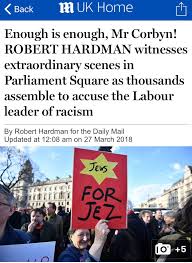
We see the BBC invite the Labour Party to denounce those supporting its leader – from a demonstration attacking him as anti-Semitic – and are supposed to see this as yet another example of his failure to stand up to anti-Semitism.  And expected to accept that this is yet another example of anti-Semitism, without a need to provide evidence that the previous charges actually stand up.

Thanks to the BBC, we are to remain entirely ignorant of the fact that those whom the BBC seek to have denounced are themselves Jewish!

Again, after days of having anti-Zionism conflated with anti-Semitism, so that the two are indistinguishable, the BBC reports that, ”during protests” and after “clashes”, which leave “16 Palestinians dead and hundreds injured” we are informed that “Israel’s response was exaggerated.”

Just so, unlike the repeated reports of the Labour Party’s anti-Semitism.

And there really is no point in anyone in the Labour Party denying it.  Because that is precisely the problem!

So, as Tony Blair – once described as “the worst terrorist in the world” – put it on BBC Radio 4’s The Week in Westminster, “It’s become a problem because I’m afraid the people around Jeremy Corbyn – maybe even he himself – I don’t think they really think it is a problem.”

So, there you go.  Denial is proof of guilt.

Not since the witch hunts of the 16th and 17th centuries, when women were dunked in water, has it looked such a lost cause to declare one’s innocence.  For the poor unfortunate women so denounced, if they floated they were witches, and if they didn’t, they weren’t”

And there is also really no point in Corbyn looking to supporters to defend him instead.  Because, as last night’s ITV reporter said to the other ITV reporter, the latter obviously speaking as an expert unbiased summariser of what is really going on – Corbyn has to reject his supporters as anti-Semitic to prove he’s not.

Then, having done so, we will, with little doubt, wait expectantly for the BBC to report that Corbyn, (we’ll just use his surname from now on) has no support, because of his anti-Semitism of course.  Corbyn anti-Semitism, anti-Semitism Corbyn, anti-Corbyn anti-Semitism.  Just put the words together often enough, and in no particular order, and that will do.

If there is a lesson to be gleaned from this ‘fake news’, it is the one that armies have long understood. While you can capture enemy soldiers and put them in camps, you shoot spies.

In this case, the most immediate enemy one can throttle (metaphorically speaking of course) are the phalanx of Blairite Labour MPs who have been the ‘credible’ ingredient of this poisonous and preposterous mix of accusations.

It reminds one that there must be elections coming up; the local elections in May.  Time to shit on your own doorstep and blame someone else for the poor reception to your ‘for sale’ sign outside.

If anyone thought Jeremy Corbyn’s landslide election as leader was going to unite the Labour Party around him, including the crowd of careerists at Westminster, then this was surely disabused when Owen Smith had another go and got trounced.  If anyone thought that this second thumping victory was going to make loyal supports of these expense claimers who couldn’t spell integirty, then they were disappointed again.

And if you thought that the snap General Election, in which the widespread presumption was that Corbyn’s speaking part was to walk on and get crushed, was final guarantee that the Parliamentary Party would unite around him.  Well, you really should have known better.

Unfortunately, despite all these lessons, despite all the deceit and betrayal; someone who also appears not to have learned the lesson is Jeremy Corbyn himself, although I hasten to add, it’s not too late.

The view that the Labour Party is a (very) broad church is really only accepted by the right of the Party when it is in the majority, and the left is considered to be irrelevant, like, for example, in the first half of  2015.  The left on the other hand, at least many of those in the Corbyn camp, seem to believe it even when the knives, wielded by Blaire hands, go repeatedly into their chest right in front of their eyes.

The theory would seem to be, if theory is not too strong a word, that keeping the Party united will help get a Labour Government elected.  And then it can go do all the good stuff it has promised.

The two flaws in this ‘theory’ are too obvious to dwell on.  The Party is patently not united.  And the same MPs who seek to thwart Corbyn’s leadership in opposition will be even more keen to do it should he cease merely to be in opposition.

Turning the other cheek to Blairite sabotage has left Jeremy Corbyn without any cheeks to turn.  Ignoring the cardinal need to democratically clear out the host of Blairite/right wing/’soft’ left saboteurs inside the party, and to do so openly, as a campaign to democratise the Party, has left him exposed to the latest assault, which will assuredly not be the last.

So right now, either he fights the ludicrous charges of anti-Semitism and stops apologising for non-existent political crimes, or he may be left to float helplessly in the water waiting to be burned, or at the bottom of the water, proved innocent and much lamented, definitely eulogised, and very definitely history.

PS: Update 3 April.  Jeremy Corbyn has met some Jewish people – see link.  But this is “irresponsible and dangerous” according to a Labour MP. He’s meeting the WRONG sort of Jews!  Isn’t this man just infuriating?  Doesn’t he know that being anti-Semitic means some Jews are good and some aren’t, and it’s only anti-Semitic when you don’t agree with the establishment ones?  I mean to say, how can it be reasonable for a left wing leader to meet left wing Jews and not demonstrate similar feelings towards the right wing sort?  It’s not as if Jewish people are just like everybody else – is it?

Brexit – the dogs that barked and those that didn’t

The Open Britain Campaign has listed seven promises that the Tory Government has broken in its welcome to the new draft of the Agreement for the UK’s withdrawal from the European Union. These are:

  1.  A transition period will be about ‘implementing’ the future relationship, not negotiating it
  2.  The UK will not pay money to the EU after March 2019
  3.  The UK will not have to abide by EU rules during transition
  4.  The UK will ‘take back control’ of fisheries policy
  5.  Free movement will end in March 2019
  6.  The UK will have new trade deals ready to come into force on 29 March 2019
  7.  The implementation period would last for two years and should not be time limited

These however are not even the biggest.  The most significant is the idea that Britain would take back control, beginning in the negotiations, at the commencement of which the importance of the UK to the EU economy would see the EU rush to agree a comprehensive deal that would suit the UK.  Now, one explanation how trade arrangements would work after Brexit includes open borders without any checks – about as far from taking control as you can imagine.

And this is not a fringe option to be considered as a fall back in the event of a no-deal.   For the only way to avoid a hard border inside Ireland and avoid a sea border between the island of Ireland and Britain is just such an arrangement.

The problems with this are not limited to those quoted in the last link to a BBC report – that even if the British did not have checks the EU would; and that the British would be compelled to let all goods flow without checks in order to be in compliance with WTO requirements that there could be no discrimination in favour of goods from or to the EU.

Already the part-time negotiator David Davis has stated that “we agree on the need to inckude legal text detailing the ‘backstop’ solution for the border between Northern Ireland and Ireland in the Withdrawal Agreement is acceptable to both sides.  But it remains our intention to achieve a partnership that is so close as to not require specific measures in relation to Northern Ireland, and therefore we will engage on the detail on all scenarios set out in the joint report.”

The problem is that the British Government proposals, as set out in the last May speech have already been rejected – there can be no mutual recognition of UK and EU standards, such that all trade can proceed in the frictionless way that now currently takes place.  Any mutual recognition that the EU would agree to would be so limited as to make a border structure inevitable and significant.

There is no ‘technical’ solution that gets round the fact that the UK wants out of the Single Market (and Customs Union); mutual recognition as a general substitute for either is cherry picking on an industrial scale and ruled out, already by the EU, many times.

That this is the rationale for the Tory claim that they can avoid both a hard border inside Ireland and at the Irish Sea proves that the EU insertion of the “third option” – of full regulatory alignment of rules between the Northern and Southern Irish states – will come to pass.

Unless the British renege on their agreement.  Not unheard of, it might be said.  I came across the following on one web site – “North’s first rule of politics comes to mind: never trust a Tory. The second rule is: always obey the first.”  As in this little ditty – “Never trust a Tory, they’ll betray you when it matters / They will scramble to the top and then they’ll kick away the ladder, hinny / Never trust a Tory, or a Tory in disguise, You can see it when you look them in the eye”.  This is why EU figures are also stating that nothing is agreed until everything is agreed.

The British Government has hailed the draft Withdrawal agreement as a great step forward because it says it allows it a transitional period within which they can negotiate their own trade deals.  This is not even a case of kicking the can down the road, as in the sense that the cliff-edge of leave is simply postponed, because the reality of leaving will still kick in before that, as it is already doing, and the failure to agree better trade deals than have been, or can be, achieved by the EU will become clearer.  It is generally agreed that no substantive deals can be negotiated within two years, and the Tories haven’t even got that long.

The prospect of Northern Ireland within the regulatory framework of the EU would be a bitter pill for the DUP and many unionists in general to swallow.  They have not barked opposition because they are possibly even more deluded that the Tory Brexiteers, although also more paranoid, so more likely to smell betrayal.

The Tory Brexiteers meanwhile are running out of justification, fabricated or not, for leaving the EU.  They also aren’t barking very loudly, and now simply want out, willing to accept more and more acts of capitulation until they get it.  As if they could then turn round when they’re out and implement their ultimate agenda of a deregulated dystopia on the edge of Europe.  Neither they nor the DUP have really appreciated that, in or out, the UK will remain under the shadow of the EU and subject to its more powerful economic interests, to a greater or lesser extent.

Just as Mays’ list of special arrangements she wants from the EU in a final deal beg the question, why is the UK leaving?, so will the period of transition make more obvious the rotten prospects that exit promises.

Even the deal on offer from the EU is far from any panacea.  The inclusion of Northern Ireland within the EU regulatory framework will mean an EU/UK border at the Irish sea, and more trade from the Irish State goes over it than across the land border inside the island.  The draft deal does not therefore solve the problems created by Brexit for Dublin.  Again, unless the British state capitulates further, and proves that a Tory plan for no border controls will actually work (which can only arise if they agree to membership of the Single Market and Customs Union) there is going to be a hard border somewhere.

For unionism in Northern Ireland the prospect of membership of the EU trading arrangements while the rest of the UK is excluded, is not in principle totally unacceptable, as they are quite happy to do things differently on many issues, such as abortion rights for women and gay marriage.  The real problem with the EU deal is that the Northern State will become more and more different from the rest of the UK as the EU develops.  This is not a static solution but a dynamic one in which their artificial majority is no longer potentially always a veto on any issue they decide to make a question of their sectarian identity.

The draft Withdrawal Agreement states that “authorities of the United Kingdom shall not act as leading authority for risk assessments, examinations, approvals and authorisations procedures provided for in Union law made applicable by this Protocol.”  So not only will the UK (as Northern Ireland) have to accept and implement EU law, in all those North-South bodies, it is the Southern authority that shall take the lead and the Northern authority will have to follow.

Of course, if one is a simple-minded Irish nationalist this is not a problem.  But this assumes that what is good for the Southern State is good for the population of Northern Ireland (and for the population of Southern Ireland as well for that matter).

So, for example, in the single electricity market, mentioned in Article six of the agreement, it could well be that the population of Northern Ireland will just have to accept the leadership of the Southern State, which dominates the electricity industry through its state-owned companies.  In the South this has led to ordinary domestic electricity customers paying higher charges than business, which involves yet another clear subsidy to multinationals and an effective tax on working people for the benefit of capital as a whole.

That this will cause aggravation amongst unionists will hardly come as a surprise to anyone.  However, a lot of the declaration of concern about a hard border endangering the peace process misses the point.  Where this peace process the success it is claimed by the same people fretting about its future there would be little concern about changed customs and trading arrangements.  What makes the border, and what happens at it, important is not so much the symbolic arrangements that may apply there, but the fact that behind it the peace process is failing, as the lack of an agreed Executive at Stormont makes abundantly clear.  Additional strain on the process is therefore widely considered unwelcome.

Maybe this is why Article 13 of the draft Withdrawal Agreement on ‘Safeguards’ is included, which states that “if the application of this Protocol leads to serious economic, societal or environmental difficulties liable to persist, the Union or the United Kingdom may unilaterally take appropriate measures.”  In other words, if civil unrest erupts again the British State will be called upon to assert its control, perhaps in the customary way it has done so in the past.

As we have noted, the Tories have celebrated the latest EU document as a success even though they have retreated on issue after issue.  Even the hard Brexiteers have been relatively quiet, complaining mostly about the fishing industry, or about ‘vassal’ status during the transition (how ironic),yet not so quiet as that other principled opposition – the supporters of Lexit on the left.

These people discounted the reactionary Brexit campaign in their support for leaving the EU, and have discounted all the reactionary political developments we have witnessed since in order to confirm their position.  So why, if getting out of the EU is so important that it over-rides all this, are they not now condemning the sell-out Tories for prolonging UK membership, or denouncing their capitulation to condition after condition of EU membership that the Tories want to continue after the transition period?

The reason for this is their entirely light-minded and totally unreflective attitude to politics that has substituted protest for alternative and national reformism for working class politics.  These supporters of Lexit could learn a lot from their failure to get this right but it seems they have no desire to do so.

This, however, is much less important than the attitude of the leadership of the Labour Party, which it would appear thinks the reactionary consequences of Brexit, including under-cutting the basis of its social-democratic programme, are of limited consequence.  The most I have heard argued is that the Party should call for a vote on the eventual deal.  But this is meaningless outside fighting for an alternative and a principled campaign against what is clearly a reactionary decision with reactionary consequences.  On this, some dogs should be barking!

Karl Marx’s Alternative to capitalism part 26 – forces and relations of production 9

In the previous series of posts I have set out Marx’s views on the contradictions of capitalism, between its productive forces and the relations of production, and have gone to some length to explain the concepts involved.

Much of this might seem rather tenuously related to the issue of Marx’s alternative to capitalism.  Previously, however, I have explained that this alternative can only arise out of existing society, and not from any sort of blueprint, either based on high moral values of equality and justice etc. or more or less elaborate plans for the a society, for example how a planned economy might be made to work more efficiently than capitalism.

More particularly, this alternative cannot be conceived as simply political revolution, for such a revolution presupposes the grounds for its success – on the development of the forces and relations of production as set out in these previous posts, this one and the next one.

The development of the forces and relations of production explains how the alternative that grows within capitalism and will supersede it might be conceived, and on these grounds that political revolution might be considered a reasonable objective.

In this way, Marx explains how the development of capitalism creates the grounds and tendencies of development of an alternative society:

“The conditions for production become increasingly general, communal and social, relying less on the individual capitalist. We have seen that the growing accumulation of capital implies its growing concentration. Thus grows the power of capital, the alienation of the conditions of social production personified in the capitalist from the real producers. Capital comes more and more to the fore as a social power, whose agent is the capitalist. This social power no longer stands in any possible relation to that which the labour of a single individual can create. It becomes an alienated, independent, social power, which stands opposed to society as an object, and as an object that is the capitalist’s source of power.”

“The contradiction between the general social power into which capital develops, on the one hand, and the private power of the individual capitalists over these social conditions of production, on the other, becomes ever more irreconcilable, and yet contains the solution of the problem, because it implies at the same time the transformation of the conditions of production into general, common, social, conditions. This transformation stems from the development of the productive forces under capitalist production, and from the ways and means by which this development takes place.”

Marx sets out “Three cardinal facts of capitalist production:

1) Concentration of means of production in few hands, whereby they cease to appear as the property of the immediate labourers and turn into social production capacities. Even if initially they are the private property of capitalists. These are the trustees of bourgeois society, but they pocket all the proceeds of this trusteeship.

2) Organisation of labour itself into social labour: through co-operation, division of labour, and the uniting of labour with the natural sciences.

In these two senses, the capitalist mode of production abolishes private property and private labour, even though in contradictory forms.”

Marx notes that the bigger, more concentrated and centralised capital becomes, the less important is the role of the capitalist himself, while this process simultaneously involves the centralisation of capital in a few hands including through the decapitalisation of many.  Although “this process would entail the rapid breakdown of capitalist production, if counteracting tendencies were not constantly at work alongside this centripetal force, in the direction of decentralisation.” (Capital Volume III, p 354 – 355)

Ernest Mandel, in his introduction to Volume III of Capital, sets out a flow-diagram putting forward the elements of Marx’s analysis and placing them within separate boxes, with the end point being ‘socialism’, and with the penultimate box the ‘tendency towards collapse of capitalist system’.

While useful as a graphical presentation of the elements of Marx’s analysis, it is misleading if it is assumed that socialism is simply a result of capitalist collapse, rather than capitalist collapse being the result of socialism, in other words the actions of the working class.

It is however useful to sum up the last few posts by itemising these different elements that are  included in Mandel’s schematic, with the understanding that socialism is not the result of the automatic working out of any or even all of these factors, but rather the conscious intervention of the working class, not in a voluntarist way, but arising out of (at least some of) the factors set out below, and in particular ways that we shall later explore.

  • Growing difficulty of maintaining market economy, value realisation, under conditions of growing automation.
  • Periodic crises of overproduction.
  • Tendency to growing centralisation of capital in fewer and fewer hands.
  • Tendency of average rate of profit to decline.
  • Tendency to growing objective socialisation of labour.
  • Growing contradiction between socialised labour and private appropriation.

The contradiction between capitalist relations of production and its productive forces is evident every day, in the inability of capitalism to secure permanent full employment, in fact its inability to function without a reserve army of labour that helps regulate its functioning.

The tendency to the socialisation of production through, for example, the growth of monopoly might be seen as anticipation of socialism, which in a negative fashion it is, but while it entails increased planning within enterprises, it does not otherwise prevent capitalist crises.

Likewise, increased state ownership and intervention also anticipates resolution of the contradiction between the forces and relations of production, but does not resolve it and does not represent a model of future society.  As Engels notes:”

“But, the transformation — either into joint-stock companies and trusts, or into State-ownership — does not do away with the capitalistic nature of the productive forces. In the joint-stock companies and trusts, this is obvious. And the modern State, again, is only the organisation that bourgeois society takes on in order to support the external conditions of the capitalist mode of production against the encroachments as well of the workers as of individual capitalists.”

“The modern state, no matter what its form, is essentially a capitalist machine — the state of the capitalists, the ideal personification of the total national capital. The more it proceeds to the taking over of productive forces, the more does it actually become the national capitalist, the more citizens does it exploit. The workers remain wage-workers — proletarians. The capitalist relation is not done away with. It is, rather, brought to a head. But, brought to a head, it topples over. State-ownership of the productive forces is not the solution of the conflict, but concealed within it are the technical conditions that form the elements of that solution.”

The true anticipation and herald of the new mode of production is contained in the development of workers’ production, anticipation of the associated workers’ mode of production, through the growth of workers cooperatives, as argued by Marx:

“The co-operative factories of the labourers themselves represent within the old form the first sprouts of the new, although they naturally reproduce, and must reproduce, everywhere in their actual organisation all the shortcomings of the prevailing system. But the antithesis between capital and labour is overcome within them, if at first only by way of making the associated labourers into their own capitalist, i.e., by enabling them to use the means of production for the employment of their own labour.”

“They show how a new mode of production naturally grows out of an old one, when the development of the material forces of production and of the corresponding forms of social production have reached a particular stage. Without the factory system arising out of the capitalist mode of production there could have been no co-operative factories. Nor could these have developed without the credit system arising out of the same mode of production. The credit system is not only the principal basis for the gradual transformation of capitalist private enterprises into capitalist stock companies, but equally offers the means for the gradual extension of co-operative enterprises on a more or less national scale.”

“The capitalist stock companies, as much as the co-operative factories, should be considered as transitional forms from the capitalist mode of production to the associated one, with the only distinction that the antagonism is resolved negatively in the one and positively in the other.” (Capital Volume III)

Back to part 25

Forward to part 27

Karl Marx’s Alternative to capitalism part 25 – forces and relations of production 8

For Marx in the 1859 Preface “the material productive forces of society come into conflict with the existing relations of production or – this merely expresses the same thing in legal terms – with the property relations within the framework of which they have operated hitherto. From forms of development of the productive forces these relations turn into their fetters. Then begins an era of social revolution.”

At this stage, it is useful to let Marx’s writings themselves set out what he means.  Explaining the nature of this conflict in Capital Vol III: “the contradiction in this capitalist mode of production consists precisely in its tendency towards the absolute development of productive forces that come into continuous conflict with the specific conditions of production in which capital moves, and can alone move.”

“On the other hand, too many means of labour and necessities of life are produced at times to permit of their serving as means for the exploitation of labourers at a certain rate of profit. Too many commodities are produced to permit of a realisation and conversion into new capital of the value and surplus-value contained in them under the conditions of distribution and consumption peculiar to capitalist production, i.e., too many to permit of the consummation of this process without constantly recurring explosions.”

“Not too much wealth is produced. But at times too much wealth is produced in its capitalistic, self-contradictory forms.”

“The limitations of the capitalist mode of production come to the surface:

“1) In that the development of the productivity of labour creates out of the falling rate of profit a law which at a certain point comes into antagonistic conflict with this development and must be overcome constantly through crises.”

“2) In that the expansion or contraction of production are determined by the appropriation of unpaid labour and the proportion of this unpaid labour to materialised labour in general, or, to speak the language of the capitalists, by profit and the proportion of this profit to the employed capital, thus by a definite rate of profit, rather than the relation of production to social requirements, i.e., to the requirements of socially developed human beings. It is for this reason that the capitalist mode of production meets with barriers at a certain expanded stage of production which, if viewed from the other premise, would reversely have been altogether inadequate. It comes to a standstill at a point fixed by the production and realisation of profit, and not the satisfaction of requirements.”

The barriers to development of the forces of production that would threaten its continued existence are explained.

“The rate of profit, i.e., the relative increment of capital, is above all important to all new offshoots of capital seeking to find an independent place for themselves. And as soon as formation of capital were to fall into the hands of a few established big capitals, for which the mass of profit compensates for the falling rate of profit, the vital flame of production would be altogether extinguished. It would die out. The rate of profit is the motive power of capitalist production. Things are produced only so long as they can be produced with a profit. . . . Development of the productive forces of social labour is the historical task and justification of capital.”

“At any rate, it is but a requirement of the capitalist mode of production that the number of wage-workers should increase absolutely, in spite of its relative decrease. Labour-power becomes redundant for it as soon as it is no longer necessary to employ it for 12 to 15 hours daily. A development of productive forces which would diminish the absolute number of labourers, i.e., enable the entire nation to accomplish its total production in a shorter time span, would cause a revolution, because it would put the bulk of the population out of the running.”

“This is another manifestation of the specific barrier of capitalist production, showing also that capitalist production is by no means an absolute form for the development of the productive forces and for the creation of wealth, but rather that at a certain point it comes into collision with this development. This collision appears partly in periodical crises, which arise from the circumstance that now this and now that portion of the labouring population becomes redundant under its old mode of employment. The limit of capitalist production is the excess time of the labourers. The absolute spare time gained by society does not concern it. The development of productivity concerns it only in so far as it increases the surplus labour-time of the working-class, not because it decreases the labour-time for material production in general. It moves thus in a contradiction.”

Marx contends “that the bourgeois mode of production contains within itself a barrier to the free development of the productive forces, a barrier which comes to the surface in crisis and, in particular over-production – the basic phenomenon in crisis.”  (Theories of Surplus Value Vol !!)

“In world market crises, all the contradictions of bourgeois production erupt collectively; in particular crises (particular in their content and in extent) the eruptions are only sporadical, isolated and one-sided.  Over-production is specifically conditioned by the general law of the production of capital: to produce to the limit set by the productive forces, that is to say, to exploit the maximum amount of labour with the given amount of capital, without any consideration for the actual limits of the market or the needs backed by the ability to pay . . . “

back to part 24

Forward to part 26

Karl Marx’s alternative to capitalism part 24 – forces and relations of production 7

Not only do increases in production often require machines to replace living labour but the increase in productivity necessarily increases the share of materials purchased and incorporated into the increased number of products produced.  Materials which pass only their own value into the final product and no new surplus.

Marx is explicit on this general point – “Moreover, it has been shown to be a law of the capitalist mode of production that its development does in fact involve a relative decline in the relation of variable capital to constant, and hence also to the total capital set in motion.” (Capital Volume III p 318)

Of course, there are often efficiencies created in the use of materials and also in the value and cost of machinery, which again is also a result of increased productivity in the industries that produce them. As Marx says “We see here once again how the same factors that produce the tendency for the rate of profit to fall also moderate the realisation of this tendency.” (Capital Volume III p 343)  And, of course, while the number of workers may reduce, the time they spend creating value purely for the capitalist will increase.

These all offset any fall in the share of surplus value in the total value of production but irrespective of this, the compulsion to increase productivity and reduce the employment of labour and its cost, impels individual capitals to seek these improvements because individually they will be able to undercut costs in relation to rivals, while perhaps selling at the same or slightly lower price than competitors while making a more significant profit.

Should their new methods of production become generalised among the majority of capitalists in their sector of production, or the less productive ones fail and exit production, then the overall share of labour in that sector of production will fall and so will the share of surplus value and of profit.  What makes sense for an individual capitalist reduces the share of profits for everyone in the sector – the development of the forces of production conflict with the relations of production which are based on seeking the greatest possible expansion of surplus value.

Such a fall in the amount of living labour in production can be offset by increased levels of exploitation but a rise in level of exploitation can check but may not cancel the fall in the rate of profit, and this is particularly so at high levels of organic composition of capital; although the latter assumes technological development that can do this across more and more industrial sectors, and increasingly so to new sectors and any new independent capitals thrown up.

A falling rate of profit may also be compensated by growth in the absolute size of surplus value although augmentation of this would decline if the absolute amount of living labour (variable capital) declines, or much more likely, its augmentation declines relatively if the quantity of living labour fails to grow at the relatively high rate commensurate with the growth of constant capital – machinery and materials etc.

While the rate of profit may fall, it may thus be the case that the mass of profit still rises, indeed given that capitalism involves the accumulation of more and more capital this mass must increase.  Marx allows that the absolute size of variable capital and surplus value may rise – in fact it “must be the case . . . on the basis of capitalist production.” (Volume III pp 322 – 324) This is certainly the reality of capitalism since Marx developed his analysis.

“Capitalist production is accumulation involving concentration of capital is simply a material means for increasing productivity.  Growth of the means of production entails growth in the working population and creation of a surplus population. (p324 – 325)

“As the process of production and accumulation advances, therefore, the mass of surplus labour that can be and is appropriated must grow, and with it too the absolute mass of profit. . . The same laws , therefore, produce both a growing absolute mass of profit for the social capital, and a falling rate of profit.”  (p 325) “A fall in the profit rate, and accelerated accumulation, are simply different expressions of the same process, in so far as both express the development of productivity. . .” (p349)

“Thus, the same development of the social productiveness of labour expresses itself with the progress of capitalist production on the one hand in a tendency of the rate of profit to fall progressively and, on the other, in a progressive growth of the absolute mass of the appropriated surplus-value, or profit; so that on the whole a relative decrease of variable capital and profit is accompanied by an absolute increase of both. This two-fold effect, as we have seen, can express itself only in a growth of the total capital at a pace more rapid than that at which the rate of profit falls.” (p329 – 330)

It will also be the case, to a greater or lesser extent, that new industries develop that require large amounts of living labour for their production, labour that can only be displaced by technology and machinery over a future, longer or shorter period of time.

New industries widen the range of commodities that capital can produce, and that can be used to produce them, which can create profit, i.e. that can become capital.  The mass of material labour that capital can command depends not only on the value of capital but on the mass of use values that can act as consumption for workers or as means of production and materials of production.  If the latter grows so can the quantity of labour employed, and therefore the accumulation of capital that can proceed, allowing capitalism to continue to develop the forces and relations of production.

It is argued that the growth of these new industries, increasingly ‘service industries’ involve higher relative amounts of living labour than the more mature manufacturing or other industry.  Increased productivity in service industries does not generally involve increased consumption of raw materials even as productivity is increased, or at least not nearly to the same extent.  Increased consumption of circulating constant capital (materials), which simply has its value transferred into the final product and does not add any surplus value but must be advanced as capital, does not occur to the same extent and so does not lead to a reduction in the rate of profit on that account.

Of course, it must be understood that many industries are described as service industries that actually produce physical commodities and these are subject to the same tendencies of development as classical manufacturing industry.

Infrastructure industries are sometimes considered as service industries but the water and sewerage industry for example produces a physical product and then transforms it.  I recall visiting a new sewerage works that had a large bank of electronic equipment.  When I asked the manger how many staff worked at the plant he said there was five, but these were all going to be transferred elsewhere because the plant could work remotely and required only a regular visit by one member of staff to check everything was ok.

Even health services, which in the UK has traditionally had a budget in which over 60 per cent is spent on staff salary and wages, relies more and more on expensive drug treatments and the use of high-tech equipment.

No contradictions are therefore escaped by the development of new industries, even some ‘service’ industries, they are simply reproduced, but then any expansion of capitalism must by definition reproduce its essential nature, which is riven by contradiction.  However, it is not that nothing has thereby changed. The effect of these industries that develop upon a lower average organic composition of capital and higher rate of surplus value is to raise the average of both across the wider economy.

Marx at one point quotes six reasons why decline in the profit rate does not reduce accumulation. “Jones emphasises correctly that in spite of the falling rate of profit the inducements and faculties to accumulate are augmented; first, on account of the growing relative overpopulation; second, because the growing productivity of labour is accompanied by an increase in the mass of use-values represented by the same exchange-value, hence in the material elements of capital; third, because the branches of production become more varied; fourth, due to the development of the credit system, the stock companies, etc., and the resultant case of converting money into capital without becoming an industrial capitalist; fifth, because the wants and the greed for wealth increase; and, sixth, because the mass of investments in fixed capital grows, etc.”

At a recent meeting on Marx’s Capital, one speaker supported the view that the rate of profit did exhibit a tendency to fall and cited, among other reasons for this view, that such a situation confirmed the temporary character of the capitalist system in an objective way.  This, even if it were true, would not thereby equally confirm the inevitability of socialism or even that the seeds of socialism had grown equally as strongly as capitalism was gripped by its objective contradictions.

There are no absolute, predetermined limits which set the boundaries on the development of capitalism such that the contradiction between the development of the forces of production and relations of production just described can be said to lead to a terminal crisis or ending of the capitalist system.  The release of the forces of production from the fetters to their growth, arising from the requirement that such growth requires sufficient profitability that capitalism can no longer deliver, is not something that Marx foresaw as the resolution to the contradictions of capitalism.

The point rather is that the tendency for the rate of profit to fall is a fundamental one within capitalism that is inevitably associated with its equally fundamental drive to increase productivity through increasing relative surplus value.  Both stem from the combined development of the forces of production and relations of production and from the need for capital to accumulate by increasing the appropriation of surplus value. This includes new production with new sources of human labour as well as both increases in absolute and relative surplus value.

It is not necessary for a fall in the rate of profit to be evident at all times, the process by which it falls proceeds regardless and is important in this respect.  If the tendencies that counter this fall outweigh its effects this does not entail its unimportance, since the law exhibits the fact that new value is created only through labour power and the tendency for the fall in the rate of profit reflects this.  The expansion of capitalism, both in terms of the forces and relations of production, requires masses of additional labour, in other words expansion of the numbers and social power of the working class, the gravediggers of the system as Marx saw it.

Back to part 23

Forward to part 25

Maybot’s latest speech – the Devil isn’t in the detail

Let’s start at the very end of Theresa May’s speech, the bit where she says “So let’s get on with it.”

The EU negotiators could have been forgiven if they rolled their eyes in derision – they’ve been waiting for the British Government to decide what it wants for well over a year.  And despite an earlier ‘agreement’ that needed ‘only’ legal drafting, it has failed to make any drafting of its own available. Indeed, the level of expectation created over the past 20 months is such that none was ever anticipated.

If Brexit was such a brilliant idea, the British would have been pushing the door to get out; the EU would have been rushing to convince them to stay in, and the negotiations would have been driven by British position papers – putting the EU on the spot on just exactly what it intended to do to mitigate the damage to it from UK withdrawal.  But this whole idea is fanciful.

The dilatory and confused approach of the British faithfully reflects their predicament.  The UK has decided on a course that weakens it economically and politically and risks the default position of no deal that is the worst possible outcome.  It is in a time-limited process in which this default position is constantly staring it in the face.

The EU has driven the process while looking as if it has been trying to save the British from themselves.  It has therefore done what the British were tasked to do so but didn’t, and come up with a solution to the question of avoiding a hard border inside Ireland.

Given all this, it shows how fatuous and vacuous the BBC is that its main political reporter claims that we can now ‘forget about all the cake jokes.’  A little bit of detail on the irreconcilable – the claims to both “want as frictionless a border as possible between us and the EU” and a cast-iron commitment that “we are leaving the single market”-  is supposed to efface the glaring contradictions of this position, through some mealy-mouthed admission that “no-one will get everything they want.”

We are supposed to be impressed by this detail and change of tone, and by such messages as “we will not be buffeted by the demands to talk tough or threaten a walk out”.  This from the Maybot who declared that Jean-Claude Juncker would find her “a bloody difficult woman” in the “tough” negotiations, and who month after month repeated that she was prepared to walk away with “no deal rather than a bad deal.”

Such is the shallowness and ignorance of the journalism at the BBC that smug and dismissive reporters can tell us that all this is to be forgotten on foot of a supposed new-found seriousness and coherence to the British position.

But the speech revealed nothing of this at all.  What it did do, was not put the cake back in the cupboard but show us the ingredients to demonstrate just how ridiculous the idea of having it and eating it is, by going through case after case in which this was being demanded.

So, she wants the UK to have access to the EU’s internal energy market; wants British hauliers unrestricted access to the EU; access to the digital, science and innovation markets; continued membership of various EU bodies such as the European Medicines Agency, the European Chemicals Agency, and the European Aviation Safety Agency; and mutual recognition of qualifications.

She wants “measures to ensure the requirements for moving goods across borders are as simple as possible”, and while she doesn’t want passporting of financial services into the EU by British companies she wants to have the ability to “access each others’ markets.”  This to be achieved with an agreement that is without precedent, one with “a collaborative, objective framework that is reciprocal, mutually agreed, and permanent and therefore reliable for businesses”.  Oh, and she also wants the UK to be able make its own rules for the finance industry.

She rejects the charge that this is cherry-pickig, or rather admits that it is, but says that “if this is cherry-picking, then every trade arrangement is cherry-picking.”  And she’s right.  It’s just that she seems oblivious to the fact that, given the balance of power and the circumstances noted above, it is the EU by and large that will be picking the cherries.  The EU has made this perfectly clear already by repeating ad nauseam that it will not accept the British approach.

The British wish list is supposed to be achieved by tariff arrangements through which goods entering the UK and bound for the EU will see UK customs levy EU tariffs on these goods and then hand over the money.  It will require a comprehensive system of mutual recognition within which the UK will make a strong commitment that its “regulatory standards will remain at least as high as the EU’s”.

This commitment would mean that UK and EU regulatory standards would remain substantially similar in the future.  “Our default is that UK law may not necessarily be identical to EU law, but it should achieve the same outcomes”.  The UK wants that, as now, products “only need to undergo one series of approvals, in one country” to show that they meet the required regulatory standards.

Since the EU has fined the UK for not effectively implementing EU trade arrangements while it has still been inside the EU it seems strange that there would be no problem imposing the rules when it isn’t.

As for mutual recognition; the whole point of EU development of a single market is not recognition but harmonisation.  Even since Brexit was announced the UK has been signing up to harmonised rules i.e. the same rules – as in identical rules.  Not the same as in similar, not the same as in equal, and not the same as in the same outcome.

What Maybot is asking for is not only that the UK leave the single market while keeping its benefits, she is asking that the EU goes back in time to when mutual recognition was enough, and before it decided a single set of standards was the way to go.  It is inconceivable that the EU would seek to protect itself from Brexit contagion by giving near frictionless access to the EU while undermining the basis of its current and future development.

All this is having your cake and eat it, set out as a shopping list, that Laura Kuenssberg of the BBC now thinks is an old joke.  And it’s a joke alright, but rather like listening to a best man’s speech at a wedding where he goes OTT slagging off the groom. It leads to the audience starting to wonder – what the hell is she marrying him for?  In this case, if all this is so necessary to leaving the EU why the hell are you leaving?

Among the supposed reasons is the claim by the Brexiteers that the EU is creating a super-state, which is supposedly not what the British signed up for.  But it’s rather like what I said about some Scottish nationalists claims for independence.

These were that Scotland was an oppressed country, while in reality achieving separation was more likely to make Scotland an ‘oppressed’ country than remaining part of the UK.  If the Brexiteers think that the British can remain sovereign, independent and totally autonomous, while the rest of Europe unites politically, the planet they live on is further away than anyone previously thought.

On one thing Kuenssberg is correct, if only because, like the rest of the media, she sees politics as a game played at Westminster.  This was a speech aimed more at the rest of the Tory Party than the EU.  Negotiations have been going on for months but we are to believe that only now is the British position being put forward, and not in the negotiations themselves but in yet another hyped-up speech.  And with proposals that Maybot knows will not be accepted.

Kuenssberg is also correct in a more significant way.  The triumphalist tone is gone even if the stupidity hasn’t.  The recognition of British weakness shines through even though it isn’t admitted.  And the direction of travel has become clearer even if it’s not the one that is being touted.  The message coming out from the speech is that Britain needs the EU, and for Brexit to seem tolerably sensible needs the EU to fall over backwards to accommodate British needs.  The EU will decline to fall over backwards or forwards, and Brexit will more and more be seen to make no sense.

The negotiations and the legal text that will be negotiated will make this clearer and clearer.  The ‘detail’ that has eventually been extracted from the Tories simply defines in more granularity the contradictions of their position, while making explicit the impossible grounds on which they are expected to be resolved.

In this sense, it exposes Brexit and the Brexiteers, which is why Rees-Mogg has declared that “this is not the time to nitpick”.  It leaves them more and more naked in espousing their ridiculous claims about British fortunes outside the EU and the benefits of no-deal.  Unfortunately, if such ‘detail’ is the expected content of the eventual outcome, no-deal is ironically a possibility.

However, if the speech indicates a different direction of travel, to recognition of the constraints on British options, the Maybot speech was not the first this week to signpost the new direction.  Jeremy Corbyn was forced to slightly dismount his Brexit horse, through which he has disingenuously pretended to represent working class Leavers and Remainers, by signaling that he wanted a customs union, in opposition to the Tory red-line that Britain was leaving it.  This, it was claimed, would prevent a hard border in the island of Ireland.

Again, the media was full of praise for this political stroke.  For these Westminster-obsessed ‘journalists’ the only game in town is the party-political personalities and games in this venerable institution – Corbyn had upstaged Maybot and put clear water between Labour and the Tories.  It didn’t matter that his policy was also nonsense; that it is simply not possible that Britain alone could negotiate a new progressive customs union, or that a customs union by itself could prevent a hard border in Ireland.

But like the Maybot speech, but more so, it indicates the direction of travel.  What matters now is the speed.

These shifts demonstrate that Brexit is ripping an enormous tear in the nationalist consensus that underlies British politics. Those that can navigate beyond its illusions will survive.  Those that don’t will shipwreck on the rocky coast of their beloved island, falling victim to the enchanting music and singing voices of its nationalist Sirens.  It’s an old story.


Karl Marx’s alternative to capitalism part 23 – forces and relations of production 6

Related imageThe contradiction between the forces and relations of production is extreme under capitalism because the relations of production, while tending to promote the unlimited development of the forces of production, force the latter against the limits of these relations.  Capitalism seeks to expand without limit through the creation and appropriation of surplus value expressed most immediately as the need to make profits.  This is enforced through increased exploitation of labour and the competition of different capitals to capture market share.  No previous mode of production has displayed such rapid development of its own logic of expansion, with such power, and with such effect across the world.

Since the material forces of production and the relations of production within which they are encased are simply two aspects of the same thing it is not the case that their contradiction sees one develop and the other not.  The contradictions that develop within them lead to crises expressed both in the fettering of the forces of production and curbing of capitalist social relations, expressed in economic, social and political crises.

Capitalist forces and relations of production, once established, produce relative surplus value through increased productivity of labour that reduces the time required by workers to create the amount of value that is consumed by them through their wage, so increasing the (surplus) value created and appropriated by the capitalist.  This relative increase is surplus value is consistent with rising living standards of workers because relative surplus value only exists by increasing the productivity of labour, increasing the amount of goods produced and a corresponding reduction in their costs.

The greater share of the value of production appropriated by capital allows still greater expansion of production under its control and yet greater appropriation of profit. Capitalist accumulation advances through investment in machines and hiring of labour: both the material forces of production and specifically capitalist relations of production between capital and wage labour increase in scale.

For each individual capital, the limit of production is presented by the whole of the market for its goods, although this cannot obviously be the case for all capitals in that market.  While the goods and services produced are relevant to the capitalist pursuit of profit, this is only the case in so far as they have an exchange value and can be sold for money.  But they must also have a use for their customer, and even with growing real incomes due to the price of goods having fallen, there are limits to how many of a whole range of goods any individual may want or be able to afford.  The increased production arising from development of the forces of production can lead to the overproduction of commodities in relation to the effective demand available that can realise their sale at a profit, and this structure and limitation of demand is determined by the ownership of the means of production and appropriation of the fruits of production, including the surplus product.

This can lead to economic crises as the scale of commodities produced cannot be sold profitably and the contradiction between the greater development of the forces of production, and the capitalist relations within which they grow, is expressed in economic crises of overproduction, evidenced in the cyclical economic crises that have existed since 1825.  If such crises encompass a number of vital or fundamental commodities, and if they severely affect the circulation of capital, for example either the extension of credit or purchase of labour power, recessions or depressions will result in bankruptcies and unemployment.  Both the forces of production are held back or even reduced while some capitalists cease to be capitalists and workers cease to work.  Periodic recessions leave productive forces unused while human needs, which these forces could fulfil, is unmet because the relations of production demand that these forces only be employed at the requisite profit.

Increased productivity of labour arises primarily through the application of science and technology, that leads more and more to the replacement of human labour with that of machines.  While the capitalist pursuit of absolute surplus value continues even today, in forms such as a “long-hours” culture – especially notorious in Japan or “presenteeism” in many offices – there are social and biological limits to this that conflict with the possibilities contained through increases in relative surplus value.  Increased productivity in the production of goods and services consumed by workers can allow their money wage to fall at least relatively, while maintaining or increasing their real wage in terms of the number of commodities they can buy.

In doing so the relative amount of living labour in the value of production may decline so that the source of surplus value in this human labour also declines relatively, which can produce a decline in the share of surplus value in relation to capital advanced, and therefore of profit. “The progressive tendency for the general rate of profit to fall is thus simply the expression, peculiar to the capitalist mode of production, of the progressive development of the social productivity of labour.  (Capital Volume III p318 – 319)

“The rate of self-expansion of the total capital, or the rate of profit, being the goad of capitalist production (just as self-expansion of capital is its only purpose), its fall checks the formation of new independent capitals and thus appears as a threat to the development of the capitalist production process. It breeds over-production, speculation, crises, and surplus-capital alongside surplus-population. Those economists, therefore, who, like Ricardo, regard the capitalist mode of production as absolute, feel at this point that it creates a barrier itself, and for this reason attribute the barrier to Nature (in the theory of rent), not to production. But the main thing about their horror of the falling rate of profit is the feeling that capitalist production meets in the development of its productive forces a barrier which has nothing to do with the production of wealth as such; and this peculiar barrier testifies to the limitations and to the merely historical, transitory character of the capitalist mode of production; testifies that for the production of wealth, it is not an absolute mode, moreover, that at a certain stage it rather conflicts with its further development.”

Back to part 22

Forward to part 24