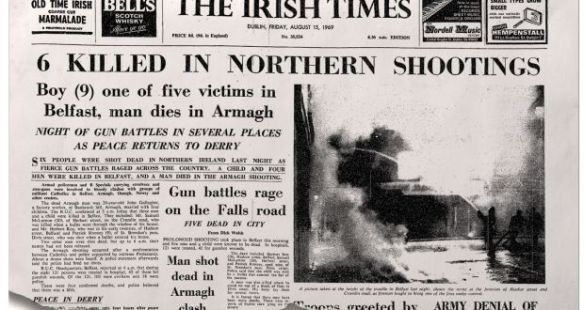
Civil rights and socialist strategy 3 – the weakness of the left

The strategic differences that existed and discussed in the previous two posts had implications for the tactics to be pursued, although the relationship was not straight-forward.

In order to appreciate the different viewpoints, it is necessary to look at the balance of political forces in the civil rights movement and in particular the strength of the left and its potential influence and power.

We have already noted the weakness of the political influence of the wider labour movement in previous posts but it is important to recall it again as it is the primary candidate as the mechanism by which a working class and socialist strategy could have been pursued.

While the Northern Ireland Labour Party and trade union movement passed a few resolutions supportive of civil rights no trade union affiliated to NICRA and neither the industrial or political wings of the movement would mobilise their membership in support.  The reason is obvious.

The members of the trade unions were not a different species from the majority of workers who voted unionist, nationalist, or on occasion the very homeopathic socialism of the NILP; and, of course, others were apathetic and unpolitical as is the case everywhere.  The trade union movement reflected this, with a survey in 1959 revealing that Catholics were 46% of branch secretaries in the mainly unskilled ATGWU, 12% in the AEU, 9% in the Association of Supervisory Staffs, Executives and Technicians, and 0% in the Boilermakers.  Of 53 unions surveyed and 379 branch secretaries, 80% were Protestant.

This is not to employ sectarian prejudice that assumes a person’s politics, including a trade union rep’s, can be read across from their religious background, but it is unfortunately the case that in the majority of occasions this is true, and is precisely the problem.

One might expect this not to be so much the case with trade union representatives, precisely because they have sought active participation in the union, but this doesn’t get away from the problem, because all trade union reps are acutely conscious of their role as a representative of their members and are careful not to tread too far from those whom they represent.  Where radical motions are passed at trade union branches this often reflects the influence of a few activists carrying a room consisting of a small fraction of the membership.

For most union officials the primary concern is the organisation within which they hold a position and the primary concern of the members they represent is wages and conditions.  In the North of Ireland there is strong pressure against raising political issues that would upset working relationships, and the trade union apparatus is keen that this remains the case, with policy not usually going beyond platitudes.

The problem of course is that the ‘unity’ then trumpeted is weak and subject to official public opinion relayed through the state and employer, and then imported through the trade union apparatus.  What this unity very definitely isn’t is socialist.  That it exists is not unimportant, in fact it signals a general and widespread aversion to conflict, especially sectarian conflict, but it is not the grounds on its own for creation of a radical alternative, and can only be presented as such by those with a willing blindness and by denuding this alternative of all political content.  The utterly reactionary content of unionism and its unsuitability to play any role in a trade union meant it only occasionally intervened in the scope of trade union affairs, which facilitated the weak ‘unity’ existing.

The very partial exception to lack of direct labour movement involvement in civil rights agitation was Derry, which was the second city in Northern Ireland and had a Catholic majority, and where the local Labour Party was central to the early civil rights struggle.  It was also in Derry that the civil rights movement exploded onto the stage and thousands of people were repeatedly mobilised.  If intervention by the left would make any difference, then Derry was as good a place for this to happen as anywhere.  That it didn’t should be taken into account when weighing the different arguments.

The prominent socialist and civil rights leader Eamonn McCann has written that almost all of those involved in organising the October civil rights march were “socialists of one sort or another.”  They were involved in the Derry Labour Party, but despite the blatant sectarian discrimination and poor housing the local trades council barely took up the latter, condemning the corporation but refusing in June 1968 to receive a delegation from the Derry Housing Action Committee.  It opposed a harsh fine imposed on its members as a result of a protest but would take no real action.

Civil rights did not come before the council until the month before the October 1968 civil rights march, when a delegate wanted to know what its position on it was.  It was agreed to have a special session if the council was invited to participate and to wait until its observers reported back on a march organising meeting.  It then decided that it “supported the establishment of equal civil rights in Northern Ireland for all citizens regardless of class or creed” and “participation . . . should be left to individual trade unionists”, before turning to the question of a pedestrian crossing at Westland Street.”

It played no role in a number of spontaneous strikes by Catholic workers that followed the October march, especially during 18 – 19 November, but decided to pledge support to the moderate Derry Citizens Action Committee and did not seek representation in it, although it did agree to send delegates to a NICRA meeting in Belfast.  Following the O’Neill reforms that month it went back to where it had been before, with economic and social issues to be pursued through official union and Government channels.  At its annual general meeting in April 1969, Billy Blease, who was a senior officer of the Northern Committee, told the audience to concentrate on the ‘real issues.’   As has been noted before, the Citizens Action Committed had more influence over Catholic workers than their trade unions.

McCann notes that no sizable socialist party was built from the experience of building the October march and “in the long run, we didn’t punch our weight,” but he also describes those involved as “our relatively small, raggedy band of socialists’, who had “a loose style of organisation . . . coalescing on an ad hoc basis against the wishes of party leaders and without fretting about the contradictions which all knew must be lurking.”

In his book ‘War and an Irish Town’, McCann states that “the leftists involved carried out no clear political struggle within either organisation [Labour Party and Republican Club].  We could not, because what we shared was not a common programme but a general contempt for the type of politics which prevailed in the city.”

He records that an attempt had been made to “codify our ideas’ in May with a ‘perspectives document’, which stated that ‘the situation which confronts us is not promising.  The great mass of the people continue, for historical reasons, to see religion, not class, as the basic divide in our society.”   What was required was a socialist party but he notes that “any perspective of building a clear-minded political organisation in opposition to the dominant tendencies within the Labour or Republican movements was forgotten in the frenetic round of breaking into empty houses, organising pickets and encouraging individuals to stand up to the landlords and local bureaucrats.”

Neither the labour movement as a whole, at least in its attitude to civil rights, or the radical socialists on its periphery, were in a strong position as the campaign exploded into a struggle on the streets.

Back to part 2

Civil rights and socialist strategy 2 – fighting for reforms

The long history of sectarian division; support for imperialist rule by many Protestant workers; and illusions in different variants of Irish nationalism by Catholic workers, is the reason why I stated at the start of the previous post  that the most significant weakness of the civil rights movement was that it was short-lived: the sectarian character of the Northern State immediately tested the small movement, and with the intervention of the British State, effectively destroyed it.

So there was no prolonged period in which a mass civil rights movement could struggle to win over the participation of the labour movement or sections of it, which really means winning over significant numbers of Protestant workers; this movement proclaimed its own unity only by not challenging political division.  We should also be clear that workers unity was not possible by relegating this struggle to a still-to-be-born united workers struggle for socialism.  Unity would not have come from waiting for the labour movement to act before acting outside it because the labour movement didn’t even act when a non-sectarian movement was created and did act.

This chronic weakness, which existed at the all-island level, where the whole Irish trade union movement was also not mobilised, demonstrates how far away the grounds were for a socialist solution.  Yet most of the radical left considered that what was necessary was a socialist struggle and what was posed was a fight for revolutionary politics against the explicit reformism of the Official republicans and Communist Party.  The Northern State could not be reformed and the fight was one against partition and for a Workers’ Republic.  This perspective needs some unpacking.

We have already seen that one version of it is the view that economic and social – ‘class’ demands – should have been brought to the fore and the key to socialism was winning over the labour movement.

A second version is that since the North is irreformable the struggle for reforms should be superseded by the fight for a united Ireland and a Workers’ Republic, in which case demands for reform such as civil rights should also be superseded or at most given a subsidiary role, in perhaps detonating the struggle or being only one subsidiary part of it.  In this view the demand for civil rights does not (certainly automatically) unite workers but exposes the need to destroy the Northern State, whose existence determines and ensures the division.

The struggle for democracy shows the need for a struggle against the state and for socialism – a process of permanent revolution whereby the state’s inability to deliver democracy exposes the need to destroy it, which can only be achieved through a Workers’ Republic since the capitalist Southern State also does not wish to challenge British rule (which stands behind the Unionist state) and seeks stability through continued partition.

In this view the shift in the struggle from civil rights to one against the State itself is a progressive one, moving from the illusion that reforms can be achieved and are sufficient to an explicit opposition to an irreformable state.  This brings closer workers appreciation that the struggle commenced can only be successfully concluded as a struggle for a Workers’ Republic as opposed to a united capitalist Ireland.  The demands of the struggle become progressively more advanced.

Unfortunately, of course, the struggle also progressed in advance of the majority of the working class.  Civil rights was overtaken by the sectarian mobilisation of grassroots unionism and by repression from the Unionist regime, which itself challenged the struggle for reform to become one of struggle against the state’s existence, or at least in the form of the Unionist regime that was in place.  This pushed the movement further than the forces against the state were capable of successfully going or many wanted to go.  While the struggle for civil rights moved to one against the existence of Stormont itself, this begged many questions about goals and strategy which could bring it about, and what would happen thereafter, that weren’t answered and that lay behind the seemingly endless years of ‘the Troubles’.

A third version of this left view at first glance appears different, but some have argued for it and the view above.  It argues that the Northern State could not be reformed (and we must leave aside here what the definition and scope of such reform is) but that any such radical reform would remove the foundations of the state and lead to its dissolution.

This was never the conception of the argument as understood at the time in so far as, and to the extent that, it was understood at all; because if this was the case the argument might have been to continue to fight for fundamental reform as the way of maximising working class unity while undermining the state.  Such an argument does not preclude seeking the end of then Stormont regime, as opposed to seeking the more or less immediate end of the Northern State itself.

All of these perspectives envisaged the direct intervention of the British State, even if this was not thought through, and such intervention was the goal of the civil rights movement, either because of the belief that Unionism would not reform without British pressure or that they would not reform at all.

In summary, the first left view regarded a socialist programme that included civil rights within it as the key to achievement of working class unity, primarily within the North.  The second looked to the struggle for democracy breaking the bounds of civil rights to become a struggle against the Northern State itself and partition, with the solution as a Workers’ Republic.  The primary struggle was thus against British imperialist rule with the expectation that this struggle would more or less automatically grow into a socialist one.  The third regards the struggle for radical reform as sufficient to undermine the Northern State and pose the question of a united Ireland and a Workers’ Republic.

These more strategic conceptions lie behind the differences that arose on the left about the correct intervention into the civil rights movement that arose during this time, and since, by those directly involved and which we shall look at next.

Back to part 1

Forward to part 3

Civil rights and socialist strategy 1 – what was civil rights for?

The civil rights movement, considered as those that sought mass participation, was disparate in organisation and uneven in strength, including geographically across Northern Ireland.  It consisted, inter alia, of the Northern Ireland Civil Rights Association (including its sponsoring organisations), various organisations in Derry including the Citizens Action Committee, and Peoples Democracy, as well as numerous local initiatives coloured by local circumstances.  This heterogeneity reflected unity around the immediate demands and fundamental differences over end goals.  Above all the movement was short-lived and none of the perspectives behind support for civil rights was able to see their particular view confirmed.

For example, the middle class leadership that later formed the Social Democratic and Labour Party (SDLP) sought a partnership with the Unionist regime in Stormont and the solution of the issues raised by civil rights through local parliamentary reform, in which the legitimate and democratic aspirations of the Catholic minority would be respected following pressure from the movement and from Westminster.  The increasing use of violent repression, the slowness and limited character of reforms, and the priority given to support for the regime by the British Government meant this strategy collapsed.

Republicans who were later to become the Official Republican Movement, and its allies, thought of civil rights as a means of removing obstacles to the unity of workers in the North.  There is nothing wrong with this view since it is obvious that no political unity could be achieved while accepting the inequality between Protestant and Catholic workers, which was fundamental to their disunity.

They were correctly criticised by others on the Left for not putting such unity within the framework of the unity of all of Ireland’s workers, not just in the North but between North and South.  But civil rights didn’t address this problem and for the Officials the necessary first step was therefore progress within the North, and given their statist view of the road to and content of socialism – deriving from Stalinism – this meant reform of the Northern State.

The Provisionals, which did not exist during most of the period covered in the previous series of posts, did not have much use for the civil rights movement since for them its primary function was to demonstrate the irreformable nature of the Northern State, which could only be destroyed by the armed struggle of the IRA.

For the radical left, civil rights was also viewed as a means to unite the working class, but as part of a revolutionary process and not, like the Officials, one of reform.  There were a number of ways in which this could be conceived, including that it was necessary to put forward a socialist programme, sometimes concieved as transitional demands, within which civil rights was only one component.  Peoples Democracy raised left wing demands and slogans as part of its support and participation in the civil rights movement and recognised the importance of uniting workers North and South.  Unfortunately, their symbolic march from the North to the South in 1969 demonstrated not only the weakness of socialists but of the grounds for working class unity between the North and South.

This might seem to be a flawed judgement, since the largest membership organisation in Ireland, North and South, was the trade union movement with, for example over 200,000 members in the North.  However, as we have seen in these earlier posts, the official movement may have passed resolutions that supported civil rights but its leadership never fought for its members to campaign for them, either by setting up its own campaign or supporting NICRA.

Despite its moderate demands and determinedly non-sectarian purpose no trade union affiliated to NICRA, and when a sectarian pogrom blew up in August 1969 the trade unions stood four-square behind the Unionist state.  The working class, as in all developed capitalist societies, has potentially enormous power but this potential has never been fully expressed and the working class was politically divided.

To say that working class unity was necessary to destroy sectarianism is simply to say that working class unity was necessary to achieve working class unity.  In other words, such a perspective doesn’t get you very far.

It has often been proposed that a programme weighted more towards ‘class’ demands was necessary to win Protestant workers, who might argue that the inequality that was claimed to exist wasn’t doing them much good and that equality of poverty was not a sensible way to win them over.  Unfortunately, there were real inequalities between the working class of each religion and this was something many Protestants were unwilling to acknowledge or to accept the significance and importance of.

For some, acceptance of the demands of the civil rights campaign meant accepting the legitimacy of Catholic grievances and so their responsibility, or complicity, in letting it happen.  This challenged both liberal pretensions of Britishness and more extreme views about Catholic disloyalty. It is also not the case that Protestant workers opposed the demand for civil rights because they saw it as a Trojan horse towards a capitalist united Ireland.  The imperialist and monarchy-supporting Unionist tradition was and is reactionary across the board and opposed a united Ireland whether it was socialist or not; in fact communism was as dirty a word as Republicanism for the vast majority of Unionist workers.

The view that demands that challenged the ills of capitalism should be primary left open how important should be considered the civil rights denied to Catholics. When this was put up to the labour movement through a campaign made up overwhelmingly of working class and poor Catholics it became a choice of whether to participate, and attempt to lead that campaign, or stand aside.  The labour movement chose the latter and the excuse that the civil rights campaign was not the way to do things rings hollow when no other way was put forward and previous more sedate means had ignominiously failed.

It is not accidental that the view that civil rights was not the issue, but general want and poverty, was argued at different times by hardliners in the Unionist Government who wanted promises of job creation etc to defuse demands for civil rights; the middle class leadership of the Derry Citizens Action Committee who appreciated the poverty that existed and wished to take the edge off confrontation with the Unionist regime and seek and accommodation with it; and various left figures who sought to turn the underlying shortage of jobs and housing etc. into a struggle against these deprivations and for a socialist solution.

This last view is only true at a certain level of abstraction, i.e. when one discounts the actual grievances around inequality which existed and passes over the actual political struggle and campaigns that prevailed.  It also ignores that the demand for civil rights challenged sectarianism directly, and all of the above recoiled for different reasons and to differing extents from this reality and what it then entailed.  For Unionist hardliners the reason was the integrity of their regime; for middle class Catholics the possibility of compromise with this regime, and for some on the left the unwillingness to accept the real mass support for the regime among Protestant workers.

The radical left inside the campaign did try in various ways to raise wider economic and social demands, explaining their opposition to the capitalist Southern State and support for jobs, houses and decent wages for everyone.  This message was carried forward through propaganda, marches, meetings and elections.  In recollections by all the left leaders involved at the time, whatever their disagreements then and now, it is clear that the necessity for such an approach was understood and acted upon.  These forces however were too small and the working class too divided and in thrall to unionism and nationalism for their actions to succeed.

Forward to part 2

Back to last part of history of the civil rights movement

The Irish and British responses to Coronavirus – different or just equally bad?

The British Government’s approach to the Coronavirus has been the subject of much, almost smug, criticism on this side of the Irish Sea.  In the North nationalists, and not only they, have called for an all-island approach and rejection of the British strategy of ‘herd immunity’.  Every British failure has been criticised and the response of the Irish Government lauded.

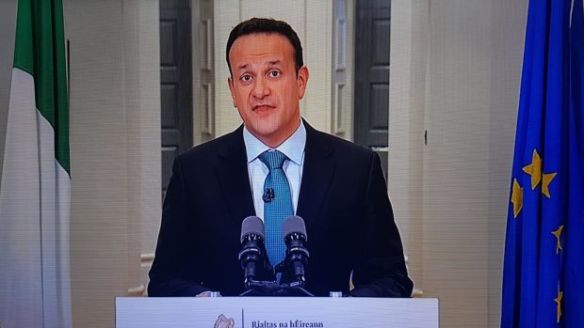
This was boosted enormously by the speech of acting Taoiseach Leo Varadkar, standing between the Tricolour and flag of the European Union, in bright contrast to the performance of Boris Johnson, sandwiched between two union flags.  The serious and statesmanlike approach of Varadkar was taken as so much more apposite than the unpredictable and sometimes incoherent ramblings of the Tory leader.  The two countries were adopting very different approaches and there was no doubt which was the better, even if Varadkar did a Churchill by saying ‘never will so many ask so much of so few’.

However, when all is said and done there is more than a little bollocks to such a view.   There are certainly more similarities than differences, starting with the flag waving as the cover for a host of failures.

Ostensibly, the Irish approach is to avoid exposure of the population and to reprise the South Korean model of testing, contact tracing and then appropriate isolation.  It has also taken more extreme measures to lockdown the population, for example by limiting outside exercise to within 2 kilometres of the home, and appearing to close down its economic activity even more drastically than the British.

The perception that this is a more responsible and sensible approach is one reason it has received popular support, although the same forces of compliance and deference apply in Ireland as much as in Britain.  Rallying round together in face of the enemy is a natural response even if it is conflated with rallying round a political leadership that has done nothing to deserve it.  And that is the most obvious similarity between the two countries.

But not only that.  The NHS has been subject to at least a decade of underfunding and misleadership that has led it to be woefully unprepared for any crisis, never mind this one. The current Fine Gael administration is the most openly right-wing and pro-free market of all the parties, which caused it to be decisively rejected at the last general election, not least because even in an economic boom the Irish health services are seen as a mess.

In February it was reported that 677,344 cases were on the waiting list with over 12,000 left on trolleys in January, the second worst month on record.  2019 was the worst year ever for hospital overcrowding as 118,367 patients were left without beds during the year.  This level of overcrowding showed that the Irish health system had insufficient capacity before the crisis and is utterly unprepared to deal with much greater demands now.  The ‘Irish Times’ reported on the front page of its 9 April edition that ‘emergency care doctors have expressed concern that the peak of the most critically ill coronavirus patients has yet to hit hospitals as existing intensive care units approach full capacity.’

As for the expected surge, the chief executive of Nursing Home Ireland has said that ‘nursing homes are effectively dealing with the surge that the hospitals were expecting.’  This has led to ‘clusters’ of the virus appearing in 137 nursing homes and other residential facilities, up from 4 on 21 March.  It is primarily the old who are dying, with the last reported median age of fatalities being 81.  The Irish State is proving no more capable of protecting its older citizens than the British.

The Irish health system is so bad the NHS is held up as an examplar, mainly because of the gross inequality in Ireland arising from health insurance that gives you greater access than public patients.

While, just like Britain, the policy is to protect the service, both states are near the bottom of hospital beds and ICU beds per capita.  The Government has hatched a deal to use private hospitals for public patients but this has led to protests from consultants that their private patients will not receive necessary treatment.

In both jurisdictions the Government has promised levels of testing that they have completely failed to deliver, which is possibly even more egregious in the case of Ireland given its so-called strategy. Johnson and his Government have gone from promising 250,000 tests a day, to promises of 100,000 by the end of the month (made at the start of it), while on 8 April Public Health England was reporting a testing capacity of 14,000.

In Ireland the Minister of Health promised 15,000 tests per day on March 19, while two weeks later the total was 1,500.  Almost a week after that, Dr Jack Lambert from the Mater Hospital in Dublin was asking ‘how can you talk about flattening the curve where you’re testing such small numbers of people and people are queuing up to get testing?’

In nursing homes some tests have taken 10 days or more for results to come through.  There are also reports of delays in tracing people having contact with those testing positive, making a total nonsense of the supposed strategy. Never mind, the Irish Minister of Health has promised action by the end of the month as well.

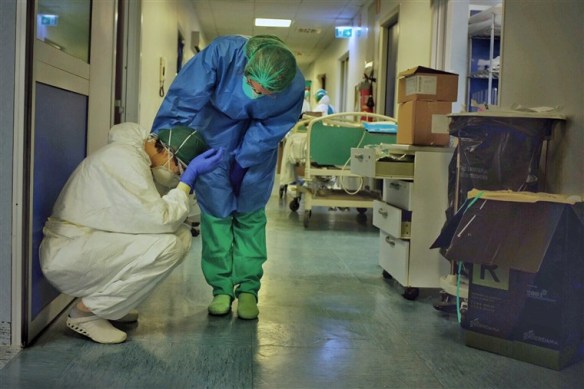
Shortages of Personal Protection Equipment exist in Ireland just as they exist in Britain, exposing health and care workers to the virus and onward transmission to the patients, clients and residents they care for.  Again, the chief executive of Nursing Home Ireland has said that nursing homes are suffering severe shortages, with just 51 receiving enough, and then only for three days normal usage, while 63 others are still waiting for a delivery.  Promises made by the Minister of Health to the sector have not been delivered.  Not that hospitals have all they need, St Vincent’s in Dublin has warned that it is facing ‘considerable difficulty’ in sourcing masks, and that the ‘ongoing availability of masks cannot be guaranteed’.

In Britain there are numerous reports of threats to NHS staff who go to the media to explain the consequences of Government failure.  Weekly clapping on behalf of NHS workers is evidence of widespread support for the service, but the silencing of NHS workers demonstrates that the NHS is not ‘our’ NHS; it is owned, run and controlled by the same state that has so abysmally failed to protect its own workers.  Were the NHS really an example of socialism we would not have its workers afraid to speak out – they would own, run, and control it and be able to speak openly.

In their place we have daily press conferences, where questions routinely don’t get answered, including by the experts, while data is misleading – the figures of those infected are next to worthless and the total number dying isn’t even accurate.  But at least in Britain they have daily press conferences where questions are asked, and there is a pretence at answering; the Irish Government has distinguished itself by its even greater secrecy, opposition to accountability or examination of its policies.  Instead, as everywhere else, moral commands induce moral outrage as a substitute for critical engagement.

Even that voice of the restrained and sober middle class, ‘The Irish Times’, has editorialised on the difficulty of obtaining information, e.g. on waiting times for test samples, on the backlog of tests, the state’s stock of protective equipment, the real-time state of ICUs, and how the virus is interacting with other conditions.  It has noted the ‘discomfort with scrutiny’ and Ministers’ requests that questions be sent in advance.

This follows the Executive’s attempt to shut down debate in the Dail, which was rejected.  This, from a Government without a mandate, that has shut down large parts of the economy sending unemployment rocketing; instituted strict limits on free movement, and introduced draconian measures that give the Garda the power to arrest you for refusing to obey instructions or to give your name and address.

We are informed that the decisive intervention that ensured the Garda got such powers was the Garda itself, through the Commissioner Drew Harris, ex of the Royal Ulster Constabulary and Police Service of Northern Ireland, recalling for me that the date of birth question was always the one that refusal to answer might lead you to being lifted by the RUC.

We can see that the Irish State has done nothing to warrant either the praise or trust it has received.  Yet it cannot hide forever from the inadequacies of the health system for which it is responsible. It will also not be able to make good its promise that the cost of shutting down the economy and temporarily supporting incomes  will not lead to austerity further down the line.  This is simply a lie.

At the same time as coronavirus has consumed attention, the politicians and media have been obsessing over the formation of a new Government, with the prospect of a coalition between the two reactionary civil war parties, ruled out so categorically, now looking more likely.  The complaint of both is that no other Party wants to join them, such is the distrust.  Except for Sinn Fein, which says a lot about all three.

However, rather than the problem being lack of a Government, the problem is lack of an opposition.  The trade union movement is disarmed because of state subsidies for those affected by unemployment although this is unsustainable and will not be sustained.  The left is in thrall to massive state intervention, which it talks and acts as if is some sort of socialism, when it is not.  The authoritarian measures are opposed but not vehemently because these have not yet become unpopular.  Not for the first time the potential to present an alternative is lost, because no alternative is presented.

From civil rights to ‘the Troubles’ 16 – the Brits and the IRA

I have already put up a number of posts on the politics of the IRA, beginning here, so I won’t repeat myself too much here.  In narrating the start of ‘the Troubles’ it should be recalled that despite its split in 1969/70 the growth and reorganisation of both IRAs did not immediately translate into widescale and open fighting.  The first British soldier was not killed until 6 February 1971.  In Derry Eamonn McCann records that ‘in the spring of 1971 the Provisional IRA in Derry for practical purposes did not yet exist;’ and when they did start shooting at the British Army ‘it can be doubted whether initially there was mass support for this escalation.’

For ‘the Troubles’ to take the form that they did, dominated by armed republican action and a counterinsurgency campaign by the British state, which employed loyalist paramilitaries as auxiliaries, the key ingredient was the development of complete disaffection of the Catholic population from the Northern State and the necessary ground this provided for the IRA to grow and operate. Even then, the political mobilisation of the Catholic population lasted only a few years after 1969, before the prorogation of Stormont and British refinement of repression placed that mobilisation in a strategic bind, without the ability to realistically take the initiative or seriously impose its own political solution.  Thereafter its political mobilisation was a defensive one dominated by campaigns against repression – against internment, against Diplock courts, criminalisation of their struggle, against shoot to kill etc. etc.

The Provisional IRA conceived and presented its campaign as an offensive one aimed at expulsion of the British presence; but when faced with political negotiations that produced ceasefires it was utterly unable to press this solution on the British, despite illusions that this is what the British wanted.

Without a political programme short of this ultimate objective the Provisionals put forward positions that fell far short of a united Ireland and involved no necessary transition to it. An illustration of this is the front page of An Phoblacht, the weekly newspaper, on 24 December 1972, at the height of the IRA’s campaign, which said that the four preconditions for an end to the IRA campaign was abolition of repressive legislation, British troops to be withdrawn, release of all political prisoners and full support for civil rights.  ‘Then – and only then – will we have a true and lasting peace in Ireland.’

These bargaining positions co-existed with uncompromising rhetoric that suggested the movement was on the brink of victory. This was used to keep it united, and to sustain morale and support by presenting the movement as strong and confident. Without it the actual potential political gains that could be made from its struggle could never inspire the military campaign and the killing and sacrifice it necessarily entailed. The current political agreement championed by Sinn Fein would have been regarded as insulting and derisively dismissed by 1970’s Provisionals.

Sinn Fein has, although recently less and less, praised the IRA for its leadership in the struggle while at the same time saying that republicans had no choice but to take up arms.  However, one can hardly be praised for doing something for which one had no choice but to do.

One can also not be criticised for defending oneself against attack.  The problem is that the choice the Provisionals made was to launch an explicitly offensive campaign aimed at expelling the British Army.  For this and all its consequences it can be criticised for adopting an objective it could not achieve and for which it therefore necessarily adopted more and more desperate measures, illustrated for example by its expanding definition of ‘legitimate targets.’

The Official IRA claimed to adopt a purely defensive campaign, although it is clear from the split that led to the IRSP/INLA that this was either not supported by many of its members or not understood.  Eamonn McCann quotes one Official IRA member as saying ‘shooting soldiers is shooting soldiers’ and seemed to endorse this view – ‘the Officials claimed their campaign was ‘defensive’ and not ‘offensive’ a distinction too nice for anyone involved in the situation to understand’. (‘War and an Irish town’)

No distinction was understood because the armed struggle strategy of Irish republicans is a principle and not a political calculation, war is assumed and not a result of prior political analysis; war might be the pursuit of politics by other means but this simply indicates the poverty of republican politics.

It would be wrong however to blame republicans for ‘the Troubles’ even if they bear heavy responsibility for their actions and for the prolongation of their campaign over decades without the slightest chance of victory.  The cardinal responsibility belongs to the British State which decided to protect and defend a reactionary unionist regime that was never reconciled to civil rights for Catholics or for their equal political participation in society.

This defence led to extreme repression which involved daily humiliation and harassment and outright torture and murder. It is exemplified by events such as the Falls curfew in July 1970 in which a whole area was effectively put under martial law, was flooded with CS gas and in which the discharge of over 1,500 rounds resulted in the deaths of three civilians, none of whom were members of the IRA.  The British Government’s Lord Carrington later admitted the operation was counter-productive and illegal.

The British Army also learned that some of it actions were mistakes and changed its tactics, something the IRA failed to do, given the increasingly limited options it had available to it to allow it to keep fighting.  As Cathal Goulding, one-time leader of the IRA and then of the Officials stated, republicans had a strategy for fighting but not for winning.

The second major event was the introduction of internment on 9 August 1971 when 342 Catholic men were imprisoned without trial after widespread arrests beginning at 4.30 am in the morning.  Some 166 were later released but no loyalists at all were arrested.

The third was the murder of 14 civil rights demonstrators on ‘Bloody Sunday’ in Derry on 30 January 1972. The victims on this day were not only those murdered but also the Northern Ireland Civil Rights Association (NICRA) which organised the demonstration.  A week later there was another huge demonstration in Newry but NICRA was effectively dead for the purposes of challenging the existing denial of civil rights and the imposition of sectarian suppression.  It had already for some time been evacuated by the most radical elements as the vehicle of protest and organisation.

All these actions by the British State were responsible for the creation of ‘the Troubles’ and all were deliberate actions following a preconceived policy.  They came to be regarded as mistakes only because they failed in their objective.  Other outcomes other than ‘the Troubles’ as defined above were possible but not after this.

This does not mean that after 1972 nothing could be done to change the course of events as they developed, but that is a new chapter of the story with which we will not be concerned.  In the next posts I will go back to the first in this series and look at the lessons for the Left arising from the civil rights campaign and the strategy and tactics that were discussed.

Back to Part 15

Forward to the first part of civil rights and socialist strategy

From civil rights to ‘the Troubles’ 15 – what were ‘the Troubles’?

If we were to stop the clock in late 1969 in Northern Ireland, even at this point we would not have been witnessing the conflict that has been called ‘the Troubles’, as it is now commonly understood, though we would have seen enough to know that this was a possible destination.  Defining when they started defines what they were.

To count October 1968 as its commencement would exclude the relatively low-level sectarian mobilisation of loyalism, aided by the state, which claimed a number of lives in the mid-1960s – sectarian killings by loyalist paramilitaries.  Does this violence not deserve inclusion in anything called ‘the Troubles’?

It would exclude earlier attempts at achieving reform by numerous forces that all failed, yet the reasons for the failures determined the actions of those later fighting for civil rights and of those opposing them.  How could an explanation for anything called ‘the Troubles’ exclude the birth of the movement that brought large numbers of Catholics and some Protestants onto the streets to demand civil rights and large numbers of loyalists to violently oppose them?  How could we account for the Troubles without including the complete opposition of the Unionist state to reform that preceded 1968?

But perhaps dating the start of ‘the Troubles’ only requires the occurrence of greater levels of politically generated violence, even if what caused this is to be excluded.  But what then determines our selection of an arbitrary level of violence to warrant inclusion?  The violence in 1968 was shocking at the time in ways that much greater levels later were not.

Were we to date the Troubles to August 1969 we would have to exclude the formation of the civil rights movement and its campaign, its attempted suppression in October 1968, the significant mobilisation of loyalism on the streets and the collaboration with their violence by the Unionist state.  We would define the commencement by a mass sectarian pogrom but exclude the organised intimidation that took place earlier in 1969, when again a number of people were killed.  Are we to determine the start with a big bang that had no beginning?

Perhaps we define it by the arrival of British troops on the streets to prevent the rapid descent into growing civil war?  Britain at this point then stood to impose reforms upon the Unionist Government in return for stabilising the existing political framework, disguised as stabilising a volatile political situation.  But we would then exclude what brought them onto the streets in the first place and what led to their initial interventions.  And how would we provide a coherent narrative if it began with British clashes with loyalism and support for the British Army by the Catholic population, which within two and a half years would be in complete opposition?

‘The Troubles’ therefore is a neologism designed to obscure.  Defining it is not a real problem because it doesn’t refer to any single thing or event; as a name for a series of events it is misleading and insulting. Thousands of deaths characterised as ‘troubles’?

By August 1969 and the months after, the unionist regime and its mass base was still opposing reform, with those most vehement getting stronger as the Catholic population failed to go home and accept whatever the unionist regime decided to allow it.  By this time the regime had demonstrated that many promised reforms were at its discretion and that it could not be relied upon to provide even the basic functions of a impartial state, its forces having collaborated with the most vicious sectarian attacks.

For these reasons the Catholic population understood that it still needed to mobilise to achieve the reforms promised, and even more important needed to maintain vigilance and organisation to defend itself against the de facto alliance between the Unionist state and loyalist vigilantes.  The initial British intervention appeared to assist both objectives by placing political pressure on the Unionist regime and standing in the way of the worst loyalist violence.  For some few months the most violent clashes in Belfast were between loyalists and the British Army – on 7 September, 27 September, 4 & 5 October, and 11 & 12 October 1969.

Unfortunately, the primary purpose of the intervention was to secure the same reactionary regime that was the barrier to thorough-going reforms and the ally of violent loyalism.  The British Army was, after all, introduced ‘in aid of the civil power’, not a beleaguered minority.  The Unionist regime therefore had its own leverage because the British had given it to them.  When the British Home Secretary James Callaghan asked whether Chichester-Clarke could broaden his Government (presumably by recruiting some Catholics) he responded by saying that there was ‘absolutely no possibility’ of this.

There was therefore no possibility of any Catholic exercising governmental power, even on behalf of unionism, which might raise a question – what was the point of civil rights if this was excluded?  This voluntary subordination, or rather deferment, to the Unionist regime was reflected on the ground by the British Army, which met weekly with the RUC and Unionist Government, by its ceasing cooperation in mid 1970 with the Derry Citizens Central Council.

This had been set up to administer the agreement between Derry Catholics and the British Army that regulated its policing role after its arrival on the streets in August 1969.  It had been set up and was dominated by ‘moderates’, so refusal to cooperate with it signalled a changed approach to the whole Catholic population.  When a spokesman for the British Army was asked about this decision he replied that ‘the army is subordinate to the Stormont Government. We will fall in with their plans.’

After a Scotland Yard investigation into the beating of Derry man Samuel Devenny met a wall of silence from the RUC, and no action was taken against police for their behaviour in the  ‘battle of the Bogside’ – despite recommendation that it should – it appeared to many that the RUC was above the law.  Catholic moderates were now put in the same position of powerlessness that for decades had made the Nationalist Party irrelevant.  After everything that had happened, and irrespective of any reforms that were or were not slowly working their way through to implementation, this was not going to be sustainable.

Yet, once again, to write the story solely in this way is to ignore the support which the British Army originally received from the Catholic population.  It would ignore the support of the leadership of the Catholic population behind the barricades for their being taken down and the state forces, so recently implicated in mass intimidation, being allowed back into the areas they had attacked.  It would ignore the actions of the majority who refused to violently attack their neighbours because of their religion.  Only when this is understood can we also appreciate the culpability of the Unionist regime and the British State for the further descent into violence that is normally painted as the result of increased sectarian clashes and which is known as ‘the Troubles’.

Certainly these clashes ratcheted up tension and fuelled those seeking to prevent any sort of meaningful reform, but on their own they could not be decisive.  Even after the events in mid-August in Derry’s Bogside and in the Falls and Ardoyne, the Catholic population was prepared to see what the reforms would deliver.  Impatience and suspicion grew as did the antipathy of Catholic youth to the new masters, while republicans also increased their support and organisation, but none of this made ‘the Troubles’ inevitable.  The most radical demands of the Bogside defenders for example had been dropped, including the demand for an end to Stormont.

This situation however could not continue and the demands of the Catholic population had inevitably to come up against the prioritisation of the maintenance of the Stormont regime, which remained implacably opposed to Catholic political mobilisation.  Tension between the local population and the British Army was inevitable and the routine symbolic manifestations of Protestant sectarianism, particularly loyal order marches, were bound to cause clashes.

A series of riots broke out in 1970 at the end of March and beginning of April in Ballymurphy in Belfast following an Orange parade, after which the British Army GOC threatened to shoot dead petrol bombers, the Provisional IRA said it would shoot at the army if anyone was killed and the loyalist UVF threatened to shoot one Catholic for every soldier.

At the end of June an Orange Order parade along the Whiterock Road in West Belfast was attacked by a Catholic crowd (according to the RUC and British Army), which involved shots being fired, perhaps by the Official IRA.  ‘The Guardian’ correspondent on the scene stated that ‘the Orangemen were prepared for trouble: one could say with some fairness that they initiated it.’  One Protestant man, William Thomas Reid, was killed.

Later, on the same day, shots were fired into the Protestant Bray Street after clashes between rival crowds on the Crumlin Road, leading to the death of three Protestants in this and nearby streets. Prevented from attacking Catholic Ardoyne by the British Army the ‘huge [Protestant] mob, crazed by a vicious combination of drink and hatred’ turned on other targets, resulting in the shooting of one RUC man and one British soldier.  A Provisional IRA leader in Ardoyne described the 27-28 June 1970 as the time when the IRA won the support of the local population, ensuring that there would be no repeat of the events of the previous August, although it has been pointed out that it was Catholic women who brought tea to the British troops after the rioting.

The British claimed that if the events of August 1969 were the fault of groups on the Protestant side, it was those on the Catholic side who were to blame ten months later.

The Orange parade that had taken place in the Whiterock Road was attended by loyalist bands from all over Belfast.  One band returning from the parade passed by the Catholic Short Strand area in East Belfast, leading to a confrontation with local residents.  The events during this clash are controversial, with claim and counter-claim that shots were fired during the encounter.  The real trouble however took place that night and is the subject of even more controversy.

The appearance of an Irish Tricolour apparently prompted an attempted attack on the Short Strand by a Protestant mob, which the Provisional IRA had anticipated, firing shots out of Seaforde Street and subsequently from other locations, followed later by return fire from Protestants.  In the ensuing exchanges of gunfire, which went on until daybreak, the leader of the Provisional IRA in Belfast Billy McKee was badly wounded.

The standard version of events is that the IRA defended the isolated Catholic area from loyalist attack.  Local Protestants have bitterly disputed this, claiming that the attack was by nationalists on loyalists.  Three people were killed, two Protestants and one Catholic, all shot by the IRA, with forty Protestants suffering bullet wounds but only one Catholic, Billy McKee.  As a consequence, on the morning of 29 June a meeting of a few hundred Protestant workers in the nearby shipyard led to the expulsion of Catholic workermen, although most were back within the week.  Loyalists started recruiting to the UVF in East Belfast and a new loyalist paramilitary group was set up, the Red Hand Commando.

These episodes bring into focus a central element of what has been called ‘the Troubles’; the resurgence of the IRA.  The conflict that had erupted out of Catholic political mobilisation and loyalist attacks on Catholics and Catholic areas was seen as an opportunity for republicans to take the initiative, to attempt to relaunch their own organisation and advance their central political objective.  As Brendan Hughes quoted Billy McKee saying:

‘this is our opportunity now with the Brits on the streets, this is what we wanted, open confrontation with the Army.  Get the Brits out through armed resistance, engage them in armed conflict and send them back across the water with their tanks and guns.  That was the Republican objective.’

Back to part 14

Forward to part 16

Coronavirus – ‘we simply don’t know’

In my previous post I said that the initial disorientation caused by the eruption of SARs-CoV-2 was ‘evaporating’, but I got that wrong. I had hoped that what was happening was a recovery from an initial shock so that some rational inquiry would emerge among the general population.  This hasn’t happened, at least not as far as I can see.

In part this is due to the mass media, which has a story and are going to run with it; I’m reminded of that great film starring Kirk Douglas – ‘Ace in the Hole‘.  It also reflects the disintegration of the socialist and labour movement that there are no scientific organisations, milieu or debate that could focus and inform debate on what approach is in the interests of the mass of working people.  Instead we have dependence on the state which breeds deference and subservience instead of critical thought.  The illusions that arise are all the greater for their being based on real dependence.  I’d hoped that the healthy dislike and skepticism of Boris Johnson among many would lead people to be more critical, although there is still plenty of time for this.

I have stayed away from BBC News and current affairs, with the exception of the web site, for years and especially after seeing some of the coverage of Jeremy Corbyn, but I tuned in this past week to watch the Prime Minister broadcast announcing increased restrictions and the half hour ‘analysis’ afterwards.  If this is reflective of the rest of the coverage then I have missed nothing.  BBC journalists often complain about the ‘Westminster bubble’ but it is they who are the prime culprits in inflating it; when they are not talking about political personalities they are essentially talking about themselves.  I also watched one of the daily press conferences, and this was much more revealing.

None of the questions asked were answered and the two experts demonstrated that they were more skilful in not answering the question than Johnson.  What answers were given provided plenty of grounds for skepticism.  We were informed that ‘the science is coming from a low base’ and when asked whether it was true that perhaps half the population had the virus, as suggested by a study from Oxford University, the answer was ‘we simply don’t know.’

The Chief Medical Officer stated that it was ‘going to be a close run thing’ whether the health service could cope while another advisor Prof. Neil Ferguson expressed confidence that NHS capacity won’t be breached.  Johnson has got by by with promises that testing, protection equipment, and ventilators etc.will all be coming soon while also claiming that everything is going to plan.  The machinery of Government has ignored offers of ventilators while giving contracts to Brexit-supporting friends who don’t make them, just like it earlier gave shipping contracts to companies without ships.

It absents itself from cooperating with the EU, giving us all a taste of things to come, while lying about why it did it, the taste of things just past.  The only thing more personally aggravating is the silence from the British Labour Party, which is only interrupted by craven agreement with Tory policy and calls for ‘more’; which reminds me of another film – ‘Oliver Twist’.

At the end of February, the Government’s Rasputin – Dominic Cummings – is reported  to have outlined the government’s strategy as “herd immunity, protect the economy, and if that means some pensioners die, too bad.”  It is supposed to have resulted in that strategy being revised on foot of a report from Imperial College London.  This report considers that there are two possible strategies: mitigation and suppression, outlining evidence that the Government strategy was mistaken and that ‘suppression’ of the virus was the only way to avoid a ‘likely result’ of ‘hundreds of thousands of deaths’.

It describes as its main conclusion “that mitigation is unlikely to be feasible without emergency surge capacity limits of the UK and US healthcare systems being exceeded many times over.”  The Government strategy therefore appears compromised because the health service can’t cope.  This is why the ‘strong and stable’ mantra of the latest Tory Prime Minister includes the dictum ‘protect the NHS’, which actually means protect the political fortunes of the Tory Government that fought the demands of junior doctors, cut nurses pay and inflicted a decade of unprecedented austerity on the NHS.

The difference between the two approaches is to move the R number, the average number of secondary cases which each antecedent case generates, to below 1, thus reducing the number affected over time.  It argues that only a strategy of suppression can do this.  The study recognises that the main challenge to this is that it has to be maintained indefinitely, until a vaccine becomes available; but it also suggests that there should be periodic relaxations of restrictions when infection numbers reduce and their reimposition when they increase again.

It may be doubted if such fine tuning is possible given lack of data on the extent of infection, the potentially misleading character of the data available as a true indicator of infection rates, and the risk that people will not find it easy or reasonable to open and shut down their lives at instruction from the Government.  The study itself notes that:

‘Once interventions are relaxed . . .  infections begin to rise, resulting in a predicted peak epidemic later in the year. The more successful a strategy is at temporary suppression, the larger the later epidemic is predicted to be in the absence of vaccination, due to lesser build-up of herd immunity.’


So what the report doesn’t do, as we can see, is condemn in principle the idea of ‘herd immunity’; in fact it notes that such an approach has been taken before,’by the world more generally in the 1957, 1968 and 2009 influenza pandemics’.

The report also doesn’t factor into its ‘suppression’ strategy the ‘enormous social and economic costs which may themselves have significant impact on health and well-being in the short and longer-term.’  It does assume that on recovery from infection individuals are immune to re-infection in the short term.

The significant assumption on which the study rests is an infection fatality rate (IFR) of 0.9%, based on an estimate of the experience in China. (It should be noted that the paper referenced in the Imperial College study states that ‘we obtain an overall IFR estimate for China of 0.66% (0.39%-1.33%), again with an increasing profile with age.’  That is, the application of the estimate of the IFR for the GB population derived from the estimate for China results in a figure over a third higher.)

The study then estimates the impact of the virus in age cohorts based on this figure and taking account of its increasing severity with age (for much more analysis of the full table see Boffy’s blog here):

Age group (years) Infection Fatality Ratio %
0 to 9           0.002
10 to 19           0.006
20 to 29.           0.03
30 to 39           0.08
40 to 49           0.15
50 to 59           0.6
60 to 69           2.2
70 to 79           5.1
80+           9.3

What this shows is that it is only for those aged 60 and above that the virus contains a significant risk.  As noted, the figures above rest on estimates for China and there has been criticism that decisions are being taken without reliable data. Others have pointed out that many cases of the virus have not been detected, because carriers have been asymptomatic or their symptoms were too mild to report:

‘Research published last week by Jeffrey Shaman of Columbia University in New York and his colleagues analysed the course of the epidemic in 375 Chinese cities between 10 January, when the epidemic took off, and 23 January, when containment measures such as travel restrictions were imposed.  The study concluded that 86 per cent of cases were “undocumented” – that is, asymptomatic or had only very mild symptoms (Science, doi.org/ggn6c2).’

The Imperial College report quotes unidentified cases as 40 to 50 per cent of infections, based on the experience of China and those returning on repatriation flights.

This would mean that the Infection Fatality Rate in the table above would be too high since deaths recorded would be a smaller proportion of those infected, many of whom were ‘undocumented’. This does not nullify the seriousness of the threat to those in older age groups, or to those with a suppressed immune system, or who rely on the immune system for effective treatment, such as targeted cancer drugs.  It means that this is where the real problem lies.

It is also recognised that all deaths of patients with the virus have not died because of it, just as it is well known that all men with prostate cancer will not die of it.  The Government advisor mentioned above noted that one half to two thirds of those dying might have died anyway.

So it is not just that the health service was, and still is, unprepared for a pandemic, which the Government knew, but that the various arrangements that are required to protect the most vulnerable are still not in place.  Lots of initiatives have come from outside Government, which can barely coordinate its own actions, and many of the grand schemes announced by it are like its promises on testing and equipment, they remain promises.  The second category of people who may suffer is therefore health service staff themselves if, as seems possible, they become exposed too much to the virus without adequate protection.

It is therefore clear that the strategy of suppression may go the way of the previous strategy of mitigation.  The Imperial College report states that its preferred strategy involving social distancing, home quarantine, case isolation at home and closure of schools should be in place for five months, not the 12 weeks spouted by Johnson.  It envisages maintenance of such policies for perhaps 18 months until a vaccine is discovered.  This raises the question whether the shift of NHS resources to treatment of the virus for such a long time would have implications for the treatment of other patients.

The report also states that ‘suppression policies are best triggered early in the epidemic’, and ‘for suppression, early action is important’, while the British and Irish Governments cannot be accused of acting quickly, and it also admits to ‘very large uncertainties around transmission of the virus.’

In accepting the difficulties of long term suppression policies it states that ‘social distancing of high-risk groups is predicted to be particularly effective at reducing severe outcomes given the strong evidence of an increased risk with age.’

The report ends by noting that ‘we emphasise that is not at all certain that suppression will succeed long term; no public health intervention with such disruptive effects on society has been previously attempted for such a long duration of time. How populations and societies will respond remains unclear.’

What should be clear is that the promises of the Government have a sell by date and a use by date; promises of delivery of tests and equipment and the mobilisation of additional staff and hundreds of thousands of volunteers will require that these are organised effectively.  If they are not then this will become a political challenge to the Tory Government that no amount of self-isolation will shield them from.


Fighting Coronavirus

An initial effect of Coronavirus in Ireland and Britain was one of disorientation, with uncertainty as to its impact and in particular its effect on those considered most vulnerable.  This is now evaporating.

The response of the British Government was a plan with four stages.

The first has passed and clearly failed.  It was called containment and was to involve trying to catch cases early and trace all contacts to avoid the spread of the infection.

The disease has spread and despite self-praise that the tracing system has been very effective there are an estimated 10,000 cases and no one knows who they are.  The disease has not been contained.

The second stage is called delay.  According to Sky News ‘this means the government will ramp up efforts to delay the spread of the illness’.  This however has only involved a recommendation that anyone with coronavirus symptoms, such as a continuous cough or high temperature, must stay at home for seven days, which appears not long enough to isolate the disease, and is anyway only a recommendation. School trips abroad should be stopped, while people over 70 with serious medical conditions should not go on cruises, which implies the problem is a foreign one that might be imported, and we are way past any such idea.

The second phase has therefore involved no actual measures so that the delay stage merely involves delaying a decision and a delay in doing anything.

This has been ignored by sporting and other bodies who have cancelled events, calling into question the Government’s strategy.  The Government, including Arlene Foster here in the North of Ireland, is hiding political decisions behind the advice of its experts.  Unfortunately, these experts are political appointments, and while Johnson gained credibility by their presence at his first press conference, their credibility will sink faster than his if they follow his agenda.  In Northern Ireland it was appropriate that the long-awaited report on the Renewable Heat Incentive scandal has just been published, reminding everyone of the lengths of stupidity that civil servants will go to in servicing their political masters.

The policies arising from the scientific advice that the British Government claims to be working from obviously conflict with that given in other countries, including the Irish State.  True to the traditions of the British state, this advice is a secret.  What we know is that Johnson appears sanguine that ‘many families will lose loved ones before their time’, and the mass media has played its role in preventing a tsunami of anger that this remark should have evoked.

On Thursday evening Radio 4 had an expert – ‘Chris’ – who continually referred to someone called ‘Boris’ as the font of all authority, as he defended the Governments’ strategy, and the interviewer gave the Government the deference it has so much enjoyed.  Social distancing measures were opposed because they could not be fully effective, but without the least recognition that less than perfect effectiveness in no argument in favour of no attempt at any effective action at all.  The strategy is clearly to allow the majority of the population to get infected in order for it to develop its own immunity and spare the health services from a task that it cannot cope with.

Delaying social distancing measures is supposed to delay the hit on the health service and flatten the impact on it; although it would appear to make more sense that the quick introduction of such steps would be much more likely to achieve this, while it also seems clear that no amount of realistically conceivable flattening will save it.

The third Phase of the British Government’s plan is called research and has been described as follows – ‘if delaying the spread fails, the government will intensify its focus on finding out more about how the virus spreads and how those who are infected can be treated most effectively.  The government has put £40m into finding a vaccine for the virus, which is undergoing clinical testing and is likely still several months off.’

So only if the delay fails will the Government focus on finding out more about how the virus spreads and how those infected can be treated most effectively???  It is impossible to take this seriously, or rather, impossible to take the plan as a serious attempt to achieve what it purports to be its objective.

The final Phase is mitigate, which, according to Sky News again,‘implies this is essentially the worst-case scenario . . . during this phase the pressures on services and wider society may start to become significant and clearly noticeable. At this stage, the virus would be considered widespread.’

However, it is clear by now that whatever impact the Coronavirus has, it will be lessened, or ‘mitigated’, less by anything the Government does than by what people do themselves, including health service staff doing their jobs.  It is beyond doubt that they are not well prepared.

Nothing in the strategy is capable of explaining how health systems will be able to deal with the massive increase in cases involving those in vulnerable groups such as the elderly and those with suppressed immune systems.  Acute facilities will be unable to cope and Governments have long starved social care systems of funds even before the last decade of austerity.

Promises of additional money now are of limited use without concrete plans to quickly requisition buildings or begin to increase production of necessary medical supplies and equipment. And these will also require additional staff, who even now should be brought forward for training in some of the basic tasks that will be required, freeing up qualified medical and nursing staff to carry out more complex tasks.

Self-isolation can only work if many of those isolating are not totally isolated.  An efficient state would be identifying this need and the means of ensuring that these people receive the minimum help in terms of food and monitoring so that they are able to maintain their self-isolation.

To pose such tasks is to expose the weakness of the current health system and illuminate the truth that far from there being no such thing as society, as Thatcher and her acolytes would have it, we are all individuals who are nothing without it.  And the nature of that society determines how we survive and thrive as individuals.  A society that defers to a state that is essentially unaccountable and governed by a moronic narcissist like Trump, or sociopathic liar like Johnson, is not one that can respond adequately to the current threat.

A struggle is therefore required to fight this disease and protect our most vulnerable fellow workers and citizens.  Relying solely on the state, a top-down bureaucratic monster that now has monsters at its top, is not an option.  A campaign to demand an adequate response to the crisis from the state is therefore only one option.

I work in an office, for the state, and it took the local union committee to raise the question of dealing with the virus and its implications for vulnerable staff and their families before local management took even minimal action.  They were, and still are, waiting for orders from above, as everyone working for the state often does, at which point we are back in Renewable Heat Incentive-land.

In general, the union movement has failed to act as a movement (as has the British Labour Party), revealing the extent to which it is a purely sectional organisation and not a class movement; more and more a series of organisations hollowed out of active participants and dominated by bureaucrats.

Acting as a social mobilisation to protect the most vulnerable and isolated would make it appear relevant to many in the working class, to whom its current relevance is not that much.  In Ireland the high level of membership at least gives it the potential to play such a role, although no one can have much confidence that it will do so.

Instead community organisations, including the GAA in Ireland, could play a major role in identifying the most vulnerable and offering them support and assistance.

A pervasive social disease requires a wide social response that only organisations within and for the working class can hope to provide adequately.  This is the perspective that socialists should offer and advance.

In the meantime it is to be hoped that the Governments that have left their populations exposed without adequate protection pay a political price; that Johnson for example is reminded how his breezy cynicism promised that the county is “extremely well prepared” when it obviously is not.

While over half the country has bitterly opposed him as an inveterate liar, and most of the rest have regarded him similarly, the latter have at the same time also agreed with him and so supported him.  With Brexit this might have been easier to do as xenophobia could be employed to ‘fight’ the EU and the imagined hordes of foreigners and immigrants.  But Johnson’s lies will be no use against viral infection and neither will xenophobia and prejudice..

The virus will be with us for some time, if it ever disappears completely at all.  It will more and more become a political issue, as it should. While we all familiarise ourselves with viral infections and epidemiology, and seek to protect ourselves and those vulnerable that we love, we should not forget what our politics means in all circumstances.  The class struggle between oppressed and oppressor is sometimes open and sometimes hidden, but it always exists.


From civil rights to ‘the Troubles’ 14 – the aftermath of August 1969

shankill road

Two days after the attempted loyalist pogrom the Stormont Government gave a press conference before bewildered journalists, who became increasingly angry as the previous days’ events were described as an IRA plot in which Catholic residents had burned their own homes.  A claim repeated by others, including Ian Paisley.

There was no criticism of loyalists or the Shankill Defence Association, and the B-Specials were defended.  One journalist pointed out that not one loyalist had been arrested, and when it was asked who information for a potential inquiry should be given to, ‘almost the entire hall burst into laughter’ when the Minister of Home Affairs suggested the police.

Academics from Queens’ University in Belfast later estimated that 1,505 (82.7%) of the households that had been displaced were Catholic while the number of Protestant households was 315 (17.3%) .  This was an under-estimate and did not include the intimidation by the SDA between April and July.  A separate  academic study estimated that during August and September 1969 3,500 families had been forced to leave their homes with 85% of them Catholic.  In a later three-week period in August 1971 a further 2,069 left.  Yet another study claimed that between 8,000 and 15,000 families in the Greater Belfast area were forced to flee their homes.

But this is not all there was to Belfast in these few days in mid-August 1969 and it has been argued that to believe so is to see only a partial and therefore distorted picture.  One author has noted* that at this time Belfast was divided into six police districts within which the majority of violence flared in only two, with it further concentrated in only three areas within these two.

District A, which included the centre of the City contained two potential flashpoints – Protestant Sandy Row and Catholic Markets – which remained quiet, with two local peace committees working together to maintain it.  District D covered North Belfast, including the Antrim Road which had a number of potential areas of conflict, but saw no sign of serious disturbances, and again some co-operation helped prevent them.  ‘E’ district covered East Belfast which included the small Catholic enclave of Short Strand and the RUC prevented two incursions by Protestant mobs; residents did put up barricades but did not seek to expel the RUC from the area.  The Catholic Committee worked with the mainly Protestant ‘East Belfast Peace Committee’ and with RUC so that the police presence was ‘at the barest minimum.’  ‘F’ district was the site of a number of attacks on Catholic property but barricades on the Donegall Road ‘were manned by Catholics and Protestants working in harmony’ and peace was secured during this period.

The importance of this is that despite it being widely considered as the start of ‘the Troubles’, the attempted pogrom of 14/15 August 1969 did not make ‘the Troubles’ inevitable and certainly not in the form that it was later to take.  This required the introduction of two further developments.  It is also important because it explodes a popular and lazy view that ‘the Troubles’ were an inevitable product of immutable religious/ethnic differences that equally inevitably would lead to violence.  However with this wider lens we can see that many people went to great lengths to avoid or prevent it, and even where it occurred many Protestants were shocked and opposed to the intimidation and expulsion of their Catholic neighbours.

Even in the Harland and Wolff shipyard the shop stewards were able to take an initiative to ensure sectarian violence, which would have led to a repeat of previous expulsions of Catholic workers, did not occur by calling a mass meeting of the workers to prevent it.  The political limitations of this were obvious however as Unionist politicians were invited to address the shipyard meeting and the resolution presented to the workers called upon the Government to enforce ‘law and order’.  The problem being, of course, that the forces of law and order had often led the attacks taking place, including the use of armoured cars and indiscriminate firing of heavy machine guns.

The Northern Ireland Labour Party members most prominent in East Belfast were also on the right wing of the party and led its later further degeneration as ‘the Troubles’ developed.  With this level of political consciousness, the spontaneous effort to limit the spread of violence could go no further, and certainly could not make itself an obstacle to the political developments that fueled the growth of violence over the next period.  These efforts were unable to develop an alternative organisation never mind any sort of force representing a political alternative.

Yet the view that what happened was a result of historic divisions that survived years of peaceful coexistence to suddenly erupt in communal violence is precisely the view that is proposed by the author who brings the wider and more mixed picture to the fore. Sectarian violence had been occasioned during the creation of the state and had also erupted in the 1930’s but these were clearly instrumental. Firstly in creation of the Northern state, by suppressing the Catholic population opposed to its creation, and then in the 1930’s to reimpose the sectarian division that had briefly broken down.  There was otherwise no widespread violence or even latent warfare despite the permanence of the state’s special powers of repression.

The main districts of violence were districts B and C, which included the Falls/Shankill interface and the Crumlin Road with Ardoyne on one side and the Eastern side of the Shankill and Woodvale on the other.  The writer puts the occurrence of violence here “to be explicable in terms of the role played by local collective histories of violence.”  He does mention the role of the police but employs the affected areas “folk memory” of previous sectarian violence to explain where it occurred in August 1969.

This does not explain why sectarian attacks took place later in areas that apparently were without this ‘folk memory’; does not explain how these other areas had ‘forgotten’ about previous sectarian clashes, and why the people of the areas that did suffer in August 1969 seemed to get on for years before 1969.   In doesn’t attempt to explain why folk memories should lead to sectarian attacks and how these memories led loyalists to attack Catholics and Catholics to seek to defend themselves, while the majority of Protestants did not to take part in any of the attacks.

It does not explain how these folk memories, were they so strong, and so recently validated, could be reflected in the particular response to the sectarian attacks by Catholic defence committees.  These were dominated by figures in the republican movement, local clergy and a few Catholic businessmen; but whatever their shortcomings, they did not support the sectarian intimidation that exploded in mid-August 1969.

The newsletter issued by the defence committees on 21 August said this – “For members of the Catholic community to attack Protestants is to sink to the same level as the B Specials and the Unionist extremists . . . The defence committees in the Catholic areas must offer the fullest protection to the Protestant families and Catholic sectarians caught interfering with these families should be severely dealt with.’  What ‘folk memories’ did such sentiments as these spring from?

In other words, this is an explanation in itself requiring an explanation, which is sufficient in itself to expel any speculative ideas about ‘folk memories’ causing the pogrom in 1969.

Such an explanation is a tendentious attempt to explain the violence that erupted in a couple of areas but not in others but fails to realise that it was not two areas but one from which the violence sprung, and this was the Shankill, from which loyalist mobs attacked the Falls to its west and Ardoyne to its east.  The single area can be identified because what happened was not ‘sectarian violence’ in some sort of general sense but an attempted pogrom by directly identifiable actors – the Shankill Defence Association, which had been engaged in such violent intimidation and attacks for the five previous months.

The SDA had succeeded in driving out the RUC, because it wasn’t violently sectarian enough, and had evolved as a particularly virulent strain of sectarianism from the movement around Ian Paisley.  We have seen its close relations with the highest levels of the Unionist regime and its even closer relations with the armed forces of the regime, especially the B-Specials.  This impunity, that continued throughout its attempted pogrom, gave it the wherewithal and confidence to take the initiative in open acts of terror without fear of actions by the state to stop it.  In fact, the state facilitated the attacks in the most direct way by often leading them.

So, what stood condemned by the August attacks was not so much loyalist sectarianism but the Unionist regime and state. The mobilisation of sections of the Catholic population to support the defenders of the Bogside did indeed inflame Protestant anger and fears but to blame this mobilisation is to ignore the political motivation behind such fears that had found expression in opposition to civil rights and the lower level sectarian intimidation of previous months.

Loyalist anger was recharged again when the British Government (Cameron) inquiry, commissioned to look into the events around the early civil rights marches, reported.  The findings of the Commission, which did not simply blame the civil rights movement, prompted yet more attacks on Catholic property.  Once again Catholic owned public houses were a particular target, although the RUC Commissioner described them as “just sheer hooliganism, nothing else.”  Very much, as in later years of the Troubles, sectarian killings by the hundred were described as ‘motiveless murders.’

In October this anger boiled over once more when the Hunt Report recommended that the RUC be disarmed and the B-Specials be replaced by a new locally recruited regiment of the British Army, to be called the Ulster Defence Regiment (UDR).  This was recognised as an important step and was described by the forerunner of the Social Democratic and Labour Party in Derry as a “hitherto unbelievably successful conclusion” to the civil rights movement if fully implemented.  Peoples Democracy described the reforms as striking “at the very heart of the traditional Unionist machine.”

John Hume welcomed the findings of the Report, while his fellow MP Ivan Cooper appealed for Catholics to join the RUC and Austin Currie stated that he was prepared to join himself.  The NICRA executive stated that the long-term good required every section of the community to join.

In the event the RUC was never disarmed, they were even at this early stage permitted to carry arms ‘in certain circumstances’, and the replacement for the B-Specials was suitably similar for it to earn its own reputation for sectarianism.  Even at the time it was clear that the personnel in the existing RUC responsible for violent sectarian acts were going nowhere and the even more unacceptable members of the B-Specials were being sent application forms to join the new UDR, which many of them did.  Half the UDR in County Derry when the force became operational in April 1970 were former members.

In true Orwellian style John McKeague from the Shankill Defence Association warned that “the day is fast approaching when responsible leaders and associations like ourselves will no longer be able to restrain the backlash of outraged Loyalist opinion.”

On Saturday 11 October 3,000 loyalists decide to show how they would defend the RUC that a few months earlier they had expelled from the Shankill Road.  As ever, anger at actions of the British Government was to be expressed through attacks on Catholics, in this case the march down the Shankill was to attack Unity Flats.

Yards from the Flats they met an RUC line with the British Army behind.  Waving Union flags they attacked the RUC and, when the scale of the rioting reduced, they opened fire with rifles, sub-machine guns and machine guns.  The RUC retreated behind the military, so that twenty-two soldiers were hit and one RUC man killed. This was Victor Arbuckle, who was to be the first policeman killed in ‘the Troubles’, shot by loyalists protesting against the possibility that the RUC might be disarmed.
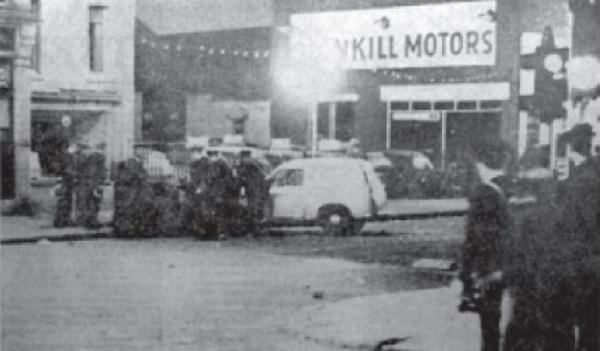
Image result for victor arbuckle ruc

The British Army did not immediately return fire but by 1.45 am they had begun using live rounds and no doubt expended their pent-up frustration at holding back for weeks while loyalists had thrown abuse.  By the end of the rioting 100 had been arrested and two had been shot dead, with fifty requiring hospital treatment, twenty with gunshot wounds. Loyalists attacked police in East Belfast with petrol bombs and snipers while the military prevented the burning of a Catholic church in North Belfast.  The next day the Shankill was sealed off and, as one British major put it, “we are searching everything, I’m afraid we’re not being very polite about it.”

– – – – – – –

Catholics initially felt satisfied at the actions of the British Army, although this was only a taste of what they were later to receive in much greater measure.  In Derry, Eamonn McCann recorded that ‘in the immediate aftermath of the fighting [the battle of the Bogside] relations between the army and most of the people of the area were very good . .’  He notes that women in the Bogside squabbled about whose turn it was to take the soldiers tea, although relations with the youth ‘were to deteriorate very quickly. ‘

James Callaghan had visited Belfast and Derry after the introduction of the British Army on the streets  and while Westminster publicly reaffirmed Stormont’s position, the Labour Prime Minister Harold Wilson also announced that the B-Specials would be phased out, a tribunal to investigate the riots would be set up and one would be commissioned to look at re-organisation of the RUC.  Behind the scenes reforms were to be speeded up and the Government in London would monitor what was going on more closely through the appointment of a permanent representative in the North.

The reaction to the visit of the London Minister of Home Affairs also demonstrated the support and trust that most of the Catholic population offered at that time.  As McCann again records – ‘Callaghan had not just impressed members of the Defence Committee; he had been very popular with the people as a whole.’

He also impressed the Belfast Central Citizens Defence Committee (CCDC) which was discussing whether to take the barricades down and accept the promise of the British army that their presence at the end of every street would prevent further loyalist attacks.  These attacks had continued at a lower level of intensity in West Belfast, Ardoyne, Highfield Estate, the Shore Road in North Belfast and in East Belfast.

The Catholic Church played a prominent role in trying to get them down and, first in Belfast and then in Derry, the Defence Committees agreed, with the last coming down in October.  The republican Jim Sullivan stated that the CCDC ‘were now confident that the army would provide adequate protection.’

After the clashes between the British Army and loyalists on the Shankill the leaders of the CCDC allowed the police to come back into the Falls and on 16 October the new RUC Inspector General was conducted on a tour of the area by Jim Sullivan and Father Murphy, a prominent Catholic priest who had pushed hard to get the barricades removed.

On the day of the publication of the Hunt Report the Derry Defence Committee announced through its chairman, Sean Keenan, later to be a member of the Provisionals, that it was to disband, saying that the government “might wait a week before sending in the RUC, but that is entirely a matter for the military authorities.  With the police force reorganised there will be no objection from the residents of the Bogside. I hope they will be wearing their new uniforms when they come in.”

When he arrived, the British officer commanding the newly deployed troops, General Freeland, predicted that the Army’s honeymoon with the nationalist population would not last, and it didn’t.

*Liam Kelly, ‘Belfast August 1969’ in ‘Riotous Assemblies’

Back to part 13

Forward to part 15
From civil rights to ‘the Troubles’ 13 – Belfast August 1969

The battle of the Bogside saw the local population expel the RUC from the area and compel the withdrawal of any threat of attack from the B-Special Constabulary.  The Irish Government made a militant sounding speech calling for a UN peacekeeping force to be brought into the North and for negotiations with Britain about its future – ‘recognising that the re-unification of the national territory can provide the only permanent solution for the problem.’
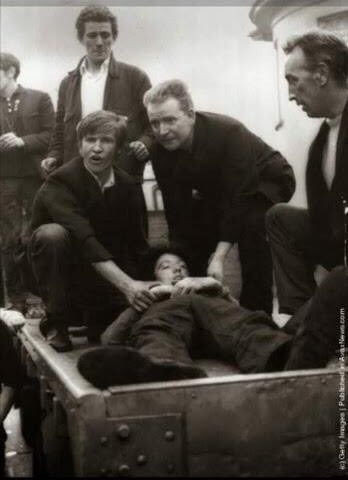
The militancy of the words however were cover for the meagreness of the action.  Although a couple of Ministers wanted to do more, and the political class in Dublin had to respond to the widespread sympathy of the population with the position of the Catholic minority in the North, they also primarily wanted to protect their own position.  Sympathy was reflected in rallies in Dublin’s O’Connell Street, which heard appeals for arms for Belfast, while Dublin Trades Council set up a fund for relief of families suffering from the attacks, many of whom had fled from their homes but with nowhere to go.

While Irish troops were moved to the border it was later noted that they went no further, and that their presence was as much an obstacle to anyone else who wanted to go North with more purpose.  This was clearly the intent of all Dublin’s actions at the time and ever since – to contain a conflict considered to have the potential to threaten the Irish partitioned state as well as the British one.

In the midst of the battle the defenders behind the Bogside barricades had called for solidarity demonstrations to tie up RUC resources that otherwise would have been deployed against them.  Demonstrations took place all over the North with some clashes arising, although it was in Belfast that the powder keg exploded.

Marches were held on 13 August on the Falls Road in Belfast, one to Hastings Street police station, where rioting broke out, and one at Springfield Road police station where shots were fired by police inside the station and fire returned from a couple of weapons in the crowd outside.  When the RUC attempted to disperse a Catholic crowd in Leeson street with armoured cars, IRA men fired some shots and threw a grenade.

Rioting increased and members of na Fianna (the republican youth wing) were ordered to attack Springfield Road RUC station with petrol bombs.  While large crowds from the Shankill Road were close by, the clashes on 13 August were between Catholics and the police.  In Ardoyne, the Catholic area on the North-eastern side of the Shankill area, residents also clashed with the RUC.

The next day the IRA were ordered to carry out defensive duties while rioting took place along the streets that linked the Catholic Falls and the Shankill, with the IRA exchanging shots with the RUC.  Loyalist mobs began attacking and burning out Catholic houses in a number of the streets connecting the two areas, coming in behind the RUC who were forcing Catholics back.  One IRA group took up position inside St Comgall’s church at the foot of the Falls to shoot at the encroaching Protestant mob but with orders to fire over their heads, which dispersed the attackers at least for a while.  Earlier in the evening a lone gunman had shot and killed one man, Herbert Roy, from the Shankill and wounded several RUC men, with the IRA claiming that Roy was a member of the loyalist Ulster Volunteer Force.

A number of IRA members were wounded in later fighting but the initial defending operation at the school could not stand against a much greater number of RUC who were heavily armed.  This included armoured cars with Browning heavy machine guns, which invaded the Divis and Lower Falls area, firing thousands of rounds indiscriminately.  Bullets went through buildings, with one penetrating the walls of a flat to blow off half the head of a nine-year-old boy, Patrick Rooney, as he lay in bed.  Other police fired Sterling sub-machine guns and revolvers, which one British journalist on the scene, Max Hastings, recounted witnessing – “I watched this for forty minutes . . . officers could not tell me what they were firing at.’ Four more civilians were to die from police bullets later that night.

More loyalist attacks took place further up the Falls in Clonard and again the IRA were engaged in defending Catholic streets as one – Bombay Street – was burned down by loyalist mobs.  One fifteen-year-old Fianna member, Gerard McAuley, was killed by gunfire.  Gerry Adams later wrote that the IRA’s actions had been crucially important in halting loyalist attacks at ‘decisive moments,’ and the republican leader at the time Jim Sullivan (later an Official republican) won praise from local priests. These had been afraid that Clonard monastery close to Bombay Street would be burned down when their calls for protection from the RUC had been unanswered.  By contrast, the local priest in Ardoyne had written of earlier events in July that ‘Catholics were as much to blame as Protestants’ for the clashes.
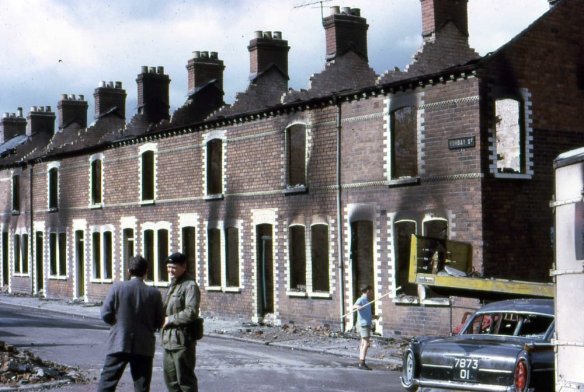
Trouble was not confined to Belfast and there were riots after civil rights rallies in Coalisland, Newry and Dungannon while in Armagh, B-Specials killed one man. In Dungannon the IRA were armed but were persuaded that any armed action would only make things worse.  In both St Comgalls, Clonard and elsewhere the IRA were too small, had too few mainly old weapons and insufficient ammunition.  In the face of much superior forces they could provide no effective defence and, notwithstanding Adam’s claim, the picture of devastation to many Catholic homes and properties after the carnage was over told its own story of its inability to prevent rampaging loyalists and B-Specials, often aided, and certainly not much impeded, by the RUC.

Republican leaders however played up their role in the defence of Catholic areas after the riots had subsided and warned the British Army that the IRA now had ‘fully-equipped’ units in the North.  While a few actions were taken along the border, the IRA was ordered not to take part in offensive operations, a more accurate acknowledgement of its capacity.  The strong public language however was seized upon by unionists to blame the IRA for the violence.  Their oft-repeated predictions of an IRA attack were now ‘confirmed’ by the battle of the Bogside, the IRA actions in Belfast and across the North, and their wider alliance with Irish nationalism proved by the civil rights rallies and the strong speeches from the Dublin government.

The reality of the maelstrom in Belfast on the 14 and 15 of August has been the subject of claim and counter-claim but even the later official Scarman Report noted that during these days the Catholic crowds never left their own territory, which was “invaded” by Protestants.  Indeed, such attacks had begun, as we have seen, much earlier in April, and in the first days of August, with repeated loyalist attacks on Catholic residents of the Shankill area and in nearby Catholic areas such as Unity Flats.  Just before the events above, on 12 August, loyalists had attacked three Catholic-owned pubs in the Crumlin Road, setting fire to one and provoking a riot.

The mobilisation of the RUC with armoured cars contrasted with their earlier withdrawal from the Shankill following loyalist attacks on them by the Shankill Defence Association (SDA).  The Unionist Government reacted to the increased violence in August by invoking the Special Powers Act and imprisoning known republicans while the Belfast Police Commissioner declared on 15 August that he and his deputy were “satisfied that the night’s events had been the work of the IRA.”

The RUC treated the attempted loyalist pogrom as an IRA conspiracy, with one senior officer making incredible claims that ‘armed bands were roaming the grounds of the Royal Victoria Hospital’, which was on the Falls Road, and that these bands had ‘also taken over the operating theatre’.

On 15 August, just a day after being introduced on the streets in Derry, the British Army was brought onto the streets of Belfast, and very much for the same reason.  The RUC misled the incoming troops into believing that they faced attack from Catholics on the Falls instead of from loyalists, who were now enraged that they formed a barrier to further attacks.

Their presence however did not immediately stop the attacks on Bombay and Kane streets and continued loyalist firing prevented the residents of these streets from returning to their burning homes. Loyalists continued to attack Catholic homes on 15 August so that when a Clonard priest asked the British for help the military initially refused and deferred to RUC guidance.  When the priest eventually did get the military to come they were shot at by loyalists, one soldier being hit twice – the first British soldier thereby being shot by loyalists.

The other major target of loyalist attacks was Ardoyne which many residents, especially women and children, had already evacuated, while barricades had been set up to protect the area.  The RUC smashed through these with an armoured personnel carrier followed by police on foot who were then followed by loyalists armed with petrol bombs.

The RUC later claimed that it was under threat and had driven armoured cars into the area in response, whereupon they were attacked by male residents throwing petrol bombs.  The RUC also claimed that it came under fire, although none received gunshot injuries and no bullets were retrieved.  The RUC on the other hand discharged twenty .38 revolver rounds and thirteen bullets from a 9mm sub-machine gun.  One 9mm round went through the window of a house and killed Sammy McLarnon.  Later, another Ardoyne resident, Michael Lynch, was also shot dead by the RUC.

The next day, on 15 August, the Ardoyne residents responded to further attacks by shooting across the Crumlin Road, which separated the area from the Shankill and Woodvale areas, killing David Linton and blinding another man.  By this stage most residents had left but the attacks continued that night, with the loyalist SDA attacking and burning nine public houses in North Belfast.  The RUC then claimed to be under further attack and opened fire with the Browning machine guns that had been firing indiscriminately in the Falls.

These could fire several rounds per second at speeds of 2400/2800 feet per second.  In one instance bullets from one weapon travelled up to a mile away, hitting a police station and causing its occupants to believe they were under attack.  The Scarman report later admitted that “it was a merciful chance that there were no fatal casualties from Browning fire this evening in Ardoyne.”  Over the two days of 14 and 15 August police fired 3,582 rounds.  Further loyalist attacks in North Belfast continued, including on remaining Catholics living or having businesses in the Shankill.

Nevertheless, in the wake of the introduction of the British Army the loyalists were compelled to call a halt to their pogrom, lamenting their failure to continue even for just a couple more days.  “Forty-eight hours”, it was reported, became the lament of loyalists on the Shankill Road, all that they needed they said to finish the job. A sentiment limited not only to sectarian thugs in the drinking dens of the Shankill.  ‘If only the bloody British Army hadn’t come in we’d have shot ten thousand of them by dawn’, as one Unionist senator was quoted as saying in the members’ dining room at the Stormont parliament.

Back to part 12

Forward to part 14