The war in Ukraine – support Russia?

A debate has been taking place on the nature of the war in Ukraine on the post put up immediately after it started.  Those familiar with this blog will be aware of the various arguments against those who would support the Ukrainian capitalist state and its western imperialist backers against the Russian invasion.

The supporters of Ukraine variously claim that it is a colony or simply a victim of invasion by a predatory imperialist power.  They demand that the working class stand with the Ukrainian capitalist state and excuse its alliance with western imperialism.  They are usually too embarrassed to argue direct support for US and NATO although they could claim that they are providing no political support to western imperialism but simply some acceptance of military commitment that can be distinguished from it.  This of course is nonsense.

The argument has been joined by the mirror opposite of this and it is claimed that because Russia is not an imperialist power in a ‘Marxist’ sense, and it faces an undoubted imperialist alliance that is imperialist in this sense, socialists must support Russia.

A number of questions are raised, including is the so-called ‘Marxist’ definition of imperialism employed correct and if it is, does Russia actually fall within it?

I am not going to address these questions which I have in other places argued are secondary.  I have contended that the support of one capitalist power against another in this war is a betrayal of the interests of the working class and of socialist principles.  It involves workers sacrificing themselves for either western imperialist interests or for Russian capitalism and it is nonsense to claim that because Russian capitalism is less advanced than western imperialism it should be supported!

It has been claimed that Russia is in some way analogous to Ethiopia in 1935 when Trotsky opposed the Italian imperialist invasion of that country and supported Ethiopia. However, Russia is not some underdeveloped country with a feudal monarchical regime being invaded by western imperialism in an attempt to colonise it; this argument will no more fly than the argument that Ukraine is a Russian colony, so there is no great point in attempting to shoot it down.   

The argument to support Russia is supported by appeals to Lenin and Trotsky but as it has been pointed out, they didn’t support Russia in the First World War.  At that time Russia was not an imperialist power by this ‘Marxist’ definition (in so far as it has been explained) and it faced in Germany an exemplar of finance-capital imperialism.  It is perhaps implied that they opposed Russia in the war because of its broader alliance with capitalist imperialist powers but Lenin repeatedly emphasised that Russian ‘imperialism’ was in respects worse than the others!

Far from supporting the argument that we should support the ‘non-imperialist’ capitalist states, they did the opposite and opposed both the imperialist and non-imperialist capitalist states (that is non-imperialist in the sense that it is employed to support Russia today).

The general approach of supporting less developed capitalisms against more developed forms is not only wrong politically but totally un-Marxist.  For Marx, socialism arises on the advances and development of capitalism and not from its backward forms.  It is what makes socialism possible.  The many posts on this blog on Marx’s alternative to capitalism explain this in detail.  It is the very definition of reactionary to believe that the road to socialism comes through defence and support for the most undeveloped and backward forms of capitalism.  Having stood Hegel on his head some want to turn Marx upside-down.

This relates to another problem reflected in both the appeal to Lenin and to the belief that opposition to imperialism today means support for non-imperialist capitalist states, just as previous socialists defended the right of nations to self-determination in the colonies and where nations were annexed to empires.

It was queried whether ‘anything qualitative has changed in the last hundred years to justify changing that approach’ to supporting non-imperialist states fighting imperialist ones.  I argued in return that:

‘When Lenin wrote on imperialism he said that capitalism had become characterised by monopolies and just as national economies were so dominated, so the world was divided up by imperialistic countries who turned each colony into their own property. The world was therefore divided into imperialist countries and colonies, between oppressor and oppressed nations.’

‘However, in the past one hundred years the Austro-Hungarian empire has disappeared, along with the Ottoman empire and by and large the European empires of Britain, France and Belgium etc. Almost all their colonies are politically independent capitalist states so the policy of self-determination does not apply, just as it is inapplicable to Ukraine today. It too is already an independent capitalist state and now with the backing of western imperialism.’

‘Many of these former colonies or dependencies are major capitalist powers in their own right including, for example, two of the biggest countries in the world – India and China. Capitalism has developed in leaps and bounds in many of these countries and with it the development of significant working classes. The role of socialists in these countries is not, as it was before, to seek to overthrow foreign imperialist rule so as to weaken the imperialist countries and thus advance the cause of socialism within them, but rather to advance the struggle of their own working classes to overthrow their own capitalism in unity with other previous colonies and the workers of the old imperialist countries.’

It was then queried whether the fact that ‘the colonies have achieved formal national independence?’ meant ‘subsequently that the political approach outlined in Permanent Revolution is also now invalid?’

Well, it must be obvious that if political independence has been achieved, and many of these former colonies have developed capitalisms with significant working classes, the scope of permanent revolution has in some respects changed.  For a start the bourgeois democratic tasks of the revolution – national independence, removal of feudal restrictions and classes – that were so prominent in permanent revolution are no longer so prominent.  To claim that they are, that in such developed capitalist societies the immediate tasks of the working class involve national independence etc. in some sort of joint struggle with native bourgeois forces would turn permanent revolution into its opposite and Trotskyism into Stalinism.

The argument to support Russia invites us to consider the big picture of what defeat for it would mean, presumably so that workers must rally to support it and prevent such defeat:

‘I think you might want to consider what is at stake for Russia in this conflict and what a victory for US/NATO imperialism in this conflict would mean for them. At the very least it is regime change in the Kremlin to install a compliant pro-imperialist puppet if not the actual dismembering of Russia into 3 or 4 smaller compliant states to better allow direct imperialist plunder of its resources.’

The same argument has been presented in favour of Ukraine and I have argued that it is not the job of socialists to come to the aid of capitalist powers just because they are losing.  Defeat undoubtedly inflicts misery and suffering and encouragement for the victor, but these are grounds to oppose the war, not to take sides in it.

Were the scenario above to transpire this would involve the dismemberment of the Russian state.  Russian military doctrine affirms that it could use nuclear weapons in response to a nuclear attack or an aggression involving conventional weapons that “threatens the very existence of the state”, which dismemberment would constitute.

The issue would then not simply be the subjugation of Russia but the immediate threat of nuclear war and the end of human civilisation as we know it.  I do not know at what point, if any, it would not become an issue of supporting the Russian capitalist state but ending the war through the activity of the working class.

Support for Russia is also argued for what might be seen as ‘positive’ reasons but personally I find this the most repulsive of all the arguments.

In arguing that Russia today is in some way comparable to Ethiopia in the 1930s the supporter of the Russian state inserts into the writings of Trotsky at that time the names of today’s combatants:

“If US/NATO and their Ukraine puppet triumphs, it means the reinforcement of fascism, the strengthening of imperialism, and the discouragement of the colonial peoples in Africa and elsewhere. The victory of Putin, however, would mean a mighty blow not only at Western imperialism but at imperialism as a whole, and would lend a powerful impulsion to the rebellious forces of the oppressed peoples. One must really be completely blind not to see this.”

We are asked to believe that the victory of Vladimir Putin would act as a beacon for the oppressed people of the world and be a blow against imperialism as a whole!  Does the writer really believe that Putin will inspire the workers of Europe and Americas to overthrow their oppression?  That is overthrow capitalism?  Will he inspire Russian and Ukrainian workers to overthrow their oppression?  Does he believe that millions of other workers and oppressed in Asia and Africa do not just see Western imperialism as murderous and hypocritical but also see Russia as their leader in a fight against their oppression?  And what if many did?  Would that be a cause for celebration, something to earnestly seek and support?

For Marxists, the emancipation of the working class will be achieved by the working class itself and not on the coat-tails of kleptocratic capitalist leaders.

The arguments in favour of supporting Russia in the war in Ukraine involve claiming Lenin and Trotsky would support the opposite of what they actually did; involves turning Marx upside-down; ignoring the effects of one hundred years of capitalist development, and the elevation of Vladimir Putin to the inspirer of the world’s oppressed. As one group of so-called socialists trail behind Zelensky and NATO another follows Putin and Russia.

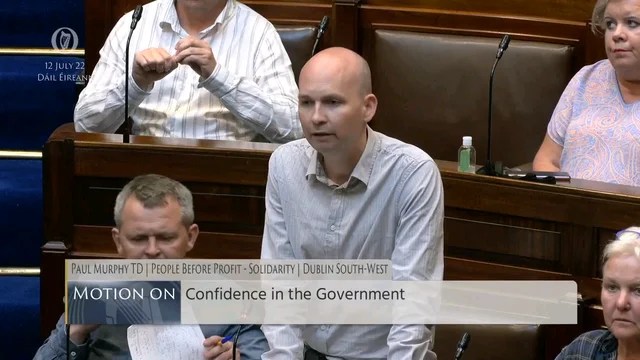
People before Profit challenges the President of the EU in Dáil Éireann, not.

As we have noted in a number of posts, including this one and a series beginning here, some socialists have argued that the war in Ukraine is both an imperialist proxy war and a war of national defence by Ukraine.

If it is the former, then socialists can support neither side and if it is the latter we are obliged to support Ukraine.  It can’t therefore be both.  As has been argued in these posts and others, there are not two wars going on; there are only two sides and the one involving the Ukrainian state involves an alliance with Western imperialism.

There is little doubt that the pretence of opposing the war while also supporting it through defending Ukraine is unsustainable.  It arises from inability to stand against the tide of the massive propaganda campaign waged in Western states by its mass media and the capitalist-controlled press and television.

The ability to sustain this balancing act against this strong head-wind is partially dependent in how sheltered a particular left organisation is from the attention of this media and their exposure to ‘public opinion’, which is pro-Ukrainian because of it.  Rolling with the punches however is painful and unprincipled; you can’t directly fight back on the central issue because you can’t establish an independent working class position consistently opposed to the supporters of the war.

People before Profit (PbP) in Ireland have been successful in getting representation in the Irish parliament but this leaves them exposed to the mass media and the ‘public opinion’ that it is able to manufacture.  Its politics are already weak, focussed as it is on parliament and maintaining their presence in it.  It is therefore no real surprise that when the President of the European Commission, Ursula von der Leyen, spoke to Dáil Éireann on 1 Dec 2022, its nonsense position fell over, and equally unsurprising on which side it fell.

The response to von der Leyen’s speech by Richard Boyd Barrett started by thanking her and ‘Europe’s commitment to ensuring that there will be no hard Border on the island of Ireland or that the exit of Britain from the EU should not in any way adversely impact on the peace on this island.’  You wouldn’t think that PbP had itself supported Brexit, so giving rise to this concern in the first place. But that is a another story.

He went on to note the housing crisis in the Irish State, stating that – ‘while much of the responsibility lies with successive Governments failing to address it, a large component of the responsibility also lies with the decisions taken by the European Commission and the ECB, as part of the troika, to ram billions worth of austerity down the throats of the people of this country.   It is long past time that the EU acknowledged its mistakes in imposing that austerity and devastating consequences it has had.’

Asking for the political representatives of capitalism to say sorry for their policies is useful for what purpose exactly?  What meaningful difference to anyone was Tony Blair’s apology for Britain’s role in the Irish famine? Was this to acknowledge the baleful role of British rule in Ireland or to present it in a good light as it imposed another ‘solution’.  What use was David Cameron’s apology for the British Army murder of fourteen civil rights demonstrators in Derry in 1972, except to absolve the political leadership and pass the blame onto the grunts on the ground?  What use are requests for apologies for past sins when you support their current ones?

Boyd Barrett went on – ‘I also note that this week the President has called – I support her in this – for a tribunal to be established to investigate the undoubted war crimes of Vladimir Putin in Ukraine. We all condemn the utterly barbaric and murderous invasion of Ukraine by Russia. We support the people of Ukraine in their struggle for self-determination.’

Of course, he noted some hypocrisy here – ‘I must say, however, in the week when there is the International Day of Solidarity with the Palestinian People, for the President to not call simultaneously for an investigation into the ongoing war crimes and crimes against humanity being committed by the apartheid state of Israel against Palestinian people makes me wonder about the consistency of the ethics of the EU’s foreign policy.’

He also criticised EU policy on Saudi Arabian and the ‘EU-Moroccan trade agreement, which involves essentially taking the fish and mineral resources of the occupied Western Sahara people.’

Summing up, he said that ‘If we are to condemn, as we must, the war crimes of Putin, we must simultaneously condemn all war crimes and all crimes against humanity, even when they are committed by people that the European Union perceives as allies, such as Israel, Saudi Arabia or those that arm and support them.’

But what has Boyd Barrett got to say about the war crimes of the Ukrainian state?  Does he not know about the continuing attacks on civilians in Donetsk City that have been going on since 2014?  Has he not seen the videos of captured Russian soldiers being shot in the head by Ukrainian armed forces?   If he wants to condemn the human rights abuses in the war in Ukraine, why does he ignore those carried out by the Ukrainian state?  Or is he too hypocritical in his selective condemnation, ignoring the crimes of the capitalist state he supports?

He finishes by declaring – ‘President, we must have consistency in our foreign policy, in our ethics and in our morality if we are to be taken seriously as defenders of human rights and opponents of war.’

He wants Western capitalist states ‘to be taken seriously as defenders of human rights and opponents of war’?  How is that going to happen?  Since when did it become possible for capitalist states to be consistent defenders of human rights and opponents of war? How can he even conceive that this is possible when every state in the EU is in the midst of supporting the biggest war in Europe since 1945!  Hasn’t Boyd Barrett noticed this support?  Or is it too like his own, as he too parades himself as against the war?

Maybe he should stop wondering about the ethics and morality of capitalism and its state machinery and try to recall some of the Marxism he claims to stand for; like Lenin suggesting that the only thing that will end war is socialism.  Maybe then he might become aware that it is not the inconsistency of capitalist states that is the problem; they are really pretty consistent in their foreign policy and support for war. He might also reflect on his support for Western imperialism adjudicating on the crimes of others, and its Ukrainian allies, when perhaps this is something only the working class can do! Just a thought he might want to consider.

This miserable speech is testament to what happens when socialists abandon principled positions and indulge in capitulation to their own rulers, leading them to the frankly idiotic nonsense that pleads for consistent progressive policies from their own capitalist states in the middle of them supporting a reactionary war.

New Left Review and the war in Ukraine (3)

The New Left Review editorial describes five aspects of the war as ‘different types of conflict—civil, defensive- revanchist, national-resistance, imperial-primacy, Sino-American.’

‘The fourth type of conflict, then, is the one being waged by the Biden Administration. A former CIA chief describes it as a proxy war . . . Leon Panetta, ‘It’s a proxy war with Russia, whether we say so or not’, (Bloomberg tv, 17 March 2022) . . . Yet the goal of Biden’s sanctions was not just to put an economic chokehold on the invasion of Ukraine; their aims, the Economist explained, are more sweeping— ‘to impair Russia’s productive capacity and technological sophistication’ and deter China.’

‘The character of the Biden Administration’s conflict with Russia is unambiguously ‘imperialist’, in the sense that it aims at regime change and the assertion of American hegemony over the Eurasian continent . . . In another sense, the Ukraine war is a massive distraction from the Democrats’ real priority: domestic revival to ensure American primacy in the strategic rivalry with China, where the US also hopes to see another type of regime installed in due course.’

This is where ‘the spectre of a fifth type of conflict intervenes, over-determining Washington’s reactions to Ukraine: the coming battle with Beijing.’

This analysis of the war as involving five, perhaps six conflicts; possibly seven if the ‘big gain in soldering Europe to Washington’ is included, is inspired by Ernest Mandel’s analysis of the various conflicts in the Second World War.  His analysis, however, involves separation of the war into distinct wars identified by their political character.  At its most simple, the New Left Review editorial identifies only three: a civil war within Ukraine, a war of national defence by the Ukrainian state and an imperialist war.

The conflict long ago (in 2014) left the terrain of a civil war and the war of ‘national-resistance’, which, in the language of NLR, might be described as ‘overdetermined’ by the US struggle to significantly cripple Russia–itself ‘overdetermined’ by the struggle against China–is therefore subordinated to the objective of ‘American hegemony over the Eurasian continent.’  This necessarily also entails subordination of Europe to US hegemony, achieved mainly through sanctions but spectacularly demonstrated by the almost certain US-determined sabotage of the Nord Stream gas pipelines.

New Left Review argues that its five wars create an escalatory dynamic.  This has included the scuppering of peace negotiations between Ukraine and Russia in March and April by the United States, acting through Boris Johnson, of all people.  This has been denied by supporters of Ukraine for whom the purity of its cause rivals that of the immaculate conception, made all the more luminous set against the evil of Russia.

Despite its turbulent and conflicted history and its renowned corruption, its cause is unblemished either by its internal politics or all this external realpolitik context.  To defend such a position an alien power can only be responsible for the tragedy on whose door all blame can be laid.  These defenders of the Ukrainian state thereby claim that ‘Russian diplomacy was always a smokescreen’ and nothing it says can be taken at face value.

Their argument is derived from the assertion “that the logic of Russia’s behaviour regarding Ukraine and the ‘collective West’ more broadly is driven by territorial expansion and the opportunistic use of violence.”  From this vantage point nothing Russia has done, or can do outside of capitulation, can be trusted and all actions can only be interpreted with this intent. An argument is thereby offered, which doesn’t prove that Russia has been insincere, but simply commits to no proof being necessary.

So, ‘Russia’s insistence on implementing the Minsk II Accords in Donbas’ was not ‘proof of [a] preference for diplomacy, and accepting it is only to make the mistake of taking ‘the Kremlin’s statements at face value.’

While it is claimed that support by Russia for the Minsk agreements was false, it is also claimed that ‘they weren’t a magic recipe for peace, but a tool of Russian military-diplomatic pressure whose meaning and use changed over time.‘

‘While in 2014-2017 the implementation of the Minsk Accords could have led to a negotiated reintegration of Donbas into Ukraine under international supervision, the international situation and Russia’s intentions have changed.’

Nowhere is it acknowledged that Ukraine had repeatedly rejected these agreements in practice and continued to treat the separate regions as the consequence of simple terrorism, hence its anti-terrorist operation to recapture them.

It is claimed that ‘the Ukrainian leadership pursued a ceasefire in Donbas from the summer of 2020’ while ‘the Kremlin used it as a bargaining chip to put pressure on Zelensky’s government and to create a flimsy pretext for an invasion.’  In fact the ceasefire was temporary and both separatist and Ukrainian forces carried out attacks, which increased just before the invasion.

The apologists for the Ukrainian state continue: ‘Zelensky’s last-ditch attempts to return to the negotiations in late 2021 were rejected by Putin, who tore up the Minsk Accords by recognising the independence of the breakaway regions.’  This claim may be a reference to the purported offer reported by Reuters, here and here for example, but which Russia has denied.

The authors state that before the invasion ‘the US and Europe made efforts to take Russia’s security preoccupations seriously, agreeing to make concessions in the areas of arms control and limitations on military exercises. Additionally, Joe Biden promised Putin that no missiles would be placed in Ukraine . . .’

Given the pre-history of NATO expansion; withdrawal from existing arms control treaties; the commitment of Ukraine to NATO membership; the endorsement of Ukrainian security policy by the US; increased participation of Ukraine in NATO exercises; a history of lying about NATO interventions in Eastern Europe and also, for example, in Libya; it is not credible to claim that at this late stage these US statements demonstrate that the war was avoidable through western good intentions.

The US claimed to know that the invasion would take place and made preparations for it; it cost nothing and was completely cynical to promise diplomatic talks involving concessions.  On the Russian part, it was equally cynical then to demand NATO concessions it knew would not be delivered and to deny that an invasion was planned.  Both were simply setting out positions just before war; nothing unusual in this.

Socialists need to cut through the lies of bourgeois diplomacy, not embroider it with nonsense that NATO ‘didn’t have a mechanism’ to agree steps that would prevent the invasion, or didn’t have time to do it.  This war was a long time in the making; that it was preceded by a propaganda war is how every such war commences.

The crux of the argument is over the collapse of the deal negotiated in April in Istanbul, of which these defenders of the Ukrainian state say: ‘we might never know what would have happened had it not [collapsed].’  In their long description of the context of the negotiations there is no rebuttal of the particular point they set themsleves to refute: that Johnson made Ukraine know of western opposition to the deal and it was thereby taken no further by it.

That Russia later conducted the war is also offered as proof of the argument that it was determined to have it in the first place; something of a non sequitur.  Like the Zelensky regime itself, these Ukrainian leftists conclude that they didn’t want this peace deal anyway – ‘It isn’t just any peace Ukrainians want.’  We are thus given to simply accept that no deal was possible because you can’t trust Russia: ‘Russia’s approach to the March negotiations likely wasn’t genuine.’

Since the war started the regime in Ukraine has taken part in negotiations, then walked away at the threat of a withdrawal of NATO support; has claimed it will not negotiate and then promised to pass a law enforcing this decision; then made a number of statements claiming it would negotiate on terms that it knows Russia will not accept.

The upshot of all this is the argument of the Ukrainian state that the war cannot end except through victory but that the cause of its continuation is not its fault in any way.  This position can only be embraced by socialists if they also embrace the Ukrainian state and its allies, which is why abstract principles are applied to the first and the second ignored.

The more and more obvious leverage that the US and NATO have over Ukraine makes it obvious that they will have a big say over the end to the war and cannot be ignored.

The most publicised element of support from western imperialism has been its provision of arms, which undoubtedly have played a significant role.  How significant is a matter to be determined.  Supporters of Ukraine, and Ukrainians themselves, have been keen to assert their own agency in this war, although not so keen to assert it in its creation.  It is Ukrainians who are fighting and dying, albeit with the support of Western military personnel to an undisclosed degree.  The quality as well as the quantity of military support has been denigrated by observers, but the greater demands of the Ukrainian state cannot be satisfied without certainty of serious escalation.

More important than this has been the financial support without which the Ukrainian state would be collapsing to an even greater extent than it is; its economic contraction is currently estimated as a reduction in GDP of around a third this year.  This points to the importance of the political support without which the Ukrainian state could not but accept it had no possibility of winning the war.  Without the potential for a political home within western imperialism there would be no alternative but agreement with Russia.  It is not enough to claim the right to self-defence in some physical sense when politically there is no viable project within which it could be effected, the alternative political resolution is therefore an agreement with the enemy.

Western imperialism, which currently means the United States, will determine how long the Ukrainian state continues to fight and for what objectives.  Ukrainians are therefore prisoners of the US, which means their leftist supporters are no less tied to it.  Ironic for a group constantly parroting the demand for self-determination.

New Left Review ends its editorial by noting that theoretically Europe could have balanced against the US but that ‘after fifty years of sapped sovereignty, European states lack the material and imaginative resources for a counter-hegemonic project.’  It concludes that ‘In the 2020s, the Europeans are wide awake, smiling and cheering, exulting in their ‘strategic autonomy’ as they are frog- marched towards the next global conflict for US primacy.’

The concern with the power of European countries to stand against the US is touching for a journal that is so committed to Brexit and opposition to the EU.  Does it really believe that a continent of independently organised states would have the material resources and thus the ‘sovereignty’ to counter US hegemony?  Does it believe that Brexit has allowed Britain to play a more independent role against the US?

*             *               *

In the meantime, the Ukrainian state doesn’t cease to be capitalist and recognises that the war will end at some point.  It therefore continues to implement its reactionary policies while its people fight for its defence.  So New Left Review describes how Zelensky has pushed forward removal of labour protections from up to 70 per cent of the existing work-force.  The unity of Ukraine celebrated by the Ukrainian left and its supporters in the west, and the former’s call for social peace, results in a one-sided suspension of the class struggle.  

As ever, prosecution of national war entails subordination of its working class, an example of what Marx meant when he said in the Communist Manifesto that ‘the working men have no country’, better rendered as the working class has no fatherland.  It should be recalled that during the Second World War British workers went on strike (in almost 9,000 stoppages between September 1939 and  April 1945), but I’m pretty sure many would no doubt be aghast at such a suggestion today.  Just like the Daily Mail, which has described them as  revealing a ‘disgusting lack of patriotism’, such suggestions would be regarded as the parroting of ‘Russian talking points’ by ‘Putin stooges.’

The New Left Review editorial describes five aspects of the war but says nothing about any independent role for the working class.  This is not a question of recognising that at present it plays no independent part but of identifying the role that it should play and the political basis on which this should rest.

Obviously, those supporting the self-determination of the Ukrainian state leave no role for it except cheering on the vehicle of its newly-adopted cause, while studiously avoiding any uneasiness at it also being the vehicle for the designs of western imperialism.  Similarly, those favouring a victory for Russia, as a defeat for the main enemy, have left no role for the working class since this is a job that can only be achieved by the Russian state.  I’m not sure these people will ever get around to removing such duties from the other enemies of the working class and in the meantime I assume they would oppose Russian workers taking action to stop the war being conducted by their state.

For socialists in the West, the task is to oppose the war, to seek its end and to oppose the interventions of its own states.  This means opposing the supply of weapons and the sanctions from which they are suffering, through campaigns and any direct action that workers can collectively organise.

The role of socialist analysis is to expose the wretched treachery of those who would proclaim that the Ukrainian capitalist state, supported by Western imperialism, is engaged in some progressive struggle that the working class should not only support but for which it should make extraordinary sacrifices.

The main enemy is at home. It is always at home and hasn’t suddenly become our vicarious ally.

Concluded

Back to part 2

New Left Review and the war in Ukraine (2)

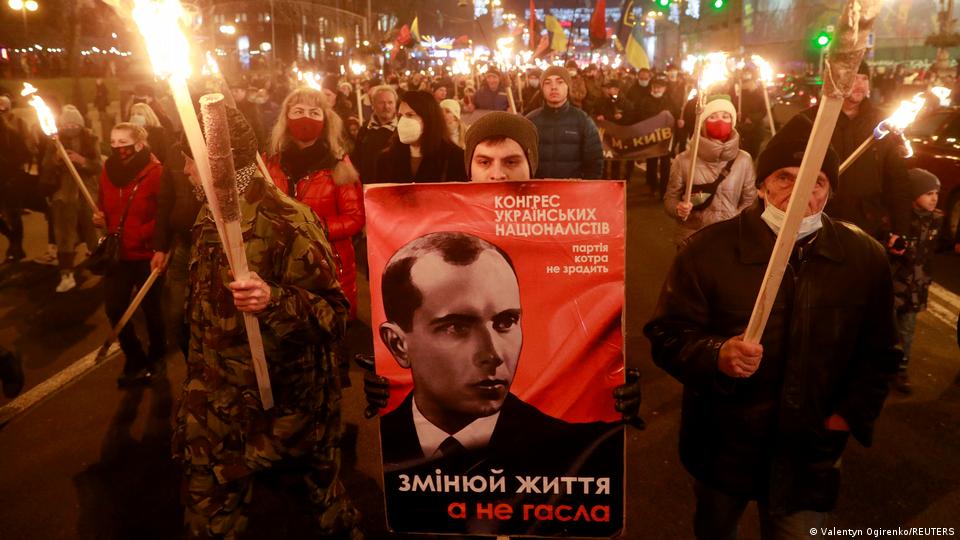
Image: Valentyn Ogirenko/REUTERS

New Left Review states that ‘Putin’s war, the second type of conflict at stake, has an ambiguous double character, defined by its twin adversaries, NATO and Ukraine. On the one hand, Russia’s mobilization began as a desperate defensive gamble against the advance of US military power. On the other, the invasion is a neo-imperialist war of conquest or partition, wavering in scope, provoked by Kiev’s declared option for incorporation into the West.’ The editorial states that ‘the two aspects of the war are distinct in their origins, aims and ideologies.’

This argument, however, sustains only one real difference, which is the ideological cover given by Putin for the Russian invasion; in all other respects the two aspects are one. As I argued on Facebook to a member of the Fourth International (FI) who condemned Putin’s imperialist justifications regarding the validity of Ukrainian claims to nationhood – Marxists should not take ideological justification for explanation.

There are not two wars going on in Ukraine, only one.  That Ukraine is still fighting is due to Western support.  Its justification is for self-determination and its left supporters have rallied to this flag in wilful ignorance of its meaning for socialists. The self-determination demanded by Ukraine entails the right to join NATO, which obviously threatens the self-determination of Russia, not to mention those in Crimea and other areas of the Ukrainian state that no longer wish to be ruled from Kyiv.  Wilful ignorance exists for them too.

The result of a Ukrainian victory would be the subordination of minorities in a Ukrainian state. In the October issue of The Atlantic magazine the very pro-Ukrainian US journalist who visited the country notes that there is ‘a burning hatred of all things Russian, whether Putin or Pushkin, and open contempt for the Russian people, who are widely regarded as Putin’s slaves.’  What price the rights of those who see themselves as Russian in a victorious Ukraine?

A victory would see Ukraine join NATO as a subordinate member of that imperialist alliance. Militarily subordinated, already dependent on western arms, the Ukrainian state will have to sign up to new IMF or other lender conditions for help, for which the Ukrainian working class will pay.  And this is what is termed self-determination! There would not be two victories in this war because there are not two wars going on, only one.

Nevertheless, New Left Review (NLR) states that ‘Russia’s invasion generated a third type of conflict: Ukraine’s war of national self-defence’. This is the argument that the war has two political characters that I have repeatedly rejected here and the series of posts starting here.

The argument presented is that:

 ‘The trauma of the invasion has inevitably forged a new national consciousness in Ukraine . . . Pride in Ukraine rose from 34 per cent in August 2021 to 75 per cent a year later. This has come at the price of a visceral hatred for Russians—‘the orcs’—whose terms Zelensky shares: ‘Until they get smashed in the face, they won’t understand anything’, he told the Wall Street Journal.’

‘In August 2022, 81 per cent of Ukrainians reported they felt ‘cold’ or ‘very cold’ towards Russian people, and nearly half regarded the populations of the Donetsk and Luhansk people’s republics in the same hostile light. The proportion of people who think Ukrainian should be the only state language has risen from 47 to 86 per cent.’

The article notes one result – ‘Given the mixed genealogies and trans-border extended families in the region, this translates into innumerable strained or broken relationships; a third of Ukrainians define their predominant feeling as grief.’

A more pointed summary is expressed in The Atlantic magazine: ‘Ukraine’s present unity is unprecedented, but war – always intolerant of complexity and ambivalence – is pushing Ukrainians to construct an identity that is simpler than the country’s history.  The war will not resolve the abiding question of what it means to be Ukrainian.’

The purported war of national defence is intensifying an already reactionary nationalism that no amount of left apologetics can render progressive.  The Atlantic magazine author is correct that this ultra-nationalism does not reflect Ukrainian history, and the ‘new national consciousness’ is being built upon the worst history of the old.  This new consciousness is not progressive, no matter that some Ukrainian socialists claim: that the war is an opportunity to create a progressive nationalist consciousness.

Its reactionary character can be seen in the views of many Ukrainians reported by the NLR editorial:

‘After the Maidan uprising in 2014, two-thirds of Ukrainians thought the country was ‘going in the wrong direction’, with a brief exception for the peace moves in 2019; now, over 75 per cent think it is heading in the right one. An overwhelming majority believes Ukraine will win the war, even though they think it may take a year or more.’

So, tens of thousands have been killed with many more injured; millions have become refugees at home and abroad; the economy has contracted catastrophically and the country effectively bankrupt.  It faces a continuing war in which it either accepts defeat and loss of territory or it seeks to regain this territory against the wishes of much of the population it will conquer.  All this is set to continue.  This is not ‘heading in the right direction’.

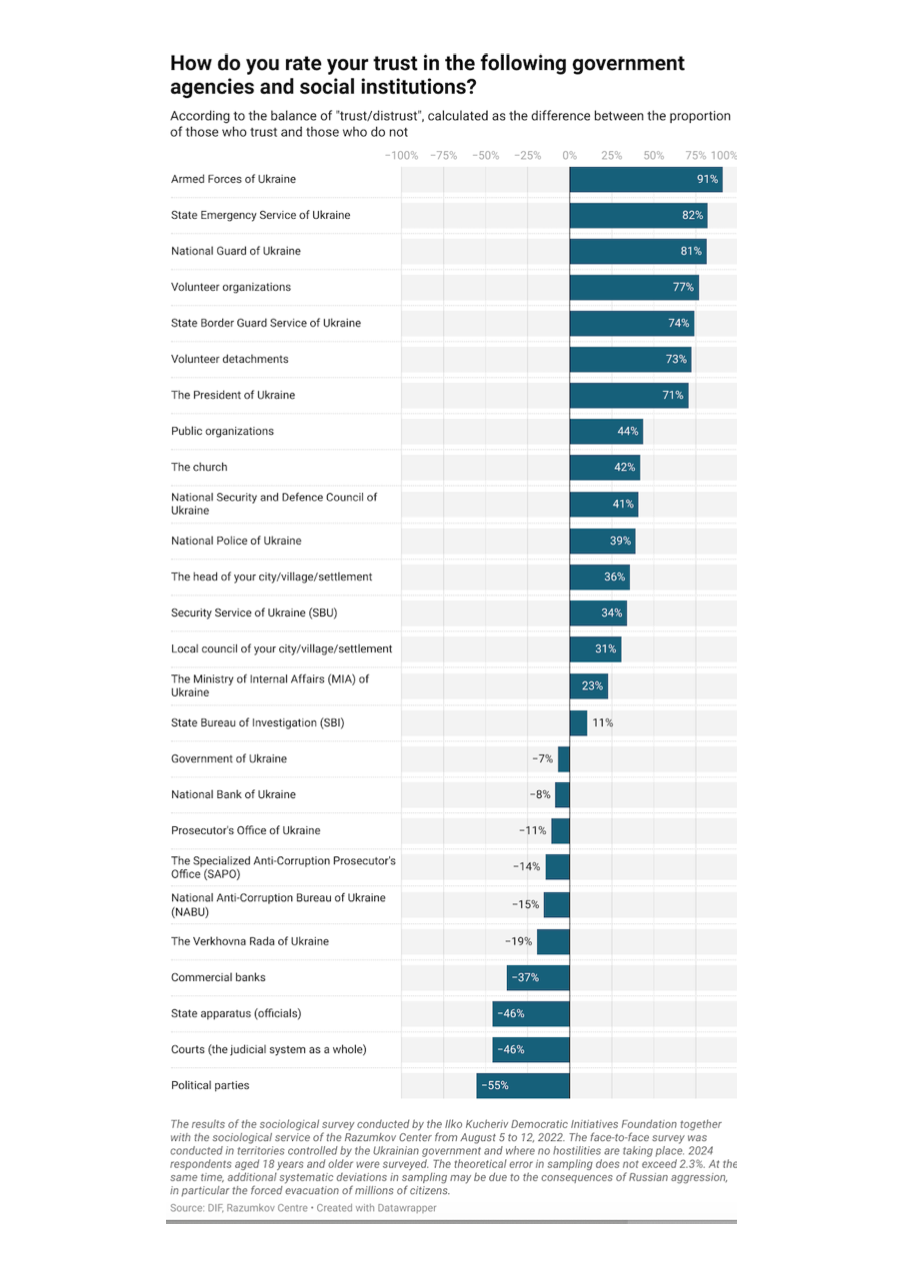
Dig deeper, and it becomes clear that while the views of most Ukrainians may have been coloured by war, the long familiarity by many of the corrupt character of the state they are fighting for has not been forgotten. 

The highest support is for the armed and security forces of the state, the most common expression of war in any country.  Support for the President is also high.  Support for other organisations is much lower and when it comes to the state bureaucracy, courts and political parties it becomes strongly negative.  The expressions of hope among the majority of Ukrainians recorded in another opinion poll are not new; they have been raised many times before in the recent past, including, for some, after the Orange Revolution in 2004 and the Maidan uprising in 2013/2014, plus the elections of various Presidents including Zelensky.

One of the most dramatic turnarounds in popularity is that of President Zelensky and this is the most marked illustration of the reactionary character of the war.  Elected promising an end to corruption and peace he has been exposed as having his own offshore account, like previous oligarchs and corrupt leaders, appointing his own supporters to positions of power, and delivering his country into an avoidable war, for which he should not be absolved of his share of responsibility.  His popularity is testament to the fact that he has, certainly he wouldn’t have had his picture in Vogue if he hadn’t.

Further evidence of the reactionary character of the war in legitimising the reactionary direction of the Ukrainian state are the words of one Ukrainian ‘socialist’ in a radio interview, who, while pointing out the regressive social policies of Zelensky, declares enthusiastic support for his policy of war, lamenting only that he does not unite the country to his satisfaction!  His words have been spoken before by every social-imperialist lamenting that his capitalist rulers do not reciprocate their own prostration to their class enemy:

‘What the Zelenskyy government does is absolutely awful and creates a lot more social instability [inaudible] in times of war by using the situation as a pretext for attacking the rights of trade unions, of the people who are in precarious conditions, attacking of housing rights, of social rights, depriving of basic social securities for the needs of advancing their market fundamentalist ideology.’

‘At the same time, they are progressing privatization laws. They are even privatizing the [inaudible] industry, so in times of war, where war economy is needed and social dialogue and social stability is absolutely necessary to enforce, they are pushing for awful neoliberal reforms.’

‘They’re actually using the situation of the war to push for the most horrible reforms in economic democracy and trade union rights that were introduced a few years ago, that they failed to push at that time. For them it’s a possibility to achieve their vision of Ukraine. I wouldn’t say that it’s a pretty good vision, especially in times of war. It’s absolutely compromising the Ukrainian defence.’

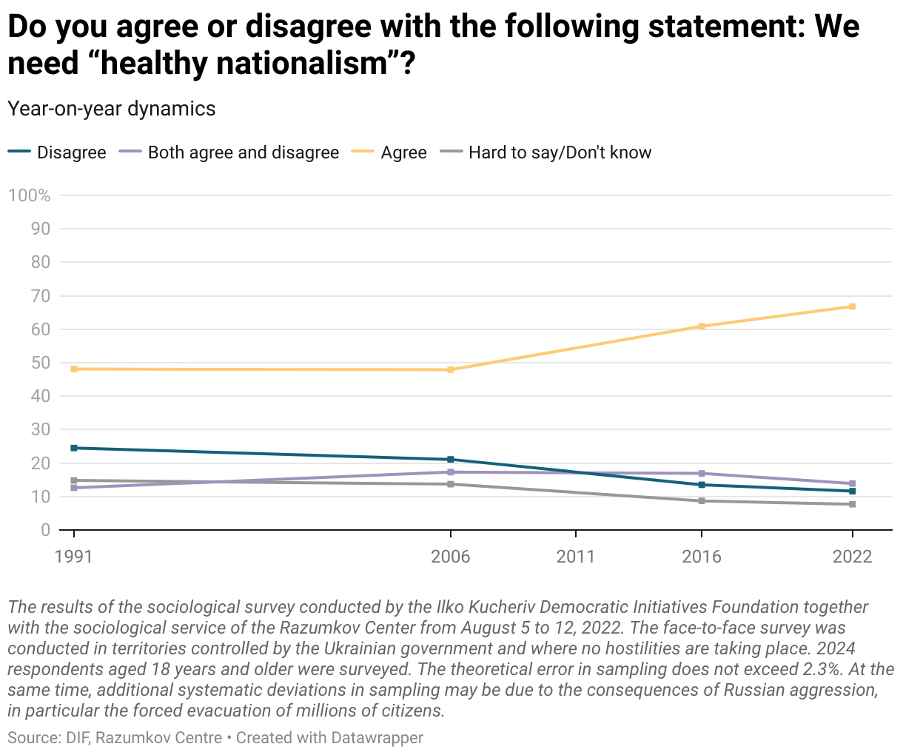
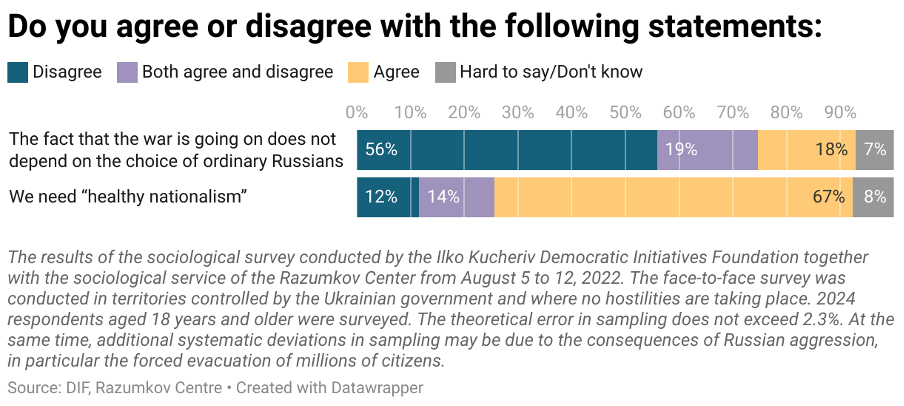
The war therefore, contrary to the view of New Left Review (NLR) is not one of ‘Ukraine’s war of national self-defence’, and the growth of Ukrainian nationalism preceding and during it has not been the expression of universal emancipatory beliefs.   As we have seen, the views are Russophobic even while presented by Ukrainian ‘socialists’ as ‘healthy’.  These views are a more accurate reflection of the nature of the war being fought by the Ukrainian state than the strident appeals to democratic values equally hypocritically trumpeted by the West.

The view that the war is the responsibility of the Russian people (no doubt while it is also illogically maintained that Ukraine is more democratic than Russia) is confirmed by the earlier opinion poll quoted above.  It recorded that while ‘86% of respondents believe that the Russian leadership is primarily responsible for the war in Ukraine 42.5% also believe that the same responsibility lies with the citizens of Russia.’  The poll, however, also records that ‘at the same time, about 20%, in addition, blame the Ukrainian leadership for the invasion, and 18% and 16%, respectively, blame NATO member states and the U.S. leadership.’  This shows a greater appreciation among a significant number of Ukrainians of the causes of the war than the left cheerleaders of the Ukrainian state inside and outside it.

This finding illustrates that there are still deep fissures in the Ukrainian population, even among those still part of the Ukrainian state.  The process of radicalisation of the population by ultranationalism has not been comprehensively successful.  This is one reason it is wrong to characterise Ukraine as either a fascist state or dominated by fascism.  Equally however, it is more than disgraceful that Western left supporters of the war have sought to minimise or downplay its importance, which they would, one would hope, not be so keen to do if similar influence existed in their own countries.

The growth of nationalism has gone hand in hand with the process of ‘decommunisation’, both of which have had the function of covering for the attacks on working class living standards and political rights resulting from the drastic imposition of capitalism into a previously non-capitalist society.  While directed at the symbols and history of Stalinism, decommunisation has been useful to discredit any left alternative to what is called neoliberalism.  Nationalism has repeatedly been employed by successive politicians and their oligarch sponsors to deflect from the failure of their austerity to deliver improvements for the majority.

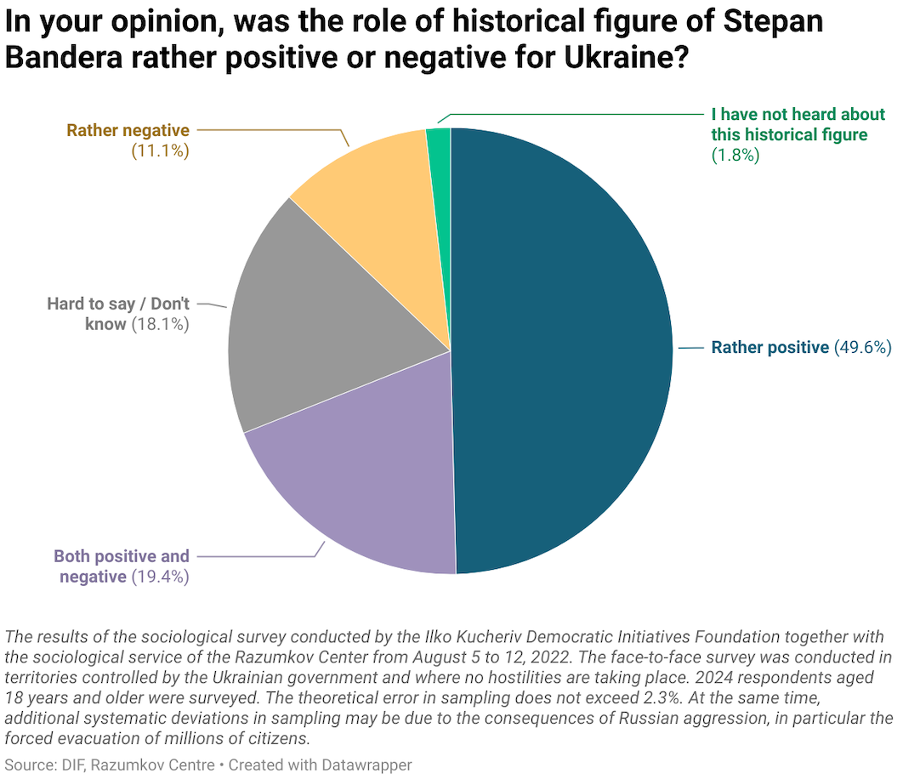
The hegemony of nationalism has been demonstrated again and again as even popular uprisings against corruption have been exploited by the far right to advance its cause.  The inchoate strivings by many Ukrainians, for example in the Maidan uprising, have empowered the far right and its oligarch sponsors.  Their leading role has endowed them with legitimacy and witnessed their slogans become popularised outside their ranks.  Its historical figures, such as Stepan Bandera, have become the precedent for, and exemplar of, Ukrainian nationalism, to be celebrated in iconography, stamps, a national holiday, street names, demonstrations and re-writing of history.

This has also involved assimilation of prominent far right figures into other parties and into the armed detachments of the state’s security forces.  Far right violence has been tolerated and sometimes important in setting the limits to state action, such as its implementing the Minsk Accords.  The ideological influence of the far right has far exceeded their numbers.

The Atlantic magazine journalist interviewed a sculptor in Lviv who ‘could hardly keep up with requests from Territorial Defence units’ for busts of Stepan Bandera.  When asked what she thought of his views, the sculptor ‘had little to say’. He was just a symbol of resistance – “Don’t fuck with Ukraine.”

The problem is not that the majority of Ukrainians have thereby become fascists, the excuse is often offered that they are not aware of his views.  It is that his followers today have a standing that means they are not and cannot be challenged, and without challenge their reactionary views cannot be confronted. The post-Euromaidan civic nationalism of liberals did not therefore undermine ethnic nationalism but empowered it, helping exclude a radical socialist agenda.

The strength of the far-right reflects the nature and strength of Ukrainian nationalism, the latter is not a replacement for it.  The assimilation, prominence and legitimacy of it all reflects not so much the independent strength of fascism in Ukraine, which is real enough despite embarrassed attempts to now minimise it, but the particularly reactionary nature of a mainstream Ukrainian nationalism that can assimilate it, accept its precepts and prominence, and lend it legitimacy.  This is not simply an ideological problem, or even barrier to the left, but a threat to any idea of being able to reconcile to its rule to the populations of eastern and southern Ukraine the state wishes to reoccupy.

Ultra-nationalism influences the potential for continued war.  The opinion poll above states that:

‘. . . the question arises, what can be considered a victory? The majority of respondents (55%) say that the withdrawal of Russian troops from the entire territory of Ukraine and the restoration of borders as of January 2014 can be considered a victory. Another 20.5% are even more radical – a victory in the war for them would be the destruction of the Russian army and assistance to the revolt/breakdown inside Russia. A relatively small proportion of respondents would consider the end of the war with some kind of concessions from Ukraine a victory. About 9% would consider the withdrawal of Russian troops from all of Ukrainian territory except occupied Crimea a victory, 7.5% would consider the restoration of the status quo as of February 23, 2022.’

But war imposes a view of its own, whether dressed up as national defence or not. In a recent Irish Times article the author of a book on Russia’s ‘Near Abroad’ reports his findings in a survey during the summer in three Ukrainian cities close to the southeast battlefields.  He states that ‘almost half agreed it was imperative to seek a ceasefire to stop Russian killing Ukraine’s young men.   Slightly more supported negotiations with Russia on a complete ceasefire, with a quarter totally against and a fifth declaring themselves neutral . . . Those most touched by the war, namely the internally displaced, were more likely to prioritise saving lives.  Other research reveals that those farthest from the battlefields have the most hawkish attitudes.’

Maybe this goes some way to explaining the moral righteousness of those western leftists supporting the Ukrainian state’s war; that and their rotten politics.

Back to part 1

Forward to part 3

New Left Review and the war in Ukraine (1)

The editorial of the most recent New Left Review covers the war in Ukraine. It attempts to ‘throw some light’ on the war through an analysis similar to that of Ernest Mandel’s examination of World War II.

Mandel claimed that the war could be defined as falling into five categories : an inter-imperialist war between the US, Japan, Germany and Britain; a war of a degenerated workers’ state – the Soviet Union – against German imperialism and its allies; a war of the Chinese people led by Mao Zedong against Japanese imperialism that also involved a social revolution against the Chinese nationalist regime; wars of national liberation in the colonies of European imperialist powers, and lastly wars of resistance against Nazi occupation waged in Yugoslavia etc.

All these involved imperialism on at least one side and were primarily the result of inter-imperialist competition arising from the forces of capitalist accumulation breaking out of existing national limitations.  It is therefore correct to state that the war was an imperialist one in which the Soviet Union, certain European workers and peoples in the colonies found themselves fighting it in various forms.

New Left Review begins by stating that ‘there is no avoiding the question of the civil conflict within Ukraine itself. On its own, this could not have generated an international war; yet the fighting could not have escalated without it.’ 

This is already an uncomfortable analysis for left supporters of Ukraine for whom there is only one type of Ukrainian – the pro-western one – with the pro-Russian minority usually ignored.  Their prime justification for support can’t allow that the nationalist demand for Ukrainian self-determination must exclude self-determination for this minority, since the Ukraine it supports is fighting against any such right that it claims only for itself.

It is of course argued, not least by anti-Russian Ukrainians, that their struggle is existential – the very existence of their country is under threat.  This, however, does not address the problem that the self-determination they seek does not allow for equal rights to its minority.

The potential for a Ukrainian polity that did so was excluded even before the invasion of 24 February through its rejection of the Minsk Accords.  This view also fails to recognise that Russia invaded with far too small a force to occupy all of Ukraine.  It would not be in Russia’s interests to attempt an occupation of such a large country and this has clearly not been its aim; clear anyway to those not seeking any and every argument to support the Ukrainian state.

This does not mean that this Ukrainian view has no validity; the war has, like all wars, changed the coordinates of all the parties to it through imposing its own logic.  Ukraine is the weaker party in any struggle against Russia and within these parameters would be expected to be unable to withstand the imposition of a new partition of the country demanded by Russia.  In this case the existence of the remaining Ukrainian state would not be in question and Russia would require only that it be militarily neutral.

The intervention of the US and NATO has given Ukraine the belief that it can win, despite the devastation caused by the war including mass emigration; the occupation of nearly 20 per cent of its territory; economic catastrophe and effective bankruptcy staved off only by western finance, and the nightmare of the loss of electricity in the coming winter caused by damage to the power system by Russian missiles and drones.

This belief has meant Ukraine rejected a peace deal brokered by Turkey and has followed the advice, if that is the right word, of western imperialist backers that it should fight on to victory.  This has meant a rejection of any negotiations with Russia and the setting of preconditions that it knows are unacceptable (such as regime change).  The US has, however, now become concerned that this weakens support around the world for its client and is seeking to modify this appearance of intransigence.

Like its fervent left supporters in the West who also seek ‘victory’, the Ukrainian state is claiming – according to The Guardian newspaper – that ‘Ukraine [is] winning the war and therefore to sit down at the negotiating table now would be “nonsense”.

The Guardian reports that ‘Ukrainian presidential adviser, Mykhailo Podalyak, told Radio Svoboda, that Ukraine will only negotiate with Russia once Russian troops have left all of Ukraine’s territory, including those it occupied in 2014. The secretary of Ukraine’s security council said on Tuesday the “main condition” for the resumption of negotiations with Russia would be the restoration of Ukraine’s territorial integrity. Oleksiy Danilov said Ukraine also needed the “guarantee” of modern air defences, aircraft, tanks and long-range missiles.’

In relation to any call for “genuine negotiations”, President Zelenskiy is reported as saying that ‘Ukraine had repeatedly proposed such talks, but “we always received insane Russian responses with new terrorist attacks, shelling or blackmail”.  He went on to say that “Once again – restoration of territorial integrity, respect for the UN Charter, compensation for all damages caused by the war, punishment of every war criminal and guarantees that this will not happen again. These are completely understandable conditions.”

What is clear is that these war aims and conditions for negotiation guarantee only continued war.  It would appear this approach is supported by many Ukrainians because they believe they can win, which in turn is a consequence of western imperialist support.  The Guardian nevertheless records that ‘Kyiv would fight on even if it is “stabbed in the back” by its allies’.

In stating that the war is existential the Ukrainian leadership is unnecessarily making it so.  It would be impossible for Ukraine to win the war without Western assistance and they have so far been unable to do so with it, regardless of the over-hyped gains made in recent months.  The Russians have learned that they could not win it with the forces they initially employed so have carried out a ‘partial mobilisation’ of a reported 300,000 reservists with which they hope to establish what they would consider victory.

Since Russia long ago made it clear that a Ukrainian state as a part of NATO was unacceptable, victory would now be a buffer zone composed of annexed territory with enough local support to make it a relatively stable part of the Russian Federation.  This is its solution to the political divisions within Ukraine, which is no more than a mirror image of the Ukrainian one.

It would be a relatively hollow victory if the remaining Ukrainian state was to become the base for a western imperialist threat, and the end-of-the-war conditions proclaimed by the Ukrainian regime involve precisely that; even excluding recovery of all territory lost since 2014 this would not be acceptable to Russia.  The declared aim of “modern air defences, aircraft . . . and long-range missiles’ would establish exactly what Russia invaded to prevent.  An effective air defence along with long-range missiles, which could only be pointed at Moscow, is what opposition to Ukrainian membership of NATO has always been about.  Even now, in the middle of the war, the US has so far refused to supply long-range artillery shells.

The conditions set by Ukraine therefore imply that the objectives set by Russia can only be achieved by reducing the rest of the Ukrainian state unoccupied by Russia to one either incapable of representing a threat, with all the devastation that this would entail, or Ukraine declares its military neutrality and abjures any attempt to militarily recover lost territory.  Since Ukraine would not accept the Minsk Accords, this looks unlikely unless western imperialism decides it will reverse its support for these conditions. This, of course, could all be fudged, just as the Minsk Accords were, but that is what has brought us to full-scale war.

It started because Ukraine chose to ally with western imperialism and is now dependent on it.  The Russian invasion has turned the majority of its people even more decisively against it, to the extent that it appears that they will not agree to what they consider an unacceptable peace. They are prepared to continue a war that Russia considers involves its decisive interests, and in which it cannot therefore accept defeat because defeat in Ukraine would present a much greater threat and represent a much greater loss than that encompassed within the boundaries of that state.

In such a ‘stalemate’ the western left that supports Ukraine will no doubt demand a Russian retreat regardless of what that state conceives as its vital interests. It is as if the world could be remade according to some predetermined state of moral justice, and through the actions of western imperialism and its client state to boot! The full results of such a victory are scarcely considered.

They will likely go along with whatever support their own imperialist states provide until perhaps such escalation threatens more or less immediate face-to-face war with Russia.  Their opposition would then be, as the saying goes, a day late and a dollar short.

Forward to part 2

Paul Murphy TD and the socialist position on Ukraine – part 3 of 3

Irish politicians give a standing ovation in the Dail following a speech by Zelensky. People before Profit TDs stand but do not applaud.

Paul Murphy clearly recognises the problem posed by his analysis that the war in Ukraine is both one of national liberation and an inter-imperialist conflict.  He asks himself:

‘What is the balance of these elements of the conflict – national liberation struggle and inter-imperialist conflict? Unlike with Serbia at the start of World War I, this is certainly not a case of 99% inter-imperialist conflict and 1% national liberation struggle. It has not, at least yet, resulted in all out global conflict, with multiple countries being directly drawn in. The different aspects are more evenly balanced. However, the trend of development has been for the inter-imperialist element to predominate more over time, as more US weapons are sent, and the number of NATO troops in eastern Europe having increased tenfold since the start of the year.’

How does this help him decide?  He still declares that ‘supporting the right of Ukrainian people to self-defence is vital.’  Why? If ‘the trend of development has been for the inter- imperialist element to predominate more over time’ why is this still vital?  In what way is it vital?  For what purpose?  Is it some quantitative assessment that at some point tips 51% support for ‘Ukraine’ become only 49% and thus 51% support for . . . who exactly?

Given the approach he takes these are impossible questions for him to answer, or at least answer correctly, and this is because the wrong question is being asked.  The correct question is what the interests of the working class are, and repeatedly we have shown from numerous arguments that these do not involve support for the Ukrainian state, or US imperialism and NATO intervention.

Murphy gets himself tied up by formulas he has learnt but are precisely only formulas because he doesn’t stop to consider their basis in reality.  This leads to proffered answers that are equally unreal. 

He sets himself tasks that should be easy to answer.  He says that his analysis – ‘means socialists must attempt to disentangle, to the degree possible, the legitimate resistance to Russian imperialist invasion, and the inter-imperialist conflict which we oppose.’  And how would we do that if we claim it is a war of national liberation?  If we consider an already independent capitalist state must be supported in war because of the formula of self-determination?

The protection of the Ukrainian working class does not lie in the continuation of a war that continues only because of imperialism.  The desire to conquer Donbas and Crimea will deliver only more war and more suffering for themselves and the workers of these regions. Only an end to the war can offer the prospect of a peace that can begin to address their needs; war on behalf of the US and NATO offers nothing but more death and destruction for everyone except the western imperialists!  More or less arms from NATO does not affect this truth.

Murphy says that his ‘disentangling’ ‘means supporting the right of Ukrainian people to resist. We don’t blame people in Ukraine for getting weaponry from wherever they can source it, but we do encourage them to operate on the basis of complete independence from NATO’. But it isn’t the people of Ukraine who are resisting, it is the Ukrainian state and the political regime that walked them into this war despite all the warnings.  The majority of the Ukrainian people might believe it is their war, but if they have guns in hand, these have been provided more and more by western imperialism and it is not for themselves that they are killing and dying.

They cannot operate ‘on the basis of complete independence from NATO’ because the state they are under the command of is not operating ‘on the basis of complete independence from NATO’.  To do this, Ukrainian workers would have to be independently organised from their capitalist state.  This, of course, may be practically impossible but this doesn’t mean you ignore the terrible consequences of not being able to, or the price to be paid by being subordinated to your own state.  It certainly doesn’t justify thinking that the interests of the Ukrainian working class can be collapsed into the idea of a Ukrainian people without class distinctions, and a Ukrainian state that it is in their interests to oppose.  The fact this state and its political leadership has led them into this war while promising peace is proof of this.

Murphy claims that ‘If such genuinely independent forces existed, socialists could even fundraise to send them weapons. However, those of us living in the western camp, the dominant imperialist bloc in the world, cannot support NATO forces pouring weapons into Ukraine in the pursuit of an inter-imperialist conflict, risking an escalatory spiral that could lead to armageddon.’

If independent working class forces existed in Ukraine they would have opposed the war from the start and opposed the project of Ukrainian ultra-nationalists to re-occupy Donbas and Crimea.  They would have opposed NATO membership and sought to campaign jointly with their fellow workers in Donbas, Crimea and Russia.  That they were too small to do so does not mean they should adopt the alternative of joining those forces who prevented their doing what they should have done had they been more powerful.

What socialists in the west should do is oppose the war, oppose sanctions, and oppose the imperialist alliance in their own countries or attempts by their politicians, as in Ireland, to get them to join it.  This is impossible if you claim that there is some justified war going on that it is ‘vital’ to support and your own state is doing just that.

Murphy claims that ‘A just peace would only be possible on the basis of the withdrawal of these [Russian] occupation forces. Included in that should be recognition of the right of minorities within Ukraine to self-determine their own future. An essential condition for the fair exercise of that right in Crimea or the Donbas region for example would have to be the withdrawal of the invading army and the right of all refugees to return.’

‘In contrast to the calls for further militarisation, we should focus on demands which can assist the Ukrainian people. The demand for cancellation of Ukrainian debt, coming from social movements within Ukraine, may yet gather momentum, as it becomes clear that reconstruction will be impossible with the mountain of illegitimate debt that arose because of the oligarchisation of Ukrainian society. This debt has grown even further as a result of war loans from the Western powers, which have no intention of releasing Ukraine from debt bondage.’

The Ukrainian state has already rejected the rights of minorities within its state, which is why it refused to implement the Minsk agreements and continued, for example, shelling Donetsk city.  Victory for the state of Ukraine will quite obviously not change this.  Equally, so obvious is it that imperialism will exploit Ukraine should it win the war that Murphy himself notes that western imperialism has no intention of leaving it debt free.  What cannot be repaid will not be repaid but this means only that new debt will replace the old and the amount to be repaid will depend on how much can be squeezed from Ukrainian workers after ‘their’ victory.

The contradictions of Murphy’s position will either be resolved positively or sprout further confusion down the line.  From a theoretical point of view the way forward is to review handed-down formulas so that their meaning is properly understood.  From a practical point of view it is to join those in Ireland attempting to campaign against the war; and from a psychological point of view it is to stand 100 per cent against the policies and lies that bourgeois politicians and its media has poured into the heads of what passes for ‘public opinion’. 

Back to part 2

Paul Murphy TD and the socialist position on Ukraine – part 2 of 3

Paul Murphy states on four occasions that Ukraine is a former colony, for example, that ‘the Russian invasion of Ukraine is a brutal imperialist invasion of a former colony is clear.’  Repetition gives the impression of the relevance of the concept of national liberation and anti-colonial war, except of course, we are informed four times that Ukraine is not a colony.  So, if it’s not a colony it must be an independent capitalist state, in which case Lenin’s policy of self-determination obviously cannot apply in the way it is assumed it must.

The outcome of believing that some principle of self-determination applies to every capitalist state in a war, perhaps as long as it finds itself up against a more powerful adversary, could only promise future support for one capitalist state after another.  The possibility of an independent working class position is permanently lost. Ironically, both those who support Ukraine and those who support Russia (because it is defending itself and China against the US) surrender working class politics and just pick a different poison.

The ’reality’ of the Russian invasion he draws attention to ­– the death, suffering and destruction of war – does not lead to support for the Ukrainian state whether presented as synonymous with its people or not.  The way to deal with the reality of this obvious tragedy is to oppose the war, oppose the Russian invasion, and oppose its never-ending continuation promised by the Ukrainian state and their imperialist supporters’ demand for victory. This is the position that this blog has argued from the start.

In opposing those who do not support the Ukrainian state, Murphy says that these people ‘by declaring that western capitalism has already robbed Ukrainian people of social and national rights . . . effectively attempt to cover up their own denial of the rights of the Ukrainian people to self-determination.’  But if it is true that the Western powers have, through their intervention, denuded Ukraine of its rights then what independent role is this state now playing; how could it have become anything other than a tool of Western imperialism, and if this is so how on earth can it be supported?

Murphy accepts that ‘The Russian invasion of Ukraine cannot be divorced from the ongoing conflict between the US-led NATO alliance and Russia and its alliance’ but if this is the case then, given these geopolitical forces involved, this is what defines the character of the war.  It is not therefore in the interests of either the Ukrainian or Russian working class that it continues. 

But this is far from the position of those on the left supporting the war for whom the victory of Ukraine is the objective, an objective only achievable if it continues to fight, no matter what forces the more powerful Russian state throws at it.  Even if Ukraine with western imperialist support was able to achieve their improbable victory, it would involve the occupation of Crimea and Donbas against the wishes of the majority of its people, make Ukraine a NATO member, and allow the stationing of large conventional forces and nuclear weapons that would threaten Russia.

Whoever thinks that this will bring peace and stability probably still believes the Versailles Treaty was a good idea, that NATO really is a defensive alliance, and that Ukrainian ultra-nationalism will be satisfied. Unfortunately, if you already support a reactionary capitalist state that has armed its native fascists; sought the unlimited support of western imperialism; supported a regime that has demanded no-fly zones and ‘pre-emptive strikes’ on Russia that would lead to World War, then your illusions in the fruits of their victory is entirely consistent with this reactionary logic.  So why the attempt to support Ukraine and oppose its NATO allies, without whom it would already have collapsed?

Paul Murphy correctly notes that the weapons going to the Ukrainian military ‘which is increasingly integrated into NATO . . . are not being transferred by western imperialism out of concern for the Ukrainian people’s rights, but in pursuance of its own interests – which are not those of working class people.’  Again, if this is the case, how can those who are wielding these weapons be pursuing any other interest than those of the imperialist powers providing them?

The interests of US imperialism is to neuter Russia as a means of surrounding and subordinating China, and which – through the sanctions directed at Russia – also hobble the European Union as its largest economic Competitor.  The lengths it is prepared to go to are illustrated by its destruction of the Nord Stream gas pipelines that cut off Europe from cheaper gas supplies and make it more dependent on much more expensive US gas.  

Already European industry is closing and looking to relocate production.  The muted response from western media would not have occurred had Russia, for some inexplicable reason, decided to blow up its own pipeline and future source of revenue, but is another perfect example of the censorship that defines western media coverage of the war. How is the victory of Ukraine and US imperialism in the interests of European workers, unless you think a permanent cost of living crisis is a good idea?

Why on earth should anyone believe that there is also an identity of interests between the Ukrainian working class and US imperialism, and that the ever-increasing reliance and subordination of the Ukrainian state to imperialism will not be at its expense?  Already, even pro-war Ukrainian socialists complain about the effect of western imperialism on the country, through IMF demanded austerity and privatisation.  Yet their subordination to the Ukrainian state leaves them supporting the war and defending the opportunity for its intensification.

This left supports ever-increasing military and financial support by imperialism while flying the kite that this should not be paid for – that the debt of the Ukrainian state should be cancelled.  The potential altruistic intentions of imperialism are given another opportunity to disappoint as the pro-imperialist logic of their position works itself out.  Pretending to be based on ‘reality’ they require a belief in the incredible to make any sense.

Paul Murphy does not endorse some of these woeful illusions but support for the Ukrainian state requires going down this road, unless the contradictory nature of his characterisation of the war is resolved correctly.  He too calls for cancellation of the debt while noting that ‘the Western powers . . . have no intention of releasing Ukraine from debt bondage.’

Back to part 1

Forward to part 3

Paul Murphy TD and the socialist position on Ukraine – part 1 of 3

The People before Profit TD Paul Murphy has written on the nature of the war in Ukraine and its importance for socialists. He makes clear that he supports a position I have already critiqued in a previous post but has something more to say than already argued; the critique therefore does so as well. 

On its importance he correctly notes that:

‘If we give succour to the idea that NATO can be a force for defending democracy and human rights, where will that leave us when its members engage in another blatantly imperialist anti-democratic intervention somewhere in the world? The question will be asked – if we accept that NATO is actually concerned with protecting democracy in Ukraine, then why not support joining NATO and expanding it further?’

This is absolutely correct and exposes the threat to any socialist opposition in the West to its own ruling class.  The ideas of some, who defend the Ukrainian state and the supply of arms to it by NATO, is such a departure from working class politics that one would expect some extraordinary arguments in its support.

What we have gotten instead is moralistic expressions of sympathy for the ‘Ukrainian people’ with no consideration of the class nature of the state waging the war, or explanation of how on earth US imperialism and NATO found itself on the side of the working class.

Paul Murphy is correct to say that if NATO is indeed playing a progressive role in the war there is no a priori reason to doubt its claims for its role in future.  These cannot be assumed to be necessarily reactionary but become subject to approval or acceptance on a contingent basis.  For all the wind expelled in claiming to uphold an an anti-imperialist position by the supporters of Ukraine, this becomes an open question; for if the greatest imperialist alliance can carry out progressive military and political actions, then it is not necessarily reactionary and to be opposed.

Unfortunately, it becomes clear in what he writes that Murphy can only avoid this fate himself if he abandons the position he goes on to advocate.  Given the enormous propaganda offensive in Ireland in support of the Ukrainian state, if People before Profit TDs were to abandon this current position, they would face even greater condemnation from manufactured ‘public opinion’, and would have to sit down as well as not applaud the Ukrainian President when he speaks to the Dail.

I will not repeat the arguments made in my previous post referenced above in relation to the statements of the International Socialist Tendency, to which PbP is aligned, but will take up directly what Paul Murphy argues.  I will not address his mistaken understanding on Lenin’s policy of self-determination of nations, which has also been taken up in a number of previous posts starting here.

It is impossible not to get fed up with this policy being held up as support for the Ukrainian state when it doesn’t fulfil this function. Again, unfortunately, left supporters of ‘Ukraine’ are so keen to offer such support they appear too lazy to read what Lenin has actually written.  No matter, this only demonstrates that it’s not what motivates their position in any case.

———————

Paul Murphy sets out three categories relevant to socialists characterisation of the war:

1) Those who have taken the side of Russia in the conflict, either because they see this as a conflict between US imperialism and a non-imperialist Russia, or because they consider Ukraine to be a fascist-dominated state;

2) Those who see the Ukrainian conflict simply as an example of an imperialist country invading a former colony and have taken the position of support for Ukraine;

3) Those who see two intertwined and sometimes contradictory aspects to this conflict: the Russian imperialist invasion of Ukraine – in which they take the side of the Ukrainian people, and an inter-imperialist conflict between the US-led NATO and Russian imperialism, in which they oppose both sides.

He seems oblivious to a position which (1) refuses support either to the Ukrainian state, in which case support for NATO does not arise, and (2) also opposes the Russian invasion.  The first statement on this blog along these lines was put up at the start of the war on 24 February.

While taking up this position it is of course necessary to evaluate the role of US imperialism and NATO, but from first principles it is impossible to support a capitalist state in war against another capitalist state; especially a state that has sought to join the primary imperialist alliance in the world led by the United States in an obvious move to assert its world-wide predominance.  Even if you start from the wrong place, it should be impossible to ignore this reality, thereby compelling an assessment of the role of the Ukrainian state in advancing it.

The right place to start is from the interests of the working class, which precludes support for either ‘Ukraine’ or Russia.  From this point it matters not whether the latter is imperialist or not, by whatever definition is considered correct, just as it is not of primary importance to what extent ‘Ukraine’ is home to, and consists of, far-right and outright fascist forces.  If the latter is noted, it is to illuminate just how awful the position of those supporting the Ukrainian state is and draw attention to the capitulation involved, as well as to pay attention to the political dynamics within that country.

The third position supported by Murphy is not therefore really a third alternative analysis but broadly just an addition of the first two, and it makes no sense, as our previous critique has argued.  He claims ‘two contradictory aspects’ to the war and claims to reconcile them in his third category above.  In fact, the contradiction involved is within his analysis of reality and not the reality itself that he seeks to explain.

Murphy realises the issue is a reoccurrence of a historical problem for socialists, stating it as similar to the those thrown up by World War II, although it more closely corresponds to the experience of the First World War. As Murphy notes: ‘For all who define ourselves as revolutionary Marxists, a common point of understanding is an appreciation of the disastrous consequences of the betrayal of the vast majority of socialists supporting their ‘own’ side with various justifications in World War’.

Through support for the state of Ukraine this is precisely the problem faced by the pro-war Left, which supports its own ruling class’s arming of that country: by one (not very distant) remove it is supporting its own capitalist class and state.  As an aside, the mass propaganda in support of Ukraine by the mainstream bourgeois media and full gamut of bourgeois politicians has caused them no embarrassment, never mind pause for thought.

If he continued this line of thinking he would arrive at the position of Trotsky that he mentions: ‘in consistently arguing against support for either side in such a clash and arguing that the end of the war which socialists should fight for was based on “the intervention of the revolutionary proletariat.’ 

Supporters of Ukraine leave no room for such a position and disarm the working class.  There is no need for its intervention if it is ‘Ukraine’ that must be supported, i.e. the capitalist Ukrainian state that is actually waging the war, not ‘the Ukrainian people’ who must fight it; while there is also no need for it since the arms relevant to Ukraine’s defence are those that can only be provided by NATO.

Murphy acknowledges that ‘the independence of the working class, with an emphasis on working class power and a socialist position is essential’ but this is precisely what is elided, through an appeal to ‘reality.’  But as we have argued before, support for ‘the Ukrainian people’ in war in the real world, as opposed to the imaginary one invoked by erroneous political formulations, involves support to the Ukrainian state actually fighting it. The Ukrainian armed forces do not cease to be a capitalist army just because it is composed of working class people, whether voluntarily enrolled or not.

Of the three types of war he mentions Ukraine does not seem to be included in any of them – not ‘Wars of national liberation or revolts against colonialism’; not Inter-imperialist wars (Ukraine is not imperialist in the sense that it subordinates other capitalist powers, though it is obviously capitalist); and not obviously a war ‘between post-capitalist or workers’ states and capitalist states.’

Murphy claims that the war in Ukraine is of the first variety:

‘The suggestion by some that there is no imperialist invasion of Ukraine, or no legitimate struggle of national liberation by Ukrainian people is not dealing with reality. To reach that conclusion, those who argue for this line are compelled to essentially ignore the fact of Russian troops invading and occupying Ukraine against the opposition of the Ukrainian people.’

But let us unpick the assumptions behind this statement.

Firstly, it is not true that all Ukrainians oppose the Russian invasion.  A minority supports Russia, and this is clearly the case in Crimea and Donbas.  A larger number has previously expressed support for greater autonomy for the Donbas but as citizens of Ukraine, and this was supposed to be the basis of the peace settlement based on the Minsk agreements.  One problem is that the Ukrainian state opposed such autonomy, partly due to far-right opposition, so this settlement became a dead letter and the Ukrainian armed forces continued to attack the population of the Donbas area.

The idea that there is one Ukrainian people with a unified political view is one spread by ultra-nationalists and by Western imperialism and its repetition by the Left in the West is but another illustration of its capitulation to these forces.  The political fracturing of Ukraine is testament not only to outside intervention by Russia and Western imperialism but also to internal divisions, a reality usually ignored in the western narrative.

Far from this proving the need for Ukrainian ‘national liberation’ it proves that Ukrainian nationalism cannot encompass all its people and that it is necessary to, not so much go beyond it, as replace it.  This is an example of why working class unity is required: as the only progressive alternative to nationalist division.

Undoubtedly part of the socialist programme to achieve this involves a fight for democracy, but this is primarily to assist the creation of working class unity and this is not made easier by either support for the Russian invasion or for Ukrainian ultra-nationalism.  This nationalism has been the banner under which the repression, censorship and banning of opposition political parties has been carried out by the Ukrainian state.

Forward to part 2

The war in Ukraine – the blind leading the blind

Pieter Bruegel the Elder, ‘The Blind leading the Blind’

Much of the argument over the war in Ukraine hits their target but misses the most essential point.

So, it is important to know that the historical demand for self-determination argued by Lenin does not provide support to those who want to support the Ukrainian state and its victory in the war.

It’s vital to understand that the massive role of the United States and NATO in provoking and affecting the course of the war also determines the war’s character.

It is important to be aware of the wider agenda of the United States, which wants to diminish Russia, and necessarily therefore achieve a change of regime in order to encircle China and also diminish it – as the only state capable of seriously challenging US hegemony.

It is instructive to appreciate the role of ultranationalism in Ukraine, which countless photographs of fascist iconography on display by the Armed Forces of Ukraine makes impossible to deny, or so you might think.

It is also necessary to understand that there is nothing progressive about the Russian state or its invasion and that this necessitates opposition to it.  To do otherwise, because Western imperialism also opposes it, is to accept that it is impossible for the working class to have an independent policy and that some indispensably correct positions must in effect be voluntarily surrendered.  It’s origin arises partially from some similar considerations of the pro-war, pro-Ukraine left who abandon the socialist programme because we can only currently fight for it with weak forces, which means, of course, that these will always remain weak.

It is, finally, important to understand what constitutes imperialism so that we can understand how the world works, the better to change it.

However, as important as these all are, the most important issue to understand is that the working class must identify and fight for its own interests including against the various states of the capitalist class, which are weapons to defend their system.  It is necessary to form a separate party of the working class to advance this understanding, including that such understanding categorically rules out support for any capitalist state, not only in war but especially in war.  This means that it is impermissible to support either the Ukrainian or Russian state and every attempt to do so is bogus and a gross betrayal.

We all know that this has not stopped large numbers of self-described socialists from supporting the Ukrainian state; defending the role of NATO when not actually supporting it; ignoring the wider agenda of the imperialist hegemon; minimising or simply ignoring the reactionary ideology of the Ukrainian state, and claiming that the interests of the working class in a war that now defines world politics is aligned with fascist fighters in Ukraine, the Ukrainian state and US imperialism and its NATO allies.

You would think that some extraordinary arguments would need to be employed to make such a case remotely plausible.  That it is not remotely credible is proved by the poverty of the arguments put forward in support of it, many of which have been addressed in previous posts.  What this implies is that much of what describes itself as left, radical left, anti-capitalist or even Marxist is nothing of the sort, and no wailing about politically sectarian argumentation can wash away the significance of the division that now exists.

A friend sent me a link to an article that presented itself as a summary of the leftists who are actively supporting the Ukrainian state.  What is noteworthy is their immediate emphasis on arming it:

‘Mick Antoniw and a group of British trade unionists went to Ukraine to deliver a car, military equipment and medical supplies to Ukrainian trade unionists currently in the Armed Forces.’

The statement calls, in particular, for the supply of military equipment and humanitarian aid to Ukraine, as well as for the country’s foreign debt to be written off.’

‘As a reaction to the ‘pacifist’ left, the initiative has focused on promoting weapons supply, and solidarity with the people of Ukraine . . .‘

‘ENSU’s founders and members are opposed to all imperialisms, but support the right of oppressed peoples everywhere to seek military, economic and diplomatic support from their invader’s enemies.’

The authors make much of their opposition to imperialism but it is a strange sort of opposition that supports the intervention of the United States and NATO.

The Polish organisation has apparently distinguished itself by displaying its opposition to the country’s notoriously Russophobic political culture through having ‘unequivocally (sometimes even by Polish standards) taken a stance on the side of Ukrainians.’

From the text of the interviews it is clear that the solidarity of these associated groups comprises of the same analysis and perspective as most of the reactionary governments in the region:

‘This is an existential and fundamental issue. Not only for the Ukrainian left, but for the whole Eastern European and Nordic countries, for all countries that have been under the threat of Russian imperialism.’

‘This closeness of EE, Baltic and Nordic left is happening on the ground of the resistance to imperialism everywhere, solidarity with sovereign countries, with the people and working class who want to determine their own fate everywhere.’

So, the sovereignty of capitalist states; the ‘people’ and the ‘working class’ are all compatible, all allies in determining their own fate ‘everywhere’.  So where in all this is opposition to the capitalist state, recognition of the division of ‘the people’ into classes, and identification of the separate interests of the working class?

The elimination of these independent interests leads to the witless belief that the capitalist state and ruling class will behave likewise and see things the same way.  What else could be meant by the following?

‘We try to convince western left activists that Russia is in no way anti-imperialist and that Ukrainian society deserves our solidarity irrespective of our disagreement with the oligarchs or the ultranationalists, conservatives and neoliberals in the Ukrainian parliament. Unfortunately, some western leftists believe that only western imperialism is a problem, so their solidarity with Ukraine is weak if not absent.’

We are meant to support ‘Ukraine’ even if we disagree (is that all?) with those who own it, rule it and are fighting to preserve its alliance with imperialism!  ‘Resistance to imperialism everywhere’ includes support for US and NATO backing for the ‘oligarchs and ultranationalists’ etc. How could socialists justify ‘solidarity . . . with the oligarchs or the ultranationalists, conservatives and neoliberals.’?

Blindness to the interest of the working class also leads to failure to see what is in front of their eyes.  Apparently it’s not western sanctions or US sabotage of pipelines that is causing the shortage of energy in Europe:

‘We are worried that Russia will manipulate oil and gas issues as winter approaches, encouraging cowardly and opportunist politicians to call for the partition of Ukraine – ‘peace at any price’ in exchange for Russian gas.’

So we get this ridiculous alternative:

‘Therefore we recently started networking with environmental groups and consumer protection activists to argue for accelerating the green transition.’

A transition that will take decades to achieve is an answer to the energy shortage this winter; and this will be accomplished through pressure by ‘environmental groups’ and ‘consumer protection activists’!  This is not serious.

The article we have been quoting starts with the following passage:

‘Since the beginning of the full-scale war, we have published numerous critical texts about those leftists who have got stuck in the past and keep seeing the war as just another confrontation between Western and Russian imperialism. Some adhere to this idea due to sincere beliefs; others simply choose a more comfortable position of not intervening or even searching for arguments against the support of Ukrainian resistance (‘nationalism,’ ‘protection of Russian-speaking people,’ ‘promotion of NATO,’ etc.). Westplaining helps them close their eyes to the whole picture.’

The author claims we must be ‘searching’ for arguments to justify opposition to the war and the Ukrainian state, and then gives us an (incomplete) list of what they might be! He thinks we are stuck in the past in opposing capitalist war, forgetting the socialist principles that have inspired this opposition and the lessons learned from the support of reformist parties for the mass slaughter of two World Wars.

This is not just another conflict between Western imperialism and Russia and no amount of covering for NATO or the ‘oligarchs ultranationalists, conservatives and neoliberals’ will change their role or the character of the war.  

It is not ‘comfortable’ to choose to fight for the independent interests of the working class and against both the reactionary Russian invasion and the Ukrainian state and its imperialist sponsors.  And as the author himself illustrates, we do not have to ‘search’ for arguments to defend our refusal to support the reactionary ‘Ukrainian resistance’, which no amount of leftists supporting will make progressive. 

We are told that we are ‘Westplaining’ – ‘a form of gaslighting that imposes Western views through the heads of residents of Central and Eastern Europe, particularly Ukrainians.’

Given the support for NATO and US imperialism in much of Central and Eastern Europe, any ‘Westplaining’ that has occurred has been accomplished by all the forces – oligarchs, ultranationalists, conservatives and neoliberals who support NATO and the US. We in the western left are expected to show solidarity with all of them and through them to our own ruling classes and capitalist states, which we are supposed to encourage to arm the kleptocratic Ukrainian State. Just who is attempting the gaslighting?

Whatever socialist now believes that these forces are on our side is lost to socialism.  Whoever in the West believes that their own state and ruling class can play a progressive role in the world has no right to proclaim themselves as socialist.  They politically disarm their own working class and present it up on a plate for imperialism’s ‘progressive’ wars of the future.

The article referenced above is of use only to show the poverty of arguments of the pro-war left.  That their authors believe them in any way credible reminds me of what the musician Prince is purported to have said of Michael Jackson’s album ‘Bad’.  It should, he said, have been called ‘Pathetic’.

The war in Ukraine – you say it best when you say nothing at all

Sometimes it’s not what you say but what you don’t say that is revealing.

From the start, the pro-war left has continually aped the bourgeois media in its denunciation of the obsession and madness of Vladimir Putin.

While Western imperialism needed some explanation that turned attention away from its own provocations and responsibility for the war, the left needed a cover for its effective solidarity with it.   How could it support western imperialist intervention unless this could safely be disregarded? And why deliberate on any wider geopolitical canvas when it could all be satisfactorily accounted for by focussing attention on the unknowable workings of Putin’s brain?

Not a word, or at least I haven’t seen any, on the workings of the brain of that other President so involved in the war, whose own obsession with Ukraine has been of long standing, and whose own cognitive functioning has been questioned long before the war.

And what about the Ukrainian President, whose popularity has apparently soared since the war started?  Does this in itself not raise questions?  How many reactionary leaders through the ages have gained (temporary) popularity through war and its glorification – Slava Ukraini?

Zelensky has called for a no-fly zone over Ukraine to be implemented by NATO, which even the most rabid supporter of the Ukrainian state must accept is an invitation to World War III.  But where were the denunciations from the pro-war left of Zelensky?

His latest demand is that the war now be declared, through a pre-emptive strike by the West on Russia.  The sound of denunciation by the cheerleaders of the war strains the ears of everyone trying to make it out.  Fixated on the supposed threats of nuclear war by Putin, while the Russian state declares no change to its nuclear policy, the pro-war left stays mum while Biden talks of ‘Armageddon’ and Zelensky calls for World War III. Even Macron rebukes Biden but the pro-war left sees its role as being the best defenders of the Ukrainian state, as it thinks it must be for every struggle it involves itself in.

And by the way, try googling ‘Zelensky calls for a preemptive strike on Russia’ and you will be rewarded with lots of articles claiming he didn’t mean what he said. Imagine the same speech and ‘clarification’ by Putin and you can appreciate the purely propagandistic character of Western media coverage of the war. While driving my wife to an appointment this morning I had to suffer RTE radio describe Russians as hyenas and express its disgust at some of them gloating over missile attacks on Ukraine. Presumably previous Ukrainian gloating over the Kerch bridge attack didn’t register; selective speech is always combined with selective hearing.

Since some of the pro-war Left claims to be inspired by Marxism, seeking the overthrow of imperialism and reactionary states like Ukraine, it might seem obvious to ask how they found themselves on the side of both. This was, after all, a choice freely taken; it was open to them to oppose the Russian invasion without supporting the Ukrainian state.

Their answer lies partly in their claim that it is necessary to support self-determination for the Ukrainian state and oppose imperialism, Russian that is, not the NATO one which Ukraine is now a supplicant of. But what will the pro-war Left do if or when it actually becomes an official NATO member? It’s alright to be armed and fight on behalf of NATO but not be an official member of the club?

Will the character of the war therefore suddenly change for them? How will they explain the transition, or will the ‘self-determination’ of Ukraine that presently justifies their support for this capitalist state and the role of NATO still determine their position?

Why would it not? If it is Russia that is waging an aggressive war and Ukraine a war of national defence, which of these would be changed by increased Western imperialist support? Having accepted that the reactionary policies and nature of the independent Ukrainian capitalist state does not invalidate support for it, why should this support not continue? Is this not inevitable when one supports the demand for self-determination of a state that is already independent and self-determines its objective of NATO membership?

The demand for ‘self-determination’ has thus been turned into a fig-leaf tat can excuse support for Western imperialism and any notoriously corrupt state.  But where in this can any part of the policy of Lenin be discerned so that it could justify support for an independent capitalist state at war?  Where is the denunciation of Ukrainian nationalism that Lenin would have demanded?  Where is the demand for an independent Ukrainian working class organisation and policy instead of loyal membership of the armed forces of the Ukrainian state?  Where is the demand for opposition to this state and its war within the Armed Forces of Ukraine?

Of course, the policy of self-determination of an already independent state is a million miles from Lenin’s demand, but then their application of it has more to do with that of Woodrow Wilson than Lenin. We have already explained at length that they either do not understand Lenin’s position or, more evidently, don’t care to understand it. But then, who reads for the purpose of changing their mind, especially to be convinced of something harder to fight for? They are not going to start now having just perverted and misrepresented his ideas.

Nothing for them has gotten in the way of supporting ‘Ukraine’ and the ‘Ukrainian resistance’.  Eyes are diverted when fascists are honoured by their President for their role in it.  We are given to concern ourselves more with fascists in places like France, while the Ukrainian variety is armed to the teeth, incorporated into the armed forces of the state, widely viewed as legitimate for its role in the fighting, and has its slogans adopted by ‘the resistance’.  We are meant not to recall its role in ensuring that the Minsk agreements to prevent the return of war were frustrated and ignored by the Ukrainian state, lest we question Russian sole responsibility.

So, the main question to ask of this left is not ‘why?’, but ‘with what consequences?’  With what result?

Failure to speak leads to, and is a result of, failure to notice what is actually going on, generating grotesque political positions.  We see self-proclaimed socialists ‘gloating’ over the success of offensives by the Ukrainian armed forces as it captures swathes of land in Kharkiv and advances in Kherson.  Their support for ‘the Ukrainians’ and defeat of the ‘Russian forces’ parrots the bourgeois media, which ignores the massive loss of Ukrainian lives from offensives only made possible through western arms and organisation, while ignoring that in Kharkiv it is not Ukrainians chasing Russians but Ukrainians primarily chasing other Ukrainians.

But of course, the view that there is a single Ukrainian people and a single ‘Ukrainian resistance’ can’t deal with the fact that this is not the case, just as it cannot start any analysis from the idea that there is a separate interest of the Ukrainian working class.  The collapse into nationalism is lit up in lights when support is declared for ‘Ukraine’ and the ‘Ukrainian resistance’ when the war is obviously one also within Ukraine and between Ukrainians. They have no answer to the obvious reality that many citizens of Crimea and Donbas etc. no longer have any wish to live under a political regime based in Kyiv.

It is not in the interests of working class people that they die in a war that only continues through Western support, objectively making them a proxy for imperialism.  The pro-war left, acting as leftist cover, also only seeks victory and is therefore silent on any demand for a democratic peace, or any sort of peace, never mind working class unity to overthrow the Zelensky regime. It has nothing to say to those other Ukrainian workers, whom their heroes are fighting, who seek salvation from the Russian state; no political demands to join in a peace agreement that puts their combined interests first. Such ideas are unspoken because they have never occurred to them.

Instead, the pro-war left celebrates offensives in which the meat-grinder of Russian artillery destroys Ukrainian workers in uniform, while failing to notice that Russian forces withdraw with minimum losses.

When one becomes a cheerleader one must continue to cheer because that is the job.  The pro-war left supports the prosecution of the war until Ukrainian victory when this can only come from a victory also of Western imperialism.  This necessarily entails escalation of the war and increased risk of it becoming a global one between NATO and Russia. Since the ultimate target is China, it too cannot remain indifferent to its encirclement, becoming more and more the target of US verbal attacks and sanctions.

To deny all this requires either stupidity or descent into the most rotten politics, hence the silence, as if all this will go away if we refuse to speak of it, at least until Ukraine and NATO win, Russian forces are expelled, and other workers who consider themselves Russian suffer occupation.