Remembering the Rising part 2 – the 1916 Proclamation

1916-ProclamationThe central reference point of the Easter Rising, of its commemoration and for understanding its meaning is the Proclamation read outside the GPO by Patrick Pearse.  Copies of the Proclamation and the national flag have been distributed to schools by the Irish Army and it was read out by an officer of the Army at the celebrations in Dublin on Easter Sunday.

Acres of newsprint over the years and in this centenary have been devoted to the relevance of the Proclamation to contemporary society, usually framed around the question of whether its promises have been realised and usually answered in the negative.  This is almost universally the case among liberal commentators and by many on the Left.

The purpose is to damn the failures of the existing Irish State by the imprimatur of its venerated foundational certificate, restated and ratified by the first independent Dail (parliament) established by the revolutionary movement in January 1919.  What is invited is the completion of an original process more or less universally honoured and exalted by nationalist Ireland.

Examples abound so let’s take a fairly typical illustration from last week’s Northern nationalist newspaper ‘The Irish News’ in a column entitled “Those who came after Rising have failed Ireland’.

It starts off “The Rising did not fail. It was failed by those who came after it. For 100 years, the Irish people including up to two million who emigrated) have watched as governments, political parties and armed groups paid homage to 1916, while abandoning the Rising’s social, economic and political principles. . . we can only marvel at the widening gap between the Proclamation’s ideals and the sad state of modern Ireland”

“The Rising aimed to achieve independence, social and economic equality and cultural maturity for the Irish nation.  Selected events exemplify how these aims were washed away.”  The author then recalls such events as the failure to create a welfare state, the strong role in society of a censorious Catholic Church, state repression and the evils of sectarianism associated with partition.

The following week the President of Ireland spoke at a commemorative event at the trade union headquarters at Liberty Hall on the Republic James Connolly and the Irish Citizen Army fought for:

“Their vision of a people free from want, free from impoverishment and free from exploitation remains the wellspring of inspiration for us as we seek to respond to the situation of too many  workers who, in Ireland today, earn a wage that guarantees neither a life free from poverty, nor access to decent housing, adequate childcare and health services.”

“Land and private property, a restrictive religiosity and a repressive pursuit of respectability, affecting women in particular” followed the Rising while “their objective was to transform Ireland’s social, economic and cultural hierarchies.  But their radical ideas of redistribution were staunchly opposed by many nationalists . . .”

*                             *                             *

The Proclamation was written by the radical nationalist Patrick Pearse with additions by James Connolly and Thomas MacDonagh and approved by the seven signatories made up of advanced nationalists and James Connolly, all of whom were to be shot by firing squad after the Rising.  It proclaimed an Irish Republic that was eventually to be recognised by its foe Great Britain over 30 years later in 1949.

It is short, exhortary, was not the subject of long deliberation by its writers or by those who signed it and is today held in regard in almost inverse proportion to its detailed examination, except perhaps by today’s Irish schoolchildren, for whom it has become a subject of study and updating.

The Proclamation is well entitled for this is what it is: a declaration of an independent Irish State – a Republic.  It is not a manifesto, not a political programme to any extent and hardly a strategy.  It is a certificate of a birth already taken place so that unlike the American Declaration of Independence, there is no date of Ireland’s independence because Ireland is already an ancient nation that itself, through its Provisional Government, “strikes for her freedom.”  It is therefore a declaration of war, symbolised in the centenary celebrations by the biggest public demonstration by the armed forces of the Irish State in its history, while sanctified in the normal hypocritical fashion by a sermon from the forces’ chaplain.

The thunderbolt that was the 1916 Rising gained its impact partly because there had been no substantial national rebellion for over 100 years, and while the proclamation speaks of an “old tradition of nationhood”, it is the newness of the events that was most striking but which is now, not unnaturally, largely unnoticed.  This novelty translated, or rather did not readily translate, into the language of the Proclamation.  The word for Republic chosen in Irish – ‘poblacht’ – was not in any of its variants current in the Irish language before 1916 – there was no direct translation for the word Republic.

When Eamon de Valera travelled to London in 1919 to negotiate a truce with the British he handed Lloyd George a document in Irish, which had an English translation, headed ‘Saorstat Eireann’ and Lloyd George asked for a literal translation, saying that ‘Saorstat’ did not strike the ear as Irish.   Eamon de Valera replied ‘Free State’. ‘Yes’ retorted Lloyd George ‘but what is the Irish word for Republic?’  While the Irish pondered the reply with some discomfort Lloyd George talked to his colleagues in Welsh and when de Valera could get no further than Saorstat and Free State, Lloyd George remarked that ‘Must we not admit that the Celts never were Republicans and have no native word for such an idea’.

The beginning of the Proclamation is modelled on the similar proclamation of Robert Emmet in 1803, in that other failed rebellion.  It is the nation itself which appeals to God’s authority and its people to declare its freedom while the Proclamation appeals to both ‘Irishmen and Irishwomen’ in pointing to an equality of gender but only to the Irish – there is no wider international appeal for recognition or solidarity, although it thanks it “gallant allies”, Germany, and its American diaspora.

The nation’s independence is required because British rule is illegitimate not because it is oppressive; Ireland was therefore not being disloyal to the Empire because it had never been loyal, there were no grounds for loyalty in the first place.

The national freedom of the Irish people has been asserted ‘six times in the last three hundred years . . . in arms’, referring to 1641, 1689, 1798, 1803, 1848 and 1867, although only the last four can really be said to involve claims to national freedom and on the last two occasions rebellion was effectively aborted.

In this strike for freedom the Proclamation ends by placing its faith in God and demanding that the people be ready to sacrifice themselves so that the Irish nation prove itself worthy of its destiny.  The people must prove themselves to the nation.

The fourth paragraph of the Proclamation is in effect the nationalist response to the threat to the unity of this nation posed by Unionism, particularly that centred in the North-East of the country. ‘The Irish Republic is entitled to, and hereby claims, the allegiance of every Irishman and Irishwoman.’ Just as the Irish Volunteers were a response to the formation of the Ulster Volunteers, just as the gunrunning at Larne was emulated by the gun running at Howth and the failure to acquire German guns at Easter 1916, so the Proclamation here is the nationalist reply to the Ulster Covenant that signalled Ulster Unionist opposition to Home Rule.

This opposition rested on the view that “Home Rule would be disastrous to the material well-being of Ulster as well as of the whole of Ireland, subversive of our civil and religious freedom, destructive of our citizenship, and perilous to the unity of the Empire.”  The Unionists pledged “to stand by one another in defending, for ourselves and our children, our cherished position of equal citizenship in the United Kingdom.”

The Proclamation stated that “The Republic guarantees religious and civil liberty, equal rights and equal opportunities to all its citizens, and declares its resolve to pursue the happiness and prosperity of the whole nation and of all its parts, cherishing all of the children of the nation equally, and oblivious of the differences carefully fostered by an alien Government, which have divided a minority from the majority in the past.”

The authors and signatories to the Proclamation had, and could not have had, any expectation that their appeal would have any material impact on Unionist opposition to Irish independence.  By 1916 the British had agreed partition with the Northern Unionists and the ‘Ulster Solemn League and Covenant’ signed in blood to oppose Home Rule for all of Ireland became a badge of honour for Unionism in six counties and a piece of hypocrisy for those Unionists in the rest of the island.  Soon the Northern unionists, or some of them, would not even be Irish.

In testament to the division created by partition and in unconscious repudiation of its centrality to the Proclamation’s signatories, the promise to ‘cherish all of the children of the nation equally’ has come to be understood as a commitment to some sort of social and economic equality  or even a commitment to children as such; the latter a response to the independent  Irish State’s history of privileging defence of the Catholic Church despite its abominable physical and sexual abuse of children.

The Proclamation states that the principle on which independence is based is ‘the right of the people of Ireland to the ownership of Ireland’ which itself is based on Pearse’s ‘The Sovereign People’ in which he states that:

“The right and privilege to make laws or to administer laws does not reside in any class within the nation; it resides in the whole nation, that is, in the whole people, and can be lawfully exercised only by those to whom it is delegated by the whole people.  The right to the control of the material resources of the nation does not reside in any individual or in any class of individuals; it resides in the whole people and in the manner in which the whole people ordains.”  For Pearse this is based on the teachings of the founder of Irish Republicanism, Wolfe Tone, who led the 1798 rebellion of the United Irishmen.

“To insist upon the sovereign control of the nation over all the property within the nation is not to disallow the right to private property.  It is for the nation to determine to what extent private property may be held by its members, and in what items of the nation’s material resources private property may be allowed.”

In the history of the Irish working class movement it is a Workers Republic that is the goal; power derives from the nature of the contending classes within society and all talk of the nation obscures the power of the capitalist class to determine the nature of society.  Private property, what the socialist tradition calls bourgeois property, is the basis of exploitation of the working class, and contrary to the implicit assumption of the President of Ireland, the Proclamation and the Rising made no claims to end exploitation and no claims to upset the hierarchies of class rule.

As a nationalist document the Proclamation upheld the view that the nation stands above classes, a view that always upholds private bourgeois property.  For socialists the material resources that are the content of property must be owned by that class which collectively through its cooperative labour creates and recreates these material resources. The Proclamation upheld the priority of the nation, where socialists uphold the priority of the working class to determine the nature of property relations.

Today, in fact since it was first written, the Proclamation has been interpreted for its meaning for the struggles of today.  This is as it should be.  What is not as it should be is to interpret the words of the Proclamation anachronistically and give of them a meaning that they did not have.  In trying thus to demonstrate the relevance of the Proclamation those doing so inadvertently subvert its true relevance.

When we remember those who fought in the Rising we should remember all who fought.  When we evoke the words of their Proclamation we should recall what those words meant to those who led down their lives fighting that they be given effect.

Back to part 1

Forward to part 3
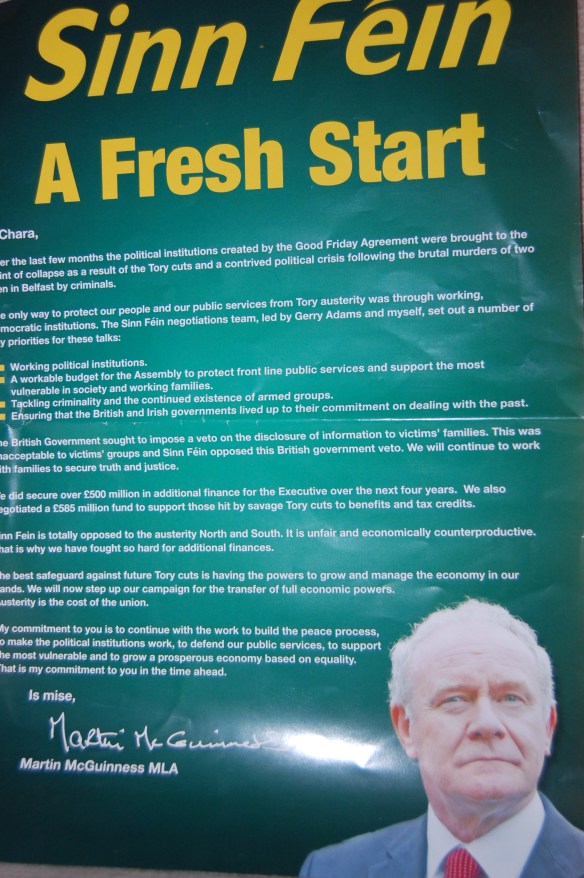
Use ‘ A Fresh Start’ to whitewash your dirty linen – maximum spin programme recommended

2015-11-24 21.25.27

The richest political party in Ireland paid for the Northern nationalist newspaper ‘The Irish News’ to include a glossy leaflet inside it, selling the latest political deal which has been negotiated between it, the British government, Irish government and the Democratic Unionist Party.

It’s called ‘A Fresh Start’ although it isn’t: the whole point of it is to refurbish the previous agreement, of which Sinn Fein had been an enthusiastic supporter.

So it’s not fresh, since it contains no new ideas, and because we have been here countless times before and the main point is to implement the Stormont House Agreement, it’s not a start either.   In fact according to Sinn Fein no fresh start was even necessary.

Not necessary because the first paragraph in its open letter states that the crisis which prevented the implementation of the Stormont House Agreement was provoked by Tory cuts and a contrived political crisis caused by the murder of two people; one of which was carried out by Provisional republicans (so the contrivance must be partly their responsibility).

The other respect in which they were responsible for the ‘contrived’ crisis was their acceptance and then refusal to implement all the Tory welfare cuts, in the process claiming opposition to austerity while implementing it in all its other aspects.   In their leaflet they state that “the only way to protect our people and our public services from Tory austerity was through working the democratic institutions.”  Except that implementing Tory austerity became the only way of saving “the democratic institutions”.

The new deal implements the Tory cuts to welfare, with apparently some local mitigating measures already agreed, and nothing more than that.  The hollowness of the previous angry Sinn Fein opposition to the Tories and their cuts has been exposed through the ‘Fresh Start ‘Agreement making provision for transferring the powers to make the cuts from Stormont to Westminster.  Not so much standing up to Tory cuts as handing over the knives to the Tories to make them.

In parenthesis it may be noted that during all this fake opposition to welfare cuts the people affected were as utterly dependent on Sinn Fein as they are on the benefits themselves and have seen this opposition withdrawn along with some of their benefits.  What it proves is that the only way to protect our people and our public services from Tory austerity is through working people organising to fight back and creating an alternative.

The next paragraph in their open letter notes that Sinn Fein is standing up for victims by demanding the British Government discloses information, which it is refusing to do.  What a pity then that this is repeated on the other side of the leaflet below a picture of Gerry Adams whose complete disclosure of the past involves complete denial of ever being in the IRA.

The next paragraph boasts of “securing over £500 million in additional finance for the Executive over the next four year.  We also negotiated a £585 million fund to support those hit by savage Tory cuts to benefits and tax credits”.

The last deal they walked away from, because it failed to protect welfare recipients sufficiently, provided for £564 million over 6 years.  Sinn Fein claimed that this roughly £95 million per year was not enough “to protect the most vulnerable in our society” but has now accepted that £86.25 million a year over 4 years to cover the same cuts will be a better deal!  The money they claim to have negotiated now – £585 million in total – will have to be set against not only previous cuts but the new cuts to tax credits introduced since the previous agreement.  Even the ‘new’ money may not be new at all and the lone Green party member of the Assembly has claimed that some of it will come out of the existing Social Security Agency budget!

So what about the first £500 million claimed by Sinn Fein?

Well most of that is earmarked for those traditional objects of Sinn Fein sympathy – security and social security.  £188 million will go to security, with £160 million going to the Police Service of Northern Ireland to tackle republicans (the dissident ones?), and £125 million going to clamping down on social security fraud and error ( the irony of this is matched only by their calling those who murdered Kevin McGuigan “criminals”).

In the debate following the Agreement neither Sinn Fein nor the DUP have been able to demonstrate that all the claims about there being new money stand up and that the partial and temporary welfare relief is not just going to be paid by existing budgets.

So when Sinn Fein claims in its leaflet that “Sinn Fein is totally opposed to the austerity North and South” this really means nothing very much in the North and will very likely mean not a great deal in the South either.

In the penultimate paragraph it says that “the best safeguard against future Tory cuts is having the powers to grow and manage the economy in our hands.”  So how have they done this and how do they propose to do it in future?

Well, the Agreement notes approvingly the reduction of 7,410 jobs from state employment in the three years between April 2014 and March 2016 and “If cost cutting does not achieve the results required the Executive will “consider revenue raising measures.”   To indicate the meeting of minds involved, and to demonstrate that we are all in it together, “the Executive commits itself to lowering corporation tax to 12.5% in April 2018.”

In addition the British Government will legislate to ensure that local spending plans cannot exceed what is permitted and will review the Block grant to Northern Ireland after four years to take account of the effect of the reduction in corporation tax, no doubt with a view to further reductions.  How all this is opposition to Tory austerity is anyone’s guess.

Rather stupidly the other side of the Sinn Fein leaflet advertises the opposition of the British Government to disclosing its role in the past, about which Sinn Fein has achieved absolutely nothing.  The Agreement includes as the first of its principles “the ending of paramilitarism”.  This is straight after The British Government has issued an ‘independent’ report saying that the IRA army council still exists, and of course following the murder of Kevin McGuigan, all while Sinn Fein continues to claim that the IRA has left the stage.

On the Unionist side the repeated collaboration with loyalist paramilitaries by the unionist parties is studiously ignored.

It would be tempting to point the finger at both Sinn Fein and the DUP for their hypocrisy but the British have a special talent when it comes to this sort of thing.  It was reported only last week that there have been only ten convictions based on membership of a paramilitary organisation since 1998 and none for nearly seven years.  So how come, all of a sudden, it’s become such a big deal?

A new task force made up of the Northern and Southern police forces and tax authorities is to be established but this will achieve what its masters want it to achieve.  It is the stick to the carrot of additional (or not so additional) money.  However, as it’s a cross-border body it’s clearly aimed at republicans.

What sticks in the craw most about this part of the deal is that the Executive, made up of Sinn Fein and the DUP etc., is to “undertake a public awareness campaign to raise public understanding of the harm done by paramilitarism.”  Yeah, we really don’t have a clue.

The heading for a ‘Shared Future’, costing £60 million over four years, gets one paragraph and explains nothing, which could mean it will never be spent or might be spent on buying off ‘community representatives’, as flagged in the latest loyalist offensive for ‘inclusion’ of their gangster outfits in the Stormont gravy train.

By contrast the section ‘Irish Government Financial Support’ gets two and a half pages, with the highlight a meager £75 million for a road, although it also includes such key aspects of the Agreement as “development of further cross-border Greenways and Blueway cycling-walking-water leisure routes, including the Ulster canal.” The Irish Government also champions the use of private finance to fund further infrastructure projects.  In other words the Irish Government is pretty irrelevant except to allow nationalists to claim some role for it, what role is pretty clear.

The rest of the Agreement promises to implement the previous Agreement on Flags, Identity, Culture and Tradition.  So, while the paper mentions sectarianism twice it mentions Flags twenty-two times.

The ‘Fresh Start’ also rather embarrassingly reminds nationalists that the British Government endorses “the need for respect for and recognition of the Irish language in Northern Ireland” but again this means nothing and reminds everyone of the failure of Sinn Fein to achieve its long held objective of an Irish language Act.

What to do about the past is the one area where failure is so total that the Agreement has to admit it.  Yet, rather than skirt round the issue in its leaflet, Sinn Fein states that dealing with the past was one if its four priorities – so what happened then?

If the only thing now that has yet to be agreed, and which will therefore involve yet more talks, is about the past, it will continue to be easy to present the problem as one of living in it.

The Sinn Fein leaflet then is a catalogue of failure and the new Agreement is an attempt to build on that failure.  It is such an open declaration of defeat that even some of those opposed to Sinn Fein appear to find it a bit embarrassing.  The ‘Irish News’ columnist Newton Emerson begins his assessment of the Agreement by saying:

“The ‘fresh start’ agreement is such a total defeat for Sinn Fein that it is positively bizarre.  Even as a unionist, I find it unnerving”

The leaflet aimed at their supporters is just as bizarre as their negotiations and their spin on it is empty and pathetic.

It should also be said that the Agreement is also a rejection of unionist appeals to take steps to ditch Sinn Fein and allow the unionists to begin running the local state apparatus without them.  This would represent a clear break from British strategy and a divided unionism is in no position to achieve this.

Besides, for the British, with ‘enemies’ like Sinn Fein who needs friends?


How can you support a united Ireland and not support Scottish independence? Part 2

Roy-Keane-as-Braveheart-Paddy-Power-3When Irish unionists claim rights to self-determination history has shown that this is not a claim for equality but a claim on behalf of sectarian supremacy – a claim to the right to inequality.

But, the question can be put, if socialists regard self-determination as a means to facilitate the voluntary unity of nationalities surely a united Ireland will itself involve the forcible suppression of Protestants and of Protestant workers?  This would mean that while Irish unionism has no legitimacy the alternative of a united Ireland is also not one that socialists can support?

Some on the Left have stopped there, accepted this, and said that the only solution to the question of democratic national rights in Ireland is therefore socialism.  This tends to come from those for whom every thorny problem is solved by the invocation of socialism.

Workers’ opposition to mass immigration? A socialist society with full employment, great public services and housing would deal with objections.  Economic crises, with periodic mass unemployment and cuts in living standards? A socialist society!  Women’s oppression and racism? Socialism is the answer.  Workers’ passivity in the face of their right wing leaders’ betrayals?  A revolutionary party with a socialist alternative.  Sectarian division?  Workers unity around a socialist programme!

Such solutions are not so much an answer to a specific problem as an invocation that the problem would simply go away if it were made not to exist. It invokes an alternative reality and not an alternative set of policies to get there.  It says that the problems and challenges faced by workers are solved by socialism when in fact the reality is the reverse – socialism is created by workers.

This means working people being persuaded and organised to present answers to all these different questions, not invoking an idealist formula disembodied from those whose conscious actions alone can bring them about.  And the only people who can do this are working people themselves, with those who are socialists attempting to advance this process.

In the case of Ireland, the point of opposing self-determination for the Protestant Irish in the North is that such a claim is not compatible with workers’ interests.  It is not an invitation to violently impose a united Ireland.  Its purpose is to explain that the claiming of such rights is reactionary.  It is meant to identify unionist and loyalist ideas and movements as right wing by virtue of the demands they hold most dear.  In this sense the demand for a united Ireland is not one taken up despite the Protestant population but because of it, because it is they who are most saturated with reactionary sectarian and imperialistic ideology.

Treating it as a sanction to pursue an armed struggle against the wishes of the artificial majority in the Northern State is part of the Irish republican liberal understanding that there are rights which, if they exist, should be exercised regardless of any considerations of the reality in which they are supposed to be grounded.

This means for example that armed struggle by republicans is justified by the principle of the right of the oppressed to fight their oppressors by any means necessary, without stopping to ask ‘by any means necessary to achieve what?’  It means rights asserted as abstract principles without regard to efficacy or morality.

Socialism on the other hand is based on workers’ interests and needs grounded in the world they live in and not of abstractions that efface these needs and interests.

Opposition to Scottish independence by socialists can therefore only respond with bemusement to nationalist claims that every other country to achieve ‘independence’ has not wanted to go back, so that it can’t therefore be such a bad idea.

Well how many of these countries are really independent, of the requirements and pressures of capitalist globalisation for example?  How many of the workers in these countries have had their basic needs and interests resolved by the ‘independence’ of the countries they live in?  In what way does the principle of separation of itself address these problems; meaning have these nationalists really considered the alternatives; meaning also that if they have, this particular argument is not really one of principle at all.

The nationalists who claim that there are 200 or so nation states in the world – why has Scotland to be different – might want to ask how this world of nation states has fared in the twentieth century and whether it has been such a good way to order the world’s affairs.  Or have two world wars taught nothing?  Perhaps a look at the character of many of these states might make one think twice that this model is one to emulate.

When it comes to the demand for a united Ireland such a demand is both abstract and unrealistic outside of its insertion into a social and political struggle that understands it, not as the demand for a new Irish capitalist state, but as a means of reducing division; including by rejecting sectarian claims to state legitimacy and power by the Protestant population and rejecting the intervention of the British state to uphold such claims.

But it also means rejection of all the other ways in which division is imposed, including sectarian organisation of education and other state services both North and South, religious imposition of restrictions on women’s rights, sectarian employment practices, sectarian political arrangements such as Stormont and state sponsorship of armed sectarian paramilitary outfits.

It means building alternative centres of working class identification and power including a non-sectarian and anti-sectarian labour movement, trade unions and political parties, democratic campaigns, and workers cooperatives where workers livelihoods directly depend on their working together.

This socialist agenda is light years from nationalist answers. By understanding this workers might be able to see that the arguments of nationalists, their claims for rights that do nothing for workers, and their claims to address grievances which are either spurious or actually derive from class oppression are false.

concluded

How can you support a united Ireland and not support Scottish independence? Part 1

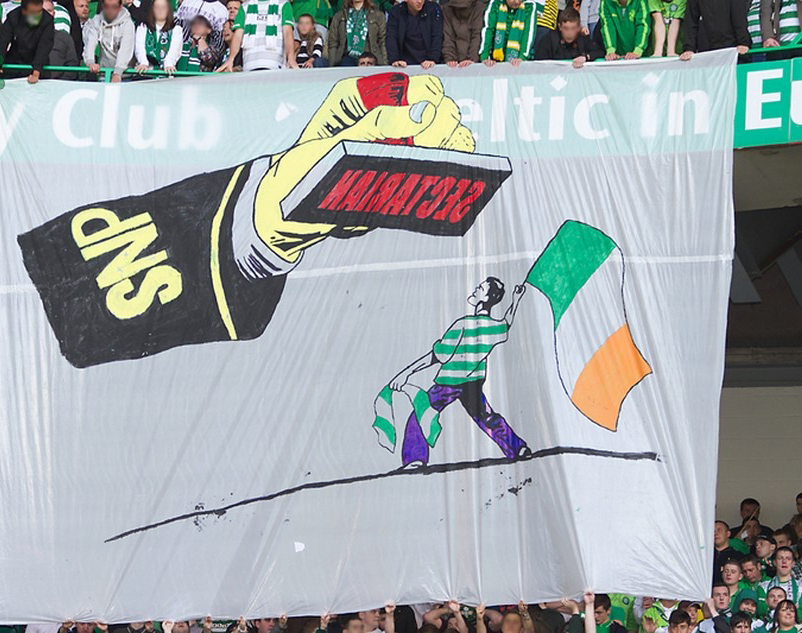
Celtic snp2_310902033This week I had a conversation arising out of Jeremy Corbyn’s interview in the Andrew Marr show on the BBC.  Like others I have spoken to who saw it I can’t remember ever making a point of watching until I knew it featured this interview.

The basic issue that arose was how Corbyn could claim to support a united Ireland but oppose Scottish independence.  Surely if you support the independence of one you should support it for the other?

Given that I agree with Corbyn I answered this question by pointing out that in both cases we were talking about removing borders (or stopping them being erected) and thereby preventing barriers to unity.

Through a united Ireland the unity of Irish people would be advanced, and by opposing the separation of Scotland from England and Wales you would support the unity of British people.  Since unity of the working class irrespective of nationality is a basic socialist principle it would require some argument to trump it.  None has been advanced for Scottish separation that isn’t either factually incorrect (like Scotland is an oppressed nation) or exceedingly weak (it would also be good for the English!).

An obvious response would be – does that mean you are also in favour of unity of Britain and Ireland?   And the answer is yes.  Provided the unity was one of equals, then there could be no objection to political arrangements that would further the erosion of national division and increase the grounds for united action by the working classes of the nationalities involved – English, Scottish, Welsh and Irish.  Previous unity of the islands involved British imperialist domination that was rejected by the majority of the Irish people and history demonstrated that no unity of the peoples was possible under these conditions, at that time at least. As I pointed out in this discussion – I am in favour of a united Europe.

The independence of Ireland has not been an over-riding principle for socialists and this is something that divides us from republicans, including those describing themselves as socialist republicans, or more bizarrely, republican socialists, whose socialism is in reality a variety of republicanism.  So much so that their socialism is not a means to overcome national division but a means of emphasising their nationalism: ensuring what they believe will be effective independence as opposed to nominal independence under a neo-colonial yoke.

What matters to socialists therefore is the unity of people, particularly of the working class, which is the bearer of a new socialist society, and not particularly the unity of state formations.  This is why socialists support self-determination so that unity is the voluntary unity required to overcome national divisions and not the forced unity of foreign rule and occupation.

As I have said before the absence of violent repression by English armed forces in Scotland stands in stark contrast to British repression in Ireland.  So while socialists support self-determination for Scotland we believe it should be exercised by continuing voluntary unity with the rest of Britain.  That the majority of Scottish people decided this in the referendum is therefore to be welcomed.

But if this is the case why do I support the unity of the Northern and Southern Irish states when quite clearly the majority in the north do not favour unity with the south?  Surely that would involve the coerced unity that you have just said you oppose?

Let’s leave aside for the purposes of this argument that unlike the Scots the population of Northern Ireland is not a nation and therefore not subject to the right of self-determination.  Leave aside also the argument that even if we restrict ourselves to the Protestant population it too, while being an identifiable people, are also not a nation and any purported right to self-determination on their behalf is transparently a means of frustrating the right to self-determination of the Irish people as a whole.

We’ll also ignore the historical fact that any declared separateness of the Ulster Protestants is inaccurate because it does not refer to Ulster but a truncated part of it and did not seem to arise when the whole of the island was ruled by Britain, when the Protestant population in the North was quite happy to consider itself Irish, the specifically ‘loyal’ part of the nation.

It’s much harder to put aside the coerced separation of partition and the continual violence needed to maintain it even if this is usually, but not always, ‘merely’ in the form of a threat to the majority of the Irish people residing south of the border.

We will however also ignore the visceral opposition to considering themselves Irish that some Northern Protestants express when the idea of a united Ireland is proposed.  Down this road leads capitulation to the most deranged bigotry – I recall being told by my father that my uncle refused to eat off a white plate with a green trim in a bed and breakfast in Blackpool, such was his sectarian impulses.  He even apparently showed some ambivalence about supporting the Northern Ireland football team because they played in green – much better the red, white and blue of Linfield and Rangers.

While it is of no interest of socialists to impose national identities on peoples against their will it is necessary for such identities to have some grounding in reality to be considered seriously by everyone else.

On this basis however it might seem that Irish Protestants in the northern state have some grounds to claim separate political rights since they obviously are in some senses a separate people.  It might appear that it doesn’t matter whether this is a nationality, defined as ‘Northern Irish’ or as simply British inhabitants of part of Ireland, or both.

What matters however again is the objective basis for claiming rights to self-determination because some of the argumentation above is really beside the point.

And the point is that (some) Irish Protestants have been provided with what they can consider self-determination, exercised as unity under the British state, which they chose to participate in through rampant and systematic sectarian discrimination; itself reflecting the objective fact that their claims for national status were based primarily on sectarian self-identification as a colonial population in what they considered, when it suited them, was (26/32 of) a foreign country.

Since for socialists national rights are democratic rights, which are reactionary if without democratic content, it would appear that the right to self-determination of the Irish/Ulster Protestants or Northern Ireland, however one wants to put it, is a reactionary demand that cannot be supported.  And it cannot be supported because not only does it not facilitate the unity of peoples but it furthers their disunity along sectarian grounds, plus the division that arises from living in two separate Irish states.  The violent and sectarian history of this self-determination is cast iron proof of the thoroughly reactionary nature of Irish unionism.

Political propagandists and political murder in Belfast

Feeney 1imagesAs the political crisis generated by the killing of Gerard McGuigan by IRA members threatens to spiral out of control the politically weary population is invited to pick sides on what is to happen next, with seemingly everyone in favour of keeping Stormont while everyone knows it’s rotten.

This appears to put the onus on being able to blame someone else in order to defend a sectarian corner and the particular rights assumed inside the settlement.

The ‘right’ attitude to the killing has therefore to be asserted first, although it is of the least concern to the parties involved in yet another round of talks.

As a result a notable feature of reaction to the murder of Gerard McGuigan has been the propensity of nationalist commentators to ventilate on the synthetic character of unionist outrage at the murder.  In other words the outrage is fake – they don’t care about dead ex IRA men.

If that were the only point being made the response should be one of agreement.  Yes, unionists have ignored state and loyalist violence and have collaborated openly with paramilitary groups so their condemnation of republican violence is hollow.  They don’t care about dead IRA men and their actions since the latest killing is guided by purely party political calculations.

But that isn’t all there is to it.  The point being made by these nationalist commentators is that what has happened shouldn’t be allowed to upset the current political arrangements because the outrage is phoney.  Just as I pointed out in the previous post on this (that the new peace institutions are now the justification for ignoring the killing of others) so expressing outrage at the killing is also to be discounted because the main unionist complainants are insincere.

And the fact that this outrage is insincere means that this is a purely manufactured crisis that originates in unionist bad faith.  This bad faith is therefore the problem.  The perfidious British however have turned this around, as they usually do, in order to appease unionism.

So nationalists are invited by these commentators to believe that what must be discussed now is not what the danger is to those who fall foul of the Provisional IRA but how the institutions can be saved.  The British are happy to go along with this but add that this involves giving the unionists confidence.  But since this a purely subjective thing we are in the world of Humpty Dumpty – confidence means just what unionists choose it to mean, neither more nor less.

So yes, nationalists have a point about pandering to unionist hypocrisy but they have a problem when they allow this hypocrisy to become their moral compass by replying to unionist hypocrisy with their own.

They have a problem when they excoriate British pandering to unionist violence while turning a blind eye to Provisional murder.  So the outrage at the latter is fake – let’s ignore both it and the event that occasioned it.  Then we can have our equal and opposite hypocrisy.  Unionists complain about Provo violence but we will turn a blind eye to it and complain about loyalist violence.

In this way the sectarian perfect circle of hell attempts to trap everyone within it, everything and everyone is to be defined by sectarian division.

A prime example of this capture by sectarian division, involving capitulation to acceptance of reactionary political violence, can be seen in the regular political columnist in the largest nationalist paper in the North, Brian Feeney in yesterday’s ‘Irish News’.

So the police fingering of Provisional IRA members for the murder of Kevin McGuigan was “ill-considered”.  As I also pointed out before – I wonder would he therefore have considered well-judged the previous failure to finger the loyalist UVF for the attempted murder of a young woman in the same area.

Feeney had a previous column on the unionist invention of the 1960s civil rights campaign as an IRA plot, a fiction of course, but what had this to do with the real IRA plot to kill McGuigan, unless he wanted to claim it too was another unionist fiction?

Instead he goes along with the Sinn Fein line that what this is all about is unionist refusal to live in equality with nationalists: “This refusal to accept mere equality prevents them seeing themselves in the same light as nationalists and republicans.”

He appears totally oblivious to the fact that with this attitude of Nelsonian ignorance of IRA responsibility in murder he should really be writing that nationalists should now see themselves in the same light as unionists, united equally in the same light of sectarian blindness.

By such a descent into sectarianism are nationalist claims for equality to become nationalist equality in sectarianism, which is indeed the political project of Sinn Fein.

He then makes hay with silly and insensitive remarks about “the futile and fatuous attempt to abolish the IRA.”  How would anyone know “if someone has left the IRA? . . how would anyone prove they’d left?”

So does Feeney not want to see the end of the UDA and UVF?  Would Feeney be questioning as futile and fatuous calls for an end to loyalist paramilitaries if they had just killed someone?

Sure how would you know whether they or the Provisional IRA had gone away or not?

Well here’s a start.  You might have a chance of convincing someone they had disappeared if they didn’t kill those who fall foul of them.

Feeney complains that the leader of the DUP Peter Robinson needs to feel that he is “not bound by any constraints that apply to normal relationships.”  Leaving aside what counts for normal in the North of Ireland, does he not think such a remark might also be pointed in another direction?

It was bad enough when the British so openly overlooked and colluded in political murder by loyalists but their shameless excuses for the Provisional IRA and its supposed peaceful intentions complete the circle that working people in the North have to break from.  In this case nationalist workers should see through the muck apparently thrown at the British and unionists because it’s really being thrown in their eyes.  Who else is expected to listen to Feeney?


The politics of murder in Belfast

images (11)The murder of Kevin McGuigan on 12 August in East Belfast is widely seen as revenge for the former’s claimed involvement in the earlier murder of Provisional IRA leader Gerard ‘Jock’ Davison.

The Police Service of Northern Ireland (PSNI) have done their bit to protect the Provisional movement by claiming that although Provisional IRA members were involved there is no evidence that it was authorised by the leadership.  Since complete denial of Provo involvement would stretch credibility to breaking point and reflect on the PSNI as well as the Provos, this was as much as they could do.

Of course this makes no sense, although it was notable that some nationalist commentators were prepared to swallow it.  Much amazement was feigned by unionists that an IRA even existed, so ‘answers’ were demanded.  The British Government said that of course it knew the IRA existed but that what was important was what Sinn Fein said (i.e. not what the IRA actually did) and especially that it continued to express support for the ‘principles of democracy and consent”.

The Garda in the South had previously claimed that the IRA had no military structure but are going to look at it again and the PSNI claimed it was a lobby group for “peaceful, political republicanism”.  Sinn Fein spokesmen claimed that of course the IRA was not involved, that it had “gone away” and all allegations to the contrary were ‘palitics’.

So the Provos continue to support the police but not as far as allowing them to get in the way of taking revenge or protecting themselves and their enormous financial empire. Support for the police is therefore purely ‘palitical’.

In the hypocrisy and lying stakes each out-does the other.

So the British Government and PSNI are claiming that while a much slimmed-down ‘peaceful’ IRA exists there is no evidence that it sanctioned the murder of McGuigan; although investigations will continue, which means that if it suits the political purposes of the British Government such a judgement can be easily changed. And easily justified – a ‘peaceful’ IRA with guns, that murders its enemies, and which by its very reduced size and tightness makes inconceivable the idea that the murder was not approved from the top.

The meaning of this is obvious: the British state and its police force doesn’t care if the Provisional IRA kills people it doesn’t like.  It doesn’t care if loyalist paramilitaries kill people they don’t like. Round the corner from where McGuigan was killed a young woman was almost killed by the loyalist Ulster Volunteer Force but the PSNI refused to blame the UVF who were responsible.

Today it is reported that the murder of another Short Strand man Robert McCartney by the Provos was subject of a secret deal between the PSNI and Provos, with the cops offering not to go after those who cleared up the murder scene, in exchange for Provo information on the less important hands-on killers.  No one has gone to jail and the Provos kept their mouths shut.

The political import of the killing is the following:

The Provos can kill and the state will give them impunity but it will expect a price to be paid.  Anyone who thinks that the end of Sinn Fein’s meagre opposition to austerity through opposition to some welfare cuts will not form part of the price probably believes that everything that the British Government, police, unionists and Sinn Fein has said about the murder of Kevin McGuigan is 100% true.

A message has been sent to all enemies of the Provos, political or criminal, that they are willing and able to kill, no doubt under some new set of initials such as AAD (Action Against Drugs).

The slow crumbling of the architecture of the political peace settlement has speeded up and now threatens the current arrangements.  The Ulster Unionist Party has withdrawn from the all-party Executive, putting pressure on its supposed more rabid rivals in the DUP to follow its lead.

The DUP has now proposed that Sinn Fein be expelled from the Executive, although Sinn Fein can prevent it, and only the British Government can do this.  If the British do not support such a move the DUP would then be forced to either put its money where its mouth is and walk themselves, bringing down the Executive, or reveal themselves as joined at the hip to the Provos in the great gravy train on the hill.  It might then start losing support.

As the pro-settlement ‘Irish News’ editorial put it today, the Executive is so discredited most will not care if it remains or goes.  And as I have noted before, the current Stormont regime is so rotten it has little credibility left.

The peace process has been built on the lie that the rotten sectarian arrangement brought about the absence of widespread political violence.  In fact the defeat of the Provos and the ending of widespread violence preceded the creation of the rotten sectarian arrangements.  Again and again the sectarian political settlement has been defended by the claim its overthrow would bring us back to the troubles.

The recent killings demonstrate precisely the opposite.  The existence of the sectarian Assembly and Executive is now justifying collusion between the state, Provos and loyalist paramilitaries in violence, intimidation and large scale criminality.  The message from the British pro-consul has been explicit:  as long as Sinn Fein supports the sectarian settlement and police that is what counts.  What it actually does will be excused and glossed over if remotely possible.  The so-called peace settlement and its preservation is now the justification for allowing political and criminal violence.

Socialists must continue to oppose this rotten settlement.  They should continue to oppose the PSNI and expose its collusion with the Provisional IRA and loyalist paramilitaries.  They should oppose the austerity imposed by the British Government and the Stormont parties, especially Sinn Fein and its phoney anti-austerity posturing.

It should likewise refuse to offer political support to any opposition by Sinn Fein to its exclusion from Government should this occur.  The Provisional movement is an obstacle to working class people in the North and South of Ireland identifying their own interests and defending them.

The UK general election part 3: sectarianism and democracy

SF 1 downloadIn the final post on the UK general election I want to look at the results from my own little polity and the political slum that is Northern Ireland.  Like all slums the blame for its condition lies with the landlord, the British state.  As usual all the tenants hope and expect that the landlord will clean it up. But it never does.

There the analogy should rest.  The most recent election was notable for what the front page of the Northern nationalist paper, ‘The Irish News’, described as ‘Nationalists turn away from the polls’.  Their parties, Sinn Fein and the SDLP, collected 38.4% of the vote while the DUP and Ulster Unionists captured 41.7%.  The latter figure does not include the various other unionist parties such as Traditional Unionist Voice and UKIP which brings the unionist total to 46.6%. If we include the Alliance Party, which is a unionist party in all but name, the unionist vote was 55.2%.

The message?  There isn’t going to be a United Ireland any time soon.  The Sinn Fein vote went down slightly by 1% even while the SDLP vote declined by 2.6% and it lost the Fermanagh and South Tyrone seat, not the way they wanted to enter into the historic hundredth anniversary of the 1916 rising.  ‘The Irish News’ explained that the nationalist vote had declined to its lowest level since the 1992 Westminster vote, which is before the ceasefires. That is, before the current peace process ‘strategy’ of republicans was/is supposed to deliver a united Ireland.

None of this fits with the accepted story of a rising Catholic population and a more and more demoralised Protestant one.  Sooner or later, the story goes, there will be a Catholic majority that will vote in a united Ireland. The truth of this is accepted by many and, I would hazard a guess, by many who would deny it vehemently in public.  I remember my aunt, a Shankill Road Protestant, remark about 25 years ago that there would eventually be a united Ireland, but not in her lifetime.  And she was at least half right in that.

Socialists have always supported self-determination for the Irish people as a whole, as the only democratic response to the Irish national question.  Not of course universally.  The Militant Tendency/Socialist Party tradition with its notoriously statist view of socialism, which incidentally has nothing to do with Marxism, has always managed to get it wrong.  Its statist view has seen it join left nationalist formations in Britain such as NO2EU, and it led the rightward collapse of the left in Scotland into Scottish nationalism.  In the North of Ireland on the other hand, entirely consistent with its accommodation to whatever nationalism is strongest, it has capitulated time and time again to loyalism and the British State.

This general response of socialist to the national question remains correct but the growth of nationalism in the North of Ireland, which now appears halted, has demonstrated that democracy is not a classless construct.  Bourgeois democracy in a society which has always been characterised by sectarianism has definite limits.

These limits are demonstrated in the more and more sectarian expression of northern nationalism.  This means that the expression of democracy by the working class can only be of a non-sectarian character, or it would fail to be a particular expression of the working class.  In other words the expression of a democratic alternative to partition must come from the working class and not from any nationalist formation.  It must therefore be non-sectarian, not in an unconscious sense, in which to be anti-imperialist is somehow also to be ‘objectively’ anti-sectarian, but in a conscious sense that this is the key objective – of uniting the working class.  Just like Scotland so must this be the case in Ireland, that socialism cannot be derived from what happens to be bad for the UK state but from the political unity of workers.

The degeneration of Sinn Fein and Irish republicanism demonstrates that fidelity to the belief in a united Ireland is no guarantee of progressive politics.  It used to be said that Irish republicanism was largely confined to Catholics because of sectarianism and this also remains true but it is also now the case that the Irish republicanism of Sinn Fein is confined to Catholics because it is sectarian.

Once the Provisionals stopped fighting the British and decided to join in the governance of its system, and started asking the landlord to sort out the slum – the landlord responsible for its creation – it stopped having any claim to progressive status.  It then became the most militant and vocal champion of Catholic rights, not civil rights, but sectarian rights.  This has been exposed in the case of a prominent Sinn Fein Minister and also in the recent election.

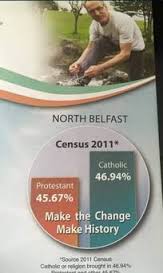
In North Belfast Sinn Fein put out an election leaflet that included a graphic showing the Catholic and Protestant proportions of the constituency, the none too subtle message being that the majority Catholic constituency should be electing a Sinn Fein MP.  But of course that also means that Protestants must vote for the sitting Unionist MP.

The Sinn Fein excuses for it only bury it deeper in the sectarian mire.  First the excuses arrived only after it spent weeks defending the leaflet.  Then it wanted, it said, to use the terms nationalist and unionist but the Post Office said census figures had to be couched in terms of Catholic and Protestant.  So what it is saying, after trying to blame the Post Office, is that  instead of rejecting the graphic it decided that yes indeed substitution of Nationalist and Unionist by Catholic and Protestant was fine.  Now we know what it means when it uses the former terms in future.

Oh, and one more thing.  It regretted its decision to include the graphic – as Mr Gerry Kelly said “I think, in retrospect, the decision then should probably have been to withdraw the graph, because it did give an argument to our opponents, whether that was the SDLP or unionists.”  Yes Gerry, you’re right about that.

SF2images (10)

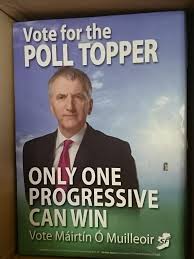
The reactionary position of Sinn Fein was also demonstrated in another graphic used on its leaflet for their candidate in South Belfast.  Having misleadingly described the candidate as ‘the poll topper’ – in fact the sitting MP was from the SDLP – it then said he was the ‘only Progressive Candidate who can win’ – clearly not the case since the SDLP were not listed by the leaflet as one of the five parties ‘united for austerity.’

These five parties were the Conservatives, DUP, UUP, UKIP and Alliance Parties. One of these parties stood out from the others – the DUP.  Why? – because Sinn Fein is in permanent coalition with this party.  And at the time the leaflet was put through the doors the Tories looked like they might be relying on the DUP to get them into power.

Wouldn’t that have looked lovely – the so-called anti-austerity Sinn Fein in Government with the DUP who were keeping the austerity-inflicting Tories in Government.  Don’t bother to try to work out how Sinn Fein would have justified it, they have been justifying inflicting one of the most right wing parties in Europe on this part of the continent for years.

‘The Irish News’ front page has reflected the disorientation of Northern nationalism following the election.  It produced some commentator to explain what had gone wrong.

Apparently  there is a ‘growing number of nationalists who appear switched off from the electoral process (reflecting) a community more at ease with Northern Ireland.’

The commentator said that “I think unionism is more highly strung about identity issues.  Nationalism is more happy in general with the status quo and there is a lack of competition between the parties.  Nationalism is suffering a retreat.”

Almost all of this is rubbish.

Yes, nationalism is suffering a retreat, it’s been retreating for years, and now endorses the legitimacy of partition and its institutions, the British nationality of Irish Protestants and the unionist veto on a united Ireland.

Contrary to its assertion, there is no lack of competition among nationalist parties and unlike unionism there was no electoral pact between the SDLP and Sinn Fein during the election.

Relatively high unionist participation in the election is not because they are more highly strung about identity; in fact the lack of unionist voter participation has been remarked upon for years.  Did they suddenly get a fit of the nerves just recently?  Newspapers have recently reported increasing numbers of parents from what is called ‘a Protestant background’ refusing to designate their children as Protestant at school.

The fall in the nationalist vote is not because nationalists are happy with the status quo but exactly the opposite.  The stench of nepotism, cronyism and corruption from Stormont is all the more repelling on the nationalist side given the claims to radical politics and progressive change from the nationalist parties, particularly Sinn Fein.

Instead the DUP/Sinn Fein coalition Government has been beset by crisis, incapacity, incompetence, secrecy, arrogance, lack of accountability, lack of transparency and financial scandal.  The simplest of questions don’t get answered for years (perhaps never) by Government departments with dozens of communications staff.

The latest such offerings are the revelation of the extent of the employment of Special Advisors (SPADS) employed by all the parties in office without any public recruitment process.  These SPADS are supposed to bring special skills to their political masters, the most prominent of which appears to be their close connection to the parties and their ability to hide any special skills.

freedom of information request revealed that in one financial year the Stormont Executive spent almost £2m on these SPADS, more than the Scottish and Welsh governments combined.  In 2013/2014, the pay bands and grades for these special advisers varied across the UK, going from £36,000 up to £91,000.  In Scotland, three of them were in the top pay band while at Stormont all 21 posts were.

The second is the scandal around a contractor to the Housing Executive which we reported on before here and here.  The SPAD at the centre of the controversy, far from being dumped has been promoted while it is reported that the DUP member who took a more principled stand is being subject to disciplinary action by the party.  At the end of an editorial dripping with scorn ‘The Irish News’ declared of the Stormont regime that “it is increasingly doubtful if the institutions are worth preserving in the first place.”

When the main voice of constitutional nationalism expresses exasperation with the peace process institutions it really does mean a lot of nationalists are thoroughly disillusioned.  This is one of the main results of the election.  In itself it is not a positive but it is certainly a prerequisite for one to develop.


Racism and anti-racism in Belfast


DSC_0117“Islam is heathen, Islam is satanic, Islam is a doctrine spawned in hell.  Enoch Powell was a prophet, he called it that blood would flow on the streets and it has happened.”

When a Protestant minister in North Belfast’s Metropolitan Tabernacle Church declared that Islam was “satanic” and “heathen” and compared “cells” of Muslims in Britain to the IRA the First Minister of Northern Ireland, Peter Robinson, who is known to have attended the church, was widely called upon to speak out.

Oh dear.

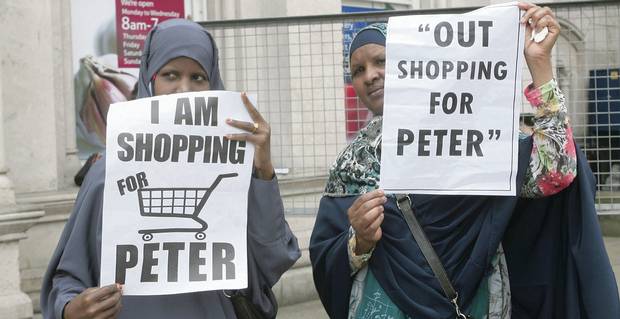
When he did, he said that Pastor McConnell had been demonised, that it was the duty of any preacher to denounce what he described as “false prophesy” and said he would not trust Muslims either, particularly with regard to those who had been involved in violence, or those who are “fully devoted to Sharia law, I wouldn’t trust them for spiritual guidance”; however he would trust Muslims to “go down to the shops” for him or to deal with a number of “day-to -day issues”.

Cue lots of people with their heads in their hands, especially those considering the Northern Ireland administration sponsored trips to the Middle East to promote trade and investment.

NWS_2014-06-02_NEW_006_31867640_I1

A newly elected unionist councillor for Belfast had that week been found to have tweeted a year earlier that “I’m so sick of the poor Catholic b*stards they make me sick I wish they would just go down to Ireland . .” but she was young and sectarianism is hardly news in the North of Ireland unless someone in the media decides to make it news.

But racist attacks, especially by loyalist paramilitaries, have already been in the news and have increased by 43 per cent over the year, twenty seven per cent of them in North Belfast.  Having been called upon to comment in order to denounce racism, Robinson was then called upon to apologise for his own offensive and insulting remarks.

Anna Lo, the Hong Kong born local politician, had just received some racist harassment herself and called upon him to resign if he did not publicly apologise, vowing to leave Northern Ireland because of local racism and  sectarianism and stating that she would not stand for election again.  One Democratic Unionist Party councillor then called her a “racist” and was dropped by that party as its candidate for mayor of Newtownabbey, which is adjacent to North Belfast.  Other ministers and unionist politicians backed McConnell and claimed Christianity was being persecuted.

Two Muslim men where then beaten in their homes in the north of the city and stated that their attack was connected to Robinson’s statement – he had “lit the fire”.

Some in the press and other unionist leaders attempted to minimise the impact of the insult by claiming he was just clumsy.  Michael Nesbitt, leader of the Unionist Party, claimed that “we say things we don’t really mean or express them in ways that perhaps we could have thought through better.”

Robinson then made a private apology to some prominent local Muslims, except it wasn’t an apology.  He didn’t admit to being wrong, did not withdraw the remarks and did not say he was unconditionally ‘sorry’.   What apparently he did say was that “If” anyone thought he had said anything derogatory “he would be hurt” and he would apologise, but he didn’t because he didn’t think so.  He had been ‘misinterpreted’.

So he might be the injured party in this episode and it was everybody else’s fault for not understanding him.

But still the calls for a public apology raged and eventually Peter Robinson did publicly apologise – except the apology wasn’t public.  It was one of those occasions when the media reports something and you look to see when and how it happened but you can’t actually find any evidence of it having happened, and when you look closer it appears that it hasn’t actually happened.  Yet most assume it has because it has been reported and before you now it it has happened because, well, that is how it has been reported.

In such cases this can only occur because everyone with any power to get across a media message has decided it’s in their interests to go along with the concealment.  For the unionist parties the interest involved is obvious.  Any gain in stature among its racist, sectarian and lumpen base has been achieved, while the reality of selling local business to Saudi Arabia etc. cannot be ignored so the controversy has to be closed down.

The British Government especially would be happy for the story to die no matter how this might happen and they showed no intention of doing anything that might shine a light on the bigoted character of their local political settlement, sold to the world as a model to be admired and to emulate.

But what about the nationalists, including Sinn Fein?  The second dog that did not bark was the failure of these parties to call upon Robinson to resign, as – to her credit – Anna Lo did.  Had such remarks been made in Britain by a leading member of the Conservative Government their feet would not have touched the ground as they headed for political exile and extinction. But not here.

What we got here was a bland resolution sponsored by Sinn Fein in the Northern Ireland Assembly opposing “racism, discrimination and intolerance of any kind, wherever it occurs”  but for God’s sake don’t mention that the First Minister has promoted all three.

What such resolutions reveal is not the willingness of Irish nationalism to oppose racism and bigotry but its willingness to avoid doing so, to avoid identifying and condemning it in reality, to replace lofty, banal and meaningless condemnations of racism in general for dealing with it in concrete reality.

Sinn Fein is setting itself up to be in Government North and South in 1916, 100 years from the Easter Rising that saw the beginnings of an attempt, that failed, to achieve Irish independence.  To do so it must ensure that there is an administration around in the North for it to be a part of.  Since this requires unionist participation no provocation or act, irrespective of how outrageous it is, will be allowed to threaten the political structure in the North no matter how rotten, dysfunctional and bereft of credibility it may prove itself to be.

In this way a political settlement based on sectarianism demonstrates its bigoted logic by ensuring that the most offensive statements can be made without fear.   In this way, but not only in this way, Irish nationalism becomes complicit in feeding the bigotry on which the Northern state rests, even while it self-righteously insists on its own non-sectarian character and its supporters continue to be the main victims of the bigotry.

What the Government parties are called upon to do, unionist and nationalist, is to deliver another document on “building a united, shared and reconciled community “, another piece of paper reviewing Stormont’s ‘Unite Against Hate’ campaign and together parrot inane promises from within ”its clear commitment within the Programme for Government.”

So if nationalism cannot provide an opposition to racist bigotry who can?

In a demonstration of thousands called quickly over social media a trade union spokesmen could only say that it was organised “in response to a worrying increase in the number of racist attacks in recent weeks, a situation which has been exacerbated by inflammatory comments by some religious and political leaders.”

Once again the identity of these racists couldn’t be stated.  Throwing a punch in mid-air takes the place of landing a blow on the real bigots who are allowed to continue to disclaim responsibility through the connivance of the media, political opponents and cowardice of others.

What political leaders are the racists?  How can you oppose something when you cannot even name it?  How are their excuses and non-apologies to be challenged?  How is the collusion of others to be highlighted and exposed?  How is their hypocrisy to be demonstrated?  And what is your alternative?

The trade unions bemoaned “the absence of the promised Racial Equality Strategy and the lack of coherent political leadership from the Northern Ireland Executive” as if pieces of paper are a solution and coherent racism would be better.

This hasn’t worked before and it’s not going to work now.

The Irish Congress of Trade Unions, Amnesty International and the Northern Ireland Council for Ethnic minorities called a second demonstration today and got a good turn-out given the bad weather.  Again however there was no call for Robinson to resign despite his remarks and his non-public public apology that retracted nothing of the substance of what he had said.

Some People Before Profit placards called for his resignation and some chants from the Socialist Party contingent called for him to go but the latter’s leaflet didn’t mention it and instead claimed his apology was a great victory for anti-racists despite it being obvious that these forces played a relatively minor role.

Such repulsive episodes highlight the rotten character of politics in the North of Ireland because they involve relatively new targets but the solution that is always proposed is that local politicians be something that they are not and do something opposite to what they have just done.  That they oppose bigotry and sectarianism even while the sectarian basis of the political settlement is supported because it is part of the peace process.  ‘Peace’ becomes the excuse for yet more and more injustice because an alternative to the present political deal cannot be conceived.

Debating what such an alternative could be would be a start to addressing this obstacle.


The arrest of Gerry Adams

images (6)When Gerry Adams was arrested for the murder in 1972 of mother-of- ten Jean McConville Sinn Féin claimed it was “political policing. The arrest of a high profile political leader during an election could hardly be anything else.  That the intention to question him was notified by the Police Service of Northern Ireland (PSNI) to the highest levels of government in advance and that this government tells us it is keeping Washington informed is simply confirmation.

Yet when it comes to explaining what this political policing amounts to, Sinn Féin’s Martin McGuinness claims lamely that the arrest is due to a “small cabal” of police officers, “an embittered rump of the old RUC (Royal Ulster Constabulary)”.  McGuinness claims that other police sources have described these people as the “dark side”.

So it’s not really political policing but a “rump” that presumably can be dealt with.

Yet Sinn Féin hasn’t asked for this but just a vague wish that the episode is “resolved in a satisfactory way”.  Meanwhile the party will continue to “support the reformers who have made a massive contribution to policing” while saying that if it “does not work out the way that it should” the party will review the situation “in the context of continuing with a positive and constructive role in a vitally important peace process”.

However the press conference at which all this was said was really about a threat to reverse its previous political support for the PSNI, an event that would precipitate yet another crisis in the never-ending peace process.

But how can Sinn Féin complain of political policing when it supports this policing?  How can it issue vague hopes that everything turns out ok when it also claims that policing is accountable?  Why is it threatening to withdraw support (in a very vague and indirect way) when it can hold the police to account for its actions?  Why doesn’t it just do that?

Graffiti has gone up in West Belfast attacking “Boston College Touts” (informers), i.e. those who gave their accounts of their own and Adams’ involvement in the IRA and its abduction of Jean McConville to the American institution , the acquisition of which may be the basis of his arrest.

_74622246_img_1763

Yet how can these people be touts when Sinn Féin supports the PSNI and has called for everyone to give the police whatever information they have on the actions of republicans (i.e. the dissidents)?  The hypocrisy involved is as staggering as it is completely unselfconscious.

McGuinness claims that “Sinn Féin’s negotiations strategy succeeded in achieving new policing arrangements, but we always knew that there remained within the PSNI an embittered rump of the old RUC (Royal Ulster Constabulary).”  Yet it never made any qualification when it announced its original support for the PSNI.

Does this mean it only supports part of the PSNI or only partly support the PSNI?  Which part? How is everyone else supposed to know which part to support?  How would it and everyone else partly support the PSNI?

How can such a situation exist when Sinn Fein is in government?  How could the brilliant negotiators of Sinn Fein agree to a deal to support the police without getting a guarantee its leader would not be lifted for allegations made years ago?

Why is Sinn Féin making such an issue of Adams’ arrest when it never threatened to withdraw support from the PSNI when the PSNI spent months allowing loyalist crowds, led by the UVF, to disrupt everyone else trying to get home during the flags protests?

Why did it not threaten to withdraw support when these illegal parades were allowed by the PSNI, in fact the PSNI met with organisers to arrange them, and not do so when these parades attacked the small Catholic area of the Short Strand?  Only this week a judge found the PSNI (all of it, its leadership included and not just some “rump”) guilty of failing to enforce the law when it came to illegal loyalist parades.

Again these last few weeks drunken loyalist paramilitary mobs have taken down legal election posters and put up their own flags on main roads in Belfast,  right in front of police stations, while the PSNI has told local residents on no account to take them down.  Is it only Sinn Féin’s leaders who must be protected from the “dark side”?

And why indeed should Adams be protected?  He denies any responsibility for Jean McConville’s killing but then he also denies ever being in the IRA.  Other former IRA members, with unimpeachable republican credentials, have admitted their involvement and claimed Adams was in on it.

As the recently deceased IRA member Dolours Price put it “I wanted very much to put Gerry Adams where he belonged and where he had been. We had worked so closely with him, on many occasions and taken orders from him on many occasions and then to deny us, particularly after we had been through such a harrowing experience in prison … we were offended that he chose to deny us as much as he chose to deny his belonging to the IRA. To deny it is to offend those of us who partook in what we partook in.”

The message on the hill overlooking Belfast calls for the truth about the British Army murders of 11 people in Ballymurphy in August 1971, an enquiry into which has just been rejected by the British Government, but the same demand can apply to Adams.

But bad as these questions are for Sinn Féin none of them get anywhere near the biggest problem it has.   And this problem is that Adams would not have been arrested if the British Government had not given it the ok.  The political policing of which Sinn Féin speaks is not the actions of a “small rump” but the actions of a state.

That Sinn Féin should peddle the line of ‘sources’ within the PSNI that what is involved are the actions of “dark forces” against the reformers, “the many progressive and open-minded elements” of the PSNI that McGuinness hallucinates, is to swallow the old good-cop bad-cop tactic that old IRA men must have been warned about if caught or arrested.  That this is now the line of Sinn Féin shows how far it has travelled and so low it has sunk.

Swallowing and parroting this means buying into the designs of the British state just as much as swallowing the good cop line gives you the bad cop result.  What this means has been signalled by the British Government.

Recent speeches by Teresa Villiers, the NI Secretary of State, have glossed over the refusal of the Unionists to accept the deal offered by US diplomat Richard Haas, and supported by the British state itself,  and have conciliated their intransigent line, which itself is a play to extreme loyalism.  So the crimes of the state, never investigated with any seriousness it has been revealed, are even more to be airbrushed out of existence and instead it is the crimes of the “terrorists” which must be centre stage.  The role of state forces in sponsoring these terrorist gangs will of course also be occluded.

So the past will more and more become the one imagined by unionism.  Parades? Well the Parades Commission has given every evidence that its restrictions on loyal orders can be ignored with impunity.  Getting a form of words that ends with the same result might not be difficult given even a minimal willingness of loyalism to engage with Catholic residents whose neighbourhoods they parade in.  Flegs? Well we have noted the PSNI’s preference to let drunken loyalist mobs put up whatever symbols of intimidation they want.

That about completes the Haas agenda but even these do not signal the end game and this too is coming more into focus in a statement of Villiers.

In a speech widely reported, but the reporting of which missed its most significant element, Villiers anticipated the rewriting of the political deal on which Sinn Féin can claim success.  She foresees the “evolution” of the power-sharing institutions towards them having an opposition.

The whole point however of these institutions is that no one is in opposition, in particular nationalists are not put into opposition by unionists who have not demonstrated any capacity to act in other than a sectarian fashion.

It’s put in the usual honeyed words:

“The third way in which politics could be moved forward here is through the evolution of the devolved institutions.

Let me be clear, power sharing and inclusivity are enshrined in the Belfast Agreement and the government is not going to undermine any of those principles.

. . . Yet at the same time nobody can plausibly argue that the institutions must be set in stone for all time.

Political institutions the world over adapt and change.

As the founding father of modern Conservatism – the Irishman Edmund Burke – once put it:

‘A state without the means of change is without means of preservation.’

And there are inherent weaknesses in a system in which it is very difficult to remove one’s rulers by voting and to choose a viable alternative.

That’s why this government is clear that we would welcome moves that facilitate a more normal system at Stormont that allows for formal opposition, so long as a way can be found to do this which is consistent with power sharing and inclusivity.

But we also believe that if or how this happens really has to be primarily for parties in the Assembly to take forward, not least because it is so firmly within the Assembly’s competence to deal with those matters that might characterise an opposition, such as speaking rights, financial assistance and committee chairmanships.”

So at the moment the British Government would be quite happy for the Stormont regime to have parties outside Government if this was accepted by these parties, if it was voluntary.  No longer is this anathema, no longer is such a suggestion the antithesis of what the new arrangements are about.  Now this is both a viable and even preferred destination.

But of course it has to be voluntary.  Since having the nationalists in opposition is the primary objective of unionism such a policy stance is not so much a disinterested, absent-minded meandering on possible future directions as an incentive for unionism to get nationalists, or at least Sinn Féin, out of Government, “voluntarily”.

This is not actually the preferred British solution but it is testimony to how far it will go to keep unionism inside the existing deal that it floats ideas that while mollifying unionism actually increase instability.

That it only undermines the deal more and more by emboldening unionism and feeding its triumphalist agenda demonstrates only the continuing contradictions within the imperialist settlement – continuation of a sectarian state and sectarian political arrangements while hoping that this sectarianism can be made innocuous or at least reduced to an acceptable level, just as there used to be an “acceptable level of violence.”

So the incentive for unionism is to continue not to work the existing institutions while seeming to maintain a modicum of good faith, obstruct and provoke Sinn Féin as much as it can without damaging itself and hope that the sheer impossibility of Sinn Féin putting up with its obvious powerlessness gets the right reaction.

Unfortunately for them it is perfectly obvious that Sinn Féin will cling to the Stormont regime like grim death with no humiliation too embarrassing and no rebuke too severe for it to walk away. Sinn Féin will hold on to the appearance of power even when this appearance has gone.

But if clinging to the trappings of office becomes the main objective the point of actually having it – making changes – grows ever less important.  Being in office in the North is important for Sinn Féin getting into office in the South and it believes that it being in office in both Irish states on the centenary of 1916 will be a powerful symbol.

Indeed it will.  It will symbolise that the party has realised its strategy but that this strategy is ultimately a failure.  A Sinn Féin in government in both partitioned states will still leave both partitioned states in place.  Sinn Féin will simply sit over both.  Should it stay in office the sight of it doing so will prove no more remarkable than the sight of Sinn Féin toasting the Queen of Great Britain.

How quickly can illusions be shattered.  Fresh from congratulating themselves and being congratulated by the chattering classes for its wearing of white tails and standing for “God save the Queen” the acceptance of the privileges of the British monarchy is rammed home by her state exercising its powers as it sees fit.

Why toasting the symbol of oppression should lessen this oppression or limit its exercise can nowhere be explained by Sinn Féin.  When one swallows the toast there can be little complaint when one has to swallow a whole lot more.

Whatever the outcome of Adams’ arrest the whole exercise is a brutal demonstration of Sinn Féin failure and it will cost it in the long run.  The grounds for creation of an alternative are clearer but unfortunately there is no sign yet that any such alternative is arising or has some progressive working class content.

What the Haass talks failure tells us about Northern Ireland

bruegel3The failure of the negotiations chaired by the US diplomat Richard Haass is a significant failure. This can be seen for three reasons.

Firstly there was widespread initial expectation that an agreement would be reached – these talks are always carefully choreographed and why else had the Democratic Unionist party and Sinn Fein set it up?  .  Later it was equally widely assumed that some fudge would emerge.  In the event no agreement was reached.

Secondly, all the participants declared that the talks were not a failure; all keen not to be seen to be the party responsible for the failure.  If they were unimportant this would not have mattered.

Lastly their importance can be seen by recognising why they were required in the first place – because the issues they were to deal with have led to a year of low level conflict and proved the last bit of grit that was gumming up the works of the Stormont administration.  Over the last year it has been increasingly impossible to maintain the pretence that the governance put together by the Good Friday Agreement was working even minimally.  Ministers were taking each other to court, the smell of corruption was getting more rancid, meetings were not taking place and one representative from the DUP tweeted her approval of the killing of a fellow Sinn Fein MLA in Government.

The latter was a direct result of the bitterness created by a year of loyalist demonstrations against the decision of Belfast City Council to fly the union flag over City Hall on only designated days instead of all day, every day.  Apparently this was the last straw; a challenge requiring a demand for No Surrender; a provocation that required movement by not an inch; the final step in the war against the Protestant, Unionist and Loyalist People; one that required that this people stand in defiance because they could do no other.  In other words this supposedly existential crisis, like every other of Irish loyalism, invites ridicule before everyone is expected to take the grossly exaggerated claims seriously before then being gently told by the British State that they should be accommodated.

The three issues that the talks dealt with were the legacy of the past, flags and emblems, and parading.  The past is not about the past but about the nature of the present.  Flags are the symbols that represent this present and parades are the street-level reality of the symbols.

It was widely reported that the talks collapsed because the most extreme fringe of loyalism  that has been behind the flag protests would not accept a code of conduct for parading, something the DUP and Sinn Fein had previously agreed to in principle.  Such a code might have outlawed paramilitary displays and other unacceptable behaviour.  The unionist parties were not quick to deny this.  The right to parade past Catholic areas by loyalist paramilitaries, while they are also engaged in drug dealing, extortion and intimidation – mostly of the communities they live in, is the apparent reason for the failure of the Haass talks.

There is some truth in this despite what it says about the character of the Northern Ireland State, which cannot function with any sort of consensus because this consensus must reconcile itself to the most blatant displays of naked bigotry.  This cannot be too openly admitted but what we see is the proverbial emperor’s new clothes.

Go to any loyalist parade, say on the 12 July, and you will see serried ranks of smug and arrogant suited men (sometimes women) in bowler hats marching behind temperance banners led by uniformed flute bands, sometimes named after a sectarian killer, playing sectarian tunes to the beat of drums pummelled as violently as it is possible.  Surrounding and following the parades will be hundreds of drunken youths in various stages of stupor.  This is what you see and appearance faithfully corresponds to essence.

Loyalist parades contain the worst of the petty bourgeoisie and what Marx would have called the dangerous classes.  The make up of the latter can be seen in newspaper reports of the court cases dealing with those arrested at loyalist parades.  These include middle aged men miles from home who have sunk enormous quantities of beer and cannot remember what they have done.  They include Scotsmen who couldn’t get enough of their sectarian fix from attendance at Ibrox every two weeks following the new Glasgow Rangers Football club but have to come to Belfast to worship at the Mecca of bigotry.  It includes bandsmen whose reason for failing to stop playing sectarian tunes is that they are so illiterate they could not read the feet-long neon signs put up by the police telling them to stop.

Such classes exist everywhere and are a tribute to the worst aspects of capitalist society.  What differentiates Northern Ireland and makes its politics so incomprehensible to outsiders and so intractable inside is that these classes and their reactionary political representatives are sponsored by the State because they are the most vocal and enthusiastic supporters of the State’s existence.  This is not so much important as vital when the existence of that state is explicitly or implicitly continually in question.

The main force behind the crisis thrown up by the flags dispute has been the Ulster volunteer Force, which must have hundreds of members and a few thousand followers.  It has been repeatedly accused of sponsoring the riots surrounding the dispute, especially in East Belfast, and the conspicuous lack of action by the State’s police force has led even supports of the police to question just exactly what it is up to.  Collusion between the police and loyalist paramilitaries is not so much suspected as assumed and mountains of evidence in the recent past has shown the police arm, direct and facilitate loyalist murder gangs.  Even after massacres of plainly innocent civilians agents of the police responsible have had their payments from the police increased.

Most recently murals on house walls of armed UVF men have been painted while the police claim there is nothing they can do about it unless someone complains.  Such action is of course illegal – try painting your neighbours wall magnolia and you will soon find out.  The approach of the Police Service of Northern Ireland however, if consistently pursued, would leave murder as a legal activity unless the victim made a complaint.

The lack of action has emboldened loyalism.  When they come under some political pressure because of their drug dealing (or shooting of a young woman reported to be an ex-girlfriend of a UVF boss)  the police have issued statements, after much delay, to state that although such and such an attack  was carried out by members of the UVF it had not been sanctioned by the organisation’s leadership.  So that’s all right then.  The police present public alibis for the criminals that the criminals don’t even claim.

Just how they know this is rarely asked and never answered. However it is obvious that only by having agents within the UVF leadership could this be the case.  Since the organisation remains largely intact the only conclusion can be that the agents of the police are not there to destroy this organisation but to bend it to the police’s will and this requires that it continues to exist and exercise the  power that it does.  Loyalist paramilitaries have their uses and these aren’t to help old ladies across roads or collect litter.

I have explained before how relatively small loyalist organisations appear to exercise undue influence on unionism as a whole and in this case the failure of the Haass talk’s is put down to the upcoming electoral cycle in which being the most extreme defender of sectarian privilege is rarely the road to failure.

The talks failed not only on the issue of parades but also on that of flags and dealing with the past.  The past includes what all the previous peace process deals have represented – not an accommodation with nationalism but a recognition that unionism had won and thus simply stepping stones to majority rule within the North and the retrieval of all the sectarian powers unionism once held at Stormont.

Close acquaintance with Sinn Fein has demonstrated to unionism that deals can be broken; republicans arrested, threatened and insulted; their ministers taken to court and prevented from implementing policies of their own, and Sinn Fein will do nothing.  Nothing except agree with the DUP to call in a couple of Americans and watch while that DUP walks away from its own initiative.

The DUP now say that what nationalism has agreed is nothing but the starting point for new negotiations that will shift the result further to the right.  And when the unionists don’t like that street mobilisations, stewarded by the armed forces of the British state, will shift things further right again.

In a society in which over 40 per cent are Catholic and many Protestants are shamed by the antics of the Orange Order and repelled by loyalist paramilitaries this might seem irrational.  It leads only to increased political instability in the State they seek to defend.  Only the accommodating position of the British rulers, who are the real objects of unionist pressure, make this strategy continue to appear to be realistic.  Unionism cannot use a modern day B Specials or army mutiny to directly enforce its demands.  It can only succeed where the British allow it.

The problem for unionism is that the British will accommodate the most extreme loyalist actions when it feels it is necessary, and it will provide for increased loyalist privilege, but it will not provoke a crisis that will exclude nationalists from any role in administering the State.  This role can become smaller and smaller but the Catholic population is not prepared to accept a return to the old Stormont regime and this is what unionism wants.

In this situation Northern nationalism is not an opposition but merely an obstacle.  The difference?  With an opposition the possibility of defeat exists or perhaps retreat.  With merely an obstacle the possibility of victory is always there.  Sooner or later the obstacle might be removed.

There is an opposition but both the British State and loyalism are blessed by its character.  Republicanism, real Irish republicanism in the shape of what is termed the dissidents, is the major opposition to both but they have learnt nothing and forgotten nothing from a quarter century of armed action.  Such action has not, cannot and will not achieve its aim of destroying partition.

In the past it played a parasitic role on the political struggle, appearing to offer a more militant road to freedom, but ultimately collapsing into the arms of imperialism.  When the gap between its methods and objectives was eventually closed this led not to a re-evaluation of methods but a ditching of the objective.  The building of a united Irish working class movement North and South and within the North itself is therefore a task for socialism.  Only it seeks the liberation of people, the class that will liberate all classes, while republicans seek the liberation of an as yet to exist Irish Republic, in other words a new State machine.

For republicans workers are instruments for revolution while for socialists they are the subject of revolution.  For republicans workers might sometimes be the best fighters for a Republic while for socialists the liberation of workers is the purpose, the means and the objective.

In concrete reality the adherence to militarism by republicans continues to be the alternative that makes the crumbling peace process – that the Haass talks have failed to shore up – attractive.  The prospect of violent political action that substitutes for a political strategy is not at all attractive, except to ideological republicans irreconcilable to British rule and poorer working class Catholics who have gained nothing from the peace process.

This is not an insignificant support but it is not enough to move to a position that threatens British rule.  Instead its actions appear provocative in that they easily allow the British not only to hold them up as the horrible alternative to their own sectarian stew but also to justify whatever repression they consider necessary.  They also provide threadbare cover to loyalist actions.

In this way the armed actions of republicans have only reactionary consequences.  Whether such provocation is meant or is merely considered an acceptable by-product is ultimately of no importance.  The result is the same.  While socialists must continue to debate with those republicans that might listen on their mistaken road of armed action we cannot do so without patiently explaining their failures, the reactionary consequences of their actions and the alternative strategy.

This alternative involves complete opposition to the sectarian parades of the Orange Order, the claims of unionism to sectarian privilege and the protection of loyalist paramilitaries by the British State.