Ukraine (2) – reality behind the slogans

photo: The Guardian

The International Institute for Research and Education (IIRE) in Amsterdam, associated with the Fourth International organisation held a number of presentations on imperialism last week, including its relevance to Ukraine.  In the presentation by Catherine Samary she began by asserting that when looking at the situation we needed to subordinate concepts to the concrete and immediate situation.  In other words, in opposition to the approach put forward in our first post.

She then stated that Russian imperialism and the Ukraine nation exist and that there is an aggressive war of the former against the latter.  The war is one against Ukrainian independence and we must assert the self-determination of that nation, which includes its right to decide upon peace and the kind of society to be built afterwards.

So, we have the dismissal of theoretical concepts and reference to the requirement to follow some others. Concrete political positions must follow from concepts that are presented as axiomatic but are to be unexamined.  The right to self-determination is presented as involving the Ukrainian nation determining what sort of peace is to be accepted and what sort of society will be constructed thereafter.

We have shown that Lenin’s concept of self-determination was concerned with the self-determination of the working class, its own independence and unity as against the capitalist class and all varieties of its politics, including nationalism.  The demand for self-determination applies only to the right of annexed nations to separate from whatever empire or agglomeration of nation states it belongs to.  Since Ukraine has been an independent state since 1991 the advocacy of its prerogatives does not apply.  As socialists we are not interested in supporting the claims of capitalist states and certainly not to their claims to independence when they are already independent.

The view expressed a number of times that because Ukraine is a smaller and weaker power, we should champion its interests is no more valid than the claim that because Russia is a weaker power vis a vis the United States we should defend it against its more powerful rival and support its victory in the war.  What we have here is the primitive substitution of size for a political assessment of the class interests involved.

And this is where we find the origin of the failure of the pro-war left to defend a socialist position on the war.  Since a position on the war must involve some class standpoint, conscious or not, the one adopted by this left is a bourgeois one.  Not only does the pro-war left make its stand upon a bourgeois demand – of self-determination of nations– but it asserts this demand with a thoroughly bourgeois content.

Self-determination is presented as the right of the Ukrainian nation to determine the nature of any acceptable peace settlement and of that nation to determine its future character afterwards.

At this point let us get concrete, as we are advised to do, but without discarding the concepts required to understand what this means in reality.  So, it is  not the Ukrainian nation that will determine the point at which peace should be declared and what it will entail but the Ukrainian capitalist state, and given its dependence on US imperialism even this is not true.  Any decision on agreeing an end to the war will be a result of the machinations of outside powers, likely made in Washington as much if not more than Kyiv.

This is the concrete truth and the inevitable result of dependence of the Ukrainian state on US arms, the provision of which the pro-war left defends and supports.  Ukraine is going bankrupt and cannot pay its current bills, even with existing help of €2.5bn-€3bn per month, never mind its additional loans.  It is printing money that is devaluing the currency and will lead to increasing inflation.  It isn’t and can’t afford the war because it doesn’t have the requisite number of troops, weapons, or money.  These are not the grounds upon which it can by itself determine the terms and timing of the end of the war. 

Likewise with the view that it is up to Ukraine to decide what sort of society will be constructed after the war.  This too will to a great extent depend on US imperialism and its European allies. Even were this not the case and it were somehow to be determined by ‘Ukraine’, this country, like every other, is made up of classes with antagonistic interests and ambitions for what any new Ukraine should look like.  The character of the country is a subject of a struggle, the class struggle, and the demand that it be resolved by the nation has everywhere and always been the demand that it be made in the interests of the capitalist class.

The Ukrainian socialist Volodymyr Ishchenko has pointed out how Ukrainian elites have employed ‘silencing and repression’ to push a nationalist pro-imperialist agenda that deprives many Ukrainian citizens of a voice:

‘In reality, Euromaidan was a deficient revolution. It did not form any national unity, but the elite groups which benefited from it (together with ideological cheerleaders) need to sustain this illusion for internal and external legitimacy via combination of silencing and repression. It is, therefore, in their interest to paint the alternative positions on Ukrainian past, present and future as “non-Ukrainian” or even “anti-Ukrainian,” even though these positions are shared by many (if not most) Ukrainian citizens. As a result, these Ukrainians are more and more deprived of a voice in the domestic and international public spheres.’

‘Ukraine has not simply turned into an object of the Great Powers’ play. In an especially humiliating way, Ukraine is exploited to cover imperialist interests and misrepresent them as a noble endeavour. The pathos-laden references to Ukraine’s sovereignty parallel the reality of the state, which is more dependent on foreign powers politically, economically and militarily than ever before since the Soviet collapse.’

As Ishchenko goes on to point out:

‘In December 2007, on the eve of the infamous Bucharest summit that settled that Ukraine and Georgia “will become members of NATO,” less than 20 percent of Ukrainian citizens supported joining NATO.  The majority of Ukrainians were split between support for a military alliance with Russia or retaining the non-bloc neutral status.’

He notes the (partially prophetic) views of some:

‘Many other Ukrainians feel that NATO membership would forfeit more of Ukraine’s sovereignty to the West, which they feel has been happening since 2014, and, at the same time, would increase tensions with Russia, escalate internal tensions among Ukrainians, and drag the nation in one of the U.S.’s “forever” wars, one of which just recently ended in a humiliating defeat.’

Nowhere in the IIRE’s Samary presentation is a separate interest of the Ukrainian working class identified and defended. At most it is buried under formulations about the ‘Ukrainian people’ as if this country was not also divided by class.  Since the interest of the working class are not ultimately separable by nationality, this means smothering the common interests of the Russian working class as well as that of the working class in the West who are paying for the weapons to the Ukrainian state and sanctions imposed on Russia.

Identifying the separate interests of the working class involves opposition not only to the Russian escalation of the war but also to the war policy of the Ukrainian state, including its alliance with Western imperialism.  It therefore also involves opposition to the supply of weapons by imperialism and its sanctions. 

In the first presentation in the IIRE series Peter Drucker argued that the key dividing line is between imperialist and imperialist dominated countries, which are not necessarily colonies.  In doing so he says that the primary task is to be anti-imperialist and to support struggles for national liberation.

Since it is not conceivable that world capitalism could any time soon remove inequalities between nations, war of this character will continue to be a regular occurrence.  His suggestion amounts to socialists prioritising the struggles of weaker capitalist powers until perhaps the working class decides to prioritise overthrowing capitalism and creating its own rule itself.  The mistake is not significantly rectified by saying that Ukraine cannot rely on NATO, that we must continue to oppose NATO and must instead seek the solidarity of the Russian people.

Once again, the fundamental division of the world into classes is ignored and the working class and its own politics are simply not mentioned.  Without this we start in the wrong place and so inevitably end up in the wrong one.  To paraphrase an old Irish saying – if I wanted to get to a working class solution I wouldn’t start from the demands of a capitalist state.

Back to part 1

Forward to part 3

Ukraine (1) – For Peace and For War

Photo: Counterfire

The war in Ukraine has been the object of an unprecedented media barrage in the West that has gone beyond propaganda and become a proselytising campaign to recruit the population to support for ‘Ukraine’.  The requirement not simply to justify but recruit is necessary not only because of the tarnished reputation of the Western powers when it comes to foreign wars, recently propelled into the headlines by the scramble to get out of Afghanistan, but also because the population is being asked to support war in new ways.

Personally, the most disappointing result of this is the otherwise sincere recruitment of many who are generally ‘for peace’ to a position of supporting the prosecution of war; a war that they have no control over and are kept uninformed of by the open bias of the main sources of information.  Support for war is declared as opposition to war in true Orwellian style;  but only to Russia’s war while supporting that waged by ‘Ukraine’, which through media censorship and bias is presented as essentially unblemished.   Through this prism their genuine and real support for war is facilitated by cognitive dissonance so that it sits comfortably with what they consider their core belief in peace.

Proselytising is necessary for them to accept the supply of arms that are daily reported to be effective means of killing, to provide accommodation to Ukrainian refugees, and to accept that, although sanctions imposed on Russia will have enormously damaging effects on themselves they must nevertheless support them. The prospect of unaffordable energy costs in winter should at the very least encourage questioning but has been employed to enjoin them in continuing to accept their governments’ sanctions on Russian gas and oil.

Any opposition is regarded as morally reprehensible and as deriving from ignorant or malicious support for Russia and its barbarous aggression.  No epithet is too charged not to be levied against it so that warlike bombast attempts to cover the failure of sanctions to quickly bring Russia to heel.

From the news reports by local radio stations with their human interest stories on the plight of Ukrainian refugees to the pompous briefings on national television by Rear Admirals discharging on the failure of Russian strategy, every angle and aspect drives home the obligation to support ‘Ukraine’ and its people.  Sympathy for refugees can only mean unilateral opposition to Russia and any deeper recounting of the history and context of the war is considered exculpatory of Russian aggression and immediately suspect.

The effects of all this on the political consciousness of workers in the West is a primary concern of socialists; only the most stupid, belligerent, or naive can believe that the war has resulted in an increase in political consciousness or that their support for ‘Ukraine’ is the expression of the recognition of an independent class viewpoint.

Western states and mass media have declared Ukraine a bastion of freedom, defending democracy in the rest of Europe from Russian autocracy.  The policy of the pro-war left is worse than the lies and hypocrisy of the bourgeoisie, not only because it should be better but because it openly declares it doesn’t matter what the character of the Ukrainian state and regime is.  With its completely bourgeois understanding of the policy of self-determination of nations it openly states that neither of these matter.

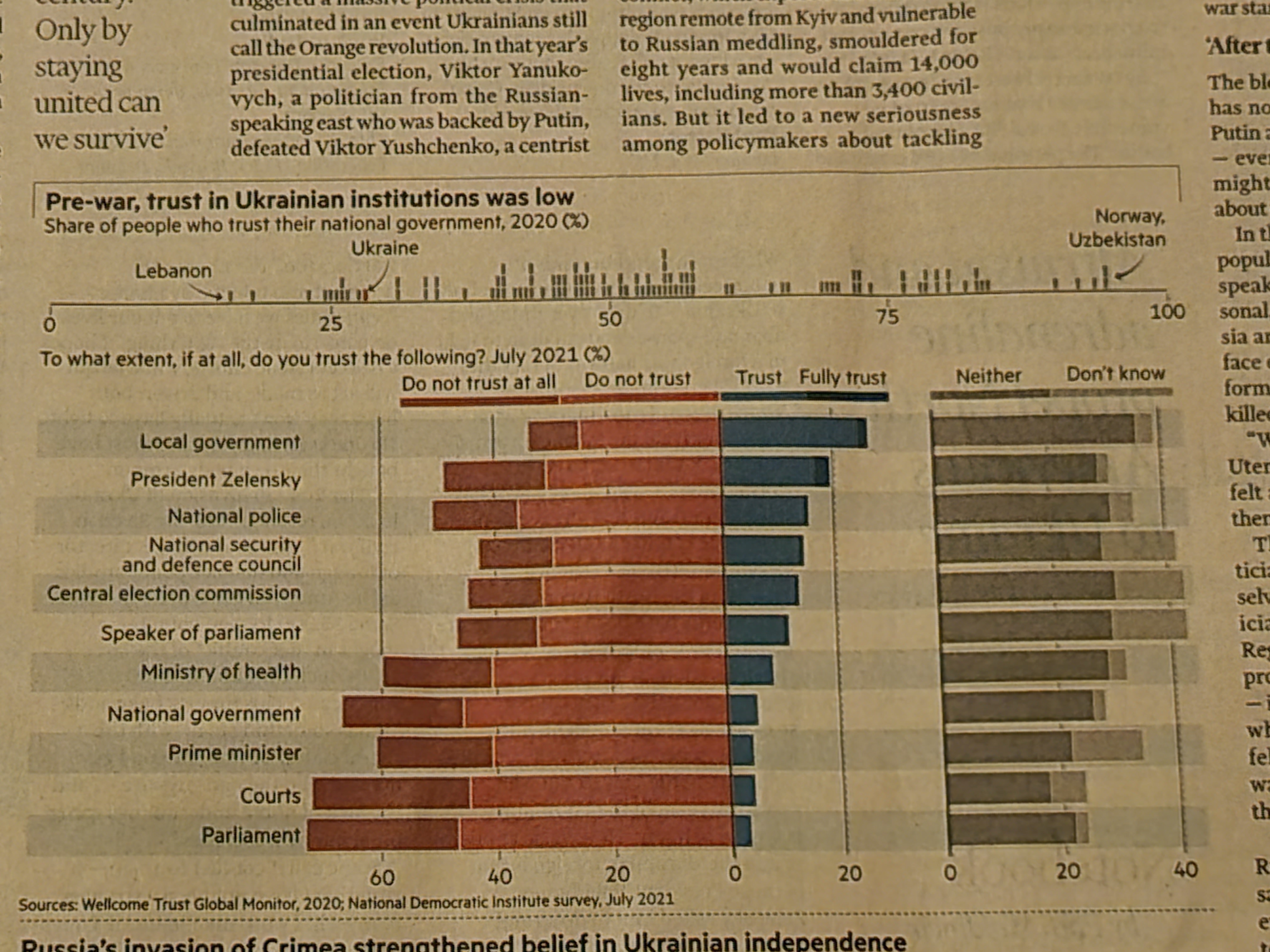
This means it would itself be hypocritical, if it even had the interest, in pointing out to workers in the West the reactionary character of this supposed defender of freedom.  Using various indicators we can quantify (however unscientifically) some differences between the saviour of freedom and the autocratic threat.  Two indices are taken purely as examples. They do not illustrate the social character of the two states, both capitalist, which is the prime determinant of whether socialists should support either.   But for what it’s worth. 

The right wing US think-tank The CATO Institute has an annual ‘Human Freedom’ index, a combination of separate indices for personal and economic freedom.  Its 2021 report shows that Ukraine is the third worst country out of 22 in Eastern Europe while the Russian Federation is the worst.  Over 165 countries Ukraine is number 98 while Russia is 126.  The freest country at number 1 is Switzerland, which scores 9.11 for human freedom while Ukraine scores 6.86 (75% of the Swiss score) and Russia scores 6.23 (or 68% of the Swiss score).  We are expected to support the war of Ukraine with 75% of the ‘human freedom’ of the freest against Russia with 68%.  The war of 7%. It is relevant to note that while in 2021 Ukraine ranked 98th, it ranked higher at 82nd in 2008, so that relatively it has gotten worse, but so has Russia from 112th to 126th.

The second index is that of ‘Transparency International’ which reports the perceived levels of public sector corruption in 180 countries/territories around the world. It scores these countries out of 100, with the lower the score the more corrupt a country is perceived to be.  The 2021 publication reports that the least corrupt countries included Denmark, Finland and New Zealand, scoring 88 each.  Ukraine is 123rd on the list while Russia is 139th. A better indication of the difference is that Ukraine scores 32 out of 100 while Russia scores 29, meaning that the former scores 36% of Denmark etc. while Russia scores 33%.  Not a pile of difference; 3 to be exact.

Source Financial Times

As the war has been articulated by the media there is no way to express any other position than to support the mainstream narrative or embellish it with democratic sounding phrases such as ‘self-determination’ that are the equivalent of putting lipstick on a pig.  It has been said that to win an argument you must rob the other of the language to articulate their disagreement.  With the language of ‘Ukraine’, ‘the Ukrainian people’ and ‘self-determination’ it seems obviously perverse to propose opposing ‘Ukraine’, ‘the Ukrainian people’ and ‘self-determination.’  How could you defend a position like that?

To stand in opposition to this war requires ideas and concepts that belong not to the hypocrisy of bourgeois politics but to socialism.  To relate these concepts correctly to the war in Ukraine is not to impose them as true because some selected facts can be held up as justification but to examine the war and the interests expressed within it to determine its character and therefore the political position one should take to determine a working class approach.

This is the position of Marxists because previous investigation has revealed that only the working class can rid humanity of exploitation, oppression and the ravages of a system that regularly and inescapably produces war.  It is not enough to hold these views at a general abstract level but to demonstrate that this is true in each individual case.  If it cannot be demonstrated, then Marxist ideas are either only partially correct or wholly wrong. 

We therefore need the language of class so that we can identify who the participants in the war actually are, what their core interests are and to what extent their actions reflect these interests.  We need this and the concepts arising from our understanding of how society works in order to construct a language that allows us to articulate what the position of the working class should be.

A first word here about language.  Supporters of Ukraine sometimes claim that Russia is an imperialist country and Ukraine is not and since the starting point of Marxists is anti-imperialism this points to opposition to Russia.  Sometimes the argument becomes infantile, as when it is argued that Ukraine is a smaller and less powerful country than Russia, as if political positions resemble the school playground where big bullies are condemned.  Others equally falsely claim that since the biggest imperialism supports Ukraine, we should support the smaller and weaker one.  Sometimes it is stated that Russia is not imperialist by Marxist definition so this too points to its defence.

Since imperialism is a form of capitalism it is not the role of socialists to support smaller or weaker capitalist states in competition with larger ones, whether imperialist or not (by whatever criteria agreed).  The starting point is not anti-imperialism or even anti-capitalism, because there are reactionary anti-capitalisms as well, but the independent interests of the working class.  This identifies our allies and our enemies and must include opposition to subordination to any capitalist state no matter how big or small it is or how much shit it finds itself in.  For the avoidance of doubt, Ukraine is not a colony, certainly not of Russia!, but an independent capitalist state.

This is the first task of socialists and the reaction to the war shows how drastically many of them have failed to properly determine its character.  This series of posts will address this failure and we will start with two examples beginning in the next post.

Forward to part 2

Jesus, Mary and Joseph! The President’s wife doesn’t support war?

Dunleer Co Louth

One can only react with a wry smile at the current kerfuffle over a letter by the wife of the President of Ireland regarding the war in Ukraine. After decades of hypocritical and sanctimonious sermons on the evil of violence, the urgent imperative for peace and negotiations to achieve it, the essential requirement now is for war; victory in war for Ukraine.

The President’s wife, Sabina Coyne Higgins, has written to that august publication ‘The Irish Times’ to express dismay and disappointment that an editorial in the newspaper did not “encourage any ceasefire negotiations that might lead to a peace settlement”. 

This led to indignant indignation among politicians that accused her of asserting moral equivalence between Ukraine and Russia and failing to follow the Government line of support for the former.  Ukrainians in Ireland were quoted as not actually understanding what she was trying to say or of accusing her of not understanding what was going on. One Ukrainian who has lived in Ireland for 15 years said that it is “very easy to call for peace when you live in safe and comfortable conditions for a very long time” although the uproar induced would seem to indicate that it is easier to call for war.

Another Ukrainian stated that “If Russia lays down its arms, there will be no war. If Ukraine lays down its arms, there will be no Ukraine. That is why Ukrainians have not wished each other peace for a long time — they wish only victory. And we won’t settle for less . . .”

The newspaper has recently run a long article extolling the nationalist narrative of Ukrainian history and the inevitable conflict between it and Russia and ‘the real explosion of Cossack identity that started with the Russian invasion in 2014.  Whole units, like the Azov battalion, wear similar [Cossack] haircuts, moustaches and earrings.  It’s popular.’  The headline quotes the Ukrainian interviewee as saying that ‘This is a war of destruction. Either we destroy the Russians or they destroy us.’

So, we read justification of a nationalist programme that would be pilloried as bellicose and reactionary were it presented in support of any other country.  The journalist responsible sees no need to interrogate the place of armed fascists in this resurgence of uncompromising nationalism or the meaning of proposed destruction of whole peoples.

She is not however to be singled out for blame.

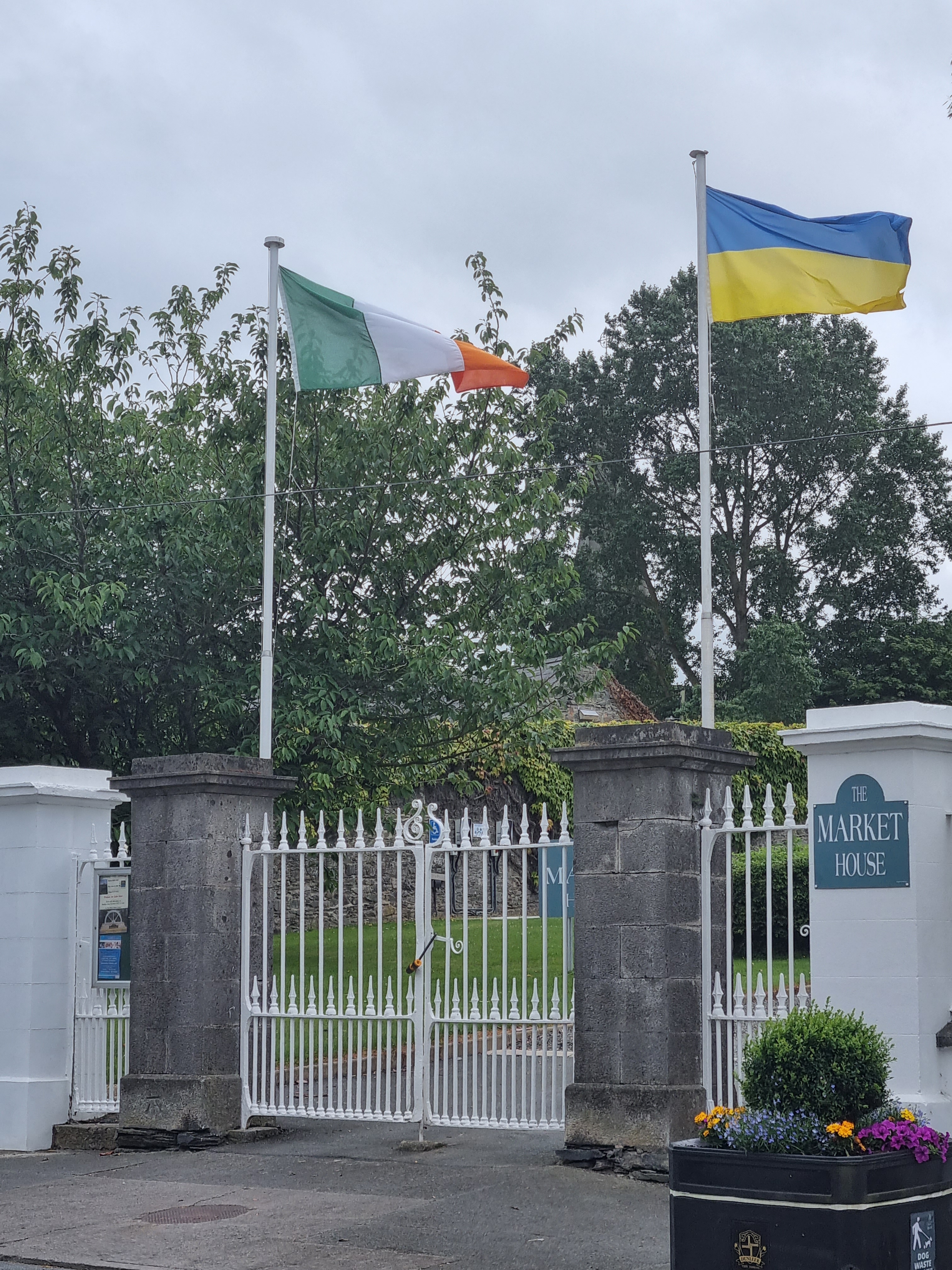
What has been striking has been the almost universal acceptance of a tale of childlike simplicity: that Ukraine is the force fighting for freedom against an unprovoked invasion by evil Russia.  As the photograph above shows, the smallest Irish towns in Ireland parade their support for the second most corrupt country in Europe against the first.  In a war barely understood their simple truths have been substituted for the complexity of a messy reality.

But they too are not soleley to blame.  Much of the left has decided to incant Lenin’s policy of ‘self-determination of nations’ in order to apply a rusty Occam’s razor to the war so it too can support ‘Ukraine’.  In doing so they demonstrate that they have not got the first clue about what this policy meant never mind whether it is relevant today to the war in Ukraine.  Self-determination thus becomes support for an already independent capitalist state in a war with another so that it can codify its alliance with the world’s biggest imperialist military alliance.  Freedom to join NATO and to land your own people in a destructive war as a result is what it actually means.

This is what is clearly happening, and as Lenin said: ‘one of the basic principles of dialectics is that there is no such thing as abstract truth, truth is always concrete . . . ‘ This reactionary war on both sides is thus the expression of the reckless policy of seeking NATO membership by Ukraine and Russia’s determination to show that it meant what it said when it warned that this was a red line not to be crossed.

It matters not that Russia has no right to determine the policy of Ukraine.  What right has Ukraine to threaten Russia through membership of NATO on its doorstep?  Neither Ukrainian nor Russian workers have any interest in standing behind either ‘right’, never mind dying for it.  But the pro-war left has decided that the right of capitalist powers to defend their prerogatives is justified under some abstract argument about the principle of self-determination that the working class has to pay for.

Their complete inability to have any purchase on reality is repeatedly exposed.  So through their call for arming Ukraine they fail to expose or oppose the role of NATO and its share of responsibility for the war.  They say Ukraine (by which they must mean this country’s capitalist state) must receive arms to fight, so dependence on NATO weapons, i.e. imperialism, becomes the road to self-determination!  But since such arms as can be effective are only available from NATO they cannot, with any seriousness, now oppose the rearmament of the Western capitalist powers.  A strange sort of ‘anti-capitalism’.

They oppose transfer of offensive weapons but the steady ratcheting up of the weapons supplied leaves them as useless spectators awaiting the transfer of whatever they decide as ‘offensive’, at which point are we to believe this capitalist war will change its character?

In this article one spokesman states that ‘we should neither support the latter’s sanctions, nor demand that they be lifted.’  But it’s as if the European Union has read this and decided to take the piss out of such ‘lack of support’ by having round after round of sanctions (currently seven) that the pro-war left will not demand are lifted?  Are there no sanctions it would straightforwardly oppose in advance as opposed to accept after the fact?

This blog opposed western sanctions from the beginning because they could only hit working class Russians hardest.  Now we see that they are hitting workers in the west as well but is there now opposition to them among those for whom the ability of a capitalist state to determine its military alliance is paramount?

Across all the issues arising from the war, from the progressive content to Ukrainian nationalism to the primary issue being Russian imperialism, the pro-war left has simply parroted the mainstream bourgeois media. Like support for Brexit; support for total economic lockdown to deal with Covid-19, and now support for sanctions, various parts of the left have championed policies that have disarmed the working class when it comes to identifying the causes of the cost-of-living crisis to which these policies have contributed. 

We can expect that none will accept the slightest responsibility.  Just like the Tories who support Brexit and ‘Ukraine’ they want to have their cake and to eat it. To oppose the capitalist EU but ignore the effects of Brexit on freedom of movement and living standards. Demand more extensive and longer economic lockdowns but ignore the social consequences some of which, like economic dislocation and inflation, now hit them in the face.  Support ‘Ukraine’ but ignore the boost it has given to the NATO imperialist alliance and the effect of sanctions on living standards.

For a blog seeking to advance Marxist politics this is important, but not as important as the failings of the imperialist strategy to which some leftists provide a grotesque mirror image.

The bourgeois media asks us to believe that our ‘freedom’ is being protected by one of the most corrupt countries in Europe whose best fighters are fascists.  We are threatened that unless we support it against the evil Russians, which have such a useless army that Ukraine can defeat it, they will steamroller across Europe.  We must accept the possibility of freezing this winter because Russia has ‘weaponised’ gas supplies, even though the West has sent real weapons to kill as many Russians as possible and started the whole gas thing by preventing operation of the new Nord Stream 2 pipeline.  We are called upon to blame Russia for potential famine in a range of countries because of its war on Ukraine but ignore the effect of Western sanctions on the supply of Russian food to the world, something that has had to be implicitly admit by its lifting of some of them.

None of this is consistent with the claims of the western bourgeoisie and its yellow media.  In Ireland the homeopathic letter from the Irish President’s wife has opened up a small window for questioning support for the war.

Over the weekend I read the ‘Financial Times’ (FT).  It had a review of the book ‘Nazi Billionaires’ which records the largely hidden history of Germany’s richest capitalist dynasties who escaped punishment after the war for their collaboration with the Nazi regime.  This was the conscious policy of the major western powers for whom strengthening German capitalism was much more important than punishing Nazis for their crimes or imposing justice on behalf of their victims.  This has not stopped regular evocation of the enemies of the Western capitalist powers as the new Nazis with Putin as the new Hitler.  Just like after World War II, these states are not interested in justice but in their own power and that of their capitalist class.

The only consistent position opposed to the war is the socialist argument that workers have no interest in fighting for the system that exploits them, in wars that we pay for in money and blood. To do so we must oppose nationalist flag-waving and a media that on this occasion does not even seek to hide its bias. A certain Mrs Higgins has proved more in tune with such a task than many of the left.

Žižek and Ukraine

With 50 books in multiple languages, innumerable magazine articles, presence on ‘Foreign Policy’ Top 100 Global Thinkers list; dubbed the “Elvis of cultural theory” and “the most dangerous philosopher in the West”, the Slovenian ‘public intellectual’ Slavoj Žižek has often appeared to be all over the place. In his recent article on the war in Ukraine for The Guardian newspaper he really is.  To follow his arguments, such as they are, is to oneself get dizzy, but here we go.

His hook is John Lennon’s song ‘Imagine’ in which ‘the world can live as one’, which, according to Žižek, is ‘the best way to end in hell’.  Such pacifism ignores ‘brutal reality’ from which ‘it’s the time to awaken’.  Unfortunately Žižek’s own message to the Left beguiled by such pacifism is instead to imagine something even more incredible, including that it ‘need[s] a stronger Nato – but not as a prolongation of the US politics.’ 

It needs to support Ukraine with NATO weapons in a war that he says it cannot win, although he doesn’t linger to consider the wasted lives this would involve. Politically, this does not mean ‘that the Left should simply take the side of the west, inclusive of the rightist fundamentalists who also support Ukraine’, although since one ‘cannot be a leftist’ without ‘unequivocally’ standing behind Ukraine one struggles to understand why not. 

Like every other commentator he gets inside Vladimir Putin’s head to warn that we must stop him exploiting global warming to hijack the world’s food supply by routing it through an ice-free Artic Circle so that ‘Russia will dominate so much food production that it will be able to blackmail the whole world.’ This, he imagines, is the ‘reality beneath Putin’s imperial dream’.

How we are to believe that Putin is implementing his imperial dream to divide Europe with an invading army too small to occupy all of Ukraine is unexplained.

Through quotations from one speech he declares Putin’s intention to carry out a ‘brutal attempt to change our entire geopolitical situation. The true target of the war is the dismantlement of the European unity.’  But since he states that this is also the intention of US conservatives, and the war is a ‘proxy war between US and Russia’, why are we to support NATO?  

His concern over this unity of Europe rests on Putin’s belief that countries are either sovereign or subordinated colonies, when it is rather the case ‘that in today’s global world in which we are all haunted by the same catastrophes we are all in-between, in an intermediate state, neither a sovereign country nor a conquered one: to insist on full sovereignty in the face of global warming is sheer madness since our very survival hinges on tight global cooperation’. Again, what NATO has to offer as a model for the cooperation necessary to avoid catastrophes rather than create one is unexplained.

But even a glimpse of the ‘brutal reality’ he claims to perceive shows we do not need these confused and wild imaginings.

The world’s food supply is already being manipulated, endangering many of the world’s poorest people, through rising prices and blockade caused not only by the Russian invasion but by Western sanctions affecting Russian food supplies to the world and refusal to lift these sanctions in order to release the supplies from Ukraine.  We don’t need to wait for global warming to melt in ice cap.

We are invited to oppose the division of Europe and its conversion into a colony, but through subordination of the continent to a United States’ controlled NATO that will commit every country to follow the US lead in war under a protective umbrella that more resembles a protection racket.  The illusion is given that every country will, with Article 5 of the NATO Treaty, be supported by a commitment to war in their defence if any member is attacked, but the Article makes no such commitment.  What NATO does is make Europe the playground of US expansionism and the potential theatre of war, as the threat of Ukrainian membership has vividly demonstrated. The United States will enter only such wars as will satisfy its own imperial interest and will provoke the same with the intention of leveraging NATO membership to gain support for its wars of choice.

The US, supported by the lap dog, has pushed for Europe to sanction Russian energy imports in what can only be seen as invitation to an enormous act of self-harm; perhaps the ultimate definition of US hegemony in which the interests of the most powerful become identified as those of the subordinated.

For Žižek the point of his article is that, ‘Today, one cannot be a leftist if one does not unequivocally stand behind Ukraine . . . If the left will fail here, the game is over for it . . . from the leftist standpoint, Ukraine fights for global freedom, inclusive of the freedom of Russians themselves. That’s why the heart of every true Russian patriot beats for Ukraine.’

What type of Russian is to hold to their heart a Ukraine wedded to NATO is another philosophical mystery–to a regime that celebrates fascist heroes and incorporates fascist forces within its armed forces?

To envisage all this is to consider that John Lennon is almost positively grounded in his call for pacifism.  By calling on us to imagine an alternative John Lennon at least could see the reality that required it.  Žižek fails to properly to identify this reality and his imagined alternative is only a grotesque reactionary response to it.  His article adds a name to the declamation of the valiant role of the Ukrainian state in its heroic fight against the uniquely evil Russian dictator but it’s all been said before and his name doesn’t make the Ukrainian state any less repugnant or reactionary.

However unrealistic John Lennon’s imagined alternative is, its other advantage is that it is at least an agreeable one.  Žižek implies the possible existence of one of his own, through a separate working class interests when he says that:

‘When a country is occupied, it is the ruling class which is usually bribed to collaborate with the occupiers to maintain its privileged position, so that the struggle against the occupiers becomes a priority. The same can go for the struggle against racism; in a state of racial tension and exploitation, the only way to effectively struggle for the working class is to focus on fighting racism (this is why any appeal to the white working class, as in today’s alt-right populism, betrays class struggle).’

The collaboration of foreign occupiers with the ruling class of the conquered country demonstrates a fundamental identity of interests and thus their equally fundamental antagonism to the working class.  The fitting response is not to fight for this country and its state, which purports to represent the interests of all its people including its working class, but to recognise within it the ideology and mechanism that enforces ruling class authority and power. The equally fundamental identity of the interests of the working class across nations, in this case Ukrainian and  Russian, is demonstrated by the barbaric effects of the war and the willingness of the various states involved to sacrifice working people recruited to fight in it.  This cannot be done by supporting one or other side but only through class struggle.

But while Žižek appears to endorse such struggle when it is necessary to fight racism it evaporates when it comes to capitalist war.  Perhaps because even his recipe for struggle against racism is also misjudged.  While leftists should not pander to alt-right populism the struggle against racism will fail if it does not ‘appeal to the white working class’. Žižek thinks ‘any appeal’ is ‘a betrayal’ but who then is he hoping to unite?

Chomsky has apparently said that Žižek’s views are often too obscure to be communicated usefully to common people.  In this case, while they are frequently confused and confusing, they are also bald statements in support of ‘Ukraine’ and NATO so are very easy to understand.  In this he adds nothing.  For someone with so much to say he ends up saying nothing that hasn’t been said a thousand times before.

5 Self-determination subordinated

UN Security Council

In The Right of Nations to Self-Determination Lenin stated that

‘The categorical requirement of Marxist theory in investigating any social question is that it be examined within definite historical limits, and, if it refers to a particular country (e. g., the national programme for a given country), that account be taken of the specific features distinguishing that country from others in the same historical epoch.’

In The Discussion On Self-Determination Summed Up he says that

‘What is the lesson to be drawn from this concrete example which must he analysed concretely if there is any desire to be true to Marxism? Only this: (1) that the interests of the liberation of a number of big and very big nations in Europe rate higher than the interests of the movement for liberation of small nations; (2) that the demand for democracy must not be considered in isolation but on a European—today we should say a world—scale.’

The globalisation of the war in Ukraine is evident not just from the antagonism between Russia and US (plus other NATO countries) but the determination of the latter to get every other country to impose its sanctions on Russia.  In other words, the demand that every other country join the war on its side.  This is echoed on the left where some make the smallness of a nation, contra Lenin, a reason to support its demands!

Evaluation of the war obviously requires Lenin’s recommendation – ‘that the demand for democracy must not be considered in isolation but on a European—today we should say a world—scale.’

Lenin gives an example of what this might mean:

‘When the Dutch and Polish Social-Democrats reason against self-determination, using general arguments, i.e., those that concern imperialism in general, socialism in general, democracy in general, national oppression in general, we may truly say that they wallow in mistakes. But one has only to discard this obviously erroneous shell of general arguments and examine the essence of the question from the standpoint of the specific conditions obtaining in Holland and Poland for their particular position to become comprehensible and quite legitimate . . .’

After addressing the Dutch example, he turns to the case of Poland:

‘Karl Radek, a Polish Social-Democrat, who has done particularly great service by his determined struggle for internationalism in German Social-Democracy since the outbreak of war, made a furious attack on self-determination in an article entitled “The Right of Nations to Self-Determination” . . . and propounds, amongst others, the argument that self-determination fosters the idea that “it is allegedly the duty of Social-Democrats to support any struggle for independence.”

Lenin’s response is that ‘From the standpoint of general theory this argument is outrageous, because it is clearly illogical . . .’  He then notes that ‘I recall Rosa Luxemburg saying in an article written in 1908, that the formula: “against national oppression” was quite adequate. But any Polish nationalist would say—and quite justly—that annexation is one of the forms of national oppression, consequently, etc.’

In other words, if you say you are ‘against national oppression,’ and Poland is nationally oppressed, then you should support Poland’s struggle for independence.  But Lenin doesn’t agree to this, and examines the specific conditions applying from the viewpoint of the interests of the struggles of the working class:

‘However, bake Poland’s specific conditions in place of these general arguments: her independence today is “impracticable” without wars or revolutions. To be in favour of an all-European war merely for the sake of restoring Poland is to be a nationalist of the worst sort, and to place the interests of a small number of Poles above those of the hundreds of millions of people who suffer from war.  . . . . To raise the question of Poland’s independence today, with the existing alignment of the neighbouring imperialist powers, is really to run after a will-o’-the-wisp, plunge into narrow-minded nationalism and forget the necessary premise of an all-European or at least a Russian and a German revolution.’

‘A third and, perhaps, the most important example. We read in the Polish theses (III, end of 82) that the idea of an independent Polish buffer state is opposed on the grounds that it is an “inane utopia of small impotent groups. Put into effect, it would mean the creation of a tiny fragment of a Polish state that would be a military colony of one or another group of Great Powers, a plaything of their military or economic interests, an area exploited by foreign capital, and a battlefield in future war”.’

‘This is all very true when used as an argument against the slogan of Polish independence today, because even a revolution in Poland alone would change nothing and would only divert the attention of the masses in Poland from the main thing—the connection between their struggle and that of the Russian and German proletariat. It is not a paradox but a fact that today the Polish proletariat as such can help the cause of socialism and freedom, including the freedom of Poland, only by joint struggle with the proletariat of the neighbouring countries, against the narrow Polish nationalists. Tile great historical service rendered by the Polish Social-Democrats in the struggle against the nationalists cannot possibly be denied.’

The parallel with Ukraine is obvious, but this is not even the point.  The point is that the specific conditions of each national struggle should be considered from the viewpoint of the working class and its class struggle and this can lead us very far from support for bourgeois nationalism, even in the case of a country dismembered by empires. Often this nationalism is painted red although generally this has not been attempted on behalf of the nationalism of Ukraine notwithstanding attempts on the left to now soften its far-right complexion.

Does this mean there is nothing left of the policy of self-determination of nations? Lenin goes on:

‘But these same arguments, which are true from the standpoint of Poland’s specific conditions in the present epoch, are manifestly untrue in the general form in which they are presented. So long as there are wars, Poland will always remain a battlefield in wars between Germany and Russia, but this is no argument against greater political liberty (and, therefore, against political independence) in the periods between wars. The same applies to the arguments about exploitation by foreign capital and Poland’s role as a plaything of foreign interests.’

‘The Polish Social-Democrats cannot, at the moment, raise the slogan of Poland’s independence, for the Poles, as proletarian internationalists, can do nothing about it without stooping, like the “Fracy” [Polish Socialist Party], to humble servitude to one of the imperialist monarchies. But it is not indifferent to the Russian and German workers whether Poland is independent, they take part in annexing her (and that would mean educating the Russian and German workers and peasants in the basest turpitude and their consent to play the part of executioner of other peoples).’

‘The situation is, indeed, bewildering, but there is a way out in which all participants would remain internationalists: the Russian and German Social-Democrats by demanding for Poland unconditional “freedom to secede”; the Polish Social-Democrats by working for the unity of the proletarian struggle in both small and big countries without putting forward the slogan of Polish independence for the given epoch or the given period.’

Such are the considerations that must be taken into account when seeking to apply the demand for self-determination for any particular nationality.  Only in extremis has this been done in the case of the war in Ukraine – when it comes to opposing the imposition of a no-fly zone over Ukraine by NATO, which risks a direct war with Russia and nuclear oblivion.  In this the pro-war left has had cause to pause, a pragmatic concession without theoretical support, their whole policy being otherwise based on bourgeois morality. As we have seen, expressed by Lenin:

‘To be in favour of an all-European war merely for the sake of restoring Poland is to be a nationalist of the worst sort, and to place the interests of a small number of Poles above those of the hundreds of millions of people who suffer from war.’ (The Discussion On Self-Determination Summed Up)

But apart from this glaringly obvious acceptance of limits to its defence of the Ukrainian capitalist state the pro-war left has demonstrated itself content with the effects of its policy.

These effects include the proposed massive militarisation of Germany and the incorporation of Sweden and Finland into NATO, not to mention the enrichment of the US military industrial complex and its consequent increased political influence. They also involve the effects of supporting imperialist sanctions and their contribution to the reduction in living standards for workers and the poor across the globe.  The working class is thereby enrolled on the side of their own ruling class in the conflict with Russia, on behalf of another corrupt capitalist state that resembles no country so much as the one uniquely damned by ‘the international community.’ 

The pro-war left demands supply of all the weapons required to achieve Ukraine’s war objectives, which requires that Ukraine be able to finance the war; imperialism does not come free.  So, for example, the requirement to address the ‘food catastrophe’ caused by the war, as headlined by ‘The Economist’, which notes that Ukraine’s food exports alone provide the calories to feed 400m people.  In true fashion the newspaper raises the prospect of NATO convoys in the Black sea to remedy this, although this too risks direct conflict between the armed forces of NATO and Russia.

Facing escalating war or threat of famine the pro-war left finds that their ‘practical’­, ‘something must be done’, approach of supporting imperialism supporting Ukraine leaves them with an unenviable ‘practical’ choice.

In this regard there is nothing new, Lenin excoriated it – ‘The bourgeoisie, which naturally assumes the leadership at the start of every national movement, says that support for all national aspirations is practical . . . The whole task of the proletarians in the national question is “unpractical” from the standpoint of the nationalist bourgeoisie of every nation . . . This call for practicality is in fact merely a call for uncritical acceptance of bourgeois aspirations.’ 

How far all this support for imperialism is from the policy of Lenin is obvious, but then equally obvious is that this left is not really interested in this policy.

concluded

back to part 4

4 Supporting the democratic content of nationalism

In ‘The Right of Nations to Self-Determination’ Lenin stated that 

‘The bourgeois nationalism of any oppressed nation has a general democratic content that is directed against oppression, and it is this content that we unconditionally support, At the same time we strictly distinguish it from the tendency towards national exclusiveness; we fight against the tendency of the Polish bourgeois to oppress the Jews, etc., etc.’

We have already explained in the previous posts the limits to such support but there are others that we have not addressed and that have further relevance when considering the situation in Ukraine today.  We should obviously be wary of claims of a democratic content to a nationalism that has already shown its reactionary character.

The recent history of Ukraine has demonstrated that the growth of nationalism in that country has been the product of the cynical strategy and policies of certain oligarchic factions in struggle with rivals.  It has been advanced not as the flag under which democratisation of Ukrainian society has advanced but as a cover for austerity and repression, and as a substitute for the failure of a number of bourgeois leaderships to carry out promises to rid Ukraine of corruption and systematic abuses of democracy.

As this nationalism has advanced it has not broadened the scope of democracy through inclusion of different ethic, linguistic and cultural groups but acted as a weapon to restrict the rights of minorities and impose a single ethno-nationalism.  This has included restrictions on freedom of speech through crack-downs on rival media organisations; the banning of political parties and silencing of particular political views; promotion of an ideology of anti-communism, and attacks on workers’ rights.

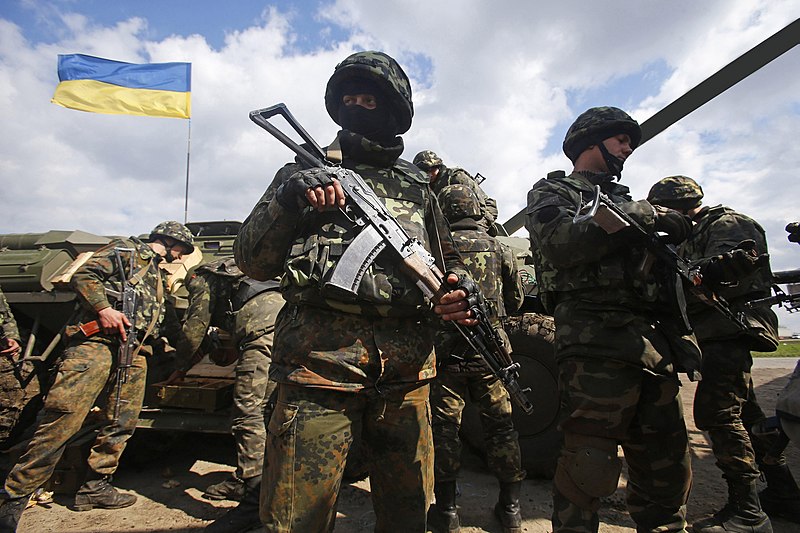
This nationalism has celebrated and legitimised fascist figures from its history (see above picture) and current political slogans from far-right organisations, going so far as to integrate their armed organisations into the state, and at times place significant figures in positions of power within the Government.  The significance of the far right has advanced under the banner of, and in lock-step with, wider Ukrainian nationalism.  It is not that mainstream Ukrainian nationalism and the state that promotes it have become fascist but that the mainstream has seen no need or want to separate itself from the far-right movement, which it has celebrated as its ‘best fighters’.

The Ukrainian state has faced a number of secessionist movements but the policy advocated by Lenin in dealing with such movements by offering the right of secession in order to forge democratic unity, as the best grounds for uniting its working class, has been rejected. When Ukrainian nationalism has demanded self-determination it has ignored its own responsibility to defend consistent democracy within the territory it claims.  Instead, it has moved further and further into alliance with the world’s greatest enemy of equality between nations – US imperialism and its NATO alliance.

In sum, there is no democratic content to Ukrainian nationalism and it cannot be defended.  If it currently wields hegemony, this is not only the responsibility of the far-right in the country, or the oligarchic and political factions who solidify their position with its support, but also due to the reactionary policy of the Russian state. This state can offer no democratic alternative because it too is headed by a corrupt and reactionary nationalist regime.  Between two such regimes the ‘instinctive and automatic rush to reach for the policy of self-determination of nations in order to justify the decision to support one side’, as explained in a previous post, is a betrayal of the working class of both nations.

The liberation of the Ukrainian working class will not be achieved in alliance with US imperialism, which is forging the strongest chains for this class through its superior economic and military power.  The utter dependency of Ukraine and its nationalists on US policy has now been firmly entrenched by the massive armed and associated financial support of the US.  Through this war Ukrainian nationalism has definitively made its country a client of the United States; so much for the promise of nationalism. 

Only by a struggle against this can the freedom of the Ukrainian working class be achieved, including in the East and South of the country, and only in conjunction with neighbouring countries including Russia.  This cannot be achieved by the US and NATO which seeks the permanent submission of Ukraine through radical diminution and debasement of Russia.

*                                  *                                  *

Unfortunately, some on the Ukrainian left acknowledge the reactionary character of US imperialism – ‘In this conflict, Russia can in no way be considered a different project than the US and the rest of the capitalist powers’ – but go on to frame the war as a purely anti-colonial struggle, with Russia as the imperial power.  ‘Ukraine needs to decolonize and de-Russify’, which neglects to explain how unity of the Ukrainian working class, including ethnic Russian workers with divided political loyalties, can be advanced.

Lip service is paid to ‘the centrality of Ukraine’s fight for independence from both Russian and Western Imperial domination’, and the war is presented as an ‘existential’ one for Ukrainians’ ‘very existence’, with war aims including the incorporation of Crimea and the Russian controlled Donbas republics under Kyiv rule.  Lenin’s policy of seeking unity through the right to secession isn’t on the table and the Ukrainian right to self-determination has simply become an example of the ‘refined nationalism’ that he warned against.

The article is therefore full of references to historic Russian oppression while defending Ukrainian ‘agency’ and ‘subjectivity’, all the while forgetting that it is now an independent state with its own capitalist structure and dynamics.  The war is framed as a national struggle, just as it is presented in the West; the war aims supported are those of the most rabid US neocon, and the current means of struggle by its capitalist state are endorsed.  How the war is understood, the appropriate war aims and means of struggle supported by Yuliya Yurchenko are the same as that of Western imperialism. 

What we have then is not a policy that will combat the most rabid forms of Ukrainian nationalism, which Yurchenko accepts is a real problem, even admitting the ‘risk [of] confirming Putin’s obscene lie that we are a nation of bigots and fascists.’  What it proposes is an idea that Ukrainian nationalism can be made progressive.  The problem with this is threefold.

First, Ukrainian nationalism is already presented as progressive in a very objective sense, although by no means only that, through the ‘spirit of collective solidarity’ that the war has inspired.  This is despite her acknowledgement that previous democratic protests and mobilisations have only led to the strengthening of different oligarchic factions and the far-right. She claims that ‘Russia’s invasion has stirred up a healthy degree of Ukrainian nationalism.’

Second, the view that a healthy nationalism can arise from the war understood in existential national terms is simply beyond any credible belief.  This is especially the case since Yurchenko’s war policy, being the same as the most reactionary nationalist, promises a ‘long fight’, one that can therefore be guaranteed to build up massive bitterness and resentment. The policy of reliance on imperialism and domestic austerity necessary to finance it, coupled with opposition to the right of minorities to secede, means that nothing progressive could emerge from such a war, unless it provoked a revolt against it and the policy behind it.  But Yurchenko is not proposing that.

Lastly, the idea that any sort of nationalism, however ‘healthy’, could be the cause that would carry the Ukrainian working class forward is simply absurd for the reasons enumerated in the previous paragraph.  Nothing in the answers given in Yurchenko’s interview indicates any strategy to expose the role of US imperialism or that of domestic capitalist and bourgeois political forces in bringing this war to the Ukrainian working class.  The war, she says, was ‘a completely unprovoked attack.’ Nothing about the moves towards joining NATO or the repeated attacks on the break-away regions in the Donbas. Nothing to indicate that the Ukrainian working class has separate interests in the war from its rulers.

‘Compromise’ is rejected and the Minsk peace process merely ‘so-called’ and also rejected.  There is no acknowledgement of any Ukrainian state responsibility for the failure.  Instead ‘we will not settle for anything less than the reunification and independence of Ukraine.’  How this can happen through subordination to the US and NATO is something she is no more able to explain that the rest of the Ukrainian nationalist spectrum.

Capitulation to nationalism means avoiding assignment of any responsibility, and hence any opposition, to domestic capitalism and its rotten state.

Ukrainian nationalism does not find any democratic content that justifies any defence of it just because some on the left support it, portray it as democratic, or think they can make it so.

Yurchenko declares that ‘the international left must put its decolonial hat on in thinking about Ukraine’; in other words, put on its blinkers and accept the progressiveness of a war backed by US imperialism, the corrupt Ukrainian capitalist state, and the ‘best fighters’ of the ‘Ukrainian resistance’–the fascists of the Azov regiment.

Whoever thinks there is any democratic content in this nationalist melange is irretrievably lost to the struggle for socialism.

Back to part 3

Forward to part 5

3 Lenin Against Nationalism

In the previous post we noted that capitalism extends itself across the globe, leading to both bigger capitals and bigger states and then to international economic and political organisation.  Inevitably small capitals and small nations suffer.  This does not mean that socialists seek to halt or reverse such processes.

Within the Great Russian Empire, with its prison house of peoples, Lenin advocated the closest relations between its nations and the united organisation of the working class movement.  In his article ‘Corrupting the Workers with Refined Nationalism’ he states that:

‘Marxists, stand, not only for the most complete, consistent and fully applied equality of nations and languages, but also for the amalgamation of the workers of the different nationalities in united proletarian organisations of every kind.’

How far this is from some of today’s ‘Marxists’ can be seen in their championing of the likes of Scottish nationalism or Catalan nationalism.  Where Lenin argued that socialists should demonstrate their proletarian internationalism through membership of united organisations, these left nationalists have demonstrated their nationalism by leading the way in splitting their own organisations along nationalist lines.

Lenin emphasises the need for unity in ‘On the National Pride of the Great Russians’:

“No nation can be free if it oppresses other nations,” said Marx and Engels, the greatest representatives of consistent nineteenth century democracy, who became the teachers of the revolutionary proletariat. And, full of a sense of national pride, we Great-Russian workers want, come what may, a free and independent, a democratic, republican and proud Great Russia, one that will base its relations with its neighbours on the human principle of equality, and not on the feudalist principle of privilege, which is so degrading to a great nation.’

‘Just because we want that, we say: it is impossible, in the twentieth century and in Europe (even in the far east of Europe), to “defend the fatherland” otherwise than by using every revolutionary means to combat the monarchy, the landowners and the capitalists of one’s own fatherland, i.e., the worst enemies of our country.’ 

‘We say that the Great Russians cannot “defend the fatherland” otherwise than by desiring the defeat of tsarism in any war, this as the lesser evil to nine-tenths of the inhabitants of Great Russia. For tsarism not only oppresses those nine-tenths economically and politically, but also demoralises, degrades, dishonours and prostitutes them by teaching them to oppress other nations and to cover up this shame with hypocritical and quasi-patriotic phrases.’

It is not necessary to endorse Lenin’s remarks about ‘desiring defeat’ or ‘lesser evil’ to appreciate the motivation of absolute opposition to the nationalism of Great Russia; the nationalism that lives on today in the pronouncements of Vladimir Putin but which is ideological garb draped over the body of the Russian state and oligarchic capitals that it is designed to protect.

Just as Marx supported the development of united nation states such as Germany and Italy, because this involved the internal overthrow of reactionary feudal privileges and restrictions, so he opposed national oppression within nations and looked to the progressive social forces within the oppressed and oppressor nations to achieve this free unity and benefit from it.  Lenin in this article mentions the ‘freedom and national independence for Ireland in the interests of the socialist movement of the British workers.’

The idea that in Ukraine any positive nationalist programme could issue from a corrupt capitalist state, one more and more the supplicant of US imperialism, and this spearheaded by its ‘best fighters’ who are fascists, shows the drastic illusions consuming many on the left. 

In relation to his opposition to Great Russian chauvinism, Lenin said that:

‘The objection may be advanced that, besides tsarism and under its wing, another historical force has arisen and become strong, viz., Great-Russian capitalism, which is carrying on progressive work by economically centralising and welding together vast regions. This objection, however, does not excuse, but on the contrary still more condemns our socialist-chauvinists . . .’

‘Let us even assume that history will decide in favour of Great-Russian dominant-nation capitalism, and against the hundred and one small nations. That is not impossible, for the entire history of capital is one of violence and plunder, blood and corruption. We do not advocate preserving small nations at all costs; other conditions being equal, we are decidedly for centralisation and are opposed to the petty-bourgeois ideal of federal relationships.’

He goes on to say that this does not mean supporting the capitalist political forces that promote this economic development.  However, it also means we do not seek to reverse it either.

In ‘The Revolutionary Proletariat and the Right of Nations to Self-Determination’ Lenin states that:

‘The Russian proletariat cannot march at the head of the people towards a victorious democratic revolution (which is its immediate task), or fight alongside its brothers, the proletarians of Europe, for a socialist revolution, without immediately demanding, fully and unreservedly, for all nations oppressed by tsarism, the freedom to secede from Russia. This we demand, not independently of our revolutionary struggle for socialism, but because this struggle will remain a hollow phrase if it is not linked up with a revolutionary approach to all questions of democracy, including the national question.’

‘We demand freedom of self-determination, i.e., independence, i.e., freedom of secession for the oppressed nations, not because we have dreamt of splitting up the country economically, or of the ideal of small states, but, on the contrary, because we want large states and the closer unity and even fusion of nations, only on a truly democratic, truly internationalist basis, which is inconceivable without the freedom to secede.’

Many of today’s ‘Marxists’ see in self-determination only separation and not the objective of unity.  They see the creation of new states where Lenin saw the unification of nationalities.  They think the right to secede mean support for secession when it is the means to provide guarantees to unification.  They think self-determination is only expressed by separation and creation of a new capitalist state when for Lenin it was the means for ensuring voluntary unity and the avoidance of such an outcome. Lenin advocated this policy even in the case of colonies.

In A Caricature of Marxism and Imperialist Economism Lenin writes that:

‘We demand from our governments that they quit the colonies, or, to put it in precise political terms rather than in agitational outcries—that they grant the colonies full freedom of secession, the genuine right to self-determination, and we ourselves are sure to implement this right, and grant this freedom, as soon as we capture power.’

‘We demand this from existing governments, and will do this when we are the government, not in order to “recommend” secession, but, on the contrary, in order to facilitate and accelerate the democratic association and merging of nations. We shall exert every effort to foster association and merger with the Mongolians, Persians, Indians, Egyptians. We believe it is our duty and in our interest to do this, for otherwise socialism in Europe will not be secure.’ 

‘We shall endeavour to render these nations, more backward and oppressed than we are, “disinterested cultural assistance”, to borrow the happy expression of the Polish Social-Democrats. In other words, we will help them pass to the use of machinery, to the lightening of labour, to democracy, to socialism.’

‘If we demand freedom of secession for the Mongolians, Persians, Egyptians and all other oppressed and unequal nations without exception, we do so not because we favour secession, but only because we stand for free, voluntary association and merging as distinct from forcible association. That is the only reason!’

The failure of Russia to offer a powerful and attractive example to Ukraine lies behind its turn towards invasion to substitute for this failure.  Undoubtedly this has divided the Ukrainian people themselves whose attempts to clean their own stables have been frustrated time and time again by oligarchic factions.

Through some of these factions the country has been turned towards the EU and NATO, membership of which its oligarchs and bourgeois political parties have attempted to impose even when the majority of the people have opposed it.  So, an unconstitutional Government signed an EU Association agreement and IMF loans, with their consequent massive implications for austerity, without any elections following the Maidan overthrow of the previous Yanukovych Government. The prime minister responsible, Yatsenyuk, admitted that “I will be the most unpopular prime minister in the history of my country . . .’

Three weeks before the ouster of Yanukovych the most popular opposition figure was Klitschko with a poll rating of 28.7% while Yatsenyuk didn’t even reach 3%.  Yatsenyuk however had the support of the United States, whose plans to put him in place were famously discussed in the leaked phone-call between US Deputy Secretary of State Victoria Nuland and the US ambassador Geoffrey Pyatt days before formation of the post-Maidan regime. 

The current divisions within Ukraine are not simply externally imposed but prove the failure and hypocrisy of nationalist claims to further national unity and oppose foreign interference.  In February 2017 a Gallop opinion poll recorded that more Ukrainians considered NATO a threat than a protection.  Nevertheless, the Ukrainian Government changed the constitution in 2019 to add a stipulation on “the strategic course” of Ukraine toward NATO membership.

This course has played no small part in causing the current massive escalation of war and making Ukraine utterly dependent on US imperialism, exposing all calls for defence of this state and its regime on the grounds of self-determination to be deceitful lies.

It is ironic that this subordination to the United States has been accompanied by, and is the product of, the growth of Ukrainian ultra-nationalism, proving that Lenin was right to warn that bourgeois nationalism will happily ally with external imperialism while demanding sacrifice from its own people.  This nationalism disguised as ‘self-determination’ has inevitably infected its left supporters in exactly the same way; we noted at the end of the previous post the absurdity of some on the left declaring that self-determination requires the ability of Ukraine to decide its own international alliances, including subordination within NATO.

The result of such subordination makes all talk of self-determination by the left while welcoming weapons from ‘anywhere’ – read NATO – not so much utter delusion, or even mistaken, but treacherous betrayal.  Having invited the US to determine the outcome of the war does this left really pretend the US will not determine the outcome of the peace? 

Back to part 2

Forward to part 4

2 What Lenin did not mean by self-determination of nations

In Ireland it has been common to hear left-wing nationalists claim that Marxists support the nationalism of oppressed nations.

In ‘Critical Remarks on the National Question’, quoted in the previous post Lenin writes:

‘The principle of nationality is historically inevitable in bourgeois society and, taking this society into due account, the Marxist fully recognises the historical legitimacy of national movements. But to prevent this recognition from becoming an apologia of nationalism, it must be strictly limited to what is progressive in such movements, in order that this recognition may not lead to bourgeois ideology obscuring proletarian consciousness.’

‘The awakening of the masses from feudal lethargy, and their struggle against all national oppression, for the sovereignty of the people, of the nation, are progressive. Hence, it is the Marxist’s bounden duty to stand for the most resolute and consistent democratism on all aspects of the national question. This task is largely a negative one. But this is the limit the proletariat can go to in supporting nationalism, for beyond that begins the “positive” activity of the bourgeoisie striving to fortify nationalism.’

‘To throw off the feudal yoke, all national oppression, and all privileges enjoyed by any particular nation or language, is the imperative duty of the proletariat as a democratic force, and is certainly in the interests of the proletarian class struggle, which is obscured and retarded by bickering on the national question. But to go beyond these strictly limited and definite historical limits in helping bourgeois nationalism means betraying the proletariat and siding with the bourgeoisie. There is a border-line here, which is often very slight and which the Bundists and Ukrainian nationalist-socialists completely lose sight of.’

‘Combat all national oppression? Yes, of course! Fight for any kind of national development, for “national culture” in general? — Of course not. The economic development of capitalist society presents us with examples of immature national movements all over the world, examples of the formation of big nations out of a number of small ones, or to the detriment of some of the small ones, and also examples of the assimilation of nations.’

‘The development of nationality in general is the principle of bourgeois nationalism; hence the exclusiveness of bourgeois nationalism, hence the endless national bickering. The proletariat, however, far from undertaking to uphold the national development of every nation, on the contrary, warns the masses against such illusions, stands for the fullest freedom of capitalist intercourse and welcomes every kind of assimilation of nations, except that which is founded on force or privilege.’

So we see the progressiveness of nationalism, as the political framework for the development of capitalism against feudal restrictions, but not as support for capitalist states or their various nationalisms that develop thereafter.  Thereafter, the development of capitalism creates a working class with the interests of this class the same across national borders and therefore opposed to the division of the class that nationalism entails.

Support for nationalism beyond the negative sense of opposition to national oppression is to capitulate to bourgeois nationalism.  Support against national oppression is limited to what is progressive in any nationalist movement and although there may be a border-line between this and betraying the working class to bourgeois nationalism, what we have in the approach of much of the left today is an instinctive and automatic rush to reach for the policy of self-determination of nations in order to justify the decision to support one state in any particular conflict.

Lenin’s ‘formula’ of self-determination of nations has been carried forward as the key to unlocking any national issue without regard to its historical limitation and by ignoring Lenin’s explicit subordination of this justification to the determining interests of the working class.  

Instead of the unity of the working class coming first, the demand for self-determination for a particular nation is placed beforehand, with the assumption that this leads to the former.  Since the demand for self-determination is a bourgeois democratic demand it cannot even on its own terms be seen to lead to the unity of the working class.  We have countless historical examples of self-determination being enacted through creation of new nation states with capitalist social relations and no progressive working class unity established.

Supporters of ‘Ukraine’ have, for example, said that ‘the people of Ukraine must be allowed to exercise freely their right to democratic self-determination, without any military or economic pressure’.  This has been accompanied with calls to cancel Ukraine’s foreign debt – ‘it is important in ensuring that, when they have reconquered their independence, Ukrainians won’t be even more dependent on creditors or domestic oligarchs over whom they have no control.’

But we have demonstrated that the demand for self-determination is not only not applicable to an independent country like Ukraine in this war, but is a capitulation to bourgeois nationalism, with the long quote above demonstrating why.

As Lenin says – self-determination is not support for anything other than the right to secede and form an independent state, and in doing so to reject feudal or dynastic chains such as were forged by the Tsarist, Ottoman and Austro-Hungarian Empires.  This will allow for the free development of capitalism by that particular state.  It is no job of socialists to uphold that state’s capitalist economic development that is built on the exploitation of workers, except in so far as we welcome this development by its creation of a working class that will overthrow it, and which more and more removes national differences.  It is therefore, not our job to seek to constrain such development through reactionary political projects such as Brexit or splitting already established states, such as Britain.

When left nationalists welcome that ‘Ukrainians’ have ‘reconquered their independence’ but complain that foreign debt must be also be cancelled, so that they won’t be dependent on foreign creditors or domestic oligarchs, they fall exactly into the camp of bourgeois nationalism.

Firstly, the cancellation of past debt will without doubt be followed by incurring new debts, debts that will be paid from the surplus produced by Ukrainian workers who will not be free and independent of either this debt or the domestic oligarchs, who can only be disposed of through socialist revolution and not mitigation of foreign loans.  It is no job of socialists to defend the capitalist development of smaller or weaker capitalist states as if they are somehow oppressed and exploited when the real exploitation involved is class exploitation.

While, on its own, socialists will not object to the cancellation of foreign debt (but why just foreign? what would these socialists demand if the debt was gifted to domestic creditors? ) this cannot be as part of support for a programme of capitalist economic development.  To repeat, for us the development of capitalism is of benefit because it creates the working class, and its greater development objectively prepares this class for its historic task of becoming the new ruling class and undertaking the task of abolishing class altogether. 

The capitalist development of new nations inevitably involves insertion into a world system that will rob the innocent of any illusion that their nation is really independent of the forces that determine its future.  Overwhelmingly these forces are based on the interests of the most powerful states and the largest capitals.  Just as big capitals destroy small ones within the framework of their own state, these capitals get too big for the nation state and seek existence across states, creating multinational capitals and multinational para-state bodies, which determine the fortune of smaller states and smaller capitals. 

In attempting to counter such forces Lenin goes on to say that ‘Consolidating nationalism within a certain “justly” delimited sphere, “constitutionalising” nationalism, and securing the separation of all nations from one another by means of a special state institution—such is the ideological foundation and content of cultural-national autonomy. This idea is thoroughly bourgeois and thoroughly false.’

‘The proletariat cannot support any consecration of nationalism; on the contrary, it supports everything that helps to obliterate national distinctions and remove national barriers; it supports everything that makes the ties between nationalities closer and closer, or tends to merge nations. To act differently means siding with reactionary nationalist philistinism.’  This is the ground on which socialists oppose all varieties of nationalism and oppose reactionary national movements.  

In one Facebook discussion a supporter of the Ukrainian state argued that self-determination required the ability of Ukraine to decide its own international alliances.  When someone tries to argue that socialists should fight for the right of a capitalist state to join an imperialist alliance such as NATO you know you aren’t dealing with any sort of socialist, and certainly not arguing with support from Lenin’s formulation of self-determination of nations.

to be continued

Back to part 1

Forward to part 3

The war in Ukraine and the politics of evasion – 2 of 2

from BBC

The Independent Left writer states his purpose as follows:

‘The left arguments I want to address here are those of the groups and their supporters who express opposition to Putin, but who refuse to take any steps towards bringing about a military defeat for the Russian invasion and in particular, are strongly opposed to the people of Ukraine obtaining arms from the West.’

Let’s look at the two arguments he wants to take to task; the first that he objects to is that ‘Support for the resistance in Ukraine is support for NATO.’

The first point to note is that he makes no attempt to politically characterise this resistance.  Like others, he appears to believe that popular support for it, including from many on the left inside Ukraine, makes it progressive.  Support from the left itself is assumed to be proof of its progressive character, which is exactly what has to be proved in the first place.

He rejects this argument because ‘To say that the people of Ukraine need arms is not at all the same as saying NATO should send troops to fight in the war.’  Indeed not, sending arms is not the same as sending troops, but this argument makes another assumption: that this means that the war cannot be a proxy one with Ukraine being used as the tool of Western imperialism.  We have already dealt with this claim here and here so will not repeat these points again.

He rejects the argument against him that the US and NATO  ‘have their own imperialist goals’ by responding that ‘this observation about the US is, of course, correct, but do you really think people in Ukraine, especially the left, are under any illusions about the US interests at play?’

The answer to this, of course, is that with reference to imperialist involvement, it really doesn’t matter what these people believe; what matters is the objective forces in operation.  As we noted in the previous post, hundreds of thousands of Ukrainians mobilised and demonstrated against corrupt regimes in 2004 and 2014 and succeeded, but still ended up with equally, if not worse, regimes afterwards.  The best organised and most conscious forces imposed their solution regardless of the desires of most of the participants. 

He argues that ‘the people of Ukraine’ are simply ‘taking advantage of inter-imperialist rivalry to obtain arms from NATO’ for which ‘there are very clear left precedents . . .  it is worth noting Lenin’s response when France and Britain offered to give military aid to Russia to fight Germany, when he wrote: “Please add my vote in favour of taking potatoes and weapons from the Anglo-French imperialist robbers.”

Unfortunately, this comparison doesn’t work for him.  Ukraine is capitalist country that isn’t ‘taking advantage of inter-imperialist rivalry’ but has allied itself with one of the imperialisms (and here we leave out in what sense Russia can be called imperialist). It seeks to formally become a member of one alliance that it has already de facto joined.  To compare this with revolutionary Russia, independent of both imperialist alliances in World War I and taking weapons from one of these imperialisms to defend itself, is off the wall.  Having taken weapons from NATO will Ukraine oppose NATO afterwards, as revolutionary Russia did with the British and French?  It’s complete nonsense.

The comparison with Solidarnosc in Poland, which the ‘CIA rushed to fund and influence’ and was ‘a genuine mass movement which socialists of the type now adopting the Evasionist position recognised and supported’ is hardly more compelling.  Just as in the previous example in which Russia was a workers’ state (however much deformed), so Solidarnosc was a workers’ trade union that socialists had a duty to join and to fight within for a socialist policy.  The attempt failed but this does not invalidate the requirement and duty to attempt it. The ‘Ukrainian resistance’ is a function of the capitalist state, not the independent organisation of the Ukrainian working class. Again, to compare the two as analogous is nonsense.

This capitalist state is in alliance with imperialism, which increasingly calls the shots and determines the aims of the war, which go way beyond defence.  Prominent figures in the US have declared the war goals as the weakening of Russia, with the US Defense Secretary Lloyd Austin saying that “the stakes reach beyond Ukraine and even beyond Europe.”  For the US this is not about Ukraine but all about Russia, with Ukraine as a tool that bleeds.  It has no more interest in the Ukrainians who take their children to school etc. than the Putin regime.

It is not therefore that ‘the people of Ukraine’ are ‘taking advantage’ of imperialism but that imperialism is taking advantage of Ukraine – to fight a war for imperialist objectives.  Typically, the US British lap dog yaps in advance of its owner that the war must go on until all of Ukraine is reoccupied, including Crimea, whose population almost certainly will not welcome either war or occupation.  The imbecilic London Government of Boris Johnson declares that China must ‘play by the international rules’; the same rules presumably that allows the US and Britain to invade Iraq and Afghanistan etc.

 So, the aims of the war will be determined not by the Ukrainian people, or its left, or their left supporters in other countries.  These forces will not use imperialism, imperialism is using them.

Kostick states that the ‘The contradiction in the Evasionist Left position – ‘we condemn Russia but we don’t support arming the resistance in Ukraine’ – is an unstable one.’  He says that the ‘effect of the Evasionist Left is to align their political energies with a victory for Putin.’

However, it is his position of support for ‘Ukraine’ that is unstable – how long can this be defended while it becomes more and more obvious that the war is being determined by the demands of US imperialism?  Biden has just announced he intends pumping $33 billion into Ukraine; after this are we still going to be told that Ukraine is not a proxy for Western imperialism? 

When will he realise that the alternative to supporting ‘Ukraine’ is not Putin but the working class, whose interest are international or they are nothing, and include the workers of Russia, the rest of Europe and, of course, Ukraine?

*      *      *

Socialists do not oppose workers defending themselves but, as noted above, Ukrainian workers have to defend themselves against their class enemies.  There is another war that never stops – the class war – and the actions of the regime topped off by Volodymyr Zelensky has already used the war with Russia to clamp down on workers’ rights and opposition parties.

What matters is the independent organisation of the Ukrainian working class; only on that basis can socialists call for the workers of each country to unite.  Such unity cannot come about through demanding support for the Ukrainian capitalist state in the guise of ‘Ukraine’; why, for example, would Russian workers oppose their own state and its war in order to support the Ukrainian state?

Conor Kostick claims that just such independent working class organisation exists – ‘Within the resistance to the invasion, the left are able to play an independent role.’

He informs us that ‘Some Social Movement activists, as well as many trade union members, have joined the TD [Territorial Defence] as volunteers. It is worth mentioning that dozens of anarchists and socialists have formed their own unit within the TD, called the Resistance Committee.’

Unfortunately, further inquiry does not support the claim that this left as described is able to play an independent role, either materially or politically.  The information provided in this article by Ukrainian Anarchists,  (which makes interesting reading for a number of reasons) explains their weakness, also something about their politics and their own division over the war.

On the last, it explains that ‘As for the attitude towards NATO, the authors of this text are divided between two standpoints. Some of us have a positive approach towards this situation. It is obvious that Ukraine cannot counter Russia on its own. Even taking into consideration the large volunteer movement, modern technologies and weapons are needed. Apart from NATO, Ukraine has no other allies who can help with this.’

On its weakness it states that ‘Anarchists do not have sufficient resources in Ukraine or elsewhere to respond effectively to the invasion of Putin’s regime. Therefore, one has to think about accepting support from NATO.’  It states baldly that ‘We still have very little influence on society at large . . . At this stage, our role can be described as the most radical approaches and views in the democratic camp . . . if a war breaks out, the main thing will again be the ability to participate in armed conflict.’

This weakness is not new and they honestly reflect on their previous experience in 2014:

‘In the end, anarchists participated in the Maidan revolution individually and in small groups, mainly in volunteer/non-militant initiatives. After a while, they decided to cooperate and make their own “hundred” (a combat group of 60-100 people). But during the registration of the detachment (a mandatory procedure on the Maidan), the outnumbered anarchists were dispersed by the far-right participants with weapons. The anarchists remained, but no longer attempted to create large organized groups.’

The other component of this Left seems not very different.  Neither has politically broken from the Ukrainian state and, given their size, they will be easily subordinated to it as members and participants in its armed forces.  It states that ‘We consider the slogans “Say No to War” or “The War of Empires” to be ineffectual and populist. The anarchist movement has no influence on the process, so such statements do not change anything at all.’

It therefore embodies all the weaknesses of the position of the Independent Left article, but for more appreciable reasons since the restrictions they suffer do not apply to socialists in some other parts of the world, including Ireland.  They do not demonstrate genuine political independence from their own State, its political regime, or its policy of NATO membership, which ultimately means their subordination to the interests of US imperialism.

*      *      *

The second argument that Kostick wishes to oppose is the one that states that ‘the war in Ukraine is an ‘inter-imperialist war’ and therefore has no affinity to the First World War.  This means that the principled opposition to the latter by socialists does not apply.  His policy is not anti-war but for the victory of one side.  He states that ‘You can’t negotiate any settlement with Putin, even a bad one for Ukraine that nevertheless de-escalates the threat of nuclear war, unless you stop his army and force him to realise he can’t implement his plan to eradicate Ukraine as an independent nation.’

Like others in the pro-war Left his war aims guarantee an extended war that ignores that it can only end with negotiation, which socialists should regard as potentially providing more favourable grounds for organising workers and conducting the fight against chauvinist nationalism on all sides.  By now it should be clear that Putin is not seeking the eradication of Ukraine but that the United States has dramatically increased the aims of the war to include defeat for Russia at a global level, which means strengthening the US against its most important competitor, China.

Kostick however is reluctant to take on board the wider significance of the war, hence the trope of a Russian convoy approaching a Ukrainian town.  He says that ‘the Russian invasion of Ukraine is nothing like the outbreak of the First World War. Within a week of Austria’s declaration of war against Serbia in 1914, all the European imperial powers were in a full-blooded war against one another. From the Russian invasion until now, we have not witnessed the equivalent to French and British armies crashing up against the German army.’

We have however, witnessed unprecedented sanctions that amount to economic warfare, that hit the weakest hardest but which he nevertheless supports.  Again, we have argued against them before and will not repeat our arguments here. We have witnessed a wall of propaganda that has been the cover for massive rearmament of Germany and the possible incorporation of Finland and Sweden into the western imperialist alliance.

His own Government has announced it intends increasing military expenditure by €500m from a base of around €1.1bn.  If the war in Ukraine is progressive, logically he should welcome this and demand the Irish Government use its additional capacity to start sending weapons. It is easy to see how supporting one foreign capitalist state can lead to supporting your own.

We have not seen direct fighting between the strongest imperialist powers but if Kostick wants to wait until that happens before declaring the war an inter-imperialist one then it appears he can only shake himself into opposition when nuclear annihilation becomes an imminent threat.

He recognises that ‘We should oppose US intervention of troops, ships, and aircraft, mainly because of the risk of nuclear war but also because of their own imperialist record’, but he doesn’t seem to recognise what this record implies for the nature of the intervention that has already taken place.  The intervention that he does want has to be significant enough to affect the outcome of the war, or why else would he call for it, but by this very fact it becomes undeniable that we have an inter-imperialist war.

He finds another analogy with Ukraine from history that is as false as those claimed with revolutionary Russia and Solidarnosc; this time with Ireland during the First World War:

‘Just as Connolly was right to take German weapons to support an armed rising against the British empire, so the Ukrainian people are right to take weapons from wherever they can to rise against the Russian empire.’

The difference is that Ukraine is not a colony and is already an independent capitalist state in alliance with the strongest imperialist alliance on earth.  Ireland was a colony, didn’t even have a state and obviously wasn’t an ally of imperialism; no imperialist powers entered on its side during the 1916 rebellion or during its later war of independence.

Adams Auctions

The aims of the Irish rebels were not determined by Germany and the slogan of the Irish Citizen Army made it clear where they stood – ‘we serve neither King nor Kaiser but Ireland’.  The Ukrainian state is not declaring – ‘We serve neither Russia nor NATO’.

*      *      *

Conor Kostick claims his policy stands on grounds of practicality, and any alternative to it must also – ‘These practical questions are a good way to judge the two key formulations that the Evasionist Left are using.’

It is indeed very practical for NATO to arm the Ukrainian state and for socialists to argue for imperialism to ‘do the right thing.’  But NATO giving weapons to Ukrainian armed forces is not any action of socialists or the working class and it involves no practicality from them at all.  Nor is calling for imperialism to ‘do the right thing’ the least bit necessary – it needs no persuasion to do what it is doing.

So, while extolling the practicality of his Ukrainian policy he genuflects to other causes but seems not to notice that these seem not to contain the same practicality, being simply influencing public feeling of solidarity.  He puts it like this:

‘The left can influence this public feeling of solidarity for Ukraine by making points about Western hypocrisy on refusing to cancel Ukraine’s debt; on refugees, on Palestine, and yes, on the imperialist role of NATO. But the best way to do that is to amplify the voices of Ukrainian socialists and anarchists who are putting their lives in the front lines against Putin’s army.’

So we are supposed to believe that solidarity with Ukraine will somehow lead to solidarity with Palestine, for example.  Calling for NATO to arm Ukraine will help expose its imperialist role! And we will do this by repeating the voices of Ukrainian socialists and anarchists? We apparently must subcontract our politics to them, including opposition to NATO, while they are simultaneously calling on it for support! What sense does this make?

These Ukrainian socialists and anarchists are unfortunately subordinated and dependent on the Ukrainian state, which is in turn subordinated and dependent on NATO, and what Conor Kostick proposes is that the rest of us join the club.

Back to part 1

The war in Ukraine and the politics of evasion – 1 of 2

An analysis has appeared on an Irish Left web site opposing the policy on the war in Ukraine that ‘one can read in Jacobin, or in statements by Chomsky, Corbyn, and the Stop the War Coalition in the UK’, and ‘in Ireland [where] we have the same type of response . . .  from People Before Profit and the Socialist Party of Ireland.’  The author, Conor Kostick, applies ‘the label Evasionist Left for this approach.’

It is not the purpose of this post to defend the positions of all or any of these journals, figures or organisations but to rebut Kostick’s own arguments.  He states that his ‘goal is to argue that these ideas are wrong and that if you take them seriously, you will find yourself on Putin’s side in the war. Often, when I try to discuss these points with their supporters, I hear only silence when I ask them to really think through the consequences of their formulations. But the war itself allows for no evasion’

His arguments are not new and the claim that if you don’t support ‘Ukraine’ you are a supporter of Putin is one that all those opposed to the Ukrainian capitalist state and its war in alliance with imperialism has had to face.  It contains the usual cheap shots that ‘“Opposing the war” is a comfortable position to adopt if you are on the other side of Europe to the columns of Russian soldiers.’

The only thing more comfortable however, is supporting the war in the West where you can preach in the slipstream of western imperialist states, their political parties, and the mass media propaganda blitzkrieg in which every word from ‘Ukraine’ about atrocity is asserted as gospel and Russian denials are dismissed out of hand.  Where videos of Russian POWs are shown being shot by their Ukrainian captors, we are not invited to denounce the Ukrainian state or its Army but to accept their denials of responsibility and promises of investigation, at which point we are directed to get back to the main story.

We are to ignore that the war didn’t start on February 24 with the Russian invasion and forget the findings of murder, torture and rape by Ukrainian forces, which have been asserted not by Russian sources but by the United Nations and the Organisation of Security and Cooperation in Europe (OSCE) – decidedly not Russian sources.  See, for example, here and here, where the crimes of both the Ukrainian state and the Donetsk people’s republic and the Luhansk people’s republic are set out.

All war involves atrocity, which is why socialists oppose it, but the propaganda propagated by the Western media and its capitalist class and state owners does not allow for attention to the stories told in these reports.  For the purposes of this article the importance of the evidence of brutality on both sides leading up to the current war is not simply to make this general point but to counter the use of the results of this media propaganda by Kostick, as we will see below.

*      *      *

The first sentence of the article states that ‘Wars are not light topics that can be dispensed of with simple formulas.’  But simple formulas is exactly what this article delivers; in fact, one simple formula.  This is a device that apparently has the merit of judging the war through looking at the ‘practical questions’.  It asks us to imagine that ‘A Russian convoy is approaching your town’ and asks what we would do – fight back or say “No. Don’t escalate. It will lead to more war horror. And potentially nuclear war. Instead, let’s appeal to the Russian anti-war movement to save us.”

From this simple illustration we are expected to determine the political character of the war, so that ‘a victory for Ukraine against Russia would be the best outcome for the left and the world generally and yes, we should support the people of Ukraine getting arms from wherever they can, including from NATO.’

The example is supposed to be so concrete and practical that those in opposition to supporting the Ukrainian state are reduced to ‘silence’.  But of course, this concrete and practical example is not concrete or practical at all.  It abstracts from everything that brought the Russian convoy to town in the first place.  If I told you that while I was typing this post I had looked out the window and saw a Russian convoy coming down my street, would you ask are you going to fight it?  I doubt it; yet you are invited to determine your political evaluation on the war in Ukraine from this little slice of information.

In the real – concrete and practical – world, you will have some idea why ‘a Russian convoy is approaching your town’ and what practical measures you can take, either to fight it or do something else.  And it is this choice among many that are in dispute, not just for those in the Ukrainian town but for everyone across the world; otherwise the author wouldn’t be writing an article boiling the whole issue down to how the residents of a Ukrainian town should react. 

But to answer this we have to go way beyond this attempt to reduce the issue to simple formulas that tell us nothing; even the author of the article has to go way beyond this scenario in order to attempt to deal with the issues.  The weakness of his argument however rests on this simplistic and abstracted formula that is an evasion of everything that went before the convoy coming down the road, that explains why it is there, and therefore informs future actions.

So in order to determine a political position on the war we need to know what happened before the convoy appeared.  Conor Kostick attempts to paint a pretty picture:

‘The majority of the world’s working class empathise with the people of Ukraine, who before Putin’s invasion were bringing their kids to school, going to work, planning their weekly shop, collecting the kids, going to the playground, chatting with friends. They were exactly like us and then the hell of war descended on them from Russia.’

Which is exactly the story presented by the western capitalist media that we noted above and which the author employs to bolster his political stance, which stance is exactly the same as this media and its corporate and political masters.  But as we have seen, there was a war already on before this convoy appeared and, in this war, the Ukrainian state was imprisoning, torturing, sexually assaulting and murdering those perceived as its enemies. Not such a pretty picture as kids going to school or playing, or adults doing shopping or going to work.

We could have rephrased the above to say that it was the Ukrainian people who were imprisoning, torturing, sexually assaulting and murdering those perceived as its enemies; but that would be to fall into the miserable mistake of the author, for whom there appears no difference between the Ukrainian people, the Ukrainian state and the Ukrainian armed forces etc.  In fact, this simple and abstract way is how nationalists talk about countries and nations, obfuscating the concrete reality to which Marxists speak – about Ukrainian classes, the Ukrainian state, the Ukrainian political leadership, the Ukrainian armed forces and the Ukrainian fascists.  Just as we talk about the Russian armed forces, the Russian state and the working class of Russia etc.

So, before ‘the hell of war descended on them from Russia’, the Ukrainian state was forming an alliance with NATO; was receiving arms and training from NATO, was sending troops to Iraq to support the US imperialist occupation of that country, and was increasingly within the grip of western imperialist finance.  Internally the political leadership was still corrupt, still the tool of oligarchic interests, and still continuing to clamp down on free speech and to repress political opposition.

And yes, before ‘the hell of war descended on them from Russia’, Ukrainians ‘were bringing their kids to school, going to work, planning their weekly shop, collecting the kids, going to the playground, chatting with friends.’  But we don’t confuse these Ukrainians with the Ukrainians who own and run the country and its state and armed forces.  In other words, we have a class analysis that means that when we are asked to support Ukraine we ask – what Ukrainians are you talking about?

So, what we have in this article is not an argument against the ‘Evasionist Left’ but an analysis that evades all the issues in order to present a bourgeois morality play.  Behind support for Ukraine lies support for the Ukrainian capitalist state and as socialists we categorically do not support it.  We recognise that the Ukrainian working class has separate interests from the Ukrainian capitalist class and its state, and that these are the enemy of the Ukrainian workers, with the war being an example of it.

One of the first comments I made in reaction to the war was that the Zelensky political leadership, in so far as he actually is and not a front man for domestic capitalist and foreign imperialist interests, had walked the country into a war.  It was not in the interests of Ukrainian workers that their country join NATO or ally with it against Russia.  Their political leadership put the objective of such membership into the constitution in February 2019 when opinion polling showed only around 45 per cent supported joining it.  Privatisation and austerity has also been opposed by Ukrainian workers but again they have been unable to prevent the state and its oligarchic supporters from imposing both.

The Ukrainian working class has been damned by regimes that promised an end to corruption but just delivered more corruption by different actors.  They have taken to the streets repeatedly to bring down these regimes yet end up with the new boss the same as the old boss.  The tragedy of this war is that it has only strengthened their chains.  Such is the reactionary nature of the Russian invasion and of the Ukrainian state, the state much of the left, including Conor Kostick, has rallied to support.

Forward to part 2