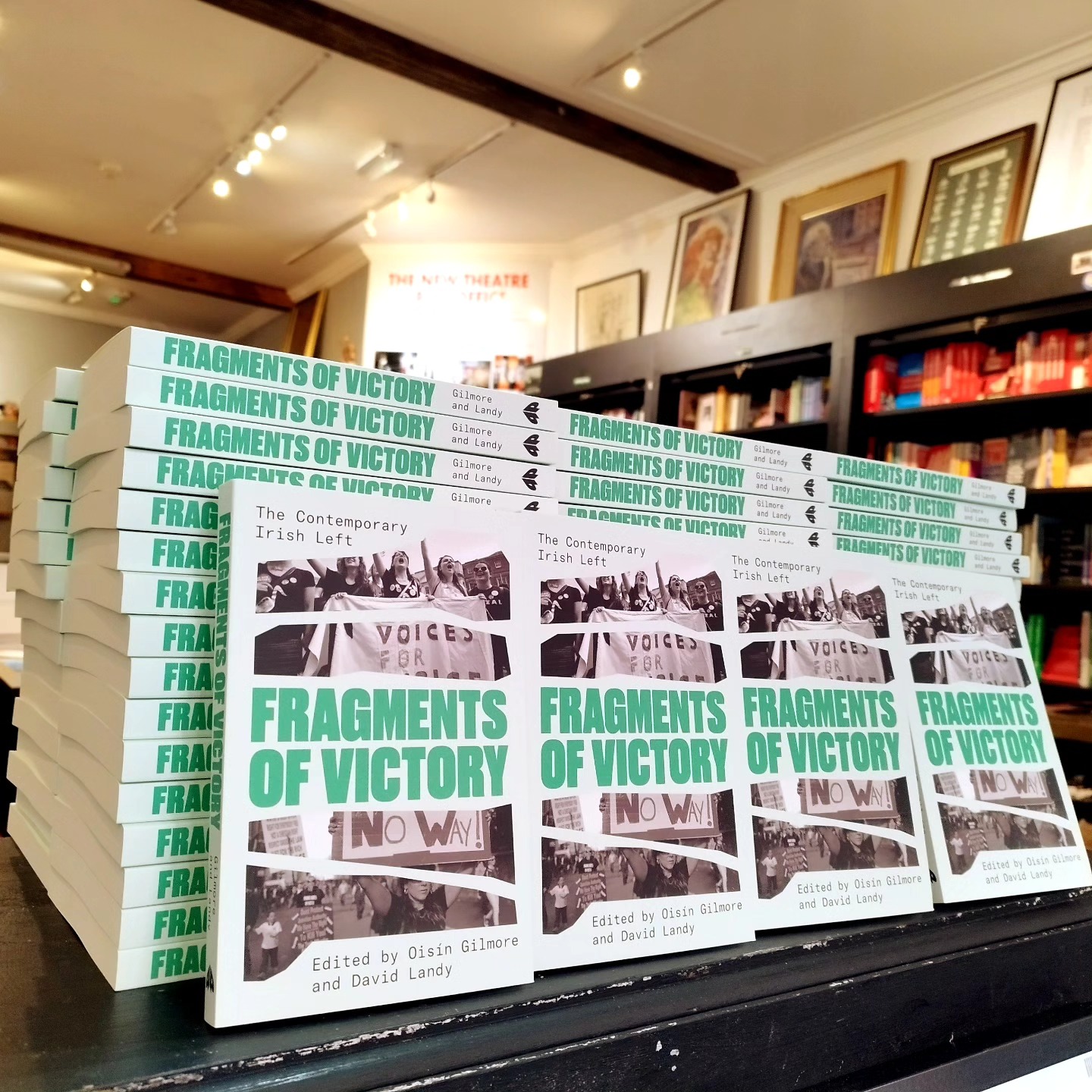
Fragments of Victory’: The Contemporary Irish Left’, book review (5 of 6)

Fragments makes a series of observations about the political consciousness of the Irish working class, some of which we have already noted, such as the view of many on the Labour Party entering office that ‘the crisis was clearly not their fault and . . . the harsh austerity measures they took were seen as both forced by the Troika and, while painful, necessary.

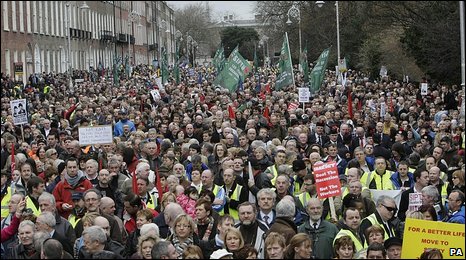
It records the view of another author that the first year of crisis saw a large number of demonstrations but these ‘dried up once the public realised the magnitude of the banking crisis, and they were replaced by years of “muted protest”. Certainly, there was a sense of powerlessness at the scale and suddenness of the economic crash, a degree of acceptance of the official narrative . . .’ (p31)

It notes that the muting of protest was partially the result of emigration, particularly of the young with 106,000 leaving from 2009 to 2013.  ‘However, the muting of opposition was also due to the influence of the Labour Party and trade unions, which contained protest and channelled anti-government anger down institutional routes from 2009 to 2011.’ (p30). These organisations did indeed push anger down the road of inevitable failure, and yes, they were betrayed, but how was this possible?

One contributor notes that by late 2013 ‘it is difficult to overstate the feeling of exhaustion and disillusionment’, with the radical left ‘comprehensively defeated on the one anti-austerity struggle they’d seriously fought – household taxes.’ The ‘public mood was judged sullen but compliant’ and was successfully ‘blackmailed’ into voting yes to the EU’s fiscal Treaty in 2012 ‘even though this treaty restricted the possibility of future government spending” (p 40-41)

wrote about this result at the time, noting that:  ‘At 60 per cent Yes against 40 per cent No there is no room for doubt.  It is a decisive endorsement of government policy and a mandate for further cuts and tax increases.  The result should not have been unexpected given the political forces ranged in support of the Treaty, the support of big and small business, the failure of the trade union movement to oppose it and the inevitable support of the mass media.  In the general election last year the Irish people voted by a large majority for a new government in no important way different from the previous one and with no claim to pursue significantly different policies.’

I also noted that ‘Austerity isn’t popular despite the vote and never will be.  Even the Yes campaign was under instructions not to celebrate its victory . . . In October last year when the Austerity Treaty was originally being negotiated an opinion poll recorded 63 per cent opposed to it with only 37 per cent supporting.’  I noted that some people had changed their minds or perhaps did not have the confidence to follow through on their opposition.  This might have united around the demand to repudiate the debt taken on by the state on behalf of the banks and their bondholders, but this also meant opposition to the Troika upon whom the state had become reliant.  It also meant opposition to the administration in the US, even though its Secretary to the Treasury Timothy Geithner thought it was ‘stupid’ to guarantee the banks liabilities. 

I wrote a number of blogs on the issue of repudiating the debt herehere and here, and the disastrous and ‘stupid’ decision to bail out the bondholders in the first place.  Doing so was a real political challenge and required an alternative that didn’t exist.  Without this the failure of the opposition to austerity was inevitable, even if the question of the debt was only one element of the necessary political alternative.

Where the book completely fails is the neglect of what the political content of the alternative might have been, although this is revealing.  In recording the activity of the left its non-appearance reflects the absence of this in the anti-austerity movement as a whole and the failure to win any significant section of it to a socialist perspective.

The same contributor noted above goes on to say that at a later time ‘A proper balance sheet would recognise how the Labour Party and the aligned section of the union movement were rendered powerless to influence or sidetrack the anti-austerity movement.’ (p 42). He points to the drop on the Labour vote from 19 per cent in the 2011 general election to 7 per cent in the 2014 local elections and the ‘victory for left-wing independents and Trotskyist parties alike.’ (p 43)

He argues this was possible because in 2014 100,000 marched against water charges in October followed by 150,000–200,000 in November and 80,000 (in Dublin alone) in December in what was ultimately a winning struggle.  We have already noted the limp role that was expected of the trade unions and political parties in the campaign in the previous posts but the argument that the Labour Party and trade union leaders could not divert the campaign is correct.

It won because it was a community campaign based on mass protests, blocking the installation of water meters and non-payment of bills.  Independents and left wing candidates benefited from their role in the campaign which also distinguished itself by exposing the equivocating role of Sinn Fein. Despite the political weaknesses of the campaign that we noted previously its tactics were able to beat the counter-measures of the government where the previous campaign against household charges could not.

The campaign proved that individual campaigns, given the right circumstances, could defeat particular austerity measures even where the wider offensive was continued successfully. It should be recalled that the water charges campaign took off almost a year after the state exited the Troika bailout programme. It is also worth recording again the failure to draw the right political lessons as the trade union official who contributed the chapter on the campaign finishes his story by endorsing the statement by ‘one of the world’s greatest authorities on water’ that:

‘The Irish system of paying for water and sanitation services through progressive taxation and non-domestic user fees, is an exemplary model of fair equitable and sustainable service delivery for the entire world.’ (p 61)

In fact, the Irish water industry was wasteful and inefficient and state ownership is neither democratic nor socialist.  For this, workers’ cooperative ownership or the demand for workers’ control would have been necessary but the Irish left, like so much in the rest of the world, have become habituated to statist views of socialism that Marx repudiated but that have become entrenched through the domination of social democracy and Stalinism over the last one hundred years.

With such a political platform the problem of the state being the solution, when the solvency and policy of the state was the problem, was once again avoided because doing otherwise would raise the question of ownership and control that would show the platform’s inadequacy.

The main victory in Fragments of Victory was thus necessarily limited and could not be a springboard to address the many deficiencies of the resistance identified in the book.  These included the failure ‘to build lasting political and social institutions’ and ‘no lasting form of working-class self-organisation.’  Reliance on capitalist state ownership as ‘an exemplary model’  illustrates why a problem could not be addressed: that ‘the steps between the current situation and the long-term goal of socialism are less clear than ever before.’ (p192)

The view that the trade union bureaucracy was ‘rendered powerless to influence or sidetrack the anti-austerity movement’ is therefore only partially true. The politics of the bureaucracy, and of the Labour Party, were not challenged by a wider political alternative and the much-trumpeted militant tactics of the campaign were no substitute for it.

back to part 4

Forward to part 6
Fragments of Victory’: The Contemporary Irish Left’, book review (4 of 6)

In the previous post I argued that the leadership of the trade unions were unable and unwilling to challenge austerity because it would involve a political challenge to the state it had decades of ingratiating itself with it as its ‘social partner’.  However, I also noted that ‘the undeveloped and inadequate political consciousness of the working class itself [was] also a major factor’ in the union movement being unable to successfully resist austerity.

The socialist critique of the bureaucratic leadership of the trade unions is not that its passivity never reflects the views of its members but that the occasions in which members are prepared to take action are often betrayed and their passivity reinforced through ensuing demoralisation.

Protests and demonstrations (called by trade unions early in the economic crisis and also later) are only useful in so far as they are necessary steps to more effective action: by rallying the troops and persuading others that there are alternative courses of action and the means to achieve them.  Otherwise, they are what they are defined as, simply public expressions of objection, disapproval, or dissent, and public exhibitions of the attitude of a group toward an issue.

There is currently no other rival union leadership that believes in independent working class politics that is separate from and opposed to the state and seeks to increase the class’s political consciousness.  Bureaucratic organisation stifles any democratic control that might permit episodic bouts of struggle to advance and accumulate an understanding of class politics.  Lack of democracy and low participation are both causes and effects of political weakness.

Both the leadership and membership are wedded to the view that fundamental change can come only through the state as the only (legitimate) agent capable of achieving it.  All sections of ‘the left’, from Sinn Fein to supposed ‘Trotskyists’, have a political programme that hold that achievement of governmental office will enact this social transformation, and campaign on this basis.  How a capitalist state will permit this is never explained.

Of course, People before Profit and Socialist Party pay obeisance to the view that the capitalist state will have to be overthrown but this plays a role analogous to republicans’ view that the legitimate government of Ireland resides within the IRA.

During the crisis there was little to no awareness of the possibility of an independent working class political force as more than perhaps a vehicle to pressurise the state, or with a view to having its representatives occupy positions in its parliament so that they could legislate sought after policies and adopt necessary measures.

This reflects the widespread support for the democratic credentials of the state and its political system, further legitimised by the country’s colonial history and the struggle against it.  This gives the nationalism that is the express ideology of almost all political parties a progressive veneer and a reactionary essence.

Accompanying this is an acute awareness of the weakness of the small Irish state and its dependence on US investment and EU membership, where most power resides in the much larger European states.  There are some illusions in the independent sovereignty of the state but also awareness of its constraints.  When the Irish state became bankrupt the view that it could not resist the demands of the EU and US that it bailout the banks was reluctantly accepted because there appeared no alternative.

When your politics is based on winning concessions from the state, and/or the perspective of being the official government of the state, it is difficult to present these as possible when that state is bankrupt and your proposed actions are opposed by much more powerful states.  Not only does it look unconvincing, it actually is.  Hence the comment in the book, in relation to the Dáil, of the ‘futility of marching to an institution that was taking its own marching orders from elsewhere.’

One contributor to Fragments, writing about the trade union input into the one anti-austerity campaign that was successful – against water charges – reports that ‘political economy training . . . was the most impactful part of the campaign’. (p57) Except this training appears to have been peddling the same mistaken conception that state ownership is the answer that the whole crisis, and the response to it from the Irish state, should have utterly dispelled.

This campaign morphed into the Rights2Change movement that on paper united much of the left and some trade unions.  Its programme of rights, which went beyond the question of water, made sense only if the state had an obligation to satisfy them, and it didn’t begin to address the claims by the government about the lack of state resources to do so.  A programme based on the supposed moral obligations of the state was as weak as the commitment of the various organisations to the project. It demonstrated only that this spectrum of organisations was united in illusions in, and subservience to, the capitalist state.

Two aspects mentioned in the book illustrate these weaknesses: ‘throughout the period of Right2Water’s existence, nobody was working on the campaign full time. The bulk of the work on the union side was done by two or three trade union officials who also had their day jobs.’ (p61)

As to the unions role as a ‘pillar’ of the campaign, it was to ‘bring organisational skills . . . politically neutral; provide economic and political research; have activists in workplaces all over the country and bring financial assistance.’  (p 55) Nothing about workers action in the workplace and what sort of action its ‘activists’ should fight for.

The role of political parties was equally somnolent – to ‘bring political knowledge; an ability to raise issues in the Dail and have activists in communities all over Ireland.’  (p55) Again, without an acceptance that political debate over aims and strategy was absolutely required, as opposed to already accepted, there was no specifically political input sanctioned for political parties.

Like so many left campaigns, broadness was confused for depth, and political shallowness for agreement and unity.  One ridiculous outcome was that at one demonstration ‘we ended up with 36 speakers or acts.’ (p53) One unambiguously positive legacy of the campaign claimed by the writer is that the ‘unions and progressive political forces were in place to prevent the movement from being co-opted by the far right.’ (p60). Not a high bar.

If the original platform for the campaign was weak (that water was a human right), there remained differences on appropriate tactics, so it could be no surprise that this attempt at turning a ‘mass movements’ into a’ story of mass organisation’ rather than simply mass mobilisation’ was a failure (p180-1 &182). This meant that it was ‘large but ephemeral’, ‘failed to lay deep social roots’, ‘failed to identify an avenue through which society might be changed, and given this, . . .  failed to develop a mass political consciousness around the capitalist nature of our society or around what needs to be done to change it.’ (p183)

Sowing illusions in the state and failing to educate those mobilised on its unreformable class nature is guaranteed not to ‘develop a mass political consciousness around the capitalist nature of our society.’  The major success of resistance to austerity set out in the book came nowhere near this because it didn’t try, and it didn’t try because the left didn’t know what this would have to involve.

Back to part 3

‘Fragments of Victory’: The Contemporary Irish Left’, book review (3 of 6)

The summary conclusions in the previous post raise a host of questions about the struggle against austerity following the crash of the Celtic Tiger: the lack of permanent organisation; the lack of working class consciousness and awareness of its specific political interests; lack of credible political programme and the inability to ‘articulate a viable alternative’; reliance on electoralism and thus on Sinn Fein, and lack of clarity on ‘the long-term goal of socialism’.

This is quite a list, and it is to the book’s credit that they are recognised.  What is also recognised, more by implication than by explicit critique, is that this is the result of the conscious approach taken by ‘the left’, which the book sees as one of failure qualified by some success.  It also implies that the answer to overall failure is not simply more and better activity.  For the left however, it is the roller-coaster of activity that is consciously seen as necessary to keep the show on the road.

If we briefly look at these issues, the first question is why ‘mass movements were less a story of mass organisation than mass mobilisation’ and were ‘large but ephemeral’.  These mobilisations were campaigns so were inevitably time limited and impermanent.  The issue is why they were temporary when their object of attack – austerity – had not been defeated and why the permanent organisations that did exist failed to keep the campaign going?

The second question is posed mainly to the trade unions and particularly ICTU, which called initial demonstrations and then left the stage.  Two further questions then arise – why did they do so and why were they able to get away with it?

The first answer is that since 1987 the trade unions have seen the state as a ‘social partner’ and very definitely not an antagonist – never mind enemy, and conducted themselves as partners in not opposing austerity itself but only seeking to modify its implementation. This to be done in the normal way of partners, through lobbying and negotiation.

The decline in strike activity and union density during the period of partnership was therefore not simply a result of economic conditions because they improved dramatically in the 1990s, at first rather slowly in terms of employment and then rapidly.  In 1986, just before the first deal, there were 309,198 days ‘lost’ in strikes and in 2007, just before the crash, a total of 6,038 days. By 2022 this had fallen even further to 5,256 while union density declined from 46 per cent in 1994 to 30 per cent in 2007.

Economic power and state revenue shifted to foreign multinationals that unions largely failed to organize, resulting in many skilled, educated, and younger workers being excluded.  One of the early results of partnership was the 1990 Industrial Relations Act that made illegal a strike unconnected to a ‘legitimate’ trade dispute, which successfully thwarted solidarity action – one of the very purposes of a trade union movement.  ‘Partnership’ also did not prevent the bosses refusing to recognise or negotiate with trade unions

Since the crisis was one of solvency of the state, arising from it guaranteeing the deposits and liabilities of the banks that it could not itself finance, the response was cuts in state services and the pay of public sector staff. The initial ICTU response was therefore a public sector strike that recognised its weakness in the private sector.  Bourgeois politicians and its media made hay with accusations about the privileges of these workers that sought to divide private sector workers from those working for the state, which the unions had themselves done little to prevent through their failure to organise across the whole working class.

Private sector workers were met by a withdrawal of their bosses from the social partnership arrangements, one result of which was their repudiation of sectoral pay arrangements.  This demonstration of the hollowness of partnership with the state and bosses, both of whom had withdrawn, did not prevent the unions going into another deal in 2010, the Croke Park Agreement, which gave way to Croke Park 2 as more cuts were sought.  When the proposals for it were initially rejected by a large majority of members the union leaders were able to manoeuvre ultimate acceptance by warning of the consequences of rejection while providing no strategy for fighting for its members decision.

‘Mass mobilisation’ was not therefore meant to involve ‘mass organisation’ but dependence on the trade union’s own bureaucratic organisation.  Its purpose was to assist union leaders’ lobbying with some pressure from below that was to be applied to the government while releasing it from the working class, amounting to simply blowing off steam. By February 2013 ICTU speakers at one of their demonstrations gave over the stage to musicians before many marchers had arrived at the finish in order to avoid being heckled.  They avoided it afterwards by not having any demonstrations at all.

Mobilisation wasn’t mean to be permanent, and it wasn’t meant to be an alternative to social partnership and the union bureaucrcay.  Although it was formally dissolved by the state it never ended given the objectives and strategy of the trade union leaders who simply pursued it unofficially, originally pushing the idea that the Labour Party in government might mitigate the worst effects of austerity.

The trade union movement, through its bureaucracy, is wedded to the state.  Most of its members are in state employment and the state facilitates its organisation through facilitating membership subscriptions, while the share of members in the private sector has declined.  The alternative offered by the trade union leaders was therefore the Labour party in government; rises in taxation instead of expenditure cuts, and ‘sharing the burden’ rather than its repudiation.  While the unions’ organisational weakness was material, they were partly responsible for this themselves, and while this weakness was also the basis of political passivity and failure, this too was partly their leaders’ own responsibility.

If we look to answer the questions about the lack of permanent working class self-organisation and failure to maintain mobilisation against austerity, we need to look at the prior commitment to social partnership and dependence on the state, which itself had become dependent on the Troika of the European Commission, European Central Bank (ECB) and the International Monetary Fund (IMF).  The unions were, and are, not the expression of the self-organisation of the working class and for this their leadership is partly responsible, with the undeveloped and inadequate political consciousness of the working class itself also a major factor.  While in times of social peace the union leaders can represent the passivity of the membership, in times of heightened political awareness and activity they consciously act to limit this independent action and the possibility and potential for advancing political consciousness.

Had there been any permanent opposition to social partnership within the trade union movement prior to the crisis it might have presented a starting point to build an alternative to the union bureaucrats.  Any opposition however was generally of a temporary campaigning character while the bona fides of the bureaucrats became generally accepted.  No independent political alternative was built within the trade unions, reflecting the political weakness of the left outside it.

In these circumstance the bureaucracy was able to mobilise spontaneous anger, demoralise it and then dump it, getting away with it primarily because the politics of the union movement went unchallenged.  This in turn partly reflected the political weakness of the left.

Back to part 2

Forward to part 4

Derry TUC publishes a Workers’ Charter

On May Day Derry Trades Union Council (DTUC) launched a Workers’ Charter and published it in local newspapers.  It argued the need for trade unions and for workers to organise to push for real change.

The Charter raised ‘the Red Flag of workers’ unity and socialism’, calling for ‘a Living Wage for all’ and ‘a shift in the balance of wealth and power away from corporations and the rich and towards the rest of us.’

We should therefore ask ourselves – what does this wealth and power consist of, where does it come from and how do workers shift the balance?

If the Coronavirus crisis has taught us anything, it is that the wealth of society is the product of the labour of the working class, with some of the lowest paid workers recognised as key to the functioning of society.

So if they are so crucial, why is this not recognised in the remuneration they receive?

The reason that they enjoy so little of the fruits of their labour is that their labour power is exercised for the production of profit, because production only takes place in pursuit of it, and is derived only from the labour performed by workers for which they are unpaid.  That is why they must now work and why they are paid so little.  They don’t own or control the corporations that they work for, which provides the enormous incomes and wealth of those who do, so the economy is not a function of need but of the expansion of this unpaid labour.

The supermarket workers do not own Tesco, which is paying out a £900m dividend to its owners despite getting a tax break, but they are absolutely necessary for this dividend to exist.  Many firms loaded with debt will get Government bail outs while the private equity firms that own this debt sit on $2.5 trillion of cash.  The state will not take this into account as they do the meagre incomes and savings of workers who apply for welfare.

The rich owners of corporations are rich because they own the means of producing the wealth of society. Their wealth and power comes from control over the production that generates current income and accumulated wealth. Health Service workers such as cleaners, nurses and doctors are exposed to danger because they also don’t own and control the NHS. They have no more control over their pay and conditions than those who work in private hospitals or private care homes.  If they did the shortage of personal protection equipment would not have existed.

The answer to shifting the wealth and power in society is therefore to shift ownership and control of production to the people who work to create this wealth.

Derry TUC correctly point out that vast sums of money have been found to cover the Covid-19 emergency after years of tiny wage increases for health service and other workers – ‘the money was there all along’.  It wants a tax-free payment of £1,500 for all front-line workers plus an additional four bank holidays a year.

But the money wasn’t there all along.  It has been borrowed.  It’s now a question of whether, how and who will pay it back.  Money was found for the financial crisis of 2007-08 but austerity was imposed to pay for it.

The DTUC statement says that the government is putting the ‘economy’ and profits ahead of protecting people and public health.

But the ‘economy’ is also about the production of all the goods and services that are required to protect people and their public health.  Not only the goods and services the NHS needs, that NHS workers need, but all the other economic activity that pays the taxes that funds the health service and other services, including any tax-free payments of £1,500.

The ‘economy’ is not something separate from the activity of working people, that has needs wholly separate from their needs.  That is the lie peddled by the Government and bosses.  The working class is the working class because it is the prime productive force of the ‘economy’.

The ‘economy’ is not just the production of profit but also the production of what people need in order to live in a civilised society.  We cannot survive without continuing to produce and no amount of additional money will be of any use to us if we cannot continue to produce.  Working people will be the first to suffer, and the last not to, if whole parts of the ‘economy’ are closed down.

That is the prime contradiction of the capitalist system – that it is production for profit but must also satisfy human need – and capitalism incurs crises because of this opposition.

The battle now is to ensure that the terms and conditions of those workers who return to work are safe and acceptable, and that depends on workers being ready to go to work organised and ready to stand up to the demands of their bosses.  That is the lesson from health workers already having to face a lack of PPE.  This requires introducing as far as possible mechanisms of workers control.

It also means the organisation of all those workers who are now unemployed and who are threatened with being idle in the longer term.

Workers cannot afford not to work, they aren’t capitalists, and capitalism does not pay for workers unless it is profitable.  It would be the height of stupidity to say that we should not return to work because this is demanded only because the bosses want to make money.  Of course they do!  Until we have a new society based on production for need, and not profit, we have no choice but to recognise this reality, to face up to the economy we actually live in and struggle within it to defend ourselves while also fighting to change it.

Capitalism will not be overthrown by refusing to work, or pretending we can change its laws by simply demanding that profit no longer rules.

Once again, it is workers ownership and control of production that is key to workers’ defence and a socialist alternative.

The DTUC says that ‘globally, one per cent of the population holds half the world’s wealth.  We need a new system’.  But why is this true?

The world’s decisive capitalist class and its corporations (with its various States) holds the vast majority of wealth creation – that is what defines them.  They are smaller than even one per cent, and own or control much more than half.  Their lavish riches composed of multiple residences, private islands, yachts, private planes, fancy cars, jewellery, stocks and shares, and bank accounts with millions, are only the product of their real wealth and power, which is their ownership of production and the political power that derives from it.

Derry TUC points specifically to the amount of money spent in the UK defence budget, ‘set to reach £55 billion’.  But why only this? UK ‘defence’ spending is only 2.1% of GDP.  What about the other 97.9% that is all produced by workers?  Should it not also be directed to their needs?  And how else would this be done except by controlling it, which means owning it?

The statement calls for ‘a government of the people’, investing this money in areas such as green energy, but why should the State own and control this?  The Irish State already owns significant parts of the energy industry in the North of Ireland as well as in the South, and this isn’t socialism. Governments already invest significant amounts in Green energy through subsidies to wind farms and taxes on consumption but this has not brought the transformation of society any closer.

The point is not to increase this state ownership but for workers to develop their own energy production, something more and more possible with smaller and more distributed renewable power generation. The point is to increase the wealth and power of the working class, not the State that defends the existing capitalist system and subsidises the capitalist class.

Derry TUC says that ‘politics has taken power away from the people moved towards the major corporations.’ But this is misleading.

The most fundamental power has always lied with the capitalist class, its system and the laws by which it operates.  The capitalist class and its state has increased its power over many years but it has always had power over the working class.  Working people can defend themselves and resist, but to create their own power and to create a society in which their power prevails requires an economy owned and controlled by workers and by no one else.  To fight for this requires more than bigger and better trade unions; it requires the creation of a mass democratic working class Party.

This is the lesson we must re-learn and teach every May Day.

In his inaugural address to the workers of the First International Marx extolled –

‘the still greater victory of the political economy of labour over the political economy of property. We speak of the co-operative movement, especially the co-operative factories raised by the unassisted efforts of a few bold “hands”. The value of these great social experiments cannot be overrated. By deed instead of by argument, they have shown that production on a large scale, and in accord with the behests of modern science, may be carried on without the existence of a class of masters employing a class of hands’

To achieve this, Marx said, ‘the great duty’ of the working classes was to ‘conquer political power’ and this required the organisation of a working class party.

The policy of that Party cannot afford to defer the tasks of the working class to the capitalist state, or to pretend that tinkering with the distribution of the fruits of labour through increasing wages etc. is a substitute for revolutionising the distribution of the ownership and control of production.

As Marx said in the ‘Critique of the Gotha Programme’, a programme representing an earlier Workers’ Charter:

‘Any distribution whatever of the means of consumption is only a consequence of the distribution of the conditions of production themselves. The latter distribution, however, is a feature of the mode of production itself. The capitalist mode of production, for example, rests on the fact that the material conditions of production are in the hands of nonworkers in the form of property in capital and land, while the masses are only owners of the personal condition of production, of labour power. If the elements of production are so distributed, then the present-day distribution of the means of consumption results automatically.’

‘If the material conditions of production are the co-operative property of the workers themselves, then there likewise results a distribution of the means of consumption different from the present one. Vulgar socialism (and from it in turn a section of the democrats) has taken over from the bourgeois economists the consideration and treatment of distribution as independent of the mode of production and hence the presentation of socialism as turning principally on distribution. After the real relation has long been made clear, why retrogress again?’

Why indeed?


Civil rights and socialist strategy 3 – the weakness of the left

The strategic differences that existed and discussed in the previous two posts had implications for the tactics to be pursued, although the relationship was not straight-forward.
In order to appreciate the different viewpoints, it is necessary to look at the balance of political forces in the civil rights movement and in particular the strength of the left and its potential influence and power.

We have already noted the weakness of the political influence of the wider labour movement in previous posts but it is important to recall it again as it is the primary candidate as the mechanism by which a working class and socialist strategy could have been pursued.

While the Northern Ireland Labour Party and trade union movement passed a few resolutions supportive of civil rights no trade union affiliated to NICRA and neither the industrial or political wings of the movement would mobilise their membership in support.  The reason is obvious.

The members of the trade unions were not a different species from the majority of workers who voted unionist, nationalist, or on occasion the very homeopathic socialism of the NILP; and, of course, others were apathetic and unpolitical as is the case everywhere.  The trade union movement reflected this, with a survey in 1959 revealing that Catholics were 46% of branch secretaries in the mainly unskilled ATGWU, 12% in the AEU, 9% in the Association of Supervisory Staffs, Executives and Technicians, and 0% in the Boilermakers.  Of 53 unions surveyed and 379 branch secretaries, 80% were Protestant.

This is not to employ sectarian prejudice that assumes a person’s politics, including a trade union rep’s, can be read across from their religious background, but it is unfortunately the case that in the majority of occasions this is true, and is precisely the problem.

One might expect this not to be so much the case with trade union representatives, precisely because they have sought active participation in the union, but this doesn’t get away from the problem, because all trade union reps are acutely conscious of their role as a representative of their members and are careful not to tread too far from those whom they represent.  Where radical motions are passed at trade union branches this often reflects the influence of a few activists carrying a room consisting of a small fraction of the membership.

For most union officials the primary concern is the organisation within which they hold a position and the primary concern of the members they represent is wages and conditions.  In the North of Ireland there is strong pressure against raising political issues that would upset working relationships, and the trade union apparatus is keen that this remains the case, with policy not usually going beyond platitudes.

The problem of course is that the ‘unity’ then trumpeted is weak and subject to official public opinion relayed through the state and employer, and then imported through the trade union apparatus.  What this unity very definitely isn’t is socialist.  That it exists is not unimportant, in fact it signals a general and widespread aversion to conflict, especially sectarian conflict, but it is not the grounds on its own for creation of a radical alternative, and can only be presented as such by those with a willing blindness and by denuding this alternative of all political content.  The utterly reactionary content of unionism and its unsuitability to play any role in a trade union meant it only occasionally intervened in the scope of trade union affairs, which facilitated the weak ‘unity’ existing.

The very partial exception to lack of direct labour movement involvement in civil rights agitation was Derry, which was the second city in Northern Ireland and had a Catholic majority, and where the local Labour Party was central to the early civil rights struggle.  It was also in Derry that the civil rights movement exploded onto the stage and thousands of people were repeatedly mobilised.  If intervention by the left would make any difference, then Derry was as good a place for this to happen as anywhere.  That it didn’t should be taken into account when weighing the different arguments.

The prominent socialist and civil rights leader Eamonn McCann has written that almost all of those involved in organising the October civil rights march were “socialists of one sort or another.”  They were involved in the Derry Labour Party, but despite the blatant sectarian discrimination and poor housing the local trades council barely took up the latter, condemning the corporation but refusing in June 1968 to receive a delegation from the Derry Housing Action Committee.  It opposed a harsh fine imposed on its members as a result of a protest but would take no real action.

Civil rights did not come before the council until the month before the October 1968 civil rights march, when a delegate wanted to know what its position on it was.  It was agreed to have a special session if the council was invited to participate and to wait until its observers reported back on a march organising meeting.  It then decided that it “supported the establishment of equal civil rights in Northern Ireland for all citizens regardless of class or creed” and “participation . . . should be left to individual trade unionists”, before turning to the question of a pedestrian crossing at Westland Street.”

It played no role in a number of spontaneous strikes by Catholic workers that followed the October march, especially during 18 – 19 November, but decided to pledge support to the moderate Derry Citizens Action Committee and did not seek representation in it, although it did agree to send delegates to a NICRA meeting in Belfast.  Following the O’Neill reforms that month it went back to where it had been before, with economic and social issues to be pursued through official union and Government channels.  At its annual general meeting in April 1969, Billy Blease, who was a senior officer of the Northern Committee, told the audience to concentrate on the ‘real issues.’   As has been noted before, the Citizens Action Committed had more influence over Catholic workers than their trade unions.

McCann notes that no sizable socialist party was built from the experience of building the October march and “in the long run, we didn’t punch our weight,” but he also describes those involved as “our relatively small, raggedy band of socialists’, who had “a loose style of organisation . . . coalescing on an ad hoc basis against the wishes of party leaders and without fretting about the contradictions which all knew must be lurking.”

In his book ‘War and an Irish Town’, McCann states that “the leftists involved carried out no clear political struggle within either organisation [Labour Party and Republican Club].  We could not, because what we shared was not a common programme but a general contempt for the type of politics which prevailed in the city.”

He records that an attempt had been made to “codify our ideas’ in May with a ‘perspectives document’, which stated that ‘the situation which confronts us is not promising.  The great mass of the people continue, for historical reasons, to see religion, not class, as the basic divide in our society.”   What was required was a socialist party but he notes that “any perspective of building a clear-minded political organisation in opposition to the dominant tendencies within the Labour or Republican movements was forgotten in the frenetic round of breaking into empty houses, organising pickets and encouraging individuals to stand up to the landlords and local bureaucrats.”

Neither the labour movement as a whole, at least in its attitude to civil rights, or the radical socialists on its periphery, were in a strong position as the campaign exploded into a struggle on the streets.

Back to part 2

Free trade and Socialism part 4 – Karl Marx on Free Trade ii

Much of the previous post setting out the circuit of capital accumulation is basic to the understanding of Marxists, although many would now not appreciate Marx’s view that socialists should not seek to destroy capitalism by simply trying to prevent it from working – by putting up barriers to trade and thus frustrate the conversion of money into commodities and commodities into money: M – C and C’ – M’.
The righting of the wrongs of capitalism can only be achieved by replacing the system of production and thus the way the reproduction of society takes place.  Since the precondition for this is the full development of capitalism, including creation of the working class as the immense majority of society, this cannot be done by seeking to make capitalism either not work, or seek to make it work differently from how it actually does and must work.

None of this prevents socialists fighting for reforms within capitalism, in order that workers’ lives are made better, but this objective cannot rely on the good intentions of the state and cannot even rely on the effects of trade union struggle.  As Marx puts it:

“the working class ought not to exaggerate to themselves the ultimate working of these everyday struggles [over wages]. They ought not to forget that they are fighting with effects, but not with the causes of those effects; that they are retarding the downward movement, but not changing its direction; that they are applying palliatives, not curing the malady.”

“They ought, therefore, not to be exclusively absorbed in these unavoidable guerilla fights incessantly springing up from the never ceasing encroachments of capital or changes of the market. They ought to understand that, with all the miseries it imposes upon them, the present system simultaneously engenders the material conditions and the social forms necessary for an economical reconstruction of society. Instead of the conservative motto: “A fair day’s wage for a fair day’s work!” they ought to inscribe on their banner the revolutionary watchword: “Abolition of the wages system!”

“ . . . Trades Unions work well as centers of resistance against the encroachments of capital. They fail partially from an injudicious use of their power. They fail generally from limiting themselves to a guerilla war against the effects of the existing system, instead of simultaneously trying to change it, instead of using their organized forces as a lever for the final emancipation of the working class that is to say the ultimate abolition of the wages system.”

So, restrictions on trade, as far as Marx was concerned, were not progressive and did not alter the basic relations of capitalist society.   And, of course, Marx was under no illusions as to what these relations were and what they entailed:

“To sum up, what is free trade under the present condition of society? Freedom of Capital. When you have torn down the few national barriers which still restrict the free development of capital, you will merely have given it complete freedom of action. So long as you let the relation of wage-labor to capital exist, no matter how favorable the conditions under which you accomplish the exchange of commodities, there will always be a class which exploits and a class which is exploited.”

“It is really difficult to understand the presumption of the free traders who imagine that the more advantageous application of capital will abolish the antagonism between industrial capitalists and wage-workers. On the contrary. The only result will be that the antagonism of these two classes will stand out more clearly.”

“Do not be deluded by the abstract word Freedom! Whose freedom? Not the freedom of one individual in relation to another, but freedom of Capital to crush the worker.”

This did not mean Marx sought to shackle capital, as those who seek to reform capitalism think can be achieved, or that its reactionary consequences can be fought by isolating their country from its international development – like leaving the ‘neoliberal’ EU and frustrating the globalisation of capital.

In concluding his speech on free trade Marx said this:

“Do not imagine, gentlemen, that in criticising freedom of commerce we have the least intention of defending protection. One may be opposed to constitutionalism without being in favor of absolutism.”

“Moreover, the protective system is nothing but a means of establishing manufacture upon a large scale in any given country, that is to say, of making it dependent upon the market of the world; and from the moment that dependence upon the market of the world is established, there is more or less dependence upon free trade too. Besides this, the protective system helps to develop free competition within a nation. Hence we see that in countries where the bourgeoisie is beginning to make itself felt as a class, in Germany for example, it makes great efforts to obtain protective duties. They serve the bourgeoisie as weapons against feudalism and absolute monarchy, as a means for the concentration of its own powers for the realization of free trade within the country.”

“But, generally speaking, the protective system in these days is conservative, while the free trade system works destructively. It breaks up old nationalities and carries antagonism of proletariat and bourgeoisie to the uttermost point. In a word, the free trade system hastens the Social Revolution. In this revolutionary sense alone, gentlemen, I am in favor of free trade.”

Unfortunately, today this approach is rejected by many calling themselves Marxist, who seek not only to protect “old nationalities” but actually to promote them, through for example support for Scottish separation. For them, the combined and uneven development of capitalism must be addressed through national separation on a more perfect basis, which unfortunately for those fooled by this scenario does not exist.

These Marxists might seek a way to demure from Marx’s words by stating that his views were particular to its time, when free trade represented the free development of a capitalism that was in some sense progressive as against reactionary feudal restrictions on free markets and development of the forces of production.

While this was certainly the situation that Marx quotes in the passage above, the current pursuit of national solutions against the development of international capitalist economic and political arrangements such as the EU, is equally reactionary since it also seeks to turn the clock back.

The defeats to the working class and socialism experienced in the twentieth century have been internalised into a predilection to state what you are against, with nothing beyond eschatological declarations of the need for revolution as something to say about what you are for.

So, in this view, socialism is to be built not on the foundation of capitalism and its achievements but on its collapse.  Capitalism must go back to national forms because the working class has failed to build itself an international unity, while this left fails to understand how impossible it would be for the working class to develop an international movement while capitalism is restricted within national economic and political forms.

The left that rails against free trade does not pause to think that the development of free trade within countries, such as Marx referred to above in relation to Germany, created exactly the same sort of circumstances for many workers as the freedom afforded to international trade does today. Yet these socialists are so limited by nationalism that they would find it incomprehensible to advocate restrictions on trade within countries.  As internationalists however, they should seek the minimisation of differences between the working classes of the different nations through the processes Marx stated above.

For many socialists internationalism has taken on a purely moralistic character because they reject the material foundations upon which it can become an immediate material need for workers.  This material need, an interest in fighting international capitalism can only be created through international capital accumulation creating an international working class more and more exposed to the reality that the system that exploits them and which they must resist is international and therefore the alternative to it must also international; there is no question of the alternative being a backward step in the socialisation of production.  As Marx says, this international development of capitalism “pushes the antagonism of the proletariat to the extreme point.  In a word, the free trade system hastens the social revolution.”

Back to part 3

Trade union leaders support austerity? Oh yes they do!

Pantomime season is upon us, where actors go through well rehearsed and sometimes laughable theatrics to keep us distracted in the chilly season, performing roles we have seen so many times we could write the script ourselves.  Familiarity creates half the fun for the adults and innocent gullibility the mirth for the children.  Or at least for some.

A number of years ago a work colleague reported a conversation between two young boys sitting behind him while he was watching a panto with his kids.  “He’s behind you”, roared the children in the audience, only for the object of their warnings to turn round and miss the actions of the dastardly villain about to carry out the nefarious deed.  “Oh no he’s not” exclaimed the gormless actor.  “Oh yes he is!” screamed the children in the audience.  “He’s behind you!” they would roar again and so again would the witless actor turn round to see nothing amiss.  This obviously went on at some length until my friend heard one very well-spoken boy behind him tell his companion to shut up about the “he’s behind you” stuff – “be quiet Roger, the man’s obviously a fool.”

This story came into my head when I read the latest statement from the Irish Congress of Trade Unions (ICTU) about the “Fresh Start” agreement between the British Government, Irish Government and Northern Ireland parties.  The agreement was a stunning exposure of the hollowness of Sinn Fein’s opposition to austerity as it agreed and subsequently praised its agreement to Tory austerity, with less mitigation of the cuts than they had previously denounced as harmful to the most vulnerable.  The rest and larger part of austerity, including job losses, it had simply ignored as it happily implemented the cuts without a murmur of protest.  Shame and embarrassment are fundamentally important human emotions but there is something that Sinn Fein and the Tories share – they don’t have any such feelings.

The ICTU statement is a staged event which acts out opposition that is without even the merit of being funny and which could only be bought as serious if one was a small child, or rather the vast majority of small children.  It sets out ICTU’s support for the agreement even though this agreement is an agreement to implement austerity.  How then do ICTU hope to oppose austerity while supporting the agreement that implements it?

Why, you may as well shout “he’s behind you”, because austerity lies inside, behind, beside and in front of the ‘Fresh Start’ but ICTU will pretend not to see it – “Oh no it’s not! – it’s over there”.  “It’s inside, behind, beside and in front of you!” you might cry, to no avail.  And so it might go on.

As you can see, not half as funny as your regular panto.

The ICTU statement is full of lies and pathetic, vapid declarations of opposition that are a tiny leaf protecting its extremely modest pretence at opposition.  Not so much the naked emperor as the emperor’s naked servant.

So we can’t get past the first line of the statement before we get untruthful nonsense – “Given the critical role of the NI trade union movement in promoting and securing a peace process, Congress views it as essential that our devolved institutions remain intact.”

As a matter of fact it was not the trade unions and their large rallies that created the peace process but the secret negotiations between the British Government and republicans plus the unionists.  Everyone knows this.  All the rallies organised by ICTU did was reinforce support for the view that peace lay with those responsible for the violence.  It is only in the sense that ICTU continues to support the same sectarian politicians that can it claim to continue to “secure” the peace.

As I pointed out before, the demand for local sectarian institutions was justified by the erroneous claim that this was required to end the violence, while now acceptance of violence is justified by needing to do so to save the institutions.  Now ICTU claim that the existence of the sectarian institution is necessary to oppose austerity – “The imposition of Direct Rule would have unimagined consequences for the most marginalised in our society, as well as for trade unionists”, when in fact it has just been demonstrated to all but gullible children that austerity is necessary for the survival of the sectarian institutions.

In order to avoid reality ICTU is required to peddle the same nonsense as Sinn Fein but because it cannot be seen to be politically partisan it has to go further and cover up for all the political parties, including those whose policies are to the right even of the evil Tories and who make little pretence about their support for austerity: “Congress accepts the validity of the statements made by political parties that they pressed the UK Government for additional financial resources for NI to no avail  . . . Congress in this context recognises that our political parties are facing up to their responsibilities to ameliorate the negative impact of welfare reform.”

Other embarrassing aspects of the agreement are hard to just ignore so instead they are ‘noted’ –“Congress, while noting the insertion of a clause in the Fresh Start Agreement which specifies that the cut in Corporation Tax can only occur if the NI Executive’s finances are on a ‘sustainable footing’, will continue to oppose the cutting of CT in the unconditional method as advocated in the Agreement.”

I don’t know what this means. Is cutting corporation tax ok if finances are on a ‘sustainable footing’; does ICTU oppose “unconditional” cuts only but support cuts with conditions; what would these be?  Does the agreement not already state conditionality – finances on a ‘sustainable footing’ – so does this not therefore mean it supports the agreement on this issue as well?

ICTU claims it will oppose the terrible austerity but only in so far as it is the responsibility of the Tories in London, without accepting the responsibility of the local reactionary parties for agreeing to it and implementing it.  All so that ICTU can pretend that the face of austerity is not in front of them when they go to lobby the local parties but is “behind them”.

ICTU pledges that it will “continue a vibrant opposition to austerity” but this opposition rests on a platform of “actions” that read not as solutions to austerity but as a list of “actions” that provide jobs for trade union bureaucrats.  Their alternative policies consist of economic strategies, models, policies and quangos that culminate in a plea for the notorious patronage in existence not to pass them by – “That the membership of the trade union movement, as the largest civil society organisation in NI, be reflected in the composition of public bodies proposed under the Fresh Start Agreement.”  So while thousands of public sector jobs disappear ICTU wants jobs for their head boys and girls.

The duplicity of the drafting of this rotten statement is exposed by the first lines of the statement being contradicted by the last – “Congress advises all of its members to note that the Fresh Start Agreement is not a trade union agreement but one reached by democratically elected political parties and both governments.”  Having claimed credit for the process at the beginning they deny responsibility for its results at the end, from embracing it they state it’s nothing to do with them.

Which of course implies that one of their claims is actually true.  And since I’ve just said that the opening lines were a lie, this means their concluding lines are correct.  But only in the literal sense that the deal was made by the local parties and British Government, and the Irish government were in attendance as well.

The political purpose of the statement however is clear – don’t blame us for the consequences of the deal we’re supporting, we didn’t negotiate it, the “democratically elected” politicians did.  More bluntly – you elected these people so you’re getting what you voted for.

This is also true and explains the ability of the two main parties to come out of negotiations confident they will still be the two biggest parties after the next election.  But this does not excuse ICTU or its rotten statement.  It simply means they lack the courage of their declared convictions.  Most crucially it means they provide no alternative to austerity but are unable and unwilling to admit it.

But doesn’t the fact that the majority has voted, and repeatedly voted, for these sectarian parties that are imposing austerity mean that there really is no alternative?

Well, yes and no.  Yes, because there is no political alternative at present to the collective plans of the British and Irish governments and the sectarian parties – no one can credibly claim that there is even a semi-coherent practical alternative being debated, or even ignored.

No, because these agreements always erupt into crises because the parties just don‘t agree on what their agreements are. ICTU backs every rotten deal that comes along and then they fail; so there will at some point be an alternative.  The problem is that there is no progressive, working class one on the horizon.

No again, because the statement not only fails to oppose the agreement and the austerity that necessarily goes with it but endorses it.  Exposing the austerity that resides in the heart of the agreement would begin to weaken it on grounds that are minimally progressive.  When the leaders of ICTU can’t even oppose austerity then what we need is to oppose the ICTU leaders.

ICTU Congress Ennis 7th and 8th July – David Begg & ICTU should answer for his role on Central Bank Board‏

ICTU_david_beggs_Dec282009When the Irish financial system collapsed in 2008 bringing down the finances of the State with it there were plenty of people to point the finger at.

The banks who lent recklessly; the property developers who speculated wildly, the politicians for having encouraged and benefited from the bubble, the Regulator for having fallen asleep at the wheel, the Finance Ministry for having fuelled the fire with tax breaks, the auditors for having signed off on bankrupt organisations and sanctioning absurd valuations, the European Union for making us pay for  the bankers, the IMF for not warning about the danger, the economists who saw nothing wrong and assured everyone of a ‘soft landing’, the press and media for eulogising the Celtic Tiger miracle economy that fed it ever growing revenue from property advertising, and of course  the current Taoiseach Enda Kenny who told the people that they were to blame – “What happened in our country was that people simply went mad borrowing” he told the rich and powerful at Davos in 2012.

cartoon_independent_284347d

Have I missed anyone?

Well actually I have.

The following appeal was sent by a reader of the blog in Dublin.

“There is an opportunity to highlight the need to end the culture of collusion between full time trade union bureaucrats and Government/Troika at the Irish Congress of Trade Unions biennial conference on Tuesday and Wednesday next week. We the victims of austerity should let the bureaucrats and delegates attending know the collusion must end. They have sold out Irish workers.

It has been rumoured that David Begg former General Secretary of ICTU who sat on the Central Bank board for 13 years and never uttered a word of warning to Irish workers about what was happening will be receiving a send off as he retired last year. Mr Begg was formally representing ICTU on the CB board and crucially was chair of the Central Bank Audit committee during the crucial years of the boom and subsequent bust.  He’s due to appear before the banking inquiry on 22nd July.

Activists could leaflet delegates to demand that Mr Begg compile a report answering to Irish workers and their families for his failure to alert us about what was going on and for which we’re now paying. He and ICTU had a watchdog role on the CB and owe us an explanation for their failure in fulfilling that role. Some of the responsibility for water charges, cuts, misery, poverty, homelessness and plundering of resources falls on their shoulders because of their inaction in the years leading up to the crash and bail out.

 
ICTU have other questions to answer –Mr Begg’s role on the Central Bank board was raised on RTE’s Liveline, following the programme ICTU complained and RTE immediately took down the podcast of the programme and issued a disclaimer the following day.

Can ICTU now reveal what their role was in this episode of censoring entirely legitimate questions and debate on Mr Begg’s role on the Central Bank Board? Perhaps Denis O’Brien has just been following in their footsteps in demanding censorship. In case anyone wants to get in contact I have a page Stop Union Sell out which I’m promoting and would be more than happy for you to post on it.”

Workers strike against austerity in the North of Ireland

20150313_130323-1Tens of thousands of workers went on strike across the North of Ireland on March 13 in protest against cuts in jobs and services implemented by the devolved administration in Stormont.  The local administration is imposing the austerity agenda dictated by the Tory-Lib Dem coalition in London.  The strike was particularly successful because transport workers, including on the buses and trains, took part as well as those in the civil service, health and education.

Observance of the strike was good and pickets and rallies had respectable turnouts.  Workers have suffered a long period of declining living standards and are clearly willing to declare their opposition.  It would be a mistake however to exaggerate the stage we are at in the development of this struggle.  A glance at the numbers voting for strike action in a couple of the biggest unions involved shows the distance yet to go to build a strong and active movement.

In the trade union NIPSA, covering staff in Government departments and other bodies as well as admin and clerical staff in the health service, 52.9% or 4,201 voted for strike action in the civil service side out of a membership of around 20,600, with the health service side having an even lower turnout.  Not all of the membership was called upon to strike but the vast majority of members were affected.  In UNISON, with a membership mainly in the health service and some in education ,3,181 voted for strike action in a membership of around 40,000, again not all of whom would have been called upon to vote but a majority of whom would have been affected.  The strike had sympathy among the wider population but this finds no expression in organisation.

Many on the left have demanded another strike and have claimed that the recent ostensible U-turn by Sinn Fein on welfare cuts is a result of the strike.  However this would be to take the Sinn Fein position at face value, or rather take them at their word, and exaggerates the effect of the strike.  While it focused opposition to austerity, and can lay the grounds for a deeper campaign against it, the actions of Sinn Fein are not so much a reaction to the strike but the wider feeling of opposition to cuts.

The strategy of the trade union leaders is to lobby and put pressure on local political parties so that if the next Westminster election results in a hung parliament local politicians can demand and negotiate an end to, or at least an amelioration of, austerity imposed in the Northern Ireland.  It therefore takes as given the continued position of these parties and resists any project of setting up a political rival.  This is on the basis that to do so would inevitably require a position to be taken on the constitutional position of the Northern State.

Such a party would inevitably have Keynesian policies of greater state activity in taxing and spending.  In other words salvation would be presented as arriving from the state, so the programme of any such labour or workers’ party would very quickly run up against this challenge.  No autonomous development of the party would be possible.  It is now some years since a labourist project was attempted and the last one that set up the current political arrangements was an embarrassing failure.

The strike was however noteworthy because it was carried out explicitly against the policies of the local Stormont Executive, the centre piece of the peace process and the ‘new’ political settlement.  It also took place against the background of another ‘crisis’ in the process, with the whole financial arrangements of the local administration thrown into doubt by a late Sinn Fein withdrawal of support for the budget because the deal to preserve it did not fully cover the cuts in welfare that were to mirror ‘reforms’ in Britain.

Sinn Fein therefore paraded its anti-austerity credentials, which the media took to be another late intervention by Gerry Adams to shore up the anti-austerity stance of the party in the South of Ireland.  Sinn Fein faces a general election in the South within the year.  The party is riding high in the polls on the basis of this perceived position and it would not look good if it were seen to be implementing austerity in the North while claiming to oppose it in the South.   Sinn Fein therefore ‘supported’ the strike even if the strike was clearly against the budget it had just approved as a major part of the local administration.

This support was invisible in the well-attended rally in Belfast city centre on 13th and is based on the party once again talking out of both sides of its mouth.  A long established practice.

This most recently saw an outing through Sinn Fein’s vocal support for the Catholic teacher training college St Mary’s, which was threatened with cuts by the local administration.  The cuts were proposed by the Alliance Party Minister responsible who was simply implementing the reduced budget given to him by Sinn Fein and its Democratic Unionist Party partners.  The sectarian aspect of this support was lost on no one as similar cuts were to be made to the ‘Protestant’ teacher training college at Stranmillis.  In the end the two biggest sectarian parties – Sinn Fein and the DUP – got together to overrule the Alliance Party Minister.

The last minute opposition to the welfare arrangements therefore doesn’t inspire the view that Sinn Fein are a principled opponent of austerity but rather smack of an opportunist change of tack.  At their Ard Fheis in Derry the weekend before they dropped their bombshell the leader of Sinn Fein in Stormont, Martin McGuinness , was proclaiming great satisfaction with the deal and congratulating the party on how well it had done in the re-negotiated financial settlement with the British Government.

At the very best their new found concern means that they hadn’t done their sums right or had been rather easily hoodwinked by the DUP; or perhaps that they had re-evaluated the calculus of staying with the welfare cuts programme as it was going to develop – thus facing the flak when it was put into practice – as against provoking another ‘crisis’ and the fall-out that would then ensue.

That this was all a bit last-minute became clear from the Sinn Fein media performances to explain its change of approach.  One prominent spokesperson on local radio refused to say it was a question of money when it could hardly be anything else; then it was claimed that it would cost over £280m to put right before this became translated into a round figure of £200m when the round figure it would appear closest to would be £300m.  Unionist claims that it was clear in the deal that not all the benefit cuts would be covered by mitigation measures in the budget, and would not be permanent for new claimants, seemed more convincing.

Nevertheless, the row over the extent of the funds to cover cuts in welfare matters to those welfare recipients affected who are indeed, as Sinn Fein says, some of the most vulnerable. It doesn’t in the least affect the fraudulent nature of Sinn Fein’s anti-austerity posturing.

To be continued

Arguments against workers’ cooperatives: the Myth of Mondragon Part 1

9780791430040Perhaps the most well-known workers’ cooperative is the Mondragon Group based in the Basque country, famous not only because of its success and longevity but because of its involvement in manufacturing.  Its approach has been recognised by many around the world as an alternative to the capitalist corporation, resulting in numerous visits and studies of its performance and operation from those keen to learn its lessons and apply them at home.  For Marxists it would seem practical demonstration of the claim that capitalists aren’t needed and workers can successfully organise production in a fairer and more equitable way and without abandoning efficiency or the making of goods that other workers would like to buy.  I therefore want to look at the arguments in a book that says that this view is wrong and is based on an understanding of the Mondragon story that is mistaken because that story is a myth.[i]

The myth arises, says the author, by de-contextualising the cooperative from its social and political environment and from its historical origins and development.  The workers of Mondragon are not more class conscious but less.  She quotes approvingly the view, expressed in a separate study of a particular group of workers’ class position, that political and ideological dimensions are often more significant for actual class position than are strict property relations.  When we adopt this perspective things look quite different.  The author presents general arguments around the question of workers’ cooperatives and a particular analysis of Mondragon.  She does so ‘from a working-class perspective.’

I am not knowledgeable enough to make judgements on the particular arguments about the Basque country but I will comment on the evidence for her claims that she presents and the general arguments presented on workers’ ownership within capitalism.

In my view her first mistake is to identify workers cooperatives as part of a spectrum of labour-management cooperation, ranging from quality circles, team organisation, works councils and employee share ownership programmes all the way to workers’ ownership.  All are designed not only to make workers obey management but to make them want to obey.  They involve various mechanisms of labour management cooperation and compare unfavourably with the conflict model that involves militant trade unions facing up to management and representing the workers.

Her mistake is to see workers’ ownership as a model of capital-labour cooperation.  Far from a mechanism for cooperation with management and capitalists it is a model for workers cooperating with each other and in which capitalists, at least within the firm, do not exist.  Its logic is to extend cooperation among the working class and in so doing create the grounds on which a new socialist society can be built and there are no capitalists anywhere.

Of course there is still a management within the cooperative and the model involves various mechanisms for shop-floor worker and management cooperation but it is the workers themselves who can appoint, and if so devised, replace management because it is the workers who are the owners.  Management is accountable to the owners who are the workers.  In a capitalist firm workers are accountable to management.

Of course Kasmir is aware of this but at places within her book she presents the management of Mondragon as virtually a separate class from workers on the shop floor.  As an anthropologist she is sensitive to the differences between the daily lives of workers and managers even where the income differences are relatively small compared to most capitalist enterprises. She sees these relatively small but significant differences in income reflected outside the workplace also reflected in knowledge, responsibility and power within the cooperative.  She notes that it is the cooperative’s managers who are most enthusiastic about the cooperative and that it is they who invariably welcome visitors and present the views of the cooperative’s members to outsiders.

It is undoubtedly true that workers are sensitive to even relatively small differences in income, especially in contexts in which equality is held as a primary virtue and objective.  It was just such dissonance between claims and reality that led to such cynicism among workers in the Stalinist regimes in Eastern Europe.  While workers were supposed to be in power and equality reigned, in the reality that everyone lived and saw the bureaucracy maintained exclusive power and defended all the material privileges that went with it.

It is not the case however that Mondragon is a little bit of Stalinism in the Basque country or economy of the Spanish State.  There is no attempt made to claim this in the book.  In fact the book records that repeated attempts by management to increase the allowed differential between management and shop floor pay have been repeatedly voted down by workers.  Workers have the power to limit the pay of management.  What capitalist firm allows that?  Read the financial press and it is full of complaints that even capitalist shareholders have difficulty doing this in big corporations.  How many votes did the Stalinist bureaucracies in Eastern Europe ever allow themselves to lose?  Unlike in these states the Mondragon cooperative does not outlaw political activity and the author records the actions of a small group of politicised workers who campaigned actively against the management proposal and succeeded.

The author however also reports that workers do not feel the strong identification with the cooperative that might be assumed.  She demonstrates this through a survey in which she is able to compare the attitudes of workers in a factory within the Mondragon Group to those in a similar privately owned one.  These results have been referred to on a number of occasions by people on the Left as justification for opposition to cooperatives, here for example.

Asked in the Clima cooperative whether ‘in your job, do you feel that you are working as if the firm is yours?’ 23 said yes (40 per cent) and 33 said no while in the privately owned Mayc 10 said yes (28 per cent) and 25 said no.  If technicians and managers are excluded the difference between the two almost disappears with 6 in Clima and 5 in Mayc agreeing.  In both therefore the majority denied feeling that they were working as if the firm was theirs.

Asked if they ‘feel that you are part of the firm?’ 34 agreed in Clima and 21 said no while 23 in Mayc said yes and 13 said no.  While a majority in both therefore agreed that they felt part of the firm a higher percentage agreed in the privately owned firm (64 per cent) than in the cooperative (59 per cent).  Again the feeling was stronger among managers within the cooperative.

Cooperative workers did however report that they felt solidarity with their co-workers, 97 per cent in Clima compared to 86 per cent in privately owned Mayc, while 53 per cent of Clima workers compared to 56 per cent of the private Mayc reported that they had participated in a solidarity strike.  The total for the Clima cooperative included 14 managers at all levels.  The author notes that age played a big part in the answer given the decline of such strikes.

To the question ‘is there any competition over salaries/job indexes?’ (indexes denote salary, responsibility and skill levels) 72 per cent in the cooperative said yes while 56 per cent in the private firm said yes.  When asked ‘is there competition for jobs?’ 79 per cent in the cooperative Clima said yes while 56 per cent in privately owned Mayc also said yes.

The author reports that in neither firms did the workers express strong confidence in the organs that represented them – the social council in the Clima cooperative and the workers’ council in Mayc.  Managers voiced stronger confidence in Clima.  Asked if trade union syndicates should play a role in the cooperative 13 manual workers said yes and 11 said no.  Asked if they needed them to support them and assist in getting expert advice to feed into alternative production and business plans 15 manual workers agreed.  Nevertheless though half of the sample agreed to trade union syndicates playing a role, and although individual membership was allowed while syndicate activity was not, only a handful of workers in 1990 were actually members.

Only six co-operators said they would prefer to work in a private firm.  Of those who did not want to change one said “but I would like it if things changed a lot in the cooperatives.”   Another, explaining his preference for a cooperative, said “because in theory we are worker-owners and the decisions are made by the manager as well as the guy who sweeps the floor.”

Finally asked ‘what social class are you?’ 25 per cent of manual workers in the private Mayc said they were middle class while 70 per cent in the Clima cooperative said they were middle class.  It is an argument of Kasmir that there is a tendency for cooperative workers to see themselves as middle class although she says that while this may be the case these workers see clear distinctions between themselves and their cooperative managers.

So what are we to make of these responses?  First we should note that the evidence is not clear cut and sometimes appears contradictory.  So more co-operators than private sector employees felt that they were working as if the firm was theirs, while a higher percentage of workers in the private firm agreed that they felt part of the firm.  More co-operators viewed themselves as middle class – 70 per cent -yet 97 per cent felt solidarity with their fellow workers.  Like all surveys we might not interpret the questions correctly never mind the answers.  Is there more competition for jobs in the cooperative and if there was was this a good thing rather than a bad thing – a sign of the openness to individual progress and a less rigid and restrictive job structure?

The most immediate problem however is that the survey was not representative.  In other words no robust conclusions can be drawn from it.  Only 58 cooperative workers answered the survey, which was only 19 per cent of the workforce.  Only 36 or 6 per cent of the private firm answered the survey.  The cooperative survey was also not representative because it contained a higher number of new recruits to the Clima cooperative, which might explain a lower identification with it.  Cooperative workers were also more likely to skip questions and write in their own answers and the author speculates that this might be evidence of the ‘culture of dialogue’ which exists in the cooperative.

The author is keen to point to the differences of response from manual workers and the technicians and managers, with the latter being more positive about the cooperative.  As we have seen, she endorses the view that ideological and political views might be more important than class position defined by the relations of production.  It is more than probable however, given the income differentials permitted in the cooperative, that these technicians and most managers were simply better paid workers and their views cannot be reduced on that account.  In the present context it would be rather circular to claim that particular ideological views are working class (less enthusiasm for cooperatives) than others (endorsement of workers’ ownership) without some argument as to why objectively cooperatives are not an expression of working class power inimical to capitalism.  To make such a case one would inevitably have to refer to relations of production but this is the approach the author appears to reject.

It would be a mistake however to simply reject and ignore the finding s of the survey because it is unrepresentative, although one could quite legitimately do this.  The author considers the survey important because its findings are consistent with the more informal and anecdotal evidence she has collected in her stays in Mondragon, including her conversations with some of the local people and review of the political debate among the left on the Mondragon experience.

But the same sort of criticism can be made of her evidence here as well.  So she refers to a demonstration in Mondragon over the annual province-wide labour contract for the metal sector.  This involved a ritualistic demonstration and a short strike as sometimes both the workers and business owners “simply go through the motions so that the structure of the contest does not break down.  Thus the strike is not always a genuine struggle between labour and owners but a ritual of class solidarity.”(page 169)

However this year, 1990, only 60 people turned up; many workers did not vote on whether to have a strike; many who did vote voted against one; the demonstration was short, was over in half an hour and “was disappointing for all who participated.”  It obviously graphically demonstrated the overall decline in workers’ struggle in the town and more widely in the Basque country and the Spanish State.  Given all this there is no big point to be made in noting that not one cooperative worker took part in the demonstration (and the metal contract only indirectly impacted on cooperative workers’ pay).  The author notes that co-operators always made some showing in the past.

The argument of the author however is that the cooperative model was a conscious stratagem to weaken the class combativity of the Mondragon working class – this argument, and that the cooperatives divide the working class, will be reviewed in the next post.  At this point however it is worthwhile accepting the possibility that the workers in Mondragon are not fully engaged in the management of the cooperative, might be apathetic and might not have the enthusiasm that we would wish for.

All this could be true and it would not at all invalidate the struggle for workers’ ownership as a crucial and central part of the struggle against capitalism and for a new socialist society.  Only if one believed that the weight of capitalist society could be lifted from workers’ shoulders by the still limited development of cooperatives could it be possible to be either surprised or deflated that the class consciousness of cooperatives workers has not risen to the requirements of socialist revolution.

It should be recalled that socialist revolution is not just the product of such consciousness but its creation and realisation.  Neither is such revolution reducible or possible as a one-off event but is the culmination of long and varied experience.  Since workers ownership and control of the whole of the productive powers of society is central to socialism it should not be a surprise that relatively early and limited steps towards this do not reflect in purity the future that socialists seek.

The Mondragon experience proves that cooperative workers and their political consciousness might not leap beyond that of their fellow workers.  The evidence of the book under review however is that the class consciousness and combativity of the Mondragon workers was not the cause of the downturn in class struggle in the Basque country and Spain but was simply a reflection of it.

Unlike workers in private firms however cooperative workers maintain ownership of their workplace even during such a downturn.  They therefore maintain an economic and social power which they can build upon in the future.  Their example lives on and they have at hand much greater resources to call upon when it is a more opportune time to advance.  All this compares very favourably with the more or less unrestricted powers of private owners and managers in firms stripped of trade unions or in which unions are weaker, thoroughly bureaucratised or in which they have become company poodles.  None of these rather common scenarios invalidates the correctness of continuing to fight for union organisation as part of the fight for socialism.

Perhaps the evidence of this book illustrates that greater trade union involvement might help raise the participation of workers in running the cooperative or that more open and structured involvement of political groups might achieve the same.  The point is that the possibility of this only arises where workers already own their workplace.

 Forward to part 2


[i] ‘The Myth of Mondragon. Cooperatives, Politics, and Working-Class Life in a Basque Town’, Sharryn Kasmir, State University of New York Press.