Savita Halappanavar and the demand for the Truth

Minister for Health James Reilly

In this post I warned that the State was going into defence mode in order to protect itself from the fall-out from the death of Savita Halappanavar who, from all accounts, died in agony while the hospital in which we was being treated refused to terminate her pregnancy because this would necessarily result in the death of the foetus. “This is a Catholic country” she and her husband were told.  As a result her life was unnecessarily put in danger and she died.

The response of the Government and many others, including the anti-abortion lobby, is to emphasise the uncertainty around events and to defuse the response to them by calling inquiries which, on the face of it, have no credibility.

Consider the following.

Mr Halappanavar heard nothing from the Irish authorities until he made the tragic death of his wife public.

The Government then announces an inquiry by the hospital group where Savita died and one by the employing body, the Heath Services Executive (HSE).  In effect both bodies would be investigating themselves.

Such is the arrogance and panic of the organs of the State concerned that they include three doctors in the HSE inquiry from the Galway hospital where Savita died!  When I first heard this on RTE news I was struck immediately with complete incredulity. Did I hear that right?  Mr Halappanavar has pointed out that there were five members of the medical staff in the room when he was told that she could not have a termination because “This is a Catholic country”.

The Chairman of the inquiry says he needs these medical staff in order to “find out about their standard practice.”  In other words those investigating the death would be asking themselves what goes on!  This is independent?

As Mr Halappanavar and his legal advice say – the inquiry is private, it is confidential, evidence will not be taken on oath and there will be no cross-examinations.

The Government makes a partial retreat by removing the local medical staff but then puts pressure on Praveen Halappanavar to accept the HSE inquiry.  The HSE know he is unhappy but then claim it is only the participation of the three staff that evoked his concern.

It is then pointed out that he didn’t know about the three internal staff at this time and had in fact objected because the HSE was running the inquiry (into itself) and would not be holding hearings with witnesses.  So he could not have objected on the grounds claimed by the HSE.

Praveen Halappanavar’s solicitor also claims that the medical notes of Savita  given to Praveen have parts missing.  They contain records of requests by Savita for tea and toast and a blanket but no written information about her repeated requests for a termination nor of the consultant saying “This is a catholic country”.

A spokeswoman from the HSE is then quoted as saying that she was sure no notes were withheld for “spurious reasons”.  Indeed.

Yet we are expected to believe that the State and its inquiries will give Praveen Halappanavar and everyone else the truth.

The courageous stand by Praveen Halappanavar has stripped the State inquiry of any credibility and it cannot now perform the function assigned to it by the State.  The huge march in Dublin has demonstrated the anger and determination of many not to accept the death of Savita or accept that it might happen again.  So far the anger of many women and men, along with Praveen Halappanavar’s determination, has forced the State to retreat and put serious pressure on the Government.  The pressure is particularly strong on the Labour Party, which claims progressive credentials.  Fine Gael on the other hand has always been a reactionary tribe. It is so far an open question how far and for how long a more or less spontaneous reaction can threaten this Government and advance women’s rights.

The emphasis on legislating for the X case, while this would be an advance, also runs the real risk of duplicating the uncertainty which already exists but which thereby provides the certain barrier to women’s realisation of their right to control their own bodies.  A limited, confused and contradictory constitution and legal view is just as liable to bring forth another limited, confused and contradictory piece of legislation, and would the Government really mind that?

The spontaneous eruption of women and men claiming their rights has an unrivalled quality of energy, hope and passion but the force and determination of organisation and strategy is, as time goes by, much more likely to bring what is required.

Politicians are manoeuvring to avoid the blame or claim the leadership of the demand for women’s rights.  The not-so-united United Left Alliance has put two separate amendments to the Sinn Fein motion in the Dail calling for legislating for the X case, putting a large question mark over its ability to perform this latter role.

This role is not to seek immediately to lead this spontaneous movement but to help it find organisation, a strategy, its own leadership and to fight for a women’s right to choose as the only certain route to establishing the rights of women.

The Left, with its history of political sectarianism, would have to change its instrumental approach to campaigns if this were to happen and they become able to play this role.  There are reasons why it might not do so but there are many, many more why it should.


Marxism and the State

In a previous post I said that I would be looking at the Marxist view of the State and in this post I will look at some aspects of Karl Marx and Frederick Engels’ original view.   For them the possibility of socialism was not that it best met some general principles of justice or equality but that it was based on the actual social and political development of the existing capitalist system.  If there were no developments within capitalism that might form a real foundation for achieving the former ideals then these ideals were practically worthless.  The question however is on what developments within capitalism is the potential for socialism based?

It is undoubtedly the case that the state plays a greater and greater role in capitalist society and that as this system has developed so has the role of the state.  That this has been so despite decades of rhetoric by the most ideologically rabid supporters of capitalism against the state ranks as only further proof of its central role.  The state also played a major role in the creation of the capitalist system although its importance may be subject to historical debate.

On this basis the majority of the socialist movement has come to identify socialism with this state either through state ownership, regulation, taxation or state expenditure on ‘public’ services.  In the form of Stalinism it has taken the shape of the most gargantuan forms of state power which has assumed prerogatives in social life that have associated the liberatory content of socialism with the totalitarian nightmares of Orwell’s 1984.

This has nothing to do with Marxism.  In fact the intellectual journey by which the young Marx came to ‘Marxism’ involved an utter and complete opposition to the state, as formulated by the German philosopher Hegel, which Marx carried out through his ‘Critique of Hegel’s Philosophy of Right’.  Marx’s view of socialism was not an ideal state which society must seek to achieve but the movement of a class to achieve political power as the means by which to ensure its own and humanity’s social liberation.  Socialism is therefore the movement of the working class to achieve power, not the actions of a state and especially not a capitalist one!

For Marx therefore the active germ of socialism is not expressed under capitalism by the growth of the state but by the growth in the social and political power of the working class, which itself is based on the objective development of the capitalist system.  The growth of the state does not in itself herald the new society because Stalinism has demonstrated that a society based on even the state of a superpower is not a historically viable social formation.

The Marxist view of the increasing role of the state was explained by Engels in relation to his native Germany under the Chancellor Bismarck:

“. . . only when the means of production and distribution have actually outgrown the form of management by joint-stock companies, and when, therefore, the taking them over by the State has become economically inevitable, only then — even if it is the State of today that effects this — is there an economic advance, the attainment of another step preliminary to the taking over of all productive forces by society itself. But of late, since Bismarck went in for State-ownership of industrial establishments, a kind of spurious Socialism has arisen, degenerating, now and again, into something of flunkyism, that without more ado declares all State-ownership, even of the Bismarkian sort, to be socialistic. Certainly, if the taking over by the State of the tobacco industry is socialistic, then Napoleon and Metternich must be numbered among the founders of Socialism.

If the Belgian State, for quite ordinary political and financial reasons, itself constructed its chief railway lines; if Bismarck, not under any economic compulsion, took over for the State the chief Prussian lines, simply to be the better able to have them in hand in case of war, to bring up the railway employees as voting cattle for the Government, and especially to create for himself a new source of income independent of parliamentary votes — this was, in no sense, a socialistic measure, directly or indirectly, consciously or unconsciously. Otherwise, the Royal Maritime Company, the Royal porcelain manufacture, and even the regimental tailor of the army would also be socialistic institutions, or even, as was seriously proposed by a sly dog in Frederick William III’s reign, the taking over by the State of the brothels.”

In the development of capitalism increased socialisation of production that anticipates and presages socialism is reflected in the increased role of the state and in this sense only is it progressive in that it signals the development of society towards socialism.  This does not mean that socialists should give any political support to this increased role of the state never mind put it forward as socialist in itself.  The development of capitalism has created and continues to create massive misery and exploitation through driving people from the countryside to cities and is progressive because it creates a working class which is the bearer of a new society but no one thereby claims that socialists should support this process politically.

This again is presented by Engels:

“But, the transformation — either into joint-stock companies and trusts, or into State-ownership — does not do away with the capitalistic nature of the productive forces. In the joint-stock companies and trusts, this is obvious. And the modern State, again, is only the organization that bourgeois society takes on in order to support the external conditions of the capitalist mode of production against the encroachments as well of the workers as of individual capitalists. The modern state, no matter what its form, is essentially a capitalist machine — the state of the capitalists, the ideal personification of the total national capital. The more it proceeds to the taking over of productive forces, the more does it actually become the national capitalist, the more citizens does it exploit. The workers remain wage-workers — proletarians. The capitalist relation is not done away with. It is, rather, brought to a head. But, brought to a head, it topples over. State-ownership of the productive forces is not the solution of the conflict, but concealed within it are the technical conditions that form the elements of that solution.”

Support for nationalisation as a socialist measure is a short-cut, a short-cut to nowhere:

“It is a purely self-serving falsification by the Manchesterite [laissez-faire] bourgeoisie to label every intervention into free competition as `socialism’: protective tariffs, guilds, tobacco monopoly, statification of branches of industry,…, royal porcelain factory. We should criticize this, not believe it. If we do the latter and base a theoretical argument on it, then it will collapse along with its premises” (Engels quoted in Draper, Karl Marx’s Theory of Revolution, 1990,p.96)

From the glorification of the power of the state comes the betrayal of socialism in the form of nationalism which is why it is so apt that this is often expressed in the demand for nation-alisation, as if the more of this demanded the more radical is the socialism.

This type of ‘socialism’ is often also associated with ethical considerations of justice and equality and the view that this can be achieved through state action.  This opens up the possibility of the latter becoming prettified beyond all recognition.  So vast bureaucracies become socialist institutions and means tested, inadequate benefits dispensed through pipettes become a whole new model of society.

If statisation is the advance of socialism then reforming this state is inherently the way forward and electoral success to reach the ‘pinnacle’ of this society becomes the most natural means to its attainment.  Calls for widespread nationalisation, defence of the welfare state without the least criticism of it, demands on the capitalist state to do things it simply will not and cannot do and rank electoralism are all consistent with each other and hallmarks of many of today’s ‘Marxists’.  As Marx was himself compelled to say of some of his ‘followers’, if this is Marxism I am no Marxist.

In his career Marx came across this approach to politics, which is all too familiar today, in the shape of the German Ferdinand Lassalle, who sought state aid for workers cooperatives as the germ of a future socialism, of which the workers were not yet ready to openly fight for.  Today some demands for nationalisation and state redistributive policies are designed to manoeuvre workers into a movement for socialism without even mentioning the word never mind traducing its real content.

Frederick Engels and Eduard Bernstein penned a critique of this sort of approach:

“If the masses could not yet be interested in the actual end of the movement, the movement itself was premature and then, even were the means attained, they would not lead to the desired end. In the hands of a body of working-men not yet able to understand their historical mission, universal suffrage might do more harm than good, and productive co-operative societies – with State-credit could only benefit the existing powers of the State, and provide it with a praetorian guard. But if the body of working-men was sufficiently developed to understand the end of the movement, then this should have been openly declared. It need not have even then been represented as an immediate aim, to be realised there and then. Not only the leaders, however, but every one of the followers that were led ought to have known what was the end these means were to attain, and that they were only means to that end.”

Today calls on the state to do good are presented as the means to win workers’ votes, which will ultimately lead to socialism, while the goal is considered too advanced to be put forward clearly, put to them as something that they must do and only they can achieve.  The avoidance of socialism and its real content today goes under the name of anti-capitalism or under the banner of broad left parties and alliances which hide what its sponsors claim they really stand for.

Let’s be clear about what the nature of Marx and Engels’ argument was.  It has been compared to their attitude to reforms.  Thus while they were in favour of many reforms to the capitalist system, the purpose of such reforms was to place the working class in a better position to carry out the revolutionary overthrow of capitalism.  It was not because such reforms of themselves were the means to bring socialism into effect.

So today socialists should not reject demands on the state or recoil from calls for nationalisation where these might be appropriate.  These proposals should not however be considered the basic mechanism for the transition to socialism; the all-encompassing framework for the programme that becomes its heart, body and soul and the all-embracing grounds on which the socialist argument takes place.  However as we have noted before this is exactly the role that the capitalist state plays today in the politics and programme of the left.  In a number of posts this has been explained; from the demands that the state tax the rich to investment to create jobs and nationalisation as if this were socialism itself.

The difference can quite easily be seen,on the one hand, in opposition to austerity, cuts in public services and opposition to privatisation, which should all be supported, and, on the other hand, putting forward as the socialist solution massive state investment  as the answer to unemployment, economic insecurity, inequality and low standards of living.  While such a policy by the capitalist state might be better for workers in that it provides some protection and better grounds for workers’ own organisation it is not itself the workers’ own alternative.  Nationalisation, state investment and taxation are not solutions and certainly not socialist ones.  All this has been explained in previous posts.

One other thing must also be explained.  Opposition to austerity must be supported, be part of the Marxist programme, because this is something to be carried out by workers themselves.  Keynesian programmes of state-led investment hand everything over to the state to achieve.  It remains in control, dictates how much and what is to be done, when, where and how.  It is precisely to remove all this from state control that is the task of the working class.

This is what Marx meant when he said that “every step of real movement is more important than a dozen programmes” which has been re-translated today so that state reformist electoral programmes are mistaken for real movement.  This denial of the primary role of workers’ own activity is reflected also in these organisations sectarian organisational practices and electoralism which are simply the everyday practical out-workings of a programme that signals dependence on the state for solutions that should come from the workers themselves.

Thus for Marx, support for workers cooperatives in ‘Capital’ is distinguished from Ferdinand Lassalle’s state aid for producers’ co-operatives  – “as far as the present co-operative societies are concerned, they are of value only insofar as they are the independent creations of the workers and not protégés either of the governments or of the bourgeois.”

For Marx and Engels “the emancipation of the working classes must be conquered by the working classes themselves.”  This is the starting point for today’s struggle for socialism, not faith in the benign actions of the capitalist state.
How deep is the division created by partition?

In an article in the ‘Irish Times’ a couple of weeks ago Andy Pollak, Director of the Centre for Cross Border Studies and a former Irish Times journalist, takes up the observation that “interest among people in the Republic these days in Northern Ireland is minimal.”  “As somebody who lives in the South and works in the North, my experience in recent years, as the economic and financial crisis has come to dominate public discourse, is that southerners largely don’t want to know any more.”  Since previous interest was taken mainly to be revulsion at the violence and gratitude that it was “up there” and not “down here” this might not seem a new issue.  In fact both reflect how deep is the division that partition has created after nearly a century of existence.

Pollak quotes the young woman in the audience of the RTÉ Frontline programme during last October’s presidential campaign who attacked Martin McGuinness: “As a young Irish person, I am curious as to why you have come down here to this country, with all your baggage, your history, your controversy? And how do you feel you can represent me, as a young Irish person, who knows nothing of the Troubles and who doesn’t want to know anything about it?”

First we must say that this is indeed a strong illustration of the division that exists between North and South of the border; all the stronger because of the happy ignorance that is displayed.  On the other hand this happy ignorance demonstrates that the division which she articulates is really an expression of the unity that she is so ignorant of.

Happy ignorance?  Well yes.  The young woman speaks of coming “down here to this country” which is actually the same country, while being a different state.  She mentions “all your baggage, your history, your controversy” without appearing to be aware that the State she lives in shares much of this baggage, history and controversy.  After all, is she not aware of the history that includes the War of Independence, the Civil War (mainly in the South) and baggage that includes Catholic Church domination of society that involved systematic and widespread abuse of thousands of women and children that still resonates today?  Is she not aware that ‘the troubles’ had its worst single episode of violence in the Southern State carried out partly by agents of the British State?  Happy in her ignorance because she herself declares she “knows nothing of the Troubles and . . . doesn’t want to know anything about it.”

The disconnect between this young woman’s understanding and real history is perhaps an example of the invention of nations that don’t exist, or sometimes later do come into existence.

Pollak says that “opinion polls over the past decade or so show that a bare majority of people in the Republic now say they want a united Ireland: for example, in the 1999-2000 European Values Survey, just 54 per cent of people favoured unity.”  He quotes one University College Dublin student as saying: “Neither of us want Northern Ireland: neither us nor the UK government. I’d say if you asked the majority of Irish people – yes, nationalists, out of a sense of allegiance, might say they wanted a united Ireland – but it’s really far more trouble than it’s worth.  I mean, to integrate Northern Ireland into this State – why would you be bothered? The status quo satisfies everyone.”

Let’s take this statement bit by bit as well. The UK state doesn’t want Northern Ireland?  A very common opinion but one that is impossible to square with the experience of the British State spending billions of pounds and engaging in a long counter-insurgency campaign in order precisely to keep hold of the Northern State.  We will not go into the reason why here but let us recall that Britain left previous parts of empire extremely reluctantly.  Why hasn’t it left this bit if it actually wants to in this case?

So “yes, nationalists, out of a sense of allegiance, might say they wanted a united Ireland – but it’s really far more trouble than it’s worth.”  What trouble might this be?  Well we know that just as partition was imposed on the Irish side of the Treaty negotiations on the basis of the threat of immediate and terrible war so we know that partition today must be unquestioned because of the perceived threat of loyalist violence.  A loyalist violence that the last thirty years have shown the British State is quite happy to support and sponsor.

Uniting Ireland? “Why would you be bothered? The status quo satisfies everyone.”  This is the decisive question.  Let’s start from the end and go to the start – “the status quo satisfies everyone.”  This is the status quo that includes the literal bankruptcy of the Irish State and its admitted loss of sovereignty over its economic affairs.  The more or less complete loss of respect and legitimacy of fundamental pillars of the Southern State – politicians, Catholic Church and crucial State institutions.  Yet  “the status quo satisfies everyone!!?”

I would bet that many UCD students are very far from satisfied with the status quo but that they don’t see their dissatisfaction with the Southern State as having anything to do with partition.  If it’s not part of the problem then why would opposition to partition be seen as part of the solution?  What we have is graphic demonstration of the division of the Irish people that partition has caused that satisfaction is expressed in a State which many are in despair of because its problems are not seen as having anything to do with the other bit of the country divided.

That the domination of the Southern State by outside powers, who have dictated that their banks must be protected by the Irish people bailing them out, is not connected at all with the political rule in the North of the foremost political power in Europe most enmeshed with banking is the result of a number of factors.

The first is that such is the seeming power of these outside forces they seem almost like a force of nature, or if not, then an unalterable fact of life.  The second is that when there has been opposition either to the Northern State or to how the Southern State exploits its citizens this opposition has made no attempt to link the two questions.  The third is the more or less complete absence of any force that wants to do this.

Instead workers have been able to react only to the more immediate appearances of their oppression. This appearance is framed as a political question by the State, which is often the mechanism for enforcing it and sometimes by the putative opposition putting forward the state under different governance as the solution to oppression.

This importance of the state in distorting socialist politics has been a theme of the blog so far.  For most people, including what passes for militant opposition, the necessity of fighting two States is one too many.  In fact consistently fighting one is one too many.  That is how deep the division created by partition is.

Survey on Scottish Independence

Having written the post on Scottish independence and a United Ireland last week, by coincidence this week the British Social Attitudes survey reported on attitudes to Scottish independence in Scotland and the wider UK.  It has prompted me to note a couple of other issues that should be taken into account by socialists when considering this question.  The survey reported that 32% of people in Scotland support Scottish independence, nine points higher than in 2010 but two points lower than in 2005.  So we have seen a significant increase but still very much a minority view which historically has been the case.  Since no majority demand for independence is being made just why would socialists support it?

The creation of new nation states is not a demand of socialists and may be supported only if it has some progressive social and political content – such as removal of oppression – that (unfortunately) takes a nationalist form.  As the reality of a referendum vote becomes nearer the reactionary content of the demand for Scottish independence becomes clearer, including low corporate taxation, retention of the monarchy, staying in NATO, retention of the pound sterling and financial regulation from London.

The demand for independence also feeds on what is a positive impulse – that the closer the levers of state are the better, which is why the survey also recorded that 43% of people in Scotland wanted Holyrood (seat of the devolved administration) to make “all” decisions.  The higher figure emerged in a question in which the word “independence” was not used, and where a second option on so-called devo-max – more power short of independence – was given.  The report also said that people were, on balance, relatively favourable to the concept of independence.

The report also recorded that those in England surveyed who said Scotland should leave the UK had increased to 26% from 14% in 1997.  This might be linked to the view that Scotland gets more than its fair share of public spending, which increased to 44% from 32%.  From such views it is not an enormous leap to believing that the problem of cuts in services can be ameliorated by reducing the spending in Scotland.  Such are the divisive results of playing with nationalism.

Some supporters of Scottish independence justify this support by claiming that Scotland is a more left wing country and that it would have a more left wing government if not encumbered with the Tory majority in England and Wales.

There are two problems with this argument.  The first is that setting up the answer as a nationalist one is not progress, especially as we see more and more that the content of independence is reactionary.  Secondly the argument accepts that English workers can just, how shall we put it, get stuffed by their Tory majority.  The thought of seeking to use the claimed left majority in Scotland to leverage a wider left majority, it’s called workers unity, doesn’t appear as a consideration.  This has negative effects on English workers’ consciousness which again is more or less ignored by left wing Scottish nationalists.  The evidence of this we see above.

The argument has been advanced that what is at stake is the integrity of the UK state and that socialists are not defenders of this state.  This is quite true.  It is claimed that what is involved in Scottish independence is precisely this question.  This is only half true.  It is also claimed that the objective of socialists is to break up the UK state.  This is not true.  The objective is to create a workers state.  Scottish independence means not only breaking up the UK state but putting forward the creation of a smaller capitalist State as the solution.  A socialist one? This is not true at all.

The SNP-run Scottish government is planning to hold a referendum on independence in autumn 2014.  Socialists should oppose Scottish independence in this referendum.

The State and Stockholm Syndrome – Part 2

Today the State is inflicting attack after attack on working people but just like sufferers of Stockholm syndrome many people keep coming back to ask it to protect them.

It is not that this is an idea with no rational content at all.  It does have a basis in reality but not one that justifies the political positions of some of the Left.

Last week on RTE news some disabled people were interviewed protesting outside the Dail at cuts to personal assistance, without which they might be forced into hospitalisation or else left to suffer appalling neglect.  Their protest was a powerful demonstration of the enormous dependence some of the most vulnerable have on the State and the capacity of that State to mistreat them appallingly.  While the media and others basked in the achievements of Irish athletes in the Paralympics in London the Irish State was preparing to shaft disabled citizens at home.  The protests succeeded in getting a U-turn on the proposed cuts and a rare but welcome victory.

This is but one example of the welfare state which is what the Left has in mind when it defends the state.  Where the right wing scream private good and public bad the left has often responded by defending public services and with declarations of the evils of the private sector.

Opposition to welfare cuts and to cuts in education and health services should not however imply any wider defence or support for the state or ‘public sector’.  The public sector is a large bureaucracy that has no democratic content, often providing poor and inefficient services.  The state training agency FAS is just one outstanding example of the corruption and wastefulness of the provision of services by the State. These are run by a capitalist state, in the interests of capitalism, by bureaucracies totally unaccountable to working people.  Why on earth should there be any inclination to defend what we are not responsible for? What we have no control over? That should rightly be criticised by us for its often bureaucratic waste of our money?

And this is the point. It is working people who pay for the welfare state, not the rich and not capital.  In a paper written some years ago the Marxist economist Anwar Shaikh sought to examine the argument that excessive welfare provision caused economic stagnation and unemployment.  In the course of this he demonstrated for six major countries (US, UK, Australia, Canada, Germany and Sweden) that this was not the case.  His central finding has relevance to our own argument, which was “that social benefit expenditures were financed out of the taxes paid by recipients of these very expenditures: in other words, by and large, social welfare expenditures were self-financed.”

The capitalist state taxes workers and then bribes them with their own money while liberals loudly declare that taxation is somehow progressive, even left-wing, and should be increased to improve welfare servicers and boost the economy.  Workers are expected to uncritically support this as if ‘the State’ is paying for something when it is actually they that are doing so.  The key question of ownership and control of the services provided by the state is ignored and the debate is framed in terms of the supposed ‘socialist’ position of ‘tax and spend’ and the right-wing position of cutting taxes and privatisation.

This framework has been used by the right to push privatisation, presenting it as the only alternative.  But it isn’t, and opposition to privatisation is not itself an alternative to the failures of health system or education systems that consistently betray those most in need of their help.  Too often the woeful character of state services has been defended in some misguided belief that defending state ownership is defending the workers delivering the services.  Such an error is rarely made when the unsatisfactory nature of services or products produced by workers in the private sector comes under similar attack.  It is against this background that the State seeks to divide private sector workers against public sector workers and portray the trade unions, often accurately enough, as primarily interested only in the latter because that is where their own bureaucratic power base resides.

While socialists must oppose privatisation as a solution to the inefficient provision of services we should never confuse this with support for or excuses for poor State delivery of services.  Too often the attacks on the working conditions of those employed to deliver these services are made prior to privatisation, or prepared prior to privatisation, by the state itself.  Nor is it true that state ownership guarantees better delivery of services.  The appalling neglect of older people in care for example has taken place under both private and state provision.

So what we have then is the provision of welfare state services which workers pay for but which are delivered often bureaucratically, with no democratic control and often in oppressive ways, such as the means-testing of welfare recipients.  Many workers delivering the services conscientiously do their best but this is despite rather than as a result of how they are organised and managed.  Simply demanding more welfare ignores all this and ignores that it is workers who pay for it.

Many are happy to pay because they care about the services provided and have in the past or will in the future benefit from them.  The provision of unemployment insurance etc. limits the devastation to living standards consequent on redundancy or sickness.  It puts a floor under the minimum wages capitalists can demand, which is why they always want it reduced; but fundamentally it is necessary because a pool of unemployed is necessary for capitalism and this pool must be of sufficient quality to take up employment when it is available.  Welfare capitalism is necessary for the capitalist system as a cost effective way of preserving the quality of labour power.  It is not fundamentally about delivering on the human needs of people.

The large growth of the capitalist state sector, from an average in the OECD (advanced capitalist countries)  of 27 per cent of gross Domestic Product in 1960 to 42 per cent in 1988 (statistics from Shaikh paper), has been the material and ideological power base of social democratic ideas that the capitalist system has been or can be reformed, if not into socialism, then at least something ‘different’ or along vague lines of ‘another world is possible’.   The limited standards of the services provided and endemic insecurity under which welfare recipients live are one testament to the limits and precariousness of this social democratic vision of reform.

Workers expected to row in behind demands to defend a large state should be aware that this sector has grown in recent years because of the state’s role in preventing a financial collapse pushing the whole capitalist system over a cliff. In Ireland, as in many other countries, workers are having to pay for it through tax increases and service cuts.  The last thing workers need is the idea that the State is something neutral that can be captured to represent its interests.  Yet this is the present perspective of much of the Left who have diagnosed the current situation as first of all a ‘crisis of working class representation’.  That is, a crisis of the social democratic illusions that once had hegemony over many workers, although to a much lesser degree in Ireland, who have suffered mainly from capitalist populism.

This dependence on the State as part of the fundamental programme of the Left is the ideological explanation for the electoralist strategy now so much a feature of the Left.  It is no accident that the need for a United Left Alliance was suddenly seen before the general election.  Having made the electoral intervention the need for unity was then considered by some as no longer so strong and the promised progress to a real party has evaporated.  We know when it will come back, if it’s not too late.

If this is at least one of the ideological origins of the chronic electoralism of the Left it must still be explained why this has happened given the parallel ideological notion that what the Left organisations want is a revolution in which the working class seizes state power.[i]

Whatever about the belief in revolution this has not been a practical proposition for many years: during the Celtic Tiger boom or the social and political defeat of workers during the previous couple of decades.  So, while often preaching revolution in the future, as a matter of pure practicality it has done what is actually possible.  Given its ideological confusion on the role of the state and having no conception of revolutionary politics outside of a contest for state power the Left has degenerated into electoralism.

The contest for state power by the working class in a long period where the working class has not been interested in such a project has become a reformist contest for state power which resolves into just getting elected to parliament.

The real Marxist attitude to the state, as opposed to dependence on the state for solutions, which I have looked at here, here and here for example, will be the subject of future posts.


[i] I realise that the Socialist Party has political roots which eschew this traditional Marxist view in favour of a perspective of a Left electoral victory, leading to majority in Parliament passing legislation nationalising big industry with the support of mass mobilisations, this allowing the introduction of what they believe to be socialism. But this has always been a relatively hidden revision of Marxism that is disguised by what is presented as a rather rigid orthodoxy.

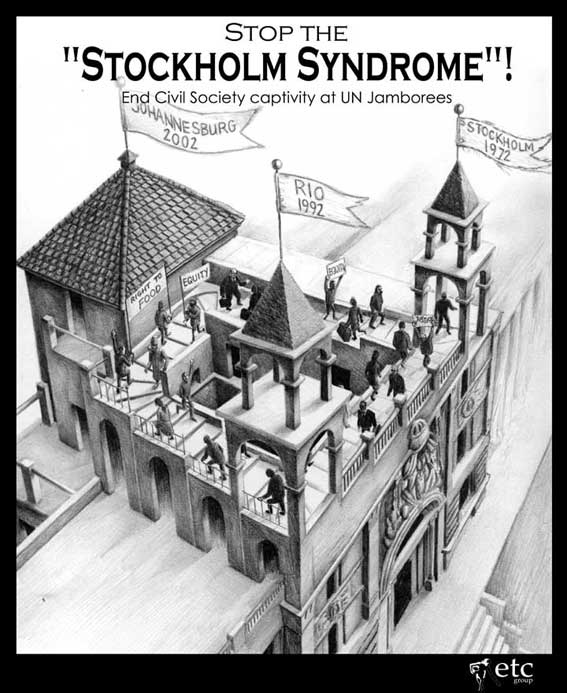
A Case of Stockholm Syndrome* – The Left and the State

In two recent posts, here and here, I have criticised proposals of the United Left Alliance (ULA) that rely on dealing with unemployment through a state investment programme.  I have also made criticisms of tax plans of the ULA, which again rely on state action for their implementation.  The state is clearly extremely important to the left alternative proposed by the ULA.

The Socialist Party in the general election called for nationalisation of all the banks and their being run democratically under public control and management. It demanded that the state take the economy and natural resources into democratic public ownership in order to plan the development of a real manufacturing base.   It called for a government based on working class people that implements socialist policies and puts people before profit.  All eight of its proposals involved state action or the need to get the left into the state and into government.

The ‘Alternative Economic Agenda’ of the People Before Profit Alliance was constructed in a similar manner.  It has eleven separate elements and again all rely on the state taking action on behalf of the working class or ‘people’ in general.  Their demands include creation of one good state bank; creation of a State Construction Agency for infrastructural investment; expansion and reorientation of the public sector away from a corporate agenda and general reliance on the state to develop the economy.

These demands for the State to take action to defend working people must be taken at face value.  It is not possible that these demands are raised in order to expose the State and rid workers of their illusions in it because very few workers actually expect the State to take over the economy and run it for the benefit of working people.  The illusions peddled are those of the Left itself, for what is presented is the ideal objective which they aim for and which workers are called upon to endorse.  Except of course that state ownership is not socialism and the Left knows it, or rather will claim to know it.  The problem is that the means – capitalist state ownership – is supposed to lead to an end that is not capitalist state ownership.

When I say that the left knows that capitalist state ownership is not socialism I mean that it knows well the statements of  James Connolly including – “state ownership and control is not necessarily Socialism — if it were, then the Army, the Navy, the Police, the Judges, the Gaolers, the Informers, and the Hangmen, all would all be Socialist functionaries, as they are State officials — but the ownership by the State of all the land and materials for labour, combined with the co-operative control by the workers of such land and materials, would be Socialism… To the cry of the middle class reformers, ‘make this or that the property of the government,’ we reply, ‘yes, in proportion as the workers are ready to make the government their property.’ Workers’ Republic, 10 June 1899.

Engels put it similarly in ‘Anti Duhring’ published just over twenty years earlier -“… since Bismarck adopted state ownership a certain spurious socialism has made its appearance here and there even degenerating into a kind of flunkeyism which declares that all taking over by the state, even of the Bismarckian kind, is itself socialist. If, however, the taking over of the tobacco trade by the State was socialist, Napoleon and Metternich would rank among the founders of socialism. If the Belgian state, for quite ordinary political and financial reasons, constructed its own main railway lines, if Bismarck… took over the main railway lines in Prussia, simply in order to be better able to organise and use them for war, to train the railway officials as the government’s voting cattle, and especially to secure a new source of revenue independent of immediate votes – such actions were in no sense socialist measures. Otherwise the Royal Maritime Company, the Royal Porcelain Manufacturer, and even the regimental tailors in the army, would be socialist institutions.”

We only need to recall that the enormous austerity that working people are suffering is due to the state’s budget deficit and the state’s debt burden to understand what Irish workers should think of ‘their’ state.  It wasn’t the collapse of the banks that placed this debt on the backs of the workers, it was the State that placed this debt on the backs of the workers through guaranteeing all their liabilities and then effectively nationalising them.  Yet nationalisation of the banks has been a left demand for years and still is today.  Yet this nationalisation is precisely the mechanism used by the State to bail out the capitalists involved directly and the whole system indirectly.

Nor is such a purpose unusual for nationalisation.  In fact I can’t offhand think of a nationalisation that wasn’t meant to benefit capitalism and didn’t place a burden on workers.  The rhetoric about dependence of many working people on the state for jobs is no different in essence from that of the supporters of Sean Quinn who have been dependent on him in the past for employment.  Anyone on the left who argues that the State is somehow democratic and has duties to working people no longer believes that the capitalist state is above all the defender of the capitalist system.  That this is what is its defining role.  But for the Left it would appear that holding the belief that the capitalist state is both a defender of capitalism and cannot be reformed and that it can provide all the things that are demanded in Left manifestos are not two mutually exclusive ideas that cannot both be true.

I am reminded of F Scott Fitzgerald’s remark that “the test of a first-rate intelligence is the ability to hold two opposed ideas in the mind at the same time, and still retain the ability to function.”  Some in the left appear to go one better and actually sincerely believe two opposed ideas at the same time.  My view is that this is dysfunctional.

*Stockholm syndrome, or capture-bonding, is a psychological phenomenon in which hostages express empathy and have positive feelings towards their captors, sometimes to the point of defending them. (from Wikipedia)

to be continued.

The state of job creation

In my last post on the politics of the left I questioned proposals on state investment as the answer to unemployment.  In this post I want to look at this further.  The Nevin Economic Research Institute (NERI), an economic think-tank affiliated to the Irish Congress of Trade Unions has published a similar proposal to that of the United Left Alliance (ULA).

Its paper is entitled ‘An Examination of the Effects of an Investment Stimulus’ and its research shows that an investment stimulus of €1 billion would create about 16,750 short term jobs and between 675 and 850 long term jobs.    In the longer term the competitiveness of the economy is increased so that the economy grows, which increases taxation, which more than offsets the interest cost of any loan to fund the investment in the first place.  This means that “overall there is a long-term permanent decrease in the government deficit as a result of an investment stimulus.”  This is what has been referred to often as growing our way out of the crisis and debt problem.  NERI therefore proposes a phased investment stimulus of €15 billion over 5 years.

The net cost per job created, at around €34,500, is nearly the same for both the NERI and ULA proposals.  The paper by NERI sets out more fully its assumptions so it is fair to assume that these are not dissimilar to those of the ULA, which in any case we can also fairly adduce from the ULA proposals themselves.

In order to arrive at its estimates the NERI researchers use an economic model.  Like all models these require assumptions as to how the economy works and therefore how the parameters of various economic variables interact, e.g. how imports will increase given a certain increase in income as employment increases.  This is calculated from historic data from the Irish economy.  The HERMIN model used “combines Keynesian short term features with neoclassical longer term features.”

This is a problem, or rather there are two problems, not perhaps so much for the presumably Keynesian researchers at NERI but for the ULA, whose biggest components claim to be Marxists.  The Marxist analysis of the way capitalism works is very different from the Keynesian or neoclassical one.  Unfortunately, through the budget proposals of the ULA and their similarity to those of NERI, the policy proposals of the ULA display much affinity to Keynesian economics.  We have noted this already in their definition of the problem as being one of insufficient demand, which is also the view of Keynesian economists.

For Marxists this is indeed a feature of the current crisis, indeed of all crises.  Where the difference lies is that Keynesians think that this problem can be put right by state-led investment while for Marxists the lack of sufficient demand is really just one expression of deeper problems but not the fundamental cause of the crisis, which will not be put right by expansion of state expenditure.  This fundamental difference is invisible when the proposals of the ULA and NERI are compared.

For Keynesians the capitalist economy can reach equilibrium, where demand for investment funds and its supply are equal, in a situation where there is nevertheless massive unemployment, both of people and resources.  The autonomous action of the state in increasing investment can solve this problem and bring the system back into an equilibrium that resolves the unemployment problem.  For Marxists state investment can at most postpone the crisis but is not itself an answer.  By contrast the ULA present it as part of the answer.

For Keynesians the autonomous action of the state can provide a solution because the system can reach equilibrium and investment can be the driver of the economy to this equilibrium.  As the Keynesian Minsky puts it –“Investment and government spending call the tune for our economy because they are not determined by how the economy is now working.”  That a model shows state investment to be self-financing when that model contains Keynesian assumptions can hardly be called convincing. Keynesianism believes that “if entrepreneurs can only screw themselves up to do enough investment, it will eventually justify itself, since the income generated will absorb the excess capacity.” (Robin Mathews in ‘The Trade Cycle’)[i]

On the other hand Marxists see this type of statement as an example of bourgeois economists overwhelming tendency to assume that the capitalist economy works like a socialist one; that all production will more or less fulfil a useful role.  After a crisis based on massive construction expenditure that powered a phenomenal boom and then bust, this is just an incredible assumption.  The NERI and ULA proposals are based on further infrastructure spending by the same state that encouraged the last ‘stimulus’. That NERI believes this will lead to long term growth is again built into the neoclassical assumptions of the model.  Neoclassical economics assumes that capitalist markets are totally free and efficient.  A model built on such long term assumptions could hardly show anything else.

Neoclassical economics assumes that production is efficient and finds a market and that growth is the result.  Marxism makes no such assumptions but instead demonstrates the contradiction at the heart of an economy determined, not by autonomous investment, but by the pursuit of profit.  The recent massive overproduction of infrastructure was massively profitable, which is why it continued for so long.  The contradiction between this profitability and real need; the contradiction between the limitless expansion of capital and the limit of the market, was suspended temporarily and resolved temporarily by the expansion of credit.  When this expansion of credit can no longer continue the limits of the market are exposed and massive overproduction , which inevitably involves massive over-accumulation of capital, is revealed.  Keynesianism’s answer is to continue the accumulation because investment will find its own market and in any case can be autonomous within the system, as we have seen.  Marxists believe on the contrary that the accumulation of capital is determined by profit and lack of it may see accumulation shudder to a halt and collapse.

In a contest of economic ideas, between neoclassical economics where crisis are not supposed to happen and are self-correcting when they do, and Marxism, in which overaccumulation driven by super-profits is periodically inevitable, the real world has given a decisive confirmation of the latter. In a contest in which Keynesianism can assume investment creates its own demand and is self-financing and Marxism which points out the contradiction in production between use and profit, the empty office blocks and ghost estates are again striking confirmation of the truthfulness of the latter.  So why oh why would the left want to promote Keynesian solutions?

There is absolutely no reason to believe that a renewed burst of construction spend would not create new imbalances.  Perhaps the left believes that because the state carries out the spend it does not have to earn a profit but this is false for a number of reasons.

First it has to pay for the investment.  If it takes out a loan it will have to pay it back and if the investment does not create tax revenue by promoting further private capitalist investment it will not raise the necessary tax.  In these circumstances taxation would have to come instead from workers or business, which would remove the stimulus that has been created.  If the investment does stimulate or facilitate private investment then this only confirms ULA reliance on the state promoting capitalism as the way out of crisis.

Although the ULA does call for €5.3 billion of state investment in modern industry it calls for much more, €26 billion, to be invested in infrastructural investment.  In fact even some of the modern industry investment is in infrastructure.  Such infrastructural investment is normally not competitive with the main private capitalist industries but complimentary to it, facilitating it to make profits.  By making such spend central to its economic alternative the left, subconsciously no doubt, evidences the inadequacy of its alternative and subservience to capitalism.

An alternative is that state investment is directed to the production of goods and services that people actually need and want and are prepared to pay for.  This would indeed be competitive with private capitalist owned industry but this is not what is proposed by NERI or the ULA.  Instead either taxes or the promotion of private capitalist production through helpful infrastructure is proposed.

In our last post on this we questioned the policy of reliance on state investment given its history of incompetence, even in areas of no great complexity or requiring no great innovation.  The left sometimes excuses this (why?) as the result of subordination of the public sector to private capitalism.  And the answer to this is yes, that is what the capitalist state is for.  It is not for creating competition to private capitalism so why would the left demand that it does?

Even if the specific proposals of the left, in the particular circumstances that Irish workers face, are not practical this is not the main objection to them.  The main objection to them has possibly more force where they actually to work.  For if they worked, even if only temporarily, they would be both a diversion from creation of a socialist alternative and some evidence that this alternative is not needed.  The success of state industry would be the success (temporarily) of state capitalism.

The successful development of capitalism has been facilitated by the state many times and it may be argued that the more recent, and quicker, that development the more it has relied on the state.  This may be true going back through the development of every new major capitalist power from Holland in the 17th century, to Britain in the 18th, Germany and America in the 19th and 20th, the Asian Tiger economies of the late twentieth century and the Chinese of the 21st century.

The socialist alternative is something very, very different from this but the left’s fixation on the power of the capitalist state is strong and we shall look at the question some more.


[i] The quotations above are taken from a new paper that compares the Marxist explanation that the capitalist economy is driven by profit with the Keynesian alternative of the role of investment – ‘Does investment call the tune? Empirical evidence and endogenous theories of the business cycle’ See link.


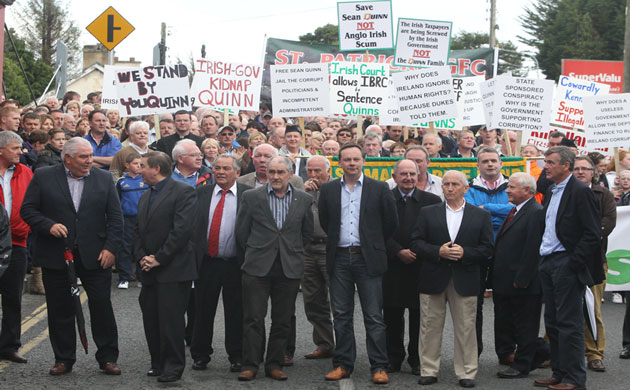
Workers rally in support of Millionaire Quinn

Ireland is in the throes of an economic slump with official unemployment at nearly 15 per cent despite emigration.  Severe cuts are being inflicted on essential public services; there are large cuts in take home pay and glaring inequality as the wealth of the richest in society has actually risen in the last few years.  So how do we explain that in one corner of Ireland four thousand of the plain people of Ireland demonstrated in support of a man who was very recently the richest man in the country and who was at the centre of a disastrous attempt to buy the most rotten of Ireland’s very rotten banks?

In a small corner of County Cavan thousands demonstrated in support of Sean Quinn as he dodges and dives to keep large bits of his foreign property empire out of the hands of the successor to the Anglo-Irish Bank from which he took out loans to buy the property but is now unable to pay back.  The property was security for the loans and now that he can’t repay the loans the State, through the Irish Bank Resolution Corporation (IBRC), wants the property.  In effect the local population was demonstrating in favour of Quinn holding on to this empire by underhand and devious means ,to keep it out of the hands of a state bankrupt and making huge cuts that affect those demonstrating as much as anyone.

In this he was supported by a local and high-profile priest, by a local Sinn Fein MP and by a number of senior and well-known figures within the Gaelic Athletic Association.  The columnist Kevin Myers once wrote that he could imagine Ireland without Fianna Fail, without the Irish language and without the Catholic Church but he could not imagine it without the GAA.  Especially in most of rural Ireland that is how important the GAA is to local society.  It is such a huge and varied organisation that it cannot be said that the GAA as a body supports Quinn but the members present were too numerous and prominent for the relationship to be simply dismissed.  Sean Quinn’s brother Peter is an ex-President of the Association and a further ex-President Sean Kelly, a Fine Gael MEP, also issued a statement in support.

I was having a conversation in the car with my other half when she said that they all had one thing in common – they were all men for whom it is always about them.  When I also pointed out that it could be said they were also all quite well off, Catholic or ‘culchies’, she thought for a moment and said – no, it’s all about them being men with their masculine egos.  Then I said that the worst aspect of all this was that so many ordinary people had come out to support him but she disagreed with this as well and said they were demonstrating because he had given them work.

Quinn is by far the biggest employer in the area with cement and glass businesses, a large hotel and latterly branching out into insurance.  It was his €2.3 billion gamble on buying Anglo-Irish Bank that brought this business empire down.  There seems little recognition locally however that not only has he sought to deprive the state of much needed funds and caused an increase in everyone’s insurance premiums required to pay for his mistake but he gambled with people’s jobs to enrich himself when he was already filthy rich.

Now, while claiming through tears, that he is a victim, a man with plain needs and modest life style he has ensured that his relatives have been paid hundreds of thousands of Euros from the Russian property companies that he is trying to keep hold of. The wife of his son has, for example, been paid €320,297 after tax by a Russian company owned by the Irish State while being a part time receptionist at a motor dealership in north Dublin.  Yet people on a fraction of this came out to declare that he has been hard done by!

For some the demonstration of support is but the latest expression of a long lived Irish slavish mentality that has much in common with peasant attitudes of supine deference to a local feudal Lord. The great and the good declare the Lord one of us and the serfs oblivious to their real interests blindly obey their masters and betters.  Such a view however is only possible from outside.

Cavan and Fermanagh are not some atavistic backwater with ignorant peasants innocent of the sophisticated ways of the modern world.  What is in evidence is not some centuries-old peasant tradition of subservience.  The rural location gives some apparent justification to such views but the industries they work in are modern, few make money directly from the land and they are as educated as anyone in the country.  What is expressed is a particularly personal and local phenomenon of dependency which characterises the whole country and which is only particularly noticeable because of the scale of the local dependency.

The obvious power of the Quinn family in economic terms has been extended naturally into an ideological and social power over the local community and become repulsive to many only because it is so personal and accentuated by the local circumstances.  Expressed in a rural idiom it is easy and tempting for others to ridicule and mock but such acerbic criticism has much bigger targets if it were only to look.

In what way is the subservience of some of Cavan people any different to the subservience of all the people of the Irish State to an unholy trinity of State, banks and property developers   who have placed on their shoulders a debt so huge that their children will be paying for it for decades to come?  In what way is the willingness to support the local Lord any different from the near universal political agreement across the State that the richest multinationals, including speculative financial institutions, should shape economic and social policy, despite the economic disaster they are so closely associated with, while the poorest and most vulnerable must suffer?  If the slavish dependency of some people in Cavan offends so much why doesn’t the much greater dependency of the whole country not also?

The exhibition of subservience witnessed in one part of rural Ireland is not to be excused.  It must be understood and above all recognised as simply a particularly obvious reflection of the exploitation and oppression of the working people of Ireland.  In this respect it is fundamentally no different from the position of workers anywhere.  The notion that Quinn gave people work is accepted as fact just as capitalists employ workers while workers are employed.  But Quinn didn’t give people work, the people gave work to Quinn and he gave them back an amount of money worth less than the work they provided.

Under a system of private ownership by capitalists of the means of production it is nearly always the case that it appears that the capitalist gives work to the workers, and it is not that this is a pure illusion.  In a very real sense workers do depend on capitalists for jobs, which they create and destroy regularly.  This dependency and its results become obscene in some circumstances but it exists everywhere.

It’s time that working people, some of them, started to put forward an alternative, starting with the left and not one that presents the state as the fountainhead of this alternative.  The alienation of people in Cavan from this state (and the banks it supported), easily pictured as a remote Dublin cabal, is a distorted reflection of what would otherwise be a healthy impulse.

After all, for socialists the alternative to Quinn is not the Irish Bank Resolution Corporation, is it?

Back to the Future? – the State to deliver jobs?

Before it went on holiday the government announced the stimulus package for the economy that many in opposition had demanded. An additional €2.25 billion is to be spent over the seven years to 2018 on roads, schools, a new college site in north Dublin, primary health care centres and Garda headquarters. The government claimed it will create 13,000 new jobs and is designed as a stimulus to the economy that will promote growth.  Green Party leader Eamon Ryan got it right when he said the “plan is a throw-back to the last century when the only way Irish politicians knew of stimulating the economy was to pump money into the construction industry.”

Unemployment is 309,000 or over 440,000 if you include part time, seasonal and casual workers entitled to Jobseeker’s benefits or allowances.  The stimulus will therefore not stimulate very much.  The chief Economist for the Irish Congress of Trade Unions (ICTU) nevertheless said it was “an important step in Ireland’s recovery.”  The Irish Business and Employer’s Confederation (IBEC) welcomed it in almost identical words saying it was “an important first step in helping to restore domestic demand in the Irish economy.”

The feeling of déjà vu became overpowering when the Minister announcing it, Labour’s Brendan Howlin, had to ‘explain’ why road projects were going ahead in his own constituency.  His Department was also unable to provide a journalist with any cost/benefit analyses for individual projects, which are always nice to see even when they begin ‘once upon a time’.  A commentator described one road project as “largely a vanity project” and that it “never added up even at the height of the boom.”

The money will come from what’s left of the National Pension Reserve Fund, so workers will know their future pension money is being craftily spent.  Some will come from the European Investment Bank but it’s not clear how much.  Some will come from the sale of state assets.  This is where the state buys duff things from the private sector – like banks – which cost it a lot of money and sells good stuff – like companies that make profits – which also cost it money.

No spanking new construction project would be complete without the involvement of the banks and they too will be involved, although again it isn’t known by how much, but since these are funded by the State this doesn’t really matter that much.  Finally, to complete the story, much use will be made of Public Private Partnerships, a partnership where one partner gives money to the other, for example when roads don’t have the traffic that was predicted but one partner gets paid anyway.  Again we don’t know the figures but we’re not expected to get much exercised over this because it’s all for a good cause, although it’s the usual story of being bribed by your own money.

Fianna Fail complained that many of the announcements would have no effect for six years, which might have been a good thing had it applied to their own policies.  They complained that some of the announcements were bringing back projects that the government had just cancelled, such as the Grangegorman project, which inspires confidence that planning by the capitalist state will continue to be used as a weapon to discredit socialist planning. The word planning might however be going a bit too far since Howlin said it would be nice to give the new jobs to people from the Live Register and also to apprentices who haven’t finished their training, but “I don’t want to promise  that that can be done.”   It’s wonderful how governments can promise to spend billions of workers’ pension and tax money while saying that they can’t promise that it will deliver what it’s supposed to deliver.  The sense of building new health facilities while preparing to get rid of health staff and of building new college facilities while cutting the number of lecturers seemed not to have been questioned by many.

The Irish State doesn’t have a great record when it comes to investment.  It bought 700 electronic voting machines for €55 million and they didn’t work.  It wasted money on hospital co-location, decentralisation and €100 million on the ‘Bertie Bowl’.  It commissioned a PPARS IT system for the health service with an original budget of €9 million in 1997 which ballooned to €120millin in 2004 before being pulled in 2007.  The Auditor General reported that the roads programme which was supposed to cost €5 billion ended up costing €20 billion.  The high-technology Media Lab Europe set up jointly with the Massachusetts Institute of Technology was to focus on the development of digital technology but went into liquidation within five years with consultants describing its output as “mediocre, “surprisingly weak” and “dismal”.

The United Left Alliance’s budget statement stated that “the current crisis cannot be resolved without a state led programme of investment.”  It proposes a reversal of cuts in capital spending and an emergency state programme of infrastructure investment costing €26 billion to get 150,000 back to work.  If we assume unemployment at around 310,000 this would still leave 150,000 unemployed. What happens to them?  The programme is to last “for at least five years”.  What happens after that? The economic contraction has already been going nearly five years and the slump could continue five more.

The ULA wants to employ workers’ private pension funds just like the government wants to use the pension funds of public sector workers.  The ULA wants the latter money, €5.3 billion, to fund investment in modern industry and it rejects privatisation.  Instead it wants state companies to carry out this investment.  If successful this might make some further dent in the unemployment total and at the cost of job creation estimated in its infrastructure programme this would reduce unemployment by perhaps 30,000. Of course there would be further multiplier effects but this depends on the overall performance of the economy.

It is the assumption around this performance that motivates both the proposals of the government and the ULA.  As we have seen, the bosses organisation IBEC, and also ICTU, see the problem as one of insufficiency of demand and the government’s stimulus “an important first step in helping to restore domestic demand in the Irish economy.”  The ULA say “direct government job creation through public works is necessary to promote effective demand and halt the deepening crisis.”  The government, bosses, trade unions and the left offers a similar analysis of the problem and a rather similar remedy.  Of course the trade unions and left oppose privatisation but state ownership in itself is not socialist. What we have, as in the sphere of taxation, is a difference of quantity in the measures being proposed, not a difference of quality.

What the ULA proposes, based apparently on a Keynesian analysis of the problem, is not socialist although, if successful, would have a big impact on defending workers’ living standards by reducing unemployment and defending its welfare entitlement, take home pay and public services.  Were its proposals to succeed they would go some way to providing a capitalist alternative to the policies of austerity although they would do little to prevent the regular future occurrence of capitalist crises.

Lest it be thought this judgement too harsh let’s go back to just one proposal of the ULA, that of using workers’ pension funds.  This is a proposal that the capitalist state that has saddled the working class with an unsupportable debt and denuded its state pension fund, imperilling the pensions of future workers, should also take a chunk of workers’ private pensions, and it with its sterling record of investment and economic management.  In effect it’s a capitalist expropriation of workers funds with no more than a promise from a politician for comfort, and a few Irish workers have had letters of comfort from the Irish State before.

The workers should take over management of their own pension fund?  They should promote worker owned firms to address the problem of unemployment?  Heaven forbid!  That sounds like socialism.