Karl Marx’s alternative to capitalism part 6

china1larg.workers.giThe continued growth in the productive powers of society can only mean the increased productive power of human labour, exercised through increasing use of the implements of labour and the organisation and application of scientific knowledge.  This in turn can only manifest itself in the growth of the working class that exercises this power, wields the implements of labour and develops and applies advances in scientific knowledge.

The result has been the increasing creation of the material conditions that can provide the foundations for a more equitable and socially just society.  The most important of these is the growth of the global working class.

From 1980 to 2010 the world’s labour force grew by 1.2 billion, to approximately 2.9 billion, with almost 90 per cent of the growth occurring in what has been called developing countries, including 500 million in China and India.  In the process 620 million people have been lifted out of poverty, as defined by the World Bank at $1.25 per day (at 2005 purchasing power parity).  Global non-farm employment rose from 54 per cent of all jobs in 1980 to 70 per cent in 2010.

From 1990 to 2010 China’s productivity was estimated to have grown by an average of 9.8 per cent per year, about one fifth as a result of the move from countryside to the city.   Wages grew as a result, and the ‘Financial Times’ has recently reported that the scope for this mass migration to continue had now ended.  (All figures from McKinsey)

In what are called the advanced economies 165 million new non-farm jobs were created and a large number of these taken by women joining the workforce.  Over this period the number of women in the labour force rose by 77 million accounting for the majority, 61 per cent, of the net new additions of 122 million.

Average skill levels of the workforce have also risen with the number of college graduates in the world labour force doubling in the economically advanced countries and growing by two and a half times in developing countries.  Around 700 million high school graduates joined the world’s labour force, increasing the proportion of those with secondary education to 48 per cent in 2010 from 39 per cent in 1980.

The assumption that only the ‘advanced’ countries have educated workers with the knowledge and skills necessary for innovation and more advanced production is now untrue.  In 1970 approximately 30 per cent of university enrolments were in the United States but by 2006 this was only around 12 per cent. The share of the world’s Ph.D.’s accounted for by the US has fallen from around 50 per cent in the early 1970s to 18 per cent in 2004.  By 2005 South Korea was sending a larger proportion of its young people to university than the US. And, for example, only 10 per cent of Italy’s working age population had a college degree in 2010, lower than in Malaysia, Thailand and the Philippines.  Countries such as Indonesia, Brazil, Peru and Poland more than doubled their university enrolments in the 1980s and 1990s. (Quoted from ‘The new global labour market’)

The McKinsey report quoted above states that in the advanced countries the share of national income going to labour rose during the 1950s and 1960s, peaking in 1975, but has fallen ever since and is now below its 1950 level.  The wages of less skilled workers have stagnated or fallen in all but a handful of advanced countries while the incomes of those in the top 10 per cent have risen.  Capitalists complain that they cannot get the necessary skilled workers and unemployment among those with only secondary education is nearly twice as high as among those with college degrees.  In the advanced countries unemployment among the least skilled is two to four times higher than the most highly skilled.

As illustration of the insanity of capitalism’s failure to develop in any sort of rational manner, an article in the ‘Irish Times’ earlier this year notes that the Irish State has the dubious distinction of having the most overeducated workforce in Europe with around a third overqualified for the jobs that they do, just in front of Cyprus, Spain and Greece.  It reports one young woman with a degree and a Diploma in primary school teaching who made 80 job applications last year and didn’t get one interview.  As the duration of unemployment grows the skills previously acquired atrophy and the social labour expended on their acquisition is wasted.

So some educated workers can’t get a job commensurate with their education while capitalists complain they can’t get skilled workers.  A further twist is added when you consider the well paid jobs that some workers get have relatively little to do with their accumulated knowledge.

I recall reading some time ago an article in a British newspaper that noted that the knowledge and skills of those with science qualifications is socially wasted in jobs within the media industry, in companies like Google or Facebook, doing jobs that involved not much more than high-tech advertising and selling.  I know of one young woman who has a PhD. in science, in which she studied the transfer of drugs through the body for those with cystic fibrosis but who could only get a decent wage by requalifying as an accountant.

When production is profit driven, without any conscious societal mechanisms to determine social priorities, such waste appears in statistics as remarkable progress.  What isn’t measured is the potential contribution that millions of working people could make but can’t because of the lack of opportunities and subordination and lack of democracy in the workplace that stifles their ambition and creative powers.

Despite all this however it has to be understood that capitalism continues to develop, and the productive power of humanity continues to grow massively.  The need for skilled workers grows even if the system often wastes much of the knowledge and skills created.

There can be no doubt that the ‘civilising mission’ of capitalism, which the last few of these posts have been about, continues.  Of course it does not develop evenly and does not develop without antagonism or contradiction and in the next posts I will look some more at the limited and contradictory character of this development.

However if capitalism were simply as system in crisis we could not explain why it still exists.  If it were not still revolutionising the means of production and developing the productivity of labour it would no longer be the capitalism analysed by Marx and we would have to find some other approach to understanding it.

Most important of all, as I have said before: if capitalism created only oppressed, exploited and alienated human beings where could the alternative come from?

Back to Part 5

Forward to part 7

Karl Marx’s alternative to capitalism part 5: capitalism’s achievements

classroom-19th-century-1140x684One comment on an earlier post on the blog relating to the situation in Greece included the following: “So I think the task at hand is not to solve Greece’s economic crisis, this will certainly take years. Rather it is to add some political organisation and direction on to the instinct to fight. I believe that you are thinking too far ahead, overly concerned with what socialism should be in the future, and not really catching the fire of the present.”

Leaving aside whether this was true of this particular post on Greece or even of other posts; a point I have made is that the Marxist movement is too concerned with attempting to “catch the fire of the present”.  This has usually meant jumping on whatever bandwagon it thinks might propel it along in some opportunist direction.  This is informed by the view that socialism will arrive through a capitalist crisis that precipitates political revolution that will destroy the existing state and then introduce the new society.  All of which it will lead through “catching the fire” in some sort of eschatological conflagration.

Missing is the development of the alternative, evolving within capitalism in advance of any crisis, that creates and develops workers’ power in the present and most of all creates the conditions that means workers actually seek a socialist alternative long before any crisis.  Missing is the building of a working class movement that fights for an alternative society now, sees such a new society as its answer to its problems and does not limit itself to the necessarily defensive struggles against capitalist attacks.

This understanding of the working class movement, as embodying the future alternative within itself, is now more or less completely lost but would have been the foundation of workers’ socialist consciousness during most of the first century of the movement’s existence.  So, the building of mass workers’ parties, trade unions, friendly societies, educational organisations and cooperatives were all seen to be the visible rise of the more or less inevitable final victory of socialism.

No such confidence now pervades the socialist movement and part of this impoverished outlook is the perspective of fighting for and relying on the state to deliver the goods.  This and/or the view that some future, but always more or less near, political crisis will quickly precipitate a struggle and a consciousness adequate for a successful political revolution.   A view that forgets that socialist revolution is distinguished by it being primarily a social one and the Marxist view that social being determines consciousness: that is the development of consciousness is based on the development of capitalism, including what workers do over many decades to develop their own power and organisation within it. There is no exception in such a view for small groups propagandising for revolution, crisis or no crisis.

The patient building of workers organisations, such as cooperatives, is viewed by some as simply reform of capitalism when in fact no successful revolution will be possible without them.  Opposition to what has been termed the stages theory of revolution, that every workers struggle is inevitably limited to certain non-socialist goals, is confused with rejection of the truth that the working class will go through stages of development and that earlier stages that do not immediately threaten the system are also just as necessary because they are expressions of the workers own activity and power.

That this has been more or less forgotten is both a product and producer of the decline of the socialist movement.

That is why I started to write a series of posts on Marx’s alternative to capitalism, because without such an alternative there will be no, well to state the obvious – alternative!  It’s why this series is now continued.

*                                                     *                                                 *                                                              

In the last post on Marx’s alternative I said I would look at the evidence that the development of capitalism continues to provide the grounds for socialism as an alternative.  By this I mean the contradictory nature of capitalism is still creating on an increasing scale its gravediggers, the working class, and that even “with all the miseries it imposes upon them, the present system simultaneously engenders the material conditions and the social forms necessary for an economical reconstruction of society.” Marx.

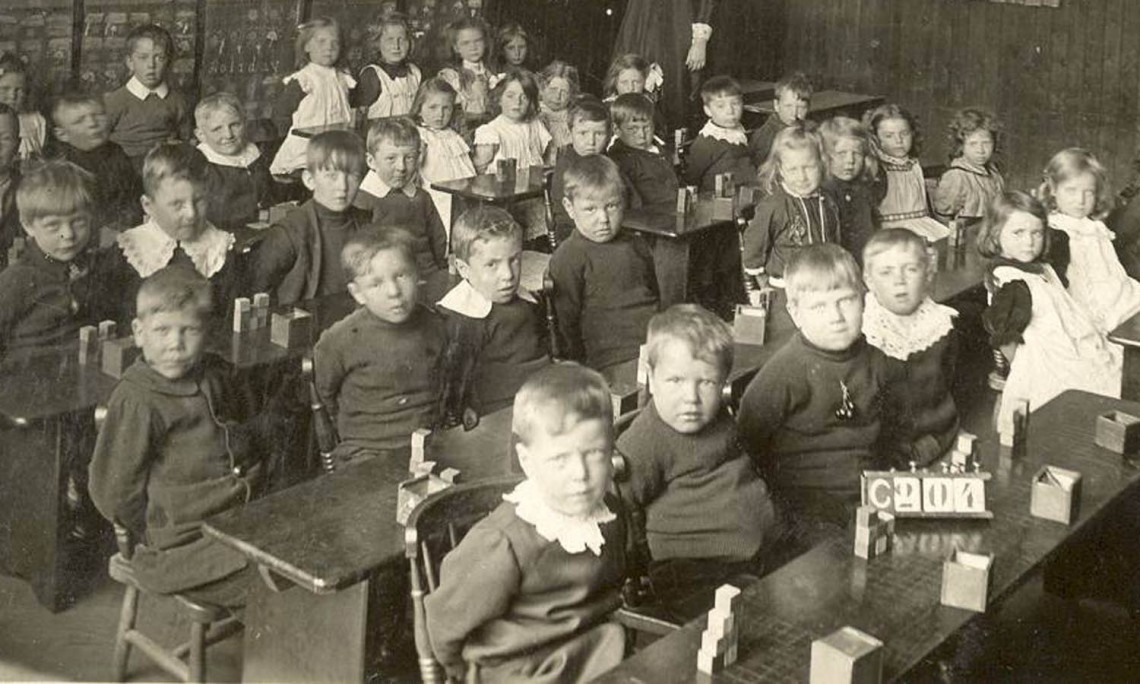
A look at the long term development of capitalism illustrates what Marx called its civilising mission, a product not just of the growing requirements of capitalist production for an educated and relatively healthy workforce but of the needs of the capitalist state itself that provides most of this education.  By 1985 mass education was compulsory in 80 per cent of the countries of the world and over 90 per cent of the world’s children spent some time enrolled in school.

Estimates for the year 1900 put participation rates in primary education at under 40 per cent in most parts of the world outside North America, northwest Europe and English speaking areas of the Pacific, where it was over 70 per cent.  By the beginning of the twenty-first century every part of the world had achieved the minimum of the most industrialised countries at the start of the 20th century and most had exceeded it.

The picture of course is far from universally rosy and a 2007 UNESCO report estimated that in 2004 781 million adults did not have minimum literacy skills and close to 77 million children of school age were not enrolled in school.  Nevertheless the twentieth century was the first in human history in which the majority of the world’s population learned to read and write.

The development of higher level education has been just as dramatic.  In 1900 roughly half a million were enrolled in higher education institutions across the world.  By 2000 the number had grown two-hundredfold to 100 million people.  Growth in higher education has not slowed but accelerated in the latter part of the twentieth century; particularly after about 1960, with enrolment rates climbing rapidly, especially of women.  This growth has created what amounts to a global higher education system with “the same subjects . . . taught with the same perspectives leading to very similar degrees . .” (The Worldwide Expansion of Higher Education in the Twentieth Century)

If we look at population and health we can see the capacity of the productive system to support a growing population and improved health.  “Since 1800, global population size has already increased by a factor of six and by 2010 will have risen by a factor of ten. . . . The length of life, which has already more than doubled, will have tripled . . In 1800, women spent about 70 percent of their adult years bearing and rearing young children, but that fraction has decreased in many parts of the world to only about 14 percent, due to lower fertility and longer life.” (The Demographic transition: Three centuries of Fundamental Change)

Global life expectancy (years at birth) in 1700 was 27, still 27 in 1800, 30 by 1900 47 by 1950 and 65 by 2000, while population was 0.68 billion, 0.98, 1.65, 2.52 and 6.07 billion in the same years.  This decline in mortality began about 1800 in northwest Europe, and in many lower income countries at the beginning of the twentieth century, accelerating after the Second World War.

“The first stage of mortality decline is due to reductions in contagious and infectious diseases that are spread by air or water. Starting with the development of the smallpox vaccine in the late eighteenth century, preventive medicine played a role in mortality decline in Europe. However, public health measures played an important role from the late nineteenth century, and some quarantine measures may have been effective in earlier centuries. Improved personal hygiene also helped as income rose and as the germ theory of disease became more widely known and accepted. Another major factor in the early phases of growing life expectancy is improvements in nutrition. Famine mortality was reduced by improvements in storage and transportation that permitted integration of regional and international food markets . . .”

“In recent decades, the continuing reduction in mortality is due to reductions in chronic and degenerative diseases, notably heart disease and cancer (Riley, 2001). In the later part of the century, publicly organized and funded biomedical research has played an increasingly important part, and the human genome project and stem cell research promise future gains.”

“Many low-income populations did not begin the mortality transition until some time in the twentieth century. However, they then made gains in life expectancy quite rapidly by historical standards. In India, life expectancy rose from around 24 years in 1920 to 62 years today, a gain of .48 years per calendar year over 80 years. In China, life expectancy rose from 41 in 1950–1955 to 70 in 1995–1999, a gain of .65 years per year over 45 years.” (The Demographic transition: Three centuries of Fundamental Change)

Again however the gains in life expectancy are not uniform and the productive advances of capitalism, some of which are reflected in public health and medical advances, are subordinated to the accumulation of profit.  This is most clearly seen in the two significant exceptions noted in the article quoted above – the stagnation in mortality gains and increased mortality from HIV/AIDS in sub-Saharan Africa and the decline in life expectancy in Eastern Europe and the former Soviet Union arising from their transition to capitalism.  The article quotes the UN in 2002 noting that male life expectancy in the Russian Federation was 60, similar to that of India.

Back to Part 4

Forward to Part 6

Does capitalism still have a civilising mission? Marx’s alternative – part 4

huajian-shoe-factoryIn the last post on Marx’s alternative to capitalism I noted that he extolled the achievements of capitalism, without which socialism could not be built.  In the Grundrisse he noted “the great civilizing influence of capital; its production of a stage of society in comparison to which all earlier ones appear as mere local developments of humanity and as nature-idolatry.”

This is very far from the attitude of most Marxists today, who have a tendency to see crisis and decline everywhere.

Perhaps, as might be implied from the quote above, the progressiveness of capitalism is only in relation to previous society, and that today it is a wholly reactionary system from which no development is possible or at least none with any progressive features.  Its replacement must therefore arise from its contradictions and crisis and not from any progressive element within it.

The days of the progressive development of capitalism are over.

The Communist Manifesto is famous for its paean of praise to the wonders of capitalist achievements, and this at a time when capitalism hardy existed on most of the globe – “It has been the first to show what man’s activity can bring about. It has accomplished wonders far surpassing Egyptian pyramids, Roman aqueducts, and Gothic cathedrals; it has conducted expeditions that put in the shade all former Exoduses of nations and crusades . . . The bourgeoisie, during its rule of scarce one hundred years, has created more massive and more colossal productive forces than have all preceding generations together. ”

But perhaps again this praise is purely relative to earlier epochs.  Capitalism has exhausted any progressive content it once may have had.  After all, didn’t Lenin refer to the highest stage of capitalism and did Trotsky not say that:

“the economic prerequisite for the proletarian revolution has already in general achieved the highest point of fruition that can be reached under capitalism. Mankind’s productive forces stagnate. Already new inventions and improvements fail to raise the level of material wealth . . . The objective prerequisites for the proletarian revolution have not only “ripened”; they have begun to get somewhat rotten. Without a socialist revolution, in the next historical period at that, a catastrophe threatens the whole culture of mankind.”

That catastrophe did of course arrive in the shape of the Second World War and the potential for catastrophe undoubtedly continues to exist within capitalism today.  The decline of the United States and the rise of new powers once again raise the spectre of economic competition that may drive rival nation states into war.

A couple of weeks ago I was reading the Guardian review of books and a review of a book by the BBC correspondent Mark Urban, who argued that new powers are developing conventional forces that can begin to rival those of the US. This means that in any conventional conflict the US may be tempted or driven to use nuclear weapons.  It’s not as if they haven’t used them before.

“Now, says Urban, Russia, China and India have such strong conventional forces, and America has cut its forces so much, that in the event of a conflict “the US would be left with the choice of nuclear escalation or backing down”.  He adds: “Against a full-scale invasion of South Korea, the US would have little choice but to go nuclear.” Russia, China, India, Israel, Pakistan, North Korea and some other countries could “mount a credible conventional defence that would leave the United States having to think the unthinkable, with profound implications for the world”.”

While there is a lot more to say about such a scenario the point is that under capitalism humanity has no rational control of its own development and no guarantee against the most irrational acts leading to its destruction.

However the view noted above – that capitalism can no longer be viewed in fundamentally the same way as Marx did in the 19th century is mistaken.

Straight after noting capitalism’s wonders far surpassing the Egyptian pyramids, Roman aqueducts and Gothic cathedrals Marx states that “The bourgeoisie cannot exist without constantly revolutionising the instruments of production, and thereby the relations of production, and with them the whole relations of society. Conservation of the old modes of production in unaltered form, was, on the contrary, the first condition of existence for all earlier industrial classes. Constant revolutionising of production, uninterrupted disturbance of all social conditions, everlasting uncertainty and agitation distinguish the bourgeois epoch from all earlier ones.”

So the development of society continues under capitalism and the imperative to accumulate unpaid labour means the continued development of the forces and relations of production and growth of the working class.  As I will show in the next post this continues to require the phenomenon of the ‘great civilising influence of capital’ because if it did not, the development of capitalism would be away from a possible socialism and not towards it.

A working class more and more exploited and oppressed, more and more demoralised, despite the massively increased social division of labour and the cooperation required for it to function; and despite the undreamed of development of technology, would patently be unable to put itself forward as the new rulers of an even more advanced society.

A purely reactionary system without fundamental contradictions out of which a new society could emerge would not be that investigated by Marx.  A contradiction-ridden system on the other hand will combine development with retrogression, the potential for the new within the embrace of the old.

Crises will occur and must occur in some way if a new society is to be given birth out of the old but the nature of this crisis must be one that allows a new society to fully develop and not simply represent a process of decline of the old.  Under capitalism it is not crisis that create the contradictions of capitalism but crises which are the means of expressing these contradictions and resolving them in whatever way and for whatever period of time.

The importance of acknowledging this is apparent when we consider the ‘new’ phenomenon of anti-capitalism, as if being anti-capitalist is inherently progressive.  In the Communist Manifesto Marx was able to analyse various types of reactionary socialism, and various types of this exist today.  Much of the left is keen to retreat into nationalism and older forms of capitalist development in response to capitalist crises in their latest form, buttressed by the idea that there can be nothing progressive in its current development.

We see this today in much of the left’s opposition to the Euro for example, as if the drachma or punt were some sort of positive alternative.  In Ireland the nationalist and republican tradition has allowed many leftists to seek progress through assertion of a ‘national sovereignty’ that is simply impossible to achieve even if were desirable.

All seem to have forgotten that socialism is not the resistance of the working class to capitalism, which can continue ‘forever’ if it does not involve an alternative, and this alternative is a higher form of society, not a retreat into the past.

In the next post on Marx’s alternative I will look at the evidence that the development of capitalism that Marx thought provides the grounds for socialism continues to exist.

Back to Part 3

Forward to Part 5

The civilising mission of capitalism – Marx’s alternative part 3

lewis-hine1So Marx understood that capitalism’s compulsion to increase the appropriation of unpaid labour through development of the forces of production and exploitation of workers also meant the expansion of the consumption of the working class and development of its needs and capacities as a result; what has been called capitalism’s civilising mission. But Marx also referred to the “inherent barbarism of bourgeois civilisation.”

Today, and over the last half century, many people have been radicalised by the threats of nuclear annihilation or environmental catastrophe, both of which are products of capitalisms’ productive powers and its irrational social and political relations.  But opposition has more often than not failed to identify the source of the threat or the solution.

It has also been noted at the end of the twentieth century that there had not been a single year since 1816 without at least one war going on in the world.  The twentieth century itself witnessed human slaughter on a truly massive scale with more than 9 million deaths in the First World War and 57 million (37.8 million of them civilians) in the Second World War, with 80 million between 1900 and 1950 in total.  The relative peace since is purely relative with proud claims that war had been abolished in Europe, for example, blown away by the war in the former Yugoslavia and now in the Ukraine.

This contradiction is not one that exists in Marx’s argument but one that exists in reality, as Marx explains in Chapter 15 of Volume 1 of Capital:

“We have seen how this absolute contradiction between the technical necessities of modern industry, and the social character inherent in its capitalistic form, dispels all fixity and security in the situation of the labourer; how it constantly threatens, by taking away the instruments of labour, to snatch from his hands his means of subsistence, and, by suppressing his detail-function, to make him superfluous.

We have seen, too, how this antagonism vents its rage in the creation of that monstrosity, an industrial reserve army, kept in misery in order to be always at the disposal of capital; in the incessant human sacrifices from among the working-class, in the most reckless squandering of labour-power and in the devastation caused by a social anarchy which turns every economic progress into a social calamity.

This is the negative side. But if, on the one hand, variation of work at present imposes itself after the manner of an overpowering natural law, and with the blindly destructive action of a natural law that meets with resistance at all points, modern industry, on the other hand, through its catastrophes imposes the necessity of recognising, as a fundamental law of production, variation of work, consequently fitness of the labourer for varied work, consequently the greatest possible development of his varied aptitudes.

It becomes a question of life and death for society to adapt the mode of production to the normal functioning of this law. modern industry, indeed, compels society, under penalty of death, to replace the detail-worker of to-day, grappled by life-long repetition of one and the same trivial operation, and thus reduced to the mere fragment of a man, by the fully developed individual, fit for a variety of labours, ready to face any change of production, and to whom the different social functions he performs, are but so many modes of giving free scope to his own natural and acquired powers.”

Marx compares capitalism favourably to its predecessors:

“Thus the ancient conception, in which man always appears (in however narrowly national, religious, or political a definition) as the aim of production, seems very much more exalted than the modern world, in which production is the aim of man and wealth the aim of production.

In fact, however, when the narrow bourgeois form has been peeled away, what is wealth, if not the universality of needs, capacities, enjoyments, productive powers etc., of individuals, produced in universal exchange? What, if not the full development of human control over the forces of nature — those of his own nature as well as those of so-called “nature”? What, if not the absolute elaboration of his creative dispositions, without any preconditions other than antecedent historical evolution which make the totality of this evolution — i.e., the evolution of all human powers as such, unmeasured by any previously established yardstick — an end in itself?

What is this, if not a situation where man does not reproduce in any determined form, but produces his totality? Where he does not seek to remain something formed by the past, but is in the absolute movement of becoming?

In bourgeois political economy — and in the epoch of production to which it corresponds — this complete elaboration of what lies within man, appears as the total alienation, and the destruction of all fixed, one-sided purposes as the sacrifice of the end in itself to a wholly external compulsion.”

Overall growth of productive powers and increased planning within capitalism – between firms and countries – and increased coordination of a massively developed division of labour is a growth of human power and civilisation, not just potentially, but in creation of the preconditions for socialism; the potential for the creation of a society without material and cultural want, for a future society in which the level of production can remove the necessity for class inequality.

If socialism must arise out of capitalism and capitalism were purely barbaric, containing within it no contradictions that presage the new society, socialism would be a utopian dream because the agents of change who are to bring it about would simply be products of barbarism.

Back to Part 2

Forward to Part 4

Karl Marx’s alternative to capitalism – part 2

333869336In the first part of this post on Marx’s alternative to capitalism we noted that this was ‘simply’ the real alternative that is already growing within capitalism and is composed of the working class that the development of capitalism creates.

Workers have no, and are not to be encouraged to produce, “ready-made utopias”.   Such blueprints are always presented to workers rather than arising from them, they must “work out their own emancipation”.   In doing so they will necessarily “have to pass through long struggles, through a series of historic processes, transforming circumstances and men”. (Marx, The Civil War in France)

The working class is the product of the prodigious development of the forces of production under capitalism but it can only achieve emancipation if it becomes conscious of its revolutionary role. So, in some way, capitalism must not only provide for the development of the forces of production, increased division of labour and cooperation across the globe and increased planning within and between companies and production facilities, upon which a higher society can be built, but it must also provide the grounds for the development of this consciousness.

Capitalism does this by removing the relations of personal dependence that, for example, ties the peasant serf to the lord of the manor or the artisan to his master and to the Guild.  In doing so it atomises individuals and promotes an ideology of individuality that in juridical terms makes people free, independent and responsible but which in reality is expressed in an estrangement of people from each other.

This estrangement is routinely expressed through terms such as the ‘rate race’; the view that ‘charity begins at home’; that you ‘have to look after your own’, or ’look after number one’ or in the thousand and one various ways in which the unity of humanity is disintegrated and vanished under capitalism.  This is not primarily an ideological phenomenon but a realty that workers are indeed in a rat race.  As a poster campaign put it some years ago – many are only a couple of pay cheques away from homelessness.  Almost all workers are an illness away from relative or absolute poverty.  Lack of ownership of the means of producing a livelihood means an inescapable compulsion to sell one’s labour power in the market under circumstances more or less totally out of one’s control.

This estrangement is universal and the idea of free individuality finds roots from this universal separation.  Its universality creates the possibility of it being overcome. This is done through the development of the forces of production that puts workers in a similar relationship to those who own the means of producing life’s necessities creating the conditions within which unity around common class interests can be built.

The development of the forces of production themselves, based on advances in scientific understanding and its practical application, has implications both for the material and moral/spiritual development of the working class.  The extraordinary development of the productivity of labour that is a feature of capitalism cannot fail over an extended period to have an effect on the material conditions of the working class.  The current level of development of the productive forces could not have been achieved simply by seeking to meet and increase the consumption demands of the richest in society.

Capitalism constantly seeks to advance the consumption of society in order to accumulate capital and thus consciously and unconsciously produces new needs and new desires and, through this, new capabilities that create not just the material but also the spiritual and cultural preconditions for socialism.  If it did not, if capitalism left workers as limited and narrow in outlook as the peasant class that preceded it, there would be no grounds for a new higher society, for who would bring it into being?

This development takes place under capitalism, under the determining dynamic of the production of profit from the exploitation of labour, and thus this development is distorted, often thwarted, partial, uneven and limited.  It is subject to advance and retreat and it is ‘dumbed down’ and commodified.  It takes place not as a rational objective of society but as one whose development is in contradiction with the system’s rationale of seeking the expansion of capital through the appropriation of more exploited labour.

This process is what Marx calls the “civilising mission” of capitalism, without which there could be no talk of socialism:

“Thus, just as production founded on capital creates universal industriousness on one side — i.e. surplus labour, value-creating labour — so does it create on the other side a system of general exploitation of the natural and human qualities, a system of general utility, utilizing science itself just as much as all the physical and mental qualities, while there appears nothing higher in itself, nothing legitimate for itself, outside this circle of social production and exchange.

Thus capital creates the bourgeois society, and the universal appropriation of nature as well as of the social bond itself by the members of society. Hence the great civilizing influence of capital; its production of a stage of society in comparison to which all earlier ones appear as mere local developments of humanity and as nature-idolatry.

For the first time, nature becomes purely an object for humankind, purely a matter of utility; ceases to be recognized as a power for itself; and the theoretical discovery of its autonomous laws appears merely as a ruse so as to subjugate it under human needs, whether as an object of consumption or as a means of production.  In accord with this tendency, capital drives beyond national barriers and prejudices as much as beyond nature worship, as well as all traditional, confined, complacent, encrusted satisfactions of present needs, and reproductions of old ways of life

It is destructive towards all of this, and constantly revolutionizes it, tearing down all the barriers which hem in the development of the forces of production, the expansion of needs, the all-sided development of production, and the exploitation and exchange of natural and mental forces.” (Grundrisse)

But how can capitalism be called civilising?  Is it not the Marxist case that capitalism is inhuman and that the historic choice is between socialism and barbarism? Does Marx not speak, in relation to British rule in India, of “the profound hypocrisy and inherent barbarism of bourgeois civilisation.”

Back to Part 1

Forward to Part 3

Karl Marx’s alternative to capitalism – part 1

DSC_0136The reason why a person will identify themselves as a Marxist will be biographical, a product of their background, history and circumstances, their attitudes, character, personality and intellectual curiosity.  All these will be individual and accidental to a greater or lesser extent, the product of one’s actions and decisively, the views and actions of others that one comes into contact with, directly and indirectly.

On the other hand their background and circumstances and the views and actions of others that influence them will be social, the product of society as a whole.  Even their individual character and intellectual curiosity will be shaped strongly by their social circumstances.  So also the reason to identify as a Marxist is not individual or accidental but crucially derives from the content of Marxism itself.

It constitutes the most rational alternative to capitalism and all the irrationality and oppression that that system entails.  The most consistent and coherent alternative to capitalism is Marxist because Marxism comprehends capitalism in a way that is adequate to its replacement.

Marxism best encapsulates the view that ‘another world is possible’ because it best understands capitalism itself and can identify whether, and to what extent, an alternative can develop out of it.  Any alternative must come out of it in some way, yet be sufficiently different to actually be an alternative, and not a refurbished version of existing society which must enforce the limitations and strictures of the existing system. Marxism must therefore identify in what precisely this alternative consists.

The strength of Marxism is not that it has developed a brilliant idea from the brain of an exceptional intellect but that it seeks to bring to consciousness the development of capitalism itself and the alternative that is pregnant within it.

“In that case we do not confront the world in a doctrinaire way with a new principle: Here is the truth, kneel down before it! We develop new principles for the world out of the world’s own principles. We do not say to the world: Cease your struggles, they are foolish; we will give you the true slogan of struggle. We merely show the world what it is really fighting for, and consciousness is something that it has to acquire, even if it does not want to.” Karl Marx 1843.

If capitalism does not contain within it the struggles that will replace it, and the grounds for those struggles to succeed, then there will be no alternative to capitalism, at least not with the features or characteristics associated with a socialist alternative.

The claim that Marxism is the social and political alternative to capitalism thus rests on its claims to understand the development of capitalism so that the alternative it poses is not then a utopian one, sprouted more or less fully formed from the brain of this or that social reformer, but from the perceptible development of capitalism itself.

Just as the alternative to capitalism grows out of capitalism itself so too does the understanding of the alternative grow in the same way from the development of the system.

This is held to account for Marx’s known aversion to setting out a blueprint of what the alternative will look like.  It was, for example only when Marx was in his mid-50s that he claimed he had found, or rather the working class itself had found, through the experience of the Paris Commune of 1871: “the political form at last discovered under which to work out the economical emancipation of labour.”

In his review of this experience Marx made many observations on the alternative to capitalism that apply today, including that:

“The working class did not expect miracles from the Commune. They have no ready-made utopias to introduce par décret du peuple. They know that in order to work out their own emancipation, and along with it that higher form to which present society is irresistibly tending by its own economical agencies, they will have to pass through long struggles, through a series of historic processes, transforming circumstances and men. They have no ideals to realize, but to set free the elements of the new society with which old collapsing bourgeois society itself is pregnant.”

A book published a few years ago is an extremely useful guide to Marx’s concept of the alternative to capitalism, more particularly of the principles that underpin it.  It demonstrates that the alternative is not some perfected socialist state or society, not some condition of social equilibrium but a movement of people and their own self-activity and self-development.

“Communism is for us not a state of affairs which is to be established, an ideal to which reality will have to adjust itself. We call communism the real movement which abolishes the present state of things. The conditions of this movement result from the premises now in existence,” (Marx in The German Ideology).

There is no end-state to socialism, perfect or otherwise, but the social conditions that allow the full flourishing of the individual and humanity as a whole, which will in turn change social conditions.

Socialism cannot be reduced to principles such as a planned economy because planning itself is only one human activity, the totality of which is the expansive alternative that Marx foresaw.

The alternative to capitalism is the self-development of humanity, its overcoming of an alienated existence within which its own powers over its environment and its own development appear separated from and oppressive to it.  So humanity understands the danger of environmental destruction but has no transparent means of control to stop it despite its own actions being the cause of the threat.  So it witnesses economic disruption, unemployment, poverty and suffering, caused by a drop in ‘value’ of pieces of paper – shares, bonds, swaps, options, derivatives etc -that it has created but which by themselves are simply pieces of paper, which in any rational society it would be impossible for them to cause the suffering involved in economic crisis.

Emancipation therefore is the result of the actions of humanity itself, led by a class within society whose liberation must entail the liberation not only of itself but of society as a whole – what is called a universal class because it represents the universal interests of all humanity.

This universal class is the product of the prodigious development of the forces of production under capitalism, to a degree that could never have been conceived in previous history, including the rapid development of technology, scientific knowledge and overall cultural development.

It is people however who create history, ‘history’ itself does nothing, and it is the development of the working class that is the carrier of the wonders of the new capitalist society and the bearer of the new within it.

What is required then is that the working class becomes conscious of its role in existing society and the necessity for it to change this society.  Decisive for the working class is therefore its awareness of itself as a separate class with its own interests, requiring a change in the consciousness of the mass of workers.

This change in consciousness to an awareness of class interest does not mean the nullification of individual personality or character but the recognition of shared interests that will allow creation of a society in which the free development of individuals is the condition for the free development of everyone; no one is subject to the requirement to work to live in order that someone else can live without working.  The creation of wealth will be for the satisfaction of individual needs and desires and not the pathological pursuit of profit for a few.  People will labour to satisfy their needs not the accumulation of money, wealth and capital for others.

The structures of society will therefore be the consciously directed products of human activity, transparent in their operation.  They will not entail the domination of people by impersonal, disembodied powers such as the ‘rule of the free market’ or ‘rule of law’ or ‘state authority’, over which individuals feel and have no control.  No longer will workers face wage cuts or unemployment because the things they produce are no longer profitable to produce and the needs of ‘the economy’ then require the sacrifice of their livelihood.  Things no longer control them, they control the things that would not exist without them.  No longer will the price of pieces of paper wreak economic devastation.

Instead workers will control the things that are their creation, including the machines they build, the firms they create, the agencies that provide services or set rules for them – all the organisations appointed for any purpose that affect them.  They control them because they work in them.  Managing them is not a detached function to be carried out by a separate class or bureaucratic group but is the task of everyone.  Management and control become part of everyone’s job description.

By this means the supreme authority, the State, that rules over society is not set apart from it but is gradually abolished through its functions being incorporated into society itself and into its day to day functioning.  Only in this way can the  rule of a minority become the rule of the majority, can the working class become the new ruling class, before there is no class system whatsoever because no relations of economic and social domination exist.

For this to happen the majority of society have to be not so much ready to carry out these million and one tasks but more and more actually carrying them out beforehand.  The problem then is not so much to revolutionise the means of production or state structures but to revolutionise the working class.

So how does capitalism create the conditions for this?  In what way does capitalism itself prepare the ground for its supersession by the working class?

Forward to Part 2

Visiting Trier

DSC_0208Last year I went on my holidays to the French wine region of Alsace although I did very little drinking as most of the time I was driving.  As a quid pro quo I was able to take the opportunity to drive over and visit Trier in Germany.

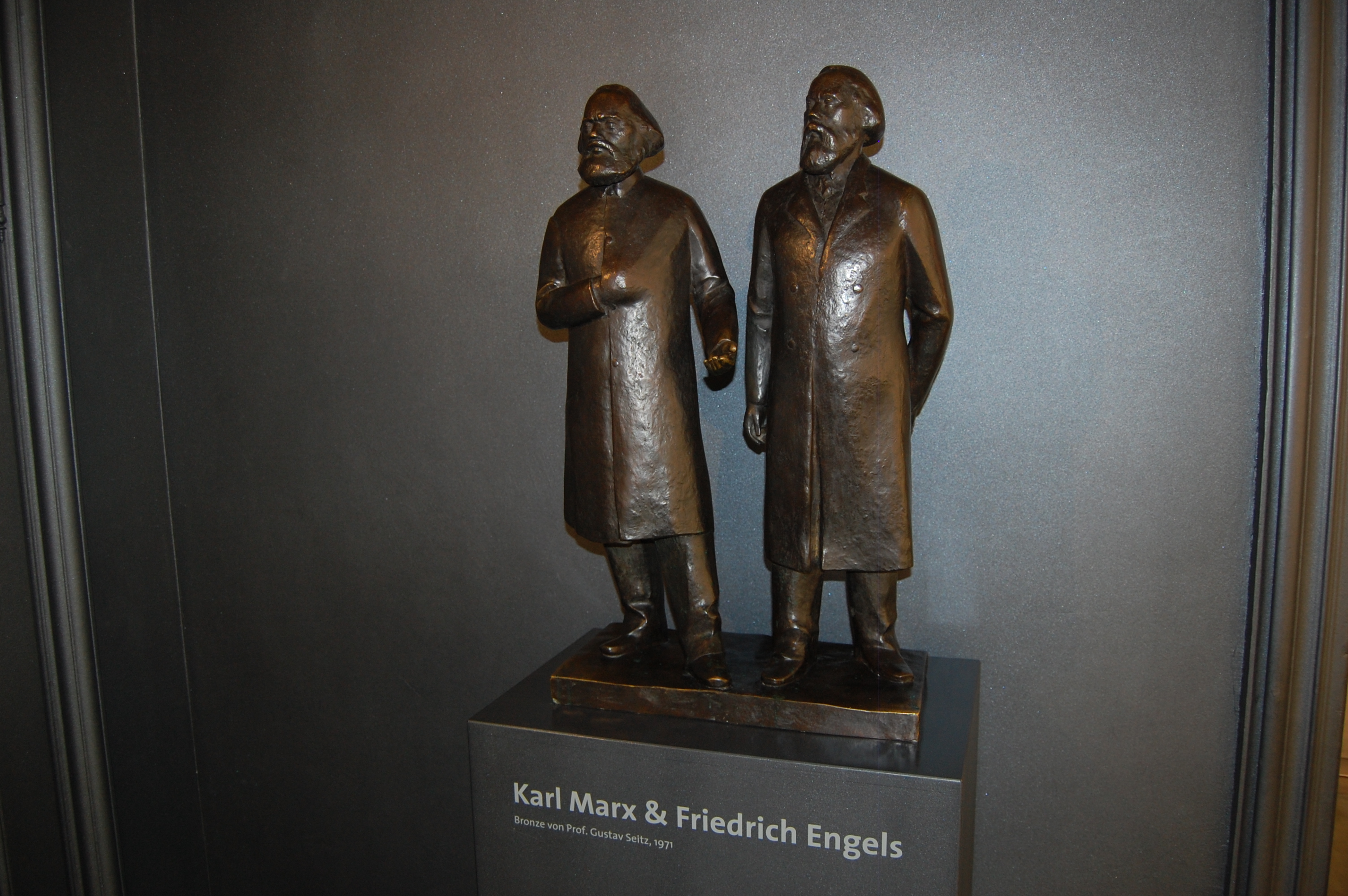
Trier is a contestant for Germany’s oldest city, a UNESCO world heritage site and the location of notable Roman buildings. Of course for a Marxist it is also distinguished as the birthplace of Karl Marx, which has been turned into a museum, and it was for this reason that I ventured out of France.

If I thought the French didn’t pay much attention to speed limits it appeared to me that the Germans didn’t have one.  On two rather short journeys to and from Trier to the French border I came across three traffic accidents including one rather nasty one in which an occupant was being cut out of a car.

Having arrived safely at our very functional hotel, which consistent of separate concrete boxes called rooms and a bigger box that doubled as reception and breakfast area, we took a dander round the town where I explained that it was unusual to have anything to do with Marxism as a local tourist attraction.  It was pointed out to me that the most memorable aspect of this was the local tourist bus painted with Karl Marx’s mug.

DSC_0016

The next morning we had breakfast in reception, in which the juice and Rice Crispies were almost in the street.  All very lean I was told, proving to me that I am not the only one who doesn’t really switch off when on holiday.  The big TV behind the desk was showing the news on some local channel.  I was too far away to hear but this wasn’t a problem as I don’t speak German anyway.  And in any case my eagerness to see who had won the Scottish referendum was being addressed by an interview with a guy who had a very bad Mel Gibson Braveheart haircut, and a Saltire painted across his face.  He had the demeanour of Mel at the end of the film when he was on the rack.  I guessed who had won.

We then took in the museum and the audio tour that outlined Marx’s family background and history, the story of his political involvement and an AB of his ideas.  It was competently done, without being ruined by the reformist bias I had feared from it being run by the Sozialdemokratische Partei Deutschlands  (SPD) and its Friedrich Ebert Foundation, named after a real reactionary bastard, whose historical role might well make those who think social democracy has turned right under neoliberalism rethink just how left it was beforehand.

It was a bit bemusing to find out that the young Karl had hardly got out of his nappies before he had moved house along with his family, but you hardly treat such a visit as a religious pilgrimage, in which you touch the foot of the statue of the blessed man or feel his earthly presence.

DSC_0040

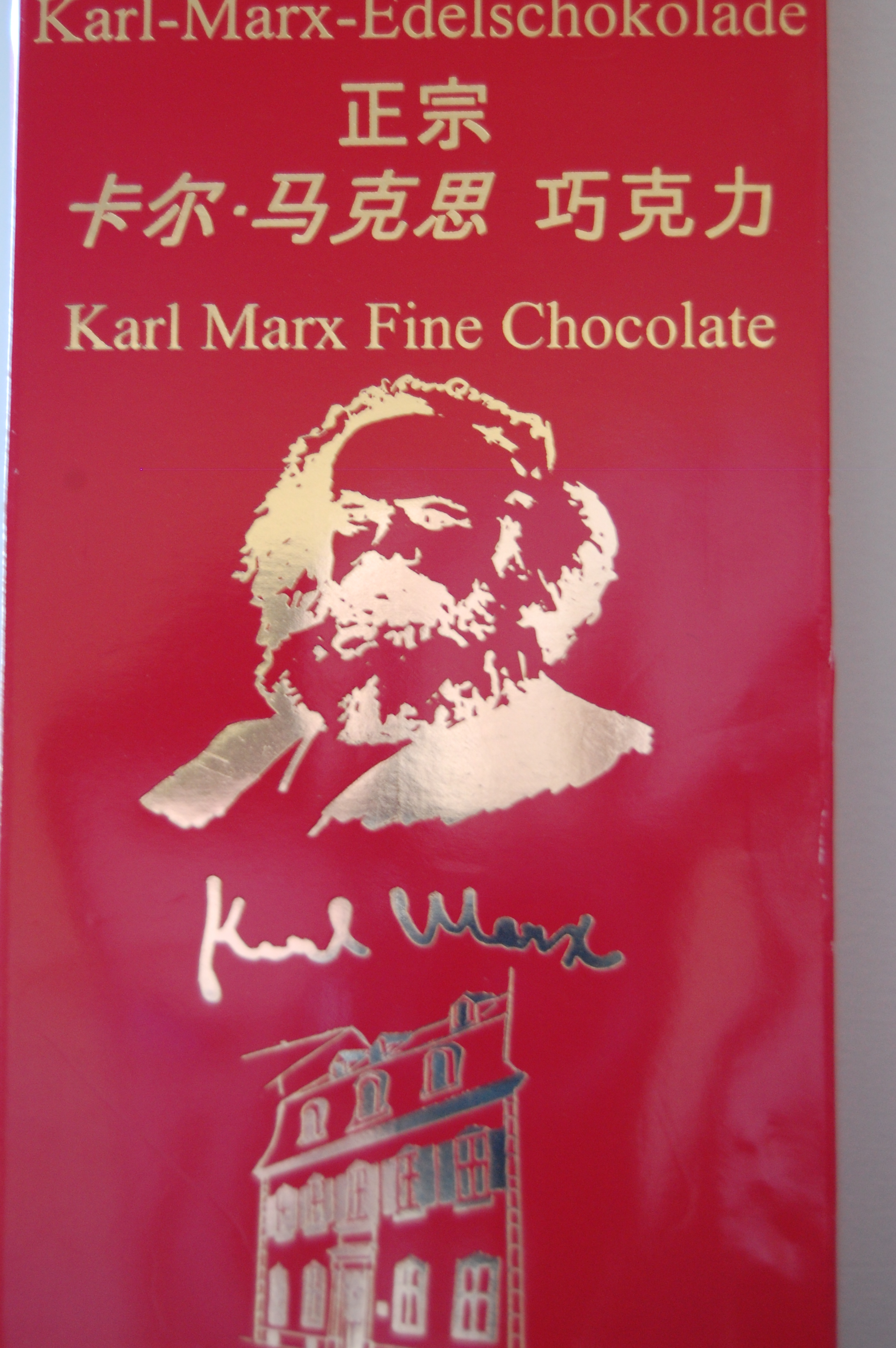
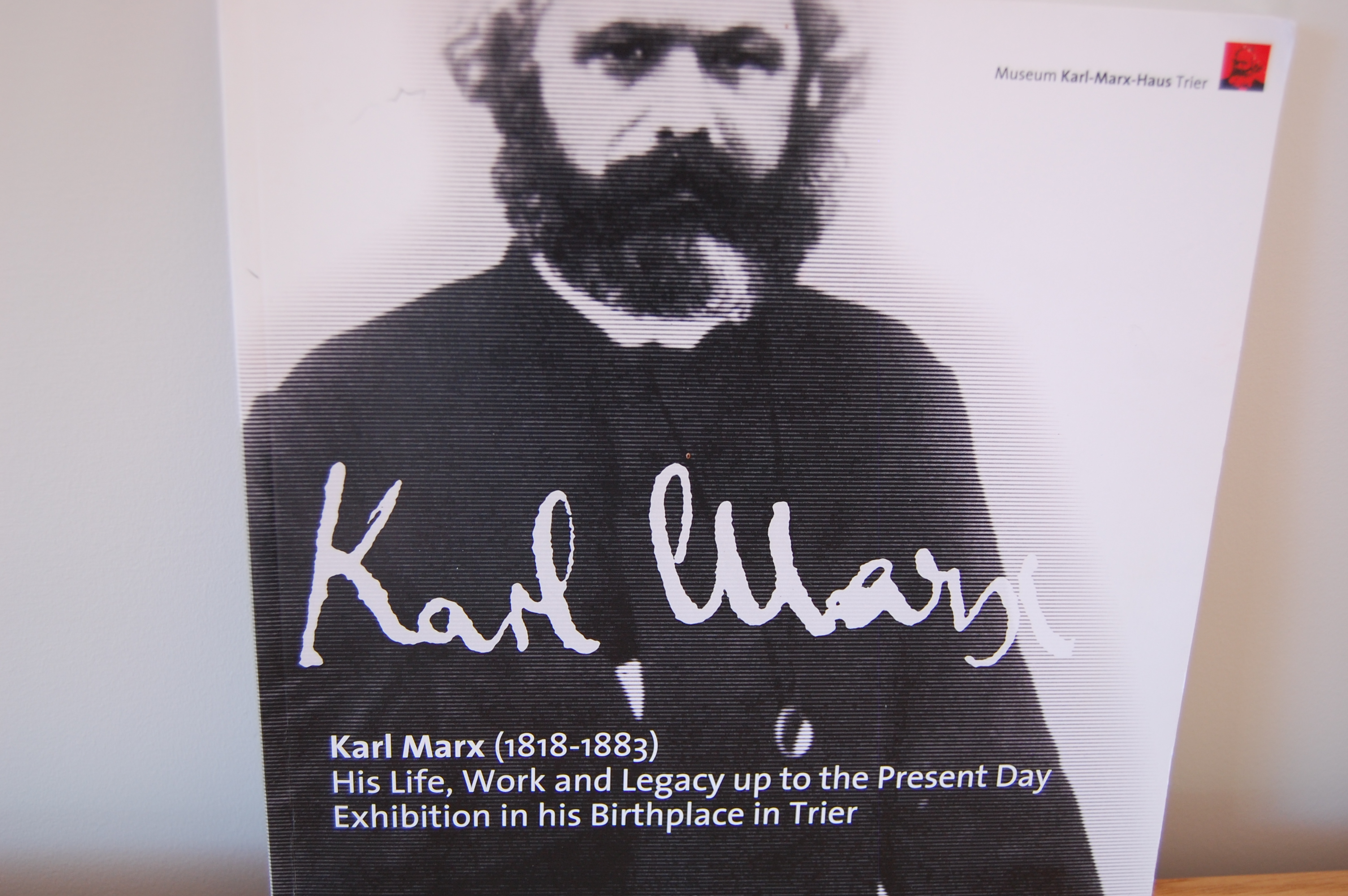
Like all museums it had a shop but inexplicably nothing for lovers of Flat Whites or three-shot Cappuccinos.  Being a sucker for a certain type of tat I attempted to buy a bust of the man himself ( you’ve already got one); a Karl Marx mug (it’s too tacky); some red wine (I’m sure it’s just not nice) and a fridge magnet (you don’t even know what it says because you can’t speak German).  However I did get away with the museum exhibition booklet and a bar of ‘Karl Marx Fine Chocolate’, which I haven’t yet opened just for badness.

What didn’t fully strike me as very poor until much later was the paucity of Marx’s writings that were for sale, but then the SPD believes that his writings really are only a museum piece, and the shop is for taking things away.  The best the exhibition booklet could come up with, in its final words on ‘Marx in the Twenty-First Century’, was that “engagement with the methods of Karl Marx and the questions he posed will continue to be meaningful”.  You don’t say.

The final chapter, on ‘Embracing of the Ideas of Karl Marx Worldwide’, cited the following, among others, as coming under his influence or claiming to express his ideas – Mao Tse-tung, Pol Pot, the ANC, Fidel Castro, Salvador Allende and liberation theology.  When we add the various ‘Marxist’ schools including the Frankfurt school, structuralism, post-Marxism and Analytical Marxism etc. and the experience of the various state regimes that have laid claim to Marx as their inspiration – from the Soviet Union to Albania – we can see the obstacles to engaging with Marx in a way that is not only meaningful but faithful to his writings.

DSC_0210

So why bother?  A look at the activities of today’s organisations claiming to be Marxist shows that the political programmes put forward hardly correspond to his oft-stated views.  From capitalist state ownership as the road to, and destination of socialism, to strikes for higher wages as ‘going to the heart of the system’, if you hang around the Left long enough you will hear every competing conception of socialism that Marx fought against being presented  as the authentic expression of his views.

Quotes from Marx are regularly thrown about but rarely after actually reading the original.  In Ireland our latest Marxist TD is shown on YouTube commencing an educational meeting with a quote from Marx’s Capital, which he admits he hasn’t read but which the chair of the meeting assures him ‘nobody has’.

By reading the original the original meaning might actually be understood.  A very simple reason why to bother.

But the answer is not simply to ‘go back to Marx’ as a way of overcoming the obstacles created by the distortion of his teachings by many who have claimed to be his followers.

This is not least because they have sometimes genuinely sought to apply his teachings, albeit often in a one-sided and partial way, providing one-sided and partial truths.  The direct words of Marxism expressed by Marx have been supplemented by the history of the development of his ideas and of the working class movement and it would be in complete conflict with his method to seek to go beyond the failures of both by simply claiming they are ‘wrong’, isolating ourselves from them and ignoring the lessons to be learned.

The history of Marxism and of the working class movement is now the ground on which both must be renewed.  Such renewal requires not just engagement with the direct views of Marx but also with the fragmentation and degeneration of Marxism and the labour movement.  The experience of both cannot be ignored or wished away and the alienation arising from them must be overcome because this alienation is now part of the reality we must seek to change, just as Marx sought to change the reality that he faced, including the various schools of socialism that he considered must be overcome and banished during his time.

Lessons from the Grangemouth dispute

GRANGEMOUTH_2700282bI received an email from Socialist Democracy inviting me to contribute to a discussion based on an article they have written on the lessons of the Grangemouth dispute in Scotland. This article sets out the devastating scale of the defeat – the freeze in pay, butchery of pension entitlement and castration of union organisation.  Many in the media called it an old fashioned battle of labour against capital, such was the unvarnished clarity of what was involved.

The questions to be answered are whether there could have been a different result and what lessons can be learnt?

The article does not say whether the result could have been different.  Given the circumstances I think not, but this means we must be clear what the circumstance were that lead to this conclusion.

As for the lessons the article posits two – that the entire strategy of the trade union leaders has been overthrown and that of union support for, and reliance on, the Labour Party is a mistake.  I believe that there is a third rather more basic one, which can be explained very much as the old fashioned relationship between labour and capital.  What is this relationship?

The relations of capitalist production are unequal as they involve capitalists as owners of the means of production, including oil refineries and petrochemical works, and workers separated from ownership of such means of production and dependent on employment by the capitalist for their livelihood.  In a struggle that does not threaten or weaken these foundations it is generally the case that the capitalists will be able to impose their wishes because these align with the power structures in society.

This does not mean each and every strike or struggle by workers is doomed to defeat but that in certain disputes this power of capital is fully deployed and the fundamental imbalance in power is cruelly demonstrated.  Were it otherwise capitalism might be able to find some stable compromise, some equilibrium between the two classes that would allow a ‘fairer’ distribution of resources.  No such stable equilibrium has been found.  Marxists have been confirmed in their view that the liberation of the majority of working people requires overturning the existing system and creation of one in which the monopoly of ownership of capital is destroyed. 

This is the basic case for socialism in opposition to all those who think a better world is possible while not overthrowing the fundamental structures of society.

It is not an all or nothing case.  It does not say that workers can do nothing to protect themselves short of socialism.  Struggles that do not threaten these fundamental relations can sometimes be victorious such as when the economy is booming, unemployment is low and workers can strike or otherwise bargain for higher wages without fear of being sacked and their place being taken by the unemployed.

Of course in an economic downturn the temporary leverage of workers and trade unions is undermined and the power of capitalists to do as they wish because of their ownership of capital is reasserted.

In the case of the Grangemouth dispute this means that no workers’ action no matter how brilliant, innovative or militant could prevent Jim Ratcliffe from using his ownership of capital to close the refinery and petrochemical works and throw thousands of workers onto the dole.

Of course if you were convinced he was lying about the profitability of the plant and convinced his threats to close were a bluff the solution is simple – call his bluff and tell him his demands will not be accepted.  Unfortunately his ownership means that only he and his management know the truth and his claims that the plant only had a future if he was able to put £300 million in investment into it were credible. The same system that decrees private ownership of a refinery also necessarily involves periodic overcapacity in production and this was held over the workers’ heads as the brute fact that required they surrender or face the sack.

Under such circumstances no one can be surprised the workers decided to accept the lesser evil.

The article is correct that simple strike action would not succeed.  It was the boss who went on strike – it’s called a lockout.  It is he who brought production to a halt and threatened to make this permanent.

Others called for widespread solidarity action perhaps secondary strikes.  Firstly these are illegal and related to this, workers have not yet the level of combativity to carry out such action, even those involved in the chemicals industry who would have lost their own jobs had Grangemouth closed.

If it is argued that this strategy is one we must argue for and attempt to build for the future then this is indeed an element of strategy.  In this situation however there is no reason to believe Ratcliffe gave a rat’s arse about the fate of the wider industry and of the other thousands of jobs that would have been lost.  If he was going to close Grangemouth then all these strikes would have made no difference to his plans.

A second possible answer was to call on the state to nationalise the refinery and works.  The problem with this is that neither the British State based in London nor that part that might go independent had no intention of doing so.  Both are ‘open for business’ only when it means private capitalism.  So who was going to nationalise the works?  If it is believed that strike action would compel such nationalisation then it would have had to be wider and deeper than that considered above and the first response of the State would have been to attempt to throttle it. Some people keep on forgetting the State is the protector of the enemy.

Some on the Scottish Left said the situation at Grangemouth showed the need for independence but this was not an immediate solution.  As we have just said, the Scottish National Party has no intention of nationalising private industry when private capitalists are prepared to invest if only the workers accept the necessary sacrifices.  Alex Salmond’s primary concern was with the exposure of his independence project, and the illustration of how weak the idea of a prosperous oil economy looks in light of this immediate threat to pull the plug.  Since the refinery provides fuel for northern England and Northern Ireland as well as Scotland the case for action to protect the service went beyond the border and thus implicitly provides the grounds for wide action to defend it.  It also undermines any case for a nationalist solution from the right or the left.

The article argues against the efficacy of such answers and proposes its own elements of a strategy.  Some of these are by no means very clear.

For example what does this mean? –

“The trade union and political fights have to be united around a movement that is willing to reject the claims of finance capital and to step in and expropriate capital where it is necessary to preserve the livelihood of workers.”

The only time a workers’ movement will be able on its own to expropriate capital is when there is a revolutionary situation. We’re not in one of those so it wasn’t and isn’t an answer.  (We’re also fighting industrial capital in this one.)

The article says –

“The Labour Party has promised a temporary freeze on prices, so a call could be made for a permanent cap . . .”

Just how are the laws of capitalism to be permanently abolished or even suspended when the system still exists?

They can’t.  The only way they can is if and when there is a revolution that creates the conditions for totally remodelling economic and social relations and even then prices will not be abolished for some considerable time.

The alternative proposed revolves around occupation and seeking an alternative to the Labour Party.

Once again however if the plant is really losing money and the threat of closure real then why would Ratcliffe not just let the workers occupy, sit in the refinery and – so far as he was concerned – rot away?  It would be just another way of closing the plant if he didn’t get the workers to accept his demands.

What the demand for occupation means is that workers take over ownership and run it themselves.  They cannot simply run it themselves without ownership.  No one would provide raw materials or other services without someone to contract with and you don’t form contracts with those in unlawful possession.  So the question is how would the workers take ownership?  How would they get the money to buy it and to invest perhaps the£300 million Ratcliffe says is needed?

Obviously this is much harder when pushed against a wall, with no preparation and no conception that this is the alternative.  Equally obviously if it is accepted that this is the road that workers in such situations should follow then it would be better to be prepared for such a challenge.  The challenge is precisely to the monopoly ownership of the means of production that we said at the start is the heart of the relationship between capital and labour and at the heart of capitalism.

The workers movement is big enough to fund research into the creation of worker owned businesses.  Workers might start to fight to gain control of their pension funds to invest in their own enterprises.  Money can be raised for investment from financial institutions or other funding means to be determined.    A network of employee owned cooperatives already exists.  What is involved is not utopian, in the sense it has never been done before, nor is it without rational calculation.

If workers could be ready for such an alternative the threats of closure would not be so conclusive.

In other words the alternative to capitalist ownership is workers’ ownership.  Not just in some indefinite future ‘after the revolution’ but now and not just for now but in order to build towards the future.

Finally the article criticises the unions’ support for the Labour Party.  It notes that organised workers continue to support their trade union and political leaders, although it only proposes that in order to fight both it is necessary to break from the Labour Party but not from the existing trade unions.  It calls for a ‘class struggle movement’ to be created across all the unions, which should call for a new working class party.

It obviously believes this fight can dismiss the Labour Party and need not go through it, although it does not explain how this can be achieved when it acknowledges workers continuing support for that Party.  Implicit is the view that a fight within that Party is not needed to convince workers to break from it.  This in my view is very doubtful.

It draws no lessons from its ridicule of the small socialist organisations which have attempted this road or what it correctly describes as the private character of their concerns; illustrated by their bizarre discussions and replication of policies that decades ago they excoriated the Labour Party for.  The articles’ own call for a revolutionary party is correct but of no help here since it is put forward, necessarily so, as an ideal future location.

Instead it states that – “there are many issues around which a fightback can be organised, but they cannot be organized by the current leadership of the working class . . . What it [Grangemouth] has shown up is the utter inability of the traditional leadership to defend workers and the demoralisation and lack of strategic vision on the part of the socialists.”

If what is being said is that a new leadership has to be created, and the existing one challenged, then this is correct.  If it is being said that this is a precondition for a fight-back then this is not correct. It is only in the course of struggle that existing leaderships can be defeated, as long as such objectives become part of the struggle by the mass of ordinary workers.

The workers at Grangemouth and, by extension, those beyond have suffered a cruel defeat.  One possible reaction is to be cowed by the power of capital to shatter livelihoods.  A second is to seek some magic bullet of a strategy that workers can employ to defeat such plans: a strike, secondary action or an occupation.

A third lesson is that very often workers are forcibly confronted with the reality that to secure a decent life they need to go beyond capitalism and that no amount of shifting it with militant action can change its fundamental nature.  This nature is one where capitalists own the means of production and they can open and close it when they want.  This is not a strong argument for capitalism but a powerful argument for changing society – for socialism.

As Marx said – “the working class ought not to exaggerate to themselves the ultimate working of these everyday struggles. They ought not to forget that they are fighting with effects, but not with the causes of those effects; that they are retarding the downward movement, but not changing its direction; that they are applying palliatives, not curing the malady. They ought, therefore, not to be exclusively absorbed in these unavoidable guerilla fights incessantly springing up from the never ceasing encroachments of capital or changes of the market. They ought to understand that, with all the miseries it imposes upon them, the present system simultaneously engenders the material conditions and the social forms necessary for an economical reconstruction of society. Instead of the conservative motto: “A fair day’s wage for a fair day’s work!” they ought to inscribe on their banner the revolutionary watchword: “Abolition of the wages system!

Marx on pre-capitalist societies: review of ‘Marx at the Margins’ part IV

karl-marx-theoristBy Belfast Plebian

Marx published very little in the last ten years of his life and did not even manage to finish volumes two and three of Capital.  Some historians have said that he ran out of mental capacity. There were only two important documents published, small in size: the Critique of the Gotha Programme of 1875 is a schematic appraisal of the muddled socialism of Germany Social Democracy and the other a revised version of the Communist Manifesto for mainly Russian readers published just a month before Marx died in March 1883

It is the second document that offers a clue to what Marx was researching in his later years.  Marx and Engels state in the preface that they had neglected to say much concerning social developments in the United States of America and also in Russia in the original Manifesto. They then present a brief synopsis of the condition of the small independent farmers in the United States under the duress of expanding capital while turning to conditions in Russia they note the rise of a new revolutionary movement. They then attempt to take stock of the revolutionary potential contained within the primeval communal relations of the Russian society:

‘Can the Russian obshchina, a form , albeit heavily eroded, of the primeval communal ownership of land, pass directly into the higher form of communal ownership? Or must it first go through the same process of dissolution that marks the West’s historical development? Today there is only one possible answer: If the Russian revolution becomes the signal for a proletarian revolution in the Wes , so that the two complement each other , then Russia’s peasant communal land ownership may serve as the point of deparure for a communist development.’(T.Shanin p139)

In 1983 Teodor Shanin published a ground breaking book called ‘Late Marx and the Russian Road: Marx and the peripheries of capitalism’, a collection of Marx’s draft sketches and letters dealing with questions posed by the development of embryonic capitalism in Russia.

In a letter addressed to the Russian populist writer Nikolai Mikhailovsky Marx explained his research: ‘In order to reach an informed judgement on Russia’s economic development, I learned Russian and then for many years studied official and other publications relating to the question’.(Shanin p135)   Marx also says that ‘I have come to the conclusion that if Russia continues along the pathway she has followed since 1861, she will lose the finest chance ever offered by history to a people and undergo all the fateful vicissitudes of the capitalist regime.’ Marx stated his thesis tentatively referring to the now hectic undermining by both Russian and foreign capital of the customs of the usually isolated communal villages.

What Marx seemed most eager to banish in the mind of his Russian populist reader was the idea that he had arrived at a general philosophical account of modern historical developments.  Marx’s letter was a response to a sympathetic review by Mikhailovsky of Capital Volume One, an appraisal that had ascribed to Marx a unilinear account of necessary historical development.

The Russian populist had said in the review that Marx:  ‘In the sixth chapter of Capital, the section called  So called Primitive Accumulation, here, Marx has in view a historical sketch of the first steps of the capitalist process of production, but he gives us something much bigger, a whole philosophical-historical theory. This theory is of great interest in general and especially great interest for us Russians.’

In his reply Marx is determined to say that he has no such general theory of historical development ‘The chapter on primitive accumulation claims no more than to trace the path by which, in Western Europe, the capitalist economic order emerged from the womb of the feudal economic order….Thus events of striking similarity, taking place in different historical contexts, led to totally disparate results.  By studying each of these developments separately, one may easily discover the key to this phenomenon, but this will never be attained with the master key of a general historical-philosophical theory, whose supreme virtue consists in being suprahistorical.’(Shanin 136)

The above is important for it distances the late Marx from some of his own more rigid conceptions as articulated in the German Ideology and from the common ‘historic Marxism’ thesis that what Marx was about was revising the Hegelian philosophy of History in a materialist direction. The idea that Marxism is a failed Universal Theory of History is still the predominant one in social science.

The other equally important point was that Russia and other pre-capitalist societies ought not to be conflated with Western feudalism. Marx was in fact researching various pre-capitalist societies that were not feudal in the European sense.  When he spoke of an Asiatic mode of production he was not using the construction in a geographical sense, for it included most of South America and even parts of North Africa, especially Algeria.  Marx was not even trying to describe the pre-capitalists societies in any historical-anthropological way.  What he was really interested in was how capitalist expansion was penetrating and transforming pre -capitalist societies that had no feudal past, in short the disruption being wrought by the advancing capitalist-colonialism of his own lifetime. (We do not say imperialism for this terminology was not used by Marx.)

Marx conducted his research using his normal method of reading the leading bourgeois authors and compiling excerpts from them with his own added comments.  He made extensive excerpts and notes drawn from authors such as: the pioneering anthropologists  Henry Morgan’s ‘Ancient Society’ 1877; the evolutionist John Lubbock’s ‘The  Origin of Civilisation and the Primitive Conditions of Man’ 1870; Maxim Kovalevsky’s  study of India ‘Communal Landownership, the Causes, Course and Consequences of its Decline’ published in Russian in 1879; the political historian Henry Sumner Maine’s ‘Early History of Institutions’ (1885); notes of sixteen thousand words on John Phear’s ‘The Aryan Village of India and Ceylon’ 1 1880 and Robert Sewell’s ‘Analytical History of India’ 1870.

Much of this material had to do with the communal and clan structures of the still prevailing pre-capitalist societies. Marx appropriated, albeit critically, these works.  He portrays Maine as an ideologue defending capitalism and empire rather than a genuine historical scholar.  He agrees with Kovalevsky’s arguments covering changes to the communal property forms in India but criticises him for sometimes conflating India with European feudalism.

Marx declares one maxim of his method as ‘One has to be on guard when reading the histories of primitive communities written by bourgeois authors. They do not even shrink from falsehoods. Sir Henry Maine, for example, who was an enthusiastic collaborator of the English government in carrying out its violent destruction of the Indian communes, hypocritically assures us that all of the government’s noble efforts to maintain the communes succumbed to the spontaneous power of economic laws!’ (Shanin 107)

Anderson, basing himself on notes by Kovalevsky, argues that, Marx created a typology of communal forms across many societies and made differing assessments of their durability.  The second theme in the notes and drafts is a comparison between Russia and other ‘Asiatic communes’. To be sure he had not worked out a theory of revolution for Russia or for the others he had studied; moreover he was careful to take note of the political independence of Russia as an important difference.

In respect of the potential for social resistance Anderson argues that of the several communal forms that he had studied, Marx thought they were not as resistant to elimination as those that were rooted in Russia. This was due more to the fact that most of the others had already been conquered by colonial capitalism.  Marx’s guess on Russia is best stated in this from a letter quoted in the Shanin collection: ‘What threatens the life of the Russian commune is neither an historical inevitability nor a theory; it is oppression by the State and exploitation by capitalist intruders made powerful, at the expense of the peasants, by this same State.’   

Anderson concludes by saying that he hopes that his journey into Marx’s writings on nationalism, race, ethnicity and non-Western societies has revealed the multidimensional character of his overall intellectual projects, especially in his later years. Marx’s critique of capitalism was far broader than is usually supposed.

Anderson has done this, though he may have talked more about gender relation.  He mentions differences between Marx and Engels on how they each made use of the findings of Morgan’s study of the origins of patriarchy but he does not develop it much.

There are just a few other points I would like to make that Anderson in his restraint refrains from making.

One point about historical materialism that springs to mind after reading Anderson’s book is that it is not a finished theory and has no pretension to be a finished one.  It must be open to new evidence and new experiences.  If it is taken up as a closed system it would only become a sort of repository of past societies, like a great city museum stuffed full of abandoned knowledge and artefacts.

Another point concerns the assessment of the idea of progress that inheres within historical materialism. The bourgeois ideology of progress is rampant and without qualification: capitalism always improves the world through its free production of commodities, its new technologies, its science and its legal and political forms.

In so far as there is an opposition to this bourgeois credo of progress it can take on more than one mask.  In our time the most forceful originates from the mind of the German philosopher F. Nietzche, who declares in his ‘The Anti-Christ’ of 1888 that ‘Progress is merely a modern idea, that is to say a false one.’  Nietzche was much more impressed by the knowledge and art of the ancient world than he was with the modern one, as are his most intelligent followers.

This is not the kind of opposition, said Marx, that the workers and oppressed of the modern world need, the opposition of reactionary modernism.  Yet the socialist movement in the broad sense has been damaged by the full embrace of the capitalist ideology of progress.  In the first instance, with the progressive Germany ideology of Social Democracy and the Second International, revolution was no longer necessary as steady progress was already happening under capitalist conditions.  This steady progress must we remind ourselves included an acceptance of progressive colonialism.

Then there was the progress of actually existing socialism, supervised by the Stalinist bureaucracy and its ideology of State controlled economic progress.  Soviet society was reputed to be one without social contractions

Yet Marx assesses capitalism and its progress under the auspicious of dialectical contradiction; all progress within capitalism is torn by irony, even the breakthroughs of science are bundled with contradiction.  Medicines are withheld by patents and the Internet technologies are distorted by corporations, to cite just a few examples.

When we speak about the dialectic we are in fact using irony rather than a special kind of logic. The use of dialectic was spoken about by Plato in his dialogues.  Socrates was the master of subjective irony.  When Hegel revived the use of the dialectic he tell us that he learned it by studying the dialogue by Plato called the Meno.

Marx is the master of something more than subjective irony, he is the master of objective irony, he found it especially in the capitalism-colonialism of his own time and the quotes I have picked out from Anderson’s study are replete with this objective irony.

Finally something should be said about the controversy over Marx’s occasional referrals to the Asiatic and feudal modes of production.  Marx in fact wrote more words about Asiatic society than he did about Ancient or Feudal society, yet in the official Stalinist literature it went unmentioned.  The Communists spoke of the slave owning, feudal and then capitalist modes of production but not the Asiatic. Why was all talk of Asiatic society covered up by the Stalinist ideologues?

The best known book on this is a tendentious one by Karl Wittfogel called Oriental Despotism published in 1957.  The book is tendentious because Marx stopped speaking about pre-capitalism societies in terms of Oriental Despotism at an early stage, and because it is doubtful Marx had developed an account of such societies to the point that he was confident in naming them as belonging to a separate mode of production; the societies were too various for him to make that mistake.

Finally the Stalinists did not censure the terminology primarily because it sounded more like a description of the despotic Soviet Union under Stalin but because referring to the feudalism of China or India or Vietnam facilitated an international politics of anti-capitalist revolution that conceded revolutionary leadership to a class of supposed ‘progressive capitalists’ who were an integral part of common national and democratic revolution directed against the colonists and a class of reactionary feudal landowners.  It hardly mattered that Marx thought these Asiatic societies were not feudal in the European sense.      

Kevin Anderson has produced an admiral book.

concluded

Marx on Ireland and the American Civil War: review of ‘Marx at the Margins’ Part III

Jenny and Karl Marx

Jenny and Karl Marx

By Belfast Plebian

After the publication of Capital volume I in 1867 Marx’s perspective on Ireland underwent a transformation. During these years the Fenian movement was gaining support in Ireland, in the United States and in England with the more political minded Irish migrant workers. Anderson explains that ‘From its beginning, the International seems to have had some links to the Fenians, although, given the fact that the latter were part of a movement that was illegal in the British Empire, these were not always made public.’

In 1867 the Irish struggle really came to a boil and in March troops crushed a Fenian led uprising by poorly armed Irish peasants. On September 11 in Manchester, the police caught and charged two leading Fenians, Thomas Kelly and Timothy Deasy. Then, on Sept 18, some Fenians ambushed the prison van escorting the arrested men and an English police sergeant died of his wounds.

These events transpired during the same week that Marx was visiting Engels in Manchester to confer about publicising Capital volume I. Kelly and Deasy managed to escape to America but the police swooped down on the Irish community of Manchester arresting dozens and putting five men on trial for murder. Three of them were hanged on November 23 as a drunken mob celebrated outside. Queen Victoria articulated the ruling class opinion of the time ‘These Irish are really shocking, abominable people-not like any other civilised nation.’

In the days before the executions the International launched a solidarity campaign on behalf of the condemned prisoners. Marx wrote a letter to Engels saying ‘I have sought by every means at my disposal to incite the English workers to demonstrate in favour of Fenianism.’ Marx prepared a speech on Ireland for the November 26 meeting of the General Council but did not speak it aloud and an English worker presented it on his behalf.

The speech begins ‘Since our last meeting the object of our discussion, Fenianism, has entered a new phase. It has been baptised in blood by the English Government. The Political Executions at Manchester remind us of the fate of John Brown at Harpers Ferry. They open a new period in the struggle between Ireland and England.’ There began a hectic period of solidarity work on behalf of the Fenian prisoners, with the daughters of Marx heavily involved.

Marx’s daughter Jenny then twenty five years of age sought to break the silence about the plight of Fenian prisoners in the European press.  In February through April 1870 she published an eight-part series of articles on Ireland in ‘La Marseillaise’, a left of centre Paris newspaper. The articles of concern for, and plight of, the prisoners was then picked up and distributed by popular newspapers across Europe and the United States. The international embarrassment caused by the articles sparked a debate in the British Parliament, resulting in a formal inquiry. Finally in December 1870 Gladstone released the prisoners on condition that they leave the country.  In their letters Marx and Engels expressed a considerable pride in Jenny’s role in the affair and Engels and Elizabeth Burns sent her a twig of shamrock on Saint Patrick’s Day.

Marx’s own engagement with Ireland came to a rise in the International when a battle with the followers of Bakunin’s group became public in January 1870, after publication of the General Council’s Confidential Communication, written by Marx in French and responding to the accusation of authoritarian leadership. What usually goes unmentioned in this disputation with the anarchists is the fact that the attack on Karl Marx was two-pronged, the second targeting Marx’s support for revolution in Ireland.  A pro- Bakunin newspaper published a strong attack on the General Council Resolution on Ireland in December 11 1886, characterising it as a diversion from true revolutionary politics. Marx drafted a response to criticism and about a quarter of his 12 page document dealt with Ireland.

Marx states that ‘Ireland is the bulwark of English landlordism. If it fell in Ireland it would fall in England too. In Ireland this is a hundred times easier because the economic struggle is concentrated exclusively on landed property, because this struggle is at the same time national and because the people are more revolutionary and angry than in England…In the second place, the English bourgeoisie has divided the proletariat into two hostile camps…The common English worker hates the Irish worker as a competitor who lowers wages and the standard of life. He feels national and religious antipathies for him. He views him similarly to how the poor whites of the Southern states of America viewed black slaves…Thus the position of the International Association with regard to the Irish question is very clear. Its first concern is to advance the social revolution in England. To this end the great blow must be struck in Ireland.’    

This public statement had been prepared after a great deal of study of Irish history undertaken during October and November of 1869 and concentrating on the periods of the American and French revolutions up to the abolition of the Act of Union of 1801. Marx’s research notes comprise some 70 printed pages, following his usual method of taking excerpts from books he had been reading and then lacing them with his own comments.

Marx tracked the career and writings of John Curran, a radical Irish parliamentarian who became the defence attorney of the United Irishmen; he writes to Engels: ‘you must get hold of Currans’s speeches…I meant to give it to you when you were in London.  For the period of 1779-1800 it is of decisive importance, not only because of Curran’s speeches in court( I regard Curran as the sole great people’s advocate of the 18th century and the noblest personality, while Grattan was a parliamentary rogue) but because you find all the sources about the United Irishmen.  This period is of greatest interest, scientifically and dramatically. First the dirty infamies of the English in 1588-89 repeated perhaps even intensified in 1788-89. Second, class movement is easily shown in the Irish movement itself. Third the infamous policy of Pitt. Fourth which very much irks the English gentlemen, the proof that Ireland came to grief because in fact, from a revolutionary standpoint, the Irish were far too advanced for the English King and church mob, while English reaction in England as in Cromwell’s time has its roots in the subjugation of Ireland..’

Two letters, one to Engels and the other to  Kugelmann dated November 29, 1869 and December 10 spelled out his mature position on Ireland, which became the basis of a refutation of his critics in the International a year later: ‘For a long time I believed it would be possible to overthrow the Irish regime by English working class ascendancy. I always took this viewpoint in the New York Tribune. Deeper study has now convinced me of the opposite.  The English working class will never accomplish anything before it has got rid of Ireland.  The lever must be applied in Ireland.  This is why the Irish question is so important for the social movement in general.’

The life of the International coincided with the revolutionary war against slavery in America. It is a travesty of historical understanding that the great conflict between capitalist-slavery and free labour in America has featured so little in the making of ‘historic Marxism’, for the historical record shows that Marx regarded it as the most important political drama in his own time.

In several key places in Capital, Marx addressed the Civil War, the relationship between capital, labour and race; the first in the very preface where he refers implicitly to the impact the Civil War made on the very founding of the First International: ‘Just as the in the eighteenth century the American War of Independence sounded the tocsin for the European middle class, so in the nineteenth century the American Civil War did the same for the European working class.’

Marx takes up the story in a chapter called ‘The Working Day’. In comparing the finished book to the draft version, Dunayevskaya had argued that the Civil War and its impact on European labour was so great that the first edition was drafted to fit around it, rearranging his composition to remove the theoretical criticism of the economists and relegating that material to a fourth volume. She held that Marx’s activity in the International alongside the workers who had championed the Union cause was crucial to his decision to add the chapter on the working day: ‘He is breaking with the whole concept of theory as something intellectual, a dispute between theoreticians. Instead of keeping up a running argument with theorists, he goes directly into the labour process and thence to the Working Day…It wasn’t he; however who decided that the Civil War in the United States was A HOLY WAR OF LABOUR. It was the working class of England, the very ones who suffered the most, who decided that.’ (1958)

The above reference to the working class of England is to the fact that they sacrificed jobs and income and fought their own national ruling class to side with the Union Cause.  The context was explained by Marx ‘Direct slavery is as much the pivot upon which our present day industrialism turns as are machinery, credit.  Without slavery there would be no cotton, without cotton there would be no modern industry.  It is slavery which has given value to the colonies, it is the colonies which created world trade, and world trade is the necessary condition for large-scale machine industry…Slavery is therefore an economic category of paramount importance.’

Marx wrote many articles charting the unfolding of events in America and intervening in the common struggle in England, it might well be argued that his theoretical proposition that the working class is the only universal emancipating class was vindicated by this single struggle.  Anderson quotes the historian Padover:  ‘The beginning of the conflict found British opinion divided. On the pro-Confederacy side were the aristocracy, which sympathised with the southern plantation owners, and commercial interests which hoped for cheaper raw materials , particularly cotton, from an independent South. On the pro-Northern side were British liberal who saw in the civil war a struggle to preserve democracy and the working class which felt that the fate of free labour was at stake. Much of the London press spearheaded by the influential Times, which Marx read assiduously was pro-South. The British government led by Lord Palmerston as Prime Minister and Lord John Russell as Foreign Minister, leaned toward the Confederacy.’ Marx’s first Tribune article The American Question in England published on October 11 1861 dealt with this political battle on the home front.

I will not try to cover the entire story, there is way too much of it to summarise. In fact Anderson’s account of it is a vital part of his study. When the Civil War started, Lancashire was the workshop of the world; the cotton industry employed at least 440,000 workers in 2,400 factories. The main source of raw material came by way of the Confederate states, over a billion tons a year.  Disaster struck when the Union side imposed a naval blockade on the South, mills in Lancashire were closed or put on reduced working hours, half of the cotton workers went without wages, became unemployed and were evicted from their factory build homes.

The shipping and factory owners openly sided with the Confederacy; they called for the British navy to be used to break the Union blockade. The cotton workers response was to organise a campaign of public meetings to maintain the blockade and stand firm with the Union. The most remarkable testimony of the social setting has come down to us in the words of one Henry Hotze a Southern agitator for the Confederacy in England: ‘The Lancashire operatives are the only class which as a class continues actively inimical to us. With them the unreasoning aversion to our institutions is as firmly rooted as in any part of New England.’  In the year of 1863 English workers held at least 50 pro-union public meetings.

The Karl Marx archive gives us the drama of the story on both sides of the Atlantic, the differences of opinion over strategy, plus the role of the International.  Marx said that it was ‘the English working class that saved the West of Europe from plunging headlong into an infamous crusade for the perpetuation and propagation of slavery on the other side of the Atlantic.’

Anderson offers us a short political history of the assessment made by various threads of ‘historic Marxism’ and how Marx has been often criticised for not being critical enough of the Union cause and of Lincoln’s role in particular. Finally he shows how Marx analysed its overall impact and quotes a passage from the section of Capital on the working day:  ‘In the United States of America, every independent workers’ movement was paralysed as long as slavery disfigured a part of the republic. Labour in a white skin cannot emancipate itself where it is branded in a black skin. However a new life immediately arose from the death of slavery. The first fruit of the American Civil War was the eight hours agitation, which ran from the Atlantic to the Pacific, from New England to California with the seven-league boots of a locomotive. The General Congress of Labour held at Baltimore in August 1866 declared “ THE FIRST AND GREAT NECESSITY OF THE PRESENT, TO FREE THE LABOUR OF THIS COUNTRY FROM CAPITALIST SLAVERY, IS THE PASSING OF A LAW BY WHICH EIGHT HOURS SHALL BE THE NORMAL WORKING DAY IN ALL THE STATES OF THE AMERICAN UNION. WE ARE RESOLVED TO PUT FORTH ALL OUR STRENGTH UNTIL THIS GLORIOUS RESULT IS ATTAINEDTH.”

to be contined