The Irish general election (2 of 2) – what lies beneath

When five political commentators were asked for the main moment of the election campaign, they all mentioned the TikTok Taoiseach’s snubbing of a disability care worker when he was on one of his many walkabouts.  It “cut through” to the public, as the saying goes, and probably did lower the Fine Gael vote a little.  However, in the grand scheme of things all it demonstrated was the irrelevance of the campaign, which has been described as a non-event.  Unlike recent general elections in many other countries, the incumbents were returned to office, providing evidence of political stability that does not exist elsewhere.  This stability rests on uncertain foundations.

The election was called following a large give-away budget of tax reductions and increased state spending, followed by a campaign where everyone promised even more tax cuts and increased spending.  This included the previous austerity-merchants in Fianna Fáil and Fine Gael. Halfway during the campaign, when Sinn Fein joined the club, Fine Gael launched hypocritical denunciations that it was about to break the “state piggy bank”.

On the surface, the only difference between the governing parties and the different varieties of opposition was how much they would spend. People before Profit claimed that their clothes were being stolen by everyone, at least for the election, while media commentators claimed that the widespread consensus on increased state intervention showed what an essentially leftwing country Ireland was.  Since PbP argues that such intervention is an expression of socialist politics these claims would be right – if PbP was also right, which it’s not.  The view of politics as a spectrum from left to right implies no fundamental difference between the government and opposition but only shades or degrees of difference.

If this didn’t provide the grounds for major change, and the existing alignment of party support made it unlikely, the most important reasons for continuity are the foundations of the state itself and the economic success that has satisfied a significant part of the population, if only on the grounds that it could be a lot worse and recently was.  The ‘left’ appeared as wanting to share the gains more equally.  Unfortunately, those seeking equality inside the Irish state have to reckon on the giant inequality outside on which it would have to be based and which determines it.

The largesse of recent budgets, and the promises of more during the election, rest on the existence of the Irish state as a tax haven where many US multinationals have decided to park their revenue for tax purposes alongside some of their real activities.  Over half of the burgeoning corporate tax receipts come from just ten companies, with the income taxes of their employees also significant.  Trump has threatened tariffs on the EU, which threatens the massive export by US pharmaceutical firms to the US, and has promised to reduce corporate taxes, which also reduces the attractiveness of the Irish state to multinational investment.  It is not so long since the shock of the Celtic Tiger crash, so very few will not be aware of the vulnerability of economic success and the finances of the state.

This vulnerability was ignored in recent budgets and election promises while the electorate is blamed for seeking short term gains that are all the political class can truthfully promise.  Failure to invest in infrastructure has weakened the state’s long term growth with the major shortfalls ranging wide, across housing, health, transport, childcare and other infrastructure such as energy and water.  This has led to calls for increased state expenditure as the existing policy of throwing money to incentivise private capital has fallen short even while the money thrown at it has mushroomed.  Bike sheds in Leinster House costing €336,000, and a new children’s hospital that had an estimated cost of €650m in 2015, but costed at €2.2 billion at the start of the year – apparently the most expensive in the world – are both examples of the results of a mixture of a booming capitalist economy and state incompetence.

The consequences are an electorate that wants change but doesn’t want or can’t conceive of anything fundamental changing.  Government and opposition differ on degree but avoid the thought of challenging the constraints their lack of an alternative binds them to.  Trump is only one of them; Irish subservience to the US has already destroyed all the blarney about Irish support for the Palestinian people.  Gestures like recognition of a corrupt Palestinian state are nauseating hypocrisy beside the secret calls to the Zionist state promising lack of real action; selling Israeli war bonds to finance genocide by the Irish central bank, and the three wise monkeys of the three government parties ignoring the use of Irish airspace to facilitate the supply of weapons employed in the genocide.

The Irish state is not in control of its destiny and its population is aware of its vulnerability.  For a left that bases itself on the capacity of the state this is a problem; involving not just the incompetence, the bottleneck constraints on real resources, and the international subservience to Western imperialism.  The fundamental problem is in seeing the state as the answer.  Were the Irish state stronger, it would have joined NATO and more directly involved itself in the war in Ukraine; it would have intensified its support to US multinationals, and perhaps been a bit better at building bike sheds and a children’s hospital.  

Parts of the left seems to think the current Irish state can oppose NATO, oppose war and perhaps tax US multinationals a bit more.  It is, however, currently on the road to effective NATO membership; is more or less unopposed in its support for Ukraine in its proxy war; and already taxes multinationals on a vastly greater scale than almost any other country I can think of. 

The left doesn’t have an alternative ‘model’ because its alternative isn’t socialist, but simply development of the state’s existing role, presided over by some sort of inchoate left government, the major distinguishing characteristic of which is that it doesn’t include Fianna Fáil and Fine Gael.  This is so anaemic a strategy it avoids all the above reasons why it has minority support.

The terms in which this is popularly understood do not go in the direction of a socialist programme because of the generally low level of class consciousness, but a genuinely socialist path requires rejection of the current statist approach of ‘the left’.  That this too is currently very far away reflects not only the very low level of class consciousness but also how the forces that are responsible for this have also debased the left itself, especially the part that thinks itself really socialist.  Instead, we have the stupidities arising from the commonality of increased state intervention among all the parties repeatedly declared to be proof that Ireland is a left wing country.

These constraints explain the difficulty in creation of a left alternative to a Fianna Fáil and Fine Gael government; the fragmentation of the left and its Oliver Twist policies of simply asking for more.  There are numerous permutations possible before any purported left government would arise, with Sinn Fein, Independents, Social Democrats, Labour Party, and others all willing to go into office with either (or both) of them.  About the least likely is a ‘left’ government (in any meaningful sense) that excludes them and is composed of Sinn Fein – the austerity party in the North – and the Labour Party and Social Democrats whose whole rationale (as the good bourgeois parties that they are) is to get into office – they don’t see the purpose of being involved in politics if you don’t.

All the calls for a ‘left’ government free of the two uglies is based on the same bourgeois conceptions.  Even if only on the grounds of the Chinese proverb – to be careful what you wish for, the failure in the election to achieve such a government is not grounds for mourning, even if the result invites it.

Back to part 1
The Irish general election (1 of 2) – As you were

A continuation of the status quo is the result of the general election in the Irish state, with the two main capitalist parties, Fianna Fáil and Fine Gael, gaining 42.7% of the first preference vote.  Falling just short of the 88 seats needed for a majority there are enough independents, who are FF and FG in everything but name, to prop them up.  The only surprise is that Fianna Fáil topped the poll, the same party written off following it presiding over State bankruptcy and Troika vassalage after the crash in 2008.

Their main opposition, Sinn Fein, gained 19% and is more than willing to go into a coalition but ‘the left’ by which it might form an alternative one is too small and fragmented, and FF or FG will only consider it as a partner if they have to, and they don’t, so this route to government participation is also closed off to it.  It has pulled its familiar trick, practised to perfection in the North, of claiming victory, which is only possible if you accept the disastrous previous local and European results as the benchmark. At one point, in the summer of 2022, an opinion poll put it on 36% but in the election its vote fell by 5.5% on the previous general election.  Beyond the various figures, it will be staying in opposition, which is not at all where it wants to be.

The third leg of the existing government – the Green Party – collapsed from 12 to only 1 seat, that of its leader who now has no followers in the Dáil. Its previous participation in office led to its complete wipe out in 2011, following its collaboration in the bail-out of the banks and imposition of austerity.  Like its fellow Green parties across Europe, its ‘left’ alternative credentials are to be taken seriously only by the terminally naïve.

On what is called ‘the left’, two parties did reasonably well in terms of their expectations.  The vestal Social Democrats gained seats and 4.8% of the vote, while the shop-worn Labour Party staged its own return from near-death by gaining seats and a 4.7% share.  They too have no justifiable route into government since FF and FG don’t need them that much and they would have little leverage on policy. They know they would likely suffer the fate of the Greens for their inevitable disappointing of the hopes of their supporters, busting the illusion that they are in some way ‘an alternative’.   The unsullied Social Democrats are relative latecomers, which will be their major USP until they see their next career move as being junior ministers, while the problem with the Labour Party is that having nine lives as a junior partner in government has required suffering the same number of deaths. It could nevertheless still be a hard habit to break but this time probably just deferred.

The People before Profit – Solidarity alliance will continue to get state-funding with 2.8% of the vote, an increase of 0.2% but with a loss of two seats from 5 to 3.  The core objective of being part of a left-alternative government to Fianna Fáil and Fine Gael might be said to have been destroyed except that it never existed in the first place. Neither formally nor informally was it advanced and ‘failed’ not only because of the continuing success of the main capitalist parties, even if much reduced by historical standards, but also by the weakness and incoherence of what PbP-Sol thinks of as ‘the left’.  To its credit the Solidarity section of the alliance is less inclined to consider Sinn Fein as left but either way, the perspective of a left alternative government as a realistic alternative to the various permutations of the current bourgeois groupings has been exposed again.  State funding, speeches in the Dáil and political social-work by TDs and would-be TDs are not only not a socialist alternative but not even a credible means of achieving the PbP-Sol reformist project.

On the right, the Catholic Aontú party made an advance with two seats and 3.9% of the vote while the Independent Ireland grouping won 4 seats and 3.6%.  Beyond these more openly right-wing groups, a couple of independents made ground with anti-immigrant politics and the far-right also stood candidates in a coordinated attempt tom unite by not standing against each other.  None were elected but what was noteworthy was their presence.  They have not yet congealed into a movement with a leader and have been stymied by the absorption of the anti-immigrant message by the main bourgeois parties and independents to varying degrees.

The result then is a return to government in some form of the existing main capitalist parties and the continued exclusion of the fragmented opposition, which was always the most likely outcome and partly accounts for the reduced turnout –down from 62.9% in the 2020 election to 59.7%.  The lowest in the history of the state. Almost as many didn’t vote as will have supported the two parties dominating the government. Some commentators, and the opposition, have attempted to explain that there are bubbling undercurrents waiting to have their effect but it is better to start explaining the apparent stability before explaining that something very different is really going on.

Forward to part 2

The Northern elections point in only one direction Or do they?

There are three take-aways from the Westminster election in the North of Ireland.

First, Sinn Fein continued to make progress, defending its existing eight seats, including securing bigger majorities in a number of constituencies, and making gains in others that promise two more in the future.  It sealed its position as the biggest party in the Westminster elections, to rank alongside earlier local and Assembly successes, although small comfort for its failure in the local and European elections in the South a month ago.

Second, the Alliance Party, as the main face of ‘others’ in the North – neither Orange nor Green, Unionist or Nationalist – lost one seat and gained another, so stood still with a small drop in the share of the vote of 1.8% on the 2019 election.  The ‘Alliance surge’ has stopped surging.  At 15% of the vote it does not come anywhere near marginalising the sectarian division and the basic conflict over the existence of the Northern state.

Thirdly, and most dramatically, the  DUP lost three of its eight seats, very neatly lost another in East Derry and saw a dramatic fall in its majority in East Antrim.  It lost from all directions: from the Alliance Party, Ulster Unionist Party and the uber-unionist TUV.  In the case of the last, the defeat of Ian Paisley junior brought a smile to most faces in spite of the identity of the victor, such is the likeability of the loser.  Even some of his colleagues were reported not to be too displeased. The only real bright spot was securing the seat of its new leader in East Belfast.  A fall in the share of the vote of 8.5%, or a proportionate fall of 28%, is a disaster.

So what does it all mean?

Some nationalist commentary repeated familiar lines about ‘the writing on the wall’ and ‘the arrow pointing in one direction’ into the ‘inevitable future’ (Brian Feeney in The Irish News) – all references to the writing pointing to a future united Ireland.  Unfortunately it’s not so simple, even for the biggest party.  It won 27% of the vote, and when you factor in the lowest turnout for a Westminster election in the history of the North of 57.47%, we can readily see that 15.5% of the electorate does not a revolution make.

Over 42.5% found no reason to vote, which undoubtedly reflects a number of things, including apathy in constituencies in which a nationalist candidate hasn’t a chance, but even in the 2022 Assembly election, with a more proportionate system, Sinn Fein got 29% in a 63% turnout, or 18% of eligible voters.  In this election the pro-united Ireland vote was just over 40%.  If this is the writing on the wall, the wall is far away, the arrow points to a very long road, and the inevitability of a united Ireland is not quite the same as that of “death and taxes.”

Sinn Fein continues to advance in the North without any justification deriving from its now long record in office at Stormont.  The latest reincarnation of devolution managed to set a budget for departments without agreeing what they were going to spend it on – what were its priorities?  It spent plenty of time passing motion after motion lauding all sorts of good things with zero commitment to doing anything about them, while utterly failing to account for the public services it has been responsible for.  These, such as the health service, have fallen into a crisis worse than anywhere in the rest of the UK. 

For Alliance, its still second order existence testifies to the inability of the status quo to satisfy Northern nationalists or provide evidence that Unionists really are as confident that the state is as British as Finchley.  Its existence at all, however, is held to define what is necessary to change this status, which is not simple growth of Irish nationalism.  Convincing the ‘others’ of a united Ireland is argued as the key task for nationalism, which must include current Alliance supporters.

In this, Sinn Fein is not succeeding, in fact it doesn’t realise it isn’t even trying.  It continually berates other nationalist parties, especially in the South, for not joining ‘the conversation’ on a united Ireland, and calls out the necessity of planning for it; as if talking about it brings it any closer never mind making it inevitable.  It’s like being lifted by the cops who want to have a conversation with you – where you do all the talking.  Where are Sinn Fein’s plans?

The biggest issue however, that has signalled a step to a united Ireland, has been Brexit, and it is this that has done to the DUP what it did to the Tories in Britain.  While the victory of the TUV was most obviously a result of the failure of the DUP to prevent ‘the Irish Sea border’ that resulted from Brexit, it also lost because it lied about its deal with the British government that would supposedly make it disappear.

The Alliance victory in Lagan Valley was partly due to the constituency MP Jeffrey Donaldson being sent for trail on sex-offence charges, but this copper-fastened a prior loss of personal credibility as author and prime advocate for the deal.  With the Brexit disaster in the background every credible opposition to the DUP looked that bit more attractive and its most vocal supporters, such as Ian Paisley and Sammy Wilson, suffered.

The local political commentator Newton Emerson noted that the DUP losses in very different directions made it difficult for the DUP to know where to pivot.  This dilemma exposes the real demoralisation within unionism that sought to strengthen partition by supporting the UK leaving Europe but found itself inside a part of Ireland less aligned with the  sovereign power.  There is no mileage in continuing to fight it, so they won’t follow the TUV in doing so, but this means that it remains exposed to this more rabid unionism with only the old age of its leader Jim Allister as the pathetic hope of future redemption.  

It can keep quiet about the whole thing and hope it disappears as an issue but there are at least three problems with this.  First, its opponents will remind people, people will remember DUP stupidity themselves, and much as Keir Starmer might try to ignore it and think he can evade its worst effects, it’s not going away and neither are its effects.

A bit like the election in Britain, a thoroughly boring campaign had some more noteworthy results.  The stasis, if not stagnation, in politics within the North continues but events elsewhere are not so stable and have their effect.

UK elections – who needs a majority?

The Labour majority of over 170 seats with only 34% of the vote is the lowest-ever winning share.  With around one third of the vote it gained two thirds of the seats. The turnout of around 60% was a drop from 67% in 2019 and the second lowest since 1918, meaning around 80 per cent of those eligible to vote didn’t vote for Starmer, whose personal rating is a net minus of 6.  Even in his own constituency his vote fell dramatically, by 15.6%.

His victory is due to the Conservatives having their worst ever result.  Polling indicated that 48% of those intending to vote for Labour were going to do so mainly to get rid of the Tories.  Had the Reform Party not existed, and its reactionary support voted Conservative, it would have beaten Labour by around 38% to 34%.  Yet for receiving 14% of the vote Reform got around 1% of the seats.

From this, two things are obvious: the British electoral system is a fraud with scant claims to democratic legitimacy and Starmer’s Government has the same lack of popular foundation.  The bourgeois media can’t ignore all this completely but can be expected to move quickly on.  One only has to recall that Starmer’s Labour received less votes than the supposedly disastrous Jeremy Corbyn in 2019 and 2017 to appreciate the treatment the media would dish out to the lack of legitimacy Starmer’s result would be accorded had Corbyn still been leader. In 2024 Starmer’s Labour won 9.7m votes with 33.8% of the vote while in 2019, in Labour’s supposedly worst result ever, Corbyn’s party won 10.2m votes with a share of 32.1%.  In 2017 Corbyn’s Labour won over 3 million votes more than Starmer did today – 12.9m as against 9.7m.

It is estimated that a quarter of 2019 conservative voters switched to Reform while the Liberal Democrats achieved their best ever result by surfing the wave of getting the Tories out by targeting their seats in the south and south-west of England.  Labour also benefited by the collapse of the SNP vote in Scotland following 17 years of failed SNP rule and the scandals that have engulfed the leadership of the party.

The short-sighted and primitive call from some on the left who simply called for the Tories to be kicked out has been exposed for the worse than useless advice that it so obviously was.  Everybody was out to get the Tories , and the election revolved around their losing it rather than Labour winning.  As we have seen – the Labour vote went down.

*                   *                   *

The Labour slogan was the vapid and vacuous one-word ‘Change’.  The bourgeois commentariat has welcomed it as a change from the incompetence, chaos and instability of fourteen years of Tory rule and a return to the previous, apparently boring politics.

True to their superficial appreciation of events, or at least as they recycle them for the consumption of the population, this ignores the commitment of Starmer to essentially continue with Tory policies.  This includes a commitment to ‘growth’, to retention of the commitment to reducing the debt over five years; minimal increase in taxation; resolution of the problems of the NHS; commitment to increased defence spending, and a promise not to reverse Brexit in his lifetime.  He has also committed to come down hard on immigration and to do so more effectively than the Tories.

How growth can be achieved without investment (increased borrowing and therefore increased debt); without a larger workforce (while reducing immigration), and without expanding either the domestic market (through pay increases Starmer has vowed to oppose) or the export market (while never rejoining the EU), is left unexplained.  It all looks exactly like the situation created by the Tories but without smug incompetence of Cameron, the wooden hopelessness of Theresa May, the performative chaos of Johnson, ideological blinkers of Truss, and the MBA qualification in cluelessness of Sunak.  All Starmer brings personally is his own brand of dislikeability and penchant for lying on the scale of Boris Johnson.

Normally a new right wing government with a mandate would be able to wield their electoral victory as a weapon against workers, through restricting public sector pay, reducing public services and welfare, and increasing taxation.  Given Starmer’s short but filled-to-the-brim history of U-turns, it would not be a surprise to see him attempt to impose austerity on public sector pay, reduce the scope of state services such as the NHS, increase taxation, take yet more reactionary measures to be seen to reduce immigration, and attempt unsuccessfully to get something meaningful from the EU in terms of better market access.  None of this will lead to significant additional growth.

Brexit is an issue that will not go away even if all the parties try to ignore it as they did in the election; just as the proxy war against the biggest nuclear arms power in the world was also ignored.  The previous election that promised that Brexit would get done resulted in it not getting done, thus not addressing all the problems created.  The lack of strong support for Starmer’s government will matter when he is called upon to do so.

*                   *                   *

Starmer managed to maintain the support of most of Labour’s voters while pivoting to the right, to win over disenchanted Tories and others simply wanting rid of them without caring particularly over who replaced them. This having been achieved, there is no reason for any of them to offer his Government any continuing support.  Even his claim to introduce integrity into government after years of Tory sleaze looks like previous broken promises given his huge catalogue of gifts and the sponsorship of his party and colleagues by private corporate interests.

His support for Brexit will anger the majority of Labour members and supporters who oppose it and who will see more and more evidence of why they are right to do so.  A harder line on immigration will do nothing to improve growth, will antagonise some supporters and will legitimise those on the right, including the Reform party, which is in second place in almost 100 constituencies, the majority of which are held by Labour.  Reform has already demonstrated that its rabid xenophobia is more convincing and attractive to reactionaries than that of the Tories, and this will apply to Starmer’s reactionary nationalism.  Pursuing the same policies will engender the same problems that brought down the Tories and the same vulnerability to right wing competitors, who will always be able to out-bid its reactionary solutions.

The Liberal Democrats did not increase its share of the vote but had its best result because it targeted Tory seats.  An anti-Brexit policy could protect those gains while targeting Labour supporters opposed to Brexit and Starmer’s continuing demonstration of its failure.  The Green Party also increased its vote and became a more credible alternative, even if its gains in two Conservative seats demonstrates its essentially petty bourgeois character and opposition to any sort of socialism.

Unfortunately, the pro-Palestine candidates elected are not a coherent left alternative while fortunately the false and fraudulent alternative represented by George Galloway was defeated.  The battle for the socialist movement is not through creation of yet another electoral alternative but assisting in the working class resisting the policies of Starmer’s government and defending its interests.  Only by working class resistance and a movement created out of it could an electoral vehicle be constructed as a subsidiary part of the movement.

The Conservative Party has lost many of its most rabid pro-Brexiteers and will always come second in competition with Reform on the basis of opposition to the EU.  Just as with the Labour Party, sooner or later being a bourgeois party will mean having to represent its interests, which means reversing Brexit.  This applies to the Liberal Democrats as well so that a party realignment to achieve this will have to take place.

Only the rabid reactionary nature of the Reform membership can hobble its further development or blow it up. There is no point in the traditional conservative section of the Tory party seeking any sort of accommodation with it, yet there is no point in the reactionary petty bourgeois sections of the Conservative Party and the Reform Party remaining separate.

The results of the election; the economic challenges facing the new government and resistance to it; and the proliferation and confusion of party supports, all point to a political realignment.  A real socialist alternative cannot be declared or created out of the organisations that exist but likewise can only come to the fore as a result of developments in the class struggle, arising as a result of working class opposition to the the new government and its attempt to carry through the failed policies of the Tory government that has just been humiliated.  A cause for some optimism. 

French elections: when Left unity is not such a good idea

The second round of the French parliamentary elections on Sunday will determine whether the far-right Rassemblement National (RN) of Marine Le Pen will be able to win enough seats to form a majority government or perhaps do so in coalition with others.  Stopping this has become the priority for the French left, which has united in a New Popular Front, recalling that of the original in the 1930s.  It consists of La France Insoumise (LFI) led by Jean-Luc Mélenchon, the Socialist Party (PS), the French Communist Party (PCF), Greens and the New Anti-capitalist Party (NPA).

To secure the defeat of RN, third placed candidates of the NPF have pulled out in favour of Emmanuel Macron’s bloc of supporters.  Left unity against the far-right has thus also meant arms-length unity with the discredited Macron Presidency.  While this alliance has placed opposition to RN as the key issue, his defeat has been the stand-out message of the results.

The growth of the Rassemblement National and vote for the New Popular Front demonstrates that the people have given their verdict on Macron’s increasingly arrogant, unpopular and discredited Presidency.  By withdrawing in his favour the NPF has accepted fundamental agreement with him, or rather, agreement on fundamentals.  The unity achieved means that this encompasses almost all the left, from the utterly discredited Socialist Party to the New Anti-capitalist Party, which proves that its anti-capitalism is purely rhetorical, never mind socialist.

The Left has once again chosen what it considers the lesser evil on the basis that parliamentary elections are the litmus test of politics: that which will ultimately determine your political stance.  When the choice has to be made, this Left has decided that there is no such thing as an independent working class politics separate and opposed to all varieties of capitalist political movements.  The lesser evil is indeed evil, one that the Left has embraced just as the majority of the French people have rejected it.  Marine Le Pen can now argue that only she is implacably opposed to what the majority has also decisively rejected.

Support for the discredited ‘Republicans’ of Macron’s Ensemble is justified by the threat of the far right and the idea that liberal bourgeois politicians are principled and reliable defenders of bourgeois democracy.  This means that the Left has embraced the primacy of defence of this democracy, with its dependence on the power of the capitalist state; the influence of money and capital over political decision making; the exclusion of any sort of economic or social democracy; and the acceptance of the capitalist system, with all its inequality, oppression and violence.

Were the Left seeking to protect the limited democratic rights allowed by this democracy, that permit the working class to more freely organise, it would have understood that the weapons required to defeat the far-right lie not simply or mainly in parliamentary elections, but in the organisation and political mobilisation of the workers’ movement.  Such a political mobilisation of the working class is opposed by its ‘republican’ allies.  If, or when, the choice comes down to a militant working class or the far right these republican defenders of ‘democracy’ will ally with the far right against it.

The Left’s political opportunism, the surrender of political principle for short term advantage, in this case the possible defeat of far-right Rassemblement National, will not make up for its subordination to the republican friends of capitalist democracy and the exposure of the feebleness of its opposition to the discredited and unpopular Macron Presidency.  The policy of short term gain fails to recall the observation that the long term for the opportunist is just a long series of short terms.  Lesser evil follows lesser evil . . .

The New Popular Front naturally forms its alliance on the basis of supporting the French imperialist contribution to the war in Ukraine, the provision of weapons to Ukraine and of French troops within the war zone – calling them “peacekeepers” changes nothing.  Its programme fails to denounce the genocide of the Palestinian people in Gaza, and of course fails to call on French workers to stop the delivery of arms to the Israeli state.  As we have said, the political mobilisation of the working class movement is not part of its policy.  If it were Macron and Ensemble would be repudiating its assistance. The NPA project of an alliance with bourgeois democracy requires a bourgeois programme.

There is nothing very much new in this New Popular Front, the Left in France has been supporting the lesser evil for a long time, each time delivering another iteration; a lesser evil groundhog day, or déjà vu all over again, as it may be put.  Starting with the 2002 Presidential election run-off between right-wing candidate Jacques Chirac and the neo-fascist Jean-Marie Le Pen, the Left responded by endorsing Chirac as a defender of democracy against Le Pen. It was such a success we are here again with the Left defending the establishment while the far right adopts the mantle of opposition.

That this policy is a clear failure should by now be obvious, but that would be to mistake the purpose of the policy, which is not to promote independent working class politics but to maintain bourgeois democracy and to be the Republic’s loyal opposition.  Such a policy puts this left in opposition to the working class and makes it prey to the contradictions of capitalism, which currently involve imperialist war in Ukraine, genocide in Gaza, the militarisation of France and the bill for it to be paid by its workers.

The New Popular Front is unwilling to challenge capitalism, supports imperialist war, restricts itself to vacuous moralising when faced with genocide and will shatter itself when the bill is forced upon French workers.  The logic of its position is to join the discredited bourgeois forces inside a government, which would bolster the credentials of Rassemblement National and demoralise its own supporters, as some of its constituent parts have already done.  It will no doubt go down singing its lack of regret as it repeats the failed policy of the 1930s original.

The British General election – what lies beneath?

“Not only do the opinion polls say that Labour will win back working class areas in Northern England it lost in 2019, but it is also expected to do well in wealthy parts of the south that were once Tory heartlands.”  So read the full-page article in the Financial Times at the start of the week.  The reason?  “There’s only one answer to that: Brexit”, according to the Tory Chair of the House of Commons justice committee.

One section of the Tory base is leaving while the other in the so-called Northern ‘Red Wall’ is also departing, and since only one third of the electorate now still thinks Brexit was a good idea, the pool the Tories are fishing in – against the competition of the Reform party – is getting a lot smaller.  Since Starmer’s Labour Party also claims that it can get Brexit to work, and is also not talking about it, it is not a surprise that the share of the vote of the two main parties is now the lowest since 1918. Only 35 % of those polled think Starmer would make the best prime minister against 19% for Sunak, the former’s rating lower than all of the recent election winners.

It is obvious that the predicted Labour landslide victory has more to do with the unpopularity of the Tories than anything to do with Starmer, so that while Labour’s support has declined during the election so has that of the Tories.  The Financial Times reported that Tory support has fallen by a third since January and the view that the only issue that matters is getting rid of them has continued to dominate.

Both parties have embraced the politics of waffle with commitments that are as few and vague as the waffle is ubiquitous.  “Growth” is the answer to every problem yet the Brexit elephant in the room that squats on growth is ignored.  Starmer has followed Tory policy like its shadow while dropping every promise he ever made to become leader, parading his patriotism with “no time for those who flinch at displaying our flag”.

He has presented himself as a strong and tough leader –in such a way that his rating for being trustworthy has fallen from 38 to 29; his rating for honesty from 45 to 34; his rating for authenticity from 37 to 30 and, for all his posturing, his rating for charisma from 20 to 18.  What we don’t have therefore is popularity born of personality to explain why it’s not born of politics or principle.

The vacuousness of the politics of the election is covered up by trivia such as Sunak taking himself off early from commemorating the D-Day landings and the betting scandal, which shows that low-level corruption is always more easily exposed than the bigger stuff.  All this however is for the consumption of the masses.

The ‘get the Tories out’ mantra that also characterises the left is perfectly acceptable to the ruling class since the Tories have failed to govern properly, leading to Brexit and Truss’s unfunded tax cuts that briefly threatened the currency and suddenly raised interest rates.  Being anti-Tory is no longer a solely left-wing pursuit, which makes the primacy of getting them out (which is going to happen anyway) illustrative of the poverty and bankruptcy of many on the left.

Bourgeois commentators lament that the lack of honesty of the election ‘debate’ will lead voters to “distrust politicians and so our democracy itself” (Martin Wolf FT), while the more cynical shrug their shoulders and accept it.  “The UK is approaching a general election of vast importance for its future.  It just has to get next week’s one out of the way first” (Janan Ganesh FT).  The first worries that the British public will not be ready for the radical attacks that are coming their way while the second is concerned only that they learn to accept them next time.  Clearly both are more interested in what happens next, which doesn’t mean what happens to the Tories but what happens when we have Starmer.

One Irish commentator described him as “legendarily boring” and “resolutely moderate”, which fatuousness is what often passes for informed political commentary in the Irish press. The ruthlessness of Starmer’s dictatorship in the Labour Party and his pathological record of lying to become its leader should give even the dimmest observer pause to wonder what he will do with the exercise of real power.  What struck me ages ago was the unwillingness to wonder what decisions someone so innocent of due process in the Labour Party made when he was Director of Public Prosecutions.

The Starmer government is now the threat to the working class in Britain and to us in the north of Ireland, while the Tories are receding in the rear view mirror.  Preparing for this can best be done in the election by robbing this government of as much legitimacy as possible and using the election to organise potential opposition.  This means not voting for the Starmer’s Labour Party but only for those on the left of the party who might be considered as some sort of opposition, including those deselected and standing as independents.

The first-past-the-post electoral system is not designed to elicit people’s true preferences but incentivises many to vote against parties and not who they are for.  When there is widespread disenchantment with the major parties this can be muffled and stifled. Yet even with the current system we have seen support for the two main parties fall and ‘wasted’ votes for others may encourage further politicisation.

The Financial Times report that behind the steady gap between the Tories and Labour that will give Labour a ‘supermajority’ is a drop in Labour’s polling matching a fall in that of the Tories.  These trends may reverse as voting approaches but at the moment they show that their ‘competition’ is not strengthening either.  The FT claims that the Labour Party is experiencing high levels of turnover in its support, losing a quarter of those who had previously (January this year) said they were planning to vote for it.  Three per cent were undecided, 9 per cent were less  likely to vote, and 4 per cent were going to vote for the Lib Dems while potential Lib Dem voters were travelling in the opposite direction, perhaps for tactical reasons.

The proportion of voters who switched parties in elections used to be about 13 per cent in 1960 but is nearer 60 per cent now.  Some might lament that this illustrates a decline in class consciousness but since this was often an habitual Labourism it is not the loss that it may appear. What has suffered a greater loss is the coherence of the left that now mainly rallies behind its own ruling class, today in a war that has the potential to escalate catastrophically and which involves endorsement of all the hypocritical claims of the British state and ruling class it claims it oppose. The consensus on the war is something that the war itself may have to break.

The Irish election, a victory for the left?

Lots of superlatives have been employed to describe the results of the Irish general election, almost all reflecting the dramatic growth of the vote for Sinn Fein, which is now the largest party in terms of popular support with 24.5%.  In 2016 it had only 14 % of the vote.
This is a bit of a surprise, not least to Sinn Fein, which was unable to capitalise fully on the votes received due to not having stood enough candidates.  The party had suffered badly in the previous Presidential, local and European elections and moderated its expectations accordingly.  Two stories indicate the abrupt turnaround.  One successful candidate topped the poll in Clare with 8,987 first preference votes after having failed to become a local councillor last May when she only got 385 votes.  Another successful candidate went off on holiday during the election and only campaigned for two weeks.

Two other changes were also notable.  The first was the comprehensive rejection of the ruling Fine Gael party, which had its worst result in 60 years, and the second was the failure of the main opposition party Fianna Fail, which had its worst result since 2011, when it paid the price for its role in the crash of the Celtic Tiger.  In 2007 these two parties totalled 68% of the vote, in this election only 43%.  Lastly, also worth noting in relation to other countries, was the failure of the far right, anti-immigration candidates.

This last phenomenon reflects both well and badly on the Irish electorate.  The Irish have no post-imperial hangover like the British and their history, in so far as they know it, is one of anti-colonial resistance.  The Irish are also much more aware of their true place in the world, as a home for mainly US multinationals, for whom no prostration to their needs is too much.  So, for example, the state’s inward investment agency gave a made-up award to the senior executive in Apple for the company having hung around Ireland for 40 years making money.  It should be recalled that according to the EU, Apple owes the Irish State €13.5 billion which Apple is contesting and so is the Irish State.

In any case the existing constraints on immigration and the treatment of immigrants in direct provision centres demonstrates the harshness of existing government policy.  The 80% majority in the racist referendum in 2004 is a stain on the country yet to be removed, although the views of younger people might now be very different.

So yes, the trouncing of far-right candidates is very much to be welcomed, just as long as we appreciate the context and its limits, which is what we should do when considering the overall results.

The election result is described as reflecting a ‘mood’ for change, and the sudden rise of Sinn Fein might reflect the fact that moods come and go and are never permanent. It might reflect not only the speed of change but also the indefinite character of the message being sent, just as we suffer moods but rarely experience them as well-thought-out drivers of definite objectives.

The ‘mood for change’ has however indicated some of the change demanded, primarily to housing availability and affordability and to access to health care, as well as a solution to the general malaise around state services, or sometimes their non-existence.  But how this change will be achieved is unclear, and how Sinn Fein would achieve it is also not clear.

Clear enough however is the rejection of the main bourgeois parties and a hope that the state can play a bigger role in sorting out the shortcomings of existing economic growth.  This growth has both caused the demand for change by making failures of the economic model and the government approach obvious, and made change apparently possible through the extra resources it has provided.

The question for socialists is how wide and how deep is the demand for change, reflected in the votes for Sinn Fein and rejection of Fianna Fail and Fine Gael? An exit poll recorded that 48% felt it was ‘best to have a change of government’, while nearly one third believed that ‘the country needs a radical change in direction’.  Fifty-one per cent said that Fianna Fail and Fine Gael were wrong to rule out forming a government with Sinn Fein. These figures are significant without being overwhelming.

Part of the reason for the result is the fact that we have had a Fine Gael government for 9 years that only had the support of one quarter of the voters from 2016, a narrow base of support for a party that has never had real majority support.  A lot of people started off not having endorsed it and Fianna Fail’s confidence and supply arrangement did not act to add any popular support.

Now the decline of the two major parties has allowed Sinn Fein to come to the fore and we have widespread commentary that we have the beginnings at least of the formation of a new Irish politics defined by a left-right division.  So who is this left?

If we add up the parties to the left of Fianna Fail and Fine Gael we reach a total of 41.5% (SF, Greens, Labour, Social Democrats, Solidarity/People before Profit) which will only be slightly greater if we include some independents, most of whom are not left wing.

There is some coherence to this left in that Sinn Fein voters generally transferred to some of these parties and research has shown that the voters for these parties generally define themselves as left wing.  Unfortunately, all this does is transfer the limitations of this purely relative term to the people who vote for these ‘left-wing’ parties. They are, of course, to the left of the two main bourgeois parties, but how much does this tell us?

Included in this list of parties is Sinn Fein, which has grown as it has dropped its core programme of support for armed struggle to force the British out of the North of Ireland.   A list as long as your arm could be written of the U-turns it has accomplished as a result, but in the South of the country most notable is that it has gone from opposition to coalition with the two bourgeois parties to openly flouting their availability for a lash-up.  If the development of Irish politics has been defined by the crash of the Celtic Tiger, it should not be forgotten that Sinn Fein voted for the bank bail-out whereby generations of Irish workers will pay for the debts of the banks.

It includes the Green Party with 7.1% of the vote, which as a partner in Government with Fianna Fail, took political responsibility for the policies leading up to the crash and those afterwards, including the bank bail-out, suffering for years afterwards as a result.  Although apparently not long enough.

It also includes the Labour Party with 4.4%, which was the only party to vote against the bank bail-out, but then entered Government to inflict punishing austerity to pay for it.  Never one to shirk this role in alliance with Fine Gael, the party may have performed this cynical trick once too often.  The point of its existence is now regularly canvassed, since its brand is discredited and other parties appear to have taken up its claimed position on the left and apparently with greater sincerity.

The Social Democrats with 2.9% is the party that most clearly represents the alternative to Labour while Solidarity/People before Profit, with 2.6%, failed to make gains and lost one seat.  In a number of seats it relied on Sinn Fein transfers to get elected, without it seems showing much appreciation.  The left changed names, split again and ‘allied’ again for the elections and hailed the mood for change but no more defined it than before.  That it failed to profit from this mood is a real failure.

For groups claiming to be Marxist it is its own judgement that their intervention always fails to call into question the role of elections or advance the organisation and political consciousness of the Irish working class.  The limits of this consciousness have instead imposed itself on this left, by which we mean reliance on the state and failure to make reorganisation of the labour movement its aim.

Behind this motley history lies a coherence that is not apparent at first glance.  Greater state intervention is common to all these parties with a preference for a left government to carry it out, however variously understood.  Now Sinn Fein has said it wants to lead negotiations of these parties to create such a government.

The numbers do not add up but this is not initially the point.  The point would be some agreement that these components should come together with their own proposal for government.  Whether it succeeds is not within its control, but it sends a message.  What happens when it does not succeed is something else again.  It would at least form a benchmark against which voters in future elections might seek reference and therefore accord relevance.

Of course, some on the left ‘left’ might denounce Sinn Fein sincerity, pointing to its implementation of austerity while in office in the North, or its use of such an initiative purely for leverage with Fianna Fail in coalition negotiations, but this would be seeking to avoid the problem.  If such denunciations were effective on their own Sinn Fein would not be where it is today.  An alternative would be to challenge the party to make real on commitment to a left programme and a left government; because of the left’s own Keynesian-type policies there are no qualitative differences with its own programme.

If this is not the approach then the claims to fight for a left Government by Solidarity/People before Profit is a fraud, for what they can only mean in such a case is that their policy is for themselves alone in Government.  Given the propensity to split this looks even further away than their already 2.6% vote would lead one to believe.  One problem is that these organisations don’t trust each other or themselves, the latter leading to splits, and if this is the case, why should the working class?

Only a united, democratic left, whatever its political shortcomings, could begin to repair this situation.

Of course, this is not a very revolutionary perspective, but there are no smart political policies or demands that will make for one.  It reflects where the working class is at, the degree to which the election results have shown the scope and extent of radicalisation.  We either meet it, and seek to develop it, or we present it with ultimatums to be more revolutionary than it is.


Sinn Fein in Government?

This week’s Irish Times/Ipsos MRBI opinion poll reported that Sinn Fein is potentially headed to be the biggest party in this weekend’s general election,  While it’s on 25% support, the governing party Fine Gale is on 20% and the opposition Fianna Fail on 23%.  Sinn Fein has almost reached these levels of support before in the Irish State but never in first place.
The Irish Times sketch writer, Miriam Lord, has described all three parties as now in various degrees of panic.  Fine Gael, because its loss of support reflects the depths of opposition to its years in office and it may be out of it soon; Fianna Fail, because of its years of keeping Fine Gael in office in an agreement between the two parties, and Sinn Fein, because it has come as a surprise to it as much as many others after very bad Presidential, local and European elections.

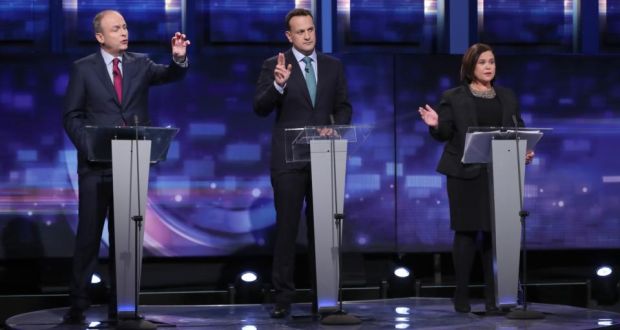
The Sinn Fein leader, Mary Lou McDonald, has been described as looking like an OTR (as in an ‘on the run’- a member of the IRA who doesn’t have immunity from prosecution) on the grounds that now that they have reached this great height they don’t want to screw it up by having to answer any difficult questions.  McDonald has been acclaimed for good media performances and tapping into a widespread mood for change, while also being applauded for not being too specific about how she is going to solve the health and housing crises giving rise to this demand for change.

It would not be wrong to note that Sinn Fein’s opposition to both Fine Gael and Fianna Fail does not exactly transmit into opposition to either of them being in office, only that they should be open to Sinn Fein joining them.  That of course would require a joint programme for Government, which by definition requires no significant differences between them in any potential coalition programme.  But if Sinn Fein can go into coalition with one of the most reactionary parties in Europe, I refer to the Democratic Unionist Party for those unfamiliar with Irish politics, coalition with either of these parties should not be a problem.

Fine Gael originates from part of the Irish Republican movement that fought the British in 1916 and in the War of Independence.  Leading figures in these struggles were also leading figures in the pro-Treaty side in the following civil war, including the prime military leader of the War of Independence, Michael Collins, and W T Cosgrave, the Irish State’s first Taoiseach.

Fianna Fail’s leaders also fought in 1916, the War of Independence and Civil War, just on the anti-Treaty side in the last conflict.  While the Pro-Treaty ancestor of Fine Gael supported the new Irish State from the beginning, because of the argument that it would provide ‘the freedom to achieve freedom’, the anti-Treaty Fianna Fail claim it is they who delivered it, (although it was a Fine Gael led government that declared the Irish State a Republic and Fianna Fail can’t explain what proved to be wrong with the pro-Treaty argument).

Sinn Fein holds itself to be the party both Fine Gael and Fianna Fail split from, except it itself is a split from the Official Republican Movement in 1970, its claim now resting on the fact that the Official Republicans abandoned the name and moved away from the politics of traditional Irish nationalism.  Like pro-Treaty republicans who rejected the British solution of Home rule; and like Fianna Fail, who rejected the new British solution of the Free State; Sinn Fein rejected both, but now accepts the latest British solution to ‘the Irish Question’, which on this side of the sea is more accurately described as ‘the British Question’.

All three parties now agree that the Free State/26 County State/Irish State is legitimate and now accept partition, with varying degrees of enthusiasm.  They have their differing constituencies of support – Sinn Fein stronger among less well-off sections of the working class in urban areas; Fianna Fail among farmers, but also among other social layers; and Fine Gael among the better off middle class, but they all hail from the same tradition of militant Irish nationalism that isn’t militant anymore.  In the end all three provide proof of the old adage that fruit doesn’t fall far from the tree.

For many decades now there has been no essential, and little inessential, difference between Fianna Fail (FF) and Fine Gael (FG), and many have ridiculed the competition between them.  It’s rather the political equivalent of club rivalry in the GAA (Gaelic Athletic Association), in which the cousins in one club beat the shit out of the cousins from a rival parish’s club.  If you’re in the club you don’t need explanation for the rivalry, but any explanation you might get for it will make not much sense.

Now we have a third force, which promises real change, and because of its youth, is not yet fully conscious of its position in the world and has yet to form a rounded, fully-developed and more or less permanent personality of gobshite politics. I have no doubt many Sinners believe they are opposed to austerity in the South and have not implemented it in the North, or will excuse themselves for it.  But reality says different.

Sinn Fein policies involve broadly social democratic promises, including significantly higher state spending, some lower taxes and increased taxation of businesses and higher incomes.  It has made hay with the now dropped plan of Fine Gael to commemorate the Royal Irish Constabulary, the paramilitary police force the British used to police the whole of Ireland before partition.  There is no good reason why this particular revisionist step should suddenly detonate a reaction, but it is welcome nonetheless, even if it exposes once again the limited nature of popular nationalism.

Sinn Fein are opposed and rather hysterically denounced by both FF and FG, but both of these have recognised the electoral need to support increased state spending and reduced emphasis on tax cuts.

They and Sinn Fein also do so because, as the economic boom in Ireland has continued, the inherent imbalances in capitalist growth require a State to intervene to ensure these do not become an obstacle to further profitable expansion.  Poor infrastructure in health, housing, childcare and transport threatens to increase the cost of labour power (the value of labour power in Marxist parlance) and so provide both practical and cost barriers to capital accumulation and growth.

The two most pressing are housing and health.  The problem is that more money is not the (only) problem for both and there is no easy solution for any of the parties within the limits of their political ideologies and projects.  An unreconstructed health service could gobble up much more money without comparable improvement in the population’s health, although the worst experiences might be avoided. Pumping more money into housing could easily make it more expensive to buy and rents no more affordable.  The power of the middle class interests in both, and particularly of landowners and property developers in political networks, makes any radical solution (that doesn’t automatically involve capitalist expropriation) the last thing the major political parties will want to do.  And this will be true of Sinn Fein, as potentially a new addition.

However, in itself, the Sinn Fein economic programme offers no insuperable barrier to the formation of a coalition with either Fianna Fail or Fine Gael.  The difference is mainly one of scale and the compromises involved in coalitions can cover that in every meaning of the word.  The economic boom provides as benevolent an environment as Sinn Fein is likely to get, even taking account of a potential hit from Brexit.

The potential for another recession, through another property crash (a couple of property investment funds have recently refused to allow investors to cash-out) might however reveal the underlying debt position of the state.  The bank bail-out that caused the bankruptcy of the Irish state has left an overhang of debt that is currently relatively easily affordable because of low interest rates, with yields on 10 year Irish bonds in negative territory.  But this cannot last and a recession could easily raise them.

But that is more than a problem for Sinn Fein, although it should not be forgotten that the party supported the bank bail out that made the debts of the banks the debts of the people.  Sinn Fein has thus shown that it is no more a real alternative to Fianna Fail than Fianna Fail is to Fine Gael.  It simply has yet to be demonstrated, which of course is not something inconsequential in itself.

Unlike the North, the Irish State is a sovereign state and acutely aware that the Provisionals were until relatively recently a subversive threat to the stability, if not the existence, of the state.  The Provisionals are no longer a real or a proclaimed threat but they are an armed force outside of state control, even if much diminished, and this is unacceptable.  Sinn Fein will still have much to prove and the political establishment in Dublin may make arrangements to ensure exclusion of Sinn Fein from office this time.  It may be possible, for example that Fianna Fail gains sufficiently in seats from the unpopularity of the Government that it is able to form a coalition, which some pundits predict will be the case.

The reaction of the left to Sinn Fein growth is to ask that it not enter coalition with either Fine Gael or Fianna Fail.   But this left is in competition with Sinn Fein for the same constituency and has regularly denounced it as soft on both establishment parties and ever-ready to do a deal with either of them.  The alternative, which I noted in a series of posts on the strategy that the left has pursued, was to be more open to an alliance with Sinn Fein and fight to unite with it in a common alliance.  Of course, this would require some common programme, but since the left’s electoral policies are just souped-up social democracy, this too would simply be a matter of compromise without breaking any principle.  The policies of the left do not involve the overthrow of capitalism, not to mention any mechanisms for the development of socialism.

In the first leaders debate on television, the first question asked was all about why people should vote for a party if it couldn’t form part of a government.  And this was a reasonable question, because this is what elections are for.  And it was a question that rendered People before Profit/Solidarity irrelevant and Richard Boyd Barrett with nothing to say.  Listening to him there was no sense in which he spoke on behalf of a movement outside the establishment bourgeois democratic process that in itself was the alternative to the problems he and the others were asked about.

That is because the left is currently now almost wholly an electoral force, something that limits its potential and limits its development.  A long time ago it ceased to fight for socialist politics in these elections and retreated to radical social democracy.  It clearly has no idea what sort of platform a Marxist organisation should stand upon in an electoral contest, or rather It thinks it already does.  However, its Keynesian policies and state-centred solutions render the working class absent as the agent of change, making it instead the supplicant of the state it must ultimately remove and replace.

The left has collapsed into social democratic politics in order to be consonant with the existing political consciousness of the Irish working class and to demonstrate its practical relevance to it by being elected.  But this ultimately means getting into office, a step it is both unprepared to take and to which it puts up unjustified obstacles, its opposition to Sinn Fein being one of them.

While it is possible to condemn Sinn Fein for its opportunism and its betrayal of working class interests, this has to be demonstrated.  Having decided to adopt electoralism as a strategy the left should either abandon the strategy and totally re-evaluate its understanding of Marxism, or it should follow through on its electoralism and take its social democratic programme to its logical conclusion.  If history is anything to go by, the latter is the much more likely road that will be taken.

The North of Ireland’s Anti-Brexit Election

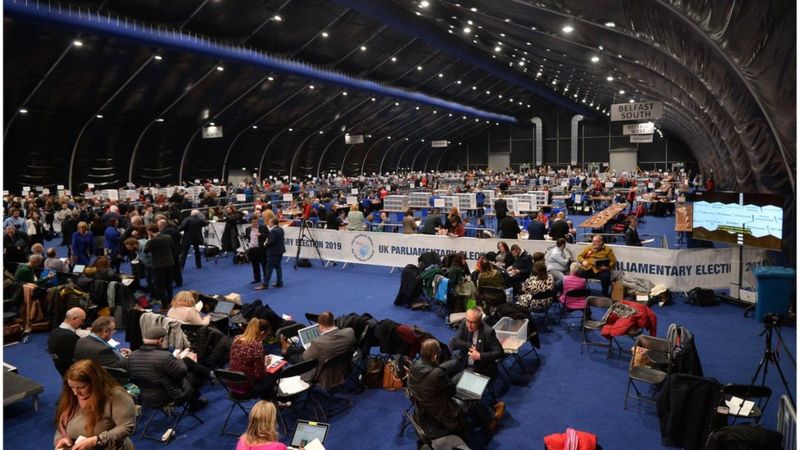
Vote count at Titanic Belfast

No sooner is the general election over but the media hails the beginning of talks to resurrect the Assembly at Stormont and the power-sharing Executive.  The election has been hailed as a dramatic change yet the same old solution that cannot find a problem it can solve is put forward again.

We are expected to forget the rampant incompetence and corruption that characterised previous Stormont attempts.  However, it’s not quite everything changes but everything remains the same, because at the same time as we wake up to groundhog devolution day we are also informed that, just perhaps, real change is on its way – ‘United Ireland’ trended on Twitter.

In part this might appear as a result of Brexit getting done under Johnson, which will hasten a Scottish referendum that will lead to Scottish independence – shattering the ‘precious’ union upon which Irish Unionism depends. In part, it is because of the results of the election in Northern Ireland, which for the first time ever has elected more nationalist MPs to Westminster than Unionist – 9 to 8.

But caveats abound.  Johnson will not get Brexit done.  The UK may leave the EU at the end of January but the transition period means nothing will change – except losing its vote in the EU – until it ends at the end of the year, which is not long enough to determine the new arrangements between the UK and the EU.  These will be contentious despite the Irish Taoiseach warmly welcoming the result of the election as removing a worrying source of instability for the Irish state and its economy.  The value of Irish shares may have soared upon the result, especially those of the banks exposed to the British economy, and one right wing politician may have welcomed the election of another, but Brexit is by no means sorted and the North of Ireland (indeed Britain itself) has just voted against it.

If the Scottish Government elected by the people demands another separation referendum then it should have it, without this the national oppression that Scotland does not currently suffer from would become real.  But Brexit will involve the same, if not even greater problems, for any separate Scottish polity that puts itself outside its main economic partner, with a hard border between it and a Brexit England and Wales.  The austerity necessary for a separate Scotland would be made worse; it is not therefore a given that the Scottish people will change its mind.

In any case socialists should oppose the erection of borders, which divide workers, and oppose nationalism that frustrates class solidarity in favour of national allegiance.  Already nationalism has many Scottish workers voting for a Party that covers its right wing politics with nationalist rhetoric.  This has unfortunately led many on the left to support its cause, perhaps not so surprising since some have also capitulated to Brexit; populist nationalism has been on the march in a muted form for longer than Boris Johnson.

So the outcome of Brexit and Scotland are not clear, but if the Withdrawal Agreement continues in some form then a real difference will be created between the North of Ireland and Britain and real harmonisation between North and South.  A loyalist campaign that attempts to stymie this is not out of the question, but it is likely to be more isolated than previous mobilisations against Sunningdale in the 1970s and the Anglo-Irish Agreement in the 1980s.  It will struggle to identify meaningful targets (which normally leads to its default disposition of attacking Catholics) and the British State lacks the incentive to indulge it.

The election results themselves have been taken to represent another step towards a United Ireland through a border poll, but again the situation is not so straightforward.  Sinn Fein, which shouts loudest for such a poll – calling for the Irish Government to create an All-Ireland Forum to advance the cause, performed badly, dropped by 6.7 percentage points.  It stood aside in a ‘Remain’ alliance in three seats, which partially explains the fall, but it also gained from the SDLP withdrawing in North Belfast, which returned a new Sinn Fein MP.  From three out of four MPs in Belfast being Unionist we now have three out of four Nationalists.

It dropped votes almost everywhere else, in West Belfast to People before Profit and spectacularly to the SDLP in Derry where its reverse was stunning.  On top of terrible results earlier this year in the local and European elections in the South, Sinn Fein has major problems.  The shine has long since come off it, it has little positive to say, and its abstentionist policy to Westminster has just cost it votes in the North.  It might have been assumed that as Irish unity appeared closer Sinn Fein would grow and benefit, but the opposite could well turn out to be the case.

It is one thing to stand out for the traditional aspiration of the majority of the Irish people when it appears you are alone in this, quite another to do anything positive to achieve it when it appears to become a realistic prospect, at least some time that isn’t the distant future.  The closer to Irish unity the less relevant appears a Party with nothing much to say about how it should be achieved or how it would actually entail a new progressive Ireland.  Previously, the SDLP suffered because it demanded the end of the IRA’s unpopular armed campaign but Sinn Fein gained from the peace process because republicans and not the SDLP could make it happen.  Sinn Fein will not make Irish unity happen, certainly not in any progressive manner.

In this election the SDLP came back from the dead to win two MPs with huge majorities in Derry and South Belfast.  Their opposition to Brexit was certainly a major factor in the latter, assisted by the fact that the sitting MP was from the DUP and Sinn Fein and the Green Party had stood aside.  Its vote however was much more than this assistance and represented more than mobilisation of a Catholic/Nationalist vote.  On the face of it this strengthens the push for restoration of Stormont since the SDLP is arguably its greatest supporter, although the sectarian carve up that is the lifeblood of Stormont faces challenges when there is competition not only between Orange and Green but also within each camp.

This is also the case in the Unionist camp where the threat to the DUP has come not from the Ulster Unionist Party, which has no real reason for existence, but from the Alliance Party – the biggest winner on the night. Like the footballer that is never off the subs bench while the team is crap, they get better the less they play, and the worse the team gets.  Alliance has benefited from appearing to stand above the sectarian incompetence and venality at Stormont but there is no indication that greater immersion into the devolution it also earnestly supports will not reveal its inadequacies as it has the others.  Its apparent opposition to the inevitable workings of Stormont will dissolve as it becomes an increasing part of it.

This however is not the major point to make about the rise of the Alliance Party.  It declares itself neither Orange nor Green although it has its origins within Unionism and has a pro-union policy.  This used to be much more obvious than it is now but has receded as the question has lost it sharpness following republican acceptance of the constitutional status-quo.  Its avowedly non-sectarian unionism has reflected its historic base inside the Protestant middle class, with an added smattering of aspiring middle class Catholics.  ‘Middle class’ here is used in the not very scientific sense to mean better paid workers and those with relatively higher standards of living.

It is now the third party in terms of votes with 17.4%, compared to the DUP with 31.6% and Sinn Fein with 23.6%, continuing its upwards trajectory following its success in getting the third MEP slot in this year’s European elections alongside one DUP and one Sinn Fein.

Much has been made of the overt sectarian arrangements at Stormont being predicated on balancing the Unionist/Protestant bloc against the Nationalist/Catholic one. This includes a veto wielding petition of concern available to each, which is blatantly undemocratic and discriminatory when a large number of representatives are defined simply as ’other’, which includes the Alliance Party.

This Alliance vote is a reflection of, but not identical to, increasing numbers of people who do not identify as unionist or nationalist, Protestant or Catholic.  The latest Northern Ireland Life and Times Survey reported that one in two identify neither as unionist or nationalist, although this seemed to me to be rather too big, confirmed by some colleagues in my office who are a generation younger than me and closer perhaps to those who might be sloughing off old identities.

This growth of ‘others’ dovetails with the growth of the Catholic population, which in the last census in 2011 reported 41% of the population as Catholic and 42% Protestant, with a Catholic majority among younger age cohorts.  Sectarian division is also influenced by the decreasing gap between Protestant and Catholic social indicators such as unemployment, and the obvious breakdown of large scale employment segregation. So society is changing in the North of Ireland, which gives credence to the idea that the union with Britain, by being less certain, is thereby closer.

Research has been done on the composition of this neither Orange nor Green population but I won’t go into it here.  Suffice to say that the majority of ‘neithers’ are in favour of the union with Britain, although one survey has reported that one third of Alliance voters have said that Brexit makes them more favourable to Irish unity.

What this shows, as if it needed pointing out, is that ‘other’ is not in itself a positive identity.  I am an ‘other’ in these terms, but I would never define myself as such because I am a socialist and do not define my views as simply other than Irish nationalism or Irish unionism.  It is pretty clear that the majority of ‘others’ do not have a coherent separate political identity beyond rejection of two major nationalisms suffused with religious identity.  And this is positive – as far as it goes.

But more importantly, this survey finding about Alliance voters shows that while ‘others’ do not define themselves as unionist or nationalist, there is no third position on the national question.  There are worlds of difference on how it might be solved, and how it might lead to more or less progressive outcomes, but increasing rejection of the old ideologies without a positive alternative leaves the old choice standing.

This does not mean that the growth of those rejecting the unionist and nationalist identities, probably because of the behaviour of the political movements that lead them, does not have an influence on the political situation or on prospective developments.  It has been remarked that these people will be pivotal in any border poll and will not be motivated by traditional war cries.  The majority are motivated by progressive impulses if only cohered in very primitive form (primitive as in undeveloped).  The struggle for a united Ireland will have to offer more than recovery of the fourth green field.

This does not mean that some economistic agenda is the way forward, for in essence this is still a political question that requires a political stand.  It is rather that what will become more and more important is what sort of transformational project will this political struggle involve – what sort of united Ireland is being fought for?

The setback for the DUP in the election is a blow to the most sectarian and reactionary Party and must be welcomed. The vote for the SDLP and Alliance is to a significant degree a vote against Brexit and again should be welcomed.  The shift of some unionists away from the parties of traditional Unionism is also a weakening of the unionist programme and acts to isolate the most extreme loyalist reactionaries, which again should be welcomed.

That Brexit has not overcome the traditional sectarian/political divide is not unexpected – in fact it is entirely to be expected that the reactionary politics of Brexit should find its natural base in unionism.  That opposition to Brexit has weakened the unionist parties and unionism is thus inevitable and once again to be welcomed.  Even the small gains by People before Profit could be welcomed were it not for the fact that it continues to fail to recognise the reactionary character of its support for Brexit and demonstrates an inability to learn from mistakes and correct them, which is more serious for it than the question itself.

What appears as significant political changes in the election are therefore, from a socialist point of view, relatively small steps forward.  They do however reflect more significant changes below the surface that socialists should be concerned to understand.

The Fall of the Red Wall

Related image

What do you do when you are leader of a Party and the vast majority of your members support a policy that you oppose?  Well, you can’t very well allow them to control the party can you?  So you can’t ensure it operates democratically.

What do you do when the majority of your voters also support that policy?  Well, you dissemble, confuse, appear to sit on the fence and declare neutrality.

In the case of the membership you first prevent them getting their way by stopping them voting on it at conference.  The next year you so manage the policy that is voted on that you can effectively continue to push your own, while of course appearing to do something different and pretending that the members got what they wanted.

But since the new policy does not make much sense the party membership are still not happy and come back to the next conference in the next year and vote again on what they want – and this time they win!  So what do you do now?  This time your friends say to the membership – ‘You Lost’ – and they start singing your name at the conference.  And it’s a victory!

For the rest?  Well, for them it’s then like being at a party where people start singing, and you don’t feel like joining in, but you’re made to feel your spoiling it for everyone, and spoiling the fun, if you don’t join in.  You really don’t want to be a party-pooper so you’re invited to suck it up.  After all, this leader has had it tough.

He’s been accused of all sorts of things that were so ridiculous that your first response might have been to ignore it. But the slander and smearing goes on and on and you want to have a square-go at the traitors inside the Party who are telling these outrageous lies, but the leader can’t trust you, so you’re not allowed.  Remember, the leader can’t very well allow you to control the party.  It’s a ‘broad church’, and just like in church it’s your job to listen to the preacher and then go out and do God’s work.

But this goes on and on, so the leader says he’ll do something about it and these terrible things will be stopped, and again and again you hear the same record.  Some people wonder why he’s saying the same thing about how bad it is, yet he’s saying it again. Why is he having to say it again?  Surely it’s been sorted?  He’s told to apologise and effectively he does, but if this happens again and again why is he apologising and nothing is changing?

Then I hear on the radio that the new manifesto is going to empower people, and I think to myself – WTF, really?  The only thing you have had the power to lead to ’empowerment’ is the membership of the Party you lead, and you’ve stood in the way of it.  Instead you’ve allowed all these reactionary shits to accuse you of nonsensical crimes.  The last time I viewed such a nightmare I was reading ‘The Trial’ by Franz Kafka, and it didn’t end well.  And this one doesn’t look like it will either.

In the election you’re facing a compulsive liar, whose own supporters don’t even trust.  They don’t believe him, but they do agree with him, and they are going to support him. But many people have gotten fed up with you.  You’re supposed to be different – he is what he is.  You are not what you have claimed to be. You’re supposed to be a conviction politician, who embodies honesty and sincerity and many people can see that you haven’t embodied either.

The dam that that held your so-called ‘red wall’ has just sprung two leaks and the first one is the enormous one. Just like a dam that you have seen in the films, your wall of support doesn’t break open only at this point, and other fractures appear in the edifice, and water spurts out of every one of them, everywhere – a hundred and one different cracks appear and it seems as if there are lots of reasons why this wall is going to fall.  When it falls it might seem difficult to say which one is responsible for the whole thing collapsing.  Lots of people look for more and more deep reasons for the collapse, the better to demonstrate their appreciation of the enormity of the collapse. But really the one big crack was vital in creating the rest.

There is a particular risk in immediately seeking the most profound reason for what has happened, although it’s not inevitably wrong and does not invalidate the attempt, but it does involve a risk.  It’s the risk that the explanation becomes so deep and meaningful that it can convey the impression that nothing could have been done about it.  We could never have won, the pressure against the wall of the dam was just too strong.

And this can lead to feeling sorry for the leader, who has been up against it all this time.  And I would feel this way too except I, like millions of others, is soaking wet and praying I’m not going to drown further down the line.  You can feel sorry for the leader if you want, my attitude involves rather more colourful expressions of emotion.

The historic defeat of the Labour Party was the result of a swing to the Tories of just 1.2 per cent and a swing away from Labour of 7.9 per cent.  The Tories won it because Labour lost it.

It lost it primarily because it lost voters loyalty on the big question that mattered – Brexit.  The machinations around it infected everything else Corbyn did, just like the real Brexit will determine so much else in the real world; limiting what good is possible and spurring on everything nasty, cruel and reactionary.

Sky called it the Brexit election, the Labour Party complained that it wasn’t, but now the Party leaders admit it was – a bit late to recognise the obvious.  The Political Studies Association reported polls asking about the issue ‘that will help you decide your vote’ and it was Health – 47% and the Economy – 35%; only 7% said Europe.

But that was in 2016.  In 2019 63% said Europe, while Health was 43% and the Economy 9%.

I could get even more annoyed now because I really dislike stupidity, especially in those who have no business being stupid.  But it wasn’t really stupidity – the reactionary position on Brexit and all its calamitous concomitants, such as suppressing Party democracy, is a sort of politics: ‘socialism from above’ is the kindest way of describing it even though there is no such sort of socialism.   It’s why it might be better to describe it as ‘state socialism’, or much more accurately, better to call it social-democracy and Stalinism.  (In this respect what was also worrying was the impression given by many socialists that the radical aspects of a social democratic programme was really socialism.). But to get back to the point.

What we saw was the nationalist politics of Brexit devour its misguided children, exemplified by Denis Skinner losing his seat to someone better able than him to embody the reactionary logic of Brexit. Unfortunately, these people brought down the rest, the majority, who have always known that Brexit had to be opposed.

If we want to look at the weaknesses of British social democracy we could do worse that start here – the narrow nationalism of the British left going back to Tony Benn or even further to Manny Shinwell and Aneurin Bevan.  Their opposition to ‘Europe’ resting on the Sterling Area and the Commonwealth, a bogus commitment to internationalism that rested entirely on the relics of Empire.

These weaknesses have been imbued by the radical left supporters of Brexit who think using one less letter and replacing one other makes a difference.  These people share the same conception of socialism – state ownership and a national state to implement and defend it from foreigners.  Entirely disappeared from consciousness is that we should be uniting with ‘foreign’ workers against our own state and theirs.  In fact, for a socialist, no worker is foreign, foreign to us is the nationalism that seeks to divide us.  Just like the Shinwell’s of old they condemn the narrowness and racism of Europe for not embracing the world while sailing on a boat that doesn’t leave the shores of Dungeness.

Labour lost 2,585,564 votes from 2017 to this election but the media narrative of the working class deserting Labour over its failure to support Brexit is a continuation of the distortions and lies that has been their staple.  Early estimates claim that over 1.1 million of this reduced vote was Labour Remainers voting for other remain Parties while perhaps 250,000 Labour Leave voters also transferred their vote to these Remain parties.

Antipathy and opposition to the figure of Jeremy Corbyn also seems to have played a major role but this is a combination of very different things that became important precisely because one person could be the focus of all of them.  For more than one reason the leadership is to blame – making Corbyn the sort of Presidential figure to the exclusion of other leaders in the campaign is probably the least important.

Anti-Corbyn hostility combined the opposition of Labour leavers; those prey to the calumny of the mass media; the failure to openly explain and discuss massive policy proposals dumped on the electorate at the last minute giving rise to some cynicism, and most of all duplicity over Brexit and apparent failure to take a position.  What price the one-day conference to discuss the Party’s Brexit policy now?

We need to stop talking about the Corbyn project in the Labour Party because clearly that project didn’t include opposing Brexit and didn’t include empowering the membership, which remain vital to any future progress.

One take on the election had a wonderful quote, ‘Disappointment is a trifle.  Disappointment is a luxury we cannot afford. The dilemma is simple but imperative. Whether to submit to mere fortune or to understand and take action.’  Perhaps not enough for the politically uninvolved but a good enough starter for the rest of us.

The struggle remains to fight Brexit, which hasn’t ceased to be the reactionary threat to the working class it has always been.  ‘Get Brexit Done’ is another lie to join everything else associated with that project.  Lies are ultimately useless because sooner or later they collide with reality.  The issue is who pays for them.  If there is one saving grace from the result it is escaping the embarrassment of an attempted Corbyn Brexit.  The Tory Brexit will fail its supporters and Labour must fight it and all of its consequences, including the disillusionment that its ‘success’ will provoke.

The second is to demand and fight for a democratic Labour Party. The mass membership has proved to be right, even if only negatively, and it must be confident in saying so.  The debate about responsibility for the defeat is not a distraction from fighting the Tories but an indispensable requirement.  Get it wrong, or lose it, and that fight will be hamstrung.  What to do depends on what is accepted as what went wrong, and there must be no truck with those who want to deal with defeat by following those who either led it or caused it.  We don’t want to tack right in pursuit of nationalists and racists and we don’t want another Corbyn who didn’t know how to fight either.