

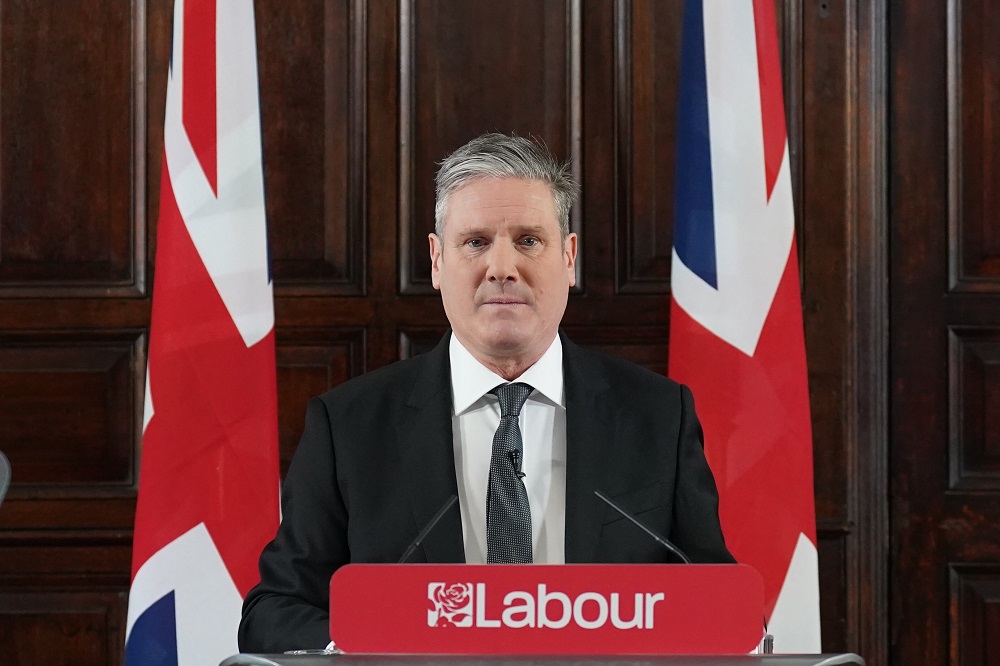
The Labour majority of over 170 seats with only 34% of the vote is the lowest-ever winning share. With around one third of the vote it gained two thirds of the seats. The turnout of around 60% was a drop from 67% in 2019 and the second lowest since 1918, meaning around 80 per cent of those eligible to vote didn’t vote for Starmer, whose personal rating is a net minus of 6. Even in his own constituency his vote fell dramatically, by 15.6%.
His victory is due to the Conservatives having their worst ever result. Polling indicated that 48% of those intending to vote for Labour were going to do so mainly to get rid of the Tories. Had the Reform Party not existed, and its reactionary support voted Conservative, it would have beaten Labour by around 38% to 34%. Yet for receiving 14% of the vote Reform got around 1% of the seats.
From this, two things are obvious: the British electoral system is a fraud with scant claims to democratic legitimacy and Starmer’s Government has the same lack of popular foundation. The bourgeois media can’t ignore all this completely but can be expected to move quickly on. One only has to recall that Starmer’s Labour received less votes than the supposedly disastrous Jeremy Corbyn in 2019 and 2017 to appreciate the treatment the media would dish out to the lack of legitimacy Starmer’s result would be accorded had Corbyn still been leader. In 2024 Starmer’s Labour won 9.7m votes with 33.8% of the vote while in 2019, in Labour’s supposedly worst result ever, Corbyn’s party won 10.2m votes with a share of 32.1%. In 2017 Corbyn’s Labour won over 3 million votes more than Starmer did today – 12.9m as against 9.7m.
It is estimated that a quarter of 2019 conservative voters switched to Reform while the Liberal Democrats achieved their best ever result by surfing the wave of getting the Tories out by targeting their seats in the south and south-west of England. Labour also benefited by the collapse of the SNP vote in Scotland following 17 years of failed SNP rule and the scandals that have engulfed the leadership of the party.
The short-sighted and primitive call from some on the left who simply called for the Tories to be kicked out has been exposed for the worse than useless advice that it so obviously was. Everybody was out to get the Tories , and the election revolved around their losing it rather than Labour winning. As we have seen – the Labour vote went down.
* * *
The Labour slogan was the vapid and vacuous one-word ‘Change’. The bourgeois commentariat has welcomed it as a change from the incompetence, chaos and instability of fourteen years of Tory rule and a return to the previous, apparently boring politics.
True to their superficial appreciation of events, or at least as they recycle them for the consumption of the population, this ignores the commitment of Starmer to essentially continue with Tory policies. This includes a commitment to ‘growth’, to retention of the commitment to reducing the debt over five years; minimal increase in taxation; resolution of the problems of the NHS; commitment to increased defence spending, and a promise not to reverse Brexit in his lifetime. He has also committed to come down hard on immigration and to do so more effectively than the Tories.
How growth can be achieved without investment (increased borrowing and therefore increased debt); without a larger workforce (while reducing immigration), and without expanding either the domestic market (through pay increases Starmer has vowed to oppose) or the export market (while never rejoining the EU), is left unexplained. It all looks exactly like the situation created by the Tories but without smug incompetence of Cameron, the wooden hopelessness of Theresa May, the performative chaos of Johnson, ideological blinkers of Truss, and the MBA qualification in cluelessness of Sunak. All Starmer brings personally is his own brand of dislikeability and penchant for lying on the scale of Boris Johnson.
Normally a new right wing government with a mandate would be able to wield their electoral victory as a weapon against workers, through restricting public sector pay, reducing public services and welfare, and increasing taxation. Given Starmer’s short but filled-to-the-brim history of U-turns, it would not be a surprise to see him attempt to impose austerity on public sector pay, reduce the scope of state services such as the NHS, increase taxation, take yet more reactionary measures to be seen to reduce immigration, and attempt unsuccessfully to get something meaningful from the EU in terms of better market access. None of this will lead to significant additional growth.
Brexit is an issue that will not go away even if all the parties try to ignore it as they did in the election; just as the proxy war against the biggest nuclear arms power in the world was also ignored. The previous election that promised that Brexit would get done resulted in it not getting done, thus not addressing all the problems created. The lack of strong support for Starmer’s government will matter when he is called upon to do so.
* * *
Starmer managed to maintain the support of most of Labour’s voters while pivoting to the right, to win over disenchanted Tories and others simply wanting rid of them without caring particularly over who replaced them. This having been achieved, there is no reason for any of them to offer his Government any continuing support. Even his claim to introduce integrity into government after years of Tory sleaze looks like previous broken promises given his huge catalogue of gifts and the sponsorship of his party and colleagues by private corporate interests.
His support for Brexit will anger the majority of Labour members and supporters who oppose it and who will see more and more evidence of why they are right to do so. A harder line on immigration will do nothing to improve growth, will antagonise some supporters and will legitimise those on the right, including the Reform party, which is in second place in almost 100 constituencies, the majority of which are held by Labour. Reform has already demonstrated that its rabid xenophobia is more convincing and attractive to reactionaries than that of the Tories, and this will apply to Starmer’s reactionary nationalism. Pursuing the same policies will engender the same problems that brought down the Tories and the same vulnerability to right wing competitors, who will always be able to out-bid its reactionary solutions.
The Liberal Democrats did not increase its share of the vote but had its best result because it targeted Tory seats. An anti-Brexit policy could protect those gains while targeting Labour supporters opposed to Brexit and Starmer’s continuing demonstration of its failure. The Green Party also increased its vote and became a more credible alternative, even if its gains in two Conservative seats demonstrates its essentially petty bourgeois character and opposition to any sort of socialism.
Unfortunately, the pro-Palestine candidates elected are not a coherent left alternative while fortunately the false and fraudulent alternative represented by George Galloway was defeated. The battle for the socialist movement is not through creation of yet another electoral alternative but assisting in the working class resisting the policies of Starmer’s government and defending its interests. Only by working class resistance and a movement created out of it could an electoral vehicle be constructed as a subsidiary part of the movement.
The Conservative Party has lost many of its most rabid pro-Brexiteers and will always come second in competition with Reform on the basis of opposition to the EU. Just as with the Labour Party, sooner or later being a bourgeois party will mean having to represent its interests, which means reversing Brexit. This applies to the Liberal Democrats as well so that a party realignment to achieve this will have to take place.
Only the rabid reactionary nature of the Reform membership can hobble its further development or blow it up. There is no point in the traditional conservative section of the Tory party seeking any sort of accommodation with it, yet there is no point in the reactionary petty bourgeois sections of the Conservative Party and the Reform Party remaining separate.
The results of the election; the economic challenges facing the new government and resistance to it; and the proliferation and confusion of party supports, all point to a political realignment. A real socialist alternative cannot be declared or created out of the organisations that exist but likewise can only come to the fore as a result of developments in the class struggle, arising as a result of working class opposition to the the new government and its attempt to carry through the failed policies of the Tory government that has just been humiliated. A cause for some optimism.
 Some people might object to the view expressed in the previous
 Sráid Marx