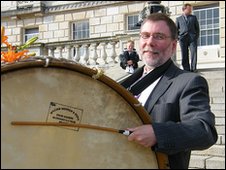
Nelson McCausland, a little man with a big loud drum. (by Belfast plebian)

47925243_3707225203_e18c6d4d4e-1It is a hell of a misfortune that at this time of a drastic need for some form of social protection for hard pressed working class families we are saddled with a social development minister in the Stormont Executive whose opinions accord well with the right wing government across the pond and who is also regarded by many as a hardened religious sectarian. This little man with the big drum is also proving to be the most active of the generally passive Stormont ministers.

It should be said at the outset that he took on the ministerial portfolio at a very awkward juncture when the Tory austerity plans where already in an advanced state. The SDLP of course vacated the crucial social development portfolio as soon as they caught sight of the content of the welfare reform bill and Sinn Fein screamed PASS to the chance to take over the department from the SDLP following the May 2011 assembly elections. Why Sinn Fein chose to take on the department of arts and culture, the one with the smallest budget and largely symbolic importance rather than one of the key economic departments stands as an interesting question without of course an answer.

Nelson McCausland is known for being an ardent Unionist, a formidable Orangeman and monarchist, a ‘pro-life’ evangelical Christian who is also a Creationist and of course a great enthusiast for something called the Ulster-Scots culture. Indeed it can be persuasively argued that he more than any other individual is responsible for the ideological mishmash called Ulster-Scots culture. When he was appointed to his previous ministerial post in 2009, in charge of dolling out money to the arts and science cliques, his primary mission was to raise Ulster-Scots heritage up a couple of intellectual notches to the status of ‘a traditional culture’ and therefore make it worthy of taxpayer cash. The small budget didn’t deter Nelson too much.

Before he captured the minister for arts and culture portfolio he was the director of a lobby organisation called the Ulster-Scots Heritage Council. Back in those days he had little or no money to promote Ulster Scots heritage as a rival to the Irish language and culture movement and so no one of any intellectual standing took him too seriously. It was only when he got his hands on the department cash card that the little man with the big drum had to be listened to by the typically anti heritage arts cliques.

For a brief moment Nelson attracted the attention of the middle brow Guardian newspaper, thus earning a wider notoriety and crossing swords with non-other than uber-scientist Richard Dawkins who declared that the minister was an unfit person to be in charge of science museums. This was after Nelson wrote to the Ulster Museum requiring that it display a range of Creationist inspired artefacts to offer the North’s naive children a legitimate alternative to the “unproved theory of evolution.”

It didn’t take much to put down poor Professor Dawkins, faced with the acuity of Ulster’s superior evangelical mind. “Dawkins is an arrogant and militant atheist who prides himself on his knowledge and reason. He loves to demean and disparage others but this time the mighty man came unstuck” declared Nelson on his personal blog.

Being anti-modern in evolutionary science has not stopped the little man with the big drum being a very successful politician, He is already into his second ministerial position and is easily the busiest minister. Some people think they know why he is so successful. The key to his lasting popularity they say is to be found in his very frequent sectarian public outbursts, something that goes down well in loyalist flag waving working class districts. Let’s run through just a few of his more recent efforts.

On the third of October the Belfast Telegraph ran a story -‘Fury after Nelson McCausland says there’s no need for more Derry housing funds.’ It emerged that the minister had refused a recent appeal by Derry City Councillors for additional funds for the Housing Executive to build more social housing in the city. The latest figures revealed that the number of families and single people on waiting lists had passed the 3,000 mark

Sinn Fein councillor Tony Hassan said ‘we get a letter back from the minister’s secretary and to me it was disgraceful.’ The SDLP councillor John Tierney called the statement of the minister ‘crazy’. And here’s a nice Nelson touch – ‘the minister’s letter also referred to Derry City Council in the address and throughout as City Council of Londonderry.’

On the 25 September he faced down an SDLP sponsored motion calling for a three month parliamentary suspension for supposedly breaching the ministerial code by failing to condemn illegal acts conducted by a royal black band parade as it swaggered outside St Patrick’s Church on Donegall Street in Belfast. The suspension motion attracted a lot of media attention and was voted down. And so the little man’s political stock went up within his own party. McCausland, more than most DUP politicians, gets a kick out of baiting both ‘republican’ and nationalist politicians. He runs his own blog just to keep the invective regular.

In mid-June we can pull out another two media stories, ably covered by the online newspaper the Detail. The story broke that Nelson McCausland had caused worry and anger among Housing Executive workers when he chose to provide fellow DUP assembly colleague Paula Bradley with the religious breakdown of staff employed in North Belfast in the most public way. The decision was strongly criticised by trade union officials who warned that publication of the religious designation of workers in specific localities might put them at risk.

Less than a week later a car belonging to a Housing Executive employee was destroyed after it was set on fire by masked youths as it was parked outside the agency’s district office in Newtownabbey. ‘The Detail understands that Housing Executive officials have been forced to review security measures at offices across Belfast as a result of the attack. In a series of questions to DSD ‘we asked Mr McCausland to explain why he decided to publish the figures against the advice of his own officials and despite staff concerns…We also asked DUP MLA Paula Bradley why she had originally asked for a religious breakdown of staff… she chose not to respond.’

Also in June McCausland was criticised for blocking plans to build 200 new houses for people deemed to be nationalists on the vacant site of the former Girdwood army base in North Belfast. ‘However the Detail can now reveal new evidence showing that the DUP minister held discussions with the Housing Executive to ensure that four loyalist areas in north Belfast were given preferential treatment to be included in a new housing building scheme despite having little or no sign of any significant homelessness.’ Nationalists make up most of the 1,300 people in homeless stress in North Belfast.

The Detail obtained evidence that emergency approval was used to ensure that the four estates were added three months after the three year building plan had been finalised by the Housing Executive. The change was all down to pressure from the DSD and was a clear breach of a 40 years old protocol that social housing should be allocated strictly on the basis of priority of need and not on the basis of political or religious affiliation. This incidentally dragged Sinn Fein into the mix as they had agreed to the decision at local level talks.

And here is one from this month, this time from Nelson’s personal blog. Under the heading Biased Broadcast Corporation he complains about a pro Sinn Fein bias at, of all places, BBC Northern Ireland . He thunders against a BBC documentary that he hasn’t even seen about the life of the youngest Lord Mayor of Belfast, who happens to be a member of Sinn Fein, councillor Niall O Donnghaile.

He notes ‘This is not the first BBC documentary on a Lord Mayor. There was also a documentary on Alex Maskey, who was Lord Mayor in 2002. In between there were eight other Lord Mayors and they were drawn from all the larger political parties, but the BBC has decided that the only party whose Lord Mayors merit a BBC documentary….There is an onus on the BBC to acknowledge that it was wrong to give preferential treatment to Sinn Fein, to determine how this happened, to ensure that it does not happen again and to take action to redress this balance.’ There is a lot of this type of thing on Nelson’s blog, most of it aimed at excoriating Sinn Fein, his partner in government.

So Nelson’s strong electoral success can be attributed to some degree to what appears to be his carefree sectarian mud-slinging that goes down well with his many loyalist followers. However this is not what I want to focus on so much, rather I want to show up his other prejudice, his right wing class prejudices that make him the emblematic leader of the main party of government at Stormont.

Nelson holds strong opinions on socio-economic matters but critics prefer to ignore them, all the more to encourage him to just get on with his ministerial post. If only Nelson would just do his job and not court publicity things would be fine say his newspaper critics. But Nelson is getting on with his job. In fact he has the two biggest policy initiatives of the Executive on his agenda, implementing the welfare reform bill and dismantling the Housing Executive.

We can pick up the thread of Nelson’s approach to welfare reform from his offering on the bedroom tax. The chief executive of the Northern Ireland Federation of Housing Associations (NIFHA) Cameron Watt recently called on Nelson to delay the implementation of the bedroom tax until the Universal Credit is actually ready to go. This would of course only mean a postponement of about six months, from April 2013 to October 2013.

According to NIFHA this is ‘necessary, realistic and fair.’ Nelson rejected the very meek proposal outright saying that ‘I intend to increase funding available for discretionary housing payments to be made to all social housing tenants.’ In other words if any of the 34,000 tenants experience problems with rent they might be able to get a discretionary payment to help them out. Housing officers are to be offered a new career path into becoming poor law guardians.

The public line of the Stormont Executive is that it is being blackmailed by the Con-Dem government into progressing the welfare reform bill. If it was down to them it would not happen but if they put obstacles in its way they would face financial penalties

Yet in his speech to the NIFHA conference Nelson says “Turning now to events at a UK level, everyone in the room will be aware of the welfare reform agenda which is progressing. We know that its implementation is unavoidable. I think most of us will agree that the key principles behind this legislation are positive and we should recognise the real positives and opportunities that can be achieved as a result of some of these reforms.”

The principle that Nelson likes most is the one that says a welfare system should promote personal and social responsibility. In fact Nelson being a keen evangelical is happy to edge the State out of welfare provision and get the churches in. His department has already licensed a couple of schemes to that end.

We find an article on his blog of 25 November 2012 called signposts for funding churches “The Minister for Social Development, Nelson McCausland, believes that there is a very critical role to be played by the faith sector in developing strategic partnerships with Government to help deliver practical approaches to tackling poverty. For this reason, the Minister funds the Faith Forum for Social Development …. Minister McCausland wants all faith-based groups to become engaged with the Department whether it is on local Neighbourhood Renewal Partnerships, benefit uptake or helping ensure the connections exist between vulnerable citizens and agencies such as the Social Security Agency or the Housing Executive. There is no cost to them and only benefits to be gained by those most in need.

Nelson’s DSD operates something called the Voluntary and Community Unit which doles out millions to agencies like the Law Centre, Citizens Advice Bureau and Northern Ireland Council For Voluntary Action. It also funds the Regional Infrastructure Programme which has an annual budget of 3 million to fund community groups. Some scope then for Nelson to put his own brand of welfare policy into operation.

The day Nelson became Social Development minister in May 2012 was the day the death knell sounded for the Northern Ireland Housing Executive (NIHE) and of socialised housing. Nelson has chosen to make social housing his battlefront. We already mentioned the clash over the abandoned Girdwood Barracks, the emails seeking knowledge of the religious makeup of the Belfast offices in February 2012 and the publication of Catholic numbers working in Newtownabbey.

There has also been his row with the senior management over a £7 million repair contract with a company situated in East Belfast, Red Sky. The contract was terminated in July 2011 following accusations that the company had engaged in a practice of overcharging. Huge political pressure was piled on the NIHE to overturn the termination of the contract

Three days into his post Nelson met with the NIHE chairman Brian Rowntree to ask that the decision be suspended for six months. The investigative magazine the Detail gained access to the emails. The NIHE chairman sent one to the Department for Social Development (DSD) Permanent Secretary Will Haire on July1 saying he had ‘serious concerns and misgivings’ over the pressure being applied by the DSD over the contract and asked that the minister take a step back. The DSD permanent secretary emailed back saying ‘I believe that you should withdraw the remarks you made.’ Four days later Mr Rowntree resigned as Chairman citing personal reasons.

Nelson knows a few things about the NIHE that are not to his liking. He knows that it came into being to end the allocation of social housing on the basis of religious affiliation and he knows it always has had a catholic majority in its staff. But putting the sectarian boot into the NIHE is not his only motivation. He does not like its social democratic ethos. He is in fact busy drawing up plans to have it broken up and privatised.

It is likely that the 90,000 tenants will be transferred to private Housing Association where rents are higher. A good number of redundancies will follow out of the 2,800 staff. For those who think he will face opposition from Sinn Fein – think again. In July Stormont announced that it had set itself a target of transferring 2,000 homes to Housing Associations and a number of British based Housing Associations are said to be taking soundings. The public justification for the change is stated in the consultation documents, which is the need to raise a billion pounds for repair work. The NIHE is not able to raise loans from private banks but Housing Associations can do so.

What is motivating the politicians in the Stormont Executive to break up and privatise the NIHE? Some might think it is pure sectarianism. But if it is, what about Sinn Fein? Do they also want a sectarian carve up? Is it simply a relentless falling into line to what is happening to social policy in Britain, with the varied the attacks on the social housing sector? Is it the Stormont Executive looking for one way to cut its own costs in this time of austerity? Or is it that nobody wants to rock the Stormont boat too much in case it sinks and so Nelson must be left to pursue his own private political agenda with a minimum of opposition? Maybe all the above motivations are factors? What do you think?

Fighting over flags in Belfast

6The decision last night of Belfast City Council to stop flying the union flag 365 days a year, and not at all over other council buildings, resulted in a protest by around 1,000 loyalists outside the City Hall and ultimately a small disturbance. There was also trouble in East Belfast when the result was announced including an attack on a Catholic Church.

In preparation for the vote the Democratic Unionist Party had distributed tens of thousands of leaflets attacking the Alliance Party which had indicated it would not support unionist demands that it continue to fly all-year round but would propose that it fly only on designated days.  This is around 15 days a year on occasions like the Queen’s birthday and is the policy at Stormont where the devolved Assembly sits.  Nationalists had stated their intention to call for a vote which would have led to the flag not being flown at all and the Alliance proposal was seen as a compromise.  Holding the balance of power in the council it was widely expected the Alliance proposal would succeed, as it did.

In the build up to the council meeting the loyalist Progressive Unionist Party (PUP), which is the political front of the paramilitary Ulster Volunteer Force (UVF) stated that while its previous position was that it accepted the flag should only fly on designated days, now that it was being demanded by nationalists it would oppose it.  Sinn Fein has claimed that the UVF was prominent in the protest which led to the minor violence.  There is no doubt that loyalist paramilitaries were behind the violence in East Belfast.

At the demonstration the usual sectarian songs and slogans were recited and an Irish tricolour was burnt.  The BBC interviewed some participants in the protest.  One protested about the need to defend the flag that had been flown in Afghanistan while inside a DUP councillor protested that nationalists were attacking the union flag and other parts of Protestant identity.  The case against flying the flag could hardly have been better made by those opposed to it.

Loyalists defend the flag because it is a symbol of imperialist might and of sectarian identity while liberals complain that it is the flag of the country and should not be confused with sectarianism.

Of course flags are symbols of states.  They fly to denote the claims of that state over territory or over institutions.  They cannot be divorced from the history and policies of that state or institutions and they cannot be divorced from the actions of those who fly it.  For all these reasons the union flag is a symbol around the world of empire, military adventure and occupation and in Ireland it has a history of being identified with a sectarian state and sectarian practices.  The protestors were defending it because they support all of this, they support imperialism and sectarianism.

The approach of the PUP is instructive in this regard.  To Catholics their policy is – yes you can have rights, but only those we will let you have.  So you would not have to put up with the union flag flying every day if you had kept your mouth shut and not tried to change it but now that you have you must be prepared to suffer protest and intimidation.

This is the point that all those complaining about pointless arguments over flags refuse to take on board.  If the continued flying of that flag results from the exercise of intimidation then that is what the continued flying of that flag represents and that is what it symbolises.  It would do so, and has done so up to now, because that is what has allowed the flag to fly.  As a symbol it represents sectarian intimidation and the union flag symbolises the power of a state established by force and sectarian intimidation.  That it is now defended in such a way simply confirms this.

Some further observations can be made.

The rabidly sectarian character of the protest and opposition inside the council chamber blows yet another hole in the ‘campaign’, if that’s not too strong a word, by Peter Robinson and his claim that Catholics are happy with the union, partition and can be won to support the DUP.  If the flag of that union is claimed by its defenders as a part of a sectarian identity just what part of the state are Catholics supposed to identify with and support?

Garnering non-sectarian support for British rule is the role of the Alliance Party and it is no coincidence that the main target of the unionist campaign was this party.  The intention of the DUP is to win the East Belfast Westminster seat back from that party and sectarian flag waving is the way to do it.  That in doing so the claims of Robinson are exposed is not accidentally ironic.

The protest was relatively small despite the effort put into it but the reaction from the state was instructive.  The police had their usual low profile which was criticised by Sinn Fein and compared to what their activity would have been had 1,000 republicans turned up.  The presence of  figures reminds everyone, or rather it should, of the Chief Constable’s attendance at the PUP party conference earlier in the year.  This is now neatly sandwiched between UVF rioting in the lower Shankill and similar activity in the city centre and East Belfast.  This attendance signalled acceptance of such activity as part of the normal rules of the game but rules which should not be overstepped.

BBC interviewers refused to entertain criticism that loyalist figures were in attendance and might have something to do with the violence.  Fortunately one no longer has to worry whether the BBC will similarly refuse criticism of Osama Bin Laden on the grounds he is not in the studio to defend himself.

Concentration on the small size of the protest is therefore misplaced.  Unionism has increasingly taken to the streets, reflected in sectarian exhibitions in Donegall Street outside a Catholic Church and in the very large Ulster Covenant demonstration. The City Hall protest was sponsored by the main unionist parties who are both in government and they have signalled the issue is not over by promising to demand that the union flag is flown permanently at the cenotaph in the grounds of council buildings.

Even as low level controversy sectarianism is necessary for political rivalry and feeds continued division.  It sets wider political expectations and exposes the limited role of the state in combating expressions of sectarianism.  The liberal pretentions of the British state are allowed to continue to be presented as the only choice and the effect is to enforce an unacknowledged intimidation of alternatives.

In the larger scheme of things this particular issue does not threaten wider instability but it is one of a number of sectarian outbursts that remind everyone who cares to pay attention that the sectarian dynamics of Northern politics and society remain intact.  It is very unlikely that the continued brewing of this sectarian kettle will forever remain off boiling point.

Belfast Trade Unions demonstrate against Austerity

Trade Unionists march against Austerity

As part of the trade union campaign against austerity across the UK the trade union movement in the North of Ireland organised a demonstration in Belfast to coincide with those in London and Glasgow.  It is difficult to estimate the size of the demonstration which appeared significant as it snaked its way through Belfast’s city centre but didn’t look impressive as it assembled and looked even less so at the final rally.  The latter however is a feature of trade union demonstrations. The notion that the purpose of a rally at the end is to explain what to do next and get everyone involved is as alien to most people at these things as little green men from Mars.  What happens next always depends on the decisions of the union leaders.  It is not for deciding by those involved.

Supporters of the United Left Alliance in the North correctly made this the subject of their leaflet and put forward the key task of the demonstration as one of creating a real permanent campaign against austerity:

“Last November saw 40,000 mobilised in Belfast in a general public sector strike  – but it was a one-off event and everyone went home again.  No further action was taken, there was no continuing campaign and the next public sector strike was much less successful.

Everyone is no less opposed to austerity and the Tories and Labour plans show the issue isn’t going away.

At the end of this demonstration we must make sure we don’t go away either.  To ensure that this doesn’t happen we need to come together to create an on-going cross-union permanent campaign that will oppose austerity.  Not one that pops up every six months but one that continues every week to campaign inside the trade unions, inside workplaces and inside communities to unite them all in a way that each of them cannot do by themselves.”

I overheard one of the trade union leaders responsible for the demonstration express her delight at the size of the turnout.  The demonstration was successful in so far as it confirmed that a basis exists for starting to build a wider and potentially successful campaign but one should not underestimate the obstacles.

The first is that the demonstration was no more than a few thousand at the very, very most.  It was dwarfed by the very, very large sectarian demonstration three weeks before, which commemorated the signing of the Ulster Covenant that led to partition.  This was celebrated by the participation of dozens of ‘kick the pope’ flute bands.  A prominent organiser of it was Nelson McCausland of the Democratic Unionist Party who has led the introduction of the Welfare Reform Bill in the Stormont Assembly, which imposes in Northern Ireland the cuts decided by the Tory Government in London.   It is ironic that many of the marchers in the Ulster Covenant commemoration will be shafted by these cuts.

The welfare changes introduce the biggest assault on entitlement in decades and were also supported by Sinn Fein.  The latter bring their own ironic aspect to its passage.  The back bone of Sinn Fein’s political machine is a network of advice centres at which Sinn Fein activists help those on welfare get as much as they can.  It is what they called ‘screwing the system’ when they first started doing it.  Now of course Sinn Fein has joined the system and the only people getting screwed are their constituents.  The first many of them will know about the changes will be when their benefits get cut.   They will then run to the advice centres where Sinn Fein will tell them ‘sorry but these are the new rules’.  What they won’t tell them is that Sinn Fein voted for them and had the power to stop them but didn’t.  While welfare is cut along with public sector pay Martin McGuinness will continue to complain that the British won’t let Sinn Fein and the DUP cut corporation tax.  Sinn Fein posturing has been particularly vacuous – they have said they ‘might’ make an issue of monthly payments of benefits and demand that they are paid fortnightly instead.

The third obstacle is reflected by the fact that so many walked away from the demonstration with no demand to those on the platform that they provide them with a strategy promising success.  The demonstrators were activists in their various trade unions and community groups but there is no understanding of the need for wider organisation.  They were there to protest and no more.

A protest is an expression of disapproval, summed up in the slogan ‘not in my name’.  It is not an alternative and it ultimately receives the following answer by the Government and State – ‘yeah, so what?’  Sinn Fein and the DUP live and breathe as defenders of their respective community against the other even as together they fillet both.  The limits of the trade union leaders’ challenge can be seen in the statement released before the demonstration:

“The devolved administrations must build a robust joint defence of the people who elected them.  Let this rally today send a message to our MLAs and our MPs from all political parties that we the people are firmly opposed to the failed policy of austerity which destroys lives and futures.”

An appeal to the political parties at Stormont and to Stormont itself is not a strategy.  It amounts to an appeal to the enemy.  The financial crisis exploded because of a property boom and the well-reported antics of the Developers’ Unionist Party and hidden ‘let’s get rich’ antics of the leaders of the Provisional Movement mean these people ae personally tied up with the system that is demanding the cuts.

The political sectarianism of the left means that it too is not an alternative.  It is unable to unite its tiny forces in an attempt to make a difference, although this is not the biggest problem.  The Left’s inability to organise in an open and democratic way means it cannot include the wider forces needed to create a real movement.  Were it to attempt to do so the Left group concerned would no longer retain control.  Since their absolute need for control is not just a rather unfortunate sectarian aberration in their practice but a foundation in principle of their existence- they all believe that they are the sole essential nucleus of the mass working class party of the future because of their particular approach to socialist politics -they are both practically and in theory sectarian.

The leaflet of the supporters of the United Left Alliance correctly put forward the next step – creation of a permanent campaign that is organised across unions by rank and file members, in workplaces and in communities and their community campaigns.  This is not just the next step in a campaign against austerity.  Just as socialism is the creation of working people themselves so is the resistance to capitalism, one of the means by which the capitalist system will be superseded by the power of a new ruling class, made up for the first  time by the vast majority of society.

Sectarianism in Belfast. What’s new?

On July 12 this year a loyalist flute band marched past St. Patrick’s Catholic Church in Donegall Street near Belfast city centre.  They stopped at that particular point by “pure chance” and started walking round in circles playing a tune known as the Famine Song, which contains the line “the famine is over, why don’t you go home?”  This song is sung by supporters of Rangers Football club in Scotland and refers to the large Irish and predominantly Catholic immigration into Scotland from the 19th century onwards.  It has been found to be both sectarian and illegal by the Scottish courts.  According to the band and their political apologists they were merely playing a pop song.  Perhaps it was again mere chance it doubles as a sectarian anthem.  Perhaps also those allegations of an attack on a cameraman filming this Orange version of the X Factor are also mistaken.

On this basis the Parades Commission, a quango established by the British government to adjudicate on contentious parades, decided the band could not take part in the loyalist parade last Saturday, which was to pass the same church.  The other bands were also only allowed to march by a single drum beat past the church.

Unionist politicians were outraged and issued a statement, along with assorted flute bands, denouncing the Parades Commission, saying they were running out of adjectives to describe it , so they gave some nouns instead – “arrogance”, “incompetence” and “general ignorance”. This statement was signed by prominent members of the Stormont Government who claimed that they could no longer let the Parades Commission do untold damage to the peace process. “Violence” would potentially ensue, they said.

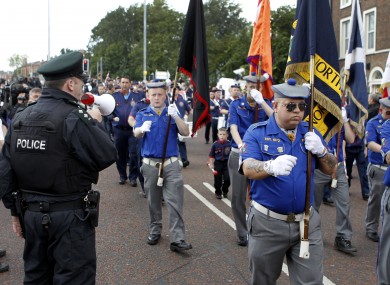
So on Saturday the loyalist flute band at the centre of events marched as normal and played the normal sectarian tunes that are the staple of these ‘kick the pope’ bands, as did many of the rest. The normal sectarian insults were hurled, which are surprising only to those terminally stupid or naive.   The police did nothing that anyone could notice to prevent this.  Well, not exactly nothing: there is a picture of one policeman using a loudhailer to tell the passing bands that they were really not allowed to do what they were doing.  This robust action will no doubt be followed by the police warning burglars by megaphone that they are breaking the law when they are seen to break into someone else’s house in broad daylight. Through the Police Federation the police later complained of being caught in the crossfire, presumably between those intent on breaking the law and those who were, well, how shall we say it, wanting it upheld?

There were minor scuffles and one apparent loyalist from Scotland was arrested for running through a nationalist protest, although this was blamed by one unionist politician on a republican.

So we have a loyalist coat-trailing exercise in bigotry, defended by the most senior unionist politicians who warn of violence, which stokes up the adrenaline of the street level bigot but allows the unionist politician to deny any responsibility when the lighted match touches the blue touch paper.  The police wring their hands and the nationalist politicians talk about getting it all sorted out through talking.  You have to be very, very young not be aware that this record has been played a thousand times before.  So what’s new then?

Well what is new is supposed to be – everything!  We have a new peace process, a new political settlement, a new Government and a new coalition between the “two sides”.  Belfast has a new skyline with lots of new visitor attractions welcoming tourists, which is still a relatively new concept to Belfast.  We have new cafes and restaurants and art galleries and a new generation too young to remember ‘the troubles’ and which just wants to live in peace and has no time for this sectarian stuff.

But we have been here before.  Belfast in the 1960s was also a ‘happening’ city with a burgeoning night-life whose young generation was hailed as no longer interested in the sectarianism of the past.  The sixties brought new life, hope and light even to Belfast and not just the streets of London or San Francisco.  New housing was being created that was demolishing the slums that had no inside toilet and entries that doubled as permanent rubbish tips.  Some of this new corporation housing promised mixed estates and a new Unity Flats was built at the bottom of the Shankill Road only a couple of hundred yards, if that, from St. Patrick’s church.  Unity Flats was so called because it was to contain both Protestant and Catholic tenants, sharing the one space in harmony.

We all know, or at least have some vague idea, what happened at the end of the sixties.  That swinging decade that even moved in Belfast was very new and modern but Belfast was incapable of accepting civil rights, including fair allocation of housing and jobs and equal voting rights.  Instead it burst into violence, with Orange parades which were hyped up by unionist politicians and a police force that could not subject violent bigots to the normal restrictions of the ordinary law.  Of course this violent explosion hasn’t happened yet and in my view isn’t going to happen, not yet at least.

The mutual exhaustion of the contending political forces has not yet ended and been reversed.  The unionist leaders are attempting to exert pressure that might eventually usher in their preferred model of unionist-only rule but they are not in a position to force a confrontation that would see the British Government accede to their demands. It is not impossible that a violent eruption might occur that goes beyond unionist plans but it needs a realistic objective and the aim of getting Sinn Fein out of government has not yet become the unifying campaign theme within unionism and loyalist organisations that is required.

Instead the provocative and vitriolic sectarianism endorsed by unionist politicians in the highest offices of the Stormont administration erodes the faith of nationalists in the new deal. The approach of Sinn Fein to the recent events has been relatively muted and resembles nothing so much as the old SDLP approach which so many nationalists rejected by supporting the old (republican) Sinn Fein.  Here too however there is no unified project beyond staying in office and doing nothing to jeopardise the electoral prospects of Sinn Fein in the South.

The real republicans can attempt to take advantage of the disillusionment with the Sinn Fein reaction to the sectarian provocation and can build up their support base but what is their political project?  In so far as it simply involves a renewed armed campaign it only strengthens the ideological hold of the peace process even while more and more people, subconsciously at first, begin to wonder when exactly this process, like every other, is going to end.  The traditional republican policy isn’t credible except as a form of protest but outside of an overarching strategy this republicanism isn’t in a position yet to mobilise a large political opposition.

A large scale sectarian provocation might accelerate these trends and the planned large loyalist parade on 29 September past the same church certainly has the potential to be such a provocation.  It might at the least drive home the lessons of last Saturday if it goes ahead as the parade did then.

The condemnation by two Protestant church leaders of the sectarian behaviour of the loyalist bands shows how vulnerable the loyalists are to criticism.  It is their solutions and that of the Catholic Church that is the problem.  They both want to set the rulings of the Parades Commission as inviolable.  The Catholic Church is worse because it calls for special measures to apply when the parades pass a place of worship conveniently setting themselves up as victim, potentially privileged  protection in future while turning a blind eye to the fact that a sectarian march is a sectarian march no matter where it passes. Its vitriolic bigotry is no more acceptable a hundred yards from a church than right in front of it.

What is needed is an anti-sectarian campaign that is unafraid to name sectarianism when it sees it and is not seduced by the siren calls for equality of traditions, including mutual respect for each other’s culture.  There can be no equality for a tradition based on sectarian supremacy or respect for a culture soaked in bigotry.  Such a campaign would target not just loyalist parades but the sectarian policy creeping into housing policy and the recent discriminatory employment practices of Sinn Fein.  It would challenge the trade unions to take a principled stand and, at least in principle, should be capable of uniting much of the small left. The ULA could take the lead on this in the South by making it an issue on the floor of the Dail as the clarion call for an all-island campaign.  To do otherwise is to turn one’s back on sectarianism while claiming this as the means of opposing it.

The main task would be to rip away the protection of the current sectarian arrangements that are more and more revealing their true colours by refusing to subordinate anti-sectarianism to the demands of the peace process, however this is defined.  What sort of peace is it that allows, even sanctions, the displays of sectarian bigotry on display in Donegall Street on Saturday?