Why have the Irish not Revolted? Part III

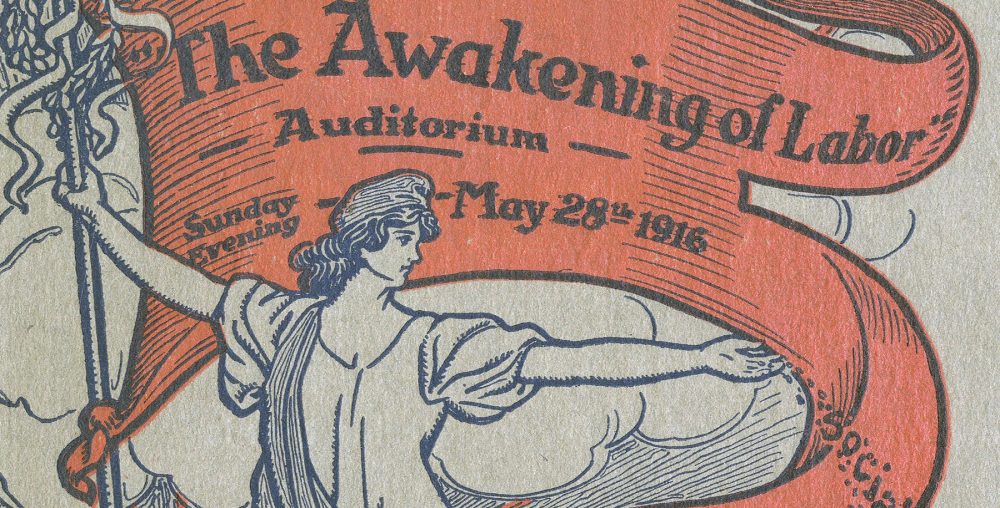
1913_LOCKOUT_ADVERT-1

The weakness of Irish workers resistance to austerity cannot be explained as a supposed result of this austerity having less effect than in other countries.  We have just witnessed the eighth austerity budget, the previous seven having cumulatively accounted for 17 per cent of current Gross Domestic Product.

The budget deficit in 2013 is higher than that of Spain, Portugal or Greece; there is at least another austerity budget pencilled in and the State debt is continuing to rise.  Next to nothing of the debt taken on in order to bail out the banks has been paid back and these banks are still saddled with mortgage customers who can’t pay their loans back.  Were the much trumpeted rebound of the property market to be anything substantial the banks would be repossessing and selling the vacated properties.  They’re not.

In other words the crisis isn’t over and neither is austerity, although faint hope that it is coming to an end plays one part in explaining latterly the weakness of protest and resistance.

The answer to the problem lies in the weakness of the Irish working class itself.  For Marx capitalism, in creating the working class, created its grave digger.  The nature of a particular capitalism goes a long way to explaining the nature of a particular working class and the weakness of the Irish working class is a reflection of the weakness of Irish capitalism.

An objection might be made to this that the Russian working class was the most ideologically advanced working class a century ago while Russian capitalism was weak. On the other hand capitalism in the United States has been the most advanced for a century or more but its working class is a byword for exceptional weakness.

The uneven and combined development of both societies has gone a long way to explaining this apparent anomaly and it is beyond the scope of this post to compare and contrast the development of the US and Russian socialist movements.  Over 100 years ago Karl Kautsky wrote on this question in ‘The American Worker’, relatively recently republished as part of a symposium in the journal ‘Historical Materialism’.

What we can say here in respect of Ireland is that its uneven historical development both inside the country, and as a region within the wider British economy, mainly as a reserve of agricultural production and labour power, has accounted for its historical weakness.

I was reminded of this nearly a year ago when I received a United Left Alliance (ULA) email newsletter what presented a series of proposed meetings to be organised by the ULA against austerity.  These meetings were to deal with different aspects of the issue such as the economy, health services etc.  In Russia a noteworthy feature of political and intellectual life a hundred years ago was the strength, vibrancy and hegemony of Marxism such that it dominated even the thinking of Russian liberals.

How different a situation from Ireland!  The speakers proposed for the ULA list of meetings demonstrated the reverse – the domination of Irish socialism by liberalism.  We can see this in everything from the Left’s opportunist search for unity with organisations that are far from working class in political character, from the Greens to Sinn Fein and populist independents, to their Keynesian economic alternative that relies on the goodness of the liberal capitalist state –taxing the rich and nationalising industry.

This of course feeds into the mis-education of workers who, while they may not reject the ULA’s state-reformism from a revolutionary perspective, have a healthy distrust of the really existing bureaucratic state they know.  And they have a healthy scepticism that this state will create a new economy and tax the rich when the most widespread view of politics and government is that the politicians and the state mandarins are only in it for themselves.

Acquaintance with the occupational training by FÁS and the decades-long state attitude to tax dodging by the elite has convinced workers that the state is rotten; a source of corruption, incompetence and of patronage which moves according to who you know or who you can lobby or to whom you can provide supplication.  Meanwhile Irish liberals bemoan the population’s lack of civic virtue and the Left feeds it nonsense about the capitalist state as the solution to austerity and poverty.

Lack of a response to austerity is in small part a result of this but more significantly a long result of Irish economic development and the working class and its movement, which it has produced.  The weakness of the working class movement is therefore of long vintage in Ireland.  The outstanding figure of Connolly, who remains a giant of working class history, and the courage of the 1913 lock-out, are today appropriated by the bureaucrats of ICTU and the Labour Party wielders of the austerity knife.  Where is the movement that can legitimately claim this heritage?

Connolly and 1913 shine so brightly because the working class movement has for most of Irish history been subordinated to other forces.  While capitalist relations developed early in Ireland and industrialisation grew beside that in Britain it was much reduced by its greater development in the latter so that by and large it became limited to the north-east of the country.  There a relatively compact and developed working class developed but the fatal disease affecting it has long been known.  It could therefore play no wider progressive leadership role for the rest of the country

There the creation of a reserve of agricultural production for Britain created the conditions for the famine in the middle of the 19th century that devastated the country and led to reactionary social and political consequences everywhere.

First were the direct effects of death and emigration which robbed the country of a growing domestic market on which capitalist production could grow.

Then there was its effect on the land question that provided the social basis of Irish nationalism but which, because of the famine and its effects, including emigration, could be solved without a wider popular alliance of forces that included the working class.  The Irish nationalist movement was thus alternately dominated by reactionary bourgeois forces heavily influenced by the Catholic Church or a republican tradition that had its most democratic leadership in the United Irishmen ripped from it at the end of the 18th century through severe repression and sectarianism.  Republicanism became a petty bourgeois movement largely indifferent if not hostile to working class politics when at its strongest.

It did develop a wing which looked at the working class as ‘the men of no property’ but only so that they would help win national freedom.  This grew into a socialist republican tradition but this has also looked to the working class as the force for national freedom.  Where in other countries the socialist movement has grown through leading a fight for democracy, in Ireland this has never happened.  The left wing of the democratic movement has on the other hand appropriated radicalism that might in different circumstances have flowed into the working class movement.

Instead of a socialist movement that has taken on board the tasks highlighted by republicanism we have had a republican movement with left wing views tagged on but which has more often than not simply not understood what a socialist programme is, although sadly they are not alone in this.  Thus left wing opinions have abounded in this part of the republican movement but opinions have substituted for programme.  Marxism, genuine Marxism, and not its bastard imitation Stalinism, has been almost non-existent.  So many of the most radical spirits in Ireland have left the country or been absorbed in the dead end of republican politics.

The famine also resulted in the growth of the enormous power of the Catholic Church.  It is commonplace to at least partly account for the weakness of the working class movement in Ireland by pointing to the sectarian division of the class.  This division was hardened and strengthened tremendously by partition, creating an additional divide between workers in the North and those in the South, on top of the religious divide.

What is more and more apparent however is not simply the effects of the division itself, in preventing unity across state jurisdictions or in spite of sectarian identification, but the paralysing influence of the resulting political forces within the separate parts of the working class.

Sectarian division allowed the Catholic Church to engage in social repression involving sexual abuse, censorship and imposition of a reactionary ideological environment that was consciously and vehemently anti-socialist.  The more that is learned about this repression the more its class aspects become apparent.

The extreme reactionary monarchist ideology is perhaps less important in the North among some Protestant workers than the sheer ideology of division itself, i.e. sectarianism.

The strength of both Catholic and Orange movements have in no small part been due to the creation of the two states issuing from the division of the country.  Again and again even today we see the state protect the most reactionary elements in society both North and South – the Northern state facilitate loyalist paramilitaries and the Southern State finance the organisations found guilty of systematic child abuse.

National oppression has prevented the Irish working class from being an organic part of the growth of the British working class movement which means it has never availed of its strengths while it has on the other hand imported and copied all its weaknesses, including economism and trade union type politics.

Upon this weakness of the working class has been built its political subordination; its domination in the South until recently by the bourgeois Fianna Fail and its saturation by sectarian politics in the North.  Without a strong socialist tradition the periodic shifts away from the traditional parties can go in almost any direction.

In the last election the Left captured the vote of a small bit of this but the apolitical and clientelistic character of Irish politics affects the Left.  This and the state-centred nature of its politics is the basis for the chronic sectarianism that has shattered the alliance the Left had formed.

As Marx said the growth of sectarianism is in inverse proportion to the development of the class as a whole and the weakness of the class is the fertile ground on which the narrow and blinkered outlook of much of the Left has been established.

So what we have had is an historically weak working class.  During the key episode of political struggle around and after the First World War it was subordinated and subordinated itself to bourgeois nationalist or sectarian forces.  The victory of the most reactionary of these forces combined with retarded economic development prevented the growth of a strong working class movement thereafter. The Irish state did not participate in the Second World War so its working class missed out in the radicalisation that accompanied it in many countries.

Marx however called capitalism a revolutionary mode of production that continually creates and recreates the working class.  While this historic political weakness weighs on today’s generations the system throws up new industries, new work relations, new circumstances enabling economic growth and new forms of working class development.  The historical development of the Irish working class during the 19th and much of the twentieth centuries cannot explain the current lack of combativity of the Irish working class because this combativity is capable of being changed and transformed.

The Irish working class continued to develop after the Second World War but this subsequent development did not create a break from its historic political weakness and to the extent it has not done so the weight of history continues to oppress.

 

Why have the Irish not revolted? Part II

imagesausterityIn my first post I qualified the view that there was something particularly weak in the resistance of Irish workers to austerity but argued that nevertheless an explanation is needed.  To develop this further we need to ask what this austerity has involved.

Some commentators would have a ready explanation.  In terms of the share of taxation in Gross Domestic Product (GDP), in terms of the share of Government spending in GDP and overall deficit as a percentage of annual value added there has not been ‘savage austerity’ so there has been nothing to rebel against.

Here unfortunately we have no choice but to enter the world of economic statistics where only the naive can expect clear objectivity and accuracy.

A post on the Irish Economy blog records that (adjusting the statistics for the well-known effect of foreign multinationals in the Irish State significantly overstating economic performance) living standards measured in GDP per person (in Purchasing Power Parity values) declined by 14 per cent from 2007 to 2011.  This is a bigger decline in living standards than in Portugal where the fall was only 1.6 per cent, in Spain where it was 4.9 per cent and Greece where it was 8 per cent.  In terms of national income (another measure) the drop was bigger – 20 per cent – and it will have fallen further since then.  It would appear that the relative quiescence of Irish workers needs additional explaining.

But does it?

Any Irish statistic that uses GDP is immediately suspect for the reason above but not only because of this.  GDP is a measure of value added which means the 2007 figure will include property produced at vastly over-inflated values.  Houses and offices built and priced at one value will have been shown subsequently to have been worth 50, 60 or 70 per cent less, or sometimes to be completely worthless.  A moment’s thought reveals that this is not a characteristic simply of Irish statistics but of measures of capitalist production everywhere.

When we think of the effects of the banking industry on measures of economic growth we again see that this measure is seriously distorting, not only because of the difficulties of capturing accurately what is happening, but because of the nature of capitalist production.  This takes place through the production of commodities whose real value is only realised after production. The value of these commodities is elaborated through the workings of the market which reveals the socially necessary value of output in a cyclical fashion.

For economists wedded to capitalism recessions are always the result of exogenous shocks outside the system or of purely irrational behaviour within it, which amount to the same thing.  For Marxists the cycle of boom and bust is how the values of commodities are established and then re-established in a constant process.  By nature therefore there can be no precise measure of value produced at any one point in time or over any one period.

In figures for GDP the distinction between use value and exchange value is absent never mind any accounting for how really ‘socially useful’ the use values produced are – ghost estates and weapons compared to commodities actually consumed by workers. This is to be considered on top of the well-known criticisms of measuring living standards by GDP.

There are alternative measures we can review but before we leave behind this discussion we should appreciate that what we have been looking at is not simple mismeasurement of economic activity but one form of the appearance of real contradictions within the system.

From the point of view of our particular investigation we can make two points.  That a critical review of some of the figures means the boom was not as boomier (to quote Bertie Ahern) as some statistics might appear to show and the recession not as sudden and complete a reversal as might first appear.  The expectation of more or less immediate revolt might therefore be less justified?  Other evidence however might suggest that such a view should be considered a relatively minor factor.

Secondly, the constant reporting of such economic statistics plays an ideological role such that workers must accept real changes to their lives on the basis of these statistics.  Workers are subject to such pressures not just in the recession but also in the boom – encouraged to get into unsustainable debt for example.  To the extent that they do the latter they are then under ideological assault to accept that they, along with everyone else, ‘partied’ and went on a ‘mad borrowing’ frenzy, as Taoiseach Enda Kenny has put it.

Some commentators might argue that a recognition of ‘guilt’ has played a role in short-circuiting resistance but the existence of such undoubted views is as much a result of demoralisation as a cause of the lack of resistance.

There are other statistics we can look at to see if there are material reasons for the lack of opposition apart from this particular ideological one.

What appears a more relevant statistic is called Actual Individual Consumption which encompasses goods and services consumed by households including government services such as education and health provision.  This would appear to show that between 2008 and 2011 living standards in the Irish State fell more than in Spain and in Portugal but less than in Greece or Iceland.

Actual Individual Consumption

State

2008 index

2011 index

Percentage fall

Ireland

109

100

8.3

Spain

99

94

5.1

Greece

104

94

9.6

Portugal

84

82

2.4

UK

123

118

4.1

Iceland

122

107

12.3


This measure is made up of a component of GDP so is subject to some of the criticism above.  We have already seen that three different measurements of living standards result in reductions in living standards of 20 per cent, 14 per cent and over 8 per cent, depending on dates and the measurement adopted.

What we can say with certainty is that living standards fell abruptly and significantly due to the crisis and it is not obvious that the severity of the fall in any country determined the relative extent of opposition to austerity.  It is necessary before drawing any conclusions to look at what might be at least some of the components of the fall in living standards, not by any means only a result of the effects of Government austerity policies.

By one measure unemployment in the Irish State increased from 3.4 per cent in 2007 to 10.4 per cent in 2012, a tripling of the rate in only five years.  The economically inactive, which must contain many who have given up hope of getting a job, increased from 27.5 per cent of the population aged 15 to 64 to 30.8 per cent.

Using a different measurement unemployment in the Irish state was 13.5 per cent in January 2013 compared to 17.8 per cent in Portugal, 26.8 per cent in Spain and 27 per cent in Greece.  Clearly the crisis has hit the latter countries much harder than Ireland.  It is by no means clear that higher unemployment breeds resistance since its function under capitalism is to facilitate increased exploitation of the working class.  The mobilisation of the unemployed is not always for progressive reasons, which is one reason we have noted before that economic crises often breed reactionary movements.

Once unemployed some workers face the prospect of hardship and one measure of this defined as deprivation, or being without two or more basic items, has increased from 11.8 per cent of the population to 24.5 per cent in 2012.  The possibility of this is affected by the level of welfare an unemployed personmight rely upon and this is measured by the net replacement rate, or the payments due to the unemployed as a percentage of previous net income.  This obviously depends on whether the person has children or is married etc.

Net Replacement rates 2011


No children

2 children

Country Single person One earner

Married couple

Two-earner Married couple Lone Parent One-earner married couple Two-earner married couple
Republic of Ireland 50 81 75 64 75 81
Greece 49 54 75 58 63 80
Spain 79 76 90 77 75 89
Portugal 75 75 92 77 76 91


The table shows that Greece has significantly lower replacement rates than the other selected countries for most categories but that the Irish state’s is generally lower than Spain’s and Portugal’s.  It would not appear that the prospect of a more significant loss of income as a result of unemployment has spurred opposition in Ireland relative to that in Spain or Portugal.

The other obvious way workers cope with periods of unemployment is falling back on any savings that they have accumulated.  The following table shows the movement in net financial assets per person (€) in the various countries:

Country

2007

2011

Republic of Ireland

23,634

26,279

Spain

21,698

16,328

Portugal

19,950

19,750

Greece

19,681

10,105

Euro area (17 countries)

37,289

36,201


The table shows the Irish State to have the highest level of financial assets (though much below the Euro area average) and that this even increased between 2007 and 2011!  Since these figures say nothing about the unequal distribution of wealth and we know that many have suffered unemployment, cuts in wages or tax increases, it is clear that certain sections of Irish society are bearing up quite well.  In the other countries financial wealth fell and in Spain, but particularly in Greece, fell quite dramatically.

Such average figures hide as much as they reveal.  Average household disposable income in the Irish state fell from €49,043 in 2008 to €41,819 in 2011 but this was still significantly higher than in 2004 when it was €38,631.  Right wing commentators have often made the observation that incomes have often just gone back to such and such a date and we are all much better off than before the boom kicked off in the first half of the 1990s.  This is undoubtedly true for many but doesn’t provide an answer why as a class Irish workers have resisted austerity so weakly, unless the argument is that expectations have very quickly reduced.  Is this however another result of defeat or a contributing factor to it, or both?

Averages can obscure because it is precisely the unequal incidence of the effects of capitalist crisis that can have decisive political effects.

Unemployment has increased dramatically but its incidence is not uniform.  Employment in construction has collapsed, from 258,000 at the start of 2008 to 102,000 at the end of 2012, a fall of over 60 per cent.  Over the same period employment in the state sector fell from 417,000 to 381,000, a fall of 8.6 per cent.  The pitting of private sector workers against those in the public sector was a clear strategy of the Government, the employers and the media and it was quite successful.

But this has not been the only divisive effect of the crisis.  Rates of unemployment among young people in Ireland, just like other countries, have been much higher than the general rate.  In the Irish state the rate of unemployment among those less than 25 years old was 26.6 per cent in April this year while it was 42.5 per cent in Portugal, 56.4 per cent in Spain and 62.5 per cent in Greece.  These are truly staggering figures.  The rate of long term unemployment has increased from 29.2 per cent of total unemployment at the start of 2007 to 45.5 per cent at the end of 2012.  What this should remind us, is that unemployment is a divisive imposition of the effects of capitalist crisis that impacts not only on those without a job but also those in employment.  Emigration has returned and is continuing to increase, up from 87,100 in the year to April 2012 to 89,000 in the year to April 2013.

None of these figures illustrates the hardship caused by tax increases and public expenditure cuts that can affect the most vulnerable the most.  They do not include the effects on people’s experience of negative equity, the full effects of which have yet to hit home.  Here again it is younger people who are more likely to be in negative equity and to be in arrears in their mortgage payments.  And of course the figures do not tell us that the results of the crisis and austerity are to be here for a long time.

Over 32 people were unemployed for each job vacancy in 2012, while the figures for Spain and Portugal were 72.6 and 90.4 respectively.  The General Government Debt as a percentage of GDP was 117.6 per cent in 2012 while the 2012 EU Fiscal Compact stipulates that where this is above 60 per cent it must reduce by 1/20th per year.  In 2012 the in-year Government deficit was 7.5 per cent which means the debt was not getting smaller but getting bigger.  Normally optimistic forecasters are predicting that unemployment, as measured by the International Labour Organisation methodology, was only to reduce from 14.7 per cent in 2012 to 13.9 per cent in 2014.

So what are we to make of all these figures?

The fall in living standards has been significant even if not so sudden or large for some sectors of society as others and not on the same scale as some other countries such as Greece.  Certainly the disproportionate effects on young people and rise in emigration have blunted resistance but these factors exist on the same or greater scale in some other countries in Southern Europe where resistance has been greater.

It is not therefore the effects of the crisis themselves that explain the response even if these act to weaken certain social and political reactions.  The left wing economist Michael Taft has claimed that the ‘squeezed middle’, the 4th to 8th deciles of income earners, suffered declines in direct income in the five years leading up to the crash, gaining only as a result of social transfers.

During the boom the level of trade union organisation fell relatively as union density dropped from 46 per cent of the workforce in 1994 to less than a third in 2007, and only 16 per cent in the private sector.

Thus even during the most favourable circumstances, when workers are best placed to protect and advance their living standards, they were unable to do so with their own strength.  During recession such weakness is exposed.

Now they are subject to the vicious laws of the capitalist market and, as we said in the first post, short of overturning the system there is a limited amount workers can do about this without challenging the system itself.

During this post I have said that workers have not resisted austerity but in truth the great mass of unemployment, insecurity caused by mortgage arrears and negative equity, and the drop in personal consumption are not so much the result of the austerity policies of the Government, which of course have made things worse, but of the capitalist crisis.  This crisis can in certain circumstances be postponed or ameliorated by the State but it cannot be suppressed and certainly not by a State in bankruptcy.

When even during the boom large number of workers dependency on this state increased rather reduced and rather than their developing their own independent power, it can be little surprise that when the state turns round and kicks them in the teeth they are unprepared.

Some socialists argued again and again during the boom that social partnership, the vehicle by which the Irish trade unions hitched themselves to the State, was to be opposed not mainly because it prevented workers making gains in their living standards that they should but because it rotted away their independent organisation.  This has not just organisational consequences but political and ideological ones and it is to these that I need to look at next.

Why have the Irish not revolted?

Public-service-workers-st-006The defeat of the opposition to the property tax and the ability of the Government to impose a second Croke Park austerity deal might lead many to conclude that resistance to austerity has been defeated.  Even before this many have commented that while Greece has witnessed violent protests and numerous general strikes the absence of such events from Ireland is notable and remarkable.  General strikes have also taken place in Spain and Portugal but not in the Irish State.

The relative electoral success of the United Left Alliance appeared to blind some to this but the collapse of the ULA has simply confirmed what is more generally understood to be the case.  More and more it is acknowledged on the Left that we have to face the reality as opposed to perennial false claims that an upsurge is taking place or is just around the corner.

Realistic assessments of the state of workers’ action have often been drowned out by childish claims that this shows one is insufficiently revolutionary, underestimates the workers , their ability to change their ideas quickly or that such views will not encourage workers to take action.  Not in front of the children appears to be the motto.  Workers are always ‘angry’ and all it needs is the right campaign, so long as it is active enough, to stir them into action.

Reality is imposing itself and no sound bites along the lines of ‘the darkest hour is just before dawn’ can hide the fact that the economic crisis has resulted in the imposition of austerity on workers without effective resistance.  Why is this?

First we must qualify the judgement that Irish workers are peculiarly useless.  Commentators have remarked in similar terms about the countries in southern Europe.  We have noted before that more or less spontaneous social explosions have not resulted in great advances by the working class.  Greek workers have been by far the most combative in terms of general strike action but in hardly anywhere has living standards plummeted so much.  I have also noted in one of my first posts that economic crises spurs growth in extreme reactionary forces and we have seen this is in Greece with the rise of the Golden Dawn movement.  So Greece is no model to seek to copy.

Secondly Irish workers have fought back albeit within very strict limits.  I can still remember the very large demonstration in November 2009 in Dublin, which had many working class people from outside the ranks of the trade unions taking part.  The following year public sector trade unions organised a successful strike.  At a local level in certain places and at certain times strong campaigns have developed against tax increases or hospital closures.  All this and more was reflected in the vote for ULA.

There is however an over-estimation about what workers can achieve within the limits of the capitalist system – a general misconception that workers’ struggles can overturn the laws of capitalism.    For example, if a company goes bust and attempts to close down, making all its workers redundant, it is pretty obvious that strike action will not achieve very much.

At this point many on the left propose that the capitalist state protect workers even though these same people have a part of their brain that tells them that the state is a weapon of the capitalist class that cannot be reformed and must be smashed.  They also believe that the emancipation of the working class must be achieved by workers themselves but usually object to the idea that, instead of the state, the workers should take over and own and run these workplaces as workers cooperatives.

It is a similar situation at the level of society as a whole and at an international level.  The Irish state was and still is bankrupt.  It needed a massive injection of money to save the banks and put itself in a position to start reducing its mushrooming debt.  Austerity is a means of doing this.  Again the Left argues that the state can adopt policies of taxing the rich and spending money on investment that will restore the capitalist economy to economic growth, which will then deal with the problem of the debt.

This is not however the view of socialists.  The socialist view, confirmed once again by recent events, is that capitalism inescapably produces economic crises which are dealt with and resolved by the laws by which the system works, including through unemployment and destruction of unsuccessful capital whose markets and sometimes businesses are picked up on the cheap by those remaining.  It is not possible for the capitalist system to prevent such crises by adopting policies of more investment, as for example argued by left followers of Keynes.

It is not therefore possible for workers no matter how well organised to prevent the laws of capitalism from working.  This at least was the view of Marx and the evidence of history would again confirm this.  So workers resistance against austerity may be able to ameliorate austerity but, in so far as they are necessary to lay the foundations of a new upturn, it is not possible for workers to prevent unemployment or wage cuts or tax increases in their entirety or even to a significant degree.  In other words it is not possible within the system to prevent capitalism periodically disrupting workers’ lives.  That’s why we oppose the system and why we propose a different one called socialism.  If we thought capitalism could work better without its nasty effects we wouldn’t be socialists would we?

Yet the left presents austerity as simply one policy option of the Government which it could choose to reject and replace with their own proposals.  But even the Keynesian alternative requires ‘counter cyclical’ state action.  In other words the austerity measures are simply postponed.  All the left’s proposals involve actions by the capitalist state in one way or another – tax changes, public investment, nationalisation etc.

The point in terms of the current argument is not that the Left is misleading workers into accepting reformist solutions that won’t work and this is a reason why resistance to austerity has been such a failure in Ireland.  These ideas are more widespread in southern Europe than they are here.  No, the issue is that, absent a socialist alternative being created, as long as capitalism exists the laws of capitalism will continue to work and impose themselves.  Resistance to austerity will therefore fail and this failure is bound in turn to lead to weakening of the resistance.

We must be careful however not to qualify the problem out of existence when it contains more than a grain of truth.  When Greek workers chanted “we are not Irish” on their May Day demonstration in Athens in 2010 they weren’t imagining the relative weakness of resistance in Ireland.

Nor can the question be dismissed by saying Irish workers did fight back – they did, but nowhere near to the extent required for success.

Nor is it credible to blame the poor politics or organisation of the Irish Left.

It is also not adequate to simply say that capitalism wins unless we create socialism. This is obviously true, although its logical implications for reformist strategies and policies are often ignored.  But it doesn’t come near explaining why the reformist strategies for resistance have elicited such weak workers’ action.  It’s hardly that Irish workers can see through such strategies and are ready for something more radical.

Socialism is not an event or a situation but a movement. Workers will only become capable of building a socialist movement and carrying out revolutionary change if they are also capable of mounting strong resistance to the ravages of capitalism.  In Ireland this hasn’t happened and there has been a retrogression of the small socialist movement, although this in itself is not particularly new.

So in Ireland the state has been able to pursue austerity policies that increase unemployment and wage restraint in order to restore its solvency in very much the same way capitalist crises work to   restore profitability in the private sector.  It has been able to do so without much of the resistance shown in other countries in a very similar situation.  This remains to be explained.

To be continued.

A new Left electoral campaign in Limerick

600802_517707581597926_1373887597_n

The Revolutionary Programme web site altered me recently to the latest electoral initiative of the Left – here.  The programme of this initiative is the following:

  • No to the Property, Water & Septic Tank Taxes – No to Deduction at Source.
  • No to all Austerity – ordinary people have paid enough.
  • For a united movement of ordinary people affected by home taxes and austerity – no to divisions based on race or nationality.
  • Tax the Wealthy as the alternative to austerity: For progressive taxation on the wealthy and corporate sector.
  • End the bailouts of banks and bondholders, instead use the money to create real jobs through a programme of necessary public works.
  • Our candidates if elected would:
    Fight against plans for Water Metering, Water Taxes and Water Privatisation.
    Oppose all cuts in council services or erosion of workers conditions.
    Make no deals on the Council with the austerity Parties (FF, FG, LP).
    Oppose the gravy train – no participation in junkets. Demand local planning for the community, not for developers or vested interests.

What attitude should Marxists take to this electoral initiative?

Just like every other party standing in an election it must surely be judged by what it says – by its professed programme or set of policies, providing of course these are also what it truly represents.

Can and should it be supported?

The electoral slate is clearly not a party and was organised by the Campaign Against Property Tax and Austerity but the logic of standing in an election is to act like a party and even more so if elected.  The failure of the Unite Left Alliance to do so has led to its demise.

The policies above are no way different from that of the ULA, except more limited.  The Left has argued over the last number of years that elections and those elected are there to advance ‘real’ struggles outside of parliament and council chambers.  The last few years have demonstrated conclusively however that it is the other way round – struggles in communities and estates have been means to advance electoral ambitions.  Electoralism is a dirty word on the Left but nothing would appear to describe the method of organising so accurately.

This initiative, the promised first of many, must be judged firstly on its own terms.

The short summary of its aims says it is against austerity and the various taxes that have made up a large part of this agenda.  The anti-property tax has failed so it will have to be explained how standing in elections will bring success.  Otherwise voters are being asked to vote for good intentions.  Councils can clearly not change the policy of central government so how will the taxes and austerity more generally be blocked and reversed?  No concrete and practical way forward is put forward.  Maybe it will be, but if it isn’t then it is purely propaganda.

If the reason for standing is to build the campaign this should be the main point of the programme but even here it should be explained how the campaign will achieve its aims.  Is, or rather was, a mass boycott a road forward given deduction at source?  If not what is the alternative – a mass political campaign aimed at persuading tax workers to refuse implementation of the tax?

What role is there for councils?  Are enough candidates standing to win a majority?  If so what would they do with such a majority?  Can they unite with other similarly minded councils to campaign against the tax?  What powers do councils have to frustrate or prevent this tax or austerity?  Will the new council promote workers control or ownership of council services?  What other steps will it take to promote the democratisation of local government?

If there is no possibility of winning a majority then what role would those elected take?  Will they release all information currently withheld on council activities?  How will they frustrate the local implementation of austerity?

If these questions aren’t put to the fore then, as I’ve said, what we are seeing is purely propaganda.  This does not mean that this aspect should be underestimated.  Even in periods of limited struggle, in fact particularly in such periods, the task of socialists is to try to educate as many workers as possible through propaganda.  Given the very small size of the socialist movement in Ireland this is by far and away its biggest task.  If it doesn’t get this right then the majority of what it is capable of doing is wasted if not positively harmful.

The thrust of the programme appears to be anti-austerity with the alternative being taxation of the wealthy – “for progressive taxation on the wealthy and corporate sector.”  It is also proposed to “End the bailouts of banks and bondholders, instead use the money to create real jobs through a programme of necessary public works.”

I have shown what is wrong with the idea you can tax the wealthy here and here so I won’t repeat my arguments again in this post.  The main problem is that it is not the wealth or high incomes of the rich that are the cause of austerity so even if it were possible to tax both effectively the cause of austerity would persist.  This cause is the economic crisis.  Because the economic system is a capitalist one the elementary task of a manifesto would be to state this and explain it.  Explain exactly how the way the capitalist system works has given rise to this crisis and will create more in future. This would be necessary in order to argue that the alternative to austerity from a working class point of view is socialism.  Explaining what this is would involve is an obvious next step – expropriation of capitalist ownership and workers ownership in its place and a workers’ state in place of the existing state.

Complaining that the programme does not mention socialism is not the problem since the programme is not a socialist one.  If this is the way it is then it is better that it does not claim to be socialist.

The programme proposes ending the bailouts of banks but does not explain how this might be done, the consequences or the alternatives.  Some of these issues are touched upon here, here and here.  How is the debt to be repudiated?  What debt is to be repudiated? How would credit be provided if the banks were allowed to fail?

Anyone who begins to think seriously about what “ending the bailouts” means will have these questions in their head and without an answer they will be open to accepting right wing claims that such proposals are not thought through , cannot be implemented or would be even more disastrous than what we already have.  Dealing with such claims is the important task of propaganda and at this point in time elections are useful means of getting across the message.

In the absence of all this the message put across is a radical Keynesian one, that is a capitalist one.  One that is temporarily more beneficial to working people but one, if followed,that would lead to inflation, wage cuts, unemployment, and calls for reducing budget deficits and tax increases later on.  That’s if it worked in the meantime!

From a political point of view therefore the programme does not assert separate working class politics but, in so far as it puts forward an alternative, puts forward the benign actions of the capitalist state as the solution.  It therefore doesn’t even get to first base in terms of a socialist alternative.  It may therefore be reformist but it isn’t working class reformism because it seems to rely solely on pressurising the state.

In terms of the reformist/revolutionary dichotomy it isn’t even the former since it lacks the courage of its convictions and fails to propose a Left Government for the Dail that could tax the rich and the corporations; burn the bondholders and use the money to create jobs in the public (read – capitalist state) sector.

A socialist programme would explain that fighting austerity is required to defend our living conditions but that this will ultimately fail unless the system is replaced.  Austerity can at best be ameliorated but such is the depth of the crisis it cannot be entirely halted and reversed under the present economic system.

Some will deny this and claim that austerity can be ended without changing the system; that the rich can be made to pay for their crisis and that policies of growth will ensure that this can happen.

On the other side will be those who will claim that austerity is an inevitable result of an economic crisis, which is caused by the capitalist system in its attempts to produce and accumulate capital beyond the conditions that allow it reproduce itself harmoniously.  The excessive expansion of credit is always a feature of capitalist crisis and the bigger the boom the bigger the bust, unless even more credit is injected into the economy in which case the bigger the boom  . . . No amount of regulation or honest government can prevent this without seriously gumming up the capitalist system, in which case you simply have a different sort of crisis with very much the same symptoms of unemployment etc.

On the first side of this debate will be the liberal defenders of Keynes, including their economists and leaders of the trade unions.  On the second, socialists, who can only consistently defend their ideas by understanding and presenting the arguments of Karl Marx, which is the reason Marx wrote ‘Capital’.

A recent post on the Michael Roberts blog has a couple of interesting points to make about these arguments.

He points to research showing that inequality of income reduced between 1910 and 1950 across the OECD (most advanced) countries, which calls into question the idea that capitalist crisis is a result of inequality that progressive taxation could cure.  This period, after all, covers the great depression of the 1930s.

He points to other research that:

“Credit booms mostly lead to financial crises, but inequality does not necessarily lead to credit booms. “Our paper looks for empirical evidence for the recent Kumhof/Rancière hypothesis attributing the US subprime mortgage crisis to rising inequality, redistributive government housing policy and a credit boom. Using data from a panel of 14 countries for over 120 years, we find strong evidence linking credit booms to banking crises, but no evidence that rising income concentration was a significant determinant of credit booms. Narrative evidence on the US experience in the 1920s, and that of other countries, casts further doubt on the role of rising inequality.

The problem with left solutions that highlight (sometimes more or less exclusively) inequality of income and wealth is that their solutions do nothing to tackle the origin and cause of this inequality.  The Michael Roberts blog points out that “in 2011, capital income constituted 60% of the top earner’s income compared to just 32% in the 1980s.”

The origin and cause is capitalist ownership of the means of production, including its purchase of labour power, its ownership of capital and the money and power this involves.  It is the relations of production in which workers have to sell their ability to work to a class of owners of the means of production that produces the gross inequalities in society.  Redistributing what is already produced, even were it possible, would not overturn this power relationship or the exploitation and oppression involved because it does not get to the heart of the matter.

In a country where little or nothing of this is understood the elementary task of socialists is to explain this to as wide a number of workers as possible and elections should be taken as an opportunity to do so.

So we are back to our question – should this electoral initiative be supported?

To the extent it has been judged as a more or less adequate immediate guide to action or corresponds to the  educational  needs of the working class the verdict would appear to be no.

Perhaps unity could not be agreed between the participants on any other basis and what we see is a campaign standing in an election not a party.  But was any other basis proposed or offered?  Was any discussed or do the participants see no problem in the platform of a campaign being adequate to a programme for an election?

It might truthfully be said that the low level of the programme reflects the low level of Irish workers’ class consciousness but this is not a way out of objections to it, for there is nothing in it to advance Irish workers’ understanding of the cause of the austerity they face or the great changes that are required to defeat it and establish a new society.

The only conditions upon which it would be possible to support this initiative is if it went further in arguing the socialist case or if it raised the prospect of invigorating a section of workers into activity, in which case through this activity they may learn about the roots of their predicament and themselves go beyond the timidity of the anti-austerity campaign.  To do the latter they may have to go beyond the existing Left groups who save what they think is socialism for potential recruits while the broader class of workers they address in electoral material, the purported agent of revolution, are fed re-heated capitalist reforms.

Workers say NO to Croke Park 2

5178_54_news_hub_5200_328x250Commentators across Europe, indeed the world, have marvelled at the ability of the Irish to suffer punishing austerity without strikes, riots and political convulsions.  Local commentators have basked in their acclaim as the austerity poster-boy – in damning comparison to those Greeks and other southern Europeans.  Instead the Irish voted for a European austerity Treaty and voted in a Fine Gael-led coalition with politics no different from the previous Fianna Fail led one.   If opinion polls are to be believed, many have gone back to supporting the utterly discredited Fianna Fail.  The recent Meath by-election saw the Fine Gael candidate handsomely returned and the particular local circumstances do not adequately explain it.

Irish workers accepted the tearing up of the existing social partnership deal and voted for a new one called Croke Park, which inflicted cuts in services and conditions, including yellow pack terms and conditions for younger workers, in return for no compulsory redundancies.

Unemployment however has soared, reaching over 14 per cent officially and, according to the IMF, over 23 per cent if the underemployed are included.  This is despite emigration of tens of thousands of the younger generation to destinations across the world.

Yet still the ‘fighting Irish’ showed no signs of fighting.

Until now.

This is the significance of the vote on a new Croke Park deal.  Irish workers have said NO.

If it has been a surprise to many on our side it has been a shock to the Government who thought their threats, bullying and intimidation would work.  Above all they thought the rotten leadership of the Irish trade union movement, which supported the new deal, would pull it through.

Its mouthpieces in the media reacted with denial.  The ‘Irish Times’ journalist said “it was so close”, “if 1,000 members of SIPTU had voted the other way, or if more of its members had been minded to come out and vote – there was an extraordinarily low turnout of 45 per cent – the deal would have sufficient support to be ratified.”

There is a grain of truth in this but we will come back to this.  Let us first note that the press and media betray once again their class character by agonising about how the democratic wishes of the workers can be subverted by ‘tweaking’ the deal to get it through.  You will search in vain for commentary deliberating over how the workers’ majority can assert and validate their democratic decision.

The deal has been rejected but the vote is a mere inconvenience.  It doesn’t count.  The workers can say anything they want and will be listened to, but only if they agree.  Like European referendums voting is to allow worker s to approve the plans of the capitalist class and its state.  Again and again Irish workers are taught this lesson – voting is not a choice, it’s a stamp made of rubber.

Instead we are fed rubbish that a vote that saw the deal decisively rejected by a majority of two to one, 115,000 to 55,000, could somehow have been passed “if 1,000 members of SIPTU had voted the other way, or if more of its members had been minded to come out and vote.”  The votes of those who didn’t vote are ‘virtually’ counted to support austerity while in fact the vote against will have awakened the many workers who didn’t vote to the possibility of voting against the Government, the State, the mass media and their own rotten leaderships.

But even these propagandists of the system couldn’t help but recognise that many workers voted no, not because they were personally affected very badly by the deal, but because they didn’t think they should vote for other workers to take a pay cut.

The grain of truth – that the result could have been very different – is a reflection of the bureaucratic nature of the trade union movement, where a majority of 60,000 might be reversed by 1,000 voting differently in the biggest union.  This is only one illustration of what is now the biggest question that is to be answered, which is not the one asked in the media – of what will the Government do?  The real question is – what will, or can, the workers do about their leaders who recommended and argued for and censored the opposition to this rotten deal?

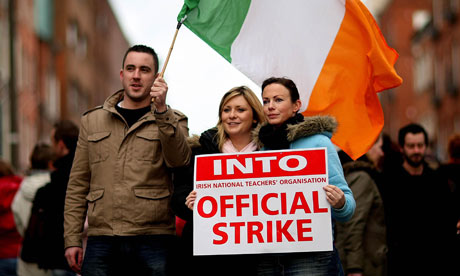
The problem is neatly encapsulated by a report on the Irish National Teachers Organisation Conference at which delegates wanted to put an emergency motion calling on the leadership to have a strategy in place if there was a No vote.  This was ruled out of order but a weaker one was allowed.  Only when delegates booted this out was a compromise motion passed that called “on the central executive committee to urgently liaise with the executives of other public service unions with a view to promoting and planning a public service solidarity alliance of trade unions across the public service.”

What this episode reveals all too obviously is the restrictions placed on workers by union bureaucracy and this bureaucracy’s intention of relying on the Government to ‘tweak’ the deal so it can be imposed on the membership.  It shows the awareness of trade unionists that a strategy is required and one that seeks the maximum unity.  The obvious weakness involves relying on the same union bureaucrats to provide this strategy and implement it.

Putting together a convincing strategy will not be easy but the vote itself is a massive step forward, as is the appreciation of the need for a strategy and for this to be based on unity within the union movement.

Very early on in the current crisis the then Government relatively easily divided workers through claiming those working in the public and private sectors had separate and opposing interests.  The union leaders seemed only too happy to walk into this trap.  Their willingness to sacrifice services for short-term and increasingly illusory benefits for public sector workers has failed even these workers as their pay has been slashed and the deal they signed up to was torn up with union consent.  Meanwhile the workers who use these services have had some confirmation that the quality of these services may suffer to defend the conditions of those who deliver them.

The initial reaction against this disastrous approach was recourse to an even more divisive one, with the creation of a Frontline Alliance that saw narrow trade unionism prioritise the interests of some workers who are on the frontline of some services, implying a common interest not shared across all workers.  However I’ve yet to meet a frontline service that could operate without the support of rearguard(?) workers.

Even this signalled not some reduced form of trade union unity but the plaintive cries of the ‘special case’.  I remember listening to an interview some months back on ‘The Last Word’ on Today FM with a group of union leaders from this Alliance.  What was most striking was that when they were interviewed one-by-one there was hardly the slightest hint of a common grievance.  They seemed totally ignorant of how narrow their complaints seemed and how stupid a strategy is which is based on claiming special treatment when such an all-engulfing attack is being meted out.

There are other courses of action and what might seem like alternative courses for workers looking to fight back are in fact the same struggle.

The view that it is impossible to get the union movement to fight back without first kicking out its rotten leadership replaces a task on which workers have just voted – rejection of Croke Park 2 – with one they have not had placed clearly before them, debated and decided upon.  There is limited traction in simply claiming ‘betrayal’ and saying these leaders must be replaced now before a real struggle to give effect to the No vote can be realised.

The entirely justified and valid view that the current union leaders must be replaced can be achieved by demonstrating to the majority of members the practical effects of these leaders supporting attacks on their interests while frustrating any resistance.  In the course of mounting this resistance the task of replacing these leaders can be posed but not as a precondition or prior requirement for such resistance.

The related questions of whether workers should demand that their leaders hammer out a united strategy or should unite at rank and file level to achieve this themselves are also not opposed.  While rank and file workers must unite across unions to create their own structures this can only be in addition to the established ones. In this way they might demand that their separate leaderships take action and also advance towards an end-point where, if they do not, workers are in a position to pose this task practically themselves.

In doing so workers might learn that replacing the current leaders is not enough and that what is really required is an entirely rejuvenated trade union movement.  One that is open, democratic and not in thrall to either bureaucratic leaders or bureaucratic structures and rules.  A big step forward has been taken with the No vote and the Government is faced with the threat of resistance.

As this post is finished it is reported that the Government does indeed intend to ‘tweak’ the deal in what is called a “carrot and stick approach”.   Since it still intends to make the same amount of cuts what won’t change are the pain and divisiveness of the tweaked deal and the threats that will accompany it.  Like donkeys workers are expected to look at a carrot paraded in front of them while what they feel is the stick.

Support the ICTU demonstrations!

frame-1-ictu-protest-march-over-the-governments-four-year-austerity-plan-assembling-at-christchurch-in-dublin-irelandThe Irish Congress of Trade Unions is meeting on Wednesday to discuss the possibility of organising a series of demonstrations across the Irish State in opposition to austerity and debt.  It has issued a press statement outlining its reasons; in particular it is targeting the issue of debt and has indicated that demonstrations might take place in a number of towns and cities including Dublin, Cork, Galway, Sligo, Limerick and Waterford.

The possibility of these being organised should be welcomed but more important, if they take place, they should be supported.  It gives working people an opportunity to demonstrate their opposition to austerity, to demonstrate the scale and anger of their opposition and put forward what they think should be the alternative.

It gives the small socialist movement an opportunity to campaign in the working class to make these events as large as possible so that the demonstrations can convince and give confidence to others to also oppose austerity and oppose the crippling debt.  It gives it the opportunity to speak to workers to take action outside as well as inside the trade union movement and in the private sector as well as the public sector.  The purpose would be to begin reuniting workers who have been successfully divided into union and non-union and between public and private sector by the propaganda of the State, employers and media.

A real campaign at union and community group meetings, at workplaces and in the streets including door to door leafleting and canvassing should aim to mobilise as many as possible to turn out, should the demonstrations be called.  Right away attempts should be made to extend the numbers building the demonstrations through meetings organised to discuss the demonstrations and how they could be made as large as possible.

These meetings should not simply be organising meetings but should also discuss why we oppose austerity and the debt, how they are affecting the lives of working people, how we should organise against them and what our alternative should be.  What for example is our position on debt default?  What role does strike action have in a campaign against austerity and default?

There are many issues facing workers and socialists have the opportunity to give them the possibility of coming together beyond the existing union movement to unite and discuss all these issues.

In this blog I have addressed these questions here, here, here and here.

What have been called as one-off demonstrations should be supported in order to make them an on-going campaign both before and after they take place.

All this is primarily the task of the socialist movement but it is not limited to it.  There are many opposed to austerity and many campaigns against its effects that should take the opportunity to better organise and unite with each other to discuss what should be the alternative.

An additional onus is however placed on the socialist movement.  It claims to stand for the interests of the whole working class and has a special duty to take every step to unite it in defence of its own interests.  This has two aspects.  First it must unite itself to carry out the task of uniting workers.  Otherwise it is weaker and opens itself to charges of incompetence, hypocrisy or political sectarianism.  The second is to create a campaign which is open and democratic and which at the very least offers the possibility, if not yet the certainty, of uniting the most militant workers.

The unity of the socialist movement in such a task should in principle be easier since it has theoretically already achieved some level of unity through the United Left Alliance.  The ULA should immediately discuss how such an opportunity can be utilised to build an anti-austerity campaign, on what basis it should be built and what policies it should fight for.  This is, after all, something which the ULA said it was going to do when it got elected and it would not do to renege on promises, just like the Labour Party and all the other right wing parties, once elected to the Dail.

Complete agreement should be no barrier to taking this action.  A democratic campaign would in any case allow everyone to argue its particular view on the way forward and the alternative.  In a democratic campaign of action there would be no role for vetoes.

The objective on the day would be a united left contingent, united around an agreed programme and demands, offering an on-going campaign to everyone at the demonstration who didn’t just want to go home afterwards to watch themselves on the RTE news.  The size and resonance of such a contingent would testify to the potential to build real and lasting opposition to austerity.

There is of course a flip side.

To borrow from management-speak: for every opportunity there is a threat and for every potential strength a potential weakness.  To fail to take opportunities threatens the effectiveness of resistance to austerity and to fail to strengthen the resistance will result in weakening it.  The ULA through its minor electoral success has given itself some responsibilities which it should relish as opportunities to help workers build a movement against austerity.

Support, build and go way beyond the ICTU demonstrations!

Budget 2013 and the alternative

6122011-budget-2012-second-day-14-630x491The 2013 budget is going to introduce tax increases and spending cuts of €3.5 billion.  Michael Noonan smiled when holding up the budget document to the cameras while Brendan Howlin looked serious.  Nevertheless RTE reported that Labour TDs were pleased claiming that their fingerprints were all over it.  And so they are.  Their footprints, where they walked all over many vulnerable sectors of society, are also all over the budget.

There has essentially been only one defence of these austerity budgets and that is that the Government has had no choice.  No choice because there is no economic alternative and no choice because the State has lost its economic sovereignty and is basically doing what it is told to by the Troika of European Commission, European Central Bank and International Monetary Fund.

In this budget they have felt compelled to come up with a new defence – it is nearly over. This was trumpeted by Michael Noonan and also claimed by the Labour leader that “It is the budget that is going to get us to 85% of the adjustment that has to be made, and will therefore put the end in sight for these types of measures and these types of budgets”.

This hardly looks credible, which is not good news, because what it essentially means is that the austerity measures implemented have both been insufficient and haven’t worked.  The economy has contracted and stagnated even as the austerity measures have been insufficient to bridge the deficit.

For 2012, the deficit has turned out to be around €500 million larger than planned but because of upward revisions to data from earlier years, the deficit target, set as a percentage of GDP, will still be hit. This assistance in meeting the ‘target’ will not be available in 2013.

At the end of 2013 the deficit will be 7.5% of GDP.  In 2008 (excluding that related to the banking bail out) it was 7.3% rising to 11.5% in 2009. All the austerity budgets have achieved so far is a reduction of 4% – less than half way to eradicating the budget deficit never mind 85% of the way.  Even by 2017 the IMF forecasts the deficit will be 1.8% so the debt will still be getting bigger.

As with all these budgets there have been cuts to capital expenditure with another €500 million reduction targeted for 2013. In 2008, capital expenditure was close to €10 billion. In 2013, it will be under €3.5 billion. Public capital expenditure has been slashed by 66% which wipes out, and more, the so-called stimulus measures announced earlier in the government’s PR/con exercise that claimed to be promoting jobs.  This means the infrastructure of the state, economy and society will disintegrate more or less quickly.

The sheer madness of the austerity agenda is demonstrated by the fact that the €3.5 billion in cuts and tax increases will be wiped out before they are even implemented by the €3 billion payment of the promissory notes for the Anglo-Irish bank, which no longer exists, and repayments of €2.45 billion of bonds for Irish Life & Permanent. On top of this there is the rising interest cost of the debt, which will increase from €5.7bn in 2012 to €8.1 billion in 2012-13.

With the debt increasing, even at a reduced rate of increase, the burden of interest payments on it can only worsen.  This makes the debt unsustainable.  A rising interest burden will be a permanent anchor on growth.  This is a problem because the Government is relying on renewed economic growth to get out of the stagnation now in place.  The weakness of Irish capitalism means that it must rely on outside forces for this growth.  Either that or there is some debt relief to lower the amount of debt and the burden of interest payments.

In the meantime particular groups of the working class will suffer real hardship, living standards will decline or at best stagnate and unemployment will be limited only by continuing emigration.  The stresses imposed on society will be expressed in mounting social problems that will often be presented as a simple increase in personal misfortune while increased inequality will coarsen social relations and further weaken social solidarity.  The absence of any radical perspective will see reactionary prejudice become common currency.

Once again the United Left Alliance has put forward what it states is a socialist alternative.  In substance it is the same argument as that put forward last year but with more detail and some development here and there.  There is no need to repeat the analysis presented earlier in this blog including here, here and here.

The ULA is in no position to implement any of its proposals.  The purpose of the document must therefore be an educational one.  What it teaches is therefore the only useful criterion by which to judge it.

It starts out by claiming to be a socialist alternative and its headline is repudiation of the debt, an end to austerity and the need to invest in jobs and services.  All these are undoubtedly the immediate needs of the working class.  The problems start when we look to see how it is proposed these ends might be achieved.

The ULA “proposes to take the burden of the crisis off working people, improve their lives and revive the Irish economy.”  On the other hand it admits that “the budgetary proposals put forward by the ULA can in no way offer a comprehensive solution to the crisis we face.”  How the first claim is reconciled to the second is not explained.

While the debt crisis “resulted entirely from the actions of developers, bankers and the politicians who facilitated them” it is not explained how this can be reconciled to it being “a manifestation of a deep structural crisis of global capitalism.”  It is nowhere explained what this latter statement means, how it explains what has happened or how it explains what solutions are possible.  The Marxism to which the core elements of the ULA claim commitment is founded on claims to present just such answers but they are not here.

It might, with some justification, be claimed that the precise cause of the crisis is also a cause of some debate within Marxism.  Unfortunately any suggestion that a key task of the ULA might be to debate this out so as to inform the politics it espouses would be held up many as a fetish of sectarian or dogmatic individuals who aren’t interested in practically ‘building the movement’, or some other such boorish remark.  Instead while (dumbed down) Marxism is relegated to recruitment meetings for novices the vacuum that is the politics presented to workers is filled with Keynesian, that is capitalist, ideas that are the currency of liberals and the leaders of the trade unions.

Let us see some ways in which this is expressed in the ULA economic alternative.

First the ULA proposes to improve the lives of working people and revive the Irish economy but there are no socialist measures proposed that would achieve this.  Were the proposals to therefore fail (if by some miracle they were tried) it would discredit what passes itself as socialism while if they were to succeed they would go some way to making socialism irrelevant.

The ULA claims that “the alternative we propose will not be implemented by the current parties in the Dail or by the Irish state.”  Yet it proposes that the Irish State increases income tax on the rich, reduces taxation on workers, introduces a wealth tax, introduces a financial transactions tax, increases corporation tax, takes “full control of the banks”, supports small business, invests to create jobs, embarks on a programme of council house construction, creates a new construction company, renationalises all privatised strategic enterprises and establishes a state owned gas and oil company. It declares that “the ULA believes public enterprise and public works must play the central role to redevelop the economy on a sustainable basis.”

The ULA claims that “radical measures that break with the logic of ‘markets’ are required” but the demands on the state above do not do this while it is claimed these measures will “revive” and redevelop the economy on a sustainable basis.”

“There is a need for active struggles to demand policies that prioritise the need for jobs, public services and growth, using public investment and democratic socialist planning to chart a way out of the current crisis.”  What sort of struggles? For what policies? And who will we demand this of?  How would they deliver on it?  What, who and how?  Where and when don’t even arise given the vacuousness of this string of words.

In other words – as a vehicle for education – the alternative budget, when it is not mistaken, as we have explained in earlier posts, is simply incoherent.

What is clear is that the ULA has no strategic perspective.  It calls for socialist planning, but socialist planning is just another term for working class rule, for the working class controlling society.  Yet it proposes the state, the capitalist state, take action in the here and now to solve the crisis and develop the economy on a “sustainable basis”.

This lack of coherence reveals itself in timidity, contradiction and calls for solutions that have already been the means to subordinate and exploit the working class; as when the ULA calls for “full nationalisation with direct public control of the banks” when it is nationalisation and state control of the banks that has been the mechanism to burden workers with the debts of the speculators.

Even when it calls for “direct public control of the banks” this can as easily be defined as the current arrangements as it might by workers control.  So how does such a demand clarify anything?  How does it educate anyone on what they should fight for?

The ULA is currently undergoing an organisational crisis but its real problems are political.  It argues an alternative that is simply not based on the actions of the working class. It is imperfectly aware of this so it substitutes vague calls for action and acknowledgements that what they are proposing is only temporary amelioration.

There is a possible solution to this problem and it involves debating openly and democratically what a socialist strategy should be.  As I have said such calls are resisted.  It therefore falls to those prepared to do so to engage in such a debate so that we don’t just point out what’s wrong but also say what’s right.

Thousands march in Dublin against Austerity

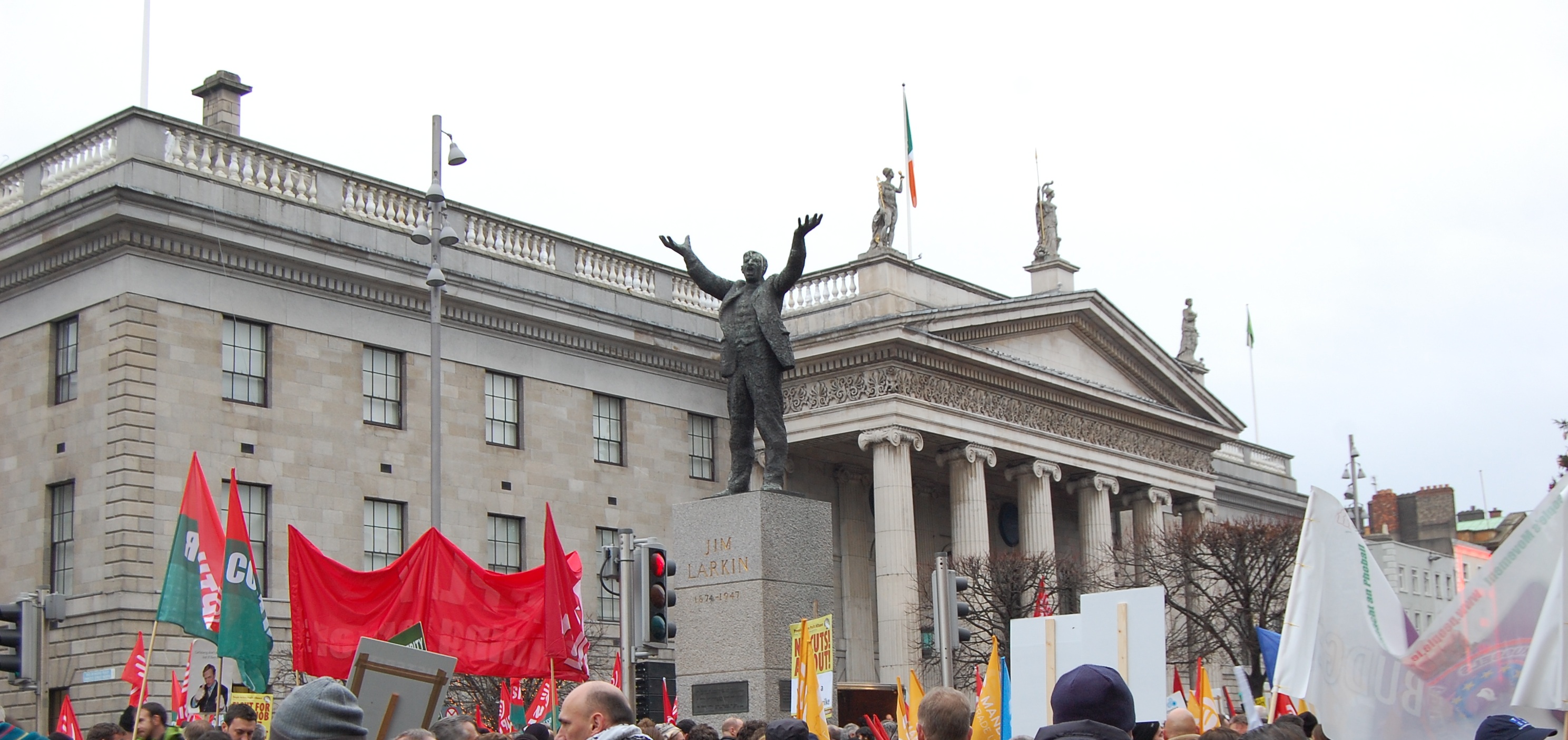
Thousands of working people from around the country marched in Dublin yesterday against austerity.  The demonstration had been called by the Dublin Council of Trade Unions and by other groups.  While not on the scale of the earlier demonstrations in 2008 and 2009 it was nevertheless a large protest against the government.  That it was smaller should not be surprising since in the meantime the people of the state have voted in a referendum, reluctantly of course, to support austerity.  The Garda initially estimated that there were 18,000 on the demonstration and later reduced that number to 10,000.  In my own view, at its height, the former figure was closer to the truth.  In this post I want to give my own impressions of the demonstration and in a further post look at some of the issues raised by it.

The demonstration was very diverse with lots of banners and placards from many different organisations and places around the State.  This diversity was not unfortunately united around any very clear or coherent perspective of opposition or alternative.  If it had a unifying theme it was simply one of opposition to austerity and opposition to the Government.  However what the demonstration did show was the potential to build some sort of opposition.  Unfortunately the organisers offered no means for those who might attend to either meet beforehand or afterwards to discuss what an opposition might look like, how it would come together to organise itself and on what policies it might unite.

In the age of the internet it should not be impossible to register groups and individuals’ interest in a demonstration beforehand and call a conference to discuss the demonstration and what everyone attending might want to come out of it.  On the other hand the demonstration itself could have been used to issue a single predominant leaflet advertising such a conference.  As ever these demonstrations seem to unite those prepared to protest for one afternoon, only for them to disperse and go their separate ways again.

The largest contingent on the demonstration seemed to be the Campaign Against the Household and Water Taxes (CAHWT) with banners from various localities in Dublin and other cities and towns across the State.  There were also large contingents from various trade unions including the Communication Workers Union, TEEU and SIPTU.  They were large by the standard of the demonstration but obviously not at all in relation to the size of their memberships.  The unions had obviously mobilised some of their activists but had not built more widely inside their union or across the movement.  A comrade had mentioned to me that he had looked at the union web sites that morning and it was clear that they had not sought to really build the demonstration.

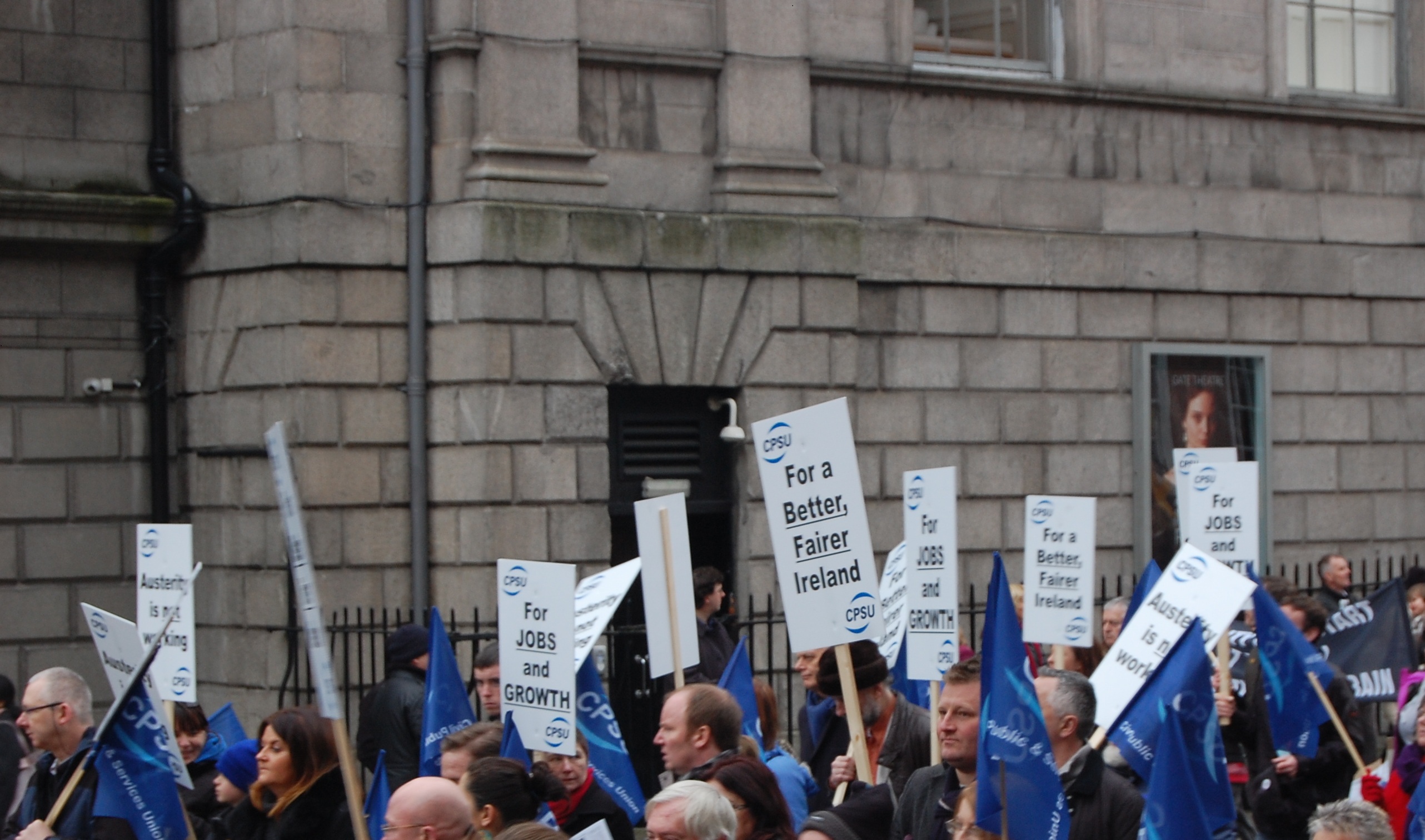
The Communication Workers Union held up placards ‘for a better fairer Ireland’(while their band played the Internationale), no doubt in reference to the Irish Congress of Trade Union’s ‘better fairer way.’  Unfortunately we’ve already got this better fairer way as far as the trade union leadership is concerned.  They have negotiated a deal with the Government – the Croke Park deal – which has involved acceptance of austerity with no more than verbal opposition and the odd protest allowed.

The Croke Park deal requires that the trade unions not take industrial action and the union leaderships have ensured that this has been the case.   They seem happy enough with the present situation because they are about to go into negotiations for a Croke Park II with the Government setting a condition of a €1 billion cut.  This is proving no barrier to entering the talks.

The various community campaigns took up a large part of the demonstration and the rest by the various political parties.  Sinn Fein had the largest contingent of a political party, taking up the rear of the march.  Labour Youth also had a banner and a very small contingent.  This was brave enough given their Party’s role in Government but at least they had the decency to look a bit sheepish.  These young comrades must certainly know that their task, if they insist on staying in the Party, is to build an opposition within it to the leadership and demand it withdraw from the Government and never enter another one like it.

There were banners and members from People before Profit/SWP, Socialist Party, United Left Alliance, Communist Party, Socialist Democracy, Irish Socialist Network, Workers Solidarity Movement, Republican Sinn Fein, 32 County Sovereignty Movement, Republican Network  for Unity and Erigi – all in favour of the unity of the working class or of the nation.

There was no predominant chant from the demonstration; the odd ‘they say cutback, we say fightback’ and chants against paying the household charge.  Socialist Democracy (SD) and their supporters held up a banner at the side of the demonstration as it left Parnell square and called for ‘Labour out of Government, ICTU out of Talks’ and ‘No new Croke Park’.

A demonstration united around these demands would have been a more powerful expression of opposition.  It would have targeted the weakest part of the Government and the key task of the moment – stopping ICTU and the trade unions selling out to the austerity drive once again.  It must be clear that preventing the trade unions’ acceptance of cuts would be a real victory, and would be a first step to really opposing them.  Failure to do so would make it much more difficult to achieve this.  The many on the Left calling for a general strike should realise that such calls mean very little if the prior step of preventing ICTU from signing up to a Croke Park II is not achieved.

There were one or two calls from small parts of the demonstration for calling a general strike and in my next post I will look at this demand.  Whether or not the Socialist Democracy call had some effect I do not know but a couple of sections of the demonstration took up their point about the Labour Party.  One SD member told me that the CAWHT contingents had reacted enthusiastically to their loudhailer demands, the trade union contingents had reacted with silence and the SIPTU contingent had attempted to raise an alternative chant to drown them out.

The small Union of Students of Ireland contingent targeted Labour with –

“Ruairi Quinn – we know you

We know you’re a blueshirt too”

The Waterford CAWHT contingent had a rather more colourful take on this message –

“Eamon Gilmore – we know you

You’re a fuckin’ blueshirt too”

At the end of the demonstration what was left of the protest waited outside the GPO for the speeches.  I waited a while as well as some music was played.  I was talking to a fellow Marxist when he said he was debating whether to wait to listen to the speeches or do some shopping.  I was in the middle of telling him I was debating the same issue myself, but felt obliged to stay since I was going to cover it in the blog, when I realised that over 90 per cent of the demonstration had left and that I could leave as well without doing an injustice to most participants’ experience of the day.

It was later reported that one of the speakers, the current President of the Irish Congress of Trade Unions, Eugene McGlone had joined in calls for a general strike in protest at austerity and cutbacks and that other speakers had echoed this call.  He was initially heckled when he took to the platform as was SIPTU President Jack O’Connor who said that ‘while he is not necessarily opposed to a day of action against austerity, unions would have to be able to convince the overwhelming majority of workers that the objectives they were advocating were achievable and were a better alternative.’  Sounds like a job description to me but not obviously one that Jack recognises.

The precious SIPTU leader then criticised what he called ‘fascist behaviour’ at the protest when McGlone and he were heckled by members of the crowd.  RTE reported that ‘a number of other senior trade unionists dissociated themselves from Mr McGlone’s call for a general strike – describing it as a “solo run”.’

RTE also reported that ‘the organisers of the pre-Budget anti-austerity protest have condemned what they describe as “the divisive attack” (on) Mr O’Connor (by) a section of the crowd.  In a statement, Councillor Brid Smith said: “Nobody orchestrated any heckling – it was a spontaneous outburst of anger at the inaction of union leaders.  Some highly-paid union bosses appear so much out of touch with the anger of their own grassroots that they see conspiracies everywhere,” she added.

We can be in little doubt that McGlone’s call is indeed a ‘solo-run’ but that unfortunately it is not “the inaction of union leaders” that is the problem but rather their actions that are.  In negotiating a deal with the Government which accepts austerity and agrees not to organise effective action against it they have consciously adopted the role of enforcing Government and Troika policy.  Their actions, in appearing to be concerned only with their members in the public sector, has effectively validated and supported the strategy of the Government, bosses and media of dividing workers into public versus private and making easier the imposition of austerity on both.

Attacking O’Connor is not “divisive” because these leaders have agreed a deal which supports austerity.  That he was allowed and able to speak at an anti-austerity rally shows how far Irish workers have to go to build a real opposition to it.  What is heartening is that some workers seem to appreciate this.

The Bedroom Tax and the Inevitability of Civil Disobedience by ‘Belfast Plebian’

By now most people will have heard something about the new welfare regime due to kick in next year. The range of the welfare bill is so vast that it almost defies summary. The implications for the whole of the working class are very profound. To the unwary the welfare changes are of little importance because they think it will not impact on them, after all they are in steady employment.  Yet the changes will impact on the whole of the working class.  First of all steady employment cannot be guaranteed in the long-run recessionary economic cycle that we are certainly in and second because most workers have family circles especially parents and children that will be severely impacted. It should be stated at once that the number of unemployed in receipt of welfare benefits are in fact the minority, just over 60% of those in receipt of significant welfare benefits are in fact not unemployed.

Let’s pick out just one item that has gone largely unrecognised, changes to housing benefit and let’s be specific about it. In the north of Ireland there are currently 63,000 people registered as unemployed, however there are a lot more, 161,634 homes to be exact, in receipt of essential housing benefit, in fact 67,500 out of a total of 90,000 of Housing Executive households get the benefit, another 23,600 with Housing Associations and then another 70,000 renting in the private sector. In additions there are another 34,800 on the social need waiting list, 20,000 classified as emergency need. It is a reasonable assumption to make that most on that list would be in receipt of housing benefit if they could find a place to live.

Life is about to get a lot more difficult for many of those in receipt of housing benefit. For a start if you are single and under 35 you will only be allowed enough benefit to cover the cost of only one bedroom in a shared property. Where are you going to go to find this prized one bedroom?  Certainly not to the Housing Executive with its ever growing waiting list and reducing building programme, down to less than 2,000 planned properties. What then of the private rented sector?  Here rents are rising due to the mortgage crash – people who in the recent past could expect to get a mortgage are now no longer able get one.

The typical rent on a small house starts at about £600 per month, fine for some who have only just missed out on the mortgage bonanza but not for the poor benefit claimant who is facing a £400 cap which can only get progressively worse in relation to non-benefit tenants, the likely outcome being private landlords refusing to rent to the poor and a steady increase in homelessness.

Let’s move on now to the bedroom tax or as the government calls it, the over occupancy charge. From April next year those in receipt of Housing Benefit will have to pay a charge of 14% relative to the cost of rent for the audacity of having too much living space i.e. having an extra bedroom and others a stiffer 25% charge for having two extra rooms. You see the new welfare orthodoxy says that the working class have way too much spare capacity in their council homes.  So from April 2012 only one bedroom in a council property will be covered by housing benefit per person or per couple. If you have anything extra you will have to pay for it out of your universal credit. You see the new regime has moved on from merely targeting single people for penalty, it now reaches right into the working class family itself. If the person or couple have children the following rules will be applied.

A child aged 15 or under will be expected to share a single bedroom with another child of the same sex.

A child aged 9 and under will be expected to share with another child regardless of their sex.

You will be deemed to be over occupying your home if for example you are a single parent family living in a three bedroom council house with two teenage sons below the age of 15, or if you are a couple without children living in a two bedroom council flat, or again you will be deemed to be over occupying if you are a couple who have to sleep in separate bedrooms due to disability or sickness needs, or again you are a divorced or separated parent living in a two or three bedroom property who needs the rooms for children who only stay at weekends and holiday periods. There are just too numerous variations on this simple over occupancy theme to cover here. The above is just a sample.

How many people in the north of Ireland are to be classified by the Daily Mail mind-set as ‘wicked over occupiers?’ We don’t yet know; when Lord Freud was asked in the House of Commons about the likely outcome for the UK as a whole he confessed that the family friendly ConDem government had not bothered to commission any proper research. It has been left to charities to come up with some statistics; Shelter reckons there are probably about 800,000 miscreants in GB.  In respect of the north of Ireland all the housing charities think that the region will be affected the most, the minimal estimate I have seen is 7,000, but a web site in sympathy with the measure put it as high as two thirds of the current social housing tenants.

How much you pay will depend on your situation. The average council rent is approx. £72 per week, meaning an over occupier stands to lose at least £10 and maybe £18 from their living expenditure. To take one pertinent example, the current job seeker who is under 25 receives just £56.25 per week to live on; those over 25 receive £71. How many of those facing the over occupation charge will be able afford to keep the roof over their heads? Some will try and succeed, others will fail and will sooner or later be up for eviction. But for those scrimpers and savers who manage to make the payments there is a looming threat to their existence; the impending bedroom charge is not a final instalment, rather it is only a first instalment.

Just a year ago it was only the under 25s who were forced into one bedroom accommodation in the private sector, this has already changed to the over 35s. The Prime Minister is on record as saying that nobody has a social right to a home financed by the taxpayer, having a council home is a privilege he says not a right; he also says that he wants to dispense with what remains of social housing.

George Osborne recently proclaimed that he wants another £10 billion worth of cuts on welfare spending. In other words it won’t be very long before the charge is increased and more fall prey to the eviction notice. By the way, the small number of people who know about the new charges think that those who may fall into the classification scheme will be offered an alternative home if they can’t pay the charge, they are mistaken; there is no legal obligation on the housing authority to offer you something more suitable, this may be because these homes don’t actually exist.

What then has been the reaction of the local politicians who say they oppose the new reforms?  Answer – bluff and evasion? Well they have passed the welfare bill, so far without amendment, the so called concessions they are championing are entirely procedural. Are they preparing to drop the over occupancy charges? No sign of it. They play the evasion game by not talking about the housing benefit part of the welfare reform bill, hoping that nobody of any importance will notice it. It is to be revealed to the unsuspecting working class voter, Cilla Black style surprise! Surprise!

Come April next year people will suddenly find out about it and it will be too late for them to turn to the local politicians for some sort of protection. The politics of this whole affair needs to be discussed now. Why are the Tories attacking the living conditions of the working class in the home and not just in the workplace? They will not even save any money on housing benefit at least in the first instalment.  It makes no macroeconomic sense and looks more like a very nasty political stoke of class divide and rule than an attempt to solve the chronic housing crisis.  Perhaps they believe that it will destroy what little remains of working class social solidarity. We know that GB has a horrendous housing crisis, those who are desperate to find a home will now be ‘educated’ by the pernicious right wing press to blame those wicked over occupiers for their unfortunate condition.

One of the splendid ironies of the impending social disaster is that the seniors of both nationalists political parties swear that they were indeed the very the people who fashioned the civil rights movement that began life as a protest and even a disobedience campaign against the Orange States’ grossly unfair housing policy. If things are programmed by Stormont to follow the requisite course set by the Welfare Bill they will have to oversee a new set of grievances in respect of housing policy of even graver consequence than went before.

Untold numbers of working class people will not be able to meet the new rent charges out of living expenditure. Not being able to find alternative smaller homes when the eviction notices start to fly; they will inevitably opt to refuse to pack up and leave their existing homes. The nationalist politicians sitting in Stormont will have to persuade them that it is a bad idea to ‘squat’ in a house that they believed falsely was theirs by right.  They will have to tell them that the incomes of the hard pressed British ‘middle class’ taxpayer must take precedence over their own voters social need. They will have to appeal ever more to sectarian instincts rather than to definite social progress to keep the party vote in place. Long live the nationalist political class! Long live the unionist political class! Long live the new dispensation!

Belfast Trade Unions demonstrate against Austerity

Trade Unionists march against Austerity

As part of the trade union campaign against austerity across the UK the trade union movement in the North of Ireland organised a demonstration in Belfast to coincide with those in London and Glasgow.  It is difficult to estimate the size of the demonstration which appeared significant as it snaked its way through Belfast’s city centre but didn’t look impressive as it assembled and looked even less so at the final rally.  The latter however is a feature of trade union demonstrations. The notion that the purpose of a rally at the end is to explain what to do next and get everyone involved is as alien to most people at these things as little green men from Mars.  What happens next always depends on the decisions of the union leaders.  It is not for deciding by those involved.

Supporters of the United Left Alliance in the North correctly made this the subject of their leaflet and put forward the key task of the demonstration as one of creating a real permanent campaign against austerity:

“Last November saw 40,000 mobilised in Belfast in a general public sector strike  – but it was a one-off event and everyone went home again.  No further action was taken, there was no continuing campaign and the next public sector strike was much less successful.

Everyone is no less opposed to austerity and the Tories and Labour plans show the issue isn’t going away.

At the end of this demonstration we must make sure we don’t go away either.  To ensure that this doesn’t happen we need to come together to create an on-going cross-union permanent campaign that will oppose austerity.  Not one that pops up every six months but one that continues every week to campaign inside the trade unions, inside workplaces and inside communities to unite them all in a way that each of them cannot do by themselves.”

I overheard one of the trade union leaders responsible for the demonstration express her delight at the size of the turnout.  The demonstration was successful in so far as it confirmed that a basis exists for starting to build a wider and potentially successful campaign but one should not underestimate the obstacles.

The first is that the demonstration was no more than a few thousand at the very, very most.  It was dwarfed by the very, very large sectarian demonstration three weeks before, which commemorated the signing of the Ulster Covenant that led to partition.  This was celebrated by the participation of dozens of ‘kick the pope’ flute bands.  A prominent organiser of it was Nelson McCausland of the Democratic Unionist Party who has led the introduction of the Welfare Reform Bill in the Stormont Assembly, which imposes in Northern Ireland the cuts decided by the Tory Government in London.   It is ironic that many of the marchers in the Ulster Covenant commemoration will be shafted by these cuts.

The welfare changes introduce the biggest assault on entitlement in decades and were also supported by Sinn Fein.  The latter bring their own ironic aspect to its passage.  The back bone of Sinn Fein’s political machine is a network of advice centres at which Sinn Fein activists help those on welfare get as much as they can.  It is what they called ‘screwing the system’ when they first started doing it.  Now of course Sinn Fein has joined the system and the only people getting screwed are their constituents.  The first many of them will know about the changes will be when their benefits get cut.   They will then run to the advice centres where Sinn Fein will tell them ‘sorry but these are the new rules’.  What they won’t tell them is that Sinn Fein voted for them and had the power to stop them but didn’t.  While welfare is cut along with public sector pay Martin McGuinness will continue to complain that the British won’t let Sinn Fein and the DUP cut corporation tax.  Sinn Fein posturing has been particularly vacuous – they have said they ‘might’ make an issue of monthly payments of benefits and demand that they are paid fortnightly instead.

The third obstacle is reflected by the fact that so many walked away from the demonstration with no demand to those on the platform that they provide them with a strategy promising success.  The demonstrators were activists in their various trade unions and community groups but there is no understanding of the need for wider organisation.  They were there to protest and no more.

A protest is an expression of disapproval, summed up in the slogan ‘not in my name’.  It is not an alternative and it ultimately receives the following answer by the Government and State – ‘yeah, so what?’  Sinn Fein and the DUP live and breathe as defenders of their respective community against the other even as together they fillet both.  The limits of the trade union leaders’ challenge can be seen in the statement released before the demonstration:

“The devolved administrations must build a robust joint defence of the people who elected them.  Let this rally today send a message to our MLAs and our MPs from all political parties that we the people are firmly opposed to the failed policy of austerity which destroys lives and futures.”

An appeal to the political parties at Stormont and to Stormont itself is not a strategy.  It amounts to an appeal to the enemy.  The financial crisis exploded because of a property boom and the well-reported antics of the Developers’ Unionist Party and hidden ‘let’s get rich’ antics of the leaders of the Provisional Movement mean these people ae personally tied up with the system that is demanding the cuts.

The political sectarianism of the left means that it too is not an alternative.  It is unable to unite its tiny forces in an attempt to make a difference, although this is not the biggest problem.  The Left’s inability to organise in an open and democratic way means it cannot include the wider forces needed to create a real movement.  Were it to attempt to do so the Left group concerned would no longer retain control.  Since their absolute need for control is not just a rather unfortunate sectarian aberration in their practice but a foundation in principle of their existence- they all believe that they are the sole essential nucleus of the mass working class party of the future because of their particular approach to socialist politics -they are both practically and in theory sectarian.

The leaflet of the supporters of the United Left Alliance correctly put forward the next step – creation of a permanent campaign that is organised across unions by rank and file members, in workplaces and in communities and their community campaigns.  This is not just the next step in a campaign against austerity.  Just as socialism is the creation of working people themselves so is the resistance to capitalism, one of the means by which the capitalist system will be superseded by the power of a new ruling class, made up for the first  time by the vast majority of society.