What sort of Social Explosion?

If austerity increases the likelihood of social upheaval and politics is crucial in determining this, it is also obvious that political factors determine the character of the reaction. Is the reaction even progressive?  The very title of an academic study that addresses this question gives pause for thought – “Right Wing Political Extremism in the Great Depression”.

The authors explain that they focus on right wing parties because it is they that made the most visible progress.  Their analysis covers 171 elections in 28 countries between 1919 and 1939, mainly in Europe but also covering North America, Australia and New Zealand.  In the last election before 1929 Communist Parties had an average vote of 2.8 per cent in these counties increasing to a post-1929 peak of 4.02 per cent.  Ring-wing ‘anti-system’ parties on the other hand increased their votes from 1.16 per cent to 7.39 per cent.  The highest post 1929 vote for a Communist Party was 16.9 per cent in Germany, 15.3 per cent in France and 10.32 per cent in Czechoslovakia.  The highest votes for the right were 43.2 per cent in Germany, 25.1 per cent in Romania, 22.8 per cent in Hungary, and 18.6 per cent in Belgium. In Spain the Franco dictatorship did away with any concern about elections.

The size of the extreme right wing vote was associated with whether the country in question was on the losing side in the First World War and, confirming the findings of the first study, whether there was a longer established democratic tradition.  The study also noted the importance of the right already having a previous base of support on which to build during the economic crisis.  “The Depression was good for fascists” the authors say but “evidently, the depression was of no great help to Communist parties on average.”

Again and again they emphasise the importance of long established traditions of what Marxists would call bourgeois democracy and the institutions and political culture this entails.  Absence of this factor increased the danger of anti-system parties growing to become a real threat.  Of such a threat they say “above all, it is greatest where depressed economic conditions are allowed to persist.”

So much for the 1930s.  What about now?  A third academic study examines the pattern of workers’ protest in a much more recent period.

This study** looks at a puzzling phenomenon: that unions have increasingly engaged in general strikes in Western Europe since 1980 while economic strikes have been in decline.   The number of general strikes has risen from 18 between 1980 and 1989 to 26 in the following decade and 28 in the next seven years between 2000 and 2006.  More recent data shows another peak with 10 in 2007-2009 and 14 in 2010. The study looked at 16 countries including Ireland, which have reported 72 general strikes of which an amazing 33 occurred in Greece alone!  The countries of Greece, France, Italy, Spain and Portugal accounted for 77 per cent of the total.

This phenomenon has taken place against a background of an increase in social pacts between unions, government and bosses, known as social partnership in Ireland, a sharp decline in trade union density and fall in the number of strikes generally.  Between 1980 and 1982 an average of 16.6 working days per 10,000 employees were lost to strikes in the 13 European countries, falling to 4.5 days by 1989-1991 and 1.1 days by 2004-2006. Finally the share of wages in the economy has fallen over the period, which is taken by the authors as an indicator of declining union power.   On the other hand general strikes have taken place even in countries with historically low levels of strike activity such as Austria and the Netherlands.

The authors point to certain political features of the general situation against which this trend has developed, which might go some way to explaining what has been happening.  They point to the rightward movement of social democratic parties and the loosening of their organisational connections with trade unions, weakening the inhibitions on unions taking action against social democratic governments.  Thus, while the more right wing a government appears the more likelihood of a general strike, half those in Greece and five out of seven in Spain have been against Socialist Party governments.

The incidence of general strikes seems linked to rejection by governments or employers of a social partnership type pact and with efforts by unions in the midst of such pact negotiations to achieve agreement on one, eventually with success.  This is often in response to government threats to abandon talks or as a demand by unions to get them started.  Within the authors’ dataset pacts succeeded a general strike or threat of one on 14 of 18 occasions where both events occurred in the same year.  On 17 occasions they find that trade unions deployed strikes as negotiations were under way, mostly to press for concessions.  The issue of union inclusion in a social contract type deal appears as important as the actual content of government policy in the deal agreed.  Finally, while trade union density was insignificant in accounting for the incidence of strikes, high authority of the trade union confederation (ICTU-like body) was important.

So what do these three academic studies tell us?  Firstly that austerity and persistent economic depression increases the likelihood of a social backlash against austerity.  The remarkable relative passivity of Irish workers in the face of significant attacks on their living conditions may therefore not continue.  On the other hand the way austerity is imposed is important, with an emphasis on tax increases as opposed to expenditure cuts perhaps reducing the likelihood of resistance. However the key factor, which is emphasised in each study, is the political conditioning of the working class through a long tradition of bourgeois democracy.

None of the studies investigate exactly how this works but it is obvious that having the ability to vote against governments imposing austerity in periodic elections is valued greatly by working people.  It can and is plausibly put forward as an alternative to specifically working class action.  Put forward by the state, bosses and the bourgeois parties and accepted by a working class bereft of any experience or knowledge of the possibility of having their own alternative.  The Irish workforce grew enormously from 1989 to 2007, by 92 per cent, but under a regime of social partnership with a political and capitalist class exposed regularly as venal and corrupt.  Partnership played its part in making this corruption acceptable.  Inevitably the corruption infected the unions.

Independent initiative and consciousness disappeared and the passivity that has been such a feature of the recent years of austerity was learned over the last two decades by many workers with no experience of anything else.  This is what is meant in Ireland by bourgeois democracy, the subordination of independent working class consciousness under the leadership of a trade union bureaucracy and populist politicians that was all the stronger because for so long it appeared to deliver increasing prosperity.  That tradition bears down heavily as an enormous weight now the boom years have evaporated and the foundations of that prosperity have been blown away.
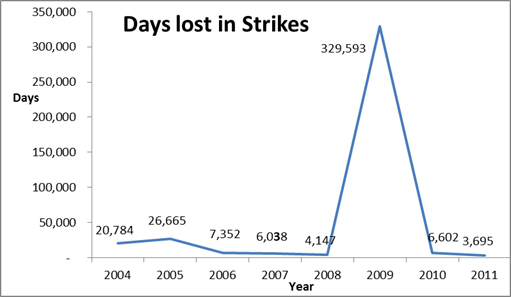
The low level of strike activity in the Irish State in the years just before the crash and after it is shown in the graph above.  The huge spike in 2009 reflects the one-day public sector strike in November of that year.  In retrospect it signalled the victory of a government policy which sought to divide workers employed in the public and private sectors and to blame the former for the state’s perilous finances.  This victory was pushed through with union agreement in the Croke Park deal which eschewed defence of state services valued by the working class in favour of defending the basic pay levels of its existing workforce.  This signalled entrenchment of division in the working class and tacit acceptance of the austerity agenda.  The rules of bourgeois democracy allowed working people to legitimise austerity further through a general election and an Austerity referendum.  All three of these demonstrate how effective bourgeois democracy is in imposing austerity when it so cruelly exposes the working class’s lack of a social and political alternative.

The studies show that no amount of militant action can substitute for this alternative.  As we have seen, general strikes, which often play such a prominent role in the demands of the left, are in themselves not the workers alternative.  Just think about it.  Greece has recoded 33 general strikes between 1980 and 2006, far more than any other country in Europe, yet if ever there is a working class in Europe suffering because of the crisis it is this one.  If ever the truth of Marx’s judgement of strikes received confirmation – that unions “ought not to forget that they are fighting with effects, but not with the causes of those effects” – it is in the Greek experience.

This, of course, does not mean that we must reject the strike weapon or the tactic of the general strike.  It is simply to confirm that these weapons of class struggle are not in themselves the alternative, or rather they are only steps and tactics in their creation.  Too often in the programme of the left they appear as events that will somehow spontaneously create the organisation and consciousness necessary for the creation of a truly permanent and conscious workers movement committed to socialism.  An unconscious faith in spontaneity appears at the heart of organisations that otherwise believe themselves to be wedded to building a fully conscious revolutionary movement.  Doubly so – that austerity will lead to militant resistance and that this will spawn the socialist alternative.  The building of the social and political power and consciousness of the working class are the crucial challenges that are bypassed.

This is often expressed in the view that the mass of workers will learn through action, which is true only in so far as it goes.  The point is that every action has a perceived purpose and, as we have seen, often what is a most militant action is wedded to quite limited, if not reactionary,  purposes – a general strike to demand a social pact, a public-sector wide strike to protect the Croke Park deal?  The ideas that workers fight with and for are crucial, if not decisive, not the tactics and methods of the unavoidable class struggle which they must engage in if they are even to think of a socialist alternative.  It is the creation of the conditions for the development of a revolutionary consciousness, which can utilise the various tactics of the class struggle, that must engage Marxists and not hopes that activity in itself, however militant, will solve this task.  The evidence we have looked at shows that this just doesn’t happen.

*Alan de Bromhead, Barry Eichengreen and Kevin H. O’Rourke, University of Oxford, Discussion Papers in Economic and Social History, Number 95, February 2012).

**“Unions Against Governments: Explaining General Strikes in Western Europe, 1980-2006”, John Kelly, Kerstin Hamann and Alison Johnston, Centre for Advanced Study in the Social Sciences, Working Paper 2011/261.

Will Austerity lead to a Social Explosion?

Greeks riot outside Parliament

In the debate over the austerity treaty the General Secretary, John Douglas, of the trade Mandate union told its Biennial Delegate in Wexford that:

“There are over 400,000 Irish workers without jobs, 50,000 are leaving the country each year, tens of thousands of families are being crushed under the burden of unsustainable mortgages and living in fear of eviction. Living standards, welfare and services are being slashed, the government is introducing a raft of regressive charges and taxes, a recent Irish League of Credit Unions report showed that 50% of those surveyed had less than €100 left to spend at the end of the month after paying all bills – what sort of an existence is this?”

“The imposition of austerity measures across Europe has resulted in over 25 million workers unemployed, of which 5.5 million are under the age of 25. This is a scandal, human waste of mega proportions – but still, our government at the behest of our European banking masters continues with these failed policies and ideologies, condemning future generations of Irish citizens to a mere existence on the margins of society.”

The treaty “may even shrink domestic demand further leading to mass unemployment, decades of emigration and sow the seeds for future social conflict.”

Irish workers are now well versed in watching scenes of riots outside the Greek parliament on RTE news bulletins.  It has been noted by just about every commentator that similar scenes have not been a regular occurrence in Merion Square or Kildare Street.

Is John Douglas therefore wrong?  A recent academic paper suggests not.*

Study

Employing the mathematical tool of regression analysis, using a wide range of indicators of social unrest – demonstrations, riots, strikes, assassinations and attempted revolutions – in  26 European countries, including Ireland, over 90 years – 1919 to 2009 – the authors look specifically at the relationship between austerity and social unrest.  They note previous studies of the same issue and a study of seven countries in South America during the period 1981 to 1990 which found that the run-up to austerity measures is associated with higher levels of unrest but that this declines after implementation.

Using the various indicators the authors create a single measure of instability which they call CHAOS which averaged 1.5 for the various countries over this period and peaked in Italy in 1947 where there were 38 incidents including 7 general strikes, 19 riots and 9 anti-government demonstrations.  The careful reader will wonder at a country with 7 general strikes but only 9 demonstrations.  We will not delve into the definition of the variables.  This does not mean we should cease to be sceptical of the results but we are obliged not simply to dismiss what we might not like, nor perhaps – more easily – simply accept that which fits our existing opinions.

Results

So what are the results of the study?

There are apparently relatively few protests caused by austerity but when they happen they are large and tend to be peaceful.  It should be remembered this study does not look at all protests, strikes and demonstrations etc. but only those linked to austerity measures.

It identifies no clear-cut patter over time but the interwar period, that immediately after World War II and the 1968 to 1994 periods show unusually high levels of unrest.  It also notes that the years since 1994 have been unusually tranquil.

Higher levels of expenditure and faster growth are associated with less unrest.  This might seem unsurprising but would appear to conflict with an assumption of socialists that lower levels of unemployment, usually associated with higher capitalist growth, allows the working class to rebuild its organisation and confidence and engage in more struggles to advance their social position.  The authors however note that while output growth is correlated negatively with assassinations, riots and revolutions it is not correlated in this way with strikes.

In the years after 1945 the authors observe that more growth lead to more unrest and state that “it seems that high rates of output growth may have encouraged worker militancy more generally.  At a time when many countries reached full employment, this effect seems to have become dominant.  The normal pattern of GDP growth reducing unrest reasserts itself after 1965, when there is also still a clear negative effect of higher government expenditure.”

State expenditure increases are relatively powerful in reducing instability while expenditure cuts are strongly correlated with increasing unrest and tax increases having a similar but weaker effect.

Expenditure cuts are linked to significant increases in demonstration’s, riots, assassinations and attempted revolutions but with less impact on the occurrence of general strikes.  These effects were strongest between the World Wars.

The authors note that after the fall of the Berlin wall the overall connection between austerity and social instability changes sign (in other words increased austerity is associated with less instability) but that it appears this relationship is statistically not significant. The authors conclude that non-economic factors become dominant in this period.

Politics

The importance of politics is emphasised when the authors look at the robustness of their results.  They find that unrest is particularly strong to budget cuts if the level of unrest generally is already high.  They also argue that the more democratic the political system in which austerity is implemented the lesser its impact in fostering unrest.

Increases in state expenditure do not reduce unrest to a large extent but this result of the statistical testing is not significant.  On the other hand state expenditure cuts “matter a great deal for unrest.”   Economic growth also does “much to cut unrest” while declines in growth do not set off unrest to the same degree.

The authors do not find that the spread of the mass media facilitates the rise of mass protest.

Finally the authors point to other literature which suggests that “there is no significant punishment at the polls for governments pursuing cut-backs . . . and no evidence of gains in response to budget expansion.”

The analysis would thus appear to confirm the view that political factors appear to be very important, which should be no surprise to Marxists.  Indeed they should find in it confirmation of their view that in questions of class struggle political questions such as the level of class consciousness and political organisation are paramount.

Thus whatever shortcomings, or suspicions, that might arise over the methods and assumptions employed in this academic paper its findings would not on the face of it appear at odds with general Marxist analysis.  It would confirm the view that austerity will generally lead to resistance, that this resistance is crucially framed by political factors and these factors will go some way to determining whether it occurs and is significant.

But what about the character of the political response to austerity?  What does history have to teach us about this?  What sort of politics arises in response to hard times and austerity?  In the next blog I will look at a second recent academic paper that carries out a statistical analysis of the political reaction to the great depression during the 1930s.

*  ‘Austerity and Anarchy: Budget cuts and social unrest in Europe 1919-2009’, Jacopo Ponticelli and Hans-Joachim Voth, CEPR Discussion Paper Series August 2011.

The Austerity Referendum and turkeys voting for Christmas

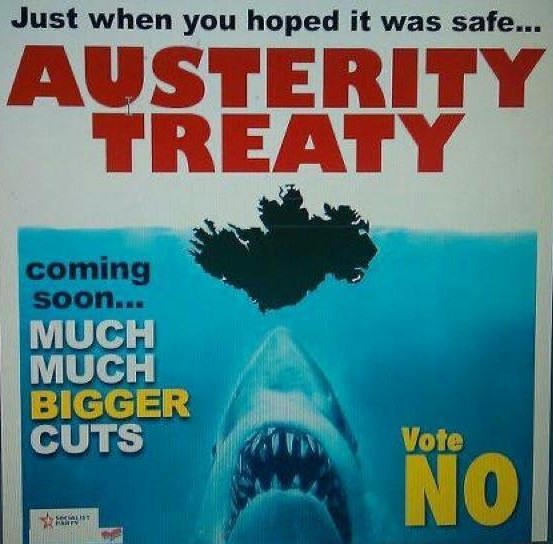
Socialist Party Poster predicts the future

The vote in favour of the Austerity Treaty is clear.  At 60 per cent Yes against 40 per cent No there is no room for doubt.  It is a decisive endorsement of government policy and a mandate for further cuts and tax increases.  The result should not have been unexpected given the political forces ranged in support of the Treaty, the support of big and small business, the failure of the trade union movement to oppose it and the inevitable support of the mass media.  In the general election last year the Irish people voted by a large majority for a new government in no important way different from the previous one and with no claim to pursue significantly different policies.

The result is nevertheless disappointing.    Austerity isn’t popular despite the vote and never will be.  Even the Yes campaign was under instructions not to celebrate its victory.  Austerity is a reality because of an economic crisis which most people still believe was the fault of bankers and property developers.  In October last year when the Austerity Treaty was originally being negotiated an opinion poll recorded 63 per cent opposed to it with only 37 per cent supporting.  Quite simply many changed their minds.  Why?

Many voting Yes did so reluctantly while many will have wanted to vote No but didn’t vote or even voted Yes.  The low turnout of 50 per cent reflected all this.  Yet the vote was decisive.

The No campaign was successful in challenging the failure of austerity and pointing out that such a policy across Europe would only lead to continued stagnation.  Ironically it was more successful than it deserved to be because from a Marxist point of view it is by no means clear that austerity always and everywhere will fail, if by this we mean failure to return a particular economy to growth.  Austerity, as the leaders of Germany understand it, is simply the state policy that enforces the normal disciplines of the market by cutting costs and devaluing capital so that the rate of profit is increased, accumulation of capital through investment and new business creation is encouraged and economic growth returns.

Socialists oppose austerity not because it might or might not return the economic system to this position but because renewed growth rests on increased exploitation of the working class and posits continuation of a capitalist system that will accumulate and grow until the next crisis. Unfortunately we are not yet in a situation where the debate can be framed in terms of a choice of alternative systems but one which only asks the best way to help the existing one.

The Keynesian alternative of increased government spending, summed up by the call for ‘growth’, has long captured the trade union movement and what passes for left politics.  On the other hand there is ignorance of the alternative Marxist perspective and difficulty in arguing for it because of our weakness. We are also not agnostic as to which side of this capitalist debate wins. This means that excavating and pushing for a genuine alternative is not easy.  The first lesson of the campaign however is that there has been a failure of the Keynesian alternative to convince, for it was predominantly under this banner that the No campaign was fought.

Ironically one reason it failed is that, being no real alternative, it was so easily appropriated by the Yes campaign who blithely announced they were working on their own growth agenda.  Being in government they are also the only ones in a position to do anything about it. Again the idea that the capitalist state should be called upon to solve a capitalist crisis is not one with which Marxists could agree.   This is particularly true of the Irish state.  Indeed the very idea that our notoriously venal and incompetent state, so implicated in facilitating the crisis, was itself the mechanism of salvation was obviously questionable.  Even the odd interviewer could not resist pointing this out.  Doubly ironic that this argument was employed by mainstream media figures in calling into question the claims of left wing No campaigners.

In terms of the campaign therefore the criticisms of austerity were blunted by the governing parties’ claims that they too were working for a growth agenda.  More importantly the need for austerity seemed inevitable because there is a huge debt, which is growing and it is going to have to be repaid.  In the meantime the Yes side told us we needed to borrow to pay for state services and we needed to borrow from those states which are telling us to impose the Treaty.  The latter would not take kindly to us saying no to their Treaty while asking for another loan.  While the No side rejected the argument that we would be unable to borrow if the Treaty was rejected the Yes side countered by saying – why take the chance?   If you heard once about needing a safety net you heard it a hundred times.

It is widely accepted that the threat that the Irish State would not be able to borrow, or only at much higher rates, introduced the fear factor that triumphed.  On this issue the weakness of the Irish state, faced with the EU and IMF, was exposed.  The Irish people have had a couple of years to get accustomed to their subordination to the major European powers and decades of acceptance of subordinating policy to the needs of US multinationals.  Any alternative based on the Irish State going in an alternative direction, one that questioned these arrangements, appeared implausible.

The second lesson is very like the first. An alternative based on the Irish state challenging the big European powers or the IMF proved unconvincing because it lacks credibility.  The campaign proved this.  Blaming workers for being afraid when this is the real situation is therefore missing the target.

The No campaign was always on the back foot.  By saying it was not necessary to approve the Treaty for the State to borrow, when this borrowing has to be repaid, it simply reminded voters of the argument that austerity was necessary.

Only two alternatives were weakly argued for in the No campaign.  The first is that the debt should be defaulted on, simply not paid back.  Secondly that the rich who caused the crisis or who have largely escaped its consequences should be taxed so that both these wrongs are righted. These arguments simply didn’t feature largely enough and I will look at just whether they are powerful and robust anyway in future posts.

In the last analysis we have had a referendum on the consequences of a systematic crisis of the capitalist economy and the referendum has told us that unfortunately the working class does not yet have an alternative.  This lesson is inescapable.  Since the socialist alternative is the actions of the working class itself, if this class is too fearful to challenge the system then by definition no alternative currently exists. The Keynesian alternative that marked the No campaign proved unpersuasive.  The capitalist alternative did not convince.  At least on this score Marxists can be at one with the majority of workers.  We can begin to exploit this agreement by putting our own criticism to counter the right and challenge the left that currently dominates what exists of a working class movement.

We can also take heart that many workers, despite no real alternative being presented and being unable to begin creating one for themselves, still decided to either vote No or abstain.  The No vote was overwhelmingly a working class one.  The 20 per cent who voted No are not however anywhere near either a majority of workers nor of the majority of society on which a socialist alternative must rest. Nor can it be claimed that the 30 per cent who voted yes are middle class and can be ignored.  What the media calls middle class is more often than not better paid workers who see themselves as having something to lose by challenging the status quo.

If fear triumphed it is not because workers are congenitally cowardly.  Fear is a rational response to relying on others for protection when these others – the governing parties, state bureaucracy and foreign institutions are all so wedded to austerity.

Confidence on the other hand means confidence in ourselves and the alternative only we can create.  It means to stop looking to others for answers, especially to parties that are committed to austerity, to a state that led us into the crisis and international bureaucracies that everywhere and at all times seek to impose austerity and protect the banks.

Many workers took what action they could and protested by voting No.  Protest is only the beginning of an alternative but it is a beginning.

Fail Better

This blog is written by someone who has been a Marxist since being a teenager over thirty five years ago.  At that time, due to immaturity and the nature of the times, hope and confidence in a socialist future were much stronger than today.  Even for those of us who never believed the bureaucratic dictatorships of the Soviet Union or Eastern Europe were socialism their existence was seen to prefigure in grossly distorted form the future end of capitalism and assurance of a new society.  The triumph of capitalism over these dictatorships and the significant weakening of the working class movement have gravely undermined these early expectations.

The response of this blogger is to look again at what he has understood to be the Marxist understanding of society and especially about how the transition from capitalism to socialism might occur.  Particularly important is a re-evaluation of what constitutes an adequate Marxist programme that socialists should argue for within the working class.  After such a long time it is difficult to slough off assumptions that are mistaken while being aware that this does not mean that everything must be prematurely thrown overboard.

It is the ambition of this blog that in its writing and reading it will stimulate both the writer and reader and encourage in whatever small way the development of Marxism in Ireland. I hope it is educative, open and accessible and encourages the productive criticism that is necessary to achieve its aims.

I could do worse than follow some famous words:  Ever tried.  Ever failed. No matter. Try again. Fail again. Fail better.