Can Ulster Unionism be left wing?

Flags of the Left?

In this week’s Belfast nationalist paper ‘the Irish News’ their regular columnist Brian Feeney put forward the claim that Protestant unionist workers had been duped into believing that being left wing was also to be ‘disloyal’.  Presumably these workers can therefore be left wing and ‘loyal’.   Indeed this is the thinking behind recent proposals within the United Left Alliance to build a “new mass working-class party in Northern Ireland to unite the working class against sectarian division and against the right-wing austerity of the Assembly Executive.”

An obvious objection to the ULA proposal is that it claims to stand for workers unity while accepting the division of workers created by partition.  The only way this can be justified is by accepting unionist claims that such workers unity should not exist.

A smarter unionist might claim that the unity of Irish workers would break the unity of the workers in Northern Ireland with those in Britain.  The problem of course is that Irish workers unity is sacrificed for a unity that does not exist.  There is in reality no genuine UK workers unity because most British workers regard those from Belfast, Derry and Enniskillen as Irish.  No carnival of reaction predicted before, and confirmed afterwards, by partition is likely upon the separation of the North of Ireland from Britain.

So we are back to the repeated collapse of what often passes for socialism in Ireland before the veto on workers unity demanded by unionism.  If such unionism is inherently and unavoidably reactionary then it is clear that such a veto should be rejected.  It might only be accepted if it could be credibly claimed that Feeney is right – Protestant workers are merely duped into believing that being left wing is also to be ‘disloyal’.

Unfortunately Feeney gives enough examples of the reactionary character of real unionism, as opposed to the pretend hypothetical unionism that at no time and nowhere has existed, to demonstrate that a different sort will never exist.  He records the mass expulsions of Catholic workers from the shipyards by sectarian unionist mobs in 1912 and 1920 when around 2,000 were expelled in the former year and thousands more in the second.  Crucially he also notes that 500 Protestant workers were also expelled in 1912 and 1,800 in 1920.  These were ‘rotten Prods’ who failed to demonstrate their true credentials by not being bigots.

Feeney notes that these Protestant workers refused to put an ‘ethnic’ solidarity, in reality a sectarian solidarity, in front of any other.  Some supporters of the ULA are presumably content that Protestant workers can accept this sectarian solidarity while being ‘left wing’.  If they did not put this sort of sectarian solidarity first then there could in principle be no objection to proposals for the unity of the whole Irish working class.  Proposals within the ULA that avoid this conclusion are in practice accepting that sectarian identity must be accepted and accommodated.  In other words sectarianism must be accepted and accommodated.  Protestations to the contrary can in reality be dismissed.  Political positions have consequences and in this case these are quite clear.

Feeney records the words of Peter Robinson of the DUP that ‘the unionists of Ulster were a distinct people entitled to determine their own future.’  Since the most right wing forces will always be the most vigorous defenders of this position acceptance of it necessarily means acceptance of the leadership of Protestant workers by the most reactionary bigots.

As to the cogency of Robinson’s claims – the unionists of Ulster were happily the unionists of Ireland until they could no longer garrison it all whereupon they then demanded not that they determine their own future but that the imperialist power did.  This then amounted to the seizure of both more than the territory within which they were a comfortable majority and less than would include all the Ulster unionist people they claimed they were.  The character of the movement that expressed this people politically became evident when it came to determining not their own future but that of the large Catholic minority they took with them.  This minority was subject to sectarian pogroms and systematic discrimination for nearly half a century before a civil rights movement exposed the irreformibilty of this unionist movement.

We can go back to Feeney’s claim that Protestant workers have been duped into believing that being left wing is ‘disloyal’.  It is obvious that they have not.  For what is it that unionism claims that there must be loyalty to?  Loyalty to what?  Well – to Queen and country!  To a monarchy and an imperialist power.  To partition and division.  To a state based on a sectarian head count.  To the rights and privileges of Robinson’s ‘distinct people’.

How could you possibly be left wing without being disloyal to all that?

Apologists on the left for capitulation to unionism put forward the final argument that we must accept unionism because the vast majority of Protestant workers are unionists.  In fact it is this very fact that makes opposition to partition absolutely necessary.  Opposition to partition is not necessary despite the unionism of Protestant workers but because of it.  It is not possible to break their commitment to this reactionary political programme without defeating it and it can only be definitively defeated by destroying the state power on which it bases its power.

BBC ‘Masters of Money’ considers Karl Marx (Part 2)

The BBC programme was called ‘Masters of Money’ and was ostensibly all about money but there was nothing said about Marx’s theory of money, which is fundamental to explaining the current economic crisis.

For mainstream economics money is essentially just paper that can be used to exchange commodities.  Provided it is not issued in too high a quantity it will maintain its value and is useful for this purpose.  Already we can see a problem.  What is the intrinsic value of pieces of paper or metal coins?  If it had an intrinsic value its issue would hardly be a problem. It becomes a problem because paper money cannot fulfil all the functions of money precisely because it does not have an intrinsic value.

The massive expansion of credit makes credit too look like money in that it is used to exchange commodities.  However at a certain point people want paid with money and not yet more credit.  When this happens credit stops being given to some people and we have a ‘credit crunch’ such as developed in the latest financial crisis when banks refused to lend to each other and Governments had to step in.

For Marx money is itself a commodity with an intrinsic value because it too is the product of human labour.  Historically it has taken the form of gold.  This is why commodity exchange is an exchange of equals because when money is exchanged for a commodity the money is either gold directly or indirectly if it is convertible into gold.  The end of such convertibility does not abolish exchange being one of equivalents.  Just as credit cannot become real money and this is proved during a credit crunch so paper money is exposed when it is over-issued and creates inflation and when in a crisis capitalist investors look to put their money into something that will preserve the real value of their wealth.

In fact this occurs during booms when speculation on one type of asset after another leads to bubbles – in high-tech company stocks, houses, commodities and now certain government bonds. The price of oil is one barometer of this activity.

Thus just as the massive expansion of credit is not a solution to the problem of capitalist crisis and the contradiction between a limited market and profitable production so also is the printing of money through quantitative easing not a solution.  Yet according to mainstream economics there is no reason why printing money should not be a solution.  The proof of the pudding is that while quantitative easing  has prevented collapse it has not abolished the crisis.

Many companies are sitting on piles of cash including US multinationals holding money outside the US and so evading US taxes.  There is an ‘investment strike’ because of the recession which has created unemployment, falling incomes, debt crises for many countries and austerity which promises not a recovery but continued recession.  All this is worse in Ireland because it is not mainly the policy of austerity which is the problem but a massive overhang of debt, which must otherwise be repaid, and shrinkage in demand due to lower wages, unemployment and emigration.

We are back to ‘solutions’ that are based on more investment and higher wagers but which ignore that it is the system based on profit which is the cause of the problems.

Two other issues occupied the last part of the BBC programme.  The first was whether capitalism would last more or less forever or would be temporary and replaced by something else. The programme accepted that Marx’s analysis of capitalism had a lot of sense to it but it did not, to no one’s surprise I am sure, think that he had any alternative.  In fact the very scarcity of his views on this was held up a number of times while recognising that no one else had much of a clue either.

This was more than a little disingenuous.  The programme started off with shots of the Berlin Wall being demolished and of pictures of Red Square in Moscow and of Stalin.  The presenter recalled that she was at university at the time the Berlin Wall came down and one thing she was aware of was that ‘communism’ had definitively failed. The programme she said would therefore not look at what Marx had to say about communism.  To return at the end of the programme and say that Marx had no alternative while excluding what he did say about an alternative is, well, not exactly fair.

Also unreasonable was the nonsense that Marx, although he had been poor, had towards the latter years of his life become a bit bourgeois.  This seemed to consist of such things as worrying over the future of his children and taking walks in the park in quite nice areas of London.  What a traitor!  He hadn’t even been down a coal mine, unlike the presenter who went down one for the programme.

That leaves me a bit conflicted as I worry over my children, like nice walks in the park (sometimes) but have been down a coal mine (once).

More importantly the programme argued that Marx had no alternative and implied that this explains the otherwise puzzling phenomenon, gleefully expressed by ex-Tory Chancellor of the Exchequer Nigel Lawson, that many people were not flocking to the banner of Marxism.  The latter is a fact, so is it the result of the former?

In an earlier post on the defeat of the opposition to the austerity referendum I asserted that the Left and the working class generally did not have a real alternative, as opposed to some theoretical one, and that this was fundamentally why many workers had voted for something that was against their interests and which some knew to be the case.  The programme actually expressed very well what is meant by an alternative, if I recall more or less accurately, it said that this would be when ‘a compelling alternative would appear.’  What is this ‘compelling alternative’?  If we are talking about the replacement of the political economy of capitalism we are also talking about its replacement by the political economy of the working class.  What is this?

Marx described the alternative to capitalism this way:

“But there was in store a still greater victory of the political economy of labour over the political economy of property. We speak of the co-operative movement, especially the co-operative factories raised by the unassisted efforts of a few bold “hands”. The value of these great social experiments cannot be overrated. By deed instead of by argument, they have shown that production on a large scale, and in accord with the behests of modern science, may be carried on without the existence of a class of masters employing a class of hands; that to bear fruit, the means of labour need not be monopolized as a means of dominion over, and of extortion against, the labouring man himself; and that, like slave labour, like serf labour, hired labour is but a transitory and inferior form, destined to disappear before associated labour plying its toil with a willing hand, a ready mind, and a joyous heart. In England, the seeds of the co-operative system were sown by Robert Owen; the workingmen’s experiments tried on the Continent were, in fact, the practical upshot of the theories, not invented, but loudly proclaimed, in 1848.”

(http://www.Marxists.org/archive/Marx/works/1864/10/27.htm)

The beginning of an alternative to capitalism arises only when the working class takes action, however small, and is not limited to creation of worker owned and controlled production.  The creation of its own organisations to defend itself against capitalism also foreshadows its future control over the whole of society.  The creation of its own workers party is the pinnacle of it being conscious of its tasks.  Many of the political organisations claiming the banner of the working class and the mantle of Marx replace the centrality of the working class itself with calls upon the state, the capitalist state, to take the action only the working class can take and only which if it does take, can it be considered any step towards socialism.

So the BBC programme on the alternative of Karl Marx got his essential teachings wrong but unfortunately, through empirical impressions, got the current weakness of the socialist alternative right.  The programme itself however is an indication that this alternative is as necessary as it ever was.

BBC ‘Masters of Money’ considers Karl Marx (Part 1)

BBC Karl MarxAs part of its ‘Masters of Money’ series the BBC 2 programme, which looked at the ideas of John Maynard Keynes and Friedrich Hayek, finished by looking at the economic ideas of Karl Marx.  The overall verdict?  It could have been a lot worse.

There were of course huge simplifications that erased exactly what Marx was saying.  These could have been avoided, and the dismissal of communism and what Marx had to say about it was on a par with cold war contempt, but despite this there was a coherent argument through the programme.

It was very much the creature of a mainstream bourgeois economist albeit one who thought there were important insights to be found in Marx, particularly his perspective on the inequality of capitalism and its instability.  It avoided some cheap shots and pointed out that Marx appreciated the revolutionising of production achieved by capitalism and its dynamic development across the world.  The presenter Stephanie Flanders repeated the often made observation that Marx’s description of capitalism is more true now than when it was first made.  She also correctly observed that profit is the soul of capitalism and made some correct remarks about the compulsive nature of the drive for profit within the system.

There were some strange observations which tried to tie the relevance of Marx’s views to particular periods which excluded the post war boom and included the 19th century but excluded the great depression of the thirties.  The whole point of the programme however was to assert the relevance of his views today and if it did no more than this then it must be judged positively.

There were some problems that, had they been addressed, would have made for a much better exposition of Marx’s ideas.  The first is that the programme avoided what Marx thought was his greatest economic discovery – the nature of surplus value.  This is the discovery that the economic value created by capitalism is the result of human labour and can be measured by the labour time necessary for its production.  The source of capitalist profit is the result of the difference between what the capitalist pays for this capacity to labour and what this labour actually produces.  This explains how a surplus can be produced and a profit arise when the exchange of commodities, including labour power, is the exchange of equivalents. It is not a question of workers being cheated when they receive a wage in return for their labour power or of unequal exchange of commodities.

This is not a particularly difficult concept to explain but it does very clearly reveal the exploitation of the working class and exposes all the hypocritical justifications of the system.

The second problem is not what was left out but what was included, that Marx held that the absolute level of wages would be held down under capitalism.  This doesn’t sit well with the programme’s acknowledgment of Marx’s view that capitalism develops the forces of production.  Who did Marx believe would buy the goods created by the development of these productive forces?  This of course was the central tenet of the programme: that for Marx this was precisely the problem.

Marx’s argument was held to be that the tendency to lower wages reduced the ability of workers to buy the goods they produced.  Increasing wages would only reduce profits, the objective of the system, so this is not a solution.  As a temporary ‘fix’ the system expanded credit to make up the shortfall in wages and allow all the goods produced to be purchased.  The explosion of credit therefore explains the current economic crisis emanating within the financial services industry.  The programme was actually quite good when it cut to the right-wing talking heads who pooh-poohed the idea that low wages contributed in any way to the crisis.  They looked neither comfortable nor convincing, or maybe that was just me.

The programme argued that Marx’s criticism went much deeper than any other but actually the programme didn’t go deep enough.  Not altogether its fault since there is widespread debate among Marxists about the causes of the current crisis and even about the fundamental mechanisms of what might be called ‘classic’ capitalist crises.

What can be said however is that the description of the crisis given in the programme and the role of credit and wages is only how the crisis manifests itself, not how it is caused.  To explain the latter would require one to start with the idea ignored – surplus value.

If low wages restricting the market were merely the problem the question would not be so acute.  The capitalists who had diddled the workers could simply purchase what the workers did not.  Everything would then be sold.  The problem is worse because the workers create added value over and above what they are paid, over and above what is required to maintain production and also above the conspicuous consumption of the capitalists, and this additional value produced must find a market.  Why can’t this too be solved by the capitalists buying the difference?

The answer is that it can but the question then is what is the result of this?  Additional value appropriated by capitalists can expand their luxurious lifestyles but the driving force of the system is not this but profit.  To increase this means expanding production both to garner extra profit and destroy competitors.  This means the capitalist must employ the additional value produced by the workers to further invest in more workers and also machinery, raw materials etc to expand output.  The problem is intensified as production increases, new markets are sought for the things that are produced and the amount of surplus value (unpaid labour) created is expanded.

In the longer term the rate of profit comes under pressure as the capitalists replace workers with machines in order to produce more cheaply or even to produce some goods at all (some high-tech ones for example).  However because profit comes from workers the value of production comprised of workers labour declines and so does the proportion made up of surplus value, from which profit comes.  Fewer workers will create proportionately less surplus value while the cost of machines and raw materials etc increases relatively, so reducing the rate of profit.  The capitalists with the lowest productivity and lowest profitability can be forced into bankruptcy.  Of course to some extent this too can be offset by lower wages but the increasing sophistication of production means that paying peanuts will not allow the ‘monkeys’ to engage in the skilled labour required.  This is a long term tendency but one we can see in operation through the economic history of the west and in the rapid economic development of Asia.  It implies that profit plays a smaller and smaller relative role in production which calls into question a system in which this is the whole purpose of its existence.

The regular periodic crisis, including the current crisis, is the route by which this longer term tendency operates.  The compulsion to produce more and more surplus value also produces these more regular booms and busts.  The drive to expand the creation of surplus value means increased accumulation of workers, machines and materials and the expansion of markets to purchase the additional production.  In an economy dedicated to the needs of the population such increased production can be consciously planned and coordinated and its limits set by society as a whole.  Under capitalism no such limits are acceptable.

The limits on production of surplus value are therefore not set by the needs of society or by the limits of the purchasing capacity of workers and capitalists.  To break from these limits credit is expanded to bridge the limitations on consumption that are the result of the limits of production.  Through credit capitalism seeks to satisfy the capitalist desire to expand production through the accumulation of more and more surplus value.  Credit expands the market for increased surplus value production.

This can produce fantastic economic booms of the sort we have seen in the last decade or so in Ireland and across much of the globe, from China to Brazil.  The attempt to expand real production and to create an even larger market for it must at some point necessarily collapse for the same reason that credit is originally introduced.  Just as increased credit is an attempt to increase profit so the collapse of credit is the result of credit no longer being able to expand profitable production.

Workers must pay back debt at some level and beyond a certain point this becomes impossible because of the limits to their real incomes determined by real production.  The same is true of the capitalists.  Ever more convoluted attempts to expand credit beyond the capacity to pay it back – through creation of yet more credit – is doomed to collapse as the ever expanding amount of debt requires greater and greater repayments to keep it going.  The fantastic expansion of the financial services industry is testament to how big such an exercise can become. A glance at the size of the balance sheets of the Irish banks in comparison to the size of the whole economy reveals the scale of the overproduction and credit expansion that can arise.

In Ireland and the US the limits were reached when workers could no longer pay for inflated housing or capitalists pay for inflated office and other building construction.  A surplus of such properties is eventually created, overproduction appears, prices collapse, capitalists cannot sell except at a loss and those who built the houses and offices go bankrupt, workers in construction are made unemployed and the banks which financed it all go bust.  At such points it can appear that the problem is that workers wages are not big enough to buy all that has been produced and that this is the problem.  Solutions are proffered by Keynesians who say that what is need is yet more investment to take the place of that which has just collapsed.  But as we see, these solutions do not address the underlying problem and provide a ‘solution’ only by postponing the collapse and stoking up a bigger tsunami when the boom busts later.

In these circumstances blame is also placed on the institutions which created the massive credit explosion – the banks – especially since such booms inevitably involve hugely speculative, criminal and stupid behaviour during a time when everyone thinks they should be getting rich quick.   No one needs regulation during a boom when money is being made and afterwards the call is made that we have to have stricter regulation when again, but for opposite reasons, no one needs regulation.  Regulation becomes the alibi for the systematic failures of the system.  Left wing critiques which focus on the banks play into the hands of those who want to ignore or are simply ignorant of the system itself being responsible for the bust.  That the bust is so spectacular is simply a result of earlier failure to burst the bubble.  For a longer and bigger boom the price paid has been a longer and bigger bust but either way capitalismproduces booms and crashes.  Keynesian solutions to extend the boom can simply create bigger crashes.

Forward to Part 2

How deep is the division created by partition?

In an article in the ‘Irish Times’ a couple of weeks ago Andy Pollak, Director of the Centre for Cross Border Studies and a former Irish Times journalist, takes up the observation that “interest among people in the Republic these days in Northern Ireland is minimal.”  “As somebody who lives in the South and works in the North, my experience in recent years, as the economic and financial crisis has come to dominate public discourse, is that southerners largely don’t want to know any more.”  Since previous interest was taken mainly to be revulsion at the violence and gratitude that it was “up there” and not “down here” this might not seem a new issue.  In fact both reflect how deep is the division that partition has created after nearly a century of existence.

Pollak quotes the young woman in the audience of the RTÉ Frontline programme during last October’s presidential campaign who attacked Martin McGuinness: “As a young Irish person, I am curious as to why you have come down here to this country, with all your baggage, your history, your controversy? And how do you feel you can represent me, as a young Irish person, who knows nothing of the Troubles and who doesn’t want to know anything about it?”

First we must say that this is indeed a strong illustration of the division that exists between North and South of the border; all the stronger because of the happy ignorance that is displayed.  On the other hand this happy ignorance demonstrates that the division which she articulates is really an expression of the unity that she is so ignorant of.

Happy ignorance?  Well yes.  The young woman speaks of coming “down here to this country” which is actually the same country, while being a different state.  She mentions “all your baggage, your history, your controversy” without appearing to be aware that the State she lives in shares much of this baggage, history and controversy.  After all, is she not aware of the history that includes the War of Independence, the Civil War (mainly in the South) and baggage that includes Catholic Church domination of society that involved systematic and widespread abuse of thousands of women and children that still resonates today?  Is she not aware that ‘the troubles’ had its worst single episode of violence in the Southern State carried out partly by agents of the British State?  Happy in her ignorance because she herself declares she “knows nothing of the Troubles and . . . doesn’t want to know anything about it.”

The disconnect between this young woman’s understanding and real history is perhaps an example of the invention of nations that don’t exist, or sometimes later do come into existence.

Pollak says that “opinion polls over the past decade or so show that a bare majority of people in the Republic now say they want a united Ireland: for example, in the 1999-2000 European Values Survey, just 54 per cent of people favoured unity.”  He quotes one University College Dublin student as saying: “Neither of us want Northern Ireland: neither us nor the UK government. I’d say if you asked the majority of Irish people – yes, nationalists, out of a sense of allegiance, might say they wanted a united Ireland – but it’s really far more trouble than it’s worth.  I mean, to integrate Northern Ireland into this State – why would you be bothered? The status quo satisfies everyone.”

Let’s take this statement bit by bit as well. The UK state doesn’t want Northern Ireland?  A very common opinion but one that is impossible to square with the experience of the British State spending billions of pounds and engaging in a long counter-insurgency campaign in order precisely to keep hold of the Northern State.  We will not go into the reason why here but let us recall that Britain left previous parts of empire extremely reluctantly.  Why hasn’t it left this bit if it actually wants to in this case?

So “yes, nationalists, out of a sense of allegiance, might say they wanted a united Ireland – but it’s really far more trouble than it’s worth.”  What trouble might this be?  Well we know that just as partition was imposed on the Irish side of the Treaty negotiations on the basis of the threat of immediate and terrible war so we know that partition today must be unquestioned because of the perceived threat of loyalist violence.  A loyalist violence that the last thirty years have shown the British State is quite happy to support and sponsor.

Uniting Ireland? “Why would you be bothered? The status quo satisfies everyone.”  This is the decisive question.  Let’s start from the end and go to the start – “the status quo satisfies everyone.”  This is the status quo that includes the literal bankruptcy of the Irish State and its admitted loss of sovereignty over its economic affairs.  The more or less complete loss of respect and legitimacy of fundamental pillars of the Southern State – politicians, Catholic Church and crucial State institutions.  Yet  “the status quo satisfies everyone!!?”

I would bet that many UCD students are very far from satisfied with the status quo but that they don’t see their dissatisfaction with the Southern State as having anything to do with partition.  If it’s not part of the problem then why would opposition to partition be seen as part of the solution?  What we have is graphic demonstration of the division of the Irish people that partition has caused that satisfaction is expressed in a State which many are in despair of because its problems are not seen as having anything to do with the other bit of the country divided.

That the domination of the Southern State by outside powers, who have dictated that their banks must be protected by the Irish people bailing them out, is not connected at all with the political rule in the North of the foremost political power in Europe most enmeshed with banking is the result of a number of factors.

The first is that such is the seeming power of these outside forces they seem almost like a force of nature, or if not, then an unalterable fact of life.  The second is that when there has been opposition either to the Northern State or to how the Southern State exploits its citizens this opposition has made no attempt to link the two questions.  The third is the more or less complete absence of any force that wants to do this.

Instead workers have been able to react only to the more immediate appearances of their oppression. This appearance is framed as a political question by the State, which is often the mechanism for enforcing it and sometimes by the putative opposition putting forward the state under different governance as the solution to oppression.

This importance of the state in distorting socialist politics has been a theme of the blog so far.  For most people, including what passes for militant opposition, the necessity of fighting two States is one too many.  In fact consistently fighting one is one too many.  That is how deep the division created by partition is.

Survey on Scottish Independence

Having written the post on Scottish independence and a United Ireland last week, by coincidence this week the British Social Attitudes survey reported on attitudes to Scottish independence in Scotland and the wider UK.  It has prompted me to note a couple of other issues that should be taken into account by socialists when considering this question.  The survey reported that 32% of people in Scotland support Scottish independence, nine points higher than in 2010 but two points lower than in 2005.  So we have seen a significant increase but still very much a minority view which historically has been the case.  Since no majority demand for independence is being made just why would socialists support it?

The creation of new nation states is not a demand of socialists and may be supported only if it has some progressive social and political content – such as removal of oppression – that (unfortunately) takes a nationalist form.  As the reality of a referendum vote becomes nearer the reactionary content of the demand for Scottish independence becomes clearer, including low corporate taxation, retention of the monarchy, staying in NATO, retention of the pound sterling and financial regulation from London.

The demand for independence also feeds on what is a positive impulse – that the closer the levers of state are the better, which is why the survey also recorded that 43% of people in Scotland wanted Holyrood (seat of the devolved administration) to make “all” decisions.  The higher figure emerged in a question in which the word “independence” was not used, and where a second option on so-called devo-max – more power short of independence – was given.  The report also said that people were, on balance, relatively favourable to the concept of independence.

The report also recorded that those in England surveyed who said Scotland should leave the UK had increased to 26% from 14% in 1997.  This might be linked to the view that Scotland gets more than its fair share of public spending, which increased to 44% from 32%.  From such views it is not an enormous leap to believing that the problem of cuts in services can be ameliorated by reducing the spending in Scotland.  Such are the divisive results of playing with nationalism.

Some supporters of Scottish independence justify this support by claiming that Scotland is a more left wing country and that it would have a more left wing government if not encumbered with the Tory majority in England and Wales.

There are two problems with this argument.  The first is that setting up the answer as a nationalist one is not progress, especially as we see more and more that the content of independence is reactionary.  Secondly the argument accepts that English workers can just, how shall we put it, get stuffed by their Tory majority.  The thought of seeking to use the claimed left majority in Scotland to leverage a wider left majority, it’s called workers unity, doesn’t appear as a consideration.  This has negative effects on English workers’ consciousness which again is more or less ignored by left wing Scottish nationalists.  The evidence of this we see above.

The argument has been advanced that what is at stake is the integrity of the UK state and that socialists are not defenders of this state.  This is quite true.  It is claimed that what is involved in Scottish independence is precisely this question.  This is only half true.  It is also claimed that the objective of socialists is to break up the UK state.  This is not true.  The objective is to create a workers state.  Scottish independence means not only breaking up the UK state but putting forward the creation of a smaller capitalist State as the solution.  A socialist one? This is not true at all.

The SNP-run Scottish government is planning to hold a referendum on independence in autumn 2014.  Socialists should oppose Scottish independence in this referendum.

Scottish Independence and a United Ireland

Peter Robinson, the leader of the Democratic Unionist Party and First Minister of the Northern Ireland administration made a speech last week about the attitude of unionists to a possible vote in Scotland for independence.  He didn’t think it would succeed and argued that there was no conflict between “one’s regional and national identity”.  Because the North of Ireland is just a region, and unionists believe themselves to be British, Robinson made the basic mistake of describing Scotland as a region when it is of course a nation.  The issues his speech touches on are interesting in a number of ways, especially the question of a United Ireland.

Firstly he states that even if Scotland voted for independence, he was confident “it would not alter Northern Ireland’s desire to maintain the link with England and Wales.”  But why England and Wales?  Why not Scotland?  We have all had to suffer the manifest nonsense of the existence of an ‘Ulster-Scots’ people with an Ulster-Scots’ language and an ‘Ulster-Scots’ culture yet nary a thought appears when it might seem there is a choice to be made between Scotland and the rest of Britain as our wider home.

This is of course because the ‘Ulster-Scots’ movement is a sectarian invention designed to prove the absolute and complete difference between the Irish, who have a real ancestral language, and can be taken as Catholic, and those who are not Catholic and support partition.  This is necessary to provide some legitimacy for this partition and the existence of the Northern State.   Marxists understand that all nations are inventions, it is just that one invented almost overnight on the basis of a non-language and another nation’s cultural heritage, whose purpose seems to fill in successful grant applications, is not very convincing.

The reason that an independent Scotland is not considered as the unit to which the Northern State must be subordinated is that it is too small and would not have the resource and power to enforce any challenge to the Northern State’s existence.  If that means sacrificing the blarney about kinship with Scotland, who cares?  After all didn’t unionists dump the identity of ‘loyal Irish’ when the majority of the Irish people decided they weren’t loyal?  And wouldn’t many also dump the loyalty to the Queen part of ‘loyal to Queen and country’ professions of faith should, heaven forbid, the British change their law, allow a Catholic to be head of State and the next King or Queen start believing in the doctrine of transubstantiation?

What matters is the existence of an outside power with the means to defend their claim to a privileged position within the population they have lived with for around four centuries.  Behind all the various labels they and others have attached – loyal Irish, Ulstermen, Ulster-Scots, British, British-Irish, Northern Irish – what is really sought is a designation that doesn’t make it quite so obvious that what is being claimed are sectarian rights.

The project tentatively raised in recent speeches by Peter Robinson about reaching out to Catholic unionists died a death when he recently supported sectarian loyalist parades past a Catholic Church in Belfast.  The attempts to dress unionism up in non-sectarian colours always fail.

A corollary of this is that those supporting Scottish independence because it will undermine Irish unionism are wrong because this unionism relies on State power directed from London, not any purported emotional or familial attachment to Scotland.  Equally the idea that because independence is sought on the grounds of democracy in Ireland, in the form of a United Ireland it should be supported for Scotland is also wrong.

For Marxists the objective is the unity of the working class across nations.  If it is not united, by definition it cannot act on behalf of its interests as a whole.  National divisions often prevent this unity.  To remove the salience of such divisions it is necessary that nations reflect no decisive material divisions beyond cultural ones that can be accommodated, involving difference without division.  For this to be the case there must be equality between nations.

Self-determination of nations is a means of ensuring that any nation suffering national oppression is able to escape this oppression and stand in a position of equality.  For small nations this is impossible in an imperialist dominated world so questions of nationality often frustrate international workers unity.  Nevertheless the removal of national divisions is also a process intrinsic to capitalist development and socialists must support the erosion and removal of divisions among workers due to nationality.

In Ireland partition has divided workers North and South and within the North on the grounds of religion. The removal of partition may be seen as part of a democratic process to remove the foundations of this division.  In principle partition and its associated divisions could just as well be undermined by a united polity across Britain and Ireland.  History has demonstrated that it is just this ‘unity’ that created and fostered this division in the first place.  A united and separate Irish State is therefore a legitimate project which could further the removal of divisions within Ireland and which socialists should recognise as progressive on this basis.

In Britain there is no real or substantive division among workers based on being English, Scottish or Welsh.  Creation of separate states, such as would  happen with Scottish independence, would however go a long way to creating the material foundation for such divisions. This would set back considerably the struggle for workers unity.

Scottish independence and a United Ireland do not have political dynamics that are at all similar and to believe so is in my view a mistake.  How do we know this?  Well this is one experience of Irish history that does have direct relevance to Scotland.  The creation of a separate state has deepened the divisions that existed in Ireland before partition because it created a new one.  This new one is also now strong and it is not one that is conducive to workers unity.  I’ll look at this in the next post.

The State and Stockholm Syndrome – Part 2

Today the State is inflicting attack after attack on working people but just like sufferers of Stockholm syndrome many people keep coming back to ask it to protect them.

It is not that this is an idea with no rational content at all.  It does have a basis in reality but not one that justifies the political positions of some of the Left.

Last week on RTE news some disabled people were interviewed protesting outside the Dail at cuts to personal assistance, without which they might be forced into hospitalisation or else left to suffer appalling neglect.  Their protest was a powerful demonstration of the enormous dependence some of the most vulnerable have on the State and the capacity of that State to mistreat them appallingly.  While the media and others basked in the achievements of Irish athletes in the Paralympics in London the Irish State was preparing to shaft disabled citizens at home.  The protests succeeded in getting a U-turn on the proposed cuts and a rare but welcome victory.

This is but one example of the welfare state which is what the Left has in mind when it defends the state.  Where the right wing scream private good and public bad the left has often responded by defending public services and with declarations of the evils of the private sector.

Opposition to welfare cuts and to cuts in education and health services should not however imply any wider defence or support for the state or ‘public sector’.  The public sector is a large bureaucracy that has no democratic content, often providing poor and inefficient services.  The state training agency FAS is just one outstanding example of the corruption and wastefulness of the provision of services by the State. These are run by a capitalist state, in the interests of capitalism, by bureaucracies totally unaccountable to working people.  Why on earth should there be any inclination to defend what we are not responsible for? What we have no control over? That should rightly be criticised by us for its often bureaucratic waste of our money?

And this is the point. It is working people who pay for the welfare state, not the rich and not capital.  In a paper written some years ago the Marxist economist Anwar Shaikh sought to examine the argument that excessive welfare provision caused economic stagnation and unemployment.  In the course of this he demonstrated for six major countries (US, UK, Australia, Canada, Germany and Sweden) that this was not the case.  His central finding has relevance to our own argument, which was “that social benefit expenditures were financed out of the taxes paid by recipients of these very expenditures: in other words, by and large, social welfare expenditures were self-financed.”

The capitalist state taxes workers and then bribes them with their own money while liberals loudly declare that taxation is somehow progressive, even left-wing, and should be increased to improve welfare servicers and boost the economy.  Workers are expected to uncritically support this as if ‘the State’ is paying for something when it is actually they that are doing so.  The key question of ownership and control of the services provided by the state is ignored and the debate is framed in terms of the supposed ‘socialist’ position of ‘tax and spend’ and the right-wing position of cutting taxes and privatisation.

This framework has been used by the right to push privatisation, presenting it as the only alternative.  But it isn’t, and opposition to privatisation is not itself an alternative to the failures of health system or education systems that consistently betray those most in need of their help.  Too often the woeful character of state services has been defended in some misguided belief that defending state ownership is defending the workers delivering the services.  Such an error is rarely made when the unsatisfactory nature of services or products produced by workers in the private sector comes under similar attack.  It is against this background that the State seeks to divide private sector workers against public sector workers and portray the trade unions, often accurately enough, as primarily interested only in the latter because that is where their own bureaucratic power base resides.

While socialists must oppose privatisation as a solution to the inefficient provision of services we should never confuse this with support for or excuses for poor State delivery of services.  Too often the attacks on the working conditions of those employed to deliver these services are made prior to privatisation, or prepared prior to privatisation, by the state itself.  Nor is it true that state ownership guarantees better delivery of services.  The appalling neglect of older people in care for example has taken place under both private and state provision.

So what we have then is the provision of welfare state services which workers pay for but which are delivered often bureaucratically, with no democratic control and often in oppressive ways, such as the means-testing of welfare recipients.  Many workers delivering the services conscientiously do their best but this is despite rather than as a result of how they are organised and managed.  Simply demanding more welfare ignores all this and ignores that it is workers who pay for it.

Many are happy to pay because they care about the services provided and have in the past or will in the future benefit from them.  The provision of unemployment insurance etc. limits the devastation to living standards consequent on redundancy or sickness.  It puts a floor under the minimum wages capitalists can demand, which is why they always want it reduced; but fundamentally it is necessary because a pool of unemployed is necessary for capitalism and this pool must be of sufficient quality to take up employment when it is available.  Welfare capitalism is necessary for the capitalist system as a cost effective way of preserving the quality of labour power.  It is not fundamentally about delivering on the human needs of people.

The large growth of the capitalist state sector, from an average in the OECD (advanced capitalist countries)  of 27 per cent of gross Domestic Product in 1960 to 42 per cent in 1988 (statistics from Shaikh paper), has been the material and ideological power base of social democratic ideas that the capitalist system has been or can be reformed, if not into socialism, then at least something ‘different’ or along vague lines of ‘another world is possible’.   The limited standards of the services provided and endemic insecurity under which welfare recipients live are one testament to the limits and precariousness of this social democratic vision of reform.

Workers expected to row in behind demands to defend a large state should be aware that this sector has grown in recent years because of the state’s role in preventing a financial collapse pushing the whole capitalist system over a cliff. In Ireland, as in many other countries, workers are having to pay for it through tax increases and service cuts.  The last thing workers need is the idea that the State is something neutral that can be captured to represent its interests.  Yet this is the present perspective of much of the Left who have diagnosed the current situation as first of all a ‘crisis of working class representation’.  That is, a crisis of the social democratic illusions that once had hegemony over many workers, although to a much lesser degree in Ireland, who have suffered mainly from capitalist populism.

This dependence on the State as part of the fundamental programme of the Left is the ideological explanation for the electoralist strategy now so much a feature of the Left.  It is no accident that the need for a United Left Alliance was suddenly seen before the general election.  Having made the electoral intervention the need for unity was then considered by some as no longer so strong and the promised progress to a real party has evaporated.  We know when it will come back, if it’s not too late.

If this is at least one of the ideological origins of the chronic electoralism of the Left it must still be explained why this has happened given the parallel ideological notion that what the Left organisations want is a revolution in which the working class seizes state power.[i]

Whatever about the belief in revolution this has not been a practical proposition for many years: during the Celtic Tiger boom or the social and political defeat of workers during the previous couple of decades.  So, while often preaching revolution in the future, as a matter of pure practicality it has done what is actually possible.  Given its ideological confusion on the role of the state and having no conception of revolutionary politics outside of a contest for state power the Left has degenerated into electoralism.

The contest for state power by the working class in a long period where the working class has not been interested in such a project has become a reformist contest for state power which resolves into just getting elected to parliament.

The real Marxist attitude to the state, as opposed to dependence on the state for solutions, which I have looked at here, here and here for example, will be the subject of future posts.


[i] I realise that the Socialist Party has political roots which eschew this traditional Marxist view in favour of a perspective of a Left electoral victory, leading to majority in Parliament passing legislation nationalising big industry with the support of mass mobilisations, this allowing the introduction of what they believe to be socialism. But this has always been a relatively hidden revision of Marxism that is disguised by what is presented as a rather rigid orthodoxy.

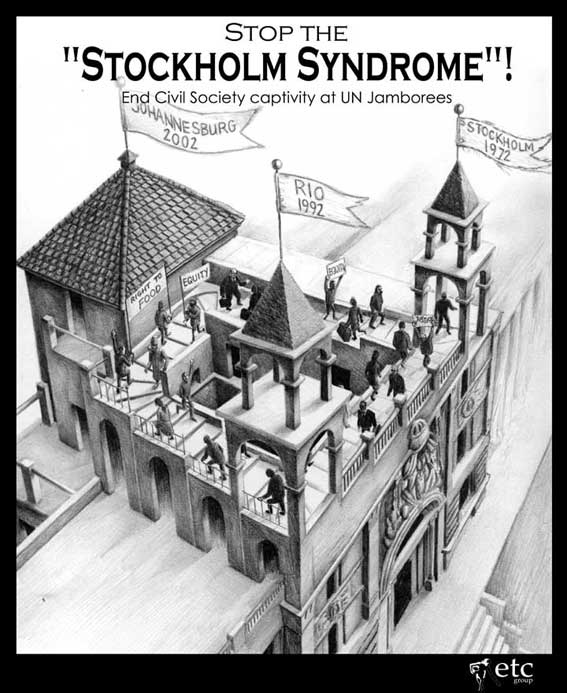
A Case of Stockholm Syndrome* – The Left and the State

In two recent posts, here and here, I have criticised proposals of the United Left Alliance (ULA) that rely on dealing with unemployment through a state investment programme.  I have also made criticisms of tax plans of the ULA, which again rely on state action for their implementation.  The state is clearly extremely important to the left alternative proposed by the ULA.

The Socialist Party in the general election called for nationalisation of all the banks and their being run democratically under public control and management. It demanded that the state take the economy and natural resources into democratic public ownership in order to plan the development of a real manufacturing base.   It called for a government based on working class people that implements socialist policies and puts people before profit.  All eight of its proposals involved state action or the need to get the left into the state and into government.

The ‘Alternative Economic Agenda’ of the People Before Profit Alliance was constructed in a similar manner.  It has eleven separate elements and again all rely on the state taking action on behalf of the working class or ‘people’ in general.  Their demands include creation of one good state bank; creation of a State Construction Agency for infrastructural investment; expansion and reorientation of the public sector away from a corporate agenda and general reliance on the state to develop the economy.

These demands for the State to take action to defend working people must be taken at face value.  It is not possible that these demands are raised in order to expose the State and rid workers of their illusions in it because very few workers actually expect the State to take over the economy and run it for the benefit of working people.  The illusions peddled are those of the Left itself, for what is presented is the ideal objective which they aim for and which workers are called upon to endorse.  Except of course that state ownership is not socialism and the Left knows it, or rather will claim to know it.  The problem is that the means – capitalist state ownership – is supposed to lead to an end that is not capitalist state ownership.

When I say that the left knows that capitalist state ownership is not socialism I mean that it knows well the statements of  James Connolly including – “state ownership and control is not necessarily Socialism — if it were, then the Army, the Navy, the Police, the Judges, the Gaolers, the Informers, and the Hangmen, all would all be Socialist functionaries, as they are State officials — but the ownership by the State of all the land and materials for labour, combined with the co-operative control by the workers of such land and materials, would be Socialism… To the cry of the middle class reformers, ‘make this or that the property of the government,’ we reply, ‘yes, in proportion as the workers are ready to make the government their property.’ Workers’ Republic, 10 June 1899.

Engels put it similarly in ‘Anti Duhring’ published just over twenty years earlier -“… since Bismarck adopted state ownership a certain spurious socialism has made its appearance here and there even degenerating into a kind of flunkeyism which declares that all taking over by the state, even of the Bismarckian kind, is itself socialist. If, however, the taking over of the tobacco trade by the State was socialist, Napoleon and Metternich would rank among the founders of socialism. If the Belgian state, for quite ordinary political and financial reasons, constructed its own main railway lines, if Bismarck… took over the main railway lines in Prussia, simply in order to be better able to organise and use them for war, to train the railway officials as the government’s voting cattle, and especially to secure a new source of revenue independent of immediate votes – such actions were in no sense socialist measures. Otherwise the Royal Maritime Company, the Royal Porcelain Manufacturer, and even the regimental tailors in the army, would be socialist institutions.”

We only need to recall that the enormous austerity that working people are suffering is due to the state’s budget deficit and the state’s debt burden to understand what Irish workers should think of ‘their’ state.  It wasn’t the collapse of the banks that placed this debt on the backs of the workers, it was the State that placed this debt on the backs of the workers through guaranteeing all their liabilities and then effectively nationalising them.  Yet nationalisation of the banks has been a left demand for years and still is today.  Yet this nationalisation is precisely the mechanism used by the State to bail out the capitalists involved directly and the whole system indirectly.

Nor is such a purpose unusual for nationalisation.  In fact I can’t offhand think of a nationalisation that wasn’t meant to benefit capitalism and didn’t place a burden on workers.  The rhetoric about dependence of many working people on the state for jobs is no different in essence from that of the supporters of Sean Quinn who have been dependent on him in the past for employment.  Anyone on the left who argues that the State is somehow democratic and has duties to working people no longer believes that the capitalist state is above all the defender of the capitalist system.  That this is what is its defining role.  But for the Left it would appear that holding the belief that the capitalist state is both a defender of capitalism and cannot be reformed and that it can provide all the things that are demanded in Left manifestos are not two mutually exclusive ideas that cannot both be true.

I am reminded of F Scott Fitzgerald’s remark that “the test of a first-rate intelligence is the ability to hold two opposed ideas in the mind at the same time, and still retain the ability to function.”  Some in the left appear to go one better and actually sincerely believe two opposed ideas at the same time.  My view is that this is dysfunctional.

*Stockholm syndrome, or capture-bonding, is a psychological phenomenon in which hostages express empathy and have positive feelings towards their captors, sometimes to the point of defending them. (from Wikipedia)

to be continued.

Sectarianism in Belfast. What’s new?

On July 12 this year a loyalist flute band marched past St. Patrick’s Catholic Church in Donegall Street near Belfast city centre.  They stopped at that particular point by “pure chance” and started walking round in circles playing a tune known as the Famine Song, which contains the line “the famine is over, why don’t you go home?”  This song is sung by supporters of Rangers Football club in Scotland and refers to the large Irish and predominantly Catholic immigration into Scotland from the 19th century onwards.  It has been found to be both sectarian and illegal by the Scottish courts.  According to the band and their political apologists they were merely playing a pop song.  Perhaps it was again mere chance it doubles as a sectarian anthem.  Perhaps also those allegations of an attack on a cameraman filming this Orange version of the X Factor are also mistaken.

On this basis the Parades Commission, a quango established by the British government to adjudicate on contentious parades, decided the band could not take part in the loyalist parade last Saturday, which was to pass the same church.  The other bands were also only allowed to march by a single drum beat past the church.

Unionist politicians were outraged and issued a statement, along with assorted flute bands, denouncing the Parades Commission, saying they were running out of adjectives to describe it , so they gave some nouns instead – “arrogance”, “incompetence” and “general ignorance”. This statement was signed by prominent members of the Stormont Government who claimed that they could no longer let the Parades Commission do untold damage to the peace process. “Violence” would potentially ensue, they said.

So on Saturday the loyalist flute band at the centre of events marched as normal and played the normal sectarian tunes that are the staple of these ‘kick the pope’ bands, as did many of the rest. The normal sectarian insults were hurled, which are surprising only to those terminally stupid or naive.   The police did nothing that anyone could notice to prevent this.  Well, not exactly nothing: there is a picture of one policeman using a loudhailer to tell the passing bands that they were really not allowed to do what they were doing.  This robust action will no doubt be followed by the police warning burglars by megaphone that they are breaking the law when they are seen to break into someone else’s house in broad daylight. Through the Police Federation the police later complained of being caught in the crossfire, presumably between those intent on breaking the law and those who were, well, how shall we say it, wanting it upheld?

There were minor scuffles and one apparent loyalist from Scotland was arrested for running through a nationalist protest, although this was blamed by one unionist politician on a republican.

So we have a loyalist coat-trailing exercise in bigotry, defended by the most senior unionist politicians who warn of violence, which stokes up the adrenaline of the street level bigot but allows the unionist politician to deny any responsibility when the lighted match touches the blue touch paper.  The police wring their hands and the nationalist politicians talk about getting it all sorted out through talking.  You have to be very, very young not be aware that this record has been played a thousand times before.  So what’s new then?

Well what is new is supposed to be – everything!  We have a new peace process, a new political settlement, a new Government and a new coalition between the “two sides”.  Belfast has a new skyline with lots of new visitor attractions welcoming tourists, which is still a relatively new concept to Belfast.  We have new cafes and restaurants and art galleries and a new generation too young to remember ‘the troubles’ and which just wants to live in peace and has no time for this sectarian stuff.

But we have been here before.  Belfast in the 1960s was also a ‘happening’ city with a burgeoning night-life whose young generation was hailed as no longer interested in the sectarianism of the past.  The sixties brought new life, hope and light even to Belfast and not just the streets of London or San Francisco.  New housing was being created that was demolishing the slums that had no inside toilet and entries that doubled as permanent rubbish tips.  Some of this new corporation housing promised mixed estates and a new Unity Flats was built at the bottom of the Shankill Road only a couple of hundred yards, if that, from St. Patrick’s church.  Unity Flats was so called because it was to contain both Protestant and Catholic tenants, sharing the one space in harmony.

We all know, or at least have some vague idea, what happened at the end of the sixties.  That swinging decade that even moved in Belfast was very new and modern but Belfast was incapable of accepting civil rights, including fair allocation of housing and jobs and equal voting rights.  Instead it burst into violence, with Orange parades which were hyped up by unionist politicians and a police force that could not subject violent bigots to the normal restrictions of the ordinary law.  Of course this violent explosion hasn’t happened yet and in my view isn’t going to happen, not yet at least.

The mutual exhaustion of the contending political forces has not yet ended and been reversed.  The unionist leaders are attempting to exert pressure that might eventually usher in their preferred model of unionist-only rule but they are not in a position to force a confrontation that would see the British Government accede to their demands. It is not impossible that a violent eruption might occur that goes beyond unionist plans but it needs a realistic objective and the aim of getting Sinn Fein out of government has not yet become the unifying campaign theme within unionism and loyalist organisations that is required.

Instead the provocative and vitriolic sectarianism endorsed by unionist politicians in the highest offices of the Stormont administration erodes the faith of nationalists in the new deal. The approach of Sinn Fein to the recent events has been relatively muted and resembles nothing so much as the old SDLP approach which so many nationalists rejected by supporting the old (republican) Sinn Fein.  Here too however there is no unified project beyond staying in office and doing nothing to jeopardise the electoral prospects of Sinn Fein in the South.

The real republicans can attempt to take advantage of the disillusionment with the Sinn Fein reaction to the sectarian provocation and can build up their support base but what is their political project?  In so far as it simply involves a renewed armed campaign it only strengthens the ideological hold of the peace process even while more and more people, subconsciously at first, begin to wonder when exactly this process, like every other, is going to end.  The traditional republican policy isn’t credible except as a form of protest but outside of an overarching strategy this republicanism isn’t in a position yet to mobilise a large political opposition.

A large scale sectarian provocation might accelerate these trends and the planned large loyalist parade on 29 September past the same church certainly has the potential to be such a provocation.  It might at the least drive home the lessons of last Saturday if it goes ahead as the parade did then.

The condemnation by two Protestant church leaders of the sectarian behaviour of the loyalist bands shows how vulnerable the loyalists are to criticism.  It is their solutions and that of the Catholic Church that is the problem.  They both want to set the rulings of the Parades Commission as inviolable.  The Catholic Church is worse because it calls for special measures to apply when the parades pass a place of worship conveniently setting themselves up as victim, potentially privileged  protection in future while turning a blind eye to the fact that a sectarian march is a sectarian march no matter where it passes. Its vitriolic bigotry is no more acceptable a hundred yards from a church than right in front of it.

What is needed is an anti-sectarian campaign that is unafraid to name sectarianism when it sees it and is not seduced by the siren calls for equality of traditions, including mutual respect for each other’s culture.  There can be no equality for a tradition based on sectarian supremacy or respect for a culture soaked in bigotry.  Such a campaign would target not just loyalist parades but the sectarian policy creeping into housing policy and the recent discriminatory employment practices of Sinn Fein.  It would challenge the trade unions to take a principled stand and, at least in principle, should be capable of uniting much of the small left. The ULA could take the lead on this in the South by making it an issue on the floor of the Dail as the clarion call for an all-island campaign.  To do otherwise is to turn one’s back on sectarianism while claiming this as the means of opposing it.

The main task would be to rip away the protection of the current sectarian arrangements that are more and more revealing their true colours by refusing to subordinate anti-sectarianism to the demands of the peace process, however this is defined.  What sort of peace is it that allows, even sanctions, the displays of sectarian bigotry on display in Donegall Street on Saturday?

The state of job creation

In my last post on the politics of the left I questioned proposals on state investment as the answer to unemployment.  In this post I want to look at this further.  The Nevin Economic Research Institute (NERI), an economic think-tank affiliated to the Irish Congress of Trade Unions has published a similar proposal to that of the United Left Alliance (ULA).

Its paper is entitled ‘An Examination of the Effects of an Investment Stimulus’ and its research shows that an investment stimulus of €1 billion would create about 16,750 short term jobs and between 675 and 850 long term jobs.    In the longer term the competitiveness of the economy is increased so that the economy grows, which increases taxation, which more than offsets the interest cost of any loan to fund the investment in the first place.  This means that “overall there is a long-term permanent decrease in the government deficit as a result of an investment stimulus.”  This is what has been referred to often as growing our way out of the crisis and debt problem.  NERI therefore proposes a phased investment stimulus of €15 billion over 5 years.

The net cost per job created, at around €34,500, is nearly the same for both the NERI and ULA proposals.  The paper by NERI sets out more fully its assumptions so it is fair to assume that these are not dissimilar to those of the ULA, which in any case we can also fairly adduce from the ULA proposals themselves.

In order to arrive at its estimates the NERI researchers use an economic model.  Like all models these require assumptions as to how the economy works and therefore how the parameters of various economic variables interact, e.g. how imports will increase given a certain increase in income as employment increases.  This is calculated from historic data from the Irish economy.  The HERMIN model used “combines Keynesian short term features with neoclassical longer term features.”

This is a problem, or rather there are two problems, not perhaps so much for the presumably Keynesian researchers at NERI but for the ULA, whose biggest components claim to be Marxists.  The Marxist analysis of the way capitalism works is very different from the Keynesian or neoclassical one.  Unfortunately, through the budget proposals of the ULA and their similarity to those of NERI, the policy proposals of the ULA display much affinity to Keynesian economics.  We have noted this already in their definition of the problem as being one of insufficient demand, which is also the view of Keynesian economists.

For Marxists this is indeed a feature of the current crisis, indeed of all crises.  Where the difference lies is that Keynesians think that this problem can be put right by state-led investment while for Marxists the lack of sufficient demand is really just one expression of deeper problems but not the fundamental cause of the crisis, which will not be put right by expansion of state expenditure.  This fundamental difference is invisible when the proposals of the ULA and NERI are compared.

For Keynesians the capitalist economy can reach equilibrium, where demand for investment funds and its supply are equal, in a situation where there is nevertheless massive unemployment, both of people and resources.  The autonomous action of the state in increasing investment can solve this problem and bring the system back into an equilibrium that resolves the unemployment problem.  For Marxists state investment can at most postpone the crisis but is not itself an answer.  By contrast the ULA present it as part of the answer.

For Keynesians the autonomous action of the state can provide a solution because the system can reach equilibrium and investment can be the driver of the economy to this equilibrium.  As the Keynesian Minsky puts it –“Investment and government spending call the tune for our economy because they are not determined by how the economy is now working.”  That a model shows state investment to be self-financing when that model contains Keynesian assumptions can hardly be called convincing. Keynesianism believes that “if entrepreneurs can only screw themselves up to do enough investment, it will eventually justify itself, since the income generated will absorb the excess capacity.” (Robin Mathews in ‘The Trade Cycle’)[i]

On the other hand Marxists see this type of statement as an example of bourgeois economists overwhelming tendency to assume that the capitalist economy works like a socialist one; that all production will more or less fulfil a useful role.  After a crisis based on massive construction expenditure that powered a phenomenal boom and then bust, this is just an incredible assumption.  The NERI and ULA proposals are based on further infrastructure spending by the same state that encouraged the last ‘stimulus’. That NERI believes this will lead to long term growth is again built into the neoclassical assumptions of the model.  Neoclassical economics assumes that capitalist markets are totally free and efficient.  A model built on such long term assumptions could hardly show anything else.

Neoclassical economics assumes that production is efficient and finds a market and that growth is the result.  Marxism makes no such assumptions but instead demonstrates the contradiction at the heart of an economy determined, not by autonomous investment, but by the pursuit of profit.  The recent massive overproduction of infrastructure was massively profitable, which is why it continued for so long.  The contradiction between this profitability and real need; the contradiction between the limitless expansion of capital and the limit of the market, was suspended temporarily and resolved temporarily by the expansion of credit.  When this expansion of credit can no longer continue the limits of the market are exposed and massive overproduction , which inevitably involves massive over-accumulation of capital, is revealed.  Keynesianism’s answer is to continue the accumulation because investment will find its own market and in any case can be autonomous within the system, as we have seen.  Marxists believe on the contrary that the accumulation of capital is determined by profit and lack of it may see accumulation shudder to a halt and collapse.

In a contest of economic ideas, between neoclassical economics where crisis are not supposed to happen and are self-correcting when they do, and Marxism, in which overaccumulation driven by super-profits is periodically inevitable, the real world has given a decisive confirmation of the latter. In a contest in which Keynesianism can assume investment creates its own demand and is self-financing and Marxism which points out the contradiction in production between use and profit, the empty office blocks and ghost estates are again striking confirmation of the truthfulness of the latter.  So why oh why would the left want to promote Keynesian solutions?

There is absolutely no reason to believe that a renewed burst of construction spend would not create new imbalances.  Perhaps the left believes that because the state carries out the spend it does not have to earn a profit but this is false for a number of reasons.

First it has to pay for the investment.  If it takes out a loan it will have to pay it back and if the investment does not create tax revenue by promoting further private capitalist investment it will not raise the necessary tax.  In these circumstances taxation would have to come instead from workers or business, which would remove the stimulus that has been created.  If the investment does stimulate or facilitate private investment then this only confirms ULA reliance on the state promoting capitalism as the way out of crisis.

Although the ULA does call for €5.3 billion of state investment in modern industry it calls for much more, €26 billion, to be invested in infrastructural investment.  In fact even some of the modern industry investment is in infrastructure.  Such infrastructural investment is normally not competitive with the main private capitalist industries but complimentary to it, facilitating it to make profits.  By making such spend central to its economic alternative the left, subconsciously no doubt, evidences the inadequacy of its alternative and subservience to capitalism.

An alternative is that state investment is directed to the production of goods and services that people actually need and want and are prepared to pay for.  This would indeed be competitive with private capitalist owned industry but this is not what is proposed by NERI or the ULA.  Instead either taxes or the promotion of private capitalist production through helpful infrastructure is proposed.

In our last post on this we questioned the policy of reliance on state investment given its history of incompetence, even in areas of no great complexity or requiring no great innovation.  The left sometimes excuses this (why?) as the result of subordination of the public sector to private capitalism.  And the answer to this is yes, that is what the capitalist state is for.  It is not for creating competition to private capitalism so why would the left demand that it does?

Even if the specific proposals of the left, in the particular circumstances that Irish workers face, are not practical this is not the main objection to them.  The main objection to them has possibly more force where they actually to work.  For if they worked, even if only temporarily, they would be both a diversion from creation of a socialist alternative and some evidence that this alternative is not needed.  The success of state industry would be the success (temporarily) of state capitalism.

The successful development of capitalism has been facilitated by the state many times and it may be argued that the more recent, and quicker, that development the more it has relied on the state.  This may be true going back through the development of every new major capitalist power from Holland in the 17th century, to Britain in the 18th, Germany and America in the 19th and 20th, the Asian Tiger economies of the late twentieth century and the Chinese of the 21st century.

The socialist alternative is something very, very different from this but the left’s fixation on the power of the capitalist state is strong and we shall look at the question some more.


[i] The quotations above are taken from a new paper that compares the Marxist explanation that the capitalist economy is driven by profit with the Keynesian alternative of the role of investment – ‘Does investment call the tune? Empirical evidence and endogenous theories of the business cycle’ See link.