The reality of the Good State

images (1)
Some readers of this blog might think that I’m labouring the question of nationalisation and state ownership and its identification with socialism. While I believe it is a question of fundamental political importance its practical significance has been vividly illustrated in the last few days.

mag6

In Britain the report from the fifth investigation into Stafford hospital has been delivered, prompting David Cameron to say that he was”truly sorry” for what had happened, which was “not just wrong, it was truly dreadful.” Previous investigations had already established in harrowing detail the abuse and neglect that took place from 2005 to 2008.

Between 400 and 1,200 more deaths took place than would have been expected between these years, although it is stated that it is impossible to say whether all of these patients would have survived had they received better treatment. Receptionists were left to decide which patients to treat, inexperienced doctors were put in charge of critically ill patients and nurses were not trained how to use vital equipment.

The National Health Service, so beloved of the British nation that it featured in the opening ceremony of the Olympics, has been damned from top to bottom.

Trust management ignored patients’ complaints while local GPs and MPs also failed to speak up, the inquiry said.

The local primary care trust and regional health authority were too quick to trust the hospital’s management and national regulators were not challenging enough.

Meanwhile, the Royal College of Nursing was highlighted for not doing enough to support its members who were trying to raise concerns.

The Department of Health was also criticised for being too “remote” and embarking on “counterproductive” reorganisations.

The findings of the report cannot be regarded as an aberration as it follows repeated damning judgments of care provided in Britain, especially care of the elderly, and news that five other hospitals are to be investigated following Stafford.

Yet the NHS is the crown jewels of the social democratic state.

The inquiry’s head said that patients “were failed by a system which ignored the warning signs and put corporate self-interest and cost control ahead of patients and their safety.”

Many on the left speak and act as if the only problem with the health service is a lack of cash but this is much less than the full story and money will not deal with what has been referred to as the cultural changes that are required.

Working class people in Britain and Ireland are all too aware of the shortcomings of the health services. While those in Ireland may wish for their own NHS those in the UK know its limitations and going to hospital is more and more regarded as something you really don’t want to do unless you have to.

Those with elderly relatives in care are all too aware of the possibility of mistreatment.

Only yesterday Channel 4 news reported on the death of an elderly person left with no domiciliary care for 9 days when the service she was receiving was closed by immigration police, who had raided the office of the private organisation providing the care. When the care provided by this organisation stopped the council never picked up on the elderly woman who had no relatives. She went without her medication and died hungry, thirsty and alone.

Two days ago the illegal charging by the Irish State of people in long-term care again became news. As early as 1976 the State, through the Department of Health, knew its charges were illegal. In 2005 the Government attempted to make them legal retrospectively although this was stopped by the Supreme Court.

The Government knew exactly what it was doing. The Minister of Health Mary Harney said that “more than 300,000 people were charged illegally during 28 years. This was entirely wrong. They were old, they were poor, they suffered from mental illness, they had intellectual disabilities, they were physically disabled. As vulnerable people, they were especially entitled to the protection of the law and to legal clarity about their situation.”

And yesterday the report on the Magdalene Laundries was released, which revealed some of the State’s role in the incarceration of thousands of women in institutions run by Catholic religious orders, compelled to work for nothing and stigmatised as ‘fallen women.’ “A very Irish form of slavery” as the Sinn Fein TD Mary Lou McDonald put it. Over one quarter of the women were put there by the State. The last laundry only closed in 1996.

The State again attempted to cover up and lie over its role.

In 2009 the Minister of Education Batt O’Keefe said that “the Magdalene laundries were privately owned and operated establishments which did not come within the responsibility of the State. The State did not refer individuals to the Magdalene laundries nor was it complicit in referring individuals to them.” Not true.

In 2011 Sean Aylward, secretary general of the Department of Justice, speaking in Geneva at the UN Committee Against Torture said “the vast majority of women who went to these institutions went there voluntarily or, if they were minors, with the consent of their parents or guardians.” He knew this because he had met some of these women.

Yet not one of the five women he had met had entered the laundries voluntarily or with the consent of their parents or guardians. Over eighty three per cent who entered the laundries were put there.

What all these examples demonstrate is that the capitalist state cannot be relied upon to provide services that working people, especially the most vulnerable, require. Some, like the Magdalene laundries, are now easy to denounce but none are models of socialism. Far from uncritically defending these services socialists must educate and agitate for a workers’ alternative to how they are currently organised and managed. The very last thing we want to do is proclaim these services as exemplars of socialism and the state that runs them as the font of this socialism.

The transitional programme and political consciousness

Trotsky-1931In a series of posts I have shown that capitalist state ownership and its identification with socialism has no support in the writings of Marx, Engels and Lenin. It nevertheless recurs again and again and has done so for years in the political programmes of organisations claiming to derive their politics from these figures. Most of these organisations also claim to be inheritors of the ideas of Leon Trotsky and consider their political programme to embody the approach of the transitional programme formulated by Trotsky in 1938. It remains therefore to look at the transitional programme to see what support it gives to today’s organisations which consider themselves to be continuing the fight for this programme.

The transitional programme was itself said to incorporate the requirements of a transitional epoch – “During a transitional epoch, the workers’ movement does not have a systematic and well-balanced, but a feverish and explosive character. Slogans as well as organisational forms should be subordinated to this feature of the movement.” (Trotsky) It cannot be said today that the workers movements of Ireland, Europe or the historically advanced capitalist countries have a feverish or explosive character. The point is therefore not to quote Trotsky in order to impose a specific formula on today but to demonstrate a general approach to Marxist politics and in so doing dismiss what are mistakes in formulating a working class programme.

The purpose of the transitional programme is to bridge the gap between workers and socialism through approaching workers at whatever level of political consciousness they are at and through progressive struggle and education direct them towards the goal of socialist revolution. It starts with existing objective conditions and through step by step struggle projects forward to the conquest of political power by the working class. It is designed to overcome the division of political programme into support for socialism as the maximum objective and the fight for a minimum programme made up of immediate demands that involve only reform of the capitalist system.

For Marxists the truth is concrete, not a formula, a schema, theory or principle and the truth lies in the whole, not any individual part or series of parts. The Marxist programme is therefore one that is true to the interests of the working class when taken in its entirety and when it becomes a guide to action. The role and purpose of the transitional programme is not therefore without its own problems; it does not of itself provide solutions to the difficulties in fighting for the interests of the working class or achieving the working class conquest of political power and it does not guarantee falling into failure to really fight for revolutionary change, on the one hand, or declarations of revolutionary virtue with limited purchase on reality on the other.

It provides no ready-made answer when objective conditions clash with working class political consciousness, when the threat to the working class is either not understood by it or it does not have the means to respond. When the Irish working class faces years of austerity, but has no conception of an alternative and so votes or accepts this austerity, the transitional programme waves no magic wand. When relatively large numbers of working class people are prepared to support or engage in very militant forms of struggle but have no or very little conception of socialism, as many republican workers did in the north of Ireland during the late 1960s and 1970s for example, the method of the transitional programme offers no off-the-shelf remedy.

What it does do is demonstrate through very practical examples how these problems may be faced and the method used to conceive the way forward – practical political demands which socialists and militant workers can fight for that can achieve their objectives. The class struggle itself will decide whether success is achieved.

This can be illustrated by a criticism I have seen made of the Irish United Left Alliance programme. This Alliance has now fallen apart but there is no reason to believe that the errors of its political programme so criticised in this blog have been understood. The electoral platform of the ULA has been criticised for not using the word socialism but this would not be a problem if it was only the word that was missing and the content it is shorthand for, working class power, was maintained.

The method of the transitional programme is based solidly on the Marxist view that the emancipation of the working class must be the task of the working class itself. The demands of the programme are all ones that the working class must fight for, impose and achieve. To bring us back to the point: nationalisation is something the working class hands to the capitalist state, the defender of capitalism, to carry out.

In terms of the examples above; the fight against austerity must place the tasks of the workers themselves to the fore, fighting the mechanisms of austerity in cuts and tax rises and putting forward alternatives that are creations of the working class itself such as democratic trade unions and workers cooperatives etc. In the North the need for defence of sections of workers attacked because of their religion must be a political task first, not a military one, and must be carried out democratically by workers themselves, not by a secret military group. It must be done under a political banner committed to democratic and class identification not sectarian and communal affiliation. Of course, as we have said, to fight is not necessarily to win but to fight under the wrong political banner and demands is already to fail.

The principle that it is working class activity and action which is key through the mechanism of workers control is also revealed in the approach to demands which on the face of it are not specifically socialist and are limited to reforms or purely democratic changes within the existing capitalist framework. In these cases such demands must be fought for through working class methods of struggle in order that the workers themselves go through the experience of fighting and learn from the experience.

Inevitably when this occurs workers quickly teach the socialists but no lesson is learnt automatically or spontaneously. The struggle in the North of Ireland is proof that even the most militant struggle does not generate socialist consciousness and that this must be fought for just as much as the particular object of struggle itself and if they cannot be linked the struggle for socialism is not on the agenda anyway.

On the other hand the fixation with electoralism evidenced by the ULA is not a lapse but sits comfortably within a political programme which calls on the capitalist state to create equality and democratic ownership. Since the illusion exists that election to governmental office allows one to utilise the state to direct capitalist society, instead of the other way round, what makes more sense that seeking election? In this scenario working class action supports the actions of the elected instead of the elected acting merely as the megaphone of the working class movement.

When I first became involved in Marxist politics in Glasgow in the middle of the 1970s the organisation I joined, the International Marxist Group, was critical of what it saw as the syndicalism of the (British) Socialist Workers Party because the SWP refused to stand in elections. Electoral intervention led to revolutionary politics being diluted and betrayed in the pursuit of votes said the SWP. Less than five years later the same argument was being advanced by Peoples Democracy against Provisional republicans who claimed that standing in elections was to play the British game, legitimising its rule and distracting from the cutting edge of the armed struggle. For both the IMG and PD the Russian Marxists at the beginning of the century were proof that entering electoral contests did not necessitate abandoning revolutionary politics.

While this might be true in principle the subsequent course of both the SWP and republicans has conclusively demonstrated that the IMG and PD (and myself) were wrong in practice. Over on the Irish Left Review a statement is quoted from Ann Foley, the ULA candidate for Cork North West and the SWP’s People before Profit electoral organisation that starkly exhibits this: “I feel the ULA has very common sense policies. When people think of socialists, they think of communism, which is not the case. There is nothing dramatic or revolutionary about our policies.”

This is not the place to explain how this collapse of these organisations’ programmes came about but it is obvious that this has happened. As explained above, even the most militant struggle may not of itself generate socialist consciousness but electoralism has its own ways of causing political degeneration.

In any case the struggle for capitalist state ownership does not challenge capitalist ideology, does not challenge the natural order of capitalist society, does not challenge the widespread illusion that the state (at least potentially) is a neutral arbiter of interests or is the embodiment and representative of a common, national interest. When the actions of the state feature so heavily in even the programme of self-declared Marxists, and for decade upon decade, can there be any wonder there is so little evidence of socialist political consciousness among the Irish working class?

For Marxists this is key because if emancipation can only follow the actions of workers themselves then the ideas these workers act upon are obviously critical. In so far as socialists can affect this consciousness then the manifestos, budget statements, press statements, speeches on the floor of the Dail carried by TV and radio, door canvassing, interventions in workers’ meetings and leaflets at demonstrations are the means by which socialist education can be achieved. How many of these stray beyond Keynesian, that is capitalist, ideas? By comparison the theoretical articles in the left press are simply salves to a guilty conscience that is not even conscious of its guilt.

Consciousness is key because socialism is another name for working class rule and no ruling class rules without being aware of it, which explains the much higher level of class consciousness among capitalists than workers. Workers cannot rule unless they purposefully chose to do so because power will not simply be handed to them. They will have to fight for it which means they will have to want it. Perhaps this is obvious but it has consequences for how socialists must see socialism coming about.

The task of ruling society by the class that makes up the vast majority of society is an enormous and unprecedented undertaking. The scope and depth of political and social awareness to make such a prospect a real possibility does not at the moment exist anywhere. It must come through struggle involving greater and greater parts of the working class, through a process of political and social education that prepares the working class both ideologically and practically for accomplishing it. The transitional programme is meant to encapsulate how this momentous task is achieved.

Unfortunately the transitional programme is looked upon in relatively restricted terms, as a result of the particular historical period in which, and for which, it was written. It is most obviously relevant to a revolutionary situation where the capitalist system is in crisis and the rule of the capitalist class is similarly struck. By their nature such situations are temporary and often fleeting.

To believe today that such crises can move the working class from its current position of subservience, where it does not even control and mostly does not even participate in the organisations which are supposedly its own, such as trade unions, to being politically conscious and organised enough to take political and economic power, is to believe in revolutionary crisis as a sort of magic wand out of which the organisation and education of decades can be squeezed into a few years, at most, of crisis.

The creation of socialist political consciousness among the vast majority of the working class is not the task of a few months or years but of decades. This is also true of the maturation of the objective conditions upon which such consciousness can only be created. This involves a qualitative increase in the social and political participation of the working class as a class in political and economic life, through real participation in trade unions, political parties, community organisations, workers’ cooperatives and other aspects of economic life.

It sometimes appears as if supporters of the transitional programme believe that a series of smart demands allied to struggle can somehow lead workers from rather backward political consciousness, almost by the nose, to one day deciding they would like to rule society. Or worse, finding by sudden surprise that they must smash the capitalist state to get what they want or that having done so waking up one morning to find themselves in charge of society almost by default. It is almost as if the working class will take conscious control of society by a process of mostly unconscious action, at least until the last minute.

While it cannot be expected that even the greatest struggle must start with full consciousness of the socialist objective it cannot be expected that the beginnings of a revolutionary struggle will start without widespread allegiance by major sections of the working class to the ideas of socialism as an objective and deep and widespread experience of self-organisation as a result of commitment to such ideals. In other words there exists a more or less long struggle to win the working class to the ideas of socialism and the need for practical experiences of organisation that comes from militant workplace organisation and inroads into capitalist property.

For those who believe only a Marxist Party needs to be conscious of such tasks and long term objective there might not appear any problem.  But if socialism is working class rule then the vast majority of workers must believe in their capacity to rule society and seek it as the solution to the critical problems which capitalist society has presented to them in periods of revolutionary crisis.

In the next post I will look at claims that Trotsky did not understand this objective requirement.

Why are the flag protests still going on?

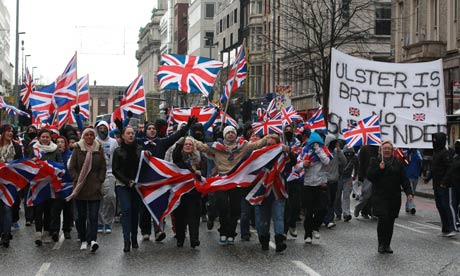
Loyalists march in Belfast waving British Union flagsWhen I first posted on the flag controversy I argued that the issue was not one of identity or culture or any supposed rights attaching to either of these but one of intimidation; as clear as day from the moment protesters attempted to get into the City Hall as the vote was taken. In fact it was clearer even earlier when the two main Unionist parties put out leaflets in East Belfast in a transparent attempt to prepare for the ousting of the Alliance Party MP.  Unionists had already supported flying of the flag on designated days, and not every day, in Lisburn and presumably the protesters hadn’t then noticed any loss of identity or culture.

As the protests have continued their intimidatory character has become more obvious: from preventing people getting to hospital to attacks on political representatives to attacks on Catholic homes in the Short Strand area of East Belfast. As the violence has increased the number of arrests by the police has fallen. The Police Service of Northern Ireland (PSNI) has stated that it is not possible to arrest those flagrantly breaking the law which is, of course, an open incentive to continue to do so.

The numbers involved have been relatively small, the core rioters have been youths and the PSNI have pointed to individuals in the paramilitary UVF as being responsible for organising the rioting. The protests, even the ‘peaceful’ ones, have been characterised by sectarian displays.

The political organisation behind the protests, in so far as it exits, is composed of marginal, relatively unknown figures or individuals with little political credibility. Their call for a return to direct rule by the British State was seen as confirmation of their marginal status and further betrayed their sectarian objective and its lack of any democratic content.

While unionist politicians have attempted to rationalise and defend the motivations of the protesters these have been exploded by the actions of the protesters themselves. So they hold up the union flag demanding ‘Hands off our Flag’, with the ‘our’ underlined. In other words the union flag is a Protestant flag and is to be defended as a sectarian symbol.

Having originated in an opportunist attempt by unionist politicians to unseat the Alliance Party the issue was initially held up as one of the right to fly the union flag 365 days a year. The acceptance by republicans that instead it could fly on the Queen’s birthdays (she has two) or the Earl of Wessex birthday etc. etc. is held up as a stunning denial of Protestant cultural rights and identity. As if understanding the absurdity of this, spokesmen for the protesters and others have listed a catalogue of grievances of which the flag issue was ‘just the straw that broke the camel’s back.’ All grievances have been blamed on republicans and nationalists.

This list includes unemployment, educational disadvantage and a supergrass trial that threatens to put some leading UVF figures behind bars. The latter is reported by some journalists as the real reason this organisation continues to keep the protests going. None of these are the result of action by, or the responsibility of, nationalists and republicans. Unemployment, educational disadvantage and poverty are the responsibility of the State from which they wish to be directly ruled and the worst areas for social and economic disadvantage are still by and large Catholic.

The idea that Protestants are unable to express their Britishness, which the more it is expressed the less those who are British recognise themselves in it, is risible. As we have said ‘Hands off our Flag’ is an expression of sectarianism, and they still want it 24/7/365 irrespective of all the other complaints.

So what we have then are relatively small protests involving mainly youths and a hard core of Loyalist paramilitaries some of whom might be facing serious criminal charges in the not too distant future. The political leadership of the protests is extremely weak and is denounced by all mainstream unionist leaders, if only for party political purposes – the Democratic Unionist Party now claims it is the target of the protests, how ironic.

The complaints of the protesters are blamed on those with nothing to do with their grievances and their demands vary over time and are in turn incoherent and contradictory. We are asked to feel their pain as they attempt and often succeed in widespread and sometimes random acts of intimidation on everyone else, regardless of religious background. There is no doubt that the vast majority of the population is fed up with the protests and there is limited appeal for incoherent violence. Many, like the State itself, have assumed, and still assume, that they will burn themselves out.

So how come the protests are able to continue? The most immediate answer is the one we have mentioned. The police have let them. It is assumed by many that once the protests are over the PSNI will quietly round up the miscreants but there is limited reason to assume this. The Chief Constable, fresh from conferring legitimacy on the political front of the UVF by attending and speaking at its conference last year has really said they can do nothing now to stop them. However the loyalist paramilitaries are thoroughly penetrated by the British security services and have in the past been financed, armed and provided with intelligence by them.

The PSNI has said that around 4,000 have taken part in recent protests and they can’t ‘wade in’, ignoring that single republican demonstrations of greater number have in the past received exactly this treatment. The point is not to demand such repression on loyalists because the forces of the state are clearly not an answer to loyalist paramilitarism.

This immediate answer is also the deeper answer. For all their small size and the opprobrium heaped upon them the protesters are not as isolated as they appear.

It was mainstream unionism which kicked the protests off. Their rank and file political representatives have appeared regularly on the protests and their leadership has endorsed their demands. The loyalist paramilitary leaderships have not disowned and expelled their wayward local leaderships and the unionist political parties and paramilitaries have come closer together, most visibly in the new unionist forum. The nationalist and republican parties have called on these mainstream unionist parties to do the right thing as the peace process deal they have sold themselves into necessitates an alliance with unionism. Coalition government is what they have demanded for decades and they have no other strategic perspective. In this way they are prisoners of their unionist partners in government just as they are now wedded to political support for the PSNI.

So the protesters are tied to the unionist parties by their function as foot soldiers for ‘peaceful protest’, by ideology and their ties to loyalist paramilitaries. The state sponsors these paramilitaries but like rabid dogs are not under total control. The paramilitaries are working more closely with the unionist parties and these unionist parties are in government with nationalists and republicans, who are clinging to them for a solution because they value their role in government above all else, including what being in it can actually deliver.

All this is understood by many people if not in quite the way just explained. There is for example the understanding that if the police went in tough to arrest violent protesters or simply to prevent obstruction of the roads this could trigger wider involvement by paramilitaries. Unionist parties might then row in to excuse, justify and attempt to gain control of the protests. The republican and nationalist policy of hugging these unionists would be put under strain and the potential would thereby be created that the existing careful political deal could unravel. This of course is an extreme but not inconceivable scenario.

It is not that the state forces could not succeed in facing down this challenge because it is still unlikely the majority of the population would engage in open rebellion but the existing political dispensation would come under extreme stress. For the British state there might be no victory.

Should they capitulate to the most rabid expressions of sectarian intimidation they leave themselves open to similar challenge in the future and in the meantime convince the nationalist population nothing has really changed – they continue to live in an orange state where loyalist sectarianism sets the rules. If they win they run the risk of inflicting the sort of defeat on unionism that republicanism has just suffered. This led republicans to giving up their armed campaign, accepting partition, accepting Stormont, supporting the police, disarming and then dissolving the IRA. Were a similar defeat inflicted on unionism where goes the basis for British rule and a separate Northern state?

The existing policy of softly, softly or bribes to the criminals involved is therefore an attractive option, as might some concession on flag waving at the City Hall, except that it works only in the short term. Instead of an immediate crisis a gangrenous corruption discredits the state and eats away at its foundations and its legitimacy.

All this reflects that the population of the north of Ireland is still bitterly divided as is the working class despite the hot air about the new modern Northern Ireland, its peace process and the solving of an 800 year old Irish question.

This does not mean that nothing can be done by those seeking to awake from this nightmare of history but this requires that we also stop dreaming that this nightmare is something other than what it is and speak the truth, however unpalatable. There is no progressive impulse behind the protests. They are entirely reactionary and they should be opposed be anyone who considers themselves anti-sectarian. This opposition needs to be organised and make its presence felt. Only then can a path be chartered out for the many workers, Protestant and Catholic, trapped inside this sectarian state.

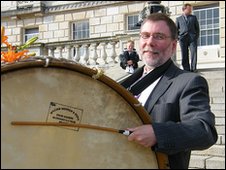
Nelson McCausland, a little man with a big loud drum. (by Belfast plebian)

47925243_3707225203_e18c6d4d4e-1It is a hell of a misfortune that at this time of a drastic need for some form of social protection for hard pressed working class families we are saddled with a social development minister in the Stormont Executive whose opinions accord well with the right wing government across the pond and who is also regarded by many as a hardened religious sectarian. This little man with the big drum is also proving to be the most active of the generally passive Stormont ministers.

It should be said at the outset that he took on the ministerial portfolio at a very awkward juncture when the Tory austerity plans where already in an advanced state. The SDLP of course vacated the crucial social development portfolio as soon as they caught sight of the content of the welfare reform bill and Sinn Fein screamed PASS to the chance to take over the department from the SDLP following the May 2011 assembly elections. Why Sinn Fein chose to take on the department of arts and culture, the one with the smallest budget and largely symbolic importance rather than one of the key economic departments stands as an interesting question without of course an answer.

Nelson McCausland is known for being an ardent Unionist, a formidable Orangeman and monarchist, a ‘pro-life’ evangelical Christian who is also a Creationist and of course a great enthusiast for something called the Ulster-Scots culture. Indeed it can be persuasively argued that he more than any other individual is responsible for the ideological mishmash called Ulster-Scots culture. When he was appointed to his previous ministerial post in 2009, in charge of dolling out money to the arts and science cliques, his primary mission was to raise Ulster-Scots heritage up a couple of intellectual notches to the status of ‘a traditional culture’ and therefore make it worthy of taxpayer cash. The small budget didn’t deter Nelson too much.

Before he captured the minister for arts and culture portfolio he was the director of a lobby organisation called the Ulster-Scots Heritage Council. Back in those days he had little or no money to promote Ulster Scots heritage as a rival to the Irish language and culture movement and so no one of any intellectual standing took him too seriously. It was only when he got his hands on the department cash card that the little man with the big drum had to be listened to by the typically anti heritage arts cliques.

For a brief moment Nelson attracted the attention of the middle brow Guardian newspaper, thus earning a wider notoriety and crossing swords with non-other than uber-scientist Richard Dawkins who declared that the minister was an unfit person to be in charge of science museums. This was after Nelson wrote to the Ulster Museum requiring that it display a range of Creationist inspired artefacts to offer the North’s naive children a legitimate alternative to the “unproved theory of evolution.”

It didn’t take much to put down poor Professor Dawkins, faced with the acuity of Ulster’s superior evangelical mind. “Dawkins is an arrogant and militant atheist who prides himself on his knowledge and reason. He loves to demean and disparage others but this time the mighty man came unstuck” declared Nelson on his personal blog.

Being anti-modern in evolutionary science has not stopped the little man with the big drum being a very successful politician, He is already into his second ministerial position and is easily the busiest minister. Some people think they know why he is so successful. The key to his lasting popularity they say is to be found in his very frequent sectarian public outbursts, something that goes down well in loyalist flag waving working class districts. Let’s run through just a few of his more recent efforts.

On the third of October the Belfast Telegraph ran a story -‘Fury after Nelson McCausland says there’s no need for more Derry housing funds.’ It emerged that the minister had refused a recent appeal by Derry City Councillors for additional funds for the Housing Executive to build more social housing in the city. The latest figures revealed that the number of families and single people on waiting lists had passed the 3,000 mark

Sinn Fein councillor Tony Hassan said ‘we get a letter back from the minister’s secretary and to me it was disgraceful.’ The SDLP councillor John Tierney called the statement of the minister ‘crazy’. And here’s a nice Nelson touch – ‘the minister’s letter also referred to Derry City Council in the address and throughout as City Council of Londonderry.’

On the 25 September he faced down an SDLP sponsored motion calling for a three month parliamentary suspension for supposedly breaching the ministerial code by failing to condemn illegal acts conducted by a royal black band parade as it swaggered outside St Patrick’s Church on Donegall Street in Belfast. The suspension motion attracted a lot of media attention and was voted down. And so the little man’s political stock went up within his own party. McCausland, more than most DUP politicians, gets a kick out of baiting both ‘republican’ and nationalist politicians. He runs his own blog just to keep the invective regular.

In mid-June we can pull out another two media stories, ably covered by the online newspaper the Detail. The story broke that Nelson McCausland had caused worry and anger among Housing Executive workers when he chose to provide fellow DUP assembly colleague Paula Bradley with the religious breakdown of staff employed in North Belfast in the most public way. The decision was strongly criticised by trade union officials who warned that publication of the religious designation of workers in specific localities might put them at risk.

Less than a week later a car belonging to a Housing Executive employee was destroyed after it was set on fire by masked youths as it was parked outside the agency’s district office in Newtownabbey. ‘The Detail understands that Housing Executive officials have been forced to review security measures at offices across Belfast as a result of the attack. In a series of questions to DSD ‘we asked Mr McCausland to explain why he decided to publish the figures against the advice of his own officials and despite staff concerns…We also asked DUP MLA Paula Bradley why she had originally asked for a religious breakdown of staff… she chose not to respond.’

Also in June McCausland was criticised for blocking plans to build 200 new houses for people deemed to be nationalists on the vacant site of the former Girdwood army base in North Belfast. ‘However the Detail can now reveal new evidence showing that the DUP minister held discussions with the Housing Executive to ensure that four loyalist areas in north Belfast were given preferential treatment to be included in a new housing building scheme despite having little or no sign of any significant homelessness.’ Nationalists make up most of the 1,300 people in homeless stress in North Belfast.

The Detail obtained evidence that emergency approval was used to ensure that the four estates were added three months after the three year building plan had been finalised by the Housing Executive. The change was all down to pressure from the DSD and was a clear breach of a 40 years old protocol that social housing should be allocated strictly on the basis of priority of need and not on the basis of political or religious affiliation. This incidentally dragged Sinn Fein into the mix as they had agreed to the decision at local level talks.

And here is one from this month, this time from Nelson’s personal blog. Under the heading Biased Broadcast Corporation he complains about a pro Sinn Fein bias at, of all places, BBC Northern Ireland . He thunders against a BBC documentary that he hasn’t even seen about the life of the youngest Lord Mayor of Belfast, who happens to be a member of Sinn Fein, councillor Niall O Donnghaile.

He notes ‘This is not the first BBC documentary on a Lord Mayor. There was also a documentary on Alex Maskey, who was Lord Mayor in 2002. In between there were eight other Lord Mayors and they were drawn from all the larger political parties, but the BBC has decided that the only party whose Lord Mayors merit a BBC documentary….There is an onus on the BBC to acknowledge that it was wrong to give preferential treatment to Sinn Fein, to determine how this happened, to ensure that it does not happen again and to take action to redress this balance.’ There is a lot of this type of thing on Nelson’s blog, most of it aimed at excoriating Sinn Fein, his partner in government.

So Nelson’s strong electoral success can be attributed to some degree to what appears to be his carefree sectarian mud-slinging that goes down well with his many loyalist followers. However this is not what I want to focus on so much, rather I want to show up his other prejudice, his right wing class prejudices that make him the emblematic leader of the main party of government at Stormont.

Nelson holds strong opinions on socio-economic matters but critics prefer to ignore them, all the more to encourage him to just get on with his ministerial post. If only Nelson would just do his job and not court publicity things would be fine say his newspaper critics. But Nelson is getting on with his job. In fact he has the two biggest policy initiatives of the Executive on his agenda, implementing the welfare reform bill and dismantling the Housing Executive.

We can pick up the thread of Nelson’s approach to welfare reform from his offering on the bedroom tax. The chief executive of the Northern Ireland Federation of Housing Associations (NIFHA) Cameron Watt recently called on Nelson to delay the implementation of the bedroom tax until the Universal Credit is actually ready to go. This would of course only mean a postponement of about six months, from April 2013 to October 2013.

According to NIFHA this is ‘necessary, realistic and fair.’ Nelson rejected the very meek proposal outright saying that ‘I intend to increase funding available for discretionary housing payments to be made to all social housing tenants.’ In other words if any of the 34,000 tenants experience problems with rent they might be able to get a discretionary payment to help them out. Housing officers are to be offered a new career path into becoming poor law guardians.

The public line of the Stormont Executive is that it is being blackmailed by the Con-Dem government into progressing the welfare reform bill. If it was down to them it would not happen but if they put obstacles in its way they would face financial penalties

Yet in his speech to the NIFHA conference Nelson says “Turning now to events at a UK level, everyone in the room will be aware of the welfare reform agenda which is progressing. We know that its implementation is unavoidable. I think most of us will agree that the key principles behind this legislation are positive and we should recognise the real positives and opportunities that can be achieved as a result of some of these reforms.”

The principle that Nelson likes most is the one that says a welfare system should promote personal and social responsibility. In fact Nelson being a keen evangelical is happy to edge the State out of welfare provision and get the churches in. His department has already licensed a couple of schemes to that end.

We find an article on his blog of 25 November 2012 called signposts for funding churches “The Minister for Social Development, Nelson McCausland, believes that there is a very critical role to be played by the faith sector in developing strategic partnerships with Government to help deliver practical approaches to tackling poverty. For this reason, the Minister funds the Faith Forum for Social Development …. Minister McCausland wants all faith-based groups to become engaged with the Department whether it is on local Neighbourhood Renewal Partnerships, benefit uptake or helping ensure the connections exist between vulnerable citizens and agencies such as the Social Security Agency or the Housing Executive. There is no cost to them and only benefits to be gained by those most in need.

Nelson’s DSD operates something called the Voluntary and Community Unit which doles out millions to agencies like the Law Centre, Citizens Advice Bureau and Northern Ireland Council For Voluntary Action. It also funds the Regional Infrastructure Programme which has an annual budget of 3 million to fund community groups. Some scope then for Nelson to put his own brand of welfare policy into operation.

The day Nelson became Social Development minister in May 2012 was the day the death knell sounded for the Northern Ireland Housing Executive (NIHE) and of socialised housing. Nelson has chosen to make social housing his battlefront. We already mentioned the clash over the abandoned Girdwood Barracks, the emails seeking knowledge of the religious makeup of the Belfast offices in February 2012 and the publication of Catholic numbers working in Newtownabbey.

There has also been his row with the senior management over a £7 million repair contract with a company situated in East Belfast, Red Sky. The contract was terminated in July 2011 following accusations that the company had engaged in a practice of overcharging. Huge political pressure was piled on the NIHE to overturn the termination of the contract

Three days into his post Nelson met with the NIHE chairman Brian Rowntree to ask that the decision be suspended for six months. The investigative magazine the Detail gained access to the emails. The NIHE chairman sent one to the Department for Social Development (DSD) Permanent Secretary Will Haire on July1 saying he had ‘serious concerns and misgivings’ over the pressure being applied by the DSD over the contract and asked that the minister take a step back. The DSD permanent secretary emailed back saying ‘I believe that you should withdraw the remarks you made.’ Four days later Mr Rowntree resigned as Chairman citing personal reasons.

Nelson knows a few things about the NIHE that are not to his liking. He knows that it came into being to end the allocation of social housing on the basis of religious affiliation and he knows it always has had a catholic majority in its staff. But putting the sectarian boot into the NIHE is not his only motivation. He does not like its social democratic ethos. He is in fact busy drawing up plans to have it broken up and privatised.

It is likely that the 90,000 tenants will be transferred to private Housing Association where rents are higher. A good number of redundancies will follow out of the 2,800 staff. For those who think he will face opposition from Sinn Fein – think again. In July Stormont announced that it had set itself a target of transferring 2,000 homes to Housing Associations and a number of British based Housing Associations are said to be taking soundings. The public justification for the change is stated in the consultation documents, which is the need to raise a billion pounds for repair work. The NIHE is not able to raise loans from private banks but Housing Associations can do so.

What is motivating the politicians in the Stormont Executive to break up and privatise the NIHE? Some might think it is pure sectarianism. But if it is, what about Sinn Fein? Do they also want a sectarian carve up? Is it simply a relentless falling into line to what is happening to social policy in Britain, with the varied the attacks on the social housing sector? Is it the Stormont Executive looking for one way to cut its own costs in this time of austerity? Or is it that nobody wants to rock the Stormont boat too much in case it sinks and so Nelson must be left to pursue his own private political agenda with a minimum of opposition? Maybe all the above motivations are factors? What do you think?

Lenin and nationalisation

144px-Lenin_perfilIn an earlier post I outlined the founders of Marxism opposition to confusing socialism, or the road to socialism, with capitalist state ownership.  I wanted to follow that up with a look at the views of Lenin.  When I did it would appear that the argument of opposition to state ownership is not advanced, in fact it is contradicted, and at best it might have to be modified.

This is because in the middle of the Russian Revolution, in fact in the weeks before the October revolution, Lenin wrote ‘The Impending Catastrophe and how to Combat it’ which sets out what appears a completely different approach.

The first thing that struck me about this short document is the title.  It does not promise a solution.  It does not declare ‘The Impending Catastrophe and how to Solve it’.  In fact the first sentence states ‘unavoidable catastrophe is threatening Russia’.  With all due regard to the much less severe crisis currently affecting Ireland there is something to be learnt from accepting that the job of socialists is not always to promise pain-free solutions to workers but to persuade them that they have to fight.

The problem is stated concretely and what’s more it is stated that everyone knows and says what the solution is.  This is “control, supervision, accounting, regulation by the state, introduction of a proper distribution of labour-power in the production and distribution of goods, husbanding of the people’s forces, the elimination of all wasteful effort, economy of effort.  Control, supervision and accounting are the prime requisites for combating catastrophe and famine. This is indisputable and universally recognised.”

Lenin proposes nationalisation of the banks but makes no claim that this is any sort of confiscation of private property.  In fact he is keen to emphasise how little difference it makes in this respect:

“If nationalisation of the banks is so often confused with the confiscation of private property, it is the bourgeois press, which has an interest in deceiving the public, that is to blame for this widespread confusion.”

“The ownership of the capital wielded by and concentrated in the banks is certified by printed and written certificates called shares, bonds, bills, receipts, etc. Not a single one of these certificates would be invalidated or altered if the banks were nationalised, i.e., if all the banks were amalgamated into a single state bank. Whoever owned fifteen rubles on a savings account would continue to be the owner of fifteen rubles after the nationalisation of the banks; and whoever had fifteen million rubles would continue after the nationalisation of the banks to have fifteen million rubles in the form of shares, bonds, bills, commercial certificates and so on.”

However he states that having done so “it is impossible to nationalise the banks alone, without proceeding to create a state monopoly of commercial and industrial syndicates (sugar, coal, iron, oil, etc.), and without nationalising them.”  Again the limitations of what is involved is stated – “All that remains to be done here is to transform reactionary-bureaucratic regulation into revolutionary-democratic regulation by simple decrees providing for the summoning of a congress of employees, engineers, directors and shareholders, for the introduction of uniform accountancy, for control by the workers’ unions, etc. This is an exceedingly simple thing, yet it has not been done! . . . and this could and should be done in a few days, at a single stroke.”

Where, as in the oil industry, the owners sabotage these plans and production generally Lenin proposed that they may have their property confiscated.  While all this was to be the task of the revolutionary-democratic state “the initiative of the workers and other employees must be drawn on; they must be immediately summoned to conferences and congresses; a certain proportion of the profits must be assigned to them, provided they institute overall control and increase production.”

The purpose was to increase production and stave off complete economic collapse and consequent famine, which was made all the more probable by the mismanagement and sabotage of the capitalist owners.  This required workers control, which meant workers supervision of existing management – not workers sole management and control never mind capitalist expropriation and workers ownership.  Abolition of commercial secrecy was proposed in order to make this control effective and democratic.  Under workers ownership the question of commercial secrecy would not arise as the owners with the secrets would be the workers.

Lenin was at pains to point out that what he was proposing was not socialism. “This is why I have already stated in Pravda that people who counter us with the argument that socialism cannot be introduced are liars, and barefaced liars at that, because it is not a question of introducing socialism now, directly, overnight, but of exposing plunder of the state .”

What he was proposing was not new.  “It might be thought that the Bolsheviks were proposing something unknown to history, something that has never been tried before, some thing “utopian”, while, as a matter of fact, even 125 years ago, in France, people who were real “revolutionary democrats”, who were really convinced of the just and defensive character of the war they were waging, who really had popular support and were sincerely convinced of this, were able to establish revolutionary control over the rich and to achieve results which earned the admiration of the world. And in the century and a quarter that have since elapsed, the development of capitalism, which resulted in the creation of banks, syndicates, railways and so forth, has greatly facilitated and simplified the adoption of measures of really democratic control by the workers and peasants over the exploiters, the landowners and capitalists.”

The exploiters, landowners and capitalists were not being abolished.  Indeed far from it.  They were to be organised!  Capitalism was to be developed!

“Compulsory syndication, i.e., compulsory association, of the industrialists, for example, is already being practised in Germany. Nor is there anything new in it.” The political opponents of the Bolsheviks were blamed for not carrying this out.  “Compulsory syndication is, on the one hand, a means whereby the state, as it were, expedites capitalist development . . . The German law, for instance, binds the leather manufacturers of a given locality or of the whole country to form an association, on the board of which there is a representative of the state for the purpose of control. A law of this kind does not directly, i.e., in itself, affect property relations in any way; it does not deprive any owner of a single kopek and does not predetermine whether the control is to be exercised in a reactionary-bureaucratic or a revolutionary-democratic form, direction or spirit. Such laws can and should be passed in our country immediately, without wasting a single week of precious time.”

The primary responsibility for implementation of this was to belong to the capitalists themselves.  “And it must be repeated that this unionisation will not in itself alter property relations one iota and will not deprive any owner of a single kopek. This circumstance must be strongly stressed, for the bourgeois press constantly “frightens” small and medium proprietors by asserting that socialists in general, and the Bolsheviks in particular, want to “expropriate” them—a deliberately false assertion, as socialists do not intend to, cannot and will not expropriate the small peasant even if there is a fully socialist revolution. All the time we are speaking only of the immediate and urgent measures, which have already been introduced in Western Europe and which a democracy that is at all consistent ought to introduce immediately in our country to combat the impending and inevitable catastrophe.”

So what are the political conceptions behind Lenin’s demands which he is clear do not amount to socialism?

“And what is the state? It is an organisation of the ruling class — in Germany, for instance, of the Junkers and capitalists. And therefore what the German Plekhanovs (Scheidemann, Lensch, and others) call “war-time socialism” is in fact war-time state-monopoly capitalism, or, to put it more simply and clearly, war-time penal servitude for the workers and war-time protection for capitalist profits.”

“Now try to substitute for the Junker-capitalist state, for the landowner-capitalist state, a revolutionary-democratic state, i.e., a state which in a revolutionary way abolishes all privileges and does not fear to introduce the fullest democracy in a revolutionary way. You will find that, given a really revolutionary-democratic state, state- monopoly capitalism inevitably and unavoidably implies a step, and more than one step, towards socialism!”

“For if a huge capitalist undertaking becomes a monopoly, it means that it serves the whole nation. If it has become a state monopoly, it means that the state (i.e., the armed organisation of the population, the workers and peasants above all, provided there is revolutionary democracy) directs the whole undertaking. In whose interest?”

“Either in the interest of the landowners and capitalists, in which case we have not a revolutionary-democratic, but a reactionary-bureaucratic state, an imperialist republic.”

“Or in the interest of revolutionary democracy—and then it is a step towards socialism.”

“For socialism is merely the next step forward from state-capitalist monopoly. Or, in other words, socialism is merely state-capitalist monopoly which is made to serve the interests of the whole people and has to that extent ceased to be capitalist monopoly.”

What Lenin is therefore saying is that the measures he proposes go no further in many cases than what exists in Western Europe but while implemented by a revolutionary-democratic state, i.e. not a workers’ state, they are a step towards socialism.  What is then decisive is the character of the state.

These measures gain their democratic and revolutionary character from the state – remember this is a state that has already resulted from a revolution, one that had overthrown a centuries-old monarchical regime, was headed by avowed Marxists and was subject to a situation of dual power where workers, soldiers and peasants organisations were vying for effective and official power with the institutions of this state.  How different is this from the idea that these measures, such as nationalisation, in themselves are socialist even when implemented by a right-wing government at the head of an established capitalist state implementing the diktats of the combined powers of European imperialism!

For the purposes of this very limited argument all this should be clear and its relevance and application to the political programme of today’s left also clear.

What concrete purpose does nationalisation of the banks serve in Ireland today?  Their nationalisation was the practical means to saddle the working class with the debts of large sections of the capitalist class.  This is obvious to everyone.  Is there any sign that the usefulness and correctness of this policy has been questioned?  Unfortunately not, instead the United Left Alliance demands “full nationalisation with direct public control of the banks”.  The same, but more so.  As was said of the Bourbon dynasty in France, ‘they had learned nothing and forgotten nothing’.

Related, but much wider, issues arise from this booklet by Lenin and the quotations cited that we shall not go into.  For example Lenin states: “that capitalism in Russia has also become monopoly capitalism is sufficiently attested by the examples of the Produgol, the Prodamet, the Sugar Syndicate, etc. This Sugar Syndicate is an object-lesson in the way monopoly capitalism develops into state-monopoly capitalism” and that “given a really revolutionary-democratic state, state-monopoly capitalism inevitably and unavoidably implies a step, and more than one step, towards socialism!”  This may gloss the undeveloped character of Russian economy and society as a whole.

Secondly the view that “if a huge capitalist undertaking becomes a monopoly, it means that it serves the whole nation. If it has become a state monopoly, it means that the state . . . directs the whole undertaking. In whose interest?  Either in the interest of the landowners and capitalists, in which case we have not a revolutionary-democratic, but a reactionary-bureaucratic state, an imperialist republic.  Or in the interest of revolutionary democracy—and then it is a step towards socialism.”  This takes a view that the state, even if “revolutionary-democratic”, can effectively act as the vehicle for working class emancipation without workers ownership of the means of production.  While Lenin calls for workers control we have seen how limited this is.  We have also to consider of course the long debate about the ambiguity of the formula of “revolutionary-democratic”.

It is not our purpose to debate these other issues here and regard must be had to the limited purposes of Lenin’s own booklet, the rather telescoped and formulaic end to it and his qualification that the revolutionary-democratic state tasks in relation to the economic crisis are “a step towards socialism” and not socialism itself.

The purpose of this post has rather been to set out that even where Lenin puts forward the demand for nationalisation it is not as a socialist programme but as one that is a precursor to it. In addition it assumes a state of a very different form and in a very different position from the one that many on the Left today call on to carry out tasks that should be those of the working class itself.
Northern Nationalism in Denial

untitledWednesday’s Northern nationalist paper ‘The Irish News’ betrays the exasperation of many at the continued widespread disruption and violence caused by loyalist protests.  Its front page headlines with ‘Arrest the loyalists who are taking us back to a wasteland’.  Inside, their columnist Brian Feeney excoriates the unionist leadership and their hypocrisy and mendacity.  He dismisses their ‘unionist forum’, which has been called by the unionist political leaders to unite all shades of unionism, and claims that they no longer rule the state, including the police, as they did in the past because “of a raft of legal changes which have gone through in the last 25 years guaranteeing equal rights for all.”  To paraphrase: Unionists will have to accept the reality of equality with nationalists and sit down with them to sort out their problems.

Meanwhile, on that day’s Dublin-based ‘The Irish Times’ its Northern editor reports on the flag riots and the new Unionist Forum and states that “most people will wish it good luck.”

What we have here is three examples in which reality, which stares one in the face, is ignored and sacrificed through ideological wishful thinking.  Let’s take them in turn.

First ‘The Irish News’ calls for the arrest of the loyalist protestors, expressing the now widespread view that they have broken the law and caused widespread disruption and intimidation with seeming impunity.  Inside it has a hard-hitting editorial which never mentions the only people who can carry out their demand and who have so utterly failed to do so – the police.

The new Police Service of Northern Ireland was supposed to banish into history the partiality of the Royal Ulster Constabulary but there is no apparent difference in the way the new PSNI has treated loyalist protest from the old RUC.  In the past this would have led to criticism of the latter but now nationalism supports the PSNI but is faced with the uncomfortable fact that the PSNI appears in no respect to be fundamentally different in its approach.  The paper’s editors are left calling on the new emperor to put on clothes while still cheering him and recoiling from pointing out he hasn’t got any on. It is unable to truly call the police to account or to explain its role in facilitating the protest because to do so might raise uncomfortable questions why all the “raft of legal changes” arising from the peace process have changed so little.

Which brings us to Brian Feeney, who has the same problem, because the last three weeks show that the Northern State continues to treat the two communities differently.  It is hardly conceivable that republicans could have caused the disruption of the past three weeks without vigorous suppression by the State.  So how can he claim that equality is a reality that unionists are refusing to accept?  Just who is blind to reality?

Even if the proposed Unionist Forum is simply an attempt to regain the political initiative by the Unionist parties who set the whole protest off, it signals that only sectarian organisation is capable of political effect.  The joint call by Peter Robinson of the DUP and Martin McGuinness of Sinn Fein for an end to the protests achieved absolutely nothing.  Brian Feeney calls for the unionists to sit down with nationalists apparently oblivious not only to the fact that they have been doing so throughout the crisis, in fact for over five years but that they have actually been in government together for all this time.  During these years they were supposed to be drawing up a joint anti-sectarianism strategy which was to include how to deal with such issues as flags.  So the clichéd call for the two parties to get together to sort out their differences now has to ignore that this has been a failure.  What’s the alternative now then?

Finally we have the pious declaration of the ‘The Irish Times’ Northern editor that most people will wish the Unionist Forum good luck.  As we have said, if it is to be more than a device for the unionist leaders to regain control, in which case it simply gives control back those who caused the protests in the first place, it will be a sectarian construction uniting the unionist political parties with the political fronts of the loyalist paramilitary outfits who have been organising much of the violence.  The policy of promoting these forces by the state became news again when it was revealed that ex-prisoner groups were to get £4 million in state funds through what has been widely described as a “slush-fund”.  The smell coming from it was such that the neither Peter Robinson nor Martin McGuinness wanted to be publically associated with it despite it coming out of their Office.  Fashionable talk about reconciling the combatants doesn’t look so smart when one set is promoting riots and intimidation in the streets and seemingly getting paid for it.

What we have therefore is Irish nationalism in denial of the reality that stares it in the face.  It is of course possible to deny reality for a long time even while this becomes more and more uncomfortable.  But it is not possible to do so forever.  Its smug assumption that what we have witnessed is unionism in crisis ignores its own role in covering for the Unionist political leaders who kicked the protest off and who they must now cling to as the way out of the protests. It is reflected also in its support for the police who have “facilitated” the protest.

If unionism is in crisis then in a system which is a joint sectarian carve-up so is nationalism.  Most nationalists may not believe it but that too stares them in the face when they can’t get home from work and can’t go Christmas shopping in Belfast city centre.

The 2011 census results in Northern Ireland

NorthernIrelandCouncils-religion2008 

The results from the 2011 Northern Ireland census have been eagerly anticipated because the Northern Ireland state was created, and continues to be justified, by a sectarian head count.  Had partition not been imposed on the island of Ireland either through the independence of the whole island or through continued British rule the census would be interesting but would not in itself raise the question of the state’s existence or legitimacy.  That the census raises both and by virtue of the religious affiliation of the people who live in it is in itself a condemnation of the Northern state.

The census revealed that the Protestant population has declined to 48% in 2011 from 53% in 2001 while that of the Catholic has increased to 45% from 44%.  In order to arrive at these figures the 17% who said they had no religion, or the religion was not stated, were asked what religion they were brought up in.  A sort of ‘you can run but you cannot hide’ from religion no matter how much you might want to.  This is similar to employment monitoring which asked not what your religion is but what community you are perceived to belong to. The latter leads to mistakes if you happen to read ‘The Irish News’ in your lunch break and show a partiality to Glasgow Celtic when discussing football in the office but have never ever been to your first holy communion.

In the latest census 5.6% say they neither belong to nor have been brought up in any religion, up from 3% who said they belonged to neither religious category in 2001.  The census of course is silent on whether anyone brought up in any religion, or who professes to be a member, has complete faith in that religion’s doctrines, respects its institutions and cadres, accepts and identifies with any of its associated cultural practices (like going to mass) or follows its leadership in any way.  So even on this the census raises more questions than it answers.

The question that an answer is sought for most is the political views of the population, which has always been strongly linked to religious affiliation.  The same problems arise in making any firm assessment of what this information means.  First political views are read across from identification of nationality rather as if the latter determined the former in some over-riding way.  However one can identify oneself as British and be appalled at the way sectarianism seeps from every pore of society and one can define oneself as Irish and still reject all the isms that supposedly accompany it such as Catholicism and nationalism.  The full range of political positions in between are absent from the census as is beliefs on how ones political views are to be put into action.

The census is full of boxes and people, even in Northern Ireland, do not fit into them, or if they do they often do not do so neatly.  The census itself is a means of forcing them to do so but because they don’t debate is now raging over what the figures mean.

So 40% said they had a British only national identity, 25% an Irish only identity and 21% a Northern Irish only identity.  It was possible for example to tick two boxes and say you were both British and Northern Irish, which was ticked by 6.2%; 5% were none of these nationalities.

It is the combination of the religion and nationality results that has raised most debate.  Are those that say they are Northern Irish mainly pointing to the fact that they are Irish but from the North, or simply as a matter of fact citizens of the Northern State, or are they saying that they recognise a separate Northern Ireland nationality that  may or may not thereby warrant a separate state?

Commentators have noted that a large section of the population that are Catholic have not identified themselves as Irish but probably as Northern Irish and some no doubt as British.  This information will be released later.  From this it might be judged that even if they are culturally Irish (whatever that means) they are either happy with British jurisdiction or might be, given certain conditions.  In any case they might not, if asked to in a referendum, vote for a united Ireland.  They are what has been described by First Minister Peter Robinson as Catholics who support the union and who the Democratic Unionist Party could canvass for support. Many in this group however currently vote for nationalist parties – either Sinn Fein or the SDLP.

This however shows only the limitations of deriving conclusions from figures in a census.  Robinson has made reference to a majority of Catholics who support the union.  He has also prominently supported loyalist bands parading past a Catholic Church at which one band had previously stopped and marched round in circles playing a sectarian song.  He also called onto the streets the loyalist mobs that have protested against the reduced flying of the union flag over Belfast City Hall.  This has resulted in violent demonstrations, attacks – particularly on the Alliance Party – and death threats.  Loyalist mobs have repeatedly blocked roads or carried out violent attacks.  They have wandered round Belfast City Hall with union flags singing sectarian songs associated with old and new Glasgow Rangers football club supporters and burning Irish tricolours.

The unionists have done this on the basis that the union flag is their flag, a symbol of unionist and Protestant identity.  The Catholics whom Robinson supposedly seeks support from are therefore being told to accept that the trappings of state are those of a different religion and alien political tradition.  The party traditionally associated with the pretence to a non-sectarian union with Britain is the Alliance Party which the DUP and loyalists have made a main target of their attacks.  So much for a non-sectarian Northern Ireland.

This week has also witnessed another report on the murder of solicitor Pat Finucane which revealed massive collusion between loyalist paramilitaries and the state.  The report, despite it being inadequate, has yet again revealed the widespread use by the British State of the most extreme sectarian bigots to kill anyone who gets in its way.

The report revealed that the forces of the British State in the shape of the army, police, security service and top level officials were all instrumental in murder.  The prominent Home office junior minister Douglass Hogg set the scent by declaring, after briefing by the police, that certain lawyers were unduly sympathetic to the IRA and legions of later government ministers and politicians did their bit by strenuously denying claims of collusion.  The report is unable to say how high up collusion went but is nevertheless sure that there was no overarching conspiracy.  The Finucane family have pointed out that those most damned are dead as are the organisations most criticised.  We are expected to believe that all this is in the past.

Unfortunately state collusion with loyalism never ended.  The treatment of widespread loyalist protest over the past week or so has revealed yet again the partial attitude of the police to loyalist illegality and violence.  The new police force declare that there is no evidence of the loyalist paramilitary leadership being involved while it is impossible to deny that the protests have been organised by these same organisations. The distinction between leadership and organisations is introduced to protect the leadership.

So we have the unionist movement claiming that the symbols of the British State are Protestant and another exposure of how this state has worked hand in glove with the most extreme bigots to kill those entirely engaged in lawful activity.  In the past week the widespread but relatively small protests have been allowed to cause considerable disruption where, had it been republican protest, it is almost certain they would have been suppressed.

In other words the State to which Catholics are more and more assumed to owe some loyalty to and to identify with has been found, both through its most fervent supporters and its officially authorised defenders, to be guilty of the most rabid bigotry and violence.  Therefore even if the former is true, and more Catholics are prepared to accept it, political developments may be such that is doesn’t matter what some people believe to be the case, it is what is actually the case that will matter.  In politics as in everything else people are free to believe what they want but they are not free to make what they want actually be the case.

While the census results cannot be read simply to determine and predict political developments, and they cannot even be confident in population projections, the figures revealed have their own political impact.

For a state set up on the basis of a sectarian head count that head count is important.  The publication of figures showing the Protestant population is no longer an absolute majority and the gap between them and the Catholic population is narrowing is a blow to unionist claims.

When the Northern state was set up Ulster Unionists had the opportunity to justify the Ulster part of their self-description by pushing for the inclusion of all 9 counties of the province within British jurisdiction.  They did not because they wanted their hold to be secure and it needed a sizeable Protestant majority because the support of the minority was not to be expected.  Now that the religious populations are so near in size it does not make sense to fight to make the state an expression of a sectarian identity if the purpose is to defend the union.  It does however make sense if the purpose is to maintain sectarian power and division.  It then makes perfect sense that even the slightest hint that within the Protestant community this sectarian solidarity is not primary should be squashed – hence the attacks on the Alliance Party.

On the other hand the census does not support a perspective based on a Catholic majority voting a united Ireland, at least not for a long time.  The previous census results appeared amidst widespread speculation of a large increase in the Catholic population, an increase that didn’t materialise.  This latest census has recorded only a small increase, albeit that Catholics are a majority in the youngest age groups.  Even in purely demographic terms this does not mean an inevitable Catholic majority and in political terms the significantly lower proportion defining themselves as Irish hardly gives confidence that even a future Catholic majority will simply demand a united Ireland.  This is especially so given that the Ireland that they might be united with is such an unattractive political entity.

With these alternative programmes and the near equivalence of populations the prognosis can hardly be one of stability.  The need for some alternative is currently championed by the call for mutual respect and reconciliation but this is proving more than a little difficult.  How can two mutually exclusive, even antagonistic, claims show respect to each other never mind be reconciled?  The DUP and Sinn Fein have supposedly been working on an anti-sectarian policy for five years and there is no sign of it while it took the unionist parties five days to propose the union flag fly all-year round at Stormont.

This policy of reconciliation is actually accommodation of sectarianism not its eradication.  Instead of the sectarian politicians being the solution it is unionist politicians who kicked off the recent protests.  Reconciliation means Sinn Fein covering up for the worst of unionist aggression.  So after getting the flag down (some of the time) Sinn Fein then votes along with those who created the violent protest in a hypocritical Assembly motion condemning violence, thus implicitly absolving the DUP and Unionist Party of responsibility.  The flying of the union flag, as we pointed out here before on this question, is a means of intimidation.  The purpose of it flying at City Hall as on every other Government building is to sanction the many, many more union flags that fly all over the North which tell Catholics that this place is not theirs and tells Protestants that their place is anti-Catholic.

The possibility of such a situation being compatible with a shared Northern Ireland national identity, much trumpeted by the media in the wake of the census results, is remote.  The only identity that can be shared by Protestants and Catholics is one that expresses something that they have in common. What is it that they have in common that could possibly form the basis for such unity?

Support the ICTU demonstrations!

frame-1-ictu-protest-march-over-the-governments-four-year-austerity-plan-assembling-at-christchurch-in-dublin-irelandThe Irish Congress of Trade Unions is meeting on Wednesday to discuss the possibility of organising a series of demonstrations across the Irish State in opposition to austerity and debt.  It has issued a press statement outlining its reasons; in particular it is targeting the issue of debt and has indicated that demonstrations might take place in a number of towns and cities including Dublin, Cork, Galway, Sligo, Limerick and Waterford.

The possibility of these being organised should be welcomed but more important, if they take place, they should be supported.  It gives working people an opportunity to demonstrate their opposition to austerity, to demonstrate the scale and anger of their opposition and put forward what they think should be the alternative.

It gives the small socialist movement an opportunity to campaign in the working class to make these events as large as possible so that the demonstrations can convince and give confidence to others to also oppose austerity and oppose the crippling debt.  It gives it the opportunity to speak to workers to take action outside as well as inside the trade union movement and in the private sector as well as the public sector.  The purpose would be to begin reuniting workers who have been successfully divided into union and non-union and between public and private sector by the propaganda of the State, employers and media.

A real campaign at union and community group meetings, at workplaces and in the streets including door to door leafleting and canvassing should aim to mobilise as many as possible to turn out, should the demonstrations be called.  Right away attempts should be made to extend the numbers building the demonstrations through meetings organised to discuss the demonstrations and how they could be made as large as possible.

These meetings should not simply be organising meetings but should also discuss why we oppose austerity and the debt, how they are affecting the lives of working people, how we should organise against them and what our alternative should be.  What for example is our position on debt default?  What role does strike action have in a campaign against austerity and default?

There are many issues facing workers and socialists have the opportunity to give them the possibility of coming together beyond the existing union movement to unite and discuss all these issues.

In this blog I have addressed these questions here, here, here and here.

What have been called as one-off demonstrations should be supported in order to make them an on-going campaign both before and after they take place.

All this is primarily the task of the socialist movement but it is not limited to it.  There are many opposed to austerity and many campaigns against its effects that should take the opportunity to better organise and unite with each other to discuss what should be the alternative.

An additional onus is however placed on the socialist movement.  It claims to stand for the interests of the whole working class and has a special duty to take every step to unite it in defence of its own interests.  This has two aspects.  First it must unite itself to carry out the task of uniting workers.  Otherwise it is weaker and opens itself to charges of incompetence, hypocrisy or political sectarianism.  The second is to create a campaign which is open and democratic and which at the very least offers the possibility, if not yet the certainty, of uniting the most militant workers.

The unity of the socialist movement in such a task should in principle be easier since it has theoretically already achieved some level of unity through the United Left Alliance.  The ULA should immediately discuss how such an opportunity can be utilised to build an anti-austerity campaign, on what basis it should be built and what policies it should fight for.  This is, after all, something which the ULA said it was going to do when it got elected and it would not do to renege on promises, just like the Labour Party and all the other right wing parties, once elected to the Dail.

Complete agreement should be no barrier to taking this action.  A democratic campaign would in any case allow everyone to argue its particular view on the way forward and the alternative.  In a democratic campaign of action there would be no role for vetoes.

The objective on the day would be a united left contingent, united around an agreed programme and demands, offering an on-going campaign to everyone at the demonstration who didn’t just want to go home afterwards to watch themselves on the RTE news.  The size and resonance of such a contingent would testify to the potential to build real and lasting opposition to austerity.

There is of course a flip side.

To borrow from management-speak: for every opportunity there is a threat and for every potential strength a potential weakness.  To fail to take opportunities threatens the effectiveness of resistance to austerity and to fail to strengthen the resistance will result in weakening it.  The ULA through its minor electoral success has given itself some responsibilities which it should relish as opportunities to help workers build a movement against austerity.

Support, build and go way beyond the ICTU demonstrations!

Budget 2013 and the alternative

6122011-budget-2012-second-day-14-630x491The 2013 budget is going to introduce tax increases and spending cuts of €3.5 billion.  Michael Noonan smiled when holding up the budget document to the cameras while Brendan Howlin looked serious.  Nevertheless RTE reported that Labour TDs were pleased claiming that their fingerprints were all over it.  And so they are.  Their footprints, where they walked all over many vulnerable sectors of society, are also all over the budget.

There has essentially been only one defence of these austerity budgets and that is that the Government has had no choice.  No choice because there is no economic alternative and no choice because the State has lost its economic sovereignty and is basically doing what it is told to by the Troika of European Commission, European Central Bank and International Monetary Fund.

In this budget they have felt compelled to come up with a new defence – it is nearly over. This was trumpeted by Michael Noonan and also claimed by the Labour leader that “It is the budget that is going to get us to 85% of the adjustment that has to be made, and will therefore put the end in sight for these types of measures and these types of budgets”.

This hardly looks credible, which is not good news, because what it essentially means is that the austerity measures implemented have both been insufficient and haven’t worked.  The economy has contracted and stagnated even as the austerity measures have been insufficient to bridge the deficit.

For 2012, the deficit has turned out to be around €500 million larger than planned but because of upward revisions to data from earlier years, the deficit target, set as a percentage of GDP, will still be hit. This assistance in meeting the ‘target’ will not be available in 2013.

At the end of 2013 the deficit will be 7.5% of GDP.  In 2008 (excluding that related to the banking bail out) it was 7.3% rising to 11.5% in 2009. All the austerity budgets have achieved so far is a reduction of 4% – less than half way to eradicating the budget deficit never mind 85% of the way.  Even by 2017 the IMF forecasts the deficit will be 1.8% so the debt will still be getting bigger.

As with all these budgets there have been cuts to capital expenditure with another €500 million reduction targeted for 2013. In 2008, capital expenditure was close to €10 billion. In 2013, it will be under €3.5 billion. Public capital expenditure has been slashed by 66% which wipes out, and more, the so-called stimulus measures announced earlier in the government’s PR/con exercise that claimed to be promoting jobs.  This means the infrastructure of the state, economy and society will disintegrate more or less quickly.

The sheer madness of the austerity agenda is demonstrated by the fact that the €3.5 billion in cuts and tax increases will be wiped out before they are even implemented by the €3 billion payment of the promissory notes for the Anglo-Irish bank, which no longer exists, and repayments of €2.45 billion of bonds for Irish Life & Permanent. On top of this there is the rising interest cost of the debt, which will increase from €5.7bn in 2012 to €8.1 billion in 2012-13.

With the debt increasing, even at a reduced rate of increase, the burden of interest payments on it can only worsen.  This makes the debt unsustainable.  A rising interest burden will be a permanent anchor on growth.  This is a problem because the Government is relying on renewed economic growth to get out of the stagnation now in place.  The weakness of Irish capitalism means that it must rely on outside forces for this growth.  Either that or there is some debt relief to lower the amount of debt and the burden of interest payments.

In the meantime particular groups of the working class will suffer real hardship, living standards will decline or at best stagnate and unemployment will be limited only by continuing emigration.  The stresses imposed on society will be expressed in mounting social problems that will often be presented as a simple increase in personal misfortune while increased inequality will coarsen social relations and further weaken social solidarity.  The absence of any radical perspective will see reactionary prejudice become common currency.

Once again the United Left Alliance has put forward what it states is a socialist alternative.  In substance it is the same argument as that put forward last year but with more detail and some development here and there.  There is no need to repeat the analysis presented earlier in this blog including here, here and here.

The ULA is in no position to implement any of its proposals.  The purpose of the document must therefore be an educational one.  What it teaches is therefore the only useful criterion by which to judge it.

It starts out by claiming to be a socialist alternative and its headline is repudiation of the debt, an end to austerity and the need to invest in jobs and services.  All these are undoubtedly the immediate needs of the working class.  The problems start when we look to see how it is proposed these ends might be achieved.

The ULA “proposes to take the burden of the crisis off working people, improve their lives and revive the Irish economy.”  On the other hand it admits that “the budgetary proposals put forward by the ULA can in no way offer a comprehensive solution to the crisis we face.”  How the first claim is reconciled to the second is not explained.

While the debt crisis “resulted entirely from the actions of developers, bankers and the politicians who facilitated them” it is not explained how this can be reconciled to it being “a manifestation of a deep structural crisis of global capitalism.”  It is nowhere explained what this latter statement means, how it explains what has happened or how it explains what solutions are possible.  The Marxism to which the core elements of the ULA claim commitment is founded on claims to present just such answers but they are not here.

It might, with some justification, be claimed that the precise cause of the crisis is also a cause of some debate within Marxism.  Unfortunately any suggestion that a key task of the ULA might be to debate this out so as to inform the politics it espouses would be held up many as a fetish of sectarian or dogmatic individuals who aren’t interested in practically ‘building the movement’, or some other such boorish remark.  Instead while (dumbed down) Marxism is relegated to recruitment meetings for novices the vacuum that is the politics presented to workers is filled with Keynesian, that is capitalist, ideas that are the currency of liberals and the leaders of the trade unions.

Let us see some ways in which this is expressed in the ULA economic alternative.

First the ULA proposes to improve the lives of working people and revive the Irish economy but there are no socialist measures proposed that would achieve this.  Were the proposals to therefore fail (if by some miracle they were tried) it would discredit what passes itself as socialism while if they were to succeed they would go some way to making socialism irrelevant.

The ULA claims that “the alternative we propose will not be implemented by the current parties in the Dail or by the Irish state.”  Yet it proposes that the Irish State increases income tax on the rich, reduces taxation on workers, introduces a wealth tax, introduces a financial transactions tax, increases corporation tax, takes “full control of the banks”, supports small business, invests to create jobs, embarks on a programme of council house construction, creates a new construction company, renationalises all privatised strategic enterprises and establishes a state owned gas and oil company. It declares that “the ULA believes public enterprise and public works must play the central role to redevelop the economy on a sustainable basis.”

The ULA claims that “radical measures that break with the logic of ‘markets’ are required” but the demands on the state above do not do this while it is claimed these measures will “revive” and redevelop the economy on a sustainable basis.”

“There is a need for active struggles to demand policies that prioritise the need for jobs, public services and growth, using public investment and democratic socialist planning to chart a way out of the current crisis.”  What sort of struggles? For what policies? And who will we demand this of?  How would they deliver on it?  What, who and how?  Where and when don’t even arise given the vacuousness of this string of words.

In other words – as a vehicle for education – the alternative budget, when it is not mistaken, as we have explained in earlier posts, is simply incoherent.

What is clear is that the ULA has no strategic perspective.  It calls for socialist planning, but socialist planning is just another term for working class rule, for the working class controlling society.  Yet it proposes the state, the capitalist state, take action in the here and now to solve the crisis and develop the economy on a “sustainable basis”.

This lack of coherence reveals itself in timidity, contradiction and calls for solutions that have already been the means to subordinate and exploit the working class; as when the ULA calls for “full nationalisation with direct public control of the banks” when it is nationalisation and state control of the banks that has been the mechanism to burden workers with the debts of the speculators.

Even when it calls for “direct public control of the banks” this can as easily be defined as the current arrangements as it might by workers control.  So how does such a demand clarify anything?  How does it educate anyone on what they should fight for?

The ULA is currently undergoing an organisational crisis but its real problems are political.  It argues an alternative that is simply not based on the actions of the working class. It is imperfectly aware of this so it substitutes vague calls for action and acknowledgements that what they are proposing is only temporary amelioration.

There is a possible solution to this problem and it involves debating openly and democratically what a socialist strategy should be.  As I have said such calls are resisted.  It therefore falls to those prepared to do so to engage in such a debate so that we don’t just point out what’s wrong but also say what’s right.

Fighting over flags in Belfast

6The decision last night of Belfast City Council to stop flying the union flag 365 days a year, and not at all over other council buildings, resulted in a protest by around 1,000 loyalists outside the City Hall and ultimately a small disturbance. There was also trouble in East Belfast when the result was announced including an attack on a Catholic Church.

In preparation for the vote the Democratic Unionist Party had distributed tens of thousands of leaflets attacking the Alliance Party which had indicated it would not support unionist demands that it continue to fly all-year round but would propose that it fly only on designated days.  This is around 15 days a year on occasions like the Queen’s birthday and is the policy at Stormont where the devolved Assembly sits.  Nationalists had stated their intention to call for a vote which would have led to the flag not being flown at all and the Alliance proposal was seen as a compromise.  Holding the balance of power in the council it was widely expected the Alliance proposal would succeed, as it did.

In the build up to the council meeting the loyalist Progressive Unionist Party (PUP), which is the political front of the paramilitary Ulster Volunteer Force (UVF) stated that while its previous position was that it accepted the flag should only fly on designated days, now that it was being demanded by nationalists it would oppose it.  Sinn Fein has claimed that the UVF was prominent in the protest which led to the minor violence.  There is no doubt that loyalist paramilitaries were behind the violence in East Belfast.

At the demonstration the usual sectarian songs and slogans were recited and an Irish tricolour was burnt.  The BBC interviewed some participants in the protest.  One protested about the need to defend the flag that had been flown in Afghanistan while inside a DUP councillor protested that nationalists were attacking the union flag and other parts of Protestant identity.  The case against flying the flag could hardly have been better made by those opposed to it.

Loyalists defend the flag because it is a symbol of imperialist might and of sectarian identity while liberals complain that it is the flag of the country and should not be confused with sectarianism.

Of course flags are symbols of states.  They fly to denote the claims of that state over territory or over institutions.  They cannot be divorced from the history and policies of that state or institutions and they cannot be divorced from the actions of those who fly it.  For all these reasons the union flag is a symbol around the world of empire, military adventure and occupation and in Ireland it has a history of being identified with a sectarian state and sectarian practices.  The protestors were defending it because they support all of this, they support imperialism and sectarianism.

The approach of the PUP is instructive in this regard.  To Catholics their policy is – yes you can have rights, but only those we will let you have.  So you would not have to put up with the union flag flying every day if you had kept your mouth shut and not tried to change it but now that you have you must be prepared to suffer protest and intimidation.

This is the point that all those complaining about pointless arguments over flags refuse to take on board.  If the continued flying of that flag results from the exercise of intimidation then that is what the continued flying of that flag represents and that is what it symbolises.  It would do so, and has done so up to now, because that is what has allowed the flag to fly.  As a symbol it represents sectarian intimidation and the union flag symbolises the power of a state established by force and sectarian intimidation.  That it is now defended in such a way simply confirms this.

Some further observations can be made.

The rabidly sectarian character of the protest and opposition inside the council chamber blows yet another hole in the ‘campaign’, if that’s not too strong a word, by Peter Robinson and his claim that Catholics are happy with the union, partition and can be won to support the DUP.  If the flag of that union is claimed by its defenders as a part of a sectarian identity just what part of the state are Catholics supposed to identify with and support?

Garnering non-sectarian support for British rule is the role of the Alliance Party and it is no coincidence that the main target of the unionist campaign was this party.  The intention of the DUP is to win the East Belfast Westminster seat back from that party and sectarian flag waving is the way to do it.  That in doing so the claims of Robinson are exposed is not accidentally ironic.

The protest was relatively small despite the effort put into it but the reaction from the state was instructive.  The police had their usual low profile which was criticised by Sinn Fein and compared to what their activity would have been had 1,000 republicans turned up.  The presence of  figures reminds everyone, or rather it should, of the Chief Constable’s attendance at the PUP party conference earlier in the year.  This is now neatly sandwiched between UVF rioting in the lower Shankill and similar activity in the city centre and East Belfast.  This attendance signalled acceptance of such activity as part of the normal rules of the game but rules which should not be overstepped.

BBC interviewers refused to entertain criticism that loyalist figures were in attendance and might have something to do with the violence.  Fortunately one no longer has to worry whether the BBC will similarly refuse criticism of Osama Bin Laden on the grounds he is not in the studio to defend himself.

Concentration on the small size of the protest is therefore misplaced.  Unionism has increasingly taken to the streets, reflected in sectarian exhibitions in Donegall Street outside a Catholic Church and in the very large Ulster Covenant demonstration. The City Hall protest was sponsored by the main unionist parties who are both in government and they have signalled the issue is not over by promising to demand that the union flag is flown permanently at the cenotaph in the grounds of council buildings.

Even as low level controversy sectarianism is necessary for political rivalry and feeds continued division.  It sets wider political expectations and exposes the limited role of the state in combating expressions of sectarianism.  The liberal pretentions of the British state are allowed to continue to be presented as the only choice and the effect is to enforce an unacknowledged intimidation of alternatives.

In the larger scheme of things this particular issue does not threaten wider instability but it is one of a number of sectarian outbursts that remind everyone who cares to pay attention that the sectarian dynamics of Northern politics and society remain intact.  It is very unlikely that the continued brewing of this sectarian kettle will forever remain off boiling point.