
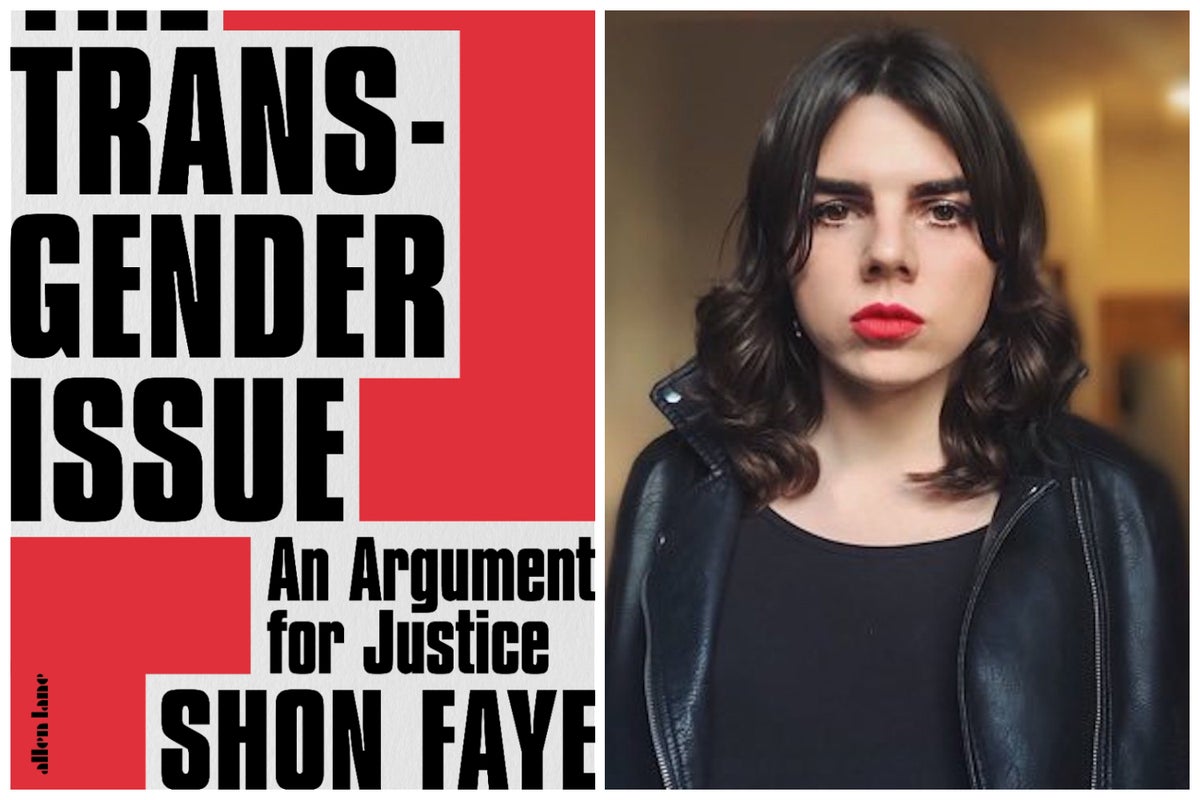
Shon Faye is a trans woman and activist who argues that trans people should unite with others to overthrow oppression, asserting that trans demands are “synonymous” with the goals of gays and feminists.
In the prologue she gives her rendering of the meaning of the “relatively new term” ‘cis’; – “’Cisgender’ is the Latin antonym for transgender.” While recognising that the word is controversial and that some hear it as an accusation or slur Faye says she needs a word to denote the 99% who are not trans. Unfortunately, this word defines everyone else as something that they are not, as not-trans, and includes gay men, lesbians and all those who are heterosexual.
She (I use trans people’s preferred pronouns for the reason and with the hesitation argued by Kathleen Stock in the first book reviewed), rejects the idea that her book has to regurgitate the debate on the trans issue (on toilets, changing rooms, pronouns and sport) as this “is itself a tactic of those who wish to oppress us.” As noted, ‘trans rights are not a debate’ is an oft repeated declaration.
Faye wants instead to write a book about what it is like to be trans and the problems trans people face, partly on the grounds that any debate typically includes those who are not “equally affected by the discussion.” She describes such debates as “confected” and “a vehicle for increased hostilities towards and misunderstandings of trans people . . .” She presents a power structure which talks about trans people; so for example the media “want to talk about their issues with us, not the challenges facing us.”
She dismisses the “myth of a powerful trans lobby”, one of the themes especially of the third book to be reviewed, and now the subject of a number of podcasts by the local (to me) BBC journalists Stephen Nolan and David Thompson. Instead, she notes that there are no trans newspaper editors, MPs, High Court judges etc. What is at issue then is a question of power, and the need for trans people to have a healthy conversation about the issues facing them.
So, while refusing debate outside, she argues that within the trans population voices are dominated by professional and middle-class members, and that the task is to create solidarity where there is an “overlap with other minorities or marginalised groups.” “Change will only be brought about by bringing class politics back on the political agenda.”
The book is meant to set out the reality of the challenges trans people face. These include prejudice, discrimination, intimidation and violence and the additional burdens particularly affecting them, including unemployment and reactionary policies such as austerity, especially its effect on health care.
She records a School Report from Stonewall (2017) that “64 per cent of British trans schoolchildren report being bullied for being trans or for their perceived sexual orientation . . . 13 per cent of trans pupils experience physical violence . . . [and] a shocking 84 per cent of British trans young people have self harmed.” She also notes that “45 per cent of trans young people had attempted suicide at least once.”
Trans people also face domestic abuse – “19 per cent had experienced domestic abuse from a partner in the previous year . . . which is significantly higher than the recorded rate of domestic abuse among the wider population . . .” (The Trans 2018 report referenced records a higher number of 28 per cent).
Elsewhere, these statistical claims have been challenged, for example the finding that “45 per cent of trans young people had attempted suicide at least once” is based on the Stonewall report. Kathleen Stock says of this that “a non-probability sampling method was used. It’s widely agreed among statisticians that this is an inadequate method with which to extrapolate to a population as a whole, because the sample isn’t random.”
Stock reports that the NHS Gender Identity Service quotes a Freedom of Information request that between 2016 and 2018 one of their patients committed suicide and two attempted it. Two others on the waiting list also committed suicide; so three in two and a half years. The doctor making the FoI request notes that “anorexia multiplies the risk of suicide by 18 to 31 times (depending on the method of estimation), while depression multiplies it by 20.”
Stock does not deny the existence of hate crime against trans people but argues that we need better data, and “data that isn’t produced by trans activist organisations for the purpose of lobbying.”
Faye does not argue that trans people are ‘born in the wrong bodies’ but does believe that unjustifiable obstacles are put in the way of medical interventions that support transition. This would appear to mean opposition to any questioning of the need for such intervention or any delay. For her it is a question of bodily autonomy, similar to a woman’s right to choose. She quotes one young person seeking such intervention, that those questioning the relatively high proportion of autistic children also seeking it is “so ableist and insulting that autistic people can’t make decisions or know themselves . . “
Faye argues from the beginning that cis men and women are credited with more authority, insight and experience on both their own identity and those of trans people than trans people themselves, and welcomes the acceptance and confirmation by parents of the declaration by their 3-year-old male child that “I’m a girl”.
But what exactly is this 3-year-old identifying as? What is the character of the identity that those adults who are not biological women have, and how do they know it is the same or similar to the gender identity of biological women, if the latter admit to any such identity at all? Or would it not matter if it is not similar, introducing another irrelevant difference?
If a woman is also, or even simply, a person identifying as a woman then a woman becomes a person identifying as a person identifying as a woman, which is itself a person identifying as a woman . . . and so it goes on indefinitely. Defined this way there is no intelligible way of securing the claim that trans women are women. The definition includes what has to be defined.
Despite the early declaration that she would not get into ‘closed-loop debates’ and “repetitive talking points” this proves impossible and her book moves to take up the issues.
As an indication of her general position, she argues her view that trans women prisoners should not be kept in male prisons. She quotes a BBC report in May 2020 that “in the previous year, eleven trans women housed in male prisons had been sexually assaulted.” She states that not only are they more likely to be victims of sexual assault than to perpetrate it, but likely to be assaulted at a higher rate than cis gender prisoners.”
She recognises that there are cases in which transwomen prisoners have assaulted women prisoners and mentions the case of Karen White, but states that this has been weaponised to derail the campaigns for the rights of all trans people. “In 2018, some sixty prisoners in England and Wales convicted of a sexual offence were recorded as having declared themselves trans. The rhetorical importance given to this small cohort can be exhausting for the 200,000–500,000 trans people in Britain who fear being tainted – and denied civil rights – by association.”
“Human rights, broadly speaking, are inalienable. Every human being has the right to autonomy over how they define their gender and to some appropriate expression of it.”
“This topic is emotive” she says. Trans peoples’ rights cannot only be “given for good behaviour. There is no easy way out” and Faye rejects possible solutions that might be seen as just such a way out. She rejects trans wings in men’s prison or in women’s prisons because trans prisoners who are at risk are harmed further, dehumanised, isolated, and their human rights not respected.
Faye has a lot to say about the prison system, its endemic violence, and her proposals for change, which she admits are currently “a big ask”, “with little hope of achievement in the foreseeable future”, and which entail “moving towards a world with no prisons at all.” In the meantime, sexual predators that are trans such as Karen White, must be allowed into women’s prisons despite knowledge of the danger.
Shone reaches such an unappealing conclusion because she must. ‘Transwomen are women’ and we know they are because they say they are; and since they are they must be accorded all the rights that women have, even if those rights have to be modified somewhat because, as she and everyone else in this ‘non-debate’ knows, women’s and transwomen’s bodies are not the same. In this case, some of the rights associated with women must belong to transmen even though they are also men; so abortion rights apply to women and also to men. It is just such men for example who make it ‘transphobic’ to say that only women have cervixes.
Back to part 1
Forward to part 3



 Sráid Marx