
What does “Don’t betray Ukraine?” mean (3 of 3)

In a Facebook discussion on why socialists should oppose the war I received a reply that stated:

‘In ninety cases out of a hundred the workers actually place a minus sign where the bourgeoisie places a plus sign. In ten cases however they are forced to fix the same sign as the bourgeoisie but with their own seal, in which is expressed their mistrust of the bourgeoisie. The policy of the proletariat is not at all automatically derived from the policy of the bourgeoisie, bearing only the opposite sign – this would make every sectarian a master strategist; no, the revolutionary party must each time orient itself independently in the internal as well as the external situation, arriving at those decisions which correspond best to the interests of the proletariat. This rule applies just as much to the war period as to the period of peace.’

This of course is a quote from Trotsky.  The problem is not to quote this as if this explains left support for the Ukrainian/Western imperialist alliance, but why this combination requires socialists to place a plus sign when the chances are only one in ten of that being correct.

If we look at the examples in the article from which the quote is taken, we see the sort of circumstances in which this would be correct.  These include when a ‘rebellion breaks out tomorrow in the French colony of Algeria’ and receives help from a rival imperialism such as Italy.  The second is when ‘the Belgian proletariat conquers power . . . Hitler will try to crush the proletarian Belgium’ and’ the French bourgeois government might find itself compelled to help the Belgian workers’ government with arms.’

In a footnote, Trotsky says that: ‘We can leave aside then the question of the class character of the USSR. We are interested in the question of policy in relation to a workers’ state in general or to a colonial country fighting for its independence.’

The Ukrainian working class has not come to power; Ukraine is not a workers’ state and has just celebrated Independence Day, so it is not a colony.  Some have tried to squeeze in the ridiculous idea that it is an oppressed country, but this is false.  It is a country backed by the whole of Western imperialism; is in an open alliance with it, and the war was provoked by both parties to this de facto alliance which sought to make it formal.

Ukraine will most likely lose territory but will not be totally occupied, unless Russia does something stupid, which it has not signalled it will do.  At least part of the territory occupied is pro-Russian so that it is not possible to see either sides’ occupation as being unambiguously liberating.  In other words, thinking in terms of oppressor and oppressed states does not provide a solution; more fundamentally because this is an imperialist war in which Ukraine is on one of the sides, and cloaking it with oppression does not explain either the origin and nature of the war or the approach that socialists should take to it. 

Victory for Ukraine, it is claimed, would be a victory against Russian imperialism, but it would also be a victory for Western imperialism with which Ukraine is now an ally. Claims that this is any sort of anti-imperialist war are therefore obviously spurious.  Only from a campist position can it be claimed that a victory for the camp of western imperialism is preferable to a victory of the Russian.  Complete disorientation and political degeneration explains why supporters of this position regularly accuse those opposed to it of ‘campism’ and describe themselves as ‘internationalist.’ 

It is irrelevant who fired the first shot, as Trotsky noted elsewhere:

‘Imperialism camouflages its own peculiar aims – seizure of colonies, markets, sources of raw material, spheres of influence – with such ideas as “safeguarding peace against the aggressors,” “defence of the fatherland,” “defence of democracy,” etc. These ideas are false through and through. It is the duty of every socialist not to support them but, on the contrary, to unmask them before the people.’

“The question of which group delivered the first military blow or first declare war,” wrote Lenin in March 1915, “has no importance whatever in determining the tactics of socialists. Phrases about the defence of the fatherland, repelling invasion by the enemy, conducting a defensive war, etc., are on both sides a complete deception of the people.”

He goes on: ‘The objective historical meaning of the war is of decisive importance for the proletariat: What class is conducting it? and for the sake of what? This is decisive, and not the subterfuges of diplomacy by means of which the enemy can always be successfully portrayed to the people as an aggressor. Just as false are the references by imperialists to the slogans of democracy and culture.’

Trotsky makes the following summary judgement: ‘If a quarter of a century ago Lenin branded as social chauvinism and as social treachery the desertion of socialists to the side of their nationalist imperialism under the pretext of defending culture and democracy, then from the standpoint of Lenin’s principles the very same policy today is all the more criminal.’  Over one hundred years has passed since Lenin’s judgement, how much more does this criminal treachery deserve condemnation today?

The depths of disorientation can be gleaned from one article reviewing the latest film documentary on the war, in which the author states that the film 2000 Meters to Andriivka is ‘the Ukrainian working class at war.’

‘The young men we see in this documentary about the capture of a village called Andriivka by the 3rd Assault Brigade of the Ukrainian army are a snapshot of the country’s working class. One is a lorry driver, their commander previously worked in a warehouse and a third is a polytechnic student studying electronics. They are virtually all in their early twenties and all volunteered to fight the Russian invasion.’ 

‘Ukraine continues to resist against overwhelming odds at the price of losing its bravest and most self-sacrificing young people’, while telling us why they are fighting, reminding him of the Soviet ‘partisans fighting Nazi invaders.’  What a pity for such a claim that it is the 3rd Assault Brigade of the Ukrainian army that the author lauds, which is composed of today’s Nazis, and hails as its historic heroes the Ukrainian fascists who collaborated with the Nazis in World War II and who fought Soviet partizans.

Aleksei ‘Kolovrat’ Kozhemyakin looks at a photo of himself. Exhibition opening in Kyiv, September 27, 2023. Source: Vechirnii Kyiv

The author, like me, will have been stopped in the streets of Belfast many times by soldiers of the British army who may have previously been lorry drivers or worked in a warehouse; certainly more or less all of them would have been working class.  This would not in the slightest have determined the nature of the British army or answered Lenin’s questions ‘What class is conducting it? and for the sake of what?’  Nor would – who fired the first shot? – have defined the conflict in the North of Ireland.

The working class British squaddies were fighting for an imperialist army in the interests of their imperialist state just as the Ukrainian workers in the 3rd Assault Brigade are fighting for the capitalist Ukrainian state in its alliance with western imperialism, from whom it will have received its funding, training, weapons and intelligence.  That the neo-Nazis within it are not the least bit interested in ‘democracy’ and are bitter enemies of anything remotely resembling socialism just puts the tin hat on the preposterous claims of the social imperialist supporters of Ukraine.

Quotes from Trotsky won’t therefore exculpate today’s social-imperialists who support imperialism while proclaiming socialism.  Even the isolated passage quoted at the start of this post assumes an independent working class movement to apply its own seal, but no such movement exists in Ukraine.  In raising the demand “Don’t betray Ukraine” the Ukraine Solidarity Campaign has fixed a plus sign to the actions of imperialism where no independent working class movement exists in Ukraine to place its own.

The demand “Don’t Betray Ukraine” is not therefore a call to take advantage of a contradiction within imperialism but to take one side of it instead of opposing both.   It is a demand for capitalist solidarity; that one section of it remain united in its struggle against the other. It is a call for Western imperialism to be united in full commitment to a particularly rotten capitalist state, signalling the total abasement of those declaring it.

Back to part 2
Permanent Revolution (3) – basic principles

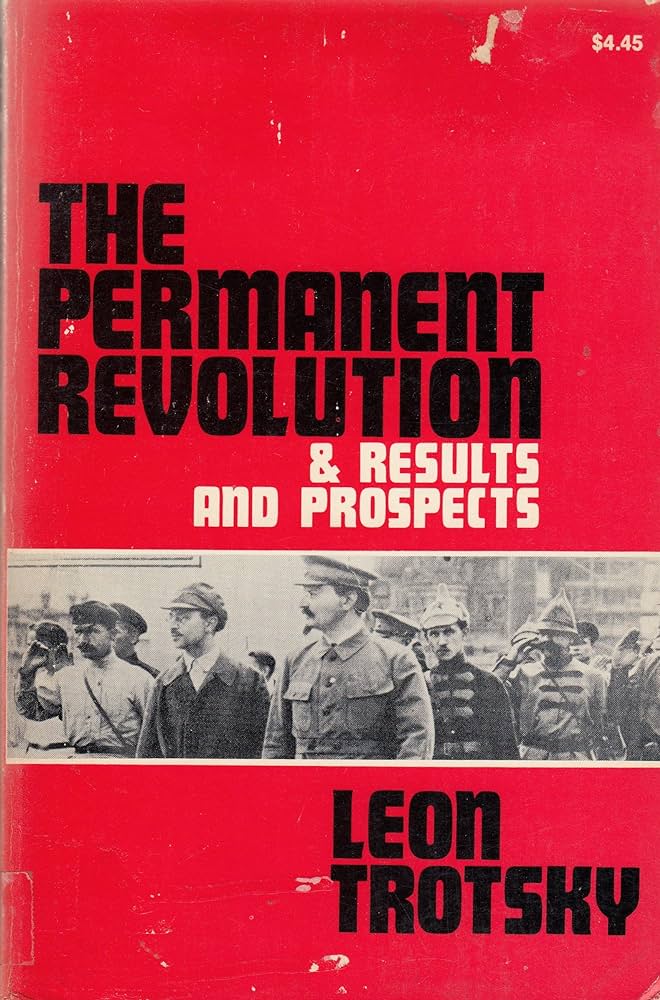
Trotsky, in his booklet The Permanent Revolution, set out a number of its ‘Basic Postulates’.  These include the following:

‘2. With regard to countries with a belated bourgeois development, especially the colonial and semi-colonial countries, the theory of the permanent revolution signifies that the complete and genuine solution of their tasks of achieving democracy and national emancipation is conceivable only through the dictatorship of the proletariat as the leader of the subjugated nation, above all of its peasant masses.’

‘3. Not only the agrarian, but also the national question assigns to the peasantry – the overwhelming majority of the population in backward countries – an exceptional place in the democratic revolution. Without an alliance of the proletariat with the peasantry the tasks of the democratic revolution cannot be solved, nor even seriously posed. But the alliance of these two classes can be realized in no other way than through an irreconcilable struggle against the influence of the national-liberal bourgeoisie.’

‘4. No matter what the first episodic stages of the revolution may be in the individual countries, the realization of the revolutionary alliance between the proletariat and the peasantry is conceivable only under the political leadership of the proletariat vanguard, organized in the Communist Party. This in turn means that the victory of the democratic revolution is conceivable only through the dictatorship of the proletariat which bases itself upon the alliance with the peasantry and solves first of all the tasks of the democratic revolution.’

‘8. The dictatorship of the proletariat which has risen to power as the leader of the democratic revolution is inevitably and very quickly confronted with tasks, the fulfilment of which is bound up with deep inroads into the rights of bourgeois property. The democratic revolution grows over directly into the socialist revolution and thereby becomes a permanent revolution.’

‘9. The conquest of power by the proletariat does not complete the revolution, but only opens it. Socialist construction is conceivable only on the foundation of the class struggle, on a national and international scale.’

‘10. The completion of the socialist revolution within national limits is unthinkable . . . The socialist revolution begins on the national arena, it unfolds on the international arena, and is completed on the world arena . . .’

‘11. The above-outlined sketch of the development of the world revolution eliminates the question of countries that are ‘mature’ or ‘immature’ for socialism in the spirit of that pedantic, lifeless classification given by the present programme of the Comintern. Insofar as capitalism has created a world market, a world division of labour and world productive forces, it has also prepared world economy as a whole for socialist transformation.’

‘13. The theory of Stalin and Bukharin, running counter to the entire experience of the Russian revolution, not only sets up the democratic revolution mechanically in contrast to the socialist revolution, but also makes a breach between the national revolution and the international revolution.’

        *         *          *

The number of ‘countries with a belated bourgeois development, especially the colonial and semi-colonial countries’ has decreased dramatically in the last one hundred years, most obviously with the massive growth of the working class, relative decline of the peasanty and the disappearance of most colonies.  Many of the semi-colonies are now important capitalist states, including those in the expanding BRICS collaboration.

It might therefore be considered that the theory of the permanent revolution, which ‘signifies that the complete and genuine solution of their tasks of achieving democracy and national emancipation is conceivable only through the dictatorship of the proletariat as the leader of the subjugated nation, above all of its peasant masses’ is of limited relevance today.

After all, how true is it that ‘the agrarian, but also the national question assigns to the peasantry – the overwhelming majority of the population in backward countries – an exceptional place in the democratic revolution’? Does this no longer apply in many countries?  We no longer consider that the question is one of democratic revolution but of socialist revolution in countries with widespread industrialisation and a large working class.  Even when Trotsky set out the basic ideas of Permanent Revolution, he was stating that his ‘sketch of the development of the world revolution eliminates the question of countries that are ‘mature’ or ‘immature’ for socialism.’

He went further to say, in the Transitional Programme in 1938 that ‘the economic prerequisite for the proletarian revolution has already in general achieved the highest point of fruition that can be reached under capitalism . . . All talk to the effect that historical conditions have not yet “ripened” for socialism is the product of ignorance or conscious deception . . . The objective prerequisites for the proletarian revolution have not only “ripened”; they have begun to get somewhat rotten . . .  The turn is now to the proletariat, i.e., chiefly to its revolutionary vanguard. The historical crisis of mankind is reduced to the crisis of the revolutionary leadership.’

Many who claim to be Trotskyist accept that the theory of Permanent Revolution applies today and also continue to argue that humanity’s crisis ‘is reduced to the crisis of the revolutionary leadership.’

We have seen, however, that despite this, many – if not most – agree to the theory but abandon it in practice.  They avoid cognitive dissonance by employing a different set of assumptions that enable the adoption of a different set of outwardly Marxist formulas to the actual struggles that arise and which previously would have been considered to come under the purview of the permanent revolution strategy.  Let’s take a look at Ukraine and Palestine.

In Ukraine, the supporters of that state who demand self-determination for Ukraine must presumably believe that the national question is key, and that therefore that the ‘democratic revolution’ is on the agenda, even if this no longer requires an alliance with the peasantry. But if this is so, where is the fight for the view that ‘the complete and genuine solution of their tasks of achieving democracy and national emancipation is conceivable only through the dictatorship of the proletariat?’  Why is support given to a bourgeois political regime and capitalist state when what is required is an ‘irreconcilable struggle against the influence of the national-liberal bourgeoisie’, with the need for ‘the political leadership of the proletariat vanguard, organised in the Communist Party?’

When have the supporters of ‘Ukraine’ ever put forward this argument to Ukrainian workers or those in their own country?  When has permanent revolution even been mentioned? Why do they defend the intervention of Western imperialism when ‘the democratic revolution grows over directly into the socialist revolution and thereby becomes a permanent revolution?’  How could Western imperialism fail to be a barrier to such an outcome? Why then do they support it?

The only political explanation is that they do not believe that permanent revolution is relevant, which means that socialism is not relevant and socialist revolution inconceivable and not in any way be a guide to longer term strategy. However, if this is so, the theory of permanent revolution states that there can’t be a democratic revolution either. They can’t believe the statement that in ‘the colonial and semi-colonial countries, the theory of the permanent revolution signifies that the complete and genuine solution of their tasks of achieving democracy and national emancipation is conceivable only through the dictatorship of the proletariat as the leader of the subjugated nation.’

They therefore cannot believe that ‘the objective prerequisites for the proletarian revolution have not only “ripened”; they have begun to get somewhat rotten . . .  The turn is now to the proletariat, i.e., chiefly to its revolutionary vanguard. The historical crisis of mankind is reduced to the crisis of the revolutionary leadership.’  If the problem was simply one of revolutionary leadership, why wouldn’t they be offering revolutionary politics?

In so far as the supporters of the Russian invasion advance the same arguments in relation to the democratic tasks supposedly devolving to the Putin regime and Russian state, purportedly justified by the rights of the Donetsk and Luhansk People’s  Republics, the same questions are posed to them!

If we turn our attention to Palestine, which is a question of (settler) colonialism, the genocide of the Palestinian people and the role of Western imperialism demonstrate that a revolution is required for their liberation.  Why is Western imperialism not their saviour as it is claimed it is for the ‘people of Ukraine’?  Why do the bourgeois Arab states not perform the same revolutionary democratic role played by the Ukrainian one?  Again, where are the arguments above advanced that this liberation can only come through permanent revolution?  A struggle that needs to be fought by the working class, under socialist leadership, ‘on the foundation of the class struggle, on a national and international scale’?

Instead, the debate revolves around a one state or two state solution, with neither having any particular class content, which, in effect, means that they are both proposals for a capitalist state and with no indication that a wider socialist revolution is necessary, in the Arab region or wider afield.

How are we to make sense of this à la carte Trotskyism – ‘God make me a Communist, but not just yet’?

Back to part 2

Forward to part 4

Oppressor and Oppressed (5) – How do socialists oppose War?

The answer to the question how to oppose war seems simple – to fight for peace.  In the article ‘Socialism and War’ Lenin set out the view of socialists, at that time in relation to the First World War, but applicable to the attitude to war in general:

‘Socialists have always condemned war between nations as barbarous and brutal. But our attitude towards war is fundamentally different from that of the bourgeois pacifists (supporters and advocates of peace) and of the Anarchists. We differ from the former in that we understand the inevitable connection between wars and the class struggle within the country; we understand that war cannot be abolished unless classes are abolished and Socialism is created; and we also differ in that we fully regard civil wars, i.e., wars waged by the oppressed class against the oppressing class, slaves against slave-owners, serfs against land-owners, and wage-workers against the bourgeoisie, as legitimate, progressive and necessary.’

When wars break out, those concerned with the oppressed are often impatient at the argument that war is inevitable under capitalism and that the fundamental task is to overthrow it and start the building of a socialist society.  More immediate tasks always seem more pressing and demand attention with the argument that all those on the side of the oppressed must unite to stop the worst of immediate suffering.

The task, of course, is not to ignore these immediate tasks, but unless they go hand in hand with creating a movement and party that will lead to the overthrow of capitalism such campaigns will have little role to play in preventing greater and more barbarous oppression in the future.  Good intentions count for naught in politics. Those who have been involved in politics longer will have seen multiple wars and will know that to simply oppose war with peace is treating symptoms but not the disease.

The current weakness of the socialist movement partially explains the pursuit of substitutes for it, which for some is ‘Ukraine’, for others Russia, and for others an unwillingness to consider such political considerations at all, with immersion in activity devoid of long-term perspectives: waiting for the next war so to demand peace.  Without stopping to think how can war be stopped before it starts – what is it that creates war after war.

Trotsky in The Programme for Peace dealt with this question in the midst of the First World War:

‘What is a peace program? From the viewpoint of the ruling classes or of the parties subservient to them, it is the totality of the demands, the ultimate realisation of which must be ensured by the power of militarism. Hence, for the realisation of Miliukov’s “peace program” Constantinople must be conquered by force of arms. Vandervelde’s “peace program” requires the expulsion of the Germans from Belgium as an antecedent condition. Bethmann-Holweg’s plans were founded on the geographical warmap. From this standpoint the peace clauses reflect but the advantages achieved by force of arms. In other words, the peace program is the war program.’ So, today, the peace programme of Ukraine and its supporters, and the peace programme of Russia and it supporters, is the war programme of the Ukrainian and Russian capitalist states, which some socialists have decided to endorse. For the former peace will come only from expulsion of Russia from all of Ukraine while for the latter peace will only be assured by a Ukraine too weak to join with NATO in threatening Russia and its legitimate security.

Consider too, for example, the peace programme of my local anti-war movement, which put out the following leaflet, which states that ‘The Belfast Anti War Group has opposed the war in the Ukraine and has called for a ceasefire and negotiations.’  But who and what will determine the outcome of the negotiations and what relationship will the outcome of the negotiations have for ‘the oppressed’; never mind the interests of ending war for good through socialism?

The answers are obvious – the stronger in the war will define the peace and the peace will be the victory of one capitalist power over the other; it will not care for the oppressed and far from bringing forward the end of war will simply create the grounds and starting point for the next.  It will not advance the interests of the working class and socialism.

This is what the call for the ending of war by negotiations means.

Trotsky’s following words could have been written for today, with reference to Ukraine instead of Belgium:

‘For the revolutionary proletariat, the peace program does not mean the demands which national militarism must fulfill, but those demands which the international proletariat intends to enforce by dint of its revolutionary fight against militarism in all countries. The more the international revolutionary movement expands, the less will the peace questions depend on the purely military position of the antagonists.’

‘This is rendered most clear to us by the question of the fate of small nations and weak states.’

‘The war began with a devastating invasion of Belgium and Luxemburg by the German armies. In the echo created by the violation of the small country, beside the false and egotistic anger of the ruling classes of the enemy, there reverberated also the genuine indignation of the common masses whose sympathy was attracted by the fate of a small people, crushed only because they happened to lie between two warring giants.’

‘At that first stage of the war the fate of Belgium attracted attention and sympathy, owing to its extraordinarily tragic nature. But thirty-four months of warfare have proved that the Belgian episode constituted only the first step towards the solution of the fundamental problem of the imperialist war, namely, the suppression of the weak by the strong.’

The analogy with Ukraine like all analogies is imperfect – Ukraine is not a small country and has large armed forces – but near enough to warrant close comparison.  Above all, such a comparison illustrates the definitive nature of the war as the ‘World competition of the capitalist forces, [which] means the systematic subjection of the small, medium-sized and backward nations by the great and the greatest capitalist powers.’

‘The war destroys the last shreds of the “independence” of small states, quite apart from the military outcome of the conflict between the two basic enemy camps.’

The mistake of those supporting Ukraine is that they think it irrelevant that Ukraine provoked the war by advancing membership of the major imperialist alliance – preparing for its own attack – and that this imperialist alliance had helped put in place in Ukraine a government that would pursue this course so that it might weaken its major competitors – Russia and China.  

The supporters of Russia make the mistake that this justifies the Russian invasion, which has nothing to do with defending democracy or its own people but is simply to protect its own capitalist interests – what else, after all, are capitalist states for?  Or do they, like the supporters of the Ukrainian state, believe that their chosen champion is unique such that it defends the interest of its working class? When these ‘socialists’ justify support for these interests, including the integrity of the Russian state, they simply admit their complete abdication from the socialist cause. The mistakes of either are the mistakes of both.  From the point of view of socialism, they land in the same place, simply waving different flags.

‘Only charlatans or hopeless simpletons can believe that the freedom of the small nations can be secured by the victory of one side or the other’, wrote Trotsky.

The supporters of one or other of the warring capitalist states are oblivious to a fact that should be blindingly obvious to Marxists, that they are supporting a capitalist state and in doing so surrender any claim to be Marxists. I have read supporters of Ukraine claim it is a democracy while Russia is an autocracy, while supporters of Russia have claimed it is an autocracy but Ukraine is fascist.  The fundamental problem is not that both are wrong but that even if one were correct, it could not justify support for either capitalist state.

Trotsky put it this way:

‘Social-patriotism which is in principle, if not always in fact, the execution of social-reformism to the utmost extent and its adaptation to the imperialist epoch, proposes to us in the present world catastrophe to direct the policy of the proletariat along the lines of the “lesser evil” by joining one of the two warring groups.’ 

‘We reject this method. We say that the war, prepared by antecedent evolution, has on the whole placed point-blank the fundamental problems of the present capitalist development as a whole; furthermore, that the line of direction to be followed by the international proletariat and its national detachments must not be determined by secondary political and national features nor by problematical advantages of militaristic preponderance of one side over the other (whereby these problematical advantages must be paid for in advance with absolute renunciation of the independent policy of the proletariat), but by the fundamental antagonism existing between the international proletariat and the capitalist regime as a whole.’

Lenin opposed the war and refused support to ‘democratic’ imperialism even when he saw Tsarism as especially reactionary, and refused support to Russia even when, after the February 1917 revolution, it was ‘the freest country on earth’, with dual power between the workers and peasant’s soviets and the capitalist Provisional Government.  Meanwhile the German social democrats supported the German state on the grounds that Tsarism was a special reactionary force compared to its own.

Today’s supporters of capitalist states only prove that, just like there is no fool like an old fool, there are no mistakes like the old mistakes.

Back to part 4

Forward to part 6

What is Anti-capitalism?

electronblueOver the last two decades the left has attempted to respond to the heavy defeats of the working class by breaking out of its isolation and creating, or rather supporting the creation of, broad left parties.  Similarly sections of society, especially youth, have responded to the obvious unfairness of global capitalism by involving themselves in protests and movements against globalisation.  Both of these moves have to one degree or other come under the label of anti-capitalism.  It has never been very clear what this anti-capitalism consists of.

The left groups have more often than not attempted to create these broad, anti-capitalist parties themselves rather than insert themselves into genuine broad movements.  The anti-globalisation movement has also by and large been separated from working class struggle due to the latter’s decline.  In the absence of such struggle speculative attempts to create broad parties can have only limited success but this does not account for complete failure.

In Ireland we have just witnessed the failure of the United Left Alliance, which follows on the failure of previous initiatives such as the Socialist Alliance.  This comes as similar initiatives in Britain such as its Socialist Alliance, Scottish Socialist Party and RESPECT have also ended in failure.

To a greater or lesser extent these projects have been based on the idea that there exists a vacuum on the left through the rightward trajectory of social democratic parties which the left organisations can fill.  There has been no pause for thought that this movement to the right is a result not of some pathology to betray traditional social democratic politics but results from the assault of right wing forces, consequent defeat of workers and an undermining of the basis for social democratic answers.

Much weaker forces from the left trying to occupy this ‘space’ with not dissimilar policies, in the absence of any change to any of these larger factors, could only expect to face a similar evacuation of this ‘space’ – usually through collapse.

The invention of the term anti-capitalism that is supposed to sit outside the traditional reformist/revolutionary dichotomy has been the programmatic basis for these initiatives although these take various guises.  In this blog I have critiqued the anti-capitalist programme of the left organisations in Ireland as they have grouped themselves around the United Left Alliance.  This criticism has examined their programme of debt default, their budget proposals, taxing the rich, state investment and nationalisation.

This programme can nevertheless be called anti-capitalist because no pro-capitalist force currently comes anywhere near supporting it.  No party supports high taxation of the rich, defaulting on debt or much increased state spending to lower unemployment.  The capitalist class would bitterly oppose implementation of these measures, which would be better for the working class than current austerity policies.

None of these considerations however make this a working class programme.  Capitalist states have defaulted on their debt before – many times; taxation of high incomes was well over 90 per cent in the post-war United States during the cold war; deficit spending by the state has been an automatic result of the current crisis and nationalisation has been a response across the world to the current crisis.  In Britain and the US parts of the financial system were effectively nationalised and in Ireland almost all the banks were nationalised.

The anti-capitalist policies proposed differ only in degree to those imposed by capitalism many times before.  Above all this programme is not a working class one because it does not provide an alternative to capitalism in the sense that working class power is built and strengthened and the germs of alternative relations of production are created.

The social democratic programme was evacuated because it was not seen as the best option for capitalism.  If the capitalist class or its representatives change their minds about this they will get their own parties, including social democratic ones, to implement it.

The anti-capitalist content of this programme is twofold.  First it may target particular sections of the capitalist class or its representatives but only to benefit others.  Thus debt default will impose losses on sectors of financial capitalism that may benefit industrial/producer sectors.  High taxation will hit the highest paid mangers of capitalist enterprises such as bank CEOs, so depressing their salaries, which may be to the benefit of capitalist owners as shareholders.  Deficit spending on infrastructure will obviously directly benefit capitalist construction companies while putting pressure on lending to other capitalists.  Nationalisation of banks has been a means of protecting capitalist investors, not of expropriating them, but it also maintains the integrity of other capitalist’s liabilities.

The second way this programme is anti-capitalist we have explained – the capitalists oppose it.  The anti-capitalism of the programme is very like the anti-imperialism of Irish republicanism in the 1970s and 1980s.  It was heartfelt and genuine in a subjective sense and involved enormous sacrifice.  In an objective sense it was unrealisable by the methods adopted – armed struggle by republicans and electoralism by the left, which means that eventually the means change or the objective is abandoned.  In the case of republicans it was both.

In both cases neither programme opposed or presented an alternative to the class interests that they fought against.  In the case of republicans they never had a programme that opposed and had an alternative to the British and Irish capitalist classes who defended partition.  In the case of the left even implementation of their programme would not end the capitalist system or threaten the power of the capitalist state.  In fact most of its programme involves strengthening the capitalist state.

As I posted before: in one aspect of their programme these weaknesses might be seen to have been mitigated if not overcome.  The demand for workers’ control of enterprises taken over by the state might seem to present a means to increase working class power while encapsulating the potential of an alternative, new society.

Unfortunately the demand for workers control is proposed as part of the demand for nationalisation as if the capitalist state is in some way a facilitator for the creation of working class power.  The Marxist analysis of the state is that when the capitalist class is threatened by working class action it is the state which is strong enough to defend capitalist interests.  State ownership is not therefore a route to workers’ control.  No aspects of the many forms of state organisation involve workers’ control of any aspect of its bureaucracy.

In capitalist society ownership entitles control and capitalist ownership entails capitalist control.  State ownership entails state control.  Only in times of extreme crisis is the possibility of workers’ control raised and it is raised only when it is imposed by the workers themselves.  If they are in a position to do so, and to make it work, the demand should also be for workers ownership.

Above all the demand for workers’ control must be posed as a practical demand because it is necessary in order to achieve certain objectives.  In the past this has often involved keeping a workplace open when it is threatened by closure.  It does not normally arise in workers minds as an objective in itself.  Unfortunately this is how it is posed by the left – not as a burning necessity to achieve certain things which only the workers have an interest in accomplishing.  It is rarely posed as a practical measure needed to achieve particular objectives.

As I posted before in relation to the Transitional Programme, demands must be concrete and practical or they are simply tools of education (when not means of spreading confusion). Nothing wrong with this in itself, if that is where the struggle is at, but for the left the education given creates illusions in the state by demanding nationalisation as the key. The demand for nationalisation under workers’ control fits comfortably within a general programme that is reliant on state action for implementation.

More often lately the primary role assigned to state action is reflected by the left’s dropping of the rider to nationalisation since it plays no vital role.  Workers’ control in itself is not necessary to achieve any particular goal.  It is what Trotsky referred to as workers’ control “for platonic purposes.”

So we have the ULA before the last election demanding that “key wealth and resources must be taken into democratic public ownership.”  Another Left organisation demands taking “Ireland’s natural Resources into public ownership”.  Another states that “AIB, Bank of Ireland and other banks should be nationalised.  The banks should be amalgamated into one state bank.  The boards should be sacked.  A new board under the democratic control of working people should be established including elected representatives from the workplace and representatives elected from society as a whole.”

Another demands that “a publicly controlled banking system should be administered by elected representatives of the Irish people, representatives of employees of the banking industry, and trained financial experts employed on public sector pay scales.”

These proposals become blueprints, not demands that workers are to impose through their struggle to achieve certain practical needs.  Demands that workers exercise control coexist with formulations that are perfectly consistent with bog standard capitalist state nationalisation.  Demands for ‘public’ or ‘democratic’ control can be perfectly understood to mean the existing forms of state ownership.

On the other hand claims that workers’ control, when it is part of the Left’s propaganda, really means what Marxists have traditionally meant by it would be hard to accept.  Calls for widespread workers’ control were characterised thus by Trotsky in 1931:

“Thus the regime of workers’ control, a provisional transitional regime by its very essence, can correspond only to the period of the convulsing of the bourgeois state, the proletarian offensive, and the failing back of the bourgeoisie, that is, to the period of the proletarian revolution in the fullest sense of the word.” It hardly needs saying that we are nowhere near such a situation today, not in Ireland or anywhere else.

Instead today’s routine demands for workers’ control, when they are made – instead of mealy-mouthed formulations about ‘democratic public ownership’- are closer to this description of it, again by Trotsky, in the same article:

“If the participation of the workers in the management of production is to be lasting, stable, “normal,” it must rest upon class collaboration, and not upon class struggle. Such a class collaboration can be realised only through the upper strata of the trade unions and the capitalist associations. There have been not a few such experiments: in Germany (“economic democracy”), in Britain (“Mondism”), etc. Yet, in all these instances, it was not a case of workers’ control over capital, but of the subserviency of the labour bureaucracy to capital. Such subserviency, as experience shows, can last for a long time: depending on the patience of the proletariat.”

We shall examine further the historical experience of workers’ control in a further post.

The transitional programme and political consciousness Part II

2010-08-16Grafik8926075967511404471

In my first post on Trotsky’s transitional programme I argued that the political consciousness of the working class is critical to the success of the socialist project and crucial to take into account in the development of a political programme. I also noted that the transitional programme was one way of approaching this problem but did not in itself provide a simple solution. It did however provide ways of thinking about one by, for example, raising demands for workers’ control as an illustration of a programme based on workers self-emancipation.

The problem arises most clearly, as I said, when the political consciousness of workers is too low for them to effectively rise to the challenges posed by objective conditions. This could be the fight for an alternative to austerity in the south of Ireland or against sectarianism and the state that supports it in the north. How then should a programme be conceived and presented in such circumstances?

Trotsky presents guidance but it is not immediately apparent that the various elements of it are all consistent and provide clear answers. Trotsky argued that Marxists must tell workers the truth –

“To face reality squarely; not to seek the line of least resistance; to call things by their right names; to speak the truth to the masses, no matter how bitter it may be; not to fear obstacles; to be true in little things as in big ones; to base one’s program on the logic of the class struggle; to be bold when the hour for action arrives — these are the rules of the Fourth International.”

Socialists must avoid abstractions, which in words such as ‘peace’ or the ‘national interest’ are weapons of the capitalist class. Socialists on the other hand must be concrete in what they propose because a programme is a call to action not, as it often appears, purely propaganda for education purposes. Where it is the latter there is no reason not to speak Marxism clearly instead of debased social democracy.

Unfortunately too often the small groups of the left are known for their dishonesty, most obvious when they inflate their own numbers and achievements. This in itself is unimportant except that it is held up as evidence for particular perspectives that are often divorced from reality.

Trotsky understands that, in a programme predicated on what it is the working class itself does, the demands of the programme must be based on the truth, on reality and be practical or the working class will have no means to put them into action.

“Using these considerations as its point of departure, the Fourth International supports every, even if insufficient, demand, if it can draw the masses to a certain extent into active politics, awaken their criticism and strengthen their control over the machinations of the bourgeoisie.”

So we are to support limited demands if these are able to bring workers into active political activity while it is still necessary to state the truth that much more radical action may be required to achieve given objectives.

Trotsky however has been criticised because he didn’t actually understand the role of workers’ consciousness in framing a political programme. Trotsky is quoted:

“We know that the subjective conditions – the consciousness of the masses, the growth of the revolutionary party – are not a fundamental factor. It depends on the objective situation; in the last instance the subjective element itself depends on the objective conditions, but this dependence is not a simple process.”

And further:

“What are the tasks? The strategic tasks consist of helping the masses, of adapting their mentality politically and psychologically to the objective situation, of overcoming the prejudicial tradition of the American workers, and of adapting it (their mentality) to the objective situation of the social crisis of the whole system.”

“I say here what I said about the whole programme of transitional demands – the problem is not the mood of the masses but the objective situation, and our job is to confront the backward material of the masses with the tasks which are determined by objective facts and not by psychology.”

The question is then posed to Trotsky:

‘Question: Isn’t the ideology of the workers a part of the objective factors? Trotsky: For us as a small minority this whole thing is objective, including the mood of the workers. But we must analyse and classify those elements of the objective situation which can be changed by our paper and those which cannot be changed. That is why we say that the programme is adapted to the fundamental, stable elements of the objective situation, and the task is to adapt the mentality of the masses to those objective factors.’

We should remember that for Trotsky the transitional programme was itself said to incorporate the requirements of a transitional epoch – “During a transitional epoch, the workers’ movement does not have a systematic and well-balanced, but a feverish and explosive character. Slogans as well as organisational forms should be subordinated to this feature of the movement,”

The organisations on the left repeatedly argue that workers’ consciousness can change quickly, and so it can, but this is mostly simply a way of avoiding the reality of the distance that workers must travel, the time required to do so and the experiences that must be gone through. This also plays a role in the debasement of the socialist programme, prompting attempts to make it look more ‘realistic’ and even ‘common sense’ by constructing a socialism based on widespread illusions in the capitalist state. How much more realistic, upon such illusions, do calls for nationalisation appear than the call for workers’ cooperatives or other measures of control?

So if we can try to summarise Trotsky’s approach, it is one that starts from trying to change the consciousness of the working class, through its more militant elements, in order to change objective conditions which alone set the tasks of the working class.

In the ‘transitional epoch’ that Trotsky described “the workers’ movement does not have a systematic and well-balanced, but a feverish and explosive character” and might therefore have been expected to be more open to the changes in organisation, action and consciousness that were required.

As I said in the first post the workers movement today in European countries cannot be said to have this character. The organisation and consciousness of workers today must therefore be considered much more an objective factor than when the transitional programme was written. This reflects the long history of capitalist boom conditions after the Second World War and the defeats inflicted on the workers movement in the most advanced countries plus the general discrediting of socialism consequent on Stalinism and its collapse.

To a much greater extent therefore the tasks of the programme is to confront workers with the objective circumstances which include the limitations of their own consciousness. Since for Marxists consciousness must reflect reality, changing consciousness means changing the conditions of workers themselves, including their own organisations and their workplace experiences. This is the task of workers themselves.

The Marxist programme must therefore place to the fore the working class changing its own circumstances so that objectively it increases its political and social activity. That this does not immediately raise the question of revolution does not matter since this cannot be raised concretely and practically any other way and certainly not by programmatic demands issued by small groups.

It must be realised that a revolutionary programme is not defined by adherence or commitment to the call for revolution now or in the future (in the sense of smashing the capitalist state and creating a new workers’ state). In the first case this is revolutionary phraseology only and in the second is merely a promise, and promises are regularly broken. Revolutionary politics exist in today’s period of retreat as they also more clearly do in periods of offensive and they do so whether an actual revolutions is more or less probable.

Revolutionary politics means the self-activity and independence of the working class themselves and an acceptance that just as workers must achieve their own emancipation they must also learn their own lessons and do so through their own mistakes. Marxists can lessen and shorten this process but not abolish it. To counterpose real expressions of working class action that may be politically weak and to abstain from it in favour of hypothetically more advanced courses of development is a sectarian mistake. This is not such a common mistake on the left today since it usually makes the opposite one but it is sometimes reflected in demands for acceptance of programmatic positions that in themselves do not answer any real tasks more or less immediately posed.

The more common mistake is to substitute action by others for action by the working class and in a whole series of posts I have given examples of this being done. To return to the beginning of the first post – Trotsky’s transitional programme gives no support to those who believe state ownership is part of the working class programme. It is rather the predominant means by which the left supports actions by others for what can only be achieved by the working class.

In the next post I will look at what Trotsky had to say on this.