Left reaction to the ‘discovery’ that a woman is an adult human female (4) – questions and answers

Of all the misconceptions and egregious nonsense in the responses of the left to the UK supreme court judgment the most irrational I have seen comes from the Fourth International and its British organisation Anti-Capitalist Resistance.

The former asks a number of questions as if these on their own expose the falsehood of the court decision but which really require only straight forward answers from anyone not immersed in gender identity ideology.

“What of the practical impacts that this ruling will have on cis women?” it asks.

The impacts are that single sex spaces will be open only to women and exclude men.  This means no men in women’s prisons, no men in women’s refuges, and no men in women’s sports etc.  Something taken for granted in the previous century during which no one was claiming that this involved women’s oppression – quite the reverse.

“What do we tell our young women when we say, ‘a woman is only biological sex’, that a man is also only biological sex?” 

Who is claiming that any woman or man is only a biological woman or biological man regardless of their other qualities, experiences and achievements?  What Marxists affirm is that, just like the assumption in the question itself, humanity is made up of women and men, and most will know that the distinction between them arises solely from their biological difference.

This reality does not at all mean, as this organisation seems to claim, “that because of a man’s biological sex, he is right to partake in oppressive structures of male hierarchy? That his desire to rape and sexually assault women is justified because of his biology?”  The biology of men does not mean that “oppressive structures” and “desires” are inevitable and if the Fourth International thinks the biological reality of humanity necessitates such structures, how then is it going to negate this biological reality and destroy these structures?

Does it think that gender identity is the answer to such ‘structures and desires?’  Does it seek to compel or convince everyone to adopt a gender identity that dispenses with their knowledge of their biological nature?  Would this not be an admission that it is they who wish to narrow young women and men’s understanding of themselves to a ‘gender identity’ that many reject they even have?

Anti-Capitalist Resistance states that trans “existence directly challenges the social order, which is structured by gendered power relations”, but fails to explain how identifying as the opposite sex (regardless of what that really means) actually changes “gendered power relations”, unless the gendered identities adopted are not those of real existing men and women that it currently argues constitute these “oppressive structures.” In other words, in their world in which sex is unimportant, but gender is decisive and in which we still have gender oppression, how will such oppression be ended simply by some (or all) identifying as the other (irrelevant!) sex?  Unless, that is, transmen aren’t actually identifying as men with all their claimed oppressive desires and transwomen aren’t really identifying as women with all their experience of oppressive structures.

Anti-Capitalist Resistance further claims that feminism seeks to overcome the view “that biology is destiny”, but only the adherents of gender identity ideology are arguing that biology is destiny, which is why they attempt the false claim that it can be dismissed.

Biology isn’t destiny in the way they claim – that it necessarily involves social oppression – but it is reality.  Biology is reality and if biology is physically and socially unimportant why does gender identity ideology base itself on being able to identify into the other sex with whatever physical changes that an individual believes they can make (with or without medical and surgical intervention)?

If these ideologists really want to stick to the claim that biology is not destiny I have an additional concept for them – death.

This organisation further claims that feminism opposes ideas “that bodily autonomy is socially dangerous” and “that organising social reproductive work on gendered lines is “natural”.  Yet the foundation of human reproduction is biological – one hundred percent of people reading this blog will be born to a woman.  The claim to autonomy is meant to evoke the rights of women to abortion but this autonomy – this independence and freedom – refers to the right to choose, which then requires the recognition by others for its effective exercise.  Trans people, as autonomous individuals, can think of themselves in any way they like but they cannot by this alone compel the world to accept their view of themselves and act upon it without violating everyone else’s right to the same autonomy. 

The Fourth International asks some more straight forward questions even more simply answered.

“How do you balance sex characteristics with gender reassignment characteristics?”  – Since these are separate characteristics, no balancing is required, the latter does not alter the essential nature of the former. 

“How do you prove sex discrimination when you are not recognized as that sex?”  – You can’t.

The Fourth International states that without this ideology we would have “an absurd ahistorical view of the working class as a homogenised lump that apparently never had gender queer people, or gay people or drag queens among its ranks.”  It sticks out a mile that women are absent from the list but yet another category of men pretending to be women is included.  That the history of the Marxist movement, going back to the man himself, has recognised the special oppression of women, and sought their organisation, is lost.  Instead, we have the truly ahistorical view of the working class in which we have something called ‘cis women’, and trans women whose very existence somehow “directly challenges the social order.”

For a Marxist the issue is also the claim that “There will be no revolution without trans liberation!”  Except, if this were true it would require the erasure of the female sex as a separate part (half!!) of humanity with all their specific oppression and need to organise.  It would also require abandoning any critical thought, with acceptance of the claim that ‘transwomen are women’ with no debate allowed over what are palpably untrue claims because of hyperbolic rhetoric and juvenile name calling.

Marx once said that ‘the philosophers have only interpreted the world, in various ways; the point is to change it.’  The left supporters of gender identity ideology think they can change it by reinterpretation but since the real world is a stubborn thing it cannot be changed by declaration, and it cannot even be reinterpreted by incantation of inane slogans or without debate.  The attempt to silence opposition by naming the gender critical left as ‘fascist’ or ‘transphobic’ is another illustration of denying reality and attempt to close down challenges to its imagined world of changing sex and many genders.

The demonisation of opponents however is only a device to buttress a position already acquired because adherents have accepted that gender identity ideology is ‘progressive’; to stand against it would see individuals also stand against those they would normally stand beside.  Support for the ideology no longer depends on rational argument because it is simply considered to be the ‘left wing’ position; it is left wing because I/she/he/we are left wing and therefore so must it.  It is circular reasoning, and a form of identity politics inoculated from reality by a form of solipsism.  The exploitation of their mistake by the right is then held aloft as ‘proof’ of their position’s left credentials.

The phenomenon of a political position being held up as left wing because so much of the left supports it has been seen before; as previously much of the left capitulated to Scottish nationalism and is now capitulating to western imperialism through support for Ukraine, both of which are their unlikely candidates as beacons of ‘democracy’ for the world.

It’s a case of political gangrene that occurs ‘as a result of an injury, infection or a long-term condition that affects blood circulation’.  The defeats of the working class and its movement are the injury; the infection is petty bourgeois politics, and these long term factors have affected the circulation of critical thought and Marxism.

Concluded

Back to part 3
Left reaction to the ‘discovery’ that a woman is an adult human female (3) –  a far-right victory?

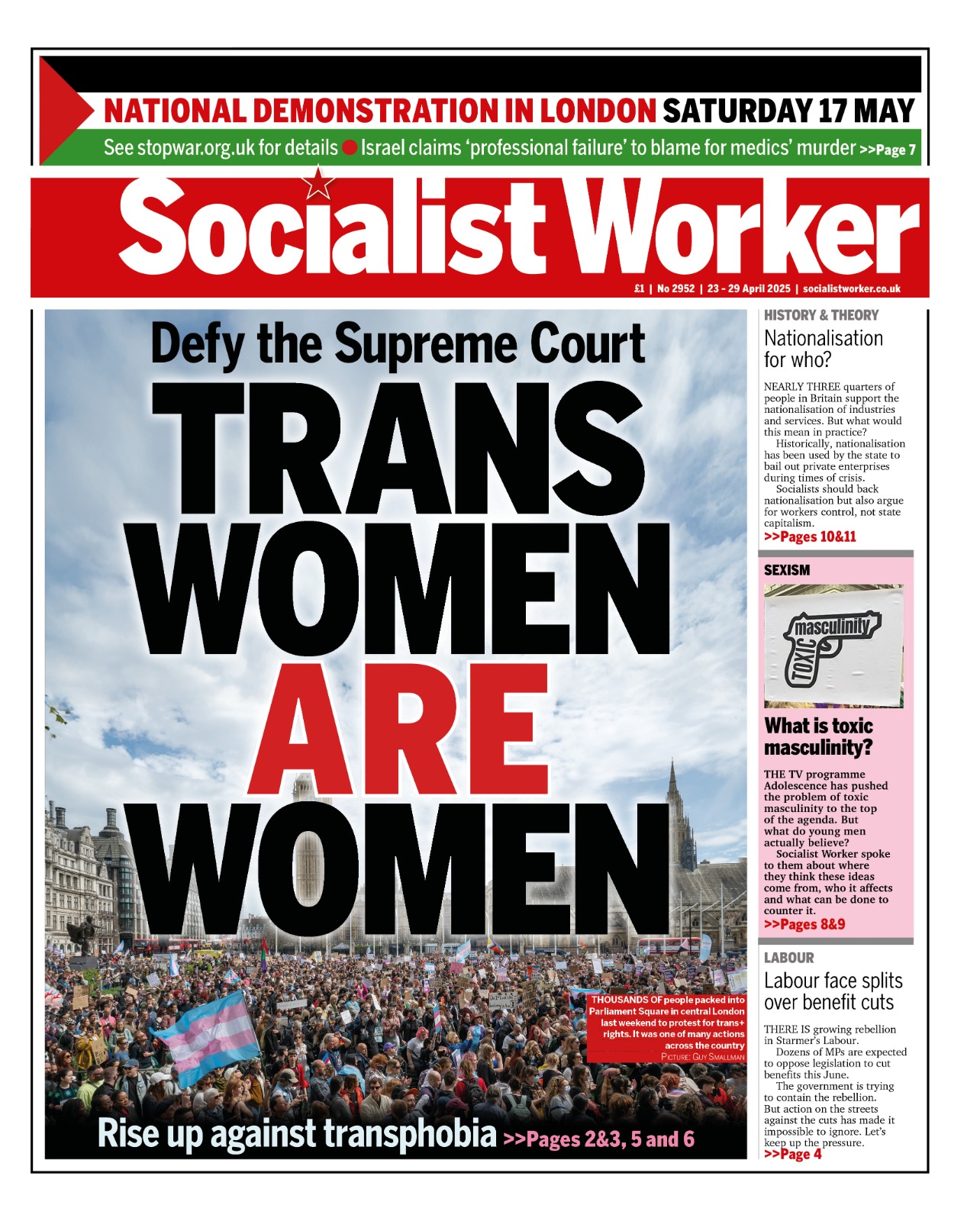
Alex Callinicos from the Socialist Workers Party writes that the ‘latest attack on trans people in Britain is part of a global offensive driven by the far right.’  Having created the narrative that only the far right opposes gender identity ideology he starts off his attack on the supreme court decision by claiming that For Women Scotland is a far right movement!  I suppose if your whole position rests on a refusal to recognise reality you find it easier to just keep on going.  Where would the gender identity left be without the claim that the recognition of the reality of being a woman is a far right programme? 

But this is just the first fiction in what is a very short article.  The most amusing is when Callinicos states that ‘Judith Butler puts it very well’! – apparently when she says that the transphobes seek “the restoration of a patriarchal dream-order”.  So, the erasure of the separate identity and reality of women, with all their rights and claims, by men is a strike against patriarchy!

The most becoming fiction for a professor who has written many books on Marxism is the following slippery circumlocution: 

‘The intellectual core of Marxism is historical materialism. It doesn’t in the slightest ignore our variable biological constitution but integrates this into the broader historical process through which human beings form and are formed by their societies.”

This involves a reference to a Marxist term, including the word “materialism”, followed by a sentence that doesn’t have the courage to say what it means – that men can become, or already are, women.  So instead, we are to swallow that our biology is “variable” and we are integrated into history and “formed” by it.  All very true, except our biology is not so variable that it means men are or can become women, or is it the case that “the broader historical process” has or can (trans)form men into women.

It is not necessary to believe that “women’s oppression” can be “reduced . .  to biology” to recognise that it is biology that makes women separate from men (and vice versa) in the first place.  Without these biological differences there would not exist the grounds upon which oppression could be built.  Women’s liberation will not remove biological differences, but Callinicos presents a view that oppression can exist without them.

His article is testament to Brandolini’s law that the amount of energy (and words) needed to refute bullshit is an order of magnitude bigger than that needed to produce it. He repeats, for example, the nonsense that the supreme court decision fails to bring “clarity and confidence.”  He has both forgotten the previous ease by which men and women could find the appropriate facilities, such as toilets, while also forgetting about the confidence the ruling gives women who might enter a facility to find a man who may or may not be trans (since she cannot read minds) and may be apprehensive about their presence whether trans or not.

As I mentioned in the first post, the rights of women are invisible to the left that adheres to gender identity ideology.  Even if every woman somehow identified as a man, they would still be prey to sexual assault, still experience childbearing and still face sexism despite some new name for it having to be invented.  Whatever new name would need to reflect reality and to exclude men identifying as women since they would not experience it.  But then, even this would be seen by the gender identity movement as discriminatory and lessening the ‘womanhood’ of transwomen. 

In an example of a recurring characteristic of the movement – that the allegations of gender identity ideology are actually admissions, Callinicos argues that “the far-right drive against “gender ideology” is aimed at reinstating the traditional heteronormative family.’” This charge is one he would presumably level at everyone who denies the veracity of gender identity ideology, including socialists who recognise the centrality of human biology to human existence and potential.  In fact, this argument against heteronormativity rebounds on the supporters of gender identity ideology.

In so far as the term has any positive content – that it privileges heterosexuality by denigrating same sex attraction – it is gender identity ideology that turns sexual stereotypes into the measure of humanity through self-identification and through, for example, permitting men identifying as women to claim to be lesbians.  In effect, same sex attraction is abolished to the extent that sex is rendered irrelevant or subsidiary to gender identity.

In a final example, he claims that “supporting trans+ liberation therefore has nothing to do with “identity politics”.  As I noted before, if gender identity ideology, self-identification, and men becoming women by identifying as one is not identity politics, nothing is.

Back to part 2

Forward to part 4

Left reaction to the ‘discovery’ that a woman is an adult human female (2) – the ‘usurpation of Parliament’

After accounting for all the explanations for the success of gender identity ideology on the left – opportunism, moralistic politics, petty bourgeois influences etc. – it is still difficult to fully comprehend its success.  It is one thing to make a mistake and to find it uncomfortable to reconsider and change one’s view, partly because of the censorious culture of tans activism summed up in the demand “no debate.”  It is quite another to come out with the nonsense polemics that characterise the attempts to defend it.

It invites the thought that if some left groups can justify this (including to themselves) they can justify anything.  Mistakes are common, refusing to learn from them is fatal, and the series of factors that are explanations for the mistake are revealed as permanently conditioning.

If we look at some of the reactions to the UK supreme court decision, we can see evidence of gender critical feminists’ repeated observation that for some, contact with this issue seems to turn their brains to mush.

One ideologue of the British Weekly Worker made a presentation in opposition to the supreme court decision in which he essentially says that the court usurped the prerogatives of parliament when it interpreted the meaning of sex in biological terms, in effect re-interpreting the conscious decision of parliament when it passed the 2004 Gender Recognition Act.  Sex, in legislation, has different meanings depending on its purpose and does not require a single ‘coherent’ definition as argued by the supreme court, or so he says.

While he recognises sex as biology, for example in relation to the difference in the incidence of breast cancer in men compared to women, and in women compared to men in prostate cancer (in women’s Skene’s glands), he disagrees that sex is defined by biology or that there are only two sexes. In justification he points to intersex people, ignoring that differences/disorders in sexual development (DSDs) are a biological phenomenon and people with DSDs are either male or female and not a third sex.

He also fails to notice that intersex is irrelevant to the issue because no one is self-identifying as intersex but as a woman or man; even as they deny the biological nature of these terms men identifying as women fetishise elements of female biology.  It cannot be escaped that to identify as a woman is to identify with their biological character, often in stereotypes of secondary sex characteristics; through delusional ‘experience’ of menstruation or menopause, or artificially replicating female functions such as breast feeding.

He is left with the problem of justifying self-identification with any of the other innumerable genders invented by the ideology, which can only have one ‘definition’, and it isn’t biological sex.  What purposes are these to be legitimately legislated for, and if none, what does this imply for the validity of gender self-identification in toto?

In relation to the question of usurpation of parliament by the reinterpretation of the meaning of sex, he ridicules the view that the word ‘sex’ can be subject to interpretation based on its ‘ordinary meaning’.  He claims that this leads only to an “arbitrary and unsatisfactory decision” (a “dodgy” decision) and is precisely what is to be decided, not assumed. 

It is, however, the case that the word ’sex’ does have an ordinary meaning and that it would be extraordinary that it should have a another one so radically different yet dependent and parasitic upon it. Given, on top of this, the novelty of self-identification as a route to defining a woman, and that it would therefore have an unstable meaning such that it could include men as a particular sort of women – a transwoman – it is difficult to claim that an interpretation based on the age-old ordinary meaning is “arbitrary” or “dodgy”, even if supporters of gender identity ideology think it is “unsatisfactory.”

In this case “unsatisfactory” pertains to the consequences of the decision, which involves the surrendering of claims by men so as to be able to assert the rights of women.  The problem the gender identity left has is that the latter is invisible because they have accepted the invisible justifications of the claims of certain men.

As for the integrity of parliament and the rigour and cogency of its decisions! Backbenchers of the Government will generally vote whatever way is in the interests of their career, which is with the government.  Whatever they thought they were doing with the concept (and real world consequences) of “sex”, I don’t recall any mandate for changing it in 2004.  As for today’s argument, it would appear that even the Labour Party’s ‘LGBTQ+’ MPs are not keen to proclaim that transwomen really are women.

The exceedingly legalistic lecture gives the impression of hitting the target of the supreme court adjudication but missing the political point.  It is argued that the reasoning employed by the court is appropriate only for a parliament when what needs to concern him is not the integrity of the division of powers in the British state – the executive branch breaks the law every day – but what reasoning should be applied to what purpose by the working class to determine its own principled position.

How does it benefit the working class for half its membership to accept that their history of oppression and continuing disadvantage in multiple spheres of life – arising from their existence as the distinct female part of humanity – is to be erased by a group of men claiming a special oppression through claims to their membership?  How are men and women to unite to rid themselves of the sexual oppression that exists if ‘for some purposes’ this sexual division doesn’t exist, ceasing to exist by the simple declaration of men?  There is no liberation to be found in men colonising the existence of women.

Back to part 1

Forward to part 3

Marxism and Gender Identity Ideology (7) – what the movement’s success explains about it

It might be asked how gender identity ideology, and the movement it represents, have been successful, despite its contradictions and impossible claims – claims by men to women’s rights while erasing the very meaning of woman; and claims to the ability to change one’s sex while denying the biological and binary nature of it and its basis in human reproduction.

There are various strands to the answer that have been touched upon in previous posts. Undue discrimination and prejudice evoke sympathy and support, and it is particularly popular among the young, who feel much less need to ask themselves how and why this issue has arisen and dominates certain milieus. Almost by definition they have less sensitivity to historical experience and awareness.  Their need for some historical validation – on the grounds that gender identity is innate – is shown by the attempts to read the modern idea of gender identity back into history, even if this results in yet more unsupported claims.

In the past week four ‘non-binary’ girls tried to disrupt a gay, lesbian and bi-sexual conference in London by releasing insects into the venue.  Their youth obviously permitted their oblivion to the irony of attacking the conference while claiming to be part of a wider LGBTQ+ movement – in doing so exposing their cannibalism of the original LGB and the incompatibility of their ideology with these original struggles.

It was also yet another demonstration that the T in the assortment of letters is interested solely in itself and is prepared to shaft its presumptive allies in pursuit of its own claims.  The young have had no experience of the struggle for gay and lesbian rights in many countries, or the experience of PRIDE marches not being huge parades that include numerous corporate sponsors; but rather, marginal demonstrations viewed by many with prejudicial revulsion and contempt.  But then, if men can aggressively and menacingly confront feminists while demanding that they be considered women, there would seem to be no set of circumstances for some in which gender ideology can be seen for what it is.

Defenders of women’s rights, and of reality itself, have thus found it necessary to explain how this modern and reactionary phenomenon has risen to such prominence.

As befits her occupation as a philosopher, Kathleen Stock in her book Material Girls, sets out ‘a brief history of Gender Identity’ in terms of the development of its ideas: from Simone de Beauvoir’s “one is not born, but rather becomes a woman”; through biological sex being “a continuum” and Judith Butler’s ‘gender as performance’; to the invention of the concept of TERF and the explosion of gender identities.

Helen Joyce, as a journalist, goes for ‘a brief history of transexuality’ in her book Trans, looking at the story of the medical and psychological treatment of what became transgender status.  Jane Clare Jones, in her essay on ‘the history of sex’ in the book Sex and Gender, looks at the ‘intellectual development and cogency of the sex-denialist ideas’ and identifies ‘the emergence of the contemporary trans movement to the early 1990s on both sides of the Atlantic through a blend of legal activism and academic theorisation.’

The periodisation of the movement to the 1990s helps understanding of the grounds upon which gender ideology has been able to drive its anti-woman and irrational claims into society.  Most obviously through the state and its various bureaucracies – especially health – and through NGOs, which are more and more reflections of the interests of the state despite their name. These often act as its conscience that the state can either ignore – if it is criticised – or hold up as justification for interventions if it is another rival state that is criticised

Legal changes supported by the gender identity movement have often been made surreptitiously, with little debate and without widespread public knowledge, as in Ireland, Denmark, Australia and Iceland.  No women’s organisations were included in the parliamentary enquiry by the UK Women and Equalities Committee in 2015 which led to consultation on changes to the UK Gender Recognition Act (2004), or for legislating for Gender self-identification in New Zealand.

The state has bought into and imposed gender identity ideology, from the local hospital and school, all the way up to the European Court of Human Rights and United Nations.  Sanctioning by such bodies has been seen as proof that the ideology and its claims are progressive by a left that has identified these bureaucracies as progressive, just as this left has more and more taken on the identity of an NGO rather than of a revolutionary working class organisation.  Law firms, prisons, sports organisations, religious and medical institutions, all normalise the abnormal so that we have ‘normal’ organisations claiming to believe in the preposterous.

It is rarely, if ever, noted by this left that the movement and ideology draws support from prominent capitalists, their corporate executives; bourgeois political parties, governments and state bureaucracies, and the NGOs they finance.  Some of these come together in the Gates, Soros and Ford foundations, which have committed $2.62bn to support self-identification.  (Women’s Rights, Gender Wrongs p187). And we haven’t even mentioned the fashionable philosophical and political ideologies pumped out of universities that give it the thinnest of veneers of intellectual legitimacy.

A small number of billionaires have played an outsized role in promoting the ideology and using their enormous wealth to fund the transgender movement through their own political organisations and corporations.  More important than the financing going directly to trans organisations is the money invested in health and pharmaceutical corporations in order to cater for the fact that many who undergo surgical and medical interventions can become lifetime patients.  The ideology has a growing material basis in the profitability of transgender medicine, especially in the US.

This is another difference between gay men and lesbians, who do not require medical or surgical intervention, and some who buy into gender identity and become lifelong patients, and especially in the US – lifelong paying customers.  For young people it can begin with puberty blockers, opposite-sex hormones, radical removal of healthy tissue, the addition of false secondary sex characteristics, and also the potential for repeated treatment to deal with the deleterious side-effects and consequences of these interventions.  In this respect, yet another difference between LGB and T.

Transgender health treatment has entailed creation of a medical-industrial complex with, for example, thousands of gender clinics around the world to deliver and support it, which also play a role in adding important ideological defences for it.  One writer gives the example of one billionaire sponsor of the ideology, Jennifer Pritzker:

‘Once a family man and a decorated member of the armed forces, Jennifer Pritzker now identifies as transgender. He has made transgenderism a high note in philanthropic funding through his Tawani Foundation. He is one of the largest contributors to transgender causes and, with his family, an enormous influence in the rapid institutionalization of transgenderism.’ 

‘Some of the organizations Jennifer owns and funds are especially noteworthy for examining the rapid induction of transgender ideology into medical, legal and educational institutions. Pritzker owns Squadron Capital, an acquisitions corporation, with a focus on medical technology, medical devices, and orthopedic implants, and the Tawani Foundation, a philanthropic organization with a grants focus on gender and human sexuality.’

‘Pritzker sits on the leadership council of the Program of Human Sexuality at the University of Minnesota, to which he also committed $6.5 million over the past decade. Among many other organizations and institutions Pritzker funds are Lurie Children’s Hospital, a medical center for gender non-conforming children, serving 400 children in Chicago; the Pritzker School of Medicine at the University of Chicago; a chair of transgender studies at the University of Victoria in Canada (the first of its kind); and the Mark S. Bonham Centre for Sexual Diversity Studies’ at the University of Toronto. He also funds the American Civil Liberties Union and his family funds Planned Parenthood, two significant organizations for institutionalizing female-erasing language and support for transgender causes. Planned Parenthood also recently decided to get into the transgender medical market.’

‘There doesn’t seem to be a sphere of influence that is untouched by Pritzker money, from early childhood education and universities to law, medical institutions, LGBT lobby and organizations, politics, and the military.’  (Bilek, Jennifer. Transsexual Transgender Transhuman: Dispatches from The 11th Hour (pp. 38-39, 43). Spinifex Press. Kindle Edition.. The money from these sources buys the spread of this influential ideological network across the world, including Ireland, which is hardly immune to economic, social, political and cultural influences from the US.

That such a tiny number of men, like Pritzker, have been able to impact in such a powerful fashion, and with such irrational effect from the point of view of our understanding and working of society, is a tribute to the irrational nature of capitalism and the power of the inequalities it generates.  The massive socialisation of production by capitalism that brings humanity together in innumerable connections exists beside the increasing monopolisation of production and the power of the tiny number of capitalists who benefit most from it: an illustration of the Marxist understanding of the contradiction between the forces and relations of production.

This impact should not be put down solely to the tiny number of billionaires who are themselves transgender, or are otherwise devoted to the idea of it as a way to advance some transhumanist agenda – in which technology increasingly renders biology (including sex) irrelevant – but to the wider influence and power that they can mobilise.  The author above also notes that:

‘Along with support by pharmaceutical giants such as Janssen Therapeutics, Johnson & Johnson, Viiv, Pfizer, Abbott Laboratories, Bristol-Myers Squibb, and Boehringer Ingelheim Pharmaceuticals, major technology corporations including Google, Microsoft, Amazon, Intel, Dell, and IBM are also funding the transgender project. In February 2017, Apple, Microsoft, Google, IBM, Yelp, PayPal, and 53 other mostly tech corporations signed onto an amicus brief pushing the US Supreme Court to prohibit schools from keeping private facilities for students designated according to sex. (Bilek, Jennifer. Transsexual Transgender Transhuman: Dispatches from The 11th Hour (pp. 43-44). Spinifex Press. Kindle Edition.)

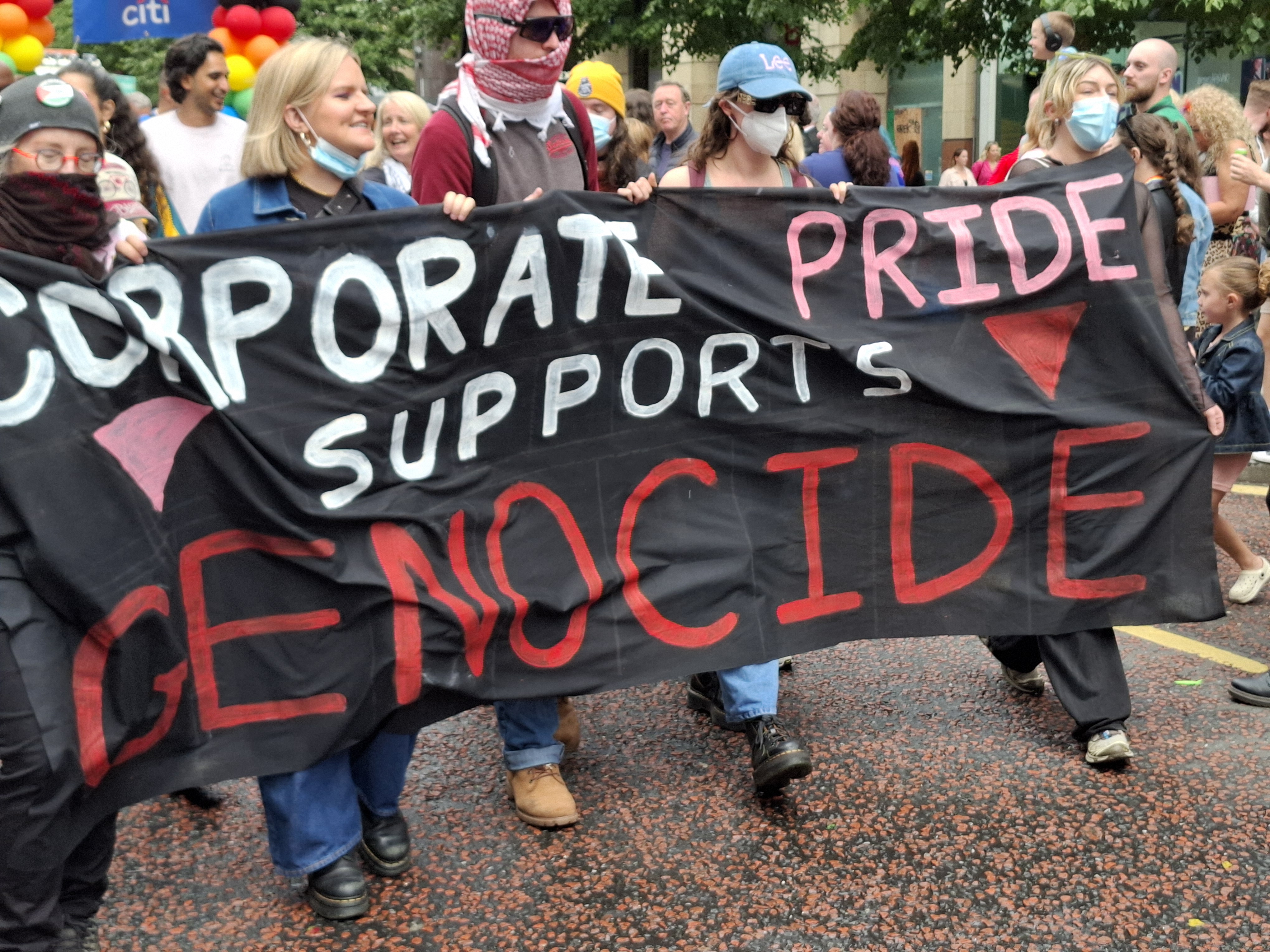
With such powerful support from big business and the state it is not hard to explain the gender identity movement’s success.  The corporate sponsorship of Pride and their HR departments’ Diversity and Inclusion departments are all examples of the appropriation of the claims of oppressed groups by capitalism.  Annual Pride demonstrations are no longer an expression of rebellious campaigns but a rainbow of multinational corporations; state agencies; NGOs; the mainstream mass media and bourgeois politicians, in what is more a fancy dress party – themed by inane slogans such as ‘love your mind’ – than a progressive campaign.  The idea that this is a grass-roots movement is as true as the claim of men to be women.

One banner at this year’s Pride parade in Belfast that hit the nail on the head.

Back to part 6

Forward to part 8

Bourgeois democracy in Ireland in two Acts (2) – Orwellian and Surreal

Bourgeois democracy can not only lie, it can also invent crimes for which you can be punished.  The Government is going ahead with the hate crime bill, shorn of its hate speech elements.  This follows its stinging defeat in the family and care referendum in which it also lied about the implications of what it was proposing when asked whether these had been raised within it as a concern.

The original proposals about ‘hate’ speech were particularly threatening but the retention of the definition of “protected characteristics” raises all sorts of questions that the government will again have to spin and lie about in order to defend.

These “protected characteristics” include ‘race, colour, nationality, religion, ethnic origin, descent, sex characteristics, sexual orientation, disability and gender’.  Beyond general issues about the wisdom of agreeing to greater repressive powers for the state, and the inclusion of essentially subjective considerations such as ‘hate’ in punishment, there are two questions – what is ‘sex characteristics?’  Is this just another term for sex, in which case what is the point of two words instead of just three letters?

The second is the definition of gender included in the legislation: “’gender” means the gender of a person or the gender which a person expresses as the person’s preferred gender, or with which the person identifies, and includes transgender and a gender other than those of male and female”.

This farrago of words is obviously not a definition of anything, certainly not of ‘gender’ or ‘transgender’, and as I have written before, it’s doubtful that one can be clearly stated.  It seeks to protect people who are ‘other than those of male and female.’  Who are they?  Where are they and how do they, or could they, exist?  In what way is this not putting into law the nonsensical ideas of gender identity ideology that the Government parties don’t have the courage to openly argue for?

When the right wing Senator Michael McDowell asked the Department of Justice what is intended by the term ‘transgender’ and ‘a gender other than those of male and female’ he got no response.  Instead, the department provided a statement that included this: 

“If someone is assaulted because they are transgender, that is a hate crime.”

“People identify as non-binary. That’s a fact. If someone follows a non-binary person after they leave a gay nightclub, and then assaults them while shouting homophobic abuse, they would likely be charged with assault causing harm aggravated by hatred (carrying a max sentence of 12 years, instead of 10 years because of the aggravating factor). If it’s not found that it has been aggravated by hatred, then the person could still be charged with assault causing harm,” it said. “A definition is required to protect that person. It has absolutely no implications outside of this law.” (Emphasis added – Sráid Marx)

The department also asked: “Does Michael McDowell believe that this person should be protected by this law, or does he believe this person should have to identify as male or female to be protected?”

There is so much that is simply stupid in this that it’s difficult to know where to start.

I am quite sure that Michael McDowell would respond that it does not require anyone to identify as anything in order to be protected, which is what the Department of Justice seems to imply. Or does the Department believe it must be proved that an assailant knows the inner thoughts of someone in order to secure conviction or aggravated punishment?  For that is what the department assumes when it wants to protect someone who is in some way not either male or female and walks out of a gay club.

How on earth could someone be attacked for being ‘non binary’ without the assailant having some prior knowledge of the person?  If a stranger was attacked for coming out of a gay club it is much more likely that any motive beyond purely violent intent would consist of homophobia, which is obviously what would be indicated by their “shouting homophobic abuse”.

It is indeed a fact that “people identify as non-binary” but it is also a fact, that the government wants to elide, that there is no such thing as a non-binary person (neither male nor female or both).  Assaulting someone for this reason is not an assault on someone because of what they are (e.g. gay) but an assault because of their (misconceived) ideas about what they are.  Since such ideas are as varied as there are ‘genders’, the state has opened up a panoply of grounds upon which to claim hate crime warranting additional punishment.

The state may have dropped attacks on free speech that might lead to criminal punishment arising from disagreement with the idea of the many ‘genders’ claimed by some activists, but this still leaves open the potential for punishment for those disputing such claims.  This may seem absurdly alarmist but it is already the case that the Department of Justice is implying that only inclusion of a gender identity in a victim ensures protection, something just as absurd.

The ability of the state to conjure up offences and therefore punishment on grounds that are non-existent is surreal.  The word Orwellian is overused but the Irish state is claiming that not only can it identify the inner thought crime of an accused but also that the inner thoughts of the victim can also be divined by the accused and in turn accessed by the state.

It is a feature of gender identity ideology that it throws up such idiocies that are easily dismissed, but these are a result of the foundational one that men can be women just by claiming to be one, and this is one nonsensical claim that is already being validated and legislated for.

McDowell has also noted that ‘the Bill suggests that there are genders (plural) other than male or female. It does not enumerate or describe such other genders”. He argues that unspecified genders beyond male and female would raise questions “over statutory provisions providing for gender balance in judicial appointments, board compositions, etc”.  “There is no case for legislating for an open-ended multiplicity of subjective genders the meaning of which is obscure,” he said.

The idea that the numerous legal and social provisions based on gender – understood as sex – will not be affected by the legal recognition in this Bill is naïve at best and does not accord with experience across the world.  I have argued elsewhere that these implications are reactionary.  They have included attacks on freedom of belief; freedom of speech and freedom of association; destroying women’s sex based rights; putting males in female spaces; attempting to obliterate sexual orientation and lying to children that they can change sex before they even have a full appreciation of what it is.

Those who think that because McDowell is right wing he cannot be quoted or we cannot agree with him on this should consider why a government and state that is complicit in genocide, as we pointed out in the previous post, should now be considered to be in the vanguard of social progress.  They might also consider that Genocide Joe Biden described trans rights as “the civil rights issue of our time. There is no room for compromise when it comes to basic human rights”. Tell that to the Palestinian people.

Back to part 1

Marxism and Gender Identity Ideology (4) – looking at a progressive movement?

We noted at the end of the previous post that there is a reason why it might be thought that the demands arising from gender identity ideology are regressive and reactionary, and for this reason should not be ignored.

In his book ‘Trouble with Gender’ the philosopher Alex Byrne remarks that it is ‘tempting to search for some hidden meaning’ in the actions of one prominent supporter of the ideology – ‘a sign that the current trouble with gender ultimately makes sense, rather than being an inexplicable cultural spasm that will eventually recede into historical mist, leaving some wondering whether it happened at all.’ 

If, for some leftists, the whole thing is therefore a diversion; is it a diversion into reactionary territory that should be ignored, even while recognising that it has many left supporters that should be challenged?

Marxists are constantly having to combat diversions from working class politics.  We are constantly facing challenges to our understanding of the world and the political responses that are required.  We only need to think of those who find reasons to support either the Western imperialist/Ukrainian alliance on the one hand, or the Russian capitalist state on the other, in the current war (that socialists should oppose outright) to see that these divisions are unfortunately common.

On the face of it gender identity ideology is reactionary, except that it pretends to be progressive, and this pretence is often effective.  I am reminded of the old TV show ‘Catchphrase’ in which contestants have to identify the familiar phrase represented by a piece of animation that appears block by block on a screen.  Today we quite regularly see feminist meetings being harassed by men dressed as women, often by young people masked up and acting in a threatening manner.

In times gone past this would have been seen as unacceptable and aggressive misogyny.  Today, many leftists support these men as the oppressed and damn the women as bigots.  The ‘Catchphrase’ presenter used to tell contestants to “say what you see”.  The upside-down inverted world of gender identity ideology prevents many from seeing what is plainly going on in front of their eyes.

The assertion that gender identity is what defines us and not sex is ‘explained’ by a leading inspiration of the movement, Judith Butler: “If gender consists of the social meanings that sex assumes, then sex does not accrue social meanings… but rather, is replaced by the social meanings it takes on; sex is relinquished… and gender emerges… as the term which absorbs and displaces ‘sex’” (Bodies That Matter, p. 5).

The substitution of gender identity for sex as the means of understanding the world, through claiming that this is how the world is actually structured, has profound consequences, not least the necessary imposition of an utterly changed comprehension of society and how it should order its everyday life.  Since the vast majority of people recognise sex as fundamental to the existence of humanity, its functioning in society, and how we relate to each other, it is necessary to impose this alternative ‘reality’.

The attempt to do so necessarily produces all the exaggerated features of gender ideology activism, including incoherence and self-righteous aggression.  In the ‘Weekly Worker’ article quoted before, even its sympathetic author notes that what he calls the ‘abolition of the oppression of trans people’ through imposition of rules against ‘transphobic speech would have unwelcome results that mean it could not be supported: ‘the workers’ movement should want to abolish it – but not at the price of losing freedom of speech and communication.’  Yet attacks on freedom of speech is a stand-out feature of this trans activism. Although not all agree, there are far too many examples of trans activism targeting women who meet or speak publicly in defence of sex-based rights to demonstrate that the ‘toxicity’ of the ‘debate’ around it is overwhelmingly the result of the approach of one side.

The censorial, hyperbolic and aggressive character of much trans activism is neither incidental nor accidental but a necessary feature of the movement. The necessity to make people perceive the world in a way that it is not makes the mantra of the movement “no debate” inevitable.  The claim to rights that cannot belong to them, that transwomen should have all the rights and prerogatives of women for example, cannot be substantiated so are camouflaged by appeals to ‘be kind’, attempts to associate themselves with the cause of gays and lesbians, and constant declarations of their special vulnerability and oppression. 

None of this is enough, so ‘no debate’ exists to forcibly try to shut down those asserting women’s sex-based rights. The attempted suppression comes in many forms, from censorship in academic journals and books; intimidation of academics in work, discrimination involving loss of employment in work, and foul and vicious threats on social media.  All justified by shouting that those critical of gender identity ideology are ‘Nazis’.

One example of the hyperbole gives a flavour of the approach. When the British Cycling organisation announced that the female category in competition would only be open to “those whose sex was assigned female at birth and transgender men who are yet to begin hormone therapy”, a transwoman cyclist published a statement stating that “This is a violent act, British Cycling are supporting this, they are furthering a genocide against us. Bans from sport is how it starts . . .” It should not need pointing out that if you want to see a real genocide you should look elsewhere – at the fate of the Palestinian people in Gaza.

It is often declared that to call into question the claims of this ideology is to deny trans people’s right to exist and constitutes violence against them; not metaphorical violence but actual violence.  To disagree is to endanger them and is proof that the critic is transphobic and bigoted.  A climate of censorship and fear of social exclusion has enveloped much of the left on the issue, a movement which needs the stifling of free speech like a hole in the head.  On this ground alone the growth of gender identity ideology is reactionary.

This shutting down of debate and presentation of the ideology as one of liberation against oppression prevents appreciation of its obvious reactionary consequences.  The erasure of sex removes the possibility of same sex attraction; ironic since the T for transgender has attached itself to LGB and come to dominate it.  Lesbians and their activities can now be attacked and sanctioned as transphobic for not considering transwomen, i.e. heterosexual men, as sexual partners.  Same sex attraction becomes impossible because it is ‘exclusionary’. Sex has been displaced by gender so that a heterosexual man declaring himself to be a woman can claim to be a lesbian and in doing so ‘change’ his sexual orientation.

Women, shorn of any essential biological reality are unable to identify, comprehend, explain, and fight the grounds of their oppression.  The ideology declares that while ‘transwomen are women’, women (females) have become ‘cis-women’, who become ‘privileged’ in comparison because their gender identity aligns with their sexed body.  This is the case even though it is also claimed that the sexed body is either a social construct, can be altered, or is irrelevant:

‘The quest for ‘gender recognition’ is not therefore an effort for an individual to change sex, but for an individual to be recognised in their true sex or gender (hence the change in nomenclature from ‘sex-change’ surgery to ‘gender-affirmation’ surgery). As Rothblatt argued in 1994, “we are not changing our sex. We are changing our gender…Our sex is the same as it was when we first entered the doctor’s office—the sex of our minds and our soul” (Rothblatt, Martine. 1994b. ‘Unisexuality: The Wave of the Future,’ Third International Conference on Transgender Law and Employment Policy Proceedings, Appendix E, pp. E1-E6. Quoted in Jones, Jane Clare. The Annals of the TERF-Wars and Other Writing (p. 40). Kindle Edition)

to be continued

Back to part 3

Forward to part 5

Marxism and Gender Ideology (3) – Nothing without our body

In reaction to the Cass Report in Britain there has been widespread denunciation of the ‘toxic’ debate around the transgender issue without specifying why this is.  There has also apparently been wide agreement that there needs to be better data to find out the effects of treatment of children and young people.. 

The second link above shows that the apparent agreement is a fiction and that the supporters of gender ideology, within and outside the NHS, have both no need for data and no need for a debate.  The report itself reveals that most of the NHS’s gender identity development service (Gids) refused to cooperate with the inquiry in providing evidence and that this was ideologically driven, i.e. they accepted gender identity ideology.

It is abundantly clear that the toxic debate is not going away any time soon because the supporters of gender identity ideology have made it plain that there is no debate to be had, and that data on clinical outcomes of those young people who have had puberty blockers, or cross-sex hormones or other surgical intervention is impermissible.  This, however, is only one reason for the toxic ‘debate’.

As we saw in the previous post, the shifting, imprecise and downright misleading use of definitions means that you get routine claims about the ‘right to change gender’ when what is meant is the ‘right to change sex’ which does not exist because it cannot be done.

The issue is not therefore about a ‘right to change sex’ but the social and political rights to be acquired from claiming to have one’s ‘true’ sex recognised, which is to be established not by any sort of health care, such as hormonal treatment or surgical intervention, but by accepting the view that one knows one’s identity better than anyone else and being a woman, for example, is just such an identity.  Something that a man can be if he puts his mind to it.

This requires the belief that one can be ‘born in the wrong body’, meaning that the ‘real’ and essential person exists as something separate from the body, which is akin to the religious idea of a soul, also separate from the body. In this way the claims of gender identity ideology are a religion for which data, or any other scientific evidence, is irrelevant.  For this ideology, denial of the quasi-religious nature of its claims means that the pretence must be made to objective validity but this must then involve denial of the means of validation.  Irrational claims give rise to irrational discourse which gives rise to the toxicity.

The shifting, imprecise and downright misleading use of words, including the word ‘gender’ adds a twist to the non-debate by making it impossible to consistently identify what is being claimed or denied.

Gender can, as well as meaning sex, also be understood as the expression of social norms associated with and based on one’s sex, such as the characteristic stereotyped attributes of femininity to be expressed by women and of masculinity to be expressed by men.  We have looked at some problems with this is the previous post but let us park these for the sake of this discussion.

Effeminate expression by men, by some gay men for example , has historically been disapproved of in many countries, with patterns of socialisation generally working to impose those characteristics considered masculine that would prevent or negate such expression.  Similarly, the phenomenon of masculinised women, such as in some lesbians, has also been frowned upon.  Regardless of the advances in gay and lesbian rights in some counties, this socialisation process continues and is still considered ‘normal’ with deviations from it being ‘abnormal’.

In real life, no one fits the pure stereotyped norms of femininity and masculinity.  It therefore makes no sense to use the term gender in the way employed by one socialist: that trans means ‘people who wish to live permanently in the gender identity polar opposite to that ascribed to the biological sex’.   No one’s gender is the polar opposite of their sex, while the free expression of one’s personality is a part of what socialism is about.  Gender norms are restricting, stifling and enforce rigid stereotypes that are regressive for both sexes and for the relations between them.  

Everyone expresses some combination of the characteristics that may be said to make up the ‘polar opposites’ of the social expression of one’s sex.  To claim that one is a ‘polar opposite’ in identity to one’s sex is therefore to define oneself in stereotypical and reactionary terms, so that to assert political claims on such grounds is also reactionary.

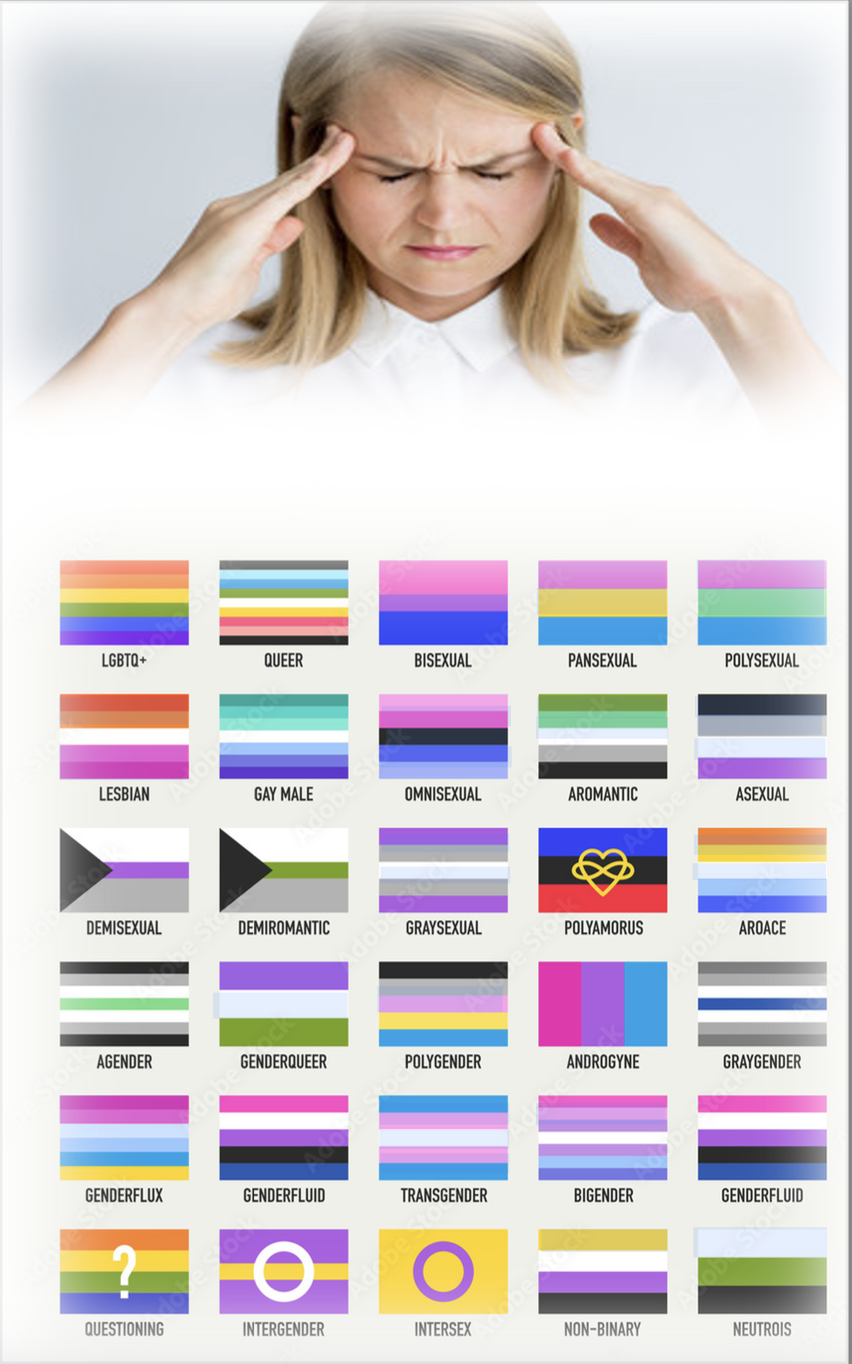
Gender identity ideology might think it avoids this by positing the idea of numerous genders, so that ‘polar opposite’ is not the only alternative to female and male, woman and man.  This involves the creation of multiple genders, and different sources will provide different numbers of them.  If you Google ‘how many genders are there’ you might find that there are either 3 or 4 or 68 nor 72 or the number is undefined.  The BBC once claimed to children that there were over 100.

Since one’s gender is determined by one’s sense of oneself there can be any number of self-definitions, each of which must be considered to be valid by this ideology, precisely because it is self-determined.  But purely subjective identities are paraded because they crave social recognition, validation and acceptance, (otherwise they remain in a private domain without validation etc.) so the assertion of such identities is a political question.

This ideology thereby becomes the only political position that asserts its legitimacy and authority on the basis of an unchallengeable declaration demanding immediate acceptance. However, this ‘first-person authority’ championed by gender identity ideologists (trans people know themselves better than anyone else so we should all accept what they say) excludes those who disagree (for example women who deny that they have any sort of gender identity).

Whatever about such claims to novel ‘genders’, the majority are either male or female, and since women are most vulnerable to the consequent results, claims that men can become (or always ‘really’ have been) women are the most contentious.  Transmen in some male-only settings are at greater risk than the men they will encounter but this cannot be said for transwomen (men) entering women-only spaces.

This also means that while many transactivists supporting gender identity ideology think of themselves as left wing and progressive, their ideology is simply a mirror of the conservative and right-wing view of women that they claim to oppose.  While the most conservative view regards the proper expression of a woman’s sex as stereotypical femininity, trans activists often define what it is to be a woman through stereotypical expression.  The causal direction is simply reversed. For one, women should be feminine and for the other being feminine, in so far as they can make it, is to be a woman.  

Since ‘gender’ can be understood as sex, or as the expression of norms of socialisation of the sexes, we confront claims to be able to change sex, which is impossible, or claims to be able to change gender through having a sense of one’s sex being different from what it actually is. In the latter case gender is then conflated with sex.  Through identification with (or through) the social norms that are supposedly rejected the claim is made that one has changed sex.

The ‘explanation’ is to claim that to be a woman is to have some innate sense of being one.  This innate sense, in order not to be something contingent and open to challenge, is held to be common to everyone; everyone has a gender identity, whether admitted or not. We thus end up with the mantra that ‘transwomen are women’.  It is claimed by some supporters of gender identity ideology that everyone’s gender identity is expressed in terms of behaviour, appearance, including clothing, make-up, etc and is evidenced by it.

This ‘argument’ has its own problems. If a transwoman wears high heels, pretty pink dresses, lots of make-up and effects a flighty and skittish air they may be accused of believing that being a woman is existence as a crude stereotype that is insulting.  Not doing any of these things might leave the transwoman looking like a man and putting immediate and impossible-to-ignore obstacles to acceptance of their claims.  How recognition of all the other genders is to be accomplished, even by their bearers, is a moot point, including the idea of gender fluid, non-binary, non-gender, agender, third-gender etc.

More generally, what particular norms of behaviour, dress etc must be included in ‘gender identity’ and what is not, and how the mélange of social factors come together to instantiate and constitute a coherent sex status, is impossible to define.  A transwoman may seek acceptance as a woman, but fundamentally rejection or qualified non-acceptance will not be because of any presentation etc. but will be based on knowledge of the person’s sex; the real transphobe will be the one who rejects a transwomen fundamentally for their failure to represent masculinity.

What these point to are the limitations of subjective claims over objective reality, illustrated in other ways.   A person’s sex exists before it is ‘assigned’ (as the ideologists put it) and will exist whether it is ‘assigned’ at all, for example if no doctor is present ‘to do it’.  A baby girl and an old woman are still females; the first does not identify as anything and will, bar accidental factors such as death, develop into a woman, and the latter is still a woman whether she is, because of dementia, no longer able to be conscious of this fact or not.  When she is dead, she will be a dead woman.

It is claimed that because these subjective senses are unverifiable, we cannot test them – we cannot reach inside someone’s head to see how they really feel, process these feelings into thoughts and see how they are then formulated into claims to objective reality.  We cannot know the motivation behind a claim to a gender identity for example.  How do we know that a transwoman actually feels or thinks like a woman (leaving aside what this actually means) when they are a biological male?  In fact, the assertion would have to be to feel and think as a woman, although this lexical formulation is immediately less plausible.

How is it known that their ideas of their identity, arising (sometimes) as the result of psychological distress caused by various factors, conform to and constitute essential ‘womanhood’?  Since Gender identification is sometimes described by transgender activism as a political act, or that ‘there’s no one way to be transgender, and no one way for transgender people to look or feel about themselves’, or ‘there is no right or wrong way to be trans’, their claim is effectively denied.

Children come to know themselves through observing others and comparing themselves to others, including observing that there are two sexes and that they fit to one of them.  They learn that this cannot be changed.  In this, the sense of one’s sex is learned and not innate, even though it cannot be changed, so that for the vast majority of people it comes with the territory.  Distress caused by a perceived discrepancy between the idea of one’s sex, misnamed gender identity, and sex characteristics of one’s body can lead to what is termed gender dysphoria, but this does not allow one to change sex.  Even if medical and surgical interventions may help, that is relieve the distress to a greater or lesser degree, these will not change a person’s sex. They cannot therefore be a ‘cure’ for the claim that their condition requires a change of sex.

Such dysphoria evidences an awareness that one’s sex is different from one’s identity, from the claim to a fixed and innate identity as the opposite, or more accurately, other, sex.  Further, it is often asserted that this identity warrants the claim that despite natal sex, for example as a male, the transwoman was ‘always’ a woman.

In effect, the sexed body is rendered both relevant and irrelevant to the construction of all of humanity since trans people are still to be included under the classification of the two sexes that encompasses everyone. (We leave aside the many other ‘identities’ that render the whole ideology even more incoherent).  The claims about the meaning and importance of sex are therefore not just about trans people but about everyone and thus involve sweeping claims about the nature of the non-trans population that they are blissfully unaware of – that gender identity and not biological sex defines them and is definitive. Everyone is to be roped into the ideology whether they like it or not and the subjective claims of some become the objective claims on others.

In other words, if gender identity defines sex and everyone has a gender identity, everyone is defined by this phenomenon of gender identity with the social and political consequences demanded by the ideology.  ‘Transwomen are women’ can thus be read backwards.

If transwomen claim that they feel like women and have the same sense of themselves as a biological woman has, it implies that the feelings that biological women have, and their sense of themselves as a sex, is the same as that of transwomen.  I doubt very much whether the vast majority of women would endorse such a claim.  Not least because their understanding and feelings about being a woman are based on their female body, its functioning and the social experiences that this necessarily entails. None of these considerations involve ‘biological determinism’ in the sense that women’s social and political roles are biologically determined.

Many women therefore, as we have said, deny having any gender identity of the kind expressed by trans activism.  Their statements on their sense of themselves and the sexed bodies that they have will be more persuasive than the claims of men who do not inhabit female bodies, have not experienced life as a woman, and who cannot know how women feel about being a woman but can really only imagine or profess some idea of it.  

Women will do so with much stronger objective grounds to make such statements.  That they are often not called upon to do so makes it hard to avoid the view that a well-known hierarchy of authority between the sexes is being adopted.  In any case, regardless of any supposed authority, identifying as a woman does not make you one.

To sum up: you cannot change sex, you cannot become a different one by behaviour or appearance or other cultural attribute, and you cannot identify yourself into one.  Since we are most interested in the politics of gender identity ideology, we are left with the conclusion that any claims it makes are not based on reality.  For Marxism, if they are not, they are reactionary.

We will look at whether this conclusion can be explained further in the next post.

Back to part 2

Forward to part 4

Marxism and Gender Identity ideology (2) – What is it?

If we look at the UK government’s 2018 consultation paper on reform of the Gender Recognition Act we see that gender is defined as ‘often expressed in terms of masculinity and femininity, gender refers to socially constructed characteristics, and is often assumed from the sex people are registered as at birth.’  Thus, do we immediately enter the world of indefinite definitions that create uncertainty as to their meaning and a tortuous journey to understand how it all is supposed to hang together in some coherent way.

In the document, a legally recognised gender is meant to allow replacement of a supposedly erroneous recording of sex on the birth certificate, although it cannot be the ‘right’ one because gender is not sex and is not defined as sex. The individual is entitled ‘to a new birth certificate issued with an updated sex marker’, and according to the definition of the Full Gender Recognition Certificate, this ‘shows that the holder has satisfied the criteria for legal recognition in their acquired gender.’  So, although it is a ‘sex marker’ it is not the actual sex of the individual, which is observed at birth.

Like so many other aspects of this question, as we shall see, sex is both central and to be displaced.

What it is displaced by is not clear, and certainly not by the above definition.  We are told that ‘gender’ is sometimes expressed in particular terms but not what it is that is being expressed.  This invites the question, what other expressions does it have that might lead us to understand what it is?  Perhaps this is explained by the definition of ‘Gender expression’, which is ‘a person’s outward expression of their gender. This may differ from their gender identity or it may reflect it.’  In which case the expression of gender that is supposed to be core to the definition of gender may not actually be a person’s ‘gender identity.’ 

The definition of gender goes on to say that ‘it refers to socially constructed characteristics’, which tells us that this is not a natural entity, like sex, which is biological, but is a social construction, but again does not tell us what it is that has been constructed.  What social constructions are we being referred to?  If it is ‘femininity’ and ‘masculinity’, why is this not stated, although it can’t be these because these are just some expressions of it and these, we have been told, may not reflect a person’s gender identity.  If conceived as social norms, of behaviour, presentation etc., it doesn’t make much sense to refer to individuals in terms of a social norm, which is a feature of society and not of individuals.

In any case, we are not told what ‘femininity’ and ‘masculinity’ are.  These might be understood to refer to the characteristics of males and females, not to their natural attributes but to social ones that have been attached.  Could there be references to some notions of what ‘femininity’ and ‘masculinity’ are or to concrete social practices?  Both, however, vary by time and place and are not like sex, from which we are told we might assume a person’s gender, which is immutable.  Gender, therefore, is something very different from sex, considered on even the most minimum basis, and gives rise to doubts as to how it could be a substitute for it.

Of course, these questions are easily answered if it asserted that ‘femininity’ and ‘masculinity’ are often seen as expressions of one’s sex but not its substance and that socially constructed characteristics are often placed on the sexes, which is why we can often assume them from a person’s sex.  This however would not assist the project of replacing sex with gender.

The definition of Gender identity is ‘a person’s internal sense of their own gender. This does not have to be man or woman. It could be, for example, non-binary.’  So, if gender refers to socially constructed characteristics and gender identity is an internal sense of these, gender identity must derive from social characteristics that have been internalised.  If this is the case, gender identity cannot be innate and cannot exist at birth since at this stage of human development such characteristics as masculinity and femininity have not been perceived.  Since they vary by time and place, this also raises the question how something claimed to be innate, being inherent in the essential nature of someone, and from birth, can vary by time and place (unlike someone’s sex).

Nevertheless, this is the ground upon which the designation of one’s sex through a new ‘sex marker’ based on ‘gender’ is made, and of the political demands made by Gender Identity ideology. 

The uncertainty is increased when we are told that a gender can not just be either a man or a woman but ‘non-binary’, which is further defined as; ‘an umbrella term for a person who identifies as in some way outside of the man-woman gender binary. They may regard themselves as neither exclusively a man nor a woman, or as both, or take another approach to gender entirely. Different people may use different words to describe their individual gender identity, such as genderfluid, agender or genderqueer.

What is meant by ‘identifies as’?  Is it a way of stating that a person is, for example, saying I am “neither a man nor a woman” or saying, “I am both a man and a woman’’?   If it is more or less the same as this, how does this make sense? 

How can gender identity, which refers to someone’s internal sense of their gender, which refers to socially constructed characteristics, refer to entities that do not exist, such as a person that is not a man or a woman?  Does this then mean that ‘socially constructed characteristics’ are, or can include, ideas or conceptions that have no material reality?  Are there any limits to the ideas constructed?  In what sense, and in what way, can someone saying they are, for example agender, be considered, and therefore treated, differently to someone claiming to be of the other sex (if these different genders are to be taken as socially significant)?

And what if the claim to be non-binary is really a political statement, in what way can the concept of gender and gender identity suppliant that of sex and its corporeal reality if such statements are also, or really, statements of political belief –  a political identity?

We are told that the Gender Recognition Act 2004: is’ an Act of Parliament that allows transgender people to gain legal recognition of their acquired gender, so long as that gender is a man or woman’, which lets us know that the law will not recognise something which does not exist, i.e. a person that is neither a man or a woman or a person that is both.  And we also don’t need to seek guidance on what the legal status is of the other genders.  This, however, leaves open the question what sort of thing ‘gender’ is, that can include things that cannot exist but is also something that can legally replace sex, which obviously does exist, for some purposes. 

We are not told what is meant by a ‘person’s internal sense of their own gender’.  What is meant by ‘sense’; is it feeling, belief, understanding, perception or knowledge?  Why should a person’s expression or statement of these be legislated as true, and subject to legal obligation by the state?  What other claims by a person of belief etc. are unequivocally accepted and acted upon by the state? Particularly when this ‘sense’ can also include things that do not make sense – like not being either a woman or a man or being both at the same time?

The definition of Gender Identity as a person’s internal sense of their own gender, is the basis of an ‘Acquired gender’, and ‘ The Gender Recognition Act 2004 describes this as the gender in which an applicant is living and seeking legal recognition. It is different from the sex recorded at birth and is instead, the gender the individual identifies with. It could be man or woman.’  Since both ‘gender’ and ‘gender identity’ do not require gender presentation or gender expression it is unclear how the ‘gender the individual identifies with’ could always be verified.  To identify ‘with’ something is not the same as identifying ‘as’ something (ignoring what exactly identifying as something can actually accomplish or entail).

In any case, what does it even mean to live ‘in’ a gender that is in some way different from your sex?  How can anyone live outside of or in some way different from what their body dictates, a body which is sexed and which determines so much of life and existence, even whether you are able to exist at all?  It is an elementary fact, understood by everyone, that life cannot exist outside the body because the functioning body is life.  To live ‘in’ some thing, and through this thing, is to live in a (sexed) body.

One does not live in femininity, for example, or in socially constructed characteristics, and social norms might be lived within society by a person but are not, as we have noted, a sort of internal identity.  Proof of having a collection of documents, such as driving licence, passport or utility bill, as set out in the Gender Recognition Act 2004, is a bureaucratic, simulated substitute. Those with a non-binary identity might struggle.

Other inconsistencies can be noted.  While gender and gender identity refer to social constructions and internal senses, ‘gender reassignment’ refers to ‘reassigning the person’s sex by changing physiological or other attributes of sex.’  Since sex can be replaced by a ‘sex marker’ that recognises a person’s ‘gender’, it would also appear that gender changes (or reassigns) a person’s sex by a physical process (that does not have to be completed).  Gender identity as an internal sense can replace sex while gender reassigned involves a physical process.  These involve two very different operations, and it is not explained in what way they are able to involve and accomplish the same task.

Finally, the British Government document states that it wants to know the implications of ‘recognising a gender that is neither male nor female’, which are, of course, the two sexes and I don’t know of any other.  At this point it is tempting to repeat philosopher Alex Byrnes’ remark in his book (Trouble with Gender, p107) that “what ‘gender’ is supposed to mean is anyone’s guess.”  The labyrinthine series of definitions examined above form the basic structure, such as it is, of an ideology that is supposed to sustain certain political claims, and it is this ideology that further occasional posts will examine

Back to part 1

Forward to part 3