BBC Spotlight and the Housing Executive – what sort of scandal?

Housing Executive 2.jpg

BY Bellfast Plebian 

A little while ago (Jan 2013) this blog singled out Nelson MaCausland, a Minister in the stored Northern Ireland Executive, as a target for criticism.  This was no random selection of a minister in an improbable regional government that we happen to have little respect for. Nelson was a bit of a special case because he was the minister most likely to cause a commotion.

It was asserted that this neo-conservative Orangeman is about the least preferable person you could hope for in charge of managing the socially damaging CON-DEM policy of comprehensive welfare reform. We were sure his approach would be to offer minimum resistance to the drastic changes being proposed.  We were especially worried that he had been given overarching control over the Northern Ireland Housing Executive: the publicly funded organisation specifically mandated to allocate social housing on the basis of objective need rather than community and religious patronage.  The Minister we said was so ardent an evangelic Protestant and a strident Orangeman that he would be inclined to put the interest of promoting his own religious community above the important non-sectarian consideration that pertains to the neutral role required of a housing minister. Well it didn’t take very long for our worries about Nelson to be confirmed – the bomb exploded earlier than we anticipated – and a few days after we posted our account he began his political assault on the very existence of the Housing Executive.

At first Nelson’s spat with the Housing Executive was carefully phrased in the all too familiar neo-liberal one of saving the taxpayer money. The Housing Executive is managed and funded on the model of a department of the British Civil Service and because it is not classified as belonging to the private sector economy it is therefore almost by definition deemed to be inefficient and wasteful of taxpayer money by the major accountancy firms that aspire to set the standards for every social service. The new Housing Executive will work all the better if it is broken up and placed in the hands of Housing Associations that know the realities of private sector finance, so claimed Nelson.

Hardly anyone of influence objected to Nelson’s declared programme of privatisation barring a few union leaders that voiced worries over potential redundancies. To most tender minded folk (folk is the favoured term used by Nelson) the reasoning if not impeccable was at least normative for our current economic condition. More tough-minded types wondered if Nelson’s impeccable reasoning was merely a convenient cover to pursue an old style Orange vendetta against the Housing Executive. In certain quarters the Housing Executive is still thought of as an anti-Orange institution, something that was imposed on Orange society against its interest, a concession made in the past by a nervous Labour government running scared of the Northern Ireland civil rights campaign.

There is a certain type of Orangeman who resents the very existence of the Housing Executive, who would like to see it done too death.  I am certainly one of those dwindling number of suspicious types who still believe that there are plenty of unreformed Orangeman around, dreaming of taking back the little victories of the civil rights movement.  I suspected that Nelson was one of those unreformed Orangeman who was bent on returning to a long standing sectarian battle over the political control of social housing and I was aroused by the fact that Nelson was only into the job a few weeks when he began asking for the religious make up of the workforce, right down to the numbers in individual offices. Was he of the viewpoint that the Housing Executive had a pinko-management and a Catholic majority work force representing an earlier victory for the sectarian enemy?  Was he out to knock it of its previously set course?  I felt that he was one government minister that needed watching.

Last week the BBC Spotlight programme (3/7/2013) provided us with an insight into what Nelson’s real agenda had been since he became the social development minister.  Before the Spotlight programme was broadcast you could see the aura of hubris already taking shape around Nelson’s head.  On June 10 he had given the management of the Housing Executive a real roasting on the floor of the Assembly; all sorts of charges were flung against the former chairman Brian Rowntree.  He accused the Housing Executive of overspending on repair contracts to the tune of £18 MILLION on four contracts. He also said that one contractor Red Sky had been singled out by the Chairman for retribution for overcharging solely because it was perceived to be a Protestant firm. The unionist benches erupted with shouts of shame on the sectarian Housing Executive. What was also striking about Nelson’s performance was the pleasure he took in laying into the management of the Housing Executive and the satisfaction he got from seeing that the non-unionist parties offering only palliative opposition to his new plan to break up and privatise the public housing body.

Just four weeks later Nelson’s confidence took a punishing blow at the hands of a BBC television expose on what he had been doing out of plain sight.  It turns out that almost everything he said in the Assembly that day was so false that it might rightly called the opposite of the truth. He and his political adviser backed by his party leader had it seems been running a hate campaign against the ousted Chairman of the Housing Executive that smacked of venomous sectarianism. The BBC reporters provided more than enough evidence to allow for other Assembly members to demand his immediate resignation.

The story begins in April 2011 and a building maintenance company situated in the constituency of Peter Robinson goes into administration after a Housing Executive investigation into allegations of low standard work and overpayments. The Board of the Housing Executive felt it had no other option but to cancel the contract with Red Sky due to the facts put before them by inspectors pertaining to the poor quality of the work undertaken by the firm and also by the firms fraudulent charging of tasks not undertaken at all, estimated to be about £1.5 million. The decision of the cross community board was unanimous.

The management of Red Sky decided not to go quietly. In the middle of the April 2011 Assembly Election campaign they approached the leader of the DUP and First Minister Peter Robinson and informed him that the Housing Executive held a sectarian i.e. anti-Protestant bias against the company. Peter was furious about what he had been told about the Housing Executive decision and nine days later led a delegation to meet with its chairman Brian Rowntree to lobby on behalf of the firm. The minutes of that meeting record the First Minister stating that the decision to terminate the contract ‘reflected a sectarian bias on behalf of the Housing Executive.’ He also warned the Chairman that he could expect an enquiry into the Housing Executive after the election of May 2011.

After the Assembly election he appointed his own sectarian attack dog Nelson MaCausland to the post of minister in charge of Social Development, which covers supervision over social housing. A strategy meeting was held in Stormont building on 27 June to find out what could be done to get Red Sky back in the contract game. In attendance where the First Minister Peter Robinson, the Minister of DSD Nelson MaCausland, his political adviser Stephen Brimstone and the DUP MLA Robert Newton.  Crucially, neither the Housing Executive nor the Administrator for Red Sky was invited to the meeting. Three days later Nelson McCausland met with the Chairman of the Housing Executive to insist that the termination of the Red Sky contract be suspended for at least six months.

A letter from Housing Executive chairman Mr Rowntree to DSD Permanent Secretary Will Haire dated July 1, expressed ‘serious concerns and misgivings’ about the way Mr McCausland and his department were attempting to overturn the Board’s decision. Expressing the thought that both Mr Robinson and Mr McCausland may have broken the ministerial code of office by lobbying in support of Red Sky, Mr Rowntree added ‘We understand that meetings have taken place with the senior management of Red Sky in administration and the minister, first minister and other DUP representatives…. This raises the question of did these meetings constitute canvassing and lobbying for government contracts and in breach, not only of public procurement principles but basic codes of conduct in public life.’

Nelson McCausland later said that he took the letter to be like a declaration of war. Having failed to pressure the Chairman of the Housing Executive into overturning the Red Sky decision once, the DUP turned to one of its own councillors who sat on the board of the Housing Executive for a second go. The minister’s special political adviser, one Stephen Brimstone, made an eight-minute phone call to DUP councillor Jenny Palmer and more or less commanded her to change her vote at the next Board meeting called in July 2011 to re-examine the Red Sky decision.

Just ahead of the board meeting Jenny Palmer told the Chairman of the Housing Board about the DUP attempt to make her change her vote and he advised her to declare an interest and absent herself from the vote, which she did. When he failed to get the vote overturned Nelson McCausland carried out Peter Robinson’s original threat and ordered a comprehensive review into how the Housing Executive awards contracts to be carried out by chartered accountants ASM Howarth.  Four days before the ASM report is due to be delivered the Chairman of the Housing Executive resigned citing personal stress and a challenging relationship with the DSD and the minister.  At this point Nelson sensed a retreat, and then went on the offensive accusing the Housing Executive of failing its tenants across many fronts. In January 2013 he announced he intended breaking up the Housing Executive and passing on the ownership of the housing stock to privately run Housing Associations.

Public Reaction:

We will cover this in two episodes. In the first episode we got a party political reaction and a media assessment of a similar temper. Sinn Fein was in the best position to drive the questioning of the credibility of Nelson McCausland and his party boss. Their leader at Stormont is Martin McGuiness the joint first minister with Peter Robinson and their senior policy maker Alex Maskey just happens to be the chairman of the Social Development committee that is supposed to make the Minister accountable.  The first thing to note about Sinn Fein is the party did not call for any immediate resignations from the DUP led government. Some starry-eyed pundits in the media praised this restraint as showing their newfound political maturity.

Martin McGuiness made just two points; that the ‘statutory inquiry led by the DSD under Alex Maskey needs to begiven full support in its work’ and that it was necessary for the Parliamentary Standards Commissioner ‘to investigate the relevant matters raised in the programme as a matter of urgency, these allegationshave the potential to undermine public confidence in the public institutions.’ Two days after the Spotlight programme was broadcast Alex Maskey convened his investigative committee and Nelson duly appeared to face the music. It was the failure of the DSD committee to pursue Nelson that provoked the first episode of widespread negative media reaction.

‘The Irish News’, the main morning newspaper read by nationalists, headlined the report on the committee meeting as; Minister shrugged off Teletubbie Mauling. The chief reporter wrote ‘Chairman Alex Maskey seemed at pains to highlight the good relationship the Minister enjoyed with his scrutiny committee and beyond asserting that the public would be demanding answers said little to cause the DUP rep any concern.’ He concluded the report by stating that ‘all round it was an opportunity missed not so much a grilling as a friendly invitation to the minister to come and warm his toes by the fire.’ 

The Belfast Telegraph, a newspaper traditionally supportive of Unionism, was equally dismissive of the DSD questioning of the DUP minister.  The headline it ran on the 5/7/2013 was ‘Watchdog lets McCausland off the hook.’  The Telegraph reporter was struck by the deference shown to McCausland – ‘He spoke for 54 minutes without one interruption’, something that rarely happens in the equivalent British committees.  He suggested the members were discouraged by Nelson’s verbal dexterity in comparison to their own lack of education. Nelson walked away from the committee asserting that the BBC Spotlight broadcast was just a ‘hotchpotch of speculation, insinuation andinnuendo.’ He threatened the BBC with legal action, as did his boss Peter Robinson, and it should be said that we referred to Nelson’s animus against the local BBC news reporting in our previous blog – Nelson reckons it is moved by a strong anti-British bias.

Because of the general negative media reaction, Sinn Fein decided to take another step and asked for a summer recall of the Stormont Assembly for a one day debate.  It looked as if they felt they needed to perform a bit better than they did at the DSD committee meeting.  However there was still no demand for resignations, only for an investigation about standards of conduct.

It is important to note at this stage what the press and assorted pundits were saying was potentially wrong with what the DUP had been doing. One view was that there was a potential ‘corruption charge’ being levelled at the minister.  What this actually amounted to was difficult to pin down, there was no suggestion that Nelson had sought to make any personal financial gain from the Red Sky advocacy.  Then there was the Sinn Fein procedural charge of breaching the ministerial code of office by lobbying on behalf of a private firm for business contracts.  Peter Robinson felt able to dodge the ministerial code charge by a nimble use of procedural semantics.

On the 5th July he gave an interview to the Irish News claiming that he had attended the strategy meeting with Red Sky in his capacity as elected MP for East Belfast and not in his capacity as the First Minister ; ‘Could anybody expect that the elected representative of east Belfast would do anything other than get exercised about the loss of jobs andseek to do something about it’.  He also declared his annoyance at the BBC saying ‘ I’m no longer going to tolerate this kind of accusations that Spotlight throw out in the hope that nobody takes any action against them for it.’

So within two days of the programme the BBC Spotlight team were facing four legal threats, one from the First Minister, one from Social Development minister Nelson McCausland, one from the management of Red Sky and one from special adviser Stephen Brimstone. A couple of media pundits pointed out that the Executive had recently rejected British Government proposals to change the libel and defamation laws to lessen restrictions and now we know why.

The third area for media concern was about bullying – the attempted bullying of Jenny Palmer by male thugs.  Jenny Palmer was talked about in terms of being a whistleblower, a heroine in the making and she became the must have interviewee.  This was the theme of  ‘The Irish News’ political column by Fionnuala O’Connor – ‘DUP’s whistleblower gives cause for cheer’. The opposition Unionist party in particular made the bullying charge the big issue and their Ross Hussey appeared on the original Spotlight programme to decry the bullying.  Then in the DSD committee meeting Michael Copeland, another Unionist Party member, made the terrible treatment of Jenny Palmer the core of the issue.    

What was remarkable at this point was the fact that the elephant in the room of the evidently sectarian inspired onslaught on the Housing Executive went largely unspoken. This was so much the case that the critics of the media elevated the ultra right wing TUV leader Jim Allister to the role of champion of public morals.  Every time the media wanted a quote about the ‘scandal’ they looked first for one from Jim Allister.

‘The Irish News’ ran the next big story on the Red Sky affair on the 9th July under the front-page banner ‘Allister rounds on the DUP’ accompanied with a picture of him.  On the same day the ‘Belfast Telegraph’ ran their lead with ‘Corruption claims rock Assembly.’  Jim Allister had framed the criticism solely in terms of financial corruption and party political favouritism, and for now most of the political class and media were happy to let it all rest at that.  Jim Allister was afforded a guest column in the Telegraph on July 11th to present us with the heart of the matter: ‘while the party ‘s treatment of Jenny Palmer  is shocking, the most  damning portion of the programme was that which dealt with the glazing contracts after representations from a DUP-friendly contractor, Mr McCausland put on hold the glazing contracts.’

He also argued for a judge led inquiry under the 2005 Inquires Act because 10 of the 11 members of the DSD committee belonged to parties of the Executive.  Another media pundit Alec Kane actually found some comfort in the scandal writing in the Telegraph; ‘This is also the first major political story which hasn’t centred on a spat between unionism and republicanism or between the DUP/Sinn Fein and the smaller Executive parties. And again that is what makes it interesting, because it’s as close as we have come to a normal so called scandal.’ (5/7/2013)

to be continued.
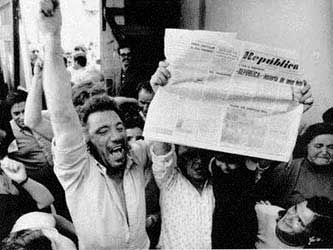
Workers’ control of production Part 2

0425.1974_Portugal-newspapeIn my last post on workers’ control I noted that it inevitably arose as a result of crisis, and crises are by their nature temporary, occasioned by society-wide political upheavals or by threatened closure of a particular workplace that is perhaps producing unnecessary products, is working in an obsolete manner or is otherwise failing to compete successfully in the capitalist market.

In Britain in the 1970s there were more than 260 occupations of workplaces by their work forces including, perhaps most famously, at Upper Clyde Shipbuilders in Glasgow, usually sparked off by closures, layoffs, redundancies, dismissals or threats of closure.  Such occupations were spontaneous, often acts of desperation and with no real planning.  If successful, the numbers occupying would be offered jobs by a new employer although this number would usually be less than when the occupation would have begun.  When no new owners would appear the occupations might attempt to become workers’ cooperatives but the motivation was normally a pragmatic search for a solution rather than something drawn from political commitment and ideology.

The occupations were often built by shop stewards and sometimes at odds with the official trade union movement, a situation we see again and again and a result of factors far from accidental.

The theme of ‘industrial democracy’ was very much alive and in 1974 the Conservative Government called a general election on the issue of “who governs Britain”, in direct reference to the miners who had engaged in successful strike action.  The Tories lost and the new Labour Party Government included Tony Benn, who wanted greater involvement of workers in their workplaces.  He also came into conflict with trade union leaders who opposed his dealings with rank and file groups of workers.  “The whole machine is against you” Benn told one supporter of an occupation at Imperial Typewriters.

Workers’ cooperatives received the support of Benn, who was in a position to do something as Minister at the Department of Industry, but his financial help was relatively small and most industrial aid continued to go towards private industry.  That which did go to the cooperatives was mainly for compensation to previous owners who were paid for obsolete plant.  This left the new cooperatives under-capitalised and without the necessary resources to carry out research and development.  They generally lasted only a short space of time but still sometimes produced radical, innovative and still exemplary struggles.  One such was as at Lucas Aerospace, where workers pioneered conversion plans to socially useful production, again opposed by the union leadership.

By the end of the decade however these types of struggles had declined dramatically.  Few of the experiments in workers’ ownership survived and as history is usually written by the winner the victory of Thatcher, built on the attacks on workers commenced by Labour, left a legacy of disappointment and nostalgia in some old enough to remember.  This has affected the Left up to today in so far as it is suspicious, if not actually hostile, to workers’ cooperatives.  This is a profound mistake as the willingness of workers to fight for ownership and control of their own workplaces is an instinctive impulse to go beyond capitalism.

The history of American workers organisation in the 1930s is perhaps more celebrated than this experience but in some ways was more limited.  Workers and trade union power grew during the decade not just because of the struggle of workers to organise, most famously in Minneapolis, but because of the strong growth of US manufacturing industry.  Between 1936 and 1939 workers occupied 583plants in sit-down strikes in defence of their terms and conditions, protection of wages, achievement of union recognition, or prevention of sell-outs where recognition already existed. These were often successful.

Unfortunately there followed 70 years of union-management collaboration – no strike agreements during the second world war; the witch hunt and expulsion of socialist activists in the McCarthy period; mob penetration of the union movement and the turning of the union bureaucracy into a world-wide vehicle of the US state in its cold war with the Soviet Union.  The US union movement has now declined so much that in most of the private sector it is irrelevant, with unionisation accounting for only 7.5 per cent in the private sector in 2008.  In some workplaces where unions do ‘organise’ workers are not even aware there is a union!

The history of American workers’ militancy drives home a lesson to be  learnt from the British experience of the 1970s and 1980s – that politics are not only determined by workers militancy and their experiments with workers control but that politics can influence decisively the short and long-term success of these experiments.

In the end the question of politics is crucial, which is why Marxists believe that working class conquest of state power – revolution – is decisive.  It is important however not to telescope the path to this destination.  Revolution is decisive only if the material basis for working class rule is present.  This is not simply a question of the level of economic development but of the social and political development of the working class.  Without both of these the question of revolution is not posed practically i.e. in reality, no matter what more general ‘crisis of capitalism’ is evident.

The analysis of workers’ control in these posts is based on the belief that working class conquest of state power is necessary but that the immediate question is how to make that a widely shared goal given the low level of class consciousness and struggle than now pertains.

It is therefore important to attempt to draw lessons from the impact of political developments on workers attempts at independent organisation in the workplace.  In turn we can then look at the role of workers’ organisation in the workplace for its impact on wider political struggle.  This will reveal the limits as well as the strengths of a workplace-based strategy and what political demands should be raised as a result.  Such lessons informs the opposition to calls for nationalisation that have been argued in many earlier posts.

For example in the Spanish revolution in the 1930s it was the Republican state that strangled the workers’ and peasants’ collectives rather than the fascist counterrevolution.  Clearly in this case a call for this government to nationalise such collectives would not have made much sense.  Anarchists believed these collectives were a means of controlling the Republican authorities but clearly what was needed was an alternative Government and state – perhaps built on these bodies.

In Yugoslavia self-management was a means of mobilising the population against economic blockade and potential invasion, boosting production, minimising the power of the trade unions during a labour shortage and hoping that the workers would discipline themselves.  Unfortunately self-management as then practised led to accusations of workers’ neo-capitalism in which the enterprises were seen as the workers property, narrowly conceived, so that they competed with each other in a capitalist-like manner.  Self-management became not a means of workers self-realisation but a trade union-like bargaining system of clientelism and patronage.  Increased enterprise autonomy acted to dissolve wider working class solidarity leaving enterprise loyalty and territorial state loyalty as the alternative, one which ultimately descended into bitter and bloody nationalist war.  On the way to this dénouement it has been argued that enterprise autonomy became a mechanism to insert the Yugoslav economy directly into the capitalist world market.  Increased autonomy became the means of strengthening management power not workers’ autonomy.

Both Spain and Yugoslavia are testament to the fact that without real working class political and state power workers’ control can be subverted and/or crushed.  I have argued that it is the lack of workers’ economic power and experience before revolutionary crises that has weakened the struggle for their class rule thus making revolutionary success less likely in such crises.  But it is also true that such episodic economic power is doomed without a political project.  In Poland workers councils existed in 1945, 1956, 1970 and 1980-81 but revolution there became a restoration of capitalism.

In nationalist revolutions, such as in Indonesia, the most radical actions of workers are betrayed by a backward political consciousness; as when workers control is achieved and defended not as an extension of workers’ power as a class but as the property and achievement of the new independent (still capitalist) state.  This state can indulge in the wildest revolutionary rhetoric but as long as its power is not an extension of that of the workers it is just rhetoric, to be retracted when the new state feels itself more in control.  It succeeds in this as long as workers power is mistakenly seen by its holders as the gift of the newly independent state.  The examples of nationalism trumping the radical actions of workers are legion and proof again that revolutionary action does not automatically generate revolutionary socialist politics and consciousness.

What is clearly decisive is workers’ own consciousness and workers control, self-management or councils are not in themselves decisive in determining it.  This however is not the question and not the argument being put.  There is no ‘magic’ strategy guaranteeing a workers’ victory but there are more or less adequate roads and strategic conceptions.

The argument here is that workers’ control, and in the longer term, workers’ ownership can provide a more solid, permanent and robust material basis for the development of the necessary socialist consciousness than simple trade unionism, no matter how militant.  More realistic than reliance on spontaneous political revolutions to do all the work of consciousness raising in the necessarily short space of time in which they take place and certainly more than demands for nationalisation, which for example were obviously meaningless in both Yugoslavia and Poland.

What workers ownership should do is provide a basis and foundation for a political programme that seeks to extend and deepen this form of ownership and give it a political dimension, to make easier removal of the division between the political and the economic that characterises capitalism.  Workers’ collective control and ownership of the state can be more easily argued for on the basis of their wider ownership in the economy.

The argument is more easily advanced if there exists a successful worker owned and controlled sector of the economy that can be presented as an alternative to the capitalist owned sector or the illusion that a benevolent state can take ownership of the latter in order to benefit workers.  On this basis the socialist project can become a political one for which the ideal form to advance it is a mass workers’ party.  Such a project can begin to win the battle for hegemony within societies which are currently dominated by capitalist ideas despite the objective failures of that system.  A real material basis for an alternative is provided that can focus generalised discontent that now expresses itself in free-floating ethical concerns for justice and can find no more specific or concrete alternative than vague calls that ‘another world is possible.’  Instead through development of workers’ cooperatives and the wider labour movement another world is built in front of our eyes.

The absence of such hegemony of ideas, and its corollary – that no alternative to the capitalist system seems possible – results in the upheavals that returned societies to capitalism in Eastern Europe and the Soviet Union.  This wider and deeper lack of legitimacy of the socialist project weighs heavily on the spontaneous activity of workers even when they have engaged in the most radical activity.

In the Portuguese revolution in 1974 a movement within the army overthrew the dictatorship and between May and October of that year 4,000 workers’ commissions were established following mass meetings.  Not only factories but empty houses and apartments were occupied.

Within these commissions political competition developed between the Portuguese Communist Party and smaller revolutionary currents.  A failed right wing coup shifted events further to the Left.  Workers councils became not just organs of control in the workplace but organisations of struggle that could potentially threaten the power of the capitalist state.

In the end however they proved too weak and were unable to pose a political alternative to the quickly developing normal organisations of capitalist democracy – trade unions, political parties, parliament and the state.  In the end the Portuguese Socialist Party became the mechanism for a stabilisation of capitalist rule and bourgeois democracy.

Short-lived experiments in workers control and ownership were not in themselves capable of establishing hegemony for the project of workers’ state power.  A deeper and wider radicalisation was required.

The point is that this can take time and can only come about through the development of socialist consciousness in the working class over a more or less extended period and this must rest on a material base.  This can only be the development of the power of the workers in existing capitalist society, expressed in democratic trade unions, political parties, cultural organisations and workers cooperatives.

The opposite of this road is reliance on the state, expressed in the demand for nationalisation.  In Spain, Eastern Europe, Indonesia and Portugal it was the State which became the guarantor of capitalist ownership and power.

Today we are in circumstances where workers must not only defend themselves against the depredations of capitalism – battling against austerity – but socialists must also look to ways in which to advance a workers consciousness that seeks permanent expression of their needs and powers.  Not just defending immediate interests but looking and taking care of the future of the movement and workers’ position in society.

But it is not simply about the needs of the present as against the needs of the future because Marxism is the belief, confirmed by nearly two centuries of industrial capitalism, that it is not possible to satisfy the needs of workers today by only fighting today’s battles.  A socialist society is the future only because it is the answer to the challe-nges and problems of the present.  The demands for workers control and ownership express this view and are rejection of the clam that the existing capitalist state, by nationalisation etc, can provide the answer.

Revealing the truth about Anglo-Irish Bank – RTE censorship and ICTU complicity

David BeggThe release of the tapes recording the Executives of Anglo-Irish bank conspiring to rob billions from the Irish people has led to a clamour for an enquiry so that the full truth can be revealed.  In my last post I argued that this truth includes the plain and obvious fact that it has been the State that has made the reckless gambles of Anglo the burden of the people.  These Executives showed no great concern that the organs of the State would prove any barrier to their plans.  In this they were of course proved exactly right.

I argued that what is required is that workers should fight for their own inquiry to reveal this and other truths that remain obscured, not least by the media that presents itself as the vehicle for revealing the truth.  I suggested that workers should fight in their trade unions to launch such an inquiry.

I have just received an email that throws light not only on the role of the media but also that of the trade unions.  In particular it shows that the leadership of the trade union movement in the person of its General Secretary, David Begg, has questions to answer over his complicity in the complete and utter failure to regulate Anglo-Irish bank.

The text below recounts the intervention of a reader of the blog into RTE’s Liveline radio programme, which addressed the Anglo tapes.  She questioned the role of David Begg, which subsequently led to a complaint by him and the removal by RTE of the podcast of the programme.  The alacrity with which Begg moved to defend his reputation can be compared to his apparent inactivity in ensuring the Central Bank performed all the roles it was responsible for and which he presumably was on its Board to ensure were discharged.

Anne has written a draft letter of complaint to RTE and has asked for signatures to a petition, both of which are set out below.

This episode highlights the need for a workers’ campaign to highlight the full truth of the banking collapse and hold all those guilty to account.  Not least the system itself.

————————————————————————————————–

On Liveline 27th June I got the opportunity to speak about my reaction to the Anglo tapes. I mentioned the protests organised each Sunday by ‘Dublin says No’ and encouraged people to attend protests that are organized around the country by the ‘Say No’ campaigns. So listen in to a podcast for the item. It is the first on the play list. Overall it was a good programme and showed the anger people feel.

I mentioned a few issues. Firstly that in Feb 2009 a group of teachers picketed Anglo-Irish bank in protest against the bail out of the bankers/speculators and to show our anger at the massive cuts that were taking place in our schools and in public services. I said a group of us went into the bank briefly to ask workers to tell us the truth about the real state of the bank as we were supposed to own this bank yet we were not allowed to even know what was going on.

I mentioned that David Begg head of ICTU sat on the Audit Committee of the Central Bank during the most damaging years of the credit bubble. He had access to what was going on in the Central Bank and that Mr Begg knows the true story and should make a detailed statement of what went on. He was supposed to be representing our interests.  Either he was happy the way the Central Bank was fulfilling its obligation to oversee the banks or he was sleeping on the job and knew nothing. Either way he should RESIGN. Begg then should have acted like the whistleblower Edward Snowden today, and in that case we might not have the present devastation to our lives.

I also mentioned that at the time of the Anglo take-over public services were being massively cut; huge cuts in education, my area of work, in our pay and pensions and that at the time Waterford Crystal workers were occupying the company as it was closing but there was no rescue for them. Mr Begg did nothing to organize a national campaign to save a flagship company while the nest of thieves in Anglo was being bailed out by the organisation of which he was a leading figure.

I contrasted what had happened to 1913, when Dublin workers stood up against the employers. They were able to gain their dignity and build the trade union movement as a real force while today when we are being ground into the dust and the trade union leaders are committed to working within the injustice and tyranny of the Troika programme. I said it was time to stand up for our right for a civilized way of life for ourselves and our children and that people should come out and join the ‘Dublin says No’ to the Bailout protests. I commented on our small numbers and the thousands of Brazilians who were protesting on O’Connell St 2 weeks ago against corruption in Brazil. It was time for people to act for themselves.

I also said that the contracts of public sector workers were torn up and emergency legislation enacted to steal our pay while nothing is done to take the massive pensions off the politicians such as Bertie Ahern. He should be stripped of his pension and the assets of the perpetrators of the crimes against us seized.

Letter of Complaint to RTE

I wish to formally complain to RTE regarding the disclaimer statement carried at the beginning of the Liveline programme 28th June 2013. It stated that RTE accepted that comments on the Live Line programme of 27th June relating to ICTU General Secretary David Begg were wholly untrue and without foundation and we also accept that Mr Begg was never a member of the Banking Regulatory Authority. We want to make clear that there was no suggestion on Live Line part that David Begg  is or was responsible or aware of any of the wrongdoings of Anglo Irish Bank which he condemned in the strongest possible terms.

RTE in acting in the manner in which it has are neglecting their duty to deal with a perfectly legitimate call from me. They are curtailing an important discussion on the role of people who held senior positions on the Board of the Central Bank leading up to and during the nationalisation of Anglo. A major scandal has blown up regarding Anglo Irish Bank where we are learning day by day of the deeply scandalous behaviour of senior executives at the bank.

Mr Begg made his complaint on the narrow base that he was not a member of the Banking Regulatory authority but I made no reference in my comments on Live Line to this.   It is a matter of record that Mr Begg had a number of major responsibilities as a member of the Board of the Central Bank, of which he was a member between 1997 and 2011. These are outlined below and as such he should have been aware of what was going on in Anglo.

Report of the Central Bank and Financial Services Authority of Ireland for the year ended 31 December 2006

Board Procedures (Page 62)

The Board holds eleven regular meetings each year. A quorum of seven normally applies for all meetings. The Governor approves the agenda and papers, which are circulated to the Directors one week in advance of meetings. Additional Board meetings may be called by the Governor at short notice either on his own initiative or at the request of any two Directors.

The Secretary of the Bank keeps minutes of meetings.

The agenda for meetings typically includes:

_ Reports on monetary and financial developments;

_ Reports on various issues relating to the Irish economy, the European economy and the international economy;

_ Reports on regulatory developments to keep the Board informed on policy issues and where decisions by the Board are required;

_ Management of the investment assets of the Bank;

_ Substantial financial contracts to be placed by the Bank for the procurement of goods and services;

_ General management, planning and budgetary issues;

_ Quarterly and annual financial statements and results.

Board Sub-Committees

The Board established three sub-committees on 30 June 1994 as follows:

_ The Audit Committee; The Remuneration and Budget Committee; The Investments Committee.

Board regulations detail the terms of reference of each sub-committee and membership in each case is comprised of Directors — of whom one is appointed as Chairman — and a further member of the Regulatory Authority with observer status. The Secretary of the Bank, or a nominee, minutes all meetings of the subcommittees and, when approved, these minutes are circulated to the Board. The members of the sub-committees, as at 31 May 2007, were as follows:

The Audit Committee members; David Begg (Chair), Martin O’Donoghue, Deirdre Purcell*, Alan Ashe**

( *Members of both the Board and the Regulatory Authority. **Members of the Regulatory Authority who are not also members of the Board but who participate at meetings of the above CBFSAI Board committees with observer status.)

It is clear from the agendas of the meetings that the Board members had a responsibility in overseeing the state of the banks which would have included Anglo Irish Bank, the 3rd largest lender at that time.  It is inconceivable that Mr Begg was completely unaware of whether the Central Bank was fulfilling its obligation to oversee the banks considering the agenda of Board Meetings and also given that he was Chair of the Audit Committee.

As General Secretary of the ICTU he is expected to represent the interests of workers/ordinary tax payers and I called Liveline as a long time trade union member concerned at the devastating consequences of the bail out of Anglo and the shocking revelations in the tapes.

RTE as a public service broadcaster should be to the forefront in lifting the veil of secrecy that has surrounded the bail out of Anglo, instead it has in this instance censored an important discussion and is failing in its duty to investigate or allow discussion on how the members of the Board of the Central Bank have fulfilled their role the role.

The refusal to podcast the programme is a further example of failing in its duty

Furthermore the disclaimer statement is an attack on my integrity and the truthfulness of my contribution to the programme. As you can see from the above excerpt on the operation of the Central Bank, I did not stray from the facts surrounding Mr Begg’s role on the Board of the Central Bank.

I request a copy of the transcript of my comments on the Liveline programme as my good name has  been brought into question by the disclaimer.

I expect an apology for the aspersions cast on my character on national airwaves.


Statement condemning RTE censorship on the role of General Secretary of ICTU David Begg in his capacity as a Board member of the Central Bank

We the undersigned strongly condemn the censorship of discussion by RTE of comments and questions raised as to the role of the General Secretary of ICTU David Begg in his capacity as a board member of the Central Bank and chair of the audit committee of the Central Bank during the period covering the boom years and the subsequent collapse of the banking system.

This gross self censorship by RTE on these legitimate questions and the subsequent erasure of the podcast of the Liveline programme of 27th June 2013 is a shameful and disgraceful episode for RTE as national broadcaster.

The role of the ICTU in demanding a disclaimer on the narrow basis that David Begg was not on the regulatory authority, (a claim that was never made) is an issue of concern for trade union members and all those affected by the criminal activity within the banking sector.  The role of a senior member of the trade union movement in these catastrophic events should not be and cannot be censored.

Anglo-Irish bank tapes – a rotten bank in a rotten State

swf+Anglo-Irish-BankRevelations by the ‘Irish Independent’ newspaper of taped telephone conversations between two senior Executives in the recently deceased Anglo-Irish Bank have aroused rage amongst a population already angry with bankers.

The expletive strewn – “we have to get the money in . . . get the fuckin’ money in, get it in” – and sometimes juvenile conversation – singing a comedy version of Deutschland Uber Allies – appears to show the two Executives planning to rope the Irish State, through the Central Bank, into bailing out Anglo to the tune of €7 billion, a number “picked out of my arse” as one Executive put it.  (The real figure proved to be over four times this amount!)

The cynicism and arrogance on display is summed up by their bragging that their losses are greater but that,  once hooked, the state will have to keep on paying  – “The reality is that, actually, we need more than that. But you know the strategy here is you pull them in, you get them to write a big cheque and they have to keep, they have to support their money” – while boasting that they would never pay it back.

On last nights’ ‘The Last Word’ radio programme the presenter Matt Cooper asked,in a tone of utter exasperation, whether this was a tipping point in the Irish population’s restrained reaction to the crisis, a crisis that has caused riots in other countries.   Would it lead to them . . . demanding a real inquiry into the banking crisis . . . because they needed someone to BLAME.  One of the interviewees however explained that inquiries are about finding out the facts.

The Government and opposition politicians have now rallied round a demand for another inquiry and the debate now will focus on what sort of inquiry will result.  Already however the call for an inquiry is being predicated on the view that the taped conversations demonstrate that the State was hoodwinked into bailing out the banks, particularly the exceptionally rotten Anglo-Irish.

I’m reminded of the words of the song from Alanis Morissette – “It’s the good advice that you just didn’t take. Who would’ve thought… it figures”.  That is because the State was not hoodwinked.  The State may well have been lied to, but the State turned round and lied to the Irish people.  Now the Irish State wants an inquiry, perhaps, all of five years afterwards so it can blame those already reviled and hated. This, so that it can continue to play the lead role in defending the banks and the economic system they sit upon.

The Irish State, its politicians and bureaucrats, claimed in September 2008 that the banking crisis was simply one of liquidity – the banks weren’t bust, they simply needed some cash to tide them over and then everything would be alright.  Basically the banks were solvent.

I claim no great powers of insight or clairvoyance when I say that I knew at the time that this was crap.  There were numerous voices, with no inside information, who knew it was crap and said so.  The inside information known to everyone that mattered would have proved it.  The Irish State was lying to save the bankers, the banks and the system.  This should not be a surprise for this is what the State is for.

And not just the local State, because the last five years have revealed that not only was it in support of bailing out banks that could not be saved but this was also the view of the European Union and the US Treasury.

Certainly, blame the banks for reckless and stupid lending but it was not the banks who made their debts the crippling burden on the people.  It took the State to do that.   Blaming the banks is a way of avoiding this, much harder to accept, reality.  Much harder to accept because we have just proved that you can change the government at the top of the State but you won’t change its role.  For the bleeding-heart liberals, and I include the leaders of the trade unions in this, this is especially a problem because the State is their only hope of making things better.

But there is an even more important reason to agree with the interviewee in the Today FM programme: that the point is to understand.  And what we have to understand is that the Irish bankers were not the only bankers to indulge in reckless lending.  It happened in the US, in Spain, in the UK and many other places right across the world.  It is happening in China today.  Criminal speculation is an inevitable part of economic booms under capitalism and cycles of boom and bust are an inevitable part of capitalism.

Blaming excessive credit expansion is fine, except that such expansion is inevitable in a boom – the bigger the boom the bigger the expansion of credit.  The problem is the system that makes credit expansion necessary.  No amount of regulation in a boom will prevent it.  New financial products, such as derivatives, or new institutions, such as a shadow banking system, are inevitable in a system defined by private property in the means of producing the wherewithal to live.   Blame greed – ok, but what other social pathology makes sense in the current economic system?  Blame the politicians – but how is the state to function without funding from the finance system?

In any new inquiry we will be invited to blame individuals, to which the implied answer is – ‘lock them up’, more power to the state, and individual banks, to which the answer is – ‘close them down’, when the real solution is to dismantle the economic system that makes such events inevitable.  Anglo will be made the focus of attention and held up as a rogue bank but Allied Irish cost almost as much and Irish Nationwide appears to have been even more rotten, however hard that may be to believe.

This view that the core and fundamental problem is the economic system and that the financial crisis and all its consequences are a result of it is not widely shared.  Yet the crisis demonstrates this dramatically.  Understanding this is an important and vital step to putting things right.  It is obvious that no State-backed inquiry could arrive at such conclusions.  We have had inquiries already which have been more soporific than enlightening.  That means the opportunity and necessity exists for the working class, or part of its movement, to launch their own inquiry to demonstrate the truthfulness of these claims.

Trade unionists should demand the unions launch their own inquiry.  The Left should campaign for this and if this fails it should launch its own inquiry, inviting evidence from workers in the banks and from left economists who can set out the mechanisms by which capitalism inevitably produces such crises.  An open forum of hearings and invitations to give evidence could provide the platform to educate workers and ourselves.  It might also invite proposals for alternatives.

In this respect the Left would do well to ponder the lessons to be derived from one part of the taped conversations.  In one recording, a Mr Bowe and another senior executive of Anglo, Peter Fitzgerald, are heard laughing about the prospect of nationalisation. They see it as “fantastic” and are delighted at the prospect of becoming civil servants.  This, of course, is exactly what happened. Why then would nationalisation be proposed by people calling themselves socialist?

G8: The Mafia Empire Part 2

obama in sunglasses

By Belfast Plebian

In 1967 LIFE Magazine published an exposé on organized crime in America. FBI Director J. Edgar Hoover admitted publicly for the first time that the Mafia did in fact exist and that the Gambino and Genovese families exercised ironclad control over the Waterfront Unions in New York and New Jersey.  Director Hoover had for thirty years refused to publicly acknowledge that the Mafia existed, his conviction was that organised labour in America had much more to fear from Communist and Socialist control than from mobsters. President Nixon stayed true to the FBI spirit when he commuted the jail sentence of Teamster President and Mafia candidate Jimmy Hoffa.

It is now part of common folklore that workers’ unions in the United States were often controlled by Mafia figures, films such as on the Waterfront have confirmed the idea . However what is less well know is the fact that Mafia figures were often encouraged by the spooks and right wing politicians to take control of the labour unions, indeed it is in this division of social life that they came together on mutual terms.  In July 1936 Luck Luciano was sentenced to 30 to 50 years in Sing Sing Correctional Facility. In 1942 the US government struck a deal with him, in return for a commutation of his sentence his union agents would monitor subversive activity on the docks on behalf of naval intelligence.  Here’s a report from a more recent study of the special relationship between the Mafia bosses and the right wing political bosses: 

‘Among the most unusual Federal Prosecutions during the 1980s were the weapons trafficking and murder solicitation trials of a rogue retired Officer of the U. S. Intelligence community, Ed Wilson.  As detailed in Peter Maas’ book MANHUNT, Ed Wilson’s career offered a rare glimpse into the interactions between the CIA and the labour union movement.  Recruited by the CIA while in college back in the dark days of the Cold War, the CIA first sent Wilson through the School for Industrial and Labour Relations at Cornell University in New York City.  After graduation Wilson convinced Paul Hall, the President of the International Seafarers Union to hire him as an Organizer. Hall sent Wilson to Belgium, where Wilson infiltrated the Communists involved in the Union movement and performed various ‘dirty tricks’ against Labour leaders. Wilson then returned to the United States where he obtained work in the International Department of the A.F.L. – C.I.O. Wilson’s biographer relates that while the Seafarers were not aware that Wilson was in fact working for the CIA, the AFL-CIO was aware. This organization has long maintained close ties to the U. S. Intelligence community and to this day labour activists in the United States will jokingly refer to this organization as the ‘AFL-CIA!’ The AFL-CIO then sent Wilson to Latin America to infiltrate the various Communist-dominated labour Unions.

The only point I am making here is that the labour unions are penetrated and controlled much more comprehensively by all sorts of political gangsters than from mobsters, entire union federations have been lost to independent workers. 

Next we come to violence and murder. Let’s compare G8 leader Obama with the very worst of the Mafia killers, Louis ‘Lepke’ Buchalter. Who the heck was he you ask?  Well he was another close associate of Lucky Luciano who back in the day controlled the garment unions of New York.  In the 1930’s Lepke was a pioneer labour racketeer and he wasn’t even Italian, he was in fact Jewish. What made Luciano stand out from the other mobsters was that he wasn’t a nationalist, he learnt his trade from New York’s Jewish mobsters especially Arnold the brain Rothstein and many of his long time friends Frank Costello and Meyer Lansky, who were also Jews. It was this willingness to associate with mobsters from outside of the Sicilian-Italian community that set him on a collision course with the traditional Bosses like Joe Masseria and Salvatore Maranzano.  Since all of the G8 leaders come to Fermanagh acting solely on the so called national interest, they walk at least one step behind the more open minded crime boss.

Lepke had another string to his bow apart from labour racketeering – hiring mobsters that he knew to kill people on contract.  In the early 1930s, Buchalter joined Charles “Lucky” Luciano and other Mob bosses to form the “National crime syndicate”.  Luciano’s associates Benjamin “Bugsy” Siegel and Meyer Lansky formed Murder Incorporated a name applied to them by the media when the first court cases came to light. Originally a band of killers, they were used to fulfil many non-Mob related contract killings. Buchalter and his partner, Albert “the Executioner” Anastasia would take control over Murder Inc. when Siegel and Lansky’s business endeavours became respectable. Buchalter was responsible for contract killings throughout the country, including the killing of the Mob hit man and bootlegger Dutch Schultz.

In 1935, law enforcement estimated that Buchalter and Shapiro had 250 assassins working for them, and Buchalter was grossing over $1 million per year in profit. They controlled rackets in the trucking, baking, and garment industries throughout New York. It is believed the corporate Jewish killers may have killed nearly a thousand people on contract before they were stopped.  The killers were put on a retainer fee and paid an extra $5,000 when the job was done; the most prolific of them Harry Pittsburg Phil Strauss notched up over a hundred burns. If the killers were caught the best Jewish lawyers, money could buy would represent them, and their families were looked after.

Their most famous hit was on one of their own; Dutch Schultz was planning to bump off special prosecutor and later to become a Presidential candidate Thomas E Dewey. The crime syndicate decided that Dutch needed to be taken care of as he was just so reckless.  Lepke the best organiser of Murder Incorporated was eventually caught and executed in Sing Sing prison  in March 1944.

Now this is all very serious stuff but in terms of well-organised killing it is still small-scale stuff.

Obama is openly referred to, even in a few of the mainstream media outlets, as the drone killer, the assassination President, and the police surveillance President.  One person who’s been working hard to expose what he has been sanctioning is investigative journalist Jeremy Scahill, a long-time war correspondent for the Nation and the writer, producer of the startling new film “Dirty Wars,” which hits the cinemas in America just this week. “Dirty Wars” documents Scahill’s exploration of the campaign of drone strikes outside the recognized battle zone, in countries like Pakistan, Yemen and Somalia.  He also found, after digging, the existence of the secret military strike force called the Joint Special Operations Command, or JSOC, which literally became famous overnight after the killing of Osama bin Laden.

He says ‘because Obama is who he is, an incredibly brilliant man who has the trust of the overwhelming majority of liberals — and probably a significant number of traditional conservatives, at least on these issues — he is going to go down in history as creating a systematized embrace of assassination as a central component of U.S. security policy. It’s not that the U.S. hasn’t been engaged in assassination basically from the beginning, but we now have this Nobel Peace Prize-winning transformational president, who is a constitutional lawyer, making it a permanent part of the national security infrastructure. While saying, ‘We don’t want a perpetual state of war,’ he’s building the machinery for a perpetual state of war.”

Here’s an exasperated review of a segment of the new film by journalist Andrew O Hehir  ‘Scahill’s film also spends quite a bit of time exploring the story of Anwar al-Awlaki the radical imam who was born in Las Cruces, N.M., and killed by a drone strike in Yemen in 2011. (His teenage son Abdulrahman, also a U.S. citizen, was later killed, apparently by accident or as collateral damage.) While the moral and legal quandaries posed by killing an American citizen without any pretence of due process have been much discussed – and we may never know exactly why the Obama administration deemed Awlaki such an imminent threat as to merit summary execution – “Dirty Wars” reminded me of the larger and more disturbing narrative that led up to that drone attack in the desert. In the immediate aftermath of the 9/11 attacks, Awlaki, who was then the imam of a Washington-area mosque, frequently appeared in the media as a voice of moderate Islam. He spoke out against terrorism, decried the 9/11 hijackers as Muslim renegades and was invited to speak at the Pentagon on the role of Islam in the contemporary world. The lunch menu that day, Scahill says, included bacon sandwiches. “Which gives you a sense of how awesome the Pentagon’s intelligence was? You invite an imam to come and speak about Islam, and you offer him a bacon sandwich.”

I am not going to pursue the Obama and murder theme any further, if you still need to be convinced, try watching the film ‘Dirty Wars.’

I think I have done enough to show there is a correspondence between the wicked ways of the Mafia Bosses and the self serving ways of the current crop of Political Bosses currently meeting as the G8 in Fermanagh.  I never claimed that they were identical and I would have to admit that the Political Bosses often have to face more complex dilemmas.  There is a serious case for the justification of Machiavellian politics which states that it is much easier for an ordinary person to refrain from doing bad things than it is for a Political Boss to do so.  This implies that a Mafia Boss can simply decide to abide by the law without prejudice to themselves while a Political Boss has no such luxury, if he did he might well bring a heap of trouble onto the citizens of his country.

The natural circumstance of politics is so extreme that the breaking of every moral convention and constitutional law is a sort of fait accompli for every potential the Political Boss. If you can’t stand the heat don’t even get into the kitchen.

Machiavelli is the political philosopher most often associated with training the political bosses to think and act in away that is incompatible with ordinary decency.  Leo Strauss once said he was inclined to the view that Machiavelli was a teacher of evil. This is what he said :

“What other description would fit a man who teaches lessons like these: princes ought to exterminate the families of rulers whose territory they wish to possess securely; princes ought to murder their opponents rather than to confiscate their property since those who have been robbed, but not those who are dead, can think of revenge, men forget the murder of their fathers sooner than the loss of their patrimony; true liberality  consists in being stingy with one’s own property and in being generous with what belongs to others; not virtue but the prudent use of virtue and vice leads to happiness; injuries ought all to be done together so that, being tasted less, they will hurt less, while benefits ought to be conferred little by little, so that they will be felt more strongly; a victorious general who fears that his prince might not reward him properly, may punish him for his anticipated ingratitude by raising the flag of rebellion; if one has to choose between inflicting severe injuries and inflicting light injuries one ought to inflict severe injuries; one ought not to say to someone whom one wants to kill ‘give me your gun, I want to kill you with it’ but merely, ‘give me your gun’ for once you have the gun in your hand, you can satisfy your desire. If it is true that only an evil man will stoop to teach maxims of public and private gangsterism, we are forced to say that Machiavelli was an evil man.” 

We will take it as evident that the political designation ‘Prince’ has wider application than just to a traditional Monarchy – it can refer to States, Heads of States, political parties, heads of political parties and so forth.  The Italian Marxist Gramsci sometimes abbreviated the revolutionary workers party with the designation Prince in his prison writing. In the same study above Professor Strauss referred to the modern alternative to the Politics of the Prince. He quotes Thomas Paine : ‘The Independence of America was accompanied by a revolution in the principles and practice of  Governments…Government founded on a moral theory, on a system of universal peace, on the hereditary Rights of Man, is now revolving from west to east by a stronger impulse than the Government of the sword revolved from east to west.’( Thomas Paine Rights of Man second introduction) 

Professor Strauss seems to be indicating that the new Democracy of America was founded on the basis of a moral and political law that had no room for Machiavellian style dirty politics. The politics of the new democracies were intended to be different from the Roman politics Machiavelli had studied. The G8 seems to point to a higher standard by excluding China, the second economy of the world from their deliberations presumably on the basis that it is not a democratic State.

Professor Strauss is famous for refuting what he called historicist accounts of political and social thought. What he meant by that was the thesis that the political philosophy of a certain historical period was necessarily bound to that period, so much so that it was an expression of it. So the harshness of Machiavelli political philosophy was merely a reflex of the division of Italy into warring city States and foreign kingdoms.  The political thought of Thomas Paine was a reflex of a middle class capitalist development and the political thought of Karl Marx was just a reflex of the early exploitative industrial capitalism of the nineteenth century.

He thought of political philosophy in terms of permanent alternatives rather than passing ideologies always to be superseded by historical change, and he thought of Machiavelli politics as one permanent alternative that could rise up in any era.  He thought of Marxism in terms of historicism and argued it was self- refuting because it predicted its own passing away due to necessary historical change.  How he asked could Marxist thought still claim to be relevant when the nineteenth century conditions that produced the ideas of Karl Marx no longer existed nearly 150 later

We will not seek to rule on Marxism and historicism here but suffice to say that we don’t think Machiavellian or its alternative Marxist politics has been superseded by necessary historical developments.  Machiavelli belongs to the long history of capitalism that includes the Italy of the city state and the merchant capitalism that originated in these very City States.  The politics of imperialism are linked by the capitalist economy so private and public gangster politics are as relevant now as they were in Michiavelli’s time.

G8: The Mafia Empire Part 1

putin in glasses

by Belfast Plebian

‘We shall not shock anyone, we shall merely expose ourselves to good-natured or at any rate harmless ridicule, if we profess ourselves inclined to the old fashioned and simple opinion according to which Machiavelli was a teacher of evil.’ Leo Strauss


The wiseguys are again meeting at a secluded location, not at the Apalachin retreat in upstate New York as depicted in the Godfather movie, they did that one back in 1957, but at a lakeside hotel in Fermanagh. The world’s most feared political gangsters are holding two days of much needed sorting out talks, for their dark mutterings and latent rivalries have reached a point of near breakdown in diplomacy. The quarrels between them have become so heated that they imply in an undeclared war over the future of Syria and beyond that you can see through in the ongoing currency war between them.

It is my contention that there is a strong correspondence between the politics of the G8 and the Mafia politics of the recent past.  When I say correspondence I do not mean identity.

The political gangsters of today are therefore obliged to acknowledge a debt to the late great mafia boss Salvatore Luciano, the mobster who dreamt up the idea of a Mafia Commission to settle intense quarrels over criminal opportunities. Lucky Luciano established the Mafia Commission in 1931, a corporate body to mitigate the violent disagreements among the warring crime gangs.  Luciano wanted to end the chaos that had led to a bloody and self -destructive gang war in New York and Chicago during the 1920s. In 1925 he was grossing over 12 million dollars a year and had a net income of around 4 million dollars after the cost of bribing the politicians, judges and police was deducted.

But his private fortune was put in jeopardy by the intense gang rivalries, which escalated into a fierce street battle known as the Castellammarese War, that raged from 1928 to 1931 and resulted in the deaths of at least 60 top mobsters. So he looked for a way to lessen the strife and violence and found it in the Commission, a corporate body that has endured for over seventy years.

Lucanio did not want to be an Italian- American Caesar. He realised that the best way for him to stay alive and rich was to let the most powerful crime families run there own internal affairs, but establish an administration to settle their differences and to mobilise enough combined muscle to crush any new rivals. He established a mob board of directors known as the Commission to oversee all criminal and business activities and to mediate strife between the contending families. It was to meet every five years and its decisions were non-negotiable.

The Commission officially comprised seven crime families; the heads of the New York five plus, the Chicago Outfit of Al Capone and the Buffalo based crime family led by Stefano Magaddino. The Commission did not stop all gang warfare, but it did reduce the number and scale of them; when one gang transgressed against another it would often find itself at war with all the rest. There was no single ruler of the Commission, but there was a nominated chairman who was oath honoured to stand for the common good.

The Commission largely succeeded, for what we find is that while the personnel of the ‘FAMILIES’ frequently changed, over time the same crime families stayed on top of the underworld from then until today: The Bonanno crime family, the Colombo crime family, the Gambino crime family, the Genovese crime family, the Lucchese crime family, the Philadelphia crime family and finally Al Capone’s Chicago outfit.  They established a better capitalist crime model for themselves than the current rather shaky G8 one and it is the reason why Time Magazine once called Lucky Luciano one of the most influential Americans of the twentieth century.

“I learned too late that you need just a good brain to make a crooked million as an honest million. These days you just apply for a license to steal from the public. If I had my time again I’d make sure I got my license first.”  Lucky Luciano.

The G8 – the people who got  the licence first.

If you succeed in politics you can usually surpass anything a Crime Family Boss can do in almost every division of life including killing and enriching yourself at the cost of others. Take Tony Blair for example.  Everyone knows about his illegal and immoral acts of killing, but what of his wealth? Here is a report just picked up from reading yesterday’s newspaper (Daily Mail Saturday 15, 2013). Depending on how you cut it Blair is now worth £60 million or £80 million.  He has set up a Byzantine network of inter-related companies to funnel his vast tribute for being a useful Prime Minister. Useful for whom you might ask, well useful for the Banksters.

His first tribute after leaving office came from the world’s leading investment bank JP Morgan Chase.  He has been a senior adviser for the last five years on a £2.5 million salary and his preferred mode of transport these days is a rented Gulf Stream V private jet. He says he was able to facilitate the bank’s clients due to high-level political contacts made with the Rwanda government when he was Prime Minister. The former PM has also done a deal to promote the dodgy government of Kazakhstan, he apparently gives it advice on good governance and this has already netted him £16 million

He has been receiving £1 million a year for advising the Abu Dhabi sovereign wealth fund where it is safe to invest their oil money. He is said to be as thick as thieves with the super rich Sheikh Hamad bin Jassim bin Jaber al Thani, the PM of Qatar. One of his other rewards for once holding political office came from the Kingdom of Kuwait – this netted him a swell £27million and his think tank was asked to produce a report on the future of the Kingdom called Kuwait Vision 2035.

There is plenty more of that sort of stuff in the newspaper article. Tony Blair is an example of a political mobster of the very successful type. The thing that makes these ‘democrats’ different is that they have to wait to leave political office before collecting the readies rather than taking it while they are in office, say like ‘oligarchs’ like President Putin, another of the G8 stars.

President Putin officially lists his salary at 5.8 million rubles, about $190,000  a good deal less than Obama’s official salary of $400,000.  He also claims that he has very little personal wealth.  During his election campaign he claimed he had $180.000 in his bank account, owned three Russian made cars and a small apartment in Moscow, so a lot less than Obama’s personal wealth estimate of $12million.

Here is an independent assessment of his personal wealth made by a celebrity magazine:

‘So what evidence is there of Putin’s secret obscene fortune? Let’s start with the small stuff. Putin is known to sport a $150,000 Patek Philippe watch on most occasions and his total collection has been valued at at $700,000.  He also has full access to a $40 million ultra luxury yacht that features a wine cellar, Jacuzzi, helipad and outdoor barbecue area   In terms of living accommodations, Putin has access to 20 mansions throughout the world including a lavish ski lodge and Medieval castle.  The crown jewel of his property portfolio is a $1 billion palace overlooking the Black Sea that he allegedly owns through an anonymous trust.  Furthermore, Putin makes frequent use of 15 Presidential helicopters and more than 40 private jets, many of which feature gold plated interiors . If Vladimir Putin’s net worth truly sits at $70 billion, that would be enough to make him the second richest person on the planet right behind Carlos Slim Helu. It would likely also represent one of the largest personal fortunes ever accumulated by a sitting President. The only other world leader who possibly looted more cash from his country was Muammar Gaddafi who after 40 years of power stashed away a reported $200 billion in ill-gotten oil money.’

It might of course be argued that Tony Blair is a rogue politician, that the Heads of States of our Democracies are usually very different from him and therefore different from the Bosses of the Mafia Families. Yet ex-President Clinton has trousered a lot more tribute than Tony Blair and Obama will certainly get filthy rich when he finally hangs his coat up on the White House door.

Some of our more notorious mobsters believe they have a good handle on the entire thing. Here are a few quotes from Al Capone about living in the world’s purest democracy.  Al didn’t ever get too caught up in the whole democracy thing ‘capitalism is just the legitimate racket of the ruling class’. . . ‘This American system ofours, call it what you will, gives each and every one of us a great opportunity if only we seize it withboth hands and make the most it’. The mobsters can never fathom how they are doing anything different from the politicians and that often is their weakness, the bankers and lawyers of the democracies get the law on their side before they commit the crimes, or if they do the crime without the assistance of the law they get the politicians to amend the law to make sure they avoid the normal consequences of the law.

In every episode of the Max Keiser show on Russia Today evidence is produced to demonstrate how the law is broken and amended to help the financial criminal elite of Wall Street and the City of London. In March of this year a US Senate committee compiled a 300 page report documenting the fraudulent and criminal practices sanctioned by Mr Blair’s favourite bank and the largest dealer in derivatives trading in the world.  Despite all the evidence, no legal action was deemed appropriate, and the CEO Jamie Dimon remains a Consigliere to the President concerning the financial markets.

The late John Gotti was once the Boss of the powerful Gambino family.  is advice to the young included the following: ‘be nice to the bankers. Always be nice to the pension fund managers. Always be nice to the media. In that particular order.’  The Mafia ‘philosophy of self enrichment without conscience’ is perfectly suited to the present condition of finance-dominated capitalism.  It is certainly difficult to spot the difference between what the law calls loan sharking and current legal lending.

The loan shark figures a lot in Mafia books and films, the person or business that offers loans at extremely high interest rates and the smaller the loan the more onerous the repayments. In the early days of Mafia loan sharking it was confined to payday lending on potential wages with most of the customers being office clerks and factory workers. The 1952 film ‘Loan Shark’, featuring mobster favourite George Raft, depicts the whole payday loan racket.

In the 1960s the Mob shifted their loansharking to small businesses as they had assets that could be confiscated if payment was overdue. The irony is that the Mafia historians tell us that payday lending to workers largely disappeared by the 1970s.  Now of course they are back with the sanction of the law and the backing of the politicians. In Britain the Campaign group Debt on our Doorstep campaigns against the practice, if you are interested go to their web site for some horrific stories.

One of the big players in the payday loan racket is Wonga, the sponsor of Blackpool football club.  Last year it declared £45million in profit, by advancing over 4million loans. The annual interest rate on its payday loan is 4,214 percent.  One of Wonga’s main stockholders is Dawn Capital, whose chairman is called Adrian Beecroft who is a donor to the Conservative party.  The Prime Minister David Cameron asked his friend Mr Beecroft to prepare a report on the future of employment law and he recommended that employers be given the right under the law to sack workers at will and without explanation.  The oily rag PM liked the idea but the Liberals thought it was a bit strong for now so it did not become law. Once again the immoral activities of the Mafia mobsters have been superseded by the legal activities of the political gangsters.

Lets move on to tax. The Mafia bosses never like to pay tax, they are very much in the low tax political camp. This brings us to Al Capone; in 1927 it is estimated he made about $100 million, the equivalent of about $1.2 BILLION today.  Despite his profession the authorities could never pin a serious crime on him with the Treasury Department attributing this to his ‘natural Italian secretiveness.’  He was maybe helped by the fact that no witnesses would testify against him, but the main reason was he was generous with his money.  It is estimated he spent over $30 million in 1927 on gifts to politicians, judges and police chiefs.

Al Capone was eventually convicted and sent down because he was a tax evader, yet how was this conviction lawful?  Capone had this to say: ‘the income tax law is a load of bunk. Thegovernment can’t collect legal taxes from illegal money.’  When he was sent down it was the toughest sentence ever imposed on a tax evader. Capone told the newspaper guys: ‘I’ve been made an issue, I guess I’m not complaining. But why don’t they go after all of those bankers who stole the savings of thousands of poor people and lost them in bank failures? How about that?  Isn’t it a lot worse to take the last few dollars some family has saved-perhaps to live on while the head of the family is out of a job-than to sell a little beer.’ 

This of course is an example of trying to get the victims of the capitalist system on to your side when you have just become undone and disgraced politicians frequently play this populist card, nevertheless we appreciate the point. Many respectable people got rich during the prohibition era by selling alcohol as a legal medicine.  The fine novel ‘The Great Gatsby’ is a fictional account of a legal medicinal bootlegger. The father of the Kennedy political dynasty held such a licence and he used it to stock his warehouses in the period just before the end of prohibition.

But what about tax evasion and tax avoidance?  Davis Cameron says this is to be one of the big-ticket items on the agenda of the G8 summit. He claims he wants to see companies pay their fair share in tax but he doesn’t try to define fair. One can just imagine him raising the matter at the G8 to the annoyance of the French President.  Here is what he had to say one year ago to the very day: “If the French go ahead with a 75% top rate of tax we will roll out the red carpet and welcome more French businesses to Britain and they will pay taxes in Britain and that will pay for our health service, and our schools and everything else.”

Let’s now add a little bit more beef to his speech from the G20 meeting in Mexico 2012: “Every country sets its own tax rates, but I think in a world of global capital, in a world where we’re competing with each other, in a world where we want to send a message that we want you to build businesses, grow businesses and invest, I think it’s wrong to have completely uncompetitive top rates of tax.”  The oily rag PM is just playing with the public over tax.

Consider this snippet from a recent white paper covering the status of the UK oversees territories: the UK’s parliament has “unlimited power to legislate for all its overseas territories and crown dependencies”.  He is putting on a show as if to say all he can do is try to persuade Bermuda, Cayman Islands and the Channel Islands etc to play fair on tax, when he could command them to do so.  They will of course carry on as before and Cameron will stand back and shrug his shoulders. You should not be fooled into thinking that the British government is responding to the campaigns of the NGO’s to make tax on companies into a social issue.  What he is defending Britain from is criticism from the other G8 political leaders, especially that coming out of the Congress in Washington who think the political class in Britain have effectively turned the country into one big Tax Haven to the detriment of Uncle Sam and others. 

New Abortion Bill – should it be supported?

4378254-3x2-700x467

The death last October of a young woman, Savita Halappanavar, refused an abortion in a Galway hospital that may well have saved her life because, she was told by staff, “this is a Catholic country”, was shocking and led to an eruption of anger across the State.  It made headlines across the world.  It forced the establishment parties to get off the fence they had been sitting on for over two decades and promise they would legislate for some sort of abortion rights.

The problem they said was one of legal clarity and certainty for the medical profession.  At the time I argued that this was not the issue.  The issue was the all too certain denial of women’s rights to control their own bodies and their own fertility to the degree that they could be left to die rather than be allowed to abort a foetus that could not survive.

Now the nature of the proposed legislation has been made public.  It is clear from this that it is designed to protect the state and not women.

Enda Kenny spelled it out – the legislation “will not create any new rights.”  Although arising from the Halappanavar case it will not prevent such a tragedy happening again.  That’s about as damning a judgement as could be made given the circumstances.

The legislation will do nothing to facilitate abortion rights in cases of rape, incest or cases of foetal abnormality.  The health of women is of no consideration.  Abortion remains a crime and the 1861 British penalty of penal servitude for life has been replaced by the 21st century Irish penalty of 14 years imprisonment.  Women may go to jail because it would be ‘inequitable to penalise the doctor but not the woman undergoing the procedure’.  This will apply to pregnant women.  The denial of rights is indivisible.  Thousands of Irish women will be regarded as criminals who have escaped punishment only because their crime was perpetrated elsewhere.  These women will continue to travel to Britain rather than face the bureaucratic obstacle course which seems designed to ensure their journeys continue.

These rules require two doctors to approve an abortion where there is a “real and substantial risk to the woman’s life” and one if the termination is considered “immediately necessary.”   In the case of a woman at risk from suicide three doctors are required to approve (unanimously), two psychiatrists and a gynaecologist or obstetrician.  If the woman is refused a termination she has the right to appeal in writing to two doctors if it involves physical risk and another three doctors if she is in danger of suicide.  Again these are to be two psychiatrists and a gynaecologist or obstetrician.

The expertise of the medical profession is to be deployed in order to adjudicate on behalf of the State on women’s rights.  That this expertise is not the real function but rather a justification of the fetters determined by the State is abundantly clear from the fact that a gynaecologist or obstetrician must be on both the original and review panel and the verdict must be unanimous.  What expertise does a gynaecologist or obstetrician have in determining a woman’s state of mind?  In what way is a medical emergency requiring only one doctor in any essential way different from one determined by the threat of suicide?

The legislation has been enacted to deal with the State’s non-compliance with the European Court of Human Rights, which had concluded unanimously that it had breached a woman’s right under Article 8 “by reason of the absence of any implementing legislative or regulatory regime providing an accessible and effective procedure by which she could have established whether she qualified for a lawful abortion in Ireland.”  Now most women will know that they don’t and will face a struggle to affirm their rights if they think they do.

The State hopes that it will have neutralised the movement that wanted to affirm women’s rights and thereby bolster all the reactionary sections of society that seek to maintain the system of repression on which the Irish State was founded.

It would therefore be a mistake to welcome this legislation, this enactment that “will not create any new rights.”  We should not get into a fight over whether only two doctors are required in cases of possible suicide rather than three.  As has been pointed out by Doctors for Choice Ireland here , women will in all probability visit their GP first before going through the bureaucratic process meaning they could see two, three or four doctors initially.

Doctors for Choice Ireland put what we need to demand very succinctly “We believe that the safest way to protect all women in Irish society is to decriminalise abortion, leaving medical matters outside the criminal law. . . Women should have the choice to access safe abortion services with fully informed consent. To achieve this we will need to repeal the 8th amendment.”

Trotsky and nationalisation

trotskyIn two previous posts I have looked at Leon Trotsky’s transitional programme and the general approach to a working class programme which it encapsulated at a particular point in time. In this final post on the question I want to look directly at what Trotsky’s views were on nationalisation. As I said at the start of these posts, many organisations claiming inspiration from his politics place calls for state ownership high up in their political programme. This conflicts directly with Marx’s views but we need to look at Trotsky to see if this is also true of him.

First we should note that in the transitional programme Trotsky explicitly counterposes ‘expropriation’ to “the muddleheaded reformist slogan of ‘nationalisation’”. He gives four reasons for doing so. The first is that he rejects ‘indemnification’, i.e. compensation to the capitalists. Secondly he does so as a warning against reformist socialists who, while also advancing this demand, nevertheless remain the agents of capitalism. Thirdly he says workers must rely on their own strength. As we have stressed, nationalisation relies on the state. Lastly he does so because he links the question of expropriation with the seizure of power by the workers. This latter point is crucial in his presentation while, because we live in less revolutionary conditions, I have laid greater emphasis on his third reason.

Thus in the very next section of the programme from that above, in which he argues the importance and the benefits of expropriation of the banks and statization of the credit system, he says that the latter will “produce these favourable results only if the state power itself passes completely from the hands of the exploiters into the hands of the toilers.”

When pushed, Trotsky accepts that ‘nationalisation’ may be accepted as a slogan but only in so far as it actually means expropriation and involves a workers’ government to achieve it. In other words reason four must apply.

It is possible to argue that the socialist programme must be taken as a whole and that therefore calls for nationalisation are perfectly valid when part of a comprehensive programme. There are several problems with such an argument but we will point out only two.

First – try finding the call for destroying the capitalist state or creation of a workers’ state in the programme of the left that might act as an alibi for demanding capitalist state ownership in the here and now.

Allied to this is the second reason. In every advanced capitalist country the working class is separated from conquest of state power by a huge gulf in social and political development and experience. The left might often be opportunistic but it is not immune to registering this fact, if only through avoidance of demanding overthrow of the state. In effect a link between nationalisation and a change in the character of the state is non-existent and the former becomes a simple call for the capitalist state to take ownership from private capitalists.

In other words the organ of the capitalist class as a collective, and its principal organ of defence of its system, is called upon to play a role in the destruction of this class and system.

For some on the left their understanding of Marxism and the working class political programme has degenerated so much that nationalisation of the economy is itself seen as the transformation of capitalism into socialism. In such circumstances however the relations of production remain unchanged; capitalism continues and the working class remains exploited, oppressed and separated from the means of production. It is precisely the establishment of this last condition that made for the creation of capitalism, and its ending that will signal capitalism’s overthrow, when the working class as the associated producers become owners of the means of production.

Trotsky was scathing about just such a belief in the socialist character of nationalisation. When talking about expropriating the banks he says that “of course this question must be indissolubly linked to the question of the conquest of power by the working class.” In the same article (Trotsky, Nationalised Industry and Workers Control, Writings , 1939) he writes that “It would, of course, be a disastrous error, an outright deception, to assert that the road to Socialism passes, not through the proletarian revolution, but through nationalisation by the bourgeois state of various branches of industry and their transfer, into the hands of the workers’ organisations.”

In many formulations of the call for nationalisation there is not even a call for nationalised property to be transferred to workers’ organisations, although the sometimes call for nationalisation under workers control is a nod in this direction.

We are thus left in the following position having reviewed Trotsky’s programme:
The socialist programme must be understood as a whole and it involves the destruction of the capitalist state and creation out of the working class itself of the new state.

In no country does the working class accept such a task or seek a way to achieve it. In no county is it subjectively revolutionary.

Trotsky seeks to adapt the working class and its political consciousness to its historical task but if it is not seeking revolution and has a very low level of political consciousness how do we proceed in a revolutionary way that does not address workers with politics that undermines the revolutionary goal?

Trotsky said that “comrades are absolutely right when they say we should tell the workers the truth, but that doesn’t signify that every moment, every place, we state the whole truth, starting with Euclid’s geometry and ending with socialist society. We do not have the right to lie to them, but we must present to them the truth in such form, at such time, in such place, that they can accept it.”

It would therefore be wrong to believe that because the complete programme of revolution cannot right now profitably be canvassed among the working class that the programme that must be fought for is less revolutionary. This is so only in degree but not in any qualitative sense. The revolutionary programme does not lose traction, does not cease to truly encapsulate the interests and immediate tasks of the workers because we cannot yet concretely and practically today propose the arming of the working class and destruction and replacement of the capitalist state.

What is also not involved is shying away from arguing outright for a socialist society, a society run by workers, and nor is it necessary or desirable to run away from this vision to the refuge of an improved capitalism. The vision of a systemic alternative to capitalism must capture the working class for it to put it into practice. It cannot be the result of stumbling blindly into it through some disembodied ‘logic’ of class struggle. Not speaking the whole truth every time and everywhere does not mean renouncing the goal of socialism at any time.

The revolutionary programme in non-revolutionary conditions means first rejecting illusions in capitalism and in its state – encapsulated in the demand for nationalisation.

It involves rejecting the substitution of the state for tasks that must be accomplished by workers themselves and it means identifying the steps forward that workers must take to develop their political consciousness, through increasing their economic, social and political weight in existing capitalist society.

There is no shortage of demands which can do so. It involves the demand for workers’ cooperatives – production without capitalists, not just as an answer to failing enterprises but as the model for new ones, through employment of workers’ pension funds and sponsorship by existing workers organisations such as trade unions. This is a question to which we shall return.

It involves workers reclaiming their organisations from the bureaucracies which currently control them through challenging and defeating these bureaucracies. In Ireland one form this takes is opposition to the policy and practice of social partnership. This in turn may involve creation of new trade unions; whether this is so is a practical and tactical question involving judgments that must ensure socialists and other militants do not become isolated.

It means creation of a workers political party that does not become the creature of electoralist stratagems and of TDs, as in the dying ULA. Similarly it does not mean the erroneous view that declarations of revolutionary virtue can in themselves guarantee anything in the wider working class, within which lies the only promise of revolution. The working class will of necessity learn from its own mistakes just as in will be its own liberator.

A programme which proclaims that the emancipation of the working class will be the achievement of the working class itself would go a long way to providing such a programme, were awareness of the dangers of reliance on the capitalist state for solutions as strong as it should be. It is arguing against such illusions, at what might seem excessive length, that many of the posts on this blog have been directed.

It is therefore time to turn to alternatives.

Does the demand for workers control represent such an alternative and does its joining together with a call for nationalisation represent a positive overcoming of the reactionary character of the latter – nationalisation under workers control? (Hint – the answer is no).

Does the call for workers cooperatives represent a real working class alternative to capitalism? Not, it would appear, to the organisations in Ireland’s left. But are they right?

The new bank deal and the working class

debt maturityThe most important aspect of the deal that has replaced the promissory notes is not what it entails but what it does not entail. It does not involve a write off of any of the debt so that less would have to be repaid and interest burden on the debt lowered. It does not involve the European Stability Mechanism, in effect the EU, directly funding the banks which appeared to be the deal offered last June and it does not affect all the bank debt.

The deal on the promissory notes affects €28 billion of a total debt at the end of last year of €192 billion and relates to less than half that incurred in bailing out the banks. The Government has not changed its austerity targets. The editorial in the Financial Times stated that ‘restructuring the promissory note does not make the public liability for bank losses lower, just easier to bear.’ Easier to get workers to pay is more accurate. All the questions regarding how the deal will work have not been answered, which also demonstrates continuity with the promissory note arrangements that were understood fully by very few despite the enormous impact on people’s lives.

Never mind, the Taoiseach proudly told us that the “stains on our international reputations and dents to our national pride, have now been removed from the financial and political landscape”. This is a statement so revealing of the shallow moral argument for the deal, so instructive of the concerns of the elite as distinct from the majority and illuminating of the poisonous demands of national identity that despite its odious character it would be good to see it repeated again and again and again. The Irish people have decades to ponder how satisfying it is to pay for so long to erase such an embarrassment.

As for the new deal itself, it involved the liquidation of IBRC, which was the combination of Anglo-Irish bank and the Irish Nationwide building society. The Government will still pay €1bn to the bondholders of Anglo, as part of the 2008 guarantee, so no bondholder is left behind, and more rotten loans in Anglo will transfer to NAMA, which promises further losses down the road. Loans left in Anglo totalled €15bn.

It involves tearing up the promissory notes that provided the means for the State to get money from the Irish Central Bank (ICB), the local branch of the European Central Bank (ECB), to be replaced by ordinary government bonds, which are really just a more regular IOU used by states. This allows the state to keep the money loaned to it on the back of the promissory notes instead of having to pay it back when the notes were torn up. The state will still have to pay the money back and pay interest but will have much longer to pay and with what appears a lower rate of interest. Both of these are good things – having longer to repay and being charged less for the loan, but both are not as good as they appear.

The longer you have to pay the more you have to pay back, just like any mortgage. The lower interest rate is not such a change for the reason explained in the last article. This is because the high rate of interest paid by IBRC (8.2 per cent) to the Irish Central Bank, which the taxpayer ultimately funded, was used by the ICB to pay the ECB which charged a much lower rate of interest. The difference was returned to the Irish State so the effective rate of interest was not they headline rate of the promissory note. The reduced interest cost between the promissory notes and the government bonds is therefore not what it might appear.

But this is not the only reason the savings might not be so great. The ICB will have an asset, the bonds, the ownership of which entitles it to receive interest every year and receive repayment of the principal. Part of the deal is that the bonds are sold to private capitalists, €6.5 must be sold by 2022. How quickly they must be sold is not at all clear and thus neither is the cost of the deal, although this has not prevented the Government, media and commentators continuing to welcome the deal and proclaim its savings as if they were hard fact.

In selling the bonds the Government will in effect be raising new loans. If for example it attempts to sell €1bn worth of these bonds and investors don’t think the interest they would get on them is high enough they may be willing only to pay €980m, €950m or €930m instead of the €1bn. In other words the bonds would be sold at a loss and the tax payer would foot the bill. To replace the loss would require more loans costing more.

The rate of interest charged on the bonds over their lifetime is not known so calculations of how much the new deal will cost must make more or less educated guesses of how much the deal will actually cost over the long term. The longer the term the more the ‘educated’ guess becomes ‘pure’ guesswork.

Nevertheless within a couple of days estimates of savings on an NPV basis were quoted and savings of €8bn announced. Net Present Value (NPV) analysis allows one to calculate and compare amounts over different time periods recognising that someone would rather pay €1 in 10 years’ time than pay €1 today. It allows one to say whether it would be better to pay €1 for each of the next 9 years and €11 the following year or pay €2 for the next 10 years. In both you pay €20.

The money paid in the future is discounted so that €1 paid in ten years’ time is less than €1 paid in 5 years’ time which is calculated as less than €1 paid in 3 years’ time. How much you reduce the amount depends on the discount rate and this rate can have a big effect on the result. The rate chosen is another variable that is a guess, first educated and then pure.

The higher the discount rate the less costly future costs become which offsets the fact you are paying longer and on the face of it more. So one could be paying €21bn equally over 20 years instead of €19bn equally over 12 years but because the first means the money is paid off later it is worth less and the total cost on an NPV basis is less. In the example above an NPV calculation at a discount rate of 6 per cent shows that the first payment schedule costs €11.2 in NPV terms, where €11 is paid in the last year, and €14.7 in the second where equal yearly payments of €2 are made.

In the new deal the first repayment of principal is not until 2038 and the last in 2053. The NPV savings in the new deal were worked out by one economist as €8bn and then by a couple of others as €4bn, a whopping difference of 50 per cent of the first estimate. Another economist has stated that almost all of the calculated savings disappear if the timing of the sale of the government bonds to the private sector is accelerated. Factor in the loss on sale to the capitalists plus increased interest costs and the deal might very well cost more.

A final argument has been much quoted, and certainly more often than the lack of robustness of the savings estimates. This is that inflation will erode the real value of debt repayable by our children, who will be middle aged when they might finally pay it off. This means that, if say the interest rate is 5 per cent and inflation is 3 per cent the effective rate of interest is only 2 per cent. Also the real value of the money repaid in thirty years’ time will be less because of the cumulative reduction in the real value of the debt by this inflationary process.

It might otherwise be amusing to listen to these experts, who gave us a property ‘soft landing’ and now the wonderful benefits of inflation, except that we can state with absolute certainty that they will also be lecturing us in the future on the evils and futility of seeking pay rises to compensate for inflation because these will only increase it. Not only will interest rates rise in response to higher inflation thus limiting the effect above, which will also put up the cost of mortgages, car loans and credit card debt etc. but higher inflation will also erode living standards. What workers might gain from erosion of the real value of the debt they will surely lose by the reduction in living standards caused by an increased cost of living.

By now it should be apparent that the deal’s main benefit is putting off repayment of the loan principal thus making it less likely the state will have to default. In other words the main beneficiaries are the State and the ECB, which is sanctioning the lending of the money and protecting the European banking system. What is good for the state, that it continues to pay and does not default, is bad for workers who will really do the paying.

The second benefit is that the low interest rate charged for the money the state gets in exchange for the bonds will be around longer. However as we have seen, how much longer we don’t know. It won’t be our decision when it goes up (through selling the bonds to the capitalists) because this is a decision of the European Central Bank. Such a decision will cost us billions but we have absolutely no say in the matter. Yes, we live in a democracy.

Once again it is necessary to educate workers that they must distrust the state as much as they would distrust an email from Nigeria asking for their bank details. (The power of the state means it doesn’t need them.) We need to remind them that the state is able to foist the debt of Anglo and Nationwide on them because it nationalised these institutions. We need to inform them that both the Irish Central Bank and European Central Bank are institutions of the state deliberately designed to be protected against any kind of democratic pressure.

This brings us to a couple of questions a reader asked me about the promissory note deal. He asks how the government borrows from the central bank as if it is separate institution. “To me it looks like the government is borrowing from itself, but if that is the case why doesn’t it borrow some more?”

The first answer is that with so much debt the Irish State cannot borrow more from the markets (private capitalist funds) which is why the EU and IMF stepped in to loan the money. It can’t borrow more from these institutions because they want the state to reduce its indebtedness and pay them back their existing loans.

The second answer is that the Irish Central Bank is a branch of the state and a normal central bank can both provide loans and ‘print money.’ There are limits to the former if, as we have just noted, the state won’t be able to pay the loan back. In this case it is if it makes a loan that isn’t repaid just printing money. Printing money will at some point lead to a devaluation of the currency meaning that the Euro will be worth less and buy less making everyone across the Eurozone worse off when it has to buy goods from countries that don’t sell in Euros.

To protect against this the ECB has a firm grip on money printing and the deal on the promissory notes and the new one involving the issuing of bonds required its approval. The Irish state is part of the Euro so doesn’t control its own currency or it could try to get away with printing some money, although in reality it is too weak to be able to do so even if it went back to the Punt.

The ECB is taking control of the timing of selling the bonds because printing money in exchange for bonds that don’t have to be repaid for years is so close to money printing it really is printing money.

The rules of the ECB prevent it funding states and public institutions directly for this reason. It has however ended up with Irish government bonds in exchange for funding the IBRC. Because it ended up in this position indirectly by funding a bank (public banks must be treated just like private ones)rather than a government and through the receipt at first of promissory notes rather than regular government bonds this has to a very little degree been hidden.

This is why they’re not very happy with the deal and might also be why they will quickly ensure the bonds are sold to private capitalists; thereby entailing an interest cost more reflective of the market. As I have said, this will cost the Irish people a lot of money.

In the next post I will look at whether the new deal has solved the debt problem.

Public Debt and Private Debt by Belfast Plebian

public and private debtAbout three months ago I was listening to Max Keiser on Russia Today talking about his participation in the Kilkenomics conference in Ireland. Max is a former stand up comedian, turned Wall Street broker and now a TV commentator on the markets. What he brings to the role is a large dollop of cynicism as to the subjective integrity of the bankers and brokers drawing on his past experience, his collective name for them is ‘banksters’ or ‘financial terrorists’

In this particular show Max went into his cynical routine and the target was the STUPID IRISH. Max was especially indignant with the attitude of the young Irish people attending the economics seminar who consistently said it was the ethical duty of the Irish taxpayers to make good the debts stacked up by the zombie Irish banks. In the world of capitalist finance where Max used to work it is established lore that the only law that really matters is the law of the survivor, the law of the advancement of the strong and the elimination of the weak. Max finished with the sarcastic quip ‘so much for the fighting Irish.’

The truth is that these young Irish have not been educated in a global financial culture that is based on the perspective of the law of the economic jungle. When ordinary folk think about the debt burden it is usually in terms of subjective feeling.

Let us go back to the most basic subjective transaction. If I need 1000 Euro to do something urgent and I don’t have the money I will have to borrow from someone else. If I borrow from a family member or a good friend I might expect to not pay any interest on the loan and I may even expect to overshoot the pay back date, say a year. But no decent person thinks that having borrowed it is right to not pay the debt.

If I have to borrow the money from a creditor rather than a friend I will expect to pay an interest on the loan, say 10 percent. If I honestly can’t make the loan and the interest on the due date then I will try to delay the terms of payment schedule. But I would still think I have an ethical obligation to pay back what I had borrowed.

There are various reasons why I might think that way, one reason being that I might not ever be able to borrow again if I defaulted. This would be a rational reason but the ethical reason is that if I entered an agreement based on a promise to pay then I feel honour bound to keep to the word of the promise. This is a way of thinking that does not belong to the law of the jungle, it is ethical but it might also be inappropriate for the present context.

Some of the young Irish are following a rational way of thinking when they contemplate the country’s debt and they infer that if the debt is not honoured the country won’t be able to borrow again. Others are following the subjective ethical way in their thinking, that is, if a financial promise or agreement is made then it ought to be kept.

Yet there is a big flaw in the way of thinking in the above. The problem is that the young Irish do not see that there is a distinction in kind to be made between private debt and the public debt and a moral rule generally applicable to the former does not necessarily carry over to the latter.

One way of approaching the matter is to argue there is a difference in kind between private debt and public debt. If this is the case then we might be more able to drop our previous adherence to subjective ethical feeling. There is a ready made version of this argument on the Mises web site (Mises Daily Feb 26, 2013).

Making use of the thought of the Austrian economist, Murray Rothbard, the author argues that it would not be unethical for the American President to repudiate the now 17 trillion dollar public debt pile because the people as private citizens had no part in the making of the debt encumbrance; that was all the work of Congress . He quotes an earlier essay by Rothbard from 1992 when the debt pile was thought to be too high at a mere 4 trillion dollars. The argument is directed against those economists who say that it would be a grossly immoral act and in fact a theft on a grand scale to refuse to honour the loans granted to the Federal Government in good faith

‘If sanctity of contracts should rule in the world of private debt, shouldn’t they be equally as sacrosanct in public debt? Shouldn’t public debt be governed by the same principles as private? The answer is no, even though such an answer may shock the sensibilities of most people…When government borrows money it does not pledge its own money, its own resources are not liable. Government commits not its own life, fortune and sacred honour to repay the debt but ours’.
.
The argument continues that the contract between the private creditor and the public authority is an inherently disingenuous one from the beginning. This is because the political authority is not borrowing in its own name but in the name of the taxpayer and secondly the creditor is not taking any risk with his friendship or his promise, for they know the government will always seek to pay the debt because it can expropriate somebody else’s money, and even worse they know in advance that governments will always come asking for another loan unlike the private individual who will eventually realises they have to stop borrowing.

The conclusion is that private borrowing and lending is something honest and is guided by an ethical code whereas public borrowing and lending is inherently crooked.

This is not a bad argument as far as it goes especially if it shocks the subjective ethical feeling out of its subordination to the public debt. In fact repudiating the public debt because it is not our subjective debt is a position that all too easily unites the left and right of the political spectrum. The economists of the Austrian school do provide arguments why the public debt should be repudiated in certain circumstances but it comes with a lot of heavy social baggage. This is the sort of economic thinking that is the basis of the Tea Party movement in the United States. It serves as a useful reminder that the slogan ‘repudiate the debt’ is a slippery one. It is important to know the reasons why we should repudiate the debt.

The problem is that some of the public debt can be construed as our debt and so the Irish government is not without the appearance of a rational case though certainly not an ethical one. Some of the public debt exists to fund crucial social services.

If we try to simplify things by going back to our original loan situation. Say for instance a third party known to me but not a friend borrowed the 1000 Euro on my behalf because he knew I really needed the money and could not get it for myself, how would we stand to this kind of borrowing and debt.?

This in fact is what the Irish government’s rational case really comes down to. The government is presenting itself as the third party that is morally obligated to pay the public debt and the interest on it because the public debt is in fact just the sum of all our private debts. The government merely borrows and spends on our behalf.

In the above situation the simple ethical relation between borrower and creditor easily breaks down into the legal or the political and the moral. The honest person I think would contend that legally they were under no obligation to pay back a loan that was taken out on their behalf by a third party but they would still feel morally responsible depending on one other factor, namely the knowledge factor.

If the money was borrowed on my behalf with my tacit knowledge and approval then I still might feel morally obliged to take on the responsibility for repaying the loan. This track of subjective thought is probably what explains the thinking of those young Irish who still believe ‘we’ have to honour the nation’s public debt. To put it in a nutshell, the government borrowed money from its creditors on our behalf and with our tacit knowledge and approval so we have a moral obligation to help the government pay it back .

Of course it is evident to the not so naive that the Irish government is playing hard and fast with the private and public debt distinction. More and more people in Ireland simply want to burn the government’s creditors; are aware that the so called public debt is not the sum of private debts but the debts of only a handful of very wealthy borrowers concentrated in the private and institutional banking sector. If this is all there is to it then the public debt would I think be repudiated

It might take a while to remove the influence of the golden circle over the political parties but in a situation where the many are steadfastly set against the interest of the few the pressure would eventually count. A no frills Marxist of course would likely disagree, knowing that in a capitalist society the few in the form of the top rung of the capitalist strata do in fact have the political clout to dictate the terms any of economic settlement to a popular government. But even the capitalists have to win elections and socialists should at least concede that their control over the political process is at times precarious.

So why has it not happened yet? I can only offer a few stabs in the dark. Some people continue to look at the situation of the borrower and the creditor in subjective terms and transfer this mode of thought to the public debt situation. What this means is that they think about the public debt in terms of the feeling of the private person: if you expect to get a loan in the future you will have to pay off the loan from the past, and this rule they believe applies to whatever government we choose to elect.

What this reels out as is a way of thinking that accepts that the best the government can do is what we individuals would do in a situation of private debt ie try to roll over the debt. This tends to give the government the benefit of the doubt. Other people think of the government situation in purely subjective or ethical terms and are prepared to honour the public debt because the money was borrowed by a third party, namely the government, with our tacit knowledge and approval when they voted for the party of government .

We might like to call such people dupes but surely the bulk of the people are not STUPID. Some have even reached the conclusion that the debt should be repudiated because the government’s case for repayment is a fraudulent one, that the Irish people had no knowledge of what the government was doing in its secret dealings with the various creditors back in September 2008. They have already repudiated the government and good on them. The reservation here though is to worry over the reasons they have for repudiating the debt and what logic they will follow into the next phase.

What is missing in the present national context is an awareness of another key concept: that of class debt. When the national debate is conducted in term of private and public debt the majority of people easily falls into the trap of applying rule of thumb maxims of how private individuals think about borrowing and lending. Or they declare the government’s debt has got absolutely nothing to do with them. Both have no place for viewing things in terms of objective class debt.

The crucial point is that the public debt that should be repudiated is the debt built up by a wealthy minority and foisted onto the working class as their debt. The idea that a workers’ government should not borrow and take on expansive debt on behalf of the working class should also be repudiated.

A rational case can be made for the idea that Ireland should in fact be cancelling old debts and searching for new creditors, there is certainly no shortage surplus savings in the world, borrowing to invest in public goods and ending the artificial regime of austerity. So it is of the utmost importance to understand the class composition and derivation of the public debt and this requires special analysis, something this blog site is at least endeavouring to do.