‘Fragments of Victory’: The Contemporary Irish Left’, book review (3 of 6)

The summary conclusions in the previous post raise a host of questions about the struggle against austerity following the crash of the Celtic Tiger: the lack of permanent organisation; the lack of working class consciousness and awareness of its specific political interests; lack of credible political programme and the inability to ‘articulate a viable alternative’; reliance on electoralism and thus on Sinn Fein, and lack of clarity on ‘the long-term goal of socialism’.

This is quite a list, and it is to the book’s credit that they are recognised.  What is also recognised, more by implication than by explicit critique, is that this is the result of the conscious approach taken by ‘the left’, which the book sees as one of failure qualified by some success.  It also implies that the answer to overall failure is not simply more and better activity.  For the left however, it is the roller-coaster of activity that is consciously seen as necessary to keep the show on the road.

If we briefly look at these issues, the first question is why ‘mass movements were less a story of mass organisation than mass mobilisation’ and were ‘large but ephemeral’.  These mobilisations were campaigns so were inevitably time limited and impermanent.  The issue is why they were temporary when their object of attack – austerity – had not been defeated and why the permanent organisations that did exist failed to keep the campaign going?

The second question is posed mainly to the trade unions and particularly ICTU, which called initial demonstrations and then left the stage.  Two further questions then arise – why did they do so and why were they able to get away with it?

The first answer is that since 1987 the trade unions have seen the state as a ‘social partner’ and very definitely not an antagonist – never mind enemy, and conducted themselves as partners in not opposing austerity itself but only seeking to modify its implementation. This to be done in the normal way of partners, through lobbying and negotiation.

The decline in strike activity and union density during the period of partnership was therefore not simply a result of economic conditions because they improved dramatically in the 1990s, at first rather slowly in terms of employment and then rapidly.  In 1986, just before the first deal, there were 309,198 days ‘lost’ in strikes and in 2007, just before the crash, a total of 6,038 days. By 2022 this had fallen even further to 5,256 while union density declined from 46 per cent in 1994 to 30 per cent in 2007.

Economic power and state revenue shifted to foreign multinationals that unions largely failed to organize, resulting in many skilled, educated, and younger workers being excluded.  One of the early results of partnership was the 1990 Industrial Relations Act that made illegal a strike unconnected to a ‘legitimate’ trade dispute, which successfully thwarted solidarity action – one of the very purposes of a trade union movement.  ‘Partnership’ also did not prevent the bosses refusing to recognise or negotiate with trade unions

Since the crisis was one of solvency of the state, arising from it guaranteeing the deposits and liabilities of the banks that it could not itself finance, the response was cuts in state services and the pay of public sector staff. The initial ICTU response was therefore a public sector strike that recognised its weakness in the private sector.  Bourgeois politicians and its media made hay with accusations about the privileges of these workers that sought to divide private sector workers from those working for the state, which the unions had themselves done little to prevent through their failure to organise across the whole working class.

Private sector workers were met by a withdrawal of their bosses from the social partnership arrangements, one result of which was their repudiation of sectoral pay arrangements.  This demonstration of the hollowness of partnership with the state and bosses, both of whom had withdrawn, did not prevent the unions going into another deal in 2010, the Croke Park Agreement, which gave way to Croke Park 2 as more cuts were sought.  When the proposals for it were initially rejected by a large majority of members the union leaders were able to manoeuvre ultimate acceptance by warning of the consequences of rejection while providing no strategy for fighting for its members decision.

‘Mass mobilisation’ was not therefore meant to involve ‘mass organisation’ but dependence on the trade union’s own bureaucratic organisation.  Its purpose was to assist union leaders’ lobbying with some pressure from below that was to be applied to the government while releasing it from the working class, amounting to simply blowing off steam. By February 2013 ICTU speakers at one of their demonstrations gave over the stage to musicians before many marchers had arrived at the finish in order to avoid being heckled.  They avoided it afterwards by not having any demonstrations at all.

Mobilisation wasn’t mean to be permanent, and it wasn’t meant to be an alternative to social partnership and the union bureaucrcay.  Although it was formally dissolved by the state it never ended given the objectives and strategy of the trade union leaders who simply pursued it unofficially, originally pushing the idea that the Labour Party in government might mitigate the worst effects of austerity.

The trade union movement, through its bureaucracy, is wedded to the state.  Most of its members are in state employment and the state facilitates its organisation through facilitating membership subscriptions, while the share of members in the private sector has declined.  The alternative offered by the trade union leaders was therefore the Labour party in government; rises in taxation instead of expenditure cuts, and ‘sharing the burden’ rather than its repudiation.  While the unions’ organisational weakness was material, they were partly responsible for this themselves, and while this weakness was also the basis of political passivity and failure, this too was partly their leaders’ own responsibility.

If we look to answer the questions about the lack of permanent working class self-organisation and failure to maintain mobilisation against austerity, we need to look at the prior commitment to social partnership and dependence on the state, which itself had become dependent on the Troika of the European Commission, European Central Bank (ECB) and the International Monetary Fund (IMF).  The unions were, and are, not the expression of the self-organisation of the working class and for this their leadership is partly responsible, with the undeveloped and inadequate political consciousness of the working class itself also a major factor.  While in times of social peace the union leaders can represent the passivity of the membership, in times of heightened political awareness and activity they consciously act to limit this independent action and the possibility and potential for advancing political consciousness.

Had there been any permanent opposition to social partnership within the trade union movement prior to the crisis it might have presented a starting point to build an alternative to the union bureaucrats.  Any opposition however was generally of a temporary campaigning character while the bona fides of the bureaucrats became generally accepted.  No independent political alternative was built within the trade unions, reflecting the political weakness of the left outside it.

In these circumstance the bureaucracy was able to mobilise spontaneous anger, demoralise it and then dump it, getting away with it primarily because the politics of the union movement went unchallenged.  This in turn partly reflected the political weakness of the left.

Back to part 2

Forward to part 4

The domestication of the Irish Left

Marxists believe that power in society resides in capital, in the capitalist system and its property relations in which ownership and control of the means of production etc. are monopolised by one class.  In the form of money, capital can be otherwise employed to gain political influence through the media, buy politicians and discipline governments through speculation on the bond markets.  Capital strikes can disable economies just as individual capitals can close down workplaces overnight destroying the livelihoods of their workers.

On top of this are states that defend these property relations through a multitude of laws bolstered by assumptions about the primacy of bourgeois private property rights that are considered holy writ.  Should this be questioned the state is also composed of forces armed with the monopoly of violence to police and impose the requirements of these property relations.  Since such relations involve the exclusion of ownership and control by the majority there is nothing democratic about them and no bourgeois claims to democracy entertain the notion that there should be democratic ownership and control of the economy.

Instead such claims to be democratic rely on parliamentary institutions that are dignified with reverential rules and procedures, the better to elevate their status above their essential subordination to the real power in society.  Incantations about their sacred embodiment of democracy cover for this subordination while most people vaguely register their awareness of the sham through a view of all politicians as essentially liars.

This, however, is a purely cynical reaction and is not the ground for either an adequate understanding of what is going on or the envisioning of a genuine democratic alternative.  Nationalism provides additional glue to bind workers to their (nation) state and the claims it makes for itself on their behalf, but more and more decisions are taken at an international level where real democracy is even more obviously absent. It is generally considered in most of Europe that its people live in a ‘democracy’.  The job of socialists is to make them aware that this is bourgeois democracy and that it is a sham that they should seek to change.  Moreover they need to be convinced that the state they are invoked to give allegiance to does not defend their interests.

One very small example of the fraudulent character of bourgeois parliamentary democracy has erupted in Ireland as the governing parties have voted to restrict the speaking time of the opposition, reduced its own exposure to questioning, and allocated opposition time to a group of ‘independents’ who have all declared full support for the government and have a number of members as ministers within it.  As all the opposition parties have put it, you are either in the government or in the opposition – you cannot be in both.

Dáil sitting has been suspended before in much disorder but was suspended again yesterday when the change in Dáil standing orders was pushed through without debate by the Ceann Comhairle (the Speaker of the House). She is supposed to be independent but was elected as a member of the same ‘independent’ group and appointed as part of the secret deal that no doubt lies behind the speaking privileges now given to it.

This is no doubt a cynical political stoke that should be opposed. The up-its-backside liberal propaganda news sheet ‘The Irish Times’ opined that “normal Dáil business” must “resume immediately” so that a list of issues can be discussed. These include climate and health care that “normal Dáil business” has failed to successfully address for decades.  Even these relatively minor attacks on democratic functioning do not find this liberal mouthpiece defending it.

Of course, the government is committing much greater crimes against democracy than these latest shenanigans, including allowing planes delivering arms to Israel to pass through Irish air space.  Like governing party claims before the general election about the number of houses that were being built or support for the Occupied Territories Bill, this is a government that cannot be trusted to tell the truth.

The opposition parties, including People before Profit, have united to ‘stridently’ oppose this ‘alarming’, ‘outrageous’ and ‘unprecedented’ plan and to defend the ‘fundamentals of parliamentary democracy’.  There has been a lot of talk about the government’s changed procedures reducing their ability to ‘hold the government to account’ and to ‘represent their constituents’.

But this follows People before Profit centring their recent electoral campaign on ending 100 years of unbroken office by the two ugly twins who nevertheless won the recent general election.  When has either Fianna Fail or Fine Gael been held to account over this 100 years?  When has it been punished for its failures, lies, hypocrisy and previous much more authoritarian measures?  In what way do impassioned speeches by People before Profit TDs excoriating government ministers to an almost empty Dáil chamber – shown regularly on social media – embody holding these ministers to account?

The man in the centre of it all,’independent’ TD Michael Lowry, has been found by a state tribunal to be “profoundly corrupt” but here he was giving two fingers to the PbP TD Paul Murphy! Why is he not in jail, never mind inducing the government to tear up Dáil standing orders on his behalf?  Tribunal after tribunal has demonstrated that there is no justice from the state and the Dáil chamber is incapable of delivering it either.  More evidence of the sham that is bourgeois democracy!  Why not say this?

Rather than use the episode to demonstrate this to the Irish working class, to further explain the limits and hypocrisy of bourgeois democracy, and to call out the alternative, People before Profit has decided to become bourgeois democracy’s most vocal defender.  Rather than use it as support for the argument that the working class will not find real democracy within a bourgeois parliament, it declares the vital need to support its fraudulent claims that it can allow workers to hold the government to account’, i.e. criticise and punish it.  Instead of exposing the hot-air bloviating that passes for democracy it holds out the necessity for extra hours of fine speeches.

Illusions in bourgeois democracy run deep in Irish society, as in most advanced capitalist states, with the continued election of Lowry and the ugly party twins as plenty of evidence.  Every opportunity to expose it should be grabbed.  Ironically, a previous posture of doing this – of exposing the hollowness of bourgeois democracy evidenced again by this latest stroke – would have been more powerful in embarrassing the government than the strident claims that more time to ask questions and talk to an almost empty room is vital to democracy.

To go back where we started – with Marxist principles.  These declare that the emancipation of the working class will come from the activity of the working class itself, a principle precisely counterposed to the parliamentary illusions of much of the left.  Real power comes from outside, that of both the capitalist system and of the working class.  It is on the power of the working class and its organisations outside that socialists need to focus, and which could do with much greater democratic functioning. Illusions in the Dáil are only for those for whom these illusions are comforting and who seek a career within it.

First steps for the left in the new Dáil

When the Dáil met following the general election the order of business included the nomination of a new Taoiseach and the position of a new Ceann Comhairle (Speaker of the Dáil).  The latter became part of the horse-trading between Fianna Fáil and Fine Gael and the Independent group of TDs (who are FF/FG in all but name) so that the three of them could form a stable administration.  With no principled difference between any of them the issues were all about divvying up the spoils of office, which included the role of Ceann Comhairle.  This comes with a salary of €255,000 a year, which is greater than that of the Taoiseach.

The Independent group let it be known that this was one bauble that they wanted and the two main parties thought about it.  Their wish was granted and their nominee, Verona Murphy, was approved following, rather appropriately, the proposal of Michael Lowry.  Murphy had previously lost the support of Fine Gael as a candidate following remarks about asylum seekers needing to be “deprogrammed”, as they may have been “infiltrated by Isis”, and further comments claiming that Isis had “manipulated children as young as three or four”.  Lowry had long ago been removed as a candidate of the Fine Gael party following a number of scandals.

This has passed without much fuss as par for the course for bourgeois politics in Ireland. Unfortunately, the Socialist Party TD Ruth Coppinger missed the point by stating that “in rallying behind its selection for Ceann Comhairle, it could be the first and last rally for women that the next government is likely to do when it comes in.”  The point of Murphy being the first woman to be elected Ceann Comhairle was really beside the point, but pretending to make it so reflected the influence of identity politics on Coppinger and the Irish left.

More importantly, Coppinger registered her abstention on the more significant business of the nomination of Mary Lou McDonald of Sinn Fein as the new Taoiseach, “simply because we do not have a real prospect of an alternative government.”  It is beyond doubt that Coppinger will vote many times over her next few years in the Dáil on motions that will have no chance of being passed or against others she will have no chance of stopping. Why is this an obstacle now?

If her rationale was a cop-out, People before Profit’s support for a Sinn Fein Taoiseach made no sense at all.  Its leader, Richard Boyd Barrett, stated that “People Before Profit will be supporting the nomination of Deputy Mary Lou McDonald, not because we agree with Sinn Féin – we disagree with it on many things, not least its refusal to rule out coalition with Fianna Fáil and Fine Gael – but because we believe parties on the left have an obligation to end 100 years of Fianna Fáil and Fine Gael and put together the first left-wing government this State has ever seen.”

Besides the absurdity of supporting an alternative government based on a party you do not agree with, or doing so on the assumption that this is a ’party of the left’ – what exactly constitutes being left-wing? – how could this party ‘put together the first left-wing government this State has ever seen”? So focused and fixated is People before Profit on ‘ending 100 years of Fianna Fáil and Fine Gael government’ that what it is replaced with appears to be utterly secondary – even admitting Sinn Fein’s potential to go into coalition with either (or both?) of them anyway!

If Coppinger’s remarks were an admission of failure of the ‘left-wing government’ project, Richard Boyd Barrett’s were a judgement on the retrograde consequences of pretending to pursue it in circumstances in which it is impossible.  The only good thing in this case about writing a blank cheque for a Sinn Fein government is that it cannot cash it.  While Coppinger cops out on what is a question of principle – what sort of administration a Sinn Fein Taoiseach would preside over? – Boyd Barrett votes in principle for a principle he cannot possibly support – a Sinn Fein Taoiseach leading a government that is not committed to opposing either Fianna Fáil or Fine Gael participation within it.

The whole performance is political theatre, which – with the season that is in it – is a pantomime.  Grubby deals accompany political posturing that reflects no good on any of the participants and is of no educational value at all to workers looking in.

People before Profit’s Paul Murphy says “What should the left do now? Rule out coalition with Fianna Fáil and Fine Gael and put forward left-wing policies”; except the first has been determined irrelevant by the recent election while ‘putting forward left-wing policies’ begs the question of what is meant by ‘left-wing’ and what is meant by ‘policies’?

People before Profit stood on a manifesto saying that “The first step in bringing about fundamental change will be the formation of a Left Government – one that excludes FF and FG.”  That is now stuffed, with no elections likely for a few years, even were it the case that working class struggle should revolve round them, or that it need start with the actions of TDs in the Dáil.  Were we now to take them at their word we would have to wait to the next general election to take “the first step in bringing about fundamental change.”

Such change does not come from parliament, not from ‘left’ governments and not even from the state, which People before Profit seems to pretend is governed by the first two.  The first step is never the action of ‘left’ governments, parliaments or the capitalist state but from the independent action of the working class.

It is not the role of the ‘left’ to lead in the Dáil while the working class is a supporting act outside.  Some part of the People before Profit thought process knows all this but has not the first idea how to operationalise it.  Even were it only able to identify it at a very general level, it would be a good first step to doing the first thing about it, a good New Year’s resolution perhaps.

The Irish general election (2 of 2) – what lies beneath

When five political commentators were asked for the main moment of the election campaign, they all mentioned the TikTok Taoiseach’s snubbing of a disability care worker when he was on one of his many walkabouts.  It “cut through” to the public, as the saying goes, and probably did lower the Fine Gael vote a little.  However, in the grand scheme of things all it demonstrated was the irrelevance of the campaign, which has been described as a non-event.  Unlike recent general elections in many other countries, the incumbents were returned to office, providing evidence of political stability that does not exist elsewhere.  This stability rests on uncertain foundations.

The election was called following a large give-away budget of tax reductions and increased state spending, followed by a campaign where everyone promised even more tax cuts and increased spending.  This included the previous austerity-merchants in Fianna Fáil and Fine Gael. Halfway during the campaign, when Sinn Fein joined the club, Fine Gael launched hypocritical denunciations that it was about to break the “state piggy bank”.

On the surface, the only difference between the governing parties and the different varieties of opposition was how much they would spend. People before Profit claimed that their clothes were being stolen by everyone, at least for the election, while media commentators claimed that the widespread consensus on increased state intervention showed what an essentially leftwing country Ireland was.  Since PbP argues that such intervention is an expression of socialist politics these claims would be right – if PbP was also right, which it’s not.  The view of politics as a spectrum from left to right implies no fundamental difference between the government and opposition but only shades or degrees of difference.

If this didn’t provide the grounds for major change, and the existing alignment of party support made it unlikely, the most important reasons for continuity are the foundations of the state itself and the economic success that has satisfied a significant part of the population, if only on the grounds that it could be a lot worse and recently was.  The ‘left’ appeared as wanting to share the gains more equally.  Unfortunately, those seeking equality inside the Irish state have to reckon on the giant inequality outside on which it would have to be based and which determines it.

The largesse of recent budgets, and the promises of more during the election, rest on the existence of the Irish state as a tax haven where many US multinationals have decided to park their revenue for tax purposes alongside some of their real activities.  Over half of the burgeoning corporate tax receipts come from just ten companies, with the income taxes of their employees also significant.  Trump has threatened tariffs on the EU, which threatens the massive export by US pharmaceutical firms to the US, and has promised to reduce corporate taxes, which also reduces the attractiveness of the Irish state to multinational investment.  It is not so long since the shock of the Celtic Tiger crash, so very few will not be aware of the vulnerability of economic success and the finances of the state.

This vulnerability was ignored in recent budgets and election promises while the electorate is blamed for seeking short term gains that are all the political class can truthfully promise.  Failure to invest in infrastructure has weakened the state’s long term growth with the major shortfalls ranging wide, across housing, health, transport, childcare and other infrastructure such as energy and water.  This has led to calls for increased state expenditure as the existing policy of throwing money to incentivise private capital has fallen short even while the money thrown at it has mushroomed.  Bike sheds in Leinster House costing €336,000, and a new children’s hospital that had an estimated cost of €650m in 2015, but costed at €2.2 billion at the start of the year – apparently the most expensive in the world – are both examples of the results of a mixture of a booming capitalist economy and state incompetence.

The consequences are an electorate that wants change but doesn’t want or can’t conceive of anything fundamental changing.  Government and opposition differ on degree but avoid the thought of challenging the constraints their lack of an alternative binds them to.  Trump is only one of them; Irish subservience to the US has already destroyed all the blarney about Irish support for the Palestinian people.  Gestures like recognition of a corrupt Palestinian state are nauseating hypocrisy beside the secret calls to the Zionist state promising lack of real action; selling Israeli war bonds to finance genocide by the Irish central bank, and the three wise monkeys of the three government parties ignoring the use of Irish airspace to facilitate the supply of weapons employed in the genocide.

The Irish state is not in control of its destiny and its population is aware of its vulnerability.  For a left that bases itself on the capacity of the state this is a problem; involving not just the incompetence, the bottleneck constraints on real resources, and the international subservience to Western imperialism.  The fundamental problem is in seeing the state as the answer.  Were the Irish state stronger, it would have joined NATO and more directly involved itself in the war in Ukraine; it would have intensified its support to US multinationals, and perhaps been a bit better at building bike sheds and a children’s hospital.  

Parts of the left seems to think the current Irish state can oppose NATO, oppose war and perhaps tax US multinationals a bit more.  It is, however, currently on the road to effective NATO membership; is more or less unopposed in its support for Ukraine in its proxy war; and already taxes multinationals on a vastly greater scale than almost any other country I can think of. 

The left doesn’t have an alternative ‘model’ because its alternative isn’t socialist, but simply development of the state’s existing role, presided over by some sort of inchoate left government, the major distinguishing characteristic of which is that it doesn’t include Fianna Fáil and Fine Gael.  This is so anaemic a strategy it avoids all the above reasons why it has minority support.

The terms in which this is popularly understood do not go in the direction of a socialist programme because of the generally low level of class consciousness, but a genuinely socialist path requires rejection of the current statist approach of ‘the left’.  That this too is currently very far away reflects not only the very low level of class consciousness but also how the forces that are responsible for this have also debased the left itself, especially the part that thinks itself really socialist.  Instead, we have the stupidities arising from the commonality of increased state intervention among all the parties repeatedly declared to be proof that Ireland is a left wing country.

These constraints explain the difficulty in creation of a left alternative to a Fianna Fáil and Fine Gael government; the fragmentation of the left and its Oliver Twist policies of simply asking for more.  There are numerous permutations possible before any purported left government would arise, with Sinn Fein, Independents, Social Democrats, Labour Party, and others all willing to go into office with either (or both) of them.  About the least likely is a ‘left’ government (in any meaningful sense) that excludes them and is composed of Sinn Fein – the austerity party in the North – and the Labour Party and Social Democrats whose whole rationale (as the good bourgeois parties that they are) is to get into office – they don’t see the purpose of being involved in politics if you don’t.

All the calls for a ‘left’ government free of the two uglies is based on the same bourgeois conceptions.  Even if only on the grounds of the Chinese proverb – to be careful what you wish for, the failure in the election to achieve such a government is not grounds for mourning, even if the result invites it.

Back to part 1

Should we support the Ukrainian Left’s route to victory? (1 of 2)

At the start of the war in Ukraine various leftists in the West said that we should listen to the voices of Ukrainian socialists, which might have made some sense were these people socialist. Except they are not.  Two recent statements by them confirm their reactionary character and have value only to illuminate their political bankruptcy and, by extension, those in the West who follow them and have called for others to do so.

The statements address what is necessary for Ukrainian victory and the tasks of the left in achieving it.  It is supposed to be a left alternative to Zelenskyy’s much trumpeted ‘victory plan’– touted round the various capitals of western imperialism – but reveals itself to be a plea for succour to the regime that has sought it itself from imperialism and failed.

It is not an alternative to it but a pathetic reflection of it.  It is useless even for its own purposes and worse than worthless as a guide for a working class alternative course out of the war.  It can be summed up by one sentence within it that shows that it pretends to no alternative to the current state, and therefore no possibility of an alternative way out of the catastrophe inflicted on the country.  It states that “We will demand full state control over the protection of lives and the well-being of workers . . .”  The same state that colluded in precipitating the disaster – that has delivered its people into a needless war that has wrought such death and destruction – is to be the protector of the lives of its workers.  This is both absurd and treacherous.

The statements themselves can’t help but note the current misdeeds of this state, its “corruption, censorship, and other abuses by officials”, and the reaction of Ukrainian workers – “civilians no longer queue at draft stations but actively evade mobilisation. Reported cases of draft dodging have tripled since 2023, and polls consistently show that nearly half of respondents view this as reasonable.”  They note “nearly 30,000 cases of AWOL have been registered in the first six months of 2024” and “the brutality and impunity of draft officers, who press-gang men off the streets . . . In the meantime, reports from the battlefield describe how unmotivated, untrained, and even unfit recruits endanger the rest, making the result of increasing coercion questionable.”   Questionable?, is that all it is?  Medically unfit men kidnapped off the street and sent to the front  – poorly trained and armed – to die in a war against a much more powerful enemy?

The result is that “after 970 days of war, 10,000s dead, 100,000s wounded, and millions displaced, the toll is immense. Few families remain untouched by this devastation.”  Yet it refuses to denounce the ridiculous tally of dead and injured quoted in the Western media, fed to them by the Ukrainian state and the Zelenskyy regime. Its statement is unwilling to challenge these lies about the devastating consequences of the war, while saying that they have “taken our people for granted”, yet refusing to acknowledge the human cost that repeats this.

“Under the realities of oligarchic capitalism, restrictions on freedoms often serve the interests of the elites”, one statement declares, in admission of the rotten nature of the society and state that commits these crimes.  It notes the statement of the minister of social policy Oksana Zholnovich, that  “we need to break everything that is social today and simply reformat from scratch the new social contract about social policy in our state.”

It sums up the hypocrisy and real policy of the state by saying that “appeals to civic duty ring hollow when the state openly declares that it owes nothing to its citizens”, yet its proposals are that “the government should start a dialogue with the people about the achievable goals of the war.”  It simply wants “to cooperate with other forces to build a political movement that ensures the voice of the people is heard in the corridors of power.  “Sotsialnyi Rukh (Social Movement) demands a sincere dialogue from the government with society on how we arrived here and what we can realistically expect.” A “sincere dialogue” with a regime that promised peace and an end to corruption that has instead walked its people into war with new opportunities for massively increased graft through it.

It would be possible to feel a little sorry for this movement were it not for its own hypocrisy and war policy.  It accuses the Zelenskyy regime of presiding over “a caricature of a war economy” that “makes it possible to prolong the war at the cost of significant human losses and constant mobilization.”  Yet its own policy is simply an extension of this through a state “subordinated to the priorities of defense . . . mobilising all resources for defence”, while simultaneously promising that it “defends the rights of conscripts and servicemen to dignified treatment” when many of these workers do not want to be conscripts at all.

Zelenskyy’s plan is criticised for “its disproportionate reliance on the West’, while acknowledging that “to fight against Russian aggression . . ., we need support from the global community, including humanitarian and military assistance.” It laments this reliance but then states that “this might appear to be a sober approach”, with the further complaint that it feels “more humiliating” to be “turned down almost immediately”.

It canvasses what would be an acceptable peace but includes proposals that shows it has no idea “how we arrived here”, i.e. why the war began, never mind how realistically it might end: “The only deal with a chance of being supported, by a slight margin, includes de-occupation of Zaporizhzhia and Kherson regions, combined with NATO and EU memberships. . . . Therefore, the greatest mistake would be to pit diplomatic efforts against military support. Without meaningful solidarity, Ukraine and its people will fall — if not now, then later.”

It complains of “a quite remarkable shift from the earlier emotional appeals for solidarity to luring support with access to natural resources and promises of outsourcing Ukrainian troops for the European Union’s security”, but its own dependence on what it euphemistically calls “the global community”, and peace involving NATO membership, shows that its alternative to Zelenskyy is no alternative at all. It doesn’t even ask the question: why it is only now – after over two and a half years – that a purported plan for victory has been drafted? Or did all the others fail too?

Forward to part 2

A New Popular Front for Ireland? (3 of 3)

AFP

A final argument in support of the New Popular Front approach is to argue that the key task of the day in the class struggle is to stop the far right, and this the Nouveau Front Populaire (NFP) has done.  How else was it to be done in the circumstances?

One way this has been put is to say that:

‘If the left had not voted for Macron candidates in the second round, it would have meant an overall majority for Le Pen. Just listen to the relief expressed by ethnic minority people on TV in the Republic Square last night. They were terrified at a Le Pen government moving aggressively against so-called bi-nationals. Stopping a Le Pen government makes a real difference. Counter-posing mass struggles or street mobilisations as an immediate solution to defend black or Arab people is just demagogy.’

Let’s get some things out of the way first – ‘Just listen to the relief expressed by ethnic minority people on TV in the Republic Square last night’ is not enough, not nearly enough, to join that fear and then surrender political principle and independence.  If this is a guide to the rationale then it is woefully weak; the fight against the far right will be advanced by militant action based on socialist politics, not fear driving the working class into the arms of the main bourgeois parties and through them the French state. Were the far-right an immediate fascist danger it would be because this state, and its political class, had decided that fascism was required, in which case allying with this class in order to preserve the current state would be an obvious disaster. 

Let’s note the admission in this article of the price paid for this ‘success.’  First, that the NFP propped up the Macron bloc to the extent it could, and ‘we should not forget her (Marine le Pen) group topped the vote share, and the increase in her party’s seat tally is still historic.’  In other words the far right still gained and the main bourgeois parties that paved their way received protection by the intervention of a ‘united left’.  These are the circumstances that facilitated the rise of the far right previously, that precipitated the crisis, and which – despite the NFP ‘success’ – still. persist.  A ‘success’ which reproduces the threat at a potentially higher level is not a success.

So, what about the claim that the need for ‘mass struggles or street mobilisations as an immediate solution to defend black or Arab people is just demagogy’?  Well, since right now mobilisation and struggle will continue to be necessary, seeking these is clearly not demagogy and do not cease to be of primary importance because there is an election.  What about the NFP not being counterposed to these steps?

Well, since the NFP has failed to achieve a majority there will be no governmental programme that will offer an alternative to either the main bourgeois parties or far right and there will be no governmental endorsement of the physical or legal protection of black or Arab people.  The NFP is not going to mobilise workers to protect them as it isn’t going to organise workers defence groups to defend itself.

The failure to win governmental office may cause some demoralisation – or at least demobilisation – of NFP supporters, especially if the whole cobbled together alliance breaks up and erstwhile allies denounce each other for the failure. Even if this proves not to be the case the need for a robust alternative to be built will be no clearer or nearer to creation by it being asserted that forces like the SP, Communist Party and Greens will lead it.  They will not. An alternative to them will remain to be created but cannot if the priority becomes an alliance with them against the far right. Acceptance of the NFP argument would mean that the far right would have achieved the removal of an independent socialist left, one not wedded to defence of the French state and bourgeois democracy.

What about the claim: ‘Key point: Without the formation of the NFP, no defeat of Le Pen.’  The argument is that had the left decided not to unite it may have been unable to weaken the far right as much as it did, but the argument also entails the strengthening of the Macron bloc as just as necessary to this outcome.  It could therefore equally be argued that supporting this bloc from the start through an alliance in the first round of voting might have achieved the same result.

That this would obviously be rejected then as now can only be because this mainstream right was not and is not an alternative to the far right that could be supported – except that it then was supported.  Why not in the first round if was acceptable in the second?

Some appreciation that there would be a day after the election should have prevented support for the Macron bloc in the second round, a bloc that they now claim they do not support in power today; except this is precisely the argument against the whole NFP project.  The fancy that it is about stopping the far right, and that this is what matters, dissolves when the election is over and you’re back to square one. Short cuts do not take you to your destination.

In so far as the creation of left unity did evoke enthusiasm and activity it is an exercise in misleading and miseducating those who became active: that their activity on behalf of a cobbled together programme and alliance of forces without any real socialist alternative is a step forward.  Support for this alliance will not withstand its fracturing, and at worst lead to yet another round of claims that what is needed is left unity of those who are ultimately united only in acceptance of the French capitalist state and not to any working class alternative.  It is not enough to be ‘active’ – the political programme that you struggle for is decisive in whether it advances the working class cause.

The article referenced states that ‘this week the big issue is what next’; surely a question that should have occurred to the supporters of the NFP beforehand, but which then elicits the observations that the NFP is set for splits, and its left under Melenchon is not a democratic alternative.  One starts to wonder why it is necessary to argue against a ‘united left’/NFP when even those who support it admit it isn’t actually united and isn’t very left?  Why would socialists want to continually repeat this failure?

As for the far right itself, the article notes that: ‘although the RN has been pushed back, their position has still been strengthened compared to the previous parliament. An unstable period with no majority and various stitch-ups means they can frame it as the caste ganging up on the true defenders of French identity. So, it could still provide them with plenty of space to build their forces.’  In other words, the far right may continue to advance while the left fails to hold together because it substitutes opportunist electoral alliances for working class struggle – for the building of a stronger working class movement.

Building a stronger working class movement out of what exists and arming it with socialist politics – that recognises the independent interests of the working class – is the alternative.  This does not rule out agreements or temporary limited alliances with others opposed to the far right, but it rules out subordination of socialist politics to a cobbled together alliance that supports the main bourgeois parties and the state.  Agreement must be based on a refusal to do so, and if such agreement is not achievable then any other more limited agreement must be based on concrete actions.  Where no agreement can be reached this does not exclude participation in specific joint activity and mobilisations while retaining an independent policy.

*                  *                   *

If we return back to Ireland, we also return to the working class movement as it is, one that has been wedded to social partnership with the main bourgeois parties and Irish state for over a generation, for so long it is no longer discussed.  The trade unions are politically dead, and its bureaucracy is in bed with the state because it provides them with a comfortable home.  The massive growth of the working class has been driven by multinationals, but the leadership of the unions has a policy of not building the movement within them.  The Irish left has given up challenging this situation and while it will support individual strikes etc. it has no campaign against the bureaucracy.

Without a revitalisation of the working class movement the (genuine socialist) left in Ireland will remain weak, and while much of what exists of it is unusual in that it claims to be Marxist, the actual politics it argues is not very different from left social democracy.  What is broadly called the left hasn’t grown in twenty years as the table below, taken from this site, illustrates:

It could reasonably be argued that the Irish Labour party isn’t left because it has always allied with Fine Gael to get into office, but one could say something similar about the Greens and we know that Sinn Fein’s whole strategy is the same today.  Excluding them would not change the picture of a failure to grow, although what it would show is that the label ‘left’ is pretty meaningless.

Creating a working class alternative will not start by cobbling together any arrangement of these in an Irish New Popular Front that will be neither left nor very popular either.  As an electoralist initiative it fails on even electoralist grounds.  For the pragmatists these last three posts could have been ignored and only the table above provided to make the argument, but that’s the problem with the Irish left: it’s primary weakness today is political not electoral.

Back to part 2

French elections: when Left unity is not such a good idea

The second round of the French parliamentary elections on Sunday will determine whether the far-right Rassemblement National (RN) of Marine Le Pen will be able to win enough seats to form a majority government or perhaps do so in coalition with others.  Stopping this has become the priority for the French left, which has united in a New Popular Front, recalling that of the original in the 1930s.  It consists of La France Insoumise (LFI) led by Jean-Luc Mélenchon, the Socialist Party (PS), the French Communist Party (PCF), Greens and the New Anti-capitalist Party (NPA).

To secure the defeat of RN, third placed candidates of the NPF have pulled out in favour of Emmanuel Macron’s bloc of supporters.  Left unity against the far-right has thus also meant arms-length unity with the discredited Macron Presidency.  While this alliance has placed opposition to RN as the key issue, his defeat has been the stand-out message of the results.

The growth of the Rassemblement National and vote for the New Popular Front demonstrates that the people have given their verdict on Macron’s increasingly arrogant, unpopular and discredited Presidency.  By withdrawing in his favour the NPF has accepted fundamental agreement with him, or rather, agreement on fundamentals.  The unity achieved means that this encompasses almost all the left, from the utterly discredited Socialist Party to the New Anti-capitalist Party, which proves that its anti-capitalism is purely rhetorical, never mind socialist.

The Left has once again chosen what it considers the lesser evil on the basis that parliamentary elections are the litmus test of politics: that which will ultimately determine your political stance.  When the choice has to be made, this Left has decided that there is no such thing as an independent working class politics separate and opposed to all varieties of capitalist political movements.  The lesser evil is indeed evil, one that the Left has embraced just as the majority of the French people have rejected it.  Marine Le Pen can now argue that only she is implacably opposed to what the majority has also decisively rejected.

Support for the discredited ‘Republicans’ of Macron’s Ensemble is justified by the threat of the far right and the idea that liberal bourgeois politicians are principled and reliable defenders of bourgeois democracy.  This means that the Left has embraced the primacy of defence of this democracy, with its dependence on the power of the capitalist state; the influence of money and capital over political decision making; the exclusion of any sort of economic or social democracy; and the acceptance of the capitalist system, with all its inequality, oppression and violence.

Were the Left seeking to protect the limited democratic rights allowed by this democracy, that permit the working class to more freely organise, it would have understood that the weapons required to defeat the far-right lie not simply or mainly in parliamentary elections, but in the organisation and political mobilisation of the workers’ movement.  Such a political mobilisation of the working class is opposed by its ‘republican’ allies.  If, or when, the choice comes down to a militant working class or the far right these republican defenders of ‘democracy’ will ally with the far right against it.

The Left’s political opportunism, the surrender of political principle for short term advantage, in this case the possible defeat of far-right Rassemblement National, will not make up for its subordination to the republican friends of capitalist democracy and the exposure of the feebleness of its opposition to the discredited and unpopular Macron Presidency.  The policy of short term gain fails to recall the observation that the long term for the opportunist is just a long series of short terms.  Lesser evil follows lesser evil . . .

The New Popular Front naturally forms its alliance on the basis of supporting the French imperialist contribution to the war in Ukraine, the provision of weapons to Ukraine and of French troops within the war zone – calling them “peacekeepers” changes nothing.  Its programme fails to denounce the genocide of the Palestinian people in Gaza, and of course fails to call on French workers to stop the delivery of arms to the Israeli state.  As we have said, the political mobilisation of the working class movement is not part of its policy.  If it were Macron and Ensemble would be repudiating its assistance. The NPA project of an alliance with bourgeois democracy requires a bourgeois programme.

There is nothing very much new in this New Popular Front, the Left in France has been supporting the lesser evil for a long time, each time delivering another iteration; a lesser evil groundhog day, or déjà vu all over again, as it may be put.  Starting with the 2002 Presidential election run-off between right-wing candidate Jacques Chirac and the neo-fascist Jean-Marie Le Pen, the Left responded by endorsing Chirac as a defender of democracy against Le Pen. It was such a success we are here again with the Left defending the establishment while the far right adopts the mantle of opposition.

That this policy is a clear failure should by now be obvious, but that would be to mistake the purpose of the policy, which is not to promote independent working class politics but to maintain bourgeois democracy and to be the Republic’s loyal opposition.  Such a policy puts this left in opposition to the working class and makes it prey to the contradictions of capitalism, which currently involve imperialist war in Ukraine, genocide in Gaza, the militarisation of France and the bill for it to be paid by its workers.

The New Popular Front is unwilling to challenge capitalism, supports imperialist war, restricts itself to vacuous moralising when faced with genocide and will shatter itself when the bill is forced upon French workers.  The logic of its position is to join the discredited bourgeois forces inside a government, which would bolster the credentials of Rassemblement National and demoralise its own supporters, as some of its constituent parts have already done.  It will no doubt go down singing its lack of regret as it repeats the failed policy of the 1930s original.

Irish elections (2) – the main story?

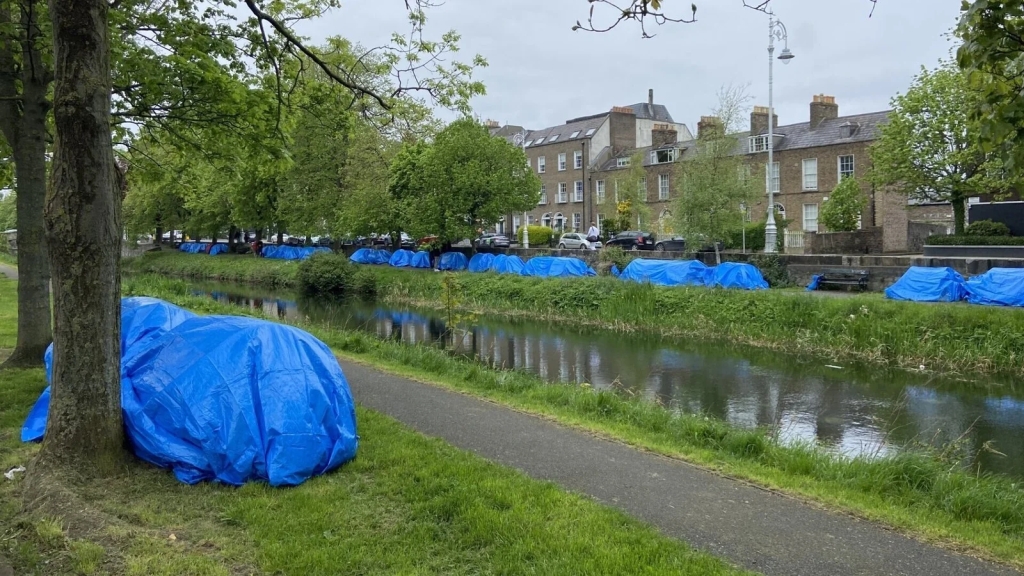
The government gives money to NGOs to help refugees. The refugees buy tents because the government won’t provide accommodation, so the government spends money to destroy the tents. Photo: RTE

The main story of the elections is that despite long-standing failures and some dissatisfaction the main governing parties, including the Greens, more or less held their own, illustrated in quick speculation that they will bring the date of the next general election forward.

Together they won around half the first preference vote in the local elections and 46 per cent in the European.  This is historically low for the two main parties (46 per cent and 41 per cent respectively) but these are now two cheeks of the same arse that are quite able to work together at the top while their voters are transferring to each other.  Even historically the previously minor party, Fine Gael, required a third party to represent an alternative, which the Green Party has, for now taken up, in the role previously performed by the Labour Party.

This has led once again to the obvious suggestion that they should merge, given the utter absence of any political differences.  At this point, however, one is reminded of the quote from the American comedian Bob Hope who said that “No one party can fool all of the people all of the time; that’s why we have two parties.”

The dissatisfaction that achieved expression was reflected in the 28 per cent vote for a variety of independents in the local election and 34 per cent in the European, while an independent won the Limerick mayoral contest.  Most of these have no fundamental political differences from the two main parties, in some cases merely being former members with no differences at all but availing of the possibilities for personal opportunism offered by the electoral system.

Despite the ups and downs the Irish state is politically stable, reflected in Fine Gael being in office for over 13 years.  This reflects the continuing recovery and growth from the financial crash.  Of course, this has a narrow foundation, resting on a limited number of US multinationals, but the threats are not yet immediate.

The problems of this growth – of income inequality and housing for example – are ones that ‘solve themselves’.  The poorest are atomised and prey to reactionary solutions or apathy while the inadequate infrastructure is partly a result of inadequate state capacity.  There is unanimous agreement that the solution lies in increasing this capacity – ranging from the governing parties themselves through to its liberal critics and its supposed left opposition. The precise role and scope of this increased state intervention is all that varies between them.  Not an inconsequential matter but not fundamental either.  The political origins of the left organisations as nominally Marxist gives its reformist programme nothing more than a radical tinge.

While Europe witnesses its biggest conflict since the Second World War, there is an Irish consensus that supports Western imperialism, which the left’s opportunism in also supporting Ukraine does nothing to challenge.  The gestures of the Government in supporting the Palestinian cause are enough to quell widespread opposition to what this imperialism does in its support for the Zionist state, while the position of the left on the war in Ukraine does nothing to clarify imperialism’s consistently reactionary and barbarous role.  Breaking the consensus on this is hard enough already given the dependence on US multinationals and EU membership, while the loss of Clare Daly in the elections is the loss of the most articulate and passionate opposition voice to this imperialism.  Again, the parliamentary left didn’t help by standing against her.

*                   *                  *

The final factor that is genuinely new is the electoral appearance of the far right, steeped in racism and xenophobia, flying the national flag and invoking Ireland’s colonial subjugation even while its most rancid elements collaborate with the British far-right.  Between it and the bourgeois parties lies various shades of reactionary nationalism; part of the stability of the ruling bloc of mainstream parties was their adoption of a harder rhetoric and tougher policies on immigration.  These parties have thus partially legitimised the more radical rhetoric to their right.

One commentator estimated that anti-immigrant candidates took 15 per cent of the vote in the Dublin European constituency and had three elected to Dublin City Council.  The naïve who think Irish nationalism is progressive because it is an expression of the oppressed should have cause to reflect, although if they have been able to ignore the character of the nationalism of Fine Gael, Fianna Fail, Sinn Fein and various republican militarists so far, it might not be a surprise if this is not revised by the far right becoming its latest expression.

It might also be estimated that about one third of the population of the Irish state still clings to its idea of this nationalism as that of holy Catholic Ireland.  In 2004 racism played no small part in an almost 80 per cent support for a referendum to limit the rights to Irish citizenship of children born in the State.

Since then, much has been made of the modernisation and progressive liberal development of the country but notwithstanding the mobilisations around referendums on divorce, abortion and gay marriage, much of these changes, including the support for change in these referenda, are due to the general secularisation of Irish society and not, unfortunately, to mass struggles of the working class, its movement or a mass women’s movement.  These changes received significant support from the main bourgeois parties and never called into question the political hegemony of these parties never mind the class foundations of the state.

All this is reflected, among other things, in the continued patronage by the state of the Catholic Church in education and health and the continued governance of the two main parties.  The growth of independents is a continuing tribute to the clientelism and parochialism of much of Irish politics.

There is therefore no crisis in the state that would provide the grounds for the mainstream parties to do more than give a certain legitimacy to anti-immigrant rhetoric.  It has no need to collaborate with outright racist forces even if they have been useful to put a squeeze on Sinn Fein through its more primitive support.  The far right is also handicapped by being very badly fragmented with no unifying figure appearing.  The far right is therefore not the primary problem but rather an expression of the weakness of an alternative.

*                   *                  *

I generally dislike blaming the successes of the right on the failure of the left since it often minimises our objective weakness, the strength of capitalist forces and their ideological hold, and the political resources of the bourgeoisie.  It is always necessary, however, to discuss what lessons we can learn.

Despite the relative success of the Governing parties there is general dissatisfaction and disaffection among many people.  That this was mainly expressed in votes for independents was a judgement on Sinn Fein.  That Sinn Fein failed to make the gains it expected while People before Profit/Solidarity stood still and didn’t increase its vote significantly is a judgement on it.

That PbP TD Paul Murphy indicated on RTE1 that a possible drop in votes was less important than a gain in seats indicates a left so mired in electoralism that its claimed ideological foundations are no guide to its actions.  It claims that it ‘sees elections as a way to build struggle’, but in reality it supports struggles in order to build itself and its primary goal in building itself is to win elections.

Its main strategy has thus been to work towards the creation of a ‘left Government’.  This only makes sense if Sinn Fein can be seen as a constituent part of this.  I have previously argued that the reformist programme of the left is no barrier to it being part of a ‘left’ government, which can be called ‘left’ because it isn’t going to be socialist or a workers’ government.  PbP/Solidarity is only on 2 – 3 per cent in opinion polls and elections so it very obviously needs something much bigger outside to make this remotely credible.

Enter Sinn Fein, and also exit Sinn Fein.  Just before the elections it was reported that the Party had travelled to London with financial firm Davy to give a briefing to ‘investors’.  Davy stated that ‘Sinn Fein does not plan to fundamentally change Ireland’s economic policy’ and noted that “overall, Sinn Fein’s approach from an economic standpoint is more ‘New Labour’ than ‘Corbyn Labour’.”  If this didn’t sink the credibility of a left Government as the way forward, then the recent election results certainly have.

These elections had a turnout of just over 50 per cent while the 2020 general election turnout was 63 per cent.  The next election will even on this basis be different, and some of the trends noted above will build up trouble if they continue.  What it will not be, however, is the opportunity to make the objective of a ‘left’ Government either credible or, more importantly, make it the central objective of those seeking to build a working class alternative.

Back to part 1