Nationalism planning for a United Ireland

The Belfast paper – The Irish News – has a column every Saturday by Patrick Murphy that regularly flagellates Sinn Fein for its hypocrisy and incompetence, sectarianism and corruption, its elevation of the cause of a united Ireland over a united people, and the constitutional question over questions of economic and social equality and poverty. Most of all it is criticised for its nationalism, even its betrayal of it through its recognition of the legitimacy of the ‘two traditions’ in Ireland, which translates as two nations and thereby betrays its own stated goal of a united nation.

Sinn Fein is not the only target and the SDLP and Southern parties get a lashing now and then as well.  It’s a bit repetitive, even if accurate in its own way, and his style can sometimes be irritating.  Anyway, the irony is that for all his economistic denunciations of nationalism, he is actually a bigger nationalist than the SDLP, Southern parties and Sinn Fein.

His bête noir is the European Union, which he sees as robbing Ireland of its sovereignty with Irish membership akin to allying with the British Empire against Germany in World War I, betraying Connolly’s entreaty to ‘serve neither King nor Kaiser but Ireland’. Of course, he has no difficulty is demonstrating the imperialist character of the EU and its current complicity in the imperialist and Zionist genocide in Palestine etc.  But he is no Marxist and so is unable to appreciate that his belief in a sovereign independent Ireland is a pipe-dream; a reactionary attempt to turn the clock back to a world of independent nation states that also ironically never existed and will never exist.  A recent article by Boffy sets out what is going on here.

By coincidence the Saturday issue of The Irish Times has an article by the Taoiseach Simon Harris setting out the need for the Irish State to defend its current success from the potentially devastating effects of a Trump presidency through some sort of ‘diplomatic offensive’.  This can only involve reminding Trump of how useful the Irish state is for the United States – “Ireland’s offering is one that speaks to Trump . . .”  Since what speaks to Trump most of all is willing and obsequious servility, the Irish are well practised in ingratiating themselves with US presidents, getting the opportunity to do so every St Patricks day with a ridiculously over-sized bowl of shamrock.  What handing over the bowl by the Irish Taoiseach symbolises is the handing over of the country to its true and ultimate chieftain.

The idea of Patrick Murphy that Ireland could genuinely be an independent and sovereign state, against the United States and outside of the European Union, is so divorced from reality it has been abandoned by every other Irish nationalist party.  Irish socialists should not take on the burden of trying to claim it and should instead recognise the ending of the era of nation states as heralding the ending (very painful ending) of capitalist nation states and inevitably of the nationalist ideology that is sustained by them.

The decline of nation states and agglomeration of super-states and imperialist alliances, demonstrated by the US and China and by NATO and BRICS, is an expression of the development of the productive forces of capitalism upon which the possibility of socialism rests.  The intensifying competition and rivalry between these imperialist states and their alliances poses an existential challenge to the interests of the working class, which, as Marx said, has no fatherland but can only assert its interests as an international class.

This means opposition to imperialist war, which currently means opposition to the imperialist conflict in Ukraine and the country’s proxy war on behalf of western imperialism against Russia.  It means rejecting the idea that an old slogan, and one not understood, of self-determination can be proclaimed as justification for supporting one or other side of this imperialist rivalry and the war it has generated.

That consciousness, including political consciousness, often lags behind economic and social development is nothing new and partly explains why many on the left have become enthusiasts for one imperialist alliance or the other.  This leads to hypocritical claims of opposition to oppression by the other side while ignoring the oppression of the favoured imperialism.  So, for example, the United States is claimed to be the key enemy of the working class of the whole world, including of Russia and China, while the role of these states in oppressing their own working class is a “separate question”, as one apologist for these states put it to me.

But let’s get back to the Murphy column in The Irish News.  He notes the recent ‘plan’ by Sinn Fein minister Conor Murphy to create 10,000 new student places centred on Derry.  He notes that it is based not on the purpose of new university facilities and what their wider role might have for development but mainly on where they will be sited.  Along with nearly all Stormont ‘plans’ it doesn’t have the money behind it to make it happen but promises to at least have some.  In this respect it is better than the new Health Service three year plan, recently announced while the first year was already three-quarters over and which promised new stuff if it had the money and cuts in the meantime.  This didn’t stop it being welcomed.

One of the many criticisms of the Conor Murphy plan was that it was a Northern Ireland plan that will reach full fruition by 2032, by which time his party leader has promised that Northern Ireland will not exist! Oh dear, nationalists revealing that they don’t believe their own hype?  I have to admit I almost laughed out loud.

Sinn Fein has been banging the drum on the ‘conversation’ about a united Ireland for years, demanding that the Irish government and everyone else start planning for it, lest the project suffer from the same lack of preparation as Brexit.  And here it is presiding over plans that ignore it!  Repeated calls for plans are followed by silence and their complete absence. Why? Because any plans would immediately confront obstacles that no one wants to talk about; assurances no one would believe, and promises that would invite the response of ‘why don’t you do that now then?’

Behind the empty rhetoric is the reality that nationalism itself has nothing to offer, which the utterly incapable Stormont regime has demonstrated in spades.  For socialists, the national question and a united Ireland is an Irish democratic revolution which cannot promise radical economic and social advance outside of an accompanying socialist revolution. All the limitations to an independent and united Ireland set out above would apply.

At most it is the act of uniting the country alone that would be justified as a democratic advance itself and during ‘the Troubles’ this was how it was implicitly understood.  Now, it is claimed by nationalists that it will have all sorts of other economic and social benefits that Sinn Fein says everyone else must plan for but which it can’t convincingly demonstrate exist and can’t plan for itself.  Instead, what political arrangements that are touted are flimsy and insubstantial – a new flag or national anthem – or actually undemocratic – some mechanism to guarantee continuing unionist power and influence.

All around us we see the pervasiveness of nationalist thinking and the failings of its nostrums.

A New Popular Front for Ireland? (1 of 3)

It’s not often that in politics you get to carry out an experiment that will tell you what will happen if you propose to take a certain course of action, but that is what we have with the proposal for the Irish Left to copy the creation of the New Popular Front in France.

People before Profit have proposed that a left pact that includes Sinn Fein should stand as an alternative alliance to the current Fianna Fail and Fine Gael government that will seek a new government mandate later in the year.  Its TD Paul Murphy has explained that a new mandate ‘would be a ‘disaster’, further ‘ratchet up’ the ‘scapegoating of asylum seekers’ and ‘embolden the far right even more.’   In this, the left should ‘take inspiration from the Nouveau Front Populaire (NFP) in France.’

There are so many issues with this it is difficult to know where to start; but let’s start with the most obvious.  In France the NFP was put forward as a way to stop the election of a far-right government of the Rassemblement National (RN).  This has involved an electoral alliance of the NFP with the main French bourgeois parties in which left voters were asked to vote for these parties where they were placed second in the second round of voting. Just like in Ireland, this alliance claims that it has been the policies of these parties that has helped incite and support the far right in the first place.

So, in Ireland, an alliance with the main bourgeois parties in France is held up as the example to follow in order to defeat the same main bourgeois parties in Ireland.  It might be claimed that this is not what is meant by copying the NFP example but that is only true if you ignore the politics involved, and politics is what it’s all about.

At a very basic level the proposal is all about what you are against and not what you are for, a common charge against the left by the right that the left continually confirms.  The far-right offer an alternative, even if it is reactionary and built on lies, while the main bourgeois parties offer the status quo, which includes all the powerful and hegemonic political, economic and ideological forces in Ireland and the world.

When faced with the slender possibility of presenting its own alternative government following the elections the hastily constructed joint platform of the NFP in France has been no help; the main point was purely negative – to allow the creation of a pact that would stymie the far right.  The NFP includes the very parties who led to the collapse and discrediting of previous left governments composed of the Communist Party and Socialist Party.  The former is now a shadow of its former self while the latter has been allowed to climb back up from its utterly discredited rule between 2012 to 2017 under President François Hollande, also back from the dead and part of the NFP.

With stopping the far-right as its prime and overriding purpose, there can be no objection to further capitulation to the main ‘centrist’ parties, which suffered the biggest defeat in the elections and to which the majority of the French public is bitterly opposed.  Now, along comes the united left to form an alliance to prop it up.  While the left in Ireland portrays the French elections as a victory for the left it ignores that this was a victory (of sorts) of an alliance with these discredited bourgeois parties, which have an effective veto over the formation of any new government.

What now remains to be determined is the exact configuration of the caretaker government cobbled together from the fragments of the NFP and bourgeois centrists before the next presidential election in which the far-right will then again claim to be the only real alternative to the rotten establishment.  Such are the fruits of short term surrender of principles, or opportunism as it has long been known as.

The relevance to Ireland is clear enough.   The left alliance proposed by People before Profit only has the remotest credibility because it must contain Sinn Fein, so this party must be called ‘left’ because it can’t be called socialist, which shows how this is a purely relative term, loaded with ambiguity and therefore dangerous in application.

The political experiment I alluded to at the start of the article also relates to the fact that Sinn Fein is already involved in a coalition government in Ireland, and with one of the most backward and reactionary parties in Europe.  What’s more, the DUP and Sinn Fein seem to get along famously, with differences not over fundamental policy but just how the sectarian pie is carved up between them.

The Stormont regime is a now a byword for disfunction and incompetency, but these are just expressions of its sectarianism.  This sectarianism has made it easy for Sinn Fein to join with the DUP in imposing austerity while trumpeting the fact that it is now the leading party in the whole rotten edifice.  Widespread acceptance of this arrangement has been possible mainly by portraying the North as a place apart with different rules that don’t apply in the rest of the country.

People before Profit thinks it can form an alliance with Sinn Fein in the South, telling it that its project of a coalition with Fianna Fail (FF) or Fine Gael (FG) would face a veto on any radical change.  It has sought to persuade SF that its attempts to make this work have failed, including its overtures to convince FF & FG that ‘you were not advocating a radical left programme’, and its ‘reluctance to clearly oppose the government’s scapegoating of asylum seekers.’  Yet this is the party that PbP portrays as ‘left’ and a vehicle for radical change!

It’s not even that PbP is promoting this with its eyes closed – blinkers maybe – but even the most blinkered can’t ignore the hypocrisy of Sinn Fein and its talking out of both sides of its mouth; one of the reasons its vote fell so far from expectations in the recent local and European elections.

Everyone knows that Sinn Fein was expecting to be in government after the next general election, with the prime candidate for partner being Fianna Fail, one of the evil twins that are the target of PbP and which it regards as the over-riding priority to defeat. If this strategy, its record in Stormont, its promise of good behaviour, and its failure to challenge the scapegoating of asylum seekers; if all this is not enough to expose the real character of Sinn Fein then we must ask the question – what compromises are PbP prepared to make for an alliance with it?

If there are none, is this because the joint platform will be so anaemic, the politics of SF and PbP are so similar, or because the priority is to get FF and FG out so it doesn’t matter?  If there are compromises to be made, what are they?

Forward to part 2

The Northern elections point in only one direction Or do they?

There are three take-aways from the Westminster election in the North of Ireland.

First, Sinn Fein continued to make progress, defending its existing eight seats, including securing bigger majorities in a number of constituencies, and making gains in others that promise two more in the future.  It sealed its position as the biggest party in the Westminster elections, to rank alongside earlier local and Assembly successes, although small comfort for its failure in the local and European elections in the South a month ago.

Second, the Alliance Party, as the main face of ‘others’ in the North – neither Orange nor Green, Unionist or Nationalist – lost one seat and gained another, so stood still with a small drop in the share of the vote of 1.8% on the 2019 election.  The ‘Alliance surge’ has stopped surging.  At 15% of the vote it does not come anywhere near marginalising the sectarian division and the basic conflict over the existence of the Northern state.

Thirdly, and most dramatically, the  DUP lost three of its eight seats, very neatly lost another in East Derry and saw a dramatic fall in its majority in East Antrim.  It lost from all directions: from the Alliance Party, Ulster Unionist Party and the uber-unionist TUV.  In the case of the last, the defeat of Ian Paisley junior brought a smile to most faces in spite of the identity of the victor, such is the likeability of the loser.  Even some of his colleagues were reported not to be too displeased. The only real bright spot was securing the seat of its new leader in East Belfast.  A fall in the share of the vote of 8.5%, or a proportionate fall of 28%, is a disaster.

So what does it all mean?

Some nationalist commentary repeated familiar lines about ‘the writing on the wall’ and ‘the arrow pointing in one direction’ into the ‘inevitable future’ (Brian Feeney in The Irish News) – all references to the writing pointing to a future united Ireland.  Unfortunately it’s not so simple, even for the biggest party.  It won 27% of the vote, and when you factor in the lowest turnout for a Westminster election in the history of the North of 57.47%, we can readily see that 15.5% of the electorate does not a revolution make.

Over 42.5% found no reason to vote, which undoubtedly reflects a number of things, including apathy in constituencies in which a nationalist candidate hasn’t a chance, but even in the 2022 Assembly election, with a more proportionate system, Sinn Fein got 29% in a 63% turnout, or 18% of eligible voters.  In this election the pro-united Ireland vote was just over 40%.  If this is the writing on the wall, the wall is far away, the arrow points to a very long road, and the inevitability of a united Ireland is not quite the same as that of “death and taxes.”

Sinn Fein continues to advance in the North without any justification deriving from its now long record in office at Stormont.  The latest reincarnation of devolution managed to set a budget for departments without agreeing what they were going to spend it on – what were its priorities?  It spent plenty of time passing motion after motion lauding all sorts of good things with zero commitment to doing anything about them, while utterly failing to account for the public services it has been responsible for.  These, such as the health service, have fallen into a crisis worse than anywhere in the rest of the UK. 

For Alliance, its still second order existence testifies to the inability of the status quo to satisfy Northern nationalists or provide evidence that Unionists really are as confident that the state is as British as Finchley.  Its existence at all, however, is held to define what is necessary to change this status, which is not simple growth of Irish nationalism.  Convincing the ‘others’ of a united Ireland is argued as the key task for nationalism, which must include current Alliance supporters.

In this, Sinn Fein is not succeeding, in fact it doesn’t realise it isn’t even trying.  It continually berates other nationalist parties, especially in the South, for not joining ‘the conversation’ on a united Ireland, and calls out the necessity of planning for it; as if talking about it brings it any closer never mind making it inevitable.  It’s like being lifted by the cops who want to have a conversation with you – where you do all the talking.  Where are Sinn Fein’s plans?

The biggest issue however, that has signalled a step to a united Ireland, has been Brexit, and it is this that has done to the DUP what it did to the Tories in Britain.  While the victory of the TUV was most obviously a result of the failure of the DUP to prevent ‘the Irish Sea border’ that resulted from Brexit, it also lost because it lied about its deal with the British government that would supposedly make it disappear.

The Alliance victory in Lagan Valley was partly due to the constituency MP Jeffrey Donaldson being sent for trail on sex-offence charges, but this copper-fastened a prior loss of personal credibility as author and prime advocate for the deal.  With the Brexit disaster in the background every credible opposition to the DUP looked that bit more attractive and its most vocal supporters, such as Ian Paisley and Sammy Wilson, suffered.

The local political commentator Newton Emerson noted that the DUP losses in very different directions made it difficult for the DUP to know where to pivot.  This dilemma exposes the real demoralisation within unionism that sought to strengthen partition by supporting the UK leaving Europe but found itself inside a part of Ireland less aligned with the  sovereign power.  There is no mileage in continuing to fight it, so they won’t follow the TUV in doing so, but this means that it remains exposed to this more rabid unionism with only the old age of its leader Jim Allister as the pathetic hope of future redemption.  

It can keep quiet about the whole thing and hope it disappears as an issue but there are at least three problems with this.  First, its opponents will remind people, people will remember DUP stupidity themselves, and much as Keir Starmer might try to ignore it and think he can evade its worst effects, it’s not going away and neither are its effects.

A bit like the election in Britain, a thoroughly boring campaign had some more noteworthy results.  The stasis, if not stagnation, in politics within the North continues but events elsewhere are not so stable and have their effect.

Irish Elections (1) – Sinn Fein was the future once?

For years Sinn Fein in the North was accused of acting as both government and opposition, enacting right wing policies in government while presenting itself as anti-establishment, pretending to oppose the sort of politics it was itself carrying out.  It talked out of both sides of its mouth and had more sides than the Albert Clock, as we say in Belfast.

It got, and still does to a lesser degree, get away with it because its dumping of traditional republicanism has been continually praised while its clinging to symbolic remembrance of its dead armed struggle is repeatedly damned.  More fundamentally, it succeeded because it is the most vigorous defender of Catholic rights in the ‘new’ political settlement that has been anointed saintly status by the powers that be, stretching from Washington and London to Dublin and Belfast, not to mention Brussels.

It has had lots of powerful friends on its journey from rebels to politicians, happy to indulge its self-ID as progressive radicals while it became the centrepiece of a regime of dysfunctional failure.  It could forever bask in the naked contempt of its unionist coalition partners, the best of enemies, while telling its supporters that a united Ireland was ‘within reach’. What made it repellant to some made it attractive to others.

*                   *                  *

During a walk-about with a Sinn Fein candidate in last weeks local elections an Irish Times journalist noted that some potential voters appeared to treat the party as if it was already in Government – part of the establishment – and part of the problem it was presenting itself as the solution to.  Waving Tricolours and singing rebel songs doesn’t exactly distinguish you in the South, which now routinely names itself Ireland, leaving the North to get along with Northern Ireland, the nomenclature that unionists goad Sinn Fein with its unwillingness to allow pass its lips.  Now Sinn Fein has found in ‘Ireland’ a new rival that claims to be even more nationalist than it and waves the flag even more vigorously.  The structural conditions applying in the North don’t exist south of the border so are no help to it.

The rise of the far-right and its opposition to immigration, especially in some working class areas of Dublin, is widely held to be a major reason for the apparently sudden and stunning setback to Sinn Fein in the local and European elections held last week.  In an opinion poll in June 2022 it was recording support at 36 per cent, by far the biggest party.  Last week it gained only 12 per cent of the first preference vote and would be the fourth largest if we count the bag of independents as a party.  In 2020 it suffered from standing too few candidates to maximise seats from 25 per cent of the vote while in 2024 it stood too many.

It isn’t Fine Gael or Fianna Fail who are labelled the traitors now, although Sinn Fein long ago found that approach would get them nowhere.  It is now Sinn Fein who are the traitors to the Irish nation, who support a ‘new plantation’ and who refuse to prevent immigration when ‘Ireland is full’.   It is Sinn Fein that is now accused by the assorted racists, far right and fascists as betrayers of the ordinary working class Irish.

All the anti-immigrant tropes that have been seen across Europe are now a ready currency in Ireland and Sinn Fein is the primary political target.  Within less than a couple of years a self-satisfied liberal view that Ireland was more or less immune from the rising tide of racism and xenophobia so prevalent elsewhere has been evaporated.

The growth of the population has largely been due to immigration while the keenness of the Irish bourgeoisie to show its support for Ukraine (in the absence of an ability to provide weapons or troops) has meant that over 100,000 Ukrainian refugees have been welcomed.  This has been followed by an increase in refugees from other countries, less welcome, not least because they aren’t white and no political capital is accrued by having them.

The Irish State was already undergoing a housing shortage when it decided to open its doors to these refugees; stumbling from one emergency measure to another in order to cope while offering welfare rates on a par with the natives.  As the number of those seeking international protection also grew local protests against the housing of these refugees developed in small towns and mainly working class areas of Dublin.

Numerous arson attacks prevented accommodation from being created for refugees while local people claiming not to be racist protested, claiming only to be concerned with the lack of local GP or other health services; an existing shortage of accommodation, or the turning of a local hotel that might have brought in tourists into a refuge for asylum seekers.  The localism of political activity in much of Ireland found it easier to mobilise against asylum seekers than against the failure of the state to keep health, education and housing in line with a growing population.  No doubt many of the local protesters are voters for the bourgeois parties responsible for the policies that led to the failure.

The governing parties decided to clamp down and the toughened rhetoric on immigration became one of control – ‘firm and fair’ – the same reactionary rhetoric employed elsewhere that everyone knows means an attack on the rights of refugees.  The governing parties had found a scapegoat for their failures and a handy weapon against its political rival in Sinn Fein: opinion polling claimed to show that part of its support was more opposed to immigration than that of other parties.

The party first tried to dampen this by arguing that the Government had failed to talk to or consult properly with local people about the accommodation of refugees in their areas but one of their TDs had to admit that “we were a bit all over the place.”  This has settled down to more or less aping the rhetoric of the Government and policies that are more or less the same.

None of this could appease those looking for a quick racist solution and who aren’t going to be convinced by the benefits of immigration, not least because they haven’t seen any.  The benefits of opposing anti-immigrant and racist solutions from a socialist point of view don’t exist for those who don’t have a socialist project and don’t see any utility in working class politics.  Sinn Fein can’t argue this way and even the left mainly presents liberal and human rights arguments that are no part of this politics.

Sinn Fein thus doesn’t escape blame from more backward and reactionary workers while its more liberal and vaguely progressive supporters won’t support it bowing too far in their direction.  Both have reason to doubt the party, with the recorded decline in its support preceding the more recent prominence of migration.

There is only so much complaining you can do before you’re asked to explain what you’re going to do about it, arising from doubts about exactly what you stand for.  U-turns have been public and obvious over a range of issues, including the price of housing, proposed hate legislation, support for the failed referendum proposals that were roundly defeated and then reversal of a promise to re-run the vote if they failed.  All these are small relative to the fundamental U-turns in the North, but this just illustrates the different environment it has to work in.

*                   *                  *

Sinn Fein is not yet the past, but it doesn’t look like the future now either.  That famous Irishman Oscar Wilde said that “there is only one thing in life worse than being talked about, and that is not being talked about.”  Sinn Fein has been much talked about leading up to the elections and especially about the results, including by the leader of the current Government coalition.  You’re not supposed to talk ill about the dead in Ireland so Sinn Fein isn’t dead, but it isn’t the main story and we’ll talk about that next.

Forward to part 2

What Sinn Fein threw out when it threw out the Palestinians

When Sinn Fein stewards threw out some Palestinians from a Palestine solidarity meeting in Belfast, they threw out something else – all pretence that it will ever take effective action against the Zionist state’s genocide of the Palestinian people.  Specifically, it will do nothing to upset the United States, the sponsor of the Zionist state, its financier, arms supplier, and political attorney.  The Zionist state has its main benefactor, and through it Sinn Fein becomes an accomplice to Zionism’s actions by one remove.

The International Court of Justice (ICJ) has found it plausible that the Israeli state is carrying out genocide, although the vast majority of the world’s population did not have to wait to make this judgement, and does not have to wait the years required to see the ICJ confirm it.  There is therefore a political obligation to take now whatever action that can be taken to stop the genocide and Sinn Fein is not taking it.  How little this requires is demonstrated by the leader of the SDLP refusing to go to Washington on St Patricks day.  Sinn Fein has rejected doing the same.  This article has good coverage of the meeting and its background.

What this incident shows is the common nature of the struggle against imperialism across the world and the common character of that struggle.  Solidarity movements are supposed to be expressions of that common struggle but have become detached by petty bourgeois politics to be mere expressions of sympathy; appealing to human rights that fail to understand that the violence of imperialism is intrinsic to the capitalist system and that the only alternative is working class socialism.  This means that working class leadership of the struggle is needed, not just in Ireland but also in Palestine and all the other countries in the region and beyond where the outcome of the genocide will be determined.

Thus, this meeting illustrates that Sinn Fein, newly reinstalled in the leadership of the imperialist settlement in Ireland, will brook no criticism of the Palestinian Authority (PA) which plays the same, increasingly discredited, role in Palestine.  The PA is widely reported to be employed again as the mechanism for imperialist and Israeli pacification once the latter has finished its slaughter.

The message is therefore clear, Sinn Fein is not part of the Palestinian solidarity movement in any meaningful sense.  A party that participates in a shindig with those behind the genocide is a fifth column that undermines the solidarity movement by limiting the terms of effective solidarity, with an attempt to blind everyone to what it is doing.  What the solidarity movement needs to do, at the very least, is to take effective action to thwart the genocide.  A result of this it should be a step forward in the creation of a militant working class movement in Ireland as well.

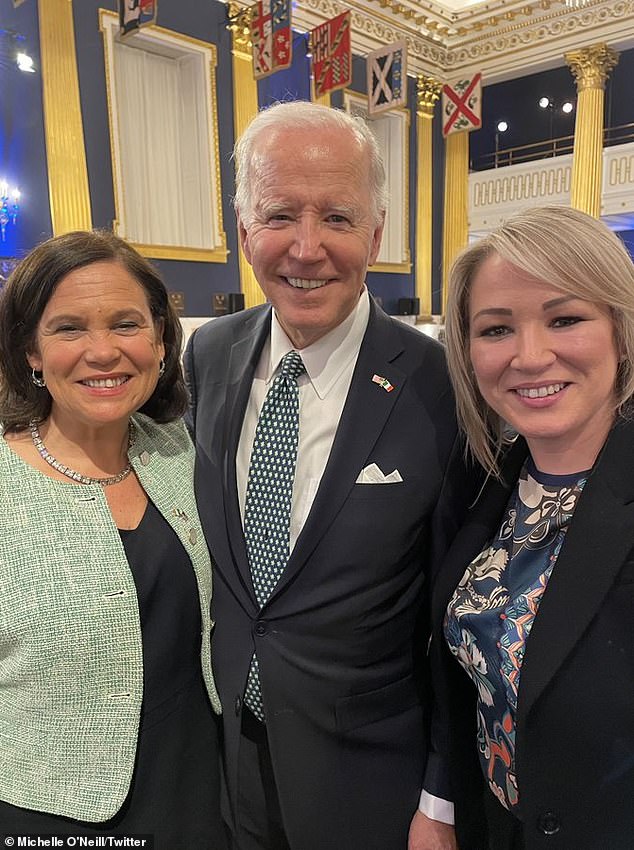
Refusing to party with Biden is not even a forceful act of solidarity but rejecting it is a statement that Palestinian genocide is not important enough to demonstrate opposition to its main facilitator.  The celebration with the British Prime Minister the week before showed Sinn Fein’s partnership with the British Government, second only to the US in its support for the Zionist state and complicity in the genocide.

Effective opposition in Ireland would involve preventing the US using Shannon airport as a transit to the Middle East and refusal to handle Israeli goods.  The solidarity campaign involving leaflets, meetings and demonstrations are in themselves protests, but the ruling class everywhere is perfectly happy to ignore protests unless they lead to more radical action.

 Instead, protests lead only to more protests which eventually tire the protestors.  They often involve naïve beliefs that those in power will listen and take action, as if they did not already know what is happening or are willing to be convinced or shamed into ‘doing the right thing’. This is a view borne of ignorance that they are not actually acting out of their class interests and will change their behaviour only if these are threatened, and only permanently change if their political and social power is destroyed.

This means creation of a working class solidarity movement.  Calls for individual boycotts of goods involve calls for individuals or individual companies that are unorganised.  The working class has the power to enforce boycotts that don’t require millions of individuals taking individual decisions millions of times not to buy this or that good.

The first place to seek to organise this is in the existing workers’ movement.  Any solidarity campaign should seek to achieve this, and the membership of its supporting organisations would have the duty to try.  The many Sinn Fein members will never be given this task, yet the purpose of all the leaflets, social media posts, meetings and demonstrations is to build a movement that will take this on and succeed.  They are designed to build the support, organisation and confidence of those who can undertake this action. Token attendance on the odd demonstration by the Irish trade union movement is a testament to failure to attempt this.

Some other lessons can be learnt from the Belfast episode.  There should be no fear in challenging Sinn Fein because other Irish political parties are doing nothing better.  It is not the job of a Palestine solidarity campaign to save Sinn Fein from its own perfidy.  The government parties are in office and have demonstrated the limits to their expression of sympathy; they will do nothing much more unless forced – they are not there to be convinced of the justice of any particular action, they know already.  Sinn Fein, on the other hand, professes to be part of the solidarity movement.

The common nature of the struggle across the world demonstrated by Sinn Fein’s defence of the Palestinian Authority means that assertions that we cannot criticise any particular Palestinian organisation or movement, as is sometimes stated, is frankly stupid and reactionary.  Socialists criticise movements across the world if they think their politics are inadequate, fail the working class, or betray it.  The Palestinian Authority has certainly betrayed the cause of Palestinian freedom and it would be a dereliction of duty not to say so.  Only belief in the moral superiority of Palestinians as a nation, uniquely undivided by class or blessed by political leadership, could justify such a position.  That some Palestinian activists have condemned the PA is to be welcomed and shames those who would keep schtum.

That these activists were thrown out of a Sinn Fein meeting is to their credit as much as it is damning of those who ejected them.  A fitting way that Sinn Fein could atone for their disgraceful action would be to protest against Genocide Joe and be thrown out of the White House.  What’s the chances?

Trusting the State (3) – giving us the ‘right’ to housing

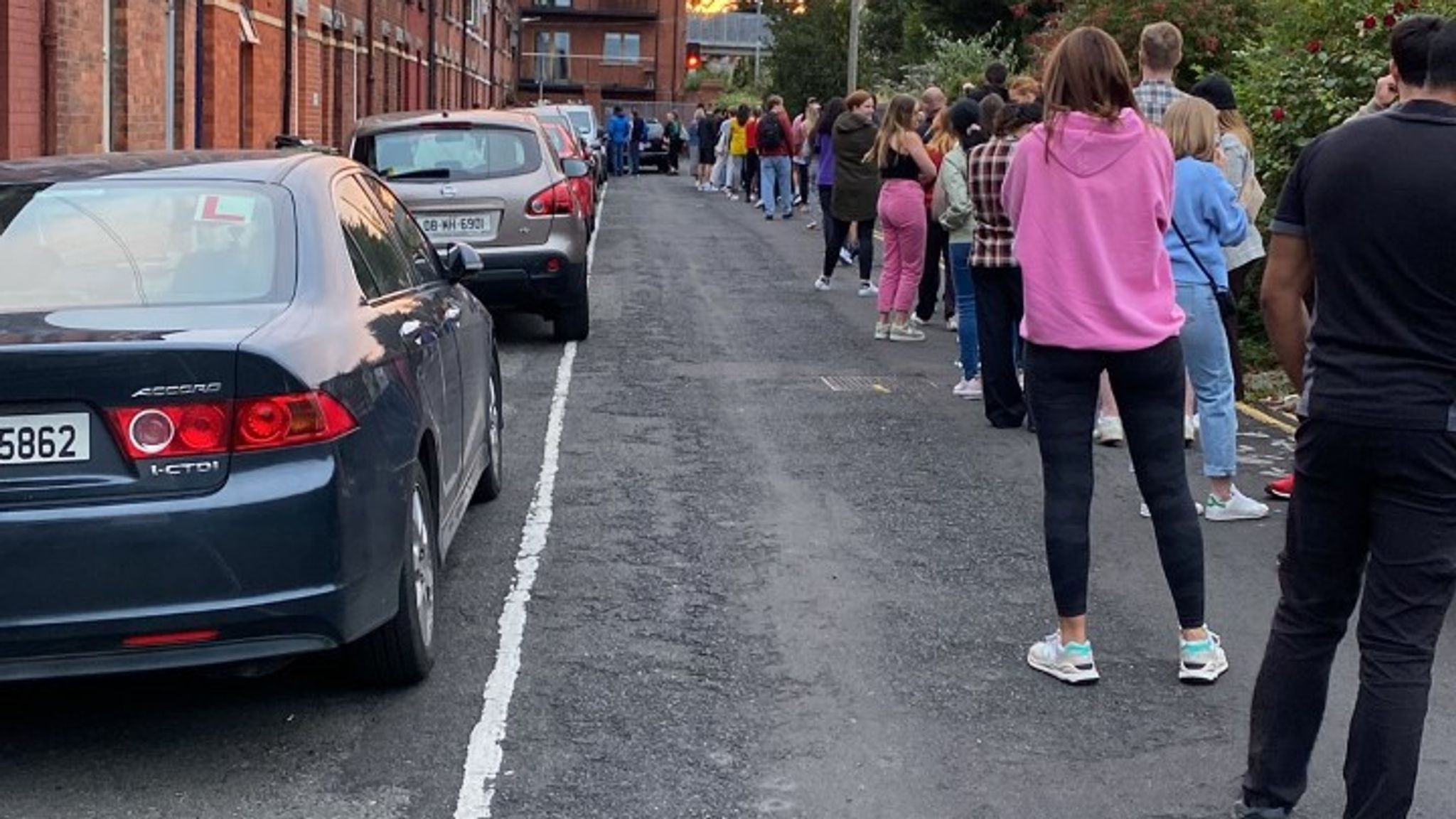
Queuing to look at one rental property in Dublin; pic Conor Finn, Sky News

Ireland suffered effective bankruptcy in 2007-08 through a property boom funded by a massive expansion of credit and crisis of overproduction, illustrated by employment in construction falling from 232,600 in in the last quarter of 2007 to 133,200 in the last quarter of 2017, a fall of 42.7%.  Yet the drop was even more precipitous than this: from 236,800 in 2007 to 83,400 in 2012, that is, by 65 per cent.  Almost one in every two workers who lost their jobs in the Irish state in the five years from 2007 to 2012 had previously been employed in construction.

The sector went from10.7 % of GDP in 2006 to 1.1% in 2011; going from the sixth largest share to the lowest in a group of around 50 countries during this period. The index of the value of residential construction fell from 751.7 In 2006 to 57.9 in 2012 while the index of non-residential construction fell from 115 to 73.59.  The growth in the stock of housing plummeted:

From an unsustainable boom to a collapse and again rapid growth, the boom-slump-boom Irish economy now has capacity constraints only partly made up by immigration, leading to a new housing crisis in which not enough houses are being built, house prices have become extortionate again, and not enough properties are available for rental.  To rub it in in, some of the partly finished houses from the boom were left to rot or demolished while the quality of much of what was built has become, or is becoming, uninhabitable because of poor materials or dangerous construction.  The banks that workers bailed out in the 2008 crisis are back in profit, having involved themselves in new rip-off scandals, and now criticised for pitiful savings rates while borrowing costs for its customers increase.  Despite their profits today their massive losses carried forward are set off against taxes, not a facility available to the working class.

The housing crisis dovetails with other aspects of the malfunctioning of Irish society including health and education.  More than 830,000 patients are on hospital waiting lists while staff vacancies are unfiled, including senior medical staff, while there are hundreds of teaching vacancies in schools.  Doctors, who in their career development will work for a year or two in Australia, aren’t coming back because they can’t afford houses in the areas they want to live.  Executives in US multinationals complain that housing is an issue for their recruitment of staff, thus raising the potential of lost foreign direct investment.

It is tempting to say that only Ireland could go from bankruptcy to growth of 26% in 2015 (and over 12% in 2022), and in some ways this is not just another example of the contradictions of capitalism in general but does speak to the particular character of the Irish variety.  Infamously, the Irish GDP figure is often ridiculed, and no longer accurately reflects real domestic economic activity; so although it has been boosted massively by US multinationals’ direct investment, it also reflects the massive impact of transfer of assets and production from elsewhere so that they can be taxed in the Irish State.  This has resulted in a massive growth in corporation tax receipts and its concentration in a few multinational companies, with around 60% of receipts come from only ten companies.

What the Celtic Tiger boom shows, and the vertiginous climb out of the following slump, is that even in good times capitalism is a problem and does not discard its contradictions.  The traditional Left alternative of spending more money by taxing the rich is not cutting to the root of the problems exposed, which arise from the contradiction of the development of productive forces coming up against the relations of production, which produce crises of overproduction and credit booms and slumps.

The unplanned and uneven development of these forces produces shiny new multinational offices beside small terraced houses that cost a fortune because not enough new housing has been built–in a city like Dublin that has witnessed an abundance of high cranes over its skyline for years.

The Government of the Irish State thus has a housing crisis and a surfeit of revenue.  Calls by opposition parties to solve the problem by spending more money and taxing the rich doesn’t recognise that this is not the problem.  The Irish state finds it both difficult and easy to spend money.  In the first three months of 2023 spending on housing was €80m behind budget, while spending on the new national children’s hospital has ballooned from a budget of €650m to an estimate of over €2bn, although nobody knows how much it will eventually actually cost or when it will be finished, being already years behind schedule.

The ability of capitalist states to waste money, which goes inevitably into the pockets of private capitalists, is not confined to Ireland, but the Irish state does seem to be good at it.  However, spending money to build houses requires workers to build them, land to build them on, and raw materials with which to build them.

Many workers and their skills have been lost following the Celtic Tiger collapse, as we have seen, and unemployment is low, falling from over 16% in 2012 to just over 4% now.  Land is privately owned and hoarded, and raw material costs have increased worldwide due to general inflation caused by monetary policies to protect the asset values of the world’s ruling class and the dislocation of supply caused by Covid lockdowns and sanctions arising from the war in Ukraine.  The Left, or some of it, thinks printing money is a solution, supported even stricter lockdowns, and supports western powers sanctions–so is in no position to parade its solutions.

In so far as it does, it calls upon the state to take direct action to build houses and acquire land.  The capacity constraints mentioned remain as does the record of failure of the Irish state.  The state itself is aware of this and the government in office has taken a host of initiatives to boost the housing market, mostly with the effect of increasing prices and relying on the private sector.  In turn, many private capitalists have suffered, as is the norm, from the workings of their own market.

Out of all this the governing parties decided that they wanted a Housing Commission to advise it on what it should do, including proposals for a constitutional referendum on housing, so that it to be some sort of right that people could refer to.   Not surprisingly, this has proven a problem.

It appears that there can be two approaches to putting such a right into the constitution.  First, it could be a statement of aspiration, which would involve more perspiration in writing it than any effective action arising out of it.  The second is the establishment of some legally enforceable obligation on the state, which the state fears will open it up to multiple legal challenges with all the horrific costs that this would entail.  Less money to spend on housing would result, they claim.

And here we come to the Karl Marx bit.  Famously, he said that ‘Right can never be higher than the economic structure of society and its cultural development conditioned thereby.’  In other words, if there aren’t the resources to build more houses the establishment of some ‘right’ to one will make no difference.  As one right-wing commentator rightly said, a referendum ‘won’t lay a single brick.’

As Marx also said: 

‘Right, by its very nature, can consist only in the application of an equal standard; but unequal individuals (and they would not be different individuals if they were not unequal) are measurable only by an equal standard insofar as they are brought under an equal point of view, are taken from one definite side only . . . one worker is married, another is not; one has more children than another, and so on and so forth. . . . To avoid all these defects, right, instead of being equal, would have to be unequal.’

So, to whom would a right to housing apply?  Everyone 18 and over, asylum seekers and refugees?  What sort of housing would a right entail – apartment, detached, terraced; where would it be sited and of what size?  And at what cost? Who would decide all this and what effective remedies would there be for non-compliance with any determined right?

It can be no surprise that Sinn Fein (paywall) fully supports a referendum, and no surprise what its reasons are.  Its housing spokesperson advances it because it ‘would restore trust in politics’ and would ‘put in place a basic floor of protection’, and ‘require the State, in its decisions and policies, to reasonably protect that right’; allowing ‘the courts to take the right into account where the State failed, manifestly to vindicate the right.’

However, just as a referendum will not lay a single brick, neither will any judge or judicial decision.  As if in recognition of this, the Sinn Fein author, Eoin Ó Broin, endorses the view that “its primary effect may actually be in the sphere of politics, administration and policy’, but doesn’t explain how the current forces prompting action we have noted above are less compelling now.  As for ‘restoring faith in politics’, the story of failure and ‘success’ set out above shows that faith in existing politics and the state is something to be overcome, not strengthened.

At the end of his piece the impotence of a constitutional right is acknowledged and then this acknowledgement denied–even on paper Sinn Fein can talk out of both sides of its mouth at the same time: ‘a constitutional right to housing will not, in and of itself, fix our broken housing system.  It would, however, place a firm legal obligation on the current and all future governments to realise that right through its laws, policies and budgets.’

The toothless nature of aspirations enshrined in the Irish constitution have been evidenced before: in its previous Articles 2 and 3, which stated that ‘The national territory consists of the whole island of Ireland, its islands and the territorial seas.’ And that ‘Pending the re-integration of the national territory, and without prejudice to the right of the parliament and government established by this constitution to exercise jurisdiction over the whole territory, the laws enacted by the parliament shall have the like area and extent of application as the laws of Saorstát Éireann and the like extra-territorial effect.’  Far from advancing the claimed sacred goal of national reunification the articles became an alibi for not doing anything remotely effective, until eventually they were overturned for something else that isn’t working.

A more recent example illustrates the feebleness of expecting economic and social ‘rights’ to mean anything. A few weeks ago the Ombudsman for Children criticised the state for “profound violation of children’s rights”, so that the Health Service Executive (HSE) had “seriously failed in its duty to uphold the rights of children to the best possible healthcare”.  “The examples of rights being ignored are numerous” he said, in a criticism that covered 20 years.

In reply, the HSE said that it had ‘prioritised targeted improvements and investment over recent years.”  It couldn’t even be bothered to explain or exculpate itself from the many previous years of failure, never mind guarantee future satisfaction of children’s healthcare needs.  Trusting the state or the constitution to deliver social and economic rights, that cannot even be precisely defined, is to trust the state and constitution that protects and legitimises the social and economic system that ensures that they are both needed and cannot be delivered.

Back to part 2

Forward to part 4

The local elections – another step to a united Ireland?

The local election results in the North of Ireland have given rise to more commentary that another step has been taken towards a referendum on Irish unity and a united Ireland.  The success of Sinn Fein in becoming the largest party at local government level in council seats and votes has provoked this reaction, as have its previous victories.  The two have almost come to seem synonymous.

At the same time the two are repeatedly separated by the selfsame commentators who argue that any vote for a united Ireland in a referendum would have to go way beyond Sinn Fein’s support.  If a vote for this party is an indicator of impending unity, then there is an obvious problem.  Its vote in the local elections was 30.9 percent of the ballot so even after an increase in its support of 7.7 percent it is not yet a third of those voting.

It is argued that other pro-unity candidates add to the forward movement of Irish nationalism, except that the other major nationalist party, the SDLP, is slowly dying.  Its vote fell by 3.3 percentage points to 8.7 per cent.  Together the two major nationalist parties gathered 39.7 per cent.  Even with the addition of the pro-unity parties on the left and right, People before Profit and Aontú, the total rises only to 41.5 per cent.  The total for the three main unionist parties is 38.1 per cent; Irish nationalism gained more votes than the these parties.

In the 2019 local government election the three Unionist parties plus smaller unionists gained 41.87 per cent of the vote while the comparable Irish nationalist and pro-unity parties won 37.73 per cent.  At this election the DUP was the largest party and the Unionist vote was higher than that of Irish nationalism.

Local elections, however, are the least accurate electoral indicator of the relative strengths of the two camps; the turnout in 2023 was only 54 per cent, an increase of 2 per cent on the 2019 vote.  Commentators have noted that the turnout in 2023 was higher in predominantly nationalist than unionist areas by as much as 10 percentage points in some places. Irish nationalism therefore won only 22 per cent of the electorate while many unionist voters stayed at home. During any referendum on a united Ireland it can hardly be expected that unionists will be so apathetic or demoralised, unless political circumstances make them so, unlikely to be a result of the vote itself.

In the 2022 Assembly elections, where the turnout was almost 63.6 per cent, the vote for the three Unionist parties was 40.1 per cent while the pro-Irish unity vote comparable to the most recent local elections was 40.7 per cent.  The recent local election results are not the first time the Unionist parties have fallen behind.

Twelve years ago in the 2011 Assembly elections, Unionism polled 47.65 per cent while Irish nationalism trailed behind at 42.81 per cent.  The decline in the Unionist vote over these years is therefore clear and it is this decline that has provided most of the impetus to claims that a nationalist referendum victory is a realistic prospect in the short to medium term.  The 2011 result however also reveals what the advance of Sinn Fein has hidden – that the nationalist share of the vote hasn’t increased:  42.81 per cent in 2011 and 41.5 per cent in 2023.

The missing piece of the jigsaw is the rise of the Alliance party: from 7.84 per cent in 2011 to  13.3 per cent in the recent local election.  The question then becomes the political nature of this party – unionist with a ‘small u’ or nationalist; or what it presents itself as – simply ‘other’.

So let’s start with the third alternative–that Alliance cannot be said to have a position on the national question.  Even if this were so the national question will face Alliance and its supporters with the choice sooner or later and ‘other’ will not be on the ballot paper.

Alliance is definitely not an Irish nationalist party, does not pretend to be or pretend to hide it, and while it has a significant Catholic support, this has consciously decided not to vote for Irish nationalism.  While it may be more likely than other Alliance supporters to vote for unity in a referendum, its existing vote is for the status quo and the status quo is continued British rule.

The party was originally set up as an openly unionist party that presented itself as non-sectarian; one that divorced its unionism from any religious identity.  It has moved from this to present itself as neither Unionist nor nationalist but with a soft, ‘small u’, unionist support that is repelled by the sectarianism of the Unionist mainstream, with many also rejecting Brexit.  In a referendum, all other things being equal, the majority of Alliance voters can be expected to support continued British rule, as will the party itself. 

The ’other things being equal’ is what will matter for many; the political circumstances will at some point be decisive.  These include the reality of what a united Ireland might offer and the configuration of the forces fighting for and against it.  This includes the approach of the British state and the extent of violent unionist opposition.  What the election results demonstrate is that this point is not yet near, whatever about Sinn Fein becoming the largest party and Irish nationalism garnering more votes than ‘big U’ Unionism.  This does not mean that nothing is really changing.

Unionism continues to decline.  Its support for Brexit and rejection of the deal negotiated by the British state with the EU indicates a political movement fighting against its own interests. These are still considered to include a sectarian supremacy that is no longer possible and opposition to economic forces that might make the Northern State more attractive, even while it strengthens the all-island character of potential economic prosperity.  No longer able to make its claims on the basis that it is the majority within the gerrymandered state, it simply declares its veto based on its own existence.  This existence has always been one of sectarian privilege.

The other significant change has been within Irish republicanism, which having ditched its armed struggle against British rule has found itself with no clothes it cannot discard.  From opposition to British imperialism it now stands foursquare behind the western imperialist  proxy war in Ukraine.  Its representatives have acclaimed its recent success as a result of its brilliant electoral campaign.  This put a united Ireland on the back-burner but purposively elevated its attendance at the British king’s coronation, ‘to show their respect’.

It seems not to occur to them that monarchy is the epitome of denial of democracy and deserves zero respect. When Celtic and Liverpool football fans demonstrate a higher level of awareness of very basic democratic and republican principles we can appreciate the level to which Sinn Fein has sunk (with all due respect to those fans).

If this seems a rather glib or flippant remark, we can recall the explanation by another Sinn Fein member who stated that its approach was anticipation of the mutually respectful attitude between an independent Ireland and Britain when it was united.  We are almost back to the original Arthur Griffith Sinn Fein that supported a Habsburg Empire-like dual monarchy.

What this illustrates is the relevance of the Marxist theory and programme of permanent revolution. This argues that the democratic tasks associated with the development of capitalism, such as national independence, should be part of a working class programme and struggle and that it was possible for this struggle to develop into one that went beyond purely democratic questions, and the limits acceptable to capitalism, to be a struggle for working class rule.

This does not mean that such struggles cannot be led by other classes, but that these could not be relied upon to advance the struggle in a thoroughly democratic way or for a consistent and comprehensive democratic outcome.  It matters who leads the struggle, because different classes will lead it to very different ends.

Marxists always defined Sinn Fein as a petty bourgeois organisation, which drew a reaction of complete incomprehension from republicans who were working class and living in solidly working class estates in Belfast, Derry or Dublin.  However, the movement’s political character was defined not mainly by its support considered in sociological terms, including its rural support or its ties to Irish American money, but by its politics.

This politics previously imagined a radically reconfigured capitalism, which the capitalist class opposed, while not seeking to overthrown the system itself, never mind forwarding real working class rule. The Irish capitalist class had no great interest in challenging British imperialism and the Irish working class has interests that go way beyond a united country that cannot provide for its needs.

As the possibility of a united Ireland is claimed to be approaching the democratic content to the struggle is more and more denuded of democratic content.  The obsequious kowtowing to British royalty does indeed show respect but not to democratic and republican principles.  The various scattered proposals to accommodate unionism in a united Ireland are also indicators of the inconsistent approach to a democratic outcome.

Many European countries have achieved unification after the defeat of the popular revolutions that sought to enact it in a more democratic way, such as Germany and Italy.  For socialists support for a united Ireland is a struggle to advance beyond a partitioned Ireland and not one that leaves every other component and trappings of the Irish and British capitalist states intact.

When measured against these tasks, the local government elections in 2023 are not even a minor tremble in the ground beneath the system that must be brought down.

Let the people sing their stories and their songs?

(Photo By Stephen McCarthy/Sportsfile via Getty Images)

Last week the Ireland women’s football team beat Scotland one nil to qualify for the World Cup, which is more than the men can do.  They celebrated by singing songs including ‘Celtic Symphony’, which includes a line ‘Ooh Aah Up the ‘Ra’ (repeated 23 times in case you missed it the first time).

Cue much declaration of outrage by a whole range of people forming a rather disorderly queue with much taking of offence.

For foreign readers, this phrase indicates support for the Irish Republican Army and in particular in its Provisional IRA incarnation, which is supposed not to exist anymore, and if it does, only in a much-reduced form that has no intention of renewing its previous armed struggle.  In fact, if the IRA was still blowing things up it is very doubtful the song would have been sung.  It therefore signals no meaningful endorsement of anything currently existing. 

Well, that’s not exactly true, since it is a football song and was written by the Wolfe Tones to celebrate 100 years of Glasgow Celtic which, unlike its Glasgow rivals, has never gone into liquidation and had to form itself into a new club. I’m not sure that all its listeners will understand its references to ‘Paradise’ or ‘the Jungle’ but the offending part is clear enough, although its meaning and significance is not.  As a football song it’s passable but even as a Celtic supporter myself it must be admitted that it will not win many Grammy awards.  I doubt it would even make a Eurovision song contest entry.

So, as explained above and for the avoidance of doubt, the IRA or ‘Ra in question is not the one which fought British rule in the War of Independence between 1919 and 1921.  That would not have caused offence, or at least not to the talking heads within the Irish State, which owes its existence at least partly to this earlier IRA.  Whether its violence was kinder, comparable, or even relevant is not something anyone wants to dwell upon lest it all get too complicated.  It’s harder to justify offence taken when it involves considerable deliberation and circumlocution to avoid explaining how some historical violence is ok and some is not.  For some if it’s not ok, well, it’s far enough in the past to consign to history.  The past is a foreign country as they say, so nothing to do with us presumably.

So, if it cannot be consigned to the past, even though, as I have said, the most recent IRA is mostly retired, this must be because the question is not really about this IRA directly but about the current embodiment of Provisional republicanism in Sinn Fein.  It’s about the present.  To quash even further doubt, it is not because anyone believes that Sinn Fein will seek to create the conditions in which a new IRA campaign can begin.  The party has shown often enough, especially in relation to dissident republicans, that it opposes armed action against the British state even if these assurances are laced with lies and hypocrisy.

No, it’s not about the prospect of renewed republican violence, not about the continuing argument over its historical legitimacy and not even about what reflection this has on the current representatives of republicanism.  It is more straightforwardly directed against Sinn Fein’s current project, which is actually light years from opposing British rule in Ireland through armed struggle, or any other political struggle if we think about it.  Today it is the major Party seeking to implement the favoured form of British rule in the North of the country, and if it has any complaint about the British, it is that they are not pushing this project hard enough against unionist opposition.

One can only imagine therefore how pleased Sinn Fein must be that the traditional expression of Irish nationalism through song is now associated so much with itself, knowing that nationalism dominates politics in the Irish State, as all its main parties are a variety of it, and its history of opposition to British rule is widely viewed, especially by the working class, as popular and legitimate.  We see this reflected in the fact that ‘Celtic Symphony’ reached number 1 in the iTunes chart and number 2, to be sure, to be sure that you can’t miss the message.

This shouldn’t be a surprise as controversy over a previous song – ‘Come Out Ye Black and Tans’ – followed attempts by the Irish Government to go a step too far in equating Irish nationalist resistance to British rule with the defenders of that rule.  Ironically, this song is also not a very good example of the better strains of the Irish nationalist tradition, but the continuing hold of this tradition was shown when it too reached number 1 in the iTune chart.  Perhaps the outraged were seeking some revenge but if they were they failed, again.

However, much of the reaction against the faux outrage of the various constituencies ‘offended’ by the singing of the song is also missing the point, or several.  While it is absolutely correct to dismiss the hypocrisy of the British media, which laughably thinks the women need to learn Irish history; and politicians who lament its damage to the ‘shared future’ with unionism, which requires for example that the mass slaughter of the First World War is commemorated by nationalists as a symbol of respect for their politics, it is also important to look at what the controversy means for those rushing to defend its use.

Yes, this ‘outrage’ and ‘offense’ is synthetic and if taken at its word would prohibit any expression of Irish nationalist opposition to British rule.  This tradition did involve violence, but nothing on the scale of that perpetrated by British imperialism.  Many of those lamenting the glorification of violence, and its traumatic effect on some who are still living, are wilfully blind to the violence of the British state.  Their sensitivity to its cruel effects is very discriminating.  Almost all of them are incapable of explaining why this violence occurred, which means their expressions of sorrow are objectively so much cant.

But some of the defensive reaction to it is unsatisfactory, to put it mildly.

One of the Wolfe Tones is reported to have dismissed complaints by saying that some of it came from people who ‘aren’t really Irish’, which if it refers to Northern Protestants, and who else could it refer to, is exactly the argument of Irish unionism. More apposite however, it is in perfect harmony with Sinn Fein’s policy of ‘respecting the two traditions.’

So, one republican said in response that “I feel very sorry that anyone died in the Troubles.  I feel very sorry that the troubles were visited on us.’  It’s as if the Provisional IRA played no active part in creating what has been called ‘the Troubles’, which simply paid a visit on it.  It too has played the victim along with every other participant, playing along with the idea that we were all responsible (so no one was) and that we all have to move on – together. And moving on together means partnership with unionism and continuing British rule, all washed down with the hope that the Catholics in the North will out-breed the Protestants and enough will be true to what is expected of them and support a united Ireland.  

It has been argued that the young women didn’t know what they were doing and didn’t actually mean support for the Provisional IRA.  Well, yes and no, or rather no and yes.  They knew what they were singing and what, to them, it signified, and that very likely didn’t mean support for an IRA armed struggle that’s over.

What is represented, what it was, is increasingly common – young people expressing their rebelliousness and defiance of the conventions of older generations, as always happens, through support for an Irish republicanism that is increasingly popular among younger generations.  It expresses both increased confidence and increased anger.  Confidence that being Irish is no longer to be in a backward country compared to its neighbour and confidence that comes from almost full employment and many working for big US tech companies.  Anger that despite this they can’t get a house and renting means queueing with dozens of others for a viewing and paying enormous amounts for sub-standard flats.  What often results is young people having to live with their parents – no wonder there’s generational friction. 

‘Up the ‘Ra’ is therefore what has been called ‘an umbrella toast to republicanism’ which is now the politics they support in the belief that it will sort out their problems.  It combines both youthful rebelliousness, a common generational cultural meme, and a declaration of confident national and political identity with the measure of each varying by individual.

Like much youth rebelliousness it’s not as radical as it thinks it is.  Such republicanism has its support among older generations too and actually has a long history in various forms.  Sinn Fein is not going to lead any revolution and is keen to project its pro-business identity, most recently by declaring its consensus with the rest of the Irish establishment parties by supporting Ukraine and damning Russia.  US multinationals in Ireland have nothing to worry about.

The song from the young footballers is a cultural refection of the fact that, as the last Irish Times Ipsos opinion poll reported, while support for Sinn Fein among all voters was 36 per cent, it was 44 per cent among 18-24 year olds and 43 per cent among 25-34 year olds.

That this rebelliousness of the young against the precepts of older generations draws upon such old traditions and aligns itself with a party that has ditched its own rebelliousness should tell us something about the nature of the ‘offensive’ behaviour,  about those ‘outraged’ and ‘offended’, and about how we should respond to it as socialists.

There was no call to apologise for the singing and no requirement to make more of it than was there by those in sympathy with it.

The Assembly elections and Brexit

The Assembly elections a month ago saw Sinn Fein become the largest party and entitled to nominate the First Minister of Northern Ireland.  The election was heralded as historic with an Irish nationalist taking the post for the first time.  Nationalists celebrated, although without much celebration, pointing to the irony of the ‘Protestant state for a Protestant people’ being headed by a (Catholic) nationalist.  Whether this was doubly ironic was not considered – what is the imperative to dismantle the Northern state if it is no longer able to guarantee its original purpose of sectarian supremacy?

Very symbolic, everyone agreed.  But beyond this obvious reversal, symbolic of what?

Perhaps the heralding of border polls North and South that would deliver a united Ireland?

This blog has argued that such unity is some way off and there does not yet exist a majority for a united Ireland in the North. Sinn Fein’s victory confirms this.

Despite declaring the election ‘historic’, turnout was slightly down from 64.78% in 2017 to 63.61% last month.  Sinn Fein appears to have cannibalised the nationalist vote rather than extended it, as its share increased by 1% and that of the nationalist SDLP fell by 2.9%.  As a share of the total vote the nationalist total amounted to 40.93% (353,069 votes), when including votes for People before Profit and the Irish Republican Socialist Party, (on the grounds that their position on the national question involves support for a united Ireland).

A point made here before however is that the national question will not be confined to purely national questions whenever it comes to be posed as a realistic possibility.  The ‘conversation’ campaigned for by Sinn Fein about such possibility does not make it probable.

The combined vote of unionist parties was only just under 4,000 less than the nationalist total at 40.47%.  Its composition changed however, as some DUP voters found something even more reactionary to vote for – the Traditional Unionist Voice vote increased from 2.55% to 7.63%, increasing more than three times absolutely.  Sinn Fein became the largest Party only because of Unionist division. Its prominence is therefore symbolic of what caused this division and weakening of unionism.

Since it might reasonably be expected that voting in a border poll will entail different considerations and additional incentives to participation it is necessary to consider what the election results imply for the outcome of a border poll.  If we consider the Sinn Fein result not just in terms of those who voted (29%) but as a share of the electorate as a whole (18.5%) we can see the scope of the potential impact of any increased turnout.

It is assumed that the 2021 census results that will come out relatively soon will record an increase in the Catholic share of the population and decrease in the Protestant. The last Census in 2011 found 45.1% of the Northern Ireland population were Catholic, with 48.4% from a Protestant background.  More importantly, religious background does not map directly onto political allegiance – the 2021 Northern Ireland Life and Times (NILT) survey reported that 32% of respondents identified as unionist, 26% as nationalist and 38% as other.  An examination of support for the Alliance Party illustrates the complexity.

It was held up as the real winner of the election, heralding not the victory of Irish nationalism but of ‘the centre ground’ in which the ‘constitutional question’ is not primary.  The party’s vote increased to 13.53% (116,681 votes) from 9.05% (72,717 votes), or an absolute increase in votes of 60%.

The Party originates as a straightforward Unionist Party with a clear position on the border but has moved away from presenting as a non-sectarian unionist party to a party variously described as neither unionist nor nationalist, as ‘other’, agnostic on the border or simply seeking to relegate it to the future. Beyond this, the Alliance Party has never shown that it is any real opposition to most of the reactionary policies pursued by either Irish nationalism or Irish unionism.

The weakness of this is obvious.  The national question is not one that can forever be avoided and the context and terms in which it is presented will go a long way in determining responses.  It will not simply be a question of recording existing opinions but a political struggle to change them, which will be heavily impacted by economic and social developments that will be driven by outside forces, as we have already seen through Brexit.

Most people already have a view, even Alliance voters.  The NILT survey is reported as showing that over half of all Alliance voters supported membership of the UK while only 35% of it from a Catholic background supported a united Ireland. When we consider that some (minority) of nationalists, in the SDLP for example, may not vote for a united Ireland and that the majority of those who do not vote will be from a Protestant background, the odds on a vote for a united Ireland are fairly long, as is the timescale in which it might become otherwise.

What has heightened speculation has been Brexit and the economic and political effects of unionist support for it, including through some unionists finding themselves voting against it.  While the DUP strongly supported it, and the hardest version of it they could get, the Ulster Unionist Party opposed Brexit, although it left it to its members whether they could support it or not.

The reverberations from the inconsistency between the anti-Brexit view of a minority of unionist voters and its most prominent leaders is not something that is going to go away. Brexit is not a one-off move, as many of its supporters believe.  Far from being the achievement of ‘freedom’ it involves increasing separation from Europe with all the negative consequences that it will continue to bring, for as long as it is implemented as it is currently.  What is really symbolic in the circumstances is the large number of unionists getting Irish (EU) passports (even some who voted for Brexit).

Trade between North and South has increased dramatically while trade between the Irish State and Britain has reduced as some of this is re-routed from the direct crossing via Dublin port to Northern Ireland and then into the Irish State.  This in itself matters because the Irish State is no longer significantly underdeveloped compared to Britain.  It is no longer clearly the case that people in the North would be significantly worse off if they lived in a united Ireland, on top of which the sectarian aspects of the Irish State have diminished, although far from disappeared.  What were once absolutes have been, and are still, in transition.  It is the North that now looks backward and parochial to increasing numbers of people across the island.

What is of more immediate importance is that despite claims to having got Brexit done, the Tory Government has demonstrated that it hasn’t got anywhere near it.  This is most obvious with the dispute over the Northern Ireland Protocol but is also shown through more delays to the introduction of controls on EU goods imported into Britain; plus the failure to gear up its own regulatory bodies to perform the functions previously carried out at EU level, and continued complaints of exclusion from European initiatives such as the Horizon scientific research programme.

The DUP is now refusing to join the Executive of the devolved administration and to allow the newly elected Assembly to operate.  It claims that the Protocol has impacted on the constitutional position of Northern Ireland as part of the UK, even though Jeffrey Donaldson has previously specifically dismissed such a claim, and the Party’s previous leader attempted to argue its positive impact on the local economy.

The DUP’s problem is not that Brexit has failed but that it has succeeded in demonstrating that it was a mistake.  The Protocol that was necessitated by the hardest Brexit the DUP could support is held up as being to blame for weakening political links to Britain. It dishonestly claims that it fundamentally impairs Northern Ireland’s constitutional position as part of the UK while nationalists equally dishonestly claim it has no significance at all.

While the DUP opposes the Protocol and nationalists support it both want it changed, and both want to pretend and ensure that Brexit can and will have little or no impact on trade. While both claimed before the vote that Brexit would have big consequences they now want to pretend it can have next to none.  It is claimed that the frictions and additional costs to trade can be more or less ameliorated and risks to the integrity of the EU’s Single Market minimised if not ignored.  

All are in reality, or so it is claimed, united on a ‘landing zone’ for a deal in which goods from Britain destined for the Northern Ireland market go through a radically different procedure than those being forwarded to the Irish State.  In this the business lobby is widely quoted as the experts without any particular agenda.

Already the EU has signaled that there can be dramatic reductions in checks but that this requires access to information, data flows and means of assurance that the British have so far refused to give, contrary to the Protocol they agreed and signed. Despite claims to the contrary the risk to the Single Market is not zero, and the British Foreign Secretary has already boasted of the future ability of Britain to import into Northern Ireland agricultural products from the rest of the world that would not be allowed into the European market.  This is not to mention other British objections around state aid and governance etc. that the EU will not accept.

The DUP hitched itself to Boris Johnson’s Brexit and was betrayed through his agreement to the Protocol, an agreement the Brexit Tories had no intention of keeping.  For the Tories, the Protocol gives them the advantage of continuing to rally their support around a Brexit struggle they claimed to have already won, while offering some hope that they can leverage any EU concessions into the wider Trade and Cooperation Agreement.

For the DUP, reversal of previous claims that the Protocol is no threat and had positive economic impacts, provides an avenue for them to regroup from their mistakes and attempt to regain their position as the biggest party and therefore entitlement to the post of First Minister.  It was their idea to change the rules so that the largest party could claim this post, which had previously enabled it to demand support from unionists in order to prevent Sinn Fein capturing it.  If they can get sufficient concessions on the Protocol it can wait for another election, claim the credit and then get back to displacing Sinn Fein as the biggest party.

This requires reliance on the Johnson Government continuing to dispute with the EU but also ultimately coming to an agreement. Despite a continuation of the dispute being a reminder that Johnson did not ‘get Brexit done’ it is the only route he has to protecting his position inside the Conservative Party and providing some sort of cover for Brexit’s negative consequences.   The introduction of the legislative route to overturning the Protocol builds some delay to actually having to break from it or swallow defeat. This is obviously not sustainable in the longer term and is less and less convincing in distracting from Brexit’s failures. In these circumstances The EU has little reason to accept British demands.

The DUP will find it difficult to retreat while Johnson pretends he can face down the EU, and Johnson has become such a liability his policy of asking the punters why he did Brexit in the first place, and sticking a crown on pint glasses, will not cover for his mess.

The victory of Sinn Fein might be symbolic, but it arises within circumstances more important than such symbolism. It might herald a position in government office North and South of the border but the border will still be there and, as usual with its successes, it will illustrate that what is good for it has only remote connection to what is good for the Irish working class.

The Irish election, a victory for the left?

Lots of superlatives have been employed to describe the results of the Irish general election, almost all reflecting the dramatic growth of the vote for Sinn Fein, which is now the largest party in terms of popular support with 24.5%.  In 2016 it had only 14 % of the vote.

This is a bit of a surprise, not least to Sinn Fein, which was unable to capitalise fully on the votes received due to not having stood enough candidates.  The party had suffered badly in the previous Presidential, local and European elections and moderated its expectations accordingly.  Two stories indicate the abrupt turnaround.  One successful candidate topped the poll in Clare with 8,987 first preference votes after having failed to become a local councillor last May when she only got 385 votes.  Another successful candidate went off on holiday during the election and only campaigned for two weeks.

Two other changes were also notable.  The first was the comprehensive rejection of the ruling Fine Gael party, which had its worst result in 60 years, and the second was the failure of the main opposition party Fianna Fail, which had its worst result since 2011, when it paid the price for its role in the crash of the Celtic Tiger.  In 2007 these two parties totalled 68% of the vote, in this election only 43%.  Lastly, also worth noting in relation to other countries, was the failure of the far right, anti-immigration candidates.

This last phenomenon reflects both well and badly on the Irish electorate.  The Irish have no post-imperial hangover like the British and their history, in so far as they know it, is one of anti-colonial resistance.  The Irish are also much more aware of their true place in the world, as a home for mainly US multinationals, for whom no prostration to their needs is too much.  So, for example, the state’s inward investment agency gave a made-up award to the senior executive in Apple for the company having hung around Ireland for 40 years making money.  It should be recalled that according to the EU, Apple owes the Irish State €13.5 billion which Apple is contesting and so is the Irish State.

In any case the existing constraints on immigration and the treatment of immigrants in direct provision centres demonstrates the harshness of existing government policy.  The 80% majority in the racist referendum in 2004 is a stain on the country yet to be removed, although the views of younger people might now be very different.

So yes, the trouncing of far-right candidates is very much to be welcomed, just as long as we appreciate the context and its limits, which is what we should do when considering the overall results.

The election result is described as reflecting a ‘mood’ for change, and the sudden rise of Sinn Fein might reflect the fact that moods come and go and are never permanent. It might reflect not only the speed of change but also the indefinite character of the message being sent, just as we suffer moods but rarely experience them as well-thought-out drivers of definite objectives.

The ‘mood for change’ has however indicated some of the change demanded, primarily to housing availability and affordability and to access to health care, as well as a solution to the general malaise around state services, or sometimes their non-existence.  But how this change will be achieved is unclear, and how Sinn Fein would achieve it is also not clear.

Clear enough however is the rejection of the main bourgeois parties and a hope that the state can play a bigger role in sorting out the shortcomings of existing economic growth.  This growth has both caused the demand for change by making failures of the economic model and the government approach obvious, and made change apparently possible through the extra resources it has provided.

The question for socialists is how wide and how deep is the demand for change, reflected in the votes for Sinn Fein and rejection of Fianna Fail and Fine Gael? An exit poll recorded that 48% felt it was ‘best to have a change of government’, while nearly one third believed that ‘the country needs a radical change in direction’.  Fifty-one per cent said that Fianna Fail and Fine Gael were wrong to rule out forming a government with Sinn Fein. These figures are significant without being overwhelming.

Part of the reason for the result is the fact that we have had a Fine Gael government for 9 years that only had the support of one quarter of the voters from 2016, a narrow base of support for a party that has never had real majority support.  A lot of people started off not having endorsed it and Fianna Fail’s confidence and supply arrangement did not act to add any popular support.

Now the decline of the two major parties has allowed Sinn Fein to come to the fore and we have widespread commentary that we have the beginnings at least of the formation of a new Irish politics defined by a left-right division.  So who is this left?

If we add up the parties to the left of Fianna Fail and Fine Gael we reach a total of 41.5% (SF, Greens, Labour, Social Democrats, Solidarity/People before Profit) which will only be slightly greater if we include some independents, most of whom are not left wing.

There is some coherence to this left in that Sinn Fein voters generally transferred to some of these parties and research has shown that the voters for these parties generally define themselves as left wing.  Unfortunately, all this does is transfer the limitations of this purely relative term to the people who vote for these ‘left-wing’ parties. They are, of course, to the left of the two main bourgeois parties, but how much does this tell us?

Included in this list of parties is Sinn Fein, which has grown as it has dropped its core programme of support for armed struggle to force the British out of the North of Ireland.   A list as long as your arm could be written of the U-turns it has accomplished as a result, but in the South of the country most notable is that it has gone from opposition to coalition with the two bourgeois parties to openly flouting their availability for a lash-up.  If the development of Irish politics has been defined by the crash of the Celtic Tiger, it should not be forgotten that Sinn Fein voted for the bank bail-out whereby generations of Irish workers will pay for the debts of the banks.

It includes the Green Party with 7.1% of the vote, which as a partner in Government with Fianna Fail, took political responsibility for the policies leading up to the crash and those afterwards, including the bank bail-out, suffering for years afterwards as a result.  Although apparently not long enough.

It also includes the Labour Party with 4.4%, which was the only party to vote against the bank bail-out, but then entered Government to inflict punishing austerity to pay for it.  Never one to shirk this role in alliance with Fine Gael, the party may have performed this cynical trick once too often.  The point of its existence is now regularly canvassed, since its brand is discredited and other parties appear to have taken up its claimed position on the left and apparently with greater sincerity.

The Social Democrats with 2.9% is the party that most clearly represents the alternative to Labour while Solidarity/People before Profit, with 2.6%, failed to make gains and lost one seat.  In a number of seats it relied on Sinn Fein transfers to get elected, without it seems showing much appreciation.  The left changed names, split again and ‘allied’ again for the elections and hailed the mood for change but no more defined it than before.  That it failed to profit from this mood is a real failure.

For groups claiming to be Marxist it is its own judgement that their intervention always fails to call into question the role of elections or advance the organisation and political consciousness of the Irish working class.  The limits of this consciousness have instead imposed itself on this left, by which we mean reliance on the state and failure to make reorganisation of the labour movement its aim.

Behind this motley history lies a coherence that is not apparent at first glance.  Greater state intervention is common to all these parties with a preference for a left government to carry it out, however variously understood.  Now Sinn Fein has said it wants to lead negotiations of these parties to create such a government.

The numbers do not add up but this is not initially the point.  The point would be some agreement that these components should come together with their own proposal for government.  Whether it succeeds is not within its control, but it sends a message.  What happens when it does not succeed is something else again.  It would at least form a benchmark against which voters in future elections might seek reference and therefore accord relevance.

Of course, some on the left ‘left’ might denounce Sinn Fein sincerity, pointing to its implementation of austerity while in office in the North, or its use of such an initiative purely for leverage with Fianna Fail in coalition negotiations, but this would be seeking to avoid the problem.  If such denunciations were effective on their own Sinn Fein would not be where it is today.  An alternative would be to challenge the party to make real on commitment to a left programme and a left government; because of the left’s own Keynesian-type policies there are no qualitative differences with its own programme.

If this is not the approach then the claims to fight for a left Government by Solidarity/People before Profit is a fraud, for what they can only mean in such a case is that their policy is for themselves alone in Government.  Given the propensity to split this looks even further away than their already 2.6% vote would lead one to believe.  One problem is that these organisations don’t trust each other or themselves, the latter leading to splits, and if this is the case, why should the working class?

Only a united, democratic left, whatever its political shortcomings, could begin to repair this situation.

Of course, this is not a very revolutionary perspective, but there are no smart political policies or demands that will make for one.  It reflects where the working class is at, the degree to which the election results have shown the scope and extent of radicalisation.  We either meet it, and seek to develop it, or we present it with ultimatums to be more revolutionary than it is.