To paraphrase John Donne, “all supporters of the referendum are diminished, because they all were involved in saying that yes was the answer; and therefore, never send to know for whom was the failure; the failure was yours”.
This could be the epitaph for all the political forces that supported the Family and Care referendum, but especially for the opposition parties, which, faced with the text put forward by those they claim to oppose, could only find ways to support it.
In their obituary for the referendum People before Profit (PbP) invite their supporters to feel sorry for their leaders because “left-wing people” were put “in an impossible situation”, which translates as People before Profit were put “in an impossible situation’. This is because, as the obituary noted, “working-class people voted overwhelmingly for marriage equality and a woman’s right to choose”; they voted to give “specific and positive rights”. Yet they voted against this referendum berceuse it consisted of “vacuous words that gave no guarantee of social care, especially outside the family”, and thought that it involved a “little bit of verbal tokenism.”
Why did most working people take this view? Because, when it comes to the government “most people do not trust them, and many despise them.” When it came to the referendum “many saw through it – especially when Varadkar appeared on television to deny the state had responsibility for social care.” So self-absorbed was he by his own privileged class background that he uttered a sort of ‘let them eat cake’ remark that revealed his arrogance, his disconnection from the reality of their lives, and in doing so inadvertently told the truth!
Did People before Profit not hear him? Why did they not see through it as well? Why did they not recognise the “vacuous words” and “verbal tokenism” and lead “the anti-establishment mood in the country”? Why ,instead, did they trail behind the referendum’s “stale top-down exercise”?
Now, after the event, it gives the excuse of being faced “with two bad options. Remove the sexist language but confirm that care must be the responsibility of the family or keep the sexist language in and embolden conservative forces in the church and on the right.” Exactly what the Government hoped would compel a majority to vote yes, except a huge majority didn’t fall for this blackmail and People before Profit did.
The majority didn’t fall for it for all the reasons above, and because Yes supporters were not telling the truth when they claimed it was a ‘first step’–it was, in fact, a last step to cover for not taking any more. They already knew that this was not “a government that guaranteed social care for the elderly . . . not providing any appropriate public care for younger disabled people – or one that provided free creches or built enough social homes.”
How could anyone believe that this Government, cynical enough to hand back €13 billion of tax to one of the richest corporations in the world, was going to put the care of its people first by putting it into its constitution? Only ‘the opposition’ it would seem, including those who think there is a problem of profit being put before people and who, in their private moments, promise to be good Marxists. Except Marxists are the last people who think a capitalist state will ever care about its working people, never mind care for them, and who would use a referendum as an opportunity to demonstrate the truth of this through exposure of “vacuous words” and “verbal tokenism”.
PbP should have been at the forefront of challenging the Government ploy that tried to make the people responsible for keeping the existing sexist wording in the constitution and thereby compel them to support their pretence of change. They could have made all the arguments put forward in these two posts that pointed to the question of women’s rights being conquered in the real world and not by a piece of paper promoted as a sort of branding document for the state.
Their shameless failure is demonstrated by the fact that they justified support for the referendum in order not to “keep the sexist language in and embolden conservative forces in the church and on the right”, although they now state that the referendum has resulted in exactly this outcome, while also denying it! (through their claim that the No vote was progressive on the basis of the reasons set out above).
At the same time their claim to justification relies on their supposed prior need to support the referendum so that they could not be blamed for any potential defeat of this ‘progressive’ step; yet they now see no reason not to blame the Government when the defeat has actually happened. What was stopping them blaming any failure to get rid of the sexist wording on the Government beforehand? Truthfully, their supporters could claim that it was not they who would be responsible, but the cynical proposals forced upon them that they had every right to reject. Why did People before Profit not take this approach?
Their statement berates (or is it hails?) the referendum because it “also represents the close of an era when the two conservative parties tried to re-furbish their image to look ‘progressive’”, which is yet another pointer to why it should have been opposed from the start. Yet this ‘progressive’ agenda is a liberal one that People before Profit has swallowed whole. The referendum amendments were vacuous because the liberal agenda is vacuous, and if it was basing itself on Marxist politics People before Profit would have known this. This whopper of a mistake leading to a whopper of a defeat (in the words of Leo Varadkar) indicates how far the organisation has departed from such politics.
Rather than admit that it screwed up People before Profit wriggle with excuses–“marginally we chose to remove the sexist language and continue to fight for more care and equality but this was a difficult call and we recognised the severe limitations of the choices on offer. Many of our own supporters adopted a Yes-No position and this was reflected in an exit poll.”
If we translate – it was all very difficult, we had good intentions, we only got it a bit wrong, and some of our supporters were smarter than we were and didn’t listen to everything we said anyway.
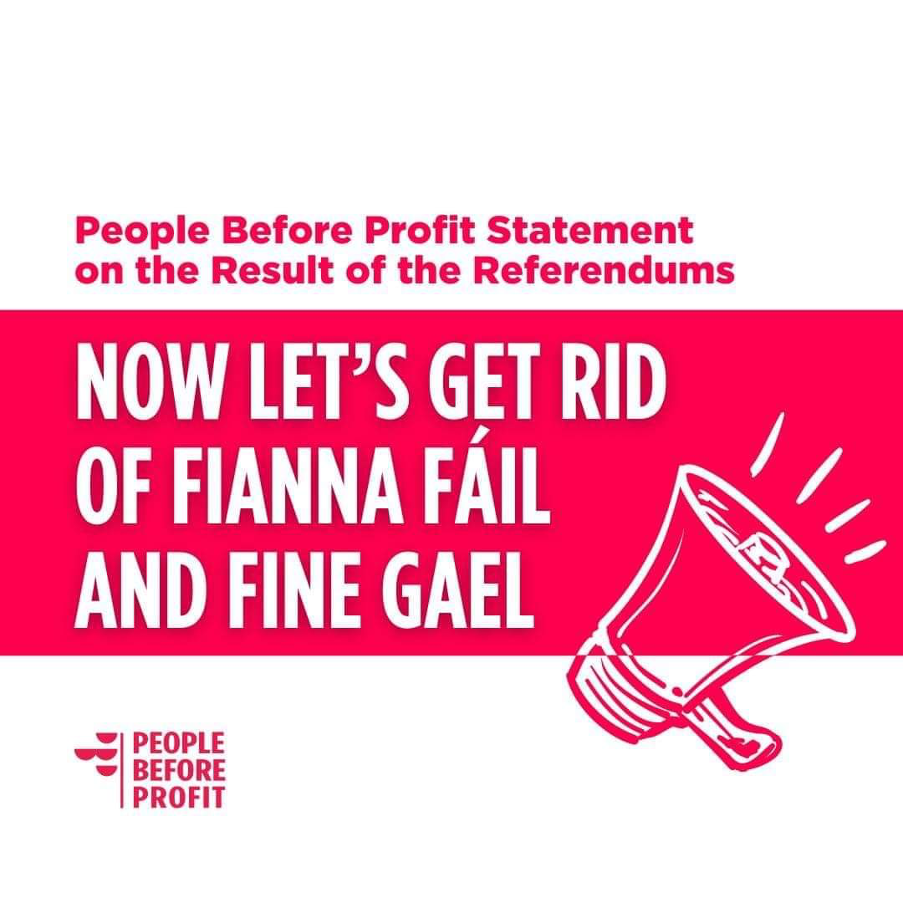
PbP go on to claim that they will go on to campaign for the Government and State to do a better job next time, so it is all in the past already and time to move on. And we know what this moving on will entail: it will involve them campaigning passionately to save their seats, desperately hoping that their constituents will forget their role and get on board with their moving on (as we see already in their graphic above this article). A bit of honesty would do them no harm but on this score they are less inclined than the bourgeois parties, are even less given too looking in the mirror while pointing the finger, and less disposed to some form of accountability.
The organisation claims that “there is also a dark side to the referendum which the left should not ignore. It brought to the fore right-wing elements who want to import Trump-style politics to Ireland.”
It goes on: “The far right and those clamouring for a return of Catholic Church power will try to use government ineptitude and anti-establishment mood in the country to rehabilitate their conservative vision for Ireland. They won a victory of sorts yesterday.” It concludes that it “will be offering a different alternative. One that takes the anger in Irish society and throws it back on the rich and their political elite. . . . We want to see a return to mass movements that challenge this government, particularly on housing. And we want a left government that makes a real break with FF and FG.”
People before Profit doesn’t recognise that to lead any anti-establishment mood it is not enough to base itself on anger, their whole international tendency has been spouting this primitive conception for decades. To form this mood into something coherent and organised requires a political programme and yes, building a mass movement and a working class political party to lead it, something People before Profit, despite its claims, is not doing.
To do so requires some very basic steps, including having a political alternative to the far right and not simply sticking labels on it–such as ‘far-right’ or ‘fascist’–that more or less rapidly lose their force, even when they are true. While claiming to want to build a mass movement they put forward–to cap the alternative–a ‘left government’, which is not the same as a perspective based on the independent organisation of the working class, although they appear not to know this. Their current approach arises from the political conceptions that led to their failure in the referendum, and their positing of a ‘left government’ – far from being realistic– is currently completely improbable. Their electoralism has now exhibited the same weaknesses as their competitors for votes, who do however have deeper roots among the classes they represent.
Most basically, to be ‘anti-establishment’ you actually have to oppose the establishment, not follow on its coattails mouthing grudging support for its empty politics.
The People before Profit statement declares at its beginning that for the Government parties “the referendum is a massive blow to their prestige and legitimacy”; but to quote John Donne again (in the more popular Ernest Hemingway version): “Ask not for whom the bell tolls; it tolls for thee.”

 Sráid Marx