Marxism is deemed by some to be deficient because it is held to deal only with ‘economic’ oppression and exploitation, or with class inequality. This view fails because it fails to recognise the depth and scope of the Marxist critique of what this ‘economic’ oppression entails. This, as we noted in the previous post, encompasses the way all of society is structured around how people produce their existence – for which the description of ‘economic’ does not do justice – and which decisively influences other types of oppression.
The inequalities suffered along many axes, such as sex and race, as well as class, are particular outcomes of the limited capacity of society to substantially provide for the needs, both material and psychic, of all its people. This inadequate capacity is due to the limited nature of the productive forces to provide for needs that has been a feature of all previous societies. It was the view of Marx that capitalism had so developed these forces that this was potentially no longer the case but that the relations of production – the relation between classes – was an obstacle to the realisation of this potential and that therefore these relations had to be transformed.
The inequalities that arise from these inadequate forces of production and consequent arrangement of classes gives rise to the social, political and ideological forces that perpetuate and defend these inequalities. These are necessary features of a society in which human freedom and self-development are restricted, and life’s activities are alienated in all the ways previously discussed. To abolish the classes that are entailed by these forces and relations of production requires a revolution against the social, political and ideological forces upon which other oppressions also rest. Without the development of the forces of production that are able to ensure the end of the inequality there can be no end of either women’s oppression, racial oppression or any other.
That none of these can be reduced to the development of the forces of production and class exploitation, does not negate their fundamental and essential conditioning of all oppression. While it may be theoretically possible to conceive of a capitalism with an absence of women’s oppression and racial oppression this does not remove the real requirement for them in the actual world that exists. What is possible in the abstract – a non-gendered or racialised oppression – is not possible when we refuse to abstract from reality all the features of capitalism that make both practically inevitable.
Even if we were to consider that this was not the case, the equal exploitation and oppression of men and women and of the various ethnic and racial groups would not be a step forward to ending the exploitation and oppression of the vast majority of the people of the world, the ruthless competition among the fractions of the exploiters and the wars this provokes, or the violence of the state and other forces necessary to impose this exploitation.
The development of the forces of production and abolition of class provide the grounds for the free development of the needs and powers of all humanity. These considerations arise from the claims by Marx of the importance of labour and production for the way humanity has developed, is developing and will continue to develop given the progression to consciousness of the class that is the bearer of the new relations of production that will sweep away all social oppression.
This was put by Marx and Engels in ‘The German Ideology’ where they first elaborated their overall ideas in 1845:
“In reality, of course, what happened was that people won freedom for themselves each time to the extent that was dictated and permitted not by their ideal of man, but by the existing productive forces. All emancipation carried through hitherto has been based, however, on unrestricted productive forces. The production which these productive forces could provide was insufficient for the whole of society and made development possible only if some persons satisfied their needs at the expense of others, and therefore some — the minority — obtained the monopoly of development, while others — the majority — owing to the constant struggle to satisfy their most essential needs, were for the time being (i.e., until the creation of new revolutionary productive forces) excluded from any development.”
The importance of the productive forces and the class relations engendered can easily be appreciated by looking at their development through history:
‘Not only do the objective conditions change in the act of reproduction, e.g. the village becomes a town, the wilderness a cleared field, etc., but the producers change, too, in that they bring out new qualities in themselves, develop themselves in production, transform themselves, develop new powers and ideas, new modes of intercourse, new needs and new language.’ (Marx, K. 1973. Grundrisse: Foundations of the Critique of Political Economy. London: Penguin/New Left Review).
The agrarian household of precapitalist society was a highly self-sufficient unit, producing almost everything it required for itself, with limited needs and limited means of satisfying them and consequently limited overall cultural development.
Today’s capitalist mode of production involves a particular set of relations of production, as set out in Engels introduction to Marx’s Wage, Labour an Capital:
“And this is the economic constitution of our present day society: it is the working class alone which produces all values. For value is only another expression for labour, that expression, whereby, in our present day capitalist society is designated the amount of socially necessary labour contained in a particular commodity. These values produced by the workers do not, however, belong to the workers. They belong to the owners of the raw materials, machines, tools, and reserve funds, which allow these owners to buy the labour-power of the working class. From the whole mass of products produced by it, the working class, therefore, receives back only a part for itself.”
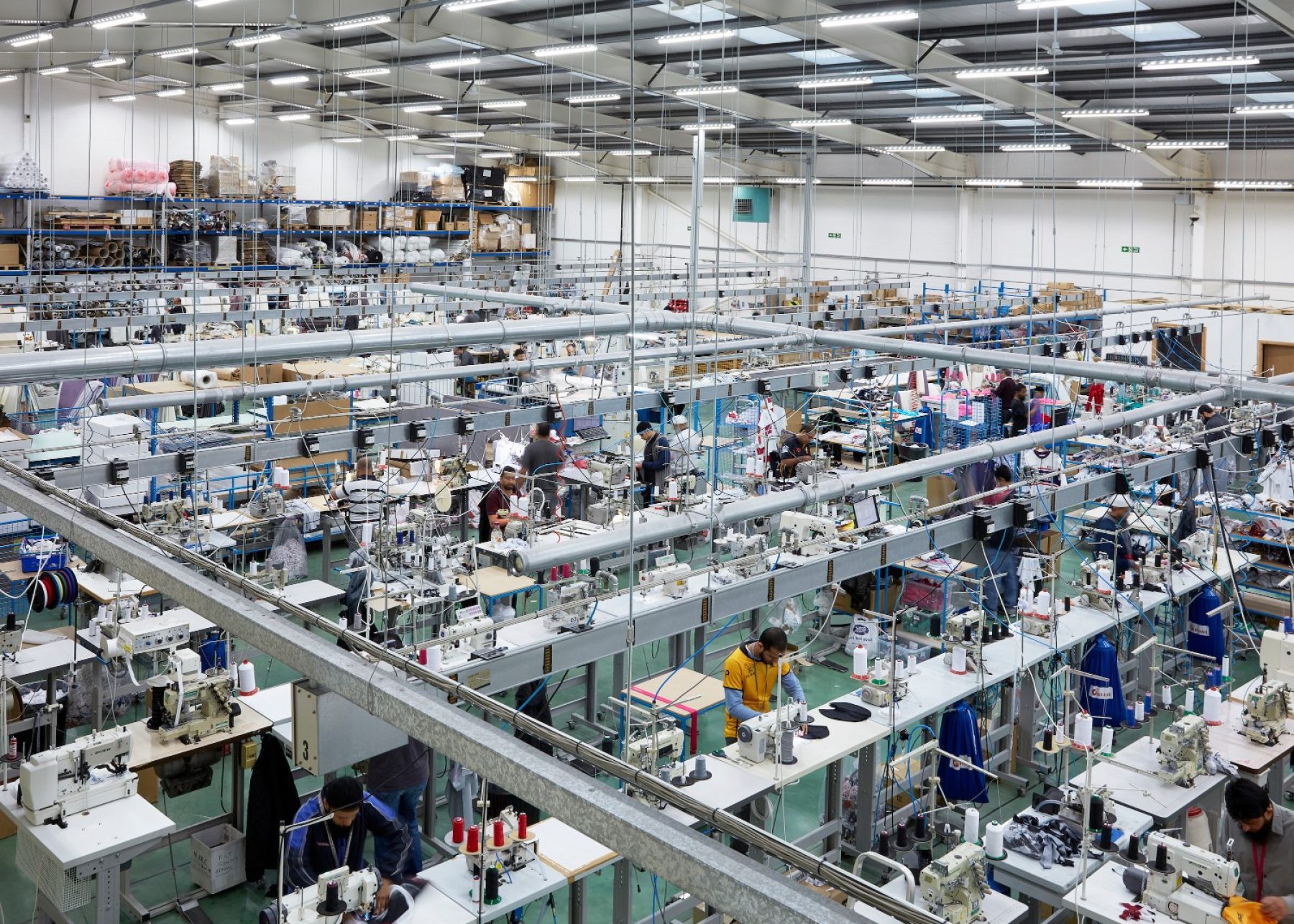
All the goods and services produced in society, and that define our civilisation at both its most basic and advanced level, are produced by the working class but do not belong to it. They are owned and controlled by capital, embodied in the relationship of the capitalist class to the working class. These productive forces, of labour, equipment etc, will only be engaged in production if to do so provides sufficient profit for capital, so that the labour of the working class will be wasted if it does not. Wasted because of the result of previous labour in the form of machinery, equipment, workplaces etc. lying idle, and wasted in that the working class will be unemployed if these forces are not set to work.
Even should they be set to work the greater the productive forces created by the working class the greater the power standing over them under the control of the capitalist class. Not only their employment but how they are employed, the hours worked and working conditions will be determined by the capitalist class as will what is produced and for whom.
The profits appropriated from the employment of labour both limits the income of workers and therefore the share of production that is to their benefit, while the production of luxuries that workers will never be able to afford will naturally be increased to meet the demand of those who have profited from the workers’ labour. Such a society determines all the inequalities in the provision of resources in all its aspects: in the consumption of goods and services; in the subjection to alienating and oppressive labour; in the time and energy available to fully enjoy life, and in the many social maladies that naturally must arise from such a society, including degradation of physical and mental health; violence and aggression and compulsive and addictive behaviour.
Necessary labour is that required to reproduce the working portion of society at its given, historically developed, level of subsistence, its standard of living, while surplus labour is production above and beyond this, which creates the basis for a privileged group of non-workers. ‘The creation of surplus labour on one side corresponds to the creation of minus-labour, relative idleness (or nonproductive labour at best) on the other’ (Marx 1858: Grundrisse 401n).
So, too, this surplus labour creates the basis upon which ‘higher’ leisure activities have developed, allowing other classes to engage in cultural and intellectual pursuits without the requirement to produce their own means of subsistence. ‘The labour of the mass has [been]…the condition for the development of general wealth, just as the non-labour of the few [has been the condition] for the development of the general powers of the human mind’ (ibid.: 705).
On the other hand, the gigantic development of the forces of production today determines how they can be further developed so that the overall cultural level of society, that includes everyone in it, can be raised:
‘Modern universal intercourse cannot be controlled by individuals, unless it is controlled by all. This appropriation is further determined by the manner in which it must be effected. It can only be effected through a union, which by the character of the proletariat itself can again only be a universal one, and through a revolution. (The German Ideology’ p. 88 in Karl Marx and Frederick Engels, Collected Works. Vol. 5)
It is the ‘historical destiny’ of capitalism to create ‘such a development of needs that surplus labour above and beyond necessity has itself become a general need’, and also through ‘the severe discipline of capital, acting on succeeding generations’ the development of ‘general industriousness’ in these new generations (Marx 1858: Grundrisse p. 325).
‘Capitalism has developed ‘the universality of individual needs, capacities, pleasures, productive forces, etc…. The full development of human mastery over the forces of nature, those of so-called nature as well as humanity’s own nature. The absolute working out of his creative potentialities.’ (Marx 1858: Grundrisse p. 488)
The universality of needs applies universally–such is the scope and the grounds upon which the purported limited nature of ‘purely economic’ emancipation rests.
Back to part 76
Forward to part 78




 Karl Marx’s Alternative to Capitalism – part 34
 The growth of the capitalist system involves the development of new needs – we did not need the mobile phone until it was invented and many didn’t consider getting one until it got small enough in size and price. This will be true of the new needs we are currently unaware of, that will also arise from the capitalist development of the forces of production.
 The endorsement of workers’ cooperatives by Marx with which the
  Sráid Marx