Permanent Revolution (5) – the working class or ‘democratic capitalism’?

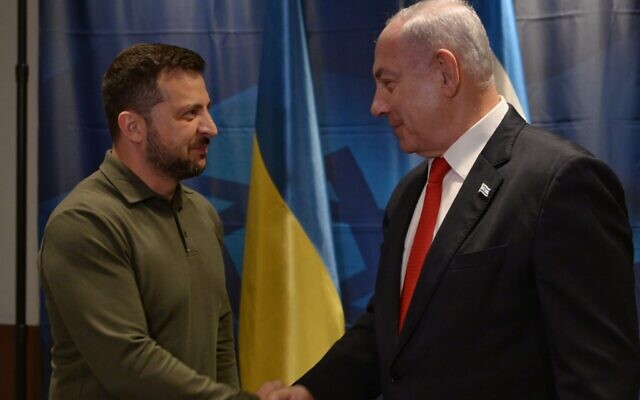
Avi Ohayon/GPO

As we noted in the previous post, the rejection of permanent revolution in practice is ultimately a result of the abandonment of any view that the working class and socialism are relevant. It is not that the objective prerequisites of socialism do not exist – in terms of development of the forces of production and creation of a large working class – but that this class is not conscious of its interests as a class and never will be.  Supporting Western imperialism in Ukraine or supporting Hamas in Gaza is a result.

For defenders of these views, being on the right side of the struggle of the oppressed is enough and everything else is secondary.  Other, perhaps ‘nice to have’ factors, like specifically working class political leadership, are relegated to an indefinite future.  Socialism becomes something so distant from application that it becomes akin to the promise of life after death.

As far as campaigns go, humanitarian demands raised in solidarity with the oppressed suffice to address the issues, and de facto support is provided for whatever political leadership happens to exist, justified on the basis that it does exist – the oppressed have picked their political leadership and who are we to disagree? ‘Being on the right side’ and ‘supporting the leadership of the oppressed’ become moralistic incantations that are supposed to demonstrate one’s commitment to the struggle while ironically condemning it to defeat.  This approach reaches its nadir when it entails support for Western imperialism in Ukraine or Islamic fundamentalism in Palestine.

Identification of the class forces involved and the distinctions arising go missing through talk, for example, of ‘Ukraine’ and the ‘Ukrainian resistance’.  Concepts such as class and the necessity for socialist leadership are rehearsed when left organisations recruit young people and provide them with what passes for a basic education in Marxism but are often ignored when real struggles develop.

*                     *                   *

Permanent revolution does not claim that certain democratic advances cannot be made by bourgeois forces (or by petty bourgeois ones) in every instance, although in the case of Ukraine and Palestine this is clear.  In Ukraine, western imperialism ignores the clampdown on democratic rights by the Zelensky regime including its lack of any constitutional legitimacy.  In this it repeats the events of 2014 and provides another example of the rules-based international order being whatever the Western powers say it is.

In Palestine it routinely speculates on what sort of Palestinian regime will be installed once the Zionist state has halted its genocide, with not the slightest recognition of the right of the Palestinian people to select its own government.  The leaderships that are touted as potential candidates are corrupt and designed to be weapons in the hands of the Zionist state (including the Palestinian Authority).

What democratic tasks that are achieved by bourgeois forces are carried out in their own interests, which interests demand that real democratic control by the majority of a country’s people is excluded.  It is ironic that those who argue that Western imperialism is in effect defending democracy in Ukraine do so when the façade of what passes for democracy is more and more exposed as fraudulent by its policy of support for genocide in Palestine.

In the West the right to protest is under attack as students are clubbed by cops and Zionist thugs in the US, while meetings are proscribed and Palestinian speakers expelled in Germany.  In the US the Presidential election is between two equally repulsive senile geriatrics, almost equally unpopular, where it is almost the case that Trump is the only candidate that Biden could possibly beat and Biden the only candidate that Trump will most likely defeat.

In Britain the choice between Sunak or Starmer is rendered fundamentally meaningless since no essential differences are involved so that there is no worthwhile choice to be made. When the limits of capitalist democracy are so blatantly exposed the stupidity of the claim that these forces are defending democracy becomes impossible to vindicate.  This should provide the opportunity to tear away the fraudulent pretence that imperialism is in some way the protector of any sort of democracy but this requires putting forward an alternative.

In the 19th and early 20th centuries democracy was viewed as tied tightly to the working class movement and socialism so that Friedrich Engels was able to state at one point that the two were almost synonymous.  The bureaucratisation of the workers’ movement, reaching its apogee in the Stalinist states, was a product of its incorporation into, and reconciliation with, the capitalist state, either in the form of reforming the state or in the form of ‘socialism in one country’ and its pursuit of accommodation with ‘democratic’ capitalism. In doing so it lost the identification of socialism with democracy.

The associated transformation of socialism into the idea that the capitalist state is the means to socialism, or even the potential embodiment of it, has meant that the central claim of Marxism, that the emancipation of the working class must be carried out by the working class itself, has been buried and lost.  This distortion is so ubiquitous it is how the idea of socialism is habitually and unthinkingly understood.

So, in Ireland the idea of a ‘left government’ (of a capitalist state) is paraded as the answer while in Britain the idea of nationalisation (capitalist state ownership) was, in the form of clause 4 of the Labour Party, the totem of socialism.  Other forms of capitalist rule, such as authoritarianism or fascism, thus become not just particular forms to be opposed but turn ‘democratic capitalism’ into the ‘lesser evil’ that must be positively supported.  What democratic rights that do exist thus become not just elements to be defended but reasons to ‘suspend’ opposition to capitalism and ally and subordinate socialism to the demands of ‘democratic’ capitalism.

These corrupting assumptions makes it easier for many self-declared socialists to claim that the Ukrainian state, Western imperialism, or the Russian or Chinese varieties are today’s forces of democracy, ‘anti-imperialism’ or even socialism.  All such claims are what permanent revolution rejects, and the road back to the central assertion of Marxism lies through reclaiming it.

*                     *                   *

In relation to Ukraine, permanent revolution means opposition to the Russian invasion, opposition to the Ukrainian state and opposition to the intervention of Western imperialism.  Opposition to war thus means organisation of the working class in opposition to membership of NATO and its rearmament.

In Palestine it means opposition to the Zionist State and its genocide and the liberation of the Palestinian people through a permanent revolution that seeks the unity of the Arab working class of the region against their exploiters and oppressors.  The liberation of the Palestinian people can only be achieved by the liberation of all the working classes and oppressed in the region, which alone can offer a socialist alternative to Jewish workers and an alternative to their allegiance to Zionism.

In this, we really have no choice.  The ‘democratic’ governments and states of the West have provoked a war in Ukraine and their defence of the Zionist state has shown us that there are no limits to the barbarity they will support.  Continued escalation of the war in Ukraine only points us to a world war.  

Russia and China are no defence against such a war because ultimately their only weapon against their Western enemies is also war.  The Russian invasion of Ukraine is proof, as are the repeated threats against Taiwan and the constant provocations of the United States that threaten to precipitate it.

Perhaps it will then be clear – even to the most stupid – that imperialism defends itself, is not interested in those it exploits and is no defender of democracy.   The working class, whose members are always expected to fight and die in every war, will face the choice of war or peace and that peace can only come through ending capitalism.  Once again it will be permanent revolution to end the war or war to end civilisation.

Of course, we are not there yet, but one product of the war in Ukraine has been the readiness of many in the West, normally opposed to war – as previously in Iraq – to rally behind this one.  The fake-left supporters of war are only a small part of this much larger constituency.  However the war in Ukraine ends, with some temporary ceasefire or agreement, the conflict and antagonism between rival imperialisms is not going to go away; imperialism itself has no way of ensuring that they do not intensify, and the world will face the possibility of their eventual resolution by way of force, in the way such conflicts have been settled before.

In some ways we are back to Marx, when the working class was not ready then either:

‘although the German workers cannot come to power and achieve the realisation of their class interests without passing through a protracted revolutionary development . . . they themselves must contribute most to their final victory, by informing themselves of their own class interests, by taking up their independent political position as soon as possible, by not allowing themselves to be misled by the hypocritical phrases of the democratic petty bourgeoisie into doubting for one minute the necessity of an independently organised party of the proletariat.’

Back to part 4

Permanent Revolution (4) – keeping the theory, ditching the practice

The pro-Ukraine Left looking right

How do we explain adherence to the theory of permanent revolution while abandoning it in practice?

If you read Trotsky’s basic postulates laid out in the previous post, with as few preconceptions as possible, the answer is rather obvious; the theory has been abandoned because it no longer appears to correspond with reality.  There is little prospect of a democratic revolution, never mind a socialist revolution, in the near term in either Ukraine or Palestine for example, and, whatever about the objective premises of socialism being present (depending on what one considers objective factors) the crisis of humanity is not reducible to ‘the crisis of the revolutionary leadership.’

The last belief is comforting to the members, supporters and many ex-members of the small left wing groups because it licences their existence and previous years of activity.  If the decisive requirement now for a socialist revolution is the existence of a sufficiently coherent and large revolutionary organisation, then building that organisation is key and the hinge upon which everything hangs.

However, reality impinges on even the most dogmatic. When the real world does not conform to what is desired and the agent of change – the working class – has suffered defeats and no longer seems to present an alternative, attempts to escape this take the form of politics based on the view of what should exist – justice and freedom etc. – expressed in terms of rights. However, the material interests that do exist will determine what justice and freedom will entail in the real world, which means that this sort of politics inevitably pretends that the world that exists is not the one we have come to know well.

Thus the right to self-determination of Ukraine (or Palestine), if dependent on US imperialism, will be expressed only in so far as it conforms to the interests of this imperialism. Justice and freedom will exist only in so far as they are consistent with its interests. Relying on US imperialism to deliver any of these because it is argued that there is something worse – Russian imperialism – must ignore its whole history.

The view that pressure from protests will force it to impose a progressive solution has no previous experience to support it and protests become a cry for help to precisely those we need to be saved from. In the case of Palestine, protests demand that US imperialism changes course and supports some sort of Palestinian state while solidarity with Ukraine demands that it drive forward with its current course and provide ever more powerful weapons.

Except ATACMS, HIMARS, F-16s, Bradley’s and Abram tanks are not the weapons of freedom and justice, never mind working class emancipation. Passive acceptance of the unlikelihood of working class action to end the war, resulting in substituting other agents of change, cannot get round the fact that working class emancipation cannot be achieved except by the working class itself. The view that it cannot provide the solution means not that some other agent will provide it but that a different solution will be imposed. In Ukraine this means ‘self-determination’ becomes a Ukrainian state with NATO membership, in permanent antagonism with Russia, with the permanent potential for further war; in other words no solution at all.

This demonstrates that demands such as self-determination dredged up from the past, that appear to have a revolutionary heritage, no longer have the same original rationale or purpose: support for the self-determination of nations in a world no longer consisting of empires and colonies but of independent capitalist states entwined in imperialist alliances usually only means support for one imperialism or another. Ukraine is so clearly an illustration of this that to declare support for it reveals a left not only no longer tied to socialist politics, but no longer tethered to the real world. This is one in which imperialism will do what it always does and the smaller capitalist states will follow.

It is instructive that polls showed no majority in Ukraine for NATO membership for years but that this didn’t stop the Ukrainian state creating CIA stations in the country to spy on Russia or pushing membership on a reluctant people, ultimately enshrining it in the constitution. Ukraine joined in the US-led invasion of Iraq in 2003 while continuing to signal its support for imperialism through its contingent of troops in the occupation of Afghanistan. While now claiming to be a victim of imperialism, its special forces are fighting in Somalia under the direction of the US. All are sterling examples of the reactionary character of support for self-determination for already independent capitalist states and the consequences of abandoning a socialist analysis that doesn’t confuse the working class with its state.

The demand for self-determination of nations that applied to annexed and colonial countries with large peasant populations, now asserted in support of independent capitalist states that are part of imperialist alliances at war, is not essentially different from the policy of those ‘socialist’ parties that sent millions of workers to their death in World War I.   Supporters of the imperialist alliance that includes Ukraine claim that it is fighting a Russian colonial project while the supporters of the imperialist alliance that includes Russia claim they are opposing the Western colonial project of regime change and dismemberment of the Russian Federation. In World War I, Marxists did not support German imperialism because its enemy was the biggest empire and colonial power in the world and the absolutist regime in Russia, or support Britain because Germany was seeking to extend its own colonial plunder and was allied to the decrepit Austro-Hungarian Empire.

The current imperialist war that is being waged in Ukraine is thus supported by what can only be called deserters from socialism who refuse to see what is in front of their eyes – an old-fashioned capitalist war that is sending hundreds of thousands of workers to their deaths, inflicts catastrophic destruction on the livelihoods of millions of others, and binds most of the working class to their own nation, their own state and their own ruling class.  Nationalism triumphs again while these apostates dress it up as progressive ‘patriotism’, ‘de-colonialism’ or even ‘anti-imperialism’. What they can’t dress it up as is socialism.

They do not lead the working class in any direction that might advance its class consciousness or create the possibility of a minority becoming aware of the class conflicts going on underneath the war propaganda of the mainstream media. Rather they follow the working class as it follows its ruling class.  Their political arguments, such as they are, are essentially no different from the dominant reactionary narratives.  One that easily extends from ‘defending Ukraine’ to supporting the West’s military alliance NATO.

In what possible way can the need for the working class to have its own politics independent of, and opposed to, that of the capitalist system be advanced by supporting an imperialist alliance in war on the grounds that it is defending the right of another capitalist state to join ithis alliance? In what way would this be opposing imperialist war and defending the interests of the working class?

This situation can only prevail because there is no significant movement of the working class in the West (or in Russia) opposed to the war so support for one imperialist side or the other is seen as the viable alternatives.  Were there to be actions by workers in Western countries against the war the left supporters of the war would be thoroughly exposed. Their position therefore not only arises from the current passivity of the working class but depends upon it.

The price paid by the small renegade left organisations committed to this is that they are not so much the naked emperor as the naked emperor’s subjects. Thus, they continue their attempts to build small ‘revolutionary’ organisations which hide their irrelevance through their complete capitulation to the bourgeois politics of their own country.  They swim comfortably in the public mood because this mood is consonant with the actions and propaganda of its rulers and mass media.

What we are seeing is not only a failure to see the relevance of permanent revolution to the conflicts which exist but the process itself in reverse.  Not permanent revolution as a general process of radicalisation but an accelerated de-radicalisation reflecting the effect of the defeats of previous decades. From the working class – led by socialism – being the only effective leadership of democratic struggle, we instead are to accept that a rotten and corrupt capitalist state in the vanguard of Western imperialism is the centre of today’s democratic and anti-imperialist struggle. Put like that, it makes no sense at all.

Back to part 3

Forward to part 5

Permanent Revolution (3) – basic principles

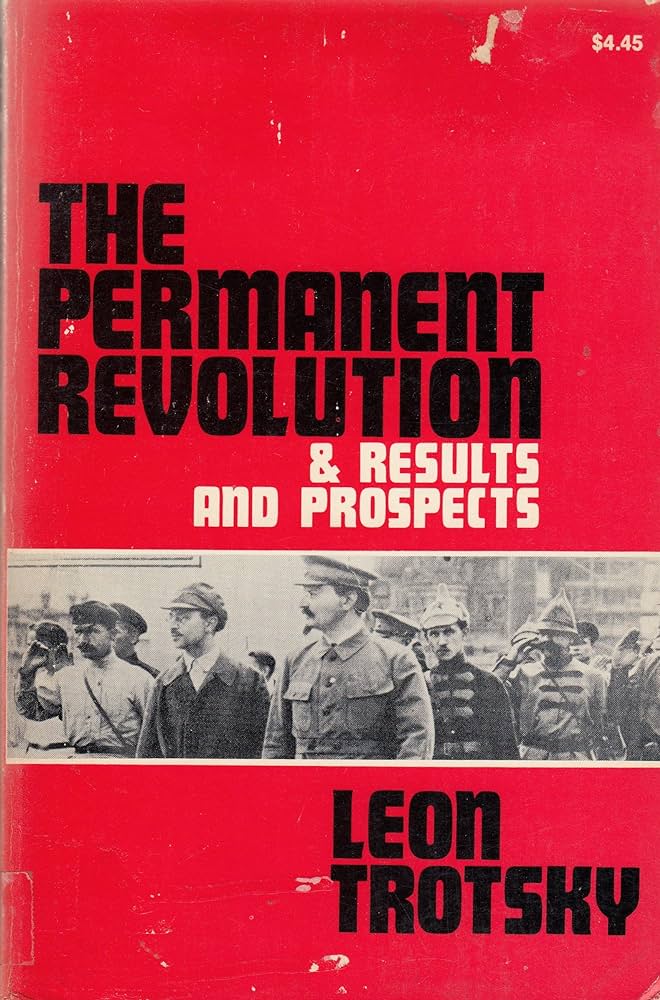
Trotsky, in his booklet The Permanent Revolution, set out a number of its ‘Basic Postulates’.  These include the following:

‘2. With regard to countries with a belated bourgeois development, especially the colonial and semi-colonial countries, the theory of the permanent revolution signifies that the complete and genuine solution of their tasks of achieving democracy and national emancipation is conceivable only through the dictatorship of the proletariat as the leader of the subjugated nation, above all of its peasant masses.’

‘3. Not only the agrarian, but also the national question assigns to the peasantry – the overwhelming majority of the population in backward countries – an exceptional place in the democratic revolution. Without an alliance of the proletariat with the peasantry the tasks of the democratic revolution cannot be solved, nor even seriously posed. But the alliance of these two classes can be realized in no other way than through an irreconcilable struggle against the influence of the national-liberal bourgeoisie.’

‘4. No matter what the first episodic stages of the revolution may be in the individual countries, the realization of the revolutionary alliance between the proletariat and the peasantry is conceivable only under the political leadership of the proletariat vanguard, organized in the Communist Party. This in turn means that the victory of the democratic revolution is conceivable only through the dictatorship of the proletariat which bases itself upon the alliance with the peasantry and solves first of all the tasks of the democratic revolution.’

‘8. The dictatorship of the proletariat which has risen to power as the leader of the democratic revolution is inevitably and very quickly confronted with tasks, the fulfilment of which is bound up with deep inroads into the rights of bourgeois property. The democratic revolution grows over directly into the socialist revolution and thereby becomes a permanent revolution.’

‘9. The conquest of power by the proletariat does not complete the revolution, but only opens it. Socialist construction is conceivable only on the foundation of the class struggle, on a national and international scale.’

‘10. The completion of the socialist revolution within national limits is unthinkable . . . The socialist revolution begins on the national arena, it unfolds on the international arena, and is completed on the world arena . . .’

‘11. The above-outlined sketch of the development of the world revolution eliminates the question of countries that are ‘mature’ or ‘immature’ for socialism in the spirit of that pedantic, lifeless classification given by the present programme of the Comintern. Insofar as capitalism has created a world market, a world division of labour and world productive forces, it has also prepared world economy as a whole for socialist transformation.’

‘13. The theory of Stalin and Bukharin, running counter to the entire experience of the Russian revolution, not only sets up the democratic revolution mechanically in contrast to the socialist revolution, but also makes a breach between the national revolution and the international revolution.’

        *         *          *

The number of ‘countries with a belated bourgeois development, especially the colonial and semi-colonial countries’ has decreased dramatically in the last one hundred years, most obviously with the massive growth of the working class, relative decline of the peasanty and the disappearance of most colonies.  Many of the semi-colonies are now important capitalist states, including those in the expanding BRICS collaboration.

It might therefore be considered that the theory of the permanent revolution, which ‘signifies that the complete and genuine solution of their tasks of achieving democracy and national emancipation is conceivable only through the dictatorship of the proletariat as the leader of the subjugated nation, above all of its peasant masses’ is of limited relevance today.

After all, how true is it that ‘the agrarian, but also the national question assigns to the peasantry – the overwhelming majority of the population in backward countries – an exceptional place in the democratic revolution’? Does this no longer apply in many countries?  We no longer consider that the question is one of democratic revolution but of socialist revolution in countries with widespread industrialisation and a large working class.  Even when Trotsky set out the basic ideas of Permanent Revolution, he was stating that his ‘sketch of the development of the world revolution eliminates the question of countries that are ‘mature’ or ‘immature’ for socialism.’

He went further to say, in the Transitional Programme in 1938 that ‘the economic prerequisite for the proletarian revolution has already in general achieved the highest point of fruition that can be reached under capitalism . . . All talk to the effect that historical conditions have not yet “ripened” for socialism is the product of ignorance or conscious deception . . . The objective prerequisites for the proletarian revolution have not only “ripened”; they have begun to get somewhat rotten . . .  The turn is now to the proletariat, i.e., chiefly to its revolutionary vanguard. The historical crisis of mankind is reduced to the crisis of the revolutionary leadership.’

Many who claim to be Trotskyist accept that the theory of Permanent Revolution applies today and also continue to argue that humanity’s crisis ‘is reduced to the crisis of the revolutionary leadership.’

We have seen, however, that despite this, many – if not most – agree to the theory but abandon it in practice.  They avoid cognitive dissonance by employing a different set of assumptions that enable the adoption of a different set of outwardly Marxist formulas to the actual struggles that arise and which previously would have been considered to come under the purview of the permanent revolution strategy.  Let’s take a look at Ukraine and Palestine.

In Ukraine, the supporters of that state who demand self-determination for Ukraine must presumably believe that the national question is key, and that therefore that the ‘democratic revolution’ is on the agenda, even if this no longer requires an alliance with the peasantry. But if this is so, where is the fight for the view that ‘the complete and genuine solution of their tasks of achieving democracy and national emancipation is conceivable only through the dictatorship of the proletariat?’  Why is support given to a bourgeois political regime and capitalist state when what is required is an ‘irreconcilable struggle against the influence of the national-liberal bourgeoisie’, with the need for ‘the political leadership of the proletariat vanguard, organised in the Communist Party?’

When have the supporters of ‘Ukraine’ ever put forward this argument to Ukrainian workers or those in their own country?  When has permanent revolution even been mentioned? Why do they defend the intervention of Western imperialism when ‘the democratic revolution grows over directly into the socialist revolution and thereby becomes a permanent revolution?’  How could Western imperialism fail to be a barrier to such an outcome? Why then do they support it?

The only political explanation is that they do not believe that permanent revolution is relevant, which means that socialism is not relevant and socialist revolution inconceivable and not in any way be a guide to longer term strategy. However, if this is so, the theory of permanent revolution states that there can’t be a democratic revolution either. They can’t believe the statement that in ‘the colonial and semi-colonial countries, the theory of the permanent revolution signifies that the complete and genuine solution of their tasks of achieving democracy and national emancipation is conceivable only through the dictatorship of the proletariat as the leader of the subjugated nation.’

They therefore cannot believe that ‘the objective prerequisites for the proletarian revolution have not only “ripened”; they have begun to get somewhat rotten . . .  The turn is now to the proletariat, i.e., chiefly to its revolutionary vanguard. The historical crisis of mankind is reduced to the crisis of the revolutionary leadership.’  If the problem was simply one of revolutionary leadership, why wouldn’t they be offering revolutionary politics?

In so far as the supporters of the Russian invasion advance the same arguments in relation to the democratic tasks supposedly devolving to the Putin regime and Russian state, purportedly justified by the rights of the Donetsk and Luhansk People’s  Republics, the same questions are posed to them!

If we turn our attention to Palestine, which is a question of (settler) colonialism, the genocide of the Palestinian people and the role of Western imperialism demonstrate that a revolution is required for their liberation.  Why is Western imperialism not their saviour as it is claimed it is for the ‘people of Ukraine’?  Why do the bourgeois Arab states not perform the same revolutionary democratic role played by the Ukrainian one?  Again, where are the arguments above advanced that this liberation can only come through permanent revolution?  A struggle that needs to be fought by the working class, under socialist leadership, ‘on the foundation of the class struggle, on a national and international scale’?

Instead, the debate revolves around a one state or two state solution, with neither having any particular class content, which, in effect, means that they are both proposals for a capitalist state and with no indication that a wider socialist revolution is necessary, in the Arab region or wider afield.

How are we to make sense of this à la carte Trotskyism – ‘God make me a Communist, but not just yet’?

Back to part 2

Forward to part 4

Permanent Revolution (2) – beginning with Marx

The theory of Permanent Revolution is associated with Leon Trotsky, although Marx is well known to have originated the term in his Address of the Central Committee to the Communist League in March 1850.  In this address he proclaimed that for German workers ‘their battle-cry must be: The Permanent Revolution.’

Marx called for this revolutionary strategy even though he noted that the situation was one in which ‘the German workers cannot come to power and achieve the realization of their class interests without passing through a protracted revolutionary development.’  They were to be comforted by the knowledge that ‘this time they can at least be certain that the first act of the approaching revolutionary drama will coincide with the direct victory of their own class in France and will thereby be accelerated.’

Their task was not one of immediate revolt but ‘must contribute most to their final victory, by informing themselves of their own class interests, by taking up their independent political position as soon as possible, by not allowing themselves to be misled by the hypocritical phrases of the democratic petty bourgeoisie into doubting for one minute the necessity of an independently organised party of the proletariat.’

Today, we are not in a situation in which the German or any other section of the working class is going to come to power, and ‘a protracted revolutionary development’ is required.  This is not admitted by many calling themselves Marxist but is imposed on them anyway.  The price paid is that they can’t consciously adjust their theoretical or strategic framework to adapt appropriately.

Today, we are again called upon to support ‘democracy’: for a ‘democratic’ Ukraine against autocratic Russia and to ‘defend the right of self-defence’ of the ‘only democracy in the Middle East’. The protests by students in US universities against the genocide carried out by this democracy is said by Antony Blinken to be a ‘hallmark of our democracy’ just as the students are attacked and locked up.  The ‘hypocritical phrases’ of the democratic bourgeoisie and petty bourgeoisie are thus louder now than they were when Marx called for their rejection 175 years ago, making his remarks as apposite now as they were then.

Unfortunately, much of the left has forgotten what it means to inform workers ‘of their own class interests, by taking up their independent political position as soon as possible’ and ‘by not allowing themselves to be misled by the hypocritical phrases’ of democracy.  Calls for national self-determination of Ukraine or Donbass simply become the hypocritical phrases by which to justify rallying behind Ukraine, because it is a ‘democratic’ capitalist state, or behind Russia, because it is fighting Western imperialism.

The capitalist character of both is rendered irrelevant by talking about ‘Ukraine’ or ‘Russia’ or the ‘people of Ukraine’ etc. while ignoring the need for the working class to ‘achieve the realisation’ of its ‘own class interests’ by ‘taking up their independent political position as soon as possible.’

On one side the Ukrainian capitalist state and Western imperialism are supported as defenders of these interests and on the other the Russian capitalist state is supposed to play the same role.  Neither can point to any independent role for the working class itself or even the existence of its own organisations that are not totally subordinated to, or in support of, their respective states.  In doing so it almost becomes superfluous to accuse them of abandoning Marxism.

The cognitive dissonance involved in defending a corrupt capitalist state, defending the massive intervention of western imperialism, and a war that continues only because of this intervention, can be seen in three defence mechanisms often employed to avoid accepting the patent contradictions: avoiding, delegitimising and belittling.

So, we get the avoidance of the implications of the points just raised and the commitment to a more straightforward campaign in support of the Palestinian people.  The arguments against support for the Ukrainian state are delegitimised by aping the propaganda of the mainstream media for whom opposition to Western imperialism and its proxy war can only equate to support for Russia.  Since this Left starts from opposition to the Russian invasion, its inability not to default immediately to support for Ukraine and the West reveals the utter irrelevance of any declared adherence to socialist politics separate and opposed to both.

Finally, the cognitive dissonance is limited through the importance of the war also being strictly circumscribed.  So, opposition to Russia becomes opposition to Russian imperialism while support for Western imperialist intervention is dismissed as the latter doing the right thing for its own reasons – without this having any significance for what it is actually doing.  The existence of a proxy war that defines a global conflict is also rendered irrelevant by the primary and over-riding issue being argued as the right to self-determination – of an independent capitalist state that had already determined its own future by allying with Western imperialism against its rival next door: not a very clever thing to do and a very reckless one for the interests of the Ukrainian working class.  The obvious danger of escalation of the conflict to a world war is also minimised but is implicit in the absolute priority given to the victory of the Ukrainian state and thereby, necessarily, of Western imperialism.

To claim that the invasion should not have taken place and is wrong.  That it should be opposed and the invaders blamed for the actions they have carried out, and for which they are responsible, is all very well but hardly constitutes an understanding of why it happened, what should be done about it, and by whom.  If you are a socialist, this socialism should have some role in answering these questions.  As has been stated many times on this blog, if you find yourself coming up with the same explanations and same policy as Western imperialism you need to deal with a lot of dissonance.  How could you start from a socialist position and end up with a policy indistinguishable in all essential and practical respects from Western imperialism? 

It is therefore relevant to look again at the ideas involved in permanent revolution to see how these should guide a socialist view of the current conflicts. 

Back tom part 1

Forward to part 3

Permanent Revolution (1) – Introduction

The world is facing a Zeitenwende, an epochal tectonic shift, according to the German Chancellor Olaf Scholz, which he claims means that Germany and the rest of the EU, United States and NATO needs to protect “our open societies” and “stand up for our democratic values”.

The US Government-backed National Endowment for Democracy has reported the view that there are three possible outcomes of this Zeitenwende, or inflection point, as Joe Biden put it:

‘1. a reinvigoration and reinvention of our existing international liberal order.’

‘2. Chinese-led illiberal order.’

‘3. or the breakdown of world order on the model of Putin’s “law of the jungle”.’

The first primarily involves ensuring the strategic defeat of the second, while the second requires the failure of the first, and the third involves in various forms the results of both of these failing.

This is portrayed as a battle between democratic and autocratic systems, so while recognising that “we might all have become capitalists (with the possible exception of North Korea and a tiny handful of other countries) . . . it makes a huge difference whether capitalism is organized in a liberal, democratic way or along authoritarian lines.”

The realpolitik involved in these sonorous pronouncements is admitted by noting that in the ‘democratic’ alliance against autocracy “What’s crucial in the year ahead is for democracies to unify in a common cause to shape the global future alongside moderate, modern non-democracies that seek a more secure, prosperous, and just world.”

What we have then is not a battle of democracy against autocracy but competition between shifting capitalist alliances sharply exposed by the war in Ukraine, which the genocide of the Palestinian people has demonstrated has nothing to do with democracy of even the most diluted capitalist kind.  Far from democracy being advanced by the war in Ukraine and support for the Zionist state, the former has been employed to justify shrill predictions of war across Europe and the need for massive rearmament, while the latter has involved damning those who oppose genocide as violent antic-semitic extremists who must be violently prevented from exercising their right to march and protest.

While for many new generations this is something new, it is far too familiar to anyone with any historical understanding not to recognise.  When the world is described as turning upon competition between rival capitalist blocs, with the eruption of regional wars and threats of a much greater conflagration, we would have to be suffering from amnesia not to recall the precedents.

In World War I a rising German industrial power sought its own colonial outlets, which required domination of Europe and defeat of the existing British and French Empires.  In Asia Japan sided with these old colonial powers and the United States but then itself sought its own Empire that brought it into conflict with the old European Empires and the US in the next war.  It is uncontroversial to note that World War II was the continuation of World War I because both had the same fundamental causes even if the latter is more commonly retold as a war against fascism and Japanese barbarism.

The same dynamics lie behind the war in Ukraine and the defence of the Zionist state by its Western sponsors; also accompanied with the same ideological garbage of defending democracy against autocratic China and a barbaric Vladimir Putin.  In turn China claims only to seek its own freedom for development as a new centre of expanding capitalist accumulation, while Russia claims simply its right to its own sphere of influence, which can only come up against that of its Western imperialist rivals.  Or vice versa, if you prefer.  Having sought alliance with Western imperialism through NATO membership, Russia, like Japan before WWII, has decided that this alliance is fundamentally anti-Russian and is now in a war against its Ukrainian proxy.

Democratic capitalism in World War II did not cease to demonstrate the hypocrisy of its liberal regime through its determination to hold on to its Empires regardless of the local desire for independence. So, the end of the war witnessed the French and the Dutch etc. – following their own occupation – fight to impose their own on their colonial possessions. Today, the claims of democratic capitalism against the Russian Bear and Chinese Dragon are similarly fraudulent as the West supports a genocidal Zionist state and uses its mass media to claim that this State is really the victim.

The Second World War was facilitated by the defeat of the revolutionary uprisings of the working class in Germany and Central Europe and the defeat of mass struggles in Italy, France and Britain etc. in the inter-war period.  In Spain the democratic revolution was defeated by fascism because the struggle was led by forces that demanded that the workers go no further than support a democratic capitalism that would rather see the victory of fascism than open the door to socialist revolution.  The same calls are made today to rally round the more ‘progressive’ capitalist parties in order to defeat Le Pen, Trump and Sunak etc. except that we have already gotten Macron and Biden to show that if you vote for the ‘lesser’ evil you do indeed get evil.  In Britain the Labour Party leadership has demonstrated that democracy in its own party is to be strangled and Brexit made ‘to work’ while no promise of genuine reform is too mild not to be betrayed.

The dynamics of war are therefore the same now as they were prior to the First World War and prior to the Second.  What is very different is the absence of a working class movement able to challenge the prospect of capitalist war and promise a socialist alternative.  There is no working class alternative Zeitenwende, so no fourth alternative to the triumph of one capitalist hegemon or the other, or the mutual destruction of both.

The small left that claims to be the inheritor of the old revolutionary working class movement has swallowed the lie that Western imperialism is defending democracy in Ukraine and that the Ukrainian state should be defended because it is a capitalist democracy.  It therefore supports one of the imperialist blocs.  A smaller section within Europe supports Russia simply because it opposes the current imperialist hegemon, even though this policy simply means support to the rivals for such a status.

Competition between rival imperialist blocs cannot lead to some sort of accommodation that respects the interests of all of them in a ‘multi-polar’ world, for that is not the purpose of capitalist economic or state competition.  The bloody history of the last 150 years demonstrates that this competition rejects any limits, and that even with only a single imperialist superpower war is ever present.  Now, with the relative decline of that superpower we are returning to circumstances akin to World War I and II, so that what is at stake is not a new accommodation of regional alliances, or limited regional wars, but a global conflict.

If the fourth alternative is to be rebuilt those that are still Marxist in more than just name must set out what this is, which brings us to the ideas contained in permanent revolution.  These began with the struggle for democracy by the working class, was made famous by the requirements of the revolutions in Russia in the first decades of the twentieth century, and now stand as the banner of the camp opposed to imperialist rivalry and to the ruination of the world that it threatens, already signposted in Ukraine and Palestine.

Forward to part 2

The enemies and friends of Palestinian Liberation (2)

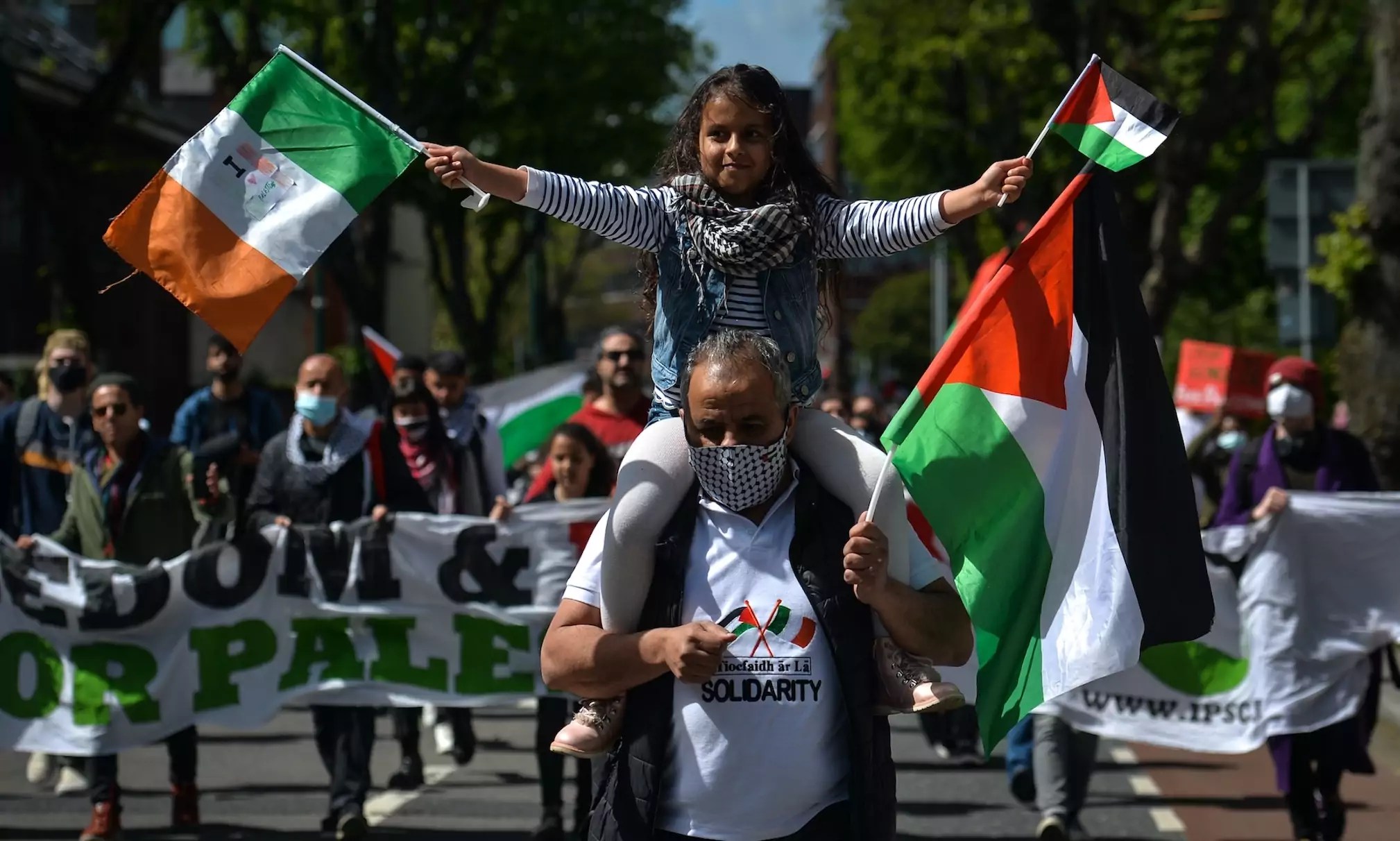
Demonstration in solidarity with the people of Palestine in Dublin, Ireland. (Photo: Artur Widak/NurPhoto via Getty Images)

US imperialism has made it clear that the Israeli cause is not just its cause but that of imperialism as a whole, encompassing its other proxy – Ukraine.  This country in turn has been happy to endorse this alignment, with Zelensky seeking a photo opportunity with Netanyahu but with Israel showing reticence only because its relations with Russia are not one of open antagonism.  An indication of the reactionary character of Russia and an embarrassment to everyone, including those leftists whose ‘anti-imperialism’ involves support for Russia.

On the other hand, many friends of the Palestinian people start sometimes from humanitarian concerns or some sort of more or less consistent and considered opposition to Western imperialism and its Zionist proxy. 

So who are the real friends of the Palestinian people might seem to be a reasonable question.  In answering it we have already seen from the previous post that we cannot identify who these are simply by accepting their word for it. We need to determine who might be expected to support the Palestinian people based on their own interests in doing so and what this support amounts to and its objectives might be.

So, just as every Arab country and people is composed of ruling classes, for whom the Palestinians are a problem, so too are there working classes and other subordinated sections of the people who genuinely support the Palestinians and have demonstrated this support.  But the Palestinian people themselves are also divided into classes, including a working class and other subordinated and marginalised people, for example in refugee camps, as well as a Palestinian middle class and bourgeoisie.

It has been the policy of the Arab states to turn the Palestinian movement into replicas of themselves, with a relatively privileged and corrupt leadership, which is why the Palestinian Authority lost Gaza and is now more and more discredited in the West Bank.  This has led to the growth of Islamic fundamentalist movements with their own state sponsors. A recent article in the ‘Financial Times‘ by a former British ambassador to Lebanon recommends that imperialism make its own attempt to fashion a Palestinian movement – “the US and Europeans have recog­nised that they need to rebuild main­stream Palestinian lead­er­ship, hav­ing cast them adrift.”

So, everyone wants to help the Palestinians, even the imperialists who are helping the Zionist regime murder thousands of them, or is happy to stand aside and parrot Israel’s ‘right to self-defence’, when what they actually mean is its right to commit mass murder and ethnic cleansing. Those who defend the democratic rights of the Palestinian people cannot therefore avoid the question of what sort of Palestine they want to solidarise with – an end to the current siege and offensive is only the most immediate task.

If we believe we can build a movement that can make a difference then it also needs to develop its own views and policy on the role of imperialism, the Arab states, Islamic fundamentalist regimes and movements, and the position of Jewish workers. This is what is meant by saying, as we did in the first post, that ‘the question of Palestine is not only about Palestine’. Even when it is about Palestine we should have a view on what sort of Palestine we want.

Arguing that it is none of our business is mistaken on two counts. First, it will not stop every other force, from imperialism to Islamic fundamentalism, seeking to create its own version of Palestine, and second, solidarity is a two way street. This means unless we think the Palestinians will always be purely victims we must allow their agency, and we want their actions to be in solidarity with the struggles of workers in the rest of the world who are, and will, come to their aid.

This means we need to consider what sort of Palestine solidarity we need. The same corruption, deceit and reactionary outlook that infects the Arab regimes, and the Palestinian movement itself ,exists among those in the West supporting Palestine, partly reflecting their class interests and partly, in some cases, awful politics.  Let us look at Ireland as an example.

The Irish state, and its people generally, are known to be the most pro-Palestinian in Europe, the Irish President, who has only symbolic powers in the main, voiced his opposition to von der Leyen’s declaration of unconditional support to Israel when she quickly visited it.  Yet who is stupid enough to believe that the Irish state, so dependent on the United States and its multinationals for its financing, will do anything effective to support the Palestinian cause and hinder Western imperialist support for it?

Or take the prominent participant in recent demonstrations supporting the Palestinian people – Sinn Fein.  It will most likely soon be a participant in Government in the Irish State. Is it going to use its position to effectively challenge Israel or its imperialist backer?  To ask the question is to answer it.  In the past it has had secret “below the radar” meetings with Likud, ‘explaining’ that it made its criticism of Israel’s policies in private, exactly the same boast of von der Leyen, Biden, Sunak etc. etc. More recently, it joined with the rest of the Irish establishment in welcoming Joe Biden to Ireland.

The only force that has an interest in solidarity with the Palestinian oppressed is the working class, and this is because their interests are aligned in opposing imperialism and the oppression that accompanies it.  Empathy with oppression is fine, but unless solidarity is a two-way street based on mutual interests it will not be strong or lasting.  Unfortunately some on then left are unable to express this solidarity consistently, because they either support western imperialism in Ukraine or also support the Zionist state itself.

Joe Biden has been congratulated by bourgeois media commentators for wrapping up the aid package for Israel with that for Ukraine, to out-manoeuvre Republicans in Congress, but it places a question in front of those on the left who oppose Israel but support Ukraine – do you support it?  Responding that you would wish to see the objects of this aid treated separately neither answers the question nor addresses the nub of the matter, which points to their inconsistent opposition to imperialism or in other words, inconsistent support.

If the Palestinian people are in the maelstrom of the world-wide imperialist conflict, the question to be put is how would it be possible to end their oppression without also ending this wider conflict, for as long as imperialism exists, so will war.  The eruption of the largest war in Europe since World War II and the renewed ethnic cleansing of the Palestinian people, with war also threatened in China and Taiwan, shows that this is not an idle or academic question.  It is one that requires and defines political movements and programmes.

It is not the first time the socialist movement and the working class has been placed with the choice.  In World War I the socialist movement split over ‘defence of the fatherland’ with most backing their own capitalist state in the war.  Today, much of the left has repeated the betrayal, mostly rallying to Ukraine and de facto Western imperialism, while another part supports Russia, ludicrously under the banner of ‘anti-imperialism’.

Neither has argued that the working class must maintain an independent position opposed to both, or argued that the only answer to capitalist war is socialism.  None of their various claims–for ‘self-determination’, ‘anti-imperialism’, or even ‘Free Palestine’ include any credible argument that these lead to socialism or are part of a socialist programme.  Nor could they– how could Western imperialist support for capitalist Ukraine, or support for Hamas, or other Arab states, or the Iranian state, lead to such an objective?  Yet many who support ‘Ukraine’ or the Palestinian cause claim to be socialists.

A socialism that is always deferred, to come to the fore at some future undefined point, while others in the meantime limit and define the political character of any solidarity, is blind to its own impotence.

The alternative programme is permanent revolution, which was first enunciated by Marx after the revolutions of 1848 and further elaborated by Trotsky after the Russian revolution in 1905 and put into practice in the revolution in 1917.  A future series of posts will look at how this has been, and should be, understood.

Back to part 1

The local elections – another step to a united Ireland?

The local election results in the North of Ireland have given rise to more commentary that another step has been taken towards a referendum on Irish unity and a united Ireland.  The success of Sinn Fein in becoming the largest party at local government level in council seats and votes has provoked this reaction, as have its previous victories.  The two have almost come to seem synonymous.

At the same time the two are repeatedly separated by the selfsame commentators who argue that any vote for a united Ireland in a referendum would have to go way beyond Sinn Fein’s support.  If a vote for this party is an indicator of impending unity, then there is an obvious problem.  Its vote in the local elections was 30.9 percent of the ballot so even after an increase in its support of 7.7 percent it is not yet a third of those voting.

It is argued that other pro-unity candidates add to the forward movement of Irish nationalism, except that the other major nationalist party, the SDLP, is slowly dying.  Its vote fell by 3.3 percentage points to 8.7 per cent.  Together the two major nationalist parties gathered 39.7 per cent.  Even with the addition of the pro-unity parties on the left and right, People before Profit and Aontú, the total rises only to 41.5 per cent.  The total for the three main unionist parties is 38.1 per cent; Irish nationalism gained more votes than the these parties.

In the 2019 local government election the three Unionist parties plus smaller unionists gained 41.87 per cent of the vote while the comparable Irish nationalist and pro-unity parties won 37.73 per cent.  At this election the DUP was the largest party and the Unionist vote was higher than that of Irish nationalism.

Local elections, however, are the least accurate electoral indicator of the relative strengths of the two camps; the turnout in 2023 was only 54 per cent, an increase of 2 per cent on the 2019 vote.  Commentators have noted that the turnout in 2023 was higher in predominantly nationalist than unionist areas by as much as 10 percentage points in some places. Irish nationalism therefore won only 22 per cent of the electorate while many unionist voters stayed at home. During any referendum on a united Ireland it can hardly be expected that unionists will be so apathetic or demoralised, unless political circumstances make them so, unlikely to be a result of the vote itself.

In the 2022 Assembly elections, where the turnout was almost 63.6 per cent, the vote for the three Unionist parties was 40.1 per cent while the pro-Irish unity vote comparable to the most recent local elections was 40.7 per cent.  The recent local election results are not the first time the Unionist parties have fallen behind.

Twelve years ago in the 2011 Assembly elections, Unionism polled 47.65 per cent while Irish nationalism trailed behind at 42.81 per cent.  The decline in the Unionist vote over these years is therefore clear and it is this decline that has provided most of the impetus to claims that a nationalist referendum victory is a realistic prospect in the short to medium term.  The 2011 result however also reveals what the advance of Sinn Fein has hidden – that the nationalist share of the vote hasn’t increased:  42.81 per cent in 2011 and 41.5 per cent in 2023.

The missing piece of the jigsaw is the rise of the Alliance party: from 7.84 per cent in 2011 to  13.3 per cent in the recent local election.  The question then becomes the political nature of this party – unionist with a ‘small u’ or nationalist; or what it presents itself as – simply ‘other’.

So let’s start with the third alternative–that Alliance cannot be said to have a position on the national question.  Even if this were so the national question will face Alliance and its supporters with the choice sooner or later and ‘other’ will not be on the ballot paper.

Alliance is definitely not an Irish nationalist party, does not pretend to be or pretend to hide it, and while it has a significant Catholic support, this has consciously decided not to vote for Irish nationalism.  While it may be more likely than other Alliance supporters to vote for unity in a referendum, its existing vote is for the status quo and the status quo is continued British rule.

The party was originally set up as an openly unionist party that presented itself as non-sectarian; one that divorced its unionism from any religious identity.  It has moved from this to present itself as neither Unionist nor nationalist but with a soft, ‘small u’, unionist support that is repelled by the sectarianism of the Unionist mainstream, with many also rejecting Brexit.  In a referendum, all other things being equal, the majority of Alliance voters can be expected to support continued British rule, as will the party itself. 

The ’other things being equal’ is what will matter for many; the political circumstances will at some point be decisive.  These include the reality of what a united Ireland might offer and the configuration of the forces fighting for and against it.  This includes the approach of the British state and the extent of violent unionist opposition.  What the election results demonstrate is that this point is not yet near, whatever about Sinn Fein becoming the largest party and Irish nationalism garnering more votes than ‘big U’ Unionism.  This does not mean that nothing is really changing.

Unionism continues to decline.  Its support for Brexit and rejection of the deal negotiated by the British state with the EU indicates a political movement fighting against its own interests. These are still considered to include a sectarian supremacy that is no longer possible and opposition to economic forces that might make the Northern State more attractive, even while it strengthens the all-island character of potential economic prosperity.  No longer able to make its claims on the basis that it is the majority within the gerrymandered state, it simply declares its veto based on its own existence.  This existence has always been one of sectarian privilege.

The other significant change has been within Irish republicanism, which having ditched its armed struggle against British rule has found itself with no clothes it cannot discard.  From opposition to British imperialism it now stands foursquare behind the western imperialist  proxy war in Ukraine.  Its representatives have acclaimed its recent success as a result of its brilliant electoral campaign.  This put a united Ireland on the back-burner but purposively elevated its attendance at the British king’s coronation, ‘to show their respect’.

It seems not to occur to them that monarchy is the epitome of denial of democracy and deserves zero respect. When Celtic and Liverpool football fans demonstrate a higher level of awareness of very basic democratic and republican principles we can appreciate the level to which Sinn Fein has sunk (with all due respect to those fans).

If this seems a rather glib or flippant remark, we can recall the explanation by another Sinn Fein member who stated that its approach was anticipation of the mutually respectful attitude between an independent Ireland and Britain when it was united.  We are almost back to the original Arthur Griffith Sinn Fein that supported a Habsburg Empire-like dual monarchy.

What this illustrates is the relevance of the Marxist theory and programme of permanent revolution. This argues that the democratic tasks associated with the development of capitalism, such as national independence, should be part of a working class programme and struggle and that it was possible for this struggle to develop into one that went beyond purely democratic questions, and the limits acceptable to capitalism, to be a struggle for working class rule.

This does not mean that such struggles cannot be led by other classes, but that these could not be relied upon to advance the struggle in a thoroughly democratic way or for a consistent and comprehensive democratic outcome.  It matters who leads the struggle, because different classes will lead it to very different ends.

Marxists always defined Sinn Fein as a petty bourgeois organisation, which drew a reaction of complete incomprehension from republicans who were working class and living in solidly working class estates in Belfast, Derry or Dublin.  However, the movement’s political character was defined not mainly by its support considered in sociological terms, including its rural support or its ties to Irish American money, but by its politics.

This politics previously imagined a radically reconfigured capitalism, which the capitalist class opposed, while not seeking to overthrown the system itself, never mind forwarding real working class rule. The Irish capitalist class had no great interest in challenging British imperialism and the Irish working class has interests that go way beyond a united country that cannot provide for its needs.

As the possibility of a united Ireland is claimed to be approaching the democratic content to the struggle is more and more denuded of democratic content.  The obsequious kowtowing to British royalty does indeed show respect but not to democratic and republican principles.  The various scattered proposals to accommodate unionism in a united Ireland are also indicators of the inconsistent approach to a democratic outcome.

Many European countries have achieved unification after the defeat of the popular revolutions that sought to enact it in a more democratic way, such as Germany and Italy.  For socialists support for a united Ireland is a struggle to advance beyond a partitioned Ireland and not one that leaves every other component and trappings of the Irish and British capitalist states intact.

When measured against these tasks, the local government elections in 2023 are not even a minor tremble in the ground beneath the system that must be brought down.

Marx and Engels learn about revolution

Karl Marx’s alternative to capitalism part 53

As we noted in the previous post, since the ideas we now consider ‘Marxism’ did not spring whole and fully formed all at once from their progenitors, these ideas underwent a development from less to more adequate expressions of working class politics.  We have already noted and addressed the penchant of Marx to anticipate the next economic crisis and potential for revolution.  

Similarly, it is argued that Marx and Engels consistently anticipated the imminence of this revolution.  If this was indeed their position it would undermine the argument of the last number of posts which have set out the constraints that bind successful working class revolution.

It would undercut their revolutionary caution and might subvert their early argument with the Willich-Schapper faction in the Communist League, which claimed that revolutions were essentially acts of “will” and that the job of revolutionaries was to ‘make’ the revolution.

Given any inconsistency it would be incumbent to compare when and how over-optimistic revolutionary expectations were expressed and when and how more considered and formal analysis led to the arguments of the last number of posts.  Marx and Engels were once young, and regardless of age were always enthusiasts of revolution, optimism expressed privately is the blood of hope that runs through the veins of all such revolutionaries.

So, when Engels was 24, a newspaper in 1845 reported that at a meeting ‘Mr Engels delivered a speech in which he proved (from the fact, that not a word was offered in reply), that the present state of Germany was such as could not but produce in a very short time a social revolution; that this imminent revolution was not to be averted by any possible measures for promoting commerce and manufacturing industry; to prevent such a revolution — a revolution more terrible than any of the mere subversions of past history — was the introduction of, and the preparation for, the Community system.’

Two years later he was writing that the coming revolution would be bourgeois and this class would have to come to power first before it would become the turn of the working class:

‘Not until only one class—the bourgeoisie—is seen to exploit and oppress, until penury and misery can no longer be blamed now on this estate, now on that, or simply on the absolute monarchy and its bureaucrats—only then will the last decisive battle break out, the battle between the propertied and the propertyless, between the bourgeoisie and the proletariat.’ 

‘Only then will the field of battle have been swept clean of all unnecessary barriers, of all that is misleading and accessory; the position of the two hostile armies will be clear and visible at a glance.’

‘With the rule of the bourgeoisie, the workers, compelled by circumstances, will also make the infinitely important advance that they will no longer come forward as individuals, as at the most a couple of hundreds or thousands, in rebellion against the established order, but all together, as one class, with its specific interests and principles, with a common plan and united strength, they will launch their attack on the last and the worst of their mortal enemies, the bourgeoisie. ‘

‘There can be no doubt as to the outcome of this battle. The bourgeoisie will and must fall to the ground before the proletariat, just as the aristocracy and the absolute monarchy have received their coup de grâce from the middle class.’

‘With the bourgeoisie, private property will at the same time be overthrown, and the victory of the working class will put an end to all class or caste rule for ever.’ (Engels, Collected Works Volume 6, p94–5) 

To believe that in underdeveloped Germany, its mainly small artisanal working class could carry out a social revolution that could ‘end class rule for ever’ would contradict the basic postulates of Marx and Engels historical analysis and their later lifetimes’ revolutionary activity.  Through both of these they learned about the validity of their view that it was necessary to fight with the bourgeoisie against the remnants of feudalism, and about how far the latter were actually prepared to struggle and not turn away from it or ally with fellow exploiting classes:

‘The workers know that the abolition of bourgeois property relations is not brought about by preserving those of feudalism. They know that the revolutionary movement of the bourgeoisie against the feudal estates and the absolute monarchy can only accelerate their own revolutionary movement. They know that their own struggle against the bourgeoisie can only dawn with the day when the bourgeoisie is victorious.’

‘Despite all this they do not share Herr Heinzen’s bourgeois illusions. They can and must accept the bourgeois revolutions a precondition for the workers’ revolution. However, they cannot for a moment regard it as their ultimate goal.’ (Collected Works Volume 6, p332–3)

The relationship between this struggle against feudalism and the bourgeois revolution on the one hand, and working class revolution on the other, is also a subject of much later debate and shall be taken up in greater depth later. In less developed countries it revolves around the idea of permanent revolution, made more famous by Leon Trotsky, but a term also employed by Marx on a number of occasions.  

Hal Draper states that a continued, uninterrupted revolution (the meaning of permanent in this case) was ‘a very widespread, though by no means unanimous view among the radicals of the time.’ (Karl Marx’s Theory of Revolution Vol II, p 201)

Marx and Engels went through a number of versions of what the transition from bourgeois to workers revolution would look like, learning from the experience of the 1848 revolutions in Europe, and summed up these lessons following the revolutions’ defeat.

Marx had, for example, hoped (at the end of 1848) that sections of the bourgeoisie would join with the Democracy in fighting for a Social Republic, an open-ended agitational slogan ‘referring to a government that takes a socialistic direction.’ (KMTR Vol II p234).  Instead, they learned that even in what was to be a bourgeois revolution, this bourgeoisie did not ally with the Democracy (peasants, urban petty bourgeoisie and working classes) but with ‘the trinity of Crown-aristocracy-bureaucracy’. (KMTR Vol II, 225).

The Communist Manifesto had stated that:

‘The Communists turn their attention chiefly to Germany, because that country is on the eve of a bourgeois revolution that is bound to be carried out under more advanced conditions of European civilisation and with a much more developed proletariat than that of England was in the seventeenth, and France in the eighteenth century, and because the bourgeois revolution in Germany will be but the prelude to an immediately following proletarian revolution.’

Following defeat of the 1848 revolutions, especially in France and Germany, Marx drew some important and lasting lessons about the importance of England, as the most advanced country, to future revolutions:

‘A transformation of the relations of political economy in every land of the European continent, on the whole of the European continent, is a tempest in a teapot without England. . . . But every social upheaval in France is necessarily wrecked on the rock of the English bourgeoisies, of the industrial and commercial world domination by Great Britain.  Every partial social reform in France, and on the European continent in general, is and remains an empty pious wish insofar as it aspires to end there [without involving England].  (quoted in KMTR Vol II pp243–4)

The permanence of the revolution would allow the ‘tendency we represented [ to] enter the struggle for the attainment of our real party aims’; the party never imagined itself capable of producing at any time and at its pleasure, that revolution which was to carry its ideas into practice . . .’

This would become possible because ‘only through the increase in power of the bourgeoisie does the proletariat gradually get to the point of becoming the majority . . .’  ‘Only its rule [the rule of the bourgeoisie] tears up the material roots of feudal society and levels the ground on which alone a proletarian revolution is possible.’  In ‘countries where the aristocracy’ must be ‘driven from power’ there was lacking ‘the first premise of a proletarian revolution, namely, an industrial proletariat on a national scale.’ 

(KMTR Vol II p 249, 208, 280 and 284)

Back to part 52

Forward to part 54