Fragments of Victory’: The Contemporary Irish Left’, book review (6 of 6)

The most damning judgements in Fragments are that the movements since 2008 ‘failed to identify an avenue through which society might be changed’; ‘it is unlikely the Trotskyist People before Profit will manage to articulate a viable alternative . . . and the steps between the current situation and the long-term goal of socialism are less clear than ever before. The radical left ‘were engaged in a form of politics incapable of realising its own aims.’  (p183, 191, 192 & 181)

The left made gains during the years covered by the book, expressed in some relatively modest electoral successes, but this was achieved though pursuit of a strategy and practice that might be considered as one of least resistance, which had inevitable shortcomings and meant these ‘steps’ were not an ‘avenue through which society might be changed’; entailed a lack of articulation of ‘a viable alternative’; lacked clarity over how to achieve ‘the long-term goal of socialism’ and gave rise to the perception that its politics was ‘incapable of realising its own aims.’

This is not only a question of an absence of a revolutionary socialist programme, which we have already noted in previous posts.  The left has worked under the assumption that achievement of  its objectives requires a revolutionary party, which alone would understand the necessity for revolution and how it may be achieved, and that in its various forms it is the nucleus of this party, which is considered to be revolutionary because its leaders truly believe in revolution (regardless of how it looks from outside).  This obviously means that its own activity and building its own organisations are the absolute priority.

I am reminded of the slogan that the duty of a revolutionary is to make the revolution, except socialist revolutions are not primarily made by revolutionaries but by the working class in its great majority.  The emancipation of the working class can be the work only of the working class itself, as someone famous once said.  This is one of many principles widely acknowledged but without understanding what it entails.  Revolutionaries are ‘the most advanced and resolute section of the working-class . . . which pushes forward all others [with] the advantage of clearly understanding the line of march, the conditions, and the ultimate general results of the proletarian movement.’ (Marx and Engels, The Communist Manifesto).

The working class party is built not solely or even mainly by the activists of the left but mainly by the working class itself, with the socialist movement playing the role just mentioned.  Instead, the mantra of building the party is reduced to building the existing left organisations not as a consequence of the development of mass working class movements but separate from them.  Revolutionary organisations can only develop if they find within the working class this growth of socialist consciousness, which is itself partly a result of their own activity but only as an integral part of the struggles of the working class itself.

We have noted the need to challenge the existing leadership of the trade union movement as an example of what is needed to begin addressing these tasks. We have noted that the limits of single issue campaigns means that they were not a substitute, however useful they may be otherwise, and that the political education that was given was the failed statist politics that subordinates the class’s own activity to that of the capitalist state. This view has come to dominate understanding of what ‘socialism’ is and reflects the historical domination of social-democracy and Stalinism.

This was rudely demonstrated by the left’s customary call for nationalisation being appropriated by the state in relation to the banking system when it faced collapse; which was carried out to protect both capitalist ownership and itself, while dumping the cost on the working class.  I have seen it defended on the grounds that this was not ‘socialist’ nationalisation, but this complaint just admits its unavoidably capitalist character.  Could capitalist state ownership be anything other than capitalist? How could the capitalist state introduce working class control and ownership when it was its own ownership that was asserted?

Progress through the lines of least resistance does not necessarily involve conscious opportunism, precisely because it does involve progress, but like all opportunism it sacrifices long term principle for short term gains. Gains which can more readily dissolve as circumstances change and change they always do.  The approach of appearing more ‘practical’ and attuned to workers’ existing consciousness by declaring that one can leverage the state to do what the workers movement itself must do, through a ‘left government’ for example, does not educate, in fact miseducates, the working class.

This does not invalidate the struggle for reforms that of necessity are under the purview of the state, but these are of benefit not only, or so much, for their direct effects but for their arising from the agency of the working class through the struggle to impose its will on the state and capitalist class.  Reforms are ultimately required to create the best conditions for a strong workers’ movement, and not as solutions to their problems that act to co-opt workers to dependence on the state.  Handed down from above they can primarily be seen as performing the latter role. 

The alternative of seeking to mobilise workers when their organisations are bureaucratised and the majority are either apathetic or antipathetic, is often seen as less practical, less advised, and ‘ultra-left’.  However, the point of socialist argument and agitation is often not with the expectation of eliciting immediate action but to advance political consciousness, which sometimes might be seen as widening what is called the ‘Overton window’.

This approach addresses the argument that only in revolutionary times or circumstances can one advance revolutionary demands.  All independent action by the working class is a step towards its own emancipation, no matter how small, just as reliance on the state is not.  Reforms won from the state are significant such steps if they involve independent organisation of the workers’ movement to achieve them.  As Marx said in the Communist Manifesto in relation to workers’ struggles: ‘Now and then the workers are victorious, but only for a time. The real fruit of their battles lies not in the immediate result, but in the ever expanding union of the workers.’

Something similar was pointed out by James Connolly, who knew that temporary victories would not yield permanent peace until permanent victory was achieved, and that for such victories ‘the spirit, the character, the militant spirit, the fighting character of the organisation, was of the first importance.’ Fragments’ statements that the left ‘failed to lay deep social roots’ and ‘failed to develop a mass political consciousness’ is the authors judgement that this didn’t happen.

It is banal and trite to acknowledge that demands need to be appropriate to their circumstances, but this must also encompass two considerations.  First, that even in situations in which it is almost impossible to achieve the working class mobilisation that is required, it may still also be necessary to say what must be done in order to achieve the desired outcome.

Second, only by always putting forward an independent working class position, which most often does not involve any call to more or less immediate revolutionary overthrow, is it possible for workers to begin to realise that an independent working class politics exists that has something to say about all the immediate and fundamental issues of the day.  As I have previously noted, this begins by instilling in workers the conception of their own position and power as a class, not that of an amorphous ‘people’.  What this involves in any particular circumstance is a political question and the subject of polemical differences that are unfortunately unavoidable.

The fall of the Celtic Tiger demonstrated that such crises on their own will not bring about the development of socialist consciousness – that capitalism is crisis-ridden and must be replaced by a society ruled by the working class.  One of the earliest posts on this blog noted evidence that these crises most often do not.  In order that they deliver such object lessons it is necessary for a critical mass of the working class to already be convinced that their power is the alternative to capitalism and its crises.  This requires a prior significant socialist movement integral to working class life and its organisations.

We are a long way away from this, with one reviewer of the book in The Irish Times noting that its editors had excessive optimism about the experience of the Irish Left over the period.  The reviewer makes other comments that are apposite.  The argument of this review is that the book records enough experience to show that optimism is unjustified, at least on the basis of continuation of the political approach recorded by it.

The project of a left government that would be dominated by Sinn Fein, with secondary roles for the Labour Party, Social Democrats and Greens is not the road to address the failures noted at the top of the post.  The project is a chimera that is incoherent and cannot work.  In (un)certain circumstances it might spur a further development of consciousness and independent working class organisation and activity, but this is by far the less likely outcome and is not, in any case, what is being argued by the projects’ left supporters.

The left is always in a hurry, partly because of the preponderance of young people involved but more decisively because of the project itself, which is not based on building the strength and consciousness of the class as a whole but of building the left organisations themselves, particularly through elections.  The next one is always the most vital.  The former is the work of years and decades to which the project of ‘party building’ and ‘the immediacy of revolution’, understood as insurrection, does not lend itself.  These are outcomes that cannot be willed by socialists but determined ultimately by the wider class struggle and the decisions of countless workers as well as by their enemies.

Elections allow socialists ‘a gauge for proportioning our action such as cannot be duplicated, restraining us from untimely hesitation as well as from untimely daring’, and ‘a means, such as there is no other, of getting in touch with the masses of the people that are still far removed from us, of forcing all parties to defend their views and actions.’  It is not a means to arrive at a government that is ‘left’ of the current bourgeois duopoly but right of socialism, and that peddles illusions that the current capitalist form of democracy can deliver fundamental change.

Back to part 5
‘The People’ before Profit? – Karl Marx’s alternative to capitalism (part 67)

The substitution of ‘the people’ for the working class as the subject of struggle is presented In Ireland, in an almost classic case, by the People before Profit organisation, whose reformist politics are based on actions demanded from the Irish capitalist state.  While ‘people’ are to come ‘before profit’, ‘people’ replaces the working class, while coming before profit still leaves profit in place.  And anyway, aren’t capitalists people as well? 

This precept fails to bring to the fore the ‘property question’, demanded by Marx in the Communist Manifesto, whereby the profit of capital arising from exploitation of the working class is not de-prioritised but abolished!

It might be argued ‘what’s in a name’, were it not for the fact that the name was deliberated on and selected precisely in order to avoid clearer identification with the working class and socialism. Presumably because reference to ‘the people’ is more readily acceptable; postponing the task of raising awareness of the paramount role of class and denying the centrality previously accorded to it by anyone calling themselves Marxist. In asserting the priority of the people, and so rejecting the primacy of class, the organisation is setting an example to be followed, not one to be excused or ignored.

Failure to root socialist politics in the material reality of the working class leaves it rootless and prey to the material reality of other forces – we have already pointed to the role of the state in the political alternative offered by People before Profit – but the ideologies encompassing this are many.  Nationalism and racism require denial of the separate political interests of the working class – socialism is international while racism denies working class unity.  It is precisely class interest that is the alternative to these reactionary programmes, not acceptance of the prior interests of an undifferentiated people.

It is possible to fill this missing foundation with moral claims to ‘humanity’ which bases internationalism on ‘human rights’; the ‘self-determination of (capitalist) states’, or protection of minorities based simply on their being a minority.  Similarly, it is possible to oppose racism based on human rights, ‘diversity’, ‘inclusion’ and opposition to ‘hate’, but these are even more vague and useless than the concept of ‘the people’.  Their employment by many on the left, tellingly often paraded under the banner of a ‘social justice’ movement, is testament to a collapse into liberal (i.e. bourgeois) politics compared to which the 19th century republicanism we have been examining in the previous posts looks positively revolutionary.

If class is not primary and immediately necessary in order to take forward a movement and programme what is opened up is the intrusion of a wide variety of identity politics that makes nationality, race, or sex etc. the primary means of securing freedom from oppression. This in turn can lead to ‘intersectional’ coalitions that further divide while pretending to unify.

It leads to rejection of the view that the working class is the only social force able to create a new society and which alone can unite the oppressed through the abolition of class. It thereby simply becomes one segment of society with no reason to prioritise its role more than any other.  Petty bourgeois ideas of individual subjective identity flourish where the nebulous abstraction of ‘people’ becomes the source of power to change the world.  With this view of politics the numerous instantiations of the people come to substitute for the working class, which in turn leads to the search for a mechanism for them to do so, and which is invariably found to be the state.

In 1849 Marx criticised the naive belief in a single “will of the entire people” rather than that of a singular ruling class (or grouping of classes) that might represent its own interest as that of society as a whole, or at least of its large majority:

‘For the National-Zeitung there exists one will of the entire people, which is not the sum of contradictory wills but a united and fixed will. How is that?

That is—the will of the majority.

And what is the will of the majority?

It is the will which emerges out of the interests, life situation, and conditions of existence of the majority.

In order to have one and the same will, the members of the majority must therefore have the same interests, the same life situation, the same conditions of existence, or must be temporarily linked together in their interests, their life situation, their conditions of existence.

In plain words: the will of the people, the will of the majority, is not the will of separate estates and classes but of one single class, and of those classes and fragments of classes that are socially—i.e., industrially and commercially—subordinated to this ruling class.

“What should we say to that?” Is the will of the entire people the will of the ruling class?’

(Marx, Marx and Engels Collected Works Vol 8 p272, Articles from the Neue Rheinische Zeitung)

Marx, in The Civil War in France, noted that the Paris Commune ‘was the first revolution in which the working class was openly acknowledged as the only class capable of social initiative, even by the great bulk of the Paris middle class—shopkeepers, tradesmen, merchants—the wealthy capitalists alone excepted. The Commune had saved them by a sagacious settlement of that ever-recurring cause of dispute among the middle classes themselves—the debtor and creditor accounts.’

It was necessary then (as it is now) for the working class to be the ‘universal’ class and to represent the needs of a society oppressed by the prevailing system: ‘For the first time in history the petty and moyenne middle class  has openly rallied round the workmen’s Revolution, and proclaimed it as the only means of their own salvation and that of France!.’ (Marx, The Civil War in France, Marx and Engels Collected Works Vol. 22 p336 & 496)

This was not something that Marx learned only from the Commune but was something strikingly demonstrated by it, particularly the need to win the majority of the population that was then composed of peasants.  How this need is addressed today depends on the particular class composition of society, but this requires that the idea of a unified people is abandoned and the various classes and their interests identified.  In relation to the peasantry, for example, it did not mean strengthening or enlarging their individual property, while a programme based on the demands of ‘the people’ would leave this wide open.

In the writings through which he and Engels formulated their particular politics, The German Ideology, he argued that ‘For each new class which puts itself in the place of one ruling before it, is compelled, merely in order to carry through its aim, to represent its interest as the common interest of all the members of society, that is, expressed in ideal form: it has to give its ideas the form of universality, and represent them as the only rational, universally valid ones.’ For the working class, this is realised through the abolition of all classes, including itself.

Marx identified this early in his political development (in 1843) before becoming a ‘Marxist’ and expressed himself in the language of the philosophy of the time: ‘No class of civil society can play this role without arousing a moment of enthusiasm in itself and in the masses, a moment in which it fraternises and merges with society in general, becomes confused with it and is perceived and acknowledged as its general representative, a moment in which its claims and rights are truly the claims and rights of society itself, a moment in which it is truly the social head and the social heart.’ (Marx, Introduction to A Contribution to the Critique of Hegel’s Philosophy of Right)

For this to happen the working class must win others as allies to its programme.  This can only be done if, in the words of The Communist Manifesto, socialists ‘disdain to conceal their views and aims.’  It will not be done by pretending that its views are those of an amorphous ‘people’.  You can only rally others to your flag if it is your flag.

Back to part 66

Forward to part 68

Part 1

The domestication of the Irish Left

Marxists believe that power in society resides in capital, in the capitalist system and its property relations in which ownership and control of the means of production etc. are monopolised by one class.  In the form of money, capital can be otherwise employed to gain political influence through the media, buy politicians and discipline governments through speculation on the bond markets.  Capital strikes can disable economies just as individual capitals can close down workplaces overnight destroying the livelihoods of their workers.

On top of this are states that defend these property relations through a multitude of laws bolstered by assumptions about the primacy of bourgeois private property rights that are considered holy writ.  Should this be questioned the state is also composed of forces armed with the monopoly of violence to police and impose the requirements of these property relations.  Since such relations involve the exclusion of ownership and control by the majority there is nothing democratic about them and no bourgeois claims to democracy entertain the notion that there should be democratic ownership and control of the economy.

Instead such claims to be democratic rely on parliamentary institutions that are dignified with reverential rules and procedures, the better to elevate their status above their essential subordination to the real power in society.  Incantations about their sacred embodiment of democracy cover for this subordination while most people vaguely register their awareness of the sham through a view of all politicians as essentially liars.

This, however, is a purely cynical reaction and is not the ground for either an adequate understanding of what is going on or the envisioning of a genuine democratic alternative.  Nationalism provides additional glue to bind workers to their (nation) state and the claims it makes for itself on their behalf, but more and more decisions are taken at an international level where real democracy is even more obviously absent. It is generally considered in most of Europe that its people live in a ‘democracy’.  The job of socialists is to make them aware that this is bourgeois democracy and that it is a sham that they should seek to change.  Moreover they need to be convinced that the state they are invoked to give allegiance to does not defend their interests.

One very small example of the fraudulent character of bourgeois parliamentary democracy has erupted in Ireland as the governing parties have voted to restrict the speaking time of the opposition, reduced its own exposure to questioning, and allocated opposition time to a group of ‘independents’ who have all declared full support for the government and have a number of members as ministers within it.  As all the opposition parties have put it, you are either in the government or in the opposition – you cannot be in both.

Dáil sitting has been suspended before in much disorder but was suspended again yesterday when the change in Dáil standing orders was pushed through without debate by the Ceann Comhairle (the Speaker of the House). She is supposed to be independent but was elected as a member of the same ‘independent’ group and appointed as part of the secret deal that no doubt lies behind the speaking privileges now given to it.

This is no doubt a cynical political stoke that should be opposed. The up-its-backside liberal propaganda news sheet ‘The Irish Times’ opined that “normal Dáil business” must “resume immediately” so that a list of issues can be discussed. These include climate and health care that “normal Dáil business” has failed to successfully address for decades.  Even these relatively minor attacks on democratic functioning do not find this liberal mouthpiece defending it.

Of course, the government is committing much greater crimes against democracy than these latest shenanigans, including allowing planes delivering arms to Israel to pass through Irish air space.  Like governing party claims before the general election about the number of houses that were being built or support for the Occupied Territories Bill, this is a government that cannot be trusted to tell the truth.

The opposition parties, including People before Profit, have united to ‘stridently’ oppose this ‘alarming’, ‘outrageous’ and ‘unprecedented’ plan and to defend the ‘fundamentals of parliamentary democracy’.  There has been a lot of talk about the government’s changed procedures reducing their ability to ‘hold the government to account’ and to ‘represent their constituents’.

But this follows People before Profit centring their recent electoral campaign on ending 100 years of unbroken office by the two ugly twins who nevertheless won the recent general election.  When has either Fianna Fail or Fine Gael been held to account over this 100 years?  When has it been punished for its failures, lies, hypocrisy and previous much more authoritarian measures?  In what way do impassioned speeches by People before Profit TDs excoriating government ministers to an almost empty Dáil chamber – shown regularly on social media – embody holding these ministers to account?

The man in the centre of it all,’independent’ TD Michael Lowry, has been found by a state tribunal to be “profoundly corrupt” but here he was giving two fingers to the PbP TD Paul Murphy! Why is he not in jail, never mind inducing the government to tear up Dáil standing orders on his behalf?  Tribunal after tribunal has demonstrated that there is no justice from the state and the Dáil chamber is incapable of delivering it either.  More evidence of the sham that is bourgeois democracy!  Why not say this?

Rather than use the episode to demonstrate this to the Irish working class, to further explain the limits and hypocrisy of bourgeois democracy, and to call out the alternative, People before Profit has decided to become bourgeois democracy’s most vocal defender.  Rather than use it as support for the argument that the working class will not find real democracy within a bourgeois parliament, it declares the vital need to support its fraudulent claims that it can allow workers to hold the government to account’, i.e. criticise and punish it.  Instead of exposing the hot-air bloviating that passes for democracy it holds out the necessity for extra hours of fine speeches.

Illusions in bourgeois democracy run deep in Irish society, as in most advanced capitalist states, with the continued election of Lowry and the ugly party twins as plenty of evidence.  Every opportunity to expose it should be grabbed.  Ironically, a previous posture of doing this – of exposing the hollowness of bourgeois democracy evidenced again by this latest stroke – would have been more powerful in embarrassing the government than the strident claims that more time to ask questions and talk to an almost empty room is vital to democracy.

To go back where we started – with Marxist principles.  These declare that the emancipation of the working class will come from the activity of the working class itself, a principle precisely counterposed to the parliamentary illusions of much of the left.  Real power comes from outside, that of both the capitalist system and of the working class.  It is on the power of the working class and its organisations outside that socialists need to focus, and which could do with much greater democratic functioning. Illusions in the Dáil are only for those for whom these illusions are comforting and who seek a career within it.

First steps for the left in the new Dáil

When the Dáil met following the general election the order of business included the nomination of a new Taoiseach and the position of a new Ceann Comhairle (Speaker of the Dáil).  The latter became part of the horse-trading between Fianna Fáil and Fine Gael and the Independent group of TDs (who are FF/FG in all but name) so that the three of them could form a stable administration.  With no principled difference between any of them the issues were all about divvying up the spoils of office, which included the role of Ceann Comhairle.  This comes with a salary of €255,000 a year, which is greater than that of the Taoiseach.

The Independent group let it be known that this was one bauble that they wanted and the two main parties thought about it.  Their wish was granted and their nominee, Verona Murphy, was approved following, rather appropriately, the proposal of Michael Lowry.  Murphy had previously lost the support of Fine Gael as a candidate following remarks about asylum seekers needing to be “deprogrammed”, as they may have been “infiltrated by Isis”, and further comments claiming that Isis had “manipulated children as young as three or four”.  Lowry had long ago been removed as a candidate of the Fine Gael party following a number of scandals.

This has passed without much fuss as par for the course for bourgeois politics in Ireland. Unfortunately, the Socialist Party TD Ruth Coppinger missed the point by stating that “in rallying behind its selection for Ceann Comhairle, it could be the first and last rally for women that the next government is likely to do when it comes in.”  The point of Murphy being the first woman to be elected Ceann Comhairle was really beside the point, but pretending to make it so reflected the influence of identity politics on Coppinger and the Irish left.

More importantly, Coppinger registered her abstention on the more significant business of the nomination of Mary Lou McDonald of Sinn Fein as the new Taoiseach, “simply because we do not have a real prospect of an alternative government.”  It is beyond doubt that Coppinger will vote many times over her next few years in the Dáil on motions that will have no chance of being passed or against others she will have no chance of stopping. Why is this an obstacle now?

If her rationale was a cop-out, People before Profit’s support for a Sinn Fein Taoiseach made no sense at all.  Its leader, Richard Boyd Barrett, stated that “People Before Profit will be supporting the nomination of Deputy Mary Lou McDonald, not because we agree with Sinn Féin – we disagree with it on many things, not least its refusal to rule out coalition with Fianna Fáil and Fine Gael – but because we believe parties on the left have an obligation to end 100 years of Fianna Fáil and Fine Gael and put together the first left-wing government this State has ever seen.”

Besides the absurdity of supporting an alternative government based on a party you do not agree with, or doing so on the assumption that this is a ’party of the left’ – what exactly constitutes being left-wing? – how could this party ‘put together the first left-wing government this State has ever seen”? So focused and fixated is People before Profit on ‘ending 100 years of Fianna Fáil and Fine Gael government’ that what it is replaced with appears to be utterly secondary – even admitting Sinn Fein’s potential to go into coalition with either (or both?) of them anyway!

If Coppinger’s remarks were an admission of failure of the ‘left-wing government’ project, Richard Boyd Barrett’s were a judgement on the retrograde consequences of pretending to pursue it in circumstances in which it is impossible.  The only good thing in this case about writing a blank cheque for a Sinn Fein government is that it cannot cash it.  While Coppinger cops out on what is a question of principle – what sort of administration a Sinn Fein Taoiseach would preside over? – Boyd Barrett votes in principle for a principle he cannot possibly support – a Sinn Fein Taoiseach leading a government that is not committed to opposing either Fianna Fáil or Fine Gael participation within it.

The whole performance is political theatre, which – with the season that is in it – is a pantomime.  Grubby deals accompany political posturing that reflects no good on any of the participants and is of no educational value at all to workers looking in.

People before Profit’s Paul Murphy says “What should the left do now? Rule out coalition with Fianna Fáil and Fine Gael and put forward left-wing policies”; except the first has been determined irrelevant by the recent election while ‘putting forward left-wing policies’ begs the question of what is meant by ‘left-wing’ and what is meant by ‘policies’?

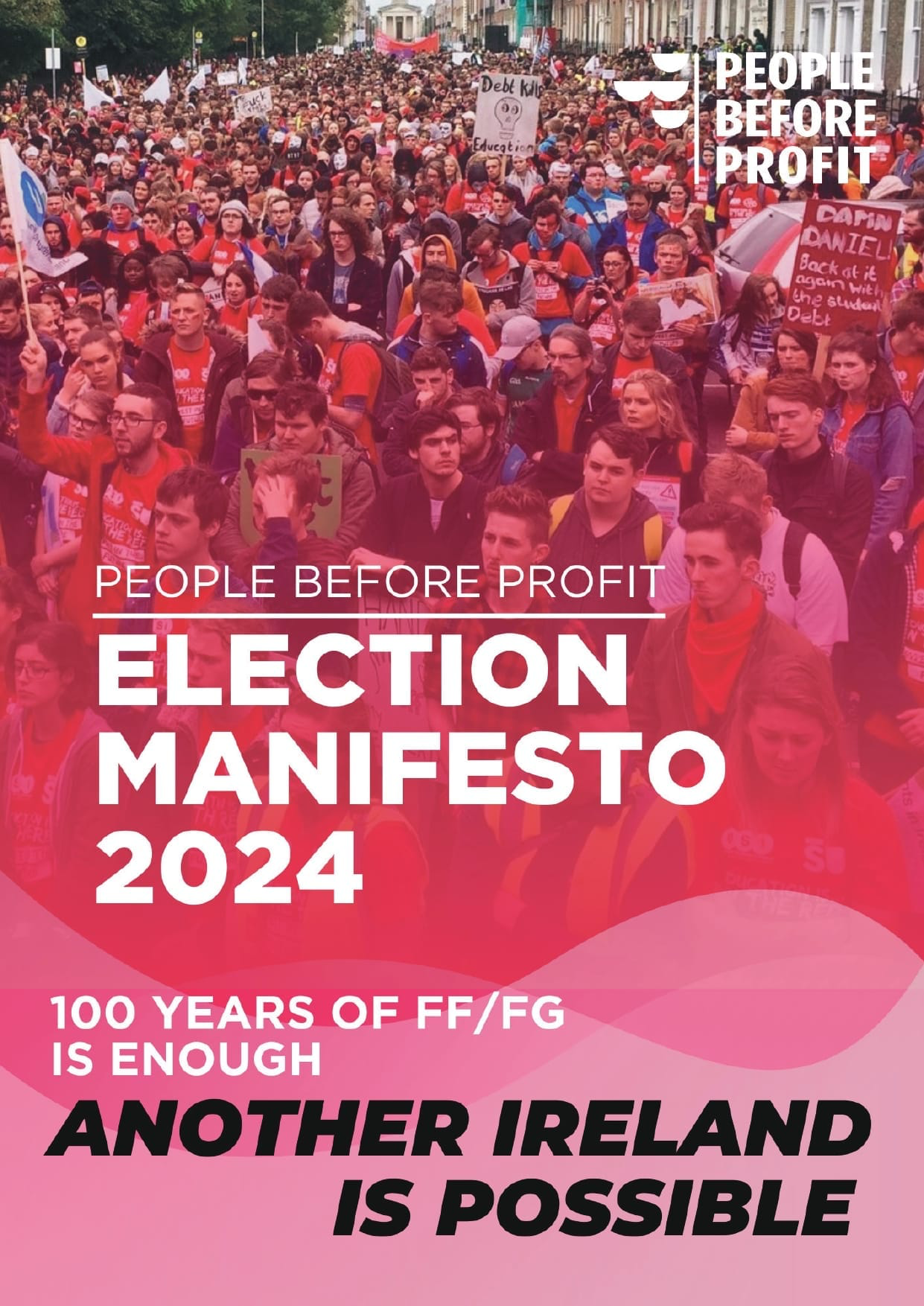
People before Profit stood on a manifesto saying that “The first step in bringing about fundamental change will be the formation of a Left Government – one that excludes FF and FG.”  That is now stuffed, with no elections likely for a few years, even were it the case that working class struggle should revolve round them, or that it need start with the actions of TDs in the Dáil.  Were we now to take them at their word we would have to wait to the next general election to take “the first step in bringing about fundamental change.”

Such change does not come from parliament, not from ‘left’ governments and not even from the state, which People before Profit seems to pretend is governed by the first two.  The first step is never the action of ‘left’ governments, parliaments or the capitalist state but from the independent action of the working class.

It is not the role of the ‘left’ to lead in the Dáil while the working class is a supporting act outside.  Some part of the People before Profit thought process knows all this but has not the first idea how to operationalise it.  Even were it only able to identify it at a very general level, it would be a good first step to doing the first thing about it, a good New Year’s resolution perhaps.

A New Popular Front for Ireland? (2 of 3)

– Demonstration against the extreme right in the presence of the new Popular Front – 15/06/2024 – France / Paris – Place de la Nation a Paris, manifestation contre l extreme droite. PUBLICATIONxNOTxINxFRAxRUS OlivierxDonnarsx/xLexPictorium LePictorium_0293005

Supporters of the New Popular Front in France start from the view that the task of the day is to defeat the far right while in Ireland it is to defeat the mainstream right.  In the first, alliance is made with the mainstream right and in the latter with the non-mainstream right that still parades a certain amount of fake radicalism.  Since neither the mainstream right or its fake radical opposition will break from capitalism the left makes compromises that it really can’t deny because it has accepted that the task is to defeat the far right, in the case of France, or the main right wing parties in the case of Ireland.  Since it is the mainstream right that has facilitated the rise of the far right in both countries the left has allied itself with the cause of this rise in France and discredited itself as an alternative.  In Ireland, the logic of the proposed policy is the same but simply lags behind France in its development. This is all pretty straightforward.

The following problems arise.  In order to create a left majority, the idea of ‘the left’ is expanded to include anyone opposed to the far right/mainstream right who proclaims itself as in any way left or socialist.  This includes those who have been in government and who have attacked the working class when they were there; for example the Socialist Party (SP) in France and Sinn Fein in Ireland. 

Since the world is full of parties with socialist or communist in their name that are anything but, it is necessary to know how to determine who exactly is a socialist.  In the case of the SP and Communist Party in France this is relatively easy – they have been in government and made it clear that they will defend French capitalism.  In the case of Sinn Fein, they have also been in office and present themselves as the most enthusiastic defenders of the institutions that are the product of a ‘peace process’ set up by British and US imperialism.  Sinn Fein’s claims to socialism are threadbare to non-existent.

Acceptance of any of these parties’ bona fides means that you join rejection of any coherent definition of socialism, ally with parties that defend capitalism and thus all of its consequences, and means that you then cease to offer genuine socialist politics. This is not because you have proposed some joint action for a specific purpose but because you propose to enter into a government with them with the pretence of a radical or socialist programme. This is not a policy you can turn off and on, becoming true to your claims in-between. This is not a slippery slope you can climb back up, but a result of the slippery slope you have already descended.

The use of words such as ‘radical’ or ‘left’ to justify alliances that cannot be described as socialist, as if there was something other than socialism that offers adequate answers and promises a different society, is one illustration. One consequence is that being on the ‘left’ becomes decisive over being socialist, with the latter robbed of any distinct meaning; all necessary because you have admitted that there is a task more important than fighting the capitalist system and socialism. This task, or ‘stage’, amounts to defending the so-called democratic version of capitalism from the far right, or ending years of the mainstream parties in office without ending the system they represent, as if they were the problem and not an expression.

The far right in France, and main bourgeois parties in Ireland, are here to stay in the foreseeable future, so the argument that there should be an alliance between the ‘left’ and the mainstream bourgeois parties in France, or a ‘left’ in Ireland that includes Sinn Fein, will hold as long as they do. This means that uncompromising opposition to both is fatally undermined and the rationale for an independent socialist alternative is permanently suspended.

The fundamental problem is therefore that the task of organising and politicising the working class to defend its own separate interests as understood by socialists is subordinated, if not entirely dispensed with, in order to defend a particular form of capitalist rule in France, while in Ireland it is to pretend that the latest generation of ‘radical’ nationalists are a genuine alternative to the rule of their historical equivalents.

We see this again and again in the politics of the ‘lesser evil’ – in relation to the war in Ukraine as well as opposition to the far right.  It is not an accident that the New Popular Front in France and united ‘left’ in Ireland support the imperialist war. The view that the separate organisation of the working class under socialism is the only safeguard against the far right is forgotten.  The view that the prime task is not to defeat the far right or replace one bunch of nationalists with another but to advance this organisation and politicisation is opposed.

Attempts are made, in relation to both France and Ireland, to claim that the policy of a popular front is part of, or at least not incompatible with, this sort of organisation but the alliance with fake-socialists and mainstream bourgeois parties makes such claims impossible to sustain.  This is fundamentally because of the second problem with the whole idea, which is that these left fronts are not about the mobilisation of the working  class but an electoral alliance.  The mainstream bourgeois parties might tolerate temporary expressions of mass support for an alliance with themselves but will never support an independent mobilisation of the working class, because this would have to involve opposition to them to be genuinely independent.

In France the previous Socialist Party government of François Hollande used the state to attack French workers mobilising against its anti-working class policies.  Sinn Fein has no tradition of independent working class organisation and even during the height of mass participation in the struggle against British rule in the North, when it wasn’t trying to manipulate it and subordinate it to its armed struggle, it repeatedly went behind the back of the mass struggle to negotiate in secret with the British state.

Today, People before Profit repeatedly declares that it supports ‘street politics’, and that while ‘a shift left will strike fear into the hearts of the establishment and the very privileged elite . . . . Our best defence against them is mass mobilisation from below on the real issues and injustices faced by ordinary working people.’  Supporters of the NFP in France point to the mass demonstrations in support of the NFP as showing the compatibility of mass struggle with electoral alliances.

Paul Murphy argues that ‘to overcome their opposition and actually implement the ecosocialist change necessary to resolve the crises faced by people would require a left government basing itself on people-power mobilisation from below.’  In reality, street politics, pressure from below, and ‘mobilisation from below’ in support of a left government are all precisely acceptance of the subordinate position of the working class to a left alliance and a left government.

A current within People before Profit put it well when it said that ‘Electing former traitors to disappoint workers is not a good strategy. Thinking that any amount of protest “from below” can make these snakes anything other than what they are is magical thinking.’   This applies to Ireland as much as France.

Paul Murphy stated that ‘I lost count of the number of times people said to me during the recent election that no matter who they vote for, nothing seems to change. I can’t blame them.’  However, instead of arguing that voting for an alliance that will include Sinn Fein is the answer he needs to explain to workers that the only way to change society is for the working class to do it itself, certainly not to promise that he and his organisation will to do it for them.

The whole article by Murphy makes it clear that radical change, sometimes even called socialist change, is to issue from a left government, to come down from on high with all the benefits of its manifesto to be acclaimed by a grateful working class; forgetting all the lessons of history and all the teachings derived from it by Marxists.  Governments don’t rule, classes and their states rule.  This is why Marxists call for workers ownership and control and a workers’ state, not a bunch of left politicians surrounded by the levers of office to be used through a capitalist state and bound by and to the economic power of the capitalist class.

Promising to achieve the change set out by PbP from a left government is actually worse than the misadventure of the NFP in France.  In France the excuse is that the enemy is at the gate, even if it fails to realise that its other enemy is inside the gate with it.  In Ireland, PbP are promising not only that it will thwart the far right but will transform Irish capitalism as well – and with Sinn Fein!

Sinn Fein has demonstrated with its new policy of opposition to the accommodation of refugees that it will continue moving to the right, which PbP can follow by pursuing its ‘left unity’ or reject by tearing up its electoralist strategy and looking for an alternative. The new SF policy is really a two-fingers to its proposal and flushes any pretence it could be part of any genuine left project down the toilet.

‘Street’ politics, ‘pressure’ and ‘mobilisation from below’ of a top-down project to deliver radical change for the working class is not new. It is not the working class achieving its own emancipation.  It is the working class being employed to support someone else doing it for them; feeding it the illusion that the capitalist state is the vehicle for its delivery.  It makes its activity subordinate to the politics of the left alliance, just as in France today the working class is subject to the machinations within the NFP and the vetoes of discredited politicians such as Holland, once so decisively rejected he didn’t bother standing for President a second time.

The alternative of independent working class organisation and action is not difficult to understand.  It is very difficult to achieve, but then liberation and emancipation by the state is impossible.  Sinn Fein is not going to become a genuinely socialist party and the Irish civil service is not going to deliver an Ireland of equality and working class power.  No amount of PbP TDs will make it happen.  The history of class struggle across the world is littered with self-declared socialists who promised to deliver for the working class but didn’t understand that what they promised could only be delivered by the working class itself.

Back to part 1

Forward to part 3

A New Popular Front for Ireland? (1 of 3)

It’s not often that in politics you get to carry out an experiment that will tell you what will happen if you propose to take a certain course of action, but that is what we have with the proposal for the Irish Left to copy the creation of the New Popular Front in France.

People before Profit have proposed that a left pact that includes Sinn Fein should stand as an alternative alliance to the current Fianna Fail and Fine Gael government that will seek a new government mandate later in the year.  Its TD Paul Murphy has explained that a new mandate ‘would be a ‘disaster’, further ‘ratchet up’ the ‘scapegoating of asylum seekers’ and ‘embolden the far right even more.’   In this, the left should ‘take inspiration from the Nouveau Front Populaire (NFP) in France.’

There are so many issues with this it is difficult to know where to start; but let’s start with the most obvious.  In France the NFP was put forward as a way to stop the election of a far-right government of the Rassemblement National (RN).  This has involved an electoral alliance of the NFP with the main French bourgeois parties in which left voters were asked to vote for these parties where they were placed second in the second round of voting. Just like in Ireland, this alliance claims that it has been the policies of these parties that has helped incite and support the far right in the first place.

So, in Ireland, an alliance with the main bourgeois parties in France is held up as the example to follow in order to defeat the same main bourgeois parties in Ireland.  It might be claimed that this is not what is meant by copying the NFP example but that is only true if you ignore the politics involved, and politics is what it’s all about.

At a very basic level the proposal is all about what you are against and not what you are for, a common charge against the left by the right that the left continually confirms.  The far-right offer an alternative, even if it is reactionary and built on lies, while the main bourgeois parties offer the status quo, which includes all the powerful and hegemonic political, economic and ideological forces in Ireland and the world.

When faced with the slender possibility of presenting its own alternative government following the elections the hastily constructed joint platform of the NFP in France has been no help; the main point was purely negative – to allow the creation of a pact that would stymie the far right.  The NFP includes the very parties who led to the collapse and discrediting of previous left governments composed of the Communist Party and Socialist Party.  The former is now a shadow of its former self while the latter has been allowed to climb back up from its utterly discredited rule between 2012 to 2017 under President François Hollande, also back from the dead and part of the NFP.

With stopping the far-right as its prime and overriding purpose, there can be no objection to further capitulation to the main ‘centrist’ parties, which suffered the biggest defeat in the elections and to which the majority of the French public is bitterly opposed.  Now, along comes the united left to form an alliance to prop it up.  While the left in Ireland portrays the French elections as a victory for the left it ignores that this was a victory (of sorts) of an alliance with these discredited bourgeois parties, which have an effective veto over the formation of any new government.

What now remains to be determined is the exact configuration of the caretaker government cobbled together from the fragments of the NFP and bourgeois centrists before the next presidential election in which the far-right will then again claim to be the only real alternative to the rotten establishment.  Such are the fruits of short term surrender of principles, or opportunism as it has long been known as.

The relevance to Ireland is clear enough.   The left alliance proposed by People before Profit only has the remotest credibility because it must contain Sinn Fein, so this party must be called ‘left’ because it can’t be called socialist, which shows how this is a purely relative term, loaded with ambiguity and therefore dangerous in application.

The political experiment I alluded to at the start of the article also relates to the fact that Sinn Fein is already involved in a coalition government in Ireland, and with one of the most backward and reactionary parties in Europe.  What’s more, the DUP and Sinn Fein seem to get along famously, with differences not over fundamental policy but just how the sectarian pie is carved up between them.

The Stormont regime is a now a byword for disfunction and incompetency, but these are just expressions of its sectarianism.  This sectarianism has made it easy for Sinn Fein to join with the DUP in imposing austerity while trumpeting the fact that it is now the leading party in the whole rotten edifice.  Widespread acceptance of this arrangement has been possible mainly by portraying the North as a place apart with different rules that don’t apply in the rest of the country.

People before Profit thinks it can form an alliance with Sinn Fein in the South, telling it that its project of a coalition with Fianna Fail (FF) or Fine Gael (FG) would face a veto on any radical change.  It has sought to persuade SF that its attempts to make this work have failed, including its overtures to convince FF & FG that ‘you were not advocating a radical left programme’, and its ‘reluctance to clearly oppose the government’s scapegoating of asylum seekers.’  Yet this is the party that PbP portrays as ‘left’ and a vehicle for radical change!

It’s not even that PbP is promoting this with its eyes closed – blinkers maybe – but even the most blinkered can’t ignore the hypocrisy of Sinn Fein and its talking out of both sides of its mouth; one of the reasons its vote fell so far from expectations in the recent local and European elections.

Everyone knows that Sinn Fein was expecting to be in government after the next general election, with the prime candidate for partner being Fianna Fail, one of the evil twins that are the target of PbP and which it regards as the over-riding priority to defeat. If this strategy, its record in Stormont, its promise of good behaviour, and its failure to challenge the scapegoating of asylum seekers; if all this is not enough to expose the real character of Sinn Fein then we must ask the question – what compromises are PbP prepared to make for an alliance with it?

If there are none, is this because the joint platform will be so anaemic, the politics of SF and PbP are so similar, or because the priority is to get FF and FG out so it doesn’t matter?  If there are compromises to be made, what are they?

Forward to part 2

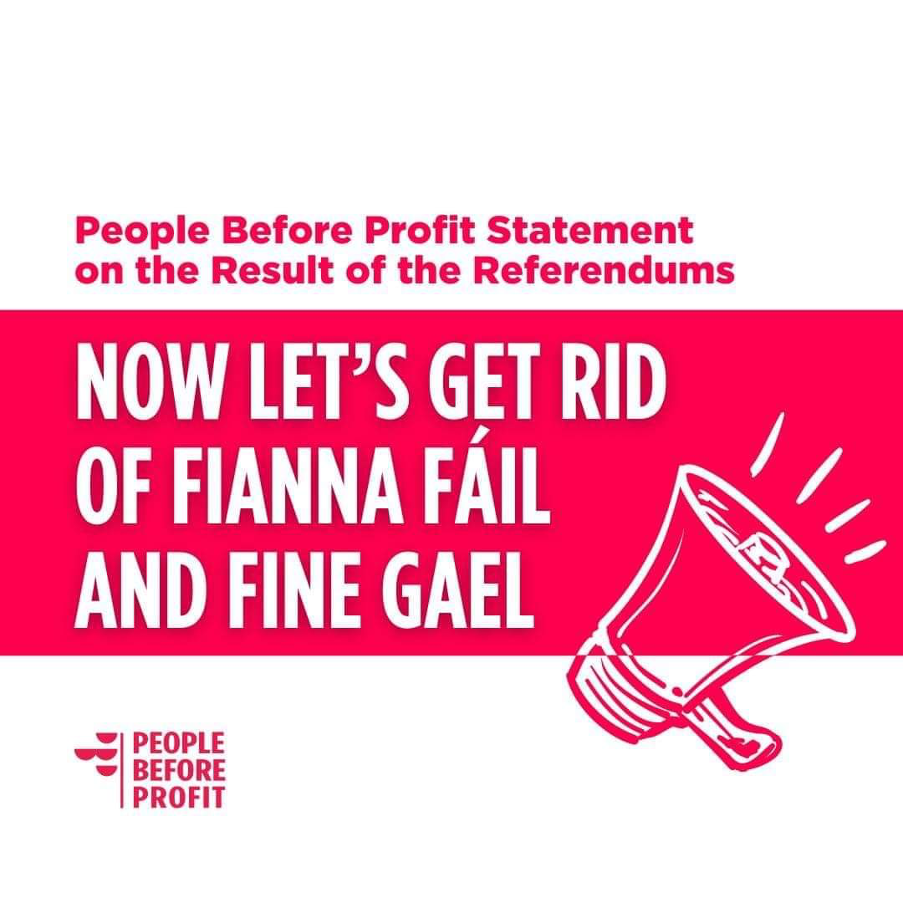
People before Profit and the Referendum – Ask not for whom the bell tolls

To paraphrase John Donne, “all supporters of the referendum are diminished, because they all were involved in saying that yes was the answer; and therefore, never send to know for whom was the failure; the failure was yours”.

This could be the epitaph for all the political forces that supported the Family and Care referendum, but especially for the opposition parties, which, faced with the text put forward by those they claim to oppose, could only find ways to support it.

In their obituary for the referendum People before Profit (PbP) invite their supporters to feel sorry for their leaders because “left-wing people” were put “in an impossible situation”, which translates as People before Profit were put “in an impossible situation’.  This is because, as the obituary noted, “working-class people voted overwhelmingly for marriage equality and a woman’s right to choose”; they voted to give “specific and positive rights”.  Yet they voted against this referendum berceuse it consisted of “vacuous words that gave no guarantee of social care, especially outside the family”, and thought that it involved a “little bit of verbal tokenism.”

Why did most working people take this view? Because, when it comes to the government “most people do not trust them, and many despise them.”  When it came to the referendum “many saw through it – especially when Varadkar appeared on television to deny the state had responsibility for social care.” So self-absorbed was he by his own privileged class background that he uttered a sort of ‘let them eat cake’ remark that revealed his arrogance, his disconnection from the reality of their lives, and in doing so inadvertently told the truth!

Did People before Profit not hear him?  Why did they not see through it as well?  Why did they not recognise the “vacuous words” and “verbal tokenism” and lead “the anti-establishment mood in the country”? Why ,instead, did they trail behind the referendum’s “stale top-down exercise”?

Now, after the event, it gives the excuse of being faced “with two bad options. Remove the sexist language but confirm that care must be the responsibility of the family or keep the sexist language in and embolden conservative forces in the church and on the right.”  Exactly what the Government hoped would compel a majority to vote yes, except a huge majority didn’t fall for this blackmail and People before Profit did.

The majority didn’t fall for it for all the reasons above, and because Yes supporters were not telling the truth when they claimed it was a ‘first step’–it was, in fact, a last step to cover for not taking any more. They already knew that this was not “a government that guaranteed social care for the elderly . . . not providing any appropriate public care for younger disabled people – or one that provided free creches or built enough social homes.”

How could anyone believe that this Government, cynical enough to hand back €13 billion of tax to one of the richest corporations in the world, was going to put the care of its people first by putting it into its constitution?  Only ‘the opposition’ it would seem, including those who think there is a problem of profit being put before people and who, in their private moments, promise to be good Marxists.  Except Marxists are the last people who think a capitalist state will ever care about its working people, never mind care for them, and who would use a referendum as an opportunity to demonstrate the truth of this through exposure of “vacuous words” and “verbal tokenism”.

PbP should have been at the forefront of challenging the Government ploy that tried to make the people responsible for keeping the existing sexist wording in the constitution and thereby compel them to support their pretence of change.  They could have made all the arguments put forward in these two posts that pointed to the question of women’s rights being conquered in the real world and not by a piece of paper promoted as a sort of branding document for the state.

Their shameless failure is demonstrated by the fact that they justified support for the referendum in order not to “keep the sexist language in and embolden conservative forces in the church and on the right”, although they now state that the referendum has resulted in exactly this outcome, while also denying it! (through their claim that the No vote was progressive on the basis of the reasons set out above).

At the same time their claim to justification relies on their supposed prior need to support the referendum so that they could not be blamed for any potential defeat of this ‘progressive’ step; yet they now see no reason not to blame the Government when the defeat has actually happened.  What was stopping them blaming any failure to get rid of the sexist wording on the Government beforehand?  Truthfully, their supporters could claim that it was not they who would be responsible, but the cynical proposals forced upon them that they had every right to reject.  Why did People before Profit not take this approach?

Their statement berates (or is it hails?) the referendum because it “also represents the close of an era when the two conservative parties tried to re-furbish their image to look ‘progressive’”, which is yet another pointer to why it should have been opposed from the start. Yet this ‘progressive’ agenda is a liberal one that People before Profit has swallowed whole.  The referendum amendments were vacuous because the liberal agenda is vacuous, and if it was basing itself on Marxist politics People before Profit would have known this.  This whopper of a mistake leading to a whopper of a defeat (in the words of Leo Varadkar) indicates how far the organisation has departed from such politics.

Rather than admit that it screwed up People before Profit wriggle with excuses–“marginally we chose to remove the sexist language and continue to fight for more care and equality but this was a difficult call and we recognised the severe limitations of the choices on offer. Many of our own supporters adopted a Yes-No position and this was reflected in an exit poll.”

If we translate – it was all very difficult, we had good intentions, we only got it a bit wrong, and some of our supporters were smarter than we were and didn’t listen to everything we said anyway.

PbP go on to claim that they will go on to campaign for the Government and State to do a better job next time, so it is all in the past already and time to move on. And we know what this moving on will entail: it will involve them campaigning passionately to save their seats, desperately hoping that their constituents will forget their role and get on board with their moving on (as we see already in their graphic above this article). A bit of honesty would do them no harm but on this score they are less inclined than the bourgeois parties, are even less given too looking in the mirror while pointing the finger, and less disposed to some form of accountability.

The organisation claims that “there is also a dark side to the referendum which the left should not ignore. It brought to the fore right-wing elements who want to import Trump-style politics to Ireland.”

It goes on: “The far right and those clamouring for a return of Catholic Church power will try to use government ineptitude and anti-establishment mood in the country to rehabilitate their conservative vision for Ireland. They won a victory of sorts yesterday.” It concludes that it “will be offering a different alternative. One that takes the anger in Irish society and throws it back on the rich and their political elite. . . .  We want to see a return to mass movements that challenge this government, particularly on housing. And we want a left government that makes a real break with FF and FG.”

People before Profit doesn’t recognise that to lead any anti-establishment mood it is not enough to base itself on anger, their whole international tendency has been spouting this primitive conception for decades.  To form this mood into something coherent and organised requires a political programme and yes, building a mass movement and a working class political party to lead it, something People before Profit, despite its claims, is not doing.

To do so requires some very basic steps, including having a political alternative to the far right and not simply sticking labels on it–such as ‘far-right’ or ‘fascist’–that more or less rapidly lose their force, even when they are true.  While claiming to want to build a mass movement they put forward–to cap the alternative–a ‘left government’, which is not the same as a perspective based on the independent organisation of the working class, although they appear not to know this.  Their current approach arises from the political conceptions that led to their failure in the referendum, and their positing of a ‘left government’ – far from being realistic– is currently completely improbable. Their electoralism has now exhibited the same weaknesses as their competitors for votes, who do however have deeper roots among the classes they represent.

Most basically, to be ‘anti-establishment’ you actually have to oppose the establishment, not follow on its coattails mouthing grudging support for its empty politics.

The People before Profit statement declares at its beginning that for the Government parties “the referendum is a massive blow to their prestige and legitimacy”; but to quote John Donne again (in the more popular Ernest Hemingway version): “Ask not for whom the bell tolls; it tolls for thee.”

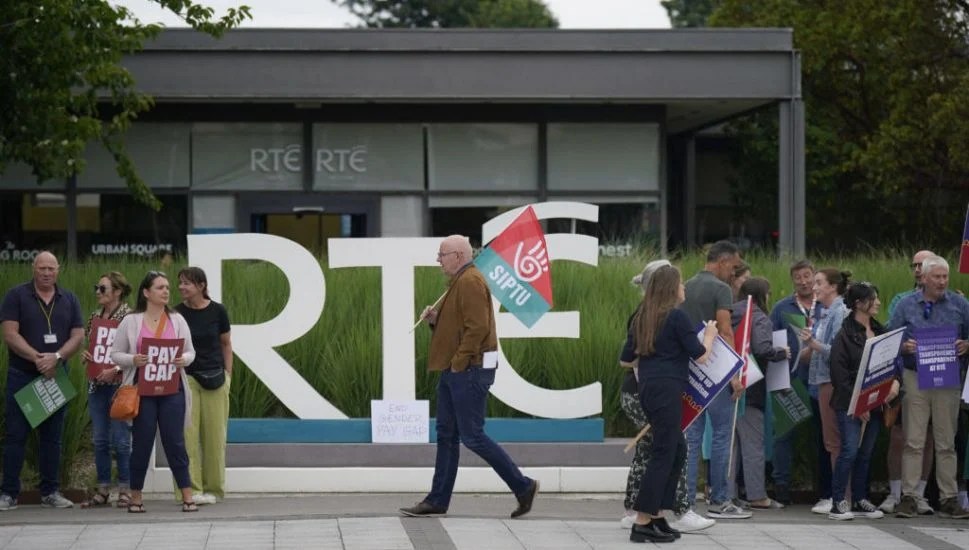
Trusting the State (2) – “RTÉ for the people”

PA Images

People before Profit (PbP) wants an “RTÉ for the people”, but just as the name ‘People before Profit’ invites the question–what people?– so does this new sort of RTÉ.  The elision of class in the PbP name pops up here again, where ‘the people’ doesn’t actually mean every person but perhaps only some, perhaps the poor, those not paid enough, or those considered to be suffering or illegitimately aggrieved.

PbP wants “genuine public service broadcasting [which] is more important than ever. But instead of being a valued public broadcaster, RTÉ has been undermined by underfunding by successive governments and by the deeply corrosive effects of advertising and sponsorships.”

But what is this ‘public service broadcasting’ that must be made “genuine”?  What service is being provided, by whom and to whom?

In so far as it shapes, and purposively shapes, social and political views, the service provided is the view of the Irish state.  This is most obvious when it openly decides to censor alternatives, as in Section 31 of the Broadcasting Authority Act 1960 , which allowed the relevant Minister to direct RTÉ “not to broadcast any matter, or any matter of any particular class”. In 1971 the first such directive was issued to direct RTÉ not to broadcast “any matter that could be calculated to promote the aims or activities of any organisation which engages in, promotes, encourages or advocates the attaining of any particular objective by violent means”. A year later the entire RTÉ Authority was removed over a report on an interview with the then leader of the Provisional IRA, with this censorship remaining in place until 1994. 

‘Public service broadcasting’ is supposedly provided for public benefit rather than to serve purely commercial interests, but this entails the common misconception–that socialists are supposed to disavow–that the state can in some way represent the interests of society as a whole.  And just as society is to be considered as a whole, and not one divided by classes with separate and antagonistic interests, so apparently we also have a classless ‘public’ just waiting to be served.  Hence the burial of the concept of class entailed in supporting ‘public service broadcasting’.

An undifferentiated public is supposed to be serviced by a state that can faithfully represent its interests as against the private interests of “advertising and sponsorships” and of “social media companies owned by billionaires”.   However, while it is one thing to oppose privatisation it is quite another to defend state ownership, although PbP gets it even more wrong!  It not only supports state ownership but wants to see it massively extended. 

It proposes “investment in a comprehensive national public media service, incorporating RTÉ and other public service media e.g. print, local radio, production companies, digital media, etc”, plus “annual public funding . . . increased to €500m, with guaranteed multi-annual funding to enable it to properly fulfil its public service broadcasting remit.”  It wants “an additional fund . . . [to] be made available to respond to the long-standing lack of investment in RTÉ and to rapidly up-grade its equipment and technology”, on top of the revenue increase of over 40 per cent.

But, and there is a but, People before Profit only propose this on certain conditions: that pay caps should be applied to the few high-earners; that “proper” pay and conditions should apply to all other workers; that there should be an end to low pay, to bogus self-employment and precarious contracts; and that there should be mandatory trade union recognition and democratisation of RTÉ.  And who should introduce this?

Well, presumably it is the proprietors who will ensure the introduction of “genuine public service broadcasting”.  Who else could fulfil these conditions but its owners–the Irish state?  So bang goes another principle of socialism–that “the emancipation of the working class is to be conquered by the working class itself”. ‘Proper’ pay, greater equality of income, working conditions, union recognition, and a say over the running of the company are all to be provided for workers by the state.

How do we know this is what is meant? Well, all the additional investment is to come through state taxation: “€500m through a 1% tax on all Information & communications companies” and “a further €500m through an additional 1.25% Big Tech Tax on the largest ICT companies.”  

Democratisation is to come from “replacement of the current Board with a Board representative of RTÉ workers and civil society”; “the board should not be dominated by people with private industry backgrounds”; there should be “development of additional mechanisms for democratic workers and public input into programming decisions”; and “Board members should be subject to recall.”  But who appoints the Board and who would have the power of recall, and recall before whom?  Will the capitalist state institute some form of workers’ control; and if it did–how would this be workers control?

These pick and mix proposals have been made up as its authors went along: who is in “civil society”–the province of private interests–but not “people with private industry backgrounds”, and what exactly are the “additional mechanisms for democratic workers and public input”?

It’s as if PbP had never heard of Karl Marx’s strident opposition to relying on the state to support working class encroachment on capitalist ownership.  It’s as if in the 19th century he anticipated the People before Profit proposals in his ‘Critique of the Gotha Programme’; were we not already aware that such rubbish has been part of the left for over 150 years and addressed here before in a number of posts.

It’s as if this Left has no idea of what an alternative programme would look like, a question they might find easier to answer if they first asked themselves who they are talking to–who they are addressing their programme to, who is it for?  Not the government sitting opposite them in the Dáil during fine speeches; not to a disembodied electorate–seeking votes to save their seats at the next election; and not potential allies like Sinn Fein with whom they want to be beside in the next government.

A socialist programme is addressed to the workers – this is what is meant by ‘the emancipation of the working classes must be conquered by the working classes themselves’. This means that ‘proper’ pay and conditions can only be won by the workers themselves, and only made permanent through their own ruling of society.  That union recognition is most powerful if achieved by the workers themselves–thus strengthening the possibility of avoiding a union sweet-heart deal with the employer, and some control over the union organisation itself. Only by doing it themselves will workers learn that the state broadcaster is not ‘theirs’ and will only be theirs if they take it over themselves, which is only likely and possible in a struggle to take over the running of the rest of society as well.  That is, only under socialism, which is why we fight for it, because working people’s control over their own lives will only occur upon assertion of their interests as a class and their creation of a new social and economic system, called socialism.

So, when PbP states that “ICTU and the NUJ, in their submissions to the Future of Media Commission, both called for a “‘windfall tax’ on the major digital platforms to help support public interest and public service media”, they should demand that they not implore the state to do what it has already rejected, but that they put forward and implement their own alternative. That is, workers media that give a platform to working class organisations through the skills and effort of media and other workers, and one not strangled by the bureaucrats who run trade unions that make their existing media so boring and irrelevant most workers don’t bother with it (which is certainly my experience).

PbP rightly observe that RTÉ “is a microcosm of the unjust class society we live in”, but instead of pointing the way to how it might be overcome it feeds illusions in the state that exists to defend it.  In the next post we will look at another current exercise that does the same thing.

Back to part 1

Forward to part 3

Trusting the State (1) RTÉ and Ryan Tubridy

It’s the subject that dominated the news for weeks in June and July and has now returned.  The RTÉ presenter Ryan Tubridy is not coming back to the state’s radio station.  The broadcaster’s most prominent and highly paid TV and radio presenter has eventually exited following the revelation that his salary was under-reported in the RTÉ accounts by €120,000 between 2017 and 2019 and €150,000 between 2020 and 2021.

A combination of RTÉ management’s concern to impose cuts on the rest of the workforce while keeping the appearance of Tubridy’s payments at under €500,000 a year, and some decidedly dodgy accounting treatment, has led to widespread complaints that RTÉ has been less than transparent and truthful.  And to top it off, the controversy also exposed the existence of previously unknown ‘barter accounts’ used to butter up corporate clients, including €5,000 spent on flip-flops for a party, and €4,200 for membership of an exclusive club in London. 

It has been feeding time at the zoo as the Irish media, including RTÉ itself, has reported endlessly over the convoluted unwinding of the story, with Oireachtas committees interrogation of most of the significant actors screened live on TV, and with some pubs streaming it live. Government Ministers have shaken their heads and commissioned a number of investigations and reports.  The talk is of RTÉ having betrayed its audience – the Irish people. How could they do it?

So, the light entertainment switches to lots of bloviating by politicians competing to show how clueless they are, and other media commentators showing inordinate zeal in going after Tubridy, giving plenty of evidence of jealousy and excessive professional disdain.  However, from the clueless to the haughtily disdainful, they all agree on what really matters – that RTÉ must win back the trust of its audience.  To which, the only serious response by socialists should be – oh no it shouldn’t!

RTÉ is the Irish State’s media arm, and abides by what is its own ‘Overton window’, the range of ideas that are considered acceptable for representation and, by default, those that lie outside this narrow range, that are too ‘extreme’, and which therefore must be disparaged when not being ignored entirely.  As the state broadcaster this range reflects the nature of the state, its character, and the particular complexion of its Irish variety.  Its coverage of the war in Ukraine is not significantly different from that of the BBC.  Since the British state makes no secret of its vanguard role in the proxy war against Russia, and the Irish state is supposed to be neutral, this might seem a greater condemnation of the Irish state, although this is not the case, which we will come to in a later post.

To sum it up, socialists do not want the general or specific views of the Irish state to be taken by the Irish working class as either unbiased, objective or truthful.  Above all we want workers not to trust the presentation of the world and its events from the point of view of the Irish capitalist state, by firstly recognising that this is what is actually involved.  That RTE lied about its ‘star personalities’ while attacking the pay and conditions of its workers should not be seen as some anomaly to be corrected but revealing of its true character.

Unfortunately, this is not the view of those elected representative of the Left who think of themselves as Marxists.  Their view is very different:

‘In a world dominated by social media companies owned by billionaires, genuine public service broadcasting is more important than ever. But instead of being a valued public broadcaster, RTÉ has been undermined by underfunding by successive governments and by the deeply corrosive effects of advertising and sponsorships.’ 

People before Profit quote approvingly the words of Harry Browne, Senior Lecturer in Media Studies at TU Dublin, who attended their press event, saying: “Ireland needs strong public service media. At last, this policy document points a way beyond the politics of scandal and outrage, towards a positive vision for RTÉ and other public oriented media.’  Attached to this is People before Profit’s support for the propaganda arm of the Irish state in the form of a report.

This starts by saying that ‘People are rightly disgusted at what has happened at RTÉ. It is a microcosm of the unjust class society we live in, where the highest paid and richest people are treated as the ‘talent’, while everybody else struggles to get by on low pay and precarious employment.’ 

Yes, it’s a microcosm of the unjust class society we live in, but its particular role is to spread the word that any injustices can be remedied, and by the state itself, including RTÉ, which has, for example, exposed abuse by the Catholic Church. This Left, by putting forward its support for ‘public service broadcasting’ with reforms, shows that it is part of this consensus.

Where this leaves this Left and the view of Marxists, which they claim to be, that the capitalist state must be smashed, is anyone’s guess. Like their perpetual demands for nationalisation and expansion of the role of the state in almost every area in order to deal with whatever problems capitalism throws up, the glaring contradiction of strengthening the state and the illusions in it, while claiming you’re going to destroy it, doesn’t seem to add up.

We’ll examine exactly what they propose in the next post.

Forward to part 2

People before Profit challenges the President of the EU in Dáil Éireann, not.

As we have noted in a number of posts, including this one and a series beginning here, some socialists have argued that the war in Ukraine is both an imperialist proxy war and a war of national defence by Ukraine.

If it is the former, then socialists can support neither side and if it is the latter we are obliged to support Ukraine.  It can’t therefore be both.  As has been argued in these posts and others, there are not two wars going on; there are only two sides and the one involving the Ukrainian state involves an alliance with Western imperialism.

There is little doubt that the pretence of opposing the war while also supporting it through defending Ukraine is unsustainable.  It arises from inability to stand against the tide of the massive propaganda campaign waged in Western states by its mass media and the capitalist-controlled press and television.

The ability to sustain this balancing act against this strong head-wind is partially dependent in how sheltered a particular left organisation is from the attention of this media and their exposure to ‘public opinion’, which is pro-Ukrainian because of it.  Rolling with the punches however is painful and unprincipled; you can’t directly fight back on the central issue because you can’t establish an independent working class position consistently opposed to the supporters of the war.

People before Profit (PbP) in Ireland have been successful in getting representation in the Irish parliament but this leaves them exposed to the mass media and the ‘public opinion’ that it is able to manufacture.  Its politics are already weak, focussed as it is on parliament and maintaining their presence in it.  It is therefore no real surprise that when the President of the European Commission, Ursula von der Leyen, spoke to Dáil Éireann on 1 Dec 2022, its nonsense position fell over, and equally unsurprising on which side it fell.

The response to von der Leyen’s speech by Richard Boyd Barrett started by thanking her and ‘Europe’s commitment to ensuring that there will be no hard Border on the island of Ireland or that the exit of Britain from the EU should not in any way adversely impact on the peace on this island.’  You wouldn’t think that PbP had itself supported Brexit, so giving rise to this concern in the first place. But that is a another story.

He went on to note the housing crisis in the Irish State, stating that – ‘while much of the responsibility lies with successive Governments failing to address it, a large component of the responsibility also lies with the decisions taken by the European Commission and the ECB, as part of the troika, to ram billions worth of austerity down the throats of the people of this country.   It is long past time that the EU acknowledged its mistakes in imposing that austerity and devastating consequences it has had.’

Asking for the political representatives of capitalism to say sorry for their policies is useful for what purpose exactly?  What meaningful difference to anyone was Tony Blair’s apology for Britain’s role in the Irish famine? Was this to acknowledge the baleful role of British rule in Ireland or to present it in a good light as it imposed another ‘solution’.  What use was David Cameron’s apology for the British Army murder of fourteen civil rights demonstrators in Derry in 1972, except to absolve the political leadership and pass the blame onto the grunts on the ground?  What use are requests for apologies for past sins when you support their current ones?

Boyd Barrett went on – ‘I also note that this week the President has called – I support her in this – for a tribunal to be established to investigate the undoubted war crimes of Vladimir Putin in Ukraine. We all condemn the utterly barbaric and murderous invasion of Ukraine by Russia. We support the people of Ukraine in their struggle for self-determination.’

Of course, he noted some hypocrisy here – ‘I must say, however, in the week when there is the International Day of Solidarity with the Palestinian People, for the President to not call simultaneously for an investigation into the ongoing war crimes and crimes against humanity being committed by the apartheid state of Israel against Palestinian people makes me wonder about the consistency of the ethics of the EU’s foreign policy.’

He also criticised EU policy on Saudi Arabian and the ‘EU-Moroccan trade agreement, which involves essentially taking the fish and mineral resources of the occupied Western Sahara people.’

Summing up, he said that ‘If we are to condemn, as we must, the war crimes of Putin, we must simultaneously condemn all war crimes and all crimes against humanity, even when they are committed by people that the European Union perceives as allies, such as Israel, Saudi Arabia or those that arm and support them.’

But what has Boyd Barrett got to say about the war crimes of the Ukrainian state?  Does he not know about the continuing attacks on civilians in Donetsk City that have been going on since 2014?  Has he not seen the videos of captured Russian soldiers being shot in the head by Ukrainian armed forces?   If he wants to condemn the human rights abuses in the war in Ukraine, why does he ignore those carried out by the Ukrainian state?  Or is he too hypocritical in his selective condemnation, ignoring the crimes of the capitalist state he supports?

He finishes by declaring – ‘President, we must have consistency in our foreign policy, in our ethics and in our morality if we are to be taken seriously as defenders of human rights and opponents of war.’

He wants Western capitalist states ‘to be taken seriously as defenders of human rights and opponents of war’?  How is that going to happen?  Since when did it become possible for capitalist states to be consistent defenders of human rights and opponents of war? How can he even conceive that this is possible when every state in the EU is in the midst of supporting the biggest war in Europe since 1945!  Hasn’t Boyd Barrett noticed this support?  Or is it too like his own, as he too parades himself as against the war?

Maybe he should stop wondering about the ethics and morality of capitalism and its state machinery and try to recall some of the Marxism he claims to stand for; like Lenin suggesting that the only thing that will end war is socialism.  Maybe then he might become aware that it is not the inconsistency of capitalist states that is the problem; they are really pretty consistent in their foreign policy and support for war. He might also reflect on his support for Western imperialism adjudicating on the crimes of others, and its Ukrainian allies, when perhaps this is something only the working class can do! Just a thought he might want to consider.

This miserable speech is testament to what happens when socialists abandon principled positions and indulge in capitulation to their own rulers, leading them to the frankly idiotic nonsense that pleads for consistent progressive policies from their own capitalist states in the middle of them supporting a reactionary war.