
Supporters of the New Popular Front in France start from the view that the task of the day is to defeat the far right while in Ireland it is to defeat the mainstream right. In the first, alliance is made with the mainstream right and in the latter with the non-mainstream right that still parades a certain amount of fake radicalism. Since neither the mainstream right or its fake radical opposition will break from capitalism the left makes compromises that it really can’t deny because it has accepted that the task is to defeat the far right, in the case of France, or the main right wing parties in the case of Ireland. Since it is the mainstream right that has facilitated the rise of the far right in both countries the left has allied itself with the cause of this rise in France and discredited itself as an alternative. In Ireland, the logic of the proposed policy is the same but simply lags behind France in its development. This is all pretty straightforward.
The following problems arise. In order to create a left majority, the idea of ‘the left’ is expanded to include anyone opposed to the far right/mainstream right who proclaims itself as in any way left or socialist. This includes those who have been in government and who have attacked the working class when they were there; for example the Socialist Party (SP) in France and Sinn Fein in Ireland.
Since the world is full of parties with socialist or communist in their name that are anything but, it is necessary to know how to determine who exactly is a socialist. In the case of the SP and Communist Party in France this is relatively easy – they have been in government and made it clear that they will defend French capitalism. In the case of Sinn Fein, they have also been in office and present themselves as the most enthusiastic defenders of the institutions that are the product of a ‘peace process’ set up by British and US imperialism. Sinn Fein’s claims to socialism are threadbare to non-existent.
Acceptance of any of these parties’ bona fides means that you join rejection of any coherent definition of socialism, ally with parties that defend capitalism and thus all of its consequences, and means that you then cease to offer genuine socialist politics. This is not because you have proposed some joint action for a specific purpose but because you propose to enter into a government with them with the pretence of a radical or socialist programme. This is not a policy you can turn off and on, becoming true to your claims in-between. This is not a slippery slope you can climb back up, but a result of the slippery slope you have already descended.
The use of words such as ‘radical’ or ‘left’ to justify alliances that cannot be described as socialist, as if there was something other than socialism that offers adequate answers and promises a different society, is one illustration. One consequence is that being on the ‘left’ becomes decisive over being socialist, with the latter robbed of any distinct meaning; all necessary because you have admitted that there is a task more important than fighting the capitalist system and socialism. This task, or ‘stage’, amounts to defending the so-called democratic version of capitalism from the far right, or ending years of the mainstream parties in office without ending the system they represent, as if they were the problem and not an expression.
The far right in France, and main bourgeois parties in Ireland, are here to stay in the foreseeable future, so the argument that there should be an alliance between the ‘left’ and the mainstream bourgeois parties in France, or a ‘left’ in Ireland that includes Sinn Fein, will hold as long as they do. This means that uncompromising opposition to both is fatally undermined and the rationale for an independent socialist alternative is permanently suspended.
The fundamental problem is therefore that the task of organising and politicising the working class to defend its own separate interests as understood by socialists is subordinated, if not entirely dispensed with, in order to defend a particular form of capitalist rule in France, while in Ireland it is to pretend that the latest generation of ‘radical’ nationalists are a genuine alternative to the rule of their historical equivalents.
We see this again and again in the politics of the ‘lesser evil’ – in relation to the war in Ukraine as well as opposition to the far right. It is not an accident that the New Popular Front in France and united ‘left’ in Ireland support the imperialist war. The view that the separate organisation of the working class under socialism is the only safeguard against the far right is forgotten. The view that the prime task is not to defeat the far right or replace one bunch of nationalists with another but to advance this organisation and politicisation is opposed.
Attempts are made, in relation to both France and Ireland, to claim that the policy of a popular front is part of, or at least not incompatible with, this sort of organisation but the alliance with fake-socialists and mainstream bourgeois parties makes such claims impossible to sustain. This is fundamentally because of the second problem with the whole idea, which is that these left fronts are not about the mobilisation of the working class but an electoral alliance. The mainstream bourgeois parties might tolerate temporary expressions of mass support for an alliance with themselves but will never support an independent mobilisation of the working class, because this would have to involve opposition to them to be genuinely independent.
In France the previous Socialist Party government of François Hollande used the state to attack French workers mobilising against its anti-working class policies. Sinn Fein has no tradition of independent working class organisation and even during the height of mass participation in the struggle against British rule in the North, when it wasn’t trying to manipulate it and subordinate it to its armed struggle, it repeatedly went behind the back of the mass struggle to negotiate in secret with the British state.
Today, People before Profit repeatedly declares that it supports ‘street politics’, and that while ‘a shift left will strike fear into the hearts of the establishment and the very privileged elite . . . . Our best defence against them is mass mobilisation from below on the real issues and injustices faced by ordinary working people.’ Supporters of the NFP in France point to the mass demonstrations in support of the NFP as showing the compatibility of mass struggle with electoral alliances.
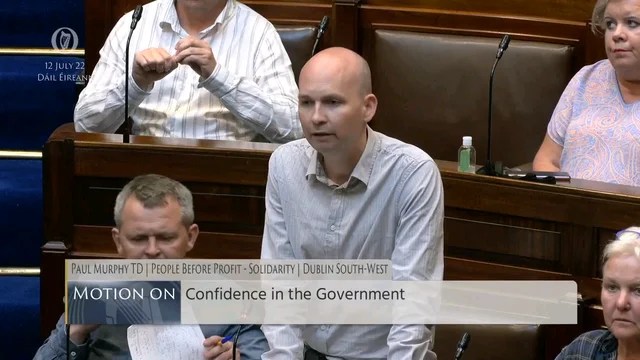
Paul Murphy argues that ‘to overcome their opposition and actually implement the ecosocialist change necessary to resolve the crises faced by people would require a left government basing itself on people-power mobilisation from below.’ In reality, street politics, pressure from below, and ‘mobilisation from below’ in support of a left government are all precisely acceptance of the subordinate position of the working class to a left alliance and a left government.
A current within People before Profit put it well when it said that ‘Electing former traitors to disappoint workers is not a good strategy. Thinking that any amount of protest “from below” can make these snakes anything other than what they are is magical thinking.’ This applies to Ireland as much as France.
Paul Murphy stated that ‘I lost count of the number of times people said to me during the recent election that no matter who they vote for, nothing seems to change. I can’t blame them.’ However, instead of arguing that voting for an alliance that will include Sinn Fein is the answer he needs to explain to workers that the only way to change society is for the working class to do it itself, certainly not to promise that he and his organisation will to do it for them.
The whole article by Murphy makes it clear that radical change, sometimes even called socialist change, is to issue from a left government, to come down from on high with all the benefits of its manifesto to be acclaimed by a grateful working class; forgetting all the lessons of history and all the teachings derived from it by Marxists. Governments don’t rule, classes and their states rule. This is why Marxists call for workers ownership and control and a workers’ state, not a bunch of left politicians surrounded by the levers of office to be used through a capitalist state and bound by and to the economic power of the capitalist class.
Promising to achieve the change set out by PbP from a left government is actually worse than the misadventure of the NFP in France. In France the excuse is that the enemy is at the gate, even if it fails to realise that its other enemy is inside the gate with it. In Ireland, PbP are promising not only that it will thwart the far right but will transform Irish capitalism as well – and with Sinn Fein!
Sinn Fein has demonstrated with its new policy of opposition to the accommodation of refugees that it will continue moving to the right, which PbP can follow by pursuing its ‘left unity’ or reject by tearing up its electoralist strategy and looking for an alternative. The new SF policy is really a two-fingers to its proposal and flushes any pretence it could be part of any genuine left project down the toilet.
‘Street’ politics, ‘pressure’ and ‘mobilisation from below’ of a top-down project to deliver radical change for the working class is not new. It is not the working class achieving its own emancipation. It is the working class being employed to support someone else doing it for them; feeding it the illusion that the capitalist state is the vehicle for its delivery. It makes its activity subordinate to the politics of the left alliance, just as in France today the working class is subject to the machinations within the NFP and the vetoes of discredited politicians such as Holland, once so decisively rejected he didn’t bother standing for President a second time.
The alternative of independent working class organisation and action is not difficult to understand. It is very difficult to achieve, but then liberation and emancipation by the state is impossible. Sinn Fein is not going to become a genuinely socialist party and the Irish civil service is not going to deliver an Ireland of equality and working class power. No amount of PbP TDs will make it happen. The history of class struggle across the world is littered with self-declared socialists who promised to deliver for the working class but didn’t understand that what they promised could only be delivered by the working class itself.
Back to part 1
Forward to part 3


 Sráid Marx