Permanent Revolution (5) – the working class or ‘democratic capitalism’?

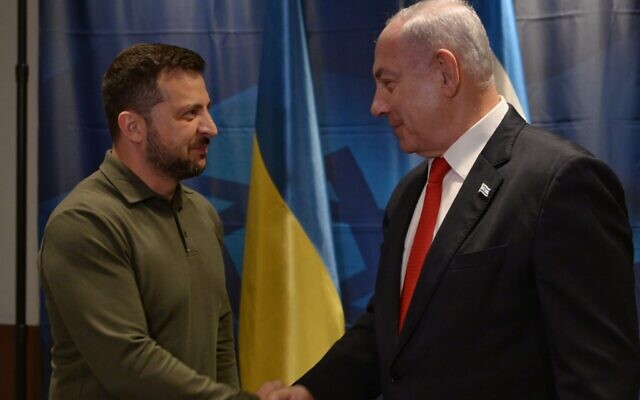
Avi Ohayon/GPO

As we noted in the previous post, the rejection of permanent revolution in practice is ultimately a result of the abandonment of any view that the working class and socialism are relevant. It is not that the objective prerequisites of socialism do not exist – in terms of development of the forces of production and creation of a large working class – but that this class is not conscious of its interests as a class and never will be.  Supporting Western imperialism in Ukraine or supporting Hamas in Gaza is a result.

For defenders of these views, being on the right side of the struggle of the oppressed is enough and everything else is secondary.  Other, perhaps ‘nice to have’ factors, like specifically working class political leadership, are relegated to an indefinite future.  Socialism becomes something so distant from application that it becomes akin to the promise of life after death.

As far as campaigns go, humanitarian demands raised in solidarity with the oppressed suffice to address the issues, and de facto support is provided for whatever political leadership happens to exist, justified on the basis that it does exist – the oppressed have picked their political leadership and who are we to disagree? ‘Being on the right side’ and ‘supporting the leadership of the oppressed’ become moralistic incantations that are supposed to demonstrate one’s commitment to the struggle while ironically condemning it to defeat.  This approach reaches its nadir when it entails support for Western imperialism in Ukraine or Islamic fundamentalism in Palestine.

Identification of the class forces involved and the distinctions arising go missing through talk, for example, of ‘Ukraine’ and the ‘Ukrainian resistance’.  Concepts such as class and the necessity for socialist leadership are rehearsed when left organisations recruit young people and provide them with what passes for a basic education in Marxism but are often ignored when real struggles develop.

*                     *                   *

Permanent revolution does not claim that certain democratic advances cannot be made by bourgeois forces (or by petty bourgeois ones) in every instance, although in the case of Ukraine and Palestine this is clear.  In Ukraine, western imperialism ignores the clampdown on democratic rights by the Zelensky regime including its lack of any constitutional legitimacy.  In this it repeats the events of 2014 and provides another example of the rules-based international order being whatever the Western powers say it is.

In Palestine it routinely speculates on what sort of Palestinian regime will be installed once the Zionist state has halted its genocide, with not the slightest recognition of the right of the Palestinian people to select its own government.  The leaderships that are touted as potential candidates are corrupt and designed to be weapons in the hands of the Zionist state (including the Palestinian Authority).

What democratic tasks that are achieved by bourgeois forces are carried out in their own interests, which interests demand that real democratic control by the majority of a country’s people is excluded.  It is ironic that those who argue that Western imperialism is in effect defending democracy in Ukraine do so when the façade of what passes for democracy is more and more exposed as fraudulent by its policy of support for genocide in Palestine.

In the West the right to protest is under attack as students are clubbed by cops and Zionist thugs in the US, while meetings are proscribed and Palestinian speakers expelled in Germany.  In the US the Presidential election is between two equally repulsive senile geriatrics, almost equally unpopular, where it is almost the case that Trump is the only candidate that Biden could possibly beat and Biden the only candidate that Trump will most likely defeat.

In Britain the choice between Sunak or Starmer is rendered fundamentally meaningless since no essential differences are involved so that there is no worthwhile choice to be made. When the limits of capitalist democracy are so blatantly exposed the stupidity of the claim that these forces are defending democracy becomes impossible to vindicate.  This should provide the opportunity to tear away the fraudulent pretence that imperialism is in some way the protector of any sort of democracy but this requires putting forward an alternative.

In the 19th and early 20th centuries democracy was viewed as tied tightly to the working class movement and socialism so that Friedrich Engels was able to state at one point that the two were almost synonymous.  The bureaucratisation of the workers’ movement, reaching its apogee in the Stalinist states, was a product of its incorporation into, and reconciliation with, the capitalist state, either in the form of reforming the state or in the form of ‘socialism in one country’ and its pursuit of accommodation with ‘democratic’ capitalism. In doing so it lost the identification of socialism with democracy.

The associated transformation of socialism into the idea that the capitalist state is the means to socialism, or even the potential embodiment of it, has meant that the central claim of Marxism, that the emancipation of the working class must be carried out by the working class itself, has been buried and lost.  This distortion is so ubiquitous it is how the idea of socialism is habitually and unthinkingly understood.

So, in Ireland the idea of a ‘left government’ (of a capitalist state) is paraded as the answer while in Britain the idea of nationalisation (capitalist state ownership) was, in the form of clause 4 of the Labour Party, the totem of socialism.  Other forms of capitalist rule, such as authoritarianism or fascism, thus become not just particular forms to be opposed but turn ‘democratic capitalism’ into the ‘lesser evil’ that must be positively supported.  What democratic rights that do exist thus become not just elements to be defended but reasons to ‘suspend’ opposition to capitalism and ally and subordinate socialism to the demands of ‘democratic’ capitalism.

These corrupting assumptions makes it easier for many self-declared socialists to claim that the Ukrainian state, Western imperialism, or the Russian or Chinese varieties are today’s forces of democracy, ‘anti-imperialism’ or even socialism.  All such claims are what permanent revolution rejects, and the road back to the central assertion of Marxism lies through reclaiming it.

*                     *                   *

In relation to Ukraine, permanent revolution means opposition to the Russian invasion, opposition to the Ukrainian state and opposition to the intervention of Western imperialism.  Opposition to war thus means organisation of the working class in opposition to membership of NATO and its rearmament.

In Palestine it means opposition to the Zionist State and its genocide and the liberation of the Palestinian people through a permanent revolution that seeks the unity of the Arab working class of the region against their exploiters and oppressors.  The liberation of the Palestinian people can only be achieved by the liberation of all the working classes and oppressed in the region, which alone can offer a socialist alternative to Jewish workers and an alternative to their allegiance to Zionism.

In this, we really have no choice.  The ‘democratic’ governments and states of the West have provoked a war in Ukraine and their defence of the Zionist state has shown us that there are no limits to the barbarity they will support.  Continued escalation of the war in Ukraine only points us to a world war.  

Russia and China are no defence against such a war because ultimately their only weapon against their Western enemies is also war.  The Russian invasion of Ukraine is proof, as are the repeated threats against Taiwan and the constant provocations of the United States that threaten to precipitate it.

Perhaps it will then be clear – even to the most stupid – that imperialism defends itself, is not interested in those it exploits and is no defender of democracy.   The working class, whose members are always expected to fight and die in every war, will face the choice of war or peace and that peace can only come through ending capitalism.  Once again it will be permanent revolution to end the war or war to end civilisation.

Of course, we are not there yet, but one product of the war in Ukraine has been the readiness of many in the West, normally opposed to war – as previously in Iraq – to rally behind this one.  The fake-left supporters of war are only a small part of this much larger constituency.  However the war in Ukraine ends, with some temporary ceasefire or agreement, the conflict and antagonism between rival imperialisms is not going to go away; imperialism itself has no way of ensuring that they do not intensify, and the world will face the possibility of their eventual resolution by way of force, in the way such conflicts have been settled before.

In some ways we are back to Marx, when the working class was not ready then either:

‘although the German workers cannot come to power and achieve the realisation of their class interests without passing through a protracted revolutionary development . . . they themselves must contribute most to their final victory, by informing themselves of their own class interests, by taking up their independent political position as soon as possible, by not allowing themselves to be misled by the hypocritical phrases of the democratic petty bourgeoisie into doubting for one minute the necessity of an independently organised party of the proletariat.’

Back to part 4
Permanent Revolution (3) – basic principles

Trotsky, in his booklet The Permanent Revolution, set out a number of its ‘Basic Postulates’.  These include the following:

‘2. With regard to countries with a belated bourgeois development, especially the colonial and semi-colonial countries, the theory of the permanent revolution signifies that the complete and genuine solution of their tasks of achieving democracy and national emancipation is conceivable only through the dictatorship of the proletariat as the leader of the subjugated nation, above all of its peasant masses.’

‘3. Not only the agrarian, but also the national question assigns to the peasantry – the overwhelming majority of the population in backward countries – an exceptional place in the democratic revolution. Without an alliance of the proletariat with the peasantry the tasks of the democratic revolution cannot be solved, nor even seriously posed. But the alliance of these two classes can be realized in no other way than through an irreconcilable struggle against the influence of the national-liberal bourgeoisie.’

‘4. No matter what the first episodic stages of the revolution may be in the individual countries, the realization of the revolutionary alliance between the proletariat and the peasantry is conceivable only under the political leadership of the proletariat vanguard, organized in the Communist Party. This in turn means that the victory of the democratic revolution is conceivable only through the dictatorship of the proletariat which bases itself upon the alliance with the peasantry and solves first of all the tasks of the democratic revolution.’

‘8. The dictatorship of the proletariat which has risen to power as the leader of the democratic revolution is inevitably and very quickly confronted with tasks, the fulfilment of which is bound up with deep inroads into the rights of bourgeois property. The democratic revolution grows over directly into the socialist revolution and thereby becomes a permanent revolution.’

‘9. The conquest of power by the proletariat does not complete the revolution, but only opens it. Socialist construction is conceivable only on the foundation of the class struggle, on a national and international scale.’

‘10. The completion of the socialist revolution within national limits is unthinkable . . . The socialist revolution begins on the national arena, it unfolds on the international arena, and is completed on the world arena . . .’

‘11. The above-outlined sketch of the development of the world revolution eliminates the question of countries that are ‘mature’ or ‘immature’ for socialism in the spirit of that pedantic, lifeless classification given by the present programme of the Comintern. Insofar as capitalism has created a world market, a world division of labour and world productive forces, it has also prepared world economy as a whole for socialist transformation.’

‘13. The theory of Stalin and Bukharin, running counter to the entire experience of the Russian revolution, not only sets up the democratic revolution mechanically in contrast to the socialist revolution, but also makes a breach between the national revolution and the international revolution.’

        *         *          *

The number of ‘countries with a belated bourgeois development, especially the colonial and semi-colonial countries’ has decreased dramatically in the last one hundred years, most obviously with the massive growth of the working class, relative decline of the peasanty and the disappearance of most colonies.  Many of the semi-colonies are now important capitalist states, including those in the expanding BRICS collaboration.

It might therefore be considered that the theory of the permanent revolution, which ‘signifies that the complete and genuine solution of their tasks of achieving democracy and national emancipation is conceivable only through the dictatorship of the proletariat as the leader of the subjugated nation, above all of its peasant masses’ is of limited relevance today.

After all, how true is it that ‘the agrarian, but also the national question assigns to the peasantry – the overwhelming majority of the population in backward countries – an exceptional place in the democratic revolution’? Does this no longer apply in many countries?  We no longer consider that the question is one of democratic revolution but of socialist revolution in countries with widespread industrialisation and a large working class.  Even when Trotsky set out the basic ideas of Permanent Revolution, he was stating that his ‘sketch of the development of the world revolution eliminates the question of countries that are ‘mature’ or ‘immature’ for socialism.’

He went further to say, in the Transitional Programme in 1938 that ‘the economic prerequisite for the proletarian revolution has already in general achieved the highest point of fruition that can be reached under capitalism . . . All talk to the effect that historical conditions have not yet “ripened” for socialism is the product of ignorance or conscious deception . . . The objective prerequisites for the proletarian revolution have not only “ripened”; they have begun to get somewhat rotten . . .  The turn is now to the proletariat, i.e., chiefly to its revolutionary vanguard. The historical crisis of mankind is reduced to the crisis of the revolutionary leadership.’

Many who claim to be Trotskyist accept that the theory of Permanent Revolution applies today and also continue to argue that humanity’s crisis ‘is reduced to the crisis of the revolutionary leadership.’

We have seen, however, that despite this, many – if not most – agree to the theory but abandon it in practice.  They avoid cognitive dissonance by employing a different set of assumptions that enable the adoption of a different set of outwardly Marxist formulas to the actual struggles that arise and which previously would have been considered to come under the purview of the permanent revolution strategy.  Let’s take a look at Ukraine and Palestine.

In Ukraine, the supporters of that state who demand self-determination for Ukraine must presumably believe that the national question is key, and that therefore that the ‘democratic revolution’ is on the agenda, even if this no longer requires an alliance with the peasantry. But if this is so, where is the fight for the view that ‘the complete and genuine solution of their tasks of achieving democracy and national emancipation is conceivable only through the dictatorship of the proletariat?’  Why is support given to a bourgeois political regime and capitalist state when what is required is an ‘irreconcilable struggle against the influence of the national-liberal bourgeoisie’, with the need for ‘the political leadership of the proletariat vanguard, organised in the Communist Party?’

When have the supporters of ‘Ukraine’ ever put forward this argument to Ukrainian workers or those in their own country?  When has permanent revolution even been mentioned? Why do they defend the intervention of Western imperialism when ‘the democratic revolution grows over directly into the socialist revolution and thereby becomes a permanent revolution?’  How could Western imperialism fail to be a barrier to such an outcome? Why then do they support it?

The only political explanation is that they do not believe that permanent revolution is relevant, which means that socialism is not relevant and socialist revolution inconceivable and not in any way be a guide to longer term strategy. However, if this is so, the theory of permanent revolution states that there can’t be a democratic revolution either. They can’t believe the statement that in ‘the colonial and semi-colonial countries, the theory of the permanent revolution signifies that the complete and genuine solution of their tasks of achieving democracy and national emancipation is conceivable only through the dictatorship of the proletariat as the leader of the subjugated nation.’

They therefore cannot believe that ‘the objective prerequisites for the proletarian revolution have not only “ripened”; they have begun to get somewhat rotten . . .  The turn is now to the proletariat, i.e., chiefly to its revolutionary vanguard. The historical crisis of mankind is reduced to the crisis of the revolutionary leadership.’  If the problem was simply one of revolutionary leadership, why wouldn’t they be offering revolutionary politics?

In so far as the supporters of the Russian invasion advance the same arguments in relation to the democratic tasks supposedly devolving to the Putin regime and Russian state, purportedly justified by the rights of the Donetsk and Luhansk People’s  Republics, the same questions are posed to them!

If we turn our attention to Palestine, which is a question of (settler) colonialism, the genocide of the Palestinian people and the role of Western imperialism demonstrate that a revolution is required for their liberation.  Why is Western imperialism not their saviour as it is claimed it is for the ‘people of Ukraine’?  Why do the bourgeois Arab states not perform the same revolutionary democratic role played by the Ukrainian one?  Again, where are the arguments above advanced that this liberation can only come through permanent revolution?  A struggle that needs to be fought by the working class, under socialist leadership, ‘on the foundation of the class struggle, on a national and international scale’?

Instead, the debate revolves around a one state or two state solution, with neither having any particular class content, which, in effect, means that they are both proposals for a capitalist state and with no indication that a wider socialist revolution is necessary, in the Arab region or wider afield.

How are we to make sense of this à la carte Trotskyism – ‘God make me a Communist, but not just yet’?

Back to part 2

Forward to part 4

Permanent Revolution (2) – beginning with Marx

The theory of Permanent Revolution is associated with Leon Trotsky, although Marx is well known to have originated the term in his Address of the Central Committee to the Communist League in March 1850.  In this address he proclaimed that for German workers ‘their battle-cry must be: The Permanent Revolution.’

Marx called for this revolutionary strategy even though he noted that the situation was one in which ‘the German workers cannot come to power and achieve the realization of their class interests without passing through a protracted revolutionary development.’  They were to be comforted by the knowledge that ‘this time they can at least be certain that the first act of the approaching revolutionary drama will coincide with the direct victory of their own class in France and will thereby be accelerated.’

Their task was not one of immediate revolt but ‘must contribute most to their final victory, by informing themselves of their own class interests, by taking up their independent political position as soon as possible, by not allowing themselves to be misled by the hypocritical phrases of the democratic petty bourgeoisie into doubting for one minute the necessity of an independently organised party of the proletariat.’

Today, we are not in a situation in which the German or any other section of the working class is going to come to power, and ‘a protracted revolutionary development’ is required.  This is not admitted by many calling themselves Marxist but is imposed on them anyway.  The price paid is that they can’t consciously adjust their theoretical or strategic framework to adapt appropriately.

Today, we are again called upon to support ‘democracy’: for a ‘democratic’ Ukraine against autocratic Russia and to ‘defend the right of self-defence’ of the ‘only democracy in the Middle East’. The protests by students in US universities against the genocide carried out by this democracy is said by Antony Blinken to be a ‘hallmark of our democracy’ just as the students are attacked and locked up.  The ‘hypocritical phrases’ of the democratic bourgeoisie and petty bourgeoisie are thus louder now than they were when Marx called for their rejection 175 years ago, making his remarks as apposite now as they were then.

Unfortunately, much of the left has forgotten what it means to inform workers ‘of their own class interests, by taking up their independent political position as soon as possible’ and ‘by not allowing themselves to be misled by the hypocritical phrases’ of democracy.  Calls for national self-determination of Ukraine or Donbass simply become the hypocritical phrases by which to justify rallying behind Ukraine, because it is a ‘democratic’ capitalist state, or behind Russia, because it is fighting Western imperialism.

The capitalist character of both is rendered irrelevant by talking about ‘Ukraine’ or ‘Russia’ or the ‘people of Ukraine’ etc. while ignoring the need for the working class to ‘achieve the realisation’ of its ‘own class interests’ by ‘taking up their independent political position as soon as possible.’

On one side the Ukrainian capitalist state and Western imperialism are supported as defenders of these interests and on the other the Russian capitalist state is supposed to play the same role.  Neither can point to any independent role for the working class itself or even the existence of its own organisations that are not totally subordinated to, or in support of, their respective states.  In doing so it almost becomes superfluous to accuse them of abandoning Marxism.

The cognitive dissonance involved in defending a corrupt capitalist state, defending the massive intervention of western imperialism, and a war that continues only because of this intervention, can be seen in three defence mechanisms often employed to avoid accepting the patent contradictions: avoiding, delegitimising and belittling.

So, we get the avoidance of the implications of the points just raised and the commitment to a more straightforward campaign in support of the Palestinian people.  The arguments against support for the Ukrainian state are delegitimised by aping the propaganda of the mainstream media for whom opposition to Western imperialism and its proxy war can only equate to support for Russia.  Since this Left starts from opposition to the Russian invasion, its inability not to default immediately to support for Ukraine and the West reveals the utter irrelevance of any declared adherence to socialist politics separate and opposed to both.

Finally, the cognitive dissonance is limited through the importance of the war also being strictly circumscribed.  So, opposition to Russia becomes opposition to Russian imperialism while support for Western imperialist intervention is dismissed as the latter doing the right thing for its own reasons – without this having any significance for what it is actually doing.  The existence of a proxy war that defines a global conflict is also rendered irrelevant by the primary and over-riding issue being argued as the right to self-determination – of an independent capitalist state that had already determined its own future by allying with Western imperialism against its rival next door: not a very clever thing to do and a very reckless one for the interests of the Ukrainian working class.  The obvious danger of escalation of the conflict to a world war is also minimised but is implicit in the absolute priority given to the victory of the Ukrainian state and thereby, necessarily, of Western imperialism.

To claim that the invasion should not have taken place and is wrong.  That it should be opposed and the invaders blamed for the actions they have carried out, and for which they are responsible, is all very well but hardly constitutes an understanding of why it happened, what should be done about it, and by whom.  If you are a socialist, this socialism should have some role in answering these questions.  As has been stated many times on this blog, if you find yourself coming up with the same explanations and same policy as Western imperialism you need to deal with a lot of dissonance.  How could you start from a socialist position and end up with a policy indistinguishable in all essential and practical respects from Western imperialism? 

It is therefore relevant to look again at the ideas involved in permanent revolution to see how these should guide a socialist view of the current conflicts. 

Back tom part 1

Forward to part 3

Permanent Revolution (1) – Introduction

The world is facing a Zeitenwende, an epochal tectonic shift, according to the German Chancellor Olaf Scholz, which he claims means that Germany and the rest of the EU, United States and NATO needs to protect “our open societies” and “stand up for our democratic values”.

The US Government-backed National Endowment for Democracy has reported the view that there are three possible outcomes of this Zeitenwende, or inflection point, as Joe Biden put it:

‘1. a reinvigoration and reinvention of our existing international liberal order.’

‘2. Chinese-led illiberal order.’

‘3. or the breakdown of world order on the model of Putin’s “law of the jungle”.’

The first primarily involves ensuring the strategic defeat of the second, while the second requires the failure of the first, and the third involves in various forms the results of both of these failing.

This is portrayed as a battle between democratic and autocratic systems, so while recognising that “we might all have become capitalists (with the possible exception of North Korea and a tiny handful of other countries) . . . it makes a huge difference whether capitalism is organized in a liberal, democratic way or along authoritarian lines.”

The realpolitik involved in these sonorous pronouncements is admitted by noting that in the ‘democratic’ alliance against autocracy “What’s crucial in the year ahead is for democracies to unify in a common cause to shape the global future alongside moderate, modern non-democracies that seek a more secure, prosperous, and just world.”

What we have then is not a battle of democracy against autocracy but competition between shifting capitalist alliances sharply exposed by the war in Ukraine, which the genocide of the Palestinian people has demonstrated has nothing to do with democracy of even the most diluted capitalist kind.  Far from democracy being advanced by the war in Ukraine and support for the Zionist state, the former has been employed to justify shrill predictions of war across Europe and the need for massive rearmament, while the latter has involved damning those who oppose genocide as violent antic-semitic extremists who must be violently prevented from exercising their right to march and protest.

While for many new generations this is something new, it is far too familiar to anyone with any historical understanding not to recognise.  When the world is described as turning upon competition between rival capitalist blocs, with the eruption of regional wars and threats of a much greater conflagration, we would have to be suffering from amnesia not to recall the precedents.

In World War I a rising German industrial power sought its own colonial outlets, which required domination of Europe and defeat of the existing British and French Empires.  In Asia Japan sided with these old colonial powers and the United States but then itself sought its own Empire that brought it into conflict with the old European Empires and the US in the next war.  It is uncontroversial to note that World War II was the continuation of World War I because both had the same fundamental causes even if the latter is more commonly retold as a war against fascism and Japanese barbarism.

The same dynamics lie behind the war in Ukraine and the defence of the Zionist state by its Western sponsors; also accompanied with the same ideological garbage of defending democracy against autocratic China and a barbaric Vladimir Putin.  In turn China claims only to seek its own freedom for development as a new centre of expanding capitalist accumulation, while Russia claims simply its right to its own sphere of influence, which can only come up against that of its Western imperialist rivals.  Or vice versa, if you prefer.  Having sought alliance with Western imperialism through NATO membership, Russia, like Japan before WWII, has decided that this alliance is fundamentally anti-Russian and is now in a war against its Ukrainian proxy.

Democratic capitalism in World War II did not cease to demonstrate the hypocrisy of its liberal regime through its determination to hold on to its Empires regardless of the local desire for independence. So, the end of the war witnessed the French and the Dutch etc. – following their own occupation – fight to impose their own on their colonial possessions. Today, the claims of democratic capitalism against the Russian Bear and Chinese Dragon are similarly fraudulent as the West supports a genocidal Zionist state and uses its mass media to claim that this State is really the victim.

The Second World War was facilitated by the defeat of the revolutionary uprisings of the working class in Germany and Central Europe and the defeat of mass struggles in Italy, France and Britain etc. in the inter-war period.  In Spain the democratic revolution was defeated by fascism because the struggle was led by forces that demanded that the workers go no further than support a democratic capitalism that would rather see the victory of fascism than open the door to socialist revolution.  The same calls are made today to rally round the more ‘progressive’ capitalist parties in order to defeat Le Pen, Trump and Sunak etc. except that we have already gotten Macron and Biden to show that if you vote for the ‘lesser’ evil you do indeed get evil.  In Britain the Labour Party leadership has demonstrated that democracy in its own party is to be strangled and Brexit made ‘to work’ while no promise of genuine reform is too mild not to be betrayed.

The dynamics of war are therefore the same now as they were prior to the First World War and prior to the Second.  What is very different is the absence of a working class movement able to challenge the prospect of capitalist war and promise a socialist alternative.  There is no working class alternative Zeitenwende, so no fourth alternative to the triumph of one capitalist hegemon or the other, or the mutual destruction of both.

The small left that claims to be the inheritor of the old revolutionary working class movement has swallowed the lie that Western imperialism is defending democracy in Ukraine and that the Ukrainian state should be defended because it is a capitalist democracy.  It therefore supports one of the imperialist blocs.  A smaller section within Europe supports Russia simply because it opposes the current imperialist hegemon, even though this policy simply means support to the rivals for such a status.

Competition between rival imperialist blocs cannot lead to some sort of accommodation that respects the interests of all of them in a ‘multi-polar’ world, for that is not the purpose of capitalist economic or state competition.  The bloody history of the last 150 years demonstrates that this competition rejects any limits, and that even with only a single imperialist superpower war is ever present.  Now, with the relative decline of that superpower we are returning to circumstances akin to World War I and II, so that what is at stake is not a new accommodation of regional alliances, or limited regional wars, but a global conflict.

If the fourth alternative is to be rebuilt those that are still Marxist in more than just name must set out what this is, which brings us to the ideas contained in permanent revolution.  These began with the struggle for democracy by the working class, was made famous by the requirements of the revolutions in Russia in the first decades of the twentieth century, and now stand as the banner of the camp opposed to imperialist rivalry and to the ruination of the world that it threatens, already signposted in Ukraine and Palestine.

Forward to part 2

Iran falls into the trap?

A couple of weeks ago at an anti-war meeting in Belfast a number of speakers remarked that the state of Israel had exposed itself through its open espousal of genocidal intentions and that the Western powers were similarly damned through their support for it.  And this is true as far as it goes, which isn’t nearly far enough.

I made the observation that the open threat of genocide was a double-edged sword.  The point I made was that the ability to openly threaten such a thing was dangerous and particularly when it is then carried out! The full-blooded support of the Western powers has not even been dented either.

The renewed threat of a wider regional war has now come to the fore following Iran’s attack on Israel with hundreds of drones and missiles.  The immediate action of the US, Britain, France and a number of Arab countries has been to come to the aid of the genocidal state.  The large number of drones and missiles has reportedly not killed anyone and it is pretty clear that this was not far from the Iranian intention, given that their attack was hardly a surprise and most of the weapons used were unlikely to breach Israeli defences.

Previously, I agreed with a large number of observers that Iran would be falling into a trap by reacting to Israel’s provocations, but it obviously believes that the repeated attacks on leading figures were going to continue; that this was damaging to its standing and that sooner or later some provocation would be too damaging to pass over.  However, none of this is enough to explain its attack, while its statement that it has concluded its actions and will stop there is designed to draw a line under the exchange.  Whether it believes this, given the purpose of the Israeli provocations, must be open to some doubt.  It must therefore believe that it can weather a war with Israel or its action is a better alternative to continuous offences and accumulation of injuries.

On the Israeli side, the attack on the Iranian diplomatic facility in Syria was a clear provocation, or an invitation to attack it, to put it another way.  It must be assumed that this is because a war with Iran will serve its purposes and it believes it can win, which is the common view of most commentators. The claimed 99% success in downing the drones and missiles is held up as evidence of Israeli military superiority, which needed only a casus belli for the Zionists to seek to impose it, one which its western imperialist supporters would immediately endorse regardless of the hypocrisy in defending the right of the genocidal state to self-defence while denying the same to Iran.

Supporters of Russia in their on-line channels have raised doubts about the more or less complete blocking claimed by both the Israeli state and Western media and have pointed to the success of the most advanced Iranian missiles in penetrating Israeli defences, while also arguing that the Iranians did not obviously seek to maximise casualties but to demonstrate intent and capability.  They argue that this explains to some degree the weakness of the impact while also pointing out the benefit of the intelligence gained in observing the response to the attack and the huge cost of Israeli success.  They also note the contribution of the Zionist state’s imperialist allies, which they claim is not certain to continue.

Whether Iran has greater offensive capacities is something that will be demonstrated should the conflict escalate.  What almost all the commentary has claimed is that Western imperialist support is conditional and that its contribution to the attack by Iran is leverage for the widespread calls to Israel by Western leaders that there should be no escalation.  And this is where the narrative stops making sense.

The Western imperialists, foremost the US, is supposed to be trying to pull Israel back from too aggressive a response to a regime it wants to overthrow.   The same US that has armed and defended Israeli genocide is suddenly resisting its attack on Iran.  Haven’t all the Western powers spent the last six months claiming to be deploring or holding back Zionist genocide?  To what effect?

We are to believe that repeated Israeli provocations have not been approved by the US.  How credible is this?  Israel is more dependent on the US now than it has almost ever been but we are supposed to believe that it went ahead and triggered a potential war with Iran without getting the ok from the US?

Is the immediate defence against the Iranian attack not evidence of support for the Israeli stance, and is the failure to denounce its provocations only the result of embarrassment at Israeli actions?  When the Biden regime once again declared its four-square support for Israel, was this a lie?   Why would the US support provocations that can only lead to war if it was not going to back Israel when it would arrive?  

The argument in response is that the US does not want another ‘forever war’ and that Biden will not want another one as he seeks re-election. But have those putting forward this argument not noted that the US has already provoked a war in Ukraine and is desperately seeking to keep Ukraine in the game, to keep the war going, and have they not also noted that a war by Israel against Iran will be more popular domestically than genocidal slaughter in Gaza, from which it might serve to divert attention?  It may seem perverse that the US, with Israel, may seek to claim the moral high ground by commencing another war but they have already done so in Ukraine and Gaza.

It is impossible to ignore that just as Ukraine is a proxy for US imperialism in its rivalry with Russia and China so is Israel a proxy in its rivalry against Russia’s Iranian ally.  The prospect of war between Israel and Iran has immediately involved Western imperialism directly and such continued support would make more obvious the reality of a world heading to a conflict between the old imperialist hegemonic alliance led by the United States, with its mostly European satraps, and the new capitalist rivals headed by China and Russia, supported by Iran and North Korea.

The duty of socialists is to oppose these wars and oppose the dynamic to a world conflagration. We should therefore oppose the drive to war by Israel and its imperialist sponsors and point out their prime responsibility for the current escalation.  In doing so we must oppose the old imperialist hegemonic alliance and also oppose the claims of its rivals. These claims are not those of liberation but of their right to carve out their own ‘fair share’ of the wealth of the world created by its workers, who they both compete in exploiting.

This is a lesson forgotten by those ‘leftists’ who either support Ukraine or Israel and, on the other side, those who think themselves ‘anti-imperialist’ for supporting the new upstart capitalist powers in the shape of China and Russia. There is no ‘fair sharing’ involved in capitalist competition, not with the workers exploited or with rivals.  What there is is permanent instability and conflict that inevitably erupts in war that working people pay for with their lives.  Such are the lessons of history.

What future for Palestine?

What is going to happen to Palestine?  The sense that the catastrophic situation is almost hopeless and that nothing can be done is reflected in the short video by the Scottish blogger Craig Murray. The question was addressed from a Marxist viewpoint in Boffy’s Blog and we are obliged to consider whether he is he right about the future of the Palestinian cause.  We can start to do this by looking at what is currently happening and what the past has to tell us about how we got here.

The invasion of Gaza was for months defended as ‘Israel’s right to self-defence’, with no one appearing on television being allowed to open their mouth before it being demanded that they agree and condemn Hamas.  This ‘right’ was said to involve targeted strikes against Hamas and avoidance of civilian casualties, still claimed today by Zionist apologists but now with zero credibility.

It took no time at all before it became clear that the Israeli Defence Force (IDF) invasion was an exercise in mass murder, with the specific targeting of journalists who could report on it, aid workers who could feed the besieged population and medical staff who could treat the sick and wounded.  It was claimed that hospitals were not being attacked and were not going to be attacked until now there are effectively none left.  The targeting of journalists, aid workers and medical staff had its rationale in defending lies, starving the population and targeting the sick and injured so that nothing was out of bounds and no hope would remain.

Civilians, particularly children and women, became the main casualties in the ‘war against Hamas’. Advised by the IDF to move to ‘safe’ areas, they were then bombed.  Millions were forced to leave their homes that had been totally destroyed and made to move further and further south in what had all the appearance of ethnic cleansing.  Each atrocity merged into the next and the intensification of the viciousness of the IDF was made more cynical by the lies that accompanied each one of them.

The International Court of Justice found that there was a plausible case of genocide although the majority of world opinion had already arrived at this conclusion some time before and had demonstrated this though thousands of protests across the world.  The speed of the killing and the callousness of the Zionist state left no room for illusions as to what was being carried out.  

There was incredulity and horror when the death toll rose and rose to dwarf that of the Hamas attack on October 7th, while no crime seemed too atrocious for it not to be followed by something worse.  Liberal illusions that an ICJ judgment might stop or even moderate the killing were swiftly dashed as were vague expectations that the pogrom might expend itself. Many hoped that there would be some sign of it ending but such hopes were repeatedly dashed by each new greater atrocity.

The reaction of Western governments was to repeat Zionist lies about forty beheaded babies and systematic rape etc. and continue to plead ‘Israel’s right to self-defence’.  Biden went out in front by claiming to have seen the evidence and calling into question the number of dead Palestinians, the total of which is now many times the number he denied.  The Western media sought to sow distrust of the scale of the killing through mandatory reference to the source of the numbers coming from the ‘Hamas-run’ Health Ministry.

The Zionist state was clearly breaking international law, as is all Western state support for it.  This includes not only political cover but continued supply of weapons and ammunition; posting a naval armada around Gaza and beyond to defend it, and attacks on those such as the Houthis who carried out armed actions against Western shipping going to and from the Suez canal.

Far from attacking the forces that were committing genocide, a course of action no one in the world remotely expected, the US and British attacked those trying to stop it,  Upon unproven allegations by the Israeli state, already repeatedly shown as pathological liars , a dozen Western powers stopped their aid going into Gaza.  Now the inevitable famine is accelerating, food aid is blocked by the IDF and this week seven aid workers have been killed.  The acme of cynicism can be seen by the US dropping tiny amounts of aid from aircraft while supplying the bombs that the IDF drops to kill the same people. 

Each atrocity causes more dismay and outrage and each Zionist lie more anger and frustration as they are propagated by the Western media.  The majority of the world knows that what is happening in Gaza is genocide and that each atrocity leads not to a step back but to a new level of barbarity so that the word is no exaggeration.

No step has been too barbaric for the western powers to row back and sanction the Zionist state while ‘international law’ is exposed to be whatever these powers decide.  Reliance on the UN, always a liberal illusion, is exposed as so much handwringing. Who is going to impose sanctions and punishment?

The Arab regimes that were set to come to terms with the state of Israel before October 7th are dogs that have barely barked with no intention to bite.  Iran is keen to stay out of war and for its own state interests is wise to do so; its conflict with the US has been subject to agreed limits but Israel increasingly shows that these are not theirs and is attempting to provoke a wider conflict. Those with the mistaken belief that the Israeli state is somehow losing the existing ‘war’ might consider all this.

So, who else is going to stop the genocide because it is not over yet, and any pause–like every other Zionist imposed ‘peace’–will simply set the scene for the next war.  Even the declared objective of destroying Hamas is a project to destroy the Palestinians in Gaza as in any way politically relevant, leaving nothing to prevent whatever next steps the Zionist state decides to take.  In the West Bank the repression of the Palestinians has accelerated as more land is expropriated and the Zionist settlers are allowed to do the IDF job for it, egged on by a Government of rabid racists and fascists.  The remaining Palestinians within Israel will suffer more discrimination and oppression. 

Knowing this, the answer to the question – what is going to happen to Palestine? – is that the objective of politically crushing Palestinian resistance of any sort will continue and all and every measure will be employed as the Zionist state, supported by the US, to achieve this objective.  The population of Israel has moved sharply to the right and is now dominated by rabid racism, leaving even ‘liberal’ Zionism and those calling for peace small and isolated.

With the continued support of Western imperialism the Zionist state will continue its policy of erasure of the Palestinian people so that no state of their own can be realistically conceived. The so-called ‘two-state’ solution has been dead since it was first proposed by the United Nations in 1947 and then buried by the Zionist movement alongside the occupations by Egypt and Transjordan. The current genocide is perfectly consistent with the Zionist project and its enactment going back to this time and before.  The extreme brutality and targeting of civilians is nothing new, as is the disproportionate violence inflicted following any form of Palestinian resistance.  The supremely cruel and brutal response after October 7th could not be unexpected.  It has stretched the previous murderous violence of the Zionist state but it is not qualitatively different from the policy of ethnic cleansing upon which the Zionist state was first constructed.

That this state has been able to so openly flout the pretences of the Western powers to defend human rights and lawful behaviour is because the Zionist state is an outpost of Western imperialism itself; it is its son of a bitch.  Israel relies on this imperialism, especially the US.  Who can the Palestinians rely on that can weigh against the overpowering position of the Zionist state when it has this support?

It is obvious that by themselves the Palestinians cannot win an independent state and that the solidarity movement cannot make the difference unless it were able to neuter the intervention of the Western powers. This might allow the workers and poor of the Arab world to join together to overthrow their own regimes and the Zionist state. Is there any sign that the support of Western imperialism has been in any way significantly damaged?

Let’s take the example of our own county: Ireland is supposed to be a beacon of support for the Palestinian cause but what is its contribution to the prevention of genocide?  The UN special rapporteur Francesca Albanese put it plainly and honestly:

‘There’s this tendency to be very supportive with rhetoric, as Ireland has, but when it comes to taking concrete actions, there is zero. Not a little. Zero. The countries that have been most outspoken, like Ireland, what have they done in practice? Nothing. And this is shameful. It is disgraceful.’

Talk is cheap and the talk from many political forces in Ireland is very cheap, and they have not been challenged.  Without challenge the cheap talk will continue until it is realised that those speaking it are part of the problem, not simply some inadequate or unsatisfactory opposition.

Socialists have an aphorism that the main enemy is at home, and this applies to those in solidarity with the Palestinian people, because the states that ensure Zionism can get away with genocide are the same states in which they live.  The task therefore is not to plead with these states to stop Israel or to believe that some sort of pressure will do the job but to oppose their own states and build towards their own revolution.

If the solidarity movement really believes that genocide is being carried out, then it must face the reality of what has happened and accept all the consequences the word entails for its victims: ‘the deliberate and systematic extermination of a national, racial, political, or cultural group’.  In the West the potential alternatives to two of the main supporters of this genocide are President Trump and Prime Minister Starmer, just as rabidly pro-Zionist, if not more so, than Genocide Joe and Sunak.  This is more or less the case across the Western capitalist world.  

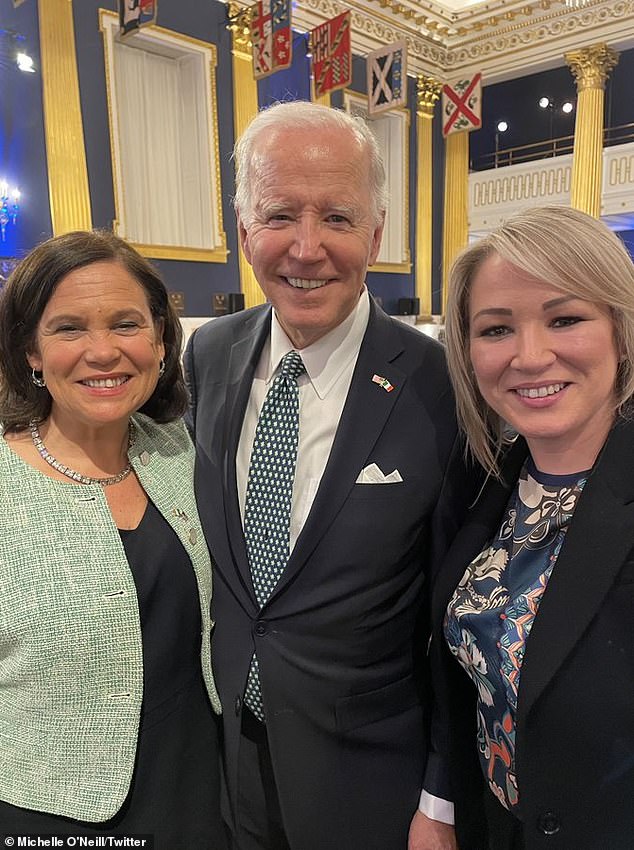
In Ireland Sinn Fein sups with the devil on St Patricks day while being treated as part of the solidarity movement. Everyone is to boycott Israel but Sinn Fein is permitted to party with those providing the weapons through which the massacre is carried out. A solidarity movement that accepts such actions is not a solidarity movement at all. We don’t need a movement that accepts the hypocritical claims of concern from those responsible for genocide and excuses those who similarly express weasel words of sympathy while being careful not to challenge those behind the slaughter.

If a genocide supported by every bourgeois political force in Western capitalism does not teach the movement that this alliance as a whole is the enemy then expressions of solidarity will go no further than demonstrating opposition and an inability to do anything about it. What is required is not pressure, because what is the price to be paid for ignoring it? it is not simply disavowal of the current leaders, because the alternatives standing by as replacement are no better. And it is not BDS, because imperialism has made it clear that far from boycotting Israel it is supporting it and will continue to do so. It is not the working class that controls the societies and economies of imperialism, its investment and trade, so it is not we who will determine what relationships imperialism will have with the Zionist state. Such victories as the BDS movement might have can only be steps towards the organisation of something more fundamental that points towards taking control out of the hands of the capitalist class.

Building a working class alternative to all these forces is required in order for pressure to be threatening, for displacement of current political leaders to be meaningful, and for actions against links with the Zionist state to become an instrument towards the working class taking control.

All the liberal institutions of this world have been exposed, and so have the spurious claims on behalf of an alternative capitalist alliance formed around China and Russia; as if they represent something radically different that will stop what is happening.

If there is another road besides organising a working class movement for socialism that defeats imperialism and its allies then what is it? And if it does not yet exist do we build it or accept the consequences of genocide?

The Third Year of War (1 of 3)

The second anniversary of the Russian invasion of Ukraine led to several retrospective summaries of the war and recapitulation of the arguments about its justification.  This should have involved an examination of the various claims made about its course over the two years and how they stand up today, but this was studiously avoided.  If we take even a cursory look at these claims, we can see how the lies told by the Western media about the war have increasingly been shredded by reality. Instead of winning against a stupid and incompetent Russia the all-powerful NATO might be losing? But let us come to that presently.

The genocide in Gaza has to a great extent eclipsed the war while the bias and lying of the Western media has increasingly been impossible to hide.  That the BBC live-streamed the Israeli case at the International Court of Justice but not the South African is just one example. While driving my car this morning Sky News reported that one hundred Palestinians had just ‘died’, which must be taken to refer to the killing by the Israeli army of their desperately starving victims attempting to get food from one of the few aid convoys the Zionists allowed through.

All this should provide grounds for clarifying the nature of the war in Ukraine but instead these have been treated as two entirely separate happenings, including by much of the left, which supports the actions of the United States in one and damns it in the other; excuses its intervention in one and rejects all its excuses in the other.  And we are supposed to believe this makes sense.

So, the war in Ukraine is the war in Ukraine; and the genocide in Gaza is but the latest murderous assault on the Palestinian people that must be addressed by a Palestinian solidarity movement. The long adopted method of single issue campaigns, designed supposedly to involve the maximum number of people, is exposed as divorced from reality.  Rather than help explain the world, it fragments reality and is an obstacle to understanding it.  Without such understanding the fundamental cause of war – capitalism – will forever lurk in the background, smothered by the appearance of this or that conflict, inviting this or that ‘solution’ that often relies on the criminals who caused it.

Much of the Western left has supported the Ukrainian state, and Western intervention, which is now accepted in Washington and Kyiv as the only thing keeping it going, with repeated threats that it will lose very soon if Western weapons do not continue to come.  Since money on its own does not kill Russians the reckless sponsorship of the war has been exposed because the Western powers no longer have the ammunition or other war materiel to keep Ukraine fighting.

Zelensky promises a new offensive in 2025 but the integrity of his armed forces might not last that long. Western powers are scrounging ammunition from various parts of the globe, but these simply mean that Ukrainians will keep on fighting and dying a little longer.  The alternative is the provision of more advanced weapons such as longer-range missiles and F-16 aircraft but these cross previous red lines, risk Russian retaliatory escalation and will not lead to Ukrainian victory.  In turn this risks further Ukrainian attempts to provoke greater Western intervention.

Threats to directly intervene with troops on the ground have only revealed that some have already been there and many of them have been killed.  A Russian officer has already stated that “NATO military personnel, under the guise of mercenaries, participate in hostilities. They control air defence systems, tactical missiles and multiple launch rocket systems, and are part of assault detachments.” The loss of over 60 French ‘mercenaries’ has already been reported in Kharkiv.  Now the German Chancellor Olaf Sholtz has let slip that the British and French are using their own troops to target and fire their missiles.  And someone else has revealed discussions within the German armed forces to attack Russia.

What successes Ukraine have achieved, such as the sinking of Russian warships and scarce and expensive surveillance aircraft, could only have been accomplished with Western systems, intelligence and personnel.  The most advanced weapons systems can only be used effectively by forces trained and familiar with them while their servicing and maintenance requires similar support. None of this has prevented increasingly rapid Russian advances on the ground.

Stopping, and reversing, this could not be achieved even by French, German, British or US troops on the ground without creation of a massive intervention force that these countries are currently in no position to construct and employ.  This has not excluded repeated announcements of the possibility of Western troops being sent to take part directly in the fighting.  This, even if on a limited scale, has the potential to lead to a World War.  The piloting of F-16 fighters by NATO pilots, with the green light by NATO Secretary General Jens Stoltenberg to attack targets in Russia, shows one path to escalation and war.

The prospect of Western infantry in Ukraine raised by Macron and shot down by others reflects awareness of the possibility of defeat, which Biden in particular has cause to fear, if this becomes clear before the November Presidential election. Even If Western escalation were partial, limited to occupation of Western Ukraine, Russia has the capacity to continue to move forward to achieving its aims, which would be expanded to account for a Western incursion. 

Left supporters of the Ukrainian state face the defeat of what has, politically, become their own proxy in their imagined progressive struggle alongside Western imperialism.  The presumed priority of Russian defeat would require massive Western imperialist intervention, with the risks discussed, and serves to justify the most reactionary nationalism in Eastern Europe (to be covered later).

Given the nature of the parties involved, exemplified in the massive disparity in power of the two forces, it is not Western imperialism that has become a proxy for the Left but the Left that has become a bourgeois proxy within the socialist movement.  Such is the position this pro-imperialist Left has put itself by supporting a pro-Western capitalist state in a war and by also supporting the assistance provided to it by Western imperialism.

The split personality of this left can be seen in their support in the case of Ukraine and opposition in the case of Palestine, as if all the Western powers are confused as to what is in their interests.  This disorder is as real for those that straight-forwardly support Ukraine and deny the proxy nature of the war as it is for those who directly express their confusion by both supporting the capitalist Ukrainian state while opposing the assistance of the capitalist states supporting it.

Defence of the Palestinian people will not be advanced by upholding in Ukraine the imperialist supporters of the Zionist state that is carrying out genocide, or by claiming that it is capable of playing a progressive role in one but not the other.

Of course, the genocide in Gaza is immediately more obvious and easier to argue, and especially more convenient for the moralistic approach that single-issue campaigns rely upon.  But for exactly this reason it is important to show how the two require the same approach and are not two single issues but two expressions of the one oppressive system that must face one combined struggle against it.

Both are wars by proxies of US imperialism in order to defend its hegemonic position in Europe and the Middle East.  Both reveal the poverty of its putative capitalist rivals.  The Russian invasion is incapable of stirring the sympathy of the workers of the world, and China, as the ultimate target of the US, cannot politically defend the Russian invasion.  In the case of Gaza, these putative leaders of the alternative pole of imperialist power have stood aside while the Zionist state commits genocide.  Russia and China have not made even a significant symbolic gesture by expelling the Israeli ambassador, while its BRICS associate, Saudi Arabia, has facilitated trade with Israel to nullify the efforts of the Houthis in Yemen to block it.  Iran has been as keen as the US to limit its opposition through its allies so that it can avoid war between them.

In both cases the Left, of almost all shades, sees no role for socialism in ending these capitalist wars but puts forward purely formal democratic proposals that do not go beyond capitalist solutions and have no bearing on reality. This includes the demand for ‘self-determination’ for Ukraine when the part of it allied to the West is already utterly reliant and subordinated to it.

In Gaza, the renewed murder and displacement of Palestinians has revived the debate over a two state or one state solution, neither of which are socialist and neither of which address the over-reaching power of the Zionist state, its US sponsors, or the opposition of the autocratic Arab regimes, which oppose the creation of any democratic Palestinian state lest it act as a beacon of inspiration for their own oppressed populations.

The hypocrisy that has been exposed by the two conflicts is a starting point to enlightening working people about the depraved and ruthless nature of the societies they live in, and that the scope and scale of the barbarity exposed is not accidental but is a fundamental feature.  This means that only a complete reordering of society will work and that this is what the socialist alternative involves.  If capitalist war does not demand and call for a socialist alternative then activists opposed to these wars will never be able to promise that one day they will end.

Forward to part 2

What Sinn Fein threw out when it threw out the Palestinians

When Sinn Fein stewards threw out some Palestinians from a Palestine solidarity meeting in Belfast, they threw out something else – all pretence that it will ever take effective action against the Zionist state’s genocide of the Palestinian people.  Specifically, it will do nothing to upset the United States, the sponsor of the Zionist state, its financier, arms supplier, and political attorney.  The Zionist state has its main benefactor, and through it Sinn Fein becomes an accomplice to Zionism’s actions by one remove.

The International Court of Justice (ICJ) has found it plausible that the Israeli state is carrying out genocide, although the vast majority of the world’s population did not have to wait to make this judgement, and does not have to wait the years required to see the ICJ confirm it.  There is therefore a political obligation to take now whatever action that can be taken to stop the genocide and Sinn Fein is not taking it.  How little this requires is demonstrated by the leader of the SDLP refusing to go to Washington on St Patricks day.  Sinn Fein has rejected doing the same.  This article has good coverage of the meeting and its background.

What this incident shows is the common nature of the struggle against imperialism across the world and the common character of that struggle.  Solidarity movements are supposed to be expressions of that common struggle but have become detached by petty bourgeois politics to be mere expressions of sympathy; appealing to human rights that fail to understand that the violence of imperialism is intrinsic to the capitalist system and that the only alternative is working class socialism.  This means that working class leadership of the struggle is needed, not just in Ireland but also in Palestine and all the other countries in the region and beyond where the outcome of the genocide will be determined.

Thus, this meeting illustrates that Sinn Fein, newly reinstalled in the leadership of the imperialist settlement in Ireland, will brook no criticism of the Palestinian Authority (PA) which plays the same, increasingly discredited, role in Palestine.  The PA is widely reported to be employed again as the mechanism for imperialist and Israeli pacification once the latter has finished its slaughter.

The message is therefore clear, Sinn Fein is not part of the Palestinian solidarity movement in any meaningful sense.  A party that participates in a shindig with those behind the genocide is a fifth column that undermines the solidarity movement by limiting the terms of effective solidarity, with an attempt to blind everyone to what it is doing.  What the solidarity movement needs to do, at the very least, is to take effective action to thwart the genocide.  A result of this it should be a step forward in the creation of a militant working class movement in Ireland as well.

Refusing to party with Biden is not even a forceful act of solidarity but rejecting it is a statement that Palestinian genocide is not important enough to demonstrate opposition to its main facilitator.  The celebration with the British Prime Minister the week before showed Sinn Fein’s partnership with the British Government, second only to the US in its support for the Zionist state and complicity in the genocide.

Effective opposition in Ireland would involve preventing the US using Shannon airport as a transit to the Middle East and refusal to handle Israeli goods.  The solidarity campaign involving leaflets, meetings and demonstrations are in themselves protests, but the ruling class everywhere is perfectly happy to ignore protests unless they lead to more radical action.

 Instead, protests lead only to more protests which eventually tire the protestors.  They often involve naïve beliefs that those in power will listen and take action, as if they did not already know what is happening or are willing to be convinced or shamed into ‘doing the right thing’. This is a view borne of ignorance that they are not actually acting out of their class interests and will change their behaviour only if these are threatened, and only permanently change if their political and social power is destroyed.

This means creation of a working class solidarity movement.  Calls for individual boycotts of goods involve calls for individuals or individual companies that are unorganised.  The working class has the power to enforce boycotts that don’t require millions of individuals taking individual decisions millions of times not to buy this or that good.

The first place to seek to organise this is in the existing workers’ movement.  Any solidarity campaign should seek to achieve this, and the membership of its supporting organisations would have the duty to try.  The many Sinn Fein members will never be given this task, yet the purpose of all the leaflets, social media posts, meetings and demonstrations is to build a movement that will take this on and succeed.  They are designed to build the support, organisation and confidence of those who can undertake this action. Token attendance on the odd demonstration by the Irish trade union movement is a testament to failure to attempt this.

Some other lessons can be learnt from the Belfast episode.  There should be no fear in challenging Sinn Fein because other Irish political parties are doing nothing better.  It is not the job of a Palestine solidarity campaign to save Sinn Fein from its own perfidy.  The government parties are in office and have demonstrated the limits to their expression of sympathy; they will do nothing much more unless forced – they are not there to be convinced of the justice of any particular action, they know already.  Sinn Fein, on the other hand, professes to be part of the solidarity movement.

The common nature of the struggle across the world demonstrated by Sinn Fein’s defence of the Palestinian Authority means that assertions that we cannot criticise any particular Palestinian organisation or movement, as is sometimes stated, is frankly stupid and reactionary.  Socialists criticise movements across the world if they think their politics are inadequate, fail the working class, or betray it.  The Palestinian Authority has certainly betrayed the cause of Palestinian freedom and it would be a dereliction of duty not to say so.  Only belief in the moral superiority of Palestinians as a nation, uniquely undivided by class or blessed by political leadership, could justify such a position.  That some Palestinian activists have condemned the PA is to be welcomed and shames those who would keep schtum.

That these activists were thrown out of a Sinn Fein meeting is to their credit as much as it is damning of those who ejected them.  A fitting way that Sinn Fein could atone for their disgraceful action would be to protest against Genocide Joe and be thrown out of the White House.  What’s the chances?

Oppressor and Oppressed (2) – Palestine and beyond

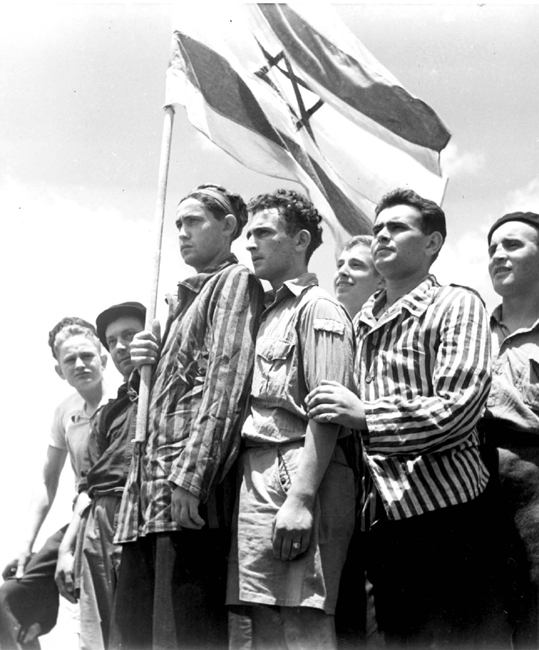
Buchenwald Concentration Camp survivors arrive in Palestine in 1945.

If ‘it is all very simple. We support the struggle of the oppressed’ it should not be difficult to identify who they are, and usually it isn’t, but not always.  What their oppression consists of is sometimes harder and how it is to be remedied harder still.  When I say harder, I mean that there is usually more dispute about it, not that there is something intrinsically difficult to determine but rather that there are fundamental differences about how it may be remedied, which in turn determines how it is understood.

For example, intersectionality identifies multiple oppressions and their combination but in doing so also identifies multiple oppressors and a hierarchy of oppression that can act to divide the oppressed into competing groups, with no joint and common project to overcome their oppression.  This series of posts deals with national oppression but even here these problems are raised.

Current events in Palestine illustrate some problems.   Jews are among histories victims and their treatment by fascism during the Second World War has become symbolic of their whole history of oppression.  The state of Israel has appropriated this symbolism to assert its legitimacy and rights, except these rights include the claim to Palestine as a state for the Jews, a Jewish state.  This has included the ethnic cleansing of the indigenous Palestinian population, a project that continues to involve dispossession and genocide.  The history of oppression and continued antisemitism against Jews is waved like a shroud to justify the claims of the Zionist movement, which proclaims a political programme and practice that involves oppression of the Palestinians.

These claims were accepted by many and it has taken decades of Palestinian oppression to reverse the sympathy many have had for the Jewish state. It should not have taken so long and stands as a warning against too simple an understanding of oppression and the claims of the oppressed. History is not a tale of good versus evil.

Marxism poses the working class as the force that can create the conditions for the ending of all oppression, whether based on class, sex, race, nationality or religion etc.  Since none of these will be ended without struggle it proposes a political programme to encompass all of them and sets out principles to judge the policies and strategies to pursue them.  As Marx once said, philosophers have only interpreted the world in various ways, the point is to change it.  To change it we have to interpret it correctly.

If we take the two wars currently raging in Gaza and Ukraine we are faced with the prospect of their expansion; so we need to understand the context in which they developed and how they might spread.  The war in Ukraine had not even begun before the United States threatened China by imposing economic sanctions, first by Trump and then by Biden, with warnings that it will intervene militarily in Taiwan.  Biden has now talked about an ‘inflection point’ in history, a decisive turning point affecting the whole world.  

Western powers have invested so much armed support to Ukraine they have admitted running out of some types of ammunition while promising to rectify this through massive rearmament, reminiscent of the build up of arms before the First and Second World Wars. A US general has predicted the possibility of war with China by 2025.

To think, therefore, that the wars in Gaza and Ukraine are unrelated events and are not expressions of the potential for a world-wide catastrophe is to feign woeful ignorance.  A response that starts from identifying the oppressed in Gaza and Ukraine and championing their cause does not get near understanding the stakes involved and what is necessary in response.

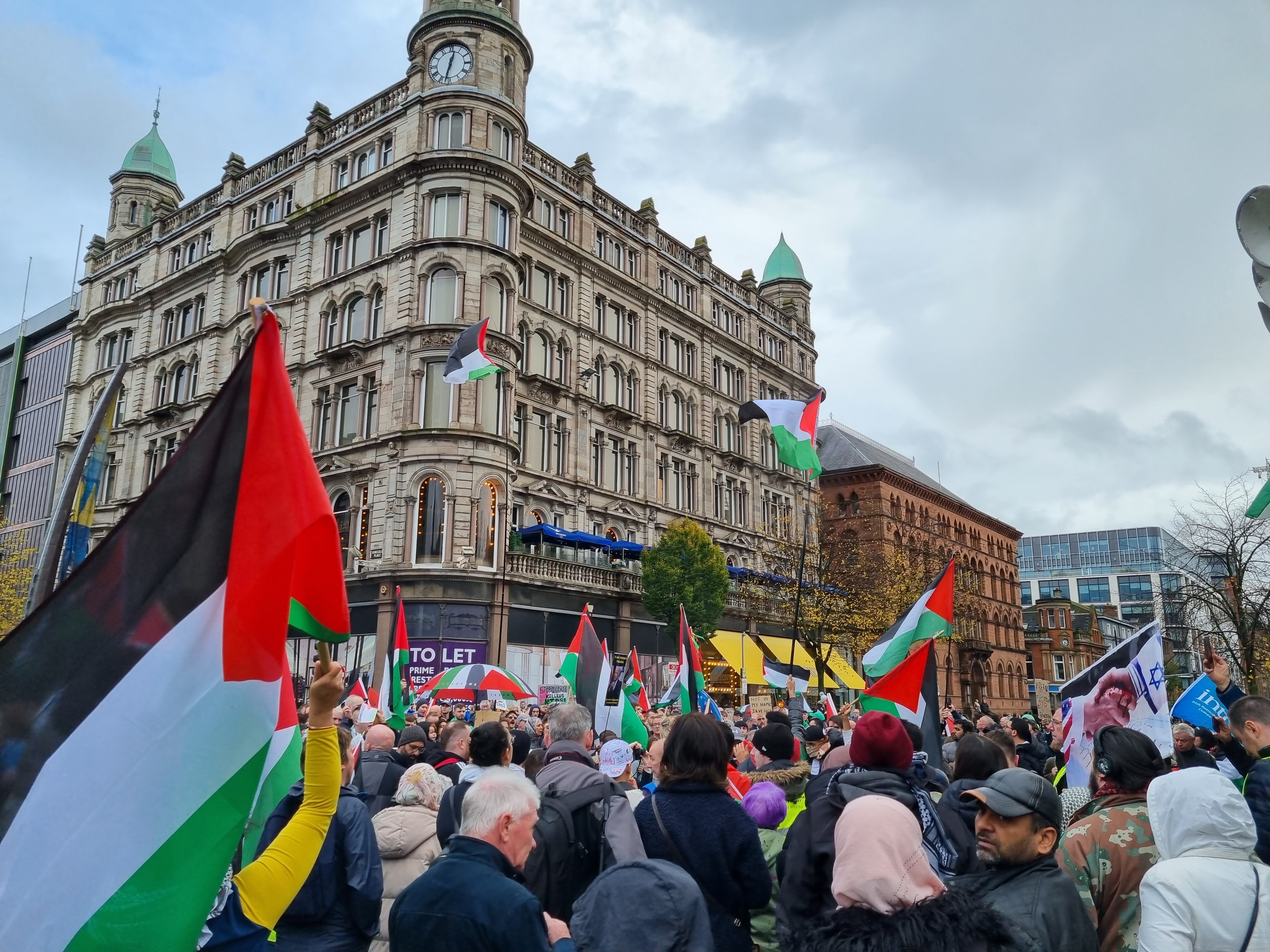
The Palestinian people are facing ethnic cleansing that in its purpose and execution is bleeding into genocide.  At a recent Palestine solidarity demonstration in Belfast a Palestinian speaker repeatedly thanked Israel for demonstrating its open commitment to destruction of the Palestinian people and to its murderous character, its dispensing with the normal lies and deception practiced by Western politicians.

This open declaration of barbarism would not be possible without the support of Western imperialism that demonstrates its full agreement to Israeli actions and revealing its own murderous character.  Rule by the capitalist class in most Western countries has ordinarily been based on some level of consent, or at least acquiescence, but their support for Zionist genocide is tearing a veil from the ugly face of capitalism.

This is the reason for the opposition to demonstrations in support of the Palestinian people, because they are objectively, and more and more subjectively, demonstrations against western governments and by this fact western imperialism.  In circumstances where this imperialism, under the hegemony of the United States, threatens ever wider and even greater cataclysmic conflict in pursuit of US hegemony, this threatens the support or acquiescence of their own working classes and thereby US dominance.

As we have said before, the Palestinian struggle is not just about Palestine– the world-wide demonstrations of support are proof of this.  The current slaughter is the continuation of the Zionist project and the Palestinian people are calling for a permanent solution before it completes.  By themselves the Palestinian people cannot prevent it and both an immediate and lasting ceasefire and creation of a free Palestine can only arise from a wider political struggle and revolutionary process.

This involves not only opposition to the Zionist state but to the reactionary Arab regimes that oppress their own people and seek increased collaboration with Israel.  Identifying the Palestinian people as oppressed does not identify how they can be free from oppression.  To be on their side means recognising this by including the vast majority of the Arab people in a struggle against their oppression.  Sweeping away the reactionary Arab rulers also includes disposing of the reactionary leadership of the Palestinian Authority. 

If the ending of one oppression is to succeed, and not to lead to another, it means embracing Jewish workers in Palestine, while also recognising that this necessarily involves the defeat of Zionism, with its project of Jewish subordination of the Palestinians and other Arab populations.  The argument that the possibility of a future oppression means that the current Zionist one must be accommodated or conciliated must be rejected; the possibility of a future oppression can never justify acceptance of current oppression but rather helps define how it should end.

The support given to the Zionist state by western imperialism means that even this is insufficient.  At the end of the day only the defeat of this imperialism, which can only be definitively carried out by its working class, can remove the decisive support available to the Zionist state.  The demonstrations in solidarity with the Palestinian people are therefore part of the same struggle that must become conscious of its own nature.

This is what imperialism fears most.  I remember being on the million-plus demonstration against the Iraq war in London, alongside many others across the world.  They did not prevent British involvement because the demonstration illustrated that the passive slogan ‘not in my name’ only dissociated the demonstrators from the actions of their governments but, by remaining at simple appeals to their ruling class, did not advance any project to remove them.

We can see from the barbaric oppression of the Palestinians that recognition of their plight as an oppressed people is only the first step.  The next are to understand how this oppression was created, how it persists and how it can be removed only by going beyond appeals to those supporting the oppression to end it.  Already, workers in Barcelona and Belgium have decided to take things into their own hands by blocking the supply of arms to Israel.  The extension of this across the world would be an enormous step towards ending the destruction of Gaza and attacks in the West Bank and against their own ruling class.

The oppression of the Palestinians thus raises many wider questions because it has a long history and involves the rest of the world.  No solution is possible that ignores this history or what is happening elsewhere.  War is an inevitable product of capitalism and these wars are the most recent of the very many wars that it has created, and will continue to create, unless a movement is created not simply to opposes this or that oppression but the system that perpetually creates all of them.

For many young people the oppression of the Palestinian people has opened their eyes to the need for political action to defend an oppressed people but their failure to take similar action in the much bigger war in Ukraine, or to appreciate the potential for even greater conflict, shows that they need to learn the lessons from the failures of their older generations, who opposed oppression but have failed to end it.  So it is not quite ‘all very simple’?

‘We support the struggle of the oppressed’ is good but there is an enormous problem when you oppose western imperialist intervention in Palestine but sit back or support it in Ukraine.

A look at the war in Ukraine is next.

Back to part 1

Forward to part 3

A comment on the Palestine solidarity demonstration in Belfast

About 3,000 people demonstrated in Belfast city centre on Saturday in solidarity with the Palestinian people. Three thousand is a large demonstration for Belfast, and for Palestinian solidarity is considerable.

The reason for the turnout is the obvious genocidal attacks of the Israeli state, on top of the existing widespread sympathy with the Palestinian cause among some sections of the population.  Israel flags have been put up by loyalists in a number of streets but this only confirms their utterly reactionary character, if any was needed.

It has become customary for commentators to smirk and disparage the different views on the Palestinian cause that overlaps to some degree with the sectarian division in Ireland, but these commentators rarely delve into the obvious explanation.  This was reflected in the speakers at the rally, where there was a speaker from the Bloody Sunday Trust, made up of relatives of the victims, and Sinn Fein as well, however, as one Protestant cleric.

A second major reason for the turnout has been the brazen endorsement of the attempted ethnic cleansing by Western states, including the British, EU and US; topped off  by deceit and hypocrisy about the Israeli ‘right to self-defence’.  In previous posts I have noted that the cause of Palestine is not only about Palestine, so the previous struggle in Ireland against imperialism should, and did, reflect consciousness about the struggle that once had Belfast at its heart.

But that was then and this is now; the anti-imperialist struggle has been buried in the North of Ireland for some time, and the politics of that defeat and the consciousness arising from it were on display at the demonstration.

Some speakers appeared to hold the Irish peace process as a model for Palestine; there were numerous calls for the ‘international community’ to call for a ceasefire, including the UN, and calls for pressure on Governments etc. to boycott, divest and sanction the Israeli state. This BDS movement “urges action to pressure Israel to comply with international law.”

I noted to a friend that the last time I was at a demonstration outside the City Hall it was rather smaller and was in protest against Joe Biden’s visit to Ireland.  At that time Sinn Fein was part of the wider effusion of welcomes to Biden by the Irish establishment – Sinn Fein wasn’t speaking at any Palestinian demonstrations then.  Yet everyone knows that Biden and the US has given the green light to the Zionist state’s mass murder, just as we protested at his visit for his provocations leading to war in Ukraine.

How credible then is the support for the Palestinian people by this party?  How credible does their participation make a campaign that prominently includes Sinn Fein leaders at its demonstrations?

Lots of calls were made on ‘the international community’ to intervene for a ceasefire, but the more accurate term for ‘international community’ is imperialism, and imperialism is not interested in a struggle against one of its proxies.  The UN has been passing resolutions seeking to limit Zionist actions for years to no effect – why would anything change now?

The calls for some sort of peace inspired by the Irish peace process is particularly blind and thoughtless.  What possible progressive outcome would arise from negotiations chaired by an American, organised by the British and which would exclude the Palestinians until they politically surrendered?  We don’t need to speculate.  The equivalent has already occurred and were the Oslo Accords that are a dead letter.  The current suspension of Stormont is hardly an advertisement for anything, except repeated failure.

The main problem for most of the speeches were that, for all the calls for action to end the siege of Gaza etc, these were directed at the Governments, including the Israeli, that have no intention or interest in bowing to this pressure.  Especially from those who have no intention of exercising what little power they currently have or could potentially levy.

Were Sinn Fein really opposed to the US arming of the Israeli state with the weapons that are currently killing thousands of civilians it would break off all contact with the US, including the politicians that regularly pop up in Ireland and currently include Joe Kennedy III, the ‘special envoy’ to Northern Ireland.  It would call on all its supporters in the United States to oppose their Government’s arming of Israel.  The chances of this happening are precisely zero.

The task of putting on pressure therefore becomes one of putting pressure on Sinn Fein.  The few heckles at the start of the Sinn Fein speech show that some are aware of the real Sinn Fein position.

Similar considerations apply to the trade union speaker at the rally.  Campaigners are entitled to ask where the campaign within the movement is that is trying to get workers themselves to boycott the transport of weapons to Israel.  Some might believe that this is currently impossible, but it is infinitely more likely than the ‘international community’ respecting ‘international law’ in protection of Palestinian lives.

Of course, this will cause dissension among supporters of the Palestine Solidarity Campaign, but while that may be the cause of an organisational split it will not be the cause of a political one because that already exists, it’s just currently hidden.  Pretending that Sinn Fein retains any sort of anti-imperialist character may be important to the Sinn Fein project, and to many of its members and supporters, but this is already being exposed as fraudulent the more it succeeds.  It is better that it be exposed by others than that it expose itself through yet more betrayals.

Otherwise the promise of the demonstration yesterday will be wasted and we will have politics as performance, something that is becoming all too prevalent.