The politics of morality and Palestine solidarity

The rights of ‘the people’ or ‘humanity’ may appear to be more fundamental and therefore more vital than those of a particular class (e.g. the working class), but this ignores the essential nature of the society that makes the struggle for these rights necessary.  Society is based on particular relations of production that generate the threats and the struggle to defend them.  These relations are capitalist, and the working class is the only social force that can fundamentally challenge these relations and the attacks on democratic and other rights that are generated by them.

It is not an answer to claim that the fight for ‘human rights’ can be taken up by the socialist and working class movement as a struggle to involve the widest layers of society in defence of what might appear legitimately to be human rights – the question of genocide in Gaza is one striking example – especially when it is claimed that no particular class perspective is required.  So, it might be claimed that surely denial of the right to life, most poignantly illustrated in the children murdered by the Zionist state of Israel, is one such example of human rights that transcend class and class interests.

The problem with this is that it ignores the cause of the genocide; that it lies in the nature of the Zionist state and its settler colonial role, and more fundamentally ignores that this is role is on behalf of Western, particularly US, imperialism.  The cause of the genocide does not lie beyond or transcend class politics but is a searing demonstration of the consequences of the continuation of the capitalist system.

Capitalism as the fundamental causal factor is disguised not just by mainstream media censorship and spin but by popular and inadequate understanding of what capitalism is.  It is not a case of class ‘reductionism’ to note that the ideology of Zionism and the actions and policy of the settler colonial state are inadequate explanations for the genocide, which can only be adequately explained by the support and endorsement by western imperialism.  Without this the genocide would not be taking place.

Even attributing the cause to imperialism can leave open a misunderstanding of what is happening, and the tendency to see it a something separate from capitalism, as opposed to its nature as its most advanced form that encompasses the planet. In this case, opposing imperialism can be a way of not opposing capitalism and avoiding putting forward a working class and socialist alternative.  This often begins by excluding a class perspective from the start and appealing to supposedly more fundamental humanitarian concerns that can be expressed in the demands and objectives of single issue campaigns.

This approach confuses the need for the working class to take on board opposition to all oppression and exploitation – to be the universal class that represents the new society within the old – with relegating its own class interests and the central role around which all the struggles against oppression must coalesce and unite.  The working class thus doesn’t become the leadership of such a movement but becomes simply one component of a putative coalition with different agendas, which excludes agreement on the central role of working class struggle and socialism.

The effect of watering down demands to appeal to a wider human-rights concerned audience is that it fails to identify the cause of oppression and fails to fight it effectively.  The constant humanitarian approach, that today justifies the old popular front strategy of yesteryear, has moved older activists to the default belief that this is the path to mass campaigning and led them to forget previous debates about the difference between this approach and a workers’ united front.  For younger activists all this is a completely different language that they see no need to learn.  As George Orwell once said about thought corrupting language, language can corrupt thought.

An example of the effects of this was illustrated to me in a recent conversation with a comrade in Dublin who is involved in the Palestine solidarity campaign.  When Israel, and then the US, bombed Iran she asked that fellow activists oppose the bombing.  She found no support, with opposition usually framed on the grounds that attention should not be distracted from the plight of the Palestinians.

The first thing to note is the instinctive rejection of opposing the attack on Iran (while also opposing the genocide), illustrating how previous instincts for solidarity have been severely weakened.  This is, however, entirely consistent with the policy of single issue campaigning which fails to recognise how the world actually works, meaning you have no coherent idea how it might be changed.  It means no protest against the extension of Zionist and US aggression, intended to strengthen their power – including against the Palestinians – and no intention of offering a total opposition to the forces of oppression.

It rests on the claim that what is needed is that attention is focused on the genocide, as if everyone by now doesn’t know exactly what is going on.  Those who don’t, don’t want to know, and those who do need to realise that the problem isn’t that people are not aware but that they feel powerless to do anything about it.  The repeated demonstrations and protests have not changed anything so those who previously took part, or looked on wondering whether to do so, can see no point to them except that they haven’t worked.

They have failed not because people haven’t been paying attention but because the protests are based on the illusion that an obvious humanitarian disaster will lead to those responsible for it stopping if enough people say that they should. Except appeals to those who are the problem are not a solution.  Western states are fully in support of the Zionist state; thinking this can be radically changed by ‘pressure’ simply avoids recognition that the Western states under ‘pressure’ press back by trying to criminalise opposition.

This approach simply exposes the fact that there is no understanding about the nature of the imperialist system despite often repeated references to it.  It simply leads to some taking more radical direct action that shows awareness of the problem but simply displaces responsibility to a small number of activists.

The current approach of moral condemnation allows many to claim that they are part of the solidarity movement when all they do is mouth words of outrage and nothing else.  Those supposedly in positions of influence are allowed to speak at protests while doing nothing, not because they are getting away with fooling their audience but because this is all that the movement demands.  They pay no price for their failure and the whole movement is rendered impotent by the acceptance of it.  If the movement accepts false friends, why should Western states fear false enemies?

Even to put it like this illustrates the problem.  It is not a question of changing the minds of this or that government but of challenging the interests of the imperialist states involved.  Were a conscious attempt made to go beyond ritualistic moral protest and seek to radicalise the movement politically, including by taking up the attack against Iran, the movement would just by this become a greater concern to the political leadership of the imperialist states.  Were organisation to be directed to workers’ action to prevent armed support to the Zionist state it would have both an immediate direct effect and increase the radicalisation of the movement.

Such a focus is not guaranteed to be successful but only the blind can deny current failure.  At worst we would have a more politically advanced working class movement for the future.

In one respect the slogan “we are all Palestinians”, which I really dislike, is true.  The failure of the political leadership of the Palestinian people is mirrored by the failure of the moral politics of the solidarity movement.

Visiting Munich and encountering Palestine

My first walk in Munich city centre from Sendlinger Tor U-Bahn station led me to the town hall in Marienplatz from which three banners hung, all upholding Western imperialism.

The first was the flag of Israel, the Zionist state carrying out the most visible genocide in history now promoted by the city authorities where the Nazi party was founded and where it maintained its headquarters until 1945.  Where Hitler launched his beer hall putsch in 1923 and the first concentration camp was created at Dachau.

The second was the flag of Ukraine, home to the most violent neo-Nazi movement in Europe, once recognised by the Western liberal media but now buried by that same media and celebrated as a leading section of the Ukrainian ‘resistance’ which Western liberalism now parades as the vanguard of the fight for democracy.  The banner of Ukraine hangs appropriately beside that of Israel as its President Zelensky has hailed the Zionist state as a model for Ukraine to emulate.

The middle banner was promotion of Mayors for Peace, which neatly parades the hypocrisy of Western imperialism and its liberal pieties.

Of course, Germany is not defined only by its Nazi past or the proclivity of the German state to sanction genocide.  A couple of recent opinion polls record that a majority of Germans oppose arms exports to Israel and oppose the genocide, with nearly 60 percent also opposed to supplying Ukraine with Taurus missiles.  Even Munich has a different history, having been home to a short-lived workers revolution in 1919.

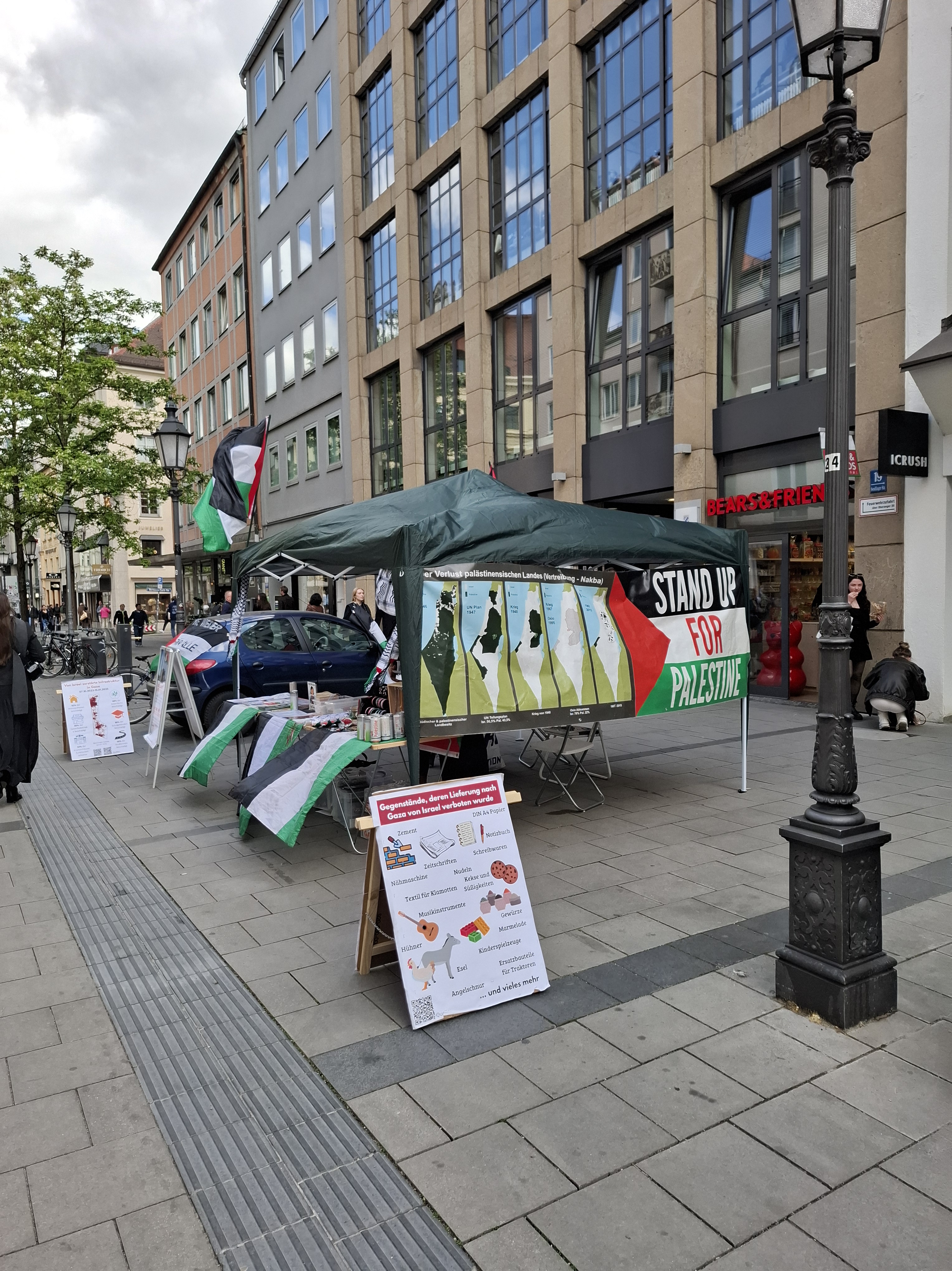
There is more than one Germany and I was pleased when I later came across a Palestine solidarity stall on Sendlinger Straße on my way to Marienplatz again.  The Palestinian woman at the stall told me how difficult it was to carry out campaigning – “up in court” all the time – and that there was a demonstration later in the afternoon.

The rally had around 500 people, which isn’t large for a city the size of Munich, with a large number being what I took to be Palestinian.  A number of speeches were made, all in German except for one in English by a young man of Palestinian extraction who appeared German by his accent.

He gave a powerful speech condemning Western imperialist responsibility for the genocide and condemning the settler colonial Zionist state based on his own family’s story of dispossession.  He condemned the demand that the Palestinians resist along the approved lines of Western liberals and stated accurately that asking politely for their rights would make no difference.  He called for workers, their unions and students to take action.  He also declared that all types of resistance were justified.

Some people can speak powerfully with emotion without losing the ability to articulate their argument and he was such a speaker.  His anger was palpable but so was the feeling that he spoke with a degree of desperation. This is not a criticism, since the plight of the Palestinian people is desperate.  It is not possible to argue that what they are enduring is genocide with no sign of it ending soon, without acknowledging that their situation is urgent and tragic.

The most recent muffled admonishment of Israel by the likes of Starmer and Mertz is even more nauseous than their previous hypocrisy for it signals that not even the grudging and muted acceptance of the reality of genocide will see them take any relevant action.  The speaker’s knowledge that it is Western imperialism that is ultimately responsible makes such awareness unavoidable, which is why he called for an anti-imperialist struggle.

Unfortunately, no anti-imperialist struggle is currently taking place.  Some think one is being carried out by Russia (in Ukraine) and by China but their indifference to the suffering of the Palestinian people simply illustrates the reactionary character of these capitalist states.  That some fake socialists think Western imperialism can actually play an anti-imperialist role (in Ukraine!) demonstrates the bizarre and crooked character of their ’anti-imperialism’.

Liberals have criticised Netanyahu because he has not set out a plan for the day after – when his war aims have been achieved.  The problem is that the issue is not Netanyahu and what we are looking at is not a war but a genocide. The Zionist ‘solution’ is not what comes after genocide but is genocide. In this sense there is no ‘day after’, which will simply be expulsion of those who haven’t been killed, however arranged, however comprehensive and to whatever timeline adopted.

The speaker in Munich understood that the meaning of genocide was the end of any pretence to a two state solution.  Of course, this has never been a solution and has been employed by Western imperialism as an alibi for colonial aggression, but the genocide also signals the death of a one state solution i.e. an imperialist imposed bourgeois state encompassing both the Jewish and Palestinian people.

The speech, for all the truth it contained, left two nagging doubts.  The first was the criticism of the reactionary Arab regimes that have done less than nothing for the Palestinian people, where he called out three states.  This included Morocco and the UAE with one other that I can’t recall.  It did not include the biggest – Egypt – or Saudi Arabia or many others.  Yet liberation of the Palestinian people is inseparable from the liberation of the working classes of all these countries, through the destruction of all the rotten regimes and the capitalist states that they sit upon.

The second was the statement that all types of resistance are justified.  But justification is not effectiveness and approval of all is a sign that there has been no identification of which one is central, what strategy lies behind it and how it should be pursued.

Back in Ireland I returned to read about the latest pronouncement of the gobshite Bono who managed to make Israel the victim (of Netanyahu) while calling for peace.  Less gross, but in reality worse, is the hypocrisy of the Irish bourgeoisie promising yet again to take the miniscule action they have promised for years and which is now so obviously damning in its pathetic inadequacy.

The responsibility of Western imperialism for genocide with this support and its hypocrisy on display in Munich and also the opposition to it, drives home the international character of the struggle against imperialism.  Too often, however, this is not against all imperialism, is not against capitalism – which is often treated as something separate – and does not identify the force for change and the socialist politics that define it. The popular opposition to genocide among the population of Europe alongside the widespread complicity of European states shows that a struggle is required against these states and not just the war and genocide abroad that they are complicit in.

An exchange of views on Palestinian solidarity and Hamas

Sráid Marx has received a comment on the series of posts that were written on solidarity with Palestine from Socialist Democracy, having linked to one of its articles in my second post. I include their comment below and a brief reply.

* * *

A critique of our position on Gaza solidarity.
Are the politics of Hamas a defining issue?

Over the course of the ongoing genocide in Gaza Socialist Democracy has distributed thousands of leaflets and newsletters commenting on the struggle and the movement in solidarity in Ireland. The aim of that work has been to provoke a response and to support a debate in the movement about it’s future direction.


While we have had a number of interesting conversations, there has been no organised response, so it is with some pleasure that we read a commentary by Sraid Marx on their blogspot, especially as we are given a C‐ for our most recent publication.


However we have some difficulties in responding. The comrade does not mention our name or give a full account of our position, so we are being invited to reverse engineer to understand the comrades own position.


Essentially we feel that the Sraid Marx position is too formalistic, whereas our approach is more contextual.


A chief point in the ongoing offensive is the constant demand that we condemn Hamas. We are familiar with this approach from the troubles and constant demands to condemn the Republicans. The demand now is that we blame Hamas for the violence, ignore the Israeli and US previous drives towards genocide and agree that history started with the Hamas breakout.


We can’t agree, because that concedes to the imperialists. We can’t endorse the action because that would tie us to the strategy of Hamas. The answer is: What do you expect when you imprison millions in an open air concentration camp and constantly humiliate and murder them?


Much of the critique is given over to the nature of Hamas. We think that beside the point. The source of the violence rests with the US and Israel. The UK is a willing participant in genocide and Ireland a consistent facilitator and opposition must start from there.


A useful criticism of Hamas lies in the context of the Gaza outbreak. That was the Abraham accords, drafted by the first Trump regime and aimed at erasing discussion of Palestinian rights and winning endorsement of Israel by the Arab regimes. When Hamas launched the Al-Aqsa flood it was appealing to the Arab regimes on the basis of nationalism and to the Muslim world on the basis of religion. An immediate tactical aim was to do what they had done in the past – seize prisoners to use as bargaining chips and win concessions from Israel.


They were profoundly mistaken. Arab nationalism no longer has a progressive content. Imperialism is poised to establish complete control of West Asia, founded on establishing the absolute military primacy of the US and Israeli axis and the capitulation of the Arab regimes. Genocide is an acceptable cost of victory and dissent is to be crushed. The imperialists have scored remarkable but still incomplete victories. The final task is to crush Iran, but there are doubts about the military capacity of the US alliance and its failures in Yemen which are holding it back from regional war.


The Irish movement does not discuss politics. It remains fixed on Free Palestine and individual acts of BDS. Demands for government action do not lead to a consistent campaign against the government.


This political weakness has a material base. Much of the leadership is the decayed remnant of the anti-imperialist left. It is in alliance with Sinn Féin, who wanted to suggest anti-imperialist positions without breaking with imperialism. Sections of the trade union movement pose as defenders of Palestine without breaking their partnership with Irish capitalism. The core of the Palestinian diaspora are linked to the collaborationist Palestinian Authority and their ambassador to Ireland and are hostile to Hamas.


A new inflection came with a current associated with the group Rebel Breeze. They criticised the solidarity campaign for inaction and failure to target the US, Israel and the Irish government. We supported the criticism but did not support their position of uncritical support for the Palestinian resistance. We attempted to engage with them but they did not reply. So the current situation is that the solidarity movement is weak and has no mechanisms for national debate.


In relation to Sraid Marx we would be critical of the formalism which led to the analysis of the CounterPunch position. We see no reason to give credence to their analysis of Hamas and their Irish solution of a Palestinian Good Friday Agreement is risible.

These positions arise less from political theory than from a long tradition of opportunism. They are not a serious attempt to plot out a revolutionary position, more an attempt to align with a relatively non-political base.

Changes are taking place. The genocide in Gaza is related to the drive to war in Europe and the trade war with China. The UK is to the fore in urging warfare not welfare. The Irish government is every day taking measures to integrate with NATO and with European militarism. This feeds a growing outlawing of protest and use of state force.

The liberal virtue signalling of Irish leftism and of the NGO world will fade away like snow from a ditch. A genuine socialist and anti-imperialist movement will arise from recognising the role of local ruling classes as representatives of the imperialist world order.

* * *

You ask the question “Are the politics of Hamas a defining issue?’” to which the answer you give is presumably ‘no’ although that depends on what the issue is to be defined.  I was careful to define the issue of solidarity with Palestine in terms of the responsibility of the Irish state in collaborating with imperialism and the Zionist state in the first part of my series of posts; the general approach of socialists to solidarity in the second part and in relation to Hamas in particular in the third part.

This means that in order to rebut the legitimacy of criticism of Hamas you need to engage with the arguments of the second post and you have not.

Progress has been made, however, in that you are no longer claiming that ‘denunciation of HAMAS is simply a mechanism for supporting genocide’, which I pointed out in my second post.  Instead, you indicate that although you cannot endorse the actions of Hamas the correct response is to say “What do you expect when you imprison millions in an open air concentration camp and constantly humiliate and murder them?”  This may be a point to make in response to imperialist calls to condemn Hamas but it is woeful as a position in relation to how imperialism is to be defeated.

It would appear however that you do believe that criticism of Hamas is valid – “A useful criticism of Hamas lies in the context of the Gaza outbreak.”  This criticism includes Hamas’s reliance on reactionary Arab regimes “on the basis of nationalism and to the Muslim world on the basis of religion.”  You also concede that its tactical plan was a strategic disaster, so that “the imperialists have scored remarkable but still incomplete victories.”  As you say, Hamas “were profoundly mistaken” and “Arab nationalism no longer has a progressive content.”

You have therefore moved considerably but remain still a bit confused.  You argue that the critique of Hamas, specifically its nature that would account for and explain ,for example, all the criticism you make yourself, is “beside the point.” You are keen to argue that the political weakness of the Irish solidarity movement “has a material base” but do you not also believe that this is true of Hamas?

If you take your critique seriously you are obliged to advance the arguments that a working class alternative armed with socialist politics is required to help advance not only the solidarity movement but also the struggle of the Palestinian people against genocide.  This is what I attempted in the second post.

A penultimate point about trying to further debate in the solidarity movement.  You state of my posts, and their reference to the analysis of two authors in Counterpunch, that you see “no reason to give credence to their analysis of Hamas and their Irish solution of a Palestinian Good Friday Agreement is risible.”  

I make my own criticism of the authors references to Ireland clear, while it gets you nowhere to claim that their criticisms of Hamas should not be discussed because I should not “give credence to their analysis.”  If you think they are categorically wrong, you need to say why and where they go wrong.  Otherwise, dismissive comments are but another example of the refusal to engage in debate for which you criticise others.

A final point. You write that a “genuine socialist and anti-imperialist movement will arise from recognising the role of local ruling classes as representatives of the imperialist world order.” It will also require a political struggle against nationalism and fundamentalism and rejection of the petty bourgeois moralism that preaches that the leaders of oppressed groups are beyond criticism.

Solidarity with the Palestinian people (3 of 3) – Solidarity with Hamas?

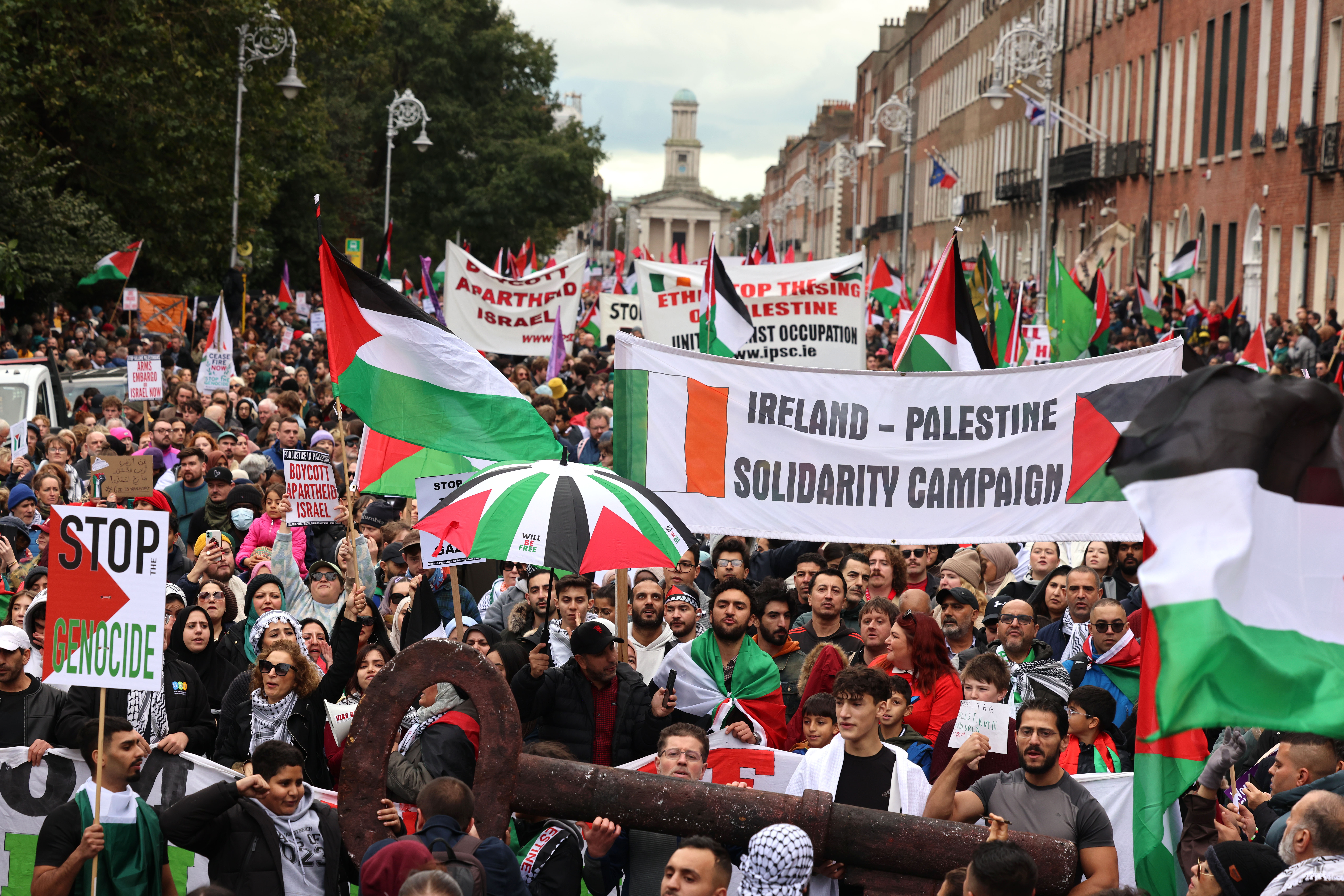
National demonstration in support of Palestine, Dublin. Photograph: Dara Mac Dónaill / The Irish Times

In the previous post I stated that the October 7 attack by Hamas precipitated the current genocide in Gaza, as in to hasten the occurrence of something; hastily, or suddenly.  This does not make Hamas responsible for the genocide.  This responsibility belongs to the Zionist state and to its US sponsor as well as those states that have also supported and defended it.  As the first post made clear, this includes the Irish State, which studiously permits and facilitates the transfer of weapons and munitions from the US to Israel.

The responsibility of the Zionist state for genocide should not be a surprise, since the state itself is a settler colonial creation founded on the dispossession of the native Palestinian population subject to repeated expulsions and attacks.  The viciousness of the Zionist state and of its response to any challenge has routinely been disproportionate and the evolution of Zionist politics from labour to far-right reflects the logic of its existence.

All this does not excuse Hamas from criticism that it provoked an attack for which it was totally unable to defend the people that it claimed to represent.  This is essentially the argument of the Counterpunch article that I referenced before and which is illustrative of the arguments presented in the previous post. 

On the Oct 7 attack the Counterpunch article states that ‘Hamas must have known that Israel would react with massive destruction in Gaza after the October 7th attacks’ and that its  ‘military strategy was suicidal and poorly planned, also entailing war crimes against civilians which the leadership must have known would lead to the total destruction of Gaza.’  It further argues that ‘those who wish to engage in deluded fantasies like endless military confrontation having been the only avenue available to Hamas are quite deficient in their analysis which is bereft of intellectual rigor, to say the least. This sentiment is often felt by those attempting to appear the most revolutionary by taking what they perceive to be the most radical position.’

The failures of Hamas flow from the nature of the organisation: ‘the bulk of Palestinian resistance fighters—the actual fighters of Hamas and other entities—are acting out of anger and a desire for revenge, as the majority of them have lost family members due to Israeli attacks’; however ‘Hamas’ leaders . . . have climbed to the apex of power amongst the exploited and now seek their own privileges, power and financial gain.’

Hamas are described as corrupt ‘kleptocrats keen on getting rich, content with the privileges they possess in real life, and if they’re assassinated or killed in combat by the Israelis, then they believe they’ll be absolved in the afterlife—as Islamic fundamentalists do.’  An example of their corruption is provided – ‘Hamas had agreed to let the PA develop Gaza’s natural gas fields in exchange for a portion of the profits during negotiations with the US, Israel and Egypt. Simply put, Hamas’ leaders had decided they would sell their own people out to the Americans and Israelis—who effectively control the PA—in exchange for a cut on the back end.’

It is ironic therefore that the authors of the article argue that this is the alternative to HAMAS’s militarist adventurism and that the example provided by the Irish peace process is one to be emulated.  The Irish example helps point to why they are wrong.

The success of the Good Friday Agreement, such as it actually exists, is largely due to the failure and unpopularity of the militarism of the IRA.  What is wrong with this peace process is not that this militarism was abandoned but that without it the IRA and Irish republicanism generally had no political alternative to British imperialism.  The circumstances in Palestine are radically different from the North of Ireland, including that there was never any threat of genocide to the nationalist population.

So, while imperialism in Ireland and the Irish state are genuine in seeking a pacified Northern state with nationalist participation in the local administration, the view that ‘for now only a two state solution along the 1967 borders seems even remotely achievable’ after ‘Palestine [is] developed and modernized under US-Israeli-PA rule’ is hopelessly optimistic and misguided.  The two state policy has been endorsed by most of western imperialism for a long time and shown to be a fraud.  The Zionist regime has rejected it and, as the authors explain , its initial support for Hamas was precisely to help prevent it.

On its own, their proposal for the economic and social development of the Palestinian areas (under what currently could only be some sort of imperialist rule) is not wrong.  It is better, infinitely better, than genocide, but it fails to appreciate that the policy of genocide and steps to ethnic cleansing are a rejection of it by imperialism and Zionism, and of itself is not a policy of the working class, rather than simply potentially the best current conditions to allow one to develop. 

The article, at best, falls into the familiar trap of providing ‘solutions’ that are not those of the working class because the working class cannot provide its own. It does this instead of accepting weakness and pursuing a policy of opposition, one that doesn’t pretend to the current possibility of socialist revolution.  The writings of Marx and Engels are replete with such a policy where the working class is too weak or undeveloped to impose its own power but should not therefore politically support that of the bourgeoisie.

One of the ways by which better conditions for a working class alternative can be created is a working class led solidarity movement that sees this as one of its tasks.  This involves opposition to genocide and western imperialist complicity but also an open policy of supporting a working class policy and movement.

This is a long way from the current humanitarian solidarity that refuses to take a position on the political solution while, in doing so, leaving reactionary forces to fill in the gap.  It involves hoping that imperialism will do what it has demonstrated it has no intention of doing; hoping the Zionist state will be forced by imperialism to accept it, and hoping the reactionary Arab regimes will play a positive role in pushing this along, as opposed to their current closer and closer accommodation with both imperialism and Zionism.

Back to part 2

Solidarity with the Palestinian people (2 of 3) – Socialist solidarity

Belfast City Hall 5 April 2025

A friend sent me an article on the Counterpunch website that looked at Hamas and the October 7 attack that precipitated the current genocide in Gaza, which I will look at it in the next post.  It raises issues about solidarity with oppressed groups by socialists and what, if anything, socialists have to say that is different.  Having something different to say isn’t in itself a reason to say it, but if socialists think they have a distinctive view of the world and don’t have anything very different to say it implies that their socialism isn’t very important.

Socialism is international or it is nothing.  By this we mean that the cause of the working class in other countries is our cause and that socialism cannot exist within a single country.  This means that we seek to advance the socialist struggle of the workers in every country and that a victory in another country is a victory for us.  This is the material basis of solidarity for socialists.

Of course, in doing so we oppose oppression in every country, but you do not need to be a socialist to do this and we are socialists not just because we oppose oppression but because we believe only socialism – only the actions of the working class – can defeat oppression and establish freedom.  And this goes for the struggle in Palestine as well, although often these considerations appear to disappear when socialists discuss it.

Instead, we get statements such as the following – ‘that we must not only oppose oppression but support the oppressed, the right to resist oppression and the resistance itself.  We also get formulas that we should not take sides in intra-Palestinian political disputes, which only the Palestinians should engage in and determine.

If we work backwards – what is this last idea but a form of identity politics?  That Palestinians are a group apart with ideas and movements separate from the rest of the world’s struggles with nothing to learn from them; nothing to learn from the long history of working class struggle across the planet? If they are so different as to have nothing to learn then they would have nothing to teach us either. Either they are uniquely blessed with a political leadership beyond criticism because it never gets anything wrong, or it gets it wrong but is beyond help.  If neither of these are true, is it because we have no right to speak about their struggle or only to do so to voice our support? (Do we take this view about every struggle: of the French working class or German or any other?).

If it is the last argument, this simply leaves us back at the start and fails to argue why socialists have no right to state what we think is good or bad for the struggle; one that we have said is part of our own world-wide struggle and on which we are also at least partly dependent.  In short, the international struggle for socialism is something that involves Palestine and therefore involves us.

It might be argued that the struggle in Palestine is not about socialism, but this is no answer since socialists have a position on all struggles against oppression and these very often do not immediately raise the possibility of a socialist victory.  Otherwise, in today’s condition of the class struggle, we would silence ourselves across most of the world.

Of course, what we have to say should be within the framework of solidarity with the oppressed and should have something relevant and positive to contribute, but part of our solidarity is that we believe we do have something distinctive to contribute, not least because for us, solidarity is not an act of altruistic humanitarian concern for others but is part of our own fight.  The only basis for refusing to engage in debate on the way forward for the Palestinian struggle is the belief that it is separate from us: ‘In our thousands! In our millions! We are all Palestinians!’ becomes not only untrue (we are not suffering genocide!) but is also denied and rejected by the claim that we are not permitted to offer our own views.

This, however, is the most common view of solidarity, which thus becomes a sort of activist charitable exercise fed by the politics of self-determination of nations.  The socialist view is the primacy of self-determination of the working class, as an international class that can unite politically and organisationally, which is obviously impossible without debate, argument and disagreement.

Where does this leave us with the formulation that we must not only oppose oppression but support the oppressed, the right to resist oppression and the resistance itself? 

First, even oppressed people’s and nations are composed of classes involving class exploitation and oppression.  Genocide only partly qualifies this, as those with lots of money will always find a way to use it to their benefit.  Class divisions have a bearing not only on whether and how to resist oppression but also on the objectives of resistance.  Class struggle doesn’t disappear and socialists above all should recognise this in their solidarity and within the solidarity movement.

So what about the right to resist?  Socialists are in favour of the working class and other oppressed groups resisting exploitation and oppression but do so on the basis that capitalism exploits and oppresses, and that class struggle exists as a result.  As Marxists we understand that capitalism gives rise to the potential for socialism because of the nature of its development.  From this arises the struggle for socialism, not some moral right to resist that is independent of the circumstances and conditions in society.  This is important for how we resist, which we will explore in relation to Gaza in the next post.

In general, however, socialists are always to the fore in advocating resistance to exploitation and oppression, with the view that advancing towards the alternative is what matters above all.  We therefore support the oppressed by seeking to end their oppression, which ultimately can only be through the working class becoming the ruling class of society.

This leads to the final claim, that those in solidarity with the oppressed must also solidarize with the resistance and with the resistance movement, and this is where the biggest difference arises.  Since our view of solidarity is not dictated by any moral assertion there can be no moral claim on us to support resistance movements that are themselves reactionary, and this obviously includes Islamic political movements (as opposed to democratic and socialist movements composed of religious believers).

Solidarity arises from common interests and purposes.  What common interests and purposes arise between reactionary movements in conflict with imperialism and socialists?  To ask the question is almost to answer it.  Both can be opposed to imperialism on the grounds of some common effects of its rule or intervention but reactionary movements that come into conflict with imperialism are not anti-capitalist, never mind socialist, so their opposition is limited and qualified.  Ultimately their interests and purposes are opposed to those of socialists and is the reason for separate organisation and politics in the first place.

Since our primary interests and purposes are separate any common activity is also limited and qualified and there can be no unqualified or unconditional support.  Common objectives may allow episodic common actions and organisational cooperation to achieve them but there are no grounds for avoiding criticism or separate organisation.

We therefore do not give political support to reactionary movements on the grounds that they embody the resistance of the oppressed, because that resistance is politically reactionary and cannot represent their full and complete interests.  Whether these movements are in our own country or another does not fundamentally change this but at most determines the emphasis to be placed on opposition to our own state for whatever role it plays in the oppression.

In practice many socialists acknowledge this while denying it in words and will criticise the Palestinian Authority but not Hamas, for example on the illogical grounds that ‘denunciation of HAMAS is simply a mechanism for supporting genocide.’  Such an overblown statement scarcely warrants a response.  See below a better statement by this organisation to the Belfast rally pictured above. 

Back to part 1

Forward to part 3

Solidarity with the Palestinian people (1 of 3) – the Irish State

Richard Boyd Barrett asked the Taoiseach “is that where we’re headed” when he recounted the arrest of fourteen women from Mothers Against Genocide during their peaceful protest outside the Dáil on Mothers’ Day.

The right answer is yes and no.  Yes, we are heading towards a more repressive state and no, because we have been heading along this road for some time.  What has changed is the decision of the Irish state that it needs to abandon its appearance of some sort of neutrality, and defender of at least the appearance of international legality, and sign up to membership of NATO.

It’s difficult to sell the legitimacy of the state on current grounds when it has steadfastly refused to do anything meaningful to oppose genocide in Gaza.  It becomes impossible when it explicitly permits the use of Irish air space to transfer the weapons by which genocide is carried out, from the US to Israel.  Up until now it had appeared that the state had simply turned a blind eye to such flights while The Irish Times has now revealed that it has explicitly approved them.

The idea that the state is a leading defender of Palestinian rights is consequently as dead as a Dodo and the foot dragging on implementing the Occupied Territories Bill has become the least of the proof.  The decision of the new government to endorse the IHRA definition of antisemitism only makes sense in order to defend the Zionist state and to develop cover to those who defend and support its mass murder. The Irish state has already gone beyond both of these and is now revealed to be up to its neck in complicity with it.

Irish neutrality is a myth, as we have argued before (herehere and here), but it has involved constraints on its collaboration with NATO.  Now the state has decided that the drive towards war by the US and rest of Europe leaves it exposed just when it already faces severe threats to its economic role as a tax haven and general platform for US multinationals.  Pissing off Trump and the rest of the supporters of Zionism in the US is not going to help any special pleading it might want to make nor engender sympathy with the rest of the EU that backs genocide to the hilt.

Within this context, the attack on Palestine solidarity protests and signing up to defend the Zionist state makes perfect sense.  What doesn’t make any sense is to base a solidarity campaign on persuading this state to defend Palestinian rights, which is what the present campaign has been doing.  Repeated calls for the state to do this or that, pass the Occupied Territories Bill or new Air Navigation and Transport (Arms Embargo) Bill, has to ignore the determination of the state not to do anything like this.  

Instead, official Ireland has sought to protect itself by recognising the Palestinian state, which most countries have done to no effect, and intervene in the International Court of Justice case brought by South Africa, which also has little effect.  Of course, this has still upset the rabid Israeli regime despite secret calls from the Irish government that nothing is meant by such actions.  Meanwhile the Irish Central Bank helps Israel finance its genocide.

A solidarity campaign based on moral appeals to the amoral or to International law that Western imperialist powers decide to accept or reject as it suits, is to already accept hypocrisy as sincerity, imperialist actions as simply mistakes, and imperialism itself as capable of taking a progressive course.  It is fine to point out the hypocrisy, the real policy, and the nature of Irish state collaboration with imperialism, but it is simply foolish and futile to expect that anything meaningful will be achieved by this alone.

The picket at the trade union conference in Belfast, picked up by this Zionist news outlet, shows the beginnings of awareness that it is not enough for trade union figures to make fine speeches at demonstrations and demand that others, especially the government, take action, but that the trade unions themselves should take action and the campaign should focus on them and speak directly to workers.

It might appear that the widespread sympathy for the plight of the Palestinian people is a strong basis on which to force effective solidarity but the ability of the new government to ignore international law, stymie its own minimalist legislation, and go on the offensive to protect Zionism is all evidence of the limits of such popular opinion.

The general lack of understanding of the reasons for the genocide and the ability of the Zionist state to act with impunity is a result of the failure to appreciate the nature and current role of imperialism.  This can be seen in the acceptance of Irish sanctions against Russia and support for the US, EU and Britain in provoking and continuing the war in Ukraine.  In a world in which imperialism can ‘do the right thing’ in Ukraine, the possibility of persuading it to do the same in Gaza can appear as a reasonable possibility.

Only by rejecting the war in Ukraine as the product of inter-imperialist rivalry, as the result partly of deliberate US provocation, and acceptance of it as essentially an imperialist proxy war, with the Ukrainian state as the willing proxy, is it possible to see the perfect consistency of US, EU and British actions in both Palestine and Ukraine.  Unfortunately, much of the Irish left, just like the British, has capitulated and supported Western imperialism through its Ukrainian proxy.

The latest revelations of the major role of the US in the war, published by the New York Times, should leave no one able to claim the innocence – never mind progressiveness – of its role, or the claim that this is something other than an imperialist war.  To continue to do so is to wilfully ignore the evidence or make an unconscious claim to stupidity.  Absent both, the real condemnation is of the rotten politics of most of the Irish and British left.

For those in Ireland, the relationship between imperialism in Palestine and imperialism in Ukraine is bound up with the attempt by the state to dissolve the pretence of neutrality – as a stepping stone to open NATO membership as a junior component of the Western imperialist alliance.  It is the responsibility of socialists to explain this and to point the campaign towards the action of the working class as the mechanism to enforce effective solidarity.

Forward to part 2

A World going to War and the resistance (3 of 3) – a multipolar alternative?

In the previous post I said that the results of the war in Ukraine would include the deaths of hundreds of thousands; massive physical destruction; a Ukrainian state more corrupt and more subject to imperialist predation; increased division within the working class; and both NATO and the reactionary Russian belligerents remaining in place.

Yet the pro-war Western left defends NATO because without it Ukrainian victory would be inconceivable and it is this victory that they prioritise above all else.  This is an inescapable consequence of their position.

Alternatively, some other leftists, in mirror image, support the victory of Russia but in doing so also bear responsibility for supporting the consequences of the war. They take this position on the grounds of opposition to US imperialist hegemony and for some, that a more multipolar or ‘pluripolar’ world is the pivotal objective.  They do not seem to appreciate that the wars in Ukraine and Middle East are the results of the developing of this multipolar world, which is another name for imperialist rivalry and conflict.  Only the historically ignorant could believe that the development of a multipolar capitalist world would not lead to imperialist conflict and war.

The idea that a more multipolar world will lead to equality of nations makes no sense to anyone who believes that capitalist states are political formations that compete with each other in an analogous way that capital itself competes – by destroying or expropriating rivals.  Socialists believe that workers should not side with their own capitalist state and should fight it, just as we call on workers to oppose their own capitalist exploiter; supporting your own capitalist state is analogous to supporting you own exploiter.

That many have come to this sorry end means that they have also ended any real connection with socialism, regardless of any subjective beliefs.  It’s not that they are stupid; it takes some intelligence to construct the respective arguments but the results above are the same whatever the rationale advanced.

It matters not if you think China is socialist and therefore you should support its ally Russia, because this means you desert the Chinese working class and Russian.  It matters not that you do so to defend colonial or semi-colonial countries, because the point about multipolarity is that many of these countries have advanced and developed so that they exploit the rivalry within the multipolar system to defend their own state and class interests.  The language of anti-imperialism, or anti-colonialism, is often employed by them to denounce other capitalists’ interests and power.

By coincidence, a friend sent me a link to an article that illustrates one consequence of the development of the multipolar world – the ability of some states to balance between US & Western imperialism on the one hand and China & Russia on the other.  The article points to this in terms of economic collaboration between many BRICS countries and the Zionist state of Israel, exploding the idea that there is emerging some state alignment of the good guys against the bad.  Not only are there no good guys but even pretence that there is a unified group doesn’t survive the obvious divisions within them, as the article illustrates.

One rationale for support for Russia was made on Facebook, which read: ‘In truth what will bring about a new revitalised working class movement is the fall of US imperialism. The world policeman will no longer be able to intervene throughout the world to suppress movements fighting for social equality. A big step forward for humanity.  For instance, if there was no US imperialism there would be no genocide of the Palestinians and Israeli would cease to exist as a settler and apartheid state.’

The article referenced above makes clear that, while the US is currently decisive in defending the Zionist state, there are no principled reasons why other imperialist and capitalist powers would not do so also, just as they currently hypocritically collaborate with it.  The principal reason that they do not, or cannot do so now, is because US imperialism is already doing it.   Israel would not be averse to being someone else’s imperialist enforcer if it had to; its history shows previous reliance on the British, German and French imperialism, not to mention the early approval of the Soviet Union.

None of the capitalist states that are rivals of the US have demonstrated that they would not carry out the same policy as the US, were they in the same hegemonic position.  Belief in a multipolar world seems to be under the illusion that such a world would involve the removal or amelioration of inter-imperialist rivalry and conflict, as opposed to the reality of its intensification, demonstrated in the current wars in Europe and Middle East.  In such a situation, support for one or other imperialist alliance is not a temporary tactical or strategic approach but a fundamental capitulation to never-ending support for imperialism, whatever its particular variety might be.

There are two ways in which ‘the fall of US imperialism’ could occur and ‘the world policeman . . .no longer be able to intervene throughout the world’.  The first is if a rival imperialist bloc defeated it, in which case there would be a new imperialist hegemon ‘able to intervene throughout the world’.  What reason, let’s call it success, would lead this hegemon to behave differently?  Would its current left supporters then withdraw their support or stick with it?

The second is if the US hegemon was overthrown by the working class.  Let’s say through a combination of military defeat and internal revolt.  The task of the working class in these circumstances, assuming for the sake of argument that only US imperialism ‘fell’, would be to defend itself against the rival hegemonic imperialist alliance.  This would be because this new hegemon would recognise what its current left supporters do not, that its real enemies are the working class.  In this case it is more likely that the rival imperialist alliance would seek to defend the newly subordinated US imperialism from overthrow by the working class and seek to crush it themselves.

What sense does it make to support this potential alternative imperialist hegemon unless one swallows the nonsense that China is either socialist, or is some sort of peaceful version of capitalism, which in either case would require ditching everything taught by Karl Marx about what capitalism is and what is involved in rule by the working class?  Or even if one doesn’t consider oneself a Marxist, how is such a view given any confirmation by the history of the world over the last 150 years?

Whatever the steps necessary to establish an independent working class force in the world, they will not be taken through supporting either Western imperialism or the China-Russia Axis, not least because each makes their working class a prisoner of its own state and thereby prevents their unity across their division.

Back to part 2

A World going to War and the resistance (2 of 3) – Two proxy wars

Western imperialist support for the Zionist state and its genocide in Gaza has exposed its hypocrisy to millions across the world but the developing war against Iran exposes what lies behind this support.

The repeated provocations against Iran, involving assassination of leading figures and terrorist attacks in Lebanon have in each case been designed to provoke an Iranian response that would justify further Israeli attacks and increased intervention by the US.  The US has been saying two things during this Israeli escalation: promoting a ceasefire that will release Israeli hostages but that will permit continued Zionist aggression thereafter, and repeated declarations of support for the Zionist state, backed up with more and more weapons plus financing for a deficit that is forecast to be almost three times that expected before the war but will turn out to be even greater. 

The Western media repeats ad nauseum that the US has been struggling to prevent regional war and that it has also struggled to rein in Zionist bellicosity.  What it also occasionally reports is that a new ‘reformist’ President in Iran is seeking to improve relations with Western imperialism in order to reduce sanctions against his country, and that this is why Iran is deliberately seeking to prevent escalation in its responses to provocation.

If the US wanted to rein in Israeli aggression, it would not supply the weapons that allows the Zionist state to carry out genocide, invade Lebanon and attack Iran.  It would not supply the finance that allows the Zionist state to finance “the longest and most expensive war’ in its history, according to its finance minister.  In other words the US is lying and the Western media parrots its lies, which are reported as news and then recycled by its talking heads and columnists as the truth.

Since the real enemy of the Zionist state and threat to its regional hegemony is Iran, the target of escalation in the war – through the invasion of Lebanon with the purpose of smashing Hizbollah – is the organisation’s patron.  Since the Zionist state is the projection of US/Western imperialist power in the region the main enemy of the US is Iran, because behind it is Russia. And behind it – China.

The invasion of Lebanon and attacks on Iran are not something the US opposes but is its proxy war against Iran and Russia.  Israel is thus playing the same role as Ukraine is playing in the war against Russia, which is why the US has supplied weapons and financing for both and why the Western media displays its bias in favour of both. 

However, even the Western media is increasingly reporting that Ukraine is losing the war while trying to determine what can retrieved from the defeat.  Anyone relying on this media would be surprised by this turn of events having been fed a diet of Russian failure and Ukrainian valour and success.  The story now is very different.

In the Financial Times its reporters quotes the head of the Washington office of the European Council on Foreign Relations thar “we are losing the war” while the rabidly pro-imperialist Economist editorialises that ‘If Ukraine and its Western backers are to win, they must first have the courage to admit that they are losing’; rich coming from that publication – given the lateness to recognise it themselves.  Even now it ventures a cunning plan for victory, of sorts, through yet more money to build up a Ukrainian arms industry, which is admission that Western imperialism can no longer supply Ukraine with their own weapons, not least because they are needed to kill Palestinians, Lebanese and Iranians.  

Having advocated and heralded previous escalation by imperialism, The Economist sees no need to explain its own failure but simply supports yet more escalation and a plan even less credible than the one concocted by Zelensky.  

Both publications provide ample evidence that Ukraine is failing and that the views of Ukrainians themselves are changing, making them less willing to fight the proxy war, never mind ‘fight to the last Ukrainian’.

“Most players want de-escalation here’ says a senior Ukrainian official, while one Ukrainian commander states his fear of a “forever war”, and another officer notes that “if the US turns off the spigot, we’re finished.”  In The Economist yet another drone commander states that “the West and the United States in particular have an unequivocal responsibility for the deaths of Ukrainians.”

Both publications note the increasing corruption of the Ukrainian state: the forced mobilisation “is perceived as abusive, worse than if you are a criminal” according to the director of the Kyiv Centre for Economic Strategy.  “It tears people apart.  The real enemy is Russia, but at the same time they fear a corrupt, abusive enrolment office doing the wrong thing.”  The effect on the front reported by The Economist is that ‘many of those drafted into service are ill-suited to fighting: too old, too ill, too drunk.’  It notes that there is no clear path out of the army, making ‘being mobilised seem like a one-way ticket to the morgue’.  It states that 5-10% are absent without leave despite prosecutions and that ‘fewer than 30% of Ukrainians consider draft-dodging shameful.’

The Economist also notes that ‘corruption and nationalism are on the rise’ while the Financial Times reports a governing party MP that ‘the biggest domestic problem for Zelenskyy might come from a nationalist minority opposed to any compromise, some of whom are now armed and trained to fight . . . The far right in Ukraine is growing.  The right wing is a danger to democracy.”

Thus, many Ukrainians understand the important role of Western imperialist intervention, even if the pro-war Western left professes not to.  They understand the rampant corruption of the state, the life and death consequences for themselves, and seek to avoid them, while this left champions the defence of the state and supports the supply of weapons to Ukrainian conscripts who simply do not want to die.  The importance and threat of the far right is recognised while this left, never slow to denounce the fascist threat everywhere else, has minimised, glossed over and treated it as inconsequential.  All these failures flowing from the initial failure to understand the war as an imperialist one in which socialists should support neither side.

Both publications proffer incomplete and confused plans for ending the war, both of which appear to treat the Russian view of how it should end as secondary to their own.

What they both do, is treat the question of NATO membership as central, yet another vital element the pro-imperialist warmongers have treated as some sort of Russian excuse.  “Land for [Nato] membership is the only game in town, everyone knows it”, says one senior western official quoted by the FT.  “Nobody will say it out loud . . . but it’s the only strategy on the table.”  On the other hand the FT quotes a senior Ukrainian official as stating that “I don’t think Russia would agree to our participation in Nato.”

The gung-ho Economist supports Ukrainian NATO membership but simply glosses over the acknowledged risk – ‘If Russia struck Ukraine again, America could face a terrible dilemma: to back Ukraine and risk war with a nuclear foe; or refuse and weaken its alliance around the world.”  It fails to notice that the US has made a choice on NATO membership already (refusing immediate admission) and simply elides the risk by claiming that a choice of not giving membership would entail Ukraine’s defeat, which ‘would be much worse.’  What could be worse than a world war between two states armed to the teeth with nuclear weapons is not explained, but this, apparently, is the future promised by the prominent publication of Western imperialism.

For the moment, The Economist and Financial Times still support the war, with the former seeking to redefine victory as less than before.  However it ends, the war will have resulted in the deaths of hundreds of thousands with many more wounded; much of Ukraine will have been destroyed; the Ukrainian rump state will be weaker, more corrupt and more subject to imperialist predation than before; the political division within the former Ukrainian working class will have been immeasurably strengthened; and both NATO and the reactionary Russian regime will remain.

These are the already known inevitable results of the war that those leftists who think victory for one band of capitalist robbers is better than the other have to justify. Socialists will remain implacably opposed to both and will not entertain the claims of these leftist pretenders that after the fighting is over they will go back to opposing NATO or Putin.

Back to part 1

Forward to part 3

A World going to War and the resistance (1 of 3) – Palestine and Lebanon

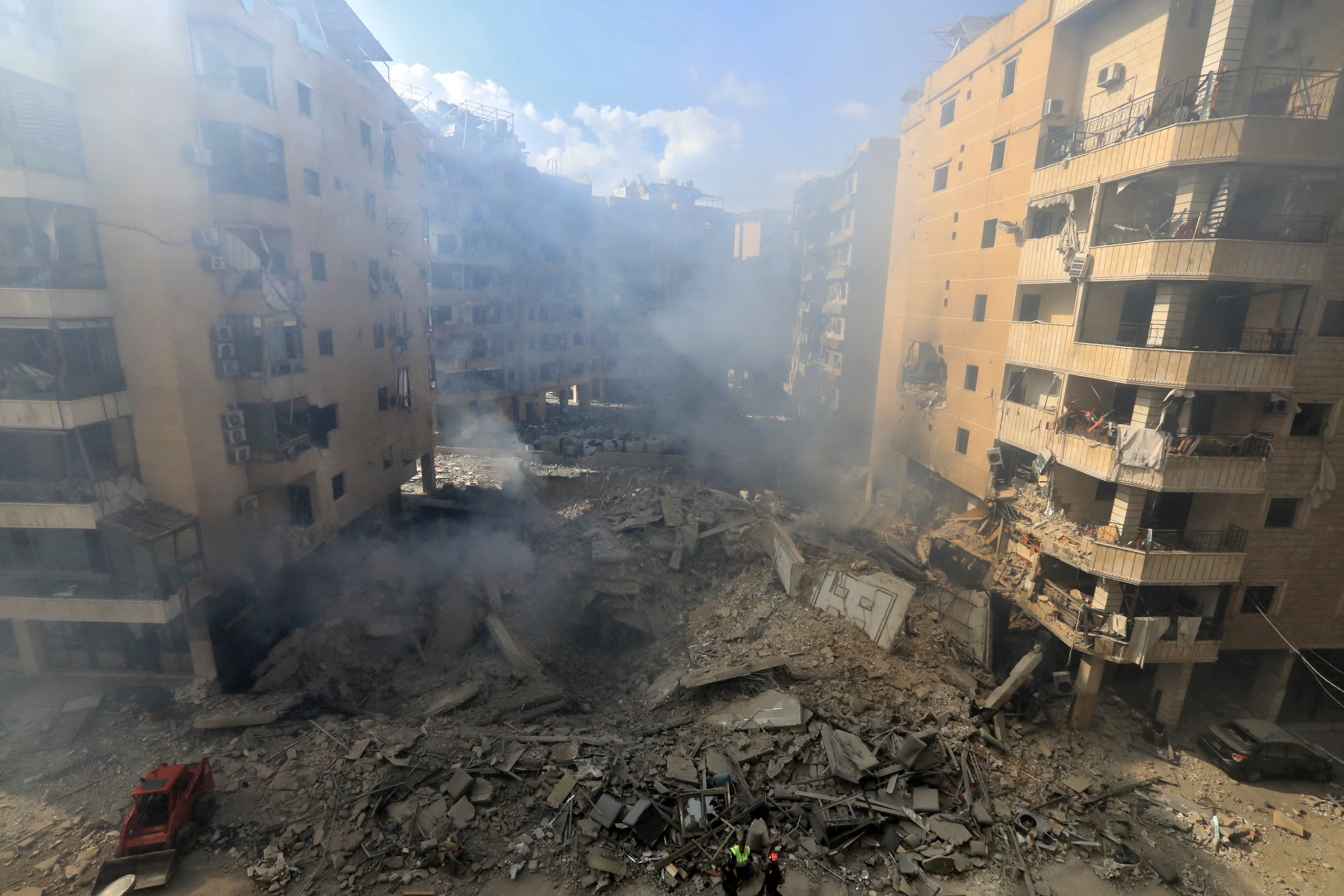
Beirut Photograph: AFP/Getty Images

Israel is reported to have killed more than a thousand people in its two weeks of bombing Lebanon and has now started a land invasion, which has caused a displacement of more than a million people, almost a fifth of the population.  It continues to murder hundreds of civilians in Gaza with the death toll approaching 42,000, not including many more buried under the rubble of destroyed buildings. One estimate, and not the highest, is 186,000!

After repeated provocations Iran attacked Israel with an unknown number of missiles that Israel says were mainly shot down, while video evidence claimed to show that many were successful, although it is not obvious that they hit their intended targets.  A main objective appears to have been to impact military airbases.

Iran reportedly gave notice to both the US and Israel that it was going to attack, allowing the Israelis to remove their aircraft from harm’s way, while it also said that its response to the provocations had finished.

Netanyahu shamelessly and offensively publicised his order to kill the leader of Hizbollah (and those unconnected who were near him) when he was at the UN in New York, straight after a speech in which he claimed that “Israel seeks peace. Israel yearns for peace. Israel has made peace and will make peace again.” After the Iranian missile strike he warned that Iran had made a “big mistake” and threatened that it “will pay for it”.

After the continuing genocide in Gaza, the more than thousand killed in Israeli bombing and now ground invasion of Lebanon, Keir Starmer declared that he and the country he claims to speak on behalf of, “stands with Israel” and recognises its right to self-defence.  The Labour Defence Secretary John Healey said that British forces had “played their part in attempts to prevent further escalation”, which must be his way of boasting that British aircraft helped the genocidal Israeli military to stop the Iranian missiles.  The US has already sent more military into the region and also boasted of its efforts against the missilles.

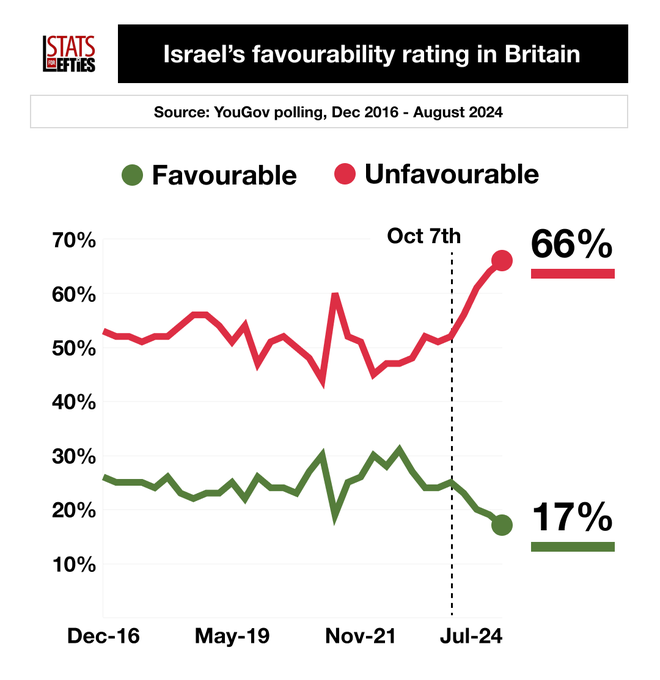
No one reading this will need an exposition of the lies and hypocrisy these statements involve, told by either the Zionist leaders or their Western backers: the selective condemnation of terrorism, selective endorsement of the right to self-defence, selective concern for civilian casualties and selective condemnation and sanctions against outside invasion.  All this is obvious.  Starmer’s support and defence of the genocidal Zionist regime has played a part in the collapse of his already low popularity and that of his government – his net approval number is now minus 30 and his government less popular than the one that has just been shredded:

More demonstrations are taking place and planned across the world, following the mass walk-out of delegates to the UN at the start of Netanyahu’s speech.  The pathetic role of the Irish delegation was clearly exposed by their staying in their seats to listen to the latest catalogue of lies that insults its listeners.

The Irish people have an opportunity to demonstrate their opposition to genocide and the attack on Lebanon through a march on Saturday.  The support declared for it reveals widespread support but also the depth of much of it. What is the purpose of this demonstration and the campaign generally? Is pointing out the hypocrisy of the government and its actions anywhere near enough?

The purpose, it would seem, can only be to put pressure on the government to take action but the repeated demands on the Government by some opposition TD’s have only been met by revelations that it will not even enforce its own laws that might somewhat inconvenience the transport of weapons to Israel – allowing flights over Irish airspace without any question.  The governing parties are riding high in the polls and are busy bribing the population with their own money in the budget – their money and that amassed as a tax haven for US multinationals. If putting pressure on it is the objective, the question must be asked – what pressure?

The political voices of these 160 civil society organisations supporting the demo have been demanding various actions from the Irish government for a year, with no success beyond its hypocritical statements that rival those of the other Western powers.  After a short time, this reveals not the power of public opinion but its weakness and that of the solidarity campaign that seeks to mobilise it.  It reveals the political poverty of demanding that the Irish bourgeoisie do something that is not in its interest.  If you expect they will do so you are naïve at best and if you don’t you are fooling your supporters and yourself.  

Look at the organisations supporting the demonstration! They include the trade unions and will probably include Sinn Fein; the party that partied with genocide Joe on St Patricks day.  Who could possibly feel pressure from such hypocrites?  The governing parties could easily turn round to the trade unions and ask – what have you done to boycott the Zionist state?

In other words, the Palestine solidarity campaign should be demanding that those who claim to support it do something, beyond supporting demonstrations that long ago revealed that bourgeois governments don’t care what their populations think as long as they can get away with it. If these governments will not take action, it needs to be taken for them, or rather – against them.

That means demanding that Sinn Fein boycott the genocidal US regime and the trade unions campaign to persuade their members to take direct action to boycott Israeli bound armaments etc. and defend them when they do.  If they don’t then their participation in solidarity demonstrations is a sham and by extension is a fraud on all the other participants who are genuinely opposed to the actions of the Zionist state and want to do something about it.

The Irish state is a very junior and subordinate partner in a Western imperialist alliance that supports the Zioinist state because this state is the West’s – primarily the US’s – instrument of power in the Arab world and beyond.  To expect that it will rebel against its dominant partners is delusional, and continual demands that it do so miseducates and misdirects everyone who doesn’t understand this. It must stop, and the campaign look to Irish workers as the means to put pressure on imperialism, starting by opposing their own state that is a part of it.

Forward to part 2

Bourgeois democracy in Ireland in two Acts (1) – supporting the Palestinians

In June the Taoiseach Simon Harris assured the Dáil that “no airport in Ireland or Irish sovereign airspace is being used to transport weapons to the conflict in the Middle East or any other war”.  The Ditch web site in September began reporting that nine such flights had been made to Israel, although the site reported that there were, and no doubt still are, many more.  It noted that ‘Carrying munitions of war through Irish airspace without permission from the minister for transport is a criminal offence punishable by up to three years’ imprisonment.’   

Harris stated in June that “In relation to the overflights, the Government of Ireland has never provided any permission for such an overflight to take place in terms of carrying munitions and therefore the Government wouldn’t have been in a position to inform the Dáil of such a flight. That position is quite clear,” which means that unless the Government expressly permits the law to be broken, it hasn’t been.  It would appear that it is only broken when it has been admitted but since the Government is never going to ask to inspect aircraft overflying or landing, it is never going to be admitted, and we just have to accept that the law has not been broken and Irish neutrality policy has not been breached.

In response to the evidence that neither of these things are true the Government has called an investigation into its own actions, as if it doesn’t know what it has been doing. Meanwhile Harris accused his critic, Sinn Fein’s Mary Lou McDonald, of “misleading people” and of trying to “muddy the waters”, which would make more sense if it was self-criticism.

The Green Party Minister of Transport has claimed that “no airport in Ireland, or Irish sovereign airspace, has been used to transport weapons directly to Israel” while he has also claimed that he supports new legislation that would allow random checks.  The sponsors of separate legislation have pointed out that the government already has powers to carry out checks but it isn’t using them, while it’s opposing their own proposals. The Minister has promised to “sit down with my officials and with legal experts over the coming months to make sure that new legislation is developed that is watertight, is workable, and is compliant with international aviation law.” Sitting for months is as near an honest admission of what action it will take as the government is likely to provide.

The prospects of any further Government legislation that would be implemented can be gauged by the fate of the Occupied Territories Bill, which would ban and criminalise “trade with and economic support for illegal settlements in territories deemed occupied under international law”, most notably Israeli settlements in the occupied territories.

This was passed in both Houses of the Oireachtas but has been stymied for four years, with yet another statement by Harris that he would seek “fresh legal advice” to extend the never ending delay.  The message is that a majority in the legislature can vote for something that is undoubtedly approved by the majority of the people but this doesn’t mean the Government will do anything to implement it.  The Ditch again explained the precise mechanism employed in this particular case, one of the many in bourgeois democracies to ensure that what democracy there is is suited only for the bourgeoisie:

‘On 25 February, 2019 Hadie Cohen from the Israeli Ministry of Justice emailed colleagues.’

‘Cohen referred to a “confidential call” (emphasis Cohen’s own) with Paschal Donohoe. Cohen said Donohoe told Israeli finance minister Moshe Kahlon that the Irish government would “block” the bill.’

“We understand that during a confidential call on 13 February between the Irish Minister of Finance and his Israeli counterpart, the Irish minister confirmed that the Irish government will be using a procedure known as “money message” to seek to block the progress of the draft Irish legislation criminalising dealings with products and services from the settlements – the Control of Economic Activity (Occupied Territories) Bill 2018,” wrote Cohen.’

‘The “money message” was invoked by ‘then foreign minister SImon Coveny [who] said government would invoke article 17.2 of the constitution . . . Coveney said government had to do this, not to frustrate the democratic process as critics of the money message argue, but because government’s “view is that additional costs will also arise from voted funds for certain Irish diplomatic missions abroad should this bill be enacted. I should state clearly at this point that because of these costs across a wide range of areas, there can be no doubt that the bill will require a money message to proceed to committee stage.” More sitting down with legal experts perhaps to ensure nothing is done.

Paschal Donohoe has denied this call but only in the sort of non-denial denial manner, similar to the non-apology apology.  What all this demonstrates is that the Irish State is no different from every other capitalist state, which are committees to run the affairs of the bourgeoisie that inevitably involve conspiracies to lie to their own people.

The Irish State joins with the others in the West in having its fingerprints all over genocide in Palestine, laced with its own particular flavour of hypocrisy, all the more disgusting because it pretends to be the very opposite if what it claims – to be in support of the Palestinian people based on its own experience of colonialism. Its reputation as an ally of the Palestinian people is exposed as a fraud and its public spats with Israel a piece of theatre.

Given this exposure of gross hypocrisy we can clearly see the futility of repeated petitions and demands by many on the left that the Irish state take action against Israel in order to help bring an end to the genocide. It is simply not in its interest to do so. The state is in hock to US multinationals, something referenced every day in the media reports of the increase in corporation taxes received from them. When it looks like some gesture might be made the US has ensured that its client Israel is protected and the Irish told what it cannot do.

The only force in Ireland with the capacity to prevent the transportation of weapons, and this itself is limited, are Irish workers, but pointed questions, petitions and criticism is never levelled by the likes of People before Profit at the trade union leaders who refuse to organise and advocate such action. The various mechanisms employed by the state to avoid taking action will not be changed by speeches in the Dáil. Action must be taken outside it, advocated and encouraged through speeches at meetings and in workplaces of those we want to take the necessary direct action; against the wishes of the government and state and the genocidal governments it stands in support of.

Workers’ democracy is the alternative to the conspiracy and lies of bourgeois democracy, and no matter how weak workers’ democracy is, it is much, much stronger than reliance on the bourgeois kind.

Forward to part 2