Trusting the State (3) – giving us the ‘right’ to housing

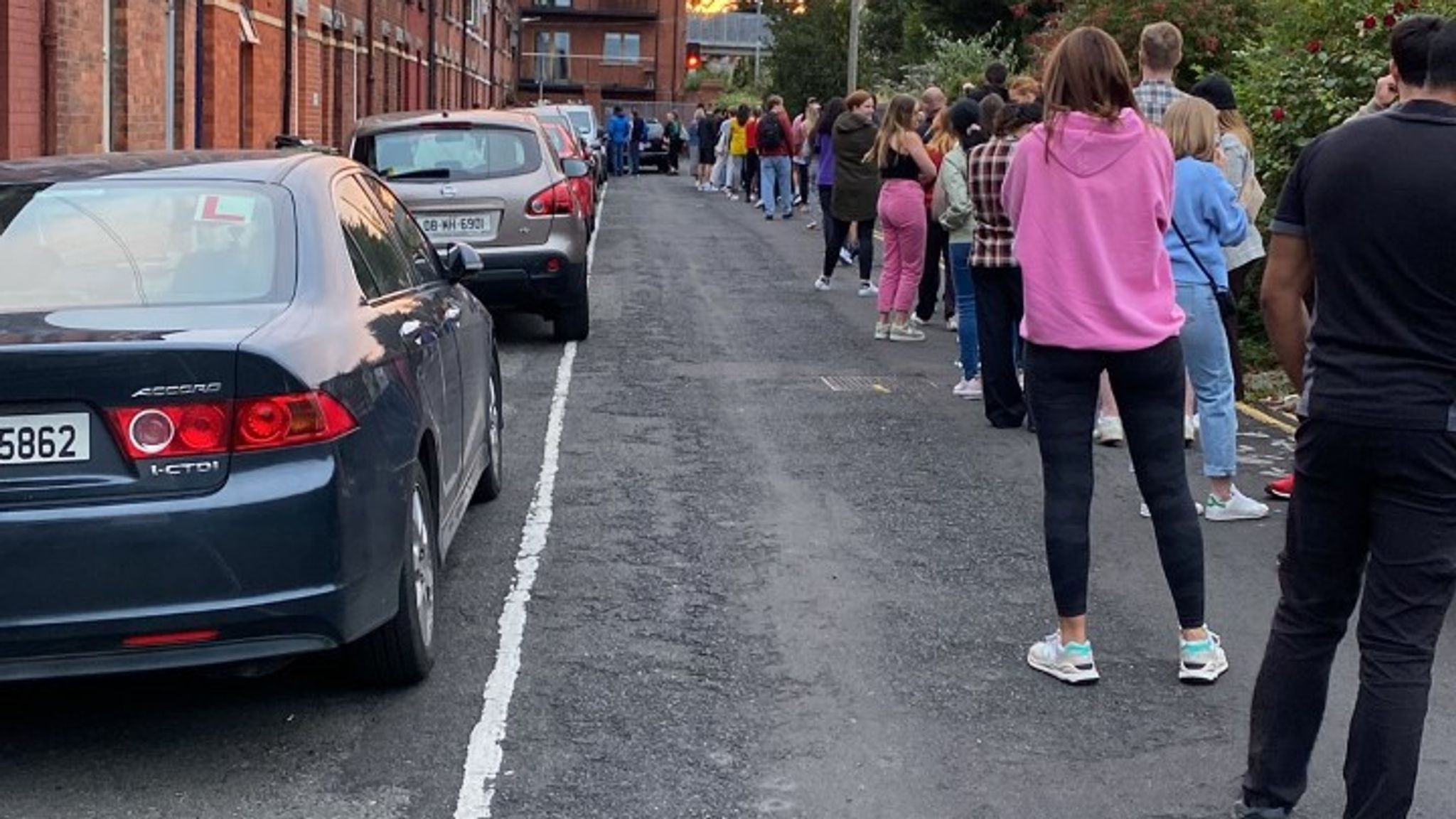
Queuing to look at one rental property in Dublin; pic Conor Finn, Sky News

Ireland suffered effective bankruptcy in 2007-08 through a property boom funded by a massive expansion of credit and crisis of overproduction, illustrated by employment in construction falling from 232,600 in in the last quarter of 2007 to 133,200 in the last quarter of 2017, a fall of 42.7%.  Yet the drop was even more precipitous than this: from 236,800 in 2007 to 83,400 in 2012, that is, by 65 per cent.  Almost one in every two workers who lost their jobs in the Irish state in the five years from 2007 to 2012 had previously been employed in construction.

The sector went from10.7 % of GDP in 2006 to 1.1% in 2011; going from the sixth largest share to the lowest in a group of around 50 countries during this period. The index of the value of residential construction fell from 751.7 In 2006 to 57.9 in 2012 while the index of non-residential construction fell from 115 to 73.59.  The growth in the stock of housing plummeted:

From an unsustainable boom to a collapse and again rapid growth, the boom-slump-boom Irish economy now has capacity constraints only partly made up by immigration, leading to a new housing crisis in which not enough houses are being built, house prices have become extortionate again, and not enough properties are available for rental.  To rub it in in, some of the partly finished houses from the boom were left to rot or demolished while the quality of much of what was built has become, or is becoming, uninhabitable because of poor materials or dangerous construction.  The banks that workers bailed out in the 2008 crisis are back in profit, having involved themselves in new rip-off scandals, and now criticised for pitiful savings rates while borrowing costs for its customers increase.  Despite their profits today their massive losses carried forward are set off against taxes, not a facility available to the working class.

The housing crisis dovetails with other aspects of the malfunctioning of Irish society including health and education.  More than 830,000 patients are on hospital waiting lists while staff vacancies are unfiled, including senior medical staff, while there are hundreds of teaching vacancies in schools.  Doctors, who in their career development will work for a year or two in Australia, aren’t coming back because they can’t afford houses in the areas they want to live.  Executives in US multinationals complain that housing is an issue for their recruitment of staff, thus raising the potential of lost foreign direct investment.

It is tempting to say that only Ireland could go from bankruptcy to growth of 26% in 2015 (and over 12% in 2022), and in some ways this is not just another example of the contradictions of capitalism in general but does speak to the particular character of the Irish variety.  Infamously, the Irish GDP figure is often ridiculed, and no longer accurately reflects real domestic economic activity; so although it has been boosted massively by US multinationals’ direct investment, it also reflects the massive impact of transfer of assets and production from elsewhere so that they can be taxed in the Irish State.  This has resulted in a massive growth in corporation tax receipts and its concentration in a few multinational companies, with around 60% of receipts come from only ten companies.

What the Celtic Tiger boom shows, and the vertiginous climb out of the following slump, is that even in good times capitalism is a problem and does not discard its contradictions.  The traditional Left alternative of spending more money by taxing the rich is not cutting to the root of the problems exposed, which arise from the contradiction of the development of productive forces coming up against the relations of production, which produce crises of overproduction and credit booms and slumps.

The unplanned and uneven development of these forces produces shiny new multinational offices beside small terraced houses that cost a fortune because not enough new housing has been built–in a city like Dublin that has witnessed an abundance of high cranes over its skyline for years.

The Government of the Irish State thus has a housing crisis and a surfeit of revenue.  Calls by opposition parties to solve the problem by spending more money and taxing the rich doesn’t recognise that this is not the problem.  The Irish state finds it both difficult and easy to spend money.  In the first three months of 2023 spending on housing was €80m behind budget, while spending on the new national children’s hospital has ballooned from a budget of €650m to an estimate of over €2bn, although nobody knows how much it will eventually actually cost or when it will be finished, being already years behind schedule.

The ability of capitalist states to waste money, which goes inevitably into the pockets of private capitalists, is not confined to Ireland, but the Irish state does seem to be good at it.  However, spending money to build houses requires workers to build them, land to build them on, and raw materials with which to build them.

Many workers and their skills have been lost following the Celtic Tiger collapse, as we have seen, and unemployment is low, falling from over 16% in 2012 to just over 4% now.  Land is privately owned and hoarded, and raw material costs have increased worldwide due to general inflation caused by monetary policies to protect the asset values of the world’s ruling class and the dislocation of supply caused by Covid lockdowns and sanctions arising from the war in Ukraine.  The Left, or some of it, thinks printing money is a solution, supported even stricter lockdowns, and supports western powers sanctions–so is in no position to parade its solutions.

In so far as it does, it calls upon the state to take direct action to build houses and acquire land.  The capacity constraints mentioned remain as does the record of failure of the Irish state.  The state itself is aware of this and the government in office has taken a host of initiatives to boost the housing market, mostly with the effect of increasing prices and relying on the private sector.  In turn, many private capitalists have suffered, as is the norm, from the workings of their own market.

Out of all this the governing parties decided that they wanted a Housing Commission to advise it on what it should do, including proposals for a constitutional referendum on housing, so that it to be some sort of right that people could refer to.   Not surprisingly, this has proven a problem.

It appears that there can be two approaches to putting such a right into the constitution.  First, it could be a statement of aspiration, which would involve more perspiration in writing it than any effective action arising out of it.  The second is the establishment of some legally enforceable obligation on the state, which the state fears will open it up to multiple legal challenges with all the horrific costs that this would entail.  Less money to spend on housing would result, they claim.

And here we come to the Karl Marx bit.  Famously, he said that ‘Right can never be higher than the economic structure of society and its cultural development conditioned thereby.’  In other words, if there aren’t the resources to build more houses the establishment of some ‘right’ to one will make no difference.  As one right-wing commentator rightly said, a referendum ‘won’t lay a single brick.’

As Marx also said: 

‘Right, by its very nature, can consist only in the application of an equal standard; but unequal individuals (and they would not be different individuals if they were not unequal) are measurable only by an equal standard insofar as they are brought under an equal point of view, are taken from one definite side only . . . one worker is married, another is not; one has more children than another, and so on and so forth. . . . To avoid all these defects, right, instead of being equal, would have to be unequal.’

So, to whom would a right to housing apply?  Everyone 18 and over, asylum seekers and refugees?  What sort of housing would a right entail – apartment, detached, terraced; where would it be sited and of what size?  And at what cost? Who would decide all this and what effective remedies would there be for non-compliance with any determined right?

It can be no surprise that Sinn Fein (paywall) fully supports a referendum, and no surprise what its reasons are.  Its housing spokesperson advances it because it ‘would restore trust in politics’ and would ‘put in place a basic floor of protection’, and ‘require the State, in its decisions and policies, to reasonably protect that right’; allowing ‘the courts to take the right into account where the State failed, manifestly to vindicate the right.’

However, just as a referendum will not lay a single brick, neither will any judge or judicial decision.  As if in recognition of this, the Sinn Fein author, Eoin Ó Broin, endorses the view that “its primary effect may actually be in the sphere of politics, administration and policy’, but doesn’t explain how the current forces prompting action we have noted above are less compelling now.  As for ‘restoring faith in politics’, the story of failure and ‘success’ set out above shows that faith in existing politics and the state is something to be overcome, not strengthened.

At the end of his piece the impotence of a constitutional right is acknowledged and then this acknowledgement denied–even on paper Sinn Fein can talk out of both sides of its mouth at the same time: ‘a constitutional right to housing will not, in and of itself, fix our broken housing system.  It would, however, place a firm legal obligation on the current and all future governments to realise that right through its laws, policies and budgets.’

The toothless nature of aspirations enshrined in the Irish constitution have been evidenced before: in its previous Articles 2 and 3, which stated that ‘The national territory consists of the whole island of Ireland, its islands and the territorial seas.’ And that ‘Pending the re-integration of the national territory, and without prejudice to the right of the parliament and government established by this constitution to exercise jurisdiction over the whole territory, the laws enacted by the parliament shall have the like area and extent of application as the laws of Saorstát Éireann and the like extra-territorial effect.’  Far from advancing the claimed sacred goal of national reunification the articles became an alibi for not doing anything remotely effective, until eventually they were overturned for something else that isn’t working.

A more recent example illustrates the feebleness of expecting economic and social ‘rights’ to mean anything. A few weeks ago the Ombudsman for Children criticised the state for “profound violation of children’s rights”, so that the Health Service Executive (HSE) had “seriously failed in its duty to uphold the rights of children to the best possible healthcare”.  “The examples of rights being ignored are numerous” he said, in a criticism that covered 20 years.

In reply, the HSE said that it had ‘prioritised targeted improvements and investment over recent years.”  It couldn’t even be bothered to explain or exculpate itself from the many previous years of failure, never mind guarantee future satisfaction of children’s healthcare needs.  Trusting the state or the constitution to deliver social and economic rights, that cannot even be precisely defined, is to trust the state and constitution that protects and legitimises the social and economic system that ensures that they are both needed and cannot be delivered.

Back to part 2

Forward to part 4
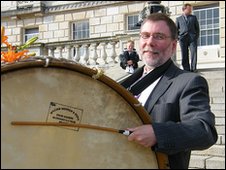
Nelson McCausland, a little man with a big loud drum. (by Belfast plebian)

47925243_3707225203_e18c6d4d4e-1It is a hell of a misfortune that at this time of a drastic need for some form of social protection for hard pressed working class families we are saddled with a social development minister in the Stormont Executive whose opinions accord well with the right wing government across the pond and who is also regarded by many as a hardened religious sectarian. This little man with the big drum is also proving to be the most active of the generally passive Stormont ministers.

It should be said at the outset that he took on the ministerial portfolio at a very awkward juncture when the Tory austerity plans where already in an advanced state. The SDLP of course vacated the crucial social development portfolio as soon as they caught sight of the content of the welfare reform bill and Sinn Fein screamed PASS to the chance to take over the department from the SDLP following the May 2011 assembly elections. Why Sinn Fein chose to take on the department of arts and culture, the one with the smallest budget and largely symbolic importance rather than one of the key economic departments stands as an interesting question without of course an answer.

Nelson McCausland is known for being an ardent Unionist, a formidable Orangeman and monarchist, a ‘pro-life’ evangelical Christian who is also a Creationist and of course a great enthusiast for something called the Ulster-Scots culture. Indeed it can be persuasively argued that he more than any other individual is responsible for the ideological mishmash called Ulster-Scots culture. When he was appointed to his previous ministerial post in 2009, in charge of dolling out money to the arts and science cliques, his primary mission was to raise Ulster-Scots heritage up a couple of intellectual notches to the status of ‘a traditional culture’ and therefore make it worthy of taxpayer cash. The small budget didn’t deter Nelson too much.

Before he captured the minister for arts and culture portfolio he was the director of a lobby organisation called the Ulster-Scots Heritage Council. Back in those days he had little or no money to promote Ulster Scots heritage as a rival to the Irish language and culture movement and so no one of any intellectual standing took him too seriously. It was only when he got his hands on the department cash card that the little man with the big drum had to be listened to by the typically anti heritage arts cliques.

For a brief moment Nelson attracted the attention of the middle brow Guardian newspaper, thus earning a wider notoriety and crossing swords with non-other than uber-scientist Richard Dawkins who declared that the minister was an unfit person to be in charge of science museums. This was after Nelson wrote to the Ulster Museum requiring that it display a range of Creationist inspired artefacts to offer the North’s naive children a legitimate alternative to the “unproved theory of evolution.”

It didn’t take much to put down poor Professor Dawkins, faced with the acuity of Ulster’s superior evangelical mind. “Dawkins is an arrogant and militant atheist who prides himself on his knowledge and reason. He loves to demean and disparage others but this time the mighty man came unstuck” declared Nelson on his personal blog.

Being anti-modern in evolutionary science has not stopped the little man with the big drum being a very successful politician, He is already into his second ministerial position and is easily the busiest minister. Some people think they know why he is so successful. The key to his lasting popularity they say is to be found in his very frequent sectarian public outbursts, something that goes down well in loyalist flag waving working class districts. Let’s run through just a few of his more recent efforts.

On the third of October the Belfast Telegraph ran a story -‘Fury after Nelson McCausland says there’s no need for more Derry housing funds.’ It emerged that the minister had refused a recent appeal by Derry City Councillors for additional funds for the Housing Executive to build more social housing in the city. The latest figures revealed that the number of families and single people on waiting lists had passed the 3,000 mark

Sinn Fein councillor Tony Hassan said ‘we get a letter back from the minister’s secretary and to me it was disgraceful.’ The SDLP councillor John Tierney called the statement of the minister ‘crazy’. And here’s a nice Nelson touch – ‘the minister’s letter also referred to Derry City Council in the address and throughout as City Council of Londonderry.’

On the 25 September he faced down an SDLP sponsored motion calling for a three month parliamentary suspension for supposedly breaching the ministerial code by failing to condemn illegal acts conducted by a royal black band parade as it swaggered outside St Patrick’s Church on Donegall Street in Belfast. The suspension motion attracted a lot of media attention and was voted down. And so the little man’s political stock went up within his own party. McCausland, more than most DUP politicians, gets a kick out of baiting both ‘republican’ and nationalist politicians. He runs his own blog just to keep the invective regular.

In mid-June we can pull out another two media stories, ably covered by the online newspaper the Detail. The story broke that Nelson McCausland had caused worry and anger among Housing Executive workers when he chose to provide fellow DUP assembly colleague Paula Bradley with the religious breakdown of staff employed in North Belfast in the most public way. The decision was strongly criticised by trade union officials who warned that publication of the religious designation of workers in specific localities might put them at risk.

Less than a week later a car belonging to a Housing Executive employee was destroyed after it was set on fire by masked youths as it was parked outside the agency’s district office in Newtownabbey. ‘The Detail understands that Housing Executive officials have been forced to review security measures at offices across Belfast as a result of the attack. In a series of questions to DSD ‘we asked Mr McCausland to explain why he decided to publish the figures against the advice of his own officials and despite staff concerns…We also asked DUP MLA Paula Bradley why she had originally asked for a religious breakdown of staff… she chose not to respond.’

Also in June McCausland was criticised for blocking plans to build 200 new houses for people deemed to be nationalists on the vacant site of the former Girdwood army base in North Belfast. ‘However the Detail can now reveal new evidence showing that the DUP minister held discussions with the Housing Executive to ensure that four loyalist areas in north Belfast were given preferential treatment to be included in a new housing building scheme despite having little or no sign of any significant homelessness.’ Nationalists make up most of the 1,300 people in homeless stress in North Belfast.

The Detail obtained evidence that emergency approval was used to ensure that the four estates were added three months after the three year building plan had been finalised by the Housing Executive. The change was all down to pressure from the DSD and was a clear breach of a 40 years old protocol that social housing should be allocated strictly on the basis of priority of need and not on the basis of political or religious affiliation. This incidentally dragged Sinn Fein into the mix as they had agreed to the decision at local level talks.

And here is one from this month, this time from Nelson’s personal blog. Under the heading Biased Broadcast Corporation he complains about a pro Sinn Fein bias at, of all places, BBC Northern Ireland . He thunders against a BBC documentary that he hasn’t even seen about the life of the youngest Lord Mayor of Belfast, who happens to be a member of Sinn Fein, councillor Niall O Donnghaile.

He notes ‘This is not the first BBC documentary on a Lord Mayor. There was also a documentary on Alex Maskey, who was Lord Mayor in 2002. In between there were eight other Lord Mayors and they were drawn from all the larger political parties, but the BBC has decided that the only party whose Lord Mayors merit a BBC documentary….There is an onus on the BBC to acknowledge that it was wrong to give preferential treatment to Sinn Fein, to determine how this happened, to ensure that it does not happen again and to take action to redress this balance.’ There is a lot of this type of thing on Nelson’s blog, most of it aimed at excoriating Sinn Fein, his partner in government.

So Nelson’s strong electoral success can be attributed to some degree to what appears to be his carefree sectarian mud-slinging that goes down well with his many loyalist followers. However this is not what I want to focus on so much, rather I want to show up his other prejudice, his right wing class prejudices that make him the emblematic leader of the main party of government at Stormont.

Nelson holds strong opinions on socio-economic matters but critics prefer to ignore them, all the more to encourage him to just get on with his ministerial post. If only Nelson would just do his job and not court publicity things would be fine say his newspaper critics. But Nelson is getting on with his job. In fact he has the two biggest policy initiatives of the Executive on his agenda, implementing the welfare reform bill and dismantling the Housing Executive.

We can pick up the thread of Nelson’s approach to welfare reform from his offering on the bedroom tax. The chief executive of the Northern Ireland Federation of Housing Associations (NIFHA) Cameron Watt recently called on Nelson to delay the implementation of the bedroom tax until the Universal Credit is actually ready to go. This would of course only mean a postponement of about six months, from April 2013 to October 2013.

According to NIFHA this is ‘necessary, realistic and fair.’ Nelson rejected the very meek proposal outright saying that ‘I intend to increase funding available for discretionary housing payments to be made to all social housing tenants.’ In other words if any of the 34,000 tenants experience problems with rent they might be able to get a discretionary payment to help them out. Housing officers are to be offered a new career path into becoming poor law guardians.

The public line of the Stormont Executive is that it is being blackmailed by the Con-Dem government into progressing the welfare reform bill. If it was down to them it would not happen but if they put obstacles in its way they would face financial penalties

Yet in his speech to the NIFHA conference Nelson says “Turning now to events at a UK level, everyone in the room will be aware of the welfare reform agenda which is progressing. We know that its implementation is unavoidable. I think most of us will agree that the key principles behind this legislation are positive and we should recognise the real positives and opportunities that can be achieved as a result of some of these reforms.”

The principle that Nelson likes most is the one that says a welfare system should promote personal and social responsibility. In fact Nelson being a keen evangelical is happy to edge the State out of welfare provision and get the churches in. His department has already licensed a couple of schemes to that end.

We find an article on his blog of 25 November 2012 called signposts for funding churches “The Minister for Social Development, Nelson McCausland, believes that there is a very critical role to be played by the faith sector in developing strategic partnerships with Government to help deliver practical approaches to tackling poverty. For this reason, the Minister funds the Faith Forum for Social Development …. Minister McCausland wants all faith-based groups to become engaged with the Department whether it is on local Neighbourhood Renewal Partnerships, benefit uptake or helping ensure the connections exist between vulnerable citizens and agencies such as the Social Security Agency or the Housing Executive. There is no cost to them and only benefits to be gained by those most in need.

Nelson’s DSD operates something called the Voluntary and Community Unit which doles out millions to agencies like the Law Centre, Citizens Advice Bureau and Northern Ireland Council For Voluntary Action. It also funds the Regional Infrastructure Programme which has an annual budget of 3 million to fund community groups. Some scope then for Nelson to put his own brand of welfare policy into operation.

The day Nelson became Social Development minister in May 2012 was the day the death knell sounded for the Northern Ireland Housing Executive (NIHE) and of socialised housing. Nelson has chosen to make social housing his battlefront. We already mentioned the clash over the abandoned Girdwood Barracks, the emails seeking knowledge of the religious makeup of the Belfast offices in February 2012 and the publication of Catholic numbers working in Newtownabbey.

There has also been his row with the senior management over a £7 million repair contract with a company situated in East Belfast, Red Sky. The contract was terminated in July 2011 following accusations that the company had engaged in a practice of overcharging. Huge political pressure was piled on the NIHE to overturn the termination of the contract

Three days into his post Nelson met with the NIHE chairman Brian Rowntree to ask that the decision be suspended for six months. The investigative magazine the Detail gained access to the emails. The NIHE chairman sent one to the Department for Social Development (DSD) Permanent Secretary Will Haire on July1 saying he had ‘serious concerns and misgivings’ over the pressure being applied by the DSD over the contract and asked that the minister take a step back. The DSD permanent secretary emailed back saying ‘I believe that you should withdraw the remarks you made.’ Four days later Mr Rowntree resigned as Chairman citing personal reasons.

Nelson knows a few things about the NIHE that are not to his liking. He knows that it came into being to end the allocation of social housing on the basis of religious affiliation and he knows it always has had a catholic majority in its staff. But putting the sectarian boot into the NIHE is not his only motivation. He does not like its social democratic ethos. He is in fact busy drawing up plans to have it broken up and privatised.

It is likely that the 90,000 tenants will be transferred to private Housing Association where rents are higher. A good number of redundancies will follow out of the 2,800 staff. For those who think he will face opposition from Sinn Fein – think again. In July Stormont announced that it had set itself a target of transferring 2,000 homes to Housing Associations and a number of British based Housing Associations are said to be taking soundings. The public justification for the change is stated in the consultation documents, which is the need to raise a billion pounds for repair work. The NIHE is not able to raise loans from private banks but Housing Associations can do so.

What is motivating the politicians in the Stormont Executive to break up and privatise the NIHE? Some might think it is pure sectarianism. But if it is, what about Sinn Fein? Do they also want a sectarian carve up? Is it simply a relentless falling into line to what is happening to social policy in Britain, with the varied the attacks on the social housing sector? Is it the Stormont Executive looking for one way to cut its own costs in this time of austerity? Or is it that nobody wants to rock the Stormont boat too much in case it sinks and so Nelson must be left to pursue his own private political agenda with a minimum of opposition? Maybe all the above motivations are factors? What do you think?