Lessons from the Grangemouth dispute

GRANGEMOUTH_2700282bI received an email from Socialist Democracy inviting me to contribute to a discussion based on an article they have written on the lessons of the Grangemouth dispute in Scotland. This article sets out the devastating scale of the defeat – the freeze in pay, butchery of pension entitlement and castration of union organisation.  Many in the media called it an old fashioned battle of labour against capital, such was the unvarnished clarity of what was involved.

The questions to be answered are whether there could have been a different result and what lessons can be learnt?

The article does not say whether the result could have been different.  Given the circumstances I think not, but this means we must be clear what the circumstance were that lead to this conclusion.

As for the lessons the article posits two – that the entire strategy of the trade union leaders has been overthrown and that of union support for, and reliance on, the Labour Party is a mistake.  I believe that there is a third rather more basic one, which can be explained very much as the old fashioned relationship between labour and capital.  What is this relationship?

The relations of capitalist production are unequal as they involve capitalists as owners of the means of production, including oil refineries and petrochemical works, and workers separated from ownership of such means of production and dependent on employment by the capitalist for their livelihood.  In a struggle that does not threaten or weaken these foundations it is generally the case that the capitalists will be able to impose their wishes because these align with the power structures in society.

This does not mean each and every strike or struggle by workers is doomed to defeat but that in certain disputes this power of capital is fully deployed and the fundamental imbalance in power is cruelly demonstrated.  Were it otherwise capitalism might be able to find some stable compromise, some equilibrium between the two classes that would allow a ‘fairer’ distribution of resources.  No such stable equilibrium has been found.  Marxists have been confirmed in their view that the liberation of the majority of working people requires overturning the existing system and creation of one in which the monopoly of ownership of capital is destroyed. 

This is the basic case for socialism in opposition to all those who think a better world is possible while not overthrowing the fundamental structures of society.

It is not an all or nothing case.  It does not say that workers can do nothing to protect themselves short of socialism.  Struggles that do not threaten these fundamental relations can sometimes be victorious such as when the economy is booming, unemployment is low and workers can strike or otherwise bargain for higher wages without fear of being sacked and their place being taken by the unemployed.

Of course in an economic downturn the temporary leverage of workers and trade unions is undermined and the power of capitalists to do as they wish because of their ownership of capital is reasserted.

In the case of the Grangemouth dispute this means that no workers’ action no matter how brilliant, innovative or militant could prevent Jim Ratcliffe from using his ownership of capital to close the refinery and petrochemical works and throw thousands of workers onto the dole.

Of course if you were convinced he was lying about the profitability of the plant and convinced his threats to close were a bluff the solution is simple – call his bluff and tell him his demands will not be accepted.  Unfortunately his ownership means that only he and his management know the truth and his claims that the plant only had a future if he was able to put £300 million in investment into it were credible. The same system that decrees private ownership of a refinery also necessarily involves periodic overcapacity in production and this was held over the workers’ heads as the brute fact that required they surrender or face the sack.

Under such circumstances no one can be surprised the workers decided to accept the lesser evil.

The article is correct that simple strike action would not succeed.  It was the boss who went on strike – it’s called a lockout.  It is he who brought production to a halt and threatened to make this permanent.

Others called for widespread solidarity action perhaps secondary strikes.  Firstly these are illegal and related to this, workers have not yet the level of combativity to carry out such action, even those involved in the chemicals industry who would have lost their own jobs had Grangemouth closed.

If it is argued that this strategy is one we must argue for and attempt to build for the future then this is indeed an element of strategy.  In this situation however there is no reason to believe Ratcliffe gave a rat’s arse about the fate of the wider industry and of the other thousands of jobs that would have been lost.  If he was going to close Grangemouth then all these strikes would have made no difference to his plans.

A second possible answer was to call on the state to nationalise the refinery and works.  The problem with this is that neither the British State based in London nor that part that might go independent had no intention of doing so.  Both are ‘open for business’ only when it means private capitalism.  So who was going to nationalise the works?  If it is believed that strike action would compel such nationalisation then it would have had to be wider and deeper than that considered above and the first response of the State would have been to attempt to throttle it. Some people keep on forgetting the State is the protector of the enemy.

Some on the Scottish Left said the situation at Grangemouth showed the need for independence but this was not an immediate solution.  As we have just said, the Scottish National Party has no intention of nationalising private industry when private capitalists are prepared to invest if only the workers accept the necessary sacrifices.  Alex Salmond’s primary concern was with the exposure of his independence project, and the illustration of how weak the idea of a prosperous oil economy looks in light of this immediate threat to pull the plug.  Since the refinery provides fuel for northern England and Northern Ireland as well as Scotland the case for action to protect the service went beyond the border and thus implicitly provides the grounds for wide action to defend it.  It also undermines any case for a nationalist solution from the right or the left.

The article argues against the efficacy of such answers and proposes its own elements of a strategy.  Some of these are by no means very clear.

For example what does this mean? –

“The trade union and political fights have to be united around a movement that is willing to reject the claims of finance capital and to step in and expropriate capital where it is necessary to preserve the livelihood of workers.”

The only time a workers’ movement will be able on its own to expropriate capital is when there is a revolutionary situation. We’re not in one of those so it wasn’t and isn’t an answer.  (We’re also fighting industrial capital in this one.)

The article says –

“The Labour Party has promised a temporary freeze on prices, so a call could be made for a permanent cap . . .”

Just how are the laws of capitalism to be permanently abolished or even suspended when the system still exists?

They can’t.  The only way they can is if and when there is a revolution that creates the conditions for totally remodelling economic and social relations and even then prices will not be abolished for some considerable time.

The alternative proposed revolves around occupation and seeking an alternative to the Labour Party.

Once again however if the plant is really losing money and the threat of closure real then why would Ratcliffe not just let the workers occupy, sit in the refinery and – so far as he was concerned – rot away?  It would be just another way of closing the plant if he didn’t get the workers to accept his demands.

What the demand for occupation means is that workers take over ownership and run it themselves.  They cannot simply run it themselves without ownership.  No one would provide raw materials or other services without someone to contract with and you don’t form contracts with those in unlawful possession.  So the question is how would the workers take ownership?  How would they get the money to buy it and to invest perhaps the£300 million Ratcliffe says is needed?

Obviously this is much harder when pushed against a wall, with no preparation and no conception that this is the alternative.  Equally obviously if it is accepted that this is the road that workers in such situations should follow then it would be better to be prepared for such a challenge.  The challenge is precisely to the monopoly ownership of the means of production that we said at the start is the heart of the relationship between capital and labour and at the heart of capitalism.

The workers movement is big enough to fund research into the creation of worker owned businesses.  Workers might start to fight to gain control of their pension funds to invest in their own enterprises.  Money can be raised for investment from financial institutions or other funding means to be determined.    A network of employee owned cooperatives already exists.  What is involved is not utopian, in the sense it has never been done before, nor is it without rational calculation.

If workers could be ready for such an alternative the threats of closure would not be so conclusive.

In other words the alternative to capitalist ownership is workers’ ownership.  Not just in some indefinite future ‘after the revolution’ but now and not just for now but in order to build towards the future.

Finally the article criticises the unions’ support for the Labour Party.  It notes that organised workers continue to support their trade union and political leaders, although it only proposes that in order to fight both it is necessary to break from the Labour Party but not from the existing trade unions.  It calls for a ‘class struggle movement’ to be created across all the unions, which should call for a new working class party.

It obviously believes this fight can dismiss the Labour Party and need not go through it, although it does not explain how this can be achieved when it acknowledges workers continuing support for that Party.  Implicit is the view that a fight within that Party is not needed to convince workers to break from it.  This in my view is very doubtful.

It draws no lessons from its ridicule of the small socialist organisations which have attempted this road or what it correctly describes as the private character of their concerns; illustrated by their bizarre discussions and replication of policies that decades ago they excoriated the Labour Party for.  The articles’ own call for a revolutionary party is correct but of no help here since it is put forward, necessarily so, as an ideal future location.

Instead it states that – “there are many issues around which a fightback can be organised, but they cannot be organized by the current leadership of the working class . . . What it [Grangemouth] has shown up is the utter inability of the traditional leadership to defend workers and the demoralisation and lack of strategic vision on the part of the socialists.”

If what is being said is that a new leadership has to be created, and the existing one challenged, then this is correct.  If it is being said that this is a precondition for a fight-back then this is not correct. It is only in the course of struggle that existing leaderships can be defeated, as long as such objectives become part of the struggle by the mass of ordinary workers.

The workers at Grangemouth and, by extension, those beyond have suffered a cruel defeat.  One possible reaction is to be cowed by the power of capital to shatter livelihoods.  A second is to seek some magic bullet of a strategy that workers can employ to defeat such plans: a strike, secondary action or an occupation.

A third lesson is that very often workers are forcibly confronted with the reality that to secure a decent life they need to go beyond capitalism and that no amount of shifting it with militant action can change its fundamental nature.  This nature is one where capitalists own the means of production and they can open and close it when they want.  This is not a strong argument for capitalism but a powerful argument for changing society – for socialism.

As Marx said – “the working class ought not to exaggerate to themselves the ultimate working of these everyday struggles. They ought not to forget that they are fighting with effects, but not with the causes of those effects; that they are retarding the downward movement, but not changing its direction; that they are applying palliatives, not curing the malady. They ought, therefore, not to be exclusively absorbed in these unavoidable guerilla fights incessantly springing up from the never ceasing encroachments of capital or changes of the market. They ought to understand that, with all the miseries it imposes upon them, the present system simultaneously engenders the material conditions and the social forms necessary for an economical reconstruction of society. Instead of the conservative motto: “A fair day’s wage for a fair day’s work!” they ought to inscribe on their banner the revolutionary watchword: “Abolition of the wages system!

Russell Brand and Revolution

F5A3478A79C182CD67445A6E8E4B8_h498_w598_m2

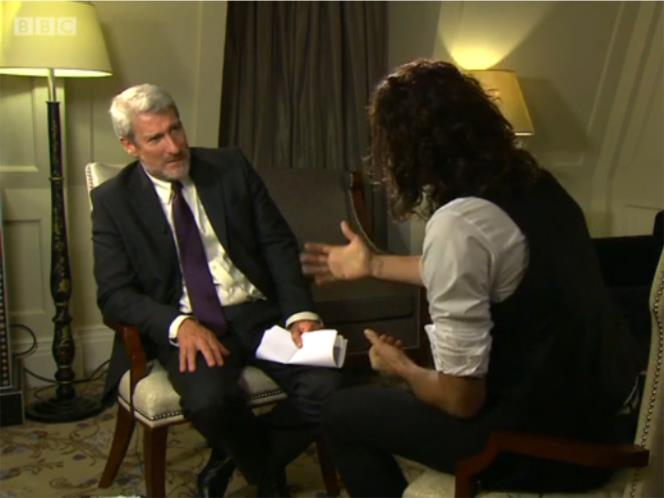
I was listening to BBC Radio 4 on the headphones on my way home from work last night when three Westminster politicians were asked about Russell Brand’s interview with Jeremy Paxman.  The link shows it has had nearly 9 million hits, just a few million more than this blog.  This is why Radio 4 was covering it and why it is important.

Is it another illustration of the celebrity culture that colonises everything?  This is the claim of some of the derisive dismissal of Brand’s rantings by the rest of the media who, at least the ones I’ve read, have slagged him off as a hypocrite.  An obvious example of ad hominem argument or shooting the messenger, not that it’s always wrong to shoot the messenger when the message is intolerable.  In this respect I’m reminded of the opening scene of Gladiator when the Germanic tribes respond to the demand to surrender by the Roman legions by throwing the severed head of the messenger on the ground in front of their massed ranks.

The problem of course is that shooting the messenger doesn’t deal with the message as the Germanic tribes discovered.  It might be claimed Brand doesn’t have an argument.  But read his New Statesman article and he does.

It might be dismissed as primitive or naïve but a better word is elemental and he does have more than a few good lines.  He makes a case.  It’s not the sort you will read on this blog but this blog doesn’t pretend to have the only or the best or the most effective voice for revolutionary change.  It aspires to encourage the recovery of Marxism and its application to the practical political programme of socialists.  It hopes that whoever thinks this is a reasonable objective to pursue will contribute to it and write their own posts.

So what if Brand’s surprising political commitment lights up the sky like a meteor and crashes and burns to earth?  What if he is a one-hit wonder?  When the rest of us are unable to get a gig a one-hit wonder is something to be.

Has his outburst reduced the credibility of our cause?  Or given it a little more light? Perhaps one more point of departure to argue for it and to advance it?

He is obviously very aware of the brickbats he would get for his ‘champagne socialist’ position and his trenchant, and in some ways reasonable, response to this is itself rather honest compared to the carefully constructed insincerity of politician’s continual hypocrisy.  It’s not as if he’s a champagne socialist in the way that that other celebrity in the new is – ‘Sir’ Alex Ferguson – with his Icumfigovan sign in his office, his hobnobbing with millionaires and his advice on man management to Tony Bliar. Nevertheless Brand has a brand problem – for example my partner thinks he’s a prat and she is very rarely wrong in such judgements.

russell brand revolution header

Brand can be criticised as anti-political, with his calls for people not to vote, but he is not stupid and he puts forward a case why we ‘should not encourage them’.  He also puts well the idea that apathy is more accessible than anger to all the shit that people have to put up with from politicians and the system they pimp.  Compared to many on the left, who claim there is a crisis of working class representation, that is we don’t have the right politicians in parliament to represent us, the radical critique of all politicians who do represent us is refreshing.

Not because we haven’t heard it before, in fact as Marxists we invented the revolutionary critique of bureaucratic ‘representation’ of the working class, but because we never see it on television.  We are extremists who never get heard but a little bit of a hearing for revolution makes us a little bit less extreme in the sense we are able to register in political debate a little bit more.

Listening to the feeble and self-serving helpings of cant from the Tory, Labour and Liberal politicians last night on the radio shows how even such a minor assault on their system from someone with a shred of credibility can so easily expose the defenders of the status quo.  Now Radio 4 reports the disillusionment of Paxman himself with the politics on offer in Britain. For Ireland multiply that lack of alternative by the number of Euros given to bailout the banks.

Above all, when pressed for what he wants as an alternative Brand calls for socialism and for revolution.  This is a darned sight more than some on the left do when faced with such a question.  The next question is that of the child – but how do we get a revolution?  You can ague all you like that Brand hasn’t much to say about this that seems practical but what is the message of the so-called revolutionary left?

As I have posted many times, the left that claims to be Marxist asks the state to extend its power through extra spending, taxation and through nationalisation while simultaneously believing, but not having the courage to say so in front of the workers, that this same state should be smashed in a revolution.

Let’s not pretend Brand is an advanced political thinker whose views we should instantly embrace.  He may be on a ‘messiah world tour’ but he’s still more a very naughty boy than a genuine Messiah.

Brandism is hardly going to succeed Marxism, Leninism and Trotskyism.  It’s not a practical guide but an emotional and reasoned outburst.  It’s not even an inarticulate expression of youth rebellion.  He’s 38 and very articulate.  We’re not obliged to defend his every word or even every tenth one but his avalanche of words creates an impression – there is something radically wrong with the world we inhabit.  Very, very wrong.

It would be easy to criticise what he says for all sorts of reasons, from his apparent attitude to women to his lack of political strategy.  But it is precisely his political limits that creates a focus on the key message that he is held to be delivering – opposition to the venality of the present system, the need for a revolution.

I’ve just finished reading a book – ‘A Marxist History of the World’, written by a member of a British left organisation.  It also makes the argument that what is needed is a socialist revolution.  The French revolution of 1789, the revolutions of 1830 and 1848; the 1917 revolution in Russia and revolutionary wave in Europe up to 1923, the Spanish revolution in 1936, the Hungarian revolution of 1956; the French general strike in 1968; the Iranian revolution of 1979; the overthrow of Stalinism after 1989 and the recent Arab revolutions, are all held up to show its possibility.  The last 100 years has been ‘pregnant with revolution’ readers are told.  We face Armageddon reminiscent of that foretold by the bible –with the appearance of the four horsemen of the apocalypse.  The stakes have never been higher with a crisis of capitalism the deepest and most intractable ever.

This to me is no more coherent than Russell Brand’s interview but without a few of the redeeming features of the latter.

The list of revolutions includes only one successful socialist one – 1917 – and it was strangled into Stalinism relatively quickly.  We will, rather shortly, be commemorating the 100th anniversary of this revolution.

The point is not that the objective of revolution should be abandoned.  Revolution is not required to achieve a certain state of affairs – socialism – revolution is that state of affairs, which is the ruling of society by its majority.

Revolution on the other hand is seen by many on the left as one strategy to achieve something as opposed to alternative reformist ones – such as voting and elections to parliament – which are said not to be realistic.  Revolution is therefore seen as a cataclysmic single event rather than as a process, one that begins and grows and that moves towards a qualitative rupture that destroys the old state and creates a new one based on the working majority of society.

The road to socialism is not growing state control but increasing workers’ control of every aspect of their lives through incrementally reducing the power of the capitalist class and its state in preparation for the final battle.  I have tried to explain this a little bit on this blog.

When a public intervention leads to Radio 4 interviewers pursuing their politician guests with the question “but why not revolution?” this intervention deserves some support.

Why have the Irish not Revolted? Part III

1913_LOCKOUT_ADVERT-1

The weakness of Irish workers resistance to austerity cannot be explained as a supposed result of this austerity having less effect than in other countries.  We have just witnessed the eighth austerity budget, the previous seven having cumulatively accounted for 17 per cent of current Gross Domestic Product.

The budget deficit in 2013 is higher than that of Spain, Portugal or Greece; there is at least another austerity budget pencilled in and the State debt is continuing to rise.  Next to nothing of the debt taken on in order to bail out the banks has been paid back and these banks are still saddled with mortgage customers who can’t pay their loans back.  Were the much trumpeted rebound of the property market to be anything substantial the banks would be repossessing and selling the vacated properties.  They’re not.

In other words the crisis isn’t over and neither is austerity, although faint hope that it is coming to an end plays one part in explaining latterly the weakness of protest and resistance.

The answer to the problem lies in the weakness of the Irish working class itself.  For Marx capitalism, in creating the working class, created its grave digger.  The nature of a particular capitalism goes a long way to explaining the nature of a particular working class and the weakness of the Irish working class is a reflection of the weakness of Irish capitalism.

An objection might be made to this that the Russian working class was the most ideologically advanced working class a century ago while Russian capitalism was weak. On the other hand capitalism in the United States has been the most advanced for a century or more but its working class is a byword for exceptional weakness.

The uneven and combined development of both societies has gone a long way to explaining this apparent anomaly and it is beyond the scope of this post to compare and contrast the development of the US and Russian socialist movements.  Over 100 years ago Karl Kautsky wrote on this question in ‘The American Worker’, relatively recently republished as part of a symposium in the journal ‘Historical Materialism’.

What we can say here in respect of Ireland is that its uneven historical development both inside the country, and as a region within the wider British economy, mainly as a reserve of agricultural production and labour power, has accounted for its historical weakness.

I was reminded of this nearly a year ago when I received a United Left Alliance (ULA) email newsletter what presented a series of proposed meetings to be organised by the ULA against austerity.  These meetings were to deal with different aspects of the issue such as the economy, health services etc.  In Russia a noteworthy feature of political and intellectual life a hundred years ago was the strength, vibrancy and hegemony of Marxism such that it dominated even the thinking of Russian liberals.

How different a situation from Ireland!  The speakers proposed for the ULA list of meetings demonstrated the reverse – the domination of Irish socialism by liberalism.  We can see this in everything from the Left’s opportunist search for unity with organisations that are far from working class in political character, from the Greens to Sinn Fein and populist independents, to their Keynesian economic alternative that relies on the goodness of the liberal capitalist state –taxing the rich and nationalising industry.

This of course feeds into the mis-education of workers who, while they may not reject the ULA’s state-reformism from a revolutionary perspective, have a healthy distrust of the really existing bureaucratic state they know.  And they have a healthy scepticism that this state will create a new economy and tax the rich when the most widespread view of politics and government is that the politicians and the state mandarins are only in it for themselves.

Acquaintance with the occupational training by FÁS and the decades-long state attitude to tax dodging by the elite has convinced workers that the state is rotten; a source of corruption, incompetence and of patronage which moves according to who you know or who you can lobby or to whom you can provide supplication.  Meanwhile Irish liberals bemoan the population’s lack of civic virtue and the Left feeds it nonsense about the capitalist state as the solution to austerity and poverty.

Lack of a response to austerity is in small part a result of this but more significantly a long result of Irish economic development and the working class and its movement, which it has produced.  The weakness of the working class movement is therefore of long vintage in Ireland.  The outstanding figure of Connolly, who remains a giant of working class history, and the courage of the 1913 lock-out, are today appropriated by the bureaucrats of ICTU and the Labour Party wielders of the austerity knife.  Where is the movement that can legitimately claim this heritage?

Connolly and 1913 shine so brightly because the working class movement has for most of Irish history been subordinated to other forces.  While capitalist relations developed early in Ireland and industrialisation grew beside that in Britain it was much reduced by its greater development in the latter so that by and large it became limited to the north-east of the country.  There a relatively compact and developed working class developed but the fatal disease affecting it has long been known.  It could therefore play no wider progressive leadership role for the rest of the country

There the creation of a reserve of agricultural production for Britain created the conditions for the famine in the middle of the 19th century that devastated the country and led to reactionary social and political consequences everywhere.

First were the direct effects of death and emigration which robbed the country of a growing domestic market on which capitalist production could grow.

Then there was its effect on the land question that provided the social basis of Irish nationalism but which, because of the famine and its effects, including emigration, could be solved without a wider popular alliance of forces that included the working class.  The Irish nationalist movement was thus alternately dominated by reactionary bourgeois forces heavily influenced by the Catholic Church or a republican tradition that had its most democratic leadership in the United Irishmen ripped from it at the end of the 18th century through severe repression and sectarianism.  Republicanism became a petty bourgeois movement largely indifferent if not hostile to working class politics when at its strongest.

It did develop a wing which looked at the working class as ‘the men of no property’ but only so that they would help win national freedom.  This grew into a socialist republican tradition but this has also looked to the working class as the force for national freedom.  Where in other countries the socialist movement has grown through leading a fight for democracy, in Ireland this has never happened.  The left wing of the democratic movement has on the other hand appropriated radicalism that might in different circumstances have flowed into the working class movement.

Instead of a socialist movement that has taken on board the tasks highlighted by republicanism we have had a republican movement with left wing views tagged on but which has more often than not simply not understood what a socialist programme is, although sadly they are not alone in this.  Thus left wing opinions have abounded in this part of the republican movement but opinions have substituted for programme.  Marxism, genuine Marxism, and not its bastard imitation Stalinism, has been almost non-existent.  So many of the most radical spirits in Ireland have left the country or been absorbed in the dead end of republican politics.

The famine also resulted in the growth of the enormous power of the Catholic Church.  It is commonplace to at least partly account for the weakness of the working class movement in Ireland by pointing to the sectarian division of the class.  This division was hardened and strengthened tremendously by partition, creating an additional divide between workers in the North and those in the South, on top of the religious divide.

What is more and more apparent however is not simply the effects of the division itself, in preventing unity across state jurisdictions or in spite of sectarian identification, but the paralysing influence of the resulting political forces within the separate parts of the working class.

Sectarian division allowed the Catholic Church to engage in social repression involving sexual abuse, censorship and imposition of a reactionary ideological environment that was consciously and vehemently anti-socialist.  The more that is learned about this repression the more its class aspects become apparent.

The extreme reactionary monarchist ideology is perhaps less important in the North among some Protestant workers than the sheer ideology of division itself, i.e. sectarianism.

The strength of both Catholic and Orange movements have in no small part been due to the creation of the two states issuing from the division of the country.  Again and again even today we see the state protect the most reactionary elements in society both North and South – the Northern state facilitate loyalist paramilitaries and the Southern State finance the organisations found guilty of systematic child abuse.

National oppression has prevented the Irish working class from being an organic part of the growth of the British working class movement which means it has never availed of its strengths while it has on the other hand imported and copied all its weaknesses, including economism and trade union type politics.

Upon this weakness of the working class has been built its political subordination; its domination in the South until recently by the bourgeois Fianna Fail and its saturation by sectarian politics in the North.  Without a strong socialist tradition the periodic shifts away from the traditional parties can go in almost any direction.

In the last election the Left captured the vote of a small bit of this but the apolitical and clientelistic character of Irish politics affects the Left.  This and the state-centred nature of its politics is the basis for the chronic sectarianism that has shattered the alliance the Left had formed.

As Marx said the growth of sectarianism is in inverse proportion to the development of the class as a whole and the weakness of the class is the fertile ground on which the narrow and blinkered outlook of much of the Left has been established.

So what we have had is an historically weak working class.  During the key episode of political struggle around and after the First World War it was subordinated and subordinated itself to bourgeois nationalist or sectarian forces.  The victory of the most reactionary of these forces combined with retarded economic development prevented the growth of a strong working class movement thereafter. The Irish state did not participate in the Second World War so its working class missed out in the radicalisation that accompanied it in many countries.

Marx however called capitalism a revolutionary mode of production that continually creates and recreates the working class.  While this historic political weakness weighs on today’s generations the system throws up new industries, new work relations, new circumstances enabling economic growth and new forms of working class development.  The historical development of the Irish working class during the 19th and much of the twentieth centuries cannot explain the current lack of combativity of the Irish working class because this combativity is capable of being changed and transformed.

The Irish working class continued to develop after the Second World War but this subsequent development did not create a break from its historic political weakness and to the extent it has not done so the weight of history continues to oppress.


What way forward for the Dublin Bus workers?

482013-dublin-bus-strike-members-of-siptu-and-3-630x484In August drivers at Dublin Bus went on strike in opposition to yet another proposed cost cutting exercise in the company totaling €11m.  Subsequently a group comprising the Government, the Irish Congress of Trade Unions and the employers’ body IBEC, joined together to carry out an investigation into why Labour Court recommendations about cost cutting proposals had been consistently rejected.

From a workers’ point of view it is difficult to know where to start in responding to such an initiative.  ICTU joined with those seeking to cut terms and conditions in order to investigate why workers hadn’t done as they were told by management.  It might have been thought that unions were there to see how workers could defend conditions but the combination involved of bureaucrats, bosses and government have been engaged in a conspiracy against the decisions of the workers.

This is dressed up as concern for the drivers themselves –  the Minister for Transport Leo Varadkar and the Minister of State Alan Kelly have said that the investigators had worked independently “in an honest attempt to address the concerns of drivers”.  But addressing the concerns of drivers for these independent experts means that “We ask the drivers to agree to the final proposals.”  In other words the drivers are to do as they are told.

And if they don’t the workers are threatened – “We are clear, however, that the outlook for Dublin Bus and its employees is very stark if this final effort does not succeed.”

To appreciate what ICTU has done it is best to consider what it didn’t do.

ICTU didn’t commit itself to an investigation to ascertain if the claims by management about the financial position of Dublin Bus were correct.

ICTU didn’t investigate why the major concessions made by drivers in at least two previous productivity/cost-cutting agreements have failed to resolve the company’s financial crises despite management assurances to the contrary. Why are they threatened by yet another cost-cutting exercise?  Has management lied about the promised effects of previous cuts or has it just been incompetent in developing a robust plan for the company?

ICTU didn’t investigate whether the support of bus services by the State was comparable to that in other states, whether the Government had any coherent transport plan for the capital or had taken adequate account of the role that transport plays in providing the infrastructure necessary for an efficient and prosperous society.  Whether instead it had taken a narrow view of the company’s profitability without regard to wider benefits to society.

ICTU didn’t seek to collaborate with all the unions involved to determine a strategy that could assert and defend the bus drivers’ rights.

ICTU didn’t seek to rally together the bus unions, wider union movement and the users and potential users of the buses to initiate a campaign for an efficient, sustainable and decent bus service.

ICTU could have done lots of things and had plenty of alternatives but it decided to conspire with the bosses’ organisation and State to threaten the drivers. And it did it in plain sight.

When you think of it this way the actions of ICTU are shocking.  But they don’t shock and they don’t surprise and they don’t do these things because workers have long got used to the fact that this is the way ICTU behaves.  So registering anger and pointing out that ICTU are engaging in an act of betrayal is hardly enough.

Do socialists have an alternative?

The first and most important thing to understand is that socialists have no alternative unless workers decide to take matters into their own hands.  The first step is therefore that workers fight to win ownership and control of their own struggles through ownership and control of their own trade unions.

In so far as the steps that ICTU should have taken are political ones, workers need to create their own political party.  This of course is a longer term requirement only in the sense that it can realistically be achieved only over a number of years.  And while the building of a genuinely democratic and militant trade union movement is also not an immediate prospect it is one that is immediately posed.  In other words the fight to create it is always present, which means we must fight for it now.

These should be central tasks of Irish socialists and outside of them the debate about unity of the Left is pretty well irrelevant.  If the Left wants to unite to build itself, unless this is a task to be achieved through the organisation of the working class itself, it will be sectarian.  Left wing unity and political sectarianism are not mutually exclusive.

On the other hand genuine unity around such a task, achieved through democratic organisation, which alone can achieve it, would act as a beacon, however small, for workers in struggle.

In order to create it however we need to ask why we need such a movement.  Why is the current movement inadequate, even treacherous, and what would a new one do?  We need these answers in order to persuade workers to undertake the task of creating one.

So how do the ideas of socialism relate to the predicament facing Dublin’s bus workers?

First we should recognise that their repeated willingness to oppose management’s plans is the indispensable basis for any alternative.

Secondly we should inform workers that militant strike action by them will not be enough.  As Marx and Engels repeatedly stated, strikes are often provoked by bosses in order to facilitate their own plans.  Often they serve to save money, implement lock-outs and close workplaces.  In Dublin Bus they will undoubtedly be used to blame workers for the financial difficulties the company is in. Strike action is insufficient and is not the only action that can be taken.

Do workers have an alternative solution of their own that could be put forward?

The first step in creating such an alternative would be to establish the real financial position of the company, which is what ICTU should have done.  This would include an assessment of the support given to Dublin Bus by the state.

The second is to establish what sort of service should be provided and how it should be delivered.

The third is to determine whether the workers themselves can offer their own model of ownership to deliver this sort of service.  Privatisation and continued state ownership both offer the same prospect of cuts in workers’ conditions.  Reliance on state subsidy should be recognised as a weakness in the workers’ position.  Dependence on the state, the ally and protector of the bosses, is reliance on precisely those that are insistent that the cuts be implemented.  That these cuts must be made prior to privatisation is demonstration that both the bosses and state recognise that it is the latter which is best placed to reduce workers’ conditions.

The fourth is to publicise and win support among other workers and the travelling public.  Other forms of action could be considered to achieve this such as providing ‘free travel’ days.  Only a campaign structure going outside the confines of trade unionism could make such a campaign a reality.

It is no great feat of criticism to describe these steps as schematic or abstract.  Only a really existing movement could make them anything else.  Schemes, or plans, are there to be proposed and debated, discarded or modified as real, active workers determine.  They sometimes abstract from the concrete realities of the situation, which give abstractions content, and become simply propaganda, usually when those with ideas lack the power to implement them.  Propaganda however is almost everything when you have little else, which is where socialism in Ireland is at.  Ideas are critical when an idea of how to fight back is the element that is missing from struggle.

The point of the commentary above is to inform workers and socialists that a certain understanding, class consciousness, is required to see any way out of the struggle that the bus workers find themselves engaged in.

One thing is for sure; the answer to the bus workers needs has been proved not to reside with management, the state or with ICTU.  The second has yet to be proved – that it resides with the workers themselves and in the strength and solidarity that they can muster.

Why have the Irish not revolted? Part II

imagesausterityIn my first post I qualified the view that there was something particularly weak in the resistance of Irish workers to austerity but argued that nevertheless an explanation is needed.  To develop this further we need to ask what this austerity has involved.

Some commentators would have a ready explanation.  In terms of the share of taxation in Gross Domestic Product (GDP), in terms of the share of Government spending in GDP and overall deficit as a percentage of annual value added there has not been ‘savage austerity’ so there has been nothing to rebel against.

Here unfortunately we have no choice but to enter the world of economic statistics where only the naive can expect clear objectivity and accuracy.

A post on the Irish Economy blog records that (adjusting the statistics for the well-known effect of foreign multinationals in the Irish State significantly overstating economic performance) living standards measured in GDP per person (in Purchasing Power Parity values) declined by 14 per cent from 2007 to 2011.  This is a bigger decline in living standards than in Portugal where the fall was only 1.6 per cent, in Spain where it was 4.9 per cent and Greece where it was 8 per cent.  In terms of national income (another measure) the drop was bigger – 20 per cent – and it will have fallen further since then.  It would appear that the relative quiescence of Irish workers needs additional explaining.

But does it?

Any Irish statistic that uses GDP is immediately suspect for the reason above but not only because of this.  GDP is a measure of value added which means the 2007 figure will include property produced at vastly over-inflated values.  Houses and offices built and priced at one value will have been shown subsequently to have been worth 50, 60 or 70 per cent less, or sometimes to be completely worthless.  A moment’s thought reveals that this is not a characteristic simply of Irish statistics but of measures of capitalist production everywhere.

When we think of the effects of the banking industry on measures of economic growth we again see that this measure is seriously distorting, not only because of the difficulties of capturing accurately what is happening, but because of the nature of capitalist production.  This takes place through the production of commodities whose real value is only realised after production. The value of these commodities is elaborated through the workings of the market which reveals the socially necessary value of output in a cyclical fashion.

For economists wedded to capitalism recessions are always the result of exogenous shocks outside the system or of purely irrational behaviour within it, which amount to the same thing.  For Marxists the cycle of boom and bust is how the values of commodities are established and then re-established in a constant process.  By nature therefore there can be no precise measure of value produced at any one point in time or over any one period.

In figures for GDP the distinction between use value and exchange value is absent never mind any accounting for how really ‘socially useful’ the use values produced are – ghost estates and weapons compared to commodities actually consumed by workers. This is to be considered on top of the well-known criticisms of measuring living standards by GDP.

There are alternative measures we can review but before we leave behind this discussion we should appreciate that what we have been looking at is not simple mismeasurement of economic activity but one form of the appearance of real contradictions within the system.

From the point of view of our particular investigation we can make two points.  That a critical review of some of the figures means the boom was not as boomier (to quote Bertie Ahern) as some statistics might appear to show and the recession not as sudden and complete a reversal as might first appear.  The expectation of more or less immediate revolt might therefore be less justified?  Other evidence however might suggest that such a view should be considered a relatively minor factor.

Secondly, the constant reporting of such economic statistics plays an ideological role such that workers must accept real changes to their lives on the basis of these statistics.  Workers are subject to such pressures not just in the recession but also in the boom – encouraged to get into unsustainable debt for example.  To the extent that they do the latter they are then under ideological assault to accept that they, along with everyone else, ‘partied’ and went on a ‘mad borrowing’ frenzy, as Taoiseach Enda Kenny has put it.

Some commentators might argue that a recognition of ‘guilt’ has played a role in short-circuiting resistance but the existence of such undoubted views is as much a result of demoralisation as a cause of the lack of resistance.

There are other statistics we can look at to see if there are material reasons for the lack of opposition apart from this particular ideological one.

What appears a more relevant statistic is called Actual Individual Consumption which encompasses goods and services consumed by households including government services such as education and health provision.  This would appear to show that between 2008 and 2011 living standards in the Irish State fell more than in Spain and in Portugal but less than in Greece or Iceland.

Actual Individual Consumption

State

2008 index

2011 index

Percentage fall

Ireland

109

100

8.3

Spain

99

94

5.1

Greece

104

94

9.6

Portugal

84

82

2.4

UK

123

118

4.1

Iceland

122

107

12.3


This measure is made up of a component of GDP so is subject to some of the criticism above.  We have already seen that three different measurements of living standards result in reductions in living standards of 20 per cent, 14 per cent and over 8 per cent, depending on dates and the measurement adopted.

What we can say with certainty is that living standards fell abruptly and significantly due to the crisis and it is not obvious that the severity of the fall in any country determined the relative extent of opposition to austerity.  It is necessary before drawing any conclusions to look at what might be at least some of the components of the fall in living standards, not by any means only a result of the effects of Government austerity policies.

By one measure unemployment in the Irish State increased from 3.4 per cent in 2007 to 10.4 per cent in 2012, a tripling of the rate in only five years.  The economically inactive, which must contain many who have given up hope of getting a job, increased from 27.5 per cent of the population aged 15 to 64 to 30.8 per cent.

Using a different measurement unemployment in the Irish state was 13.5 per cent in January 2013 compared to 17.8 per cent in Portugal, 26.8 per cent in Spain and 27 per cent in Greece.  Clearly the crisis has hit the latter countries much harder than Ireland.  It is by no means clear that higher unemployment breeds resistance since its function under capitalism is to facilitate increased exploitation of the working class.  The mobilisation of the unemployed is not always for progressive reasons, which is one reason we have noted before that economic crises often breed reactionary movements.

Once unemployed some workers face the prospect of hardship and one measure of this defined as deprivation, or being without two or more basic items, has increased from 11.8 per cent of the population to 24.5 per cent in 2012.  The possibility of this is affected by the level of welfare an unemployed personmight rely upon and this is measured by the net replacement rate, or the payments due to the unemployed as a percentage of previous net income.  This obviously depends on whether the person has children or is married etc.

Net Replacement rates 2011


No children

2 children

Country Single person One earner

Married couple

Two-earner Married couple Lone Parent One-earner married couple Two-earner married couple
Republic of Ireland 50 81 75 64 75 81
Greece 49 54 75 58 63 80
Spain 79 76 90 77 75 89
Portugal 75 75 92 77 76 91


The table shows that Greece has significantly lower replacement rates than the other selected countries for most categories but that the Irish state’s is generally lower than Spain’s and Portugal’s.  It would not appear that the prospect of a more significant loss of income as a result of unemployment has spurred opposition in Ireland relative to that in Spain or Portugal.

The other obvious way workers cope with periods of unemployment is falling back on any savings that they have accumulated.  The following table shows the movement in net financial assets per person (€) in the various countries:

Country

2007

2011

Republic of Ireland

23,634

26,279

Spain

21,698

16,328

Portugal

19,950

19,750

Greece

19,681

10,105

Euro area (17 countries)

37,289

36,201


The table shows the Irish State to have the highest level of financial assets (though much below the Euro area average) and that this even increased between 2007 and 2011!  Since these figures say nothing about the unequal distribution of wealth and we know that many have suffered unemployment, cuts in wages or tax increases, it is clear that certain sections of Irish society are bearing up quite well.  In the other countries financial wealth fell and in Spain, but particularly in Greece, fell quite dramatically.

Such average figures hide as much as they reveal.  Average household disposable income in the Irish state fell from €49,043 in 2008 to €41,819 in 2011 but this was still significantly higher than in 2004 when it was €38,631.  Right wing commentators have often made the observation that incomes have often just gone back to such and such a date and we are all much better off than before the boom kicked off in the first half of the 1990s.  This is undoubtedly true for many but doesn’t provide an answer why as a class Irish workers have resisted austerity so weakly, unless the argument is that expectations have very quickly reduced.  Is this however another result of defeat or a contributing factor to it, or both?

Averages can obscure because it is precisely the unequal incidence of the effects of capitalist crisis that can have decisive political effects.

Unemployment has increased dramatically but its incidence is not uniform.  Employment in construction has collapsed, from 258,000 at the start of 2008 to 102,000 at the end of 2012, a fall of over 60 per cent.  Over the same period employment in the state sector fell from 417,000 to 381,000, a fall of 8.6 per cent.  The pitting of private sector workers against those in the public sector was a clear strategy of the Government, the employers and the media and it was quite successful.

But this has not been the only divisive effect of the crisis.  Rates of unemployment among young people in Ireland, just like other countries, have been much higher than the general rate.  In the Irish state the rate of unemployment among those less than 25 years old was 26.6 per cent in April this year while it was 42.5 per cent in Portugal, 56.4 per cent in Spain and 62.5 per cent in Greece.  These are truly staggering figures.  The rate of long term unemployment has increased from 29.2 per cent of total unemployment at the start of 2007 to 45.5 per cent at the end of 2012.  What this should remind us, is that unemployment is a divisive imposition of the effects of capitalist crisis that impacts not only on those without a job but also those in employment.  Emigration has returned and is continuing to increase, up from 87,100 in the year to April 2012 to 89,000 in the year to April 2013.

None of these figures illustrates the hardship caused by tax increases and public expenditure cuts that can affect the most vulnerable the most.  They do not include the effects on people’s experience of negative equity, the full effects of which have yet to hit home.  Here again it is younger people who are more likely to be in negative equity and to be in arrears in their mortgage payments.  And of course the figures do not tell us that the results of the crisis and austerity are to be here for a long time.

Over 32 people were unemployed for each job vacancy in 2012, while the figures for Spain and Portugal were 72.6 and 90.4 respectively.  The General Government Debt as a percentage of GDP was 117.6 per cent in 2012 while the 2012 EU Fiscal Compact stipulates that where this is above 60 per cent it must reduce by 1/20th per year.  In 2012 the in-year Government deficit was 7.5 per cent which means the debt was not getting smaller but getting bigger.  Normally optimistic forecasters are predicting that unemployment, as measured by the International Labour Organisation methodology, was only to reduce from 14.7 per cent in 2012 to 13.9 per cent in 2014.

So what are we to make of all these figures?

The fall in living standards has been significant even if not so sudden or large for some sectors of society as others and not on the same scale as some other countries such as Greece.  Certainly the disproportionate effects on young people and rise in emigration have blunted resistance but these factors exist on the same or greater scale in some other countries in Southern Europe where resistance has been greater.

It is not therefore the effects of the crisis themselves that explain the response even if these act to weaken certain social and political reactions.  The left wing economist Michael Taft has claimed that the ‘squeezed middle’, the 4th to 8th deciles of income earners, suffered declines in direct income in the five years leading up to the crash, gaining only as a result of social transfers.

During the boom the level of trade union organisation fell relatively as union density dropped from 46 per cent of the workforce in 1994 to less than a third in 2007, and only 16 per cent in the private sector.

Thus even during the most favourable circumstances, when workers are best placed to protect and advance their living standards, they were unable to do so with their own strength.  During recession such weakness is exposed.

Now they are subject to the vicious laws of the capitalist market and, as we said in the first post, short of overturning the system there is a limited amount workers can do about this without challenging the system itself.

During this post I have said that workers have not resisted austerity but in truth the great mass of unemployment, insecurity caused by mortgage arrears and negative equity, and the drop in personal consumption are not so much the result of the austerity policies of the Government, which of course have made things worse, but of the capitalist crisis.  This crisis can in certain circumstances be postponed or ameliorated by the State but it cannot be suppressed and certainly not by a State in bankruptcy.

When even during the boom large number of workers dependency on this state increased rather reduced and rather than their developing their own independent power, it can be little surprise that when the state turns round and kicks them in the teeth they are unprepared.

Some socialists argued again and again during the boom that social partnership, the vehicle by which the Irish trade unions hitched themselves to the State, was to be opposed not mainly because it prevented workers making gains in their living standards that they should but because it rotted away their independent organisation.  This has not just organisational consequences but political and ideological ones and it is to these that I need to look at next.

Why have the Irish not revolted?

Public-service-workers-st-006The defeat of the opposition to the property tax and the ability of the Government to impose a second Croke Park austerity deal might lead many to conclude that resistance to austerity has been defeated.  Even before this many have commented that while Greece has witnessed violent protests and numerous general strikes the absence of such events from Ireland is notable and remarkable.  General strikes have also taken place in Spain and Portugal but not in the Irish State.

The relative electoral success of the United Left Alliance appeared to blind some to this but the collapse of the ULA has simply confirmed what is more generally understood to be the case.  More and more it is acknowledged on the Left that we have to face the reality as opposed to perennial false claims that an upsurge is taking place or is just around the corner.

Realistic assessments of the state of workers’ action have often been drowned out by childish claims that this shows one is insufficiently revolutionary, underestimates the workers , their ability to change their ideas quickly or that such views will not encourage workers to take action.  Not in front of the children appears to be the motto.  Workers are always ‘angry’ and all it needs is the right campaign, so long as it is active enough, to stir them into action.

Reality is imposing itself and no sound bites along the lines of ‘the darkest hour is just before dawn’ can hide the fact that the economic crisis has resulted in the imposition of austerity on workers without effective resistance.  Why is this?

First we must qualify the judgement that Irish workers are peculiarly useless.  Commentators have remarked in similar terms about the countries in southern Europe.  We have noted before that more or less spontaneous social explosions have not resulted in great advances by the working class.  Greek workers have been by far the most combative in terms of general strike action but in hardly anywhere has living standards plummeted so much.  I have also noted in one of my first posts that economic crises spurs growth in extreme reactionary forces and we have seen this is in Greece with the rise of the Golden Dawn movement.  So Greece is no model to seek to copy.

Secondly Irish workers have fought back albeit within very strict limits.  I can still remember the very large demonstration in November 2009 in Dublin, which had many working class people from outside the ranks of the trade unions taking part.  The following year public sector trade unions organised a successful strike.  At a local level in certain places and at certain times strong campaigns have developed against tax increases or hospital closures.  All this and more was reflected in the vote for ULA.

There is however an over-estimation about what workers can achieve within the limits of the capitalist system – a general misconception that workers’ struggles can overturn the laws of capitalism.    For example, if a company goes bust and attempts to close down, making all its workers redundant, it is pretty obvious that strike action will not achieve very much.

At this point many on the left propose that the capitalist state protect workers even though these same people have a part of their brain that tells them that the state is a weapon of the capitalist class that cannot be reformed and must be smashed.  They also believe that the emancipation of the working class must be achieved by workers themselves but usually object to the idea that, instead of the state, the workers should take over and own and run these workplaces as workers cooperatives.

It is a similar situation at the level of society as a whole and at an international level.  The Irish state was and still is bankrupt.  It needed a massive injection of money to save the banks and put itself in a position to start reducing its mushrooming debt.  Austerity is a means of doing this.  Again the Left argues that the state can adopt policies of taxing the rich and spending money on investment that will restore the capitalist economy to economic growth, which will then deal with the problem of the debt.

This is not however the view of socialists.  The socialist view, confirmed once again by recent events, is that capitalism inescapably produces economic crises which are dealt with and resolved by the laws by which the system works, including through unemployment and destruction of unsuccessful capital whose markets and sometimes businesses are picked up on the cheap by those remaining.  It is not possible for the capitalist system to prevent such crises by adopting policies of more investment, as for example argued by left followers of Keynes.

It is not therefore possible for workers no matter how well organised to prevent the laws of capitalism from working.  This at least was the view of Marx and the evidence of history would again confirm this.  So workers resistance against austerity may be able to ameliorate austerity but, in so far as they are necessary to lay the foundations of a new upturn, it is not possible for workers to prevent unemployment or wage cuts or tax increases in their entirety or even to a significant degree.  In other words it is not possible within the system to prevent capitalism periodically disrupting workers’ lives.  That’s why we oppose the system and why we propose a different one called socialism.  If we thought capitalism could work better without its nasty effects we wouldn’t be socialists would we?

Yet the left presents austerity as simply one policy option of the Government which it could choose to reject and replace with their own proposals.  But even the Keynesian alternative requires ‘counter cyclical’ state action.  In other words the austerity measures are simply postponed.  All the left’s proposals involve actions by the capitalist state in one way or another – tax changes, public investment, nationalisation etc.

The point in terms of the current argument is not that the Left is misleading workers into accepting reformist solutions that won’t work and this is a reason why resistance to austerity has been such a failure in Ireland.  These ideas are more widespread in southern Europe than they are here.  No, the issue is that, absent a socialist alternative being created, as long as capitalism exists the laws of capitalism will continue to work and impose themselves.  Resistance to austerity will therefore fail and this failure is bound in turn to lead to weakening of the resistance.

We must be careful however not to qualify the problem out of existence when it contains more than a grain of truth.  When Greek workers chanted “we are not Irish” on their May Day demonstration in Athens in 2010 they weren’t imagining the relative weakness of resistance in Ireland.

Nor can the question be dismissed by saying Irish workers did fight back – they did, but nowhere near to the extent required for success.

Nor is it credible to blame the poor politics or organisation of the Irish Left.

It is also not adequate to simply say that capitalism wins unless we create socialism. This is obviously true, although its logical implications for reformist strategies and policies are often ignored.  But it doesn’t come near explaining why the reformist strategies for resistance have elicited such weak workers’ action.  It’s hardly that Irish workers can see through such strategies and are ready for something more radical.

Socialism is not an event or a situation but a movement. Workers will only become capable of building a socialist movement and carrying out revolutionary change if they are also capable of mounting strong resistance to the ravages of capitalism.  In Ireland this hasn’t happened and there has been a retrogression of the small socialist movement, although this in itself is not particularly new.

So in Ireland the state has been able to pursue austerity policies that increase unemployment and wage restraint in order to restore its solvency in very much the same way capitalist crises work to   restore profitability in the private sector.  It has been able to do so without much of the resistance shown in other countries in a very similar situation.  This remains to be explained.

To be continued.

One Year to the Scottish referendum on Independence

_65598596_ballotToday marks one year until the Scottish people vote on whether Scotland is to be independent and this morning I listened to an interview with Scotland’s Deputy First Minister Nicola Sturgeon on radio 4.  It was an interesting interview both for what was said and what was not said.

Invited by the interviewer to agree that the Scottish people will decide based on what was economically good for them she agreed.  What made the difference she said was that decisions on what should happen in Scotland are best taken in Scotland.

There was no mention of the issue being in any sense one of national and democratic rights, nothing about national oppression.  This would of course be a hard argument to make given that Scotland can exit the UK without facing the sort of threats and war that Ireland suffered almost 100 years ago.

The argument that decisions under independence would be taken in Scotland took something of a battering when Sturgeon accepted that the Scottish National Party favoured retaining sterling as the currency.  That’s a bucket load of decisions still being taken in London then, either in Downing Street or Canary Wharf.  It was also somewhat embarrassing when the interviewer quoted a statement by the SNP leader Alex Salmond in 1999 that described sterling ‘as a millstone round Scotland’s neck’.  For many years he had supported joining the Euro until the crisis in the Eurozone made this a less easy and obvious sell.  The change she said had been prompted by advice from ‘experts.’

Since the SNP also favour Scotland’s membership of the EU and NATO plus keeping the British monarchy the elements of independence start to look less impressive. More decisions from Brussels and Washington here.

The interview elicited the real concern for independence mentioned by Sturgeon, which is increased control over the levers of the State and its ability to tax and distribute the proceeds, including operation of the welfare state.  On this score the SNP have simultaneously attempted to present a future independent Scotland as some sort of social-democratic nirvana while also promising lower corporation taxes for foreign companies.

In this respect it seeks to emulate the Irish State and previously held the latter up as a model of what an independent Scotland could achieve until the proverbial hit the fan and the Irish became a model for austerity instead of prosperity.  The Irish are no longer referred to as the future and nationalists have to defend themselves against the charge that a newly independent state could not afford to support the large Scottish financial sector should it go into the same sort of crisis as the 2008 credit crunch.  Royal Bank of Scotland and HBOS (Halifax Bank of Scotland) featured prominently in that financial crisis.

The case for independence then revolves around the respective ownership shares by Scotland and rump UK of the oil reserves and the national debt.  Ownership is a question of geography not of class.  Once again ownership by the state or at least increased capacity to tax resources is held up as in the interests of Scottish workers.

The state, in this case an independent Scottish one, is presented as the vehicle to deliver on the needs of workers.  The concern of the SNP to capture control of the state machine, irrespective of its actual power to control the economy – absent an independent currency and insertion into the EU – betray the real class forces behind the pursuit of independence.

Those on the left in Scotland supporting independence in effect tail end the promises of these forces that the capitalist state, in this case an independent Scottish one, can be the vehicle for working class advance.  As I have been at pains to point out in numerous posts it is the independent movement of the working class itself that will deliver and represent such an advance.  It cannot be devolved to the capitalist state whether newly minted or not.

The attractions of nationalism boil down to the attractions of state power which have less and less substance the smaller the state but which seemingly have greater and greater attraction the smaller and therefore closer it comes to some people being beside it.

In a debate that assumes capitalist ownership, that assumes a capitalist state, that revolves around nationality but excludes any opposition to national oppression the tasks of Marxists is a difficult one.

The first is to base oneself on the commonality of class interests regardless of nationality as the bedrock of working class unity and need for internationalism.  This requires defence of the Scottish people’s right to self determination free from any sort of outside threat or force.  It involves opposition to nationalist arguments and those which present the state as the vehicle for progress.  It requires being alive to the prospect that such a debate will increase the divisions between Scottish and other British workers and also divide the Scottish working class itself between those more and more committed to nationalist solutions and those who see no reason for an independent state.

Opinion polls appear to show a comfortable majority against independence and it looks likely at this point that the referendum will result in a vote against it.  In the meantime the referendum is an important event that has important implications for the development of working class politics not only in Scotland but also in the rest of the UK.  The parallels drawn with Ireland by many in the debate demonstrate that it has important implications here as well.

Some Scottish commentators have noted the dominance of the issue in the media inside Scotland and comparative absence in the rest of Britain.  I hope the blog will be able to keep up with and contribute to understanding this important struggle.  The relationship between socialism and nationalism is one that has repeatedly proven a difficult one for socialists and the Scottish debate may allow us to learn more about how best to address the difficulties.

Sectarianism in the North of Ireland and Republicanism

the-triumpth-of-deathThe dysfunctional nature of the Stormont regime is widely acknowledged.  The two leading parties exclude the others in decision making while being unable to make decisions themselves; except not to expose each other’s most sectarian actions – employment discrimination by Sinn Fein minister Conor Murphy and moves to sectarianise housing by the DUP’s Nelson McCausland.

Other parts of the settlement are also exposed. The PSNI have lost much credibility with their facilitation of illegal loyalist flag protests while the Parades Commission, set up to solve the parades issue, is now part of the problem.  It is ignored even by the police, as during the flags protests, or has its determinations on how parades are to behave brazenly flouted by loyalist marchers, who the Commission then allows to parade again, with the same results.

Meanwhile spokesmen for the DUP partners of Sinn Fein in government blame the Sinn Fein Lord Mayor of Belfast for being physically assaulted by loyalists while visiting a park in a unionist area (DUP leaders were not attacked in the nationalist park earlier in the day) and a DUP member of the Stormont Assembly tweets her support for the killing of Sinn Fein leaders.

The DUP decision, announced by the First Minister from a holiday in Florida which appeared to last forever, that there will be no ‘peace centre’ at the site of the prison where the IRA hunger strikers died exposes the weakness of Sinn Fein.  A settlement that makes any change to the status quo dependent on the defenders of that status quo has been exposed once again.

In this situation it is not one religious group that primarily loses out, although the evidence in the first post shows that disadvantage remains unequal, but the lowest section of each working class that suffers most.  The old socialist maxim that sectarianism hits workers most, and the poorest at that, is demonstrated in the ways the new sharing of sectarianism works, or rather how it operates in its own dysfunctional manner.

The exposure that a homeless man in East Belfast on the housing waiting list with a points total of 330 (indicating level of need) was passed over in favour of a person with only 26 points caused a minor scandal (all scandals in the North are minor).  This flagrant breach of ‘rights’ was carried out by a housing association whose member includes a former Sinn Fein councillor.  Two of his nieces were allocated housing by the association, which is why, when the case appeared in court, the judge referred to nepotism.

A friend of mine has also reminded me that while he is recommended to go for a job interview with Shorts in East Belfast the social security staff tell him they won’t bother sending him for an interview in West Belfast, where he lives, because a job there is for ‘Shinners’.

In many Protestant areas the indulgence of loyalist paramilitaries by the state has made them more attractive to young Protestants who then end up with a career in violent sectarianism as opposed to a career on the dole or in part time and poorly paid employment.  These paramilitaries then feed off the local population in a wholly parasitic fashion – extorting protection money from small businesses; selling drugs and then claiming to be protectors against dealers; engaging in general criminality then ‘dealing’ with (other) criminals; and finally parading the reactionary politics of the local population while hiding their criminality behind their politics.  This reactionary politics in working class areas acts as another barrier to Protestant workers being able to escape the loyalist gangsters.

The situation is therefore complicated.  A political settlement exists that has the support of the State and Sinn Fein but which is more and more clearly just a stepping stone for unionism to return to unrestricted unionist rule.  At the moment this is simply not possible.  The reversal of the previous struggle against unionist and British misrule does not mean that history has gone backwards.

At the same time the sectarian demands of loyalism set the agenda.  Once more nationalist commentators call for loyalists to be ‘brought in from the cold’ despite their being treated as legitimate political representatives and special slush funds being created for their benefit.  It is vainly hoped that there is just one more Orange parade that is causing trouble and that if only it is sorted the other 3,000 odd will never cause a problem.

As this article is written the loyalists that everyone is invited to save from their supposed marginalisation by the peace process has, through a nomme de guerre, threatened everyone connected with three Catholic schools in North Belfast with ‘military action’.  In a throwback to sectarian assaults on Catholic primary school children in Ardoyne, primary school children are threatened because if loyalists can’t parade Catholics can’t go to school.

With such a mass of contradictions it appears that the whole edifice must crumble, and it is indeed crumbling.  But this could take some time – a decay that brings mutual ruination presided over by the British State but with no progressive force or alternative emerging.

In his eye-witness report of the republican anti-internment march Belfast Plebeian speculates on the revival of republicanism.  Not the new partitionism of Sinn Fein but a genuine movement committed to a united Ireland.  This anti-internment demonstration and relatively small electoral victories demonstrates that the movement has a small base of support.  But whether it has a progressive and realistic alternative is a different matter.

The support of a marginalised section of the Catholic population is one thing.  A programme that might promise an alternative to this population must go beyond gaining support from it to advancing solutions to wider society.  It is self-evident that there is no solution at the local level nor at the level of the Northern State and not, as recent events have so clearly shown, at the level of the island.

Republicans have to answer the question how they can unite the Irish people in order to unite the country.  Poor Catholics in Belfast would benefit from an ending of partition but workers in Dublin might want some alternative to the problems brought about by a capitalist economic crisis and political domination by a state in cahoots with imperialism – right now obviously subordinated by the Troika of European Union, International Monetary Fund and European Central Bank.

The challenges to the creation of this alternative even in the North are more complicated than those faced by the movement created in the 1960s.  While Catholic disadvantage persists the inclusion, even at a secondary level, of Catholic parties in the political administration, means, as has been argued, that it is not simply a matter of discrimination but of sectarian competition.  That Catholics lose out more than Protestants means the simple equation of their respective position and of the political expressions of the two sectarian groups is wrong.  That it is the workers and poorest of both that pay most does not mean that the sectarian division, and the political issues around it, can be ignored or treated as something without need of a particular political intervention that gives specific answers.

Despite their small base of support the republicans are not well placed to face up to and address these difficulties.

Firstly, and most obviously, but most importantly, this movement is confined to the Catholic population.  A strategy of seeking unity across the sectarian division is rendered particularly difficult.  These forces are weak among the rest of the Irish working class in the southern state so the mobilisation of the latter in a political alternative that can practically demonstrate to Protestant, and to other workers, the possibilities of their programme is itself presented with formidable obstacles.

All this assumes in the first place that these republicans, who are divided into a number of groups, regard the political contradictions of the peace process as the primary challenge and political task that they face.  Many in this movement have not broken from the militarism that so demonstratively failed in the 1970s, 1980s and 1990s.

The re-creation of a military campaign even approaching that of the Provisionals at its height in 1972, when the Official IRA also participated (‘ceasefire’ or not), is simply not going to happen.  This campaign fed off an elemental upsurge, British repression and extreme loyalist reaction.  The British learnt lessons in their counter-insurgency, which is one reason they won, although given the relative military resources they couldn’t really lose.

Some republican attempts to recreate a crisis, including British repression and loyalist reaction, through armed action (in the hope of sparking the third element of Catholic upsurge) might produce two out of three.  It is and will therefore be a reactionary project.

Some republicans clearly recognise this but no coherent, comprehensive or convincing critique of their previous military strategy has come from this movement.  Without this the option will remain open to large sections of it and with such an option failure is guaranteed.  Marxists do not favour premature armed action by revolutionary socialist forces never mind the action of republicans with no credible socialist credentials.

The character of the armed struggle was of an armed revolt by a minority of an oppressed Catholic population that was solely Catholic because the sectarian character of the State made it so. Nevertheless this situation meat that a premature armed campaign with no prospect of military victory was wide open and susceptible to political degeneration, which is what happened.  From mass gun battles lasting hours against the British army the armed struggle moved to blowing things up, like shops, bus depots, restaurants and hotels etc. without any rationale for doing so.

It meant the pursuit of soft targets and a wider and wider definition of ‘legitimate targets’; all to avoid the hard fact that the IRA could no longer engage the British Army, the army of occupation, in a serious guerrilla struggle.  The failure of the armed struggle and the impossibility of it succeeding against the military power of Britain were denied in word while accepted in deed.

This meant that the sectarian weakness of the republican resistance, its wholly Catholic character, was impressed on it through actions that more and more conflicted with its declared non-sectarian objectives.  Bombings were targeted at groups of Protestants seemingly without any regard to their political impact as if some spurious military logic was of primary importance.

So, for example, the IRA complained that the British caused unnecessary civilian casualties by not acting on bomb warnings.  The fact that the British had devised a way of discrediting republicans through exploiting one weakness of their bombing tactic did not prevent the IRA walking into this trap again and again for which many civilians paid the price.  This blindness to the requirements of a political struggle betrayed the undeveloped nature of the movement; one that still characterises those that would continue armed action today.

So we can say that while the republican struggle involved a progressive objective, fought for by an oppressed section of the population, it involved elements of sectarian practice that conflicted with this objective.  This may be contrasted with the armed actions of loyalists whose programme and actions didn’t contradict one another. Their programme didn’t occasionally involve sectarian murder but was sectarian murder.

I have never checked, but if the argument by John Hume – that more Catholics died at the hands of the IRA than British and loyalists – was even close to being true it would demonstrate the hopelessly misguided nature of the republican armed struggle.  This lesson needs to be learnt or many Irish workers will not trust today’s republicans with political leadership.  It has been said many times by many people that it is the threat of renewed armed struggle that has been one of the strongest arguments used to support the peace process and the current political settlement.

Today’s republicans are therefore an expression of the contradictions of imperialist rule and, in so far as they understand this and oppose this rule, they understand something important.  However the fact that this movement is so old in historical terms, going back to the late 18th century shows two other things.

One, is that its historical task has not therefore been achieved and two, that history has developed more fundamental tasks than the creation of an independent nation state within which an Irish capitalist system can develop and grow.

The development of capitalism around the world and creation of a world working class means that political programmes that put forward new independent states as the fundamental and first step to wider and deeper liberation are now backward looking.

The latest expressions of republicanism are old in another sense.  It is nearly 20 years since the first IRA ceasefire and the definitive surrender of the republican programme.  It is 15 years since the leadership and majority of the membership accepted partition and the Good Friday Agreement.  Time enough for those opposed to both to develop a programme that has learnt the lessons of this defeat and begun to construct an alternative.  It is not encouraging that this has yet to be done.

Nationalism, Sectarianism and Democracy in the North of Ireland

castledergMarxists have regarded the struggle against British rule in the North of Ireland as a legitimate one in the sense that it is a fight against an imperialist state and its political rule in a country in which it has no democratic right to exercise its powers.  This is reflected in the undemocratic partition of the country and its reliance on a colonial movement which has proven incapable of providing or allowing basic democratic rights to its neighbours of a different religion. The legitimate democratic rights of this population have never been advanced but have always been subsumed under a bigoted and triumphalist programme of support for sectarian privilege and for the most reactionary characteristics of the British State.

Imperialist rule has thus always involved promotion and pandering to the worst aspects of sectarianism.  During ‘the troubles’ this involved repeated attempts to give coherence and effectiveness to loyalist gangs who were often more interested in pure criminality than their reactionary political programme.  This included planting security services agents into the loyalist paramilitaries, arming these gangs, providing them with intelligence on targeting, facilitating their actions and preventing other arms of the police from apprehending their killers.

What has often struck commentators on loyalist violence has been its sheer frenzied brutality and savagery, a feature of extreme reactionary violence everywhere.

This year the British State has once again indulged loyalist violence – during the flags protests – and the more honest local journalists have reported the patronage by the state and politicians of the loyalist paramilitary group, the Ulster Volunteer Force, especially in East Belfast.

This organisation has gained confidence and power in Protestant working class areas through State acceptance of its nefarious activities.  Rather than attempt to completely destroy the most vicious supporters of British rule the British State has attempted to tame it and make it amenable to its own more measured policies.  The riot in July in the Woodvale area after a local Orange parade was prevented going past a Catholic area, and the riot in Belfast City Centre to prevent a Republican demonstration, show how limited the success of such a policy has been.

The claims of loyalism that it is simply defending its culture and traditions are without any merit.  Its culture is one of sectarian practices, made-up of borrowings from others and simple invention.

Attending a loyalist parade made up of bowler hated men declaring temperance and loyalty to the British monarchy, as long as it remains Protestant, led by aggressive flute bands sometimes named after sectarian killers and followed by drunken and hate filled followers will tell you most of what you need to know about the nature of Ulster unionism.

The Marxist opposition to British rule and loyalism and attendant defence of Irish nationalist claims is therefore mainly a negative one.  It is a positive one to the extent that this Irish nationalism puts forward and advances real democratic demands.

It is therefore possible to imagine (but only imagine!) a situation in which Protestant workers opposed a united Ireland because Irish nationalism wished to foist a catholic clerical regime on a genuine outpost of the British State, which was integrated into that State, was part of its on-going political development and in which this outpost of Irish workers were fully integrated into the British class struggle.  In such a situation it might be the case that the demand s of Irish nationalism would be reactionary – a call to disrupt a united working class which had overcome sectarian division and which was moving instead to a programme of independent working class politics.

To present such a scenario is to demonstrate how far reality is from the real situation and why Marxists adopt the programme for Ireland that they do. The scenario above is put forward purely to illustrate the approach which Marxist take and to distinguish it from all varieties of Irish nationalism.  Marxists are primarily concerned with the unity and independent struggle of the working class irrespective of nationality.  The programme of the socialist movement can only be successful if the disunity caused by nationalist division is overcome.

This means that there is no automatic support for the activities of Irish nationalists and republicans.  Marxists defend the democratic content of the struggle of those oppressed but this does not mean support for its expression in nationalist politics.  Marxists do indeed distinguish between the nationalism of the oppressed and the nationalism of the oppressor but that does not mean they support the former.

In the recent dispute over parading Sinn Fein has more and more shifted its political position to one of recognising that the Protestant population of the North of Ireland is British and can therefore claim rights that are equivalent, but not greater, than those of the Catholic Irish.  Marxists accept neither of these arguments – that the Protestant population is British or that even if it was its political claims therefore have to be supported.  For the loyalists their demands continue to mean the assertion of sectarian privilege.

The acceptance of the political legitimacy of unionism, defined by itself in sectarian terms, means that Sinn Fein’s own claims become judged by the same measure.  This is indeed why Sinn Fein has moved to this position.  It is the logic of the peace process, its ‘parity of esteem’, ‘reconciliation between the two traditions’, mutual understanding, respect and equality of rights and all the other honeyed phrases behind which lie behind poisonous sectarianism.

The logic of the political settlement in the North is sectarian competition where once it was purely sectarian domination and Sinn Fein has bought into this.  Thus it declares its interests in the concepts appropriate to this sectarian competition.

The statement by it on the recent IRA commemoration in Castlederg shows all this. The local Sinn Fein councillor said

‘This parade is organised to show respect for those who gave their lives for this community. It should never have been an issue of controversy- it has been ‘made’ controversial by unionist politicians. We have proposed this initiative to take the controversy out of it while reducing tension.

“Our initiative will consist of choosing to go along John Street which avoids passing the cenotaph and the Methodist church.

“On the back of this initiative, we wish to engage with all key stakeholders in relation to the issue of the town center being designated as a shared space for all traditions, in this mainly nationalist town.

“There has been around 20 unionist parades through the town centre in 2013 so far without objection, we understand and accept peoples Britishness- others need to understand and accept our Irishness.”

So the IRA fought for Catholic freedom not Irish freedom unless Sinn Fein now equates the latter with the former, which appears to be the case.  At the same time it now recognises the legitimacy of the claims of Irish Protestants to be British so there appears no reason why one sectarian groups’ claims should have priority over the other.

What we have is endless competition with no reason to judge any particular outcome fair or appropriate, except that it exists and it exist only as a result of struggle between the groups, presided over by the British State.

What this means is that where the civil rights struggle once demanded an end to sectarian domination, essentially discrimination against Catholics by unionism, now the necessary democratic struggle would appear to be against sectarian competition, essentially discrimination by unionists against Catholics and nationalists against Protestants.

Sectarian competition is however unstable.  Unionism wants sectarian privilege while Sinn Fein claims it wants equality but it has demonstrated that it seeks equality not through unity, which is the only way it could exist or be brought about, but through sectarian claims on behalf of Catholics, because they are Catholics and because they are claiming Catholic rights.

It is now lost on a whole generation that the demands for civil rights and equality were demands for democratic rights irrespective of religious beliefs not because of them.  It is lost on this generation that claiming Catholic rights is not the same as claiming civil rights.

The civil rights’ demand for equality required unity because civil rights were disconnected from religious belief.   Now rights are claimed by virtue of religion.  Equality now means the equality of resources to sectarian groups, which can only be achieved by ensuring the continued existence and political priority of these groups.  Demands are made that those not designating themselves in sectarian terms must do so or someone must label them on their behalf.  In other words equality now requires sectarianism.

If sectarian domination was unstable this sectarian competition is even more so.  The current political situation is unstable because not only is it impossible to have stable agreement on the equitable sharing of sectarian rights but such equality does not yet exist.

Despite decades of Sinn Fein ‘leadership’ in West Belfast the social and economic problems of the constituency are among the worst.  Unemployment among Catholics is still worse than among Protestants.  Thousands of Orange parades still proclaim their sectarian superiority except everyone is now called upon to be tolerant, seek reconciliation with the participants and show non-sectarianism by accepting the displays of bigotry.

In such an Orwellian world sectarianism is to be eradicated by support for sectarianism.  And then we are to be amazed how on earth the problem hasn’t disappeared and often appears to be getting worse.

To be continued.

‘Sins of the Father’ by Conor McCabe – a book review

downloadThis book sets out to explain why the banking crisis in the Irish state developed the way it did and how property and financial speculation has been so prominent a feature of its economic development.  It is therefore an argument against the view that the crisis has been the result of some sort of moral collapse in certain sections of society.

Along the way the author, Conor McCabe, disposes of some common beliefs about the role of property in the Irish psyche, convincingly demonstrating that property ownership is not hard-wired into the Irish but has been consciously and repeatedly promoted by the state and employed as a means of strengthening particular class interests.  Thus the first Cumann na nGaedeal government promoted – as a solution to the notorious condition and shortage of decent housing for the working class – better housing for the middle class!

In an earlier version of the recent bailout of the banks he notes that helping the middle classes and property speculators with state money was the way the first Government decided to deal with tenements and slums.  As if proving there is truly nothing new in the world he notes the development of Dublin suburbs in the 1930s with little or no infrastructure or amenities.

The effects of this over the decades was to create a situation in which if you wanted a house you needed to buy one.  Public housing was neglected, a choice of last resort, and the earlier desire of workers to rent was blocked.  Even so the relatively recent and rapid rise in the proportion of home ownership is surprising, rising from 25 per cent in 1961 to 75 per cent in 1986. So much for property ownership being in the DNA!  In fact, as the author shows, it has been consciously promoted as a means of preventing “social unrest”, “revolutionary change” and because “there is no greater barrier against communism.”

McCabe points to the argument that the property boom at the turn of the century crowded out investment in productive activities and shows that State tax breaks helped fund the speculation that fuelled it.  Just as the State helped pump up the bubble it then stepped in to prop up the same interests that were behind it when it burst.  In this sense the State’s response to financial collapse was no turning point.  He effectively shows that British landlordism of the 19th century was replaced by a native version for the 20th and 21st.  Government policy helped create huge overproduction: in 2010 the number of empty housing units was counted as 302,625 – excluding holiday homes!

Conor is aware that all this is a description of the property boom and bust but is not an explanation (see page 56).  To do this he then presents a fuller history of Irish economic development.  It is not the case however that further, fuller and more complete description is explanation either.

If particular and contingent historical factors are not the explanation of the deeper causes of the boom and bust, but rather the concrete form in which the underlying contradictions played out, then it is only these fundamental processes which can provide a satisfactory explanation.  Or at least one that seeks to advance an argument that the causes of the crisis were in some way more than accidental.  Being more fundamental they can explain similar phenomena in more varied, concretely different circumstances – in countries as different as Japan, Spain, the USA and UK.  In fact the very variety of situations giving rise to similar symptoms of crisis point to systemic contradictions.

What the book does do very well however is show the particular features of Irish economic development, including the weakness of an economy which was governed as if it was still a region of Britain but which was cut off from the potential supports that this might have involved.

Nor did this change with the election of a Fianna Fail government in 1932, which introduced tariffs: at this point the State was described as virtually the last free-trading economy in the world.  There was no introduction of a separate currency or Central Bank and parity with Sterling was maintained.  In important ways the economy remained a region of Britain no matter the declaration of a Republic after World War II.

The resulting failure led to the new policy of promoting multinational investment, which was seen by the State as the least disruptive way of responding to international pressures to develop while protecting the existing class structure and minimising economic change.   McCabe emphasises the limits of multinational investment and the fact that money flows from it enter and exit the State with relatively modest impact. He quotes an assessment that this foreign investment did not develop a manufacturing base ‘comparable’ other small countries and argues its real importance lay in the opportunities provided to native property developers and financial and banking interests which service the investment.  This process fed into a property bubble in the 1960s which burst in the 1970s, again fuelled by state tax incentives but also state demand for the property developed.

He gives examples of the extraordinary tax incentives given to foreign investment and how State policy allowed the companies involved to do more or less what they wanted including at Bantry Bay where, in 1979, over 50 lives were lost in an oil explosion.  It transpired that the necessary safety measures had not been implemented and Gulf Oil had been allowed to regulate itself.  The Treaty Ports had been returned from the Brits but the Irish State had connived in the creation of another; all under the banner of economic development.

The policy was held up as a success but it was still recognised that it was a qualified one and accepted that indigenous industry had failed to create self-sustaining industrialisation.  Foreign investment remained largely divorced from local industry and the government sponsored Telesis report noted that only 8 per cent of components and sub-assemblies in the foreign engineering sector were sourced locally.  However, like inquiries and reports before it (and after) the Telesis Report was “greeted with fanfare and followed with silence.”

The major innovation came instead in the financial services sector where State policy had always been to maintain the parity link with sterling.  For Conor McCabe parity also meant poverty: the value of the Irish currency was maintained at too high a level to facilitate the development of competitive industry.

He does not delve into what a lower level would have meant for Irish workers as a lower valued currency would also have meant lower wages and a lower standard of living, all else being equal.  All else not being equal would have depended on the Irish State having a successful policy of state-led industrial development, not just throwing tax breaks and grants at private capitalists. In part his history is designed to show the strength of those class interests in the State who made their money through agriculture, property and banking and for whom all this would have been, at best, an unnecessary experiment.

That this ultimately was a feature of continuing imperialist domination – expressed in the relatively weak native capitalist development; in state institutions and policy and in other cultural traits – is not developed in the book.  The book is relatively short so this is not a criticism.  This subject raises political questions that have bedevilled an understanding of the relationship between ‘national oppression’ and capitalist exploitation and it is no criticism that this is not gone into.  It was not the purpose of the book. The State maintained the link with sterling until joining the Exchange Rate Mechanism but devaluation drove home the lesson that the link was more than just a policy decision but reflected a deeper economic relationship.

The book repeatedly shows the linkage between State policy and class interests.  Conor shows that the setting up of the Irish Financial Services Centre (IFSC) represented no exception to the state’s patronage of banking and financial interests, or a radically new economic development, and accepts the case that the IFSC is a tax haven, reporting its reputation even before the crash as the “wild west of European finance.”

He records the almost forgotten fact that the bank bail-out of 2008 was not the first and that tax payers had already bailed out Allied Irish Bank (AIB) before – in 1985.  While it has become fashionable to excoriate Anglo-Irish Bank at least it only went bust once.  The Fine Gael led Government of the time included Alan Dukes who, in the latest banking disaster, reprised his role by impersonating a Director of Anglo-Irish supposed to represent the public interest.  In 1985 AIB was saved from going bust by the tax payer who then watched seven days later this same bank announce unchanged dividends to its shareholders!  There followed years of law-breaking by the whole banking industry for which not one banker paid any penalty.  Put into context, the bail-out of 2008 becomes both more shocking and less surprising.

The book pulls together the various aspects of Irish economic development to show how the State’s policies, especially tax breaks and almost non-existent regulation, came together in the 2008 crisis. Property speculation fed on a limited boom partly fuelled by foreign investment which, boosted by state policy, became super-charged by credit speculation.  It was, in this sense, not at all new but rather the culmination (until the next time?) of the sins of the father. And the sins were many.

The book ends too summarily and in doing so appears to endorse more state spending on infrastructure as part of the solution: a liberal, Keynesian answer to the crisis.  One is compelled to ask in what way this is an alternative to what has gone before.  In so far as construction paid for by the state is designed to boost private capitalist investment there appears no major difference. (This is by no means the only similarity.) It is yet another tribute to the forces and policies described in the book, the power of the existing system and status quo, that those who are popularly viewed as its most vocal critics often simply echo it.

In the conclusion Conor McCabe notes that the new state did not have an independent economy.  What he has done is give a good account of the internal structure of this subordination and the class and state that constituted its structure.  But this is obviously only half the story.  If the economy was not independent a full description or analysis would have to describe and explain the much stronger international forces on which this subordination rested.

This itself would only be possible by recognising, as we have said, that the Irish State was not the only one to suffer a financial crisis and that, whatever its peculiarities might be, other crises in the US and Spain and before that in Japan, and perhaps tomorrow in China and Britain, point to a systemic crisis; in other words a crisis of capitalism.  Explaining how the Irish crisis took the form it did is impossible to do fully without also explaining why there was a crisis in the first place, one shared with other countries with a very different historical development.

Although beyond the scope of the book it is nonetheless a necessary task for Irish socialists.  Conor McCabe is not to be criticised for not doing what he did not intend and which others have not done.  Rather it is to be hoped that he can play a significant role in this collective task.  It will therefore be interesting to see what he writes in future because while the bad news is that the first edition of ‘Sins of the Father’ has sold out the good news is that the second is on its way.